PART 2: He Survived Six Years in a Dogfighting Ring—Then One Golden Retriever Taught Him What Love Felt Like
PART 2
Rachel brought Cooper back less than an hour later.
This time, everything was different.
Cooper didn’t burst through the doorway.
He didn’t bounce toward Jack.
He didn’t shove his nose into Jack’s space or drop into that playful bow I had seen him use with nearly every dog he met.
Instead, Cooper walked quietly into the living room.
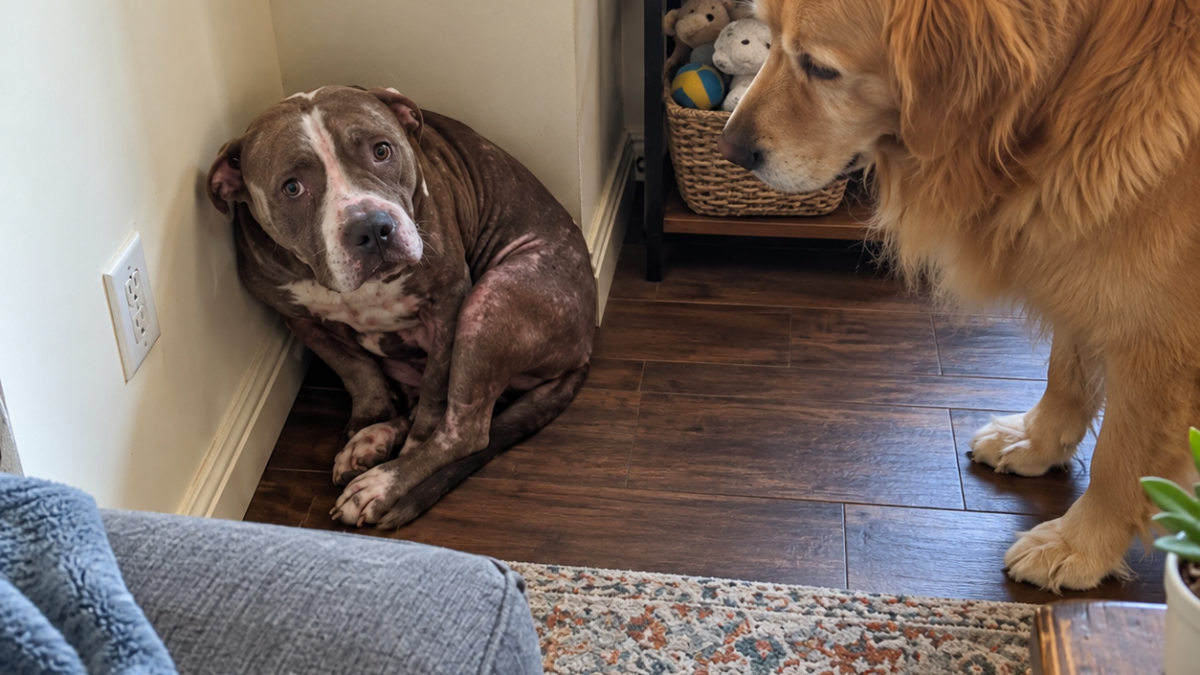
He looked at Jack once.
Then he stopped about six feet away, circled twice on the rug, and lay down.
That was it.
No pressure.
No invitation.
No demand.
He simply stayed.
Rachel and I stood in the kitchen doorway watching.
“Did you teach him that?” I whispered.
She shook her head.
“No.”
Jack’s eyes never left Cooper.
His body was still tense, but something had changed.
Usually, when someone entered the house, Jack would turn his face toward the wall as if making himself smaller could make him invisible.
This time he watched.
For twenty minutes, neither dog moved.
Eventually, Rachel whispered, “Maybe we should leave them alone.”
We went into the kitchen and drank coffee.
Every few minutes, I leaned far enough to see into the living room.
Cooper remained on the rug.
Jack remained against the wall.
It didn’t look like progress.
But for Jack, not retreating was progress.
Around noon, I put out two bowls of food.
Cooper trotted over to his.
Jack stayed where he was.
I expected Cooper to eat immediately.
He didn’t.
He sniffed his bowl, then Jack’s.
Then he sat between them.
“What is he doing?” I asked.
Rachel shrugged.
“I have no idea.”
Jack watched him.
Minutes passed.
Then Jack slowly stood.
His movement was so cautious that I held my breath.
One paw.
Then another.
He crossed the room.
Cooper didn’t move toward him.
Jack stopped beside his bowl.
His eyes flicked toward me.
I froze.
Normally that would have been the moment he turned away.
Instead, Cooper’s tail tapped the floor once.
Jack looked at him.
Then Jack lowered his head.
He took one bite.
I felt Rachel’s fingers close around my wrist.
Neither of us spoke.
Jack chewed.
Then he took another bite.
And another.
I was still standing in the kitchen.
He knew I was there.
And he kept eating.
My eyes burned.
I had spent weeks measuring progress by human standards.
Would he come to me?
Would he let me touch him?
Would he play with the toys I bought?
Would he sleep in the bed I chose?
But Jack had never asked for any of those things.
His first act of trust wasn’t walking toward me.
It was eating while I existed in the same house.
That evening, Cooper went home.
Jack watched the front door after he left.
It was subtle.
His head stayed turned in that direction longer than usual.
I noticed.
The next morning, Rachel called again.
“Same thing,” she said.
“Cooper?”
“Standing at the door.”
I smiled for the first time in days.
“Bring him over.”
That became our routine.
At first, Cooper visited for a few hours.
Then most of the day.
He never forced Jack to interact.
That fascinated me.
Cooper was normally the most social creature I knew. He greeted delivery drivers as though they had returned from war. He tried to befriend squirrels. He carried tennis balls to strangers at the park and dropped them at their feet with complete confidence that every human being had been placed on earth specifically to throw something for him.
But with Jack, he changed.
He seemed to understand that enthusiasm could feel like pressure.
So he waited.
On the third day, Cooper lay closer.
Jack didn’t move away.
On the fourth day, Cooper rolled onto his side and fell asleep.
Jack lowered his head onto his paws.
On the fifth afternoon, I was reading when I heard claws against the hardwood floor.
I looked over the top of my book.
Jack was standing.
Cooper was asleep near the couch.
Jack stared at him.
Then Jack took three careful steps.
He stopped.
I didn’t move.
Three more steps.
Cooper opened one eye.
His tail moved once.
Jack froze.
Cooper closed his eye again.
Jack crossed the remaining distance.
He stood beside Cooper for several seconds.
Then, with the slow uncertainty of an animal entering a world he had never been allowed to know, Jack lowered himself to the floor.
His shoulder touched Cooper’s back.
Jack jerked slightly.
Cooper didn’t react.
A minute passed.
Jack’s head began to sink.
Finally, he rested his chin across Cooper’s side.
I put my book down.
Jack’s eyes closed.
I had seen him sleep before, but never like that.
Normally, even asleep, his muscles stayed tight. His paws twitched. Sudden sounds brought him upright instantly.
Now his breathing slowed.
His jaw relaxed.
His entire body seemed heavier, as though he had finally allowed the floor to hold his weight.
I sat there until my legs went numb.
I was afraid that if I moved, I would break whatever fragile thing had just happened.
Rachel came through the back door an hour later.
I raised one finger to my lips.
She saw them.
Her hand flew to her mouth.
Jack was sleeping with his head on Cooper.
Rachel’s eyes filled immediately.
“Oh,” she whispered.
That single word contained everything.
All the weeks of fear.
All the years we couldn’t know.
All the nights Jack must have slept listening for danger.
And now, for the first time in perhaps his entire life, he was sleeping because another living creature had told him without words:
You don’t have to watch the door.
I’ll stay.
Over the next two weeks, Cooper became Jack’s teacher.
Not a trainer.
Not a therapist.
Not a miracle worker.
A teacher.
He showed Jack how ordinary life worked.
The mail carrier came.
Cooper glanced toward the window and went back to sleep.
Jack watched him.
A garbage truck roared outside.
Jack jumped.
Cooper yawned.
Jack watched him.
I dropped a metal spoon in the kitchen one morning.
Jack bolted halfway across the room.
Cooper looked at the spoon, looked at Jack, then went back to chewing a toy.
Jack stopped running.
Slowly, he returned.
Every time the world made a frightening noise, Cooper seemed to answer the same way.
Nothing is happening.
We’re okay.
You can stay.
Jack believed him before he believed me.
At first, I thought that should hurt.
It didn’t.
I was simply grateful that Jack had found someone whose language he understood.
One evening, about three weeks after Cooper’s first visit, I sat cross-legged on the living room floor.
I had started doing that because standing seemed to make Jack nervous.
I was reading emails on my phone when I felt something warm against my elbow.
I turned my head slowly.
Jack was standing beside me.
Not Cooper.
Jack.
He sniffed my sleeve.
My heart began pounding so hard I was certain he could hear it.
I kept my hand on my knee.
Jack sniffed again.
Then he touched his nose to my wrist.
For weeks, I had wanted to pet him.
In that moment, I understood that touching him because I wanted to would have been about me.
So I waited.
Jack stepped away.
I smiled.
“Okay,” I whispered. “Whenever you’re ready.”
The next evening, he came back.
This time he stayed longer.
Two days later, his nose touched the back of my hand.
Then one afternoon, while Cooper slept nearby, Jack lowered his head beneath my fingers.
For half a second, I didn’t understand what he was doing.
Then I realized.
He was asking.
I stroked the side of his neck once.
Jack flinched.
I stopped.
He remained beside me.
I waited.
After several seconds, he moved his head toward my hand again.
I touched him a second time.
That was how it began.
Not with me hugging him.
Not with him climbing into my lap.
One touch.
A pause.
Another touch.
Trust measured in inches.
Trust measured in seconds.
Trust built so slowly that most people wouldn’t have noticed it happening.
But I noticed everything.
The first time his tail moved when I said his name.
The first time he followed me into the kitchen instead of waiting until I left.
The first time he drank water while I stood nearby.
The first time he chose the rug instead of the corner.
The first time he slept with his back toward the front door.
Then came the tennis ball.
Cooper carried one everywhere.
One Saturday morning, he dropped it near Jack.
Jack looked at it.
Cooper nudged it closer.
Jack stepped away.
Cooper picked it up and ran across the yard.
He returned.
Dropped it again.
This happened several times.
Finally, Jack sniffed the ball.
Cooper froze.
Jack put one paw on it.
Cooper’s entire body began vibrating with excitement, but somehow he restrained himself.
Jack pushed the ball.
It rolled two feet.
Cooper chased it.
Jack stared.
Cooper brought it back.
Jack pushed it again.
Cooper chased it again.
Something changed in Jack’s expression.
I had never seen it before.
Curiosity.
He pushed harder.
The ball rolled across the lawn.
Cooper exploded after it.
And then Jack ran after Cooper.
Rachel screamed.
I laughed so suddenly that it became a sob.
Jack ran.
Not away.
Toward something.
His legs stretched across the grass.
His ears moved in the wind.
Cooper turned in a circle, and Jack followed him.
For thirty seconds, maybe forty, Jack forgot to be afraid.
Then he stopped.
He looked toward us.
Rachel and I stood completely still.
Jack looked at Cooper.
Cooper grabbed the tennis ball and tore across the yard again.
Jack followed.
That afternoon, I sat on my back steps and watched two dogs race through the sunlight.
One of them had spent most of his life learning that another dog’s presence meant danger.
Now another dog was teaching him that it could mean joy.
I thought that would be the emotional climax of Jack’s story.
I was wrong.
About six weeks after I adopted him, the shelter called.
Melissa sounded serious.
“Is Jack doing okay?”
“He’s doing better than okay.”
I told her about Cooper.
About the food.
About the yard.
About the tennis ball.
She was quiet for a moment.
“That’s incredible.”
Then her voice changed.
“There is something else I wanted to ask you.”
I straightened.
“What?”
“The criminal case connected to the property where Jack was found is moving forward.”
I stopped breathing for a second.
I had known there had been an investigation.
I hadn’t asked for details because I wasn’t sure I wanted them.
I wanted Jack’s life to move forward, not backward.
Melissa continued.
“They’ve identified several dogs through veterinary reports and seizure records. Jack is one of them.”
“What does that mean?”
“It means the prosecutor may contact you.”
My hand tightened around the phone.
“For what?”
“Mostly documentation. They may want updated photographs, veterinary information, perhaps a statement about his behavior when he arrived.”
I looked through the glass door.
Jack and Cooper were asleep beside each other on the porch.
The past I had tried to keep outside my home had just knocked.
“Do they know who did this to him?” I asked.
Melissa paused.
“Yes.”
Something cold settled in my chest.
For weeks, I had been so focused on Jack’s recovery that I hadn’t allowed myself to think about the people who had caused the fear I saw every day.
Suddenly, anger rushed into every place where helplessness had been.
“Tell them to call me.”
Two days later, a woman named Assistant District Attorney Elena Ruiz contacted me.
She was careful with her words.
She explained that several people had been charged in connection with an illegal dogfighting operation, animal cruelty, unlawful gambling and related offenses.
I won’t pretend I listened calmly.
I didn’t.
I paced my kitchen while she spoke.
Jack watched from the doorway.
“What happens to them?” I finally asked.
“That depends on the court.”
“Have you seen him?”
“Yes.”
“Then you know what they did.”
“I know what the evidence shows.”
Evidence.
The word sounded too clean.
Evidence didn’t wake at two in the morning because a neighbor slammed a car door.
Evidence didn’t hide when a man wearing work boots walked past the house.
Evidence didn’t refuse to eat while another person stood in the room.
Evidence didn’t carry scars beneath short brown fur.
Jack did.
“What do you need from me?” I asked.
Elena requested permission to obtain his medical and shelter records.
She also asked me to write a detailed statement describing his condition when I brought him home and the changes I had observed.
I agreed.
That evening, I sat at my kitchen table and stared at a blank page.
I thought it would be easy.
It wasn’t.
How do you translate fear into sentences?
How do you describe a dog waiting until you leave before eating without sounding like you’re talking about a small behavioral quirk?
How do you explain what it means when an animal treats kindness as a trap?
I wrote one paragraph.
Deleted it.
Wrote another.
Deleted that too.
Rachel came over.
“You okay?”
“No.”
She sat across from me.
“They want a statement.”
“Then tell them the truth.”
“I don’t know how.”
She looked toward the living room.
Jack was sleeping.
Cooper was beside him.
Rachel said quietly, “Tell them about the first night Cooper stayed.”
I looked at her.
“Tell them Jack couldn’t sleep until another dog showed him he was safe.”
That became my first line.
I wrote for nearly three hours.
I wrote about Jack pressing himself against the wall.
I wrote about his untouched toys.
I wrote about the food bowl.
I wrote about footsteps.
About hands.
About doors.
About how he watched human beings before he watched anything else.
I wrote about Cooper.
I wrote about the first meal.
The first touch.
The first run across the yard.
Then I wrote something I hadn’t understood until that moment.
The people who hurt Jack hadn’t only scarred his body.
They had stolen ordinary things from him.
Sleep.
Play.
Hunger without fear.
Curiosity.
The simple belief that a person walking toward him might be coming to offer affection.
Those things had to be rebuilt one at a time.
I sent the statement the next morning.
Several weeks passed.
Jack continued changing.
He developed habits.
Wonderful, ridiculous, ordinary habits.
He began waiting beside the refrigerator every morning because Cooper had taught him that cheese existed.
He discovered that the couch was softer than the floor.
He learned to scratch the back door when he wanted to go outside.
He became fascinated with sprinklers.
He hated the vacuum cleaner.
He loved scrambled eggs.
He started following me from room to room.
At first, he stayed several feet behind.
Then three feet.
Then one.
One night, I woke up and found him standing beside my bed.
His face was inches from mine.
I nearly screamed.
Jack jumped backward.
“Sorry!” I whispered.
He stared at me.
I patted the edge of the mattress.
“You want up?”
He didn’t.
But the next night he came back.
And the night after that.
On the fourth night, he placed his front paws on the mattress.
I remained still.
Jack climbed onto the bed.
He circled near my feet and lay down.
I didn’t sleep much that night.
Not because he disturbed me.
Because every time I looked down and saw him there, I wanted to cry.
Six years of surviving whatever darkness he had known.
And now he had chosen my bed.
One Saturday morning, I woke with Jack’s head resting against my ankle.
I whispered, “You’re home.”
His tail thumped once beneath the blanket.
The criminal case remained in the background.
I told myself I wasn’t thinking about it.
That wasn’t true.
Sometimes I imagined seeing the defendants.
I imagined asking them whether they remembered Jack.
Whether he had been a name to them or only a number.
Whether they had ever noticed the way his ears folded when he was worried.
Whether they knew he liked cheese.
Whether they knew he slept pressed against another dog’s side.
I wanted them to see what they had almost destroyed.
I wanted them to understand that he had become more than the role they forced him into.
But mostly I wanted them to have no power over him ever again.
Then Elena called.
“There will be a hearing next month.”
My stomach tightened.
“Do I need to attend?”
“You don’t have to.”
I looked at Jack.
He was lying in a patch of sunlight.
Cooper had one paw across his back.
“What happens if I do?”
“You would observe. If the court accepts victim-impact information connected to the animals, your written statement may be considered. I can’t promise how much of it will be discussed.”
I thought about it.
“I want to be there.”
Rachel offered to come with me.
On the morning of the hearing, I almost changed my mind.
I stood in my bedroom staring at myself in the mirror.
My hands were shaking.
Jack entered.
He stopped in the doorway.
By then, he usually came closer.
That morning, something about me made him cautious.
Maybe the shoes.
Maybe the dark jacket.
Maybe simply the tension in my body.
I crouched.
“I’m okay.”
Jack watched.
I realized how absurd those words were.
He had spent months learning that he was safe.
Now I was trying to convince both of us.
I sat on the floor.
Jack walked toward me.
He pressed his nose beneath my palm.
I stroked his head.
“This isn’t revenge,” I whispered.
The word had been living inside me for weeks.
Revenge.
I had imagined anger as something sharp and satisfying.
But kneeling beside Jack, I realized I didn’t actually want to hurt anyone.
I wanted something more difficult.
Accountability.
I wanted a judge to look at the evidence and say that what happened mattered.
I wanted people who treated living creatures like disposable equipment to lose the ability to do it again.
I wanted Jack’s suffering to count for something in a room where decisions were made.
Rachel drove.
The courthouse was smaller than I expected.
So was the courtroom.
Nothing about it felt dramatic.
There were fluorescent lights.
Wooden benches.
Attorneys carrying folders.
People whispering.
Then the defendants entered.
I won’t describe them in detail.
I don’t want them to own space in Jack’s story.
But I remember one thing.
They looked ordinary.
That disturbed me.
Some part of me had expected monsters to look like monsters.
They didn’t.
One of them laughed quietly about something his attorney said.
The sound made my hands curl into fists.
Rachel touched my arm.
“Don’t give them your peace,” she whispered.
The hearing moved through legal language I barely understood.
Dates.
Motions.
Records.
Searches.
Photographs.
Veterinary findings.
Then I heard Jack’s identification number.
Not his name.
A number assigned when officers removed him from the property.
My throat tightened.
The prosecutor referred to photographs documenting old injuries and scarring.
I stared at the table.
I didn’t want to see the pictures.
I had seen enough on the living animal sleeping beside my bed.
At one point, one defense attorney argued that some injuries could not be definitively connected to a single incident.
Elena responded calmly.
She didn’t raise her voice.
She didn’t need to.
She referred to veterinary assessments, property evidence, witness statements and records recovered during the investigation.
The judge listened.
I realized then that justice rarely looks the way movies teach us.
There was no shouting confession.
No dramatic gasp.
No perfect sentence that suddenly fixed everything.
There was documentation.
There were records.
There were people doing slow, careful work.
And there was a dog at home learning to chase tennis balls.
The case continued.
I attended more than once.
Then came the day Elena called and told me that plea agreements had been reached for some defendants while charges remained pending against others.
I had mixed feelings.
Part of me wanted one enormous trial.
One moment when everything would be exposed.
Instead, justice arrived in pieces.
Guilty pleas.
Sentencing recommendations.
Restrictions on animal ownership.
Fines.
Probation conditions.
And for the principal defendant, incarceration connected to multiple offenses.
When Elena explained it, I sat in silence.
“Are you still there?” she asked.
“Yes.”
“I know it may not feel like enough.”
I looked at Jack.
He was standing at the back door with Cooper, waiting to go outside.
“No,” I said. “It doesn’t.”
She was quiet.
Then I added, “But Jack doesn’t need me to spend the rest of his life being angry.”
That surprised me as soon as I said it.
Because it was true.
The most satisfying answer to what had been done to Jack was not watching another person suffer.
It was watching Jack stop suffering.
I opened the door.
He ran outside.
Months earlier, he had moved through my house like every shadow could hide danger.
Now he charged into the yard because Cooper had stolen his tennis ball.
“Get him, Jack!” I yelled.
Jack sprinted.
Cooper turned.
They collided gently, spun through the grass and raced toward the fence.
Rachel appeared on her porch.
“You’re encouraging chaos!”
“I’ve changed!”
She laughed.
So did I.
Jack looked toward the sound.
For one fraction of a second, he froze.
Then he wagged his tail and kept playing.
That became my measure of healing.
Not forgetting.
Returning.
Fear still visited him.
It just stopped deciding where he lived.
Around five months after Jack’s adoption, Cooper began refusing to go home at night.
Rachel would stand at my front door.
“Come on, traitor.”
Cooper would look at her, then at Jack.
Jack would look at Cooper.
Neither moved.
Rachel placed her hands on her hips.
“You know I buy your food, right?”
Cooper wagged.
“You have a perfectly good bed.”
Nothing.
One evening she sighed.
“I think I’ve lost my dog.”
“You live twenty feet away.”
“Emotionally, I’ve lost him.”
I laughed.
Then she became serious.
“He’s happier here.”
I stopped.
“Rachel—”
“I’m not abandoning him. I’m saying maybe his life is here now.”
I couldn’t answer.
Cooper had always belonged to her.
“He still belongs to you.”
“I know.”
She looked through the window.
Jack and Cooper were asleep beside each other.
“But maybe we stop thinking about which house is whose.”
That was how our strange little family formed.
Cooper slept at my house most nights.
Rachel kept his veterinary records and continued paying for half his expenses despite my protests.
I gave her a key.
She gave me one.
Most evenings, we ate dinner together.
Some nights at her house.
Some nights at mine.
The dogs stopped caring which yard they were in.
A gate between our fences stayed open.
Then another unexpected thing happened.
Jack started liking people.
Not everyone.
Not immediately.
But selectively.
Rachel was first.
One afternoon, she sat on my kitchen floor holding a piece of cheese.
Jack approached.
He took it from her fingers.
Rachel looked at me with enormous eyes.
“Did that just happen?”
“Don’t make a big deal.”
“I am absolutely making a big deal.”
Jack backed away.
We both froze.
Rachel lowered her voice.
“Quiet big deal.”
Within weeks, Jack allowed her to touch his shoulder.
Then his neck.
Then his head.
Melissa from the shelter visited.
Jack hid at first.
When she sat with Cooper, Jack eventually entered the room.
She recognized the significance immediately.
“Oh, buddy,” she whispered.
Jack looked at her.
Melissa started crying.
I handed her a tissue.
“You told me he didn’t understand affection.”
She smiled through tears.
“I was wrong.”
“No. You said he didn’t understand what it cost.”
Melissa nodded.
I looked at Jack.
“He knows now.”
As Jack improved, I became curious about trauma-informed dog care.
I read books.
I spoke with trainers experienced with fearful rescue dogs.
I learned about thresholds, triggers and choice.
I learned why forcing affection could make fear worse.
I learned to let Jack decide whether to approach.
I learned that progress wasn’t linear.
Some days he seemed transformed.
Other days, an unfamiliar sound sent him back months.
One afternoon, a contractor arrived to repair my porch.
He carried a metal tool bag.
The moment Jack heard the tools clank, he flattened to the floor.
Then he ran.
I found him behind the couch shaking.
My heart broke all over again.
“It’s okay,” I whispered.
I sat several feet away.
Cooper entered.
He looked at Jack.
Then at me.
Then he squeezed behind the couch.
The space was too small for a Golden Retriever.
He didn’t care.
He wedged half his body beside Jack and stayed.
An hour later, Jack emerged.
That night I cried in the shower.
Not because we had lost progress.
Because I finally understood that healing doesn’t erase memory.
Jack could be happy and still carry fear.
He could be loved and still have bad days.
He could be safe and still need reassurance.
Those things weren’t contradictions.
They were reality.
The following spring marked six months since I adopted him.
I decided not to celebrate the date I brought him home.
Instead, I celebrated the first day he played.
Rachel baked a dog-safe cake.
It leaned badly to one side.
“It looks terrible,” I said.
“The dogs are illiterate.”
“What does literacy have to do with cake?”
“They can’t leave a bad review.”
Cooper ate his piece in three seconds.
Jack approached more carefully.
He sniffed.
Licked the frosting.
Then devoured it.
We sat in the yard afterward.
The sun was low.
Jack lay between us.
My hand rested on his back.
I could feel each breath.
Rachel said, “Do you ever think about that first day?”
“All the time.”
“I thought Cooper failed.”
“So did I.”
She smiled.
“He didn’t.”
“No.”
The truth was, none of us had understood what Cooper was doing.
We saw Jack turning away and assumed rejection.
Cooper saw something else.
Maybe fear.
Maybe exhaustion.
Maybe simply a dog who needed space.
So Cooper came back and did the hardest thing for an enthusiastic Golden Retriever.
Nothing.
He waited.
There was a lesson in that I carried into every part of my life.
Sometimes love isn’t an action.
Sometimes love is restraint.
Sometimes the kindest thing you can do for someone who has spent years having choices taken away is give them choices back.
That summer, the final major criminal case connected to the property reached sentencing.
Elena called again.
“You don’t need to come.”
“I know.”
“Your statement has already been submitted.”
“I know.”
“You’ve done enough.”
I looked outside.
Jack was lying beneath a maple tree.
“I want to finish it.”
Rachel came with me again.
This time I felt different walking into the courthouse.
The anger was still there.
But it no longer controlled my breathing.
When the judge discussed the seriousness of the offenses, I listened.
When restrictions involving future possession of animals were discussed, I listened even more carefully.
When the sentence was imposed, there was no rush of triumph.
I expected one.
Instead, I felt tired.
Deeply tired.
Rachel and I walked outside.
“Well?” she asked.
I stared at the courthouse steps.
“I thought I’d feel better.”
“Do you?”
“I don’t know.”
She waited.
Finally I said, “I think I kept imagining this day as the end of what happened to Jack.”
Rachel nodded.
“But it isn’t,” I continued. “That ended when we started giving him a different life.”
We drove home.
I opened the front door.
Jack came running.
Running.
That word still amazed me.
He came straight toward me, stopped inches away and pushed his head against my waist.
I dropped my purse.
Then I knelt and wrapped one arm gently around him.
Jack leaned into me.
Behind him, Cooper appeared with a stolen kitchen towel.
Rachel pointed.
“Hey!”
Cooper ran.
Jack spun around and chased him.
I started laughing.
There it was.
The ending I had wanted.
Not in court.
In my living room.
Two dogs racing around my couch with a dish towel.
Justice had happened in the courtroom.
But victory was happening here.
One year after Jack came home, he changed again in a way none of us expected.
He started helping other dogs.
Melissa contacted me about a young mixed-breed dog at the shelter named Daisy.
She hadn’t come from Jack’s situation, but she had been badly neglected.
She was terrified of people.
“We’ve tried pairing her with a few calm dogs,” Melissa told me. “I wondered whether Jack might…”
I almost laughed.
“Jack?”
“I know.”
“The dog who used to hide behind my couch?”
“The same dog.”
I looked at him.
Jack was asleep upside down on my sofa with his legs in the air.
“Let me think.”
I talked to the trainer who had been helping us.
We agreed to try a carefully controlled meeting outdoors.
When we arrived at the shelter, Jack hesitated.
The smells affected him.
His tail dropped.
His body tightened.
For a moment, I regretted coming.
Then Cooper stepped beside him.
Jack looked at Cooper.
I watched the familiar exchange happen.
Nothing.
We’re okay.
You can stay.
Jack relaxed.
Daisy entered the fenced area with a handler.
She was smaller than Jack.
Thin.
Nervous.
Her body low.
She avoided all eye contact.
Jack saw her.
He didn’t rush toward her.
He didn’t bark.
He didn’t try to play.
He walked to the far side of the yard.
Then he lay down.
I stared.
Melissa whispered, “He’s doing what Cooper did.”
My eyes filled.
Daisy watched Jack.
Five minutes passed.
Ten.
Fifteen.
Jack remained there.
Eventually, Daisy took a step toward him.
Jack didn’t move.
Another step.
Then another.
By the end of the session, Daisy was lying several feet from Jack.
No dramatic transformation.
No miraculous adoption that afternoon.
Just two frightened animals occupying the same patch of sunlight.
But I knew what that could become.
We brought Jack back three more times.
On the fourth visit, Daisy followed him around the yard.
Two weeks later, she went to a foster home.
Several months after that, she was adopted.
Melissa sent me a photograph.
Daisy was lying on a couch with her head in a man’s lap.
I showed Jack.
He sniffed my phone.
“You did that,” I said.
Of course he hadn’t done it alone.
But he had helped.
The dog who once needed another dog to show him the world was safe had become the dog showing someone else.
That was the moment I understood healing could travel.
Cooper’s patience had changed Jack.
Jack’s presence had helped Daisy.
Daisy would bring something into another home.
Kindness moved forward.
So did cruelty, if nobody stopped it.
But kindness could move forward too.
That became our answer.
Not pretending Jack’s past had never happened.
Building something his past couldn’t control.
Over the next two years, we occasionally helped with carefully selected fearful dogs through the shelter’s foster-support program.
Jack wasn’t suitable for every dog.
No dog is.
But when the match was right, he had an extraordinary calmness.
He never crowded them.
Never demanded attention.
He seemed to remember exactly what pressure felt like.
Sometimes all he did was lie nearby.
I began volunteering too.
The woman who had once been afraid to adopt one dog now spent Saturday mornings washing blankets, filling water bowls and sitting quietly outside kennels.
I didn’t become some fearless expert.
I still worried.
I still made mistakes.
But Jack taught me something important.
You don’t have to know everything before you begin helping.
You have to be willing to learn.
One afternoon, a man stopped outside the kennel of a terrified dog.
He looked at me.
“She doesn’t like people?”
“She’s afraid of people.”
“Same thing.”
“No,” I said. “It isn’t.”
He looked at me.
I thought about Jack.
“Not liking someone is a decision. Fear isn’t.”
The man stayed.
He sat outside the kennel.
Twenty minutes later, the dog looked at him.
That was all.
He came back the next weekend.
Then again.
Two months later, he adopted her.
I attended one community education event with Melissa about rescued animals from cruelty cases.
Jack did not come.
Crowds still made him uncomfortable.
I talked about him instead.
Afterward, a woman approached.
“I don’t think I could adopt a traumatized dog,” she said. “I’d be afraid I couldn’t fix him.”
I knew that sentence.
I had said versions of it for years.
“You don’t fix them,” I told her. “You make room for them to heal.”
I thought of Cooper lying six feet away.
Doing nothing.
Doing everything.
At home, Jack’s world continued growing.
First our street.
Then a quiet park.
Then a walking trail.
He loved the woods.
Open fields made him nervous at first, so we stayed near trees.
Eventually he learned that a rustle in the bushes could mean a squirrel instead of danger.
He became obsessed with squirrels.
Cooper never caught one.
Neither did Jack.
They remained convinced success was imminent.
On Jack’s eighth birthday—or at least the date the shelter used because nobody knew his real one—we drove to a cabin by a lake.
Rachel came.
Cooper came.
I brought too many blankets.
Rachel brought enough food for six people.
“There are two of us.”
“And two dogs.”
“They don’t eat lasagna.”
“Not with that attitude.”
The first night, Jack was unsettled.
New house.
New smells.
Different floor.
He paced.
I worried we had pushed too far.
Then Cooper climbed onto the rug near the fireplace.
Jack circled.
Lay beside him.
Ten minutes later, he was asleep.
The next morning, Jack saw the lake.
He froze at the edge.
Cooper charged directly into the water.
Jack stared at him as though he had lost his mind.
Cooper splashed back.
Jack backed away.
We didn’t force him.
On the second morning, Jack put his paws in.
On the third, he went chest-deep.
Then Cooper shook water directly onto my jeans.
I yelled.
Rachel laughed so hard she had to sit down.
Jack started running in circles.
We all ended up soaked.
That evening, we sat on the porch.
Jack slept at my feet.
I thought about the kennel.
The corner.
The wall against his back.
I had once believed adopting him was the bravest thing I had ever done.
It wasn’t.
Jack trusting me was braver.
He had far more evidence against trusting humans than I ever had against adopting a dog.
And still he tried.
Years passed.
Not dramatically.
Ordinarily.
That became the greatest gift.
Jack grew older.
His muzzle turned gray.
Cooper’s did too.
They still played, although their wrestling matches became shorter.
Jack developed arthritis in one hip.
We added rugs so he wouldn’t slip.
He began sleeping later.
He still followed me into the kitchen whenever cheese was involved.
Some fears disappeared almost completely.
Fireworks remained difficult.
Thunderstorms too.
Every Fourth of July, we prepared the quietest room in the house.
Curtains closed.
Music on.
Cooper beside him.
Me on the floor.
Jack no longer trembled the entire night.
Sometimes he even slept.
The scars remained.
I used to hate them.
Every time my fingers passed over one, I thought about the people responsible.
Eventually, the scars became part of the map of Jack’s life.
They showed where he had been.
They did not tell me where he was going.
When Jack was ten, Cooper became ill.
It happened gradually.
He slowed down.
Then bloodwork showed something was wrong.
More tests followed.
Cancer.
Aggressive.
Rachel cried in my kitchen for nearly an hour.
I cried with her.
Cooper had been the strongest, happiest presence in Jack’s life.
I didn’t know how Jack would survive losing him.
We pursued treatment while Cooper remained comfortable.
Some days were good.
Others weren’t.
Jack stayed close.
When Cooper stopped wanting to play, Jack stopped asking.
When Cooper struggled with stairs, Jack waited beside him.
When Cooper’s appetite faded, Jack lay near his bowl.
It felt as though their first days together were happening in reverse.
Once, Cooper had taught Jack how to live.
Now Jack was teaching Cooper that he wouldn’t have to face the end alone.
One evening, Rachel called me next door.
“It’s time.”
I knew what she meant.
The veterinarian came to the house the next morning.
We placed Cooper’s favorite blanket beneath the maple tree between our yards.
The same tree under which Jack had once slept during his first spring with me.
Rachel lay beside Cooper.
I sat on his other side.
Jack walked around us nervously.
Then he approached Cooper.
He sniffed his face.
Cooper’s tail moved weakly.
Jack lay down.
He put his head across Cooper’s back.
Exactly as he had years before.
I couldn’t breathe.
Rachel saw it too.
“Oh, God,” she whispered.
The first time, Jack had been the frightened dog seeking safety.
Now he was the one giving it.
Cooper died with Rachel’s hand on his chest and Jack’s head against his side.
For a long time afterward, none of us moved.
Jack remained there.
Then he lifted his head.
He sniffed Cooper once.
He looked at me.
There are moments when human language feels useless.
That was one of them.
I touched Jack’s face.
“He loved you,” I whispered.
Jack leaned against me.
The weeks after Cooper’s death were difficult.
Jack searched for him.
At night he stood by Rachel’s door.
Sometimes he waited beside the gate between our yards.
His appetite dropped.
For several days, I was terrified we would lose him emotionally.
But something had changed in Jack over the years.
He grieved.
He did not collapse.
He came to me.
That was new.
When he couldn’t find Cooper, he found me.
One night, he climbed onto my bed and pressed his body against my side.
I wrapped my arm around him.
Years earlier, I had been afraid to touch him without permission.
Now, when thunder came, Jack pushed himself closer.
“I know,” I whispered.
Maybe he was comforting me too.
Rachel spent more time at my house.
Our little family had become three.
The absence was enormous.
But so was the evidence of Cooper everywhere.
Jack eating with someone in the room.
Jack sleeping on a couch.
Jack enjoying the yard.
Jack trusting Rachel.
Jack trusting me.
Cooper was gone.
What he had taught Jack remained.
Several months later, Melissa called.
“I have a strange question.”
“Those are usually expensive.”
She laughed.
“No. Just emotional.”
“That sounds worse.”
“There is an older Golden Retriever mix here.”
I closed my eyes.
“Melissa.”
“I’m not asking you to adopt him.”
“Good.”
“He’s eleven.”
“Melissa.”
“His owner died.”
I was silent.
“He’s confused,” she continued. “Not severely traumatized. Just lost. He stopped interacting after he arrived.”
I knew where this was going.
“You want Jack to meet him.”
“I wondered.”
I looked at Jack asleep beside my chair.
For the first time, I wasn’t sure.
Was that fair?
Would bringing another dog into Jack’s world feel like replacing Cooper?
Rachel and I talked for two days.
Finally she said, “Cooper wasn’t a job Jack had to fill.”
“I know.”
“So don’t ask Jack to replace him.”
“Then what are we doing?”
“Giving two old dogs a chance to decide whether they want company.”
We agreed to one meeting.
The dog’s name was Henry.
He was heavier than Cooper had been, with a white face and slow movements.
When Jack entered the shelter yard, Henry barely looked up.
Jack approached halfway.
Stopped.
Then lay down.
I felt tears immediately.
Rachel whispered, “Here we go again.”
Henry watched him.
Ten minutes passed.
Then Henry stood.
He walked toward Jack.
Jack remained still.
Henry stopped beside him.
Sniffed his shoulder.
Then lay down.
Neither dog touched.
They simply stayed.
I laughed through tears.
“Apparently this is how our family gets dogs now.”
Henry came home as a foster.
Three days became a week.
One week became a month.
At the end of the month, Rachel looked at me.
“We’re keeping him.”
“You don’t know that.”
Henry was asleep upside down on her couch.
“Yes, I do.”
Henry never became Cooper.
That mattered.
He was calmer.
Less ridiculous.
He didn’t care about tennis balls.
He loved car rides.
He hated rain.
Jack and Henry became companions, but differently.
They didn’t wrestle much.
They walked together.
Slept near each other.
Explored the yard slowly.
It was gentler.
Older.
Still beautiful.
Watching Jack with Henry taught me something else.
Love after loss isn’t replacement.
It is expansion.
Cooper had occupied a place nobody else could take.
Henry built a new place beside it.
The same was true for us.
On Jack’s twelfth birthday, I found the original adoption folder while cleaning a cabinet.
Inside was the first photograph I had ever seen of him.
His shelter intake picture.
Back against the wall.
Eyes wide.
Body rigid.
I sat at the kitchen table staring at it.
Jack wandered in.
His walk was slower now.
He placed his chin on my knee.
I held the photograph beside his face.
“You know this guy?”
Jack sneezed.
“Yeah. Me neither.”
Rachel came in.
She saw the picture.
Her expression softened.
“That’s hard to look at.”
I looked down at Jack.
“No.”
She waited.
I smiled.
“Not anymore.”
The photograph no longer felt like an ending.
It was proof of distance traveled.
That year, Elena Ruiz sent me an email.
We hadn’t spoken in a long time.
She had moved into a different role.
She wrote that she still remembered Jack’s case and hoped he was doing well.
I replied with two photographs.
The first was the old shelter picture.
The second was Jack asleep on my bed with his head on my pillow.
Elena answered:
That is why the work matters.
I printed the email.
Not because the people who hurt Jack deserved a final chapter.
Because the people who helped him did.
The officers who removed the dogs.
The shelter staff who cared for them.
The veterinarians.
The prosecutors.
The volunteers.
Rachel.
Cooper.
Every person who had chosen to protect instead of exploit.
Cruelty had been loud in Jack’s early life.
Kindness had been quieter.
But kindness lasted longer.
When Jack reached thirteen, his arthritis worsened.
Walks became shorter.
He still insisted on going.
Some mornings we made it only to the corner.
That was enough.
He stopped climbing onto my bed without help, so I bought a ramp.
He stared at it for three days.
Henry used it immediately.
Jack watched.
I laughed.
“Apparently you still need another dog to demonstrate everything.”
On day four, Jack used the ramp.
Some things never changed.
At night, he slept beside me.
Sometimes I woke and placed my hand on his ribs just to feel them rise.
I knew what was coming eventually.
Every person who loves an animal knows.
We bargain with time anyway.
One more summer.
One more birthday.
One more walk.
One more morning.
Jack gave me all of those.
Then, late one autumn, he stopped eating breakfast.
At first I blamed his stomach.
By dinner, he still wouldn’t eat.
The veterinarian examined him the next day.
Tests followed.
Then more tests.
Cancer.
I remember staring at the veterinarian.
The room seemed to tilt.
“Can we treat it?”
“There are options.”
“Will they cure him?”
Silence.
That was the answer.
We chose comfort.
Medication.
Good food when he wanted it.
Short walks.
Sunlight.
No unnecessary fear.
Jack had spent too much of his life being forced into things.
His final chapter would be about choice.
For several weeks, he remained mostly himself.
He ate chicken.
He slept in the yard.
He followed me slowly into the kitchen.
Rachel visited every day.
Henry lay beside him.
One afternoon, I carried Jack’s old tennis ball outside.
He hadn’t chased one in years.
I rolled it gently across the grass.
Jack watched.
Then he stood.
He walked toward it.
Touched it with his nose.
For one ridiculous second, I saw the six-year-old dog Cooper had taught to play.
I laughed.
Jack picked up the ball.
Only for a moment.
Then he dropped it.
I sat beside him.
“That was enough,” I said.
His tail moved.
A week later, I knew.
Jack couldn’t get comfortable.
He looked tired in a way sleep wouldn’t fix.
I called the veterinarian.
Then I called Rachel.
She didn’t ask questions.
“I’ll come over.”
We chose the maple tree.
The same tree.
Life has strange circles.
Henry lay several feet away.
Rachel sat beside me.
Jack rested on his favorite blanket.
I had expected panic.
Instead, I felt something almost peaceful beneath the grief.
Jack was not afraid.
That mattered more than anything.
I stroked his head.
His eyes remained on me.
“You did so good,” I whispered.
My voice broke.
“I need you to know that.”
Jack breathed slowly.
“You don’t have to be scared anymore.”
Rachel began crying.
I touched the scar along Jack’s shoulder.
The one I had noticed during our first meeting.
For years, that scar had represented everything someone had done to him.
Now my hand moved over it without anger.
“You were loved,” I told him. “Do you hear me? You were so loved.”
Jack’s tail tapped the blanket once.
The veterinarian gave the medication.
I kept my face close to his.
Jack’s eyes grew heavy.
Then, for one final moment, he pushed his nose into my palm.
The same hand he had once been too frightened to approach.
I closed my fingers gently around his muzzle.
“I’m here.”
Jack exhaled.
And he was gone.
For a long time, I remained beneath that tree.
Rachel’s arm was around me.
Henry stayed nearby.
The yard felt impossibly quiet.
I thought about the first version of Jack I had known.
The dog pressed against the shelter wall.
The dog who wouldn’t eat if I was home.
The dog who thought footsteps meant danger.
If someone had shown me that day how his story would end, I would have cried.
But not only because he died.
Because of everything that happened first.
He slept on a bed.
He ate cheese.
He chased squirrels.
He ran through sprinklers.
He traveled to a lake.
He helped other frightened dogs.
He loved Cooper.
He comforted Cooper.
He trusted Rachel.
He trusted me.
He learned that a door opening could mean someone he loved was coming home.
He learned that a raised hand could hold a treat.
He learned that another dog could be a friend.
He learned that sleep could be safe.
Most important, he learned that he belonged somewhere.
Months later, the shelter asked whether they could place a photograph of Jack in their lobby.
I chose one from the backyard.
Not the intake picture.
In the photograph, Jack was running beside Cooper.
Both dogs were mid-stride.
Cooper’s mouth was open.
Jack’s ears were flying backward.
Sunlight covered the grass.
There were no visible walls.
No corners.
No chains.
No fear.
Beneath the photograph, they placed only his name.
JACK.
Nothing else was necessary.
People sometimes ask me whether adopting him was difficult.
Yes.
It was.
There were nights I wondered whether I was doing everything wrong.
There were weeks when progress was almost invisible.
There were setbacks.
There were tears.
There were medical bills.
There were destroyed pillows once Jack discovered pillows could be destroyed.
There was a memorable incident involving an entire rotisserie chicken.
I would do all of it again.
Every second.
People also tell me I saved Jack.
I understand what they mean.
But the sentence has never felt completely accurate.
I signed papers.
I opened a door.
I provided food and shelter.
Cooper taught him trust.
Rachel gave us patience.
The shelter gave him a chance.
Jack did the hardest part himself.
He chose, over and over again, to believe that his future might be different from his past.
And somewhere along the way, he changed me too.
At forty-four, I had believed fear was a reason not to begin.
Jack taught me fear could come along for the journey.
You could be uncertain and still step forward.
You could be scarred and still love.
You could lose something and still open your heart again.
You could remember pain without allowing pain to own every tomorrow.
The people who hurt Jack once had control over nearly every part of his existence.
They decided when he ate.
Where he slept.
When he was afraid.
What another dog’s presence meant.
For years, I wanted some dramatic form of revenge for that.
Eventually I understood the most complete answer had already happened.
They had tried to teach Jack that the world contained nothing except fear.
They failed.
They tried to make him believe other dogs were enemies.
They failed.
They taught him human beings could not be trusted.
In the end, they failed at that too.
Jack died with a human hand resting against his face.
He died under a tree in the yard he considered his own.
He died having known friendship.
Home.
Safety.
Play.
Choice.
Love.
The people responsible for his suffering faced the justice the legal system could impose.
But their greatest defeat was something no courtroom could create.
Jack became happy.
He became gentle without being forced.
He became trusting without forgetting.
He became the kind of dog who could lie beside another frightened animal and silently say what Cooper had once said to him:
You don’t have to be afraid here.
Years have passed since that Saturday when I walked into a shelter intending to leave only a donation.
I still volunteer there.
Sometimes I pass a kennel and see a dog sitting far in the back.
No barking.
No tail wagging.
No effort to come closer.
And I recognize the look.
People occasionally walk by those dogs because they think the animal isn’t interested.
I know better now.
Sometimes the quietest dog in the building is carrying the loudest story.
Sometimes the one who turns away is not rejecting you.
Sometimes he’s asking whether you are capable of staying without demanding anything in return.
When that happens, I sit down.
I don’t reach through the bars.
I don’t call repeatedly.
I don’t promise that everything will be perfect.
I simply stay for a while.
Because once, a Golden Retriever named Cooper walked into my living room and showed me that love doesn’t always arrive with dramatic gestures.
Sometimes love lies down six feet away.
Sometimes it waits beside a food bowl.
Sometimes it returns the next morning.
Sometimes it stays long enough for fear to become curiosity.
Curiosity to become trust.
Trust to become friendship.
And friendship to become a life.
Jack spent his first six years surviving.
But that isn’t the part of his story I remember most.
I remember him running.
I remember his ears flying backward as he chased Cooper across my yard.
I remember the first time he ate while I remained in the room.
I remember the weight of his head beneath my hand.
I remember waking up and finding him asleep at my feet.
I remember watching him lie quietly beside Daisy and realizing he had become someone else’s safe place.
I remember him beside Cooper at the end.
I remember his nose pressing into my palm during his own final moments.
And whenever someone tells me that a badly traumatized animal is “broken,” I think about Jack.
He was never broken.
He was afraid.
There is a difference.
Broken things are discarded.
Fearful living beings can heal when they are given safety, patience, choice and time.
Jack proved that to me every day he lived in my home.
I once believed I adopted a dog because I couldn’t bear to leave him behind.
Years later, I understood something deeper.
That frightened pit bull in the corner of the shelter had been waiting for someone to show him that his past was over.
I thought I would be that person.
I wasn’t.
Not at first.
A joyful Golden Retriever walked into my house, looked at a terrified dog who wanted nothing from him, and somehow understood exactly what Jack needed.
No pressure.
No demands.
No fear.
Just presence.
Then Jack taught me the same lesson.
And I have carried it ever since.
Love does not always rescue by pulling someone out of darkness.
Sometimes it sits quietly at the edge of that darkness and waits until they are ready to walk out on their own.
Jack eventually walked out.
Then he ran.
And for the rest of his life, nobody ever forced him back into a corner again.








