PART 2: He Spent His Whole Puppyhood Hidden in a Basement—Then a Plumber Found the Secret His Owner Tried to Throw Away
PART 2
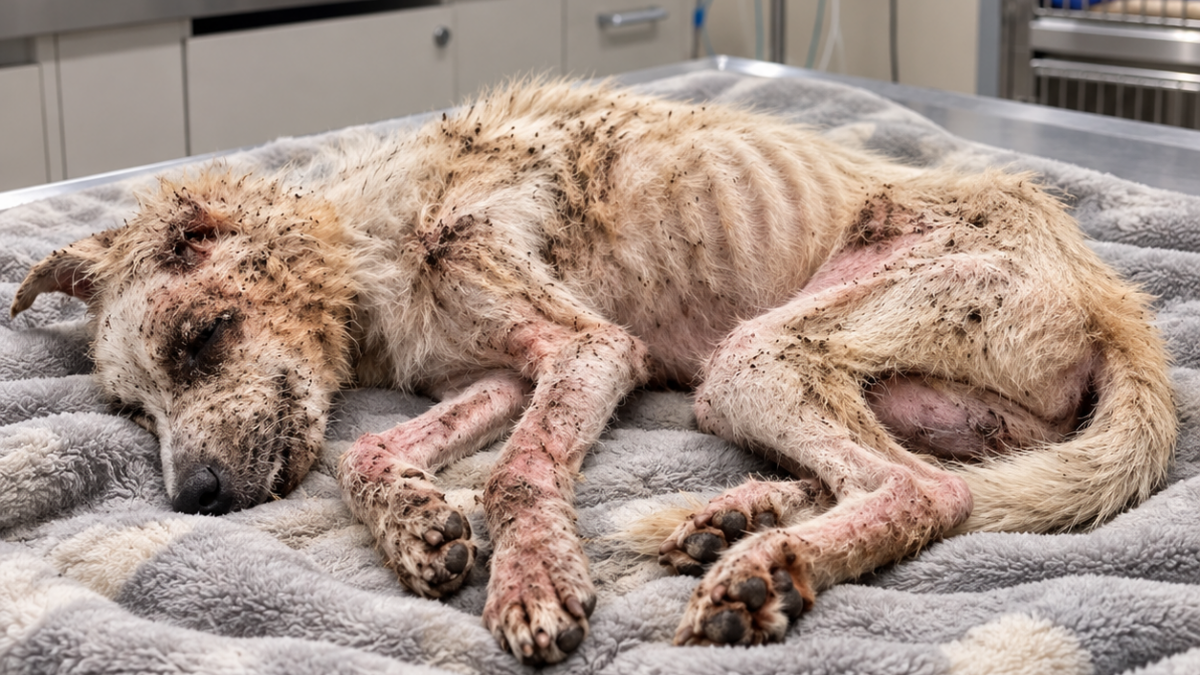
His tail moved.
Only once.
A tiny sweep against the blanket.
But I saw it.
The technician beside me saw it too.
“Did he just—”
“Yes.”
I crouched beside the kennel.
“Angelito?”
We had not officially named him yet.
At that point, everyone was still calling him “the basement puppy” or “the landfill puppy,” descriptions I hated because they reduced him to the worst things that had happened to him.
Still, I whispered softly.
“Hey, little man.”
His eyes followed my hand.
I touched the stuffed toy.
The tail moved again.
Two weak taps.
I laughed before I realized I was crying.
The technician smiled.
“That’s new.”
“It is.”
Angelito tried to lift his head higher.
His neck trembled.
I wanted to help him.
Instead, I waited.
He managed it.
Only for a few seconds.
Then his head sank back onto the blanket.
But those seconds felt enormous.
The day before, we had wondered whether his body could keep itself alive.
Now he was trying to investigate a toy.
That was the beginning.
Not the dramatic beginning people like to imagine.
There was no sudden recovery.
No moment when Angelito stood up and everything became easy.
His body had been neglected for too long.
Healing would come in pieces.
And some days those pieces were almost too small to see.
The veterinarians believed he had spent much of his early life without adequate nutrition.
His muscles were wasted.
His immune system was weak.
His skin infections were severe.
One eye needed close treatment.
His wounds had to be cleaned and dressed repeatedly.
Even after his temperature stabilized, his body remained fragile.
The first thing we celebrated was appetite.
At first, Angelito could only manage carefully controlled portions.
His system had been deprived for so long that feeding him too aggressively could create new problems.
So meals were small.
Measured.
Frequent.
The first time he finished a bowl, I took a picture.
One of the veterinary assistants looked at me.
“You realize that’s just an empty bowl.”
“No.”
I showed her the photograph.
“That is evidence.”
“Evidence of what?”
“That he ate everything.”
She smiled.
“I stand corrected.”
Every meal became evidence.
Every normal temperature reading became evidence.
Every dressing change that revealed cleaner skin became evidence.
Every hour without collapse became evidence.
That was how we survived the first week with him.
By collecting proof that today was slightly better than yesterday.
The police investigation continued in the background.
The plumber had given a statement.
He described entering the basement for a repair and hearing a faint scratching noise behind stored boxes.
At first, he thought it was a rat.
Then he moved the boxes.
He found a puppy.
According to his statement, the room had almost no natural light.
There was no proper dog bed.
No visible supply of food.
The puppy was already extremely thin.
The plumber later told me that Angelito tried to crawl toward him but could not stand.
That image stayed in my mind.
A stranger opening a door.
Light entering.
A puppy who had barely known people trying to move toward it.
The plumber had taken photographs before leaving.
Thank God he had.
Those photographs became important.
Because by the time authorities went to the house, Angelito was gone.
The owner initially claimed the dog had run away.
The plumber knew that was impossible.
“A dog like that couldn’t run anywhere,” he said.
He was right.
When officers pressed further, the story changed.
Then changed again.
Eventually information led us to the landfill.
I tried not to think about what would have happened if no one had found him.
Landfills are enormous.
Vehicles move constantly.
Trash shifts.
Temperatures change.
A puppy too weak to lift his head does not survive long there.
The person who dumped Angelito had not simply abandoned him.
They had left him somewhere disappearance was almost guaranteed.
That knowledge made me angry in a way I struggled to explain.
But each time anger rose, I looked at Angelito.
He did not need my rage.
He needed my patience.
So we focused on healing.
Day three brought another scare.
Angelito refused breakfast.
The previous evening he had eaten well enough that we had allowed ourselves a little optimism.
Then the bowl sat untouched.
I opened the isolation-room door wearing protective clothing.
“Hey.”
Angelito did not lift his head.
My heart dropped.
A nurse checked his temperature.
Normal.
His gums.
Better than before.
Vitals.
Stable.
The veterinarian examined him.
“No obvious crisis.”
“Then why won’t he eat?”
“He’s tired.”
“He ate yesterday.”
“He’s recovering from profound malnutrition and infection. Energy will fluctuate.”
I hated that answer.
I had learned from other rescues that healing rarely moves in a straight line.
But knowledge does not remove fear.
I sat outside the kennel.
Angelito’s toy rested against his chest.
“Listen,” I told him. “I need you to make this easier on me.”
His eyes opened.
“That means eating.”
He stared.
“Very reasonable request.”
Nothing.
I moved the bowl closer.
Still nothing.
Then I dipped one finger in the soft food and held it near his nose.
Angelito sniffed.
Licked.
I offered a little more.
Another lick.
Ten minutes later, he had eaten several small bites.
The staff continued from there.
By afternoon, he finished a partial meal.
That evening, I received a photograph.
Angelito was asleep with one paw resting on the toy.
I stared at that picture for a long time.
When I arrived on day four, the toy was wet.
“What happened?”
The technician laughed.
“He chewed it.”
“He did?”
“A little.”
I picked it up.
One corner had clearly been mouthed.
It was almost nothing.
To me it was rebellion.
Angelito had discovered that something could belong to him and be used for fun.
I washed the toy.
Dried it.
Returned it.
He watched me place it beside him.
“You’re allowed to destroy this.”
His tail moved.
“Seriously. That’s what it’s for.”
If I had understood then how many toys he would eventually destroy, I might have chosen my words more carefully.
Day five was better.
Angelito sat upright with assistance.
Not for long.
His front legs shook.
His back remained curved.
But his head stayed up.
He looked around the isolation room as if he had suddenly realized the world extended beyond the blanket directly in front of him.
I sat several feet away.
He stared at my shoes.
Then my hands.
Then my face.
“Hi.”
His ears twitched.
The right eye was still healing.
The swelling had reduced.
For the first time, I could see more of the expression beneath the pain.
He was young.
That sounds obvious.
He was a puppy.
But severe neglect ages an animal’s face.
Fear ages them.
Hunger does too.
As the infection eased, I began seeing glimpses of what Angelito might have looked like if his life had started differently.
Curious.
Soft.
Almost mischievous.
On day six, he licked my hand.
On day seven, he wagged his tail when I entered the room carrying the toy.
Not once.
Repeatedly.
His entire back end shifted.
I stopped in the doorway.
The technician laughed.
“He knows you.”
I knelt.
“Do you?”
Angelito’s tail moved faster.
I held up the toy.
He stretched his neck forward.
“You know this too, apparently.”
I placed it down.
He mouthed one ear.
I felt something inside me loosen.
The first week had been about keeping him alive.
For the first time, I allowed myself to imagine something beyond survival.
A yard.
Grass.
Sunlight.
Another dog.
A home.
Not a hospital kennel.
Not bandages.
A normal life.
But first, he had to stand.
That remained difficult.
His muscle loss was severe.
The medical team began gentle rehabilitation as soon as it was safe.
At first, that meant supporting his weight.
We used a towel beneath his abdomen.
Angelito’s feet touched the floor.
His legs shook.
He looked down.
Confused.
“Easy,” I whispered.
He tried.
One front paw moved.
Then another.
His back legs barely followed.
We supported most of his weight.
After several seconds, he sagged.
“That’s enough.”
I lifted him.
His breathing was fast.
I carried him back to the kennel.
He rested against my chest.
The puppy who had spent months hidden away was now experiencing something completely ordinary.
Being held gently.
I wondered whether he understood the difference.
Probably not in words.
But animals understand patterns.
Hands that hurt.
Hands that feed.
Doors that trap.
Doors that lead outside.
Voices that frighten.
Voices that reassure.
Angelito was beginning to learn new patterns.
On day eight, police contacted the rescue again.
The owner had been formally questioned.
The photographs from the plumber, veterinary reports and evidence surrounding Angelito’s disappearance were being reviewed.
I wanted immediate consequences.
That is another uncomfortable truth about rescue.
You can spend twenty-four hours watching a dog nearly die and then discover that legal processes move at a pace that feels unbearable.
Statements.
Reports.
Evidence.
Interviews.
Timelines.
No dramatic handcuffs the moment anger demands them.
I called the officer assigned to the case.
“Is something actually going to happen?”
“I can’t promise an outcome.”
“He almost died.”
“I understand.”
“He was dumped after being reported.”
“We’re documenting everything.”
I closed my eyes.
That phrase sounded cold.
Then the officer continued.
“The medical report matters. The plumber’s photographs matter. The landfill location matters. We need it done correctly.”
That stopped me.
Correctly.
Not quickly.
Correctly.
Because anger could not replace evidence.
If we wanted accountability that would hold, the case had to be built carefully.
I understood.
I still hated waiting.
When I returned to Angelito’s kennel, he was chewing his toy.
I sat beside him.
“You know what?”
He looked at me.
“You don’t need to worry about any of that.”
He bit harder.
“We will.”
That became the closest thing to revenge I wanted for him.
Not cruelty returned with cruelty.
Accountability.
A record.
A consequence strong enough to say that what happened to him mattered.
Angelito deserved justice.
But he also deserved something more important.
A future that did not revolve around the person who hurt him.
So we made a rule among ourselves.
We could talk about the investigation outside the isolation room.
Inside, Angelito’s life would be about Angelito.
Food.
Medicine.
Toys.
Rehabilitation.
Kindness.
Day nine, he stood with less support.
Day ten, he held himself upright for several seconds.
Day eleven changed everything.
I entered the hospital in the morning.
One of the technicians met me in the hallway.
“Don’t go in yet.”
My stomach dropped.
“What happened?”
She smiled.
“Nothing bad.”
“Then why are you stopping me?”
“Because I want you to see this.”
She opened the isolation-room door slowly.
Angelito was inside.
Sitting.
By himself.
No towel.
No hand supporting his chest.
Sitting.
His back was slightly hunched.
His legs were awkwardly positioned.
But he was upright.
I covered my mouth.
“Oh my God.”
Angelito saw me.
His mouth opened.
For a second, it looked like a smile.
Then his tail began thumping.
I crouched several feet away.
“You did that?”
He leaned forward.
Almost lost his balance.
Corrected.
The technician whispered, “He’s been doing it for about a minute.”
“A minute?”
“Maybe longer.”
I sat on the floor.
Angelito remained upright.
One minute became two.
Then he tired and lowered himself onto the blanket.
I applauded.
The technician joined me.
Angelito looked at us as if we were insane.
I laughed.
That was the morning we finally settled on his name.
We had discussed several.
Nothing felt right.
Someone suggested Angelito.
“Little angel.”
I looked at him.
The name stuck instantly.
“Angelito.”
His ears moved.
“That’s you.”
Rachel, who had begun visiting when she could, smiled.
“Angelito.”
He wagged.
Maybe he responded to tone.
Maybe coincidence.
We decided it counted.
From then on, every medical note carried a name instead of a description.
Not basement puppy.
Not landfill puppy.
Angelito.
His own identity.
Something that belonged to him.
On day twelve, he stood for several seconds without assistance.
Day thirteen, he took two steps.
They were ugly steps.
His rear legs spread.
His body swayed.
He almost fell.
I loved them anyway.
Day fourteen, three steps.
Day fifteen, five.
Then he had a difficult afternoon and managed only two.
I tried not to panic.
The veterinarian reminded me again.
“Progress fluctuates.”
“I know.”
“You’re making the face.”
“What face?”
“The face people make when they know something and refuse to believe it.”
I looked at Angelito.
He was asleep with the toy under his chin.
“I just want him to keep moving forward.”
“He is.”
“How do you know?”
“Because two weeks ago we were trying to keep him warm enough to survive the night.”
That put everything back in perspective.
On day seventeen, one of the veterinary assistants called me closer during a dressing change.
“Look.”
She pointed near Angelito’s shoulder.
At first I saw nothing.
Then I saw it.
Tiny hairs.
New growth.
Soft.
Barely visible.
His skin was healing.
Hair was beginning to return where infection and neglect had left large damaged patches.
I touched the air above it without making contact.
“That’s new.”
“Yes.”
I looked at his right eye.
The infection there had improved dramatically too.
His face looked different.
Less swollen.
More balanced.
You could finally see both eyes clearly.
Angelito looked back.
For the first time, his expression did not immediately make me think of suffering.
He looked annoyed because we were delaying breakfast.
That delighted me.
The medical staff gradually reduced the isolation precautions as infection risks changed.
Soon we began planning something we had been waiting for.
Outside.
Real outside.
Angelito had spent almost all of his remembered life in darkness.
Then hospital rooms.
Controlled spaces.
Artificial light.
He had never had what other puppies took for granted.
Sun.
Grass.
Wind.
I worried the experience might overwhelm him.
The first outing was short.
We carried him through the rear door.
When sunlight touched his face, Angelito froze.
Not from fear exactly.
From sensation.
His nose lifted.
His eyes narrowed.
He sniffed.
Wind moved across his healing coat.
I lowered him onto the grass.
His paws touched the ground.
He stood.
Shaky.
But standing.
For several seconds, he did nothing.
Then his head turned toward a moving leaf.
It rolled across the yard.
Angelito followed it with his eyes.
The leaf stopped.
He took a step.
Then another.
No one spoke.
He reached the leaf.
Sniffed.
Sneezed.
I laughed.
Angelito looked at me.
Then at the sky.
I remember that moment more clearly than almost anything else.
The puppy raised in darkness looking upward.
There was no dramatic music.
No crowd.
Only three people standing in a small backyard while a recovering dog experienced sunlight.
But it felt enormous.
He sat.
Closed his eyes briefly.
Sun warmed his face.
I turned away because I was crying again.
Rachel put a hand on my shoulder.
“Look at him.”
“I am.”
“No.”
She smiled.
“Really look.”
I did.
Angelito was not hiding.
Not curled against concrete.
Not lying among garbage.
He was sitting in grass beneath an open sky.
The contrast was almost unbearable.
That first outing lasted only a few minutes.
When we carried him inside, he fell asleep immediately.
The next morning, he went to the door.
Not far.
Just enough that we noticed.
The technician laughed.
“He wants outside.”
Of course he did.
Angelito had discovered the sun.
After that, rehabilitation accelerated.
Not magically.
But motivation changed.
Inside, walking had been work.
Outside, walking led somewhere interesting.
A smell.
A leaf.
A bird.
A patch of dirt.
He wanted to explore.
The muscles followed desire.
We supported him less.
Then not at all.
His gait remained awkward.
But stronger.
Meals increased appropriately.
Weight followed.
His ribs became less severe.
His hips disappeared beneath returning muscle.
His skin continued healing.
Hair spread across the bare patches.
Community members had begun hearing about him.
Some learned through rescue updates.
Others heard from veterinary staff or local animal advocates.
People started sending things.
Blankets.
Food.
Toys.
So many toys.
The first package contained three stuffed animals and a rubber ball.
I placed them around Angelito.
He stared.
Rachel laughed.
“You overwhelmed him.”
“I thought he’d be happy.”
“He had one toy. Now he has inventory.”
Angelito sniffed each item.
Chose the smallest stuffed animal.
Carried it clumsily to his bed.
The next morning, it had a hole in the side.
Stuffing everywhere.
I stared.
“You destroyed a gift.”
Angelito wagged.
Rachel leaned against the door.
“You did tell him toys were for destroying.”
“That was one toy.”
“Instructions unclear.”
I cleaned the stuffing.
Angelito stole a piece.
“No.”
He ran three steps away.
Ran.
I froze.
He froze too, stuffing hanging from his mouth.
Rachel pointed.
“He ran.”
“I saw.”
Angelito took another quick step.
I reached toward him.
He dodged.
Not well.
But deliberately.
I laughed.
“You little criminal.”
The dog who once could not lift his head was now stealing stuffing and evading capture.
That felt like justice.
Angelito’s appetite became legendary.
Because of his history, we watched his feeding carefully.
He ate every meal as though someone might take the bowl away.
Fast.
Urgent.
At first, that broke my heart.
Then his behavior slowly changed.
We fed him on schedule.
Every day.
Same times.
Same routine.
Food arrived.
Then arrived again.
Then again.
Eventually, something shifted.
He began eating more slowly.
One afternoon, I noticed him leave a few bites in the bowl.
I panicked.
“Why didn’t he finish?”
Rachel looked.
“He’s fine.”
“He always finishes.”
“He’s probably full.”
The word stopped me.
Full.
Not sick.
Not refusing food.
Full.
Angelito had reached a point where his body trusted another meal would come.
He could walk away.
That small act meant more than an empty bowl ever had.
Food was no longer an emergency.
Life was becoming predictable.
That is one of the things people underestimate about neglected animals.
Safety is not only the absence of pain.
Safety is expectation.
Breakfast comes.
Water remains.
Doors open.
People return.
Beds stay.
Hands are gentle.
Darkness ends in morning.
Angelito had never been given those expectations.
Now we were teaching them.
At night, staff checked him.
At first, darkness made him restless.
The moment lights dimmed, he sometimes lifted his head and watched the doorway.
We wondered whether nighttime reminded him of the basement.
We could not know.
So for several nights, we left a small light on nearby.
One evening, I sat with him later than usual.
He lay on his bed.
Toy between his paws.
His eyes grew heavy.
I whispered, “You can sleep.”
He blinked.
“I’ll be here tomorrow.”
His eyes closed.
That sentence felt important.
Tomorrow.
Something Angelito had never been able to rely on.
I would be here tomorrow.
Food would be here tomorrow.
People would be here tomorrow.
Sunlight would still exist tomorrow.
Eventually, darkness stopped making him alert.
He slept.
Deeply.
Legs stretched.
Sometimes upside down.
The first time I saw him sleeping on his back with his belly exposed, I stopped in the doorway.
Animals do not make themselves vulnerable when they expect danger.
Angelito’s body was learning what his mind might not yet understand.
This place was safe.
Around the third week, we introduced him to another dog.
Her name was Sofia.
Adult female.
Calm.
Gentle.
Excellent with puppies.
The first meeting happened through a barrier.
Angelito saw her.
Froze.
Sofia sniffed.
Angelito’s tail moved cautiously.
We watched closely.
The basement had isolated him during critical developmental weeks.
We did not know how well he understood canine social behavior.
Sofia approached.
Angelito backed up.
She stopped.
He moved forward.
She remained still.
Their noses touched through the barrier.
Angelito jumped backward.
Then returned.
His tail moved faster.
Sofia sneezed.
Angelito sneezed back.
Rachel smiled.
“That’s going well.”
The next meeting happened without the barrier.
Angelito approached sideways.
Sofia sniffed him.
He crouched.
Then something happened that made me laugh.
He tried to play.
It was clumsy.
Front legs down.
Rear up.
One paw slipping.
But unmistakable.
Sofia responded.
She bounced once.
Angelito exploded.
He ran in a half circle.
Almost fell.
Recovered.
Ran again.
I stood with both hands over my mouth.
He was not just learning to walk anymore.
He was learning to be a puppy.
Over the next several days, Sofia became his teacher.
She corrected him when he became too rough.
Invited him to chase.
Waited when he tired.
Angelito adored her.
The first time she left after a play session, he sat by the door.
“You’ll see her again.”
He stared.
“I promise.”
Another promise about tomorrow.
That afternoon, the police officer called.
There had been movement in the case.
The investigation had gathered enough evidence for formal animal-cruelty charges to proceed.
I sat down.
“You’re sure?”
“Yes.”
“What about dumping him?”
“That conduct is part of what investigators documented.”
I closed my eyes.
Relief came first.
Then anger.
Then something quieter.
“He survived.”
“I heard.”
“He’s walking now.”
“That’s good.”
“He has hair coming back.”
The officer paused.
“You sound proud.”
“I am.”
He continued explaining the next legal steps.
Court dates.
Evidence.
Possible testimony.
Nothing was final.
I understood that.
But for the first time, the person responsible would have to answer publicly.
Not to me.
Not to social media.
To the legal system.
The plumber’s decision to speak up had started it.
The photographs made denial harder.
The veterinary records documented Angelito’s condition.
The timeline mattered.
Every detail we had carefully preserved mattered.
I told the officer, “I want to help however I can.”
“We may need records or a statement.”
“You’ll have them.”
After the call, I walked outside.
Angelito was chasing Sofia.
He had no idea anything had changed.
Good.
I wanted the case to matter.
But I did not want his life to become permanently attached to the defendant.
Justice should close a door.
Angelito deserved to walk through another one.
By day twenty-five, he had gained noticeable weight.
People who had not seen him for a week were stunned.
One volunteer walked into the yard.
“That’s him?”
“Yes.”
“No.”
“Yes.”
“He looks completely different.”
Not completely.
I could still see the sharpness.
The healing skin.
The slight weakness after long activity.
But the transformation had begun.
His face was fuller.
Eyes brighter.
Tail constantly moving.
He had developed a habit of carrying toys to visitors.
Not giving them away.
Just showing them.
He would approach with a stuffed animal.
Stand close.
Let you admire it.
Then move away if you tried to take it.
“You know sharing?” I asked once.
He wagged.
“No?”
He turned his head.
“Apparently not.”
Rachel laughed.
“He spent months with nothing. Let him be selfish.”
She had a point.
The town began falling in love with him.
Packages arrived with his name.
ANGELITO.
The first time I saw it written on a cardboard box, I smiled.
Someone who had never met him knew his name.
That mattered.
A woman sent a blue blanket.
A school group sent handmade cards, though we did not place the paper where Angelito could eat it.
Someone donated medical costs.
Another person brought a basket of toys.
An older man appeared at the rescue carrying a bag.
“My wife saw his story.”
Inside was a thick dog bed.
“She said no dog should sleep on concrete again.”
I swallowed.
“Tell her thank you.”
“She’s in the car.”
“Why didn’t she come in?”
He smiled.
“She’s crying.”
I walked outside.
His wife rolled down the window.
“I’m sorry.”
“For what?”
“I’m emotional.”
“You’re allowed.”
She wiped her face.
“Is he really doing better?”
“Yes.”
“Does he know people love him?”
That question stopped me.
“I think he’s learning.”
She nodded.
“Good.”
People often asked whether Angelito understood what had happened to him.
I did not know.
Dogs do not narrate trauma the way humans do.
They carry experience through behavior.
Angelito startled at sudden noises.
He disliked closed, unlit rooms.
He guarded food briefly in the beginning.
He watched doors.
But he also learned.
Quickly.
A person entering did not always mean harm.
A closed door could reopen.
A hand near his bowl did not necessarily take food away.
Darkness could happen in a warm room.
A toy could remain his overnight.
Trust did not arrive all at once.
It accumulated.
Day by day.
Day thirty brought his first real sprint.
We were in the backyard.
Sofia had a rubber ball.
Angelito wanted it.
Sofia ran.
Angelito followed.
At first, a trot.
Then faster.
His stride lengthened.
Back legs pushed.
For five seconds, he moved like a normal healthy puppy.
No visible hesitation.
No wobble.
Just speed.
He caught Sofia near the fence.
She turned.
He turned too sharply.
Rolled.
I gasped.
Angelito popped up immediately.
Then chased again.
Rachel grabbed my arm.
“Did you see that?”
“Yes.”
“He didn’t even think about falling.”
That was it.
Angelito had stopped treating movement as something fragile.
His body belonged to him now.
That afternoon, he slept for three hours.
I sat beside him.
His chest rose and fell steadily.
The fur around his shoulders had thickened.
The scars would remain in some areas.
But new hair covered more skin every week.
I touched one of the healed patches.
“You’re getting handsome.”
Angelito opened one eye.
“You know that?”
His tail thumped without the rest of his body moving.
“Arrogant already.”
Day thirty-two brought our first serious adoption inquiry.
I was not ready.
No one ever is.
The application came from a woman named Maria who lived about twenty minutes away.
She had followed Angelito’s recovery from early on.
No current dog.
Fenced yard.
Stable home.
Excellent veterinary references from pets she had owned previously.
She worked partly from home.
Her sister lived nearby.
Everything looked good.
I found reasons to worry anyway.
Rachel watched me read the application for the fourth time.
“What’s wrong with her?”
“I’m checking.”
“You’ve been checking for forty minutes.”
“She doesn’t currently have a dog.”
“That is not a problem.”
“Angelito likes Sofia.”
“So?”
“He could benefit from a canine companion.”
“Or individual attention.”
I frowned.
“She has stairs.”
“She wrote that she’ll install a gate until he’s stronger.”
I scrolled.
“She has hardwood floors.”
“She wrote she’ll put runners down.”
I looked at Rachel.
“Why are you defending someone you’ve never met?”
“Because you’re trying to invent a felony.”
“I am evaluating.”
“You’re attached.”
“I am responsible.”
“You can be both.”
That irritated me because it was true.
We scheduled a visit.
Maria arrived carrying nothing.
I liked that.
No toys.
No treats.
No attempt to buy affection.
She sat on the floor and waited.
Angelito entered.
He saw her.
Stopped.
Maria did not reach.
“Hi.”
Angelito sniffed the room.
Approached.
Sniffed her shoe.
Backed away.
Returned.
Maria remained still.
After several minutes, Angelito sat beside her leg.
She smiled.
Did not touch him.
I noticed.
“Most people would pet him.”
“I thought I’d let him decide.”
That was the first moment I considered liking her.
Angelito sniffed her hand.
She stroked beneath his chin.
He leaned closer.
Maria’s eyes filled with tears.
She looked at me.
“I’m sorry.”
“People cry around him a lot.”
She laughed quietly.
“I followed the updates.”
I nodded.
“When you found him, I thought he wouldn’t make it.”
“So did we.”
Angelito placed one paw on her knee.
Maria swallowed.
“I lost my dog last year.”
“I’m sorry.”
“Fourteen years.”
“That’s a good life.”
“It was.”
She stroked Angelito.
“I told myself I wouldn’t get another dog for a long time.”
“What changed?”
She looked at him.
“Him.”
I hated that answer because I understood it.
Over the next hour, Maria asked questions.
Good questions.
Medication.
Skin sensitivity.
Feeding.
Exercise.
What frightened him.
What comforted him.
Whether he needed a light at night.
That question surprised me.
“How did you know?”
“I saw one update mentioning that darkness made him restless.”
I nodded.
“It’s improving.”
“I can leave lights on.”
“You may not need to forever.”
“That’s okay.”
Angelito climbed partly into her lap.
I looked away.
Traitor.
Again.
After she left, Rachel smiled.
“Say it.”
“No.”
“Say she’s good.”
“I need the home check.”
“Of course.”
The home check was good.
Annoyingly good.
Maria had already placed non-slip runners down the hallway.
She had bought a bed but left the tags attached in case adoption did not happen.
She had installed a small night-light near where she planned to place the bed.
In the yard, she had fenced a shaded area.
No obvious hazards.
Her previous veterinary clinic spoke highly of her.
There was no reasonable reason to reject her.
I still wanted one.
Meanwhile, Angelito continued improving.
By day thirty-five, his weight had increased substantially.
He could play longer.
Sit.
Stand.
Walk.
Run short distances.
The right eye had healed.
His skin looked dramatically better.
Hair covered areas that weeks earlier had been raw.
People who remembered the landfill photographs could barely recognize him.
He had also become spoiled.
Terribly.
He expected visitors.
He expected toys.
He expected praise for basic actions.
One morning he sat in front of the refrigerator at the clinic.
“What are you doing?”
He stared.
“Your food isn’t even in there.”
He stared harder.
Rachel walked past.
“He thinks refrigeration means snacks.”
“Why?”
“Because somebody gave him chicken from there yesterday.”
I looked at her.
She kept walking.
“Rachel.”
“What?”
“Did you do that?”
“No comment.”
Angelito wagged.
I pointed at him.
“You have manipulated the staff.”
He smiled.
Yes.
Smiled.
At least that is what we called it.
Mouth open.
Eyes soft.
Tail moving.
A face that once carried constant pain now seemed built for happiness.
Around day thirty-seven, we attended the first legal hearing connected to the cruelty case.
I almost did not go.
Angelito did not need me there.
But I needed to see the process.
The plumber attended too.
I recognized him immediately from earlier meetings with investigators.
His name was Daniel.
He sat quietly in the hallway.
I walked over.
“You saved his life.”
Daniel shook his head.
“I made a phone call.”
“That phone call saved his life.”
He looked uncomfortable.
“I almost didn’t.”
“What?”
“I was working.”
He stared at the floor.
“Jobs were backed up. I was already late. I heard the noise and thought I should finish the repair.”
He swallowed.
“Then I thought, if something living is down there, I can’t pretend I didn’t hear it.”
I sat beside him.
“Thank you for not pretending.”
He nodded.
“I keep thinking about if I had left.”
“So do I.”
Inside the courtroom, the case was procedural.
No dramatic confession.
No instant sentence.
Dates.
Evidence.
Attorneys.
The slow machinery of law.
But one thing mattered.
The photographs were part of the record.
Angelito existed on paper.
What happened to him could not simply be denied away.
The defense disputed parts of the timeline.
The prosecution relied on physical evidence, photographs, veterinary documentation and witness statements.
I refused to let myself imagine an outcome before it happened.
But when we left, Daniel said, “At least nobody can say he wasn’t there.”
“No.”
That mattered.
Back at the rescue, Angelito met me at the yard gate.
He carried a blue stuffed elephant.
“You have no idea where I’ve been.”
He wagged.
“Good.”
I sat on the grass.
Angelito climbed onto my legs.
The court could deal with the past.
This was his future.
Day forty arrived.
Maria returned for another meeting.
This time Angelito recognized her.
The moment she entered, his tail began moving.
I felt betrayed on a spiritual level.
Maria laughed.
“Hi, buddy.”
Angelito walked straight to her.
No hesitation.
She crouched.
He pressed his head into her chest.
That was when I knew.
Not because dogs magically choose the perfect person in one cinematic moment.
Real adoption requires more than emotion.
But the practical pieces were already there.
The home.
References.
Preparation.
Commitment.
And now comfort.
Angelito trusted her.
Maria looked over his head at me.
“I’m ready whenever you think he is.”
I swallowed.
“The veterinarian clears him tomorrow.”
She nodded.
“No pressure.”
That almost made it worse.
“I know.”
“If he needs longer, he stays longer.”
“I know.”
She kissed the top of his head.
“I waited this long.”
On day forty-one, Angelito received his final evaluation before adoption.
I stood beside the veterinarian while he reviewed everything.
Weight.
Skin.
Eye.
Temperature.
Mobility.
Appetite.
Blood results.
He looked up.
“He’s in excellent condition considering where he started.”
“Excellent?”
“For adoption, yes.”
I stared.
“You’re sure?”
He laughed.
“You’ve asked me that question at every stage.”
“It’s an important question.”
“He has gained more than seven kilograms.”
I looked at Angelito.
The number felt unbelievable.
“He can continue normal recovery in a home.”
“What about the skin?”
“Routine monitoring.”
“Exercise?”
“Gradually increase.”
“Food?”
“You know the plan.”
“I want you to say it.”
The veterinarian folded his arms.
“You’re stalling.”
I frowned.
“I am being thorough.”
“You’re attached.”
Apparently everyone had agreed on this diagnosis.
Angelito sat beside my shoe.
The veterinarian softened.
“He’s ready.”
I looked down.
Angelito looked up.
Ready.
The word I had wanted.
The word I now hated.
I spent the next morning preparing a bag.
Medical records.
Food.
Medication instructions.
Favorite toy.
Blue blanket.
The small stuffed animal from his first week had been repaired so many times it barely resembled its original form.
I put that in too.
Rachel noticed.
“You’re sending the first toy?”
“It’s his.”
“Obviously.”
I touched the torn ear.
“He didn’t know what it was.”
“I remember.”
“Now look at him.”
Across the room, Angelito was trying to remove a towel from a shelf.
Rachel called, “Exactly.”
Maria arrived after lunch.
Her eyes filled the moment she saw him.
Angelito ran toward her.
Actually ran.
No support.
No hesitation.
Forty-one days earlier, we had lifted him from garbage because he could not raise his head.
Now he crossed the room under his own power.
I turned away.
Rachel whispered, “You’re already crying.”
“No.”
“You are.”
“Something is in my eye.”
“Both eyes?”
I ignored her.
We reviewed everything with Maria.
She listened carefully.
Asked questions.
Took notes.
Then paperwork ended.
The moment arrived.
I clipped Angelito’s leash onto his harness.
He stared at me.
“You know what this is?”
Tail wag.
“You’re leaving.”
More wagging.
“That enthusiasm is rude.”
Maria laughed.
I crouched.
Angelito walked into me.
I wrapped my arms around him.
He smelled like shampoo now.
Not infection.
Not garbage.
Not basement dampness.
Clean fur.
Healthy dog.
I pressed my face into his neck.
“You were supposed to be dead.”
The words escaped before I could stop them.
Maria covered her mouth.
I continued softly.
“But you weren’t.”
Angelito licked my cheek.
“You were supposed to disappear.”
Another lick.
“But somebody found you.”
My voice broke.
“And now you’re going home.”
He wagged harder.
I pulled back.
“Do me one favor.”
He looked at me.
“Destroy every toy she buys you.”
Maria laughed through tears.
“I heard that.”
“Good.”
We walked toward the door.
Angelito reached the threshold.
Stopped.
Sunlight spread across the pavement.
The first time we had taken him into sunlight, he froze in wonder.
Now he stepped into it without hesitation.
Maria walked beside him.
At the car, she opened the rear door.
A thick bed covered the seat.
Angelito placed his front paws up.
He was not quite sure how to climb.
I helped once.
Just once.
He settled on the bed.
Maria attached the safety restraint.
Angelito looked out the window.
I touched the glass.
“Bye, little man.”
The car pulled away.
I stood in the parking lot until it disappeared.
Rachel came beside me.
“You okay?”
“No.”
“Good adoption?”
“Perfect.”
“Then why the face?”
I looked at her.
“You know why.”
She did.
We walked back inside.
Angelito’s kennel was empty.
His food bowl sat clean.
The room felt wrong without him.
But emptiness in rescue can mean success.
We remind ourselves of that.
An empty kennel after adoption is not loss.
It is space for the next life that needs help.
Still, that night I missed him.
At 8:03 p.m., my phone buzzed.
Maria.
A photograph.
Angelito asleep on the blue blanket.
His first toy tucked beneath his chin.
The message read:
HE ATE. EXPLORED EVERY ROOM. FOUND THE TOY BASKET. NOW HE’S OUT COLD.
I laughed.
Then another message appeared.
I LEFT THE NIGHT-LIGHT ON.
I replied:
THANK YOU.
The next morning came a video.
Angelito stood in Maria’s backyard.
Sunlight.
Grass.
A red ball.
Maria rolled it.
Angelito chased.
Picked it up.
Ran back.
Not perfectly.
Not fast.
But happy.
I watched it four times.
Then sent it to Daniel, the plumber.
His response came almost immediately.
IS THAT REALLY HIM?
YES.
A minute later:
I NEEDED TO SEE THAT.
So did all of us.
The legal case continued.
Several weeks later, another hearing took place.
This time more evidence was entered.
The veterinary photographs were difficult to look at.
Angelito on the day of rescue.
Thin body.
Wounds.
Infection.
The defense tried to raise questions about when specific injuries occurred.
The veterinarian’s records were clear.
Malnutrition and infection of that severity did not appear within a few hours at a landfill.
The plumber testified about the basement.
He described the puppy’s condition.
The photographs he had taken were shown.
The room went silent.
I watched Daniel on the witness stand.
“What did you do after seeing the dog?” the prosecutor asked.
“I reported it.”
“Why?”
Daniel looked toward the judge.
“Because he couldn’t help himself.”
That sentence stayed with me.
He couldn’t help himself.
Sometimes that is the entire moral obligation.
Someone is suffering.
They cannot stop it alone.
You act.
The proceedings eventually resulted in legal consequences for the owner under the applicable animal-cruelty process.
The exact penalties were less emotionally satisfying than the fantasy people imagine when they hear stories like this.
There was no dramatic revenge scene.
No cheering crowd.
Law is rarely cinematic.
But there was accountability.
The neglect was documented.
The abandonment was not erased.
The person responsible could no longer pretend Angelito had simply vanished.
Conditions regarding animal ownership and other penalties followed through the court process.
For me, the most important consequence was not punishment.
It was permanence.
Angelito’s suffering became part of an official record.
Someone had tried to throw him into a place where nobody would know he existed.
Now his existence had been witnessed.
Documented.
Defended.
The effort to erase him had failed.
That was justice.
But the better revenge happened somewhere else.
At Maria’s house.
Angelito became spoiled.
Spectacularly spoiled.
The puppy who once had one toy eventually owned so many that Maria bought a large basket.
He still preferred the damaged stuffed animal we had sent home with him.
He carried it from room to room.
At night, he slept on a bed beside Maria.
The night-light remained for several weeks.
Then one evening, she forgot to switch it on.
She woke at two in the morning and panicked.
Angelito was asleep.
Completely relaxed.
Dark room.
No pacing.
No whining.
No watching the doorway.
Maria sent me a message the next morning.
HE SLEPT THROUGH THE DARK.
I stared at those words.
Darkness had changed meaning.
Once, darkness meant isolation.
Basement walls.
Hunger.
No one coming.
Now darkness meant sleep.
A bed.
A home.
Someone nearby.
That transformation may have meant more to me than the weight gain.
Angelito also learned that meals were permanent.
At first, he waited beside the feeding area long before dinner.
Sometimes thirty minutes.
Sometimes an hour.
Maria said he would sit and stare at the cupboard.
She began using the same routine every day.
Breakfast.
Dinner.
No uncertainty.
After several months, he stopped waiting early.
He could nap through the hour before feeding.
He knew.
Food would come.
He no longer needed to supervise it.
Another stolen piece of his life returned.
Trust.
The first time I visited him at home, I barely recognized him.
Maria opened the door.
Angelito appeared from the hallway.
His coat had grown back across almost his entire body.
Healthy weight.
Strong legs.
Bright eyes.
For one second, he stared.
Then his entire body changed.
He remembered me.
He ran.
I dropped to my knees.
“Angelito!”
He crashed into me.
I fell backward.
Maria laughed.
He licked every part of my face he could reach.
“You look different.”
Angelito barked.
“I know. I look terrible. You look amazing.”
He ran to the toy basket.
Selected the original stuffed animal.
Brought it to me.
I reached.
He backed away.
Maria laughed.
“He still won’t share.”
“I see.”
Angelito moved closer.
Displayed the toy.
Moved away again.
“Very impressive.”
His tail wagged.
I looked around the house.
Photos.
Dog bed.
Water bowl.
Blankets.
A basket of toys.
Sunlight through windows.
The basement puppy had windows.
That thought nearly broke me.
Maria noticed.
“You okay?”
“Yes.”
I looked at Angelito.
“I’m just comparing.”
“To what?”
“The first room I knew him in.”
She understood.
She sat beside me.
“I think about it too.”
“Does he ever seem afraid here?”
“Sometimes sudden noises.”
She paused.
“And he used to hate the basement stairs.”
My body tensed.
“You have a basement?”
“Laundry room. Finished.”
“How did that go?”
“Badly at first.”
I looked at her.
Maria continued quickly.
“I never forced him.”
“Okay.”
“He would stop at the top. So I stopped asking.”
“What changed?”
“One day I went down to switch laundry. He followed halfway. Then turned around.”
She smiled.
“A few weeks later he came all the way down.”
My chest tightened.
“What did he do?”
“Sniffed everything.”
“And then?”
“Stole a sock and ran upstairs.”
I started laughing.
Of course.
“That’s perfect.”
The basement no longer belonged to his past.
He could enter one and leave whenever he wanted.
Choice.
Another thing he had never had.
Maria began taking him on walks through town.
People recognized him.
“Is that Angelito?”
Strangers would stop.
Some asked before approaching.
Others simply smiled.
A café kept dog biscuits behind the counter for him.
A local pet store donated a harness.
Children sent drawings.
Angelito became, in a small way, everybody’s dog.
Not because suffering made him famous.
Because survival made people hopeful.
Maria joked that she could not walk two blocks without someone asking about him.
One afternoon, she sent a picture of Angelito asleep under an outdoor café table.
Caption:
LOCAL CELEBRITY EXHAUSTED BY PUBLIC APPEARANCES.
I laughed for five minutes.
Months passed.
His scars softened.
Some remained visible.
One area near his shoulder never grew hair normally.
I used to hate that scar.
Then I stopped.
It was not proof that the cruelty had won.
It was proof Angelito’s body had repaired itself around damage.
A scar is not an open wound.
That difference matters.
Around the first anniversary of his rescue, the shelter organized a small gathering.
Nothing elaborate.
Volunteers.
The veterinary staff.
Daniel.
Maria.
People who had donated.
Angelito arrived wearing a plain blue bandana.
No dramatic costume.
He hated those.
The moment Daniel entered the yard, Angelito became curious.
They had not really met.
Daniel had discovered him but authorities and rescuers took over afterward.
Maria walked Angelito closer.
I stood beside them.
“This is Daniel.”
Maria knew exactly who he was.
She looked emotional.
Daniel crouched but stayed back.
Angelito sniffed him.
Daniel whispered, “Hi.”
His voice changed.
He was trying not to cry.
Angelito moved forward.
Sniffed his hands.
Then licked one.
Daniel covered his face.
Maria cried.
I cried.
Everyone around us suddenly found reasons to inspect the ground.
Daniel sat on the grass.
Angelito leaned against his knee.
“I’m sorry,” Daniel said.
I shook my head.
“For what?”
“I should have gotten him out that day.”
“You did what you were supposed to do.”
“I left him there.”
“You reported it immediately.”
“I still left.”
I understood the guilt.
“If you had taken him without reporting and something went wrong, evidence could have been lost. You made the call that led to everything.”
Daniel looked at Angelito.
“I kept thinking I failed him.”
“No.”
I touched his shoulder.
“You were the first person who didn’t.”
That finally broke him.
Daniel cried openly.
Angelito climbed partly into his lap.
The puppy had no idea what role the man played in his story.
Maybe that was better.
Humans need narratives.
Dogs need safety.
Still, seeing them together closed something inside me.
The first stranger who discovered Angelito in darkness was now sitting with him in sunlight.
There are circles in life you do not recognize until they close.
At the gathering, people brought toys.
Too many.
Maria shook her head.
“He owns more property than I do.”
Angelito carried each toy briefly.
Then returned to his old stuffed animal.
Rachel laughed.
“Sentimental.”
“Or stubborn.”
“Same thing.”
Later, Angelito played with Sofia again.
They remembered each other instantly.
Sofia was still faster.
Angelito disagreed.
They chased through the yard.
At one point he turned too sharply.
For half a second, I saw the fragile puppy.
Then he corrected and kept running.
No fear.
No hesitation.
Daniel stood beside me.
“He couldn’t stand when I saw him.”
“I know.”
“Look at him.”
“I know.”
He shook his head.
“That doesn’t seem possible.”
I smiled.
“It didn’t for a while.”
Angelito ran past.
His coat flashed in the sun.
That was revenge.
Not court.
Not punishment.
This.
A dog who had been hidden now impossible to ignore.
A dog thrown away now surrounded by people.
A dog starved now healthy.
A dog raised without sunlight now racing beneath it.
A dog who had once been treated like evidence somebody wanted gone now treated like family.
No punishment could have been more complete than the failure of everything cruelty had tried to do to him.
It had tried to make him disappear.
He became known.
It had tried to leave him weak.
He became strong.
It had given him darkness.
He learned to love mornings.
It had denied him affection.
He became surrounded by it.
It had taught him food could vanish.
He learned to leave food in the bowl when he was full.
It had taught him nobody would come.
He learned that Maria always did.
That was the ending I wanted.
But Angelito’s story kept going.
A year became two.
His puppy awkwardness disappeared.
His body matured.
He became broader across the chest.
Muscular.
Confident.
His favorite activities changed.
He still loved toys.
But walks became his obsession.
If Maria touched the leash, Angelito appeared instantly.
She tried spelling the word W-A-L-K once.
He learned that too.
Then she tried calling it “outside time.”
He learned that.
Eventually she stopped attempting secrecy.
One rainy morning, Maria sent me a video.
Angelito stood at the door.
Rain poured outside.
She opened it.
Angelito backed up.
“No?”
He stared.
“Come on.”
He looked at her.
Then the rain.
Then the couch.
He chose the couch.
I replied:
WARRIOR, YES. FOOL, NO.
Maria answered:
HE HAS STANDARDS NOW.
That sentence delighted me.
Angelito had standards.
He had preferences.
He could reject rain.
Choose a toy.
Ask for dinner.
Decide where to sleep.
A dog who once had no control over anything had opinions about weather.
That was what a good life looked like.
Ordinary choice.
He also became unexpectedly gentle with frightened animals.
Maria began volunteering occasionally with the rescue.
One weekend, she brought Angelito while we were working with a shy adolescent dog named Benny.
Benny would not approach people.
He remained near the back fence.
Angelito noticed him.
We allowed a controlled introduction.
Angelito approached slowly.
Benny froze.
Angelito stopped.
Then sat.
No pressure.
No barking.
He waited.
After a minute, Benny stepped forward.
Angelito looked away.
Another step.
Eventually they sniffed.
Within twenty minutes, Benny followed Angelito around the yard.
Maria looked at me.
“Does he know?”
“Know what?”
“What being scared feels like.”
I watched them.
“I think dogs know more than we give them credit for.”
Angelito visited again.
Benny improved.
I would never claim Angelito magically healed him.
That is not how behavior works.
But a calm social dog can teach another dog what safety looks like.
Angelito, who had once needed that lesson, now helped demonstrate it.
Again, the circle.
During the third year after his rescue, Daniel called me unexpectedly.
“I’m thinking about adopting.”
I smiled.
“Angelito did this?”
“Maybe.”
“What kind of dog?”
“I don’t know.”
“That’s the correct answer.”
He visited the shelter.
Walked through kennels.
Stopped at a middle-aged mixed breed named Rosie.
Rosie had been returned twice.
Not because she was aggressive.
Because she was anxious and people underestimated how much patience she needed.
Daniel sat outside her kennel.
Did not reach.
Did not call.
Waited.
I watched from across the hall.
After fifteen minutes, Rosie approached.
Sniffed.
Sat near him.
I thought about Angelito in the basement.
Daniel hearing scratching.
Stopping.
Paying attention.
Some people are changed by the animal they save even when the animal never becomes theirs.
Daniel adopted Rosie three weeks later.
Maria brought Angelito to meet them.
Rosie initially hid behind Daniel.
Angelito did not push.
Eventually she came forward.
Months later, Daniel sent me a photograph of Rosie and Angelito asleep on the same porch.
I saved it.
One act had branched into another.
A plumber notices a puppy.
The puppy survives.
The plumber later adopts a frightened dog.
Maybe Rosie would have found another home.
Maybe not.
We cannot calculate every consequence.
But kindness often travels further than the person who starts it will ever see.
The cruelty case eventually faded from public attention.
That was appropriate.
The person responsible served the penalties imposed and remained subject to the court’s restrictions and record.
People sometimes asked me whether I wished the punishment had been harsher.
Emotionally?
Yes.
There were nights during Angelito’s first week when I could have imagined almost anything.
But years changed my perspective.
The legal case mattered.
Accountability mattered.
Protection for future animals mattered.
But if I spent Angelito’s entire life thinking about the person who hurt him, I would be giving that person too much space in a story they did not deserve to own.
Angelito’s story belonged to Angelito.
And to everyone who helped change its direction.
The plumber.
Police officers who followed the evidence.
Veterinarians.
Technicians.
Volunteers.
Donors.
Sofia.
Maria.
Neighbors.
People who sent toys.
Each played a part.
Years later, someone asked me at a rescue event, “What was the best revenge?”
I knew what they meant.
They expected court consequences.
I pointed across the field.
Angelito was standing beside Maria.
Healthy.
Gray beginning around his muzzle.
A ridiculous stuffed duck in his mouth.
“That.”
The person looked confused.
I explained.
“Someone tried to throw him away. He became the most loved dog in the room.”
That was enough.
Time changed Angelito.
Gray hairs appeared.
His runs shortened.
He still loved sunlight.
In summer, he would find a warm patch on the floor and sleep in it.
Every time Maria sent a photo like that, I thought about the basement.
Darkness.
No windows.
Then this dog deliberately choosing the brightest place in the house.
It never stopped affecting me.
As he aged, his old injuries occasionally mattered.
His skin remained sensitive.
His joints became stiff sooner than Maria expected.
Veterinarians monitored him closely.
Nothing severe at first.
Just age meeting a body that had survived a difficult beginning.
Maria adapted.
Orthopedic bed.
Supplements recommended by the vet.
Shorter walks.
More rest.
Angelito complained.
He still wanted the long route.
One afternoon, I joined them.
Angelito reached the corner where Maria usually turned back.
She tugged gently.
“This way.”
He planted his feet.
I laughed.
“He disagrees.”
“He always disagrees.”
Angelito stared toward the longer path.
Maria sighed.
“We can go one more block.”
His tail wagged.
I looked at her.
“He trained you.”
“I know.”
We walked slowly.
Angelito stopped at every interesting smell.
No rush.
That mattered.
His earliest life had been spent waiting without choice.
His later life could afford to be slow.
He had somewhere to return to.
At the house, Maria poured water.
Angelito drank.
Then collapsed theatrically onto his bed.
“You wanted the extra block,” she reminded him.
He sighed.
I laughed.
“He regrets nothing.”
As years passed, the town slowly stopped recognizing Angelito.
New people moved in.
Children who once sent cards grew older.
Stories fade.
That is normal.
I did not mind.
Angelito did not need to be a symbol forever.
He deserved privacy too.
He became simply Maria’s dog.
The one who barked at delivery trucks.
The one who slept in sun patches.
The one who preferred chicken.
The one who hated rain.
The one who carried toys to visitors without giving them up.
That ordinary identity was another victory.
He no longer needed the word rescue attached to him.
One evening, Maria called.
“He did something weird.”
“What?”
“Power went out.”
My first thought was darkness.
“Was he scared?”
“That’s the thing.”
She laughed softly.
“No.”
“What did he do?”
“Nothing.”
“Nothing?”
“He was sleeping. Lights went out. I found a flashlight. He looked at me like I was interrupting him.”
I smiled.
“He’s done.”
“With what?”
“Being afraid of the dark.”
There was silence.
Then Maria said, “I think you’re right.”
That night I thought about Angelito’s first hospital week.
The dim light we left near his kennel.
The way he watched the door.
The promise I whispered.
I’ll be here tomorrow.
Years later, darkness had become nothing.
Not a basement.
Not abandonment.
Just the absence of light.
That may be one of the most profound forms of healing.
Not conquering a fear dramatically.
Forgetting it deserves your attention.
Angelito became a senior dog.
The first time Maria called him “old man,” I objected.
“He is not old.”
“He’s gray.”
“Distinguished.”
“He groans when he stands.”
“Expressive.”
“He sleeps eighteen hours.”
“Efficient.”
Maria laughed.
“You’re in denial.”
Maybe.
When you meet an animal near death as a puppy, old age feels like an insult and a miracle at the same time.
I wanted him to remain forever young because I loved him.
But aging meant he had received years we once feared he would not get.
That was the gift.
On his adoption anniversary one year, Maria invited Daniel and me to dinner.
Angelito slept beneath the table.
Rosie, Daniel’s dog, slept nearby.
At one point Daniel looked down.
“Think about where this started.”
I did.
A plumbing job.
A sound behind boxes.
One decision to investigate.
Maria touched Angelito with her foot.
“I try not to think about it.”
“Why?”
“Because I get angry.”
I nodded.
Daniel stared at his hands.
“I still do too.”
Then Maria smiled.
“But mostly I look at him now.”
Angelito snored.
We laughed.
“Very inspiring,” I said.
He snored louder.
That was exactly the point.
A dog should be allowed to become boring.
Safe enough to snore through dinner.
Safe enough to be taken for granted in the healthiest sense.
Not forgotten.
Expected.
Angelito belongs here.
Of course he does.
No drama.
No question.
When his mobility began declining more noticeably, Maria called the veterinarian.
Arthritis.
Age.
Manageable at first.
Medication helped.
Rugs returned to the house.
The same kind of non-slip surfaces she had placed when he was first adopted.
“Full circle,” she said.
“Different circle.”
“What do you mean?”
“When you brought him home, those rugs helped a young dog build strength.”
I paused.
“Now they help an old dog keep comfort.”
Maria became quiet.
“That’s a nice way to say it.”
“It’s true.”
Angelito still loved the yard.
He walked more slowly.
Sunlight still made him close his eyes.
One afternoon, Maria sent a photograph.
Angelito lay in the grass.
His muzzle white.
Eyes closed.
Sun on his face.
It looked almost exactly like the first backyard photo from the hospital.
Except everything was different.
Then: healing wounds.
Now: old age.
Then: barely strong enough to sit.
Now: resting after years of living.
I printed both photographs.
Placed them beside each other.
The distance between them was Angelito’s life.
Not transformation.
Life.
That distinction mattered more as I got older too.
Rescue work can make you obsessed with before and after.
Before photograph.
After photograph.
Broken.
Healed.
Thin.
Healthy.
Scared.
Happy.
But no life is two photographs.
Angelito existed in the thousands of days between.
That was where the real story lived.
Breakfasts.
Walks.
Toys.
Rainy mornings.
Vet visits.
Naps.
Visitors.
Birthdays.
Ordinary Tuesdays.
The big rescue moment gave him those ordinary days.
That was its value.
Eventually, Angelito developed a serious age-related health problem.
I will not pretend we were prepared.
Maria called me after the appointment.
Her voice was steady at first.
Then it broke.
“We’re going to treat what we can.”
I sat down.
“What did the vet say?”
She told me.
Options.
Comfort.
Time.
No certainty.
I drove over that evening.
Angelito came to the door.
Slowly.
Still wagging.
I crouched.
“Hey, old man.”
He pressed his head into my chest.
Maria stood behind him.
“We’re not there yet.”
“I know.”
And we weren’t.
He still ate.
Still enjoyed sunlight.
Still wanted walks.
Still carried a toy.
Quality of life remained good.
So they managed symptoms.
Adjusted routines.
Celebrated good days.
For several months, Angelito continued.
That period reminded me strangely of his beginning.
Not because he was suffering the same way.
He was not.
Because once again, we learned to measure small things.
A good meal.
A comfortable nap.
A short walk.
Tail wag.
Interest in a toy.
The difference was enormous.
At the beginning, we measured small things hoping life was starting.
At the end, we measured them to know life was still enjoyable.
Maria handled it with extraordinary care.
One afternoon, Angelito walked into the yard.
Sunlight touched his face.
He stood still.
Closed his eyes.
I remembered the puppy seeing sun for the first time.
I whispered, “You always liked that.”
His tail moved.
Maria looked at me.
“What?”
“Nothing.”
But I told her anyway.
“The first time we brought him outside, he did exactly that.”
She wiped her eyes.
“I wish I’d seen it.”
“You did.”
She looked confused.
“He’s been doing it at your house for years.”
That was true.
She had seen the continuation.
Far more times than I had.
When the difficult day finally came, it came quietly.
Angelito stopped enjoying food.
Then stopped wanting to walk.
Medication no longer gave enough comfort.
Maria called.
“I think he’s telling me.”
I hated the sentence.
I also respected it.
We arranged a home visit with the veterinarian.
Daniel came.
Rachel came.
Not because Angelito needed a crowd.
Because we had become part of the circle around him.
He lay on his favorite bed near a window.
Sunlight entered across the floor.
Of course.
His first stuffed toy was beside him.
Patched beyond recognition.
Maria sat at his head.
I sat near his shoulders.
Daniel stayed close.
Rachel stroked one paw.
Nobody talked much.
Angelito looked around.
No fear.
He knew every person in the room.
The veterinarian explained the process.
Maria nodded.
Then bent close.
“You never have to be scared again.”
My throat closed.
She continued.
“You never have to be hungry.”
Daniel covered his face.
“You never have to wonder if someone’s coming.”
Angelito breathed slowly.
Maria kissed his forehead.
“Because we’re already here.”
That sentence undid all of us.
We’re already here.
The opposite of the basement.
The opposite of the landfill.
The opposite of abandonment.
At the beginning of his life, nobody came.
At the end, everyone who mattered was there.
The veterinarian administered the medication.
Angelito relaxed.
His head became heavy in Maria’s hands.
She whispered his name.
I touched the healed scar near his shoulder.
The scar I once hated.
Now it felt like part of him.
Proof of distance traveled.
His breathing slowed.
Then stopped.
No panic.
No pain.
No darkness swallowing him alone.
Sunlight across the floor.
His person holding him.
Friends nearby.
A toy beside him.
That was his final moment.
Afterward, no one moved for a long time.
Daniel finally whispered, “I’m glad I heard him.”
I looked at him.
“What?”
“That day.”
His eyes were red.
“I’m glad I heard him behind those boxes.”
Maria reached across Angelito and touched his hand.
“So am I.”
I thought about how close the world had come to missing Angelito completely.
A plumber could have ignored the noise.
Police could have received the report too late.
The landfill could have swallowed him.
His body could have failed during those first twenty-seven hours.
So many points where the story could have ended.
Instead, it continued for years.
That is why I do not describe Angelito’s story as tragic.
His beginning was tragic.
His life was not.
His life became beautiful.
There is a difference.
A week after his death, Maria brought the first toy to the shelter.
I shook my head.
“No.”
“I want you to have it.”
“It belongs with you.”
“So does every other toy in my house.”
She smiled through tears.
“This one belongs to where he became Angelito.”
I took it.
The fabric was faded.
Several repairs.
One ear missing despite our best efforts.
I placed it on the shelf in the rehabilitation room.
Near a photograph of him sitting in sunlight.
No elaborate memorial.
Just his name.
ANGELITO.
New volunteers sometimes asked about the toy.
I told them.
Not everything.
Only enough.
A puppy had been found nearly dead.
He survived.
He learned what toys were.
He was adopted.
He grew old.
That last part always mattered most.
He grew old.
For animals rescued near death, old age is one of the finest endings available.
Years after the case ended, someone online rediscovered Angelito’s early photographs.
The story circulated again.
People became angry.
Understandably.
Comments demanded revenge.
Punishment.
Violence.
I closed the page.
Then I opened my folder of photographs.
Angelito in Maria’s yard.
Angelito with his toy basket.
Angelito asleep in sunlight.
Angelito beside Rosie.
Angelito gray-faced at the dinner table.
Angelito old.
Loved.
Safe.
That was the response I wanted people to see.
Cruelty wants to reduce a life to suffering.
Rescue restores everything else.
Personality.
Preference.
Relationships.
Time.
The greatest thing we ever gave Angelito was not treatment.
It was years in which what happened to him stopped being the most important fact about him.
I think about his first toy sometimes.
The way he stared at it.
Confused.
A puppy who understood hunger but not play.
Pain but not gifts.
Darkness but not sunlight.
By day seven, his tail moved when he saw that toy.
By day eleven, he sat.
Day seventeen, hair returned.
Weeks later, he walked in the yard.
Day forty-one, he went home.
Then the day numbers stopped mattering.
That may be my favorite part.
Once Angelito became healthy, nobody needed to count.
Day 42.
Day 100.
Day 700.
Who cares?
They became normal days.
Good ones.
Bad weather.
Vet appointments.
Walks.
Birthdays.
Nothing extraordinary.
Exactly what he deserved.
If there was revenge in his story, it was not what anger first made me imagine.
It was not cruelty returned.
It was contradiction.
Everything his first owner’s actions seemed to say about his worth was proven wrong.
He was hidden.
People learned his name.
He was neglected.
People cared for him carefully.
He was starved.
He eventually left food because he trusted another meal would come.
He was denied sunlight.
He spent years sleeping in it.
He was given nothing.
He owned baskets of toys.
He was discarded.
A woman built her home around him.
He was left alone in darkness.
He died surrounded by people who loved him.
The attempt to make Angelito worthless failed completely.
That was the revenge.
The attempt to erase him failed too.
I am telling his story years later.
Daniel still remembers.
Maria will always remember.
The staff remembers.
People who never met him remember.
And somewhere in a house that was once his, sunlight still falls across the floor where he used to sleep.
Sometimes when a new frightened puppy arrives, I place a toy beside them.
Not too close.
No pressure.
I remember Angelito staring at that first stuffed animal.
The confusion.
The caution.
Then the tail.
One small movement.
A beginning.
A new puppy may sniff the toy.
Ignore it.
Move closer later.
Every animal learns safety differently.
But I always think the same thing.
You do not know yet what good things are.
That does not mean you never will.
You may not know what toys are.
You may not know food can be guaranteed.
You may not know hands can be gentle.
You may not know doors can open.
You may not know darkness can simply mean bedtime.
But you can learn.
Angelito did.
And once he learned, he became greedy for life.
Toys.
Walks.
Sun.
Attention.
Chicken.
Long routes.
Visitors.
He wanted everything.
I loved him for that.
He had been given almost nothing in the beginning.
Later, he acted as if he intended to collect every good thing the world had withheld.
Maybe he succeeded.
The last photograph I keep on my desk was not taken at the landfill.
Not at the hospital.
Not during rehabilitation.
It was taken many years later.
Angelito was asleep beside a window.
Gray muzzle resting on his paws.
Sunlight across his back.
His old toy beside him.
There is nothing dramatic about the photograph.
That is why I chose it.
Nobody seeing it without context would know what he survived.
They would see an old dog sleeping peacefully in his home.
That was the whole point.
Angelito did not spend his life looking like a rescue dog.
He spent it becoming somebody’s dog.
Loved.
Annoying.
Spoiled.
Funny.
Stubborn.
Old.
Safe.
When I think back to the landfill, I remember kneeling among garbage and wondering whether his eyes were the only part of him still capable of fighting.
I remember saying, “Hey, sweetheart.”
I remember lifting him.
I remember feeling almost no weight in my arms.
I remember the hospital.
The four collapses.
The warm blankets.
The sobbing sound.
The first meal.
The first toy.
The first tail wag.
The first time he sat.
The first hairs returning.
The first sunlight.
The first run.
The adoption.
The legal case.
The years after.
And I know now that rescue is not really one moment.
We say someone “rescued” an animal as though the event ends when the animal is removed from danger.
Sometimes removal takes minutes.
Recovery takes months.
Trust takes longer.
A life takes years.
Angelito’s rescue was the plumber stopping to listen.
It was the police report.
It was finding the landfill.
It was lifting him.
It was twenty-seven frightening hours.
It was medical treatment.
It was a toy.
A meal.
A tail wag.
A backyard.
Maria opening her home.
Daniel testifying.
A judge taking the evidence seriously.
Community members sending toys.
Sofia teaching him play.
Angelito learning darkness could be safe.
All of it.
That was the rescue.
And there is one more thing his story taught me.
Finding an animal is not enough.
Seeing suffering creates responsibility.
Daniel could have looked away.
Anyone could.
Most terrible things survive because people convince themselves they are not their problem.
That dog belongs to somebody else.
That house is none of my business.
Someone else will call.
Someone else will stop.
Someone else will help.
Angelito is what happened because one person decided not to leave the responsibility to someone else.
He heard scratching.
He investigated.
He saw suffering.
He reported it.
That was all.
A phone call.
One action.
From there, dozens of people carried the rest.
No single person was the hero.
That is another reason I love this story.
Angelito was saved by a chain.
And chains of kindness can be stronger than chains of neglect.
One person notices.
Another responds.
Another treats.
Another fosters.
Another adopts.
Another donates.
Another testifies.
The animal survives.
Then someone who sees that survival helps another animal.
The chain continues.
Rosie found Daniel.
Benny learned from Angelito.
Volunteers learned patience.
Maria later helped other rescue dogs.
None of that erases what happened in the basement.
Healing is not erasure.
But pain does not deserve exclusive ownership of a life.
Angelito proved that.
The last time I held him, he was old and heavy.
That fact mattered.
Heavy.
The landfill puppy had weighed almost nothing in my arms.
The old dog required both hands.
Years of meals were inside that weight.
Years of muscle.
Years of health.
Years of being cared for.
I remember thinking as I supported his body that I had once prayed for every ounce.
Now he had lived long enough for age to take them slowly back.
There was grief in that.
But gratitude too.
If someone offered me the choice between never knowing Angelito so I would never have to grieve him, or having every year we got and accepting the pain at the end, I would choose him every time.
Maria would too.
Daniel would.
Every person who loved him would.
That is the bargain.
We cannot promise rescued animals forever.
We can promise the part of forever that reaches us.
Angelito got his.
When his life began, he was hidden beneath a house where nobody knew he existed.
When his life ended, people knew exactly where he was.
Home.
That word still gets me.
Home.
Not basement.
Not landfill.
Not hospital.
Home.
He knew where the water bowl was.
Which window had the best sunlight.
Which cupboard meant dinner.
Which bed belonged to him.
Which person always returned.
That is what rescue finally gave him.
Not just survival.
Certainty.
And maybe certainty is the opposite of abandonment.
You are here.
You belong here.
Someone knows your name.
Someone is coming back.
Your bowl will be filled.
The door will open.
Morning will come.
For a dog who began with none of those guarantees, that was everything.
I still keep his first toy.
Sometimes I pick it up.
The stitching is uneven from all the repairs.
One ear missing.
Fabric worn thin.
It looks worthless.
I know better.
It marks the first moment Angelito began learning life could contain something other than survival.
He did not know how to play.
Then he learned.
He did not know how to walk.
Then he learned.
He did not know what sunlight felt like.
Then he learned.
He did not know how to trust meals.
Then he learned.
He did not know darkness could be safe.
Then he learned.
He did not know a home.
Then Maria taught him.
And he did not know what it meant to grow old.
He got to learn that too.
That is why, when people ask which part of Angelito’s transformation was the most beautiful, I never choose the dramatic photographs.
Not the first walk.
Not the hair growing back.
Not the adoption day.
I choose the years.
The ordinary years.
Because those were the years someone once tried to steal from him.
And Angelito took every one of them back.
One breakfast.
One walk.
One nap in the sun.
One destroyed toy.
One peaceful night at a time.
He spent the beginning of his life hidden in darkness.
But darkness did not get the final word.
Neither did hunger.
Neither did the landfill.
Neither did the person who tried to make him disappear.
Angelito did.
And his final answer was not anger.
It was a long, ordinary, deeply loved life.
That was the justice.
That was the victory.
And for the little puppy I once lifted out of garbage because he could not even raise his own head, it was more than enough.








