PART 2: He Spent His Whole Life Chained and Starving—Then One Family Refused to Let Ragnar Di3
PART 2
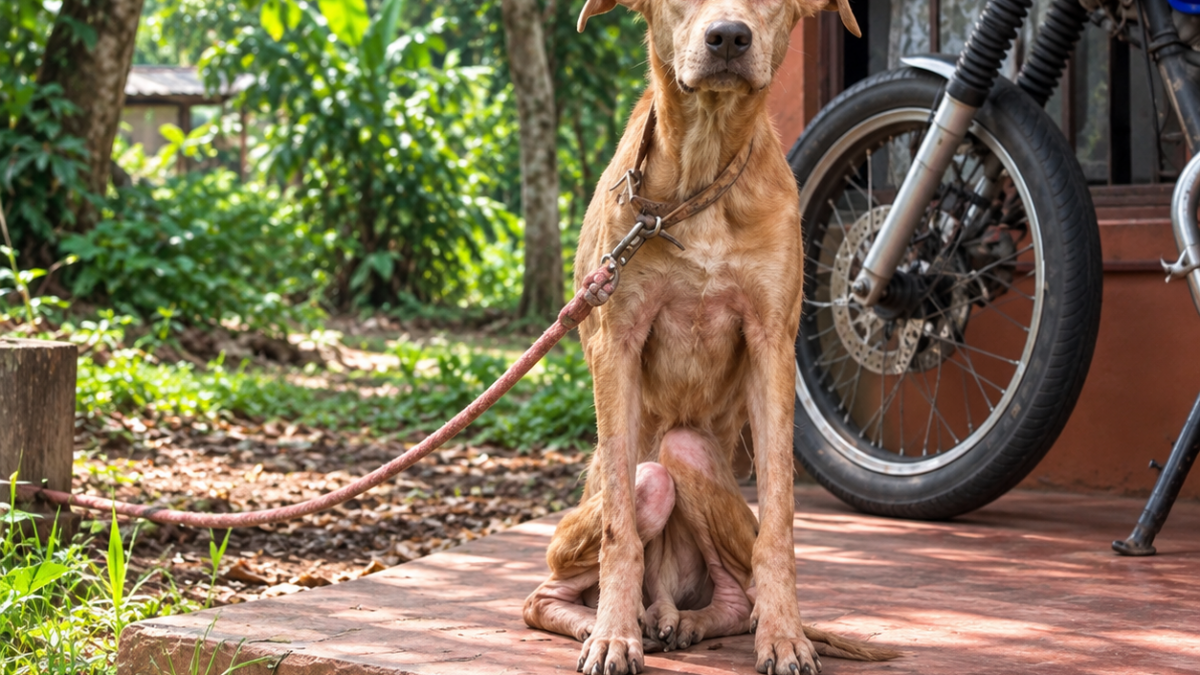
The skin beneath Ragnar’s collar was raw.
Not irritated.
Not simply rubbed.
Raw.
The heavy collar had sat against the same place for so long that the skin beneath it had become inflamed, thickened, and infected. There were sections where the fur had vanished completely.
I heard Marcus inhale sharply beside me.
“Jesus.”
Dana lowered her camera.
For several seconds, even she didn’t say anything.
The owner was still standing near the porch.
“This is exactly what I’m talking about,” Dana finally said.
He folded his arms.
“That ain’t from me.”
I looked at him.
The anger rising inside me was almost physical.
I had spent years learning not to scream at neglectful owners.
It rarely helped the animal.
Evidence helped.
Veterinarians helped.
Photographs helped.
Police reports helped.
Losing your temper usually helped only the person you were angry with, because suddenly the conversation became about your behavior instead of theirs.
So I swallowed everything I wanted to say.
I turned back to Ragnar.
“Can you walk?”
Of course he couldn’t answer.
I slipped one arm beneath his chest.
Marcus supported his hindquarters.
The moment we tried lifting him, Ragnar panicked.
His legs kicked weakly.
He twisted his head toward the post.
Toward the chain lying in the dirt.
“He thinks he has to stay,” Marcus said.
The words stopped me.
For years, perhaps his entire life, Ragnar had learned one rule.
The chain determined how far his world went.
Even when the chain was gone, his body still obeyed it.
I put him down again.
“All right.”
I sat beside him.
Marcus looked at me.
“We need to get him to the clinic.”
“I know.”
I touched Ragnar’s shoulder carefully.
“But he doesn’t know that yet.”
His breathing was fast.
I waited.
Then I moved three feet away.
“Come on.”
Nothing.
I tapped the ground.
“You can.”
Ragnar stared at the post.
Then at me.
I moved another foot.
His front paw shifted.
The movement was so small I almost missed it.
“Good boy.”
Another paw.
His hind legs trembled when he stood.
Then he took one step beyond the place where the chain would normally have stopped him.
Ragnar froze.
There was no snap of metal.
No pressure against his throat.
He looked behind himself.
Then forward.
He took another step.
Marcus turned his face away.
I knew why.
I was trying not to cry too.
The distance from the post to our rescue van was maybe forty yards.
It took nearly ten minutes.
Ragnar stopped constantly.
Sometimes from weakness.
Sometimes because every extra foot seemed to violate something he had been taught.
When he reached the vehicle, he refused to climb.
So Marcus and I lifted him onto a blanket.
He weighed far less than a dog his size should.
That frightened me more than his ribs had from a distance.
There was simply no weight in my arms.
We closed the van doors.
The owner shouted something behind us.
Dana stayed to finish the investigation.
I climbed into the back with Ragnar.
Marcus drove.
The dog pressed himself against the far wall.
His eyes followed every movement.
I didn’t touch him.
“Okay,” I whispered. “No one’s making you do anything right now.”
He stared at me.
“You can just breathe.”
For twenty minutes, that was all we did.
By the time we reached Willow Creek Veterinary Hospital, Ragnar had lowered his head onto the blanket.
Dr. Hannah Mitchell was waiting.
She had treated dozens of our rescue cases.
Normally Hannah smiled when we entered, even during difficult situations.
That day she didn’t.
She took one look at Ragnar.
“How long was he like this?”
“We don’t know.”
She crouched.
Ragnar immediately tried backing away.
“It’s okay,” Hannah said.
We carried him into an examination room.
His temperature was slightly low.
He was dehydrated.
His body-condition score was dangerously poor.
His muscles had wasted badly, particularly around his hips and hind legs.
Hannah ran her hands gently along his ribs.
Ragnar flinched whenever she touched his skin.
“We need bloodwork. Skin scrapings. Fecal testing. Cultures if necessary. I want abdominal imaging too.”
“Do all of it.”
Hannah looked at me.
“You know this could become expensive.”
“Do it.”
Our rescue account was already strained.
I knew that.
But there are moments when numbers become impossible to think about.
Ragnar was looking at me.
I was not going to make his survival dependent on a spreadsheet.
We started slowly.
Fluids.
Nutrition.
Pain management.
Medication for infection.
Hannah wanted to avoid feeding him too aggressively because severely malnourished animals can develop dangerous metabolic complications if nutrition is restored too quickly.
That meant tiny meals.
Frequent monitoring.
Blood tests.
Ragnar didn’t understand.
When we offered his first small portion of wet food, he inhaled it.
Then licked the bowl.
Then licked the floor.
Then looked at me.
“More?”
I looked at Hannah.
She shook her head.
“Not yet.”
Ragnar pushed the bowl with his nose.
That moment hurt in a way I wasn’t prepared for.
A hungry animal doesn’t understand medical restraint.
He only understands that food appeared and then stopped.
I sat beside him.
“I promise there’s more.”
Ragnar stared at the empty bowl.
“I promise.”
That night, he stayed at the clinic.
So did I.
Not because I needed to.
Because when I tried leaving the room, Ragnar stood despite his weakness.
When I stepped into the hallway, he whined.
Not loudly.
One soft, frightened sound.
I came back.
His body relaxed.
“All right.”
I pulled a chair beside his kennel.
“I guess we’re both sleeping here.”
At two in the morning, I woke to find his eyes open.
Watching me.
“You checking whether I disappeared?”
His tail moved against the blanket.
One quiet thump.
“No.”
I leaned back.
“I’m still here.”
The bloodwork showed anemia.
Low protein.
Evidence of chronic inflammation.
Parasites.
His skin samples suggested severe dermatitis complicated by infection and immune dysfunction.
But there was something else.
Hannah sat across from me the next morning with the results.
“I don’t think this is only neglect.”
I frowned.
“What do you mean?”
“The neglect made everything dramatically worse. No question. But there may be an underlying disorder.”
“Cancer?”
“Not what I’m thinking.”
She tapped the laboratory report.
“His immune system looks abnormal. I want to run additional tests.”
“How bad?”
“I don’t know yet.”
That became the answer we heard often with Ragnar.
I don’t know yet.
For the next five days, he remained hospitalized.
Every morning, I arrived before seven.
Every evening, I stayed until after closing.
Marcus teased me.
“You realize we have other dogs?”
“I’ve met them.”
“You’re obsessed.”
“Maybe.”
Ragnar began recognizing my footsteps.
I would enter the hallway.
His head would lift before I reached the room.
On day three, his tail wagged.
On day five, he stood when I entered.
That felt enormous.
His body, however, was still struggling.
The infected skin improved slightly under medication.
Then worsened.
New sores appeared along his flank.
His paws became inflamed.
He scratched until Hannah fitted him with protective coverings.
We changed antibiotics.
Added medicated baths.
Adjusted his diet.
Nothing seemed to hold.
The cruelty case was developing at the same time.
Dana called me one afternoon.
“The owner says Ragnar was born sick.”
“Does he have records?”
“No.”
“Of course not.”
“He claims he tried treating him himself.”
“With what?”
“Wouldn’t specify.”
I looked through the glass at Ragnar sleeping.
“Is he getting charged?”
“We’re building the case.”
“Dana.”
“I know.”
“Please tell me he isn’t getting Ragnar back.”
“He isn’t.”
That was the one answer I needed.
“Good.”
Two days later, Ragnar was stable enough to leave the hospital.
Not healthy.
Stable.
There is a huge difference.
We placed him with me because his medical needs were too complicated for our normal foster network.
I lived alone then.
Technically.
I already had two rescue dogs, Cooper and Sadie, who believed ownership of my house was a settled legal matter.
When Ragnar arrived, I introduced them carefully.
Sadie sniffed him.
Then walked away.
Cooper tried bringing him a stuffed duck.
Ragnar stared at the toy.
Cooper dropped it.
Ragnar stared harder.
I laughed.
“I don’t think he knows what that is.”
Cooper pushed it toward him.
Ragnar backed away.
It occurred to me that Ragnar might never have had a toy.
So I put the duck down and left it there.
The first night, Ragnar slept beside the back door.
I had prepared a thick orthopedic bed.
Blankets.
A quiet corner.
He ignored all of it.
Instead, he curled on the hard floor.
When I tried moving the bed beneath him, he stood and returned to the tile.
Years on dirt and concrete had taught him comfort was unfamiliar.
So I slept on the couch nearby.
Around midnight, I heard movement.
Ragnar was standing over the orthopedic bed.
He sniffed it.
Placed one paw on it.
Pulled back.
Tried again.
Then slowly climbed onto it.
He circled once.
His legs folded.
For several minutes, he stayed rigid.
Then his head lowered.
His eyes closed.
That was his first night sleeping on something soft.
It should have felt like victory.
But at three in the morning, he began scratching.
By sunrise, one sore had opened.
There was blood on the blanket.
I called Hannah.
Treatment changed again.
That became our routine.
Progress.
Setback.
Progress.
Setback.
One week his coat looked better.
The next week another patch fell out.
His appetite improved.
Then medication upset his stomach.
His weight increased two pounds.
Then he lost one.
I remember sitting on my kitchen floor one evening with my forehead against the cabinet.
Ragnar had just vomited his dinner.
Cooper was hiding because he hated vomiting.
Sadie was staring at me as though I was incompetent.
I felt exhausted.
“This isn’t fair,” I said.
Ragnar was lying beside the water bowl.
He looked at me.
“You finally get rescued and your own body won’t cooperate.”
His tail moved once.
I crawled toward him.
“I’m sorry.”
He licked my wrist.
That nearly destroyed me.
Because Ragnar had every reason to mistrust humans.
Yet every day, he gave us another chance.
The specialist appointment happened three weeks later.
Dr. Priya Shah was a veterinary dermatologist two counties away.
She spent almost an hour examining him.
Then another hour reviewing his history.
“We’re dealing with several things simultaneously,” she finally said.
“Can we fix them?”
“We can treat them.”
That distinction scared me.
She explained that Ragnar’s severe long-term malnutrition and chronic skin disease had disrupted his immune function. There were recurrent infections. Significant inflammation. Possible immune-mediated complications.
She prescribed a more aggressive treatment plan.
Specialized shampoo.
Topical medication.
Immune-modulating therapy.
Diet changes.
More bloodwork.
The cost made our rescue treasurer go silent on the phone.
“We can cover maybe half.”
“I’ll find the rest.”
“How?”
“I don’t know.”
But Ragnar’s story had already started circulating among people connected to our rescue.
One family reached out.
The Millers.
Daniel and Rebecca Miller had two teenage daughters, Sophie and Grace.
They had seen Ragnar’s photograph through a volunteer.
Rebecca called me.
“We’d like to help with his treatment.”
“That’s incredibly generous.”
“We’d also like to meet him.”
I hesitated.
Ragnar was not ready for adoption.
He wasn’t even medically stable.
Rebecca seemed to understand.
“We’re not asking to take him home now.”
“Then what are you asking?”
“To be there.”
They came Saturday.
I warned them.
“He may not approach you.”
“That’s okay.”
“He may be frightened.”
“That’s okay.”
“He may never become the dog you imagine.”
Rebecca looked at me.
“We don’t imagine anything.”
That answer mattered.
When the Millers entered my backyard, Ragnar stood behind me.
Sophie, sixteen, sat on the grass.
Grace, fourteen, did the same.
Nobody called Ragnar.
Nobody reached.
Daniel placed a paper bag beside me.
“What’s that?”
“Food.”
“For us?”
“For him.”
Inside were containers of the prescription diet Ragnar needed.
Rebecca smiled.
“The clinic told us the brand.”
“You called the clinic?”
“With your rescue’s permission.”
I looked at them.
These people were serious.
For almost forty minutes, Ragnar stayed near the porch.
Then Sophie did something clever.
She lay completely flat in the grass and started reading a book.
Ragnar watched.
Eventually, curiosity won.
He approached from behind.
Sniffed her shoes.
Sophie kept reading.
He sniffed her elbow.
Then her hair.
She still didn’t move.
Finally Ragnar sat three feet away.
Grace whispered, “He likes you.”
Sophie answered without looking up.
“He doesn’t know me yet.”
That was when I started believing this family might deserve him.
They visited every week.
Sometimes twice.
They paid portions of his medical bills without making a show of it.
They brought food.
They cleaned my yard when I was overwhelmed.
Daniel repaired a broken gate.
Grace learned how to prepare Ragnar’s medicated baths.
Sophie became the first person besides me Ragnar willingly followed from room to room.
But his body was still failing him.
Two months after rescue, his sores returned worse than before.
He developed fever.
I rushed him back to Hannah.
Blood tests were concerning.
His white blood cells were abnormal.
His anemia had worsened.
Hannah called Dr. Shah.
More testing followed.
Then we received the diagnosis none of us expected.
Ragnar had a complex bone marrow and immune disorder that was preventing his body from producing and maintaining healthy blood cells normally.
I stared at Hannah.
“What do we do?”
“There are treatment options.”
“Medication?”
“Some.”
She hesitated.
“And potentially a stem cell transplant.”
I thought I had misheard.
“A what?”
“A hematopoietic stem cell transplant from a compatible donor.”
“For a dog?”
“Yes.”
“Does that actually happen?”
“It’s uncommon. Specialized. Expensive. But it can be done in selected cases.”
I looked through the examination-room window.
Ragnar was sleeping.
The fur on his chest had begun growing back.
His body finally looked less skeletal.
And now we were talking about a transplant.
“How much?”
Hannah gave me a number.
I laughed once.
Not because it was funny.
Because sometimes a number is so large your brain refuses to treat it seriously.
“Our rescue doesn’t have that.”
“I know.”
“What happens without it?”
“We continue supportive care. There are other treatments we can try, but his prognosis becomes much more uncertain.”
I drove home crying.
Ragnar sat in the back seat.
He had finally learned to enjoy cars.
His nose rested near the window.
At one traffic light, I looked at him in the mirror.
“You couldn’t have picked something simple?”
His tail moved.
“Ear infection?”
Another wag.
“Bad tooth?”
He panted.
“No. You needed experimental medicine.”
When I reached home, the Millers were waiting.
Rebecca saw my face.
“What happened?”
We sat at the kitchen table.
I explained everything.
Nobody spoke.
Finally Daniel asked, “Can they do it?”
“If we find a donor.”
“And money.”
“Yes.”
“How much?”
I told him.
Grace covered her mouth.
Sophie stared at Ragnar.
Rebecca looked at her husband.
I immediately shook my head.
“No.”
She hadn’t even spoken.
“Emily.”
“No. You’ve already done enough.”
Rebecca leaned forward.
“We asked to be part of his recovery.”
“This isn’t a bag of dog food.”
“We know.”
“You have children. A mortgage. A life.”
“So do you.”
“That’s different.”
“Why?”
Because I had made Ragnar my responsibility.
Because I had taken him off the chain.
Because somehow I believed that meant every battle afterward belonged to me.
Rebecca seemed to read my mind.
“Emily, helping him does not mean you have to carry him alone.”
That sentence stayed with me.
They contributed money.
The rescue launched an emergency medical fund.
Former adopters gave what they could.
Dr. Shah reduced some fees.
Hannah donated diagnostic work.
A local veterinary pharmacy discounted medication.
And slowly, impossibly, the treatment became possible.
But we still needed a donor.
Finding one was complicated.
Size mattered.
Health mattered.
Blood compatibility mattered.
Additional tissue matching mattered.
Several dogs were tested.
No match.
Then another.
No match.
Weeks passed.
Ragnar weakened again.
One evening he refused food.
I sat beside his bed.
“Come on.”
Nothing.
I offered chicken.
Nothing.
Beef.
Nothing.
Peanut butter.
He turned away.
My fear became anger.
Not at Ragnar.
At everything.
At his former owner.
At the years of neglect.
At a body forced to survive without basic care until survival itself had become complicated.
I walked onto the back porch and called Dana.
“What’s happening with the cruelty case?”
“Court date’s next month.”
“He’s fighting it?”
“Yes.”
I laughed bitterly.
“Of course he is.”
“Emily.”
“Ragnar may die.”
“I know.”
“No, you don’t understand. We’re looking for a stem cell donor because this dog was allowed to deteriorate for years, and that man is arguing he did nothing wrong.”
Dana was quiet.
Then she said, “The medical evidence matters.”
“Good.”
“The photographs matter.”
“Good.”
“Your testimony matters.”
I stared through the window.
Ragnar had raised his head.
“Then I’ll testify.”
“You may have to.”
“I hope I do.”
The donor came from an unexpected place.
A former rescue dog named Atlas.
Atlas was a healthy seventy-pound shepherd mix adopted three years earlier by a firefighter named Ryan Cole.
Ryan had seen our donor appeal.
He brought Atlas for testing.
I tried not to hope.
We had already been disappointed too many times.
Two days later, Hannah called.
“Emily.”
Something in her voice made me stand.
“What?”
“We have a match.”
I couldn’t speak.
“Atlas is compatible.”
I sat down hard.
“Say that again.”
“We found Ragnar’s donor.”
I started crying before the call ended.
The Millers arrived that evening.
Grace cried.
Sophie hugged Ragnar.
Daniel shook Ryan’s hand at the clinic the next morning.
Rebecca brought Atlas a bag full of toys.
Ryan laughed.
“He’s going to think donating stem cells is the best decision he ever made.”
The transplant required preparation.
Ragnar was admitted to a specialty hospital.
The risks were significant.
Infection.
Rejection.
Complications from immune suppression.
Failure of the transplanted cells to engraft.
The specialist explained everything.
I heard maybe half.
One sentence stayed clear.
“There is no guarantee.”
I looked at Ragnar.
There never had been.
No guarantee when we removed the chain.
No guarantee when we treated his skin.
No guarantee when his bloodwork worsened.
Ragnar’s entire life had been built without guarantees.
What he finally had was a chance.
We took it.
The morning of the procedure, Sophie sat beside him.
She had become his person in a way none of us expected.
Ragnar placed his head on her lap.
She whispered, “You’re supposed to come home with us, remember?”
Ragnar looked up.
Grace started crying.
Rebecca pulled her close.
Sophie stroked Ragnar’s ears.
“We’ve been waiting.”
That sentence almost broke me.
Waiting.
Ragnar had spent most of his life waiting for somebody to stop.
Now a family was waiting for him to survive.
The procedure went forward.
Then came the hardest part.
Watching.
There is nothing heroic about sitting in a hospital waiting room.
You don’t save anybody.
You don’t make decisions.
You don’t fight.
You drink terrible coffee.
You stare at doors.
You check the clock.
You pretend every person walking toward you isn’t carrying news that could change everything.
Hours passed.
Eventually the specialist came out.
“The procedure is complete.”
Rebecca stood.
“How is he?”
“Stable.”
I almost collapsed.
Stable.
That word had never sounded beautiful until Ragnar.
But the transplant wasn’t victory yet.
His immune system was dangerously vulnerable.
He remained hospitalized.
Day one.
Day two.
Day three.
He developed a fever.
Antibiotics changed.
Day four.
His appetite disappeared.
Day five.
Blood counts remained concerning.
On day six, I found Sophie crying in the hallway.
“Hey.”
She wiped her face.
“I’m fine.”
“No, you’re not.”
“What if he doesn’t make it?”
I sat beside her.
“I don’t know.”
She looked angry.
“You’re supposed to tell me he will.”
“I can’t.”
“But he’s fought everything.”
“I know.”
“That should matter.”
“It does.”
“Then why can’t you promise?”
Because love doesn’t create certainty.
I wished it did.
Instead, I took her hand.
“I can promise he isn’t fighting alone.”
Sophie cried harder.
“So that’s it?”
“No.”
I looked through the window at Ragnar.
“That’s everything.”
His blood counts started improving on day nine.
Not dramatically.
Enough.
The transplanted cells appeared to be engrafting.
Hannah called it encouraging.
I called it the first time I breathed properly in weeks.
By day twelve, Ragnar ate chicken from Sophie’s hand.
By day fourteen, his fever was gone.
Day seventeen, he stood without assistance.
Day twenty-one, the specialist used the word we had all been afraid to say.
Successful.
Not cured forever.
Not magically healthy.
Successful.
Ragnar had survived the transplant.
Daniel lifted Grace off the floor in a hug.
Rebecca cried.
Ryan sent a photograph of Atlas wearing a ridiculous superhero cape.
The caption said:
DONOR DOG.
Ragnar came home to me temporarily because he still needed close medical monitoring.
But something had changed.
The Millers were no longer visitors.
Ragnar knew their car.
Every time it entered my driveway, he stood.
Tail moving.
He waited beside the door.
One afternoon Sophie arrived after school.
Ragnar walked directly to her.
She knelt.
He pressed his head into her chest.
I saw Rebecca watching from behind me.
Her eyes filled.
“He’s ours, isn’t he?”
I smiled.
“I think he decided that months ago.”
There was one final obstacle.
The cruelty case.
Ragnar’s former owner had pleaded not guilty.
His lawyer argued that the dog’s underlying medical condition explained his appearance.
That made me furious.
Yes, Ragnar had a complex disease.
But disease did not create the chain.
Disease did not explain the absence of veterinary records.
Disease did not explain untreated infections.
Disease did not explain his extreme malnutrition.
Disease did not explain the terror in Ragnar’s body when the owner grabbed that chain.
Dr. Hannah Mitchell testified first.
She explained Ragnar’s condition clinically.
Calmly.
Precisely.
The defense attorney asked, “Doctor, is it possible that Ragnar would have experienced skin disease even if properly cared for?”
“Yes.”
“Is it possible he would have experienced weight loss?”
“Possibly.”
The attorney nodded as though he had proven something.
Then Hannah continued.
“But none of that explains allowing him to deteriorate to the condition in which he arrived.”
The courtroom became quiet.
She explained muscle wasting.
Dehydration.
Untreated infection.
Parasites.
The damaged neck beneath the collar.
She described the difference between having a sick dog and neglecting a sick dog.
“An illness creates a responsibility to seek care,” she said. “It does not erase that responsibility.”
I wanted to applaud.
Obviously, I didn’t.
Then Dana testified.
Photographs appeared on the courtroom monitor.
Ragnar at the chain.
Ribs visible.
Skin raw.
Dirty water container.
Bare ground.
No adequate shelter.
Then came the photograph beneath the collar.
Even people who had seen the earlier pictures shifted in their seats.
Finally, I testified.
The former owner sat fifteen feet away.
For the first time since rescue day, we were in the same room.
His attorney asked me about my rescue work.
Then he tried suggesting I was emotionally biased.
“You became attached to Ragnar, correct?”
“Yes.”
“You wanted him removed.”
“Yes.”
“So you were not neutral.”
“No.”
He seemed pleased.
Then I added, “I wasn’t neutral about whether a starving dog with untreated wounds should remain chained.”
The judge glanced at me.
The attorney’s smile vanished.
“Please answer only the question.”
“I did.”
He asked whether Ragnar’s later medical diagnosis could explain why treatment had been difficult.
“Yes.”
“Could it explain the hair loss?”
“Some of it.”
“The sores?”
“Some.”
“The low body weight?”
“Potentially part of it.”
“So you cannot say my client caused Ragnar’s medical condition.”
“I never said he did.”
The attorney paused.
“What are you saying?”
I looked at Ragnar’s former owner.
For months I had imagined this moment.
I thought I would want revenge.
I thought I would want to humiliate him.
Instead, I felt tired.
“I’m saying Ragnar was sick and needed help.”
I turned toward the judge.
“He was chained where people passed every day. He cried when vehicles slowed because he wanted somebody to come near him. His body was failing. He had open sores. He was dangerously underweight. Whatever disease he had, he needed a veterinarian.”
I looked back at the attorney.
“And no one took him.”
Silence.
The prosecutor later showed veterinary invoices.
Zero.
Not one legitimate clinic visit during Ragnar’s years with the owner.
The owner eventually took the stand.
That was his mistake.
He said Ragnar had always been “weak.”
He claimed he couldn’t afford expensive veterinary care.
The prosecutor asked whether he had ever contacted a rescue.
No.
A shelter?
No.
A low-cost veterinary clinic?
No.
Asked for assistance?
No.
Surrendered the dog?
No.
Then the prosecutor asked:
“If you could not provide necessary medical care, why did you keep him chained on your property?”
He had no good answer.
The judge found him guilty on the principal cruelty and neglect counts.
He received a period of incarceration that was partially suspended, probation, fines, restitution for part of Ragnar’s emergency veterinary care, and a prohibition against owning animals during the court-ordered period.
Some people wanted a harsher sentence.
Maybe part of me did too.
But I remember standing outside the courthouse afterward when Rebecca asked:
“Do you feel better?”
I thought about it.
“No.”
She looked surprised.
“I thought I would.”
“Why don’t you?”
I looked toward the parking lot.
“Because punishment doesn’t give Ragnar those years back.”
Rebecca nodded.
Then her phone buzzed.
She opened a photograph.
Sophie had sent it from my house.
Ragnar was lying on my couch.
Upside down.
All four legs in the air.
The stuffed duck Cooper had once offered him was under his chin.
I laughed.
Rebecca showed me the screen.
“Maybe that’s the revenge.”
I looked at her.
“What?”
“That he gets to be happy anyway.”
She was right.
Ragnar’s former owner had spent years teaching him that the world was the length of a chain.
Now Ragnar was going to learn how big it actually was.
His adoption day came nearly seven months after we removed him from that post.
By then, his transformation was remarkable.
He still carried scars.
Some fur never grew back completely.
His skin required maintenance.
His transplant meant regular specialist appointments and bloodwork.
He would probably have medical needs for the rest of his life.
But he had gained more than twenty pounds.
His eyes were bright.
His shoulders had filled out.
He could run.
Not far.
But enough.
The adoption paperwork waited on my kitchen table.
I hated it.
Not because I doubted the Millers.
Because signing meant Ragnar was leaving my house.
Marcus noticed.
“You’re crying.”
“I am not.”
“You absolutely are.”
“I have allergies.”
“In February?”
“Rare winter allergies.”
He laughed.
Ragnar sat beside Sophie while Rebecca signed.
Grace had bought him a new blue collar.
No chain.
Just a collar with his name.
RAGNAR MILLER.
Daniel looked at me.
“Ready?”
“No.”
Everyone laughed.
I crouched in front of Ragnar.
He licked my chin.
“That’s unnecessary.”
Another lick.
“You know you’re supposed to go with them, right?”
His tail moved.
“Sophie has been planning your bedroom for four months.”
Sophie corrected me.
“His corner.”
“You bought him a mattress larger than mine.”
“He deserves it.”
I looked at Ragnar.
“She’s going to ruin you.”
His tail moved harder.
I put both hands around his face.
For a second, the room disappeared.
I saw the dog beside the post again.
Ribs.
Trembling legs.
That rusted chain stretched tight.
The eyes that had watched people pass.
Waiting.
He had spent his life asking for somebody to stop.
Now an entire family was waiting at the door to take him home.
“You made it,” I whispered.
Ragnar pressed his forehead against mine.
“You actually made it.”
I stood before I completely fell apart.
The Millers walked toward their SUV.
Ragnar followed Sophie.
Then halfway across the driveway, he stopped.
He turned around.
Looked at me.
My heart cracked.
“It’s okay.”
He stood still.
“Go.”
Nothing.
I laughed through tears.
“Ragnar.”
His ears lifted.
“You don’t have to stay because I stayed.”
Sophie waited beside the vehicle.
I pointed toward her.
“That’s your home.”
Ragnar looked at Sophie.
Then me.
Then something extraordinary happened.
He ran back.
Not fast.
Not like a young healthy dog.
But he ran.
He reached me.
Pressed against my legs.
Then turned and ran back to Sophie.
Marcus covered his face.
“Oh, come on.”
I was openly crying now.
Ragnar climbed into the SUV.
Rebecca closed the door.
Through the window, his face appeared.
For years, vehicles must have represented fear.
Rescue.
Hospitals.
Treatment.
Separation.
That day, the vehicle meant home.
I watched until they disappeared down the road.
My house felt horribly quiet afterward.
Cooper walked through each room looking for Ragnar.
Sadie lay on his empty bed.
I picked up the stuffed duck.
There were tooth marks along one ear.
I sat on the floor.
And cried.
Then my phone buzzed.
A photograph from Sophie.
Ragnar was standing inside their living room.
Behind him was a giant dog bed.
Three blankets.
A basket of toys.
Grace was sitting on the floor.
Daniel was carrying bags of medication.
Rebecca had apparently decorated a small wooden sign.
RAGNAR’S PLACE.
I smiled.
Another photograph arrived ten minutes later.
Ragnar on the couch.
Then one of him investigating the kitchen.
Then one of him sleeping beside Sophie.
By eight that night, I had received twenty-three photographs.
Marcus texted me:
THEY’RE WORSE THAN YOU.
He was correct.
Two weeks later, I visited.
When my car pulled into their driveway, Ragnar appeared at the front window.
His head tilted.
Then he vanished.
The front door opened before I reached it.
Ragnar came running.
He hit me hard enough that I almost lost my balance.
“Hey!”
His tail was moving so violently his entire rear half swung.
I knelt.
He buried his head against my shoulder.
Sophie stood in the doorway laughing.
“He remembers you.”
“Apparently.”
Ragnar licked my face.
“Okay. Memory confirmed.”
But then something even better happened.
After greeting me, Ragnar went back to Sophie.
He leaned against her leg.
Relaxed.
He didn’t panic when I moved toward the door later.
He didn’t try following me.
He knew I could leave without disappearing forever.
That mattered.
His life with the Millers became everything we had wanted for him.
Morning walks.
A fenced yard.
Soft beds.
Special food.
Medication given on schedule.
Regular appointments.
Car rides that ended at parks instead of hospitals.
He discovered lakes.
He discovered snow.
He discovered that Daniel dropped food while grilling.
He discovered Grace would let him sleep across her feet while she studied.
He discovered Sophie could be manipulated by one strategically placed paw.
He discovered birthdays.
His first birthday celebration was technically based on the anniversary of his rescue because nobody knew his actual birth date.
The Millers called it Freedom Day.
They sent me a video.
Ragnar wore a paper hat for approximately four seconds before eating it.
There was a dog-safe cake.
Atlas, his donor, attended.
When the two dogs met again, Ragnar sniffed Atlas carefully.
Atlas immediately stole Ragnar’s toy.
Apparently stem cell donation does not create gratitude.
Ryan laughed so hard he nearly dropped his phone.
We took a photograph of them together.
Ragnar and Atlas.
One had given cells.
The other had used them to survive.
Years later, that photograph still sits on my desk.
Ragnar’s recovery was never perfectly smooth.
There were flare-ups.
One serious infection.
Several frightening blood-test results.
A medication reaction that sent him back to the specialty hospital overnight.
Every setback brought fear.
But the difference was enormous.
Before, when Ragnar hurt, nobody came.
Now when he refused breakfast, four people noticed.
When he scratched more than usual, Sophie called the dermatologist.
When a new sore appeared, Rebecca photographed it and sent it to the clinic.
When his medication needed adjustment, Daniel drove two hours after work to pick it up.
Ragnar no longer had to cry toward the road hoping somebody might stop.
His people were already there.
About a year after his adoption, Dana called me.
“I thought you’d want to know.”
“What?”
“His former owner violated the animal-possession restriction.”
My stomach dropped.
“He got another dog?”
“Apparently.”
“What happened?”
“Neighbor reported it.”
“Is the dog okay?”
“We removed her.”
A young female pit mix.
Underweight but nowhere near Ragnar’s condition.
Because this time someone had reported it quickly.
The court responded.
The violation extended the owner’s legal consequences.
The dog entered rescue care and eventually found a home.
When I told Rebecca, she was furious.
Sophie, now seventeen, said something I didn’t expect.
“At least that dog didn’t have to wait as long as Ragnar.”
Exactly.
Maybe that was another piece of Ragnar’s legacy.
People had seen his story.
Neighbors who once might have ignored a chained dog started calling.
Delivery drivers reported neglect.
Veterinarians offered help.
Our rescue received more foster applications.
Not because suffering is good publicity.
I hate that idea.
Ragnar should never have needed to become a symbol.
But since he had suffered, we could at least make sure the evidence of what happened to him taught people not to look away.
Three years after Ragnar’s rescue, the delivery driver who originally reported him came to our annual rescue picnic.
His name was Miguel Santos.
I had never met him.
He approached me awkwardly.
“Are you Emily?”
“Yes.”
“I’m the guy who called about Ragnar.”
I stared.
“You’re Miguel?”
He nodded.
I hugged him before asking permission.
“I’ve wanted to meet you for three years.”
He laughed.
“I almost didn’t call.”
“Why?”
“I thought maybe it wasn’t my business.”
That sentence mattered.
“How many times did you drive past him?”
Miguel looked ashamed.
“Too many.”
“Don’t.”
“What?”
“Don’t do that to yourself.”
He looked at me.
“You eventually stopped.”
“I called.”
“You stopped.”
I pointed across the park.
Ragnar was lying beside Sophie beneath a tree.
Healthy.
Comfortable.
Loved.
“That happened because you decided it was your business.”
Miguel’s eyes filled.
Sophie brought Ragnar over.
Miguel knelt.
“This is really him?”
Ragnar sniffed him.
“Yes.”
Miguel stroked his neck.
“I’m sorry it took me so long, buddy.”
Ragnar leaned against him.
Miguel covered his face.
We all cried.
That afternoon, someone asked me what the most important part of Ragnar’s story was.
The rescue?
The transplant?
The conviction?
The adoption?
For a long time, I didn’t know.
Then I realized.
The most important moment happened before any of us knew his name.
A truck slowed.
A man looked toward a chained dog.
And instead of deciding someone else would handle it, he made a phone call.
That was the moment Ragnar’s future changed.
Not because Miguel was a superhero.
Because he noticed.
Years passed.
Ragnar’s face began turning gray.
The first white hairs appeared around his muzzle.
Sophie went to college twenty minutes away instead of moving across the state because, according to Rebecca, she “refused to be geographically inconvenient to Ragnar.”
Grace eventually left for college too.
Daniel complained that Ragnar now received more phone calls from his daughters than he did.
Every evening around eight, Sophie video-called.
Rebecca would hold the phone near Ragnar.
“Hi, baby.”
Ragnar’s ears lifted.
Daniel once said, “I’m standing right here.”
Sophie replied through the phone, “Hi, Dad.”
Then immediately:
“Move the camera back to Ragnar.”
I received updates constantly.
The dog who once slept on dirt developed strong preferences.
He disliked rain.
He refused to walk through puddles.
He would not eat carrots.
He loved scrambled eggs.
He hated the vacuum cleaner.
He slept with his head on pillows like a human.
If anyone stopped petting him before he felt finished, he placed one paw firmly on their arm.
“He’s demanding,” Rebecca told me.
“Good.”
“Good?”
“Yes.”
A dog who expects things is a dog who finally believes the world might provide them.
That matters.
One winter morning, almost six years after rescue, Rebecca called.
Her voice was wrong.
My heart knew before she spoke.
“Ragnar collapsed.”
I stood immediately.
“Where?”
“Emergency hospital.”
“I’m coming.”
He was nearly twelve by then, as best we could estimate.
For a dog with his medical history, every year had been borrowed time.
That knowledge did nothing to make the fear easier.
I arrived to find the entire Miller family there.
Sophie had driven from her apartment.
Grace had come directly from work.
Daniel stood with his hands in his pockets staring at the floor.
Rebecca hugged me.
The veterinarian explained that Ragnar had developed internal bleeding related to a splenic mass.
There were surgical options.
But his age, transplant history, kidney function, and cardiac condition made the risks enormous.
We listened.
Asked questions.
Cried.
Then asked the only question that mattered.
“Is he suffering?”
“Yes.”
Sophie sat beside Ragnar.
He looked tired.
But when he saw me, his tail moved.
Still.
After everything.
It moved.
I sat on his other side.
“Hey, trouble.”
His eyes found mine.
“You really like expensive hospitals.”
Sophie laughed through tears.
Ragnar breathed slowly.
Rebecca asked whether we should attempt surgery.
Nobody wanted to make the decision.
That is the cruelest part of loving an animal.
They trust you with the decision they cannot make.
The veterinarian gave us time.
Daniel finally said, “If surgery had a strong chance, I’d do it.”
“So would I,” Rebecca whispered.
“But it doesn’t.”
Sophie bent over Ragnar.
“I’m not ready.”
Nobody told her she should be.
Grace sat on the floor and took Ragnar’s paw.
“Neither am I.”
I remembered his first day.
The chain.
The trembling legs.
The raw neck.
The dog who seemed already exhausted by life.
I had once begged him to fight.
Now, six years later, something inside me knew we could not demand another battle just because we were afraid to say goodbye.
I touched Sophie’s shoulder.
“You told him before the transplant that he was supposed to come home with you.”
She nodded.
“He did.”
She cried.
“He kept his promise.”
Ragnar’s breathing became heavier.
I stroked his head.
“He doesn’t owe us another one.”
Sophie pressed her face into his fur.
That decided it.
We brought Ragnar home.
Not because he was going to recover.
Because that was where his life belonged.
The Millers placed his bed near the fireplace.
The same enormous bed Sophie had bought before his adoption.
Atlas’s owner, Ryan, came by.
Atlas had died two years earlier at thirteen.
Ryan knelt beside Ragnar.
“You carried a piece of him a long way.”
Ragnar licked his hand.
Miguel came.
Marcus came.
Dana came.
Dr. Hannah Mitchell, retired by then, came too.
She looked at the dog she once described as dangerously malnourished.
Then at his gray face surrounded by people.
“This,” she whispered, “is why we do it.”
By evening, everyone except immediate family left.
I stayed because the Millers insisted.
Ragnar lay between Sophie and Grace.
Rebecca sat behind him.
Daniel rested one hand on his back.
I sat near his head.
Outside, snow began falling.
Sophie smiled weakly.
“Remember his first Freedom Day?”
“The hat?”
“He ate it.”
“Four seconds.”
“Three.”
“It was definitely four.”
Even then, we argued.
Ragnar’s eyes moved between us.
I touched his scarred neck.
The place where the chain once rubbed him raw.
The skin was soft now.
Old scars beneath thick fur.
“You know,” I whispered, “the first time I touched you, you were attached to a post.”
His tail gave the faintest movement.
“And I told you I was stopping.”
Sophie wiped her face.
“I didn’t know what that promise was going to cost.”
Daniel smiled through tears.
“A lot.”
“An unbelievable amount.”
Rebecca laughed softly.
“Worth it.”
I looked at Ragnar.
“Every penny.”
His breathing slowed.
The veterinarian arrived after dark.
She explained the process.
We already knew.
That did not make it easier.
Sophie held Ragnar’s face.
“You were supposed to come home.”
Her voice broke.
“You did.”
Grace kissed his forehead.
“You were supposed to know what a family felt like.”
She sobbed.
“You do.”
Rebecca whispered, “You were supposed to be loved.”
Daniel covered his face.
“You are.”
I placed my hand over the old scar beneath Ragnar’s collar.
“And you were supposed to stop waiting.”
Ragnar looked at me.
“You did that too.”
The veterinarian gave the sedative.
His body relaxed.
For the first time since I had known him, there was no tension anywhere in his muscles.
Sophie whispered his name.
Grace stroked his paw.
Rebecca kept saying, “Good boy.”
Daniel said nothing because he couldn’t.
I leaned close.
“No chain.”
My tears fell into Ragnar’s fur.
“No pain.”
His eyes became heavy.
“No more fighting.”
I kissed his forehead.
“You can rest.”
Ragnar took one deep breath.
Then another.
Then he was gone.
The room became completely silent.
Six years earlier, Ragnar had stood crying beside a road while people passed.
On the last night of his life, he was surrounded so closely by people who loved him that there was barely room around his bed.
That is the ending I choose to remember.
Not the chain.
Not the starvation.
Not the court case.
Not even the transplant.
The room.
The fireplace.
Snow outside.
His family touching him from every side.
A dog who once seemed invisible leaving this world as somebody deeply known.
The Millers buried Ragnar on their property beneath a maple tree.
Sophie chose the inscription.
It said:
RAGNAR
HE WAITED FOR SOMEONE TO STOP.
THEN HE TAUGHT US NEVER TO WALK PAST.
A few weeks later, Rebecca found something while sorting his belongings.
The blue collar.
RAGNAR MILLER.
She brought it to me.
“We thought you should have this.”
I shook my head.
“No.”
“You rescued him.”
“You were his family.”
Rebecca smiled sadly.
“You were too.”
We compromised.
The collar stayed with the Millers.
I kept his first rescue tag.
It hangs beside my desk.
Every time a cruelty case comes in and I feel tired, I touch it.
Every time someone says, “It’s probably not that bad,” I remember Ragnar.
Every time somebody worries they are interfering by reporting an animal in distress, I tell them about Miguel.
And every time someone asks whether rescuing one animal really matters when thousands still need help, I think about the Miller living room on Ragnar’s final night.
One animal.
One phone call.
One family.
One donor.
One veterinarian who refused to stop searching.
One officer who documented everything.
One rescue that spent money it didn’t have.
One dog who survived long enough to discover couches, snow, scrambled eggs, birthday cakes, car rides, soft blankets, and what it felt like to have four people argue over who loved him most.
One matters.
Ragnar taught me that better than anyone.
People often describe rescue stories as transformations.
Before and after photographs.
The starving dog.
Then the healthy dog.
The chain.
Then the couch.
Those pictures matter.
But they leave something out.
The most important transformation is often invisible.
When we first removed Ragnar, he did not understand that a missing chain meant freedom.
He stood near the post because his mind still believed his world ended there.
Months later, he walked into the Millers’ house and stretched across a couch as if he had always owned it.
That distance—from believing you cannot move to believing you belong—is the real transformation.
And it took hundreds of small moments.
A bowl appearing every morning.
Hands that did not hurt.
Doors that opened.
People who returned.
Medicine when he was sick.
Food when he was hungry.
A family waiting outside hospital rooms.
Someone saying his name with love.
Again.
And again.
And again.
Until Ragnar finally believed them.
Years after his death, Sophie became a veterinary nurse.
When she told me, I laughed.
“You know Ragnar did this to you.”
“I know.”
Grace became a teacher but still fosters dogs.
Daniel claims he never wanted more pets.
At last count, they had three.
Rebecca volunteers with our rescue.
Miguel still reports animals he sees in trouble along his delivery route.
Dana retired after twenty-four years in animal control.
Marcus remains incapable of walking past an injured animal without somehow involving me.
And I’m older now.
There are days when rescue feels heavier than it used to.
My knees hurt.
My back hurts.
I have lost dogs I loved.
I have seen cruelty I wish I could forget.
But sometimes a frightened animal arrives at our door and refuses to move.
Sometimes that animal looks at me with the same exhausted uncertainty Ragnar once did.
And I sit on the ground.
I don’t pull.
I don’t rush.
I simply move a few feet away.
Then I say the words I first said to Ragnar beside that rusted post.
“You can.”
Sometimes they take one step.
Then another.
And every time they cross the invisible boundary where fear once stopped them, I see Ragnar again.
Not dying.
Not suffering.
Walking beyond the end of his chain for the first time.
The metal lying useless in the dirt behind him.
His legs shaking.
His eyes confused.
One step.
Then another.
Until suddenly there was nothing left holding him back.
That was Ragnar’s life in the end.
One impossible step after another.
Away from the chain.
Toward food.
Toward healing.
Toward Sophie.
Toward the family that had waited through every setback.
Toward home.
His former owner once said, “He’s just a dog.”
He was wrong.
Ragnar was a life.
A responsibility.
A patient.
A survivor.
A member of a family.
And eventually, a reason many other animals were noticed sooner than he had been.
If that man’s punishment was supposed to be the final victory, it wasn’t.
The final victory was Ragnar asleep upside down on a couch he had no permission to occupy.
It was Sophie rearranging her college schedule around his dermatologist appointments.
It was Daniel grilling an extra piece of chicken because Ragnar had perfected the art of looking neglected despite weighing seventy pounds.
It was Grace laughing while Ragnar stole her blanket.
It was Rebecca waking in the night and reaching down automatically to make sure he was still beside the bed.
It was Atlas giving part of himself so another dog could live.
It was Miguel finally kneeling beside the animal he once saw from his truck.
It was a birthday hat being eaten.
It was an old scar disappearing beneath healthy fur.
It was a blue collar that held nothing heavier than an identification tag.
That was our revenge.
Not pain returned for pain.
Not cruelty answered with cruelty.
A life lived so fully that the chain became only the first chapter.
Ragnar spent years belonging to someone who treated him as if he were worth almost nothing.
Then he spent the rest of his life surrounded by people who considered him priceless.
Nothing we did could erase his first years.
We could not give him back the meals he missed.
The nights outside.
The medical treatment he should have received.
The affection he should have known from the beginning.
But we could make sure those years did not get the final word.
And they didn’t.
Love did.
If I close my eyes, I can still see him at the beginning.
Thin.
Weak.
Standing beside that post.
The chain tight.
His head raised whenever someone passed.
Waiting for one person to stop.
Then I see him at the end.
Gray around the muzzle.
Heavy enough that Sophie complained when he lay across her legs.
Warm beside a fireplace.
Four hands resting on him.
His name spoken softly by people who had spent years proving that he mattered.
Between those two images was everything.
Medicine.
Setbacks.
Courtrooms.
Tears.
A donor.
A transplant.
Money we didn’t know how to find.
A family that refused to stop waiting.
And a dog who, somehow, refused to stop trying.
Ragnar had spent the first part of his life chained to one spot.
But by the time he left us, he had traveled farther than anyone imagined.
Not in miles.
In trust.
That was the journey.
From crying toward strangers on a road…
to falling asleep without fear because he knew exactly who would still be there when he woke.
And whenever someone asks me whether Ragnar knew, in the end, how loved he was, I never hesitate.
Yes.
He knew.
Because the last time he closed his eyes, he wasn’t staring down an empty road waiting for someone to come.
Everyone he had been waiting for was already there.
Years after Ragnar was gone, there was one part of his story I still struggled to explain.
People understood the chain.
They understood the starvation.
They understood the photographs of his ribs, the raw skin, the hospital stays, the transplant, and the family who eventually gave him everything he had once been denied.
Those were things you could see.
But the most important thing Ragnar left behind couldn’t be photographed.
It happened quietly.
One animal at a time.
One person at a time.
One decision not to look away.
About eight years after the day we removed Ragnar from that rusted chain, I received a call from Sophie.
By then she was working full-time at a veterinary hospital.
Her voice sounded different.
“Emily, I need your help.”
“What happened?”
“We have a dog here.”
That alone wasn’t unusual.
Sophie called me about dogs constantly.
But then she said, “He reminds me of Ragnar.”
Everything inside me went still.
I drove to the clinic.
The dog was in the last treatment room.
He was older, maybe nine or ten, with a gray muzzle and a coat that should have been thick but had become patchy from poor nutrition.
Someone had found him tied behind an abandoned rental property.
The rope around his neck was barely six feet long.
When I entered the room, he pressed himself against the wall.
Sophie sat on the floor several feet away.
She wasn’t reaching for him.
Wasn’t calling him.
Just waiting.
Exactly as I had waited for Ragnar.
“You’re doing it right,” I whispered.
Sophie looked at me.
“Doing what?”
“Giving him room to choose.”
She smiled sadly.
“I learned from somebody.”
We both knew who she meant.
The dog’s name became Henry.
At least that was the name Sophie gave him.
He refused food when anyone stood nearby.
So Sophie began placing his bowl down and turning her back.
The first day, he didn’t eat.
The second day, barely anything.
The third day, Sophie called me crying because she had heard chewing behind her.
“I didn’t turn around,” she said.
“Good.”
“I wanted to so badly.”
“I know.”
A week later, Henry ate while she sat sideways in the room.
Two weeks later, he took food from her hand.
One month later, he slept with his back toward the door.
That was when Sophie sent me a photograph.
Nothing dramatic.
Just an old dog sleeping on a blanket.
Beneath it she wrote:
He finally believes nobody is coming to hurt him.
I stared at those words for a long time.
Then I looked toward the little rescue tag of Ragnar’s hanging beside my desk.
“You see that?” I whispered.
Of course, the room stayed quiet.
But somehow I didn’t feel foolish talking to him anymore.
“You’re still doing it.”
Henry eventually went to a retired couple who had lost their Labrador the year before.
At the adoption, Sophie knelt and touched the scar around Henry’s neck.
Then she whispered something.
I was close enough to hear.
“No chain.”
The same words I had said over Ragnar on his final night.
I had to turn away.
That was the moment I understood legacy differently.
Ragnar had not left us only memories.
He had left instructions.
Be patient.
Notice suffering.
Do not confuse fear with aggression.
Do not expect trust immediately.
Feed the animal in front of you.
Treat the illness in front of you.
Report cruelty when you see it.
Stay when staying matters.
And when an animal finally discovers freedom, don’t decide what freedom should look like for them.
Let them choose.
Ragnar’s story became part of our rescue training.
Not the dramatic version.
The practical one.
We showed new volunteers his first medical photographs.
Then the photograph of him asleep upside down on the Millers’ couch.
We asked one question.
“What happened between these two pictures?”
New volunteers usually answered:
“Medical treatment.”
“Food.”
“A transplant.”
“Adoption.”
All true.
Then Sophie would say:
“Consistency.”
And the room would become quiet.
Because that was the part people underestimated.
Ragnar did not become whole because one extraordinary thing happened.
Even the transplant was only one chapter.
He changed because hundreds of ordinary things kept happening.
Breakfast appeared again.
And again.
Medication arrived on time.
Again.
Hands touched him gently.
Again.
Cars brought him home.
Again.
People left and returned.
Again.
No one hit him.
No one forgot him.
No one tied him to a post.
Day after day, reality contradicted everything his earlier life had taught him.
Eventually he believed the new reality.
That was healing.
Not forgetting fear.
Gathering enough evidence that fear no longer controlled every choice.
Years later, I was invited to speak at a small animal-welfare conference.
I almost declined.
Public speaking had never been my favorite thing.
Marcus told me I would regret it if I didn’t go.
“You talk nonstop at the rescue.”
“That’s different.”
“How?”
“Nobody there is listening.”
He laughed.
So I went.
Near the end, somebody asked:
“If you could change one thing about Ragnar’s story, what would it be?”
I didn’t need time to answer.
“I would make somebody stop sooner.”
The room became completely still.
“I wouldn’t remove the difficult treatment. I wouldn’t remove the transplant if he still needed it. I wouldn’t remove the family who loved him.”
I looked at the screen behind me.
Ragnar’s first photograph was there.
Thin body.
Chain visible.
“But I would erase the years before us.”
I clicked to the next photograph.
Ragnar healthy beside Sophie.
“I would give him those years back.”
Then I told them something I had learned from Miguel.
Cruelty often survives because every witness assumes someone else will act.
The neighbor assumes the delivery driver will report it.
The driver assumes the family knows.
The family assumes animal control is aware.
Animal control cannot act on what nobody reports.
And somewhere in the middle of all that assuming, an animal keeps waiting.
After the talk, a woman approached me.
She was crying.
“I think there’s a dog near my house in trouble.”
I gave her the local reporting information.
She called the next morning.
That report led officers to three neglected dogs.
All three survived.
Months later, the woman sent me a picture of one of them sleeping beside a little girl.
She wrote:
I kept thinking about Ragnar and realized I didn’t want to be another person who drove past.
I printed the message.
It still hangs beside his rescue tag.
That, more than the court conviction, felt like justice.
Ragnar’s former owner probably stopped thinking about him years ago.
But strangers who never met Ragnar were changing their behavior because he had existed.
People reported chains.
People fostered difficult dogs.
People donated toward medical cases.
People adopted older animals.
People learned that a dog trembling in the corner might not be “broken.”
He might simply be waiting for proof.
Sometimes I wondered whether Ragnar would have understood any of that.
Probably not.
Ragnar’s priorities were simpler.
Food.
A soft place to sleep.
Sophie.
Family.
Chicken falling from Daniel’s grill.
Keeping Grace’s feet warm.
Getting as close to Rebecca as physically possible without violating the laws of matter.
Those were probably enough.
One evening, the Millers invited me to dinner on the anniversary of Ragnar’s rescue.
They still called it Freedom Day.
Even after his death.
Sophie arrived with Henry.
Grace brought her newest foster dog, a ridiculous little terrier who barked at Daniel’s shoes.
Rebecca made Ragnar’s favorite chicken.
Daniel complained that cooking a dead dog’s favorite meal was proof he had lost control of his household years ago.
Nobody disagreed.
After dinner, we walked outside.
Ragnar’s maple had grown taller.
His marker sat beneath it.
Sophie knelt and brushed leaves from the stone.
For a while, none of us spoke.
Then Daniel said, “You know what I miss?”
“What?” Rebecca asked.
“The way he used to put his paw on me if I stopped petting him.”
Grace laughed.
“He did that to everyone.”
“No. He respected me differently.”
“He stole your steak.”
“One time.”
“Three times.”
We started laughing.
That mattered.
For years after Ragnar died, memories could still hurt.
But eventually they became something else too.
Warm.
Funny.
Alive.
Sophie placed her hand against the stone.
“He got enough time, didn’t he?”
It was not really a question.
It was something people say when they need another person to help carry an impossible truth.
I sat beside her.
“No.”
She looked at me.
I shook my head.
“It’s never enough.”
Her eyes filled.
“But he got good time.”
Sophie nodded.
“Yes.”
“That matters.”
The first part of Ragnar’s life had been measured by survival.
The second part was measured differently.
Birthdays.
Christmas mornings.
Medical victories.
Naps beside fireplaces.
Vacations.
Car rides.
Visitors.
Sophie coming home from college.
Grace graduating.
Atlas visiting.
Miguel kneeling beside him.
Ordinary Tuesdays when absolutely nothing terrible happened.
Those ordinary days were perhaps our greatest achievement.
A dog who had once needed a miracle simply to survive eventually had days so safe they were boring.
I wish every neglected animal could receive that kind of ending.
Not fame.
Not viral photographs.
Not strangers calling them inspiring.
Just boredom.
Breakfast.
A walk.
A nap.
Someone saying, “Move over,” because the dog has taken too much of the couch.
Someone complaining about fur on clean clothes.
Someone buying treats they swore they weren’t going to buy.
A life where love becomes so normal the animal stops noticing it as something unusual.
That was Ragnar’s real victory.
Near sunset, we stood to go inside.
I stayed behind for a moment.
I placed my hand on his marker.
“I told you I was stopping,” I whispered.
The words transported me back instantly.
That yard.
That rusted chain.
His trembling body.
His exhausted eyes.
I remembered telling him:
You don’t know me, but I’m stopping.
At the time, I thought I meant I was stopping my car.
Stopping beside him.
Stopping long enough to help.
Years later, I understood the promise had meant something larger.
We were stopping the chain.
Stopping the neglect.
Stopping the idea that his suffering was normal.
Stopping one terrible chapter before it became his entire life.
I looked toward the Miller house.
Through the window I could see Sophie laughing.
Henry beside her.
Grace’s foster dog racing through the living room.
Rebecca putting dishes away.
Daniel pretending not to feed the dogs scraps.
Life continuing.
Ragnar was not inside.
But his influence was everywhere.
I touched the stone one final time.
“You did good, buddy.”
Then I walked toward the house.
Behind me, beneath the maple, rested the dog who once cried while the world passed him by.
Ahead of me was a house full of people who had learned from him how to stop.
And that is why, when I remember Ragnar now, I no longer see the chain first.
I see the distance beyond it.
I see the first step he took when the metal no longer stopped him.
I see the family waiting at the other end of his recovery.
I see the blue collar.
The ridiculous birthday hat.
The hospital victories.
The couch.
The fireplace.
The gray muzzle.
The hands surrounding him on his final night.
And I see all the dogs who came afterward because his story taught somebody to notice.
Ragnar spent the beginning of his life waiting for one person to stop.
In the end, he taught hundreds of us never to keep walking.
That was the life waiting for him beyond the chain.
And long after Ragnar was gone, it was still beginning for someone else.








