PART 2: He Should Have Weighed 80 Pounds—But Raider Was Only 18, and the X-Ray Revealed Why
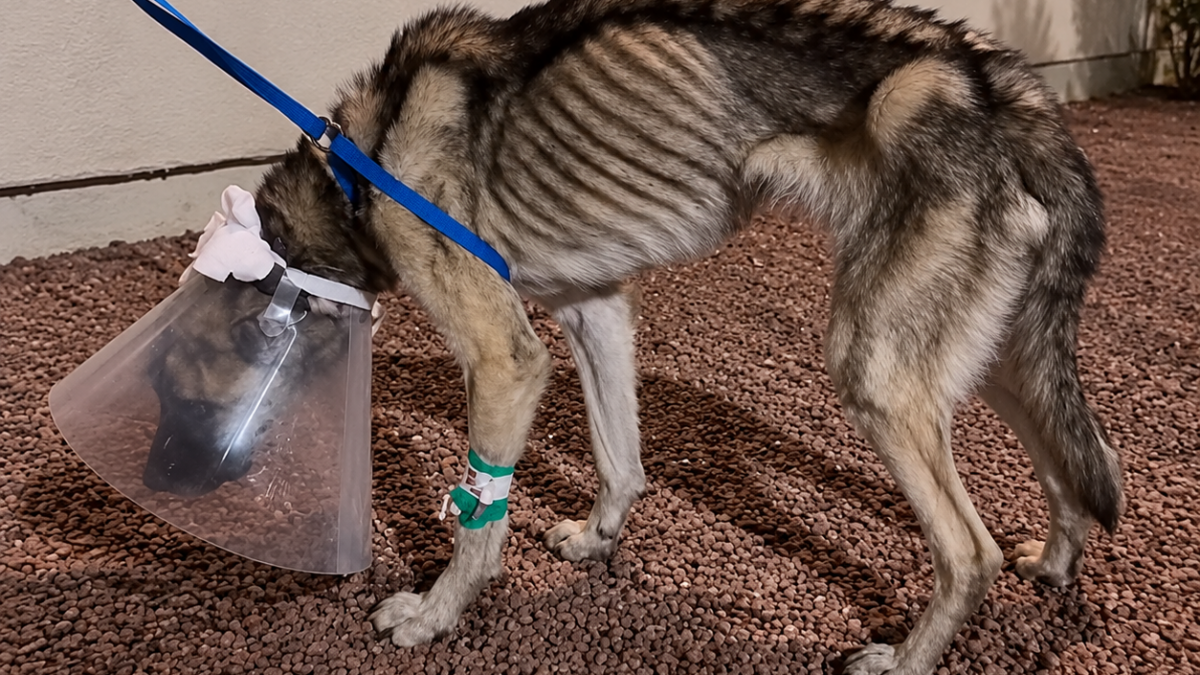
Raider should have weighed close to eighty pounds, but the dog carried through our hospital doors weighed only eighteen.
Every rib, every vertebra, and every sharp edge of his hips showed beneath skin stretched so tightly over his body that I was afraid even touching him might hurt.
We thought starvation was the worst thing someone had done to him, until the first examination suggested something hidden inside Raider might kill him before we ever got the chance to learn how he had become this way.
I had worked around neglected dogs before.
I’d seen animals arrive covered in fleas, dogs with untreated infections, dogs abandoned after injuries their owners couldn’t—or wouldn’t—pay to treat.
But Raider silenced the entire treatment room.
He was a large-breed dog, probably a shepherd and mastiff mix, though at eighteen pounds it was difficult to imagine the animal he was supposed to be.
The technician carrying him didn’t need help.
That alone broke my heart.
A healthy dog his size should have required two arms and effort.
Raider felt almost weightless.
“Easy,” I whispered as we lowered him onto a padded blanket.
He didn’t resist.
He didn’t growl.
He didn’t even lift his head.
His eyes followed us, though.
That was the first thing I noticed about him.
His body looked like it had surrendered.
His eyes hadn’t.
Dr. Melissa Grant ran her hands carefully along his abdomen.
Raider flinched.
“Pain?”
“Looks like it,” I said.
She listened to his heart.
Checked his gums.
Took his temperature.
Then she looked at me.
“I don’t like his abdomen.”
Neither did I.
It wasn’t just empty.
Something about the way he reacted when we touched one particular area made us worry there was more happening than starvation.
We took X-rays.
Normally, that would have given us answers quickly.
With Raider, even the images seemed uncertain.
There were suspicious shapes in his gastrointestinal tract, but he was so emaciated that normal anatomy was difficult to distinguish.
“Could be foreign material,” Dr. Grant said.
“Could it pass?”
She kept looking at the scan.
“Maybe.”
That word scared me.
“Or?”
“Or there’s an obstruction.”
The room became quiet.
An obstruction meant surgery.
Surgery meant anesthesia.
And Raider barely had enough strength to hold his own head up.
His blood pressure could crash the moment anesthesia began.
His heart could fail.
His intestines might already be damaged.
If we waited, whatever was trapped inside him could perforate his bowel or cause tissue to die.
If we operated, the surgery itself could kill him.
There was no safe choice.
Only different kinds of danger.
We drew blood.
Started fluids.
Warmed him gradually.
And waited for numbers that would tell us whether Raider’s body had anything left to fight with.
When the results appeared, Dr. Grant stared at them for several seconds.
“What?”
I asked.
She looked toward Raider.
“They’re better than I expected.”
Not normal.
Not good.
But better.
His body was somehow still compensating.
We called an ultrasound specialist.
By then, Raider had been with us for hours.
He hadn’t barked.
Hadn’t complained.
Whenever someone approached, he simply watched them.
I sat beside him while we waited.
“You don’t have to understand any of this,” I whispered.
His eyes moved toward me.
“But we’re trying.”
I put my hand near his paw.
After several seconds, Raider shifted one skeletal foot until it touched my fingers.
That was all.
But it felt like a decision.
The specialist arrived shortly before evening.
We dimmed the room.
Gel was placed on Raider’s abdomen.
The ultrasound probe moved slowly across his skin.
I watched the specialist’s face instead of the monitor.
Her expression tightened.
Then she stopped.
“Here.”
Dr. Grant leaned closer.
Another angle.
Another silent minute.
Finally the specialist looked up.
“It’s obstructed.”
My stomach dropped.
“Completely?”
“Enough that I wouldn’t wait.”
Dr. Grant looked at Raider.
Eighteen pounds.
A dog who should have weighed nearly eighty.
A dog whose body had consumed almost everything it had just to remain alive.
And now we were going to ask it to survive surgery.
I bent down beside him.
His eyes opened.
“Okay, Raider.”
My voice shook despite everything I did to control it.
“We know what’s hurting you.”
A technician opened the operating-room doors.
Dr. Grant took one breath.
“Let’s go.”
As we wheeled Raider toward surgery, none of us yet knew what the doctors were about to pull from inside him—or what those objects would tell us about just how desperately hungry he had been.
PART 2
The operating-room doors closed behind us.
That was when the fear became real.
Until then, every step had been about getting Raider to the next one.
Warm him.
Stabilize him.
Run bloodwork.
Call the specialist.
Confirm the obstruction.
There was always another task.
Now there was nothing left between Raider and the thing all of us had been trying not to say aloud.
He might not survive.
Dr. Grant scrubbed in while I helped prepare him.
Even under the bright surgical lights, Raider looked impossibly small.
His legs were narrow enough for me to circle with my fingers.
The bones of his pelvis seemed carved beneath the skin.
We placed warming equipment around him because a body with almost no fat has very little ability to regulate temperature.
The anesthetist checked his blood pressure again.
“Still holding.”
Dr. Grant looked over.
“Let’s keep it that way.”
Her voice was calm.
She was always calm before difficult surgeries.
That didn’t mean she wasn’t worried.
I knew her too well.
Raider was induced slowly.
For one terrible second, as his eyes closed, I had the irrational urge to wake him back up.
He’d trusted us while conscious.
Now he had surrendered everything.
The monitor began recording his heart rhythm.
Beep.
Beep.
Beep.
I stared at the green line.
“Pressure?”
“Low-normal.”
“Fluids running.”
“Yes.”
“Temperature?”
“Coming down.”
“Increase warming.”
The incision began.
There are moments in veterinary medicine when you have to separate emotion from function.
You can cry later.
You can get angry later.
You can wonder what kind of human being allows a dog to reach eighteen pounds later.
During surgery, there is only anatomy.
Numbers.
Blood pressure.
Oxygen.
Heart rate.
Tissue.
Dr. Grant worked carefully through Raider’s abdomen.
It didn’t take long before she found the problem.
“There.”
I moved closer.
A section of intestine was distended.
Something was inside.
Several things.
Dr. Grant opened the affected portion carefully.
The first object that came out was a mass of hair.
Then pieces of thin plastic.
Then rubber.
At first I thought the rubber might have come from a toy.
It hadn’t.
They were rubber bands.
Several of them.
Some tangled with hair.
Some wrapped around scraps of plastic.
The collection had formed a dense obstruction inside Raider’s digestive tract.
I stared at the tray.
“How does a dog eat this much garbage?”
Nobody answered.
We all knew.
Hunger.
Not curiosity.
Not one stupid accident.
Hunger.
A dog might swallow one inappropriate thing because it smells interesting.
Raider had swallowed anything his stomach could convince him might be food.
Plastic.
Hair.
Rubber bands.
Things with almost no nutritional value.
Things no well-fed animal would need to consume.
Dr. Grant examined the intestine around the obstruction.
“Viable.”
I exhaled.
“You’re sure?”
“It’s inflamed, but I don’t see necrosis.”
That was the first good news.
If the tissue had died, we’d have needed to remove part of his intestine.
For a dog in Raider’s condition, that would have increased the danger dramatically.
The obstruction was removed.
The intestine was flushed and closed.
Then Dr. Grant ran the rest of Raider’s bowel through her hands section by section.
“Nothing else.”
The anesthetist called out.
“Pressure dropping.”
Every person in the room changed instantly.
“How low?”
Numbers followed.
Not catastrophic.
Not yet.
But falling.
“Bolus.”
“Starting.”
“Heart rate?”
“Stable.”
Dr. Grant didn’t rush.
Rushing causes mistakes.
But her movements became more precise.
Faster.
The surgical field was checked.
No significant bleeding.
Raider’s blood pressure dipped again.
I watched the monitor.
Come on.
I don’t know whether I whispered it or only thought it.
Come on, Raider.
You’ve gotten this far.
Dr. Grant finished closing.
The anesthetist adjusted medication.
Another pressure reading appeared.
Still low.
Then another.
Slightly better.
No one celebrated.
Not yet.
Raider was transferred to recovery with heated blankets wrapped around him.
We reduced anesthesia.
Waited.
His breathing changed.
His eyelids moved.
“Come on, big guy.”
That phrase felt ridiculous for a dog who weighed eighteen pounds.
But he was supposed to be big.
I wanted somebody to speak to the dog he should have been, not the skeleton lying in front of us.
“Come on, Raider.”
His tongue moved.
A few minutes later, his eyes opened.
Cloudy.
Confused.
But open.
Dr. Grant stood beside me.
“He made it through.”
Through surgery.
Not through danger.
There was a difference.
The next seventy-two hours were going to matter almost as much as the operation.
Maybe more.
People hear that a starving animal has been rescued and imagine the solution is simple.
Feed him.
Give him as much food as he wants.
Let him regain his weight.
With a dog like Raider, that could kill him.
His body had adapted to prolonged starvation.
His metabolism had changed.
Electrolytes had shifted.
Suddenly giving him a large amount of nutrition could trigger refeeding syndrome—a dangerous cascade that could affect his heart, muscles, breathing, and nervous system.
We had to bring him back slowly.
Painfully slowly.
Tiny portions.
Carefully calculated calories.
Repeated blood tests.
Electrolyte monitoring.
Fluids adjusted constantly.
Enough nutrition to help.
Not enough to overwhelm.
The cruel irony was impossible to miss.
Raider had been starving so long that even after we had food everywhere around him, we couldn’t simply let him eat.
The first night, I stayed long after my shift ended.
He lay in intensive care beneath warming blankets.
An IV ran into one leg.
A blood-pressure cuff wrapped around another.
His incision was protected.
He slept.
I sat on the floor beside the kennel.
At around two in the morning, his eyes opened.
“Hey.”
His nose moved.
I had a small dish containing the first measured amount of food he was allowed after surgery.
It looked insultingly small.
Less than what most healthy dogs would swallow in seconds.
Raider smelled it.
His head lifted.
The change in him was immediate.
His pupils widened.
His nose worked desperately.
When I offered the food, he lunged harder than his body should have been capable of moving.
“Easy.”
He swallowed the first bite without chewing.
Then searched the dish.
“Slow down.”
He looked at me.
Then at the bowl.
There was nothing left.
His eyes followed my hand as I removed it.
That expression destroyed me.
He didn’t understand.
Food existed.
He was hungry.
Why wouldn’t we give him more?
“I’m sorry.”
He tried to rise.
His legs shook beneath him.
“Raider, no.”
He pushed anyway.
One front leg straightened.
Then the other.
His back end lifted halfway.
For two seconds, he was standing.
Then his body collapsed.
I caught him before he hit the floor.
“Easy.”
He was panting.
All he’d done was try to stand.
That was how little strength he had.
I settled him down.
He kept looking toward the place where I’d put the empty dish.
“I know.”
I stroked his neck.
“I know you’re hungry.”
The most difficult part was knowing he’d probably heard those words before from people who didn’t feed him.
Maybe not exactly those words.
Maybe nobody had spoken to him at all.
But hunger was clearly not new.
Dr. Grant came in early the next morning.
“How’d he do?”
“Tolerated first feeding.”
“Vomiting?”
“No.”
“Diarrhea?”
“No.”
“Pressure?”
“Soft, but acceptable.”
She looked relieved.
“Good.”
Raider received another tiny meal.
Again, he devoured it.
Again, we stopped him from getting more.
Blood was drawn.
Phosphorus.
Potassium.
Magnesium.
Glucose.
Everything that could tell us whether refeeding was beginning to destabilize him.
For most of that day, his numbers held.
That evening, he surprised us by trying to walk.
We supported him with a sling beneath his belly.
“Ready?”
Raider’s front paw moved.
One step.
Then another.
His rear legs trembled.
“Good boy.”
Third step.
His foot slipped.
We caught him.
He tried again.
For perhaps fifteen seconds, he moved under his own power.
Everyone in intensive care watched.
Fifteen seconds wouldn’t sound like much to anyone else.
To us, it was enormous.
“Look at you,” one technician whispered.
Raider looked toward her voice.
His tail moved.
Not a full wag.
Just the end of it.
It was the first time we’d seen it.
Then, that night, his blood pressure crashed.
There was no warning.
One moment his monitor was concerning but stable.
The next, the numbers dropped sharply.
“Raider?”
I opened the kennel.
His gums had become pale.
“Get Dr. Grant.”
People moved fast.
Fluids were adjusted.
Medications were prepared.
Bloodwork repeated.
His abdomen was checked for evidence of postoperative bleeding.
Ultrasound.
Nothing obvious.
Temperature.
Low.
Pressure.
Still too low.
Raider lay on his side while we worked.
He looked more exhausted than he had immediately after surgery.
I remember thinking that this was how it happened.
Not during the dramatic operation.
Not while everyone was prepared for catastrophe.
Hours later.
Quietly.
His body would simply decide it had done enough.
“No.”
I said it under my breath.
A technician beside me looked over.
I don’t know if she realized I was talking to Raider.
“You don’t get to quit now.”
His eyes opened slightly.
We stabilized him through the night.
Barely.
There were moments when his pressure responded.
Then dipped.
Responded.
Dipped.
Each time, the monitor became the entire universe.
By dawn, he was still alive.
Dr. Grant sat down beside me.
Neither of us had really stopped moving for hours.
“What caused it?”
I asked.
“Could be several things.”
“Leak?”
“Nothing suggests it.”
“Sepsis?”
“Possible, but his temperature and labs aren’t pointing strongly that way.”
“Refeeding?”
“Not classic.”
She rubbed her forehead.
“His body has almost no reserve, Emily.”
That was the truth.
A healthy dog can absorb a bad hour.
A healthy dog has muscle, fat, proteins, glycogen, everything the body uses when something goes wrong.
Raider had almost none.
Every complication was bigger because there was nothing behind him.
No cushion.
No reserve.
No backup.
Just eighteen pounds of skin, bone, organs, and determination.
That afternoon, we placed a feeding tube.
The idea sounded frightening to some people when they later heard about it.
For Raider, it was protection.
It allowed us to control every bit of nutrition he received.
Exact amounts.
Exact timing.
Less stress.
Less desperate gulping.
Less work for a dog whose body needed every calorie for healing.
The first tube feeding went smoothly.
Then the second.
Then the third.
His electrolytes remained stable.
His blood pressure slowly improved.
That night, I sat beside him again.
“You scared us.”
His eyes opened.
“You know that?”
Nothing.
“You’re expensive too.”
One ear moved.
“Very expensive.”
He looked at me.
“And you’re not even paying.”
For the first time, I saw something different in his expression.
Not happiness.
Not yet.
But awareness.
Interest.
Maybe even annoyance.
“Was that attitude?”
His ear moved again.
I smiled.
“There you are.”
Raider’s recovery did not move in a straight line.
There were good mornings followed by terrible afternoons.
He’d tolerate three feedings and then develop nausea.
He’d stand with assistance one day and seem too weak to lift his head the next.
His incision looked beautiful.
Then his albumin levels worried us.
His blood pressure stabilized.
Then his glucose dipped.
Every improvement created room for another fear.
We lived by small victories.
No vomiting.
Victory.
Normal temperature for six hours.
Victory.
One bowel movement.
A ridiculous thing to celebrate under normal circumstances.
We celebrated.
When Raider passed stool after his surgery and there was no sign of obstruction or intestinal leakage, one of the technicians came into the treatment room smiling.
“He pooped.”
Three people cheered.
A visitor in reception probably thought we’d lost our minds.
We hadn’t.
We were simply measuring life differently.
On the fourth day, Raider was strong enough to spend a few minutes sitting upright.
I positioned pillows around him.
He looked around the room.
Until then, most of his world had been blankets, hands, needles, tubes, and sleep.
Now he seemed to notice the hospital.
A small terrier barked from another room.
Raider’s ears lifted.
“That’s another dog.”
He turned his head.
The terrier barked again.
Raider opened his mouth.
Nothing came out.
Then he made a low sound.
“Woo.”
I stared.
Raider looked at me.
“Woooo.”
One of the technicians started laughing.
“What was that?”
Raider tried again.
“Woo-woo.”
Suddenly everyone was looking.
“He’s talking.”
Raider’s tail moved.
“Woooo.”
It sounded less like a bark than an old man complaining about customer service.
I laughed harder than I had in days.
“Oh, so now you have opinions?”
“Woo.”
“You’ve been here four days and you’re already complaining?”
“Woooo.”
That became Raider’s voice.
As his strength returned, so did the talking.
Food late by thirty seconds?
“Woo.”
Physical therapy interrupted his nap?
“Woooo.”
Someone walked past without greeting him?
A deeply offended series of grumbles.
Dr. Grant said it was the best clinical sign she’d seen all week.
Not because vocalizing meant his labs were perfect.
Because personality requires energy.
Starvation had reduced Raider to survival.
Eat.
Breathe.
Stay warm.
Endure.
There had been nothing left for curiosity.
Play.
Affection.
Annoyance.
Communication.
Now there was.
Raider was coming back.
But there was one question we had deliberately pushed aside.
Who had done this to him?
Raider had been found near an abandoned service road at the edge of the county.
A utility worker had spotted him lying beside a drainage ditch and initially thought he was dead.
When he approached, Raider raised his head.
That was how animal control became involved.
There was no collar.
No visible identification.
But once Raider was stable enough, a technician scanned him thoroughly for a microchip.
The scanner beeped.
Everyone stopped.
“Again.”
She passed it over his shoulder.
Beep.
A number appeared.
I felt my stomach tighten.
A microchip meant history.
Sometimes nothing useful.
Sometimes everything.
We contacted the registry.
The chip had been implanted nearly four years earlier.
Registered name:
Raider.
So the name we’d been calling him hadn’t been invented by the shelter.
It was actually his.
Registered owner:
Caleb Morrison.
Address on file:
Pine Hollow Road.
Twenty-two miles from where Raider had been found.
Phone disconnected.
Email inactive.
Animal control opened an investigation.
I tried not to think about it.
Raider still needed us focused on recovery.
But anger is difficult to compartmentalize when you’re holding a dog whose hip bones cut through blankets.
An officer named Laura Benton came to the hospital two days later.
“Can I photograph him?”
“Yes.”
“For the investigation.”
I nodded.
Raider was standing with a rehabilitation sling when she entered.
He had gained just over a pound.
It was almost invisible.
He still looked catastrophic.
Laura stopped at the doorway.
I’d seen that reaction before.
People could be told Raider weighed eighteen pounds.
They could see photographs.
Nothing prepared them for seeing him alive.
“Jesus.”
Raider looked toward her.
His tail moved.
Laura swallowed.
“He’s friendly?”
“Too friendly.”
She crouched.
Raider took one shaky step toward her.
Then another.
He sniffed her hand.
She touched his head.
“Hey, buddy.”
Raider leaned into her palm.
Laura’s jaw tightened.
“Somebody did this and he still likes us.”
That sentence stayed with me.
She photographed him carefully.
His side.
His spine.
His hips.
His paws.
His mouth.
His surgical incision.
Then she photographed the foreign material removed from his digestive tract.
The rubber bands.
Plastic.
Hair.
A fragment of what looked like food packaging.
“Can you tell how long he was starving?”
She asked Dr. Grant.
“Not exactly.”
“Weeks?”
“At this severity? Almost certainly longer than a few days. Severe muscle wasting doesn’t happen overnight.”
“Could the obstruction have caused the weight loss?”
“No.”
That mattered.
The owner’s defense, if we ever found him, could not simply be that Raider got sick and suddenly lost weight.
“The obstruction was acute compared to the emaciation,” Dr. Grant explained. “The dog was already severely malnourished before he ate those objects.”
Laura wrote everything down.
“So he was hungry enough to eat trash because he’d already been starving.”
“That’s the most medically consistent explanation.”
Laura closed her notebook.
“We located Morrison.”
I looked at her.
“Where?”
“Still in the county.”
My anger arrived so fast it surprised me.
“What did he say?”
“I haven’t interviewed him yet.”
“Why?”
“Because I want the records first.”
She looked at Raider.
“And because I want a veterinarian to document exactly what we’re dealing with before he has a chance to invent a story.”
That was the first time anyone said it openly.
A story.
Someone was going to have one.
Raider couldn’t tell his.
So we had to make sure the evidence could.
Laura requested Raider’s historical veterinary records using the microchip registration information.
What came back made the room silent all over again.
Raider had once weighed seventy-six pounds.
There was a photograph attached to an old wellness visit.
I stared at it for a long time.
The dog in that picture was magnificent.
Broad chest.
Healthy coat.
Muscular shoulders.
Bright eyes.
The same white mark on his chest.
The same slightly crooked right ear.
Raider.
Our Raider.
Seventy-six pounds.
Standing proudly beside a man wearing a baseball cap.
Caleb Morrison.
My first thought was irrational.
I hated the photograph.
Not because Raider looked bad.
Because he looked loved.
That somehow made everything worse.
If he’d always been neglected, you could imagine ignorance.
Poverty.
Chaos.
A life where nobody ever properly cared.
But someone had once fed him.
Taken him for vaccines.
Posed beside him.
Registered his chip.
Raider had known what a full stomach felt like.
And then someone took that away.
Laura interviewed Morrison the following morning.
We didn’t hear the details until later.
He initially claimed Raider had run away almost a year earlier.
He said he’d searched for weeks.
Posted online.
Called shelters.
Been devastated.
Laura asked for proof.
He produced none.
No missing-dog reports.
No social-media posts.
No shelter contacts.
Then Laura showed him Raider’s intake photograph.
According to her, Morrison looked away.
He said:
“That’s not my dog.”
Laura placed the microchip record on the table.
Morrison changed his answer.
“Well, maybe. He looks different.”
“He’s lost nearly sixty pounds.”
Silence.
Then Morrison tried another explanation.
He said he’d given Raider to someone else.
Who?
A man named Steven.
Last name?
Didn’t remember.
Phone number?
Didn’t have it.
Where did Steven live?
Somewhere north.
When did he take Raider?
Maybe six months ago.
Was there a text?
No.
Email?
No.
Transfer of microchip ownership?
No.
Veterinary records?
No.
It was the kind of story that exists only because the truth is worse.
Laura wasn’t satisfied.
She obtained permission to examine Morrison’s property from the road and later secured a warrant based on additional information.
Behind his house stood a detached garage.
Inside that garage, investigators found a heavy plastic dog crate.
A metal water bowl.
A torn bag of cheap dog food long past its expiration date.
And a chain.
The crate floor was layered with dried waste.
More importantly, hair recovered from the crate was consistent in color and texture with Raider’s coat.
There was no second dog registered to the property.
Morrison changed his story again.
Raider had been kept in the garage temporarily, he said.
Because Raider destroyed furniture.
How long?
A few days.
Investigators spoke to neighbors.
One remembered hearing a dog barking from the garage for months.
Another remembered seeing Morrison walking Raider years earlier but hadn’t seen the dog outside recently.
A delivery driver recalled hearing scratching and barking inside the garage during the summer.
Then a neighbor named Mrs. Alvarez gave investigators what they needed.
She had complained about the barking.
Repeatedly.
And she had saved text messages.
In one exchange from four months earlier, she had written:
Your dog has been crying in that garage all day. Is he okay?
Morrison replied:
Mind your business. He gets fed.
Two weeks later:
I’m serious, Caleb. That dog sounds sick.
Response:
He’s fine. Stop coming onto my property.
Another month passed.
Mrs. Alvarez sent:
I haven’t heard Raider barking in two days. Did you finally move him?
Morrison’s response was one sentence.
Took care of it.
I read those messages sitting in the staff room after Laura brought copies for the medical file.
Took care of it.
I looked through the glass toward Raider’s kennel.
He was asleep under three blankets.
A feeding tube still entered through his nose.
“Took care of it.”
I said the words aloud.
Laura looked at me.
“Yeah.”
“What does that mean?”
“We’re working on it.”
“You know what it means.”
“I know what I suspect.”
“He dumped him.”
“Probably.”
“After starving him.”
“Probably.”
“And he’ll say Raider escaped.”
“Probably.”
I stood.
“How is that enough?”
Laura remained calm.
“Because we don’t charge people on what we feel.”
“Look at him.”
“I have.”
“He’s eighteen pounds.”
“I know.”
“He ate rubber bands because he was starving.”
“I know.”
“Then what are we waiting for?”
“Evidence strong enough that his lawyer can’t turn your anger into doubt.”
That stopped me.
Laura pointed toward Raider.
“If we do this wrong, Morrison gets to walk away and tell everyone the rescue people exaggerated.”
She tapped the copied messages.
“If we do it right, Raider doesn’t need to speak.”
I sat back down.
“His body speaks for him.”
“Exactly.”
That became our rule.
No confrontation.
No public accusations before charges.
No angry social-media posts.
No revenge fantasy.
Documents.
Photographs.
Lab values.
Weight records.
Neighbor statements.
Veterinary testimony.
The discarded objects removed from Raider’s intestine.
The garage.
The messages.
The timeline.
If Morrison had spent months pretending Raider didn’t matter, then we would make every detail matter.
Meanwhile, Raider had his own battle.
On day seven, his feeding tube was removed.
The moment he realized food would now arrive in a bowl again, his entire personality changed.
I carried in the first measured meal.
Raider stood.
Without a sling.
Only for a second.
But he stood.
“Wait.”
I froze.
“Nobody move.”
Everyone turned.
Raider’s legs trembled.
His back was still sharply curved.
But all four paws were underneath him.
“Raider.”
His eyes remained locked on the food.
Of course.
Not us.
The food.
I lowered the bowl.
“Slow.”
He took three steps.
One.
Two.
Three.
Then reached it.
He ate.
Carefully this time.
Not the frantic swallowing from the first nights.
Still eager.
But no longer terrified every bite might disappear before he could get it.
That mattered almost as much as the calories.
Afterward, he looked up.
“Woo.”
I laughed.
“That’s all you get.”
“Woooo.”
“Doctor’s orders.”
“Woo-woo-woo.”
Dr. Grant walked past.
“Is he filing a complaint?”
“Against the portion size.”
“Denied.”
Raider stared after her.
Then looked at me.
“Woooo.”
“Appeal denied too.”
His tail wagged.
A real wag.
Not one movement.
Back and forth.
The entire treatment room erupted.
Someone started recording.
Raider wagged harder because he thought the attention meant more food.
That video became the first time people outside the hospital saw him as more than a skeleton.
Until then, every photograph showed suffering.
That video showed a dog.
A stubborn, dramatic, talkative dog demanding lunch.
He had gained three pounds.
Twenty-one pounds.
Still horrifyingly thin.
But moving forward.
Physical therapy began gently.
Standing on padded surfaces.
Weight shifting.
Short supported walks.
Massage.
Passive range-of-motion exercises.
The rehabilitation specialist, Dana, had the patience of a saint.
“One step.”
Raider stared at her treat pouch.
“One.”
He moved.
“Good.”
Another.
“Good boy.”
Third.
His back leg buckled.
Dana supported him.
“No shame.”
Raider looked offended.
“Woo.”
“I know.”
Another step.
By the end of the session, Raider had walked twelve feet.
We measured it.
Twelve.
The next day, sixteen.
Then twenty-three.
Then from his kennel to the treatment-room door.
He began recognizing the sound of Dana’s cart.
When it appeared, he’d start talking.
“Woooo.”
“That means he’s excited.”
I said.
Dana laughed.
“That means he thinks I have chicken.”
Both were true.
His body began changing slowly.
At twenty-five pounds, his face looked less hollow.
At twenty-eight, the deepest grooves between his ribs softened.
At thirty, he could stand long enough to eat without assistance.
We took weekly photographs from the same angle.
Side view.
Front.
Top.
At first, changes were difficult to see day to day.
Placed beside the first photograph, they were staggering.
The dog was emerging.
But recovery gave Raider enough strength to reveal damage starvation had hidden.
He was afraid of closed doors.
We learned that by accident.
A technician led him into an exam room for a dressing change.
Someone closed the door behind them.
Raider froze.
His body dropped.
Not sitting.
Collapsing.
His pupils widened.
He scratched at the door.
“Open it.”
The technician did.
Raider immediately tried to crawl into the hallway.
I knelt beside him.
“Okay.”
He shook so hard his teeth clicked.
“Okay. Door stays open.”
From then on, doors stayed open whenever possible.
He also panicked when food disappeared.
If he saw someone take an unfinished bowl away—even when the meal was over—he became frantic.
So we changed that too.
We showed him the empty bowl.
Let him sniff it.
Then removed it.
No mystery.
No sudden disappearance.
Raider hated garages.
We didn’t learn that until much later.
But the closed-door fear already told us something.
Whatever happened before the service road had left memories deeper than hunger.
The day animal control formally arrested Caleb Morrison, Raider weighed thirty-three pounds.
Laura called me.
“We got him.”
I stepped into the supply room.
“What charges?”
“Felony aggravated animal cruelty, abandonment, failure to provide necessary sustenance and veterinary care. More may follow depending on the prosecutor.”
My knees actually weakened.
“He’s arrested?”
“Yes.”
“What did he say?”
“You really want to know?”
“Yes.”
“He said everyone was overreacting because it’s ‘just a dog.'”
I closed my eyes.
Just a dog.
Through the small window in the supply-room door, I could see Raider trying to steal a towel from a laundry cart.
“Is he getting bail?”
“Probably.”
“Then what’s the point?”
“The point is the case isn’t over because he goes home tonight.”
I hated that answer.
But Laura was right.
Justice is slower than anger.
Morrison was released pending trial.
Within forty-eight hours, his attorney issued a statement saying Raider had suffered from “an undiagnosed gastrointestinal condition” after disappearing from Morrison’s care.
That was the defense.
The obstruction.
They were going to blame Raider’s condition on the rubber, plastic, and hair we removed.
Dr. Grant read the statement at her desk.
Then she did something rare.
She laughed.
Not because it was funny.
Because it was absurd.
“He wants to use the obstruction?”
“Apparently.”
She turned toward me.
“Good.”
“Good?”
“Yes.”
She opened Raider’s medical chart.
“Because we can disprove that.”
She began compiling evidence.
Historic healthy weight: seventy-six pounds.
Degree of muscle wasting at intake.
Serum values consistent with chronic malnutrition.
Skin and coat changes.
Body condition score.
Fat stores.
Physical findings that could not plausibly develop during the short period expected from an acute intestinal obstruction.
She wrote everything.
Then contacted a veterinary nutrition specialist for an independent opinion.
The conclusion was unequivocal.
Raider’s severe emaciation predated the obstruction.
The obstruction was likely a consequence of food deprivation.
Not the cause of the starvation.
In simple terms:
Raider ate garbage because he was starving.
He wasn’t starving because he ate garbage.
Morrison’s defense had accidentally highlighted the strongest evidence against him.
I printed the specialist’s report.
Read that sentence again.
Then walked to Raider.
“You hear that?”
He was chewing a rubber veterinary toy designed specifically to be safe.
I took it gently.
“Maybe let’s not make rubber your thing.”
“Woo.”
“The court already has enough exhibits.”
Raider smiled.
I don’t know when exactly we first called it smiling.
Dogs don’t smile the way humans do.
But Raider developed an expression when he was comfortable.
Mouth slightly open.
Eyes soft.
Ears relaxed.
The corners of his mouth seemed to lift.
The first photograph of that expression was taken after a therapy session when he weighed thirty-eight pounds.
Dana was sitting on the floor beside him.
Raider had managed to walk the entire rehabilitation hallway.
He turned toward the camera.
And there it was.
The smile.
I stared at the photograph that evening.
Then at his intake picture.
Eighteen pounds.
Collapsed.
Eyes enormous in a skull-like face.
Beside it:
Thirty-eight pounds.
Standing.
Smiling.
Same dog.
I cried.
Not because the first picture was sad.
I’d cried over that enough.
I cried because the second existed.
There had been too many moments when I didn’t believe it would.
Raider remained hospitalized longer than most dogs ever do.
His medical bills were significant.
Donations helped.
A local rescue organization called Second Chance Guardians took legal custody after animal control obtained surrender through the court.
They agreed to fund his continued rehabilitation.
And then came the question we’d all been avoiding.
Where would Raider go when he left?
Foster care first.
Adoption later.
He needed someone experienced.
Someone home often.
Someone willing to follow a strict feeding plan.
Someone patient with his fears.
Someone who understood that gaining weight didn’t mean trauma disappeared.
Applications came in after Raider’s story became public.
Hundreds.
People loved dramatic rescues.
But loving a story and living with the dog inside that story are different things.
Some applicants wanted the famous dog.
Some wanted to “fatten him up” with giant meals despite repeated explanations about controlled nutrition.
One person wrote that Raider needed “a farm where he can toughen up.”
Rejected.
Then I read an application from a woman named Sarah Bennett.
Forty-two.
Worked remotely as a medical transcriptionist.
Owned a small house with a fenced yard.
One older dog named Hazel.
Had fostered medically fragile animals for eight years.
Her answer to the question “Why Raider?” was one sentence.
Because I don’t need him to be grateful; I just want him to be safe.
I read it twice.
Then gave it to Rachel, the rescue coordinator.
“This one.”
Rachel read it.
“Home check first.”
“I know.”
“Meet Hazel.”
“I know.”
“Trial visit.”
“I know.”
She smiled.
“You’re attached.”
“No.”
“Emily.”
“He nearly died in my hands.”
“That’s attachment.”
Sarah came to meet Raider on a Tuesday.
She didn’t rush toward him.
That was the first thing I liked.
Most visitors crouched immediately.
Called his name.
Reached.
Sarah sat on the floor six feet away.
Raider looked at her.
She looked back.
“Hi.”
Nothing else.
Five minutes passed.
Raider approached.
Sniffed her shoe.
Sarah didn’t touch him.
Raider sniffed her hand.
Then leaned against her shoulder.
Sarah’s eyes filled with tears.
But she still didn’t grab him.
“Hi, sweetheart.”
Raider sat beside her.
“Woo.”
Sarah laughed softly.
“Oh, I’ve heard about this.”
“Woooo.”
“You’re very opinionated.”
His tail wagged.
Hazel came for the second meeting.
She was a calm eleven-year-old Labrador with the emotional energy of someone’s grandmother.
Raider sniffed her.
Hazel sniffed him.
Then Hazel walked away and lay down.
Raider followed.
That was the entire introduction.
Perfect.
The home check passed.
The yard was secure.
Food could be separated.
No narrow enclosed spaces Raider would need to enter.
Sarah had already placed non-slip rugs through the house.
A bed stood in the living room.
Another in the bedroom.
Another beside her desk.
“Three beds?”
I asked.
Sarah shrugged.
“He can choose.”
Raider’s foster discharge was scheduled for Friday.
Thursday night, I stayed late.
Again.
Like the first night.
Except now Raider weighed forty-three pounds.
He walked into the treatment room on his own.
Slowly.
A little awkwardly.
But walking.
His coat was coming back.
The wounds over his pressure points had healed.
His incision had become a thin line.
His eyes were bright.
I sat beside him.
“Tomorrow you leave.”
“Woo.”
“You understand?”
He put his paw on my leg.
“I’m supposed to be happy.”
Raider leaned against me.
“I am.”
That was mostly true.
“I just don’t know what I’m supposed to do when you’re not here demanding food every twenty minutes.”
“Woooo.”
“I know. Tragic.”
I put my forehead against his.
“Don’t scare Sarah.”
He licked my chin.
“Don’t eat rubber bands.”
Another lick.
“Don’t eat plastic.”
He yawned.
“Don’t eat her hair.”
Raider rested his head on my shoulder.
I stopped joking.
“Nobody’s going to starve you again.”
His breathing slowed.
“I promise.”
The next morning, every staff member somehow found a reason to be near the lobby.
Raider’s discharge bag was absurd.
Medication.
Food.
Feeding schedule.
Supplements.
Emergency numbers.
Harness.
Blanket.
Toys.
Medical records.
Sarah arrived with Hazel.
Raider started talking the second he saw them.
“Woo-woo.”
Sarah laughed.
“Ready?”
I clipped on his leash.
My hands shook.
“He’s yours for foster.”
“I know.”
“Meals exactly as written.”
“I know.”
“Call if he vomits, stops eating, gets lethargic—”
“I have the instructions.”
“Or if his stool changes.”
“Emily.”
“What?”
Sarah smiled.
“I’ll call.”
I handed her the leash.
Raider walked toward the door.
Then stopped.
He turned.
Looked at me.
My throat closed.
“Go.”
Raider didn’t.
I crouched.
“It’s okay.”
He walked back.
Pressed his head against my chest.
I wrapped my arms around him.
“You go live.”
He stood there for several seconds.
Then turned.
Sarah opened the door.
Sunlight came across the floor.
Raider stepped outside.
No stretcher.
No technician carrying his almost weightless body.
No oxygen.
No feeding tube.
Four paws.
One step.
Then another.
Then another.
I watched until Sarah’s car disappeared.
The treatment room felt enormous afterward.
The kennel Raider had occupied was cleaned.
Blankets removed.
Bowls sterilized.
Chart moved to discharge status.
His name disappeared from the inpatient board.
I hated it.
Then my phone buzzed.
Sarah.
Photograph.
Raider standing in her backyard.
Hazel beside him.
Caption:
He peed on my rosemary and is now yelling at a squirrel. I think we’re okay.
I laughed so loudly Dr. Grant came out of her office.
“What?”
I showed her.
She smiled.
“That’s what we wanted.”
It was.
Raider’s first weeks in foster care were not perfect.
He stole food.
Of course he did.
Sarah discovered he could open one type of kitchen cabinet with his nose.
He ate half a loaf of bread before she caught him.
We all panicked.
Not because bread was poisonous.
Because Raider’s digestive history made any binge frightening.
He was fine.
Sarah installed childproof locks.
Raider considered this a personal betrayal.
“Woooo.”
Sarah sent us the video.
He sat in front of the locked cabinet complaining for almost a full minute.
But his food anxiety slowly changed.
At first, Raider followed Sarah every time she entered the kitchen.
If she touched his food container, he’d tremble.
If Hazel ate before he did, he paced.
If one piece of kibble fell behind a bowl, he searched obsessively.
So Sarah created routine.
Same meal times.
Same place.
Same bowl.
Never skipped.
Never used food as punishment.
Never teased him with it.
Never made him compete with Hazel.
Weeks passed.
Then one evening, Sarah sent a message that made me cry harder than most dramatic updates.
Raider left food in his bowl.
Three pieces.
He ate until he was satisfied.
Then walked away.
Sarah left the bowl there.
Raider went to sleep.
He had learned something.
There would be another meal.
For most dogs, that is nothing.
For Raider, it was recovery.
His weight continued climbing.
Forty-eight pounds.
Fifty-two.
Fifty-eight.
He developed muscle along his shoulders.
His rear legs strengthened.
Dana transitioned his therapy from clinical rehabilitation to longer outdoor walks.
Sarah took videos.
The first showed Raider carefully stepping down her driveway.
Hazel moved beside him.
Raider’s gait was uneven.
He paused every few yards.
But his nose was working constantly.
Grass.
Trees.
Mailbox.
Wind.
The entire ordinary world seemed new.
At the end of the video, Sarah said:
“Ready to go home?”
Raider turned.
And smiled.
That photograph—the one from his first real walk—became my favorite.
Not because he looked fully recovered.
He didn’t.
His ribs were still visible.
His head still seemed too large for his body.
But there was joy in his face.
Not dramatic joy.
No balloons.
No rescue banner.
Just sunlight.
Grass.
A leash held loosely.
And a dog discovering a walk could end at home instead of in abandonment.
Meanwhile, Morrison’s case moved toward trial.
His lawyer offered a plea.
The prosecutor rejected the first deal.
Then another.
Rejected.
Morrison wanted no jail time and no permanent animal-ownership prohibition.
That was unacceptable to everyone involved.
His attorney argued he had financial problems.
Lost work.
Depression.
A difficult divorce.
I didn’t dismiss those things.
Life can destroy people.
But hardship can explain why someone struggles.
It does not explain months of watching an animal shrink from seventy-six pounds to eighteen while keeping him locked in a garage.
There were food banks.
Shelters.
Rescues.
Neighbors.
Animal control.
Veterinarians.
Hundreds of ways to surrender a dog without starving him.
Morrison chose none.
The case went to trial eleven months after Raider was found.
By then Raider weighed sixty-seven pounds.
Not quite his old seventy-six.
But healthy enough that Dr. Grant said his ideal weight might actually be closer to seventy considering his age and build.
Sarah had officially adopted him two months earlier.
Raider Bennett.
His microchip record changed.
That detail mattered more to me than it probably should have.
Owner:
Sarah Bennett.
Not Caleb Morrison.
The prosecutor asked Sarah not to bring Raider to court.
No need.
His photographs would be enough.
I testified first about his hospital course.
The defense attorney was polite.
That almost made it worse.
“Ms. Walker, you’re a veterinary technician, not a veterinarian?”
“Correct.”
“So you cannot independently diagnose the cause of Raider’s weight loss.”
“Correct.”
“You became emotionally involved in his care.”
“Yes.”
“You posted updates about him.”
“With rescue approval.”
“You referred to his condition as starvation.”
“Because the veterinarians treating him diagnosed severe malnutrition consistent with prolonged caloric deprivation.”
The attorney paused.
“You personally did not witness my client withholding food.”
“No.”
“So your opinion about him is based on what others told you.”
“My opinion isn’t why I’m here.”
“What is?”
“I weighed Raider when he arrived.”
Silence.
“Eighteen pounds.”
The attorney moved on.
Dr. Grant testified after me.
That was devastating.
She explained body condition scoring.
Muscle wasting.
How the obstruction could not account for the chronic degree of emaciation.
How Raider’s body had consumed its own fat and muscle tissue for energy.
How the foreign objects were consistent with indiscriminate eating driven by hunger.
Then the prosecutor displayed Raider’s historical veterinary photograph.
Seventy-six pounds.
Healthy.
Next to his intake photograph.
Eighteen.
Several jurors visibly reacted.
Dr. Grant didn’t dramatize it.
She didn’t need to.
“This degree of loss reflects prolonged inadequate nutrition.”
“Could a responsible owner have failed to notice it?”
“No.”
One word.
No.
Morrison’s attorney tried.
“What if Raider had refused food?”
“Then he required veterinary attention.”
“What if he vomited?”
“Veterinary attention.”
“What if the owner could not afford extensive treatment?”
“Then surrender to a rescue, shelter, charitable clinic, or animal-control agency would have been appropriate.”
“What if—”
Dr. Grant remained calm.
“There is no medically reasonable scenario in which allowing a seventy-six-pound dog to deteriorate to eighteen pounds without seeking care constitutes adequate treatment.”
The courtroom went silent.
Laura testified about the garage.
Mrs. Alvarez testified about the barking.
Then the text messages appeared.
Your dog has been crying in that garage all day.
Mind your business. He gets fed.
The jury saw photographs of the crate.
The dried waste.
The empty bowl.
The chain.
Then:
I haven’t heard Raider barking in two days. Did you finally move him?
Took care of it.
The prosecutor produced traffic-camera evidence showing Morrison’s vehicle near the service road the night before Raider was discovered.
That evidence had taken months to locate.
A county road camera wasn’t pointed directly at the dumping location.
But it captured Morrison’s truck entering the road at 11:42 p.m.
Then leaving fourteen minutes later.
No dog was visible.
It didn’t need to be.
Morrison had claimed he hadn’t been near the area in months.
His truck said otherwise.
Then came the evidence I hadn’t known existed.
A receipt.
Convenience store.
11:31 p.m.
Less than four miles away.
Security video showed Morrison buying cigarettes and a drink.
In the truck bed behind him was a large plastic dog crate.
Laura recognized it immediately.
Same model.
Same faded sticker on one corner as the crate later found in Morrison’s garage.
When Morrison returned home that night, a neighbor’s doorbell camera recorded him unloading the crate.
Empty.
That changed the entire case.
The prosecutor laid out the timeline.
11:31 p.m.—Morrison at convenience store, crate in truck.
11:42 p.m.—truck enters service road.
11:56 p.m.—truck leaves.
12:18 a.m.—truck returns home.
12:24 a.m.—empty crate unloaded.
7:10 a.m.—utility worker discovers Raider beside drainage ditch.
Nobody spoke.
Morrison stared at the defense table.
The man who had said Raider wasn’t his dog.
Then said he’d given him away.
Then said Raider ran away.
Then said the dog had gotten sick.
Every story collapsed into fourteen minutes on a road camera.
The prosecutor asked one final witness to testify.
Sarah.
I didn’t expect it.
Neither did Morrison.
Sarah didn’t talk about the worst part.
She talked about afterward.
“How did Raider behave when he came to your home?”
“He guarded food.”
“What do you mean?”
“He didn’t attack anyone. But he couldn’t relax around it. He searched counters. Cabinets. Trash cans. If I moved his bowl, he panicked.”
“Did that improve?”
“Yes.”
“How?”
“Routine.”
“Explain.”
“I fed him every day.”
The simplicity of that answer hit harder than anything else.
“I fed him breakfast. Then dinner. And the next morning, breakfast came again.”
The prosecutor waited.
Sarah’s voice shook.
“Eventually he believed me.”
Several jurors looked down.
“What was the first sign?”
“He left three pieces of kibble in his bowl.”
The defense objected to relevance.
The judge allowed limited testimony.
Sarah continued.
“That was when I knew he understood there would be more food later.”
She looked toward Morrison.
“For him, leaving food behind was trust.”
Morrison testified in his own defense.
That surprised us.
He blamed everything.
His divorce.
Money.
Raider’s behavior.
The obstruction.
He said Raider destroyed things.
Ate trash.
Barked.
Defecated inside the garage.
He claimed he had tried to feed him but Raider “never kept weight on.”
The prosecutor stood.
“How much did Raider weigh at his last documented veterinary visit while healthy?”
“Seventy-something.”
“Seventy-six.”
“Okay.”
“How much did he weigh when found?”
“I don’t know.”
“Eighteen.”
Morrison looked away.
“At what weight did you decide veterinary attention was necessary?”
Silence.
“Sixty?”
“No.”
“Fifty?”
“I don’t know.”
“Forty?”
“He wouldn’t eat right.”
“Thirty?”
No answer.
“Twenty?”
Morrison’s lawyer objected.
The judge overruled.
The prosecutor stepped closer.
“At what point between seventy-six pounds and eighteen pounds did you call a veterinarian?”
“I didn’t have money.”
“At what point did you call a shelter?”
Silence.
“Animal control?”
Silence.
“A rescue?”
Silence.
“A friend?”
Nothing.
“You had a phone?”
“Yes.”
“You had a truck?”
“Yes.”
“You bought cigarettes the night Raider disappeared?”
Morrison stiffened.
“Yes.”
“You purchased gasoline that week?”
“Obviously.”
“You had the means to drive Raider to the service road?”
The defense objected.
Sustained.
The prosecutor changed direction.
“Mr. Morrison, why did you tell Investigator Benton you hadn’t been near that road?”
“I didn’t remember.”
“Why did you say Raider ran away?”
“I was confused.”
“Why did you say you’d given him to a man named Steven?”
“I was stressed.”
“Why did you initially say the dog in the photograph wasn’t Raider?”
“He didn’t look like him.”
That answer destroyed him.
The prosecutor turned toward the jury.
“Why didn’t he look like him?”
Morrison said nothing.
Because eighteen pounds doesn’t look like seventy-six.
Closing arguments finished the next morning.
The jury deliberated four hours.
I spent those hours with Sarah in a hallway.
She showed me videos of Raider.
In one, he was rolling on his back in the grass.
In another, Hazel stole his bed and Raider stood beside her complaining.
“Woooo.”
I laughed.
“He’s healthier than my blood pressure right now.”
Sarah smiled.
Then the courtroom officer opened the door.
“Verdict.”
We returned.
Morrison stood.
The jury foreperson did not look at him.
Guilty.
First count.
Guilty.
Second.
Guilty.
Third.
I stopped hearing each individual word.
Sarah gripped my hand.
Laura closed her eyes.
Dr. Grant remained perfectly still.
Morrison stared forward.
No dramatic outburst.
No confession.
No apology.
Just consequences.
Sentencing happened several weeks later.
The judge reviewed Raider’s photographs before speaking.
He called the neglect “prolonged, obvious, and entirely preventable.”
Morrison received a custodial sentence combined with probation under the applicable counts, mandatory counseling, restitution toward Raider’s veterinary expenses, and a lengthy prohibition against owning or possessing animals.
The court also authorized continued monitoring after release.
Was it enough?
Some people said no.
Some wanted years more.
Some wanted him to experience hunger.
Pain.
Fear.
I understood the anger.
I’d felt versions of it myself.
But revenge became less important to me every time I looked at Raider.
Because Morrison had already lost the thing he treated as disposable.
Raider.
And Raider had won everything Morrison tried to take from him.
Food.
Health.
Safety.
A yard.
A family.
A name attached to someone who wanted him.
That was the justice I cared about.
The most satisfying moment didn’t happen in court.
It happened two days after sentencing.
Sarah invited several of us to her house.
Dr. Grant.
Dana.
Laura.
Rachel from the rescue.
Me.
Raider met us at the gate.
Not eighteen pounds.
Not twenty.
Not forty.
Seventy-one.
Seventy-one pounds of muscle, fur, enormous paws, and opinions.
I barely had time to open the gate.
He hit me in the chest.
“Raider!”
He stood on his back legs.
Something he once couldn’t do for half a second.
His front paws landed on my shoulders.
I almost fell.
“You’re too big!”
“Woooo!”
Everyone laughed.
I wrapped my arms around him.
There was weight there now.
Real weight.
Warm body.
Muscle.
Life.
I remembered carrying him into treatment with almost no effort.
Now he could knock me over.
It was the best problem I’d ever had.
Sarah had prepared a small dinner for us.
Raider and Hazel wandered through the yard.
At one point, Raider found a fallen leaf and chased it.
Just a leaf.
He jumped sideways.
Pounced.
Missed.
Spun around.
Tried again.
Dana stood beside me.
“Look at his rear legs.”
Strong.
Steady.
No trembling.
No sling.
No one supporting him.
“He doesn’t even know we’re watching.”
“Good.”
That mattered.
Raider didn’t need to perform recovery anymore.
He could simply be a dog.
Later, Sarah measured his dinner.
Still controlled.
Still healthy.
But an actual meal.
Raider ate.
Then drank water.
Then something happened.
Three pieces of kibble remained.
Again.
He looked at them.
Looked toward Sarah.
Then walked away.
I felt tears come immediately.
“You’ve got to be kidding me.”
Sarah smiled.
“He does it all the time now.”
Raider climbed onto his bed.
Turned around.
Lay down.
Three pieces of food sitting ten feet away.
Untouched.
Because somewhere inside him, the dog who once swallowed plastic and rubber bands to quiet his stomach finally believed there would be breakfast tomorrow.
That was when I understood what healing really was.
Not seventy-one pounds.
Not a healed incision.
Not normal bloodwork.
Trust.
The ability to walk away from food.
The certainty that hunger wasn’t coming back.
Raider lived with Sarah for years.
I remained part of his life.
How could I not?
On the anniversary of his rescue, Sarah brought him to the hospital.
The first year, he walked through the doors confidently.
The staff screamed his name.
Raider immediately started talking.
“Woo-woo-woo!”
“Yes, we remember you.”
He visited the scale.
Sixty-nine point eight pounds.
“Perfect,” Dr. Grant said.
Raider looked insulted that stepping on the scale produced no food.
“Woooo.”
“Still dramatic.”
She examined him.
Heart good.
Abdomen good.
Muscle good.
Coat beautiful.
Then she crouched and held his face.
“You had absolutely no business surviving.”
Raider licked her nose.
She laughed.
“Apparently you disagree.”
The hospital kept his intake photograph in our staff education room.
Not publicly.
We didn’t want Raider’s suffering turned into decoration.
But new veterinary technicians saw it during training when we taught severe malnutrition and refeeding protocols.
Beside it was a photograph from one year later.
Raider standing in Sarah’s yard.
Healthy.
Mouth open.
Smile visible.
Underneath, Dr. Grant had written:
TREAT THE PATIENT IN FRONT OF YOU, NOT THE ODDS AGAINST HIM.
Raider taught us that.
Years passed.
Hazel grew older first.
She had been eleven when Raider moved in.
At fourteen, her health declined.
Raider had always followed her.
Hazel had taught him things humans couldn’t.
How to sleep while Sarah cooked without checking every sound.
How to wait by the door without panicking.
How to understand a closed bathroom door didn’t mean abandonment.
How to walk past the trash can.
Mostly.
When Hazel’s final day came, Sarah arranged for a veterinarian to come to the house.
Raider lay nearby.
After Hazel died, he walked over.
Sniffed her gently.
Then lay beside her.
Sarah called me crying.
“I think he knows.”
He probably did.
For weeks afterward, Raider slept in Hazel’s bed.
Then gradually, he stopped.
Life rearranged itself.
Sarah eventually fostered another dog.
A frightened hound named Lucy.
Lucy wouldn’t eat around people.
Wouldn’t approach.
Wouldn’t come inside without coaxing.
Raider became her teacher.
The starving dog who had once panicked over food would finish his meal, step back, and lie down while Lucy cautiously ate hers.
He never tried to take it.
Not once.
Sarah sent me a video.
Raider lying six feet away.
Lucy eating.
I watched it three times.
“What?”
Dr. Grant asked.
I showed her.
She was quiet.
Then said:
“That’s one hell of a full circle.”
It was.
Raider had gone from competing with garbage for survival to making another scared dog feel safe around food.
By the time Raider reached what we estimated was eleven or twelve years old, his face had gone gray.
His hips stiffened.
The surgery from years earlier never caused long-term problems, but arthritis did what age eventually does.
Sarah installed ramps.
Raider initially refused them.
Of course.
He was Raider.
He preferred to complain at the stairs until someone helped.
“Woooo.”
One day, I visited.
He was asleep near Sarah’s couch.
I sat beside him.
His eyes opened.
The tail started.
Slowly.
“Hey, big guy.”
He tried to stand.
“No.”
He stood anyway.
Stubborn.
Always.
He walked toward me.
Then pressed his head into my chest.
I buried my face in his fur.
He smelled like dog shampoo and sunshine.
Nothing like the antiseptic blankets from that first week.
“Remember me?”
“Woo.”
“Good answer.”
Sarah brought coffee.
We sat in the yard.
Raider lay between us.
“You know,” she said, “I used to think his worst habit was food theft.”
“What changed?”
“He snores louder now.”
Raider opened one eye.
“She’s talking about you.”
“Woooo.”
We laughed.
That was Raider’s life.
Not dramatic every day.
That was the victory.
Ordinary mornings.
Walks.
Squirrels.
Vet appointments.
Naps.
Friends.
A woman who knew exactly how much breakfast he needed and never once forgot to provide it.
His final decline began quietly.
He started sleeping more.
Then eating less.
That frightened Sarah because food had always been Raider’s great certainty.
She brought him in.
Bloodwork.
Ultrasound.
X-rays.
This time, the news couldn’t be fixed with surgery.
Cancer.
Aggressive.
Already spread.
The room went silent.
Sarah sat on the floor with him.
“How long?”
Dr. Grant answered gently.
“Weeks. Maybe a couple months with supportive care. But we need to watch his comfort.”
Sarah nodded.
Raider looked between us.
“Woo.”
Everyone laughed and cried at the same time.
Even then.
Still talking.
Sarah chose comfort.
No brutal chemotherapy.
No desperate procedures that might buy miserable days.
Pain control.
Favorite walks.
Good food.
Sunshine.
People.
Raider had spent too much of his early life suffering because someone else didn’t care what he needed.
His final days would be about exactly what he needed.
I visited often.
So did Dana.
Laura came once in uniform.
Raider remembered her.
He walked straight over.
“Woo.”
Laura crouched.
“You know I arrested your old owner?”
Raider licked her face.
“I’ll take that as gratitude.”
She stayed almost an hour.
Before leaving, she stood at the gate looking back at him.
“The case changed how our office handles neglect calls.”
I looked at her.
“How?”
“We used to prioritize obvious injuries. Broken bones. Bleeding. Immediate violence.”
She nodded toward Raider.
“Now severe weight loss gets escalated faster.”
That mattered.
Raider’s suffering had become training.
Procedure.
A reason the next starving dog might be reached sooner.
Dana’s rehabilitation clinic created an emergency fund in Raider’s name for severely emaciated animals.
The hospital revised its written refeeding protocol using lessons from his case.
Second Chance Guardians developed a foster guide for food-insecure dogs.
Sarah helped write it.
Even years later, Raider was still helping dogs he’d never meet.
His last good day came in October.
The air was cool.
Leaves covered Sarah’s yard.
I arrived after work.
Raider was outside.
Standing.
He looked thin again.
Not eighteen pounds thin.
Nothing like that.
But illness had taken weight.
For a moment, seeing his ribs frightened me in a way I couldn’t explain.
The past and present overlapped.
Then Raider saw me.
His tail wagged.
“Woooo.”
I laughed.
“Still complaining?”
He walked toward me.
Slowly.
I knelt.
He leaned against me.
Sarah was sitting on the porch.
She already knew.
So did I.
Raider had barely eaten that morning.
He’d fallen twice.
His breathing was changing.
Dr. Grant was coming that evening.
We spent the afternoon outside.
No hospital.
No machines.
No needles until the end.
Sarah offered Raider things he’d never been allowed during his controlled recovery.
A little hamburger.
Pieces of chicken.
A spoonful of vanilla ice cream.
He ate some.
Not all.
Years earlier, uneaten food meant healing.
Now it meant goodbye.
That was difficult to accept.
Near sunset, Dr. Grant arrived.
Dana came.
I was already there.
Sarah placed Raider’s bed beneath the maple tree.
He lowered himself onto it.
His breathing was slow.
Sarah sat on one side.
I sat on the other.
“Do you remember the first night?” I asked Dr. Grant.
She smiled sadly.
“I remember thinking he wouldn’t survive anesthesia.”
“You didn’t tell me that.”
“I didn’t need to.”
“I knew.”
Raider opened his eyes.
“Woo.”
We all laughed.
“Yes.”
I touched his ear.
“We’re talking about you.”
Sarah leaned down.
“You know how many people love you?”
Raider breathed.
She put her forehead against his.
“You never have to be hungry again.”
That sentence broke me.
I had heard variations of it for years.
Said it myself.
But now it meant something different.
Never again.
Not because Sarah would feed him tomorrow.
Because Raider’s fear of hunger was ending forever.
Dr. Grant prepared the medication.
Sarah looked at me.
“I can’t.”
I took her hand.
“You can.”
“What if he thinks I’m giving up on him?”
I thought of Raider at eighteen pounds.
His eyes.
That refusal to die.
Then I looked at the old dog resting peacefully beneath a tree.
“No.”
I said.
“He fought because he wanted a life.”
I touched his shoulder.
“You gave him one.”
Sarah cried.
“Years.”
“Years.”
She looked down.
Raider licked her fingers.
I said softly:
“He doesn’t owe us another fight.”
Sarah closed her eyes.
Then nodded.
Dr. Grant gave the first medication.
Raider relaxed.
His head settled into Sarah’s lap.
I kept one hand on his chest.
“You were eighteen pounds when I met you.”
His breathing slowed.
“You scared the hell out of us.”
A soft exhale.
“You ate rubber bands.”
Dana laughed through tears.
“Plastic.”
Another breath.
“Hair.”
Sarah stroked his face.
“Then you ate my bread.”
His tail moved once.
She laughed.
“Yeah. I know.”
I leaned closer.
“You learned food comes back.”
Raider’s eyes were nearly closed.
“You learned people come back too.”
My throat tightened.
“And now nobody’s leaving you.”
Sarah kissed his forehead.
Dr. Grant administered the final medication.
Raider took one breath.
Then another.
Then rested.
No alarms.
No crashing blood pressure.
No emergency surgery.
No hunger.
He died weighing sixty-six pounds.
Not because the number mattered anymore.
But I remembered eighteen.
I would always remember eighteen.
Sarah kept her hand on him long after his heart stopped.
The sun disappeared behind the trees.
Eventually she whispered:
“Is he really gone?”
Dr. Grant nodded.
Sarah cried into Raider’s fur.
I looked at his body and felt the strange mixture grief sometimes brings.
Devastation.
And gratitude.
We had wanted more time.
Of course.
But Raider had received what once seemed impossible.
Years.
He had gone home.
He had grown old.
The dog whose body had nearly been destroyed by neglect had lived long enough for age to become the final thing we fought.
That was a victory.
Morrison was eventually released from custody under supervision.
His animal-ownership restriction remained.
Laura checked more than once.
He never legally owned another dog.
Some people asked whether I wished the sentence had been harsher.
Maybe.
But by then, Raider had taught me a different definition of revenge.
Morrison’s last real power over Raider had ended the day that utility worker stopped beside the drainage ditch.
Everything afterward belonged to Raider.
The surgery Morrison never paid for.
The food he never provided.
The rehabilitation he never bothered to seek.
The home he never deserved to share.
The walks.
The toys.
The couch.
The friends.
The old age.
You want to know what revenge looked like?
It looked like Raider becoming seventy-one pounds.
It looked like him leaving three pieces of kibble because he knew breakfast would come.
It looked like his microchip changing to Sarah Bennett’s name.
It looked like court records permanently documenting what had been done to him.
It looked like other dogs being helped because professionals learned from his case.
It looked like the man who once called him a problem being legally barred from owning animals while Raider slept safely inside a warm house.
Most of all, it looked like time.
Years Morrison had almost stolen.
Years Raider got anyway.
After Raider died, Sarah brought his collar to the hospital.
She didn’t want to keep everything.
“Could you put this somewhere?”
I held it.
His blue collar.
Worn.
Soft from years of use.
His tag still attached.
RAIDER BENNETT.
I looked at Sarah.
“You sure?”
She nodded.
“I have his first foster tag.”
She smiled through tears.
“And about nine thousand pictures.”
“Only nine thousand?”
“Maybe twelve.”
We placed Raider’s collar beside the two photographs in the education room.
Not as a memorial to suffering.
As evidence of what recovery can look like.
Eighteen pounds.
Then seventy-one.
Below the photographs, we added another sentence.
STARVATION WAS SOMETHING THAT HAPPENED TO HIM. IT WAS NOT WHO HE WAS.
That distinction matters.
Raider wasn’t “the starving dog.”
He was loud.
Stubborn.
Food-obsessed.
Affectionate.
Suspicious of garages.
Terrified of missing meals until he learned not to be.
He loved chicken.
Hated rain.
Argued with squirrels.
Snored.
Stole bread.
Helped Lucy learn to eat without fear.
Leaned his entire body against anyone he trusted.
And for reasons nobody understood, he adored yellow tennis balls despite never learning to bring one back after it was thrown.
You’d throw it.
Raider would run.
Pick it up.
Then walk away.
“Bring it back!”
“Woo.”
That was Raider.
The worst thing done to him was dramatic.
His life wasn’t.
Thank God.
His life became beautifully ordinary.
Months after he died, Sarah fostered another severely underweight dog.
Her name was Molly.
Not as critical as Raider had been.
But frightened.
Food insecure.
She arrived at Sarah’s house and refused to enter the kitchen.
Sarah sat on the floor.
Didn’t pull.
Didn’t coax too hard.
Didn’t rush her.
Eventually Molly walked in.
Sarah sent me a photograph.
Beside Molly’s bowl was Raider’s old stainless-steel water dish.
I called immediately.
“You’re using his bowl?”
“Water only.”
I laughed.
“Still.”
There was a pause.
Then Sarah said:
“I think he’d approve.”
I looked toward Raider’s photograph on the hospital wall.
“Only if she leaves him some chicken.”
Sarah laughed.
Life kept moving.
That’s the hard part.
And the mercy.
New dogs entered the hospital.
New emergencies.
New families.
Some stories ended well.
Some didn’t.
Every time a dangerously thin animal arrived, somebody on staff mentioned Raider.
Not as false reassurance.
We knew better than that.
Not every dog survives.
But Raider reminded us that the body can surprise you.
That numbers guide us but don’t tell the entire story.
That an eighteen-pound dog who should weigh eighty can still have stronger bloodwork than expected.
Can survive anesthesia.
Can survive obstruction surgery.
Can survive a blood-pressure crash.
Can tolerate refeeding.
Can stand.
Can walk.
Can talk.
Can smile.
Can go home.
And can live long enough to become gray.
Several years later, a new technician named Olivia joined us.
One afternoon, she stood in front of Raider’s photographs.
“Is that really the same dog?”
“Yes.”
“That’s impossible.”
“No.”
I stood beside her.
“It just looks impossible.”
She read the story in his training file.
Then pointed toward the tray photograph showing the objects removed from his intestine.
“He ate all that?”
“Yes.”
“Why?”
I looked at the intake photo.
Because that’s always the question.
Why would an animal eat rubber bands?
Plastic?
Hair?
The answer sounds simple until you understand what it means.
“He was hungry.”
Olivia went quiet.
Then looked at the recovery photograph.
“And he really recovered?”
“Yes.”
“Completely?”
I thought about closed doors.
Food panic.
Garages.
The way trauma sometimes follows even after the body heals.
“Not completely.”
I answered.
“But enough.”
Enough to trust.
Enough to play.
Enough to love.
Enough to walk away from a full bowl.
Enough to grow old.
Sometimes enough is an extraordinary thing.
On the anniversary of Raider’s death, Sarah and I drove out to the place where he’d been found.
I’d never visited.
Laura gave us the approximate location.
It was unremarkable.
A service road.
Weeds.
Trees.
A drainage ditch.
Cars could barely be heard from the main highway.
I stood there trying to imagine Raider that morning.
Eighteen pounds.
Too weak to walk far.
Abandoned.
How long had he lain there?
Did he expect Morrison to return?
Did he try to follow the truck?
Did he eat the plastic before or after being dumped?
Some questions don’t deserve answers because imagining them only creates pain.
Sarah seemed to feel the same.
She didn’t stay near the ditch.
Instead, she walked toward a patch of grass where sunlight came through the trees.
She placed something there.
A small stone.
I read it.
RAIDER
HE LEFT NOTHING IN THE BOWL BECAUSE HE FINALLY KNEW THERE WOULD BE MORE.
I stared at her.
“That’s going to make me cry.”
“That’s the plan.”
“You’re terrible.”
“I learned from you.”
We sat beneath the trees.
Sarah opened her phone.
Raider photographs.
Of course.
There was the first day home.
Raider asleep with his face pressed against Hazel.
Raider barking at a vacuum.
Raider stealing bread.
Raider in snow.
Raider refusing his ramp.
Raider wearing a ridiculous birthday hat.
Raider beside Lucy.
Raider asleep on Sarah’s couch with all four legs in the air.
Then she found the video.
His first walk after leaving the hospital.
I knew it immediately.
Raider stepped carefully down the driveway.
Thin.
Uncertain.
Hazel beside him.
Sarah’s voice behind the camera.
“Easy, Raider.”
He sniffed the grass.
Took another step.
Stopped.
Looked back.
Then smiled.
We watched without speaking.
When the video ended, Sarah said:
“That’s the moment.”
“What?”
“The moment I knew.”
“Knew what?”
“That he was going to be mine.”
I smiled.
“You were fostering.”
“I know.”
“You told everyone you were fostering.”
“I lied.”
“I knew it.”
She laughed.
Then became quiet.
“I just couldn’t imagine him ever wondering where home was again.”
That sentence stayed with me.
Maybe that was the entire story.
Raider survived surgery.
But survival wasn’t the ending.
Raider gained weight.
But weight wasn’t the ending.
Morrison was convicted.
But punishment wasn’t the ending either.
Home was the ending.
A dog who had been deprived of nearly everything eventually reached a place where nothing essential was uncertain.
Food.
Water.
Warmth.
Safety.
Touch.
Tomorrow.
That’s what Sarah gave him.
That’s what Raider fought to reach.
People often think rescue happens when you remove an animal from danger.
Sometimes that’s only the beginning.
The real rescue might happen months later when a dog doesn’t flinch as you close a door.
When he sleeps without waking at every sound.
When he stops searching the trash.
When he stops guarding crumbs.
When he discovers toys.
When the leash means a walk instead of being taken away.
When hands mean affection instead of fear.
When the bowl becomes empty because he is full—not because there was never enough.
Raider’s body told us what had happened.
Eighteen pounds told us.
The rubber bands told us.
The plastic told us.
The muscle wasting told us.
His panic around food told us.
His fear of enclosed spaces told us.
Morrison’s messages told us.
The garage told us.
The camera footage told us.
The court eventually listened.
But Raider’s recovery told us something too.
It told us what happens when cruelty stops.
When medicine takes over.
Then patience.
Then routine.
Then love.
He should have weighed almost eighty pounds.
When he arrived, he weighed eighteen.
I still have the original intake sheet.
Weight: 18.2 lbs.
Every time I see that number, I remember lifting him.
How easy it was.
That should never be an easy memory.
A dog Raider’s size should feel heavy in your arms.
He should force you to adjust your grip.
He should make your back complain.
He should take up space.
Years later, during one of his visits, Raider jumped against me and nearly knocked me over.
I yelled:
“Get off!”
Everyone laughed.
I didn’t push him away immediately.
Because I could feel all seventy pounds of him.
And there are few things in my life that have ever felt better.
I hope people remember Raider that way.
Not as eighteen pounds.
Not as bones beneath skin.
Not as the dog on an operating table while we removed garbage from his intestine.
Remember him standing in Sarah’s yard.
Remember his crooked ear.
Remember the stupid tennis ball he refused to return.
Remember him yelling at squirrels.
Remember him leaving three pieces of kibble behind.
Remember the first smile.
Remember the first walk.
Remember the dog who once couldn’t stand taking slow steps into sunlight because somebody was waiting beside him.
Raider’s suffering was real.
So was what came afterward.
And if there is one image I will carry for the rest of my life, it isn’t the intake photograph.
It’s the last photograph Sarah sent before he became seriously ill.
Raider was sleeping on the couch.
Gray around the muzzle.
His body healthy.
One paw hanging off the cushion.
Lucy curled against his back.
On the coffee table nearby sat an open bag of dog treats.
Raider could have reached them.
He didn’t.
He was asleep.
Completely relaxed.
A dog who once swallowed plastic because his stomach was empty could sleep beside food without fear.
Because he knew.
When he woke up, someone would feed him.
When night came, someone would stay.
When morning arrived, he’d still be home.
That was Raider’s revenge.
He survived long enough to stop being afraid of tomorrow.








