PART 2: He Hid Behind a Garage With a Chain Around His Neck—Then One Tiny “Meep” Revealed the Dog He’d Been All Along**
PART 2
I stayed as still as I could while Beaker slept.
There are moments during rescue work when you feel useful because you are doing something tangible. You are carrying an animal, making a phone call, arranging medical care, preparing food, opening a kennel, signing paperwork, or driving somewhere as quickly and safely as possible.
And then there are moments when the most important thing you can do is nothing.
That afternoon, my job was simply to let Beaker sleep.
His head rested across my lap with the surprising weight of total surrender. Every few minutes one of his paws twitched. Once, his nose moved as though he had caught the scent of something in a dream. I wondered what a dog like him dreamed about when his body finally stopped expecting the next bad thing to happen.
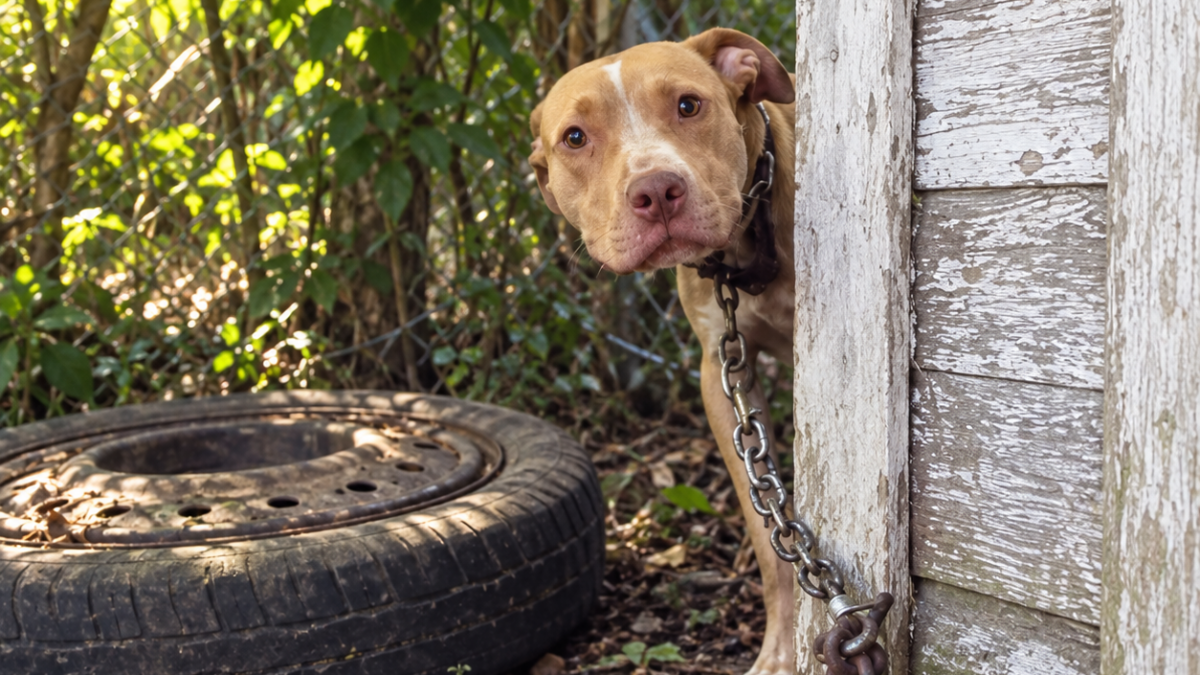
I kept thinking about the place where I had first seen him.
That patch behind the garage.
The way he had folded himself into the smallest version of his own body.
There had been no dramatic barking, no frantic jumping, no aggressive display designed to warn us away. His strategy had been quieter than that.
Hide.
Watch.
Wait.
Those behaviors tell you something.
Not everything.
Rescue work teaches you to be careful about inventing an animal’s history. A dog cannot sit across from you and explain exactly what happened yesterday, last month, or last year. You can observe his condition. You can document what you find. You can respond to the needs directly in front of you.
And what was directly in front of me was enough.
Beaker had been abandoned.
He had been left chained.
The chain around his neck required veterinary intervention.
Those were facts.
The rest was written in smaller clues—the hesitation, the caution, the way affection seemed almost shocking to him at first.
But what amazed me was how quickly another side of him appeared.
The moment kindness became predictable, Beaker wanted more of it.
A lot more.
He had rolled over for belly rubs with almost comic enthusiasm.
He had leaned his whole body into attention.
And then there was that sound.
“Meep.”
I looked down at him and smiled.
“You really are strange, buddy.”
One eye opened.
His head stayed on my lap.
“Meep.”
I laughed again.
“Yeah. You.”
His eye closed.
That was Beaker.
Even before he was physically free of the last piece of what had happened to him, his personality was already pushing through.
The wait lasted more than five hours.
Five hours can feel endless when you are worried.
Every time someone came near the vehicle, I looked up.
Every time a door opened in the distance, I wondered whether it was time.
Beaker alternated between watching and sleeping.
When he became nervous, I spoke quietly.
When he settled, I let silence do the work.
At some point, I realized he had stopped checking me every few seconds.
That small change nearly broke me.
When I first approached him, Beaker had studied every movement as though he needed to calculate whether staying near me was safe.
Now he was sleeping.
He had decided, at least for that moment, that nothing bad was going to happen while his head was resting on me.
People talk about earning an animal’s trust as though it is an accomplishment for the human.
That day it felt like the opposite.
It felt like a gift Beaker had chosen to give despite having every reason to be cautious with it.
Eventually, it was time.
I touched his shoulder.
“Come on, buddy.”
His head lifted.
For a second he looked confused, and then his tail tapped once.
“Time to get you fixed up.”
“Meep.”
“Exactly.”
We went inside.
The veterinarian understood immediately why we had come.
Beaker needed the chain removed safely, and that meant a procedure rather than forcing something that could cause him more harm.
I stayed close as long as I could.
When the time came to let the veterinary team take over, Beaker looked back at me.
That look stayed with me.
He had known me for only hours.
Hours.
Yet I felt an almost irrational urge to explain everything to him.
I wanted to tell him that this was not abandonment.
That I was not handing him over because I was finished with him.
That the strangers taking him through that doorway were going to help.
That when he woke up, something that had trapped him would finally be gone.
Instead, I rubbed the side of his face.
“You’re okay,” I said. “Go with them.”
He hesitated.
Then he went.
The door closed.
And suddenly the space beside me felt enormous.
Waiting during an animal’s procedure creates a strange kind of silence.
Your mind fills it with every possible outcome.
I tried not to do that.
I reminded myself that Beaker was where he needed to be.
I reminded myself that trained professionals were taking care of him.
I reminded myself of the way he had rolled onto his back for affection.
Still, I kept seeing that chain.
Not as a symbol.
As a real object that had been stuck around the neck of a living animal who could not remove it himself.
For Beaker, freedom had depended on someone else noticing.
That thought made me angry.
Not the loud kind of anger.
Something colder.
Because neglect rarely announces itself with dramatic music or a villain standing beside it explaining what he has done.
Sometimes neglect looks like an animal hidden behind a building.
Sometimes it looks like a chain that has been there too long.
Sometimes it looks like a frightened dog learning that no one is coming.
The only reason Beaker’s story changed was that eventually someone did come.
When I finally received word that the procedure had been successful, the breath left my lungs so quickly that I had to sit back.
The chain was gone.
That sentence sounds simple.
The chain was gone.
But for Beaker, those four words divided his life into two parts.
Before.
And after.
When I saw him again, he was tired.
Of course he was.
He had been through a stressful day, a long wait, and a medical procedure.
But the thing I noticed first was his neck.
Nothing binding it.
Nothing tethering him to the place where he had been left.
I crouched near him.
“Hey, Beaker.”
His eyes lifted.
The tail moved.
Then came the sound.
“Meep.”
I covered my mouth with my hand.
One of the people nearby smiled.
“That’s him?”
“That’s him.”
“Beaker?”
“Listen to him.”
As if summoned for a performance, he made the noise again.
“Meep.”
That was it.
The name stayed.
Beaker.
It fit him too well to argue with.
But naming him was the easy part.
Getting him healthy and emotionally settled would take time.
A rescue does not end when an animal is lifted into a car.
It does not end when a chain is removed.
It does not end at the veterinary clinic.
Sometimes that is where the real work begins.
Beaker needed somewhere safe to recover.
A foster home offered him that chance.
The first time he entered a real home environment after the rescue, I watched him carefully.
Everything was different.
The floor.
The rooms.
The sounds.
The smells.
The simple fact that he could move from one place to another without reaching the end of a chain.
He investigated cautiously.
That uncertainty returned for a while.
He would take a few steps, stop, look around, then continue.
A soft bed waited for him.
He sniffed it.
Walked around it.
Sniffed it again.
I almost laughed.
“You’re allowed to use that.”
He looked at me.
“Yes. You.”
He placed one paw on it.
Then another.
A few moments later, Beaker was standing completely on the bed as if he had just successfully solved a complicated puzzle.
His foster caregiver sat nearby without crowding him.
“That’s yours,” she said.
Beaker lowered himself slowly.
For a few seconds he stayed upright, head raised.
Then he sank down.
His body disappeared into softness.
His eyes widened.
And I swear there was a moment when he looked offended that nobody had told him beds existed.
I smiled.
“There you go.”
His tail moved against the cushion.
That became one of my favorite parts of watching Beaker recover.
Ordinary things amazed him.
A comfortable place to sleep.
A meal arriving reliably.
A hand reaching toward him only to scratch behind his ears.
A door opening without forcing him into danger.
A person walking away and then coming back.
Routine.
People underestimate routine.
For a frightened animal, routine can be a language.
Breakfast comes.
The water bowl stays full.
Nobody yanks the chain.
Nobody abandons you outside.
Night comes.
The house becomes quiet.
Morning comes.
The same kind faces are still there.
Again.
And again.
And again.
Trust is often built that way—not in a single dramatic moment, but through repetition.
Beaker started learning.
The first days were not a perfect montage of instant happiness.
He was still figuring out a world that had suddenly become much larger.
There were moments when unfamiliar sounds made him hesitate.
Moments when he paused before entering a new space.
Moments when he looked toward people as though waiting for instructions.
But with every passing day, the balance shifted.
Fear took up less room.
Beaker took up more.
That timid dog who had once compressed himself behind a garage began stretching across beds like he had paid rent.
He discovered that human laps could be used as pillows.
He discovered that belly rubs were apparently available without limit.
He discovered play.
Most importantly, he discovered choice.
He could approach.
He could move away.
He could sleep.
He could explore.
He could lean into a person because he wanted affection, not because a chain determined the radius of his world.
One afternoon I watched him trot toward another dog with a burst of energy that made me stop.
There was nothing hesitant about him.
His body looked loose.
His ears were alert.
His tail was high enough to show confidence without tension.
He wanted to play.
The other dog responded, and suddenly Beaker was moving across the space with the kind of joyful awkwardness that made everyone nearby laugh.
I stood there staring.
Someone said, “He’s a completely different dog.”
I knew what they meant.
But I shook my head.
“No,” I said. “I think this was always him.”
That difference mattered to me.
Beaker had not magically become a sweet dog because people rescued him.
The sweetness had been there behind the garage.
We had seen it in that first tail wag.
We had felt it when he leaned into us.
We had heard it in the ridiculous little meep that earned him his name.
Fear had covered his personality.
Safety uncovered it.
There is a difference.
And once Beaker understood he was safe, he blossomed fast.
He became affectionate.
Playful.
Expressive.
The kind of dog who wanted connection.
The kind of dog who could turn a quiet room into laughter because he had decided something deserved an excited little “meep.”
His foster home gave him something he had been missing before we met him: stability.
Not excitement.
Not grand gestures.
Stability.
That was what allowed healing to happen.
He began sleeping deeply.
Not the light, ready-to-run sleep I had seen at first.
Real sleep.
The kind where his legs stretched out and his face softened.
Sometimes he would fall asleep after playing and end up in some ridiculous position with his belly exposed.
Every time I saw that, I remembered the first time he rolled over after being freed.
Even then, with the day still chaotic around him, his instinct had been to ask for affection.
Now he could ask whenever he wanted.
And he did.
Frequently.
One day I sat beside him and rubbed his chest.
“You know you’re spoiled now, right?”
His tail started.
“You’re going to have expectations.”
“Meep.”
“Oh, you already have expectations?”
Another sound.
I laughed.
“Unbelievable.”
He pressed his head into me.
That was Beaker’s revenge on everything that had happened to him.
Not violence.
Not anger.
Not destruction.
He became happy.
I know people sometimes want rescue stories to end with the person responsible being confronted, punished, or publicly humiliated.
I understand the instinct.
When you see an animal in distress, anger comes easily.
But Beaker’s documented story did not give me some cinematic villain to chase through a courtroom.
What it gave me was something quieter and, in its own way, more powerful.
The chain lost.
Fear lost.
Abandonment lost.
Every time Beaker stretched across a soft bed, they lost.
Every time he received a meal and never had to wonder when the next one would come, they lost.
Every time he ran toward a person instead of hiding, they lost.
Every time that strange little “meep” came out because he was excited, they lost.
And every time Beaker closed his eyes in a home where nobody intended to leave him chained and forgotten, the life that had once been forced on him became a little less important than the life he was building now.
That did not erase what happened.
Healing is not erasure.
But it changed what happened next.
Weeks passed.
Beaker grew more comfortable.
His foster family began sending updates that made it difficult to remember the frightened shape I had first seen behind the garage.
“He’s doing great.”
“He wants to play constantly.”
“He follows us around.”
“He loves attention.”
I smiled at every message.
There was another important observation.
Beaker seemed likely to thrive with another playful, energetic dog.
It made sense.
He enjoyed companionship.
He learned from interaction.
Another confident dog could give him both company and reassurance as he continued adjusting to his new life.
That became part of what we hoped to find for his future.
Because foster care, by design, is usually a bridge.
The goal is not only to rescue an animal from danger.
The goal is to get that animal ready for the next chapter.
A permanent home.
A family.
A place where temporary safety becomes ordinary life.
That is where rescue becomes emotionally complicated.
You celebrate the progress.
Then you realize the dog is ready to leave.
People sometimes ask foster families, “How can you give them up?”
The answer is never as simple as people expect.
You do not give them up.
You send them forward.
At least that is what you tell yourself when your chest hurts.
Beaker deserved forward.
He deserved someone who would look at him and see not “that abandoned dog” but simply Beaker.
The affectionate one.
The playful one.
The funny one.
The dog with the sound nobody could imitate properly.
The dog who wanted another canine friend.
The dog who had discovered beds and seemed determined to make up for lost sleeping time.
The dog who leaned against people because now he understood they could be safe.
As Beaker recovered, that became the next challenge.
Finding the right place.
Not merely any available home.
The right one.
A dog can survive being moved.
That does not mean every move is easy.
After everything Beaker had experienced, we wanted his next transition to build on the trust he had developed rather than shake it.
So we watched.
We learned.
We paid attention to what made him comfortable.
His personality was telling us what he needed.
And for the first time, his needs mattered.
That sentence stayed with me.
His needs mattered.
Such a simple principle.
Yet Beaker’s entire rescue could be understood through it.
Behind the garage, his need for safety mattered.
At the veterinary clinic, his medical need mattered.
During those five hours in the car, his need for calm companionship mattered.
After surgery, his need for recovery mattered.
In foster care, his need for routine mattered.
And now, when thinking about a permanent future, his need for the right environment mattered.
Nobody was asking Beaker to accept whatever was convenient for humans anymore.
Humans were adjusting themselves for him.
That is what care looks like.
Not pity.
Responsibility.
I visited him after he had been in foster care long enough to settle into the rhythm of the household.
The door opened.
For half a second there was silence.
Then Beaker recognized me.
His entire body reacted.
Tail.
Ears.
Feet.
That unmistakable sound.
“Meep!”
I laughed before I could stop myself.
“There he is.”
He ran toward me.
Ran.
The dog who once had to measure the distance between himself and a stranger now closed the distance without hesitation.
He pressed himself against my legs.
I crouched.
He tried simultaneously to lick me, lean against me, roll over, and make his strange noises.
“Pick one,” I told him. “You can’t do everything at once.”
Apparently, he disagreed.
He attempted all of it again.
His foster caregiver was laughing.
“He remembers you.”
That hit harder than I expected.
I rubbed both hands along his shoulders.
“Yeah,” I said quietly. “I think he does.”
Beaker suddenly rolled onto his back.
Of course.
I stared at him.
“You’ve learned nothing.”
His tail hammered against the floor.
I gave him the belly rub.
He closed his eyes.
And for a few seconds I was back on the day of the rescue.
Only everything had changed.
There was no chain.
No garage wall behind him.
No uncertainty about whether the person approaching meant danger.
His body was relaxed.
His world was bigger.
He trusted.
I looked at the foster caregiver.
“He really is thriving.”
“He is.”
She looked down at him.
“He just wants love.”
That was the sentence.
The entire story in five words.
He just wanted love.
Not perfection.
Not luxury.
Not some extraordinary life.
Safety.
Food.
Companionship.
Play.
A soft place to sleep.
Gentle hands.
Someone who came back.
The things animals ask from us are often painfully simple.
Beaker’s story made that impossible to ignore.
I sat on the floor for a while with him.
He eventually climbed partly across my legs and settled.
I scratched behind one ear.
“You remember the car?”
His eyes stayed half closed.
“Five hours.”
No reaction.
“You used me as a pillow.”
His tail moved.
“And now look at you.”
For some reason, that was when emotion caught up with me.
Not during the chain removal.
Not during the procedure.
Not even when he had first fallen asleep on my lap.
It happened sitting on an ordinary floor while Beaker relaxed against me.
Maybe because emergencies do not always leave room for feeling.
When something needs to be done, you do it.
Later, when the danger is over, your mind finally understands what almost happened.
If nobody had discovered him.
If nobody had looked behind the garage.
If everyone had assumed somebody else would take care of it.
How long would Beaker have waited?
I stopped myself there.
There is a point where imagining alternate endings becomes useless.
Beaker had been found.
He had been helped.
He was safe.
That was the reality worth holding.
He shifted closer.
“Meep.”
I laughed through the tightness in my throat.
“You always know when things get too serious, don’t you?”
His foster caregiver smiled.
“That sound still cracks me up.”
“It saved the whole day when we found him.”
I told her again about the first time.
The cautious tail wag.
The slow approach.
The way he leaned against us.
Then the tiny noise.
She shook her head affectionately.
“Beaker.”
“Exactly.”
Names are funny.
Sometimes a name is planned.
Sometimes it is inherited.
Sometimes a dog makes a bizarre sound at exactly the right moment and names himself.
Beaker had named himself.
In a way, it felt appropriate.
From the beginning, even when almost everything else had been decided for him, Beaker had insisted on contributing something of his own.
A sound.
A personality.
A spark.
As he became healthier and more confident, that spark grew.
Soon we were no longer talking about a frightened chained dog.
We were talking about what kind of forever family would match an energetic, affectionate dog who enjoyed canine companionship.
That shift was enormous.
His past had become background information instead of his entire identity.
That is one of the best moments in rescue.
When the question changes from “How do we save him?” to “What kind of life will make him happiest?”
Beaker had reached that point.
He was ready for more than survival.
He was ready to belong.
And yet belonging cannot be rushed.
There were people who would see his story and feel sorry for him.
Pity alone was not enough.
A permanent home needed patience.
Consistency.
Understanding.
Ideally, another playful dog.
People willing to continue the work his foster home had begun.
People who understood that adopting a rescued animal is not collecting a happy ending.
It is accepting responsibility for everything that comes after the dramatic part of the story is over.
Meals.
Vet care.
Exercise.
Training.
Bad weather.
Unexpected messes.
Early mornings.
Late nights.
Ordinary Tuesdays.
Years.
Love becomes real in those ordinary days.
That was what Beaker needed.
Not a person who wanted to rescue him for one emotional afternoon.
A person who wanted him on the boring days too.
Especially the boring days.
I wanted him to become ordinary.
That may sound strange.
But ordinary was exactly what had been denied to him.
I wanted Beaker to become somebody’s dog.
Not “the dog with the chain.”
Not “the abandoned dog.”
Not “the dog found behind the garage.”
Just Beaker.
The dog sleeping upside down on the couch.
The dog waiting beside the food bowl five minutes before dinner.
The dog racing another dog across the yard.
The dog making a ridiculous noise at the front door.
The dog whose fur ended up on clothing and furniture.
The dog whose people automatically stepped around him in the kitchen because he had decided the least convenient spot was where he wanted to lie.
Ordinary.
Safe.
Loved.
There is enormous dignity in an ordinary life after chaos.
During Beaker’s recovery, I kept returning to the memory of his first tail wag.
At the time, it had been tiny.
Almost nothing.
If I had looked away for a second, I might have missed it.
But that tail wag contained the entire possibility of what came afterward.
He had not surrendered completely to fear.
Some part of him was still willing to consider us.
That was all we needed.
Not instant trust.
A possibility.
We took one slow step.
He gave us one cautious wag.
We spoke gently.
He came closer.
He leaned against us.
From there, everything followed.
Sometimes rescue is less about dragging an animal toward safety and more about creating enough safety that the animal chooses to move toward you.
Beaker chose.
Again and again.
He chose to approach.
He chose to lean in.
He chose to roll over.
He chose to sleep on my lap.
He chose to explore his foster home.
He chose to play.
He chose to trust.
Those choices mattered because for too long choice had not been available to him.
The chain around his neck had been the most obvious symbol of that.
A chain defines distance.
You can go this far.
Not farther.
Your world ends here.
When the veterinarian removed it, Beaker’s physical boundary disappeared in a single procedure.
The emotional boundary took longer.
But that one was disappearing too.
Day by day.
Room by room.
Person by person.
I began receiving pictures of him in different places around the foster home.
Beaker on a bed.
Beaker stretched across the floor.
Beaker looking toward another dog.
Beaker leaning against someone.
In almost every image, he occupied space confidently.
That detail fascinated me.
The first image in my mind was always the same: Beaker trying to become small.
Now he seemed to be learning the opposite.
I belong here.
I can stretch out.
I can walk into the middle of the room.
I can ask for attention.
I can make noise.
I can exist without apologizing.
Perhaps humans read too much into animals sometimes.
I know that.
But the physical change was undeniable.
Fear alters posture.
Safety does too.
The foster home was showing in the way Beaker carried himself.
Then came one of those evenings that makes rescue feel worth every difficult moment.
I was sitting nearby while Beaker played.
He moved fast, darting after his canine companion, turning, bouncing back, then racing in the opposite direction.
At one point he slid slightly, recovered, and looked around as if embarrassed.
Everyone laughed.
Beaker responded with an excited:
“Meep!”
That made us laugh harder.
He ran again.
I watched his legs carry him wherever he wanted to go.
No chain stopping him.
No fixed radius.
No garage corner.
Just movement.
He ran until he was tired.
Then he came over, dropped beside us, and rolled onto his back.
Naturally.
“You have one move,” I said.
His paws hung loosely.
His tongue slipped partly out of his mouth.
Someone rubbed his belly.
He looked completely ridiculous.
Completely happy.
And there it was.
The ending people had wanted from the moment we found him.
Except it was not an ending.
It was life.
That distinction became important to me.
Rescue stories are often told like fairy tales.
The dog is found.
The dog is saved.
The dog is happy.
The end.
But the happiest part is that there is no real ending.
The good part keeps going.
Another breakfast.
Another walk.
Another nap.
Another game.
Another evening.
Another morning.
That is the victory.
Beaker did not need one perfect final scene.
He needed thousands of safe ordinary scenes stacked on top of one another until the terrible ones no longer controlled him.
And that was happening.
Eventually, conversations about adoption became more serious.
Beaker was recovering well.
His personality was clear.
He had shown us what kind of environment would likely help him continue thriving.
Now we needed people who could see him not as a project, but as family.
I found myself strangely protective during those conversations.
Someone could be kind and still not be the right fit.
Someone could genuinely love dogs and still have a home that did not match Beaker’s needs.
Saying no when a match is wrong can be uncomfortable.
But rescue is not about avoiding uncomfortable conversations.
It is about the animal.
Beaker had already spent enough of his life adapting to circumstances he did not choose.
We could afford to be patient now.
He could afford to wait somewhere safe.
That was a privilege he had not possessed before.
And while he waited, he kept changing.
He became more playful.
More affectionate.
More secure.
The longer he lived surrounded by kindness, the harder it became to imagine him behind that garage.
One afternoon, I showed someone a picture from earlier and then a newer picture.
“Same dog?” they asked.
“Same dog.”
They stared.
“He looks totally different.”
Again, I thought of my earlier answer.
Not different.
Revealed.
The real Beaker had been under the fear all along.
One gentle approach had started uncovering him.
One successful veterinary procedure had removed what physically trapped him.
One foster home had given him room to expand into himself.
And one day, somewhere ahead, the right permanent family would hopefully give him the rest.
That was what we were working toward.
Not revenge.
Not punishment.
A future.
The older I get, the less interested I am in revenge stories anyway.
I understand why people crave them.
Cruelty creates a desire for balance.
We want the person responsible to feel exactly what the victim felt.
But animals like Beaker taught me another kind of justice.
Give back what was taken.
If fear took his confidence, help him rebuild it.
If neglect took his comfort, surround him with care.
If a chain took his movement, let him run.
If abandonment taught him that people disappear, become the person who returns every morning.
There is a fierce kind of justice in restoration.
Beaker became living proof.
The most satisfying response to what had happened to him was not watching somebody else suffer.
It was watching him stop suffering.
That was enough.
More than enough.
Months from now, years from now, I knew certain images would remain.
Beaker peeking cautiously from behind the garage.
The first tiny wag.
His body leaning into us.
His belly exposed.
His head on my lap.
The empty space around his neck after surgery.
The soft bed.
The foster home.
The running.
The playing.
The meep.
Especially the meep.
I sometimes imagined what I would say if I could explain the entire journey to the Beaker I first met.
I would crouch at the edge of that garage again.
I would not rush him.
I would wait until his eyes met mine.
Then I would say:
“You don’t know me yet.
You don’t have to.
But a few hours from now, you’re going to fall asleep on me.
The chain around your neck is going to come off.
You’re going to wake up without it.
After that, you’re going somewhere warm.
There will be food.
There will be a bed.
There will be people who want you near them.
You’re going to discover that you like playing.
You’re going to make that ridiculous noise so many times that everybody will associate it with you.
And one day, people are going to look at you and have trouble believing you were ever this frightened.”
Of course I could not tell him any of that.
The Beaker behind the garage would not have understood.
So I gave him the only promise I could actually make in that moment.
A gentle voice.
A slow approach.
A hand that did not hurt him.
Sometimes that is where an entirely different life begins.
Not with a speech.
With evidence.
Kindness has to become evidence.
Beaker needed proof that humans could be safe.
We gave him a little.
He took a chance.
Then we gave him more.
He took another.
Trust grew.
That is the thing about trust after neglect.
You cannot demand it.
You cannot tell an animal, “You’re safe now,” and expect his nervous system to understand your vocabulary.
You show him.
Again.
Again.
Again.
Eventually, the body believes what the words cannot explain.
Beaker’s body believed.
I could see it whenever he slept.
A frightened dog sleeps differently.
He keeps part of himself available for escape.
But Beaker in foster care could disappear completely into rest.
Head down.
Muscles soft.
Breathing slow.
Sometimes belly up.
Sometimes pressed against another warm body.
Safe enough not to watch the room.
I loved seeing that more than almost anything.
Sleep is trust without performance.
There is nobody to impress while you are asleep.
No rescue story to tell.
No camera to acknowledge.
Just a living creature deciding that for the next hour, he does not have to protect himself.
Beaker earned that kind of sleep.
He earned every soft surface beneath him.
Every full meal.
Every game.
Every scratch behind the ears.
Every person saying his ridiculous name.
“Beaker.”
Every answer.
“Meep.”
Eventually, I had to accept something else.
Beaker did not need me in the same way anymore.
That realization was bittersweet.
On the day I found him, I had been necessary.
He needed someone to approach.
Someone to transport him.
Someone to stay.
Someone to connect him with veterinary care.
But successful rescue reduces that emergency dependence.
The goal is not to remain the hero forever.
The goal is to help the animal build a life in which heroes are unnecessary.
Beaker was getting there.
When I visited, he was happy to see me.
But he was not desperate when I left.
That mattered.
He had other people.
He had routine.
He had security.
His whole world no longer hinged on whether I was in the room.
That was success.
I remember standing near the door after one visit.
Beaker followed me.
For a second my chest tightened.
Then his foster caregiver called his name.
He turned.
His tail wagged.
She held out a hand.
Beaker trotted back toward her.
No panic.
No frantic scrambling.
Just a dog moving comfortably between people he trusted.
I watched him go.
“That’s what I wanted,” I whispered.
Beaker looked back once.
“Meep.”
Then he kept walking.
I smiled all the way to my car.
His story was no longer about the garage.
It was no longer really about the chain either.
Those things explained where we met him.
They did not explain who he was becoming.
Beaker was becoming the dog who expected breakfast.
The dog who knew what a bed was.
The dog who wanted to play with other dogs.
The dog who leaned into affection because he had learned it would not disappear the second he accepted it.
The dog who slept.
The dog who ran.
The dog who trusted.
The dog who made people laugh.
That was the Beaker worth remembering.
And somewhere, eventually, there would be a family ready for exactly that dog.
Maybe they would first hear about the chain.
Maybe that was what would make them stop scrolling and look at his face.
But I hoped that when they met him, they would forget the chain almost immediately.
I hoped he would walk toward them.
I hoped his tail would start wagging.
I hoped he would lean against one of them before they expected it.
And I hoped, at exactly the right moment, he would look up and say:
“Meep.”
Then they would understand.
They were not meeting a tragedy.
They were meeting Beaker.
That was the victory.
The dog I found trying to disappear had learned that he was allowed to be seen.
The dog who had been confined had learned to move freely.
The dog who had been abandoned had learned that people could stay.
And the dog who had every reason to close his heart had done something far braver.
He opened it.
Beaker’s future was still being written, and his permanent home was still the dream ahead of him, but he no longer waited for that future in fear.
He waited from a safe foster home.
With food.
With comfort.
With play.
With affection.
With people who cared whether he was happy.
Sometimes I think back to those five hours in the car.
Of all the dramatic moments in his rescue, that quiet stretch may have been the most important.
He could not know what surgery meant.
He could not understand why we were waiting.
He could not know what foster care was or what adoption might eventually mean.
He knew only what existed beside him.
A lap.
A hand.
A person who stayed.
That was enough for him to close his eyes.
And maybe that is why the memory still moves me.
Before Beaker had a foster home, before his medical problem was resolved, before anyone could promise him anything about tomorrow, he experienced one small piece of safety and decided to trust it.
He rested his head on my lap.
I did not move.
Five hours earlier, he had been hiding behind a garage.
Now he was asleep.
The physical distance between those two places was nothing.
The emotional distance was enormous.
Beaker crossed it himself.
All I did was stay beside him while he crossed.
Today, when I think of him, I do not picture a chain first.
I picture that tail.
I picture him running.
I picture him stretched across something soft.
I picture a dog leaning into people because affection is no longer a rare event he has to beg for.
And I hear that tiny ridiculous sound.
“Meep.”
People sometimes say rescued animals should be grateful.
I never liked that idea.
Beaker did not owe us gratitude.
Safety should not have been extraordinary.
Kindness should not have surprised him.
Freedom should not have required a rescue.
Those things should have belonged to him from the beginning.
What I felt was gratitude in the opposite direction.
I was grateful he took the chance to trust us.
Grateful he showed us his personality.
Grateful that after whatever uncertainty he had known, some part of him still believed the next human might be different.
And grateful that this time, he was right.
His happiest revenge was simple.
He lived.
He healed.
He played.
He trusted.
He became impossible to ignore.
And every peaceful day that followed was proof that the frightened dog behind the garage had never been weak.
He had simply been waiting for the moment when surviving could finally become living.
Beaker did not need the world to apologize to him.
He needed the world to change around him.
For once, it did.
And if you had stood beside me in those first uncertain minutes, watching that thin little tail begin to move, you might have thought you were witnessing one frightened dog deciding whether to take a single step toward a stranger.
I know better now.
I was watching the first step of his entire new life.
Months passed, and the strangest thing happened.
The memory of the chain began to fade.
Not completely. I don’t think I will ever forget the sight of it around Beaker’s neck or the way my stomach tightened when I realized it could not simply be slipped off. I will never forget the veterinary clinic, the long hours in the car, or the moment he finally rested his head across my lap because exhaustion had overcome whatever fear remained inside him.
But those images stopped being the first ones that came to mind when I heard his name.
Instead, I started thinking about the ridiculous way he ran through the foster home when he became excited.
I thought about the way his paws skidded slightly when he tried to turn too quickly.
I thought about his obsession with belly rubs and the complete lack of dignity he displayed whenever someone sat close enough to provide them.
Most of all, I thought about that sound.
“Meep.”
It had become his signature.
Sometimes he made it when someone came home.
Sometimes he made it when another dog invited him to play.
Sometimes he seemed to make it for no reason at all.
Every time I heard it, I remembered the frightened animal behind the garage and wondered how something so joyful had survived inside him.
One afternoon I received another update from his foster family.
The message was simple.
“You need to see him today.”
I called immediately.
“Is something wrong?”
There was a pause.
Then laughter.
“No. For once, absolutely nothing is wrong.”
Those words felt almost strange.
In rescue work, people often call because something has happened.
A dog has stopped eating.
A wound looks worse.
A foster placement is struggling.
A veterinary appointment produced unexpected news.
There is always another problem waiting to be solved.
But this time there was no emergency.
I drove over anyway.
When I walked through the door, Beaker came charging toward me with so much enthusiasm that I barely had time to brace myself.
“Beaker!”
He slammed gently against my legs, tail whipping from side to side.
“Meep!”
I crouched and wrapped my arms around him.
“All right, all right. I missed you too.”
He immediately rolled onto his back.
I laughed.
“You are predictable.”
His paws curled toward his chest while I scratched his belly.
The foster caregiver stood nearby smiling.
“He’s been doing that all morning.”
“Demanding attention?”
“No. Running.”
I looked toward her.
“Running?”
She nodded toward the backyard.
“Watch.”
Beaker jumped up when she opened the door.
Another dog was already outside.
The second Beaker saw him, his whole body changed.
He lowered his front legs playfully, tail high, then exploded forward.
The other dog chased him.
Beaker flew across the grass.
There was no hesitation.
No invisible line stopping him.
No fear that he had moved too far.
He ran toward the fence, turned sharply, raced back across the yard and bounced sideways when his companion caught up.
I stood in the doorway without saying anything.
The foster caregiver glanced at me.
“You okay?”
“Yeah.”
I swallowed.
“I’m just remembering the garage.”
She understood immediately.
We watched Beaker run another circle around the yard.
His mouth was open.
His ears bounced.
When he reached the porch again, he looked at us and made that ridiculous excited noise.
“Meep!”
Then he took off again.
I laughed, but my eyes were burning.
There are moments when a rescue becomes real in a different way.
Saving an animal from immediate danger is one thing.
Watching that animal reclaim something that was once denied to him is another.
Beaker had been chained.
Now he was running because he could.
Nobody was calling him back.
Nobody was deciding the length of his world.
He chose where to go.
He chose when to stop.
He chose when to return.
That afternoon, he ran until both dogs collapsed beneath the shade near the porch.
Beaker stretched out on his side, panting happily.
I walked over and sat beside him.
He lifted his head.
“You tired?”
His tail thumped once.
“I’ll take that as a yes.”
He laid his head on my shoe.
For several minutes we simply sat there.
I realized then that Beaker’s greatest victory was not dramatic.
It was not something that could fit neatly into a headline.
His victory was choice.
A choice to run.
A choice to rest.
A choice to approach a person.
A choice to walk away.
A choice to sleep without keeping one eye open.
Those choices were ordinary for most dogs.
For Beaker, they were freedom.
And freedom had changed him.
A few weeks later, we began discussing his permanent home more seriously.
There had already been interest.
Beaker was affectionate, playful and undeniably memorable.
People saw his pictures and fell in love with him quickly.
But loving a photograph was different from building a life with the dog in it.
We wanted somebody who understood that.
Someone patient.
Someone willing to give him consistency.
Someone who would see his history without allowing that history to become the only thing they saw.
And ideally, Beaker would have another playful dog.
He seemed happier with canine companionship.
Another dog gave him confidence, structure and a friend who understood a language humans never fully could.
There were inquiries.
Some sounded promising.
Some clearly were not right.
We waited.
That was difficult.
When you know an animal is ready for his next chapter, waiting feels unfair.
But rushing can be worse.
Beaker had already experienced enough instability.
If we had the luxury of choosing carefully, we were going to use it.
Then one evening I received a call.
“There’s a family I think you should meet.”
“What are they like?”
“They have another dog. Fenced yard. They’ve adopted before.”
I remained quiet.
Those things sounded good, but checklists never told the whole story.
The voice on the phone continued.
“They didn’t ask what was wrong with him.”
That caught my attention.
“What did they ask?”
“They asked what makes him happy.”
I smiled.
“When can we meet them?”
The introduction was arranged.
I arrived early.
Maybe I was nervous.
Maybe I was pretending I wasn’t.
Beaker had no idea anything important was happening.
He was busy investigating a toy he had apparently decided needed to be carried from one side of the room to another repeatedly.
When the family arrived, I watched them carefully.
There were no dramatic reactions.
No one rushed Beaker.
No one immediately grabbed his face or wrapped their arms around him.
They entered calmly.
They let him look.
They let him sniff.
That mattered.
Beaker stood several feet away at first.
For a moment I saw a shadow of the dog behind the garage.
Not the same fear.
Just caution.
The man crouched.
He didn’t reach.
“Hey, Beaker.”
Beaker stared.
The woman sat beside him.
Their dog stood nearby, interested but relaxed.
Beaker looked at the other dog.
Then at the people.
Then at me.
I smiled.
“You can go.”
Of course he had no idea what the words meant.
Still, he took a step.
Then another.
The other dog moved forward.
They sniffed each other.
Beaker’s tail started.
The woman laughed softly.
“There it is.”
I looked at her.
“What?”
“That little wag.”
She had noticed.
That told me something.
Beaker moved closer.
The man still had not reached for him.
Instead he waited until Beaker crossed the final distance himself.
Then he slowly touched the side of Beaker’s neck.
Beaker leaned in.
My chest tightened.
I had seen that before.
The first day.
The same motion.
The same quiet request for closeness.
Only this time, Beaker was not desperate.
He was choosing.
The man smiled.
“Hi, buddy.”
Beaker looked up.
And then, as if he understood that the moment needed something only he could provide, he made the sound.
“Meep.”
Everyone froze.
The woman burst out laughing.
“That’s real?”
I laughed too.
“I told you.”
“Meep.”
The family’s other dog bounced forward.
Beaker responded instantly.
Within minutes, the two dogs were chasing each other across the yard.
We stood watching.
The couple asked questions.
Good ones.
What food was he eating?
What routines had helped him settle?
How did he react to unfamiliar sounds?
What did he enjoy?
How much exercise seemed right?
Where did he like to sleep?
They did not ask how dramatic his story was.
They asked how to care for the dog standing in front of them.
That difference mattered more than they probably knew.
Eventually Beaker returned, panting.
He walked straight toward the woman and pressed against her leg.
She looked down but did not immediately move.
“Is this okay?”
“Yes.”
Only then did she pet him.
Beaker closed his eyes.
I looked away.
Sometimes you know before paperwork says anything.
Nothing had been finalized yet.
There were still steps.
But something about the room had changed.
Beaker seemed comfortable.
The other dog seemed comfortable.
The people were not trying to force a connection.
They were allowing one to form.
Before they left, the man looked at Beaker.
“We’d really like him.”
I nodded slowly.
“He’s been through a lot.”
“I know.”
“He doesn’t need people who feel sorry for him.”
The man looked toward Beaker, who was attempting to steal the other dog’s toy.
“I don’t feel sorry for him.”
I waited.
He smiled.
“He looks like trouble.”
I laughed.
“That’s a much better answer.”
The adoption process moved forward.
When the day finally came, I told myself repeatedly that this was what we wanted.
Beaker needed a permanent home.
Foster care had done exactly what it was supposed to do.
He had healed.
He had learned.
He had become ready.
Still, knowing something is right does not make it painless.
His foster caregiver cried while packing his belongings.
Not dramatically.
Quietly.
She folded his blanket.
Packed his food.
Collected his toys.
Beaker walked between rooms wondering why everyone suddenly seemed emotional.
At one point he picked up one of the toys she had just packed and carried it away.
She laughed through tears.
“Apparently that one isn’t ready.”
I sat on the floor beside him.
“Big day, buddy.”
Beaker pushed his head against my chest.
I scratched behind his ears.
“You remember when we met?”
His eyes wandered toward the bag of toys.
“I know. Terrible speech. You’re busy.”
His foster caregiver sat beside us.
“I’m going to miss him.”
“I know.”
“What if he thinks we’re giving him away?”
That question hurt because it was the fear every foster caregiver eventually faces.
I looked at Beaker.
“He won’t understand today the way we do.”
She wiped her face.
“But?”
“But he understands safety now.”
I looked at her.
“You taught him that people can leave a room and come back. You taught him meals keep coming. Beds stay soft. Hands stay gentle. He takes all of that with him.”
She nodded.
“He’s ready.”
“He is.”
When his new family arrived, their dog was with them.
The second Beaker saw his new canine friend, half the sadness disappeared from the room.
His tail started.
Then his whole body started.
“Meep!”
The man laughed.
“There it is.”
Beaker ran toward the other dog.
They greeted each other as though weeks had passed instead of days.
The woman knelt.
Beaker immediately shoved himself against her.
His foster caregiver covered her mouth.
I touched her shoulder.
“This is why.”
She nodded.
The paperwork was completed.
The bags were moved.
The leash was clipped on.
That part bothered me for reasons I did not expect.
I looked at the leash, then at Beaker’s neck.
For half a second the image of the old chain returned.
But a leash was not a chain.
The difference was not simply the material.
A chain had kept Beaker somewhere he did not choose to be.
The leash was about to guide him toward a home where he was wanted.
Same neck.
Completely different world.
We walked outside together.
Beaker jumped into the vehicle after his new canine companion.
Then he turned and looked back.
His foster caregiver stepped closer.
“Be good.”
Beaker stared at her.
“Or don’t,” she said, laughing through tears. “Just be happy.”
His tail wagged.
I leaned through the open door and rubbed his chest one last time.
“You know what to do.”
“Meep.”
I smiled.
“Exactly.”
The door closed.
The vehicle pulled away.
Nobody spoke for several seconds.
His foster caregiver cried.
I did too.
There was no point pretending otherwise.
Then she whispered, “The house is going to feel empty.”
“It will.”
“You think he’ll be okay?”
I watched the vehicle disappear around the corner.
“Yes.”
This time I believed it completely.
The first update came before the evening was over.
A picture.
Beaker was stretched across a couch.
Not sitting politely on one side.
Stretched diagonally across almost the entire thing.
His new canine brother was squeezed into the remaining space.
The caption beneath the picture said:
“Apparently Beaker owns the couch.”
I laughed so loudly I startled the person beside me.
A second photograph came later.
Both dogs were asleep.
Beaker’s head rested across the other dog’s back.
I stared at the picture for a long time.
That first night mattered to me.
I remembered another night when Beaker had not known where he belonged.
Now he was asleep in a permanent home beside a dog who was already becoming family.
Over the next several days, updates kept arriving.
Beaker discovered the backyard.
Beaker discovered where treats were stored.
Beaker discovered which window gave him the best view of the street.
Beaker discovered that if he stood near the kitchen with a sufficiently hopeful expression, humans occasionally dropped food.
Beaker discovered the bedroom.
Then came a message that made me laugh.
“He refused the dog bed last night.”
I typed back, “Problem?”
The response arrived with a photograph.
Beaker was lying between the couple in their bed.
“No. He apparently upgraded.”
That was Beaker.
The dog who once had nowhere comfortable to rest had become selective about sleeping arrangements.
I considered that progress.
Weeks became months.
The adoption held.
Not merely held.
It flourished.
Beaker and the other dog became inseparable.
They ran together.
Slept together.
Investigated the yard together.
When one moved toward the door, the other followed.
His family learned every version of his strange little vocalizations.
There was the excited meep.
The impatient meep.
The greeting meep.
The “why did you stop petting me?” meep.
One evening his adopter called.
I answered immediately.
“Everything okay?”
“Everything’s great.”
I relaxed.
“You rescue people really need to stop calling me like that.”
He laughed.
“I wanted to tell you something.”
“What?”
“We had friends over tonight.”
I waited.
“Beaker walked into the middle of the room.”
At first I did not understand why that mattered.
Then I did.
“He didn’t hide?”
“Not once.”
I closed my eyes.
The garage flashed through my mind.
The dog making himself small.
The careful eyes.
The body held back from the world.
“No,” his adopter said. “He went from person to person collecting attention like he was hosting the party.”
I laughed.
“That sounds like him now.”
“Someone stopped petting him.”
“Oh no.”
“He meeped at her.”
“Of course he did.”
“She started again.”
“Then he has trained all of you successfully.”
After we hung up, I sat quietly for a while.
That update meant more to me than they probably realized.
Beaker had walked into the middle of a room full of people.
He had not hidden.
He had not chosen the edges.
He had expected kindness.
That was healing.
Not forgetting.
Learning something new strongly enough that the old lesson no longer controlled every decision.
Beaker had once learned that hiding might keep him safe.
Now he had learned something else.
Being seen could be safe too.
Months later, I visited.
I wondered whether he would remember me.
The front door opened.
For exactly one second, Beaker stared.
Then chaos.
He ran toward me.
“Meep!”
I laughed and dropped to my knees.
“There you are!”
He slammed against me.
I buried my hands in his fur.
His family laughed.
“He definitely remembers.”
Beaker rolled onto his back.
Naturally.
I rubbed his belly.
“You have not changed at all.”
That was not true.
He had changed completely.
His body was relaxed.
His coat looked healthy.
His eyes were bright.
Confidence showed in the way he moved through the house.
But beneath all that change was the same sweetness we had glimpsed on the first day.
That was what got me.
The chain had never defined him.
Fear had never defined him.
Neglect had never defined him.
They had affected him.
They had hurt him.
But they had not become his identity.
Beaker had always contained something else.
Curiosity.
Affection.
Playfulness.
Trust waiting for somewhere safe to land.
His family had given him that place.
We went outside.
Beaker and his companion immediately began running.
I stood beside his adopter and watched them.
“He does this every day?”
“Every chance he gets.”
The two dogs raced around the yard.
I shook my head.
“What?”
I smiled.
“The first day I saw him, the length of a chain was basically the size of his world.”
We watched Beaker sprint from one end of the yard to the other.
“Not anymore.”
“No.”
Not anymore.
That was his revenge.
Not against one person.
Against everything that had tried to convince him his life would always be small.
His world grew.
That was the answer.
Every foot he ran beyond the distance that chain once allowed was an answer.
Every night he slept safely was an answer.
Every meal was an answer.
Every toy scattered across the house was an answer.
Every person he approached without fear was an answer.
Every ridiculous “meep” was an answer.
He did not need anger.
He had joy.
And joy proved far more permanent.
Eventually Beaker tired himself out.
He walked toward us slowly and dropped onto the grass.
I sat beside him.
His head settled against my thigh.
For a moment, time folded in on itself.
Another place.
Another day.
A frightened dog putting his head on my lap after only hours of knowing me.
Five hours waiting for the procedure.
The chain still around him.
The future unknown.
Now here we were.
Different yard.
Different life.
No emergency.
No clinic waiting.
No chain.
Just afternoon sunlight, grass beneath us and another dog sleeping nearby.
I put my hand gently against Beaker’s side.
“You made it.”
His eyes stayed closed.
Maybe he was already falling asleep.
“You actually made it.”
His tail moved once.
I smiled.
People sometimes give rescuers too much credit.
They say we saved an animal.
The truth is usually more complicated.
We opened a door.
Beaker walked through it.
He was the one who tolerated the frightening ride.
He was the one who endured the medical procedure.
He was the one who learned unfamiliar rooms could be safe.
He was the one who risked trusting people again.
He was the one who entered a new foster home, then later another permanent home.
He was the one who kept choosing connection.
The bravery belonged to him.
I had simply been lucky enough to witness it.
His adopter stepped outside holding two bowls.
Beaker’s eyes opened immediately.
I laughed.
“You were asleep two seconds ago.”
The word “dinner” was spoken.
Beaker stood instantly.
“Meep!”
His canine brother appeared.
Both dogs rushed toward the house.
I remained in the yard alone for a second.
The grass where Beaker had been lying was flattened.
I thought about how desperately he once tried not to take up space.
Now he left evidence of himself everywhere.
Dog hair on furniture.
Toys on floors.
Paw prints near the door.
Flattened grass.
A warm indentation in the bed.
A sound his family instantly recognized from another room.
Presence.
Beaker had become beautifully, gloriously impossible to overlook.
I followed them inside.
His family was laughing because Beaker had apparently decided dinner preparation was taking far too long.
He stood beside his bowl, looking upward.
“Meep.”
“I’m moving as fast as I can,” the woman told him.
“Meep.”
“You waited behind a garage and suddenly you have no patience?”
Beaker’s tail whipped.
She put the bowl down.
He began eating.
I leaned against the doorway.
That ordinary scene nearly moved me more than the rescue itself.
A dog eating dinner in his home.
Nothing remarkable.
Nothing viral.
Nothing dramatic.
And yet everything we had hoped for was contained in it.
His home.
His bowl.
His people.
His friend.
Tomorrow there would be another dinner.
And another.
That was the promise Beaker had finally received.
Not that nothing bad would ever happen.
Nobody can promise that.
The promise was that he would not face life alone.
When I left that evening, Beaker followed me to the door.
I crouched.
He pushed his forehead gently against mine.
“Stay out of trouble.”
His tail moved.
“I know that’s unlikely.”
“Meep.”
I stood.
His family was behind him.
The other dog was waiting nearby.
For the first time since I had known him, I felt absolutely no sadness walking away.
Beaker was exactly where he belonged.
I stepped outside.
The door closed.
Through the window, I saw him turn back toward his family.
He did not scratch at the door.
He did not panic.
He walked toward the people who had become his everyday life.
That was enough.
More than enough.
Years from now, people might forget the details.
They might forget the garage.
They might forget how long the veterinary wait lasted.
They might forget exactly what the chain looked like.
But I hope nobody who met Beaker ever forgets the lesson hidden inside his story.
Fear can make a life look smaller than it really is.
Neglect can hide personality.
Pain can teach an animal to disappear.
But none of those things necessarily get the final word.
Sometimes the final word sounds ridiculous.
Sometimes it sounds like one joyful little dog standing in a warm home, surrounded by people who love him, opening his mouth and saying:
“Meep.”
And if I could return to the beginning one last time, I would not change the way I approached him.
I would still stop several feet away.
I would still crouch.
I would still call softly.
I would still give him the choice.
Because the most important thing we gave Beaker was not simply freedom from a chain.
It was the chance to choose what came afterward.
And he chose life with everything he had.
He chose people.
He chose play.
He chose affection.
He chose companionship.
He chose the middle of the room instead of the corner.
He chose the open yard instead of hiding behind a building.
He chose to sleep deeply.
He chose to trust.
That frightened dog had once tried to make himself invisible because invisibility felt safe.
Now people knew when Beaker entered a room.
They heard him.
They laughed.
They bent down to greet him.
Another dog ran to meet him.
A family called his name.
And Beaker never had to wonder whether anybody noticed him anymore.
He was noticed.
He was expected.
He was missed when he left a room.
He was searched for when the house became suspiciously quiet.
He had a place on the couch.
A place in the yard.
A place beside another dog.
A place inside a family.
A place in the memories of everyone who had watched him change.
That was the ending I wanted for him.
Not a dramatic punishment for someone else.
A permanent victory for Beaker.
The chain was gone.
The garage was behind him.
The fear no longer controlled the size of his world.
And the dog who once made himself as small as possible had finally learned one beautiful truth.
He did not have to disappear to be safe anymore.
He could take up space.
He could run as far as the yard allowed.
He could climb onto the couch.
He could sleep across someone’s bed.
He could shove his nose beneath a hand and demand another scratch.
He could race another dog until both of them collapsed in the grass.
He could greet visitors.
He could make noise.
He could be silly.
He could be loved without earning it through suffering.
He could simply be Beaker.
And whenever I remember him now, that is the image I choose.
Not the chain.
Not the fear.
Not the garage.
I see him running.
I hear a family laughing somewhere behind him.
I hear another dog chasing him through the grass.
Then Beaker turns toward the people waiting for him, his whole body bright with the certainty that he belongs there.
His tail starts moving.
He races home.
And just before he reaches the porch, he opens his mouth.
“Meep.”
This time, nobody has to convince him to come closer.
He already knows where he belongs.








