PART 2: He Guarded His Dead Brother for Four Freezing Days—Then Rescuers Found Him With One Paw Across His Chest
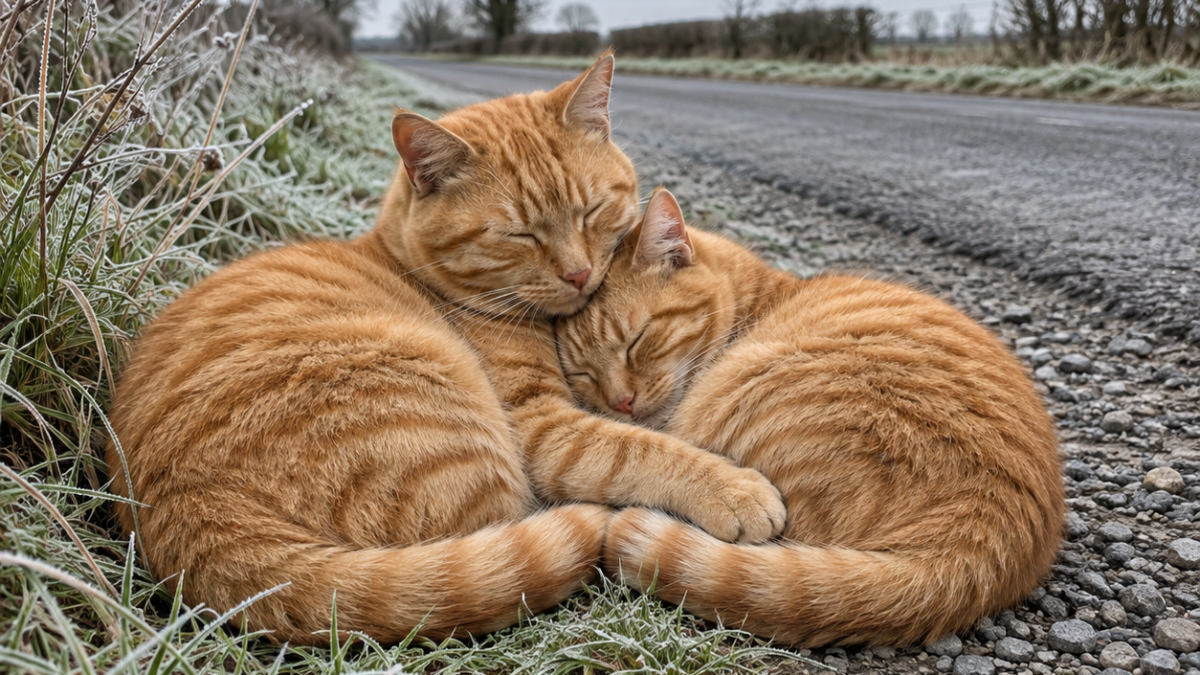
PART 2
I barely slept that night.
Every few hours, I checked the temperature.
It fell below freezing.
Then lower.
By early morning it had reached around minus three degrees Celsius.
Each time I looked at the weather report, I pictured the roadside.
Open farmland.
No shelter.
No porch.
No barn within reach.
Just two cats beside gravel.
One unable to feel the cold.
One refusing to escape it.
I left before sunrise.
The food from the previous evening was still there.
So was the water.
A thin layer of ice had formed across part of it.
And the ginger cat?
Still beside his brother.
“Hey.”
His eyes moved toward me.
That was all.
I stayed farther away this time.
No reaching.
No attempt to touch the body.
I parked across the road where I could watch without forcing him to defend anything.
For nearly two hours, I sat inside my car.
And during those two hours, I watched three things that changed the way I understood animal grief forever.
The first happened about twenty minutes after sunrise.
The surviving cat leaned toward his brother.
At first I thought he was checking the body.
Then his tongue moved across the dead cat’s forehead.
Once.
Again.
He groomed between the ears.
Across the face.
Slowly.
Carefully.
Exactly the way bonded cats groom one another when they are resting together.
I had seen dead animals before.
I had seen surviving animals remain near them.
But I had never seen anything like this.
The body had been beside the road for days.
Yet the face was remarkably clean.
I suddenly understood why.
He had been washing him.
Keeping his brother’s face clean as though cleanliness might somehow preserve the normal world.
As though if he performed enough of their familiar rituals, something familiar might return.
I pressed my fist against my mouth.
“Come on, sweetheart.”
He continued grooming.
“Please.”
Of course he couldn’t hear what I meant.
I wasn’t asking him to come toward me.
I was asking him to let reality exist.
He wasn’t ready.
The second behavior happened later.
The living cat pressed his nose against his brother’s neck.
Then stayed there.
Not for a second.
Not a quick investigation.
He remained with his face buried in the fur.
I watched his chest move.
Breathing in.
Breathing out.
Against a chest that did not rise.
For nearly a minute, he stayed like that.
Then lifted his head.
Waited.
Pressed his nose against the same place again.
I had the strange, irrational thought that he was searching for warmth.
Or breath.
Or scent.
Or the smallest sign that his brother had not become what the cold body already told him he had become.
The third behavior destroyed me.
He began making a sound.
Not a normal meow.
A soft trill.
Low.
Continuous.
Gentle.
Cats use sounds like that to greet each other.
To communicate with kittens.
To reassure.
He put his mouth close to his brother’s ear.
And trilled.
Again.
No response.
He waited.
Another quiet trill.
Still nothing.
I sat in my car and cried.
Not politely.
Not the controlled tears rescue workers learn to hide because there is always another practical task waiting.
I cried for ten minutes before I could even pick up my phone.
Then I called for experienced backup.
“We need to take them today.”
“What happened?”
“He’s getting weaker.”
“Can you trap him?”
“I don’t think food will work.”
“Sedation?”
“Maybe.”
I looked through the windshield.
The ginger cat was grooming his brother again.
“We may need it.”
## HE WAS DYING BESIDE HIM
That afternoon I approached only enough to check his condition visually.
He was noticeably thinner.
The large frame that had probably once made him look powerful now seemed hollow along the flanks.
His trembling had become constant.
The tips of his ears looked pale and damaged from cold exposure.
He was dehydrated.
Weak.
And still refusing food.
I placed fresh wet food close enough that the smell should have tempted any hungry cat.
He smelled it.
Turned his face away.
I moved the water closer.
Same thing.
“You can’t do this.”
His eyes met mine.
“I know you don’t understand me, but you can’t.”
Nothing.
“You’re going to die too.”
He looked back at his brother.
That was the answer.
## WHAT DO CATS UNDERSTAND ABOUT DEATH?
People ask that question as though there must be one clean scientific answer.
There isn’t.
We know animals recognize absence.
We know bonded animals change behavior when a companion disappears.
They search.
Call.
Stop eating.
Become withdrawn.
Sleep differently.
Some remain near bodies.
But do they understand death in the abstract human sense?
Do they understand permanence?
Do they know:
He will never wake again?
I don’t know.
Watching that ginger cat, I suspected the problem was exactly that he could not understand permanence.
His brother looked like his brother.
Smelled like his brother.
Occupied the same physical space.
But everything that had always come from that body was gone.
No warmth.
No movement.
No familiar sound.
No heartbeat.
So he waited.
Maybe he believed waiting was still something useful.
## THE FOURTH MORNING
We returned on February 15 at around eight in the morning.
There were three of us this time.
Protective gloves.
Humane trap.
Heavy towels.
Carrier.
Sedation equipment available if a veterinarian determined it necessary.
I prepared myself for a fight.
For claws.
For teeth.
For another deliberate strike if we touched his brother.
Instead, when we rounded the roadside bend, I stopped walking.
Something had changed.
The ginger cat was no longer sitting upright.
He was lying beside the dead cat.
Pressed against him.
One front leg stretched across his brother’s chest.
His head rested against the ribcage.
Right where a heartbeat should have been.
His eyes were closed.
“Oh no.”
One of the rescuers moved faster.
We crossed the road.
The cat didn’t react.
No head movement.
No defensive paw.
Nothing.
I knelt.
His chest moved.
Barely.
“He’s alive.”
I touched his side.
Cold.
Dangerously cold.
His breathing was shallow.
One rescuer checked his gums.
“Pale.”
“Heart?”
“Slow.”
I whispered:
“Hey.”
His eyes opened a fraction.
No attack.
No warning.
We moved his paw away from his brother.
Nothing.
I lifted him.
Four days earlier, he had been strong enough to slash anyone who approached.
Now he went completely limp against me.
His body felt impossibly light for a cat that size.
I could feel his ribs.
And beneath them?
A heartbeat.
Weak.
Slow.
Still there.
I held him close enough to feel it.
“Come on.”
He did not resist.
That frightened me more than any bite ever could have.
## TAKING HIS BROTHER AWAY
We had two animals to recover.
One living.
One dead.
We wrapped the deceased brother carefully in a blanket.
I watched the living cat while we did it.
His head rested against my arm.
His eyes were half open.
Did he understand we were removing the body?
I don’t know.
Part of me wanted him to react.
To fight.
To prove he still had enough strength to care.
He didn’t.
The brother he had protected from strangers for four days disappeared into a blanket.
For the first time since the accident, they were separated.
The living cat made no sound.
## THE DRIVE
We drove straight to the veterinary clinic.
I sat beside the carrier.
The heater ran high.
Controlled warming matters with severe hypothermia; you don’t simply blast an animal with extreme heat.
Blankets.
Warm environment.
Careful monitoring.
The cat lay on his side.
His head again rested at chest height against the folded towel.
Same posture.
I hated seeing it.
“Stay.”
His eyes opened slightly.
“Please.”
I had spent days trying to make him leave the road.
Now I was begging him not to leave us.
## 34.2 DEGREES
The veterinary thermometer read 34.2°C.
Normal feline body temperature is significantly higher.
His core temperature had fallen almost four degrees below normal.
Severe hypothermia.
Dehydration.
Major weight and muscle loss.
Early kidney stress.
Weak immune condition.
And an upper respiratory infection that had likely developed while he sat outside in freezing weather.
The veterinarian looked at us.
“How long?”
“Four days.”
“Without eating?”
“As far as we can tell.”
“Water?”
“Refused what we left.”
She looked at the cat.
Then at us.
“He’s in very serious condition.”
“Can you save him?”
“We’ll start.”
That wasn’t the answer I wanted.
It was the honest one.
## WARMING HIM
They placed him on controlled warming support.
IV fluids.
Slow.
Careful.
Blood tests.
Respiratory assessment.
Antibiotics.
Nutrition planning.
He remained quiet.
Too quiet.
When a nurse touched him, he allowed it.
When they placed a catheter, he barely protested.
This was the cat who had defended his brother with claws.
Now he behaved as if everything that required defense had already been lost.
## HIS WEIGHT
He weighed only 7.2 pounds.
For his frame, that was frightening.
His fur disguised some of it from a distance.
Hands did not.
When you touched him, there was almost nothing between fur and bone.
The veterinarian said:
“Four days without adequate intake can do serious damage, especially with cold stress.”
I looked at him through the kennel door.
“He did it deliberately.”
The vet looked at me.
“We can’t know that.”
“He had food.”
“I know.”
“He wouldn’t leave.”
“I know.”
“He chose the body.”
She was quiet.
Then:
“Whatever word we use, emotionally he is profoundly distressed.”
That was the beginning of the second fight.
His body was treatable.
His grief was not something we could inject into a vein and remove.
## DAY ONE IN THE CLINIC
We offered food once his temperature had begun rising safely.
Warm wet food.
Strong smell.
He turned his head.
Different flavor.
Nothing.
Hand feeding.
He clenched his mouth and turned away.
The veterinarian said:
“We may need assisted feeding.”
“Do it.”
“We will.”
His body needed calories whether his emotions were interested or not.
## DAY TWO
Still no voluntary eating.
He faced the wall.
That posture became familiar.
Food entered the kennel.
He looked once.
Turned away.
Closed his eyes.
The nurse called me.
“He’s medically a little more stable.”
“But?”
“He won’t engage.”
I visited.
Sat outside the kennel.
“I’m sorry.”
No response.
“You hate us, don’t you?”
His ear moved.
“We took you away from him.”
The words felt ridiculous.
Yet true.
I rested my fingers against the cage.
“You would’ve died.”
He kept his face toward the wall.
“I know you don’t care.”
That was what scared me.
## DID HE WANT TO DIE?
People later used that phrase.
“He wanted to die with his brother.”
Maybe.
We have to be careful when we describe animal behavior with human motives.
A cat cannot tell us:
I have evaluated the future and chosen death.
But we can observe.
He had remained beside the body for four days.
Refused food.
Refused water.
Defended the corpse.
Groomed it.
Called to it.
Pressed himself against it.
Then collapsed with his head where the heartbeat had once been.
In the clinic, he continued refusing food despite treatment.
Whatever we called it, his grief had become physically dangerous.
## DAY THREE
His temperature normalized gradually.
Kidney values remained concerning but had not deteriorated catastrophically.
Respiratory symptoms were treated.
Assisted nutrition continued.
He still refused voluntary food.
A veterinary nurse named Maeve sat with him during her break.
She later told me:
“I didn’t touch him.”
“Why?”
“He looked like he didn’t want another person asking something from him.”
So she simply sat.
Twenty minutes.
No touching.
No food.
No coaxing.
When she stood to leave, the cat opened his eyes.
Watched her.
Then turned back toward the wall.
## DAY FOUR
Same.
## DAY FIVE
Same.
At that point, even the veterinarian sounded worried in a different way.
“Medically he’s responding.”
“Good.”
“But his appetite isn’t.”
“Could the infection cause it?”
“Some.”
“Medication?”
“Possibly some nausea, but we’re treating that.”
“So?”
She looked toward the kennel.
“Grief is not a diagnosis I can fix with a tablet.”
Then she said something I never forgot.
“From a medical perspective, I’m treating hypothermia, malnutrition, dehydration, kidney stress, and infection. Emotionally, I am treating an animal who seems to believe we took him away from where he wanted to be.”
I looked at the cat.
“You think he wants to go back?”
“I think everything familiar is gone.”
That was close enough.
## THE BROTHER’S BLANKET
On Day Six, Maeve remembered the blanket.
The deceased brother had been wrapped in it when we removed him from the roadside.
It had not yet been washed.
There were reasons not to use contaminated materials casually in veterinary settings.
But after considering the condition and ensuring it could be used safely enough in his kennel, the team brought it in.
I was there.
Maeve unfolded the blanket.
The ginger cat’s head lifted before the fabric even touched the floor.
First real reaction in days.
He smelled.
Once.
Then again.
His body shifted.
I stopped breathing.
Maeve placed the blanket inside.
The cat walked toward it.
Slowly.
Weakly.
He lowered his face into the fabric.
Then froze.
No kneading.
No meowing.
No dramatic reaction.
He simply buried his nose.
And stayed there.
Ten minutes.
Thirty.
An hour.
I went outside, came back.
Still there.
Two hours.
Still.
Three.
Face buried in the blanket that had carried his brother’s body.
## THEN HE ATE
Nobody was watching for a miracle.
We had stopped expecting dramatic moments.
A nurse placed food nearby.
The usual routine.
Bowl down.
No pressure.
Walk away.
Several minutes later, Maeve looked through the kennel door.
“Wait.”
The cat lifted his head from the blanket.
Smelled the food.
We all froze.
He moved toward the bowl.
One bite.
Stopped.
I covered my mouth.
Another bite.
Then a third.
Not a meal.
Barely anything.
But food he chose himself.
The first voluntary bites in six days.
Maeve started crying.
I did too.
The veterinarian stood behind us.
“Don’t overwhelm him.”
Nobody moved.
The cat took another bite.
Then returned to the blanket.
That was enough.
## THE SCENT THAT COULDN’T BRING HIS BROTHER BACK
People later called the blanket a miracle.
I wouldn’t.
It didn’t cure grief.
It didn’t make the dead cat return.
Whatever scent remained was only a trace.
But perhaps it provided continuity.
Something familiar inside a place where everything smelled wrong.
Disinfectant.
Medication.
Strangers.
Metal.
Plastic.
The blanket smelled like the roadside.
Like his brother.
Like the life before separation.
Maybe he needed proof that the world he had lost had not disappeared completely.
We will never know.
We only know what happened next.
He ate.
## DAY SEVEN
A little more.
Still small portions.
Voluntary.
He spent most of his time on the blanket.
If staff moved it to clean the kennel, he watched them.
When it returned, he lay on it.
## DAY EIGHT
He groomed himself.
The veterinarian smiled.
“Good.”
Why?
Because grooming requires energy and interest.
For a cat who had spent days facing a wall, cleaning his paw meant something.
## DAY NINE
He hissed at a nurse during medication.
She laughed afterward.
“He hates me.”
I said:
“Congratulations.”
The return of objection was progress.
## DAY TEN
He stood at the kennel door when Maeve approached.
No greeting trill.
Nothing like his old personality, according to people who later described him.
But he watched.
Engaged.
Present.
## FOURTEEN DAYS
He remained in veterinary care for two full weeks.
By discharge, the immediate crisis had passed.
Temperature stable.
Hydration restored.
Kidney function improving.
Respiratory infection under control.
Eating independently.
Still underweight.
Still quiet.
Still carrying something medicine couldn’t measure.
## WHO WERE THE TWO CATS?
By then, people living nearby helped us piece together their story.
They were brothers.
Confirmed.
Almost identical.
They had been seen together repeatedly before the accident.
Always close.
Walking along hedges.
Resting near farm buildings.
Sitting beside each other.
One neighbor had taken a photograph several months earlier.
Two ginger cats sitting side by side.
Same posture.
Same white chest patch.
The caption beneath the photo was simple.
**The lads.**
That photograph eventually became one of the most important objects in Parish’s new home.
But he did not have that name yet.
## FOSTER
I took him home as a foster.
Temporary.
That word has caused more permanent animal adoptions than anyone admits.
The first night, he left the carrier and immediately hid behind furniture.
I gave him a room.
Food.
Water.
Litter.
The brother’s blanket.
No pressure.
Around midnight, I checked.
He was asleep.
On his side.
One front paw extended.
Head resting low against the folded blanket.
I froze.
It was the position we’d found him in.
Head where his brother’s chest had been.
I turned off the light.
## THE FIRST WEEK HOME
He moved like a shadow.
Close to walls.
Quiet.
Almost no vocalizing.
People who knew him before said he had once been talkative.
Confident.
Friendly.
The kind of cat who announced himself when entering a room.
That cat seemed gone.
Physical survival does not always restore personality immediately.
Sometimes trauma reorganizes behavior.
## I TRIED TO MAKE HIM PLAY
String.
Nothing.
Ball.
Nothing.
Feather toy.
He watched, briefly.
Then walked away.
Food?
That worked.
Barely.
He ate enough.
Not enthusiastically.
Better than nothing.
## THE WINDOW
One afternoon I found him sitting by the living room window.
Watching the road.
My stomach tightened.
Was he searching?
Remembering?
Simply watching movement?
I don’t know.
He sat there for nearly an hour.
No crying.
No pacing.
Just watching.
## I ALMOST LET HIM OUT
That sentence embarrasses me now.
Part of me thought:
Maybe he needs to return.
To the road.
To the place.
Then I pictured four freezing days.
No.
Whatever he believed was waiting there could not be allowed to kill him again.
He became an indoor cat.
Permanently.
## HIS NAME
I called him Parish.
The road where he’d been found ran near a parish cemetery, and the name stayed in my mind.
Parish.
A word connected to community.
Place.
History.
Belonging.
And, in its own quiet way, the place where the living remember the dead.
He learned it slowly.
“Parish.”
Ear turn.
“Parish.”
Look.
Eventually:
“Parish.”
He came for food.
Good enough.
## ONE MONTH
His weight climbed.
Fur looked better.
Respiratory infection gone.
Kidneys stable.
Ears healing.
No permanent frostbite damage.
His body was returning.
Personality?
Slower.
## 7.2 TO 11.6 POUNDS
Over roughly two months, Parish went from a dangerously low 7.2 pounds to around 11.6.
The veterinarian was delighted.
“Good weight.”
I smiled.
Parish looked offended by the scale.
Normal.
## HE DIDN’T BECOME HIS OLD SELF
I need to keep that part of the story honest.
There was no morning when Parish woke up suddenly cheerful and returned to the confident, loud cat neighbors remembered.
He changed.
He remained quieter.
More cautious.
He preferred walls.
Corners.
Predictable rooms.
He rarely trilled.
That particular sound almost disappeared.
The same sound he’d made into his brother’s ear.
I wondered if that was coincidence.
Probably.
Still, I noticed.
## THE BLANKET
The brother’s blanket came home with us.
Eventually it had to be washed.
The first time, I delayed.
Ridiculous.
Fabric gets dirty.
Hygiene matters.
But I worried.
What if washing away the scent removed the thing that brought Parish back?
Eventually there was no choice.
I washed it.
Dried it.
Placed it down.
Parish approached.
Smelled.
The original scent was surely altered.
Maybe gone.
He stepped onto it.
Turned twice.
Kneaded.
Then lay down.
I cried in the laundry room.
## HE KEPT CHOOSING IT
Wash after wash.
Month after month.
The blanket became just fabric.
At least to a human nose.
Parish still chose it.
Maybe texture.
Habit.
Association.
Comfort.
Whatever the explanation, it became his.
## THE PHOTOGRAPH
The neighbor gave me the old photograph of the brothers.
Two ginger tabbies sitting together.
“The lads.”
I framed it.
Put it on a shelf behind Parish’s bed.
Not in front of him.
Not as some test to see if he’d recognize a photograph.
Cats do not interact with images the way humans do.
It was for me.
Maybe also for the brother who had no home to return to.
## PARISH SLEPT BENEATH IT
Every night.
Same bed.
Blanket.
One paw forward.
Head low.
Chest height.
The exact posture.
At first, the sight broke me every time.
Eventually it became simply how Parish slept.
## PEOPLE WANTED A HAPPY ENDING
“He’s happy now, right?”
That question came often.
I learned to answer carefully.
“He’s safe.”
Healthy.
Warm.
Well-fed.
Loved.
Does that equal happy?
Often.
Parish purred.
Accepted affection.
Sat in sunlight.
Enjoyed certain foods.
Eventually played in short bursts.
He had good days.
But grief had changed him.
I didn’t want to erase that just to give people a cleaner ending.
## THE DRIVER
We never identified the person who struck his brother.
And even if we had, a road accident is not automatically cruelty.
Cats cross roads.
Drivers don’t always have time to stop.
Sometimes terrible things happen without a villain.
That frustrated people.
They wanted someone to blame.
So did I at first.
Grief likes targets.
But Parish’s story didn’t need revenge against a stranger behind a steering wheel.
It needed something more difficult.
A life after loss.
## THE AUTHORITIES
People also became angry that the body remained beside the road after the first report.
I understood.
If it had been removed immediately, Parish might not have spent four days outside.
Or maybe he would have searched for his brother and become equally distressed.
We cannot know.
What we could change was response.
The rescue and local volunteers created a clearer contact chain for reports involving dead companion animals with surviving animals nearby.
Because sometimes “one dead cat and one live cat” is not just a collection call.
Sometimes the living animal is also in emergency.
## THAT WAS OUR REVENGE AGAINST DELAY
Not punishment.
Better response.
The next call got treated differently.
That’s the kind of revenge I believe in now.
Make the failure harder to repeat.
## THREE MONTHS
Parish began sleeping on the couch.
Not every day.
Then more.
If I sat at one end, he’d choose the other.
Eventually the middle.
One night, his back touched my leg.
He didn’t move away.
I stayed frozen until my foot went numb.
## FOUR MONTHS
Toy mouse.
One pounce.
I almost screamed.
Didn’t.
He looked at me suspiciously.
I pretended nothing happened.
Two minutes later, another pounce.
That was how play returned.
Quietly.
## SIX MONTHS
Visitors came.
Parish hid less.
A man who had known the brothers before the accident visited.
“That’s him.”
Parish watched from the hallway.
The man crouched.
“You used to shout at everybody.”
Parish did not shout.
The man looked at me.
“He was always with his brother.”
I knew.
“He slept on top of him half the time.”
That detail stayed.
Warmth shared.
Then roadside cold.
No wonder Parish had placed his head against that chest.
It had once been the warmest place he knew.
## THE LADS
The photograph became more important to visitors than Parish.
People would stand before it.
Two identical ginger cats.
Alive.
Together.
Before.
Humans are obsessed with before.
Animals live in now.
Parish rarely looked toward the photograph.
He looked toward bowls.
Windows.
Sunlight.
Blanket.
Maybe he was wiser.
## ONE YEAR
On February 11, I expected to feel something dramatic.
Anniversary.
Instead, morning came.
Parish ate breakfast.
Sat near window.
Slept.
I visited the roadside alone.
The gravel looked ordinary.
Cars passed.
No sign.
No marker.
No reason a stranger would know anything had happened there.
I stood exactly where I’d first approached him.
The world had moved on almost offensively well.
## I DID NOT BRING PARISH
People asked why.
Because he didn’t need my symbolism.
He had already spent enough time there.
## I LEFT NOTHING
No flowers.
No plaque.
I considered it.
Then decided no.
His brother did not belong to the road any more than Parish did.
The photograph was enough.
## TWO YEARS
Parish became more affectionate.
Not dramatically.
He sat closer.
Sometimes climbed onto the couch while I watched television.
He still rarely vocalized.
But one evening I heard a sound.
Soft.
Short.
A trill.
My heart stopped.
Parish walked into the kitchen.
Saw me.
Trilled again.
I started crying.
He immediately turned around.
Apparently emotional humans remained intolerable.
## DID THAT MEAN HE WAS HEALED?
No.
Healing isn’t returning to the exact person—or animal—you were before something happened.
Sometimes there is no return.
There is only forward.
Parish became a different cat.
That did not mean a lesser one.
## THE WINDOW ROUTINE
Late afternoons.
Same window.
Road visible in distance.
Parish sat.
Watched.
Not anxious.
No scratching.
No attempt to escape.
Just stillness.
People romanticized it when they heard.
“He’s waiting for his brother.”
Maybe.
Or watching birds.
Cars.
Light.
We don’t know.
I preferred not knowing.
Love does not require us to translate every silence.
## THE BROTHER’S NAME
We never knew it with certainty.
People in the area had nicknames.
No formal owner came forward.
So in our private conversations, I usually called him simply “his brother.”
That felt more honest than inventing something.
## THREE YEARS
Parish became slightly overweight.
I laughed at the veterinary appointment.
“What?”
The vet looked confused.
“You’re telling me to reduce his food.”
“Yes.”
“He nearly starved himself.”
“Three years ago.”
“I know.”
“Now he’s heavy.”
Best medical complaint of his life.
We adjusted food.
Parish disagreed.
## NORMAL PROBLEMS
Hairballs.
Dental cleaning.
Too much weight.
A scratched chair.
Vomiting because he ate too quickly once.
Normal.
Every ordinary inconvenience felt like revenge against the cold roadside.
## PEOPLE STILL SHARED THE STORY
Occasionally the rescue page reposted his early photos.
I disliked the most dramatic ones.
The picture of him beside the body.
I understood why it mattered.
But Parish had become more than that image.
So I always sent a new one too.
Parish asleep on couch.
Parish fat.
Parish glaring at diet food.
Parish in sun.
## NEVER FREEZE SOMEONE IN THEIR WORST DAY
That’s another lesson rescue taught me.
Suffering attracts attention.
Life afterward deserves equal space.
## FOUR YEARS
Parish became confident enough to sleep in doorways again.
That matched what neighbors remembered about his old personality.
He didn’t become talkative.
But doorway ownership returned.
Progress.
## A FOSTER KITTEN
I brought home a foster kitten.
I worried Parish would hate him.
He did.
Initially.
Hiss.
Leave me alone.
Classic.
The kitten ignored boundaries.
Eventually I found them asleep in the same room.
Not touching.
Then, weeks later, touching.
My breath caught.
Parish woke.
Moved away.
Too much.
## THE KITTEN LEFT
Adopted.
Parish searched the room for a day.
My fear returned instantly.
No.
Not again.
But he ate.
Slept.
Adjusted.
He could lose a companion and continue.
That mattered to me more than he knew.
## FIVE YEARS
Parish was around six years old by then.
Healthy.
Warm.
Safe.
Exactly what I had once begged for.
His nighttime ritual remained.
Blanket.
Knead.
Turn.
Side.
One paw forward.
Head resting at chest height.
Every night.
## THE SCENT WAS LONG GONE
The blanket had been washed dozens of times.
Whatever physical trace of his brother had once remained should have disappeared long ago.
Parish still kneaded it.
Comfort can outlive its original reason.
Humans do that too.
## WHAT WAS HE LISTENING FOR?
Nothing.
Probably.
Yet when I watched his head settle in that familiar place, I couldn’t stop remembering the rescue morning.
His ear against his brother’s chest.
The heartbeat absent.
His own heart barely surviving.
## THE REVENGE PEOPLE ASKED FOR
They wanted something dramatic.
“Did the driver get caught?”
No.
“Did authorities get punished for not coming?”
No grand punishment.
“Did you confront anyone?”
No.
Parish’s story was not about destroying someone else.
It was about refusing to let grief destroy the survivor too.
That was the fight.
And for a while?
Grief nearly won.
## GRIEF HAD FOUR DAYS
Cold.
No food.
No water.
Infection.
Hypothermia.
A body he would not leave.
Then grief followed him to the clinic.
Five more days refusing food.
Facing the wall.
Closing his eyes.
It had momentum.
## THEN A BLANKET INTERRUPTED IT
A smell.
Memory.
Food.
One bite.
Then another.
The smallest reversal.
## REVENGE CAN BE A MEAL
People think revenge must be loud.
Sometimes revenge is eating after despair convinced you not to.
## REVENGE CAN BE WARMTH
A cat once trembling at minus three degrees sleeping beside a heater.
## REVENGE CAN BE WEIGHT
7.2 pounds becoming 11.6.
## REVENGE CAN BE AN OLD BLANKET
Not beside a corpse.
Inside a home.
## THE ROAD BECAME IRRELEVANT
Years passed.
I stopped driving that route often.
When I did, I no longer slowed.
That surprised me.
At first, I had believed forgetting the place would disrespect the brother.
Then I realized memory doesn’t require constant reopening of wounds.
The roadside had done enough.
## PARISH’S BROTHER
The brother’s body had been treated with dignity after recovery from the roadside.
There wasn’t a dramatic funeral.
No audience.
No social media ceremony.
Quiet.
That’s enough.
Parish had already performed the vigil.
Four days.
No human ritual could compete with that.
## PEOPLE SAID HE WAS LOYAL
Yes.
But loyalty can become dangerous when survival requires leaving.
That’s something humans understand too.
We praise devotion.
Sometimes devotion kills.
Parish had no concept of balance.
He simply stayed.
Our job was not to romanticize him dying beside his brother.
Our job was to stop it.
## IF WE HAD ARRIVED LATER
Hours.
Maybe.
His temperature was 34.2°C.
Heart rate critical.
Breathing shallow.
Dehydrated.
Kidneys stressed.
Infection.
Another freezing night?
I don’t like to imagine it.
He probably would have died in that position.
Paw across brother.
Head on chest.
Two ginger bodies found together.
People would have called it heartbreaking.
Maybe beautiful.
It would not have been beautiful.
It would have been another preventable death.
## LOVE SHOULD NOT REQUIRE DYING TOGETHER
That’s what I learned.
Love can mean staying.
Rescue sometimes means forcing separation so someone survives.
Parish hated us for that, perhaps.
Or simply withdrew.
Either way, we separated him from the dead because the living still had needs.
## SIX YEARS
Parish’s health remained good.
He became a cat people would never identify as once near death.
Thick coat.
Strong body.
Clear eyes.
No frostbite damage.
Kidneys normal for his age.
He still disliked open doors.
That was interesting.
Most cats were curious about outside.
Parish wasn’t.
If the front door opened, he moved farther into the room.
Maybe he had learned enough about roads.
## I NEVER TESTED IT
No harness walks.
No “exposure therapy.”
He didn’t need to conquer outdoors.
Home was enough.
## THE WINDOW WAS ENOUGH WORLD
He watched.
Safe behind glass.
Maybe that was his compromise.
## YEARS LATER, THE WOMAN WHO FIRST STOPPED VISITED
The farm woman whose hand he had scratched.
She held out her knuckles.
Faint scar.
“Remember me?”
Parish sniffed.
Walked away.
She laughed.
“I’ll take that as forgiveness.”
I smiled.
“He probably doesn’t remember.”
“Good.”
We both meant it.
## THE DELIVERY DRIVER
I eventually spoke with the original delivery driver too.
He felt guilty.
“I called.”
“You did.”
“But I didn’t stop.”
“You reported what you saw.”
“I assumed someone would come.”
I looked at him.
“Yes.”
He swallowed.
“I don’t assume now.”
That’s what mattered.
## ASSUMPTIONS
Someone else will call.
Someone else will come.
The cat will leave.
The body will be collected.
Four days can grow inside those assumptions.
## OUR NEW RULE
When a report involved a live animal staying beside a deceased companion, we treated the living animal as at risk immediately.
No waiting to see if it moved on.
Maybe it would.
Maybe not.
Parish taught us not to gamble.
## ANOTHER CASE
Months later, a dog remained beside another dog hit on a road.
Call came.
We responded that day.
The surviving dog was frightened but willing to leave.
Was Parish responsible?
Partly.
Experience becomes procedure.
That’s how suffering earns meaning without being justified.
## HE NEVER KNEW
Parish had no idea.
Good.
Animals should not have to know they became lessons for humans.
## THE PHOTO ABOVE HIS BED
The lads.
Two brothers.
Side by side.
Parish never seemed interested in it.
I was.
Sometimes visitors asked if it upset him.
I doubted he even processed it as we did.
The photograph was for us.
Proof there had once been two.
## HUMAN GRIEF NEEDS OBJECTS
Blankets.
Photographs.
Collars.
Ashes.
Animals perhaps need scent, routine, presence.
Parish had the blanket.
I had the photograph.
We each used what we understood.
## HIS BROTHER’S FACE
That remains one of the most devastating details.
Clean.
After days outside.
Because Parish groomed him.
People hear that and cry.
So do I.
But I try not to turn it into poetry.
The behavior came from confusion, attachment, ritual, or all three.
He was maintaining a relationship after one side of that relationship had stopped participating.
Humans know that feeling.
## THE TRILL
I remember it too.
A soft sound into an ear that could not hear.
People say animals don’t understand death like us.
Maybe that’s exactly what makes the behavior so painful.
Parish kept using the language that had always worked.
No answer came.
So he used it again.
## THE HEAD AGAINST THE CHEST
Maybe searching for heartbeat.
Maybe warmth.
Maybe familiar sleeping posture.
Probably some combination.
By the fourth day, he stopped searching and simply remained there.
That was how we found him.
## HIS NAME BECAME HIS SECOND LIFE
Parish.
At first, it was a practical entry on rescue paperwork.
Then foster paperwork.
Then veterinary records.
Then adoption documents.
Eventually simply:
Parish, dinner.
Parish, get off the counter.
Parish, stop.
Parish, come here.
A name becoming ordinary means a life has become ordinary.
Good.
## YES, I ADOPTED HIM
I was supposed to foster.
People laughed when the adoption became official.
“I knew it.”
I pretended I hadn’t.
Truth?
I knew somewhere around the third week.
Maybe earlier.
Perhaps the moment he voluntarily ate after smelling the blanket.
That felt like a contract.
He would keep trying.
I would stay.
## THE PAPERWORK
Signature.
Date.
Microchip.
Permanent address.
That was all.
No cinematic music.
Parish slept through the signing.
Typical.
## I PROMISED NOTHING IMPOSSIBLE
Not:
You’ll never hurt again.
Not:
You’ll never lose anyone.
Not:
You’ll forget.
Only:
You’ll be warm.
You’ll have food.
Medical care.
No roads.
No one will force you outside.
And when loss comes again—as it eventually comes to every long life—you won’t face it alone.
## AGE
Eventually Parish became older.
Not old yet.
Then truly older.
More sleep.
Less jumping.
Dental problems.
A little arthritis.
Normal.
Wonderful.
## THE VET ONCE SAID
“He’s aging well.”
I almost laughed.
Aging.
The thing he nearly never got to do.
## THE BLANKET THINNED
Years of kneading.
Washing.
Claws.
Fabric wore down.
I considered replacing it.
Couldn’t.
I patched it.
Parish accepted.
## ONE PATCH BECAME THREE
Eventually it looked more repair than original fabric.
Still his.
## THE PHOTO FADED
Sunlight reached the framed photograph.
The orange fur faded slightly in the print.
I moved it away from direct light.
Two brothers preserved imperfectly.
## PARISH DID NOT KNOW HE WAS A SYMBOL
People wrote about sibling bonds.
Animal grief.
Loyalty.
He cared about chicken.
I liked that.
## THE LAST YEARS
Kidney values began changing eventually.
Not because of those four days, as far as anyone could tell.
Age.
Common feline disease.
We changed diet.
Medication later.
Fluids when necessary.
He hated everything.
Strongly.
The cat who once wouldn’t fight treatment now fought us about every treatment.
Full circle.
## I CELEBRATED EVERY HISS
Not literally.
But part of me remembered the limp body in my arms.
Resistance meant presence.
## HE STOPPED JUMPING TO THE WINDOW
I placed steps.
Then a low bench.
He used them.
Still watched the road.
Same calm attention.
## DID HE STILL REMEMBER?
Almost certainly some aspects of his past remained in memory.
Did he specifically remember the roadside every afternoon?
No one can know.
I stopped pretending to.
He was allowed mystery.
## ONE WINTER MORNING
Snow outside.
Parish on blanket.
I looked at thermometer.
Warm house.
He stretched.
One paw forward.
Head low.
I thought of minus three degrees.
Then turned up the heat one degree anyway.
Ridiculous.
Love often is.
## HIS FINAL ILLNESS
He became truly old.
Appetite dropped.
Weight followed.
Kidney disease progressed.
The veterinarian adjusted treatment.
He rallied.
Months more.
Then another decline.
## FOOD
This time he did not refuse because of grief.
His body was tired.
Still, seeing untouched food brought me back to the clinic.
Day One.
Day Two.
Day Five.
Wall.
Closed eyes.
I had to remind myself:
This is different.
## YOU CANNOT RESCUE SOMEONE FROM AGE
Hardest lesson.
## QUALITY OF LIFE
We counted.
Eating.
Drinking.
Comfort.
Grooming.
Movement.
Interest.
Affection.
Good days.
Bad days.
The list shifted.
Slowly.
Then quickly.
## ONE NIGHT
Parish lay on the blanket.
Same position.
Paw forward.
Head low.
But there was no second body.
Only fabric.
I sat beside him.
“Hey.”
His ear moved.
I touched his forehead.
“You stayed too long once.”
He purred faintly.
“You don’t have to do that again.”
I cried.
## THE DECISION
Home euthanasia.
I couldn’t take him to a clinic for the final moment if I didn’t have to.
The veterinarian came.
Parish remained on the blanket.
The photograph of the lads behind him.
I noticed the arrangement only then.
Living brother.
Old blanket.
Two young brothers in the frame.
Time stacked together.
## I MOVED THE PHOTO
Then stopped.
Why?
I didn’t know.
I put it back.
This wasn’t a performance.
Objects could remain where they had always been.
## THE FINAL MORNING
Parish ate a little tuna.
The kidney diet rules no longer mattered.
He licked the plate.
Not much.
Enough.
Then walked slowly to the window.
Sat.
Watched the road.
For perhaps ten minutes.
Then returned to bed.
## THE VETERINARIAN ARRIVED
She knew his story.
Everyone in the clinic did.
She sat on the floor.
“Hello, Parish.”
He looked at her.
Not impressed.
Good.
## SEDATION
The first medication relaxed him.
His head lowered.
I slid one hand beneath his cheek.
For a moment I thought of moving his head higher.
Then I didn’t.
He chose the position.
Chest height.
Like always.
## ONE PAW FORWARD
His front paw stretched across the blanket.
Exactly as it had stretched across his brother.
My breathing broke.
The veterinarian waited.
“You okay?”
“No.”
Honest.
## WHAT I SAID
Not much.
“I’ve got you.”
Same words rescuers always say.
Even when the thing we’re holding cannot stay.
“You don’t have to wait.”
That was the important part.
## THE FINAL MEDICATION
Entered slowly.
Parish breathed.
Once.
Again.
Another.
Then stillness.
The veterinarian listened.
Waited.
Nodded.
## I EXPECTED SOMETHING DRAMATIC
Nothing.
No final trill.
No sudden movement.
Just quiet.
The same kind of quiet that had terrified me on the roadside years earlier.
This time, quiet was not abandonment.
It was rest.
## I LEFT HIM ON THE BLANKET FOR A WHILE
No rushing.
No road.
No cold.
I placed my hand where his heartbeat had been.
Warm at first.
Then less.
And suddenly I understood, in the smallest way, what Parish had experienced beside his brother.
The impossible transition.
A body still looking familiar.
Then no heartbeat.
The difference was that I understood what death meant.
Parish may not have.
That made his vigil even more heartbreaking.
## I DID NOT STAY FOUR DAYS
Love doesn’t require reenacting suffering.
I said goodbye.
Let the veterinarian take him when it was time.
That was another thing Parish taught me.
Letting a body go does not mean letting love go.
## THE BLANKET
I kept it.
Of course.
Washed eventually.
Folded.
Not on the floor anymore.
## THE PHOTOGRAPH
Still on the shelf.
The lads.
Now both gone.
That changed the photograph.
Before, it represented the brother Parish lost.
Now it represented a world that had once contained both.
## HIS ASHES
Simple box.
No long inscription.
**PARISH**
Enough.
## PEOPLE ASKED IF I PUT HIM WITH HIS BROTHER
No.
We didn’t have the brother’s remains years later.
No shared grave.
No cinematic reunion.
Death does not need physical symmetry to matter.
They were brothers.
That fact survived.
## THE REVENGE ENDING PEOPLE EXPECTED
There wasn’t one.
No driver exposed.
No courtroom.
No arrest.
No cruel owner.
No dramatic confrontation.
I refuse to invent one simply because anger is easier to sell than grief.
The truth already contained enough conflict.
Parish versus cold.
Parish versus hunger.
Parish versus separation.
Parish versus his own body’s collapse.
Then Parish versus a world without his brother.
That was the real fight.
## AND HE WON?
Not exactly.
You don’t “win” grief by forgetting.
He carried change forever.
But grief did not kill him.
That’s enough.
## HE ALMOST DIED BESIDE HIS BROTHER
Instead:
He ate.
Gained weight.
Recovered kidney function.
Beat the respiratory infection.
Avoided permanent frostbite.
Found a home.
Grew older.
Became overweight once.
Played again.
Trilled again.
Loved again in his quieter way.
Aged.
Died warm.
That’s the satisfying ending.
Not revenge.
Continuation.
## THE ROAD TOOK ONE BROTHER
It almost took both.
It didn’t.
## THE COLD TOOK STRENGTH
Medicine returned it.
## GRIEF TOOK HIS APPETITE
A blanket helped call it back.
## LOSS TOOK HIS OLD PERSONALITY
Life still gave him a new one.
## THE WORLD MOVED ON
So did Parish.
Not by leaving his brother behind emotionally.
By carrying something forward that we could never see.
## IF I COULD GO BACK TO THE SECOND DAY
Before rescue.
Before the collapse.
I’d kneel farther away.
No touching.
I’d look at the ginger cat guarding his brother and say:
“You think staying is the only thing love allows.”
He’d stare.
“You’re wrong.”
He would not understand.
“Love can stay in you after the body leaves.”
No response.
“You’re going to hate us for taking you away.”
Maybe a swipe.
“You’ll refuse food.”
“Face a wall.”
“Then you’ll smell him again on a blanket.”
“You’ll eat.”
“One bite.”
“Then another.”
“You’ll gain four pounds.”
“You’ll go into a house.”
“You’ll stay there.”
“You’ll sit by a window and watch roads from safety.”
“You’ll become an indoor cat who doesn’t want the door open.”
“You’ll grow older than your brother had the chance to.”
“You’ll sleep every night with one paw forward.”
“And one day, years from now, when your own heartbeat finally stops, you will not be lying on frozen gravel.”
“You will be on the blanket you chose.”
“Warm.”
“Home.”
“Someone’s hand beneath your face.”
“And this time, nobody will leave you alone beside death.”
## WHAT I WOULD TELL HIS BROTHER
Nothing.
He was gone before I arrived.
But if stories allow one impossible sentence:
Your brother stayed.
Too long.
Long enough to almost follow you.
We took him away.
He hated it.
Then lived.
I hope that counts as keeping him safe.
## THE FIRST WOMAN’S SCRATCH
The woman who first tried to move the body still had a faint scar months later.
She once apologized.
“For what?”
“Trying to take his brother.”
“You didn’t know.”
“I should’ve understood.”
No.
We cannot expect people to understand everything before experience teaches it.
She stopped.
Fed them.
Called.
That mattered.
## THE LESSON OF THE DRIVER
He called authorities.
Good.
Then trusted the system.
Reasonable.
But nobody came.
So another lesson:
If a vulnerable living animal remains at a dangerous scene, follow up.
A call is good.
Confirmation is better.
## THE LESSON OF THE RESCUE
We waited because he defended the body and because we wanted more experienced help.
Reasonable.
But the cold was faster than grief.
We learned.
## THE LESSON OF PARISH
There are bonds we should not dismiss simply because the participants cannot explain them.
He did not need human language to demonstrate attachment.
Four days were his language.
## THE MORAL PEOPLE LIKE
“Animals love too.”
True.
But incomplete.
Animals grieve.
Grief can be medically dangerous.
Watch appetite.
Behavior.
Sleep.
Withdrawal.
Companion loss can require real support.
That is practical.
Not sentimental.
## THE BLANKET TAUGHT US THAT
Scent mattered.
Familiarity mattered.
Environment mattered.
Medicine treated his organs.
Comfort helped treat the rest.
## THE PHOTO TAUGHT ME SOMETHING DIFFERENT
Never assume the animal in front of you began on the day you met him.
Parish had history.
A brother.
Habits.
Personality.
Shared warmth.
We met him after half his world disappeared.
Of course he was different.
## PARISH WAS NOT BROKEN
Changed.
Grieving.
Traumatized.
But not broken.
I dislike that word now.
Broken things are objects waiting to be repaired or discarded.
Living beings adapt.
## HE ADAPTED
Not back.
Forward.
## THE LAST TIME I DROVE THAT ROAD
Years after Parish died, I happened to pass the place.
I recognized the bend.
The gravel shoulder had been resurfaced.
Grass different.
Fence replaced.
No trace.
I slowed.
Then continued.
That surprised me.
I didn’t stop.
Didn’t need to.
## THE PLACE WAS EMPTY
Good.
The road didn’t deserve ownership of either brother.
## HOME DID
## THE END
When people first heard Parish’s story, they often focused on the four days.
I understand.
Four freezing days beside a dead brother is almost impossible to hear without feeling something.
But if I could choose what part people remembered, I would ask them not to stop at the roadside.
Yes, remember the ginger cat sitting guard.
Remember him striking anyone who tried to touch the body.
Remember the food he refused.
The water.
The frost.
The face he kept grooming.
Remember the way he pressed his nose into his brother’s neck.
Remember the soft trills.
Remember the final morning, when his strength was gone and we found him lying exactly as bonded cats often sleep—one paw across his brother’s chest, head where a heartbeat should have been.
Remember that.
But don’t leave him there.
That is not where his story ended.
We lifted him.
He was cold.
34.2 degrees Celsius.
Severely dehydrated.
7.2 pounds.
Kidneys under stress.
Respiratory infection.
Weak heartbeat.
A body that had spent four days making grief physical.
We took him to warmth.
For five more days, Parish still behaved as if survival held no attraction.
He turned away from food.
Faced the wall.
Closed his eyes.
That part was harder for me than the roadside.
At least beside his brother, I understood what he wanted.
Inside the clinic, everything we offered seemed meaningless compared with what we’d taken him from.
Then came the blanket.
Still carrying a scent none of us could fully perceive the way Parish could.
He buried his face in it.
Stayed for hours.
Then lifted his head.
Walked to food.
Ate a few bites.
That was the turning point.
Not a miracle.
Not proof of some supernatural connection.
A grieving animal interacting with something familiar.
But sometimes the difference between death and life looks very small from the outside.
Three bites.
A little water.
A cat deciding—or his body deciding for him—to continue one more day.
Then another.
Two months later, he weighed 11.6 pounds.
His kidneys stabilized.
Infection disappeared.
His ears healed.
He lived.
Not unchanged.
That’s important.
People sometimes want rescue stories to end with complete restoration.
As though success means returning an animal to the exact personality he had before trauma.
Parish didn’t.
Before his brother died, people remembered a confident, vocal ginger cat who greeted visitors and stretched across doorways.
Afterward, Parish became quieter.
He walked close to walls.
Rarely called out.
Slept in one particular position.
Perhaps grief permanently altered the way he felt safe.
That doesn’t make the rescue unsuccessful.
Healing is not erasure.
If I break a bone and it heals, an X-ray may still show where it broke.
Why should emotional lives be expected to leave no trace?
Parish carried his trace.
Every night.
One paw forward.
Head at chest height.
But he also carried new things.
A home.
Regular meals.
Sunlight through windows.
A name.
A veterinarian who complained when he gained too much weight.
A foster kitten he eventually tolerated.
A couch he claimed.
A kitchen where he rediscovered his voice enough to trill again.
An old blanket kneaded so many times that I had to patch it.
Those things matter too.
People asked me whether Parish ever “got over” his brother.
I stopped answering.
What does that even mean?
Do humans get over someone they loved?
Or do we build a life large enough that the loss is no longer the only thing inside it?
I think that is what Parish did.
His brother remained part of the shape of him.
But no longer all of it.
The cat who once sat beside a body became the cat who sat beside a window.
The cat who refused food became the cat who once had to go on a diet.
The cat who nearly froze became the cat who slept beside heat and refused to go outdoors.
The cat whose kidneys nearly failed from dehydration lived long enough to develop ordinary age-related problems.
The cat who almost died with his brother eventually died years later at home.
Warm.
Safe.
Loved.
That is why I don’t want a villain added to this story.
A cruel driver would make the narrative easier.
A negligent owner would make anger easier.
A courtroom would give people somewhere to point all that emotion.
But real grief often offers no such convenience.
A vehicle hit one cat.
A report was made.
Response failed to happen quickly enough.
A surviving brother stayed.
Cold came.
Nobody’s evil plan was required.
Sometimes tragedy is built from accidents, delays, assumptions, and love powerful enough to become self-destructive.
The lesson isn’t to hate someone.
The lesson is to notice sooner.
Follow up.
Understand that an animal beside a dead companion may also be in danger.
Recognize grief as something that can affect the body.
Offer familiarity where possible.
Don’t mistake a quiet animal for an animal who is fine.
And never romanticize suffering so much that you forget to intervene.
Parish remaining beside his brother was beautiful in one sense.
Devotion.
Loyalty.
Attachment.
But if we had arrived a few hours later, beauty would have become two dead cats beside a road.
I refuse to call that romantic.
Love is not always staying.
Sometimes love is carrying someone away from the place they insist on dying.
That was our role.
Parish’s role was harder.
He had to discover that leaving the body did not erase the bond.
Whether he understood that the way I do doesn’t matter.
His life proved it.
Years passed.
The brother was gone.
Parish still lived.
And when Parish himself finally became old and sick, I found him on that same blanket, his front paw stretched out, his head low.
For one horrible second, I saw February again.
Frozen gravel.
Two ginger bodies.
Then I looked around.
Home.
Heat.
Water.
Food.
No traffic.
No frost.
My hand on him.
And I understood the difference between the first time he lay that way and the last.
The first time, he had placed his head beside death because he could not bring himself to leave.
The last time, he placed his head on a blanket because he knew exactly where home was.
When his breathing stopped, I stayed.
Not four days.
Not until my own body failed.
Long enough.
Then I let him go.
I think Parish spent years teaching me that those two actions can both be love.
Stay.
And let go.
His brother could not teach him the second part.
So life had to.
That old photograph remained on my shelf afterward.
Two nearly identical ginger cats.
Side by side.
The neighbor’s caption underneath:
**The lads.**
For years, Parish slept beneath it without seeming to care.
Now both were gone.
I could have taken the picture down.
I didn’t.
Not because I wanted my house to become a shrine to sadness.
Because before the road, there had been ordinary life.
Two cats sitting together.
That deserved remembering more than the accident did.
I kept the blanket too.
Washed.
Patched.
No scent remaining that I could detect.
Empty now.
Sometimes people think empty objects are sad.
I don’t.
An empty blanket can mean someone lived long enough not to need it anymore.
And when I think about Parish today, I don’t begin with the body beside the road.
I begin with two ginger cats sitting together in a photograph.
Then I remember one was gone too soon.
The other almost followed.
But he didn’t.
He stayed with his brother for four freezing days.
Then, eventually, he stayed with us for years.
And in the end, that became his quiet revenge against the road that nearly took them both.
Not forgetting.
Not replacing.
Living.
**THE END**








