PART 2: He Guarded Her Body for Four Days Until His Paws Bled—Then We Learned Why He Refused to Leave
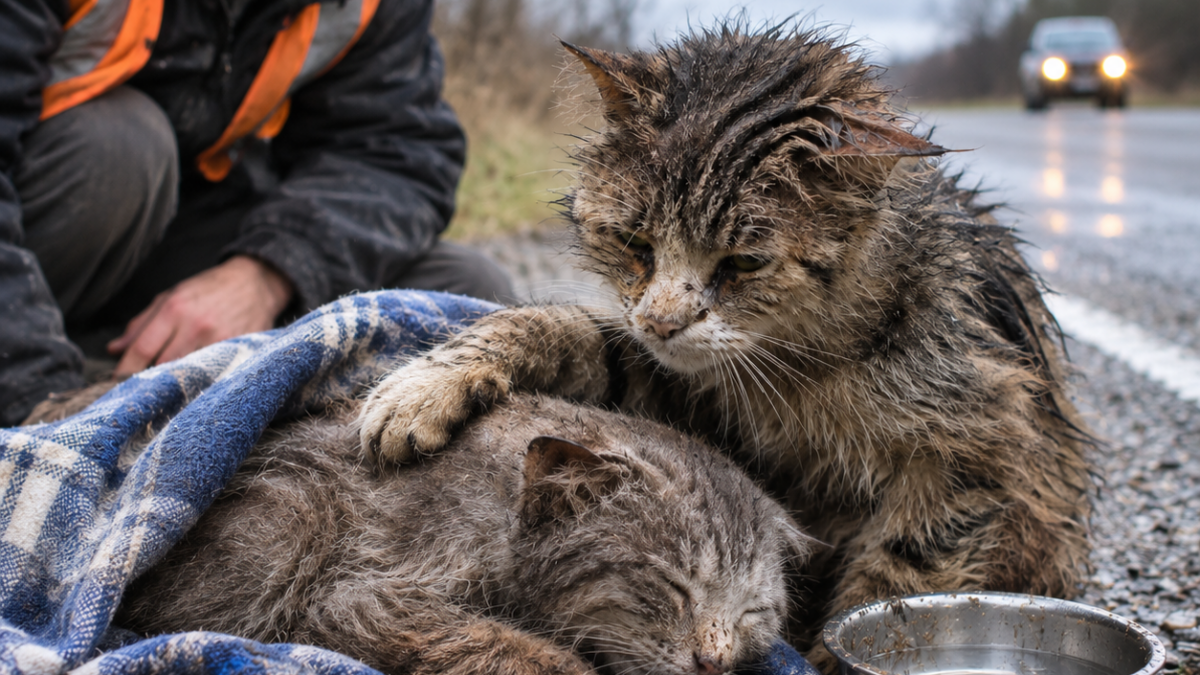
PART 2
I stayed on the ground with him for several minutes.
The woman who had called me stood beside her mailbox about fifty yards away. She had tears in her eyes.
“Has he really been here four days?” I asked.
She nodded.
“I first noticed them Thursday morning.”
It was Monday.
“Why didn’t anyone call sooner?”
She looked ashamed.
“I thought they were both alive at first. They were lying close together. Then Saturday I realized she hadn’t changed position.”
I looked toward the road.
“And him?”
“He disappears sometimes. Ten minutes. Maybe twenty. Then comes back.”
“For food?”
“Maybe water.”
That explained how he’d survived.
Barely.
I turned back to the orange cat.
He had lowered himself beside the towel again.
One paw rested over the edge.
“You stubborn little guy.”
His eyes closed for a second.
Then opened again immediately.
As if he was afraid something might happen if he slept.
I called the rescue veterinarian.
Dr. Elena Morris answered.
“Morning.”
“I need you ready for a cat.”
“How bad?”
“Dehydrated. Malnourished. Four paws injured, two severely.”
“Car?”
“No.”
Silence.
“What happened?”
“He’s been trying to drag another cat off a road.”
Another pause.
“Is the other one alive?”
“No.”
Her voice softened.
“Bring them both.”
That sentence mattered.
Both.
Not just him.
I thanked her.
Then I called animal control.
Because of the possibility that the gray cat had been struck by a vehicle, they asked me not to move her until an officer arrived.
So I waited.
The tomcat never left.
I offered food again.
He finally took one bite.
Then another.
He ate without standing, stretching his neck toward the dish so he could keep one side of his body touching the towel.
When I moved the bowl closer to make it easier, he looked at me.
“You don’t have to thank me.”
He ate slowly.
After several bites, he stopped.
Too tired.
I poured water into another dish.
This time he drank.
Too fast.
I pulled it back.
“Easy.”
He looked offended.
“I know. I’m terrible.”
I gave him a little more.
Then a little more.
By the time the animal control truck arrived, he’d taken perhaps half a cup.
Officer Daniel Ruiz stepped out carrying gloves and a scanner.
He had worked with our rescue before.
“What happened?”
I pointed toward the gray cat.
“Looks like possible vehicle trauma. Male’s been guarding her.”
“For how long?”
“Four days.”
Ruiz stared at me.
“Four?”
“His paws tell the story.”
He crouched.
The orange cat immediately sat up.
Ruiz looked at the bloodied pads.
“Damn.”
“Exactly.”
We scanned the male first.
No chip.
Then Ruiz gently uncovered enough of the gray cat to scan her shoulder.
The machine beeped.
I looked up.
“She has one?”
“Yeah.”
That changed everything.
A microchip meant a name.
Maybe an owner.
Maybe an explanation.
Ruiz read the number twice and called dispatch.
While he waited, I watched the orange cat.
He stared at the little scanner as if he understood it had somehow changed the situation.
Within a few minutes, Ruiz’s phone rang.
He stepped away.
I heard only pieces.
Registered owner.
Address.
Phone disconnected.
Then he came back.
“The chip is registered to a woman named Margaret Ellis.”
“Local?”
“Address is about six miles from here.”
“Can we contact her?”
“Number’s disconnected.”
“What about the house?”
“I’ll check.”
I looked at the gray cat beneath the towel.
“Does the chip show her name?”
Ruiz checked his notes.
“Willow.”
The orange cat lifted his head when he heard the word.
All three of us noticed.
I said it again.
“Willow?”
His ears pointed toward me.
Ruiz looked at me.
“He knows it.”
“Yeah.”
I felt my throat tighten.
The nameless gray body wasn’t nameless anymore.
Willow.
I looked at the orange cat.
“And if you’re with Willow, maybe you’ve got a name too.”
He gave no clue.
Ruiz stood.
“I’ll go to the registered address.”
“I’ll take them to Elena.”
“Document his injuries before treatment.”
“I know.”
“And photograph the roadway.”
Already thinking the same thing, I took out my phone.
There were skid marks farther up the pavement.
Faint.
Not enough to mean anything by themselves.
A small piece of black plastic lay near the grass.
Ruiz picked it up with gloved fingers.
“Could be from a car.”
“Could be trash.”
“Exactly.”
He bagged it anyway.
Evidence didn’t have to be exciting to matter.
—
Moving Willow was the hardest part.
Ruiz brought over a rigid animal stretcher.
The moment we lifted the towel, the orange cat stood.
“Easy,” I whispered.
He walked toward Willow.
Ruiz slid the stretcher beneath her.
The tomcat panicked.
He pushed his head against her side.
Then bit gently at the fur near her shoulder.
Trying again.
Still trying to move her himself.
My chest hurt.
“Buddy, you can’t.”
He ignored me.
I reached around him.
He twisted away.
Not attacking.
Just desperate.
Then Willow’s body rose on the stretcher.
The tomcat let out that terrible cry again.
He tried to follow despite his injured feet.
I finally lifted him.
He weighed almost nothing.
His body stiffened in my arms.
“I’m not leaving her.”
That was the only thing I could think to say.
“We’re taking her too.”
He struggled until he saw Ruiz place Willow into the back of my rescue van.
Then he stopped.
Completely.
I carried him inside.
He crawled from my arms and settled beside the stretcher.
His face rested against the towel covering Willow’s shoulder.
I didn’t have the heart to separate them.
For the entire drive to the clinic, he stayed there.
—
Dr. Morris met us at the door.
The first thing she did was examine the male cat.
“Temperature’s low.”
“Dehydration?”
“Definitely.”
She looked at his paws.
Her face tightened.
“This is bad.”
“How bad?”
“Pads on both front feet are severely abraded. One hind pad is partially torn. There’s infection starting in two wounds.”
“Can you save the tissue?”
“We’ll clean it, manage pain, antibiotics, bandaging. Cats heal surprisingly well if infection hasn’t gone too deep.”
She ran a hand gently along his ribs.
“Very thin.”
“He ate a little.”
“Good.”
Then she looked toward Willow.
“We need to examine her too.”
I knew what that meant.
A basic postmortem evaluation could help determine what happened.
The male cat—still nameless—didn’t want to leave Willow.
We finally moved him into a kennel directly across from her.
He pressed against the bars.
Dr. Morris spoke softly.
“He’s grieving.”
“People are going to tell me that’s anthropomorphism.”
“People say a lot of things.”
She put on gloves.
“Animals form bonds. They experience distress when those bonds disappear. You don’t need poetry to explain what we’re seeing.”
I watched him stare at Willow.
“You think he understands she’s dead?”
Dr. Morris considered that.
“Maybe not in the way you and I understand death. But after four days, he knows she’s not responding.”
“Then why stay?”
She looked at me.
“Why do people sit beside hospital beds after there’s nothing left to say?”
I had no answer.
—
Willow had injuries consistent with being struck by a vehicle.
Pelvic trauma.
Internal bleeding.
A broken hind leg.
Dr. Morris believed she had probably died within minutes.
That was the only mercy in the entire situation.
“She likely didn’t suffer for four days?”
“No.”
I closed my eyes.
“Good.”
“The male’s wounds are much newer than whatever happened to her. Repeated abrasion. Your theory about him dragging her is plausible.”
I looked through the glass.
He was lying awake in his kennel.
“We need a name.”
Dr. Morris nodded.
“You’ve earned naming rights.”
I hated that phrase.
It sounded cheerful.
I walked closer to his kennel.
His coat was orange, but darkened by mud.
One ear had a small notch.
His eyes were golden.
“Rowan.”
Dr. Morris looked at me.
“Why Rowan?”
“I don’t know.”
The cat blinked.
I said it again.
“Rowan?”
He lifted his head.
Dr. Morris smiled.
“Good enough for me.”
So Willow and Rowan had names.
One living.
One gone.
And somehow that made the whole thing hurt more.
—
Officer Ruiz called that afternoon.
“I went to the chip address.”
“And?”
“House is empty.”
“Abandoned?”
“Recently vacated.”
“What happened to Margaret Ellis?”
“Neighbor says she went into assisted living six months ago.”
My stomach tightened.
“Were Willow and Rowan hers?”
“Neighbor remembers two cats. Gray female and orange male.”
There it was.
They had lived together.
Not imagined.
Not guessed.
Known.
“What happened to them when Margaret left?”
“That’s where things get interesting.”
I hated that phrase when police used it.
“What?”
“Margaret’s nephew handled the house.”
“And the cats?”
“Neighbor assumed he took them.”
“Did he?”
“I haven’t spoken to him yet.”
I sat down.
“So they didn’t start as strays.”
“No.”
“They had a home.”
“Yes.”
“And somehow they ended up six miles away near an old road.”
“Yes.”
I looked toward Rowan.
His paws were wrapped in blue bandages now.
He hadn’t slept.
“Find the nephew.”
“We’re trying.”
—
Margaret Ellis was seventy-eight.
Her neighbor, a woman named Linda, came to the clinic the next morning.
She brought a photograph.
Willow and Rowan were sitting together on a floral couch.
Willow was younger and heavier.
Rowan looked almost exactly the same except healthier.
In the picture, his front paw was draped across Willow’s back.
Linda handed it to me.
“They were always like that.”
I swallowed.
“How long did Margaret have them?”
“Willow first. Maybe eight years. Rowan showed up as a kitten a year later.”
“She adopted him?”
“More like Willow adopted him.”
Linda smiled through tears.
“He was a sick little stray behind the grocery store. Margaret brought him home. Willow cleaned him, slept with him, let him eat from her bowl.”
I looked at the photograph again.
So that was it.
Willow hadn’t just been another cat.
She was the first family Rowan had ever known.
Linda continued.
“When Margaret had her stroke, she was devastated about leaving them.”
“Who promised to care for them?”
Her expression changed.
“Her nephew. Jason.”
“Jason what?”
“Jason Pike.”
“Did he keep them?”
“I thought he did.”
“Did Margaret think he did?”
“Yes.”
That answer made me cold.
“Does she still?”
Linda looked down.
“I haven’t told her.”
—
Officer Ruiz located Jason Pike that same day.
He lived forty minutes away.
He told Ruiz that when Margaret entered assisted living, he’d tried to keep the cats.
According to him, they were “impossible.”
They scratched furniture.
They hid.
They wouldn’t use the litter box.
So he gave them to “a guy from work.”
Name?
Couldn’t remember.
Phone number?
Didn’t have it.
Where did the guy live?
Somewhere north.
Convenient.
Very convenient.
Ruiz wasn’t convinced.
Neither was I.
But suspicious wasn’t proof.
Then Linda remembered something.
Margaret had security cameras.
Not because she feared crime.
Because she liked checking on her garden when she traveled.
The cameras had been disconnected after the house was emptied, but the system stored recordings online.
Linda was listed as an emergency contact.
With Margaret’s permission, we got access.
And that was when the story changed.
—
The footage was six months old.
Jason’s truck pulled into Margaret’s driveway three days after she entered assisted living.
He carried furniture out.
Boxes.
A television.
Then he came back for the cats.
Willow appeared first.
She walked toward him.
He grabbed her roughly by the body and put her into a plastic carrier.
Rowan ran.
Jason chased him around the living room.
At one point, he threw a cushion.
I had to stop watching.
Ruiz didn’t.
“Keep going.”
Eventually Jason caught Rowan.
Put him in another carrier.
Loaded both into his truck.
That didn’t prove where he took them.
But it proved he’d lied about giving them away later.
Then we found another video.
Jason returned home alone forty minutes later.
Without the carriers.
Without the cats.
Ruiz paused the screen.
“Time stamp?”
I read it.
3:12 p.m.
He compared it to traffic-camera records.
The county had a highway camera near the intersection leading toward the old road.
Jason’s truck appeared heading that direction at 2:29.
Returning at 2:57.
Twenty-eight minutes.
Enough time.
My hands clenched.
“He dumped them.”
“Looks like it.”
“Six months ago?”
“Probably.”
“They survived outside for six months.”
“Yes.”
“And Margaret thought they were safe.”
Ruiz didn’t answer.
I looked toward Rowan’s kennel.
Suddenly his thin body made even more sense.
He and Willow had gone from a warm house to nothing.
No porch.
No bowls.
No couch.
No Margaret.
Just each other.
And somehow they survived.
Until the road took Willow.
—
I wanted Jason arrested immediately.
Ruiz explained the problem.
“Animal abandonment from six months ago is one case.”
“And?”
“The collision is another.”
“You think he hit Willow?”
“No evidence of that.”
I knew he was right.
Still, the anger needed somewhere to go.
“He dumped two house cats in an unfamiliar area. One eventually got killed on the road.”
“Morally, I understand what you’re saying.”
“Legally?”
“We prove what we can prove.”
I hated legal precision.
I also learned to respect it.
Because anger is easy to dismiss.
Evidence is harder.
—
The next question was who struck Willow.
At first, everyone assumed we’d never know.
Old road.
No direct cameras.
No witnesses.
Then the woman who had called me remembered something.
“There’s a hunting cabin about a mile up.”
“Camera?”
“Trail cameras. Owner watches for deer.”
Ruiz got permission to check them.
One camera faced the road.
Its image quality wasn’t perfect.
But it captured vehicles.
At 11:48 p.m. Thursday night, a dark SUV passed south.
At 11:51, it came back north.
At 11:53, a light-colored pickup passed.
Then nothing for twenty minutes.
Another camera closer to the accident site had captured a brief flash of headlights and a vehicle braking sharply.
Timestamp: 11:52.
Light-colored pickup.
The same one.
Ruiz found another piece of black plastic near Willow’s body.
Dr. Morris believed it could be part of a lower bumper trim panel.
The make might be identifiable.
Now we had two threads.
Jason, who abandoned them.
And an unknown driver who may have struck Willow.
—
Rowan finally slept on his second night at the clinic.
Not deeply.
He woke whenever someone moved near the room where Willow’s body had been held.
We had arranged for cremation.
Margaret deserved to decide what happened to Willow’s ashes, but we hadn’t told her yet.
Linda called the assisted living center.
Margaret was mentally sharp.
Physically limited after her stroke.
She wanted to see Rowan.
I wasn’t sure I was ready.
Neither was Linda.
But Margaret had already lost six months with both cats because other people decided what she could handle.
We weren’t going to make that mistake again.
So three days later, when Rowan was stable enough to leave the clinic for a short visit, I drove him to see her.
—
Margaret was sitting near a window when we arrived.
She was small.
Silver-haired.
Her left hand rested motionless in her lap.
Linda walked in first.
Then me.
Then the carrier.
Margaret saw it.
Her eyes widened.
“Is that—”
I opened the carrier.
Rowan heard her voice.
He froze.
For maybe two seconds.
Then he made a sound.
Not the broken cry from the roadside.
Something higher.
Urgent.
He pushed through the carrier door before I had it fully open.
“Rowan?”
Margaret started crying.
He jumped onto her lap.
Bandaged paws and all.
He buried his head beneath her chin.
Margaret held him with her good arm.
“Oh, my baby.”
I turned away.
Linda didn’t bother.
She was crying openly.
Margaret pressed her face into Rowan’s fur.
“Where’s Willow?”
There it was.
The question none of us wanted.
Rowan went still.
I don’t know whether that was coincidence.
It didn’t feel like it.
Margaret looked at me.
“Where is she?”
I pulled a chair closer.
“Mrs. Ellis…”
Her face changed before I finished.
She knew.
People often know.
“Was she sick?”
“No.”
“What happened?”
“She was hit by a vehicle.”
Margaret closed her eyes.
Rowan climbed higher against her chest.
“Was she alone?”
“No.”
That mattered.
I leaned forward.
“Rowan stayed with her.”
Margaret opened her eyes.
“How long?”
I hesitated.
“Four days.”
Her mouth trembled.
“No.”
“He didn’t leave her.”
She held him tighter.
“He never would.”
Then she whispered something that stayed with me.
“She raised him.”
I nodded.
“I heard.”
“No. You don’t understand.”
Margaret stroked the top of Rowan’s head.
“When I found him, he was barely alive. Willow slept wrapped around him every night for weeks. He followed her everywhere.”
She looked at the bandages.
“What happened to his feet?”
Nobody answered fast enough.
Margaret looked at me.
“What happened?”
“He tried to move her away from the road.”
She broke.
Not loudly.
That would have been easier.
She bent over Rowan and cried into his fur.
Rowan didn’t move.
He just stayed.
Exactly as he had stayed with Willow.
—
Margaret wanted Willow’s ashes.
Of course she did.
She also wanted Rowan back.
That part was harder.
The assisted living facility didn’t allow permanent pets.
But the director had seen the local news story after someone leaked the rescue.
She made an exception for visits.
Rowan could spend afternoons with Margaret several times a week if he had a permanent foster home nearby.
I volunteered before anyone else could.
That surprised me.
I had rescued animals for years.
I tried not to adopt every one.
That way lies madness and thirty-two cats.
But Rowan was different.
Maybe because I’d found him at the end of something.
He had already lost too much.
So I became his foster.
“Temporary,” I told Dr. Morris.
She laughed.
Linda laughed.
Officer Ruiz laughed.
Even Margaret laughed.
“What?”
Margaret stroked Rowan.
“That’s what I said about him when I brought him inside.”
Fair.
—
Rowan’s paws healed slowly.
Every two days, we changed his bandages.
He hated it.
He never bit.
Never scratched.
He just stared at me as though I had personally betrayed him.
“You dragged a body across asphalt for days, but gauze is where you draw the line?”
He turned his head away.
“Fine.”
The raw pads began forming healthy tissue.
He gained weight.
His coat improved.
But emotionally, he seemed stuck.
At night, he searched my house.
Room to room.
Closet.
Bathroom.
Behind furniture.
Then he stood near the front door.
Waiting.
The first week, he barely slept anywhere except on the mat beside the door.
I put Willow’s photograph near his bed.
Maybe that was silly.
Maybe it wasn’t.
One night, I found him curled beneath it.
—
The search for the driver took another week.
The plastic fragment matched trim used on several Ford pickup models.
Ruiz requested repair records from local body shops.
Nothing.
Then he found something better.
A gas station camera five miles north.
At 12:07 a.m., a white Ford F-150 pulled in.
Its front bumper had fresh damage.
The driver got out.
Looked at the bumper.
Kicked something loose.
Then drove away.
The plate was visible.
Registered owner: Craig Dalton.
Forty-two.
Local construction subcontractor.
No serious criminal history.
Several speeding citations.
Ruiz interviewed him.
At first, Dalton denied everything.
Then said he’d hit “something.”
A raccoon, maybe.
Didn’t know.
Didn’t stop because it was dark.
When shown the footage, he changed his story.
Maybe it was a cat.
He wasn’t sure.
Maybe he braked.
Maybe he didn’t.
He said he couldn’t remember.
I wanted to hate him instantly.
Then Ruiz told me something I didn’t expect.
Dalton hadn’t been drinking.
He hadn’t been texting, as far as phone records showed.
The road was dark.
Willow had probably entered suddenly.
He might genuinely not have seen her until it was too late.
The thing I couldn’t accept was that he didn’t stop.
Maybe stopping wouldn’t have saved Willow.
Dr. Morris believed the impact killed her quickly.
But if Dalton had stopped, he would have seen Rowan.
He could have called someone.
Four days of torn paws and starvation might have been prevented.
When Ruiz told Dalton that part, he apparently went pale.
“He stayed there?”
“Four days.”
“Jesus.”
“He tore his feet trying to drag her.”
Dalton sat down.
Then asked if Rowan survived.
That complicated my anger.
I didn’t want complicated.
I wanted villains.
Life rarely cooperates.
—
Jason Pike was different.
Jason never asked about Rowan.
Never asked about Willow.
Never asked whether they survived after he dumped them.
When police confronted him with the video, he shrugged.
“I couldn’t keep them.”
“You told your aunt you would.”
“I changed my mind.”
“So you abandoned two indoor cats?”
“They’re cats. They survive.”
One did.
Until she didn’t.
Ruiz told me not to attend the first hearing.
I attended anyway.
Jason saw me in the hallway.
He recognized me from news coverage.
“You the cat lady?”
“Depends who’s asking.”
He smirked.
“You people are making a huge deal out of nothing.”
My hands went cold.
“Nothing?”
“They lived outside for months, didn’t they?”
I stared at him.
“One of them is dead.”
“Not because of me.”
There it was.
The line people use when they want consequences to stop exactly one inch before reaching them.
I stepped closer.
Ruiz appeared between us.
“Walk away.”
Jason smiled.
“Yeah. Walk away.”
For one second, every angry thought I had rushed forward.
I imagined saying something cruel.
Threatening him.
Making him afraid.
Instead, I looked at Ruiz.
“What happens if I punch him?”
“Bad things for you. Good things for his lawyer.”
I nodded.
Then looked at Jason.
“Not worth it.”
His smile disappeared.
That felt better than hitting him.
—
Margaret agreed to testify.
Her doctors worried it would exhaust her.
She insisted.
“He lied to me.”
She practiced with the prosecutor.
Jason’s attorney tried to argue that Margaret had given him broad discretion over the cats.
Margaret answered in one sentence.
“I asked him to care for my family, not throw them away.”
That became the line quoted in every local article.
Jason hated the attention.
Good.
He had wanted the cats to disappear quietly.
Instead, everyone learned exactly what he’d done.
—
Craig Dalton contacted me through Ruiz.
He wanted to meet.
I almost refused.
Then I remembered my own anger at people making decisions without facing the thing they’d caused.
So I agreed.
We met at the clinic.
Rowan came with me.
His paws were mostly healed, though still sensitive.
Dalton arrived early.
He looked nothing like the villain I’d built in my head.
Work jacket.
Tired face.
Nervous hands.
He saw Rowan.
His eyes dropped.
“That’s him?”
“Yes.”
Rowan stayed close to me.
Dalton crouched but didn’t reach out.
“I didn’t see them.”
I said nothing.
“I swear to God, I didn’t see them until something ran across.”
“Willow.”
He swallowed.
“Willow.”
I appreciated that he used her name.
“I hit the brakes. I heard the impact.”
“And you kept driving.”
He looked down.
“Yes.”
“Why?”
“I panicked.”
“That’s not good enough.”
“I know.”
“You got out at the gas station and checked your truck.”
“I know.”
“You cared enough to check your bumper.”
He flinched.
“Yeah.”
“But not enough to check what you hit.”
“No.”
Rowan stared at him.
Dalton’s eyes filled.
“I’ve replayed that night a hundred times since the police came.”
I didn’t soften.
“Rowan replayed it for four days.”
He covered his mouth.
For a moment, we said nothing.
Then he asked, “Can I help with the vet bills?”
“They’re mostly covered.”
“Then the rescue.”
“Why?”
“Because I should’ve stopped.”
That was the first thing he’d said that mattered.
Not I didn’t see.
Not it was dark.
Not it was an accident.
I should’ve stopped.
“Yes,” I said. “You should have.”
He nodded.
We didn’t forgive each other.
There wasn’t anything between us that required friendship.
But he donated enough money to cover Rowan’s treatment and several other emergency cases.
Later, he volunteered to install lighting outside the rescue building.
People argued online about whether he deserved credit.
I didn’t care.
Willow was dead.
Nothing bought that back.
But responsibility that changes behavior matters more than apologies that don’t.
—
Jason offered no such thing.
He fought every charge.
He blamed Margaret.
The rescue.
Me.
The police.
The media.
Even Willow.
At one point his attorney suggested the cats could have returned home if they’d wanted.
I nearly laughed out loud.
Six miles.
Across highways.
After being driven in carriers.
House cats.
But nonsense becomes less powerful when facts are patient.
The prosecution had the security footage.
Margaret’s testimony.
The abandoned-cat report.
Neighbors who had seen Jason load them.
Traffic cameras placing his truck near the dumping location.
Messages between Jason and a friend sent that same afternoon.
One said:
Got rid of aunt’s stupid cats. Problem solved.
Problem solved.
I stared at that sentence when the prosecutor showed me.
Rowan slept beside my chair.
“What does everyone have against calling animals by their names?” I asked.
The prosecutor sighed.
“Distance makes cruelty easier.”
Maybe that was it.
If Willow was “a cat,” she could be discarded.
If Rowan was “a cat,” his grief was meaningless.
If they were Willow and Rowan, suddenly you had to picture them.
—
The case drew more attention than anyone expected.
People began sending photographs of bonded animals.
Dogs sleeping beside each other.
Cats grooming lifelong companions.
Horses standing near sick herd mates.
One local teacher used Rowan’s story in a class discussion about responsibility.
A child sent him a card.
On the front was a drawing of an orange cat with enormous feet.
Inside:
YOU DID A GOOD JOB TAKING CARE OF YOUR FRIEND.
I cried over that one.
Margaret kept it beside her bed.
—
Rowan started visiting Margaret every Tuesday and Friday.
The first visit after his bandages came off, he walked carefully across her blanket.
Margaret touched one paw.
“All better?”
Mostly.
A little scarred.
One pad would probably always be thinner than the others.
She kissed his head.
“Willow would be proud of you.”
Rowan curled against her.
That day, we brought Willow’s ashes.
A small wooden box.
Margaret held it with one hand.
Rowan sniffed it.
Then sat beside her.
I don’t know what he understood.
I stopped pretending I needed to know.
—
Months passed before Rowan began acting like a normal cat again.
The first major breakthrough came with a toy mouse.
I tossed it across the living room without thinking.
Rowan chased it.
Three steps.
Then five.
Then pounced.
I froze.
He froze.
We both looked at the toy.
Then Rowan swatted it under the couch.
I started laughing.
He jumped.
“Sorry.”
I got down on the floor.
“Do it again.”
He did.
That night he slept on my bed instead of beside the front door.
I noticed at 2:00 a.m.
I didn’t move because I was afraid of waking him.
My back hurt for two days.
Worth it.
—
The hearing for Jason’s plea agreement happened in late winter.
He had finally realized trial wasn’t going to erase video evidence.
The deal included a guilty plea to animal abandonment and cruelty-related charges under local law.
Probation.
Community service.
Restitution.
A prohibition on owning animals during the probation period.
And a suspended jail term that could be activated if he violated conditions.
I wanted more.
Margaret surprised me.
“Take it.”
I looked at her.
“He abandoned them.”
“I know.”
“Willow died out there.”
“I know.”
“You’re okay with probation?”
“No.”
“Then why?”
She looked at Rowan sleeping against her hip.
“Because I don’t want my last years spent waiting for that man’s trial.”
That silenced me.
Revenge can become another kind of leash if you hold it too tightly.
Margaret wanted her life back.
So we supported the plea.
But there was one condition she insisted on.
She wanted to speak at sentencing.
—
The courtroom was full.
Jason sat beside his attorney.
Margaret arrived in a wheelchair.
Rowan could not enter the courtroom, but Linda waited with him outside.
I sat behind Margaret.
The prosecutor summarized the case.
Then Jason’s attorney described him as overwhelmed by responsibility.
Margaret whispered, “He was overwhelmed by two cats?”
I nearly laughed.
The judge heard.
His mouth twitched.
Then Margaret was called.
I wheeled her forward.
She raised her good hand slightly.
“I can speak for myself.”
The judge nodded.
“Of course.”
Margaret looked at Jason.
Not angrily.
That somehow made it worse.
“I trusted you because you were family.”
Jason looked down.
“I asked you for one thing when I went into care.”
She paused.
“Take care of Willow and Rowan.”
Her voice shook.
“I had already lost my house. I had lost the use of half my body. I had lost the life I knew.”
She swallowed.
“But I thought I still had them.”
No one moved.
“You sent me photographs for three weeks.”
I hadn’t known that.
Neither had I.
Jason stiffened.
Margaret continued.
“Old photographs.”
The prosecutor had discovered he’d been sending her images taken before he dumped the cats.
“You let me believe they were safe.”
Her eyes filled.
“While they were outside trying to survive.”
Jason’s attorney put a hand on his arm.
Margaret kept going.
“Willow died beside a road.”
Her voice cracked.
“And Rowan stayed with her until his feet bled.”
Now even Jason looked uncomfortable.
Margaret leaned forward.
“You keep saying you didn’t kill Willow.”
She nodded slowly.
“Maybe you didn’t drive the truck.”
Then came the sentence that ended every argument.
“But you put her on that road.”
Silence.
Absolute silence.
Margaret sat back.
“That is all.”
I wheeled her away.
She didn’t look at Jason again.
—
When my turn came, I had planned a long statement.
I didn’t need it anymore.
Margaret had already said the truth better than I could.
So I spoke for less than two minutes.
“I found Rowan beside Willow.”
I described his paws.
The drag marks.
The four days.
Then I looked at Jason.
“You called them a problem you had gotten rid of.”
His eyes met mine.
“Rowan didn’t see Willow as a problem.”
I paused.
“He saw her as family.”
Then I looked at the judge.
“I hope whatever sentence you impose makes one thing very clear: when people take responsibility for animals, they don’t get to erase that responsibility by driving somewhere remote and opening a carrier.”
I sat down.
The judge imposed the plea terms.
Then added the maximum animal-ownership restrictions permitted.
He ordered Jason to pay restitution to the rescue and Margaret.
Community service had to be completed with a county-approved program—but specifically not one giving him unsupervised access to animals.
And he warned him:
“If you violate these conditions, the suspended jail sentence will become very real.”
Jason’s face changed.
Good.
Not because fear is justice.
But because for the first time, the consequences were attached to him instead of Willow and Rowan.
—
Outside the courthouse, reporters waited.
I wanted no part of it.
Margaret did.
One reporter asked, “Do you feel justice was done?”
Margaret thought for a moment.
“No.”
Everyone went quiet.
She continued.
“Justice would be Willow alive.”
Then she looked down at Rowan in his carrier.
“This is accountability.”
That became the headline.
And she was right.
Justice and accountability aren’t always the same.
Sometimes life doesn’t give you justice.
You build the best accountability you can from what’s left.
—
Craig Dalton came to one of Rowan’s visits with Margaret.
He asked permission first.
She agreed.
He stood awkwardly in the doorway.
Margaret knew who he was.
For a long moment, neither spoke.
Then Dalton said, “Mrs. Ellis, I’m sorry.”
Margaret looked at him.
He didn’t make excuses.
“I should’ve stopped.”
She nodded.
“Yes.”
“I don’t know whether it would have changed anything for Willow.”
“It might have changed things for Rowan.”
“Yes.”
Dalton’s eyes dropped.
“I know.”
Margaret looked toward Rowan.
Then back at him.
“Are you still driving too fast on that road?”
“No, ma’am.”
“Good.”
That was it.
No forgiveness scene.
No dramatic embrace.
Just a boundary.
A fact.
A change.
Sometimes that’s enough.
—
Spring came.
Rowan’s paws were fully healed.
He ran now.
Really ran.
The first time I saw him sprint across my hallway, I had to stop what I was doing.
Those feet had once been torn almost to the bone because he refused to leave Willow.
Now they carried him toward a patch of sunlight.
I watched him leap onto the windowsill.
He looked back at me.
“What?”
He blinked.
“You’re allowed.”
He curled up in the sun.
For months, every time I looked at his paws I saw the road.
Eventually I started seeing where they could take him instead.
—
Then Margaret’s health worsened.
We knew it might happen.
Her stroke had left complications.
One evening Linda called me.
“You should bring Rowan.”
I didn’t ask why.
I put him in the carrier and drove.
Margaret was in bed.
The room was dim.
She smiled when she saw him.
“There he is.”
Rowan climbed onto the bed.
He moved slowly, almost carefully.
Then curled beside her chest.
Margaret rested her hand over him.
“I worried about you every day.”
His purr filled the quiet room.
She looked at me.
“Will you keep him?”
My throat closed.
“Yes.”
“Not foster.”
“No.”
“Promise?”
“I promise.”
She smiled.
“Good.”
Then she looked at Rowan.
“You hear that?”
He purred harder.
Margaret died two days later.
Rowan was with her for most of the final evening.
I brought him home afterward.
He searched my house again.
Not frantically.
Just quietly.
Then he went to the front door.
He sat there for an hour.
I sat beside him.
Neither of us had anywhere else to be.
—
Margaret left a small envelope for me.
Inside was the photograph of Willow and Rowan on the floral couch.
On the back, she’d written:
They always chose each other. Thank you for choosing him when she couldn’t anymore.
I still have it.
—
After Margaret died, Rowan changed again.
Grief didn’t disappear.
It rearranged itself.
He stopped waiting beside the door every night.
Started sleeping beside me.
He became obsessed with sitting on paperwork.
If I opened a laptop, he sat on the keyboard.
If I made a phone call, he meowed until I acknowledged him.
He discovered chicken.
Then behaved as though chicken had been withheld from him through deliberate cruelty his entire life.
The first time he stole some from my plate, I stared at him.
“You nearly starved yourself beside a road and now you’re a thief?”
He kept chewing.
“Good.”
I gave him another piece.
—
A year after Willow died, we held a small memorial at the rescue.
Nothing elaborate.
Claire planted a willow tree near the entrance.
Of course she did.
Under it, we placed a small stone.
WILLOW
LOVED, REMEMBERED, NEVER LEFT ALONE.
Rowan attended.
He spent most of the ceremony trying to eat grass.
That felt appropriate.
Grief can be solemn for humans.
Cats don’t care about ceremony.
They care about being there.
When everyone left, Rowan sat beneath the young tree.
A breeze moved the leaves.
I took a photograph.
Later, people told me it was beautiful.
I didn’t post it for months.
It felt private.
—
Then something unexpected happened.
A shelter called about a kitten.
Gray.
Female.
Found beneath a porch.
No mother.
Eight weeks old.
She was healthy but terrified of other cats.
Claire asked whether Rowan might help socialize her.
My first answer was no.
I didn’t want some sentimental replacement for Willow.
Willow wasn’t replaceable.
Then I realized nobody had asked for replacement.
They’d asked for help.
So we brought the kitten over.
Her foster name was Poppy.
Poppy hissed at Rowan.
Rowan stared.
Poppy hissed again.
Rowan walked away.
Excellent start.
For three days, they ignored each other.
Then Poppy began following him.
Rowan tolerated it.
Then she started eating from his bowl.
He looked at me with deep betrayal.
“I know.”
A week later, I found them asleep on the couch.
Not touching.
Close.
The next week, Poppy was pressed against him.
Rowan had one paw over her back.
Exactly like the old photograph with Willow.
I sat on the floor and cried.
Not because Poppy had become Willow.
She hadn’t.
Because Rowan still had love left.
After everything, he hadn’t closed that part of himself.
That felt like a miracle.
Poppy never left.
Apparently I now had two cats.
Claire called it predictable.
I called it temporary for three days.
Then stopped lying.
—
People sometimes ask whether Rowan remembered Willow.
I don’t know.
Memory in animals isn’t something I can translate into human sentences.
But I know this:
For months after the rescue, if he heard tires screech outside, he froze.
If a towel covered another animal at the clinic, he became agitated.
If I said Willow while showing Margaret the old photograph, his ears moved.
And for the rest of his life, he hated being separated from any animal he had bonded with.
Maybe that’s memory.
Maybe it’s simply the shape love leaves behind.
—
Jason Pike completed probation without violation.
He paid restitution slowly.
He never contacted me.
I was glad.
I didn’t need an apology.
The most satisfying part wasn’t what happened to him.
It was what happened without him.
Margaret’s estate donated a small amount to the rescue.
Craig Dalton continued donating every year on the anniversary of Willow’s death.
The old road got additional warning signs and reflective markers after residents pushed the county for safety improvements.
The rescue created an emergency foster program specifically for pets belonging to elderly people who suddenly enter hospitals or care facilities.
That program mattered more than any courtroom sentence.
Because Willow and Rowan’s story had exposed a gap.
People enter hospitals.
Families panic.
Pets become an afterthought.
Sometimes somebody says, “I’ll handle it,” and nobody checks what that means.
Now there was another option.
No one had to dump an animal because a relative became ill.
Every kennel in that program carried a small plaque:
THE WILLOW & ROWAN SAFE HAVEN PROGRAM
Margaret would have loved that.
Probably more than she would have loved knowing Jason was punished.
—
Years later, I drove the old road again.
I had Rowan in the passenger seat.
Poppy was in a carrier behind me because she hated driving and expressed that hatred continuously.
We weren’t going anywhere special.
I just wanted to see the place.
The shoulder looked smaller.
Most places tied to painful memories do.
I pulled over.
Rowan looked out the window.
I didn’t let him out.
Too close to traffic.
He stared at the grass.
I wondered if he remembered.
Then he turned toward me and meowed.
“Hungry?”
Another meow.
“Of course.”
I gave him a treat.
Poppy screamed from the back.
“You too.”
She got one.
I sat there for several minutes.
This was where I had first seen him.
Thin.
Bloody.
Guarding a body.
At the time, I thought his story was about loyalty.
It was.
But not only that.
It became a story about responsibility.
Jason thought responsibility ended when keeping two cats became inconvenient.
Dalton thought responsibility ended because the thing he hit was probably “just an animal.”
People passing the road thought responsibility belonged to somebody else.
Rowan thought differently.
He stayed.
Four days.
Until his body was failing.
A cat understood something several humans didn’t.
You don’t abandon someone just because helping them is hard.
—
I looked at him.
“You know, you were terrible at letting go.”
Rowan blinked.
“So was I.”
For a long time, I had carried anger like it proved I cared.
I wanted Jason humiliated.
I wanted Dalton punished.
I wanted someone to hurt because Willow had died.
But anger is only useful while it moves something toward justice.
After that, it can become another roadside you refuse to leave.
Rowan taught me that too.
He stayed with Willow until help came.
Then, slowly, he moved.
He ate.
He healed.
He loved Margaret again.
He lost Margaret.
He healed again.
He let Poppy follow him.
He slept in the sun.
He stole chicken.
He lived.
That was the part I wanted to remember.
Not only that he stayed.
That eventually, he allowed himself to go on.
—
Rowan grew old with me.
His face turned pale around the muzzle.
He stopped jumping onto the kitchen counter.
I pretended to be disappointed.
He slept more.
Poppy became his shadow.
One winter morning, I found them curled together in a blanket.
Poppy’s head was tucked beneath his chin.
I took a picture.
Then pulled out Margaret’s old photograph.
Willow with her paw around young Rowan.
Two photographs.
Two chapters.
Same cat in the middle.
Once protected.
Then protector.
I put both photographs in the same frame.
—
When Rowan’s final day came, it was nothing like Willow’s.
That matters to me.
He was not beside a road.
He was not cold.
He was not frightened.
He was at home.
Old.
Tired.
Wrapped in his favorite blanket.
Poppy lay beside him.
I sat on the floor.
Dr. Morris—older now too—came to the house.
She examined him gently.
Rowan barely lifted his head.
“He’s ready,” she whispered.
I wasn’t.
Of course I wasn’t.
I held him.
He purred once.
Very softly.
I thought about the first day.
The bleeding paws.
The towel.
The desperate cry.
“I’m not taking anyone away from you this time,” I whispered.
I don’t know why I said it.
Maybe I was talking to the terrified cat from years ago.
Maybe I was talking to myself.
I put Margaret’s photograph beside him.
Willow and Rowan.
Young.
Healthy.
Together.
“You did enough.”
That was the last thing I told him.
“You stayed long enough.”
He died with my hand on his side and Poppy touching his back.
Peacefully.
Exactly the ending he should have had.
—
We buried Rowan’s ashes beside Willow’s tree at the rescue.
Margaret’s ashes weren’t there—her family had placed them elsewhere—but part of me felt the three of them had found each other again in the only way stories allow.
Claire placed another stone beside Willow’s.
ROWAN
HE STAYED WHEN LEAVING WOULD HAVE BEEN EASIER.
Underneath, I added one sentence.
AND THEN HE LEARNED TO LIVE AGAIN.
That was important.
Without it, the story would have ended on the road.
I didn’t want that.
Neither would Margaret.
—
Poppy lived many years after Rowan.
She slept beneath the photographs.
She still stole from his old bowl.
Whenever I volunteered with frightened cats, people sometimes asked how I knew when to stop pushing.
I would think of Rowan.
You sit nearby.
You offer food.
You don’t force touch.
You let trust choose its own speed.
That was how he had trusted me beside Willow.
Half a step at a time.
—
People still tell Rowan’s story.
Usually they focus on the four days.
They say:
A cat guarded his companion’s body until his paws bled.
It’s true.
But it’s only the beginning.
They don’t always mention the old woman who thought her animals were safe.
The nephew who chose convenience over a promise.
The driver who chose fear over stopping.
The officer who kept collecting boring pieces of evidence.
The veterinarian who treated four destroyed paws.
The rescue that built a program so another elderly person’s animals wouldn’t disappear.
The kitten who later taught Rowan that loving someone new wasn’t betrayal.
Those parts matter too.
Because tragedies rarely happen because of one moment.
And healing rarely happens because of one person.
—
If you ask me what the revenge was, I can tell you.
It wasn’t me hitting Jason in a courthouse hallway.
It wasn’t strangers threatening him online.
It wasn’t Craig Dalton spending the rest of his life drowning in guilt.
None of that would have brought Willow back.
The revenge was this:
Jason tried to make Willow and Rowan disappear.
Instead, their names ended up on a program that saved hundreds of other animals.
He abandoned them because he thought nobody would know.
Now people know their story.
He treated them as disposable.
They became unforgettable.
The man who dumped them became a cautionary detail.
Willow became a name on a tree.
Rowan became the reason people stopped when they saw an animal waiting beside a road.
That was enough for me.
More than enough.
—
Sometimes I still think about those first few minutes.
The rain.
The cold shoulder.
Willow’s gray body.
Rowan standing on paws that should have been too painful to use.
I remember lowering the towel.
His cry.
His teeth pulling at the fabric.
His forehead pressing into my hand.
At the time, I thought he was begging me not to take Willow.
Years later, I understood it differently.
He wasn’t asking me to leave her there.
He was asking me not to make her disappear.
So I didn’t.
We learned her name.
We found Margaret.
We told the truth.
We planted a tree.
We built something in their names.
And when Rowan finally left this world many years later, he didn’t leave Willow forgotten on the side of a road.
He left behind proof that she had mattered.
Maybe that’s what love is sometimes.
Not being able to save someone.
Not being able to change what already happened.
But refusing to let the world act as though their life meant nothing.
Rowan couldn’t bring Willow home.
He tried until his feet bled.
In the end, other people had to carry her for him.
But he did something just as powerful.
He made us stop.
And because we stopped, we learned her name.
We learned his.
We learned what had been done to them.
And we made sure it never disappeared quietly.
Years after that morning, when I stood beneath the willow tree with both stones at my feet, I finally understood why the image of him on that road had never left me.
It wasn’t because he refused to move.
It was because even after losing almost everything, he still believed staying beside someone mattered.
He was right.
And when the time finally came for him to go, he wasn’t alone either.
Not for a single second.








