PART 2: He Guarded an Empty Warehouse for 11 Years—Then One Hug Made Him Realize He Was Finally Going Home
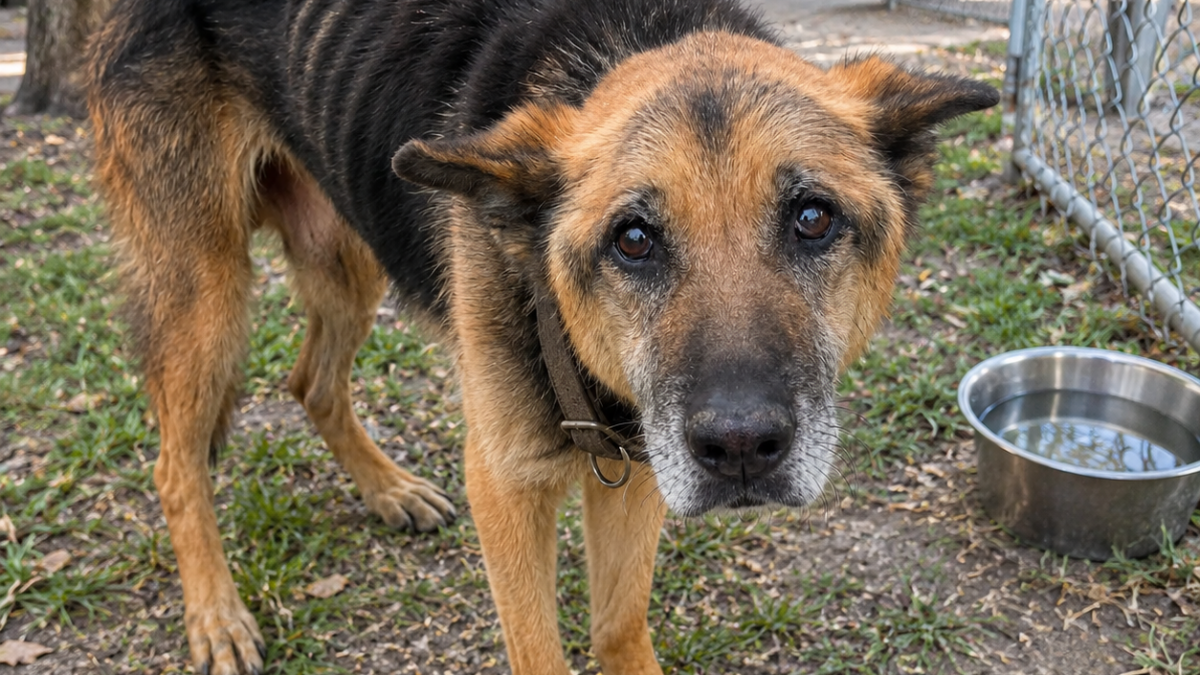
PART 2
We called him Major.
Not because we knew his real name.
We didn’t.
At first, he had no tag except a rusted piece of metal attached to his collar with the number 14 stamped into it.
Anna stared at it while we loaded him into the rescue van.
“Fourteen?” I asked.
“Could be a kennel number.”
“Or employee dog number.”
She looked at Major.
“I hate that sentence.”
Getting him into the van took nearly twenty minutes.
Not because he fought us.
Major didn’t fight anything.
That almost made it worse.
A frightened dog usually pulls backward or tries to escape.
Major simply stopped.
Whenever we asked him to move somewhere unfamiliar, his entire body became still.
He waited.
For permission, perhaps.
Or punishment.
We weren’t sure.
Anna put a blanket across the floor of the van.
“It’s okay.”
Major stared at the open doors.
“Come on.”
Nothing.
I moved behind him but didn’t touch him.
“We may have to lift him.”
“No,” Anna said.
“He can barely stand.”
“I know.”
“It’s freezing.”
“I know.”
I heard the impatience in my own voice and immediately regretted it.
Anna didn’t react.
She sat inside the van.
Then she waited.
Major stared at her.
She patted the blanket once.
“You already left the gate. This part is easier.”
His front paw lifted.
Then stopped in midair.
He placed it on the bumper.
His rear legs trembled.
Anna leaned forward, but she didn’t grab him.
Major climbed inside.
One paw.
Then another.
By the time he reached the blanket, he was panting.
He turned around immediately.
His eyes searched through the open doors.
Back toward the warehouse.
Back toward the gate.
“Close them,” Anna whispered.
I did.
Major watched the warehouse disappear through the rear window.
For the entire drive to the veterinary clinic, he never lay down.
He stood facing backward.
Waiting for the place he had served for eleven years to return.
It didn’t.
The clinic staff knew we were coming.
Dr. Harris met us at the side entrance.
He had worked with Anna’s rescue for years and had learned that when she called ahead and said, “I need you to prepare yourself,” the animal usually had a difficult story.
Major was no exception.
The examination took almost two hours.
He was severely underweight.
Dehydrated.
His teeth were worn badly.
There was arthritis in both hips.
The crooked back leg came from an old fracture that had healed without proper treatment.
He had a skin infection beneath his collar.
A mass near his shoulder needed testing.
One ear had been damaged years earlier.
His nails were so long they changed the angle of his paws.
But what surprised Dr. Harris most was his age.
“Eleven, maybe twelve,” he said.
Anna looked at him.
“Can he recover?”
Dr. Harris leaned against the counter.
“Recover means different things.”
“Can he have a normal life?”
“At his age? With those hips? Probably not what you’d call normal.”
Anna’s face fell.
He continued.
“But comfortable? Happy?”
“Yes.”
I looked at Major.
He was standing beside the examination-room door.
Of course.
Always near the exit.
Always waiting.
“How long?” I asked.
Dr. Harris shrugged.
“Could be months.”
Anna swallowed.
“Could be years?”
“Maybe.”
He looked at us.
“Here’s what I can tell you. That dog survived eleven years outside. He’s tougher than he looks.”
That became the first hopeful thing anyone said about Major.
We arranged for him to stay at the clinic overnight.
Anna and I left around six.
Before going home, I drove back to the warehouse.
I don’t know exactly why.
Maybe I wanted answers.
Maybe I was angry.
Maybe I needed to prove to myself that we hadn’t misunderstood something.
The property was even more depressing after dark.
I parked near the gate.
For years, Major had guarded this place at night.
I imagined him listening to trucks pass on the road.
Rain.
Wind.
Snow.
Maybe workers once greeted him.
Maybe somebody occasionally scratched his head.
Maybe, early in his life, he had believed he belonged to people.
But standing there after everyone had left, all I could see was the empty post.
The broken chain lay where we had cut it.
I photographed it.
That became the first picture I took of Major’s story.
Not the dog.
The chain.
The next morning, Anna called.
“He won’t eat.”
I drove to the clinic.
Major was lying in a kennel.
A bowl of food sat untouched.
Anna was sitting on the floor outside.
“He hasn’t eaten since yesterday?”
“Apparently not.”
Dr. Harris had tried wet food.
Chicken.
Prescription food.
Nothing.
When Anna opened the kennel door, Major stood.
He walked past the food.
Straight toward the clinic exit.
Anna followed him.
“He thinks he has to go back.”
I didn’t want to believe her.
But she was right.
Outside, Major turned toward the parking lot.
He stood there.
Then looked at us.
We tried walking him around the grass.
He moved slowly, stopping every few yards.
When we returned to the clinic entrance, he resisted.
Not violently.
He simply planted his feet.
“He thinks we’re taking him back,” I said.
Anna looked at me.
“No.”
She crouched beside him.
“He thinks he needs to find the gate.”
That day, we made our first mistake.
We brought him back to the warehouse.
Not permanently.
Only for a few minutes.
Dr. Harris wasn’t thrilled.
But Anna believed Major needed to understand what had happened.
We parked outside.
Major recognized the place immediately.
His entire body changed.
He stood taller.
He pulled on the leash for the first time.
Not strongly.
But urgently.
He walked toward the gate.
When we reached the post, he sat.
Exactly where he had been.
Anna’s eyes filled with tears.
“Major.”
He stared at the gate.
I hated every person who had ever walked through it.
Anna sat beside him.
“They’re not coming.”
Major waited.
Ten minutes.
Twenty.
Then thirty.
Anna finally whispered, “Show him.”
I knew what she meant.
We walked him through the property.
Past the empty loading bays.
Past the office.
Past the security cabin.
There was nothing.
Desks gone.
Machinery gone.
Lockers empty.
Only trash and dust remained.
Major sniffed every doorway.
At the old security booth, he stopped.
There was a faded blanket inside.
A plastic bowl.
And writing on the wall.
Shift schedules.
Phone numbers.
Names.
One line had been written in permanent marker near the door.
**DON’T FORGET TO FEED RANGER.**
Anna stared at it.
“Ranger.”
Major’s ears lifted.
Anna turned.
“Ranger?”
His head moved.
I felt something run through me.
“That’s his name.”
Anna tried again.
“Ranger.”
His tail moved.
Once.
The smallest movement imaginable.
But it moved.
Eleven years.
That was his name.
Not Major.
Ranger.
Anna knelt.
“Hi, Ranger.”
He looked at her.
And this time, when she touched his face, he leaned into her hand.
Barely.
But enough.
We searched the security booth.
In a drawer, I found old paperwork.
Most of it was useless.
Inspection sheets.
Delivery logs.
Employee schedules.
Then I found a veterinary receipt.
Eight years old.
**Dog: Ranger.**
Owner information listed the warehouse company.
Not a person.
The receipt was for vaccinations and treatment of a paw injury.
Under notes, someone had written:
**Working guard dog. Lives on premises.**
Anna read it twice.
“Lives on premises.”
There was something about those words that made me furious.
Not “family dog.”
Not “beloved pet.”
Lives on premises.
Like a generator.
A forklift.
A piece of equipment.
We photographed everything.
Then Anna stood in front of Ranger.
“Come on.”
He stared at the booth.
“No.”
She gently touched his collar.
“You don’t work here anymore.”
Ranger didn’t move.
Anna’s voice became firmer.
“Your shift is over.”
Something about those words changed him.
Maybe it was coincidence.
Maybe I wanted it to mean more than it did.
But Ranger looked at her.
Then at the empty warehouse.
Then he stood.
And he followed us out.
He never returned again.
The next problem was finding somewhere for him to go.
The rescue shelter was crowded.
Anna already had three foster dogs at home, including one recovering from surgery.
I lived in an apartment where my landlord barely tolerated my cat.
Ranger needed quiet.
Warmth.
A yard would help.
Someone patient.
Someone who didn’t expect affection in exchange for food.
We posted his story privately among rescue volunteers.
No public campaign yet.
Anna didn’t want strangers rushing to meet him.
Three people offered.
Two changed their minds after hearing about his medical condition.
The third was a sixty-eight-year-old retired mechanic named Thomas.
Thomas lived alone in a small house outside town.
His wife, Ellen, had died three years earlier.
Their last dog had died a year after her.
When Anna called him, his first question was:
“Does the dog like people?”
Anna thought carefully.
“I don’t know if he knows what liking people means.”
Thomas paused.
“Does he bite?”
“No.”
“Then bring him.”
We arrived at Thomas’s house two days later.
It was modest.
One story.
A porch.
Fenced backyard.
Wood stove.
Ranger stood beside the van and stared at the house.
Thomas came outside.
He didn’t approach.
“That’s him?”
“That’s Ranger.”
Thomas folded his arms.
“Looks older than me.”
“You might have competition.”
Thomas smiled.
Ranger didn’t.
We walked him toward the yard.
At the gate, he stopped.
Thomas opened it.
Ranger stared through.
Anna waited.
I had learned by then that waiting was half of rescue work.
Eventually, Ranger entered.
He walked the perimeter first.
Fence line.
Gate.
Back door.
Porch.
Again.
Always checking boundaries.
Thomas watched.
“He’s doing security.”
Anna nodded.
“He doesn’t know anything else.”
Thomas sat on the porch steps.
Ranger passed him several times.
No interaction.
Finally Thomas said, “You want the job, old man?”
Ranger stopped.
Thomas pointed toward the yard.
“Fine. It’s yours.”
Ranger continued walking.
That was his first night in a home.
He refused to enter the house.
Thomas called at nine.
“He’s on the porch.”
“Can you leave the door open?”
“It’s twenty-eight degrees.”
“Just for a few minutes.”
Thomas opened the door.
Ranger stared inside.
The fire was burning.
A blanket was near the stove.
Food sat several feet away.
Thomas sat in his chair.
He didn’t call the dog.
Ten minutes passed.
Then fifteen.
At twenty-three minutes, Ranger crossed the threshold.
Thomas later told me he almost celebrated.
Instead, he stayed still.
Ranger walked through the living room.
Checked the kitchen.
Checked the hallway.
Checked the back door.
Then returned to the front entrance.
He lay down across it.
Guarding.
Of course.
Thomas didn’t move him.
The next morning, Ranger was still there.
That became his place for almost three weeks.
Every night, Thomas went to bed.
Every morning, Ranger was lying across the front door.
He wasn’t a pet.
Not yet.
He was doing what he understood.
Protecting the entrance.
Thomas fed him twice a day.
Changed his water.
Gave his medication hidden in cheese.
Never touched him without warning.
Ranger accepted all of it with the distant calm of an employee receiving instructions.
Then came the first breakthrough.
Thomas was carrying firewood inside when he slipped on ice.
He went down hard.
Ranger was lying on the porch.
For the first time since arriving, the dog barked.
Thomas tried to stand.
His ankle gave way.
Ranger approached.
“I’m fine.”
Ranger sniffed his face.
Thomas laughed.
“Now you care?”
Ranger remained beside him.
Thomas grabbed the dog’s collar and used the porch rail to pull himself upright.
Ranger stood completely still.
Afterward, Thomas sat in his chair with an ice pack on his ankle.
Ranger entered.
He walked across the room.
Then, instead of lying at the door, he lay beside Thomas’s chair.
Thomas called Anna immediately.
“He changed positions.”
She laughed.
“That’s your emergency?”
“You don’t understand.”
We did understand.
The next day, I visited.
Ranger was beside Thomas.
Still not touching him.
But close.
Thomas looked ridiculously proud.
“Look at that.”
“He likes you.”
“He tolerates me.”
“That’s love from some old men.”
Thomas pointed at me.
“Careful.”
For the first time, Ranger’s tail moved when Thomas laughed.
Healing came in pieces.
A tail movement.
A longer look.
Sleeping somewhere other than the door.
Accepting a hand on his back.
Then one evening, nearly six weeks after Ranger left the warehouse, Thomas sat on the floor to change the bandage on Ranger’s neck.
The skin had finally healed.
Hair was beginning to grow where the collar had rubbed for years.
Thomas removed the old bandage.
“Almost done, buddy.”
Ranger watched him.
Thomas reached toward him.
Ranger flinched.
Thomas stopped.
“Sorry.”
He lowered his hand.
Ranger stared at him.
Then something unexpected happened.
The dog stepped forward.
He pushed his head into Thomas’s chest.
Thomas froze.
Ranger remained there.
His forehead pressed against Thomas.
Thomas slowly placed both arms around him.
One loose embrace.
Nothing more.
Ranger’s body trembled.
Thomas later told me he thought the dog might pull away.
He didn’t.
Instead, Ranger leaned harder.
Thomas began crying.
Not loudly.
He simply sat on the floor with an old dog in his arms and tears running down his face.
Eleven years.
Thousands of nights guarding someone else’s property.
Cold.
Heat.
Rain.
Noise.
People entering and leaving.
Commands.
Food bowls.
Chains.
And possibly not one real embrace.
Thomas whispered something into Ranger’s fur.
“You don’t work for me.”
Ranger’s ears moved.
“You live with me.”
Thomas tightened his arms.
“You’re family now.”
That was the moment everything changed.
Not instantly.
Ranger didn’t suddenly become playful.
He didn’t turn into a puppy.
But after that night, he stopped sleeping at the front door.
He began sleeping beside Thomas’s bed.
When Thomas went into the yard, Ranger followed.
When Thomas sat on the porch, Ranger leaned against his leg.
And when Thomas drove into town, Ranger waited at the window instead of guarding the gate.
For the first time in eleven years, Ranger was waiting for someone who actually came back.
Then we discovered the warehouse company hadn’t simply forgotten him.
They had knowingly left him.
That changed everything.
I had sent copies of the veterinary receipt and warehouse papers to the county animal welfare officer.
Her name was Detective Moreno.
A week later, she called me.
“You were right to document everything.”
“What did you find?”
“The company transferred ownership of the property six months ago.”
“But workers were there until two weeks before we found Ranger.”
“Yes.”
“Who was responsible for him?”
“We’re determining that.”
Her tone told me there was more.
“What aren’t you saying?”
“There are emails.”
My stomach tightened.
“What emails?”
“Internal messages about the dog.”
I sat down.
Moreno explained.
During the warehouse shutdown, an operations supervisor had emailed management asking what should happen to Ranger.
The response had been short.
**Leave him. Property buyer can deal with it.**
Another employee asked who would feed him after staff left.
The reply:
**Someone nearby probably will.**
I stopped speaking.
Moreno continued.
“There was another email three days later.”
“What did it say?”
She hesitated.
“Supervisor said the dog was still chained and asked permission to take him home.”
“And?”
“He was told not to remove company property.”
Company property.
Ranger.
An eleven-year-old dog.
A living animal.
Company property.
I felt physically sick.
“They stopped feeding him?”
“Records suggest staff were instructed not to return to the site after closure.”
“So yes.”
“Yes.”
I drove to Thomas’s house that evening.
Ranger was asleep near the fireplace.
Thomas listened while I told him.
He didn’t interrupt.
When I finished, his jaw tightened.
“I want their names.”
“Thomas.”
“I want the man who wrote that.”
“We’re letting investigators handle it.”
“He called him property.”
“I know.”
Thomas looked at Ranger.
The dog was dreaming.
One paw twitched.
“I spent forty years fixing machines,” Thomas said. “You know what I did when a machine got too old?”
“What?”
“I replaced it.”
He looked back at me.
“That’s what they did to him.”
I didn’t answer.
Thomas stood and walked toward Ranger.
The dog woke.
Thomas knelt.
“No,” he whispered. “You’re not a machine.”
Ranger put his head against Thomas’s shoulder.
The investigation took months.
The former warehouse operator tried everything.
They claimed Ranger technically belonged to the security contractor.
The security contractor claimed the warehouse owned him.
The warehouse said an employee had promised to take him.
The employee produced emails showing management had refused permission.
Everyone pointed elsewhere.
Nobody wanted the dog when he was starving beside the gate.
Now everyone wanted to explain why it wasn’t their responsibility.
Detective Moreno didn’t let them.
Neither did Anna.
Neither did Thomas.
And neither did I.
I had photographs.
The chain.
The empty bowl.
The security booth.
The receipt.
The scar around Ranger’s neck.
Most importantly, there was Ranger himself.
The case attracted attention after a local reporter heard about it.
At first, I resisted.
I didn’t want Ranger turned into entertainment.
Thomas agreed.
“If they tell the story, they tell it right.”
The reporter came to his house.
Ranger was lying in the sun.
She asked Thomas what he wanted people to understand.
He thought for a long time.
Then he said, “Everybody keeps saying he guarded that warehouse for eleven years.”
She nodded.
“He did.”
“No.”
Thomas looked down at Ranger.
“He survived that warehouse for eleven years.”
That sentence became the headline.
The article spread farther than any of us expected.
Former employees contacted investigators.
Some were ashamed.
One man named Caleb called Anna.
“I worked nights there six years.”
“Did you know Ranger?”
“Yeah.”
“Did you feed him?”
“When I could.”
Anna didn’t speak.
Caleb began crying.
“They told us he was aggressive.”
“Was he?”
“No.”
“Then why was he chained?”
“Security.”
“To protect what?”
Silence.
Then he said, “I don’t know anymore.”
Caleb told us Ranger had been brought to the site as a young dog.
The company had originally hired a trainer.
Ranger was supposed to patrol with security guards.
But after budget cuts, they stopped using the patrol service.
Ranger remained.
Employees fed him.
Nobody took him home.
Eventually the chain became permanent.
“Did he ever sleep inside?”
“Sometimes during storms.”
“Sometimes?”
“We weren’t supposed to let him.”
Anna closed her eyes.
Caleb continued.
“He loved people when he was young.”
That sentence hurt more than I expected.
Because it meant Ranger had not always been distant.
He had learned distance.
“He used to carry a red ball around,” Caleb said.
“A ball?”
“Yeah. Until management said toys made him look less intimidating.”
Thomas heard about that.
The next morning, he drove to a pet store.
He bought a red rubber ball.
Ranger stared at it.
Thomas rolled it across the living room.
The ball stopped near Ranger’s paws.
Nothing.
Thomas shrugged.
“Worth a try.”
He walked away.
Two hours later, he heard something bounce in the hallway.
Ranger had the ball.
Not playing exactly.
Just carrying it.
Thomas took a photograph.
It was the first picture I ever saw where Ranger looked younger than his age.
The legal consequences eventually arrived.
Fines were issued for abandonment and neglect.
The company reached a settlement covering Ranger’s veterinary expenses and making a substantial payment to the rescue organization.
Several management employees were cited.
The county also changed its procedures for animals kept on commercial properties, requiring documented ownership and emergency care plans when businesses closed.
Was it enough?
No punishment could return eleven years to Ranger.
Nothing could turn him into the young dog who once carried a red ball before someone decided happiness made a guard dog look weak.
But accountability mattered.
The most satisfying moment came during a formal hearing.
Thomas attended.
So did I.
Ranger stayed home with Anna.
One of the former executives testified remotely.
He kept referring to Ranger as “the animal.”
Finally, the hearing officer interrupted him.
“Does the dog have a name?”
The executive hesitated.
“I believe so.”
“What is it?”
Silence.
He didn’t know.
Eleven years.
His company had used Ranger for eleven years.
And the man responsible for defending the decision to abandon him didn’t know his name.
The hearing officer looked down at the file.
“His name is Ranger.”
The room became very quiet.
Thomas looked at me.
I will never forget his expression.
Not victory.
Something sadder.
Because knowing Ranger’s name was such a tiny thing.
Yet the people who had owned him hadn’t bothered.
After the hearing, reporters approached Thomas.
One asked, “Do you feel justice was served?”
Thomas looked uncomfortable.
He hated cameras.
Finally he said, “Justice?”
He considered the question.
“Ranger slept in my bed last night.”
The reporter smiled.
Thomas continued.
“He had scrambled eggs this morning. He has a red ball in my living room and a vet appointment next week because I’m worried about one of his teeth.”
He looked directly into the camera.
“The people who left him don’t get to decide what happens to him anymore.”
He paused.
“That’s enough justice for me.”
I understood.
The real revenge wasn’t the fine.
It wasn’t the article.
It wasn’t embarrassment.
It wasn’t watching former managers explain themselves before officials.
The real revenge was ordinary life.
Ranger getting breakfast.
Ranger sleeping inside.
Ranger riding in Thomas’s truck.
Ranger discovering grass without a chain attached to his neck.
Ranger hearing a car in the driveway and knowing the person coming home belonged to him.
His first spring with Thomas was almost ridiculous.
The old dog discovered gardening.
By “gardening,” I mean he followed Thomas through the yard and lay directly where Thomas wanted to work.
“You spent eleven years guarding forty acres,” Thomas complained. “Now you’re protecting one tomato plant?”
Ranger wagged.
Thomas moved him.
Ranger returned.
Eventually Thomas planted around him.
Anna visited every few weeks.
Ranger greeted her differently than he greeted anyone else.
No wild excitement.
He was too old for that.
But when Anna entered, he walked toward her and pressed his head against her waist.
She always hugged him.
The first embrace had changed his life.
Now he expected them.
Sometimes I thought about that more than anything.
A dog can live without hugs.
Of course.
But there is a difference between surviving near humans and belonging to them.
Ranger had spent eleven years being useful.
Thomas taught him what it meant to be wanted.
There is no command for that.
No training technique.
You prove it through repetition.
Come inside.
Here’s your dinner.
I’m back.
You can sleep here.
No, you don’t have to guard the door.
Yes, I’m coming home.
No, I’m not leaving you behind.
Day after day.
Month after month.
Ranger slowly stopped checking the front gate.
At first, whenever Thomas opened it, he became alert.
Later, he barely raised his head.
The gate had once defined his entire world.
Now it was just part of a fence.
His health improved too.
He gained weight.
The skin infection disappeared.
His coat thickened.
Medication reduced his hip pain.
The mass near his shoulder was benign.
The old leg could never be repaired completely without causing him more pain than the surgery was worth, so Dr. Harris recommended management instead.
Ranger would always limp.
Thomas didn’t care.
“I’m crooked too.”
The two of them walked every morning.
Short distances.
Slow pace.
Thomas with a stiff knee.
Ranger with a bad hip.
Neighbors began recognizing them.
Children asked whether they could pet Ranger.
At first, Thomas said no.
Then Ranger began approaching them on his own.
A little girl named Sophie became his favorite.
She lived three houses down.
She was seven.
The first time she met Ranger, she sat cross-legged on the sidewalk.
“Why is his ear funny?”
Thomas answered, “Because he’s had an interesting life.”
“Does it hurt?”
“Not anymore.”
“Can I touch it?”
“If he says yes.”
Sophie held out her hand.
Ranger sniffed it.
Then he moved closer.
She touched the damaged ear gently.
“You’re beautiful anyway.”
Thomas had to look away.
Ranger began waiting for Sophie during morning walks.
She gave him small pieces of dog treats her mother approved.
Eventually she learned his story.
Her reaction was simple.
“Why didn’t they take him home?”
Thomas said, “Some people forget that animals have feelings.”
Sophie frowned.
“I wouldn’t forget.”
“I know.”
Children sometimes understand morality better when adults stop complicating it.
Ranger became part of the neighborhood.
Not a dramatic part.
Just familiar.
People waved at him.
The mail carrier carried biscuits.
A retired teacher brought him a blanket.
At Christmas, Sophie gave him a red ball.
He already had one.
Thomas didn’t tell her.
Ranger carried both.
Then, one year after we found him, Thomas did something I never expected.
He invited everyone to dinner.
Anna.
Me.
Dr. Harris.
Detective Moreno.
Caleb, the former warehouse employee.
Emily from the rescue.
Even Sophie and her mother.
“What is this?” I asked.
Thomas shrugged.
“Ranger’s retirement party.”
“He’s been retired a year.”
“I needed time to organize.”
“You bought paper plates.”
“Exactly.”
Ranger spent the evening moving slowly between guests.
Receiving scratches.
Stealing a piece of chicken.
Sleeping near the fireplace.
At one point, Caleb knelt beside him.
Ranger sniffed his hand.
Caleb cried.
“I’m sorry, buddy.”
Ranger licked his fingers.
Caleb covered his face.
“I should’ve taken you.”
Thomas placed a hand on his shoulder.
“You were twenty-two.”
“I knew it was wrong.”
“You fed him.”
“It wasn’t enough.”
“No.”
Thomas didn’t lie to comfort him.
Then he added, “But you’re here now.”
Caleb nodded.
That mattered too.
Responsibility wasn’t the same as endless punishment.
Some people had failed Ranger because they were cruel.
Others had failed because they were afraid to challenge authority.
They had to live with that distinction.
Near the end of the evening, Thomas tapped a glass.
Everyone looked at him.
“I hate speeches.”
I laughed.
“You invited witnesses.”
“Quiet.”
He looked down at Ranger.
“When this dog came here, he slept across my front door.”
Anna smiled.
“Security.”
“Exactly.”
Thomas continued.
“He thought his job was to protect my house.”
He paused.
“Took me months to convince him the house was supposed to protect him.”
Nobody laughed this time.
Thomas cleared his throat.
“So here’s to Ranger.”
He lifted his glass.
“Retired security guard.”
Sophie raised her juice box.
Thomas smiled.
“Professional tomato-plant protector.”
More laughter.
“And family.”
Ranger lifted his head at the sound of his name.
Thomas looked at him.
“Especially family.”
That became one of my favorite memories.
Not because anything dramatic happened.
Because nothing did.
Ranger was simply inside a warm house surrounded by people who knew his name.
Two years passed.
Then three.
Ranger surprised everyone.
Dr. Harris had warned us we might have months.
Instead, the old dog seemed stubbornly determined to make up for lost time.
At fourteen, he still walked to the end of Thomas’s road every morning.
At fifteen, the walks shortened to the mailbox.
Thomas adjusted.
He built a ramp for the porch.
Covered slippery floors with rugs.
Raised Ranger’s food bowl.
Bought a larger orthopedic bed.
Then discovered Ranger preferred sleeping beside his bed anyway.
Aging wasn’t graceful.
His hearing faded.
His eyes clouded further.
Some mornings his hips refused to cooperate.
But he remained himself.
And he remained loved.
One winter night, Thomas woke around three.
Ranger was standing beside the bed.
Panting.
“What is it?”
Ranger turned toward the hallway.
Thomas followed.
The dog led him to the kitchen.
Nothing.
Then Ranger walked toward the back door.
Thomas opened it.
Ranger went outside.
Instead of using the yard, he stood looking at the sky.
Snow was falling.
Slowly.
Quietly.
Thomas stepped beside him.
Ranger sat.
Thomas sat too.
For nearly twenty minutes, the two old men watched snow cover the yard.
When Thomas told me later, he said, “Maybe he was remembering.”
“What?”
“The warehouse.”
I didn’t know.
Maybe.
But memories don’t always hurt the same way forever.
At the warehouse, snow had meant cold concrete and a chain.
At Thomas’s house, snow meant going inside afterward.
That difference was everything.
The first serious decline came the following summer.
Ranger stopped finishing meals.
Blood tests showed kidney disease.
Early stage.
Manageable, Dr. Harris said.
Diet.
Medication.
Monitoring.
Thomas followed every instruction.
Then Ranger developed weakness in his back legs.
The veterinarian added pain medication.
Thomas bought a support harness.
Ranger hated it.
“You’re fourteen or fifteen years old,” Thomas told him. “You don’t get to be embarrassed.”
Ranger stared.
“You’re wearing it.”
The dog eventually accepted it.
Anna visited more often.
So did I.
Nobody said what we were thinking.
We didn’t need to.
Rescue people learn that every happy ending carries another truth.
Saving an old animal means choosing love even when you know the goodbye may come sooner.
Thomas knew that better than anyone.
He had already lost Ellen.
He knew the price of attachment.
He paid it anyway.
One afternoon, I found him on the porch with Ranger’s head in his lap.
“You okay?”
“No.”
I sat beside him.
Ranger slept.
Thomas stroked the gray muzzle.
“I wasted years after Ellen died.”
“You were grieving.”
“I was hiding.”
He looked at Ranger.
“This idiot fixed that.”
I smiled.
“He’s talented.”
Thomas shook his head.
“I thought I rescued him.”
“We all love saying that.”
“You know what I mean.”
“I do.”
Thomas looked toward the yard.
“He needed a house.”
He touched Ranger’s ear.
“I needed something to come home to.”
Ranger opened one eye.
Thomas smiled.
“Yeah, you.”
The dog closed it again.
Several weeks later, Thomas received a letter.
It came from the former warehouse supervisor.
The man who had asked management for permission to take Ranger home.
His name was Paul.
The letter was handwritten.
Thomas read it twice before calling us.
Paul apologized.
Not with excuses.
He explained that he had worked at the warehouse for eighteen years.
When closure was announced, he had asked to take Ranger.
Management refused because of liability.
Paul had considered taking him anyway.
Then he became afraid he would lose his severance pay.
He left Ranger.
“I have regretted it every day,” he wrote.
Thomas didn’t know how to respond.
“What do you think?” he asked Anna.
“That’s up to you.”
“He wants to meet Ranger.”
Anna looked at me.
I looked at Thomas.
Finally Thomas said, “Ranger decides.”
Paul came the following Saturday.
He was in his sixties.
He stood at the gate holding nothing.
No treats.
No flowers.
No attempt to buy forgiveness.
Ranger was sleeping on the porch.
Paul stopped twenty feet away.
His face collapsed.
“Oh, buddy.”
Ranger’s ears moved.
Paul whispered, “Ranger.”
The dog lifted his head.
For several seconds, he stared.
Then he stood.
Slowly.
Paul began crying before Ranger even moved.
The dog walked toward him.
One painful step at a time.
Paul knelt.
Ranger stopped in front of him.
He sniffed his hands.
Then his jacket.
Paul reached toward him but stopped himself.
“I’m sorry.”
Ranger stared.
“You waited.”
Paul’s voice broke.
“And I didn’t come.”
Thomas stood behind Ranger.
Nobody spoke.
Then Ranger moved forward.
He pressed his head against Paul’s chest.
Paul wrapped his arms around him.
He sobbed.
Not delicately.
Not quietly.
He cried like someone who had been carrying something heavy for years.
Ranger simply stood there.
I don’t know whether animals forgive in the human sense.
Maybe Ranger remembered Paul.
Maybe he remembered only the smell.
Maybe he simply recognized kindness in the moment.
But Paul needed that embrace.
Afterward, he sat on the porch with Thomas for almost three hours.
They talked.
Not about punishment.
About Ranger.
What he had been like young.
Apparently Ranger loved watermelon.
Thomas laughed.
“You’re joking.”
Paul shook his head.
“We used to give him pieces during summer shifts.”
Thomas went inside.
He returned with watermelon.
Ranger smelled it.
Then ate the entire piece.
Thomas stared at Paul.
“I’ve had this dog three years and nobody told me?”
Paul laughed through tears.
For the rest of that summer, Ranger got watermelon every Sunday.
Small pieces.
No seeds.
Thomas called it “retirement benefits.”
Ranger’s final winter was gentle.
He slept most of the day.
His walks ended.
Thomas carried him outside with the support harness.
Sophie, now older, still visited.
She sat beside his bed and read books aloud.
Ranger didn’t hear much anymore.
That didn’t matter.
He knew she was there.
One evening, she asked Thomas, “Is Ranger going to die soon?”
Thomas could have lied.
He didn’t.
“Yes.”
Sophie stared at the dog.
“Does he know?”
“I don’t know.”
“Is he scared?”
Thomas looked at Ranger.
“No.”
“How do you know?”
“Because he’s home.”
Sophie thought about that.
Then she lay beside Ranger and hugged him.
That photograph sits on my desk now.
An old dog with a white muzzle.
A young girl with her arms around him.
No gate.
No chain.
No warehouse.
Just home.
The end came on a Sunday morning.
Thomas called me at 6:12.
I knew before answering.
“He won’t stand.”
His voice barely worked.
“I’m coming.”
Anna was already on the way.
Dr. Harris agreed to come to the house.
When I arrived, Ranger was on his bed near the fireplace.
Thomas sat beside him.
Ranger’s breathing was shallow.
His eyes opened when I approached.
“Hey, old man.”
His tail moved once.
Just once.
It was enough.
Anna arrived.
Ranger saw her.
Something changed in his face.
She dropped to her knees.
“Hi.”
He lifted his head.
Anna placed both hands around his face.
“You remember me?”
His tail moved again.
Anna started crying.
“You were sitting by that stupid gate.”
Ranger looked at her.
“You wouldn’t leave.”
She laughed through tears.
“And now look at you.”
Ranger lowered his head.
Thomas sat on the other side.
Dr. Harris examined him.
Kidney failure.
Severe pain.
His body was done fighting.
Thomas understood.
That didn’t make the decision easier.
“I promised him nobody would abandon him again.”
Dr. Harris nodded.
“You’re not abandoning him.”
“I know.”
Thomas looked at Ranger.
“I just don’t want him thinking I’m sending him away.”
Anna shook her head.
“Then don’t send him anywhere.”
Thomas looked confused.
“Stay with him.”
So we did.
Ranger remained on his bed.
Thomas held his head.
Anna stroked his back.
I sat beside them.
Dr. Harris administered the medication.
Ranger relaxed.
His breathing slowed.
Thomas bent down.
He wrapped both arms around him.
The same kind of embrace that had changed everything years earlier.
“You’re not working anymore,” Thomas whispered.
Ranger’s eyes were half closed.
“You hear me?”
Thomas pressed his forehead against his.
“Your shift is over.”
Anna covered her mouth.
Thomas continued.
“You did enough.”
His voice broke.
“You were always enough.”
Ranger exhaled.
Thomas held him tighter.
“You’re family.”
And Ranger died in his arms.
No chain.
No concrete.
No empty warehouse.
No gate waiting to open.
His last feeling was an embrace.
For eleven years, people had defined him by what he could guard.
Thomas defined him by nothing except who he was.
Afterward, Thomas didn’t move for almost an hour.
Neither did we.
Losing a rescued animal has a particular cruelty.
You think about all the time they didn’t have.
All the years you wish you could rewrite.
But eventually I understood something.
Ranger didn’t know he had been cheated of eleven years.
Humans knew.
Ranger knew what was happening now.
Warm floor.
Food.
Red ball.
Walks.
Watermelon.
Sophie.
Anna.
Thomas.
Home.
Maybe animals are wiser than us because they don’t spend their final days calculating what should have been.
We do that for them.
Thomas had Ranger cremated.
He placed the urn beside a photograph.
Not the warehouse photograph.
Not the picture of Ranger skinny and chained.
Thomas hated that people always wanted to remember rescued animals at their worst.
The photograph he chose showed Ranger lying in the yard with a red ball between his paws.
His coat was thick.
His eyes were bright.
His mouth was slightly open.
Happy.
Underneath, Thomas placed Ranger’s old metal tag.
Number 14.
But beside it he added a new brass plate.
It said:
**RANGER**
**FAMILY**
Nothing else.
A month after Ranger died, the county invited Thomas and Anna to a small ceremony.
The new commercial-animal welfare policy had been finalized.
Businesses keeping guard dogs would now be required to register a responsible human owner.
No animal could simply belong to a property.
There had to be a person accountable.
Emergency closure plans were mandatory.
Regular welfare checks were required.
The policy wasn’t named after Ranger officially.
Government policies rarely get sentimental names.
But everyone involved called it “Ranger’s Rule.”
Thomas attended quietly.
Afterward, someone asked him whether he was proud.
He said, “I wish we never needed it.”
Then he looked at the document.
“But if another old dog doesn’t get left behind because of him, then yeah.”
He nodded.
“I’m proud.”
Months passed.
Thomas’s house became painfully quiet.
He told us he wasn’t ready for another dog.
Nobody pressured him.
Then one rainy afternoon, Anna called him.
“I need a favor.”
“No.”
“You don’t know what it is.”
“Whenever you say that, I end up owning something.”
Anna laughed.
“There’s a dog.”
“No.”
“Thomas.”
“No.”
“She’s nine.”
Silence.
“She’s at the shelter.”
More silence.
“She belonged to an elderly man who died.”
Thomas sighed.
“Anna.”
“She keeps waiting by the front entrance.”
That was unfair.
Anna knew it.
Thomas knew it.
“Just meet her,” Anna said.
The dog was named Daisy.
Small.
Brown.
Nothing like Ranger.
Thomas went to the shelter.
He told everyone he was only looking.
Daisy sat near the kennel door.
Thomas crouched.
She walked toward him.
Then climbed into his lap.
Thomas closed his eyes.
“No.”
Daisy licked his chin.
“You’re manipulative.”
Her tail moved.
Thomas looked at Anna.
“I hate you.”
Anna smiled.
Daisy went home that afternoon.
She didn’t replace Ranger.
No dog could.
Thomas didn’t want her to.
Grief isn’t an empty chair you fill with another body.
It’s a room you learn to carry differently.
Daisy brought something new.
Noise.
Chaos.
She stole food.
She barked at delivery trucks.
She hated rain.
Thomas adored her.
Ranger’s red ball remained in a basket near the fireplace.
Daisy ignored it.
Thomas was glad.
Some things were allowed to belong to one story.
Years later, I drove past the old warehouse again.
The building had been demolished.
A distribution center was being constructed on the property.
The gate was gone.
The rusted post was gone.
Nothing remained of the place where Ranger had spent eleven years.
I pulled over.
I stood near where I thought the old entrance had been.
For a moment, I could see him.
Gray muzzle.
Thin body.
Eyes fixed on the gate.
Waiting for someone to tell him what came next.
I thought about the first day.
The chain hitting concrete.
Anna sitting beside him.
Ranger refusing to move.
Then one step.
Another.
Another.
At the time, I thought we had rescued a dog.
Now I understand that what happened was smaller and larger than that.
We interrupted a belief.
Ranger believed his worth came from staying at that gate.
He believed his job was his identity.
He believed waiting was what loyalty meant.
It took Anna’s patience to get him away from the warehouse.
It took Thomas to teach him something harder.
Loyalty doesn’t mean staying where you’re abandoned.
Love doesn’t mean waiting forever for people who chose not to return.
And being needed isn’t the same as being loved.
Ranger had spent eleven years guarding a building.
During his final years, nobody asked him to guard anything.
He didn’t have to earn breakfast.
He didn’t have to protect the yard.
He didn’t have to prove himself useful.
He simply existed.
And that was enough.
That may sound ordinary.
It should be ordinary.
Every animal should understand that.
But for Ranger, it was revolutionary.
I still have the photograph of his broken chain.
I almost deleted it years ago.
Now I keep it beside the photograph Thomas chose for Ranger’s memorial.
Two images.
In one, there is no dog.
Just a broken chain beside an abandoned post.
In the other, Ranger lies in green grass with his red ball.
The difference between those photographs is everything.
One shows what people took from him.
The other shows what love gave back.
And whenever someone asks me why I still answer strange phone calls about forgotten animals, why I keep driving to places other people stopped noticing, I think about Ranger.
I think about an old shepherd mix sitting beside a gate long after everyone had left.
I think about Anna putting an arm around him.
I think about Thomas crying the first time Ranger leaned into his chest.
And I remember the most important thing that eleven-year guard dog ever taught me.
Sometimes freedom doesn’t begin when a chain breaks.
Sometimes the chain breaks first, and the animal still sits exactly where he was.
Because the hardest chains aren’t always made of metal.
Sometimes they’re routines.
Fear.
Loyalty.
Memory.
The belief that this is all you deserve.
Those chains take longer.
You don’t cut them with bolt cutters.
You break them with consistency.
A warm room.
A full bowl.
A name spoken gently.
A person who leaves and actually comes back.
A hand that reaches without demanding.
And sometimes, one simple embrace.
Ranger spent eleven years being treated like a guard.
It took one hug to begin teaching him he could be something else.
Not equipment.
Not security.
Not property.
Not number fourteen.
Family.
And in the end, that was exactly what he became.
For the first few weeks after Daisy came home, Thomas refused to admit that she was helping him.
He called her a nuisance.
A thief.
A professional manipulator.
She stole one of his slippers the first night, dragged a kitchen towel into the living room on the second, and somehow figured out how to open the cabinet where he kept dog treats by the end of the first week.
“She’s nothing like Ranger,” he told me.
I was sitting at his kitchen table while Daisy stood beside him with half a biscuit hanging from her mouth.
“That’s probably a good thing.”
Thomas looked offended.
“What’s that supposed to mean?”
“It means you don’t need another Ranger.”
His expression changed.
Daisy finished the biscuit.
Thomas looked toward the basket beside the fireplace.
Ranger’s red ball was still there.
Untouched.
“I know.”
He said it quietly.
Then Daisy shoved her nose beneath his hand.
Thomas scratched behind her ears without thinking.
That was how grief changed in his house.
Not disappearing.
Never that.
It simply stopped occupying every room.
At first, Ranger’s absence had been everywhere.
The empty space beside Thomas’s bed.
The unused ramp on the porch.
The water bowl Thomas still filled twice before remembering there was only one dog in the house now.
The mailbox walks that took half as long.
The patch of grass beneath the maple tree where Ranger used to lie.
Even silence had a shape.
Then Daisy arrived and made silence almost impossible.
She barked at birds.
She barked at the mail truck.
She barked at her own reflection in the oven door.
Once, she woke Thomas at two in the morning because a plastic bag had blown into the yard.
He stood on the porch in his robe while Daisy barked furiously at it.
“That is garbage.”
Daisy barked again.
“It is literally garbage.”
She looked at him as if disappointed by his lack of concern.
The next morning, Thomas called me.
“You gave me an idiot.”
“I didn’t give you anything.”
“You and Anna set me up.”
“We asked you to meet her.”
“You knew.”
“Knew what?”
“That she’d climb into my lap.”
I laughed.
“That was all Daisy.”
Thomas grumbled.
But there was something in his voice I hadn’t heard since Ranger died.
Life.
He had a reason to complain.
A reason to mop muddy paw prints.
A reason to get up at six because Daisy had decided that was breakfast time.
A reason to buy dog food again.
There is a danger in talking about rescue as though animals exist to heal people.
They don’t.
Daisy was not medicine.
Ranger had not been medicine either.
They were living beings with their own needs, histories, fears, and preferences.
But relationships change both sides.
That is simply true.
Thomas gave Ranger a home.
Ranger gave Thomas a reason to open his heart after losing Ellen.
Then Ranger died.
And when Thomas could have closed himself again, Daisy arrived.
Not to replace him.
To keep the door from shutting.
One afternoon, nearly six months after Ranger’s death, Thomas called me and asked whether I still had the old photographs from the warehouse.
I did.
“Why?”
“I want to see them.”
I hesitated.
“Are you sure?”
“Yes.”
I drove over with my laptop.
We sat at the kitchen table.
Daisy slept beneath it.
I opened the folder.
The first image was the broken chain.
Thomas stared at it.
Next came the empty water bowl.
Then the security booth.
The faded blanket.
The rusted post.
Finally, Ranger.
Thin.
Gray.
Standing beside Anna after we freed him.
Thomas inhaled slowly.
“I forgot how bad he looked.”
I hadn’t.
But I understood.
When you love an animal through recovery, memory sometimes protects you.
You stop seeing the ribs.
You remember the healthy coat.
You stop remembering the wounds.
You remember the way they slept.
Thomas moved to the next image.
Ranger sitting beside the gate.
Waiting.
“That one.”
“What?”
“That picture.”
“You want a copy?”
“No.”
Thomas leaned closer.
“I want people to see it.”
I looked at him.
He had spent years resisting publicity.
“What changed?”
He closed the laptop.
“Ranger’s Rule.”
The county policy had taken effect months earlier.
But implementation was uneven.
Some businesses had complied immediately.
Others complained.
A few argued that working dogs were equipment necessary for security and that the new requirements created unnecessary costs.
Thomas had read an article quoting one business owner who called the policy “emotional bureaucracy.”
It made him furious.
“They think it’s about paperwork,” he said.
“It partly is.”
“No.”
His palm landed against the table.
“It’s about that.”
He pointed at the laptop.
“A dog sitting beside an empty building because nobody had their name on a piece of paper saying, ‘This life is my responsibility.’”
Daisy raised her head at the sound.
Thomas immediately softened.
“Sorry.”
She lowered her head again.
He looked back at me.
“I want to speak at the county meeting.”
I nearly smiled.
“You hate public speaking.”
“I hate stupid people more.”
That was Thomas.
Two weeks later, he stood before a room full of officials, business owners, animal welfare officers, and reporters.
He had written notes.
He never looked at them.
I sat beside Anna in the second row.
Behind Thomas, a screen displayed the photograph of Ranger at the warehouse gate.
Thomas began simply.
“This dog’s name was Ranger.”
The room went quiet.
“For eleven years, he worked at an industrial warehouse. He guarded gates, equipment, trucks, and property worth more money than I will ever see.”
He turned toward the photograph.
“When the warehouse closed, everything valuable was removed.”
Pause.
“Except him.”
Several people lowered their eyes.
Thomas continued.
“People keep arguing about whether this policy creates extra responsibility.”
He gripped the podium.
“That is exactly the point.”
No one moved.
“If a business uses an animal for work, there should be a human being responsible when the work ends.”
He looked around the room.
“A building can be sold.”
“A truck can be auctioned.”
“A machine can be scrapped.”
“A dog cannot be left beside a gate and expected to understand that the company disappeared.”
The room was completely silent.
Thomas looked toward Ranger’s picture.
“He waited.”
His voice changed.
“He waited after they stopped coming.”
I saw him swallow.
“He waited because that’s what they trained him to do.”
Anna reached for my hand.
Thomas continued.
“When we found him, his chain was shorter than the distance from that podium to the front row.”
He pointed.
“He had no food.”
“No clean water.”
“No one coming back.”
“And somehow people still want to talk about whether responsibility is inconvenient.”
He shook his head.
“Responsibility is supposed to be inconvenient.”
That line made the local news.
But the line that mattered most came at the end.
Thomas stepped away from the podium.
Then stopped.
“I’m not asking businesses to love their working dogs the way families love pets.”
He turned back.
“I’m asking them to remember that the dog doesn’t know the difference.”
I saw several officials nod.
Afterward, three business owners approached him.
One apologized for opposing the policy.
Another asked for information about retirement placement for security dogs.
The third simply shook Thomas’s hand.
That was how Ranger’s story kept moving.
Not dramatically.
Not through some grand revolution.
Through small changes.
Forms.
Inspections.
Emergency contacts.
Retirement plans.
Things that sound boring until you understand what happens when they don’t exist.
Within a year, the county animal welfare office had reviewed thirty-seven commercial sites using working dogs.
Four animals were removed from unacceptable conditions.
Nine businesses improved shelter or veterinary care.
Several older dogs were formally transferred into retirement homes.
Anna sent Thomas every update.
He saved them in a folder.
He labeled it:
RANGER STILL WORKING.
I laughed when I saw it.
“You retired him.”
“Apparently he disagreed.”
Daisy, meanwhile, had become completely convinced she owned Thomas.
She slept on his couch.
Stole his blankets.
Refused to go outside in heavy rain unless he stood beneath an umbrella with her.
Thomas complained constantly.
He also took more photographs of her than I had ever seen him take of Ranger.
Not because he loved her more.
Because Ranger had taught him time was not guaranteed.
That lesson stayed.
One evening, Thomas showed me a picture of Daisy sleeping upside down with all four paws in the air.
“Ridiculous.”
“You took seventeen photos.”
“I was documenting the stupidity.”
“Of course.”
He smiled.
Then his eyes moved toward Ranger’s memorial shelf.
“I wish I’d taken more of him.”
“You have hundreds.”
“Not the first year.”
“You were busy living with him.”
Thomas nodded.
“That’s better, I guess.”
It was.
We are obsessed with preserving things.
Photographs.
Videos.
Collars.
Tags.
But some of the best memories survive without evidence.
Thomas remembered Ranger’s weight leaning against his leg.
The sound of his nails on the hallway floor.
The way he sighed before sleep.
The smell of his wet fur after rain.
None of those fit into a photograph.
They stayed anyway.
Around the same time, Paul became more involved with the rescue.
His visit with Ranger had changed something in him.
He began volunteering on Saturdays.
At first, he did maintenance work.
Fixed gates.
Repaired kennels.
Replaced broken hinges.
Then one morning, Anna found him sitting inside a kennel beside an elderly Rottweiler named Duke.
Duke had been surrendered because his owner moved into assisted living.
He refused to eat.
Paul was sitting on the concrete reading a newspaper aloud.
Anna stopped.
“What are you doing?”
Paul looked up.
“He seems calmer when somebody talks.”
“Why the newspaper?”
“I didn’t know what else to say.”
Duke rested his chin on Paul’s knee.
Anna smiled.
“Looks like it’s working.”
Paul began fostering senior dogs.
Not one after another like some heroic mission.
Carefully.
One at a time.
Dogs nobody wanted because they were twelve.
Thirteen.
Half blind.
Slow.
Medicated.
He gave them beds.
Routine.
Soft food.
Sometimes months.
Sometimes only weeks.
Once, after losing an elderly hound named Franklin after just nineteen days, Paul called me.
“I don’t think I can do this again.”
I understood.
“Nineteen days isn’t enough.”
“No.”
“He barely knew me.”
“You don’t know that.”
Paul cried.
“What was the point?”
I thought about Ranger.
Then answered.
“For nineteen days, Franklin knew exactly where he was sleeping.”
Silence.
“For nineteen days, he knew who was feeding him.”
More silence.
“For nineteen days, nobody was leaving him behind.”
Paul breathed shakily.
“That’s the point?”
“That can be enough.”
Three months later, he fostered another senior.
A shepherd mix.
Of course.
When Anna sent Thomas the picture, he stared at it for a long time.
“Looks nothing like Ranger.”
“It’s a shepherd.”
“Ranger had better ears.”
Anna rolled her eyes.
The new dog’s name was Otis.
Paul adopted him six months later.
Some forms of redemption are quieter than punishment.
Paul never stopped regretting that he had left Ranger at the warehouse.
He should regret it.
Regret can be appropriate.
But he didn’t use regret to make himself the victim of his own mistake.
He used it to become different.
That mattered.
Years passed.
I turned thirty.
My old camera finally died.
Thomas bought me another one.
I refused at first.
“It’s too expensive.”
“Take it.”
“Thomas.”
“You photographed Ranger’s life.”
“I photographed parts of it.”
“Exactly.”
He pushed the box toward me.
“Keep following the forgotten.”
I looked at him.
“You used to make fun of that.”
“I still do.”
Daisy barked from the hallway.
Thomas shouted, “Nobody asked you!”
She barked again.
I took the camera.
The first photograph I made with it was Thomas and Daisy sitting on the porch.
Ranger’s ramp was still there.
Daisy didn’t need it.
Thomas had never removed it.
I once asked why.
He shrugged.
“I like it.”
That was enough.
Eventually, people outside the county began contacting Anna about Ranger’s story.
Other rescues.
Animal control departments.
A nonprofit working to improve standards for retired working dogs.
We learned that Ranger’s situation was not unique.
Guard dogs were still being abandoned when businesses closed.
Farm dogs were left after property sales.
Older working animals became inconvenient once they could no longer perform the job that justified their food.
Ranger’s case became useful because it had documentation.
Emails.
Photographs.
Veterinary records.
A clear timeline.
Sometimes one story changes nothing.
Sometimes one story becomes evidence.
Evidence changes policy.
Anna began giving presentations.
She always included two pictures.
Ranger at the gate.
Ranger in Thomas’s yard with the red ball.
She would show the first photograph and say:
“This is survival.”
Then the second.
“This is living.”
That distinction stayed with me.
For years, people praised animals for being resilient.
Dogs survived starvation.
Cold.
Chains.
Abuse.
Neglect.
We called them strong.
But sometimes I wondered whether we romanticized survival because it made their suffering easier for us to process.
Ranger should never have needed that strength.
Luna should never have needed hers.
No animal should have to become extraordinary simply to survive ordinary human cruelty.
The goal wasn’t to celebrate how much they could endure.
The goal was to build a world where they didn’t have to endure it.
Thomas understood that better than anyone.
He kept attending county meetings long after Ranger’s Rule passed.
Whenever officials discussed animal welfare budgets, he showed up.
They knew him by name.
One commissioner once joked, “You’re becoming a politician.”
Thomas looked horrified.
“Take that back.”
The room laughed.
Then he spent ten minutes arguing for funding for emergency boarding during property seizures.
That was how change happened.
Not because grief disappeared.
Because Thomas found somewhere to put it.
I noticed the same thing in Anna.
Every difficult rescue used to stay with her like a wound.
Now she kept a notebook.
After each case, she wrote down one thing that needed to change.
Better microchip enforcement.
Emergency foster contacts.
More senior adoption support.
Commercial animal registration.
She called it her “anger list.”
“What happens when the notebook is full?” I asked.
“I buy another notebook.”
Fair enough.
Daisy grew older.
Years went by quickly.
Her muzzle turned white.
She developed arthritis.
Thomas installed another rug in the hallway.
Then another.
He joked that his house had become a senior dog facility.
One evening, he called me.
“She used the ramp.”
I knew which ramp.
Ranger’s.
Daisy had ignored it for years.
Now her hips hurt enough that she walked down it instead of taking the porch steps.
Thomas watched her carefully.
“She looked at me like she knew.”
“Knew what?”
“That it belonged to him.”
I smiled.
“She probably saw a ramp.”
“Let me have this.”
“Fine.”
After that, the old ramp belonged to Daisy too.
That seemed right.
Nothing about loving Ranger required freezing the house in his memory.
Love wasn’t a museum.
The ramp could be used.
The bowls could be reused.
The blankets could be washed and given to another dog.
Even grief could become useful.
Only the red ball remained untouched.
Thomas kept it in the basket.
Some symbols deserve to stay symbols.
When Daisy eventually died, Thomas was nearly eighty.
I expected him to say he was done.
Instead, three months later, he called Anna himself.
“You got anything old?”
Anna laughed.
“You’re asking?”
“Don’t make this a thing.”
“What are your requirements?”
“No puppies.”
“Obviously.”
“No runners.”
“Understandable.”
“No dogs that weigh more than I do.”
“That still leaves a lot of dogs.”
Thomas sighed.
“Just find one nobody wants.”
That sentence closed a circle I hadn’t realized was still open.
The first time we brought Ranger to Thomas, he had asked whether the dog bit.
He hadn’t been looking to rescue anybody.
Years later, he specifically asked for the dog nobody wanted.
Anna brought him a twelve-year-old mixed breed named Walter.
Walter was deaf.
Missing several teeth.
He had a heart murmur.
Thomas looked at him.
Walter looked at Thomas.
Thomas said, “You look terrible.”
Walter wagged.
Thomas looked at Anna.
“I’ll take him.”
That became the pattern.
Thomas never created a sanctuary.
Never became some famous rescuer.
He simply kept one old dog in his house whenever he could.
One bed.
One bowl.
One life.
When that dog was gone and Thomas was ready, another came.
Not because Ranger needed a monument.
Because Ranger had changed what Thomas noticed.
Once you recognize the forgotten, it becomes harder to look away.
That was true for all of us.
Years after Ranger’s death, I returned to the county animal welfare office to photograph a retirement transfer.
A security company was closing one of its properties.
Two working dogs lived there.
Both had registered handlers.
Both had veterinary records.
Both had documented retirement plans.
One handler was adopting his dog.
The other dog was being transferred to an approved rescue foster.
I watched the older dog climb into a family’s SUV.
Blanket in the back.
Water bowl.
Bag of food.
Paperwork.
Someone responsible.
It was ordinary.
Exactly as it should be.
Detective Moreno, now close to retirement herself, stood beside me.
“You know why this happens differently now.”
“Policy.”
She smiled.
“Ranger.”
I lifted my camera.
The old dog in the SUV leaned against his new owner.
I took the photograph.
No chain.
No empty building.
No desperate rescue.
Just a planned goodbye to one job and the beginning of another life.
I realized then that Ranger’s most important photograph might not contain Ranger at all.
Maybe it was that one.
A dog leaving work before everyone disappeared.
A human waiting for him.
A plan.
A home.
That was what we had wanted from the beginning.
Not sympathy.
Prevention.
Thomas kept that photograph beside Ranger’s memorial.
When I gave it to him, he studied it carefully.
“Who’s the dog?”
“His name is Max.”
“Old?”
“Ten.”
“Where’s he going?”
“Home with his handler.”
Thomas smiled.
“Good.”
He placed the picture beside Ranger’s.
“That’s better.”
“What is?”
“No rescue story.”
I understood.
Nobody had to find Max starving.
Nobody had to cut a chain.
Nobody had to rebuild his trust.
There was no viral tragedy.
Just responsibility.
Thomas touched Ranger’s brass plate.
“Should’ve been this boring for you too.”
I looked at the photograph of Ranger with his red ball.
“Yes.”
Several more years passed before Thomas himself began slowing down.
He moved carefully.
Used a cane.
Stopped driving at night.
But he kept one old dog.
Always.
When people asked why he preferred seniors, he gave different answers depending on his mood.
“They don’t chew furniture.”
Not always true.
“They sleep a lot.”
Mostly true.
“They understand naps.”
Definitely true.
But once, when a reporter asked him the same question during a feature on senior adoption, Thomas gave the real answer.
“Because everyone wants more time.”
The reporter waited.
Thomas looked toward Walter sleeping at his feet.
“People see an old dog and think, ‘I might only get two years.’”
He shrugged.
“The dog is thinking, ‘I get today.’”
That line stayed with me.
Ranger had not known how many years Thomas would give him.
Thomas had not known either.
They simply kept receiving days.
Morning after morning.
Breakfast after breakfast.
Walk after walk.
Eventually, those days became years.
There is no way to guarantee enough time.
You can only decide what to do with the time that arrives.
The last time I saw Thomas before his health declined seriously, we sat on the same porch where Ranger had once refused to enter the house.
Walter was sleeping beside the ramp.
Thomas looked toward the yard.
“You remember the first night?”
“With Ranger?”
“He wouldn’t come inside.”
“I remember.”
“I almost called you people and told you to take him back.”
I turned.
“You never told me that.”
“Didn’t want Anna yelling at me.”
“She would have.”
Thomas laughed.
“I sat in that chair for almost an hour thinking, ‘This dog hates me.’”
“He didn’t know you.”
“I know that now.”
He was quiet.
“Funny thing.”
“What?”
“I thought rescue was convincing him to come inside.”
Thomas looked toward the open front door.
“Turns out the bigger thing was convincing him nobody was going to make him leave.”
I didn’t answer.
There was nothing to add.
He pointed toward the wall inside the house.
Ranger’s photograph was still there.
“People always talk about that hug.”
“The first one?”
“Yeah.”
“You told me it changed everything.”
“It did.”
Thomas leaned back.
“But not because I hugged him.”
I waited.
“Because he stayed.”
That was the part I had never considered.
Ranger could have pulled away.
Could have tolerated the contact and returned to the door.
Instead he leaned into Thomas.
A small decision.
A frightened, tired old dog choosing not to leave an embrace.
Maybe every relationship begins with something like that.
One side offering.
The other deciding it is safe enough to stay.
Thomas looked at me.
“You wrote that down with your face.”
“What?”
“That thing you do when you’re remembering something.”
“I don’t do that.”
“You absolutely do.”
Walter woke, stretched, and placed his head on Thomas’s foot.
Thomas smiled.
“See?”
“See what?”
“He stayed too.”
That became the last photograph I ever took of Thomas on that porch.
An old man.
An old dog.
A ramp built for another old dog years earlier.
The front door open behind them.
Nothing dramatic.
Nothing staged.
Just belonging.
Whenever I think about Ranger now, I no longer picture him at the warehouse first.
That surprised me.
For years, the gate had been the defining image.
The chain.
The waiting.
The ribs beneath his coat.
But memory eventually changed.
Now I see the red ball.
Thomas’s yard.
Sophie hugging him.
Watermelon on Sundays.
The snow falling while he sat beside Thomas.
The way he leaned into Anna every time she visited.
The last embrace.
That is what healing does when it succeeds.
It doesn’t erase what happened.
It changes which memories get the most space.
The warehouse still existed in Ranger’s story.
It simply stopped being the whole story.
And perhaps that was the greatest revenge any of us could have given him.
The people who abandoned Ranger believed his value ended when the warehouse closed.
They were wrong.
His most important work began after they left.
Not guarding property.
Changing people.
Changing policy.
Changing Thomas.
Changing Paul.
Changing me.
Changing what happened to dogs like Max years later.
Ranger spent eleven years beside one gate because humans had decided that was where he belonged.
Then one cold morning, a chain fell to the ground.
He remained sitting.
Freedom alone wasn’t enough.
He needed someone to wait beside him.
Someone to show him the road away.
Someone to keep opening a door until he understood he was allowed to enter.
Someone to hold him without asking him to guard anything in return.
That was Anna.
That was Thomas.
And eventually, that became all of us.
I used to think rescue meant removing an animal from danger.
Now I think that’s only the first sentence.
Rescue is what happens afterward.
It is medicine hidden in cheese.
Rugs on slippery floors.
Sitting beside a dog who won’t eat.
Learning which noises frighten him.
Building ramps.
Going to meetings.
Filing reports.
Getting angry.
Showing up again tomorrow.
It is telling an old dog the same thing until he finally believes you.
You are not property.
You are not your job.
You are not what happened to you.
You don’t have to wait at the gate anymore.
Come inside.
You’re home.








