PART 2: He Dumped a Broken Cat in a Park and Drove Away—Then the Cat Put One Paw on My Hand
PART 2
I didn’t touch it again.
Every instinct in me wanted to pull the wire loose immediately, but even I knew that could make things worse.
The cat kept purring.
That was somehow unbearable.
He was injured.
Starving.
His neck had wire cutting into it.
And he was sitting in the lap of a complete stranger, purring because someone had finally picked him up.
The older woman knelt beside us.
“Oh God.”
“Please don’t touch his neck.”
“I won’t.”
“Do you have a phone?”
“Yes.”
“Can you call the nearest emergency vet?”
“I’ll find one.”
The man with the bicycle had stayed too.
He looked in the direction the car had gone.
“You get the plate?”
“No.”
“I saw part of it.”
I looked up sharply.
“What?”
“Last three numbers, maybe.”
“Are you sure?”
“Pretty sure.”
“Write them down.”
He pulled out his phone.
The woman said:
“There may be cameras.”
“What?”
She pointed toward a lamppost.
I followed her finger.
A small city security camera faced the path.
My heart started pounding.
Maybe the man who had abandoned the cat hadn’t disappeared as completely as he thought.
But that could wait.
The cat couldn’t.
The nearest emergency veterinary clinic was twelve minutes away.
The woman offered to drive because I was afraid to put the cat back into the carrier.
I carried him in my arms.
He didn’t struggle once.
Not when we walked to the car.
Not when I sat in the back seat.
Not when the engine started.
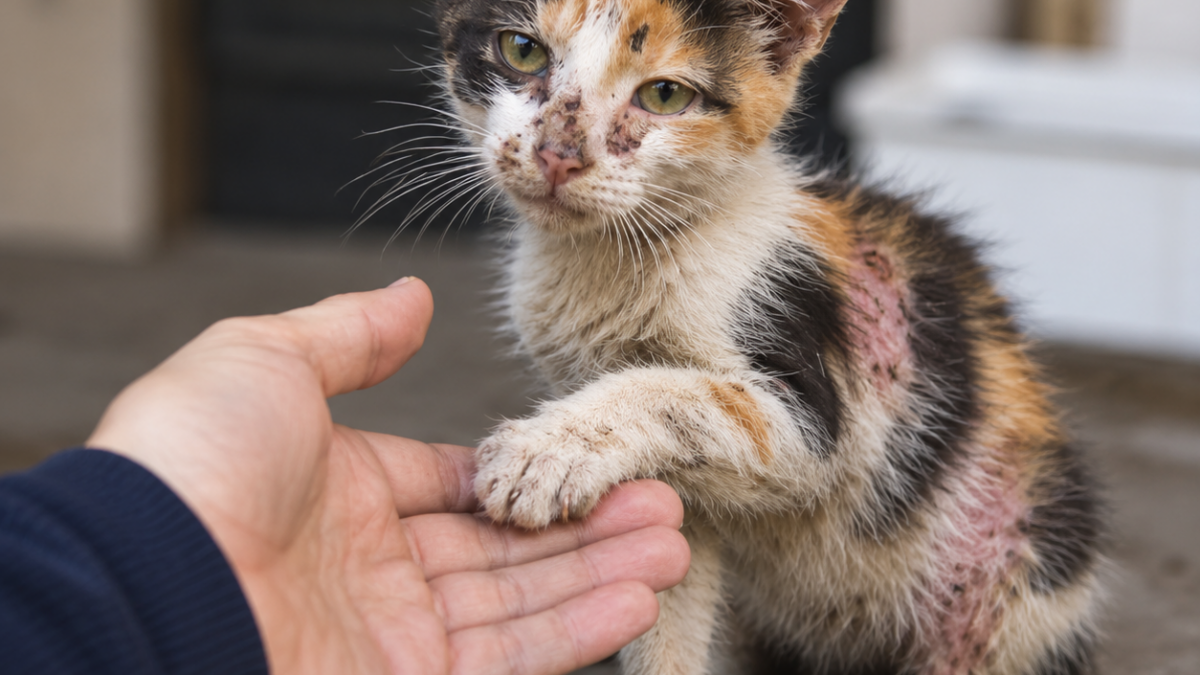
He pressed himself against me and kept one paw on my wrist.
Every few minutes, I looked down.
“Still here.”
His eyes half closed.
“I’m still here.”
At the clinic, a technician rushed us into an examination room.
The veterinarian, Dr. Harris, came in less than five minutes later.
He took one look at the wire.
“How long has that been there?”
“I don’t know.”
“You found him?”
“I watched someone dump him in the park.”
Dr. Harris’s expression hardened.
“Today?”
“Twenty minutes ago.”
He examined the cat without touching the neck first.
Weight.
Temperature.
Gums.
Hydration.
Body condition.
Then he sighed.
“He’s in bad shape.”
“Can you get the wire off?”
“Yes.”
“Will he be okay?”
“I didn’t say that.”
My throat tightened.
“What’s wrong besides the wire?”
“He’s severely underweight. Dehydrated. Flea infestation. Likely skin infection. Possible anemia.”
He gently moved the fur near the cat’s side.
“This patch may be from untreated dermatitis, trauma, or both.”
“What about his ear?”
“Old injury.”
“The scratches?”
“Some old. Some more recent.”
I looked at the little cat.
He was still trying to press against my hand.
Dr. Harris said:
“I need to sedate him to remove the wire properly.”
“Do it.”
“I’ll also run bloodwork and X-rays.”
“Whatever he needs.”
He glanced at me.
“Are you taking financial responsibility?”
I didn’t hesitate.
“Yes.”
Only after he left did I realize what I’d agreed to.
I didn’t care.
The technician returned with paperwork.
“Do you want to name him for the file?”
“He doesn’t have a tag?”
“No.”
“Microchip?”
“We’ll scan after stabilization.”
I looked through the small window in the treatment-room door.
The cat lay on a towel.
“What do you call a cat who gets abandoned in a park and immediately decides the first stranger he sees belongs to him?”
The technician smiled.
“Lucky?”
I shook my head.
“He doesn’t look lucky.”
“Not yet.”
That word stayed with me.
Yet.
I looked at him again.
“Oliver.”
“Oliver?”
“My grandfather’s cat was named Oliver.”
She wrote it down.
“Oliver it is.”
They took him into treatment.
I called my husband, Daniel.
He answered on the second ring.
“Where are you?”
“At an emergency vet.”
Silence.
Then:
“What did you find?”
It was not even a question of whether I had found something.
Daniel knew me too well.
“A cat.”
“Of course.”
“He was dumped in the park.”
“That’s awful.”
“He has wire embedded in his neck.”
Another silence.
“I’m coming.”
“You don’t have to.”
“I know.”
He arrived thirty minutes later with my phone charger, a bottle of water, and the expression of a man who knew our household might already have changed permanently.
“How bad?”
“I don’t know yet.”
“Do we know who dumped him?”
“No.”
I told him about the camera.
Daniel’s face changed.
“Did you report it?”
“Not yet.”
“We should.”
“I know.”
“What kind of car?”
“Dark sedan.”
“Make?”
“I don’t know.”
“Driver?”
“Man. Maybe forty. Dark jacket.”
“You saw his face?”
“Partly.”
Daniel sat.
“Then we report it.”
I nodded.
But my attention stayed on the treatment room.
Almost an hour later, Dr. Harris returned.
“The wire is off.”
I exhaled.
“How deep?”
“Deep enough to cause ulceration around most of the neck.”
My stomach turned.
“But?”
“No major vessel damage.”
“Thank God.”
“He’ll need antibiotics and wound care.”
“And bloodwork?”
“Anemic, but not critically. Kidney and liver values are acceptable. That’s good.”
“X-rays?”
“Old rib fractures.”
I stared at him.
“Old?”
“Healed.”
“How many?”
“At least two.”
I felt anger rise.
“From what?”
“Can’t say.”
“Could someone have kicked him?”
“Could have been trauma from many things.”
“Car?”
“Possible.”
“Another animal?”
“Possible.”
“You’re telling me nothing.”
“I’m telling you what I can prove.”
That sentence would become important later.
At that moment, I hated it.
“Can I see him?”
“Yes.”
Oliver was waking slowly.
The wire sat inside a specimen bag on a counter.
I stared at it.
A loop of thin metal.
Rusty in places.
Twisted at one end.
“Keep that,” I said.
Dr. Harris looked at me.
“For what?”
“Evidence.”
His expression changed.
“You’re filing a report.”
“Yes.”
“Then I’ll document everything thoroughly.”
When I approached Oliver, he lifted his head.
His neck had been shaved.
The wound around it looked worse now that the fur was gone.
Raw skin.
Scarring.
Inflammation.
Someone had put that wire around him and left it there long enough for his body to grow around the damage.
“Hey.”
Oliver tried to stand.
“Don’t.”
He ignored me.
He staggered forward.
Then placed one paw on my hand again.
Daniel looked away.
“What?”
I asked.
“Nothing.”
“You’re crying.”
“I’m not.”
“You are.”
He wiped his face.
“Shut up.”
Oliver purred.
Dr. Harris said quietly:
“He likes you.”
“I met him two hours ago.”
“Sometimes that’s enough.”
The police report was filed that night.
Because the abandonment occurred on city property and potential cruelty was involved, animal control was notified too.
Officer Nina Brooks met us at the clinic.
She photographed Oliver.
The wire.
His wounds.
The carrier.
She asked me to describe everything from the beginning.
Then again.
Slowly.
“What direction did the vehicle leave?”
“West.”
“Did the man say anything?”
“No.”
“Did he look at the cat?”
“I don’t think so.”
“Did he place food or water?”
“No.”
“Did he leave the carrier?”
“Yes.”
“Door open?”
“Yes.”
“Was the animal able to walk?”
“Yes.”
“Could he have left the park?”
“Probably.”
She stopped writing.
“That matters.”
“Why?”
“Because abandonment near a public road increases risk.”
I swallowed.
“Can you get the camera footage?”
“We’ll request it.”
“Request?”
“City system.”
“How long?”
“Hopefully quickly.”
“Hopefully?”
Brooks looked at me.
“I know you want an answer tonight.”
“I want his name.”
“I understand.”
“No, I want him to explain why.”
“That may take longer.”
Oliver spent three nights at the clinic.
I visited every day.
The first morning, he was too weak to stand for long.
The second, he ate almost an entire bowl of wet food.
The third, he hissed at a technician who tried giving medication.
Dr. Harris seemed delighted.
“He’s getting his personality back.”
“He hissed.”
“Exactly.”
“That’s good?”
“Very.”
Oliver never hissed at me.
He did something worse.
He learned that my purse contained treats.
The moment I walked in, he crawled directly toward it.
“You’re manipulative.”
Purr.
“You almost died three days ago.”
Purr.
“You have no shame.”
Purr louder.
On the fourth day, the microchip information came back.
Oliver had a chip.
The registration was eight years old.
Name:
**Marshmallow.**
I stared at the screen.
“Marshmallow?”
The technician laughed.
“That was apparently his original name.”
“Absolutely not.”
“His registered owner is listed as Helen Ward.”
“Phone?”
“Disconnected.”
“Address?”
“An apartment across town.”
Officer Brooks checked it.
Helen Ward no longer lived there.
The current tenant had never heard of her.
Then something even stranger happened.
The veterinary clinic associated with the old microchip called us back.
Helen Ward had been a client.
Marshmallow had been hers.
But Helen had died almost three years earlier.
I sat down.
“What happened to the cat?”
The receptionist couldn’t give full records without authorization, but after animal control became involved, some ownership history was released.
Helen’s adult son had taken the cat after her death.
His name was:
**Caleb Ward.**
Officer Brooks called me that afternoon.
“We have a name associated with the cat.”
“Caleb.”
“Yes.”
“Is he the man?”
“We don’t know yet.”
“How old?”
“Forty-two.”
The driver looked around forty.
“What car?”
“We’re checking.”
“Address?”
“Can’t give that to you.”
“Does he own a dark sedan?”
“Marina.”
“What?”
“Let me work.”
I stopped.
Barely.
The city camera footage arrived the next morning.
Brooks asked me to come to the animal control office.
Daniel came too.
She played the clip on a large monitor.
It showed the park entrance.
Dark sedan.
The plate was clearly visible.
The vehicle stopped.
Man exited.
Carrier.
Door.
Car leaves.
My body went cold even though I had already seen it happen in person.
“Is that Caleb Ward?”
Brooks paused on the man.
“Yes.”
I stared.
“No doubt?”
“Vehicle registered to him. Driver’s-license photo is consistent.”
“So you have him.”
“We have evidence that he abandoned a cat.”
“And the wire?”
“Different question.”
“What do you mean?”
“We need to establish who caused the injuries.”
“Who had the cat?”
“Potentially Caleb.”
“For three years.”
“We’re determining that.”
My frustration returned.
“Oliver had old broken ribs.”
“I know.”
“He had wire around his neck.”
“I know.”
“Someone did that.”
“Yes.”
“And Caleb dumped him.”
“Yes.”
“So—”
“So I will not charge someone with conduct I cannot prove because it feels obvious.”
I stared at her.
She stared back.
Then she said:
“You want this done right, don’t you?”
“Yes.”
“Then let me do it right.”
Caleb was interviewed that afternoon.
His first story was that Oliver wasn’t his cat.
Brooks showed him the microchip records.
Then he said the cat had run away almost two years earlier and recently “showed up again.”
Brooks showed him park footage.
He admitted leaving the cat.
Why?
“He was sick.”
Why not call a shelter?
“They charge fees.”
Why not call animal control?
“I didn’t think of it.”
Why leave the carrier door open?
“So he could leave.”
Why put him in a city park?
“Someone would find him.”
Did he know the cat was injured?
“Yes.”
Did he know about the wire?
“He got into something.”
What?
“Fence.”
Which fence?
Caleb couldn’t say.
Officer Brooks called me afterward.
“He admits seeing the wire.”
My hand tightened around the phone.
“And he did nothing?”
“He says he tried cutting it but couldn’t.”
“Vet?”
“No.”
“How long had he known?”
“Claims two days.”
“Do you believe him?”
“Not relevant.”
I wanted to scream.
Then she added:
“But Dr. Harris doesn’t.”
I went quiet.
“What?”
“The wound is too developed for two days.”
Finally.
Evidence.
Dr. Harris documented that the tissue changes and scarring indicated a much longer period.
Not exact.
But weeks at minimum.
Possibly longer.
Then police executed a welfare inspection at Caleb’s property because neighbors reported hearing animals.
That changed everything.
He had two other cats.
One dog.
The dog was underweight.
One cat had untreated dental disease.
The second cat was hiding in a basement room.
There were no obvious severe injuries.
But conditions were poor.
Dirty bowls.
Heavy flea infestation.
Strong ammonia odor.
And in the backyard, investigators found a roll of the same type of wire removed from Oliver’s neck.
Not rare wire.
Not proof by itself.
But another piece.
More important was what a neighbor said.
She had seen Oliver outside frequently.
Sometimes tied near the back steps.
“Tied?” I repeated.
“With what?”
“A thin cable or wire.”
My stomach turned.
“Why would anyone tie a cat?”
Brooks sighed.
“I’ve learned not to ask why before I know what happened.”
The neighbor had photographs.
Not taken for evidence.
She had once photographed a storm cloud over the houses.
In the bottom corner of one image, Oliver was visible.
Thin.
White fur dirty.
Something around his neck connected to the porch railing.
The date stamp was four months earlier.
Officer Brooks sent the image to Dr. Harris.
He compared the position and likely material.
Still not definitive.
But the story Caleb had given—two days, fence accident—was collapsing.
Then a second neighbor came forward.
She had heard Caleb complain about the cat.
“His mother’s useless animal.”
“He pees inside.”
“He keeps trying to get out.”
One time, she claimed Caleb said:
“If he wants outside so badly, I ought to make sure he can’t get far.”
Brooks called me late one afternoon.
“We’re moving forward.”
“With what?”
“Abandonment. Failure to provide necessary veterinary care. Additional cruelty-related counts are being reviewed.”
I sat in my car outside the clinic.
Oliver was inside waiting for me.
“Will he go to jail?”
“I don’t know.”
“That’s not satisfying.”
“I know.”
“Will he get Oliver back?”
“No.”
That was the answer I really needed.
“Ever?”
“Not if I have anything to say about it.”
Caleb formally surrendered his legal claim during the early case process.
The other animals were removed temporarily.
The dog later went to a rescue.
One cat was returned only after required veterinary treatment and a compliance plan.
The second cat was rehomed voluntarily.
Oliver remained on evidence hold for another two weeks.
Then came home with us as a foster.
I say foster because that was the word on the paperwork.
Daniel said:
“You understand this cat is never leaving.”
“You don’t know that.”
“He sleeps on your sweater at the clinic.”
“That means nothing.”
“He screams when you leave.”
“He has separation anxiety.”
“He put his paw on your hand five seconds after you met.”
“That was trauma.”
Daniel smiled.
“Sure.”
We prepared a spare bedroom.
Soft bed.
Litter box.
Food.
Water.
Hideouts.
Low furniture.
Everything experts recommended.
Oliver entered the room.
Sniffed for thirty seconds.
Then followed me back out.
“No.”
He followed.
“You need to stay in your safe room.”
He followed.
Daniel sat on the couch.
Oliver walked past him.
Followed me into the kitchen.
I turned.
Oliver stopped.
“Really?”
Purr.
I returned to the bedroom.
He followed.
I left again.
He followed.
Daniel laughed.
“His safe room is apparently you.”
That first night, we tried leaving him in the spare bedroom.
He cried.
Not normal cat meows.
A low, desperate sound.
I lasted nine minutes.
Daniel lasted eleven.
At midnight, we opened the door.
Oliver walked directly into our bedroom.
Jumped onto the bed with more confidence than his physical condition justified.
Curled against my ribs.
And slept.
The first week taught us how damaged he really was.
If I left the room, he woke.
If the front door opened, he ran after me.
If he heard a car start outside, he hid.
Carriers terrified him.
The first time I took one from the closet for a vet appointment, Oliver flattened himself under the bed and shook.
We cancelled the appointment time and spent forty minutes sitting nearby.
Eventually he came out.
I didn’t force him into the carrier.
We left it open in the bedroom for a week.
Food near it.
Then inside it.
Door never closed.
He learned.
Slowly.
The wire scar around his neck healed.
The fur eventually covered most of it.
His side improved with treatment.
He gained weight.
Three pounds in two months.
His coat became white again.
Actually white.
We discovered he had one gray spot near his tail that nobody had noticed beneath the dirt.
His torn ear gave him a permanently crooked expression.
He also had terrible manners.
Oliver stole chicken.
Opened cabinets.
Knocked pens off desks.
Learned that if he screamed outside the bathroom door, I emerged faster.
The first time he jumped onto the dining table, Daniel pointed.
“Down.”
Oliver looked at him.
Daniel pointed again.
“Down.”
Oliver sat.
“Don’t sit. Down.”
Oliver lay down on the table.
I laughed so hard I had to leave the room.
Daniel stared at me.
“You’re encouraging him.”
“He misunderstood.”
“He did that on purpose.”
Oliver closed his eyes.
“He absolutely did that on purpose.”
The criminal case took months.
That was harder than I expected.
Every time Caleb’s attorney delayed something, I became angry all over again.
Every time Brooks called for another statement, I remembered the park.
The carrier.
The wire.
The paw on my hand.
Caleb’s defense argued that Oliver had been difficult to care for after Helen’s death.
He urinated outside the litter box.
He scratched furniture.
He tried escaping.
He was aggressive during grooming.
As if bad behavior transformed cruelty into an option.
Then Helen’s former neighbor provided something none of us expected.
A letter.
Helen had written it shortly before her death.
Not a legal will.
Just handwritten instructions because she was ill.
The woman had kept a photocopy.
It said:
**If anything happens to me, please make sure Marshmallow stays inside. He is nervous outdoors. Caleb says he can take him, but I worry because he has never liked cats. If Caleb cannot keep him, I want him taken to a proper shelter. Please don’t let anyone abandon him outside.**
I read that last sentence three times.
Please don’t let anyone abandon him outside.
Helen had feared exactly what happened.
Brooks said the letter might have limited legal value.
Emotionally, it destroyed me.
Caleb had known.
At least, investigators later found the original among Helen’s old documents in a storage box at his house.
He had the instruction.
He ignored it.
At the hearing, I sat behind the prosecutor.
Caleb looked different from the man in the park.
Smaller somehow.
Not physically.
The certainty had left him.
The park footage played first.
No dramatic music.
Just a man placing a carrier beside a bench.
Opening it.
Leaving.
Then my voice from a nearby camera microphone:
“Sir! You forgot your cat!”
The car accelerates.
The prosecutor froze the image.
“You heard her?”
Caleb shifted.
“I don’t remember.”
“The witness was approximately thirty feet from you.”
“I was stressed.”
“You looked toward her.”
“I don’t remember.”
“You then accelerated.”
“I was leaving.”
“Without the cat.”
“Yes.”
Then veterinary photographs.
Oliver’s neck.
The embedded wire.
His weight.
The missing fur.
Old rib fractures.
Caleb’s attorney argued the injuries could have occurred while Oliver was missing.
The prosecutor asked:
“How long was he missing?”
Caleb returned to his original claim.
“About two years.”
Then the neighbor’s photograph appeared.
Date stamped four months before abandonment.
Oliver tied at Caleb’s porch.
Silence.
Caleb’s face changed.
His attorney leaned toward him.
The prosecutor asked:
“Is that your house?”
“Yes.”
“Your porch?”
“Yes.”
“Your cat?”
Pause.
“Yes.”
“So he was not missing for two years.”
“I meant he kept disappearing.”
“Yet he was in your possession four months before you abandoned him.”
“I guess.”
“Is that a restraint around his neck?”
“I don’t know.”
“You were responsible for him.”
“I didn’t put that there.”
“Who did?”
“No idea.”
Another photograph.
Taken two months later by the same neighbor.
Oliver was again near the porch.
Still tethered.
The prosecutor zoomed in.
A thin line ran from his neck toward the railing.
“You didn’t notice?”
“I worked a lot.”
“Did the cat tie himself?”
Objection.
Sustained.
But everyone in the room understood.
Then Dr. Harris testified.
The wound around Oliver’s neck could not reasonably have developed in forty-eight hours.
Untreated.
Painful.
Progressive.
The anemia.
Fleas.
Dehydration.
Old injuries.
No regular veterinary records for nearly three years after Helen’s death.
Then the letter.
Caleb’s lawyer objected to parts.
The judge allowed limited use concerning knowledge and care instructions.
The prosecutor read:
**If Caleb cannot keep him, I want him taken to a proper shelter. Please don’t let anyone abandon him outside.**
Caleb looked down.
The prosecutor asked:
“Did you know your mother wanted the cat taken to a shelter if you could not keep him?”
No answer.
“Mr. Ward?”
“Yes.”
“Did you take him to a shelter?”
“No.”
“Did you call one?”
“No.”
“Why?”
“They wanted an intake appointment.”
“How long would that take?”
“I don’t know.”
“Did you ask?”
“No.”
“Did you contact a rescue?”
“No.”
“Animal control?”
“No.”
“Veterinarian?”
“No.”
“Friend?”
“No.”
“Family member?”
“No.”
“What did you do instead?”
Long silence.
“I left him in the park.”
The prosecutor stepped closer.
“While he had wire embedded in his neck.”
Caleb stared at the table.
“Yes.”
I felt Daniel take my hand.
That one word was enough.
The final outcome wasn’t cinematic.
Real court rarely is.
Caleb entered a plea on several counts.
He received probation.
Fines.
Restitution toward veterinary and shelter costs.
Mandatory animal-care restrictions.
A court order preventing him from possessing animals during the probation period and requiring future compliance under local regulations.
Some charges were reduced.
Some arguments I wanted made never happened.
I was angry.
Then Officer Brooks called me after everything was finalized.
“You sound disappointed.”
“He hurt him.”
“Yes.”
“He should hurt too.”
She was quiet.
Then:
“Maybe.”
“That’s it?”
“No.”
She paused.
“But the law’s job isn’t to create equal suffering.”
“I know.”
“Oliver is alive.”
“I know.”
“He won’t go back.”
“I know.”
“The other animals were treated.”
“I know.”
“Caleb has a record of what he did.”
I said nothing.
Brooks continued.
“And you have a cat who currently has three separate complaints in his shelter file for stealing food from staff.”
I laughed despite myself.
“That was one time.”
“Three documented incidents.”
“He was hungry.”
“One involved a tuna sandwich he removed from a closed lunch bag.”
“He’s resourceful.”
Brooks laughed.
“Go home, Marina.”
I did.
Oliver was waiting at the front window.
The moment my car pulled into the driveway, he jumped down.
By the time I entered, he was at the door.
He placed one paw on my shoe.
Exactly like the park.
I picked him up.
“You won.”
Daniel, standing in the kitchen, said:
“No, he didn’t.”
I looked at him.
“What?”
“He doesn’t know there was a case.”
Oliver purred.
Daniel walked over.
“He doesn’t care what happened to Caleb.”
That irritated me at first.
Then I understood.
Oliver wasn’t waiting for punishment.
He was waiting for dinner.
For warmth.
For the door to open.
For people to come back.
Justice mattered to us.
Safety mattered to him.
Maybe that was why recovery became more important than revenge.
The first big milestone happened six months later.
I brought home a new carrier.
A soft-sided one.
Oliver froze.
His pupils widened.
He backed away.
I placed it in the living room.
Open.
Then ignored it.
For three days, he wouldn’t approach.
On the fourth, I put treats several feet away.
Then closer.
A week later, one treat inside.
Oliver stared.
I sat on the floor.
“Your choice.”
He approached.
Reached in.
Grabbed the treat.
Retreated.
Next day, he put both front paws inside.
Then all four.
Eventually, he began sleeping there voluntarily.
Daniel took a picture.
“Look at that.”
Oliver was curled inside.
Door open.
Completely relaxed.
I started crying.
Daniel sighed.
“You cry over everything he does.”
“No, I don’t.”
“You cried because he used the litter box after surgery.”
“He was constipated.”
“You cried when he jumped on the couch.”
“He was weak.”
“You cried when he hissed at the vacuum.”
“That was confidence.”
Daniel smiled.
“Sure.”
But this was different.
The carrier had once been the place someone used to discard him.
Now it was just a bed with a zipper.
Fear had lost one meaning.
That mattered.
Another milestone came with the front door.
For months, Oliver panicked whenever it opened.
If I stepped outside, he ran after me.
If Daniel blocked him, Oliver screamed.
We started practicing.
Door opens.
Door closes.
I remain inside.
Then one foot out.
Back.
Two seconds.
Back.
Thirty seconds.
Back.
Again.
Again.
The first time I checked the mail and returned to find Oliver still sitting calmly inside, I nearly celebrated.
“You waited.”
He meowed.
“I came back.”
He meowed louder.
“Yes, I know. Dinner.”
Eventually, my departures became ordinary.
Not meaningless.
Ordinary.
That was better.
About a year after I found him, an elderly woman contacted me through the rescue.
Her name was Ruth.
She had been Helen Ward’s closest friend.
She had heard about the court case late.
She asked whether she could see Oliver.
I hesitated.
Not because I distrusted her.
Because I didn’t know what memories her voice might bring back.
But the rescue verified her connection.
So Ruth came.
She was eighty-one.
Small.
Silver hair.
Carried an old photo album.
When she entered our living room, Oliver was on the windowsill.
Ruth stopped.
Her eyes filled.
“Marshmallow.”
Oliver’s ears moved.
He turned.
Ruth covered her mouth.
“Oh, honey.”
Oliver jumped down.
Walked toward her.
Then stopped several feet away.
He sniffed.
Ruth didn’t move.
“It’s Auntie Ruth.”
Oliver’s tail lifted.
He approached.
Sniffed her shoe.
Then her hand.
Suddenly, he rubbed his entire body against her legs.
Ruth started crying.
“He remembers.”
I knelt beside her.
“I think so.”
She sat on the couch.
Oliver climbed into her lap.
Exactly the way he’d climbed into mine in the park.
Ruth stroked his head.
“Helen loved you so much.”
That sentence hurt.
Ruth opened the photo album.
Oliver as a kitten.
Actually white.
Fluffy.
Round.
Wearing a ridiculous blue bow.
Oliver sleeping beside Helen.
Oliver sitting in a Christmas box.
Oliver stretched across a windowsill.
The healthy cat in those photographs looked nothing like the animal I found.
“How old is he?”
“Almost eleven now.”
Ruth nodded.
“Helen got him when she retired.”
“What was she like with him?”
“Absurd.”
Ruth smiled.
“She cooked him chicken.”
“Of course.”
“She bought him a fountain because she thought bowls weren’t sophisticated enough.”
Daniel whispered:
“He would like her.”
Ruth heard and laughed.
Then her expression changed.
“She worried about Caleb.”
“Why?”
“He wasn’t cruel to animals when she was alive.”
Ruth paused.
“He was just indifferent.”
“That became cruelty.”
“Yes.”
She looked at Oliver.
“Helen kept making excuses for him.”
“What kind?”
“Caleb had problems.”
“Drugs?”
“No. Gambling. Anger. Money. Always somebody else’s fault.”
Ruth sighed.
“When Helen got sick, she asked me if I’d take Marshmallow.”
“Why didn’t you?”
Her eyes filled again.
“My building stopped allowing pets.”
“You tried?”
“For months.”
She looked at Oliver.
“When Caleb said he would keep him, Helen was relieved.”
“Did you believe him?”
“I wanted to.”
Ruth stroked Oliver.
“I should’ve checked.”
There it was again.
That terrible instinct decent people have.
To take someone else’s cruelty and search for where they personally failed to prevent it.
“You weren’t responsible.”
“I could have visited.”
“You didn’t know.”
“I knew Caleb.”
“That isn’t the same thing.”
Ruth looked at me.
“You sound like someone has said that to you too.”
She was right.
For months I’d asked myself whether I should have run faster in the park.
Gotten the license plate.
Stopped the car.
Blocked it.
Done something dramatic.
As if rescuing Oliver after the fact wasn’t enough.
As if his suffering became partly mine because I hadn’t appeared sooner.
We sat quietly.
Then Ruth said:
“Can I tell you his real name?”
“Marshmallow?”
“No.”
I laughed.
“What?”
“Helen called him Marshmallow for about two weeks.”
“Then?”
“She called him Ollie.”
I stared at her.
“Ollie?”
“Yes.”
I looked at Daniel.
He looked at me.
I had named him Oliver without knowing.
Ruth smiled through tears.
“Well.”
I whispered:
“Maybe he told me.”
Daniel rolled his eyes.
“Don’t start.”
But I liked believing it.
Oliver became Ollie to us after that.
Not always.
Sometimes Oliver.
Sometimes Ollie.
Mostly “Get off the counter.”
Ruth began visiting once a month.
Oliver loved her.
She brought photos.
Stories.
Memories of Helen.
Through Ruth, I learned something important.
Oliver had not spent his entire life afraid.
Before Caleb, he had known love.
Real love.
A warm house.
A woman who talked to him.
A bed.
Chicken.
Windows.
That explained part of why he reached for me so quickly.
He wasn’t learning love for the first time.
He was remembering it.
That changed the way I thought about him.
He wasn’t a broken animal becoming whole because I rescued him.
He had been whole before someone damaged his world.
He was reclaiming himself.
There is a difference.
Two years after the park, Oliver’s story surfaced again unexpectedly.
A local television station was doing a report on animal abandonment.
The city had seen an increase.
The shelter asked whether we’d participate.
I said no at first.
I didn’t want Oliver turned into sad footage.
Then the producer showed me the angle.
Not “look at this poor abused cat.”
Instead:
What happens after abandonment.
Behavioral trauma.
Veterinary costs.
Legal consequences.
Recovery.
I agreed.
On filming day, Oliver sabotaged everything.
The reporter sat on our couch.
Camera rolling.
She asked:
“What was your first impression when you saw him?”
I said:
“That he looked like life had hit him too many times.”
At that moment, Oliver jumped onto the coffee table and attempted to steal the reporter’s microphone windscreen.
“Oliver.”
He bit it.
The reporter laughed.
“This is the traumatized cat?”
“He has diversified.”
Oliver ran.
The cameraman followed.
For thirty seconds, the entire segment became footage of Oliver sprinting through the house with equipment he should not have had.
Daniel yelled:
“Justice!”
The reporter nearly fell over laughing.
They kept part of it.
The final piece showed park surveillance footage.
Then veterinary images.
Then Oliver now.
Healthy.
White fur clean.
Crooked ear.
Gray spot near his tail.
Standing on our kitchen counter despite being told not to.
The reporter asked me:
“Do you forgive the man who abandoned him?”
I hadn’t expected that.
I thought.
Then said:
“It isn’t my forgiveness he needs.”
“What do you mean?”
“Oliver doesn’t think about him anymore.”
The reporter waited.
“I used to want that man to feel exactly what Oliver felt.”
“What changed?”
“I realized Oliver’s healing doesn’t require someone else’s suffering.”
I paused.
“It requires safety.”
The segment aired.
The response was enormous.
Most people were kind.
Some were furious.
Too furious.
Caleb’s name appeared online.
His address.
Workplace.
Threats.
I contacted the station and animal control immediately.
Then posted one public statement through the rescue:
**Please do not threaten, contact, or harass anyone involved in Oliver’s past. Accountability was handled through the legal process. Oliver is safe. His story should help animals, not create more harm.**
Daniel read it.
“You mean that?”
“Yes.”
“Fully?”
I thought.
“Almost.”
He smiled.
“Progress.”
I still disliked Caleb.
I still thought what he did was cruel.
But I no longer wanted to build my life around hating him.
Oliver didn’t.
Why should I?
That didn’t mean consequences disappeared.
Years later, Caleb attempted to adopt a kitten from another rescue.
The background check flagged the court record.
His application was denied.
The rescue contacted Officer Brooks to verify.
She called me afterward.
“Thought you’d appreciate knowing.”
I felt something strange.
Not joy.
Not revenge.
Relief.
Another animal didn’t end up dependent on him.
That was enough.
“What happened?”
“They declined him.”
“Did he argue?”
“Apparently.”
“Good.”
Brooks laughed.
“You’re not as evolved as you think.”
“No.”
“None of us are.”
Oliver aged.
Slowly at first.
Around thirteen, he developed arthritis.
Jumping onto the kitchen counter became harder.
Daniel was thrilled.
“Consequences.”
Then Oliver learned to use a chair as a step.
Daniel stared.
“He adapted.”
“He’s a genius.”
“He’s a criminal.”
We put steps near the bed.
A ramp by the windowsill.
Warm pads.
More veterinary visits.
Oliver hated prescription food.
Loved things he shouldn’t eat.
His kidneys began showing mild changes.
Dr. Harris, now grayer himself, said:
“He’s an old man.”
“Don’t call him that.”
“He’s fourteen.”
“He’s experienced.”
Dr. Harris smiled.
“Experienced cats also get kidney disease.”
We adjusted food.
Added fluids later.
Oliver tolerated subcutaneous fluids because treats followed.
His relationship with the carrier remained surprisingly good.
He’d walk inside willingly.
Every time he did, I remembered the park.
The open carrier door.
His paw.
That memory never completely stopped hurting.
But over time, it became less sharp.
The park itself changed.
The old bench was replaced.
The path resurfaced.
The tree near where Oliver had been abandoned was trimmed.
One autumn, Daniel asked:
“Do you want to take him there?”
I almost said no.
“Why?”
“I don’t know.”
“Closure?”
“He’s a cat.”
“So?”
“He doesn’t need symbolic closure.”
“Maybe you do.”
I hated when Daniel was right.
We used Oliver’s soft carrier.
Drove to the park.
It was early evening.
Almost exactly like the day I found him.
Leaves.
Children leaving.
Cold air.
We opened the carrier on the grass.
Oliver stayed inside.
I sat beside him.
“You don’t have to.”
He sniffed.
Then stepped out.
Slowly.
Harness on.
Leash loose.
He looked around.
I watched for fear.
I saw curiosity.
He sniffed the grass.
A bench.
A tree root.
A leaf.
Then he walked directly toward me and sat on my shoe.
Daniel laughed.
“Very moving.”
“Shut up.”
Oliver looked completely uninterested in the significance of the place.
That taught me something too.
Humans assign locations meaning.
Animals often assign meaning to what happens there now.
The park was no longer only where Oliver was abandoned.
It was somewhere he sat in grass with us.
A dog walked past.
Oliver stared.
The dog stared back.
Oliver hissed.
The dog retreated.
Daniel smiled.
“Full circle.”
“He’s protecting us.”
“He’s fourteen pounds.”
“Spiritually enormous.”
We stayed twenty minutes.
When I opened the carrier, Oliver walked inside.
No panic.
I zipped it.
He lay down.
The same kind of object once used to leave him behind.
Now it meant we were all going home together.
That was closure enough.
Ruth died the following winter.
She was eighty-seven.
Her niece called me.
“She had something for Oliver.”
A small box arrived.
Inside was Helen’s original blue bow from one of the kitten photographs.
And a note from Ruth:
**For Ollie. Proof that before the bad years, he was loved. And after them, he was loved again. Please remember that the middle was never the whole story.**
I sat at the kitchen table crying.
Daniel read the note.
Then looked at Oliver sleeping beneath a radiator.
“The middle was never the whole story.”
I nodded.
That became the sentence I remembered most.
Because rescue stories can accidentally do something unfair.
We freeze animals inside their trauma.
The dog on a chain.
The cat in a carrier.
The starving stray.
The abandoned litter.
But trauma is something that happened to them.
Not everything they are.
Oliver wasn’t the cat Caleb abandoned.
Not anymore.
He was the cat who woke me at 5:13 every morning.
The cat who loved roast chicken.
The cat who hated closed doors.
The cat who slept on Daniel’s chest even though Daniel insisted he wasn’t a “cat person.”
The cat who knocked one specific framed photograph off the shelf every single week.
The cat who recognized Ruth.
The cat who learned carriers could bring him home.
The cat who put one paw on my hand.
Every night.
Almost without exception.
He developed the habit after coming home.
I’d get into bed.
Oliver would climb beside me.
Turn twice.
Lie down.
Then put one front paw on my wrist.
Not gripping.
Just contact.
If I moved too far away, the paw followed.
For years, I wondered whether it came from the park.
Are you leaving too?
Eventually, I stopped interpreting it.
Maybe he simply liked touching me.
That was enough.
At fifteen, his kidney disease progressed.
We increased treatment.
He still had good days.
Lots of them.
He sat in windows.
Yelled for food.
Stole Daniel’s chair.
Then good days became mixed days.
Then tired days.
Dr. Harris was gentle.
“You know where this is going.”
“I know.”
“Not today.”
“Good.”
“But eventually.”
“I know.”
I hated knowing.
There is a strange cruelty in rescuing an animal.
When you find them, all you want is time.
Then, if you’re lucky, you get it.
Years.
Enough years that one day you have to give time back.
Oliver was sixteen when the final decline came.
He stopped eating one Saturday.
Not completely.
But enough.
Sunday, he barely moved from the heated bed.
Monday, he drank but refused chicken.
Chicken.
That terrified me.
We went to Dr. Harris.
Bloodwork.
Kidneys.
Much worse.
Blood pressure.
Weight loss.
Anemia.
He explained hospitalization.
Aggressive fluids.
Possible short-term improvement.
Possible days.
Maybe weeks.
I looked at Oliver.
He sat against my arm.
One paw on my hand.
“What would you do?”
Dr. Harris hated that question.
I could see it.
Finally:
“If he were mine, I’d ask whether treatment is for him or because I’m not ready.”
I started crying.
“I’m not ready.”
“I know.”
Daniel held my shoulder.
I whispered:
“What if he could have another month?”
“Maybe.”
“What if it’s good?”
“Possible.”
“What if it’s mostly needles and nausea?”
“Also possible.”
I hated every answer.
We took Oliver home.
Not because we’d given up.
Because home was where he wanted to be.
For three days, we spoiled him.
Chicken.
Tuna water.
His favorite blanket.
Sunlight when it appeared.
He had moments.
Tuesday afternoon, he jumped onto the couch without using the step.
Daniel laughed.
“Show-off.”
Oliver purred.
Wednesday, he climbed into his old soft carrier and slept there.
Door open.
I sat beside him.
“You know this thing caused us a lot of problems.”
One eye opened.
“You used to hate carriers.”
Purr.
“You used to be polite too.”
Purr.
Thursday morning, he walked to the front door.
That surprised me.
We opened it.
He stepped onto the porch.
No leash.
Just supervised.
He sat in the sun.
Cold spring sun.
Birds.
Wind.
For twenty minutes.
Then he looked at me.
I knew.
People sometimes say animals tell you.
I always thought that sounded sentimental.
Until Oliver did.
No dramatic collapse.
No cry.
Just a look.
Tired.
Finished.
Still trusting.
I picked him up.
His body felt lighter than it should.
“Okay.”
Daniel stood behind me crying.
“Okay.”
We called Dr. Harris.
He came to the house that evening.
Oliver was on our bed.
The same bed he’d claimed his first night.
The blue bow Ruth had saved sat nearby.
I didn’t put it on him.
He would have hated that.
I just wanted it there.
Proof.
Before the bad years, he was loved.
After them, loved again.
Dr. Harris explained every step.
I already knew.
Still, I needed him to explain.
Oliver lay against my side.
One paw on my wrist.
Of course.
I stroked his face.
The torn ear.
The gray spot.
The fur that had become thinner with age.
“You know what you did to me?”
His eyes half closed.
“You climbed into my lap without permission.”
Purr.
“Then you moved into my house.”
Another purr.
Daniel laughed through tears.
“You stole half the bed.”
Oliver breathed slowly.
“You cost me more money than my first car.”
Daniel said:
“Definitely true.”
“You destroyed three sets of curtains.”
“Four.”
“Not helping.”
Oliver’s paw remained on me.
I lowered my face to his.
“The first day, I thought you were asking if I would leave.”
My voice broke.
“I hope I answered.”
Daniel turned away.
“I hope all these years answered.”
Oliver’s paw moved slightly against my skin.
I took a shaking breath.
“I stayed.”
Dr. Harris gave the first medication.
Oliver relaxed.
Completely.
His body softened.
No fear.
No struggle.
I whispered:
“You don’t have to check anymore.”
Tears fell onto his fur.
“No one is leaving you.”
Daniel put his hand on Oliver’s back.
“We’re all here.”
Oliver breathed.
Once.
Again.
Slower.
I kissed his forehead.
“You can go first this time.”
His paw stayed on my wrist until his body became still.
For a long time, I didn’t move my hand.
Neither did Daniel.
Dr. Harris waited.
Finally he said softly:
“He’s gone.”
I knew.
But I wasn’t ready to lift that paw.
The first time Oliver touched me, he was asking for something.
At least, that was how it felt.
The last time, I think he already knew the answer.
He wasn’t alone.
After he died, the house became unbearable.
Not immediately.
At first, there were tasks.
Blankets.
Bowls.
Medication.
Calls.
His ashes.
Then silence.
I heard phantom meows.
Saw white shapes in doorways.
Woke at 5:13 expecting screaming.
Nothing.
Daniel struggled too.
He pretended otherwise.
One morning, I found him sitting with Oliver’s old blanket.
“You okay?”
“No.”
That was the first time he admitted it.
We sat together.
“I thought I wasn’t a cat person,” he said.
“You weren’t.”
“I hate you.”
“You were an Oliver person.”
He nodded.
“Yeah.”
We buried part of Oliver’s ashes beneath a tree in our yard.
We kept the rest inside.
No elaborate memorial.
Just a small stone.
**OLIVER**
Underneath:
**HE REACHED OUT FIRST.**
Months passed.
Then Officer Brooks called.
She was nearing retirement.
“I thought you’d want to know something.”
“What?”
“Caleb completed probation years ago, obviously.”
“I know.”
“He recently contacted the municipal shelter.”
My body tightened.
“For what?”
“Found animal.”
I paused.
“He found an injured cat behind his workplace.”
That wasn’t the answer I expected.
“What happened?”
“He brought it in.”
“Personally?”
“Yes.”
“Did he leave?”
“After completing intake.”
I said nothing.
Brooks continued.
“He paid toward emergency treatment.”
I felt strangely angry.
“Why are you telling me?”
“Because people aren’t always frozen at their worst moment either.”
That hit harder than I wanted.
“You think he changed?”
“I have no idea.”
“Then—”
“I think Oliver’s story doesn’t need Caleb to remain a monster forever.”
I sat down.
“That feels unfair.”
“To who?”
“I don’t know.”
Brooks waited.
I said:
“I spent years hating him.”
“I know.”
“And now I’m supposed to feel good because he helped one cat?”
“No.”
“What am I supposed to feel?”
“Nothing, if you want.”
She paused.
“I just thought you’d rather know that one injured animal wasn’t left outside.”
I closed my eyes.
That was true.
Whatever I thought of Caleb, one cat got help.
“Did the cat survive?”
“Yes.”
“Good.”
Brooks smiled through the phone.
“That’s all that matters.”
Maybe.
Not everything.
But enough.
The next year, Daniel and I began fostering senior cats.
Not kittens.
Never kittens.
Too much energy.
Our first was a twelve-year-old black cat named May.
She hated us for nine days.
Then slept on Daniel.
He looked betrayed.
“This keeps happening.”
“Cat person.”
“Shut up.”
May was adopted after four months.
Then came Jasper.
Thirteen.
Diabetic.
Then Luna.
Fifteen.
Three teeth.
Then a white cat named Simon.
He had a torn ear.
I nearly said no.
Too close.
Then Simon placed one paw on my shoe.
Daniel looked at me.
“No.”
I said:
“I didn’t say anything.”
“You don’t have to.”
Simon stayed.
Not because he was Oliver.
Because he wasn’t.
He hated chicken.
Loved fish.
Slept alone.
Never touched my wrist.
He screamed at dawn for entirely different reasons.
That helped.
New love didn’t erase old love.
It proved love wasn’t a limited resource.
Years after Oliver’s death, the city rescue asked permission to use his story in volunteer training.
Not the court drama.
Not the social-media attention.
The first moment.
Carrier open.
Cat too afraid to leave.
Human sits down.
Cat reaches out.
The lesson was simple.
Don’t assume an animal’s first behavior tells the whole story.
Fear can look like aggression.
Shutdown can look like calmness.
Clinging can look like instant affection.
Sometimes the animal who climbs into your lap isn’t saying:
I trust everyone.
Sometimes they’re saying:
Please don’t disappear.
I attended one training.
A new volunteer asked:
“Do you think Oliver knew you saved him?”
I thought about it.
“No.”
She looked surprised.
“No?”
“I think he knew I stayed.”
That was different.
Animals may not understand rescue as a concept.
They understand patterns.
Food appears.
Hands are gentle.
Doors open.
You return.
Again.
Again.
Again.
Eventually, fear loses arguments.
That was Oliver’s life.
Not one dramatic rescue.
Thousands of ordinary returns.
I came home.
Daniel came home.
Ruth visited.
Meals arrived.
Water stayed full.
The carrier always came back through the same door with him inside.
No wire tightened.
No one threw him out.
The world became predictable.
Safe.
And in the end, that is what healed him.
Not revenge.
Not court.
Not strangers online calling Caleb names.
Not even the conviction.
Those things mattered because accountability protects animals.
But they were human things.
Oliver’s justice was simpler.
Warmth.
Food.
Age.
He got old.
That might sound like a sad ending.
It wasn’t.
For an abandoned, injured cat, old age was victory.
He had enough years for arthritis.
Enough years for kidney disease.
Enough years to become annoying.
Enough years to get bored with toys.
Enough years to stop fearing carriers.
Enough years that the park became just a park.
Enough years that the worst thing anyone ever did to him became the middle of his story.
Never the ending.
Sometimes I still walk through that park.
The old bench is gone.
Another one replaced it.
People sit there.
Drink coffee.
Check phones.
Feed birds even though signs tell them not to.
Nobody knows what happened there.
That’s fine.
I know.
One evening, years after Oliver died, I sat on the new bench.
A young woman passed carrying a cat in a backpack carrier.
The cat looked out through the clear window.
White.
For one second, my heart stopped.
Then the cat turned.
Different face.
Different ears.
Different life.
The woman smiled.
“He likes watching birds.”
“He’s beautiful.”
“Thanks.”
She kept walking.
I looked at the spot beside the bench where the old plastic carrier had once sat.
I remembered the door.
Open.
A frightened cat inside.
People watching.
Nobody moving.
Then one tiny paw reaching toward me.
I used to think that was the moment I rescued Oliver.
I was wrong.
That was simply the moment he gave me the chance.
The real rescue happened afterward.
Every day we chose not to leave.
Every veterinary visit.
Every meal.
Every night.
Every time I opened the front door and returned.
Every time he woke from a nightmare and found us still there.
Every time he climbed into a carrier and came home again.
Every ordinary moment.
That was how we answered his first question.
And if I could go back to that evening, kneel beside that filthy carrier, and speak to the small cat before he put his paw on my hand, I wouldn’t tell him what happened to Caleb.
I wouldn’t tell him about court.
Or the city cameras.
Or the investigation.
Or the people who would become angry on his behalf.
I wouldn’t tell him he’d become a story strangers shared.
He wouldn’t care.
I would tell him only the things that mattered.
You’re going to have a name again.
You’re going to sleep somewhere warm.
You’re going to get old.
You’re going to be loved by people you haven’t met yet.
You’re going to steal food and destroy curtains and wake us before sunrise.
You’re going to know exactly what it feels like when someone leaves the house—
and comes back.
Again.
Again.
Again.
Until one day you stop asking whether they will.
And when your life finally ends, it will not end beside an open carrier in a dark park.
It will end in your home.
On your bed.
With your paw on the same hand you touched the first day.
And nobody will leave you alone.
Not even for a second.








