PART 2: He Dug Until His Paws Bled Beneath a Dried-Up Lake—Then We Learned Who He Refused to Leave Behind
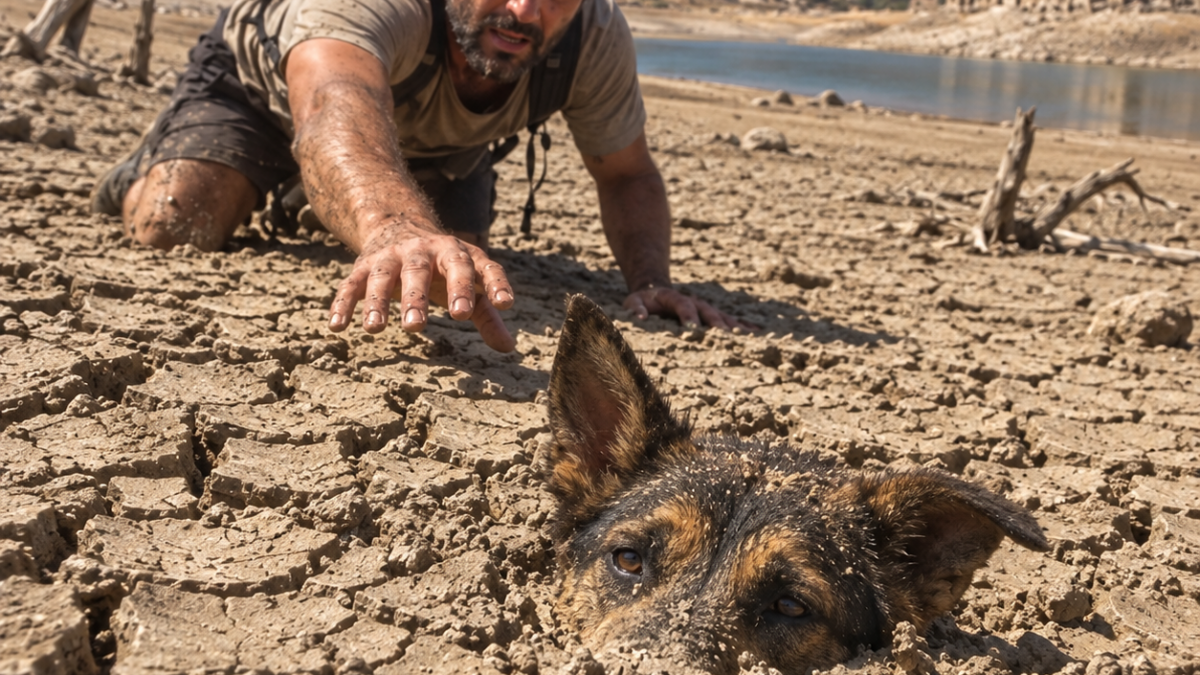
PART 2
I remember the silence more clearly than anything else.
Ten people had been moving around us seconds earlier.
Boots on boards.
Equipment bags opening.
Radios crackling.
The veterinarian giving instructions.
Then Laurent said there was something under the ground, and every sound seemed to disappear.
I looked at the Shepherd.
His eyes were almost closed.
But his head had lifted.
Barely.
He knew.
“What did you hear?” I asked.
Laurent kept his ear against the dry crust.
“I’m not sure.”
“Animal?”
“Maybe.”
“Movement?”
He held up a finger.
We waited.
Then I heard it too.
Not from where I was standing.
Through the steel bar in my hand.
A faint vibration.
Tap.
Nothing.
Then another.
Tap.
The Shepherd gave a low whine.
The veterinarian knelt beside him.
“We need to move him away from here.”
The dog immediately tried to rise.
His front legs folded beneath him.
“Don’t,” I said.
He ignored me.
He dragged himself forward.
An animal that had barely reacted while we cut hardened mud away from his body was suddenly willing to injure himself again.
That told me everything I needed to know.
“Bring the smaller shovels,” I said.
“And boards,” Laurent added. “More boards.”
We started twenty inches from the place the Shepherd had been scratching.
The top layer was dry.
Beneath that, the clay was damp.
Six inches farther down, it became wet enough to cling to our gloves.
“There’s a cavity,” Laurent said.
He pushed a thin metal probe into the soil.
It dropped suddenly.
“How deep?”
“Maybe two feet.”
The Shepherd whined again.
The veterinarian stroked his neck.
“He knows.”
I looked at her.
“You think another dog?”
“I think we’re about to find out.”
We widened the hole instead of digging straight down.
The reservoir bottom had formed layers.
Hard crust above.
Soft mud below.
If we opened it too quickly, the walls could collapse.
Nobody wanted to rescue one dog by burying another.
It took twenty minutes to create a safe opening.
Then Laurent reached down.
His hand froze.
“Fur.”
The German Shepherd tried to stand.
“Stay down,” the veterinarian whispered.
Laurent cleared more mud.
Gray fur appeared.
Then part of a shoulder.
“Dog.”
My chest tightened.
“Alive?”
“I don’t know yet.”
We moved faster.
Not recklessly.
But faster.
The Shepherd began crying.
Not barking.
Crying.
A thin, broken sound that seemed impossible from such a large dog.
When we uncovered the second animal’s head, I thought we were too late.
He was old.
That was obvious even beneath the mud.
His muzzle was almost completely white.
One eye was sealed shut with dirt.
His body was buried on its side inside a pocket beneath the crust.
For a few seconds, I saw no movement.
The veterinarian reached into the opening.
“Wait.”
Her fingers touched the old dog’s neck.
Everyone watched her face.
Then she said the word we needed.
“Pulse.”
Laurent closed his eyes.
Someone behind me whispered, “Thank God.”
The German Shepherd heard us.
His head dropped onto the tarp.
For the first time since we pulled him out, he stopped fighting.
We spent another forty-five minutes freeing the old dog.
His body was wedged deeper than the Shepherd’s had been.
The explanation became clear as we worked.
The older dog had broken through the thin crust first.
He had sunk sideways into the wet clay.
Then part of the surface collapsed over him.
The younger Shepherd had started digging.
He had dug until the hole widened.
Then he had stepped too close to the softened edge.
His front legs had gone through.
The mud had pulled him down.
Instead of turning away, he had kept digging.
That was why his claws were destroyed.
He had nearly buried himself trying to reach his companion.
When we finally lifted the old dog free, his body felt frighteningly light.
The Shepherd saw him.
His tail moved again.
One slow sweep.
Then another.
The veterinarian placed the old dog beside him.
Their noses touched.
The Shepherd closed his eyes.
The old dog did not move at first.
Then his tongue appeared.
Once.
He licked the younger dog’s muzzle.
I looked away.
So did Laurent.
There are moments when pretending to check equipment is the only dignity grown men have left.
We transported both dogs to the same veterinary clinic.
That caused an argument.
The clinic wanted them in separate treatment areas.
Medically, it made sense.
The Shepherd needed fluids, wound care, antibiotics, and treatment for severe dehydration.
The older dog was worse.
His temperature was dangerously high.
His kidneys were under stress.
One rear leg had been trapped beneath his body for so long the veterinarian worried about circulation damage.
But the first time they wheeled the older dog through a different door, the Shepherd panicked.
His heart rate jumped.
He tried to pull out his IV.
So they changed the plan.
Two treatment tables.
Same room.
Close enough that each dog could smell the other.
Only then did the Shepherd lie down.
That afternoon we finally read the tag properly.
The initials were not the dog’s initials.
They belonged to the owner.
Jean Morel.
The partial address led to a small stone house on the edge of an olive property north of Draguignan.
The Shepherd had another tag hidden beneath the first.
His name was Rook.
The old dog wore no visible tag.
I drove to the address after my shift.
I told myself I was going because the police needed help identifying the dogs.
That was only partly true.
I wanted to know what kind of person allowed two dogs to end up in a dried reservoir in August.
The property sat at the end of a narrow lane.
Old olive trees lined both sides.
The house was beautiful in the tired way old rural homes can be beautiful.
Stone walls.
Blue shutters.
A rusted water pump.
A wooden bench beneath a fig tree.
The first thing I noticed was that the gate was open.
The second was that the mailbox was overflowing.
I knocked.
Nothing.
I called out.
“Mr. Morel?”
No answer.
A woman from the neighboring property appeared behind a hedge.
She looked to be in her late sixties.
“Jean isn’t there.”
“You know him?”
“Forty years.”
I introduced myself.
When I mentioned the dogs, both hands rose to her mouth.
“You found Rook?”
“And another dog.”
“Bastien.”
“You know him too?”
Her eyes filled immediately.
“Bastien is still alive?”
“For now.”
She leaned against the gate.
“Oh, Jean.”
I waited.
“What happened here?”
Her name was Marianne Lefèvre.
She knew more than I expected.
Jean Morel was seventy-nine.
Widower.
Former schoolteacher.
He had lived on the property for nearly fifty years.
Bastien, the old dog, was fourteen.
Rook was seven.
“They’ve never been apart,” Marianne said.
“Never?”
“Not since Jean brought Rook home.”
She smiled through tears.
“Rook was a disaster as a puppy. Afraid of cars. Afraid of storms. Afraid of men in hats for some reason.”
“Bastien?”
“Bastien raised him.”
That explained some things.
“Where is Jean now?”
Her smile disappeared.
“Rehabilitation center.”
“For what?”
“He fell down the cellar steps six weeks ago.”
“Badly?”
“Broken hip. Two cracked ribs.”
“Who took care of the dogs?”
She looked toward the house.
“His nephew.”
Something in the way she said it made me stop.
“Name?”
“Étienne Morel.”
“What happened?”
“Étienne said the dogs escaped.”
“When?”
“Ten days ago.”
I stared at her.
“The reservoir is nearly twenty kilometers away.”
“I know.”
“Could they have walked there?”
“Bastien?”
She shook her head.
“Bastien could barely walk to my gate without resting.”
That was the first moment I understood we might not be dealing with an accident.
I asked Marianne whether she had reported the dogs missing.
“Of course. Jean was frantic when he heard.”
“How did he hear?”
“I visit him twice a week.”
“Did Étienne tell him?”
“No.”
That answer bothered me more than all the others.
“Why not?”
Marianne looked at the stone house.
Then back at me.
“Because Étienne doesn’t want Jean coming home.”
I said nothing.
She stepped closer.
“There’s something going on with this property.”
“What kind of something?”
“Jean has refused to sell for years.”
“To whom?”
“A development group.”
“What development?”
“Vacation villas. Forty or fifty houses. Maybe more.”
I looked over the olive trees.
“Here?”
“And the adjoining fields.”
“Who owns those?”
“Different families. Most already sold.”
“But Jean didn’t.”
“No.”
“What does his nephew have to do with it?”
She lowered her voice.
“Everything, I think.”
The story came slowly.
A company called Domaine Horizon had spent three years assembling land for a luxury development.
Jean’s ten acres sat directly across the route they needed for the access road and drainage system.
Without his property, the project became more expensive.
Jean had refused every offer.
Then he fell.
Within days, Étienne began appearing at the property.
Contractors visited.
Survey markers appeared.
Marianne confronted one of them.
The man told her the land was “under new management.”
“But Jean still owns it?”
“As far as I know.”
“And the dogs?”
“They barked whenever anyone came through the gate.”
That seemed insignificant.
It wasn’t.
Bastien was old, but Rook was protective.
Not aggressive.
Protective.
Surveyors could not work comfortably with a ninety-pound German Shepherd watching them.
Marianne told me Étienne had complained about the dogs several times.
“He said they were preventing inspections.”
“Inspections for what?”
“He never answered.”
I went back to the clinic that evening.
Rook was awake.
Bastien wasn’t.
The old dog lay beneath a cooling blanket with an IV line in one leg.
Rook watched every person who entered.
When I approached, he lifted his head.
“You made trouble for somebody, didn’t you?”
His tail moved weakly.
The veterinarian, Dr. Claire Fournier, joined me.
“The younger one will recover.”
“And Bastien?”
She hesitated.
“Ask me tomorrow.”
I hated that answer.
“How long do you think they were out there?”
“At least three days. Possibly four.”
“Could Bastien have walked twenty kilometers?”
“Absolutely not.”
“So somebody drove them.”
“That would be my conclusion.”
I called the gendarmerie.
By midnight, an animal cruelty investigation had been opened.
The next morning, we went back to the reservoir.
We weren’t looking for dogs anymore.
We were looking for evidence.
The service road had only one vehicle entrance.
A camera monitored the barrier.
Unfortunately, it had been offline during part of the previous week because of electrical problems.
But a second camera at a vineyard farther up the road had captured vehicles heading toward the reservoir.
We reviewed footage.
Delivery van.
Tractor.
Municipal truck.
Two motorcycles.
Then, at 6:41 on a Monday morning, a dark blue utility van appeared.
No company logo.
The license plate was visible for less than two seconds.
Enough.
The van was registered to Étienne Morel.
I felt something cold move through my chest.
The footage showed the van returning twenty-three minutes later.
One person inside.
No dogs visible.
That didn’t prove they had been dumped.
It proved Étienne had driven to the reservoir.
Nothing more.
He was questioned that afternoon.
He said he had gone fishing.
At a reservoir where fishing had been suspended because there was almost no water.
Then he changed his explanation.
He said he had driven down looking for scrap metal.
Then he said he was checking the drought conditions for a family friend.
Three explanations in forty minutes.
Still not enough.
People lie.
Courts need evidence.
The next piece came from Rook.
More precisely, from his collar.
When Dr. Fournier cleaned it, she found a tiny black device attached beneath the leather.
A tracking tag.
Jean had apparently installed it after Rook escaped during a thunderstorm years earlier.
The battery was nearly dead.
But not dead enough.
The tracking history existed on Jean’s tablet.
Marianne knew the password because she helped him with email.
With Jean’s permission, police downloaded the location record.
Rook had been at Jean’s house at 6:13 Monday morning.
At 6:29, he moved rapidly along the departmental road.
Not walking.
Vehicle speed.
At 6:41, he entered the reservoir access road.
At 6:48, movement stopped.
For the next three days, his location remained inside the basin.
Then the battery weakened.
Étienne’s van had traveled the same route at the same time.
Now we had a problem bigger than two abandoned dogs.
Because Jean told investigators something Étienne clearly had not expected him to say.
“I never gave him permission to take them.”
Jean was still in rehabilitation when I met him.
He was thinner than I expected.
White hair.
Sharp blue eyes.
A cane leaning beside his chair.
When I introduced myself, he stared at me for several seconds.
“You found my boys.”
“Yes.”
“Both?”
“Both.”
“Alive?”
“Yes.”
That was technically true.
Bastien was still alive.
Barely.
Jean closed his eyes.
His hand began shaking.
“Can I see them?”
“The clinic is working on that.”
“I don’t care if they have to bring me in an ambulance.”
“I think Dr. Fournier understands.”
He looked at me.
“Did Rook stay with him?”
The question surprised me.
“Yes.”
Jean nodded.
“Of course.”
“What do you mean?”
“They made a promise.”
I almost smiled.
“Dogs make promises?”
“These two did.”
He told me the story.
Bastien had belonged to Jean’s wife, Elise.
She rescued him as a young dog after someone abandoned him near a highway.
Years later, after Elise died from cancer, Bastien stopped eating.
Jean said the house became unbearably quiet.
Then a friend called about a frightened German Shepherd puppy surrendered to a shelter.
Jean didn’t want another dog.
Bastien apparently did.
The first night Rook came home, the puppy hid beneath the kitchen table.
Bastien slept beside him.
For nearly a week.
Whenever Rook went outside, Bastien followed.
Whenever Bastien returned, Rook followed.
“They never came through the door separately after that,” Jean said.
“What?”
“Never.”
He smiled.
“If one lagged behind, the other waited.”
I remembered Rook dragging himself toward the buried dog.
Jean’s smile vanished.
“So when Étienne told me they had run away separately, I knew he was lying.”
I leaned forward.
“What exactly did he tell you?”
“That he arrived one morning and found the gate open.”
“Both dogs gone?”
“Yes.”
“Was the gate damaged?”
“He said no.”
“Then why would they leave?”
“They wouldn’t.”
Jean looked toward the window.
“Especially Bastien.”
“Why?”
“Because he doesn’t like walking farther than Marianne’s gate anymore.”
There was anger in his voice now.
Not loud.
Worse.
Controlled.
“I asked Étienne to show me a photograph of the gate.”
“He did?”
“No.”
“Did you ask him to report them missing?”
“Yes.”
“Did he?”
“He told me he had.”
There was no report.
Not from Étienne.
Marianne had filed the only one.
I asked Jean about the property.
He laughed without humor.
“So you’ve heard.”
“Some.”
“Étienne thinks this place belongs to him already.”
“It doesn’t?”
“I’m not dead.”
Simple sentence.
Hard as stone.
Jean explained that Étienne was his late brother’s son.
After his wife died, Jean had no children of his own.
For years, he treated Étienne almost like one.
Helped pay for school.
Loaned him money to start a contracting business.
Gave him work.
Trusted him.
Then Étienne began pressing him to sell the property.
At first, the offers were reasonable.
Then constant.
Then aggressive.
“He told me I was sitting on money I’d never spend.”
“What did you tell him?”
“That some things are worth more than money.”
“The property?”
“The home my wife built with me.”
He looked at me.
“And the trees she planted.”
The olive grove had been Elise’s project.
Every spring, Jean still placed flowers beneath one tree overlooking the valley.
Domaine Horizon offered more than two million euros for the land.
Jean said no.
They raised the offer.
He said no again.
Then he fell down the cellar stairs.
I asked him whether the fall had anything to do with Étienne.
Jean’s eyes sharpened.
“No.”
“You’re sure?”
“Yes.”
“Why?”
“Because I fell alone.”
I believed him.
The fall was real.
The opportunity it created was the problem.
While Jean recovered, Étienne obtained a power-of-attorney document.
Jean denied signing it.
Investigators found a copy.
The signature looked convincing.
Jean stared at it for less than five seconds.
“That isn’t mine.”
A handwriting expert later agreed.
Then investigators found something worse.
Using that document, Étienne had signed a preliminary sales agreement with Domaine Horizon.
He stood to receive a “family management fee” upon completion.
One hundred and eighty thousand euros.
And there was a deadline.
If Jean returned home before the closing and objected publicly, the deal could collapse.
Rook and Bastien complicated things.
Not legally.
Practically.
The dogs were part of Jean’s routine.
Neighbors knew them.
Delivery drivers knew them.
Jean talked about them constantly at the rehabilitation center.
If the dogs vanished and Jean became distressed enough to demand to go home, people might start looking closely at what Étienne was doing.
So Étienne removed them.
He later claimed he had only intended to take them temporarily to a friend’s property.
There was no friend.
He claimed the dogs escaped from the van near the reservoir.
The tracking data showed Rook’s movement stopped at the same isolated section where the van remained parked.
No movement along the road.
No wandering.
Nothing.
Investigators believed both dogs had been unloaded there.
I tried not to imagine it.
But Jean did.
That was the worst part.
He sat in that rehabilitation room and imagined Étienne opening the van doors.
Bastien stepping down slowly.
Rook following because Bastien did.
The van driving away.
Two dogs standing beneath the August sun watching someone they knew disappear.
Jean’s hands shook.
“Why?”
No one answered.
He looked at me.
“I helped raise that boy.”
“I know.”
“I paid his debts twice.”
I stayed quiet.
“Do you know what he said when my wife died?”
I shook my head.
“He said I would never be alone.”
Jean laughed once.
“He was right.”
He looked toward the cane.
“I had the dogs.”
That afternoon, Dr. Fournier called.
Bastien was getting worse.
Jean was transported to the veterinary clinic.
I went too.
I don’t know why.
Maybe because I had been there when we pulled Bastien from the earth.
Maybe because after some rescues, you feel responsible for what happens next.
Rook heard Jean before he saw him.
We were halfway down the hall when barking erupted from the treatment room.
Not frantic barking.
Joy.
Pure joy.
When the door opened, Rook tried to launch himself off the mattress.
Jean dropped his cane.
“Rook!”
The Shepherd dragged his IV stand sideways.
A technician grabbed it.
Jean knelt badly, almost falling.
Rook pushed his head against Jean’s chest.
The old man wrapped both arms around him.
“I’m sorry.”
Rook licked his face.
“I’m sorry, boy.”
Then Jean looked toward the second bed.
Bastien lay beneath a blanket.
His eyes were open.
Barely.
Jean crawled the last few feet.
“Hey, old man.”
Bastien’s tail moved.
Once.
Jean touched his head.
“You waited.”
Another tail movement.
“You always wait.”
Rook limped across the room.
He lay beside Bastien.
Their shoulders touched.
Nobody tried to separate them.
Dr. Fournier explained the situation.
Bastien’s kidneys were struggling.
His trapped leg had some nerve damage.
But the biggest problem was his heart.
He was old.
The dehydration and heat had pushed him close to failure.
“Can he recover?”
Jean asked.
“I don’t know.”
“That means no.”
“It means I don’t know.”
“What does he need?”
“Time.”
Jean looked at Rook.
“Then give him mine.”
Nobody said anything.
Bastien survived the night.
Then another.
On the third morning, he ate three bites of chicken from Jean’s hand.
Dr. Fournier called it encouraging.
Jean called it proof.
“You see?” he told me. “Stubbornness.”
“You think he learned it from you?”
“No. Elise.”
Rook recovered faster.
Within a week, he could stand.
Within ten days, he could walk slowly.
But he refused to leave Bastien’s room.
The clinic eventually stopped trying.
They moved a mattress beside Bastien’s enclosure.
Rook slept there.
Every night.
Meanwhile, the investigation widened.
Domaine Horizon claimed it knew nothing about the forged power of attorney.
Maybe that was true.
Maybe not.
Investigators found emails between Étienne and a regional acquisitions manager named Paul Vautrin.
The messages did not mention forging documents.
They did show pressure.
The development company had spent millions assembling surrounding parcels.
Jean’s land was the last major obstacle.
One email from Vautrin read:
WE NEED THE OLD MAN’S PARCEL CLEARED BEFORE SEPTEMBER OR THE FINANCING WINDOW CLOSES.
Another from Étienne:
I’LL HANDLE JEAN. THE DOGS ARE PART OF THE PROBLEM.
That sentence changed everything.
Vautrin replied:
I DON’T CARE ABOUT HIS DOGS. I CARE ABOUT THE SIGNATURE.
Not proof of animal cruelty by the company.
But proof that Étienne had discussed the dogs in connection with the sale.
Police seized his laptop.
Deleted messages were recovered.
One sent to a friend the night before the dogs disappeared said:
TOMORROW I FINALLY REMOVE THE LAST TWO THINGS KEEPING HIM TIED TO THAT HOUSE.
Another:
ONCE HE STOPS THINKING HE CAN GO BACK, HE’LL SIGN ANYTHING.
He had misunderstood Jean completely.
Losing the dogs didn’t make him surrender.
It made him suspicious.
Then angry.
Then determined.
The revenge Jean eventually took was not the kind people expect in stories.
He didn’t threaten Étienne.
He didn’t confront him in a parking lot.
He didn’t destroy his truck.
He did something worse for a man who believed everything had a price.
Jean revoked every legal authority Étienne possessed.
Then he rewrote his will.
Étienne received nothing.
Not the olive grove.
Not the stone house.
Not the accounts.
Not even Jean’s old tractor.
The property would eventually pass into a trust supporting senior citizens who needed temporary foster care for their pets during hospitalization.
When Jean told me, I stared at him.
“You created that because of what happened?”
“Yes.”
“What does it do?”
“If an old fool like me breaks his hip, somebody takes care of his animals without giving a nephew the keys to everything.”
I laughed.
Jean did too.
Then he became serious.
“And no one gets to use a person’s love for an animal as leverage against them.”
That became the heart of it.
The trust started small.
Jean donated part of his savings.
Marianne joined the board.
Dr. Fournier agreed to provide discounted veterinary care.
Our rescue unit offered transportation.
Within six months, the program had helped fourteen elderly people keep their pets while they were hospitalized.
Within a year, more municipalities joined.
Étienne heard about it in court.
His face told me he understood exactly what Jean had done.
He had tried to remove two dogs because he believed they were preventing a property sale.
Instead, those dogs became the reason the property would never be sold to him, inherited by him, or controlled by anyone like him.
Domaine Horizon withdrew from the project.
Without Jean’s land, the access plan became too expensive.
Several neighboring owners pulled out after learning about the investigation.
The development collapsed.
Paul Vautrin lost his position months later.
The company publicly stated he had violated internal compliance procedures.
Whether they knew more than they admitted, I can’t say.
I only know they never built those villas.
The olive trees are still there.
Étienne’s trial began the following spring.
I testified.
So did Marianne.
So did Dr. Fournier.
Jean attended every day Bastien’s health allowed it.
By then, Bastien could walk again.
Slowly.
His rear leg never fully recovered.
He wore a support harness on long walks.
Rook’s claws grew back.
One remained permanently crooked.
Jean called it his medal.
The strongest evidence was not my testimony.
It was the data.
The van.
The tracking tag.
The emails.
The forged document.
The altered story.
Étienne’s own messages.
His attorney argued he had never intended for the dogs to be harmed.
He said Étienne had planned to leave them at a safer location and panicked when Bastien struggled to walk.
Jean stared straight ahead.
The attorney said the dogs’ decision to walk onto unstable mud was unforeseeable.
Technically, that argument mattered.
Emotionally, it meant nothing.
You don’t abandon an old dog who can barely walk in forty-degree heat beside a dry reservoir and then act surprised when he suffers.
The prosecutor showed photographs of Rook’s paws.
Split claws.
Open skin.
Dried blood.
Then photographs of Bastien trapped beneath the earth.
Nobody in the courtroom spoke.
Étienne finally looked at Jean.
Jean did not look back.
The court found Étienne responsible for animal cruelty, document fraud, and related offenses connected to the attempted property transfer.
There were fines.
A suspended prison term with strict conditions.
A prohibition on owning animals.
Restitution.
And a separate civil judgment canceling every document he had executed under the forged authority.
People later asked Jean whether he was satisfied.
His answer never changed.
“I wanted my dogs.”
That was all.
He got them back.
The rest was paperwork.
Three months after the trial, Jean returned home.
The day mattered so much that half the village somehow found an excuse to stand along the lane.
I drove Jean from the rehabilitation center.
Marianne waited at the gate.
Dr. Fournier brought the dogs separately in her clinic van.
We unloaded Bastien first.
He stood on the gravel in his support harness.
His nose lifted.
For a moment, he didn’t move.
Then he smelled home.
His entire body changed.
Tail up.
Ears forward.
Rook jumped from the van behind him.
The Shepherd started toward the house.
Three steps.
Then stopped.
He looked back.
Bastien had only taken one.
Rook returned.
He stood beside him.
Bastien walked.
Rook matched his pace.
They crossed the gate together.
Jean watched from beside me.
His face broke.
“Every time.”
I knew what he meant.
They never entered alone.
The villagers applauded.
Jean hated that.
“Stop making a funeral out of my driveway,” he shouted.
Everyone laughed.
Then Rook reached the front door.
He waited.
Bastien came beside him.
Jean opened it.
Neither dog crossed.
They looked back at Jean.
“You idiots.”
He stepped forward.
All three entered together.
That should have been the ending.
It would have been a good one.
But life gave us several more.
The first came that winter.
Jean invited me for coffee.
Rook slept beneath the table.
Bastien lay near the fireplace.
Outside, rain tapped the windows.
I noticed Jean watching Bastien.
“What?”
“He’s slowing down.”
“He’s fourteen.”
“Fifteen next month.”
“That’s old.”
“Don’t tell him.”
Bastien lifted his head.
Jean smiled.
“He still checks the door.”
“For Rook?”
“For everyone.”
He told me that since coming home, Bastien had developed a strange habit.
Every night before sleeping, he walked through the house.
Kitchen.
Hallway.
Bedroom.
Back door.
Then he found Rook.
Only after locating the Shepherd did Bastien lie down.
“Like counting,” Jean said.
“Maybe.”
“No.”
Jean shook his head.
“He’s making sure nobody got left.”
That hurt more than I expected.
Rook had his own habit.
Whenever Bastien struggled to stand, Rook positioned himself beside the older dog.
Not underneath.
Beside.
Shoulder against shoulder.
Sometimes Bastien leaned on him.
The younger dog had nearly died digging for his friend.
Months later, he was still helping him stay upright.
The second ending came the next summer.
A drought returned.
Not as severe.
But enough to expose much of the reservoir basin again.
The municipality installed new barriers and warning signs.
Our rescue team was asked to inspect the area.
I almost said no.
Then I went.
At 10:18 in the morning, nearly one year to the minute after I had first seen Rook’s ear, I stood near the same place.
The hole was gone.
Rain and maintenance work had changed the surface.
You would never know two dogs had almost died there.
Laurent stood beside me.
“Hard to believe.”
I nodded.
We placed a small marker near the safe edge of the service road.
Not where the dogs had been trapped.
That would have encouraged people to walk onto the basin.
The marker simply said:
ROOK AND BASTIEN RESCUE SITE
CHECK TWICE. LEAVE NO ONE BEHIND.
Jean pretended not to like it.
Then visited three times in the first month.
The third ending came two years later.
Bastien was seventeen.
He could no longer manage the stone steps outside Jean’s house.
So we built a ramp.
By “we,” I mean Mathieu designed it, Laurent bought lumber, I held tools and offered opinions nobody requested, and Jean criticized everything.
Rook supervised.
When we finished, Bastien walked down the ramp slowly.
Rook stayed beside him.
At the bottom, Bastien turned toward the olive trees.
He walked to the largest one.
The tree Elise had planted.
Then he lay down.
Jean sat beside him.
I remember thinking the old dog looked tired.
Not sick.
Not distressed.
Just tired.
Three weeks later, Jean called me before sunrise.
“Daniel.”
His voice told me.
“I’m coming.”
“No rush.”
That was worse.
When I arrived, Bastien was lying on his blanket near the fireplace.
Jean sat on the floor.
Rook lay beside Bastien.
Dr. Fournier was there.
She looked at me and shook her head slightly.
Nothing to do.
Bastien’s heart was failing.
He wasn’t in pain.
Jean had chosen to let him stay home.
We spent the morning talking.
Mostly about ordinary things.
The time Bastien stole an entire roasted chicken.
The time he climbed into Marianne’s car and refused to get out because she had cheese.
The time Rook was afraid of a garden sprinkler and Bastien deliberately walked through it until the younger dog followed.
Around noon, Bastien stopped drinking.
Rook pushed the water bowl toward him.
Jean cried.
Not loudly.
He touched the old dog’s head.
“It’s okay.”
Rook looked at him.
Jean repeated it.
“It’s okay, boy.”
Bastien breathed more slowly.
Rook moved closer.
Their noses touched.
Exactly as they had in the clinic after we pulled Bastien from the mud.
I thought about that first day.
Rook covered in clay.
Paws bleeding.
Refusing water.
Refusing safety.
Refusing to leave.
Now he was doing it again.
Only this time there was nothing to dig through.
Nothing to rescue Bastien from.
Some things cannot be fought.
At 12:43, Bastien took one last breath.
Rook remained motionless.
Jean lowered his forehead against Bastien’s.
“I’m here.”
I stepped outside.
So did everyone else.
We gave them time.
Twenty minutes later, Jean opened the door.
Rook still hadn’t moved.
“Come on,” Jean whispered.
The Shepherd stayed.
“Rook.”
Nothing.
Jean looked at me.
“What do I do?”
I didn’t know.
Dr. Fournier knelt.
“Let him understand.”
So we waited.
Rook sniffed Bastien.
He nudged his shoulder.
Once.
Again.
He lay down.
Nearly an hour passed.
Then, finally, Rook stood.
He walked to Jean.
Pressed against his legs.
Jean buried both hands in his fur.
And for the first time in almost twelve years, Rook walked through the house without Bastien beside him.
He made it halfway to the kitchen.
Stopped.
Turned around.
Looked toward the blanket.
Then came back.
Jean sat on the floor with him.
Neither moved for a long time.
We buried Bastien beneath Elise’s olive tree.
Jean placed no large monument.
Only a flat stone.
BASTIEN
HE ALWAYS WAITED.
Rook slept beside that stone for the first week.
Jean began leaving the back door open in the evenings so he could come inside when he was ready.
At first, Rook stayed outside for hours.
Then less.
Then one evening I watched him rise from the tree, walk toward the house, and stop at the doorway.
His old habit.
Wait for Bastien.
I held my breath.
Rook looked back at the olive tree.
Jean stood inside.
“Come on, boy.”
Rook hesitated.
Then crossed the threshold.
Alone.
Jean cried.
I did too.
That might sound like defeat.
It wasn’t.
Sometimes love means refusing to leave.
Sometimes it means learning how to continue after you have no choice.
Rook lived another four years.
He became Jean’s shadow.
The dog who had once followed Bastien everywhere now followed the old man.
Kitchen.
Garden.
Mailbox.
Olive grove.
Everywhere.
The trust Jean created continued growing.
We called it the Bastien-Rook Homecoming Fund.
Jean hated the name.
Which was exactly why Marianne chose it.
By its fifth year, the program had volunteers across the region.
If an elderly owner went to the hospital, a coordinator responded.
Pets stayed in approved foster homes.
Medication schedules followed them.
Veterinary records traveled with them.
Owners received photographs.
Nobody had to sign away property rights.
Nobody had to depend on one relative simply because they were injured.
One afternoon Jean received a letter from an eighty-three-year-old woman named Colette.
She had undergone heart surgery.
The fund cared for her two cats for seven weeks.
She wrote:
Knowing they were safe gave me a reason to work hard enough to come home.
Jean read that line three times.
Then he handed the letter to me.
“This is better.”
“Better than what?”
“Revenge.”
I looked at him.
He shrugged.
“Étienne wanted my property.”
“Yes.”
“He got a criminal record.”
“Yes.”
“He wanted the dogs gone.”
“Yes.”
“Now their names are on paperwork in twenty-three towns.”
I laughed.
Jean smiled.
“That’s better.”
He was right.
Étienne tried to erase two animals because he considered them obstacles.
Instead, their story created a system that protected hundreds.
He tried to force an old man away from his home.
Instead, the property became the center of a program devoted to helping old people return to theirs.
He tried to turn Jean’s vulnerability into profit.
Instead, Jean used what remained of his wealth to remove that vulnerability for others.
There are punishments handed down by courts.
Then there are consequences people build with their own hands.
Jean built his beneath olive trees.
Rook was eleven when Jean’s health began failing again.
Heart this time.
Not dramatic.
Just age collecting its debts.
Jean spent two weeks in the hospital.
Under the rules of the very program he had created, Rook should have gone to an approved foster home.
Jean refused.
“Marianne.”
So Rook stayed next door.
Every morning, Marianne drove him to the hospital courtyard.
Staff eventually stopped pretending this was normal policy.
Jean came down in a wheelchair.
Rook placed his head in his lap.
Same time every day.
When Jean returned home, Rook rode beside him.
He stepped from the car.
Started toward the door.
Stopped.
Waited.
Jean laughed.
“Still?”
Rook looked back.
Jean reached him.
They crossed together.
A year later, Jean died in that house.
Peacefully.
At eighty-four.
Marianne found him in his chair beneath the window.
Rook lay at his feet.
This time, when the ambulance crew came, Rook did not bark.
He did not fight.
He did not try to follow the stretcher.
He simply watched.
Afterward, he walked outside.
Straight to Bastien’s tree.
He lay beside the stone.
When I arrived, dusk had already fallen.
I sat beside him.
“You lost both of them.”
Rook looked at me.
His muzzle was gray now.
One ear still carried a tiny scar from the reservoir.
I placed my hand on his shoulder.
“I’m sorry.”
He leaned against me.
Jean’s will was read two weeks later.
The house and olive grove went into the trust.
Marianne received lifetime rights to use part of the land.
The rest became a temporary foster center for animals belonging to hospitalized seniors.
And Rook?
Jean had written six pages of instructions for Rook.
Of course he had.
Food brand.
Veterinarian.
Walking schedule.
Medication.
Favorite blanket.
Fear of fireworks.
Dislike of men wearing wide-brimmed hats.
At the end Jean wrote:
Rook should live with Daniel Mercer if Daniel agrees. He already knows how stubborn the dog is.
I stared at the sentence.
Marianne laughed.
“He planned that for years.”
“He never asked me.”
“He knew you’d say yes.”
“He could have asked.”
“Would you have?”
I looked at Rook.
“Yes.”
“Then Jean saved time.”
Rook came home with me.
The first night, he stood outside my front door.
Wouldn’t enter.
I knew what he was doing.
Waiting.
For Jean.
For Bastien.
For someone who wasn’t coming.
I sat on the step.
“You don’t know me well enough yet.”
He looked at me.
“But I know something about waiting.”
Nothing.
“I also know Jean trusted you to me.”
Rook’s ears moved.
“And me to you, probably.”
His tail touched the ground.
“So here’s the deal.”
I stood.
“We go in together.”
I stepped across the threshold.
Rook remained outside.
I waited.
Five seconds.
Ten.
Twenty.
Then he walked forward.
Beside me.
Not behind.
We entered together.
That became our routine.
For the rest of Rook’s life, he rarely entered a door before me.
If I was slow, he waited.
If I forgot something in the car, he waited.
If I stopped to speak to a neighbor, he waited.
People thought he was trained.
He wasn’t.
He had simply spent his whole life believing nobody should have to go home alone.
The day Rook finally began slowing down, I recognized the signs immediately.
Stiffness.
Longer naps.
Less interest in food.
He was fifteen.
Dr. Fournier had retired by then, but her daughter worked at the clinic.
She examined him.
“His heart is strong.”
“That sounds good.”
“For fifteen, yes.”
“What isn’t good?”
“Arthritis. Kidney changes. Age.”
There it was again.
Age.
The one thing nobody has defeated yet.
Rook lived another year.
On his sixteenth birthday, the Bastien-Rook fund organized a small gathering at Jean’s old property.
I brought Rook.
Children were there.
Volunteers.
Several elderly owners whose pets had been fostered through the program.
The reservoir firefighters came.
Laurent brought the steel bar we had used during the rescue.
He had kept it all those years.
“Why?”
“I don’t know.”
“You’re strange.”
“Says the man who adopted the dog.”
Fair.
Near the olive grove stood two stones.
Bastien’s original marker.
Jean’s beside it.
JEAN MOREL
HE CAME HOME.
Rook walked to them.
Sniffed both.
Lay down.
Thirty people became silent.
I sat beside him.
A little girl approached with an old Labrador.
She was visiting with her grandmother.
“Is that Rook?”
“Yes.”
“The dog who dug?”
“Yes.”
She looked at his paws.
The crooked claw was still visible.
“Did it hurt?”
“I’m sure it did.”
“Why didn’t he stop?”
I looked at Rook.
“Because his friend was still down there.”
The girl considered that.
Then she sat beside him.
Her Labrador lay on Rook’s other side.
Three generations of dogs beneath an olive tree.
That photograph ended up in local newspapers.
I kept a copy.
Not because Rook looked heroic.
He looked sleepy.
That was better.
Heroes deserve days when they look sleepy.
Rook’s final winter was gentle.
No major storms.
No severe cold.
He slept beside my fireplace.
Sometimes I woke at night and found him standing in the hallway.
Looking toward the door.
I wondered who he expected.
Bastien?
Jean?
Maybe nobody.
Maybe waiting had simply become part of him.
One February morning, he refused breakfast.
At noon, he refused water.
I called the veterinarian.
She came to the house.
After examining him, she sat beside me.
“You know.”
“Yes.”
His kidneys were shutting down.
He could have gone to the clinic.
We could have given him another day.
Maybe two.
But there would have been needles.
Stress.
A room that smelled unfamiliar.
I had learned something from Jean.
Home mattered.
So we stayed.
I carried Rook outside that afternoon.
He was lighter than he should have been.
I took him to Jean’s olive grove.
Marianne was there.
Laurent came.
Dr. Fournier came despite retirement.
We laid a blanket between Bastien and Jean’s stones.
Rook looked around.
The olive branches moved above us.
I placed my hand on his chest.
“Remember the reservoir?”
His ear moved.
“I do.”
I laughed softly.
“You were the worst patient I ever had.”
His tail tapped the blanket.
“You wouldn’t drink.”
Another tap.
“You tried to crawl back into a mud hole.”
His eyes stayed on me.
“And you were right.”
I swallowed.
“I thought I was rescuing you.”
My hand tightened in his fur.
“But you were telling us where to look.”
Rook breathed slowly.
“You saved Bastien.”
Dr. Fournier wiped her eyes.
“You saved Jean too, in a way.”
Rook closed his eyes.
“And you made a lot of trouble for Étienne.”
Laurent laughed through his tears.
“That part was excellent.”
Rook opened one eye.
I swear he looked satisfied.
The sun moved lower.
At 4:12, Rook stopped breathing.
No struggle.
No fear.
My hand was still on him.
Marianne whispered, “He waited until he got here.”
I looked at the two stones.
Bastien.
Jean.
Maybe she was right.
We buried Rook beside them.
His marker took weeks because I couldn’t decide what to write.
Everything sounded too dramatic.
LOYAL.
HERO.
RESCUER.
None felt right.
Then I remembered the doorway.
The reservoir.
The clinic.
The olive grove.
The hundreds of times he had stopped and looked behind him.
So we carved four words.
ROOK
HE NEVER LEFT ALONE.
Years have passed since then.
I’m older now.
Much older.
I no longer patrol reservoirs.
My knees decided retirement before I did.
The Amandiers basin has been reinforced and partially restored.
New monitoring equipment warns maintenance teams when ground conditions become dangerous.
Walking onto exposed mud is prohibited.
Near the service road, the little rescue marker still stands.
ROOK AND BASTIEN RESCUE SITE
CHECK TWICE. LEAVE NO ONE BEHIND.
Sometimes people leave flowers there.
Once, someone left a dog collar.
I don’t know who.
Jean’s property looks different now.
The stone house remains.
The olive grove remains.
But part of the old barn has been converted into four heated rooms for temporary animal foster care.
There’s an exercise yard.
A veterinary treatment room.
A small office.
Photographs cover one wall.
Dogs.
Cats.
A parrot.
Two rabbits.
Once, unbelievably, a tortoise.
Every animal belonged to someone who was hospitalized, recovering, or temporarily unable to provide care.
Under each photograph is the owner’s first name and the date they were reunited.
I visit sometimes.
Not often.
Enough.
The best days are reunion days.
An old man returning from heart surgery.
A woman leaving rehabilitation after a broken hip.
A dog recognizing a voice before seeing the person.
A cat pretending for three seconds not to care before climbing into somebody’s arms.
Every time, I think about Rook.
I think about him trapped up to his neck in hardened mud.
His body failing.
His paws destroyed.
Water offered directly in front of him.
Safety inches away.
And still he turned back.
At first, I believed he wanted to return to the hole because he was confused.
Traumatized.
Disoriented.
I was wrong.
He knew exactly where Bastien was.
And Bastien, when we finally uncovered him, had survived partly because Rook’s digging created a small path for air through the mud.
Dr. Fournier told me that later.
Without that opening, Bastien probably would have suffocated before we arrived.
Rook didn’t simply point us toward him.
He kept him alive long enough for us to find him.
That changes the story.
But not as much as what happened afterward.
Étienne believed two dogs were obstacles.
Jean believed they were family.
One man saw inconvenience.
The other saw responsibility.
That difference destroyed Étienne’s plan.
Not violence.
Not revenge in the way people usually imagine revenge.
Truth.
Records.
A tracking tag.
A neighbor who paid attention.
An old man who refused to be manipulated.
And two dogs who would not abandon each other.
Étienne once tried to remove the last things connecting Jean to his home.
Instead, Rook and Bastien became the reason hundreds of other people were able to return to theirs.
That is the part I tell people when they ask whether Jean ever got revenge.
Yes.
He did.
He lived long enough to watch his nephew lose everything he had tried to steal.
The forged sale disappeared.
The development disappeared.
The inheritance disappeared.
The authority disappeared.
And in their place, Jean built something Étienne could never take from him.
A legacy.
One that still opens its doors every morning.
One that still reunites people with the animals waiting for them.
One that still carries the names of the two dogs Étienne tried to erase.
And maybe the most satisfying part is this:
Almost nobody remembers Étienne Morel anymore.
But people remember Rook.
They remember Bastien.
They remember Jean.
Children who were not born when we crawled across that cracked reservoir floor know the story.
They point at Rook’s photograph in the foster center.
The photograph shows him after recovery.
Standing beside Bastien.
Jean behind them.
The three of them at their gate.
Underneath is a sentence from Jean.
It says:
HOME ISN’T A PLACE YOU REACH FIRST.
IT’S A PLACE YOU MAKE SURE EVERYONE REACHES.
I wish I could claim Jean spent weeks writing that.
He didn’t.
He said it while complaining that Rook was blocking the doorway again.
Marianne wrote it down.
That feels appropriate.
The most important truths are often spoken before anyone realizes they matter.
I think about that first morning sometimes.
10:18.
The heat.
The cracked earth.
One ear moving above the surface.
If I had driven a little faster, I might not have seen it.
If I had assumed the basin was solid, I might have become trapped myself.
If we had loaded Rook into the ambulance immediately, we might never have checked the second patch of earth.
If Laurent had not lowered his head to the ground, we might never have heard anything.
Rescue is full of those moments.
Tiny decisions.
Look again.
Listen again.
Wait five more seconds.
Check one more room.
Follow the dog who refuses to leave.
People like clean explanations.
Hero saves dog.
Dog saves friend.
Bad man punished.
Old man gets home.
But real life is messier.
Rook was not fearless.
He was terrified.
Bastien was not strong.
He survived because his younger companion refused to stop digging.
Jean was not invulnerable.
He was an injured old man who trusted the wrong relative.
I was not a hero.
I almost misunderstood the most important thing Rook was telling us.
What mattered was that eventually we listened.
That is why, when young rescuers ask me what I learned that day, I don’t tell them first about mud stability or dehydration or animal extraction.
I tell them about the moment we put Rook on the tarp.
He had every reason to collapse.
Every reason to drink.
Every reason to let us carry him away.
Instead, he turned toward the ground.
Scratch.
Once.
His paw fell.
Scratch.
Again.
He had almost nothing left.
But Bastien was still underneath.
So Rook spent what little strength remained trying to make us understand.
That is loyalty in its purest form.
Not a photograph.
Not a slogan.
Not a dog waiting patiently by a window.
Loyalty is ugly sometimes.
It is broken claws.
Heat.
Blood.
Mud.
Refusing safety because someone else hasn’t reached it yet.
And love is not always gentle.
Sometimes love digs until the earth gives way.
Sometimes love waits at the door.
Sometimes love lies beside an old friend for an hour after his heart stops because leaving first feels impossible.
Sometimes love eventually crosses the threshold alone because the people who loved you would want you to keep going.
That was Rook.
That was Bastien.
That was Jean.
And every summer, when the land dries and the hills turn pale beneath the sun, I still think about a dark ear moving above cracked earth.
The smallest sign.
Almost nothing.
But enough.
Enough to stop one vehicle.
Enough to bring ten people onto a reservoir floor.
Enough to uncover an old dog still breathing beneath the mud.
Enough to expose a betrayal.
Enough to save a home.
Enough to destroy a fraudulent sale.
Enough to build a program that outlived everyone who started it.
One ear.
One dog refusing to leave.
That was all it took.
Because Rook never understood property values.
He didn’t understand inheritances.
He didn’t understand forged signatures, development contracts, court hearings, or revenge.
He understood something simpler.
Bastien was down there.
So he stayed.
Jean was his person.
So he came home.
And when everyone he had once waited for was finally gone, he gave me the last lesson of his life.
You can survive losing someone without proving they mattered less.
You can walk through the door alone and still carry them with you.
I know that now.
Every time I visit the olive grove, I stop beneath Elise’s tree.
Three stones rest together.
Bastien.
Jean.
Rook.
I usually stand there longer than I intend.
Before leaving, I read Rook’s marker.
HE NEVER LEFT ALONE.
Then I walk back toward the gate.
And every single time, just before I cross it, I find myself stopping.
Looking behind me.
Checking once more.
Maybe some habits are contagious.
Maybe some promises are too.
Years later, people still came to Jean’s old property because of two dogs they had never met.
The stone house remained almost exactly as I remembered it.
Blue shutters.
The old fig tree.
The olive grove stretching toward the hills.
But the barn was different.
Where Jean had once stored tools, feed bags, and an old tractor that barely started in winter, there were now heated kennels, recovery rooms, shelves of medication, and a small office where volunteers answered calls from hospitals across the region.
Above the entrance hung a wooden sign.
THE ROOK & BASTIEN HOMECOMING FUND.
Jean would have complained about the name.
Marianne knew that.
That was probably why she insisted on keeping it.
The program had grown far beyond anything Jean imagined when he first signed the trust papers.
If an elderly person was suddenly hospitalized, volunteers could collect their dog or cat within hours.
Medication came with them.
Favorite blankets came with them.
Special diets.
Veterinary records.
Even ridiculous little routines.
One terrier had to sleep with a radio playing softly.
A fifteen-year-old cat refused food unless her bowl sat beside a particular yellow towel.
Another dog needed someone to say, “All done,” after every meal before he would walk away from his bowl.
The volunteers followed every instruction.
Because Jean had understood something the rest of us were only beginning to understand.
To someone lying in a hospital bed, wondering whether they would ever return home, knowing their animal was safe could become one more reason to fight.
I saw it myself one spring afternoon.
An eighty-one-year-old man named Henri had spent almost two months recovering from a stroke.
His little brown spaniel, Milo, had stayed at the center the entire time.
Henri arrived in a wheelchair.
Milo was outside in the exercise yard.
The moment he heard Henri’s voice, the dog stopped.
His head lifted.
For half a second, he simply stared.
Then he ran.
Not toward the volunteers.
Not toward the food.
Straight toward the wheelchair.
Henri bent forward.
Milo jumped against his knees.
The old man buried his face in the dog’s neck and began sobbing.
“I told you I’d come back.”
Nobody spoke.
I looked toward the olive grove.
Toward the place where Jean, Bastien, and Rook were buried.
And I remember thinking:
This is what survived.
Not Étienne’s forged papers.
Not the development plans.
Not the money he had expected to collect.
This.
A dog returning to an old man.
That was Jean’s answer.
Étienne had tried to use loneliness against him.
Jean turned loneliness into a reason to protect strangers.
There was something almost perfect about that.
I heard very little about Étienne after the trial.
The court had already stripped away the power of attorney he had abused.
The fraudulent property transfer was void.
His financial interest in Jean’s estate disappeared when Jean rewrote the will.
He was prohibited from owning animals for years and ordered to pay restitution and fines.
His contracting business collapsed not long afterward.
Some people blamed the publicity.
Others said he had already been drowning in debt.
I never investigated.
I didn’t care.
That surprised me.
There had been a time when I wanted to know every consequence.
Every lost contract.
Every rejection.
Every humiliation.
After seeing Rook’s ruined paws, I wanted Étienne to understand what his decisions had caused.
But Jean changed the way I thought about revenge.
He once told me, while Bastien slept beside the fireplace:
“If your whole life becomes watching the man who hurt you suffer, he still owns part of your life.”
Then Jean had pointed toward the dogs.
“I’d rather watch them live.”
That was exactly what he did.
And after Jean died, I tried to do the same.
Rook lived with me for almost five years.
The first months were the hardest.
Every time we returned from a walk, he stopped outside my front door.
He waited.
Sometimes only ten seconds.
Sometimes a full minute.
At first, I thought he was confused.
Then I understood.
For most of his life, Rook had never crossed a doorway alone.
He waited for Bastien.
Then for Jean.
So I stopped trying to rush him.
Whenever he paused, I paused.
Eventually I started saying the same thing.
“Everyone’s here, buddy.”
Only then would he enter.
I don’t know whether the words meant anything to him.
But over time, the waiting became shorter.
One minute became twenty seconds.
Twenty became five.
And finally there were mornings when Rook walked through the door without looking back.
Those moments should have made me happy.
Instead, they always hurt a little.
Healing does that sometimes.
It looks like forgetting from the outside.
But it isn’t.
It is learning that memory can travel with you.
Rook never forgot Bastien.
He never forgot Jean.
I knew because whenever we visited the olive grove, he walked straight to their stones.
First Bastien.
Then Jean.
Always in that order.
He sniffed them.
Circled once.
Then lay down between them.
The final time he did it, he was sixteen.
His legs were weak.
His muzzle had gone almost completely gray.
The crooked claw from the reservoir was still there.
I could still trace the scar beneath the fur where dried mud had cut into his shoulder.
That afternoon, he lowered himself beside Bastien’s stone and sighed.
Not painfully.
Just tired.
I sat beside him.
“You’ve spent your entire life waiting for everybody else.”
His ear moved.
I smiled.
“You know you’re allowed to rest someday.”
He looked at me.
That expression stayed with me.
Calm.
Trusting.
No fear.
Three weeks later, Rook stopped eating.
The veterinarian came to my house.
His kidneys were failing.
We could have taken him to a clinic.
We could have tried fluids, tests, maybe bought another day or two.
But there would have been strange rooms.
Needles.
Stress.
And Rook had spent too much of his life trying to bring others home for me to make his final hours happen anywhere else.
So I drove him to Jean’s property.
Marianne met us beneath the olive trees.
We placed his blanket between Bastien and Jean’s stones.
Rook lifted his head once.
Sniffed the air.
Then relaxed.
I put one hand on his chest.
“Everybody’s here.”
His tail moved.
Barely.
But it moved.
That was the last time.
Rook died beneath the same trees where Jean had brought Bastien home all those years before.
We buried him beside them.
For days, I couldn’t decide what should go on his marker.
People suggested:
LOYAL FRIEND.
HEROIC RESCUER.
FAITHFUL COMPANION.
None of them felt right.
Then I remembered the reservoir.
His bleeding paws.
The way he refused water because Bastien was still trapped.
I remembered the clinic.
The doorway.
The years he spent stopping to make sure nobody had been left behind.
So we carved:
ROOK
HE NEVER LEFT ALONE.
Months later, I was standing inside the foster center when a boy of about ten noticed Rook’s photograph on the wall.
He pointed at it.
“Is that the dog who dug up the other dog?”
I smiled.
“More or less.”
“Why did he do it?”
“Because Bastien was his friend.”
The boy studied the photograph.
“But he could’ve died.”
“Yes.”
“Didn’t he know?”
I looked at Rook’s face.
Young in the photograph.
Strong.
Standing beside Bastien.
Jean behind them with one hand resting on each dog.
“Maybe.”
The boy frowned.
“Then why didn’t he save himself?”
I thought about that question all afternoon.
Children sometimes ask things adults spend their whole lives avoiding.
Finally I said:
“Because for Rook, being safe without Bastien wasn’t the same as being saved.”
The boy seemed satisfied.
I wasn’t.
Not until later.
I walked outside.
The sun was lowering behind the olive grove.
Three stones rested beneath the oldest tree.
Bastien.
Jean.
Rook.
Beyond them stood the barn Jean had transformed into something no one could steal from him.
Inside, animals waited safely for people who were trying to come home.
That was when I understood the full ending.
Étienne had tried to remove two dogs because he believed love made Jean weak.
He had been wrong.
Love was the strongest thing on that property.
It exposed the lie.
Destroyed the fraudulent sale.
Protected Jean’s home.
Built the trust.
Saved hundreds of animals.
And gave hundreds of people one more reason to recover.
Étienne wanted Jean’s land.
Instead, Jean made sure the land would carry Rook and Bastien’s names long after everyone forgot Étienne’s.
That was the revenge.
Not hatred.
Not destruction.
Legacy.
Today, when I visit the grove, I still stop before leaving.
I read Rook’s marker.
HE NEVER LEFT ALONE.
Then I start toward the gate.
And almost every time, I catch myself doing something I never did before I met him.
I stop.
I look behind me.
Just once.
Checking.
Making sure no one was left.
Because some animals leave paw prints on floors.
Some leave them in photographs.
And once in a lifetime, if you’re lucky, one leaves them on the way you live.








