PART 2: He Dragged His Paralyzed Body Through the Storm—Then One Stranger in Neluwa Refused to Walk Away
PART 2
The first night Shane spent at the clinic, I learned how dangerous hope can be.
It gives you something to hold.
Then every piece of bad news has something to tear away.
Maya kept him on pain medication, fluids, and warming blankets while we waited for additional imaging and blood work.
He was dehydrated.
Underweight.
Anemic, though not critically.
His skin showed several old pressure sores along his hips where the bones had rubbed against hard surfaces.
There were abrasions across the tops of both rear paws from being dragged over rough ground.
Those wounds told their own story.
Shane had not become paralyzed that afternoon.
He had been surviving with that disability long enough for movement itself to injure him.
I stood beside his kennel while Maya cleaned one paw.
“How does a dog survive like that?”
She glanced at me.
“Dogs adapt.”
“That isn’t what I asked.”
“No.”
She put fresh dressing around his foot.
“Some survive because someone feeds them. Some find scraps. Some stay near places where people occasionally give them food.”
“And some?”
She looked at Shane.
“Some don’t.”
Shane lifted his head when he heard my voice.
I reached through the open kennel door.
He sniffed my knuckles.
Then pressed his nose against my hand.
Maya noticed.
“He likes you.”
“He met me six hours ago.”
“That’s six hours longer than he’s known most people in this room.”
I sat on the floor.
Rain continued against the clinic windows.
The storm had become quieter, but every few minutes water still rushed through the gutter outside.
“Can I stay?”
Maya looked at the clock.
“It’s almost eleven.”
“I know.”
“You have somewhere to be?”
“No one waiting.”
That wasn’t completely true.
I had a small rental house.
An old ceiling fan.
A refrigerator containing too much takeout.
But no person.
No animal.
Nothing that would notice if I came home at midnight instead of ten.
Maya gave me a folded blanket.
“Use the chair.”
“I’m fine here.”
“You’re sitting on tile.”
“I’ve made worse decisions.”
She left me with Shane.
Around midnight, I spoke to him.
Not because I expected him to understand the words.
Because he seemed calmer whenever he heard a voice.
“You picked a terrible day to walk through Neluwa.”
His ears shifted.
“Worst rain in weeks.”
He breathed slowly.
“You know, most dogs I rescue at least pretend they appreciate the transportation.”
He opened one eye.
“That look is unnecessary.”
I kept talking.
I told him about my work repairing electrical systems for tea-processing equipment around the district.
About my father, who had once kept six dogs around our family property and insisted every one of them had wandered in “temporarily.”
About how my mother always complained but still cooked extra rice for them.
I told Shane I had grown up thinking every home had dogs sleeping beneath the table.
Then adulthood had somehow become work, rent, bills, and excuses.
At one in the morning, I fell asleep in the chair.
At two thirteen, I woke because something touched my hand.
Shane had stretched his neck as far as he could.
His nose rested against my fingers.
I did not move.
“Still here.”
His eyes closed.
That became the first phrase between us.
Still here.
The following morning, Dr. Maya arranged for more detailed imaging at a larger veterinary center in Galle.
Transporting Shane required care.
We placed him on thick padding to reduce pressure against his hips.
I drove.
Maya came with us.
Halfway there, Shane became restless.
I pulled over.
“What?”
Maya checked him.
“Probably needs to relieve himself.”
I looked at her.
“How?”
“With help.”
That was another thing I learned.
Paralysis was not simply “a dog who can’t walk.”
It affected everything.
Urination.
Bowel control.
Skin integrity.
Muscle mass.
Infections.
Positioning.
Pressure injuries.
Hygiene.
A dog with disabled hindquarters needed more than sympathy.
He needed work.
Constant, practical work.
Maya helped support him with a towel beneath his abdomen.
Shane pulled himself forward using his front legs.
Then stopped.
His rear legs dragged over the blanket we had placed on the ground.
I saw the frustration in him.
He wanted to move.
His body had simply stopped obeying half of itself.
Back on the road, Maya said quietly, “Aaron.”
“Yes?”
“If the specialist says the spinal damage is permanent, we need to think realistically.”
I knew what she meant.
“About quality of life.”
“Yes.”
“Are you asking whether he should be put down?”
“I’m asking you not to confuse disability with suffering.”
I glanced at her.
“That sounds like the opposite.”
“It is.”
She folded her arms.
“Some people see a paralyzed dog and think euthanasia immediately. Others see a rescue story and insist the dog must survive no matter what.”
“And you?”
“I want to know what Shane wants his days to feel like.”
That stayed with me.
At the larger hospital, the specialist examined him for nearly an hour.
Deep pain sensation remained in both rear feet.
That was good.
Reflexes were abnormal but present.
Muscle wasting was significant.
Imaging showed an old fracture and compression affecting the lower spinal region.
There were signs that the injury had partly healed in a bad position.
The doctor sat with us afterward.
“Could surgery fix it?” I asked.
“Not simply.”
“Could he walk?”
“We can’t promise normal walking.”
“Could he improve?”
“Yes.”
“How much?”
“That depends on nerve damage, rehabilitation response, and how long he has been like this.”
Maya asked, “Would you recommend surgery now?”
The specialist shook his head.
“Not as first step. He is too weak. Nutritional recovery and rehabilitation first. We reassess.”
I looked at Shane.
He was lying on his side, staring at us.
“So we try.”
“Yes.”
No miracle.
No instant cure.
Try.
That was enough.
We returned to Neluwa with a plan.
Nutrition.
Wound care.
Physical therapy.
Supported standing.
Range-of-motion exercises.
Prevention of pressure sores.
Monitoring bladder function.
And, later, possibly a mobility cart if walking recovery remained limited.
The first week was ugly.
Shane hated being handled around his hips.
Not because he was aggressive.
Because something about it frightened him.
If we lifted his hindquarters too quickly, his front paws clawed at the floor.
His breathing accelerated.
Once, when a male assistant approached from behind with a support sling, Shane twisted so sharply he nearly fell from the treatment mat.
“Stop,” Maya said immediately.
We backed away.
Shane trembled.
I sat near his head.
“Hey.”
He tried to pull forward.
I blocked nothing.
I only placed my hand where he could choose it.
He sniffed.
Then pressed his face against my wrist.
Still here.
Over the next few days, we changed how we worked.
No surprise touches.
We approached where Shane could see us.
Spoke before lifting.
Let him smell every sling.
Every towel.
Every piece of equipment.
It helped.
Trust came faster when control remained partly his.
The marks around his hind legs bothered me.
So did the old spinal injury.
I kept replaying Maya’s words.
Find out exactly where he came from.
The rescue group posted a photograph of Shane.
Not the dramatic road scene.
Just his face.
FOUND IN NELUWA AREA. MALE DOG. DARK COAT. DISABLED HINDQUARTERS. SEEKING INFORMATION ABOUT PRIOR OWNER.
For two days, nothing.
Then a woman called.
Her name was Priyanka.
She ran a small vegetable stall near a road leading toward one of the older tea estates.
“I’ve seen that dog.”
My heartbeat changed.
“Where?”
“Months ago.”
“Are you sure?”
“He used to be near a house behind the old rubber-storage shed.”
“Owner?”
“I don’t know the man’s name. Tall. Thin. Drove a red three-wheeler sometimes.”
“What happened to the dog?”
“He stopped appearing.”
“When?”
“Maybe two months ago.”
“Could he walk then?”
Silence.
“I don’t think so.”
I tightened my grip on the phone.
“What do you mean?”
“I saw him pulling himself.”
“Like now?”
“Yes.”
“Did anyone help him?”
“I gave food sometimes.”
“Was he tied?”
Another pause.
“Sometimes.”
“With what?”
“Rope.”
The room around me disappeared.
“Where?”
“Behind the house.”
I wrote down every direction she gave me.
Then I called Maya.
“I found where he may have lived.”
“Call animal welfare.”
“I’m going there.”
“No.”
“Maya.”
“No.”
“I only want to look.”
“And if the person is there?”
“I’ll talk.”
“That is exactly what I don’t want.”
“I’m not going to hit anybody.”
“That is an absurdly low standard.”
I almost laughed.
Almost.
She gave me the number of a local animal-welfare officer named Sanjeewa Perera.
I called him.
He listened.
Then said, “Do not enter private property.”
“I know.”
“Do not accuse anyone.”
“I know.”
“Send me the witness information.”
I did.
For the next several days, nothing happened.
At least nothing I could see.
That frustrated me.
Shane’s rehabilitation did not care about my impatience.
Every morning, I helped him stand.
We placed a wide sling beneath his abdomen.
One person supported the hips.
Another encouraged his front legs to remain aligned.
At first, he could bear almost no weight on the rear.
Then one morning, his right hind paw pressed against the mat.
Maya noticed.
“Again.”
We repositioned.
The paw pressed.
Not much.
But pressure.
“Did he do that?”
“Yes.”
I crouched beside him.
“Shane.”
His tail moved.
For the first time.
Not a huge wag.
Just one sweep against the mat.
I laughed.
“You know what you did?”
He had no idea.
But he liked my voice.
His tail moved again.
The clinic staff started calling him “Storm Dog.”
I hated it.
“His name is Shane.”
An assistant smiled.
“He came from the storm.”
“He came from somewhere before the storm.”
That distinction mattered to me.
I did not want the worst day of his life to become his identity.
Shane had preferences.
We began discovering them.
He loved boiled chicken.
Hated pumpkin.
Liked women with soft voices.
Was initially cautious around tall men.
Loved having his chest scratched.
Disliked anyone touching his rear paws without warning.
He enjoyed lying near the clinic entrance where he could watch rain without being inside it.
The first time another storm rolled over Neluwa after his rescue, thunder shook the windows.
Shane’s body became rigid.
His front legs locked.
His breathing changed.
I sat beside him.
“It’s rain.”
He tried to pull toward the back of the room.
We moved his bed there.
I lowered the lights.
Stayed.
Every thunderclap made him flinch.
At midnight, the storm eased.
Shane slept with his head on my foot.
I realized then that rain would never sound neutral to me again.
Two weeks into treatment, Sanjeewa called.
“We identified the property.”
I stood immediately.
“And?”
“The current resident says the dog belonged to a relative.”
“Name?”
“I’m not giving you that yet.”
“Why?”
“Because you are not the investigator.”
I disliked him already.
“Was Shane tied there?”
“We have statements.”
“What statements?”
“A neighbor says a disabled dog matching him was kept behind the residence.”
“Why wasn’t anything done?”
“She says she assumed the family was caring for him.”
“With ropes around his legs?”
“I did not say that.”
I lowered my voice.
“Then tell me what you can.”
“We found an old length of rope near the structure where the dog was reportedly kept.”
My stomach tightened.
“Blood?”
“We don’t know.”
“Hair?”
“Aaron.”
“Fine.”
He sighed.
“There is more.”
I waited.
“The person who had Shane says he was injured after being struck by a vehicle.”
“How long ago?”
“Approximately five months.”
“And they took him to a veterinarian?”
“No documentation.”
“Meaning no.”
“That is not the same sentence.”
“Did they get treatment?”
“They claim they could not afford surgery.”
“So they chained him behind the house?”
“The exact care conditions are being investigated.”
I started pacing.
“What happened when they couldn’t manage him anymore?”
“They claim the dog disappeared.”
I stopped.
“Disappeared.”
“Yes.”
“A dog dragging two useless legs disappeared.”
“That is their statement.”
I laughed once.
Cold.
“You believe that?”
“My job is not to believe. My job is to establish.”
That irritated me because it was responsible.
“What happens now?”
“We speak to additional witnesses.”
“Can I do anything?”
“Keep Shane alive.”
I looked through the clinic window.
He was sleeping.
“That I can do.”
The next month became the hardest and best month of my life.
I stopped going home most nights.
My landlord complained once.
Not because I was absent.
Because I had begun washing dog bedding in the small machine behind my house at strange hours.
I bought thicker pads.
A support harness.
A cooling mat.
A ridiculous stuffed elephant Shane immediately destroyed.
His front half had become strong from months of compensating for his back legs.
When he wanted something, he could pull himself surprisingly fast.
One afternoon, an assistant left a bag of chicken on a low shelf.
Shane crossed half the room using only his front legs.
When we found him, his head was inside the bag.
I stared.
“You can move when crime is involved.”
He kept eating.
Maya folded her arms.
“Neurological motivation appears excellent.”
“Very funny.”
We controlled his portions more carefully after that.
Weight gain mattered.
Too little and he lacked strength.
Too much and movement became harder.
Physical therapy slowly changed his body.
Muscles began returning along his back.
His coat looked glossier.
The abrasions on his rear paws healed because we protected them with soft boots during assisted movement.
He started bearing slight weight through the right hind leg.
Then, unexpectedly, the left.
Not walking.
Not even close.
But participation.
Every small contraction felt enormous.
One morning, we placed him in a standing frame with support.
Maya tapped the floor ahead.
“Come on.”
Shane pulled forward.
His right back leg moved.
Not dragged.
Moved.
Half a step.
Maya froze.
I stopped breathing.
“Again.”
Shane looked at us.
Then tried.
The left paw scraped forward.
He collapsed into the sling.
I shouted.
Everyone in the room turned.
“He moved!”
Maya smiled.
“I saw.”
“He moved both.”
“I saw.”
Shane wagged his tail because people were excited.
I bent down and kissed the top of his head.
“You stubborn little man.”
He licked my chin.
That day, I allowed myself to imagine walking.
I should not have.
Two days later, Shane developed a urinary infection.
Paralyzed dogs are vulnerable to them.
His temperature rose.
He stopped eating.
The right leg that had moved went quiet again.
I felt betrayed by biology.
Maya started antibiotics.
Fluids.
Monitoring.
Shane lay motionless.
I sat beside him.
“This isn’t fair.”
Maya stood behind me.
“Recovery isn’t a contract.”
“I know.”
“You’re acting like it promised you something.”
“He moved.”
“He can move again.”
“What if he doesn’t?”
“Then we change the goal.”
I looked at her.
“To what?”
“Comfort. Mobility. A cart. Whatever gives him a life.”
I hated hearing it.
Not because a cart was bad.
Because I had allowed walking to become proof that we had won.
Shane taught me better.
Three days later, his fever dropped.
He ate.
A week later, he moved his hind paw again.
Not as dramatically.
But enough.
The investigation also moved.
A neighbor named Mr. Jayasuriya agreed to give a statement.
He had seen Shane tied behind the property after the reported accident.
He said the dog cried at night.
He once offered to help take Shane to a clinic.
The owner refused.
Why?
“Too expensive.”
Another neighbor said the dog had been restrained more tightly after he started dragging himself toward the road.
That explained the rubbed marks around the legs.
The rope had not caused paralysis.
It had been used to stop a paralyzed dog from moving.
When Sanjeewa told me that, I had to sit down.
“They tied his back legs?”
“Witness says sometimes the hindquarters were tethered to keep him near the shelter.”
My hands shook.
“A dog who couldn’t walk.”
“Yes.”
“They still tied him.”
“Yes.”
“Why?”
“He was soiling areas near the house.”
I stared at him.
For a moment, I could not produce language.
Sanjeewa said quietly, “I know.”
“No, I don’t think you do.”
His expression changed.
“I have investigated animal cruelty for eleven years.”
I stopped.
He continued.
“I know exactly how stupid suffering can be. There is not always a dramatic motive. Sometimes people simply decide inconvenience matters more than pain.”
That was worse.
I had imagined someone malicious.
Instead, Shane may have suffered because someone got tired of cleaning.
Sanjeewa continued.
“We also have a witness who says Shane was transported away from the property.”
My head snapped up.
“When?”
“About one week before you found him.”
“Transported where?”
“Witness saw him placed in a vehicle. Did not know destination.”
“So he didn’t disappear.”
“That is what we are examining.”
My anger sharpened.
“He was dumped.”
“We have not established location.”
“Come on.”
“Aaron.”
“He was disabled, taken away, then found miles away dragging himself through a storm.”
“I understand the inference.”
“The inference?”
“Evidence matters.”
I hated him again.
Then respected him again.
Justice was apparently irritating.
A month and a half after rescue, Shane left the clinic.
Not because he was recovered.
Because he was stable enough for foster care.
The rescue coordinator began discussing homes.
I rejected three immediately.
One had steep stairs.
One had an unfenced yard.
One worked twelve-hour shifts.
Maya watched me.
“You’re doing that thing.”
“What thing?”
“The thing where you pretend to evaluate foster homes while secretly deciding none of them deserve your dog.”
“He is not my dog.”
Shane was asleep with his head on my shoe.
Maya looked down.
“Of course.”
“My rental is small.”
“One story.”
“I work.”
“Flexible hours.”
“I don’t have experience with a paralyzed dog.”
“You have spent six weeks learning.”
“I don’t have a yard.”
“You have access to the clinic rehab area.”
She smiled.
“You’re taking him home.”
“I am temporarily fostering him.”
“Sure.”
I built a ramp to my front door.
That should have told me everything.
Shane came home on a Saturday.
I had moved my furniture to create wide paths.
Covered slippery tile with rugs.
Placed beds in three rooms.
Installed washable pads.
Bought a shallow food stand.
Set up rehabilitation equipment.
Then claimed the arrangement was temporary.
The first hour, Shane explored by pulling himself.
I stopped him.
“You have a sling now.”
He ignored me.
I attached the support harness.
Helped lift his hips.
Together we crossed the room.
His right hind leg made occasional contact.
The left mostly dragged.
Still, he moved with more dignity than he had on that road.
At night, I placed his bed beside mine.
At two in the morning, I heard scratching.
Shane was trying to reach me.
I lowered my hand.
“Still here.”
He settled.
By the second week at home, he had memorized my routine.
Alarm.
Bathroom.
Coffee.
Medication.
Breakfast.
Rehabilitation.
Work.
I brought him to my shop on days when noise was low.
Customers loved him.
Shane loved attention.
Especially from older women carrying food.
He discovered manipulation quickly.
Mrs. Perera from the bakery next door began bringing small pieces of plain chicken.
I warned her.
“He has a diet.”
“He is thin.”
“He was thin.”
“He looks hungry.”
“He always looks hungry.”
Shane rested his head on her shoe.
She glared at me.
“See?”
“He is acting.”
“You are cruel.”
Shane wagged.
I lost.
Within a month, he knew exactly what time the bakery opened.
His rehabilitation continued.
We built strength with controlled exercises.
Supported steps.
Hydrotherapy during trips to a larger facility.
Massage.
Range-of-motion work.
A therapist introduced a canine wheelchair.
I resisted.
“What if he walks?”
“He can still use the cart while recovering.”
“I don’t want him dependent.”
The therapist looked at me.
“Aaron, mobility is not surrender.”
That sentence embarrassed me.
Because I had been treating walking as the only acceptable victory.
We fitted the cart.
The first time Shane was strapped in, he froze.
He looked behind himself.
Then at me.
“It’s okay.”
He took one front step.
The wheels moved.
He stopped.
Another.
Roll.
His ears lifted.
Then he accelerated.
“Shane.”
He went faster.
“Shane!”
He crossed the rehabilitation yard like someone had released a spring.
The wheels bounced over grass.
His front legs pumped.
Tail high.
I started laughing.
Maya stood near the fence.
“Still worried about dependence?”
Shane turned too sharply and nearly tipped.
We caught him.
I crouched.
“You lunatic.”
He licked my face.
That cart changed his world.
Before, every journey required support.
Now Shane could choose direction.
He followed smells.
Approached people.
Chased a slow-moving ball.
Rolled to the bakery door.
He became a menace.
Freedom made him mischievous.
I loved every second.
Then the case reached a breaking point.
Sanjeewa called me to a meeting with a regional animal-welfare inspector and police representative.
They had confirmed that the former owner, a man named Dilan Weerasekara, had placed Shane in a vehicle days before the storm.
A relative admitted helping.
Their explanation was that they planned to leave him near a temple because “someone there would feed him.”
“Did they?”
Sanjeewa looked at me.
“No evidence they reached the temple.”
“Where did they leave him?”
“A roadside area approximately seven kilometers from where you found him.”
I stared.
“In the rain season.”
“Yes.”
“Paralyzed.”
“Yes.”
“No cart.”
“Yes.”
“No shelter.”
“Yes.”
My throat tightened.
“How long between that and when I found him?”
“Likely five to seven days.”
I pictured Shane pulling himself across wet roads.
Front paws raw.
Hindquarters dragging.
Rain soaking him.
Traffic.
Ditches.
Cold nights.
My hands clenched.
“What happens now?”
“Charges for abandonment and failure to provide necessary care are being prepared under applicable local provisions.”
“Is that enough?”
“It is what the evidence supports.”
“He suffered for months.”
“We can document parts of that.”
“Then document all of it.”
“We are.”
I stood.
“I want to testify.”
“You probably will.”
“Good.”
Sanjeewa studied me.
“You need to understand something.”
“What?”
“This will not feel satisfying.”
I frowned.
“Court?”
“Accountability.”
“You don’t know that.”
“I do.”
He leaned back.
“You think there will be a moment where someone says the perfect sentence and everything balances.”
I said nothing.
“There won’t.”
I hated him for being right before it happened.
The story became public when a local animal-welfare page shared confirmed details about the case.
People were furious.
Comments demanded punishment far beyond anything legally realistic.
Some wanted addresses.
Photos of the former owner spread.
I refused to participate.
Not because I felt generous.
Because Shane’s story did not need a mob.
I wanted consequences that survived scrutiny.
Not chaos that could damage the case.
A reporter came to my shop.
“Can we film Shane?”
“No.”
“Why?”
“He isn’t a prop.”
“We want people to see his recovery.”
“You can use the rescue’s approved photographs.”
“Can we ask how you feel about the accused?”
“No.”
The reporter seemed surprised.
“You don’t want people to know?”
“I want people to know what happened to the dog.”
“What about revenge?”
I looked toward Shane.
He was in his wheelchair attempting to steal a rag from beneath a bench.
“That’s not the useful question.”
“What is?”
“Whether the next disabled dog gets dumped because somebody thinks caring for him is inconvenient.”
The article ran anyway.
Thankfully, it focused mostly on Shane.
His wheelchair photograph spread everywhere locally.
People called him brave.
I disliked that word too.
Shane was not brave because he was disabled.
He was Shane.
Sometimes fearful.
Sometimes stubborn.
Sometimes greedy.
Sometimes ridiculous.
Disability had become part of his life.
Not his entire personality.
Three months after rescue, he did something that shocked everyone.
During supported therapy without the cart, Shane took three steps.
Actual steps.
Not perfect.
His hind legs moved awkwardly.
The right stronger than the left.
But he placed the paw.
Shifted weight.
Moved.
Maya shouted.
I nearly dropped the sling.
“Again.”
Shane looked toward a chicken treat.
Of course.
He stepped.
One.
Two.
Collapsed.
I caught him.
Everyone clapped.
Shane ate the chicken.
Completely unconcerned with history.
The video showed only seven seconds.
But behind those seven seconds were hundreds of hours.
Massage.
Infections.
Setbacks.
Cleaning.
Exercises.
Nutrition.
Fear.
A wheelchair.
Support.
Patience.
People watched the clip and called it a miracle.
It wasn’t.
It was work.
And even after those steps, Shane still needed the cart for meaningful mobility.
We refused to turn progress into pressure.
If he eventually walked independently, wonderful.
If he remained a wheelchair dog, also wonderful.
The goal had finally become what Maya told me from the beginning.
A life.
Not a performance.
Dilan’s first court appearance happened four months after Shane’s rescue.
I attended.
Shane did not.
Dilan looked younger than I expected.
Thirty-something.
Plain shirt.
Nervous.
Human.
That frustrated me.
I wanted the person responsible for so much suffering to look obviously cruel.
He didn’t.
The prosecution summarized allegations.
The defense argued financial hardship.
Lack of access to specialized veterinary treatment.
No intent to cause suffering.
The dog’s injury had happened accidentally.
The family had tried to care for him.
They became overwhelmed.
I listened.
Some of that could be true.
Poverty and limited veterinary access are real.
But then the prosecutor introduced witness testimony showing offers of help had been rejected.
One neighbor had offered transportation to a clinic.
Another had suggested contacting a rescue.
A local temple caretaker said no one had contacted him about receiving a disabled dog.
The family had options.
Not perfect ones.
Options.
The question was not why they failed to buy expensive surgery.
The question was why they tied an injured dog behind a house and later left him roadside.
That distinction mattered.
Outside court, a journalist asked Dilan whether he regretted what happened.
His attorney stopped him from answering.
I watched from across the courtyard.
For a second, Dilan looked at me.
He knew who I was.
I knew who he was.
I expected rage.
Instead, I thought about Shane waiting at the bakery for chicken.
I walked away.
Court continued over several dates.
Shane continued living.
He became stronger.
The right hind leg improved more than anyone predicted.
The left remained weak.
He could now stand briefly without support.
Take several steps.
Then sit.
He preferred the wheelchair because it was faster.
I respected that.
One afternoon, I removed the cart after exercise.
Shane stood.
Walked four steps toward me.
Then stopped.
I crouched.
“Come on.”
He looked at me.
Then turned toward his wheelchair.
Maya laughed.
“He has chosen technology.”
“Apparently.”
We helped him back into it.
He sped away.
That was the day I stopped dreaming about a magical moment when he would become “normal.”
He already was.
Shane’s normal included wheels.
Scarred paws.
Weak hips.
Strong front legs.
A ridiculous appetite.
Fear of thunderstorms.
A hatred of pumpkin.
A love affair with bakery chicken.
That was enough.
Half a year passed.
My temporary foster arrangement became embarrassing.
The rescue coordinator called.
“We have an adoption application.”
“For who?”
There was silence.
“For Shane.”
“No.”
She laughed.
“You haven’t heard it.”
“He has specialized needs.”
“The applicant knows.”
“He needs ongoing therapy.”
“They know.”
“Wheelchair maintenance.”
“They know.”
“Possible future infections.”
“They know.”
“Pressure sore prevention.”
“They know.”
“A quiet indoor environment during storms.”
“Aaron.”
“What?”
“You’re adopting him, aren’t you?”
I looked at Shane.
He was sleeping beneath my workbench.
His wheelchair leaned beside the wall.
“No.”
She waited.
“I’m evaluating.”
“Sure.”
The applicants were a couple from Colombo with experience caring for a disabled dog.
They were excellent.
That made everything worse.
We arranged a meeting.
Shane liked them.
That made it unbearable.
The woman sat on the floor and let him approach.
He rolled over in his cart and immediately placed his chin on her knee.
Traitor.
Her husband asked intelligent questions about bladder care, therapy, mobility equipment.
Responsible.
Calm.
Kind.
They could give Shane a very good life.
After they left, I sat beside him.
“You liked them.”
Tail.
“They have a bigger house.”
Tail.
“Better yard.”
Tail.
“Probably better food.”
Tail.
“You are supposed to show loyalty at some point.”
He licked my hand.
I understood then that I was not afraid they would fail him.
I was afraid they would succeed.
Because that meant I would lose him.
Maya came by that evening.
“What happened?”
I told her.
She stared at me.
“You rescued a dog from a monsoon, spent six months at every medical appointment, built two ramps, learned spinal rehabilitation, bought him a wheelchair, and rearranged your work schedule around his bowel movements.”
“That summary is invasive.”
“And you’re pretending the adoption question is unresolved.”
“I want what’s best for Shane.”
“Good.”
She pointed at the floor.
“Ask him.”
“He doesn’t speak.”
“No. But he sleeps in your house, waits for your van, panics when you leave during thunderstorms, follows you around your shop, and knows exactly which neighbor gives him chicken.”
She smiled.
“He already answered.”
The next morning, I called the rescue.
“I’m adopting Shane.”
“I know.”
“You could pretend to be surprised.”
“I could.”
Paperwork took less than fifteen minutes.
Strange.
The decision had taken months.
The official part took fifteen minutes.
I bought Shane a new collar.
Not expensive.
Just strong, comfortable, dark blue.
The tag said:
SHANE
AARON SILVA
NELUWA
On the back:
I HAVE A DISABILITY. PLEASE CALL MY PERSON.
My person.
I read that line several times.
Then changed it.
PLEASE CALL MY FAMILY.
That felt right.
When I attached it, Shane tried to bite the tag.
“Emotional moment ruined.”
He wagged.
Court concluded several months later.
The final outcome included penalties for neglect and abandonment, financial restitution toward veterinary care, and restrictions on keeping animals for a period imposed by the court.
There was no cinematic prison sentence.
No dramatic collapse.
No crowd cheering.
Sanjeewa had warned me.
Accountability felt smaller in real life.
But there was one part I did not expect.
Dilan asked through his attorney whether he could make a statement.
The judge permitted it.
He stood.
Hands shaking.
He admitted that after Shane’s accident, the family had become overwhelmed.
He said the dog’s constant care exhausted them.
Money was short.
Shane soiled bedding.
Dragged himself into areas they tried to keep clean.
Relatives argued.
They tied him because they did not know how to manage him.
Then, as the situation worsened, shame kept them from asking for help.
Finally, they left him.
Dilan said, “I thought someone would take him.”
My jaw tightened.
He continued.
“I told myself that because it was easier than saying I abandoned him.”
The room became quiet.
“I was wrong.”
I did not forgive him.
Not there.
Maybe never.
But I listened.
“I have seen the pictures of him now.”
His voice broke slightly.
“I did not know dogs like him could live that way.”
That sentence stayed with me.
Not because it excused anything.
Because ignorance had been part of the harm.
He thought paralysis meant burden.
He never imagined wheels.
Rehabilitation.
Adaptation.
That made what happened even more preventable.
When I was invited to speak, I carried a photograph of Shane in his wheelchair.
He was moving across grass, ears up, mouth open.
Happy.
I placed it where the court could see.
“This is Shane now.”
I looked toward Dilan.
“You said you didn’t know a dog like him could live this way.”
He lowered his eyes.
“That is exactly why people must ask for help before deciding an animal has no future.”
I kept my voice calm.
“Shane did not need expensive perfection.”
I pointed to the photograph.
“He needed food. Dry shelter. Wound care. Someone to make phone calls. Someone to say, ‘I can’t do this alone.’”
The room remained silent.
“He was disabled before he was abandoned.”
I swallowed.
“But disability was not what nearly killed him.”
Dilan looked at me.
“Abandonment was.”
I sat down.
That was enough.
Outside, Sanjeewa found me.
“You did well.”
“I don’t feel better.”
“I told you.”
“That’s annoying.”
He smiled.
“I know.”
“What happens to Dilan?”
“He follows the court orders.”
“And after the restriction period?”
“That depends on future compliance and applicable law.”
I frowned.
“Not the ending I wanted.”
“What ending did you want?”
I looked toward the road.
“Something that guarantees no dog goes through this again.”
“There isn’t one.”
He paused.
“But there are fewer excuses now.”
That mattered.
The case led local rescue volunteers to create a small assistance program for disabled street dogs and low-income owners.
Not because of me alone.
Not because of Shane alone.
But because people saw a gap.
Transportation.
Mobility equipment.
Basic training for caring for paralyzed animals.
Temporary foster support.
A phone number people could call before desperation became abandonment.
The first dog they helped was a white mixed-breed female named Lila.
Rear-leg paralysis after a vehicle accident.
Her elderly owner loved her but could not lift her safely.
Before the program, he might have surrendered her.
Instead, volunteers built a simple support sling and arranged rehabilitation.
When I visited, the old man cried.
“I thought I would have to give her away.”
I looked at Lila.
“You asked for help.”
He nodded.
“That’s the difference.”
Shane met Lila several weeks later.
Two wheelchair dogs.
Shane immediately tried to sniff her food.
She growled.
He retreated.
I laughed.
“Excellent social skills.”
The program grew.
Small.
Imperfect.
Useful.
That became the part of “revenge” that satisfied me more than court ever could.
The thing that almost killed Shane became the reason somebody else received help sooner.
His second year with me was ordinary.
Wonderfully, painfully ordinary.
He woke around six.
Scratched at the side of his bed until I got up.
Ate breakfast.
Did stretching exercises.
Used his wheelchair for longer outings.
Walked several unsupported steps on good days.
Slept while I worked.
Waited for Mrs. Perera.
Manipulated everyone.
Storms remained difficult.
During the monsoon, I stayed close.
One night rain hammered the roof so hard conversation became difficult.
Shane trembled beside my bed.
I moved onto the floor.
“Still here.”
He pressed against me.
Years later, those words still worked.
He never stopped fearing heavy rain completely.
I stopped trying to make him.
Safety does not always erase memory.
Sometimes safety means fear arrives and someone stays.
Shane developed arthritis in his shoulders from years of carrying extra weight through his front legs.
We adjusted.
Shorter wheelchair runs.
Therapy.
Massage.
Different wheel alignment.
A more supportive harness.
He accepted everything except pumpkin.
Maya kept trying.
“It’s good fiber.”
“He hates it.”
“Mix it with chicken.”
“He will identify the betrayal.”
She did.
Shane ate the chicken around the pumpkin.
Maya stared.
“I hate this dog.”
Shane wagged.
“You don’t.”
“No.”
She scratched his ears.
“I absolutely don’t.”
By year three, Shane had become something of a local symbol for disabled-animal care.
I guarded against that.
People asked to photograph him.
Sometimes yes.
Sometimes no.
He was not a motivational poster.
If he was tired, he went home.
If he didn’t want to interact, people left him alone.
His life mattered beyond what he could teach humans.
Still, he did teach.
Especially children.
One boy at a community event stared at the wheelchair.
“Is he broken?”
I knelt.
“No.”
“Why can’t he walk?”
“His back was injured.”
“So he’s broken.”
Shane rolled closer.
I pointed to the wheels.
“What is a bicycle without wheels?”
The boy thought.
“It can’t move.”
“And with wheels?”
“It can.”
“So sometimes the problem isn’t the person or the dog.”
I tapped the cart.
“Sometimes you just need the right equipment.”
The boy touched Shane’s head.
“Does he like it?”
At that moment, Shane spotted Mrs. Perera across the field and took off toward her chicken bag.
The boy laughed.
“I think yes.”
Exactly.
Shane lived six years with me.
Longer than anyone could tell me to expect that first night.
His back legs never fully recovered.
The right gained some useful movement.
The left remained weak.
He could stand for short periods.
Walk several steps.
But wheels remained his freedom.
By age estimates, he was probably around nine or ten when his health began changing.
Not his spine.
His kidneys.
Routine blood work showed the first signs.
Maya explained.
We adjusted diet.
Medication later.
More monitoring.
I felt old fear returning.
“How bad?”
“Early.”
“Can we treat it?”
“We can manage.”
“For how long?”
She looked at me.
“You know better than to ask that.”
“I still ask.”
“I know.”
For almost a year, Shane did well.
Then he began losing weight.
The dog who once treated chicken like a religion occasionally refused breakfast.
That was how I knew things were changing.
We ran more tests.
Kidney disease had progressed.
Other age-related problems appeared.
His shoulder arthritis worsened.
Long wheelchair runs became too tiring.
So our world got smaller.
The bakery.
My shop.
The house.
Short rolls along the lane.
He was happy.
That remained the standard.
One evening, I took him to the same general road where I had found him.
Not the exact muddy shoulder.
I never wanted to turn trauma into ceremony.
We stopped at a dry overlook above the valley.
The monsoon had ended.
Tea-covered hills stretched in the distance.
Shane sat in his cart.
Wind moved through his coat.
I crouched beside him.
“You know what I used to dream about?”
He sniffed the air.
“You walking.”
His ear shifted.
“I thought if you walked normally, then everything we did would count.”
I looked at the wheels.
“I was stupid.”
Shane turned toward me.
“You were never supposed to become the dog you were before.”
I rested my hand on his chest.
“You were supposed to become you.”
His tail moved.
That was enough.
In his final year, the wheelchair became less important.
He preferred lying outside the shop.
Watching people.
Receiving food he was not supposed to receive.
Sleeping through afternoon rain as long as I remained nearby.
One rainy evening, I realized something had changed.
Thunder rolled.
Shane lifted his head.
But he did not tremble.
I was sitting three feet away.
He looked at me.
Then went back to sleep.
I started crying.
Not because fear was gone.
Because he knew where he was.
That was stronger.
His final decline happened gradually.
First appetite.
Then energy.
Then an infection we treated successfully.
Then another.
One morning, he could not pull himself upright even with the harness.
I crouched.
“Come on.”
He tried.
His front legs shook.
I stopped.
“No.”
I lifted him.
He rested his head against my shoulder.
The same way he had in the van years earlier.
Maya examined him that afternoon.
Blood tests were worse.
Kidney failure.
Severe.
We discussed hospitalization.
Fluids might help temporarily.
He could possibly gain days.
Maybe weeks.
I asked the question I had learned to ask.
“Would those days feel like his life?”
Maya’s eyes filled.
“Probably not for long.”
I looked at Shane.
He was asleep on the exam blanket.
“What if we take him home?”
“We keep him comfortable.”
“And when he can’t be?”
“You call me.”
I nodded.
We went home.
Mrs. Perera came.
She brought chicken.
Shane ate one piece.
Then another.
Refused the third.
She started crying.
“He never refuses.”
“I know.”
She sat beside him for an hour.
Sanjeewa visited the next day.
The investigator I had once found unbearably irritating became a friend over the years.
He crouched.
“Storm Dog.”
I glared.
“Don’t call him that.”
He smiled.
“Still?”
“Still.”
Shane licked his hand.
Sanjeewa sat beside me.
“You changed a lot because of him.”
“I lost money.”
“You spend too much on wheelchairs.”
“Correct.”
“You volunteer now.”
“Poor judgment.”
“You adopted another dog?”
“I did not.”
He looked toward the kitchen.
A three-legged street dog named Mango was asleep near the refrigerator.
“That is temporary.”
Sanjeewa laughed.
Shane’s final good day was sunny.
That felt appropriate.
No rain.
I carried him outside.
His wheelchair remained by the door, but he did not ask to use it.
I placed his bed beneath the shade.
Mango lay nearby.
Mrs. Perera brought chicken.
Maya stopped after clinic hours.
Several people visited.
Not a crowd.
Just his people.
At sunset, Shane lifted his head when a distant rumble of thunder came from the hills.
I felt his body tense.
I placed my hand on him.
“Still here.”
He relaxed.
Those two words had followed us from the clinic floor to the end.
That night, his breathing became restless.
He could not settle.
He refused water.
I called Maya.
She arrived before midnight.
She examined him quietly.
Then looked at me.
I knew.
Still, I asked.
“Anything else?”
“Not anything that gives him back a comfortable life.”
I lowered my head.
Shane’s eyes stayed on me.
I had spent years fighting helplessness.
Building ramps.
Buying wheels.
Learning exercises.
Fighting infections.
Driving to appointments.
I wanted one more solution.
There wasn’t one.
Maya said, “You don’t have to decide this second.”
“Yes, I do.”
She waited.
I looked at Shane.
“He hated being trapped.”
My voice broke.
“His whole story started because he couldn’t get away.”
I touched his shoulder.
“I’m not trapping him here for me.”
We carried his bed onto the covered porch.
Rain had begun lightly.
Not heavy.
Just a soft, steady sound.
For a moment, I considered bringing him inside.
Then Shane lifted his nose.
Listened.
No trembling.
I smiled through tears.
“You hear that?”
His tail moved faintly.
“The first time I saw you, rain was beating you into the road.”
I sat beside him.
“You were dragging yourself through mud.”
His eyes stayed on me.
“I thought I saved you.”
I laughed quietly.
“That story sounded good for a while.”
Maya sat a few feet away.
Mango rested near the door.
“But you gave me six years of reasons to come home.”
My throat closed.
“You taught me wheels aren’t failure.”
Tail.
“You taught me a dog doesn’t need four working legs to have a whole life.”
Another faint movement.
“You taught an entire district that asking for help is better than abandoning somebody.”
Rain fell beyond the porch.
I leaned down.
“And you taught me something else.”
Shane breathed slowly.
“The storm wasn’t your story.”
I placed my forehead against his.
“It was just where I found you.”
Maya prepared the medication.
I held Shane against my chest.
“Still here.”
The first injection relaxed him.
His breathing softened.
His head became heavy in my hands.
I kissed between his ears.
“Still here.”
Maya looked at me.
I nodded.
The final medication entered.
Shane exhaled.
His chest rose again.
Then once more.
Then stopped.
Rain continued.
But I did not hate it.
Not that night.
Because Shane was dry.
Warm.
Held.
The dog who had once dragged himself alone through a monsoon left this world with someone holding every part of him his broken body could no longer carry.
We buried part of Shane’s ashes beneath a tree behind my house.
The rest remain in a wooden box at the shop.
His first wheelchair hangs on the wall.
People ask why I kept it.
Not because I am sentimental.
At least that is what I claim.
A brass plate beneath it reads:
SHANE
HE DIDN’T NEED PERFECT LEGS.
HE NEEDED A CHANCE.
The assistance program we helped start still operates.
We repair mobility carts.
Loan harnesses.
Transport disabled dogs.
Teach families basic care.
When money is the problem, we try to solve the money problem.
When knowledge is the problem, we teach.
When a home truly cannot continue care, we find another before an animal reaches the road.
We cannot fix everything.
Sometimes people still abandon dogs.
Sometimes rescues arrive too late.
That reality never became easier.
But Shane’s story removed one excuse.
“I didn’t know there was another way.”
There is.
Years after Shane died, a man brought a paralyzed puppy to my shop.
Not because I’m a veterinarian.
Because someone told him about the wheelchairs.
The puppy had been hit by a motorcycle.
Her hind legs did not work.
The man looked terrified.
“I cannot afford surgery.”
I remembered Dilan.
Not the abandonment.
The sentence.
I did not know dogs like him could live that way.
I showed the man Shane’s wheelchair.
Then photographs.
Shane rolling through grass.
Shane waiting outside the bakery.
Shane asleep beneath my workbench.
Shane standing with support.
Shane old and gray.
The man stared.
“That dog lived like this?”
“Six years with me.”
The man looked at the puppy.
“So she can have a life?”
“Yes.”
Not a promise of walking.
A promise of possibility.
We connected him with veterinary support.
The puppy eventually received a custom cart.
Her name was Tilly.
The first time she used it, she rolled straight into a flowerpot.
Then kept going.
I laughed so hard I cried.
That is what Shane left behind.
Not tragedy.
Options.
I sometimes drive through the place where I first saw him.
The road has changed.
The shop is painted now.
Drainage improved.
Traffic heavier.
During monsoon season, water still gathers along the shoulder.
Every time I pass, I see him.
Black coat soaked.
Front legs pulling.
Back legs dragging.
Head up.
Still moving.
For years, I thought that image represented suffering.
Now I see something else.
Direction.
Shane had no idea where he was going.
He could not know there was a van coming.
A clinic.
A wheelchair.
Chicken from a bakery.
A home.
Six years.
He only knew the next pull.
Front paws into mud.
Body forward.
Again.
Again.
Again.
That is why I never describe him as the dog who could not walk.
He moved more than almost anyone I knew.
He moved from a roadside to a clinic.
From fear to trust.
From dragging to rolling.
From survival to living.
From somebody’s burden to somebody’s family.
And when people ask me whether the man who abandoned him got what he deserved, I tell them the court handled the punishment.
Shane handled the revenge.
Every time his wheelchair crossed a yard someone thought he would never enjoy.
Every time he barked at me because breakfast was late.
Every piece of chicken he stole.
Every thunderstorm he slept through after learning he was safe.
Every family that asked for help because they saw what his life could look like.
That was the answer.
Someone left Shane because they believed his disabled body made him too difficult to keep.
Then that same disabled dog built a community around himself.
He became the reason other dogs stayed in their homes.
The reason wheelchairs were loaned instead of animals being abandoned.
The reason people learned that care could look different without being less valuable.
That is the kind of revenge I can live with.
The kind where nobody has to suffer for the ending to feel complete.
The kind where the dog wins simply by having a life.
And on nights when rain becomes heavy over Neluwa, I sometimes sit beneath my porch roof and listen.
Mango is old now.
Tilly’s owner still sends photographs.
The repair shop still smells like oil and metal.
Mrs. Perera still insists every dog is hungry.
Life continued.
But whenever the rain becomes loud enough, I remember the first promise I made to Shane without realizing it was a promise.
My hand beside his head.
His chin against my fingers.
Two words.
Still here.
For six years, I kept saying them.
And until his final breath, I meant every one.
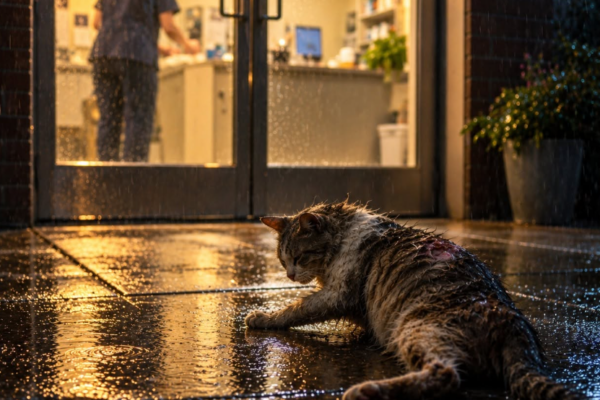
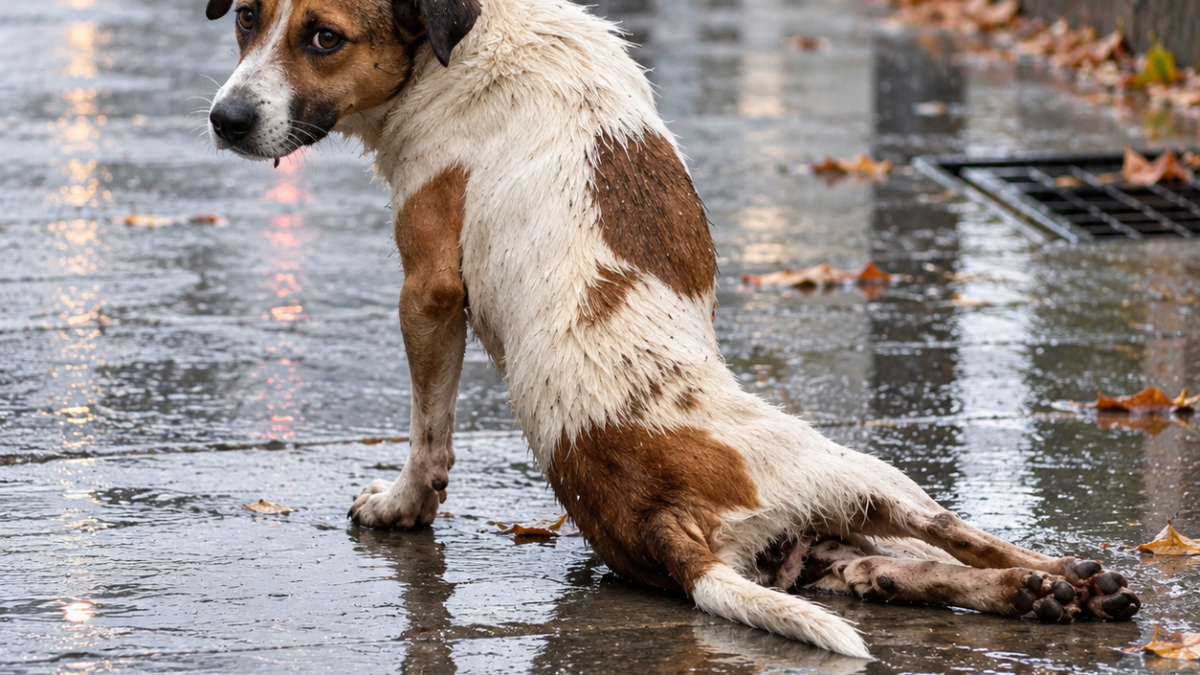
I first saw Shane dragging himself through the rain with only his front legs, his useless hindquarters trailing through the mud while water poured off his dark coat and traffic splashed past only a few feet away.
He could not run, climb onto dry ground, or turn quickly enough to protect himself, yet every few feet he stopped, lifted his exhausted head, and pulled himself forward again.
At that moment, I thought the worst thing about his story was the injury that had taken away the use of his back legs, but I would soon learn that paralysis was only part of what Shane had survived.
My name is Aaron Silva, and that afternoon in Neluwa, Sri Lanka, the rain was so heavy that the road looked like a shallow river. Water rushed along both sides carrying leaves, branches, and plastic bottles downhill, and most drivers were moving slowly through the storm.
I almost missed him.
At first, the dark shape beside a closed shop looked like a piece of wet cloth.
Then it moved.
I hit the brakes and pulled over.
A dog was dragging himself across the muddy shoulder.
His front paws dug into the ground while his hind legs trailed behind him without helping at all.
“Oh, God.”
I ran toward him.
The moment Shane heard my footsteps, he tried to move faster.
He couldn’t.
“Easy,” I said. “I’m not going to hurt you.”
He turned his head toward me.
His coat was soaked against a painfully thin body, and his front legs trembled from exhaustion. The tops of both back paws were scraped from being dragged across rough surfaces.
I crouched several feet away.
When I moved my hand toward him, he flinched.
So I stopped.
“All right. I’ll wait.”
For several minutes, I sat in the mud while rain hammered the metal roof behind us.
Eventually Shane lowered his head.
I slipped one arm beneath his chest and another beneath his hips.
When I lifted him, he gave a quiet cry.
“I know. I’m sorry.”
He was frighteningly light.
I wrapped him in a blanket inside my van and called Dr. Maya Fernando, a veterinarian I knew through a local rescue group.
“Can he move either back leg?” she asked.
“No.”
“Bring him in.”
The clinic was almost forty minutes away.
During the drive, Shane watched me carefully. When I rested my hand beside his face, he sniffed my fingers and slowly lowered his chin onto them.
That tiny gesture stayed with me.
He had no reason to trust me.
But he did.
At the clinic, Maya examined his spine and legs.
X-rays showed an old injury around his lower spine and pelvis.
“This didn’t happen today,” she said.
“How old?”
“Weeks at least. Maybe months.”
I looked at Shane.
“You mean he’s been moving like this for months?”
“Possibly.”
Then one of the assistants cleaning his legs stopped.
There was a narrow band of missing fur around one hind ankle.
Another appeared on the other leg.
Maya examined them.
“What caused that?” I asked.
“Possibly rope.”
I felt sick.
The paralysis might have come from an accident.
But somebody appeared to have restrained his already useless legs afterward.
That night Shane stayed at the clinic.
So did I.
He was dehydrated, underweight, anemic, and covered with pressure sores around his hips. We later learned how complicated paralysis truly was. It did not only mean a dog could not walk. Shane needed help relieving himself. His skin needed constant checking. His rear paws required protection. His wasted muscles had to be exercised carefully.
Every morning, we placed a wide sling beneath his abdomen and helped him stand.
At first, his hind legs carried almost no weight.
Then one morning his right paw pressed against the mat.
Maya froze.
“Again.”
We repositioned him.
The paw pressed again.
I crouched beside him.
“You did that.”
Shane’s tail moved weakly.
It was the first real wag I had seen.
For the next few weeks, improvement came in tiny pieces.
His wounds began healing.
His appetite increased.
His coat became cleaner and shinier.
He learned the sound of my footsteps and started wagging whenever I entered.
Then a woman named Priyanka contacted the rescue after seeing Shane’s photograph.
“I know that dog,” she said.
My stomach tightened.
“Where?”
“Behind a house near an old storage building.”
“Could he walk?”
There was a pause.
“No.”
“Was he tied?”
“Sometimes.”
“With what?”
“Rope.”
I immediately contacted a local animal-welfare officer named Sanjeewa Perera.
Investigators located the property and began interviewing neighbors.
The man who had kept Shane claimed the dog had been struck by a vehicle months earlier.
He said surgery was too expensive.
There was no veterinary record showing proper treatment had ever been sought.
Several neighbors said they had offered help.
One had offered transportation to a clinic.
Another suggested contacting a rescue.
Those offers had gone nowhere.
Worse, witnesses said Shane had been tied behind the house because he dragged himself into places the family wanted kept clean.
The rope marks around his hind legs suddenly made sense.
He had already lost the use of them.
And someone had still tied them.
I was furious.
But Shane needed rehabilitation more than he needed my anger.
A therapist suggested trying a canine wheelchair.
At first, I resisted.
“What if he learns to walk again?”
“He can still use wheels while recovering,” she said.
“I don’t want him becoming dependent.”
She looked directly at me.
“Aaron, mobility is not surrender.”
I realized I had been measuring success the wrong way.
We fitted Shane into the wheelchair.
He froze at first.
Then he moved one front paw.
The wheels rolled.
Another step.
Roll.
He stopped, looked around, and tried again.
Then suddenly he understood.
Shane accelerated across the rehabilitation yard.
“Shane!”
He went faster.
His ears lifted.
His mouth opened.
For the first time since I had found him in the storm, he looked completely free.
I laughed until tears filled my eyes.
The wheelchair transformed him.
He could decide where to go.
He followed people.
Chased slow-moving toys.
Rolled toward the clinic entrance whenever he smelled food.
And after discovering that Mrs. Perera at the bakery next door sometimes gave him chicken, he learned exactly what time she arrived every morning.
“You’re spoiling him,” I told her.
“He suffered.”
“That doesn’t mean unlimited chicken.”
Shane rested his chin on her foot.
She looked at me.
“He is hungry.”
“He is acting.”
Shane wagged.
I lost the argument.
Months after his rescue, investigators confirmed something even worse.
Shane had not simply wandered away.
After his care became inconvenient, he had been loaded into a vehicle and taken away from the property.
The family claimed they intended to leave him somewhere people would feed him.
Instead, he was found kilometers away, dragging himself through the rain.
Disabled.
Underweight.
Unable to protect himself.
Charges related to neglect and abandonment followed.
The legal process moved slowly.
Shane’s life did not.
By then, I had brought him home as a foster.
At least that was what I called it.
I built a ramp.
Covered slippery floors with rugs.
Bought several beds.
Learned his exercise routine.
Brought him to my repair shop when it was quiet.
Shane slept under my workbench while I worked.
He waited by the door when I left.
During thunderstorms, he pressed himself against my legs.
I would put my hand on him and say the same two words every time.
“Still here.”
Six months after his rescue, another family applied to adopt him.
They were excellent.
Experienced.
Kind.
They had a larger house and a fenced yard.
I hated the idea immediately.
Not because they were wrong for Shane.
Because they might be right.
After they visited, I sat beside him.
“You liked them.”
His tail moved.
“They have more space.”
Tail.
“Probably better treats.”
Tail again.
“You’re showing very little loyalty.”
Shane licked my hand.
The next morning, I called the rescue.
“I’m adopting him.”
The coordinator laughed.
“I know.”
I bought Shane a dark blue collar.
His tag carried his name, my number, and one sentence on the back:
I HAVE A DISABILITY. PLEASE CALL MY FAMILY.
Family.
That was what he had become.
The court eventually imposed penalties, restitution toward veterinary costs, and restrictions on the former owner keeping animals.
I attended the final hearing.
When I was allowed to speak, I held up a photograph of Shane racing across grass in his wheelchair.
“This is Shane now.”
The room became quiet.
“He was disabled before he was abandoned.”
I looked toward the man who had left him.
“But disability was not what nearly killed him.”
I paused.
“Abandonment was.”
That was all I needed to say.
For a long time, I had imagined revenge as watching someone else suffer.
Shane taught me something better.
His revenge was the wheelchair waiting beside my door.
It was the bakery chicken he stole.
It was the bed under my workbench.
It was every thunderstorm he eventually learned to sleep through because he knew someone would stay.
It was every morning he woke in a house where nobody considered his body inconvenient.
Shane never became a perfectly walking dog.
He recovered some movement in his hind legs and could stand briefly and take a few supported steps, but his wheelchair remained the fastest and happiest way for him to explore.
And eventually I stopped wishing he would become the dog he had been before the injury.
He did not need to become anyone else.
He was already Shane.
Disabled.
Stubborn.
Funny.
Greedy.
Loved.
Safe.
Home.
The storm had been where I found him.
But it was never the story of his life.
The real story began the moment he stopped dragging himself forward alone and discovered there was finally someone beside him saying the same two words again and again.
Still here.