PART 2: He Dragged a Dying Leg Through My Farm Gate Begging for Food—Weeks Later, I Cried Watching Him Run on Three Legs
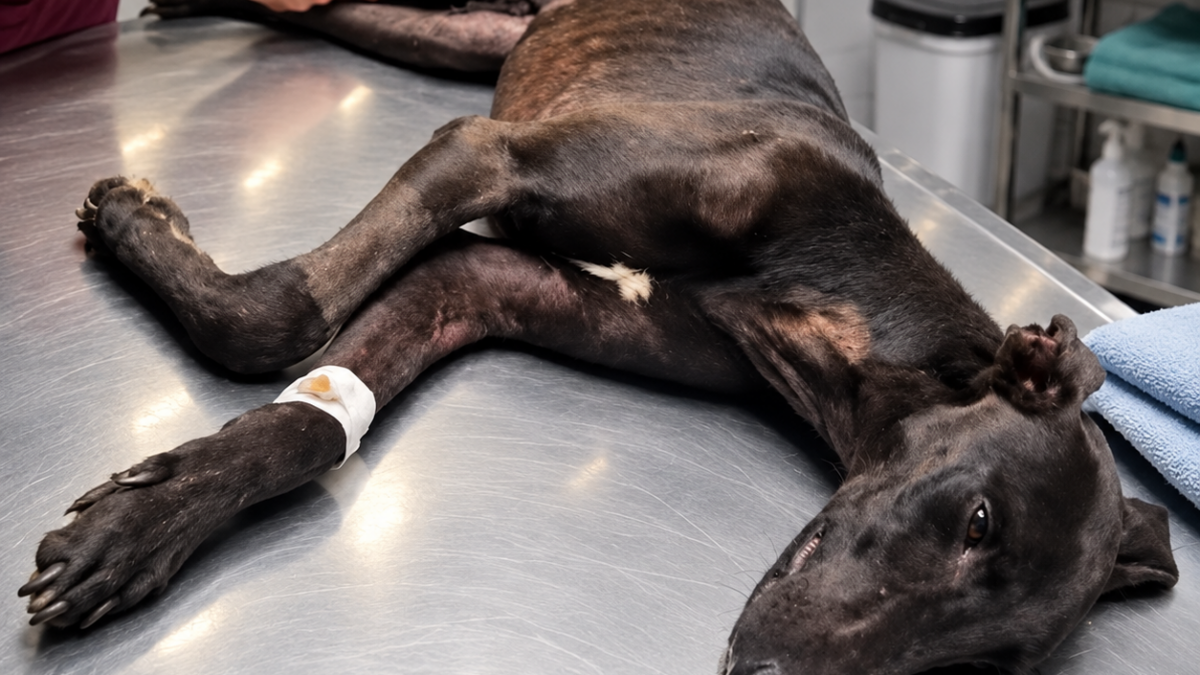
The veterinarian kept looking at the leg.
That worried me.
Doctors have different kinds of silence.
There is the ordinary silence of concentration.
Then there is the silence that means they are deciding how much truth to give you at once.
I had already learned enough about this dog in a few hours to understand that his body had been running on borrowed time.
The fever.
The pale gums.
The lack of muscle.
The wound.
Still, I wanted the veterinarian to look at me and say the same thing I was telling myself.
Antibiotics.
Food.
Rest.
He would heal.
Instead, she touched the edge of the damaged tissue with gloved fingers and frowned.
“We need to clean this thoroughly.”
“Can you save the leg?”
She didn’t answer immediately.
That was my answer.
“We’re going to try,” she said.
I nodded.
Trying was enough for that day.
We didn’t even know his name.
The clinic staff kept calling him “the farm dog.”
One technician asked me whether I had thought about naming him.
I looked through the small examination-room window.
He was lying on a folded blanket while fluids dripped into him.
“Not yet.”
“You should.”
“Why?”
“Because he’s going to need one.”
I knew what she meant.
A name changes something.
A stray becomes an individual.
A case becomes a life.
I studied him.
His head rested between his front paws.
The back leg stretched awkwardly beside him.
He looked exhausted, but every time somebody entered the room, his eyes followed them.
Alert.
Cautious.
Waiting.
“What about Chance?” the technician said.
I shook my head.
“Too obvious.”
She smiled.
“Lucky?”
“He doesn’t look lucky.”
“Maybe that’s why he needs the name.”
I looked at him again.
“No. Let’s wait.”
In truth, I was afraid of naming him too soon.
That may sound foolish.
But anyone who has spent time around severely neglected animals knows the superstition.
You tell yourself not to become attached before the blood work comes back.
Before the fever breaks.
Before they eat.
Before they survive the night.
As if withholding a name can protect your heart.
It can’t.
The veterinarian returned with the first results.
His body was fighting infection.
His red blood cell count was low.
His protein levels reflected prolonged malnutrition.
His condition had not developed over a weekend.
Whatever his exact history, he had been living without enough nutrition for a long time.
“How long?”
“Three months would not surprise me.”
I stared at her.
“Three months starving?”
“Not necessarily no food at all. Animals like this often survive on scraps. Enough to keep moving. Not enough to maintain their body.”
I looked through the glass again.
Enough to keep moving.
That sentence would stay with me.
Somehow he had found enough calories to remain alive.
Enough water.
Enough shelter.
Enough luck.
Never enough of anything to be well.
Then his injured leg became worse.
Maybe the wound had started weeks earlier.
Maybe longer.
Nobody could tell.
A trap remained one possibility because of the pattern of injury, but there was no evidence proving it.
All we knew was that he had continued walking.
I imagined him traveling back roads at night.
Avoiding houses.
Digging through trash.
Resting beneath sheds.
Licking the wound because instinct was the only medicine he had.
It was easy to become angry.
Angry at whoever might have owned him.
Angry at everyone who may have seen him and continued driving.
Angry at the possibility that someone had chased him away.
But anger needed facts.
And we did not have them.
So I focused on what was in front of me.
“What happens next?”
“Antibiotics,” the veterinarian said. “Pain medication. Careful feeding. We clean the wound. We monitor the fever.”
“And the leg?”
“We give it time.”
I nodded.
“Okay.”
She looked directly at me.
“This dog may need significant care.”
“I understand.”
“Do you?”
Probably not.
But I said yes.
Because he had walked through my gate.
That was enough.
They cleaned the wound.
I stayed nearby.
The staff tried to minimize stress, but even gentle handling frightened him.
Every time someone positioned his body, he went rigid.
Never aggressive.
Never even defensive.
Just resigned.
That bothered me more than snapping would have.
A dog that snaps is still telling you where the boundary is.
This dog seemed to believe boundaries did not matter.
People would do what they wanted.
His job was to endure it.
I sat beside him afterward.
“You’re allowed to be mad, you know.”
His eyes opened.
“I’d probably be mad.”
Nothing.
“You can growl at me.”
His ears moved.
“I won’t take it personally.”
The tip of his tail tapped the blanket.
I laughed.
“That’s not what I meant.”
That weak tail became the thing everyone noticed.
He could be feverish.
He could be exhausted.
He could be standing on a leg that looked unbearable.
Yet if someone spoke gently, the tail moved.
Sometimes once.
Sometimes twice.
It was never dramatic.
Just enough to say that somewhere inside that wrecked body was still a dog who wanted connection.
The clinic kept him overnight.
I went home without him.
That surprised me.
I had met him only hours earlier, yet the farm felt wrong.
I walked past the open gate several times.
The bowl he had eaten from was still near the barn.
I picked it up.
There were scrape marks inside from the way he had pushed it across the ground while eating.
I washed it.
Then I set it beside the back door.
For tomorrow.
Just in case.
At 6:18 the next morning, the clinic called.
I answered before the second ring.
“Is he alive?”
The technician paused.
“Yes.”
I closed my eyes.
“I’m sorry. I shouldn’t have started with that.”
“It’s okay.”
“How is he?”
“Still feverish. But he ate.”
“How much?”
“All of breakfast.”
I laughed.
Actually laughed.
The technician laughed too.
“He has an impressive appetite.”
“That may be the best thing he has going for him.”
“It’s a very good sign.”
I was at the clinic before eight.
When I entered his room, he raised his head.
No tail movement.
Then he recognized my voice.
“Hey.”
Tap.
One wag.
I sat down.
“You remember me?”
Another wag.
That settled the name problem.
Not because I suddenly heard a perfect name.
Because I no longer cared whether I was supposed to avoid attachment.
He was already mine in the only way that mattered.
I was responsible.
“What about Ranger?”
The dog blinked.
The technician behind me said, “Ranger?”
“He’s been traveling.”
“That works.”
I crouched.
“Ranger?”
His tail tapped.
The technician smiled.
“There you go.”
So Ranger he became.
Maybe he had another name once.
If he did, we never learned it.
Ranger was the name attached to the life that began after the gate.
For the first several days, almost everything revolved around food.
Not unlimited food.
That could be dangerous in a severely malnourished animal.
The clinic built a careful feeding plan.
Small meals.
Frequent meals.
Easily digestible nutrition.
Supplements.
Monitoring.
Ranger disagreed with the “small” part.
Every empty bowl offended him.
The first time I picked one up after he finished eating, he followed it with his eyes as if I had stolen treasure.
“There’s more later.”
He stared.
“I promise.”
The stare continued.
“You don’t believe me.”
He did not.
Of course he didn’t.
Promises about food mean nothing to a starving dog.
Only repetition teaches them.
Breakfast appears.
Then lunch.
Then dinner.
Then breakfast again.
Day after day until the body finally stops believing every bowl might be the last.
I brought Ranger home once the veterinarian believed he was stable enough for close care outside the clinic.
I had prepared a quiet room near the kitchen.
Soft bedding.
Water.
No stairs.
Easy access outside.
His first reaction was suspicion.
He stood at the doorway and refused to enter.
“It’s yours.”
He looked at me.
“The whole room.”
Nothing.
I stepped inside and sat on the floor.
Ranger remained outside.
I placed one piece of food near the doorway.
He ate it.
Another piece just inside.
He stretched his neck and took it without moving his feet.
“Smart.”
Third piece.
A little farther.
Finally one paw crossed.
Then two.
Then all four.
Well, three and a barely usable fourth.
Once inside, he immediately looked for another exit.
There wasn’t one.
Panic flashed across his face.
I moved away from the doorway.
“You can leave.”
He stared.
“Go ahead.”
He walked back out.
Then stopped in the hall.
I stayed where I was.
Thirty seconds later, Ranger came back.
That mattered.
The first entrance had been hunger.
The second was choice.
He approached the bed.
Sniffed.
Walked away.
Sniffed again.
Then he collapsed beside it instead of on it.
I did not correct him.
That first night, Ranger slept near the door.
At least I thought he slept.
Every time I checked, his eyes opened immediately.
At midnight.
At two.
At four.
He never seemed to enter deep sleep.
His body remained prepared to move.
By dawn, I was sitting in the hallway drinking coffee.
Ranger looked at me.
“I’m tired too.”
Tail tap.
“You caused this.”
Another tap.
He was improving.
Slowly.
The fever came down.
His gums gained more color.
His appetite stayed strong.
The wound received daily attention.
That was the hardest part.
Whenever I prepared the supplies, Ranger knew.
He would lower his head.
Sometimes he tried to move away.
The first few times, I needed help.
Not because he fought.
Because I refused to pin him down unless absolutely necessary.
I wanted him to learn something new.
Painful things could happen without cruelty.
Hands could hold him without anger.
A person could touch the wound and still stop when he became overwhelmed.
“Okay,” I’d say. “Break.”
We would stop.
He would breathe.
Then continue.
The veterinarian approved the approach.
“Trust matters here.”
It did.
Ranger’s body needed healing.
His mind did too.
Food produced the fastest change.
After one week, the bones still showed sharply, but something had softened about his face.
After two weeks, his hips looked less severe.
His shoulders started carrying a faint layer of muscle.
The hollow spaces around his skull filled slightly.
Visitors who had seen him on the first day were shocked.
“He looks like a different dog.”
He didn’t.
Not to me.
He looked like the same dog with a little more life covering his bones.
The most dramatic change was his behavior around meals.
At first, Ranger inhaled food as if another animal might steal it.
I used a slow feeder.
He learned to defeat it.
I divided meals into several bowls.
He ran between them.
I scattered kibble in a snuffle mat.
He nearly ate the mat.
“Sir.”
Ranger looked up.
“This is not a competition.”
Tail wag.
Eventually, he slowed.
Not much.
But enough.
One morning he left three pieces of food in the bowl.
I stared.
“Are you sick?”
Ranger walked to the water.
I called the veterinarian.
“I think something’s wrong.”
“What?”
“He left food.”
“How much?”
“Three pieces.”
There was a pause.
Then she laughed.
“You called me because the formerly starving dog left three pieces of kibble?”
“Yes.”
“He might be learning he’ll get another meal.”
That sentence stopped me.
Learning he’ll get another meal.
I looked at Ranger.
He had finished drinking and was lying near the doorway.
For the first time, food remained behind him.
He was not guarding it.
Not checking it.
Not worried.
Three pieces of kibble should not have made me emotional.
They did.
The leg was not following the same recovery.
At first, the swelling decreased.
The surface looked cleaner.
We felt hopeful.
Ranger gained weight.
His blood values improved.
His fever disappeared.
He wanted to spend more time outside.
But the wound stalled.
Then it changed.
One morning, I noticed an odor.
My stomach dropped.
I called the clinic immediately.
“Bring him.”
The veterinarian examined the leg.
Her face told me before she spoke.
“I want new imaging.”
“Why?”
“I’m concerned the infection is deeper than we hoped.”
Ranger stood beside me.
Tail wagging.
He had no idea the room had just changed.
The X-rays were taken.
Then more testing.
We waited.
I sat on the floor.
Ranger put his head on my knee.
He had never done that before.
“You pick today?”
Tail thump.
I rubbed behind his ears.
He leaned slightly into the touch.
The veterinarian returned.
I knew.
“The infection has reached the bone.”
I looked at her.
“Can you treat it?”
“We’ve been treating aggressively.”
“But?”
She sat down.
“The tissue is necrotic. There is too much damage. Leaving the leg gives the infection a route to keep threatening the rest of him.”
I understood the words individually.
Together, I resisted them.
“You said we were trying to save it.”
“We did.”
“So try something else.”
Her expression remained gentle.
“This is something else.”
I looked down at Ranger.
“No.”
She waited.
“There has to be another option.”
“We could continue antibiotics and wound care.”
“Okay.”
“But I don’t believe it would be the kind option.”
That word hurt.
Kind.
I had been imagining kindness as preserving him intact.
Four legs.
Whole body.
Saving everything starvation and injury had already taken from him.
The veterinarian continued.
“If this were my dog, I would amputate.”
I stared at her.
Ranger’s tail moved.
“Why is he wagging?”
She looked at him.
“Because you’re here.”
That nearly broke me.
I stood and walked to the other side of the room.
I needed a few seconds where Ranger could not see my face.
The veterinarian gave me space.
I looked at the X-ray screen.
Bone infection.
Dead tissue.
A leg that had carried him through months of hunger now threatened to kill him.
It felt unfair.
He had finally found food.
Finally stopped shaking whenever I reached toward him.
Finally slept longer than an hour at a time.
Now we were going to take part of him away.
“What happens if we don’t?”
The veterinarian answered carefully.
“The infection could continue spreading. He could become systemically ill again. Septic complications are possible. The pain continues.”
“And if we do?”
“Recovery is difficult at first. But dogs often adapt extremely well to three legs, especially if we get him stronger beforehand.”
I looked at Ranger.
He was standing badly on four legs already.
One barely functioned.
Maybe I had been thinking about the number instead of the pain.
“When?”
“Not tomorrow. I want another week if his condition stays stable. Build strength. Build nutrition. Then surgery.”
I returned to Ranger.
I knelt in front of him.
He sniffed my chin.
“You’re going to lose this leg.”
Tail wag.
“You don’t understand.”
He licked my hand.
The veterinarian said quietly, “Maybe he understands enough. He knows it hurts.”
That night, I sat beside Ranger longer than usual.
He slept with the injured leg stretched away from his body.
I studied it.
Anger returned.
Not at the veterinarian.
At the mystery.
What had caught him?
How long had he been trapped?
Had someone found him and ignored him?
Had a trap been placed legally for another animal?
Had he been owned?
Was someone looking for him?
Every question created a villain, and none of them came with evidence.
I could have invented one.
Emotion makes that easy.
But Ranger deserved truth.
We knew only this:
Something had badly injured his leg.
He had survived.
No person had brought him for treatment.
He had reached my gate himself.
Everything after that was our responsibility.
So I changed the direction of my anger.
If pain wanted to take more from him, we would make sure it failed.
If starvation had reduced him to bone, we would rebuild him.
If fear had taught him hands were dangerous, we would replace the lesson.
If the leg had become a threat, we would remove the threat.
That would be the revenge.
Not against a person I could not identify.
Against everything that had tried to kill him.
The week before surgery became strangely happy.
Ranger did not know a countdown had begun.
He simply discovered life.
He followed me around the farm on a restricted lead.
Not far.
The veterinarian had strict instructions.
But Ranger loved smells.
Hay.
Mud.
Chickens.
Grass.
Diesel from the tractor.
The barn cat, who hated him on principle.
His first meeting with the cat was almost comedic.
Ranger noticed her near the feed room.
He froze.
The cat froze.
I shortened the leash.
“Easy.”
Ranger’s tail moved.
The cat puffed twice her size.
Ranger took one curious step.
The cat hissed.
Ranger jumped backward so quickly he nearly fell.
I laughed.
The cat walked away like she had defeated a wolf.
Ranger looked at me.
“Don’t worry. She does that to everybody.”
He stared after her.
Five minutes later, he wanted to follow again.
Curiosity was returning.
That was important.
A dog focused only on survival has no energy for curiosity.
Ranger now wanted to know things.
What was behind the barn?
Why did chickens move like that?
Could the kitchen counter be reached?
Why did the refrigerator contain food?
Was every vehicle ride going to the veterinarian?
Could blankets be rearranged?
Yes.
Ranger discovered blanket architecture.
I would make his bed.
He would immediately pull everything out.
Turn.
Dig.
Push.
Pile.
Then sleep on the bare floor beside it.
“Why?”
Tail wag.
I bought a softer bed.
He dismantled that arrangement too.
Eventually, I stopped making it.
Ranger arranged his sleeping area however he wanted.
It was the first thing in his life he controlled.
He could have the privilege.
Two days before surgery, I received a call from someone who had seen a photograph of Ranger.
“Is that the dog you found near the east road?”
“Yes.”
“I’ve seen him before.”
My heart jumped.
“Where?”
“Months ago.”
“Was he with anyone?”
“No. He was near the old fence line.”
“Was he injured?”
“I think he was limping.”
“Did you see what happened?”
“No.”
The disappointment was immediate.
“Did you ever see him near traps?”
A pause.
“There are fox traps used on some properties out that direction. But I never saw him in one.”
That was all.
Another possibility.
No proof.
Still no clean answer.
I asked whether he remembered anyone feeding Ranger.
“Maybe the gas station.”
That gave me something.
The next morning, I drove there.
The cashier recognized the photograph.
“Oh, that dog.”
“You saw him?”
“Several times.”
“When?”
“A while back.”
“Was his leg injured?”
She frowned.
“Later, yes.”
“Later?”
“He came around before that without the bad limp.”
That detail mattered.
“You’re sure?”
“I think so.”
“How long ago?”
She couldn’t remember.
Weeks blurred.
Stray animals are landmarks until someone pays attention.
“Did anyone own him?”
“Not that I know.”
“Anyone hurt him?”
“No.”
“Feed him?”
“Sometimes we put scraps out behind the dumpster.”
“Did he trust you?”
She shook her head.
“Never came close.”
I showed her a current photo.
Ranger looked fuller.
Eyes brighter.
Clean blanket beneath him.
She smiled.
“That’s the same dog?”
“Yes.”
“He looks good.”
“He’s losing the leg tomorrow.”
Her face changed.
“Oh.”
“The infection reached the bone.”
She looked at the image again.
“Poor baby.”
Before I left, she handed me a sealed package of dog treats.
“Give him these after.”
I took them.
“Thank you.”
That was the first piece of Ranger’s past that felt useful.
Not because it explained the injury.
Because it reminded me that even during the worst months, not every human had chased him.
Someone had put scraps behind a dumpster.
Someone had noticed the limp.
Someone had kept him alive another night.
Maybe his survival had always been built from tiny mercies.
The day of surgery arrived.
I woke before the alarm.
Ranger could not eat breakfast.
He considered this betrayal.
He walked to the bowl.
Empty.
He looked at me.
“Not today.”
He looked back at the bowl.
“I know.”
Tail stopped.
“I know.”
He followed me into the kitchen.
I had no food for him.
He looked deeply offended.
“Doctor’s rules.”
He lay down dramatically.
If a skeletal dog can become spoiled, Ranger had achieved it in less than a month.
The drive to the clinic was quiet.
Ranger watched the window.
When we arrived, he recognized the building and hesitated.
I crouched.
“Come on.”
He stepped toward me.
That alone showed how far we had come.
The first trip had taken forty minutes to get him into a vehicle.
Now he followed me through the clinic door.
The staff greeted him.
“Morning, Ranger.”
Tail wag.
“You ready?”
Wag.
I wanted to say no for him.
Instead, I signed the paperwork.
The consent form felt brutal.
Risks.
Anesthesia.
Bleeding.
Complications.
Death.
Every possible failure summarized in boxes and signatures.
The veterinarian sat with me before taking him back.
“You understand why we’re doing this?”
“Yes.”
“You can change your mind.”
I looked at Ranger.
“No.”
“Good.”
I laughed nervously.
“You could pretend I sounded confident.”
“You don’t have to be confident. You just have to make the decision that gives him the best chance.”
I put both hands around Ranger’s face.
He allowed it now.
A month earlier, he would have recoiled.
“Listen.”
He looked into my eyes.
“You walk back through that door.”
Tail wag.
“I mean it.”
He licked my wrist.
“Good.”
The technician clipped the leash.
Ranger took three steps.
Then looked back.
I nearly stopped the entire surgery.
“Go.”
He stared.
“You’re coming back.”
The technician waited.
I smiled despite the pressure in my chest.
“Go get rid of that bad leg.”
Ranger followed her.
The door closed.
Waiting was unbearable.
I went home because staring at clinic walls would not change anything.
At the farm, every object reminded me of him.
His water bowl.
His blankets.
The path he had started using.
The empty space near the kitchen.
I tried working.
Impossible.
I checked my phone twelve times in fifteen minutes.
Finally it rang.
The veterinarian.
I answered.
“Tell me he’s okay.”
“He’s okay.”
I sat down on a feed bucket.
“Say it again.”
“He’s awake. Surgery went well.”
I covered my face.
“Thank you.”
“The leg was worse than we wanted to see.”
I closed my eyes.
“So we were right?”
“Yes. This was the right decision.”
That mattered more than I expected.
No wondering.
No regret.
The leg needed to go.
“When can I see him?”
“Soon.”
I arrived before “soon” had probably technically passed.
Ranger was groggy.
For one terrible second, the missing leg shocked me.
You can prepare mentally.
You can understand medically.
You can sign the paper.
Then you see the empty space.
My chest tightened.
Ranger lifted his head.
His tail moved.
I laughed through tears.
“You’re unbelievable.”
The veterinarian stood beside me.
“He’s doing very well.”
“He’s wagging.”
“He does that.”
I crouched near him.
“Three legs.”
Wag.
“You don’t care?”
His eyes drifted closed.
“No. Of course you don’t.”
I stayed until he fell asleep.
The first twenty-four hours were difficult.
Pain management mattered.
Balance confused him.
When he tried standing, his body searched for a limb that was no longer there.
He fell once.
My heart stopped.
Ranger looked surprised.
Then irritated.
The technician steadied him.
“Easy.”
He tried again.
This time, he stayed upright for two seconds.
Three.
Then sat.
“Good,” I whispered.
He looked at me.
“Again later.”
The next morning, he stood longer.
By afternoon, he took a few steps.
Not pretty steps.
Not confident.
But steps.
The veterinarian warned me recovery would not be linear.
She was right.
Some moments Ranger seemed determined.
Others exhausted.
Sometimes he tried too much and became frustrated.
The first time he could not turn properly, he barked.
Actually barked.
I stared.
“What was that?”
Ranger barked again.
The technician laughed.
“There’s your personality.”
“You had a voice this whole time?”
Ranger looked furious.
I loved it.
Anger was better than resignation.
He was learning that he could object.
His body belonged to him now.
Three days after surgery, Ranger came home.
The room near the kitchen had been rearranged.
Non-slip mats.
Fewer obstacles.
Low bedding.
I opened the door.
Ranger stood at the threshold.
For a second, I saw the frightened dog from the first night.
Then he smelled his blankets.
His nose moved.
Tail wag.
He stepped inside.
One.
Two.
Three.
A slight wobble.
Then four.
He reached the bed.
Sniffed.
Turned.
Collapsed onto it.
This time, he used the bed.
“You finally understand furniture.”
His eyes closed.
Recovery built slowly.
At first, every trip outside required support.
I used a sling when necessary.
Ranger hated the sling.
He tolerated it because treats existed.
A few feet.
Rest.
A few more.
Rest.
His front legs grew stronger.
The remaining back leg had to adapt.
His core muscles changed.
Balance improved.
Dogs are astonishing that way.
They do not stand in front of mirrors mourning symmetry.
They adapt to what exists.
Ranger’s first goal was food.
If dinner was in the kitchen, he figured out how to reach it.
His second goal was me.
If I left the room, he wanted to follow.
His third goal was the barn cat.
The cat remained unimpressed.
Within two weeks, Ranger could move through the house with increasing confidence.
The incision healed.
The infection markers improved.
His appetite remained heroic.
And something happened to his eyes.
They became playful.
Not always.
Fear still lived there sometimes.
But it no longer occupied every room.
One morning, I found Ranger standing at the back door.
“What?”
Tail wag.
“Outside?”
Wag.
I opened it.
He stepped onto the porch.
Paused.
Then moved toward the grass.
For the first time, he did not need the sling.
I stayed close.
Ranger took five steps.
Ten.
Then he stopped and smelled something.
A rabbit trail, probably.
His nose lowered.
He followed it.
“Not too far.”
He ignored me.
I laughed.
That was the first time Ranger disobeyed because he was interested in life.
I let him have a few extra feet.
Three weeks after surgery, the veterinarian approved longer controlled walks.
Ranger celebrated by attempting to chase a chicken.
It was not graceful.
He saw the bird.
His ears lifted.
The chicken ran.
Ranger lunged.
His new three-legged balance failed mid-turn.
He rolled gently into the grass.
I shouted his name.
He popped back up.
Tail wagging wildly.
The chicken escaped.
Ranger looked at me as if I had interfered with a great hunt.
“No.”
He stepped forward.
“No chickens.”
Tail wag.
“You have three legs and bad judgment.”
That evening, I told the veterinarian.
She laughed.
“That’s progress.”
“Trying to chase livestock?”
“Feeling well enough to make stupid decisions.”
Fair point.
The farm became Ranger’s classroom.
Uneven ground.
Different surfaces.
Small slopes.
Door thresholds.
Each obstacle forced him to learn.
At first, gravel bothered him.
Then mud.
Then stairs.
We avoided full staircases, but one shallow porch step became his enemy.
He would stand before it.
Look up.
Look at me.
Then back at the step.
“You can do it.”
He tried once and backed away.
I did not lift him.
Not yet.
“Think.”
Ranger shifted his weight.
Front feet up.
Push.
Remaining rear leg jumped.
He made it.
His tail exploded.
I cheered louder than anyone should cheer for one step.
“That’s it!”
Ranger bounced around and nearly fell again.
“Okay. Calm celebration.”
He turned toward the step.
Now he wanted to go back down.
Confidence had consequences.
The next major breakthrough happened unexpectedly.
I was walking Ranger across a flat pasture on a long lead.
His gait had become surprisingly smooth.
Not normal in the four-legged sense.
Normal for him.
He stopped.
Looked toward the barn.
Then something changed.
Maybe he heard me.
Maybe he saw the open space.
Maybe his body suddenly understood it could do more.
Ranger began moving faster.
Not walking.
Trotting.
I tightened my grip on the lead.
“Easy.”
He accelerated.
Three-legged rhythm.
Front.
Front.
Rear.
Lift.
Balance.
Again.
Then he ran.
Only for several seconds.
But he ran.
I followed, half laughing, half terrified.
“Ranger!”
His ears flew back.
Tail high.
He reached the end of the safe distance and turned toward me.
His entire face looked different.
Alive.
Not surviving.
Alive.
I knelt.
He ran back.
Straight into my chest.
I fell backward into the grass.
Ranger stood over me licking my face.
“You can run.”
Tail wag.
“You can actually run.”
He barked.
I laughed so hard my stomach hurt.
That was the moment I understood the amputation had not taken freedom from him.
It had returned freedom.
The dying leg had been the prison.
Three legs were the escape.
From that day, Ranger’s confidence grew quickly.
I still restricted activity according to veterinary guidance.
He disagreed constantly.
He wanted more distance.
More time outside.
More exploration.
His body had spent months shrinking.
Now his world was expanding.
The first place he chose to revisit was the gate.
I didn’t plan it.
We were walking one morning when Ranger turned onto the path leading toward the entrance.
I almost redirected him.
Then I stopped.
This was where he had arrived.
The gate stood open.
Same way it had that day.
Ranger walked toward it.
Slowly.
I felt every detail return.
The bucket in my hand.
His skeletal body.
The dying leg.
The way he had looked toward the road as if escape remained necessary.
Now Ranger reached the gate.
He stopped on the inside.
Outside lay the road.
The direction he had come from.
I shortened the lead slightly.
Not because I expected him to run away.
Because some irrational part of me feared the past could still call him back.
Ranger sniffed the air.
He looked down the road.
Then back at me.
His tail moved.
“Want to go?”
He stepped toward me.
Not the road.
I swallowed.
“Good choice.”
He walked beside me toward the house.
I kept looking over my shoulder.
The gate remained open behind us.
Ranger did not.
That felt like another kind of victory.
Weeks later, someone contacted me claiming Ranger might have belonged to a man several miles away.
My stomach tightened immediately.
By then Ranger was part of the farm.
Part of my day.
Part of me.
But ownership mattered.
If somebody had lost him, I had to know.
I asked for details.
Color.
Size.
Markings.
Sex.
Approximate age.
The description was vague.
A skinny brown dog.
Male.
The area had many.
I requested photographs.
The caller sent one.
It was not Ranger.
I felt relief before guilt.
Relief that nobody was going to take him.
Guilt because that other dog might also be missing.
I forwarded the information to local rescue contacts.
Ranger remained beside me.
One evening, I realized something else.
I had been calling myself his rescuer.
Maybe that was no longer accurate.
I was simply his person.
The adoption decision had happened without paperwork.
The official version came later.
The veterinarian asked during a follow-up appointment, “Are you keeping him?”
I looked at Ranger.
He was lying under my chair.
“Apparently.”
“Apparently?”
“He refuses to leave.”
She smiled.
“Did you ask him?”
“No.”
“You should.”
I looked down.
“Ranger, do you want to stay?”
His tail hit the floor.
The veterinarian laughed.
“Documented consent.”
So I signed the paperwork.
Ranger had a home.
A legal one.
Permanent.
I bought him an identification tag.
When it arrived, I attached it to his collar.
Ranger hated the sound at first.
He shook his head.
The tag jingled.
He shook harder.
More jingling.
He glared at me.
“You have an address now.”
He stared.
“That’s a big deal.”
Tail wag.
I crouched and read it aloud.
“Ranger.”
His ears lifted.
Then the phone number.
Then the farm address.
I had not expected the address to make me emotional.
But it did.
There had been a time when nobody knew where Ranger slept.
Now anyone who found him could bring him home.
The first time a delivery driver arrived after Ranger gained confidence, he barked from the porch.
Deep.
Serious.
The driver looked nervous.
“Does he bite?”
I looked at Ranger.
Three legs.
Healthy body.
Strong chest.
Tail wagging behind him.
“No. He thinks he works here.”
Ranger barked again.
“Apparently security.”
The driver laughed.
“What happened to his leg?”
That question became common.
At first, I gave the full story.
Starvation.
Infection.
Possible trap injury.
Necrosis.
Bone infection.
Amputation.
Eventually I shortened it.
“He came through the gate dying. Now he’s fine.”
Most people looked at Ranger again after hearing that.
Different eyes.
Not pity.
Respect.
I preferred that.
Ranger did not need pity.
The farm’s social hierarchy also changed.
The barn cat eventually accepted him.
Acceptance meant she stopped hissing unless he deserved it.
One cold morning, I found them lying six feet apart in a patch of sunlight.
I took a picture.
Ranger saw me.
Tail wag.
The cat looked offended.
I moved closer.
She left.
Ranger took her spot.
Classic.
His relationship with food changed slowly.
Months after rescue, he still rushed to the kitchen at meal times.
But he no longer panicked.
If I told him to wait, he could.
Barely.
I placed the bowl down.
“Wait.”
Ranger trembled with anticipation.
“Wait.”
His eyes stayed locked on the food.
“Okay.”
He ate.
Fast, but not desperately.
Then one day he stopped halfway.
Walked to the water.
Drank.
Returned.
Finished.
I remembered the farm gate.
The skeletal dog swallowing as if someone might remove the bowl.
This dog believed food would remain even if he walked away.
That is what safety looks like when you have been hungry.
The veterinary checkups became less dramatic.
Weight gain stabilized.
Blood values normalized.
The surgical site healed completely.
The infection was gone.
The veterinarian ran a hand along Ranger’s side.
“Look at this muscle.”
I smiled.
“He has muscles?”
“He absolutely has muscles.”
Ranger looked pleased.
“You remember when I said there was almost nothing left?”
“I remember.”
“Not anymore.”
I looked at him standing solidly on three legs.
The shape of his body had transformed.
Chest filled out.
Shoulders strong.
Coat brighter.
Eyes clear.
If I had not witnessed the beginning, I would struggle to believe the first photos belonged to the same dog.
The veterinarian pulled one up on her computer.
We stared.
Ranger at intake.
Every rib.
Hollow abdomen.
Head lowered.
Open wound.
Then she looked at the dog beside us.
“I can’t believe he walked onto your farm.”
“Neither can I.”
“Do you know how close he probably was?”
I knew what she meant.
“Don’t.”
She nodded.
Some questions do not need exact answers.
Ranger had arrived before the body crossed a line it could not return from.
That was enough.
Months after surgery, I received another call from the woman at the gas station.
“Is that dog still with you?”
“Yes.”
“How is he?”
“Better than me.”
She laughed.
“I’ve been thinking about him.”
“Want to see him?”
There was a pause.
“Could I?”
So we arranged it.
She came to the farm with the same brand of treats she had given me before surgery.
Ranger did not recognize her immediately.
Why would he?
Back then, he had never approached close enough.
She sat on the porch.
He watched from a distance.
“That really is him?”
“Yes.”
“He looks twice the size.”
“Pretty close.”
“And he runs?”
“You’ll see.”
She became emotional.
“I used to leave food out.”
“I know.”
“I always wondered whether he got it.”
“He probably did.”
“I should’ve done more.”
I had heard that sentence before.
From different people.
Not enough.
Should have.
Could have.
Regret is easy after someone else completes the rescue.
But I remembered the veterinarian’s words.
Ranger had survived on tiny amounts.
Enough to keep moving.
Maybe one handful of scraps behind that gas station had become enough calories for one more mile.
Maybe that mile brought him toward the farm.
“You fed him,” I said.
She looked at me.
“It mattered.”
Ranger approached.
Slowly at first.
She held out a treat but did not move toward him.
He sniffed.
Took it.
Tail wag.
She cried.
Ranger immediately searched her hand for another.
I laughed.
“He has moved past the emotional part.”
She gave him another.
Then another.
“You’re going to create a problem.”
“He deserves it.”
He probably did.
A few minutes later, Ranger trotted across the yard.
The woman covered her mouth.
“He’s fast.”
“Don’t tell him. He already thinks he is.”
Ranger turned and ran back.
Three legs.
Full speed.
Joy in every movement.
The woman shook her head.
“I thought losing the leg would ruin him.”
“So did I.”
That was difficult to admit.
I had mourned the leg more than Ranger ever did.
Humans attach meaning to absence.
Dogs attach meaning to pain, movement, food, safety, companionship.
Ranger did not count limbs.
He counted opportunities.
Can I reach the barn?
Yes.
Can I follow you?
Yes.
Can I chase that chicken?
Not legally, but physically yes.
Can I climb onto the couch?
Absolutely.
Can I run?
Yes.
Then what exactly had he lost?
The infected source of pain.
Not his life.
That realization changed the way I told his story.
At first I said, “He survived even though he lost a leg.”
Later I said, “He survived because we removed the leg that was killing him.”
Those are different stories.
One is tragedy.
The other is liberation.
Ranger’s life became full of ordinary rituals.
Morning patrol.
Breakfast.
Farm work.
Nap.
Second patrol.
Dinner.
Evening couch.
He learned which tractor meant I would be gone only a few minutes and which truck meant a longer trip.
He learned to wait at the door.
He learned not to chase chickens.
Mostly.
He learned the barn cat controlled all treaties.
He learned visitors often carried food.
He learned the veterinarian was not trying to kill him.
This took longer.
Every clinic visit still produced hesitation.
But once inside, his tail wagged for familiar staff.
One technician knelt.
“Remember when he wouldn’t let us near him?”
I watched Ranger press his head against her chest.
“I remember when he didn’t think hands were safe.”
She scratched his neck.
“What do you think changed?”
“Thousands of boring good experiences.”
She smiled.
That was exactly it.
Trauma does not always heal through one dramatic act of love.
Sometimes it heals through repetition.
A bowl appearing every morning.
A hand touching without hurting.
A door opening and closing but never locking you outside.
A person leaving and returning.
A bed still there after you wake.
No shouting.
No chasing.
No sudden loss.
Boring kindness.
Again.
Again.
Again.
Until fear becomes outdated information.
Ranger still carried echoes.
If someone raised a hand quickly, he sometimes flinched.
If metal snapped suddenly, his body stiffened.
That sound made me wonder about the trap theory.
But wondering was all I could do.
We never learned exactly what injured him.
And I stopped needing to.
Ranger did not need a villain for his life to have meaning.
He needed a future.
That was something we could provide.
Nearly six months after he walked through the gate, I took Ranger on the longest walk he had attempted.
Veterinarian approved.
Cool morning.
Flat trail across the property.
We moved slowly.
Ranger chose the pace.
At first, he sniffed everything.
Then he began trotting.
I watched the rhythm.
Three legs no longer looked unusual.
It simply looked like Ranger.
Halfway across the field, we reached a low hill.
I considered turning back.
Ranger looked uphill.
“No.”
He stepped forward.
“Ranger.”
Another step.
“You’re stubborn.”
Tail wag.
Fine.
We climbed slowly.
At the top, the whole farm spread beneath us.
Barn.
House.
Fence lines.
The gate in the distance.
Ranger stood beside me.
Wind moved through his coat.
I looked toward the gate.
“You came in over there.”
He followed my gaze.
“You looked terrible.”
Tail wag.
“Seriously. Awful.”
He sat.
“I didn’t know whether you’d make it.”
Ranger leaned against my leg.
“I guess you did.”
We stayed there for several minutes.
Then Ranger suddenly sprinted downhill.
“Ranger!”
I ran after him.
He was faster.
Three legs pounding the grass.
No hesitation.
No fear.
At the bottom, he turned in a wide circle and ran back toward me.
I stopped.
He came straight up the hill.
Not perfectly.
Not symmetrically.
Powerfully.
The dog who had once dragged a dying leg through my gate was running uphill toward me.
I laughed.
Then I cried.
Ranger reached me.
He pushed against my knees.
“You win.”
Tail wag.
“You hear me?”
He looked up.
“You win.”
That became the phrase.
Every milestone.
You win.
First healthy blood work.
You win.
First full-speed run.
You win.
First night he slept through thunder without hiding.
You win.
First time he ignored dropped food because he was already full.
You definitely win.
The revenge I had wanted in those angry early weeks eventually arrived.
Not as confrontation.
Not as punishment.
Not as finding the person responsible and making them suffer.
We never discovered such a person.
The revenge was Ranger’s body becoming strong enough to turn suffering into history.
Starvation had tried to erase him.
Weight returned.
Infection had tried to spread through him.
The infected leg was gone.
Fear had taught him strangers were dangerous.
Now he met visitors at the porch.
Pain had forced him to drag himself forward.
Now he ran.
Whatever trap, accident or event damaged that leg had taken one limb.
It did not take his movement.
Whoever may have rejected him had denied him kindness.
It did not stop him from trusting again.
That was enough revenge for me.
Then came a day I had not expected.
A local animal welfare volunteer contacted me.
She had heard Ranger’s story and asked whether I would bring him to a small educational event about neglected animals and responsible care.
My first reaction was no.
Ranger was not a display.
He was not a tragedy people could gather around.
But the event was quiet.
No crowds.
No stage.
Mostly families learning about rescue and veterinary care.
I thought about the dogs still wandering roads.
The ones people see but assume someone else will help.
So I agreed.
On one condition.
“If he gets uncomfortable, we leave.”
“Absolutely.”
The morning of the event, Ranger wore his cleanest harness.
I told him, “You’re employed.”
Tail wag.
“You’re terrible with responsibilities.”
He jumped into the vehicle.
At the event, people noticed him immediately.
A three-legged dog draws attention.
A young boy approached with his mother.
“What happened to his leg?”
I crouched beside Ranger.
“He got hurt before he came to live with me. The injury became badly infected.”
“Did losing it hurt?”
“The surgery helped stop the pain that was already there.”
The boy studied Ranger.
“Is he sad?”
Ranger chose that moment to steal a treat from my pocket.
The boy laughed.
“No.”
“Exactly.”
That question stayed with me.
Is he sad?
Humans look at missing pieces and imagine grief.
Ranger looked at what remained and used it.
He walked around the event.
Accepted gentle pets.
Ate too many treats.
At one point, a woman stared at his old photographs displayed by the organizers.
“That cannot be the same dog.”
I pointed.
“He’s right there.”
She looked from the photo to Ranger.
Her eyes filled.
“How long was he starving?”
“We think months.”
“And he just walked onto your property?”
“Yes.”
She shook her head.
“He chose the right gate.”
That phrase hit me.
The right gate.
Ranger had passed roads.
Businesses.
Fences.
Maybe dozens of properties.
Then hunger became stronger than fear and pushed him through one opening.
Had the gate been closed that afternoon, what would have happened?
I tried not to think about it.
After the event, I began calling him “the dog who chose the right gate.”
People liked that.
I did too.
But eventually I corrected myself.
Ranger had not chosen based on knowledge.
He had been desperate.
The gate just happened to be open.
Luck mattered.
Timing mattered.
That scared me.
There were other Rangers walking somewhere with no open gate.
That realization led to the only lasting “revenge” I could create beyond his own recovery.
I began keeping food, water, slip leads and basic rescue supplies in my vehicle.
Not because I suddenly became a professional rescuer.
Because I had learned what one delay could cost.
If I saw a dog struggling beside the road, I stopped when it was safe.
If a neighbor mentioned a stray, I asked questions instead of assuming it would leave.
If someone said, “It’s probably somebody’s dog,” I still checked.
Sometimes nothing came of it.
Sometimes the dog disappeared.
Sometimes another owner was found.
But I never again wanted “I thought someone else would” to be the last sentence in an animal’s story.
Ranger supervised these efforts terribly.
Any rescued dog entering the property had to pass inspection.
He would stand behind a gate and wag.
Sometimes bark.
The barn cat disapproved of expansion.
Life continued.
One year after Ranger arrived, I recreated the walk from the house to the gate.
Not for social media.
Not for anybody else.
For me.
I had saved one photograph from his first day.
Ranger standing near the barn.
Skeleton visible.
Head low.
Wounded leg beneath him.
I carried the photo in my pocket.
We walked the path.
Ranger trotted ahead.
He had filled out completely.
Healthy weight.
Strong shoulders.
Shiny coat.
The remaining hind leg muscular from carrying extra load.
At the gate, he turned.
I held the old picture beside him.
The contrast was almost absurd.
I sat on the ground.
Ranger came over.
“You know what this is?”
He sniffed the photograph.
Then tried to lick it.
“That was you.”
Tail wag.
“You looked dead.”
He leaned against me.
“But you weren’t.”
That distinction mattered.
He had looked close to death.
But life had still been inside him.
Wagging.
Eating.
Walking.
Choosing one more step.
I placed the photograph in my lap.
“People would’ve called you broken.”
Ranger scratched his ear.
“You were hungry.”
He sniffed grass.
“People would’ve called you damaged.”
He looked toward the barn.
“You were hurting.”
Tail wag.
“You weren’t broken.”
Ranger started walking toward the house.
Conversation over.
I followed.
By then, his three-legged gait was so familiar that I stopped noticing it.
Visitors noticed.
Children noticed.
New veterinarians noticed.
I saw Ranger.
That may have been the final stage of healing.
Not when the incision closed.
Not when the weight returned.
When the missing leg stopped being the first thing I saw.
Ranger had become larger than his injury.
He had quirks.
He hated rain but loved muddy puddles, which made no logical sense.
He slept with his head hanging off the couch.
He stole gloves.
Never shoes.
Only gloves.
He feared the vacuum cleaner.
He adored the mail carrier.
He had a special bark reserved for tractors.
He could locate a dropped piece of chicken from impossible distances.
He occasionally dreamed.
His paws moved.
Sometimes all three.
Sometimes the muscles near where the missing leg had once been twitched too.
The first time I saw that, I became sad.
Then Ranger woke, yawned and demanded breakfast.
He did not need my sadness.
One cold evening, I sat beside the fireplace with Ranger sleeping near my feet.
I ran a hand along the scar.
Smooth now.
No infection.
No open tissue.
Just history written on skin.
I remembered the veterinary room.
“There’s no longer any way to preserve it.”
At the time, that sentence sounded like defeat.
Now I understood it differently.
Preserving the leg would not have preserved Ranger.
Sometimes saving means releasing what cannot be saved.
That lesson extended beyond veterinary medicine.
I had wanted a perfect restoration.
Four legs.
No scars.
No fear.
A dog returned to what he might have been before suffering.
That future never existed.
The future available to Ranger was different.
Three legs.
Some scars.
Occasional fear.
And tremendous joy.
That was not a lesser ending.
It was his ending.
And it was good.
Years later, the gate story remained the one people asked about.
“Did he really just walk in?”
“Yes.”
“Was he really that thin?”
Thinner than the photos make him look.
“Was the leg really that bad?”
Worse than I like remembering.
“Did you know he would survive?”
No.
Absolutely not.
“What made you keep going?”
That question always made me laugh.
I didn’t keep going.
Ranger did.
He ate.
He took antibiotics.
He tolerated wound cleaning.
He survived surgery.
He stood.
He fell.
He stood again.
He learned to balance.
He learned to run.
All I did was make sure the next good thing was available when he was ready for it.
Food.
Medicine.
Hands.
Home.
Maybe that is rescue.
Not carrying someone the entire distance.
Making sure they have somewhere safe to take the next step.
Ranger’s last step on four legs happened on an operating-room floor.
His first real steps toward life happened on three.
That would have sounded impossible to me at the beginning.
Now it felt obvious.
The infected leg had been evidence of suffering.
Its absence became evidence of survival.
One summer afternoon, years after he arrived, I found Ranger near the gate again.
It was open.
I had been moving equipment.
He stood on the inside watching the road.
My heart still reacted.
“Ranger.”
He looked back.
I expected him to walk toward me.
Instead, he stepped through the gate.
My stomach dropped.
“Ranger!”
He moved several feet onto the verge.
Then stopped.
He sniffed.
I hurried closer.
“Inside.”
Ranger looked at me.
For a moment, we stood on opposite sides of the place where his entire life had changed.
Then he turned.
Trotted through the gate.
Passed me.
Continued toward the house.
Tail high.
I closed the gate.
Not because I thought he wanted to leave.
Because home was inside.
That evening, he climbed onto the couch.
I sat beside him.
“You scared me.”
He sighed.
“You don’t remember what that road did to you?”
Ranger placed his head on my leg.
Maybe he did.
Maybe he didn’t.
Dogs have the privilege of living without narrating themselves endlessly.
I envied him.
His past lived in reflexes, scars and preferences.
Not identity.
He was not “the starving dog.”
Not to himself.
He was Ranger.
Farm supervisor.
Chicken patrol failure.
Professional food critic.
Three-legged runner.
My dog.
The final proof came during a veterinary visit many years after the surgery.
A new technician entered.
She had never met Ranger.
She read his chart.
“Amputation due to severe infected trauma?”
“Yes.”
“History of extreme malnutrition?”
“Yes.”
She looked down at him.
Ranger was trying to investigate her treat pouch.
She laughed.
“He doesn’t act traumatized.”
I understood what she meant.
But the statement bothered me.
“He does sometimes.”
She looked up.
“He just doesn’t act traumatized every minute.”
That distinction mattered.
Healing does not erase history.
It prevents history from controlling every moment.
Ranger could still startle.
Still fear certain sounds.
Still become anxious around unfamiliar restraint.
But he could also play.
Sleep deeply.
Trust.
Run.
Beg shamelessly for food despite having been fed twenty minutes earlier.
Trauma remained part of his story.
It was no longer the author.
One night, during a storm, thunder cracked over the farm.
Ranger had always disliked loud weather.
He lifted his head.
Looked toward the window.
Years earlier, he would have paced.
This time, he stood.
Walked across the room.
Climbed beside me.
Pressed his body against my leg.
Then fell asleep.
I sat there listening to rain hit the roof.
A thought came unexpectedly.
This was the dog who once may have slept outside through storms with an open wound.
Maybe under brush.
Maybe beneath a vehicle.
Maybe nowhere dry.
Now thunder simply meant move closer to the person.
That is what trust does.
It does not stop the storm.
It changes where you believe safety is.
I rested my hand on Ranger’s shoulder.
He sighed.
Outside, rain crossed the fields.
The farm gate rattled slightly in the wind.
I thought about the day it had been open.
How ordinary the morning had been.
How easily I might have been somewhere else.
How easily Ranger might have kept walking.
Instead, hunger pushed him through.
He lowered his head.
He asked without sound.
Food.
Help.
Anything.
I had thought I was giving him a bowl.
What he needed was an entire future.
The bowl was simply the first piece.
I never discovered who Ranger belonged to before me.
I never learned exactly what injured the leg.
I never learned where he slept during those months.
How he survived the fever.
Who fed him.
Who chased him.
Whether anybody tried to catch him.
Whether he had been loved once.
Whether he remembered another name.
Those mysteries stopped bothering me eventually.
Some stories arrive without a complete first chapter.
You can spend years trying to reconstruct it.
Or you can write the next one carefully.
Ranger’s next chapter had meals.
Medicine.
Painful decisions.
Surgery.
Recovery.
Mud.
Chickens.
Treats.
A couch.
A name tag.
A home.
And running.
Always running.
The first time he ran across the field on three legs remains one of the clearest memories of my life.
Not because three-legged dogs running is rare.
Many do.
Because I knew what every step had cost.
I had watched the first ones.
Slow.
Uncertain.
His body searching for balance.
I had seen him fall.
Become frustrated.
Try again.
So when Ranger ran, I didn’t see missing anatomy.
I saw every failed step inside the successful ones.
That is why I cried.
The world had taken something from him.
He answered by discovering what remained was enough.
That is the closest thing to perfect revenge I have ever seen.
No courtroom.
No shouting.
No punishment.
Just a dog racing through sunlight when pain had once made every step unbearable.
A full stomach when hunger had once dictated every decision.
A warm house when he had once wandered from place to place.
Hands he leaned into when he had once stiffened beneath them.
And an open gate he no longer needed to enter as a beggar.
If I could return to that first afternoon, I know exactly what I would tell the skeletal dog standing just inside the property.
I would put the food down.
I would keep my distance.
And while he ate, I would say:
“You don’t know me yet.
“You shouldn’t trust me yet.
“I don’t know what happened to you.
“I don’t know whether someone abandoned you, whether you got lost, whether that leg was caught in a trap or injured some other way.
“I don’t know how many people saw you and kept moving.
“I don’t know how many nights you went hungry.
“But I know this.
“You made it through the gate.
“That is enough for today.
“Eat.
“Drink.
“Sleep.
“Tomorrow there will be another bowl.
“And another after that.
“People are going to touch your leg, but they will be trying to help you.
“Medicine will hurt sometimes.
“You are going to become stronger before one part of you becomes worse.
“We are going to fight hard to save that leg.
“And then we are going to learn that saving it would cost us you.
“So we will let it go.
“You will wake up confused.
“You will try to stand and fall.
“You will get angry.
“That will make me happier than you can imagine.
“Then you will stand again.
“You will learn a different way to walk.
“You will take one porch step like it is a mountain.
“You will chase a chicken you have absolutely no business chasing.
“You will run.
“Yes, run.
“Three legs.
“Across this same farm.
“Faster than I can follow.
“You will gain weight until strangers cannot believe your first photographs.
“You will stop swallowing every meal like it might disappear.
“One day, you will actually leave food in a bowl.
“I will panic and call the veterinarian.
“She will laugh at me.
“You will sleep through the night.
“You will learn that hands can scratch behind your ears without hurting you.
“You will learn that the barn cat controls the property.
“You will get a collar.
“You will get a tag.
“It will have your name on it.
“And beneath your name will be an address.
“Your address.
“This farm.
“This house.
“This open gate you just dragged yourself through.
“You will never have to beg your way through it again.
“You will belong on the other side.”
Maybe he would have ignored me.
He had food to eat.
But I wish I could tell him anyway.
Because that starving dog had no idea what he had just done.
He thought he had found one meal.
He had found the rest of his life.
And I thought I had opened a gate.
I had opened my home.
Years later, whenever I watch Ranger run, I still see flashes of that first dog.
The ribs.
The pale gums.
The fever.
The wounded leg.
The tiny tail wag.
Not because I want to remember his suffering.
Because contrast makes gratitude visible.
Ranger never knew people considered him inspirational.
Dogs are lucky that way.
He never carried the burden of becoming a symbol.
He simply lived.
And maybe that is why his story means so much to me.
He did not survive to teach anybody a lesson.
He survived because he wanted food.
Because he wanted safety.
Because his body refused to stop.
Because medicine worked.
Because surgery worked.
Because care continued.
Because one gate was open.
Everything beautiful came afterward.
The end of Ranger’s story is not really the day he recovered from surgery.
It is not the day the infection disappeared.
Not the first run.
Not the adoption paperwork.
Not the healthy blood tests.
The ending is ordinary.
And that is exactly why I love it.
It is Ranger asleep on the couch after dinner.
His stomach full.
One back leg stretched comfortably behind him.
Rain tapping the window.
No fever.
No wound.
No road.
No desperate search for scraps.
I walk into the room.
He opens one eye.
His tail taps the cushion.
Once.
Twice.
The same small greeting he offered when his body had almost nothing left.
Only now the tail is strong.
The body around it is strong.
And he is not thanking me for saving him.
He is simply saying hello.
I sit beside him.
Ranger lifts his head and places it in my lap.
The farm is quiet.
The gate is closed.
His bowl is ready for morning.
There will be breakfast.
Then lunch.
Then dinner.
Then another morning.
He knows that now.
That knowledge may be the greatest thing we ever gave him.
Not food.
Not surgery.
Not even a home.
Certainty.
The certainty that pain will be noticed.
Hunger will be answered.
Fear will not be punished.
A person will return.
A bowl will be filled.
A door will open.
And after spending months dragging himself through a world that gave him no guarantees, Ranger finally has one.
Tomorrow is coming.
And when it does, he will still be home.








