PART 2: Four Starving Dogs Refused to Leave Their Dying Friend on a Dumped Mattress—Then a Garbage Truck Finally Stopped
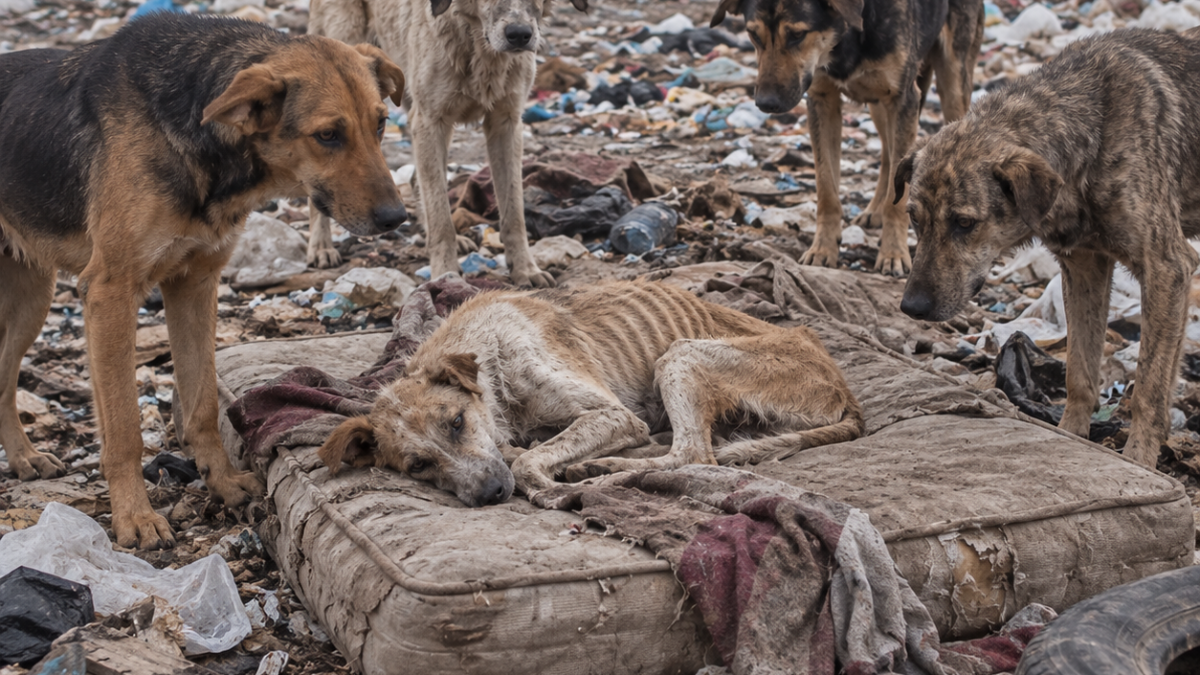
Four starving dogs stood like sentries around a filthy mattress in the middle of the landfill, refusing to abandon the friend who could no longer stand.
When I stepped out of the garbage truck, they didn’t run from me—they cried, backed away from the mattress, and stared at me as if they had been waiting for one human being to finally understand.
But when I knelt beside the fifth dog and saw what he tried to do with his tail, I realized we had arrived at the edge of something none of us would ever forget.
My name is Jackson, and until that morning, I thought I understood the landfill.
I knew its sounds.
The groan of hydraulic lifts.
The metallic crash of discarded appliances.
The low rumble of heavy equipment crawling over mountains of things people no longer wanted.
I knew the smell that settled into your clothes and followed you home.
I knew where the ground turned soft after rain and which piles were unstable.
What I didn’t expect was to find something alive among all that abandonment.
Ray was driving when he suddenly hit the brakes.
“Hold up.”
I grabbed the dashboard.
“What?”
He didn’t answer.
He was staring through the windshield toward a remote section of the dumping ground.
At first, I saw only ripped plastic bags, broken furniture, and a stained mattress lying crooked between two heaps of debris.
Then something moved.
A dog.
Then another.
“Ray…”
“I see them.”
There were four.
Mixed breeds, all painfully thin.
Their coats were tangled with dirt. Their ribs showed clearly beneath their skin. One had a torn ear. Another stood with its head hanging low from exhaustion.
But none of them wandered toward our truck looking for food.
None tried to escape.
They stayed around that mattress.
And on it lay a fifth dog.
He was stretched on his side, almost perfectly still.
My stomach dropped.
“Is he alive?”
Ray leaned forward.
“I don’t know.”
We climbed down.
The moment my boots touched the ground, all four dogs turned toward us.
I expected barking.
Growling.
Maybe panic.
Instead, a sound rose from them that stopped me where I stood.
They whimpered.
Not one dog.
All four.
It was low, broken, almost pleading.
One of them looked toward the mattress and then back at us.
Another took two steps toward me before retreating to the sick dog’s side.
Ray whispered, “They want us to look at him.”
I had the same thought.
We moved slowly.
“Easy,” I said. “We’re not here to hurt anybody.”
The dogs watched every step.
When we got close enough to the mattress, something extraordinary happened.
They moved aside.
Not far.
Just enough.
Almost like they were opening a path.
I knelt.
The dog on the mattress was alive.
Barely.
His ribs and hips pressed sharply against his skin. His paws were filthy. His gums looked pale. Each breath seemed to require a decision.
I reached toward him slowly.
“It’s okay, buddy.”
My fingers touched his forehead.
He trembled.
Then one eye opened.
He looked directly at me.
I’ll never forget that look.
There was no strength left in his body, but somewhere inside him, there was still a little bit of trust.
“Hey,” I whispered. “There you are.”
His eye remained on me.
Then his back leg shifted.
For a second I thought he was trying to stand.
He wasn’t.
His tail moved.
Maybe an inch.
Then stopped.
He had tried to wag it.
I swallowed hard.
Behind me, Ray was already reaching for his phone.
“I’m calling the veterinary clinic.”
The four other dogs tightened around us as he spoke.
One rested its chin on the edge of the mattress.
Another gently sniffed the sick dog’s face.
They were starving too.
They were exhausted too.
But somehow, they had stayed.
Somehow, in a place where everything had been thrown away, these dogs had refused to throw away one another.
Ray ended the call.
His face had changed.
“The clinic will take him immediately.”
“Good.”
“There’s a problem.”
I looked up.
“The road’s too rough for their vehicle. They can’t get out here.”
I looked at the dog beneath my hand.
Then at the distance between us and our truck.
We couldn’t leave him.
We couldn’t drag him.
And judging by the way he reacted when he breathed too deeply, even lifting him wrong could cause more pain.
The four dogs stared at me.
Waiting.
Trusting.
Ray looked around at the broken furniture and scattered debris.
“We’re going to have to carry him ourselves.”
I nodded.
Then I noticed one of the other dogs move closer to the mattress and press its body against its sick friend.
And that was when I made a promise I had no idea would soon become much bigger than one dying dog.
“We’re getting every one of you out of here.”
PART 2
Ray heard me.
He looked at the four dogs gathered around the mattress, then back at our truck.
“All five?”
“All five.”
He rubbed a hand over his face.
Our collection route was already behind schedule. The truck wasn’t designed to transport animals, and the landfill supervisor was expecting us on the other side of the property within twenty minutes.
None of that mattered anymore.
Ray gave one short nod.
“All right. We start with him.”
The veterinary clinic had told us the most important thing was to keep the sick dog as level and stable as possible.
We searched the debris around us for something we could use as a stretcher.
I found a thick piece of canvas caught beneath a broken wooden frame.
Ray pulled it free.
It was filthy, but solid.
We spread it beside the mattress.
The dogs watched closely.
The largest of the four, a black-and-tan male with one white paw, stepped between Ray and the sick dog.
He didn’t growl.
He simply stood there.
Protecting him.
Ray stopped.
“Easy, big guy.”
The dog stared at him.
I crouched several feet away.
“We’re helping him. That’s all.”
The dog glanced toward me.
Then toward his friend.
For several seconds, nobody moved.
Finally, he stepped aside.
“Thank you,” I whispered.
We slid our hands beneath the sick dog as carefully as we could.
The second I felt his weight—or rather the lack of it—something twisted inside my chest.
He should have been forty or fifty pounds.
He felt like half that.
When we lifted him, he released a weak whine.
Immediately all four dogs crowded forward.
“It’s okay,” I said quickly. “It’s okay.”
We lowered him onto the canvas.
One of the smaller females began licking his muzzle.
He opened his eyes.
She stopped whining.
Then Ray and I each took two corners of the canvas.
We lifted.
The route back to the truck couldn’t have been more than a few hundred yards.
That morning it felt like several miles.
Every step mattered.
The ground shifted under our boots.
Broken glass, chunks of wood, pieces of metal and old household trash covered the path.
The sick dog whimpered whenever the canvas swayed.
“Slow,” I kept saying.
“I’m slow.”
“Slower.”
“I’m practically not moving.”
The four dogs followed us.
They stayed so close that twice I had to warn them away from our feet.
Whenever the sick dog made a sound, they became anxious.
The black-and-tan male rushed alongside the canvas and sniffed him.
The smaller female whined.
I had never seen anything like it.
They were not simply a group of strays occupying the same place.
They behaved like a family.
When we finally reached the truck, Ray lowered his side first.
I opened the rear cab door.
There wasn’t much room.
“We can fit him,” Ray said. “Not all of them.”
I looked back.
The four dogs stood several yards away.
They seemed to understand.
My stomach tightened.
“I hate this.”
“We’ll come back.”
“What if they leave?”
“They haven’t left him yet.”
That was true.
I crouched beside them.
“We have to take your friend first.”
The dogs stared at me.
I felt ridiculous explaining a plan to animals, but I kept talking.
“We’re coming back.”
The little female tilted her head.
“I promise.”
Ray and I lifted the canvas onto the rear seat.
I climbed in beside the sick dog.
Before Ray closed the door, I looked back one more time.
The four dogs were standing together beside the abandoned mattress.
Watching.
Then we drove away.
For the first few minutes, the sick dog shook continuously.
I kept one hand on his shoulder.
“You’re okay.”
The garbage truck bounced over the rough road.
Each jolt made me tense.
“Take it easy, Ray.”
“I’m trying.”
“You hit another hole like that and I’m going to crawl up there and drive.”
“You’ve seen this road.”
“I know.”
Then, more softly, Ray said, “How’s he doing?”
I looked down.
The dog’s eyes were half open.
“Still with us.”
“Good.”
We reached pavement.
The ride became smoother.
After several minutes, the trembling eased.
I stroked the side of his face.
“You’ve got four friends waiting for you, buddy. You better not quit.”
His eyes opened.
“That’s right.”
His head moved slightly.
Then he lowered it against my leg.
I didn’t move again until we reached the clinic.
The staff were waiting outside.
A veterinarian named Dr. Elena Morales came through the door with two technicians and a rolling stretcher.
“What happened?”
“Found him at the landfill.”
She looked down at him and her expression sharpened.
“How long was he down?”
“No idea.”
“Any vomiting? Seizure activity?”
“We just found him.”
They transferred him immediately.
As the stretcher disappeared through the clinic doors, I started to follow.
Dr. Morales turned.
“Are you the owner?”
“No.”
“Do you know the owner?”
“No.”
She glanced through the glass at the dog.
“All right. We’re treating him as an emergency stray. We’ll stabilize him first.”
“Is he going to live?”
Her face told me she wasn’t going to give me false hope.
“He is critically dehydrated and severely underweight. His temperature is low. We need bloodwork and imaging. Right now I can tell you he needs fluid therapy, nutrition, warmth and time.”
“But he has a chance?”
“He got here alive.”
It wasn’t the answer I wanted.
It was the only honest answer she could give.
Then I remembered the others.
“There are four more.”
Her eyebrows rose.
“Where?”
“Landfill.”
“In the same condition?”
“Thin, but walking.”
“Bring them.”
“We’re going back now.”
She touched my arm before I turned.
“And Jackson?”
I hadn’t told her my name.
One of the technicians must have read it from my work shirt.
“Yes?”
“You did the right thing.”
That nearly broke me.
I nodded because I didn’t trust my voice.
Ray was already in the truck.
“Well?”
“Critical.”
His hands tightened around the steering wheel.
“But?”
“He has a chance.”
Ray started the engine.
“Then let’s get his family.”
We drove faster going back.
Our supervisor called before we reached the landfill entrance.
Ray looked at the phone vibrating in the cup holder.
“That’ll be Mr. Harmon.”
“Answer it.”
“You answer it.”
“You’re driving.”
He put it on speaker.
“Ray? Where are you two?”
Ray glanced at me.
“At the veterinary clinic.”
Silence.
Then our supervisor said, “Why?”
“We found five starving dogs.”
Another silence.
“You did what?”
“One was dying.”
“Ray, you are operating a municipal waste vehicle.”
“We know.”
“You left your route?”
I leaned toward the phone.
“Mr. Harmon, we found a dog that couldn’t stand.”
“Jackson?”
“Yes.”
“You’re with him?”
“Yes.”
He sighed.
I expected anger.
Instead, he said, “Where are the other four?”
“Still at the landfill. We’re going back.”
“You have fifteen minutes until I have to explain why your truck disappeared.”
“We’ll be there.”
“No. Listen to me. I’ll send Ellis with the maintenance pickup. It has more room. Meet him at the south access lane.”
Ray and I looked at each other.
“Seriously?” I asked.
Mr. Harmon grunted.
“I’m not having four dogs riding in the garbage truck. And don’t make me regret helping you.”
The line went dead.
Ray smiled for the first time that morning.
“I always liked that man.”
“You complain about him every Tuesday.”
“I’ve changed.”
When we reached the mattress, the four dogs were still there.
Exactly where we had left them.
The moment they saw our truck, all four stood.
Then their tails began moving.
The little female ran several steps toward us before stopping.
The black-and-tan male followed.
Their cries sounded different this time.
Higher.
Almost excited.
“They waited,” Ray said.
“Of course they did.”
I stepped out.
“We told you we’d come back.”
The female rushed toward me.
She stopped inches from my boots.
Then slowly, carefully, she pressed her forehead against my leg.
I felt my throat tighten.
“You’re welcome.”
Ellis arrived in the maintenance pickup with Mr. Harmon himself.
My supervisor climbed out carrying two leashes, a plastic bowl and a bag of dog food.
I stared at him.
“What?”
“Nothing.”
“You expected me to show up empty-handed?”
“Kind of.”
“Get to work, Jackson.”
We gave the dogs only small amounts of food because Dr. Morales had warned us not to let severely starved animals gorge themselves.
That was difficult.
They attacked the first portions so desperately that I had to pull the bowls away.
“Easy.”
The black-and-tan dog licked the empty plastic.
“There’s more coming. I promise.”
The word promise had already started to mean something different that day.
We loaded them into the maintenance truck.
To my surprise, they did not fight us.
The little female climbed in first.
The others followed her.
Mr. Harmon watched them settle together.
“You sure they’re strays?”
“Look around.”
He stared toward the mattress.
“People dump animals out here.”
His voice changed when he said it.
Not surprise.
Anger.
“Sometimes.”
“You knew?”
“We find them occasionally. Usually one dog. Maybe puppies.”
“Five?”
“Never five together.”
He looked toward the distant security pole near the service road.
Then he frowned.
“What?”
Mr. Harmon kept staring.
“There’s a camera near the west gate.”
“So?”
“If someone brought these dogs through a vehicle entrance…”
My eyes followed his.
“You might have them on video.”
“Maybe.”
That thought lodged in my mind.
But first we had to save the dogs.
At the clinic, the reunion happened before anyone expected it.
The four dogs had barely entered the treatment area when the little female began pulling toward a closed door.
She could smell him.
A technician tried to guide her away.
She cried.
Inside the room, we heard movement.
Then a weak whine.
Dr. Morales looked at us.
“Let them see each other.”
The door opened.
The sick dog was lying beneath a warming blanket with an IV line in his front leg.
He lifted his head.
For the first time since we found him, he lifted it on his own.
The little female immediately lowered herself beside him.
The black-and-tan dog sniffed his ear.
The other two crowded near his bed.
And the sick dog’s tail moved.
Not much.
But this time, it really moved.
Back and forth.
Once.
Twice.
Three times.
Ray looked away.
I knew why.
I was doing everything I could not to cry too.
Dr. Morales didn’t bother pretending she wasn’t affected.
“They’re bonded.”
“That’s what we thought.”
“No,” she said. “I mean intensely bonded. They’re regulating around him. Look at them.”
The sick dog had stopped trembling.
His breathing had slowed.
One of his companions rested a paw against the edge of his blanket.
Dr. Morales shook her head.
“We’ll keep them where they can see one another.”
That night, I went home several hours later than usual.
My wife, Emily, met me at the kitchen door.
She stared at my clothes.
“You smell worse than normal.”
“Thank you.”
“I mean significantly worse.”
“I’ve been carrying dogs through a landfill.”
She blinked.
“What?”
I told her everything.
By the time I reached the part about the sick dog trying to wag his tail, Emily had tears in her eyes.
“You’re going back tomorrow.”
It wasn’t a question.
“Yes.”
“Take these.”
She opened the pantry and started filling a grocery bag.
“Blankets, towels…”
“I think the clinic has those.”
“They can have more.”
The next morning I arrived before my shift.
Dr. Morales was checking his chart.
“How is he?”
She smiled slightly.
“Better than yesterday.”
The relief hit me physically.
His bloodwork showed severe malnutrition and dehydration, but his major organs were still functioning.
He had intestinal parasites.
A skin infection.
Several old wounds.
No microchip.
And no evidence that he had received proper veterinary care anytime recently.
“But nothing we can’t treat?” I asked.
She paused.
“Nothing obvious yet.”
That yet stayed with me.
She pointed toward him.
“We started him on very small, frequent meals. Too much food too quickly can be dangerous after prolonged starvation.”
“Is he eating?”
“He ate four bites this morning.”
“Four?”
“Four is progress.”
I sat beside him.
“Did you hear that? You’re a champion now.”
His eyes opened.
I had started calling him Buddy in my head because I didn’t know what else to call him.
Ray thought the name was too obvious.
Emily loved it.
Dr. Morales said we shouldn’t get attached.
By the third day, everyone at the clinic called him Buddy.
The other four got temporary names too.
The black-and-tan male became Duke.
The small female who never left Buddy’s side became Rosie.
A shaggy brown male with one crooked ear became Rusty.
And the youngest-looking dog, a cream-colored female with enormous dark eyes, became Grace.
I learned their personalities quickly.
Duke watched doors.
Always.
If someone unfamiliar entered, he positioned himself between that person and the others.
Rosie was Buddy’s shadow.
Rusty loved food with an enthusiasm bordering on criminal activity.
Grace was initially afraid of hands.
If someone reached too quickly, she flattened herself against the floor.
That told Dr. Morales more than any scar could.
“Somebody handled her badly,” she said quietly.
I felt anger rise inside me.
“Can you tell how long they were out there?”
“No.”
“What about how they got there?”
“No.”
Mr. Harmon could.
Or at least, the landfill cameras could.
Two days after the rescue, he called Ray and me into the office.
He closed the door.
On his computer screen was security footage.
“Found something.”
I stepped closer.
The timestamp was from six nights before we discovered the dogs.
At 2:13 in the morning, headlights appeared beyond the west service road.
A white cargo van stopped near the unauthorized dumping area.
The footage was grainy.
A man climbed out.
Then another.
They opened the rear doors.
My stomach turned before I saw what happened next.
Dog after dog was pulled out.
Duke first.
Rusty.
Grace.
Rosie.
Then Buddy.
Even on the poor-quality recording, Buddy looked weak.
He stumbled when his feet touched the ground.
One of the men dragged the mattress out of the van.
They threw it down.
Buddy collapsed near it.
The other dogs gathered around him.
One man kicked at the ground near them to drive them away from the van.
Then the doors closed.
The van disappeared.
For several seconds none of us spoke.
Mr. Harmon froze the image where the license plate was partially visible.
“You can’t read all of it.”
“No.”
“But we have vehicle markings.”
There was a faded logo on the rear panel.
Paws & Pines Kennels.
I stared at it.
“You know them?”
“No.”
Ray pulled out his phone.
A few seconds later, his face hardened.
“They’re thirty miles away.”
“What kind of place?”
“Dog breeder and boarding facility.”
My hands clenched.
Mr. Harmon pointed at me.
“Don’t.”
“Don’t what?”
“I know your face, Jackson.”
“I’m just standing here.”
“You are not driving over there.”
“Those dogs were dumped like garbage.”
“And if this video shows what we think it shows, animal control and law enforcement handle it.”
I hated that he was right.
I wanted to confront whoever had done it.
I wanted them to see Buddy unable to lift his head.
I wanted them to see Grace flinch from human hands.
I wanted them to explain why four starving dogs had spent days trying to keep a fifth alive.
Instead, Mr. Harmon copied the footage.
Animal control arrived that afternoon.
Officer Leah Brennan watched the recording three times.
Then she asked for the original file.
“Can you identify the men?” I asked.
“Not yet.”
“The kennel logo is right there.”
“I see it.”
“You’re going there?”
“Yes.”
“Can we come?”
“No.”
“Why?”
“Because you rescued the dogs. That makes you potential witnesses. I need you to stay out of the investigation.”
I knew she was right too.
I was becoming tired of people being right.
“What happens if those men say the dogs weren’t theirs?”
“Then we investigate.”
“What if they say someone stole the van?”
“We investigate.”
“What if—”
“Jackson.”
I stopped.
Officer Brennan’s voice softened.
“I’ve done this for twelve years. I know what you saw.”
She looked toward Buddy’s treatment room.
“And I know what those dogs look like.”
She picked up the video drive.
“Let me do my job.”
So I did.
Or at least I tried.
For the next week, my world became a strange routine.
Garbage route.
Clinic.
Home.
Sleep.
Repeat.
Every day Buddy improved by some tiny amount.
Five bites became half a meal.
Half a meal became a full portion.
He began sitting up.
Then one morning I entered the clinic and found his bed empty.
My heart stopped.
“Where is he?”
A technician looked confused.
“Buddy?”
“Yes.”
“He’s outside.”
“Outside?”
I rushed through the rear door.
Dr. Morales stood in the fenced exercise yard.
Buddy was beside her.
Standing.
His legs shook badly.
He looked impossibly thin.
But he was standing.
I covered my mouth.
Dr. Morales smiled.
“Come here.”
I crouched.
“Buddy.”
His head turned.
His tail started moving.
Then he took one step.
His back legs nearly folded.
Dr. Morales steadied him.
“One at a time.”
He took another.
Then another.
By the fourth step, tears were running down my face.
“Come on, buddy.”
He walked toward me.
Five steps.
Six.
Seven.
Then he reached me and pressed his head against my chest.
I wrapped my arms around him carefully.
“You did it.”
He licked my chin.
It was probably the worst-smelling kiss I had ever received.
I didn’t care.
Behind the fence, Duke began barking.
Rosie jumped against the gate.
Rusty spun in circles.
Grace wagged her entire body.
“Can they come in?” I asked.
Dr. Morales laughed.
“I think we’d better.”
The gate opened.
Chaos.
Rosie reached Buddy first.
She licked his face so vigorously that he nearly lost his balance.
Duke pressed his shoulder against him.
Rusty sniffed him from nose to tail.
Grace bounced around them as if Buddy had returned from war.
Buddy stood in the middle of all four.
His tail never stopped.
That was the moment I knew he would survive.
Not because of bloodwork.
Not because of numbers on a chart.
Because for the first time, he looked like a dog who believed he had a future.
The investigation continued quietly.
Officer Brennan called me four days later.
“We identified the van.”
“Paws & Pines?”
“Yes.”
“And the men?”
“One is the facility owner, Martin Keller.”
I gripped the phone.
“The other?”
“An employee.”
“Why did they dump the dogs?”
“I can’t discuss everything yet.”
“Were the dogs theirs?”
A pause.
“Yes.”
I shut my eyes.
Something about hearing it confirmed made me even angrier.
“So they starved them and dumped them.”
“We are documenting veterinary findings.”
“That’s not an answer.”
“It’s the answer I can legally give you right now.”
“Is Keller being arrested?”
“We’re pursuing the case.”
I hated those words too.
Pursuing the case.
They sounded too calm.
Buddy had nearly died on a mattress surrounded by garbage.
There had been nothing calm about that.
Then Brennan said something that changed my focus.
“We located more animals.”
I straightened.
“What?”
“Jackson, I need you not to repeat this publicly yet.”
“How many?”
“Several.”
“Alive?”
“Yes.”
“Condition?”
“Some need medical attention.”
I sat down.
Paws & Pines advertised itself online as a peaceful country kennel.
The photographs showed green grass, clean runs and smiling dogs.
Customers had left reviews about buying puppies there.
Families had boarded pets there.
Behind that image, according to what investigators later documented, several animals had been kept in conditions nothing like the photographs.
Buddy and the others had not simply wandered away.
They had become inconvenient.
Sick.
Unprofitable.
Disposable.
The thought made me sick.
But Officer Brennan and the county investigators did what Mr. Harmon had told me to let them do.
They built the case.
Veterinary records were collected.
Former workers were interviewed.
Financial records were examined.
The landfill footage was enhanced enough to confirm the vehicle and identify the men.
And perhaps most importantly, the five dogs themselves survived.
Buddy continued gaining weight.
Rosie discovered tennis balls.
Duke discovered that if he stared at Dr. Morales long enough, she would eventually give him a treat.
Rusty discovered every cabinet in the clinic that contained food.
Grace discovered that not every hand reaching toward her meant pain.
That one took longer.
I was sitting on the clinic floor one afternoon when she came near me.
I didn’t reach for her.
I had learned not to.
She sniffed my boots.
Then my knee.
Then she sat.
“Hi, Grace.”
Her ears moved.
I kept my hands on the floor.
“You don’t owe me anything.”
She stared at me.
Slowly, she leaned forward.
Her nose touched my wrist.
I didn’t move.
She sniffed.
Then she placed her chin in my palm.
My eyes burned.
“All right,” I whispered. “We can do it your way.”
From then on, she began approaching people instead of retreating.
It was never instant.
Healing rarely is.
Buddy had setbacks too.
One night the clinic called because he had vomited and developed a fever.
Emily and I drove there after midnight.
Dr. Morales met us in the hallway.
“What happened?”
“Possible secondary infection. We’ve started antibiotics.”
“He was doing so well.”
“He still is.”
“But—”
“Recovery isn’t a straight line, Jackson.”
I looked through the glass.
Buddy lay curled beneath a blanket.
Rosie had been allowed into the room.
She was pressed against his back.
“I thought he was safe.”
“He’s safer than he was.”
“That’s not the same thing.”
“No.”
I sat beside him until almost three in the morning.
At some point Emily put her head on my shoulder.
“You can’t fight his body for him.”
“I know.”
“You’ve already given him the chance.”
“I know.”
But knowing something and accepting it are different things.
Buddy’s fever broke the next morning.
Two days later he was eating again.
A week later he was trotting.
Not walking.
Trotting.
Ray arrived during his lunch break and saw him run across the clinic yard after Rosie.
He stopped cold.
“That’s him?”
“That’s him.”
“No.”
“Yes.”
Ray started laughing.
Buddy ran toward us.
He was still thin, but muscle had begun to return to his legs.
His coat looked cleaner and healthier.
His eyes were completely different.
Bright.
Alert.
Alive.
Ray crouched.
Buddy jumped up and put both paws on his chest.
“Hey!”
Ray nearly fell backward.
I laughed.
“Careful. He almost died. Apparently he intends to kill you now.”
Ray scratched Buddy’s neck.
“I’ll accept it.”
That afternoon Dr. Morales gathered us in her office.
“All five are medically stable.”
I looked from her to the dogs through the window.
“What does that mean?”
“It means we need to start discussing where they go next.”
I had avoided that question.
The clinic couldn’t keep them forever.
A rescue organization had offered to take them.
But there was a problem.
“They want to separate them?” I asked.
“They may need to.”
“No.”
“Jackson—”
“They stayed around him for days.”
“I know.”
“Duke protected him. Rosie wouldn’t leave him. They all waited at that mattress after we drove away.”
“I know.”
“We promised them.”
Dr. Morales folded her hands.
“Finding one home willing to adopt five medium-sized dogs is difficult.”
“Then we find one.”
“What if we can’t?”
“We keep looking.”
Ray leaned back in his chair.
“My apartment doesn’t allow one dog, let alone five.”
I looked at him.
“Useful contribution.”
“I’m establishing facts.”
Emily and I talked that night.
She knew what I was thinking before I said anything.
“No.”
“I haven’t asked.”
“You have a face.”
“What face?”
“The five-dogs face.”
“I don’t have a five-dogs face.”
“You absolutely have a five-dogs face.”
I sat across from her at the kitchen table.
“What if nobody takes them together?”
“We already have two dogs.”
“We have a backyard.”
“We have a normal backyard, Jackson. Not a wildlife preserve.”
“I could build—”
“No.”
I sighed.
She reached across the table and took my hand.
“I love them too.”
“I know.”
“But saving them doesn’t mean we have to be the only people capable of loving them.”
That sentence stayed with me.
So we began looking.
The rescue organization posted their story.
Not all the details because of the pending investigation.
Just the truth that mattered most.
Five dogs had been found abandoned together.
One nearly died.
The others refused to leave him.
They were deeply bonded.
The rescue wanted to keep them together if humanly possible.
Hundreds of people responded.
Many wanted Buddy.
Some offered to adopt Rosie with him.
A few wanted Duke.
Almost nobody could take all five.
Then came a message from a woman named Margaret Ellis.
She lived about forty minutes outside town on six fenced acres.
She had recently lost two elderly rescue dogs.
Her husband had died three years earlier.
She wasn’t looking for one dog.
She wrote:
“If these five survived because they refused to abandon one another, I don’t think their reward should be losing one another now.”
I read that line twice.
Then I sent it to Emily.
She called immediately.
“That’s her.”
“You don’t know that.”
“That’s her.”
The rescue conducted a home visit.
The property had a large fenced yard, shaded areas, a covered porch and an enclosed room attached to the house where the dogs could sleep.
Margaret was sixty-two, retired, calm, experienced with rescue animals and financially capable of caring for five dogs.
When she came to the clinic, she didn’t walk into the room squealing.
She sat on the floor.
She waited.
Duke approached first.
He sniffed her shoulder.
She didn’t touch him.
“Hello, handsome.”
Rosie came next.
Then Rusty.
Grace stayed back.
Buddy watched from beside me.
Margaret looked at him.
“You must be the one who scared everybody.”
Buddy’s tail moved.
She smiled.
“You don’t look so scary now.”
I studied her.
“You understand they may have issues.”
“I would too.”
“Food guarding. Fear. Separation anxiety.”
“I’ve dealt with all three.”
“They need veterinary follow-up.”
“I already spoke to Dr. Morales.”
“Five dogs are expensive.”
She smiled at me.
“Are you interviewing me?”
“Yes.”
“Good.”
Emily nudged me.
Margaret continued.
“My husband used to say nobody should be trusted with an animal if they’re offended by questions.”
I liked her immediately.
Then Grace moved.
Slowly.
One step.
Then another.
She approached Margaret from behind.
Margaret remained still.
Grace sniffed her sleeve.
Then sat beside her.
I looked at Dr. Morales.
She smiled.
A week later, adoption paperwork was nearly complete.
That should have been the end.
It wasn’t.
Officer Brennan called me again.
“Jackson, we have a complication.”
My stomach tightened.
“What?”
“Martin Keller has retained an attorney.”
“So?”
“He is claiming the five dogs were removed from his facility without authorization by the employee seen with him.”
I nearly laughed.
“He’s on the video.”
“Yes.”
“He’s standing beside the van.”
“Yes.”
“He dumped them.”
“That will be addressed.”
“What’s the complication?”
“He is asserting ownership.”
For a moment I genuinely thought I had misunderstood her.
“Ownership?”
“Yes.”
“Of Buddy?”
“All five.”
I stood from my chair.
“He left them to die.”
“I understand.”
“He wants them back?”
“His attorney sent notice contesting their transfer.”
My hands started shaking.
“No.”
“Jackson.”
“No. Absolutely not.”
“They are not being returned today.”
“Or tomorrow.”
“The court will decide custody.”
“They’re going to court over dogs they threw away?”
“In part, yes.”
The anger I had been carrying for weeks suddenly found a target.
Keller wasn’t sorry.
He wasn’t embarrassed.
He wasn’t even willing to disappear.
He wanted control.
Maybe because the criminal investigation had damaged his business.
Maybe because admitting the dogs weren’t his would weaken his defense.
Maybe because some people would rather reclaim something they abused than admit they abandoned it.
Whatever his reason, he had made a mistake.
He had forced everyone to place the evidence in one room.
The hearing occurred at the county courthouse.
I was asked to testify.
So was Ray.
So was Dr. Morales.
So was Mr. Harmon.
Margaret sat behind us.
I remember seeing Keller for the first time outside the courtroom.
He looked ordinary.
That bothered me.
Part of me had expected someone who looked obviously cruel.
Instead, he was a middle-aged man in a clean button-down shirt.
He passed close enough that I could smell his aftershave.
He glanced at me.
“You’re the garbage guy.”
I stopped.
Ray immediately touched my arm.
“Jackson.”
Keller smiled slightly.
“You made quite a story out of this.”
“They were on a mattress in a landfill.”
His attorney stepped closer.
“Mr. Keller, let’s go.”
But Keller looked at me.
“You don’t know what happened.”
I felt every muscle in my body tighten.
“You’re right.”
He seemed surprised.
I continued.
“I only know what I saw.”
His smile disappeared.
“I saw four starving dogs surrounding a fifth dog who was too weak to lift his head.”
“Jackson,” Ray warned.
“I saw him try to wag his tail when I touched him. I saw the others cry when we carried him away. I saw them sitting on that same mattress when we came back.”
Keller’s attorney moved between us.
“That’s enough.”
I looked over his shoulder.
“And then I saw the video.”
Keller looked away.
That was enough for me.
Inside the courtroom, the evidence was far stronger than emotion.
The landfill footage showed Keller at the scene.
The veterinary records documented severe malnutrition.
Dr. Morales described Buddy’s condition when he arrived.
“On a standard nine-point body condition scale,” she explained, “he was dangerously underweight. His dehydration was significant. He had untreated parasitic infection, skin disease and evidence of prolonged nutritional deprivation.”
The county attorney asked, “Could this condition have developed during several days at the landfill?”
“No.”
Keller’s lawyer stood.
“How can you be certain?”
“Because the degree of muscle wasting and overall body condition reflected a longer period of inadequate nutrition and care.”
“Can you tell this court exactly how long?”
“No. Medicine does not allow me to provide an exact number of days from visual assessment alone.”
“So you cannot say whether Mr. Keller caused it.”
“I can say the dog did not become severely emaciated in the short period between the date shown on the landfill video and his examination.”
The attorney sat down.
Ray testified about seeing the dogs.
Then I did.
The county attorney showed a still image from the landfill.
Five dogs.
The mattress.
Garbage all around them.
“That is what you found?”
“Yes.”
“Describe the behavior of the four standing dogs.”
“They wouldn’t leave him.”
“Were they aggressive?”
“No.”
“Did they attempt to escape when you approached?”
“No.”
“What did they do?”
I swallowed.
“They moved aside.”
“Why is that significant to you?”
Keller’s attorney objected.
The judge allowed me to describe what I observed, not interpret the dogs’ thoughts.
So I corrected myself.
“They watched us approach. When we got near the sick dog, they stepped away enough for us to kneel beside him.”
“And after you transported the sick dog?”
“We returned.”
“Where were the other four?”
“On the mattress.”
“Still there?”
“Yes.”
“Approximately how much time had passed?”
“More than an hour.”
“Did they appear to recognize your vehicle?”
“They stood up and came toward us.”
Then the video played.
No interpretation was necessary.
Everyone watched Keller’s van stop.
Everyone watched the doors open.
Everyone watched the dogs come out.
Everyone watched Buddy collapse.
Everyone watched the mattress being unloaded.
Everyone watched the van leave without them.
Keller stared at the table.
His attorney argued that an employee had made decisions about the dogs and that Keller’s presence did not prove intent to abandon them permanently.
Then Officer Brennan testified.
A warrant search of Paws & Pines had uncovered veterinary and internal business records.
Buddy had previously been listed under another name.
So had Duke, Rosie, Rusty and Grace.
They belonged to the kennel.
More importantly, investigators had recovered messages discussing several dogs described as “loss animals”—animals costing the business money without generating revenue.
One message mentioned “clearing the five.”
Another referred to avoiding veterinary expenses for “the sick tan male.”
Buddy.
Keller’s attorney objected to interpretations of the language.
The judge read the documents himself.
The hearing lasted hours.
When the judge finally ruled on temporary custody, I barely breathed.
He found that sufficient evidence existed that the dogs had been abandoned and neglected and ordered that they remain in protective custody pending final disposition.
They were not going back.
Margaret covered her mouth.
Ray squeezed my shoulder.
I looked toward Keller.
For the first time since seeing him, he looked afraid.
Not because I had threatened him.
Not because anyone had taken revenge on him.
Because facts had finally surrounded him the same way those four dogs had once surrounded Buddy.
And there was nowhere left for him to hide.
The criminal case continued afterward.
Other animals seized from the kennel were placed with rescue organizations.
Several former employees cooperated with investigators.
Paws & Pines lost the licenses necessary to continue its operation.
Keller eventually faced animal cruelty and abandonment charges connected to multiple dogs, including the five we had found.
I wasn’t present for every legal proceeding.
I didn’t need to be.
The outcome that mattered most was waiting outside the courthouse on the day Margaret received final approval to adopt all five.
She brought a large SUV.
Inside were five new beds.
Five collars.
Five water bowls.
A ridiculous number of toys.
“You’re spoiling them,” I said.
“That is the plan.”
Buddy had gained nearly twenty pounds.
His coat had filled in.
His legs were strong.
Rosie looked like a completely different dog.
Rusty had discovered that humans sometimes carried sandwiches and therefore regarded every person as a potential business opportunity.
Duke remained protective, but now he spent more time guarding couches than dying friends.
Grace had become the biggest surprise.
She walked directly toward Margaret that morning and allowed a collar to be placed around her neck.
No shrinking.
No flinch.
Just trust.
Dr. Morales signed the final medical papers.
“All cleared.”
Margaret looked at the dogs.
“Ready to go home?”
Rusty barked.
Ray laughed.
“That one definitely is.”
We walked them outside together.
Buddy stopped halfway across the parking lot.
He turned back.
Toward me.
I crouched.
“Go on.”
He came closer instead.
His nose touched my chin.
Then he leaned his full weight into me.
I wrapped my arms around him.
For several seconds, the world around me disappeared.
I saw the mattress again.
The garbage.
The bones beneath his skin.
That weak eye opening.
That tiny attempted wag.
“You made it,” I whispered into his fur.
His tail beat against my leg.
“You actually made it.”
Rosie came over.
Then Grace.
Rusty.
Finally Duke.
Suddenly I was surrounded by all five.
Ray said, “Well, this looks familiar.”
I laughed through my tears.
Except it wasn’t familiar.
Not really.
The first time I had seen them gathered in a circle, they had been protecting a friend they thought they might lose.
Now they were crowding around me because they were excited.
Healthy.
Safe.
Loved.
Margaret opened the vehicle door.
Buddy looked at me once more.
“Go.”
He climbed inside.
Rosie followed.
Then Rusty.
Grace.
Duke was last.
Of course he was.
He stood outside for a moment, checking that everyone else had entered.
Then he jumped in.
The protector.
Still doing his job.
Margaret drove them home.
Emily and I visited the following weekend.
Her property was even better with dogs in it.
Rusty sprinted across the yard carrying a yellow ball.
Grace chased him.
Rosie and Buddy rolled in the grass.
Duke lay beneath a tree where he could see the gate, the house and every member of his little family.
Margaret brought coffee onto the porch.
“I haven’t slept past six in the morning since they arrived.”
“Regrets?”
She looked offended.
“Absolutely none.”
Buddy came up the steps.
He looked heavier already.
Margaret scratched beneath his collar.
“He sleeps beside my bed.”
“Rosie too?”
“Rosie sleeps on my bed.”
Emily laughed.
“I knew it.”
“Duke sleeps in the hallway because apparently I need overnight security. Rusty sleeps wherever he thinks breakfast will appear first. Grace has claimed the armchair.”
I watched them.
Five dogs.
Same family.
Different life.
“What about Buddy?” I asked.
Margaret looked at him.
“He wakes up sometimes.”
“Nightmares?”
“Maybe.”
My chest tightened.
“What does he do?”
“He walks around and checks the others.”
I looked at her.
“All of them?”
“Every one.”
Of course he did.
The dog they had guarded now guarded them.
Months passed.
The court case made local news for a while.
I was interviewed once and hated every second of it.
People called Ray and me heroes.
Neither of us liked the word.
We had stopped a truck.
That was all.
We saw suffering and stopped.
The dogs had done the difficult part.
They had survived long enough for someone to notice.
The final criminal resolution came almost a year after we found them.
Keller was convicted on multiple animal neglect-related counts and received penalties that included restrictions preventing him from operating an animal business again, along with the other consequences imposed by the court.
Some people asked me whether I felt satisfied.
I did.
But not for the reason they expected.
Seeing a man punished didn’t erase what Buddy experienced.
It didn’t erase Grace’s fear.
It didn’t put food into their stomachs during the weeks they had gone hungry.
Justice could close a kennel.
It could impose penalties.
It could create a record that said what happened was wrong.
But it couldn’t rewrite those nights.
The satisfying part came somewhere else.
It came when I watched Buddy run.
That was his revenge.
It came when Grace fell asleep with her belly exposed in Margaret’s living room because she finally felt safe enough to be vulnerable.
That was hers.
It came when Rusty became too heavy because Margaret had to be reminded that “one little piece of chicken” counted even when given repeatedly.
That was his.
It came when Rosie climbed into bed every night beside the dog she once guarded on a filthy mattress.
That was hers.
And Duke?
Duke remained Duke.
Watchful.
Loyal.
Serious.
But his ribs disappeared beneath healthy muscle.
His coat became glossy.
His old wounds healed.
And sometimes, when he forgot he was supposed to be the responsible one, he chased butterflies through Margaret’s field like a puppy.
That was his revenge too.
A year after the rescue, Mr. Harmon asked us to meet him near the south access road.
I arrived with Ray.
“What are we doing?”
“You’ll see.”
He drove us toward the area where we had found the dogs.
The landfill never really stays the same.
Trash is moved.
Ground is covered.
Roads shift.
What had been a mountain one season became flattened earth the next.
The mattress was long gone.
The exact place was almost impossible to identify.
Mr. Harmon stopped beside a newly installed security pole.
“We’ve added cameras along every unauthorized dumping lane.”
Ray looked upward.
“Because of the dogs?”
“Partly.”
There were also new signs informing people that abandoning animals was illegal and monitored.
Mr. Harmon put his hands on his hips.
“We’ve partnered with county animal control. Workers now have a protocol. Any animal found here gets reported immediately.”
I stared across the landfill.
“You did all this?”
“We did.”
He looked embarrassed by the compliment.
Then he added, “And before you say something emotional, don’t.”
“I wasn’t.”
“You were.”
Ray laughed.
A vehicle appeared on the access road.
Margaret’s SUV.
All five dogs were inside.
She had arranged it with Mr. Harmon.
When she opened the rear door, Buddy jumped out.
Then Rosie.
Rusty.
Grace.
Duke.
They were leashed, of course.
Even so, seeing them standing there nearly knocked the breath from me.
Buddy looked around.
Did he remember?
I don’t know.
People like to imagine dogs remember locations exactly as we do.
Maybe he smelled something.
Maybe he recognized the sounds.
Maybe it meant nothing.
But his body changed.
He became still.
Rosie moved close beside him.
Duke watched.
Grace leaned against Margaret.
I crouched.
“It’s okay, buddy.”
Buddy looked at me.
Then something happened that I will carry with me for the rest of my life.
He walked toward me.
Not cautiously.
Not weakly.
He pulled Margaret forward until he reached me.
Then he rose onto his hind legs and put his front paws against my chest.
The first morning, he couldn’t lift his head.
Now he nearly knocked me over.
I laughed.
“All right. All right.”
His tail whipped back and forth.
Ray scratched Rosie behind the ears.
Mr. Harmon pretended something had flown into his eye.
Margaret smiled.
“We don’t have to stay.”
“No,” I said. “Let’s go somewhere better.”
So we did.
We drove to a small park several miles away.
Margaret released the dogs inside a fenced field.
Buddy exploded into a run.
All five followed.
They raced in one wide circle across the grass.
Rosie caught him.
Rusty tried to catch Rosie.
Grace cut across the middle.
Duke chased everybody.
Ray and I stood by the fence.
“Remember when he couldn’t move?” Ray asked.
“Every day.”
Buddy turned.
He ran toward us.
At the last second he veered away, kicking grass behind him.
Ray laughed.
“That dog has become a menace.”
“The clinic created a monster.”
But I thought about what Dr. Morales had told me during Buddy’s worst night.
Recovery isn’t a straight line.
She had been talking about his body.
I think it applies to more than that.
There were days when I remained angry.
Days when the memory of that video came back to me.
Days when I thought about how easy it would have been for Ray not to see those dogs from the truck.
What if he had been looking at the road?
What if we had been assigned another route?
What if we had arrived one day later?
I asked Dr. Morales once how much longer Buddy might have survived without treatment.
She refused to give me an exact answer.
“Not long,” was all she said.
That was enough.
For a while, that knowledge haunted me.
Then I started thinking about something else.
Four starving dogs had been facing the same reality.
They had no clinic.
No food supply.
No phones.
No way to ask for help.
They could have left.
Maybe they could have searched farther for food.
Maybe they could have followed a road toward people.
Instead, they stayed with Buddy.
I don’t know whether dogs understand death the way we do.
I don’t know what they thought while lying beside that mattress at night.
I don’t know whether Duke believed he was protecting Buddy from danger.
I don’t know whether Rosie understood that Buddy was sick.
I only know what I saw.
They stayed.
When we approached, they called to us.
When we touched their friend, they watched.
When we carried him away, they cried.
When we returned, they were waiting.
And when Buddy finally stood again, they celebrated with him.
People sometimes talk about loyalty as if it requires speeches.
It doesn’t.
Sometimes loyalty is simply refusing to walk away.
Two years after the rescue, Margaret invited us to Buddy’s “found day.”
She didn’t know his birthday, so the day we found him became the day she celebrated.
There were five ridiculous dog-safe cupcakes.
“Five?” I asked.
“I’m not starting a riot.”
Rusty was staring at the table with religious devotion.
Emily laughed.
“He would absolutely start a riot.”
We gathered in Margaret’s yard.
Dr. Morales came.
Officer Brennan came.
Mr. Harmon came.
Ray brought his kids.
The five dogs tore around the yard while the adults talked.
At one point Brennan stood beside me.
“You know Keller tried to appeal some of the restrictions.”
“What happened?”
“They remained in place.”
“Good.”
She nodded toward Buddy.
“You still angry?”
I thought about it.
“Sometimes.”
“That’s normal.”
“I thought seeing Keller punished would make the anger disappear.”
“It usually doesn’t.”
“What does?”
She watched Buddy tackle Rusty into the grass.
“Maybe that.”
I smiled.
“Yeah.”
That.
People sometimes imagine revenge as making someone suffer because they caused suffering.
I don’t anymore.
Keller threw those dogs away because, to him, they had stopped having value.
Every healthy day they lived afterward proved him wrong.
Every veterinarian bill someone willingly paid for them proved him wrong.
Every toy scattered across Margaret’s house proved him wrong.
Every photograph on her refrigerator proved him wrong.
Every time Grace approached a stranger instead of hiding, the past lost a little more power over her.
Every time Buddy ran until his tongue hung from his mouth, the mattress became farther away.
That was enough for me.
At sunset, Margaret brought out an old photograph.
One of the clinic technicians had taken it shortly after all five dogs arrived.
Buddy lay under a blanket.
Rosie was beside him.
Duke stood behind them.
Rusty and Grace were curled on the floor.
They looked exhausted.
Broken.
Yet together.
Margaret held the photograph beside another one taken the previous week.
In the new picture, the same five dogs sat on her porch.
Healthy.
Bright-eyed.
Their coats shone in the sunlight.
Buddy sat in the center.
“You should keep these,” she said.
I shook my head.
“They belong here.”
“I made copies.”
“Of course you did.”
She handed me an envelope.
I took it home.
Those photographs still sit on a shelf in our living room.
Visitors sometimes ask about them.
I tell the story.
But I always correct one part when people say it.
“You rescued five dogs.”
No.
We helped them.
There is a difference.
Before any human came along, four dogs had already been doing everything they knew how to do.
They protected Buddy.
They kept him warm.
They stayed beside him.
Maybe their presence was the reason he kept fighting.
Maybe when he opened his eyes during those terrible days, he saw Rosie beside him.
Maybe he smelled Duke nearby.
Maybe that told him he wasn’t alone.
I will never know.
But I know this:
By the time we arrived, the rescue had already started.
We were just the next part of it.
Years have passed now.
I still work around waste trucks.
Ray still works with me.
We’re older.
The landfill has changed.
There are more cameras.
Better animal-response procedures.
And every worker knows the story of the five dogs.
New employees hear it during safety orientation.
Mr. Harmon pretends that wasn’t his idea.
It absolutely was.
Margaret sends photographs constantly.
Rusty eventually slowed down, though he never lost his obsession with food.
Grace became surprisingly confident.
Duke developed gray around his muzzle but remained the self-appointed guardian of the property.
Rosie still followed Buddy.
And Buddy?
Buddy became the dog who greeted everyone.
The dog who had once been too weak to lift his head became the one who ran toward the gate whenever visitors arrived.
He loved people.
That amazed me more than anything.
After everything humans had done to him, he still chose trust.
On one of my last visits, I sat on Margaret’s porch near sunset.
Buddy was older by then.
So was I.
He lay beside my chair.
Rosie slept a few feet away.
Duke was under his tree.
Rusty was dreaming near the kitchen door.
Grace was curled beside Margaret.
The evening was quiet.
I reached down and rested my hand on Buddy’s head.
His eyes opened.
“Remember me?”
His tail thumped once against the porch.
I laughed.
“I guess you do.”
Margaret looked over.
“He always knows when you’re coming.”
“How?”
“The truck.”
“My car doesn’t sound like the garbage truck.”
“No. But you do.”
“What does that even mean?”
She smiled.
“I don’t know. Ask him.”
Buddy lifted his head.
Then, exactly as he had done on that terrible morning so many years before, he looked straight into my eyes.
Except everything else had changed.
There were no garbage mountains behind him.
No stained mattress.
No exposed ribs.
No trembling body.
No desperate friends begging strangers to help.
There was grass.
A porch.
A warm house.
Food bowls inside.
Five beds even though at least three of the dogs preferred furniture.
There was safety.
There was family.
There was home.
Buddy’s tail began moving.
Strongly this time.
Back and forth against the wooden boards.
I looked toward the yard where the light was turning gold.
“You know,” I said, “the first thing you ever did when I touched you was try to wag that tail.”
Margaret looked at me.
“He did?”
“He couldn’t do it.”
Buddy leaned against my leg.
I scratched behind his ears.
“But he tried.”
That was the part I never forgot.
Not the landfill.
Not Keller.
Not the courthouse.
Not even the moment Buddy first walked again.
The thing that stayed with me was that tiny movement from a dog whose body had almost nothing left.
He was starving.
Dehydrated.
Weak.
Sick.
Abandoned.
And surrounded by four equally hungry companions who had every reason to save themselves.
Yet they stayed.
And when a stranger touched his head, Buddy tried to wag his tail.
Hope sometimes looks like that.
Not victory.
Not certainty.
Not some grand miracle.
Sometimes hope is a movement so small that almost nobody would notice it.
A tail trying to move.
Four dogs refusing to leave.
A garbage truck stopping when it could have continued.
A man saying, “We’ll come back.”
A veterinarian saying, “Four bites is progress.”
A frightened dog placing her chin into an open hand.
A woman looking at five animals everyone expected her to separate and saying, “They’re coming home together.”
Those moments changed everything.
People still occasionally ask me what lesson I learned that morning.
For years I gave different answers.
Loyalty.
Compassion.
Responsibility.
Justice.
All of them are true.
But now I think the answer is simpler.
Pay attention.
Most of us pass suffering more often than we realize.
Sometimes we’re busy.
Sometimes we assume someone else will help.
Sometimes the problem seems too complicated.
That morning, Ray saw movement beside a mattress.
He stopped.
Because he stopped, I saw the dogs.
Because we saw the dogs, Buddy reached a clinic.
Because Buddy reached a clinic, investigators eventually saw the evidence.
Because people kept paying attention, more animals were removed from danger.
Because a rescue organization paid attention to the bond between five dogs, they weren’t casually separated.
Because Margaret paid attention, they found a home together.
A whole chain of events began with a truck slowing down.
I don’t believe we can fix everything.
I’ve worked around discarded things most of my adult life.
I know how much gets thrown away.
I know how easily people decide something—or someone—has become inconvenient.
But I also know what can happen when one person refuses to treat a living creature as disposable.
Keller left five dogs beside a mountain of garbage because he apparently believed nobody would care enough to stop.
He was wrong.
Ray stopped.
I got out.
Mr. Harmon sent another truck.
Dr. Morales opened her clinic.
Officer Brennan followed the evidence.
Margaret opened her home.
And four starving dogs had already opened the way for all of us by refusing to abandon the fifth.
That is why, when people ask me whether the story had a happy ending, I tell them no.
It had something better.
It had a complete ending.
The sick dog survived.
His friends survived.
They stayed together.
The people responsible were forced to answer for what happened.
The kennel could no longer continue treating animals that way.
Other dogs were removed from danger.
And five animals once considered disposable grew old in a home where someone knew each of their habits, fears, favorite sleeping places and preferred treats.
Buddy never returned to that mattress.
Rosie never had to guard his dying body again.
Duke never had to decide whether a stranger was coming to hurt his family.
Grace learned that hands could comfort.
Rusty learned that refrigerators were basically sacred objects.
They got years.
That was the victory.
Years of grass beneath their paws.
Years of running.
Years of warm nights.
Years of barking at delivery drivers.
Years of stealing blankets.
Years of veterinary appointments.
Years of muddy footprints.
Years of sleeping together.
Years of being wanted.
I once watched somebody throw them away.
Then I watched life give them back everything that abandonment tried to take.
And if you want to know what real revenge looks like, I can tell you.
It looks like Buddy racing across Margaret’s yard on legs that once couldn’t hold him.
It looks like Rosie chasing him.
It looks like Rusty running behind them.
It looks like Grace no longer flinching.
It looks like Duke standing in the sunshine, watching his entire family come home.
It looks like five wagging tails.
It looks like a full food bowl.
It looks like an unlocked door leading into a warm house.
It looks like surviving long enough to discover that the worst day of your life was not the last chapter.
My name is Jackson.
I was there when four starving dogs stood around their dying friend on an abandoned mattress in the middle of a landfill.
I was there when Buddy could barely open his eyes.
I was there when he tried to wag his tail.
And years later, I was sitting beside him when that same tail thumped happily against the porch of the home he shared with every friend who had refused to leave him behind.
I lowered my hand onto his head.
Buddy closed his eyes.
Around us, the other four slept peacefully.
Nobody was guarding anybody anymore.
They didn’t have to.
They were home.








