PART 2: Four Families Returned Him to the Shelter—Then Oscar Sat on a Stranger’s Feet and Refused to Move
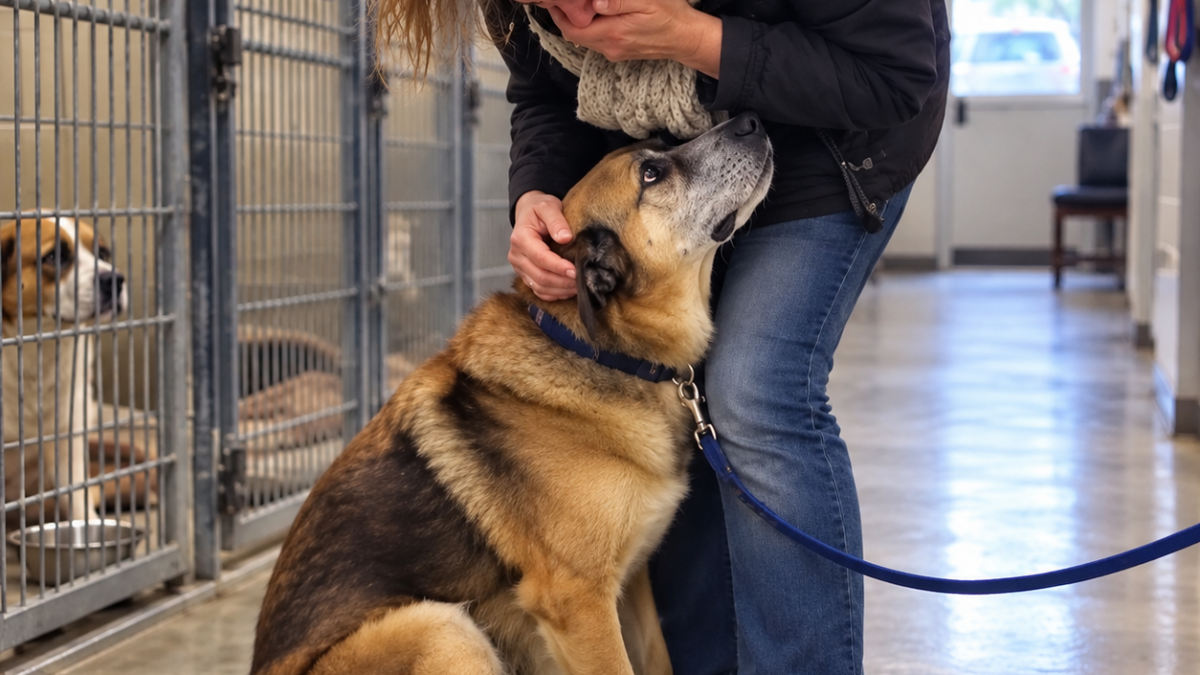
The first time I watched Oscar come back through our shelter doors, he was still wearing the blue bandana his new family had tied around his neck.
By the fourth return, he no longer ran to the gate when cars pulled into the parking lot.
And the morning he finally chose someone for himself, none of us understood why he planted his body on a stranger’s shoes and refused to move.
“Come on, Oscar. Walk with me.”
I held the red leash toward him through the open kennel door, but he did not lift his head.
He was six years old then, a broad-chested mixed-breed dog with caramel fur, a white patch under his throat, and eyes that used to brighten whenever a human said his name.
Used to.
That morning, he stayed curled against the back wall with his muzzle between his paws.
I knew he could hear me.
Oscar heard everything.
The rattle of food bowls two rooms away. The click of the front gate. The low rumble of a car slowing on the gravel outside.
And he knew what the red leash meant.
A visitor.
A walk.
A soft voice saying, “What a good boy.”
Maybe a hand scratching his chest.
Then, eventually, the kennel door closing again.
Oscar had learned a lesson no dog should ever have to learn.
Sometimes “forever” lasts three weeks.
Sometimes it lasts ten days.
And sometimes a person cries while handing your leash back, as if their sadness somehow explains why you are the one being left behind.
I had met Oscar almost two years earlier, after a road worker found him wandering beside a rural highway outside town.
He was underweight, filthy, and wearing an old leather collar with no tag.
No microchip.
No missing-dog report.
No one came looking.
But Oscar did not act like a dog who had given up on people.
The opposite.
He loved us immediately.
Too immediately, maybe.
If I stepped into his kennel, he pressed his whole body against my legs.
If I sat on the floor, he rested his chin on my knee.
If I left, he waited by the gate and stared after me.
Whenever a visitor stopped in front of him, Oscar’s tail hit the wall hard enough to make the metal panel shake.
The first family who chose him was a married couple in their fifties.
They spent nearly an hour with him in our meeting room.
The wife rubbed his chest.
The husband laughed when Oscar rolled onto his back.
“This one,” he said. “He’s ours.”
I remember how quickly Oscar trusted them.
That should have made me happy.
Instead, some small part of me worried.
Oscar gave his heart away like he had an unlimited supply.
On adoption day, I packed his old rope toy, a blanket, two days of food, and the medication he was finishing for a minor skin irritation.
He jumped into their car without hesitation.
He never looked back at me.
And I was glad.
That was how it was supposed to happen.
Three days later, the wife emailed me a photo of Oscar asleep on a thick rug in their living room.
Behind him was a new dog bed.
Beside him sat a stainless-steel bowl with his name written on it.
“He follows us everywhere,” she wrote. “We adore him.”
Then Monday came.
They both went to work.
Oscar watched the front door close.
And something inside him broke open.
He did not chew furniture.
He did not tear up pillows.
He did not urinate on the floor.
He sat by the door and cried.
For hours.
The neighbors complained.
The couple tried leaving the television on.
They tried a stuffed toy.
They tried closing him in the kitchen.
Nothing touched the panic that seized him when he realized he was alone.
Every evening, when they returned, Oscar threw himself against their legs so desperately that the wife told me it felt less like a greeting and more like a rescue.
After three weeks, my phone rang.
I recognized the number.
I remember staring at the screen before I answered.
“We’re bringing him back,” the husband said quietly.
A few hours later, their car rolled through our gate.
Oscar stood in the back seat wearing the same blue bandana from his adoption photo.
The moment he saw me through the windshield, his tail started wagging.
Then the car door opened, the husband reached for the leash, and Oscar looked from him to me as if he had suddenly understood that this trip was not a visit.
PART 2
His tail stopped.
That is the part I remember most.
Not the paperwork.
Not the husband apologizing.
Not his wife sitting in the passenger seat wiping her face with both hands.
Oscar’s tail simply stopped moving.
He looked at the man holding his leash.
Then at me.
Then at the shelter building behind me.
I watched the understanding settle into his face.
Dogs may not understand contracts, adoption fees, or the promises people make over kitchen tables.
But they understand places.
Oscar knew exactly where he was.
The husband cleared his throat.
“We really tried.”
I nodded because I had heard those words before from other people, and because arguing in the parking lot would not help the dog standing between us.
“He cries all day,” the man continued. “Our neighbor works nights. She says she can’t sleep. We bought one of those cameras. He just sits at the door and howls.”
“Did you try the exercises we discussed?”
“For a while.”
His eyes dropped.
“My wife thinks maybe he needs someone who’s home all day.”
Oscar leaned against his leg.
The man flinched.
Not because Oscar hurt him.
Because he knew what that small movement meant.
Oscar still trusted him.
That was almost worse.
I crouched and clipped our shelter leash onto his collar.
“Come on, buddy.”
Oscar resisted.
Only slightly.
His body leaned backward toward the car.
The wife finally got out.
She knelt in the gravel and wrapped her arms around him.
“I’m sorry,” she whispered.
Oscar licked her chin.
When she stood, he followed her.
She had to close the car door between them.
Oscar stared through the glass as they drove away.
He remained in the parking lot long after the car disappeared.
That night, he refused dinner.
The next morning, he ate.
Two days later, he wagged his tail when I entered his kennel.
A week later, he was pressing against my legs again.
I convinced myself he had recovered.
I was wrong.
Something had changed.
Before that first adoption, Oscar had greeted every stranger as though they might be the person he had been waiting for.
Afterward, he watched people more carefully.
He still approached.
He still accepted treats.
But he waited before giving them his whole body.
It was a small hesitation.
Most visitors never noticed it.
I did.
Our shelter director, Monica, noticed too.
“He’s learning,” she said one afternoon.
“That people leave?”
She glanced toward his kennel.
“That he needs to be careful.”
I hated that answer because it was true.
We contacted a behavior consultant named Dr. Elena Morris who volunteered with several rescue groups.
After watching Oscar for an afternoon, she sat beside me in the empty meeting room.
“His problem isn’t that he loves people too much,” she said.
“What is it?”
“He is terrified of losing them.”
She explained separation anxiety in language I already knew professionally but suddenly heard differently because Oscar was ten yards away.
His behavior was not stubbornness.
It was not manipulation.
It was panic.
Somewhere in his life, being alone had become associated with something terrible.
We might never know what.
Maybe he had been abandoned in a house.
Maybe someone had tied him outside and never returned.
Maybe he had simply been passed from person to person so often that closed doors had become warnings.
“He needs predictability,” Elena said. “And whoever adopts him needs patience.”
So we rewrote his profile.
We stopped calling him “clingy.”
We stopped describing him as a dog who “wants to be with you every second.”
We wrote the truth.
Oscar suffered from separation anxiety.
He needed a home willing to work through it gradually.
He needed someone who could avoid leaving him alone for long periods while training began.
He needed structure.
He needed time.
Most importantly, he needed somebody who would not interpret fear as disobedience.
For nearly two months, no one applied.
Then came Rachel.
She was thirty-four, worked remotely as an insurance claims processor, and lived in a small house with a fenced yard.
When she read Oscar’s profile, she did not seem frightened by it.
“I’m home almost all the time,” she told me.
Almost.
That word would matter later.
But that day it sounded perfect.
Rachel visited Oscar six times before signing anything.
She brought treats.
She sat on the floor.
She practiced stepping out of the room for thirty seconds while I stayed with him.
Oscar began waiting for her on visiting days.
He recognized the sound of her little silver hatchback.
By the fourth visit, his tail started pounding against the kennel wall before she even entered the building.
I allowed myself to hope again.
So did Oscar.
Rachel took him home on a rainy Thursday afternoon.
This time he looked back at me before climbing into the car.
I smiled.
“Go on,” I told him.
His hesitation lasted only a second.
Then he jumped inside.
For the first month, everything went beautifully.
Rachel sent videos.
Oscar sleeping under her desk while she worked.
Oscar running through fallen leaves in the yard.
Oscar learning to wait calmly while she walked to the mailbox.
Thirty seconds became a minute.
A minute became three.
Three became five.
One afternoon, Rachel called me nearly crying with happiness.
“I went around the block.”
“How long?”
“Eight minutes.”
“And?”
“He was on his bed when I came back.”
I grinned so hard my face hurt.
“That’s huge.”
“I know.”
In the background, I heard her laugh.
“Stop stealing my sock, Oscar.”
For the first time, I thought we might have solved it.
Then Rachel’s mother fell.
She lived two states away.
Rachel called me from an airport.
Her voice was rushed.
“My sister is meeting me there. Mom broke her hip. I had to get the first flight.”
“Where’s Oscar?”
“My neighbor has him.”
My stomach tightened.
“Does he know her?”
“A little.”
“How long will you be gone?”
“I don’t know.”
Oscar lasted twenty-seven minutes after Rachel left.
Then he began pacing.
The neighbor tried sitting with him.
He pressed himself against her legs but kept looking toward the front window.
At sunset, he stopped eating.
That night, he scratched the front door until two nails bled.
The neighbor panicked.
Rachel called me from the hospital.
I drove to her house at eleven-thirty and found Oscar standing behind the door.
When I stepped inside, he looked past me.
Not at me.
Past me.
Waiting for Rachel.
I slept on her couch that night.
Oscar did not.
He lay facing the front door until dawn.
Rachel was gone nine days.
I stayed with Oscar when I could. Other volunteers rotated in.
He never destroyed the house.
He never threatened anyone.
He simply waited.
When Rachel finally returned, he screamed.
I had never heard a sound like it from him.
His whole body folded around her legs.
Rachel dropped her suitcase and sat on the floor.
“I’m here,” she kept saying.
Oscar climbed halfway into her lap.
“I’m here.”
For another six weeks, things improved.
But something had changed for Rachel too.
Her mother needed surgery.
Then rehabilitation.
Rachel began traveling more.
The careful training schedule fell apart.
Oscar started panicking whenever he saw a suitcase.
Then a laptop bag.
Then shoes.
Rachel loved him.
I believe that.
But love and capacity are not the same thing.
One Tuesday morning, she called me.
“I can’t keep doing this to him.”
I knew what was coming.
Still, I asked, “Doing what?”
“Promising him I won’t disappear when I know I might have to.”
She brought him back that afternoon.
Oscar did not resist when I took his leash.
That frightened me more than his first return.
He simply walked beside me.
Rachel knelt.
He allowed her to hug him.
She cried into his fur.
Then she left.
Oscar watched her car go.
He did not pull toward it.
He did not whine.
He walked back inside with me.
That night he ate his dinner.
The next morning he ate breakfast.
Everyone told me that was a good sign.
It wasn’t.
The dog who had once screamed when people left had begun learning that there was no point.
His third adoption came four months later.
I almost rejected the application.
The Bennett family had two teenage children, a large backyard, and a father named Kevin who owned a small accounting business and worked flexible hours.
His wife, Laura, taught at a middle school.
Their son played baseball.
Their daughter volunteered at an animal hospital.
They looked ideal on paper.
But by then, paper frightened me.
I made them visit Oscar eight times.
I talked about his separation anxiety until I was sure I sounded obsessive.
Kevin finally laughed.
“We understand, Maya.”
“No,” I said. “I need you to really understand. He isn’t going to become a dog you can leave for ten hours because he looks comfortable after two weeks.”
“We won’t do that.”
“If your schedule changes, you call me before it becomes a crisis.”
“We will.”
“If he panics, you don’t punish him.”
“Of course not.”
I looked around the table.
“Everyone agrees?”
Their daughter, Sophie, nodded first.
“I do.”
Oscar adored Sophie.
She was sixteen and quiet.
She never leaned over him.
Never hugged him without warning.
She sat beside him and let him decide how close he wanted to be.
Usually, within a minute, his head was in her lap.
On adoption day, Sophie tied a green scarf around his neck.
Oscar followed her into the car.
I watched them leave.
For two months, it worked.
Maybe better than either previous home.
Because four people lived there, Oscar was rarely alone.
Kevin took him to the office some mornings.
Sophie walked him after school.
Laura practiced the separation exercises.
They sent us a Christmas card with Oscar sitting between the two kids.
I pinned it above my desk.
Then Kevin’s business lost its lease.
He moved his office into a downtown building that did not allow animals.
Sophie began spring sports.
Laura stayed late for parent conferences.
Suddenly the house that was supposed to be full of people became empty for seven or eight hours at a time.
They did not call me.
They bought a crate.
The first day, Oscar bent two metal bars trying to escape.
The second day, they bought a stronger crate.
He rubbed the skin raw above his nose.
The third day, he broke a tooth.
Sophie called me from the school bathroom.
She was crying so hard I could barely understand her.
“My dad says Oscar has to go.”
“What happened?”
“He ruined another crate.”
“Where is he now?”
“At home.”
“Is someone with him?”
Silence.
“Sophie?”
“No.”
I grabbed my keys.
When I reached the Bennett house, Kevin was already there.
He stood in the driveway with his arms crossed.
Oscar was inside.
I could hear him.
One bark.
Then another.
Then a long, broken howl.
“I told Sophie not to call you,” Kevin said.
“And I’m glad she did.”
“He can’t keep doing this.”
“He’s panicking.”
“He’s destroyed six hundred dollars’ worth of crates.”
“He broke a tooth.”
Kevin’s jaw tightened.
“I have a job.”
“So call us. We offered help.”
“You don’t live here.”
“No. But I told you exactly what would happen if you suddenly left him alone all day.”
That made him angry.
“You people made this dog sound manageable.”
“I told you he had severe separation anxiety.”
“You said he was improving.”
“He was. Improvement isn’t a cure.”
The front curtain moved.
Oscar’s face appeared behind the glass.
The moment he saw me, he stopped barking.
Kevin noticed.
“See?”
I looked at him.
“That isn’t proof that he’s manipulating you.”
“Well, it sure looks like it.”
That sentence stayed with me.
Because frightened animals are often accused of manipulation when their fear becomes inconvenient.
Laura arrived twenty minutes later.
Sophie came home shortly after.
There was no dramatic argument.
No one threw anything.
No one was cruel.
That somehow made it sadder.
They had reached their limit.
Oscar was coming back.
Sophie sat on the front steps with him for nearly half an hour.
She pressed her forehead against his.
“I’m sorry,” she whispered.
Oscar licked the tears from her cheek.
Kevin carried the crate pieces toward the garage.
He would not look at me.
As I loaded Oscar into our van, Sophie slipped his green scarf into my hand.
“Can he keep this?”
“Yes.”
“Will you tell the next person he sleeps better if there’s a light on in the hall?”
I swallowed.
“I will.”
She hugged him one last time.
Oscar climbed into the van.
He did not look back.
Two days after his return, a post appeared in a neighborhood Facebook group.
I did not see it first.
Monica did.
She called me into her office and turned the monitor toward me.
Kevin Bennett had written about Oscar.
He did not use the dog’s name, but the details made it obvious.
According to the post, his family had adopted “a rescue advertised as trained and stable” only to discover that the dog was “destructive, impossible to contain, and potentially dangerous when left alone.”
Potentially dangerous.
Those two words were a match dropped into dry grass.
People shared the post.
Someone copied it onto the shelter’s page.
Another person asked whether we were “hiding behavioral problems to get dogs adopted.”
By the next afternoon, Oscar’s adoption profile had comments beneath it.
“Is this the crate destroyer?”
“Why would you adopt out an unsafe animal?”
“Hope you tell the next family the truth.”
I sat at my desk staring at the screen until my hands shook.
Monica closed the office door.
“Don’t respond while you’re angry.”
“He lied.”
“He described his experience.”
“He said we called Oscar trained and stable.”
“Our paperwork proves otherwise.”
“He called him dangerous.”
“That is where we respond.”
We did.
Not emotionally.
Not with insults.
With records.
Every adopter signed a behavioral disclosure describing Oscar’s separation anxiety.
The Bennett family had received the same training plan as everyone else.
Our notes documented the crate injury.
The veterinary report described Oscar’s broken tooth as self-inflicted during escape behavior.
There had never been a bite.
Never a growl recorded toward a person.
Never an aggression report.
Monica published a factual statement correcting the claims without naming the family.
Then she called Kevin.
I was in the room.
He put her on speaker.
“You’re making us look like liars,” he said.
“We did not name you.”
“Everyone knows.”
“Then I suggest you correct the parts of your post that are inaccurate.”
“My family lived through it.”
“I don’t dispute that it was difficult.”
“You weren’t there.”
“No, but we have the agreement you signed acknowledging severe separation anxiety.”
Silence.
Then Kevin said, “I didn’t say he bit anybody.”
“You called him potentially dangerous.”
“He broke out of two crates.”
“To reach people, not attack them.”
Another silence.
Monica’s voice remained calm.
“You are entitled to say the placement failed. You are entitled to say it was more than your family could handle. You are not entitled to rewrite the adoption history.”
The post disappeared that evening.
A shorter correction appeared the next morning.
It did not undo everything.
Screenshots still existed.
Whispers still followed Oscar.
For weeks, people walked past his kennel and looked at the information card longer than they looked at him.
One man pointed through the glass.
“That the crazy one?”
I stepped between him and the kennel.
“He’s the anxious one.”
The man shrugged.
“Same difference.”
No.
It wasn’t.
But Oscar could not defend himself.
So I did.
Still, the damage had been done.
Three months passed before another serious application came.
His name was Harold Mercer.
He was sixty-eight, recently retired from the postal service, and lived alone in a small brick house with a covered porch.
Harold had owned dogs for forty years.
His last one, a Labrador named Sunny, had died the previous winter.
When I explained Oscar’s history, Harold did not interrupt.
When I finished, he said, “Sounds like the poor guy has spent his whole life waiting for the other shoe to drop.”
That sentence made me look at him differently.
Harold visited almost every day for three weeks.
He walked Oscar slowly.
He never rushed him.
Sometimes they sat together under the maple tree behind the shelter.
Harold would read the newspaper.
Oscar would lie against his boots.
It was the calmest I had seen him with anyone.
One afternoon, Harold asked, “What if he never gets completely over it?”
“Then whoever adopts him has to build a life that accounts for it.”
He folded the newspaper.
“That’s what you do when you love somebody, isn’t it?”
I wanted to believe him.
God, I wanted to.
Oscar went home with Harold in early June.
The next four months were the happiest period of his life up to that point.
Harold rarely left him.
When he did, he arranged for his sister to sit with Oscar.
They continued training.
Five minutes alone became fifteen.
Fifteen became thirty.
Oscar stopped following Harold into the bathroom.
He learned to sleep in the living room while Harold worked in the garage.
The first time Harold left him alone for forty-five minutes and came back to find him asleep, he called me.
“I think our boy finally believes I’m coming back.”
Our boy.
I wrote the words down after we hung up.
In October, Harold sent me a photograph.
He was sitting on his porch.
Oscar lay across both of his feet.
I printed that one too.
Then, at 6:14 on a cold November morning, my phone rang.
Harold’s sister was crying.
He had suffered a massive stroke.
He was alive.
But he was in intensive care.
Oscar was alone in the house.
I drove there before sunrise.
A police officer had already unlocked the door for the family.
Oscar stood in the hallway.
He knew something was wrong.
Harold’s shoes were beside the mat.
His coffee mug sat on the kitchen counter.
The newspaper was still rolled inside its plastic sleeve on the porch.
But Harold was gone.
Oscar searched every room.
He went to the bedroom.
The bathroom.
The garage door.
Then back to the front entrance.
Harold’s sister knelt beside him.
“He can’t come home right now, baby.”
Oscar stared at the door.
For two days, relatives rotated through the house.
On the third day, Harold’s daughter arrived from Arizona.
Her name was Melissa.
She loved her father.
She did not want Oscar.
“I have two cats,” she explained. “And my apartment won’t allow another animal.”
“What about Harold’s sister?”
“She travels.”
“A temporary foster?”
“For how long?”
We did not know.
Harold had lost movement on his right side.
He could barely speak.
His doctors expected months of rehabilitation.
Maybe more.
Melissa pressed both hands against her forehead.
“I can’t deal with this too.”
I understood.
I still hated what I had to do.
We took Oscar back.
His fourth return.
This time there was no family walking him through the doors.
No apology.
No suitcase.
No adoption bag.
I brought him inside myself.
Oscar stopped at the entrance.
His nails scraped against the tile.
“Come on.”
He would not move.
I crouched.
“It’s okay.”
He looked up at me.
I will remember those eyes for the rest of my life.
Not frightened.
Not confused.
Tired.
He walked to his old kennel.
I opened the gate.
He entered.
Turned around once.
Lay down.
And faced the wall.
For three days, he barely moved.
He ate only when the building was empty.
He stopped running to greet volunteers.
When visitors came through the corridor, he did not stand.
Children crouched in front of his kennel.
He kept his head down.
People offered treats.
He waited until they left before eating them.
The dog who once believed every stranger might become family had stopped applying for the job.
A month later, Harold died.
Melissa called me herself.
She cried while telling me.
I waited until evening to sit beside Oscar.
I knew he would not understand the words.
Still, I told him.
“Harold isn’t coming back.”
Oscar rested his head against my thigh.
“I’m sorry.”
We stayed that way for nearly an hour.
Afterward, he got up and returned to his bed.
Something in me broke with him.
I stopped pushing adoption events.
I stopped taking him into the lobby when families arrived.
We changed his profile to “special placement.”
I told myself I was protecting him.
Maybe I was.
Maybe I was also afraid.
Every adoption had taught Oscar that love could disappear.
Every return had taught me that hope could become another weapon if I handed it to the wrong person.
Winter arrived.
Then January.
Then February.
Oscar turned six.
We gave him a hamburger-shaped dog treat and put a paper birthday sign on his kennel.
He ate the treat after everyone left.
That was the dog Grace Holloway met.
Except Grace had not come to meet a dog.
She arrived on a gray Saturday morning carrying two cardboard boxes.
I was at the reception desk when the front door opened.
She looked to be in her late fifties.
She wore jeans, a navy coat, and rain-darkened boots.
Her silver-brown hair was tied loosely behind her head.
“I called about donating some things,” she said.
I came around the desk.
“Blankets?”
“And bowls. Leashes. A bed. Some unopened treats.”
Her voice changed slightly on the last word.
I looked at the boxes.
One had a name written on the side in black marker.
SAM.
“Was Sam yours?”
Grace nodded.
“Fourteen years.”
“I’m sorry.”
She gave me the small, controlled smile of someone who had heard that sentence many times.
“Thank you.”
We carried the boxes toward the storage room.
To get there, we had to pass the kennel corridor.
Grace did not stop.
She did not look from side to side like adopters do.
She was not shopping.
Oscar was lying in his usual place at the back of his kennel.
I glanced toward him automatically.
His head came up.
That alone stopped me.
Grace kept walking.
Oscar stood.
I stopped.
“Everything okay?” Grace asked.
“Yeah.”
But I was staring at him.
He approached the kennel gate.
Not excitedly.
Slowly.
Grace followed my gaze.
“Oh.”
Oscar’s nose touched the bars.
Grace smiled faintly.
“Hello there.”
Oscar stared at her.
Then something happened that he had not done in months.
His tail moved.
Once.
A small sweep.
Then again.
Grace looked at me.
“Is he friendly?”
“Very.”
I heard the caution in my own voice.
“He just hasn’t been interested in visitors lately.”
She stepped closer.
Oscar pressed his nose between the bars.
Grace lowered her hand but did not reach through.
She simply held it near him.
Oscar breathed in.
Then sat.
Grace laughed softly.
“Well, hello.”
I should have continued to the storage room.
Instead, I heard myself ask, “Would you like to meet him?”
Her smile vanished.
“No.”
The answer came quickly.
Then she softened it.
“Sorry. I didn’t mean that harshly.”
“That’s okay.”
“I’m not here for another dog.”
“I understand.”
She looked at Oscar again.
“I really don’t want another dog.”
I nodded.
Oscar remained at the gate.
Grace walked away.
Oscar watched her.
We unloaded the boxes.
She signed the donation form.
Then she headed toward the exit.
Oscar could not see her from his kennel.
But as she passed the end of the corridor, he began whining.
One soft sound.
Grace stopped.
I closed my eyes.
Of course.
She looked back.
“That him?”
“Yes.”
She stood there for a moment.
Then sighed.
“I can say goodbye.”
I opened Oscar’s kennel.
“Just stay here,” I told Grace. “I’ll bring him out.”
I clipped on the red leash.
Oscar walked through the gate willingly.
That surprised me.
Then he saw her.
He pulled.
Not wildly.
Not hard enough to drag me.
Just with purpose.
Grace crouched halfway.
“Easy, buddy.”
Oscar reached her.
He sniffed her boots.
Her jeans.
Her hands.
Grace stroked the side of his neck.
“There you are.”
Then Oscar turned in a circle.
Backed up.
And sat directly on both of her feet.
Grace froze.
I did too.
Oscar leaned his full weight against her legs.
His eyes closed.
Grace looked down.
“What is he doing?”
I tried to answer.
Nothing came out.
She touched his head.
Oscar exhaled.
A long, deep breath.
The kind a dog gives when he has finally stopped holding something inside.
Grace’s face changed.
She swallowed.
“What’s his name?”
“Oscar.”
“How long has he been here?”
I hesitated.
“Which time?”
Her hand stopped.
She looked at me.
“What does that mean?”
So I told her.
Not everything.
Not yet.
Just enough.
Four adoptions.
Four returns.
Separation anxiety.
The last owner had died.
Oscar had stopped engaging with visitors.
Grace listened without interrupting.
When I finished, she looked down at the dog sitting on her feet.
“No.”
For a second I thought she was talking to me.
Then she touched Oscar’s ear.
“You picked the wrong woman, sweetheart.”
Oscar stayed where he was.
Grace laughed, but her eyes filled.
“I mean it.”
He leaned harder against her.
“I’m not taking you home.”
His tail tapped the floor.
Once.
“You’re terrible at listening.”
Another tap.
Grace wiped beneath one eye.
I pretended not to notice.
She stayed twenty-three minutes.
When she left, Oscar followed her to the lobby door.
He watched her cross the parking lot.
I stood beside him, holding the leash loosely.
When Grace reached her car, she turned around.
Oscar was still watching.
She lifted one hand.
He wagged his tail.
Then she drove away.
Oscar returned to his kennel.
But he did not face the wall.
The next Saturday, Grace came back.
She carried no boxes.
“I forgot a blanket,” she said.
I knew she was lying because I had personally emptied both boxes.
I said nothing.
Oscar heard her voice from the corridor.
For the first time in months, he barked.
Grace closed her eyes.
“Don’t.”
I smiled.
“I didn’t say anything.”
“You’re thinking it.”
“I’m thinking he remembers you.”
“That’s all.”
“Probably.”
She gave me a look.
“Definitely all.”
Grace stayed forty minutes.
The following Wednesday she returned again.
Then Saturday.
Then Monday.
She began walking Oscar.
At first she refused to take the leash outside the shelter property.
By the second week, they were walking around the block.
By the third, she brought him a blanket.
“It’s not his,” she said quickly. “It’s just an old one.”
Oscar slept on it that night.
I did not tell her.
One afternoon, rain hammered the shelter roof so loudly that several dogs were barking.
Grace sat cross-legged on the floor of our meeting room.
Oscar rested against her.
She finally asked the question I had been waiting for.
“Why does he do that?”
“What?”
“Sit on my feet.”
I considered my answer.
“I don’t know.”
“Helpful.”
I smiled.
“It could be contact seeking. Some anxious dogs feel safer touching a person.”
“He does it every time.”
“He likes you.”
“Dogs like lots of people.”
“Oscar doesn’t anymore.”
That silenced her.
She rubbed the white patch under his throat.
“My husband used to say Sam sat on my feet because he was afraid I’d sneak away.”
“I didn’t know you were married.”
“Was.”
“I’m sorry.”
“Six years now.”
She stared at the rain on the windows.
“Sam got me through it.”
Oscar lifted his head.
Grace scratched behind his ear.
“Then last fall, his kidneys failed.”
“I’m sorry.”
She nodded.
“I told myself one heartbreak per lifetime was enough.”
Oscar lowered his head onto her shoe.
Grace laughed bitterly.
“Apparently he has other plans.”
Still, she did not adopt him.
And I did not ask.
That was important.
Oscar had spent enough of his life being forced into decisions by humans.
Grace needed to choose freely.
So did he.
Another month passed.
Then came the night everything changed.
A pipe burst in the shelter laundry room just after midnight.
By the time the alarm alerted Monica, water had spread into two corridors.
We had to move eleven dogs temporarily.
I drove in wearing sweatpants under my winter coat.
Grace was on our emergency volunteer list by then.
I had added her because she had started helping with laundry and weekend walks.
She arrived at 1:08 a.m.
Oscar was shaking.
Not from the water.
From the chaos.
Dogs barking.
Mops slamming.
Strangers moving cages.
The overhead alarm chirping.
I tried to lead him toward the temporary kennel room.
He planted his feet.
“Come on, buddy.”
Nothing.
Then Grace entered the corridor.
“Oscar?”
His head snapped toward her.
She crossed the wet floor.
Oscar pulled me so suddenly I nearly dropped the leash.
He reached Grace and pushed his head against her stomach.
“All right,” she murmured. “I’ve got you.”
He sat on her boots.
Even with water spreading across the floor.
Even with alarms sounding.
He sat there as if those two feet were the safest place in the building.
Grace looked at me.
“What happens tonight?”
“We’re moving everyone to the dry wing.”
“How many kennels?”
“Not enough.”
She looked down.
Oscar trembled.
Then she said the words I had stopped expecting.
“He can come home with me.”
I stared at her.
“For tonight.”
“Grace—”
“One night.”
“Okay.”
Her eyes narrowed.
“Do not make that face.”
“What face?”
“The face where you think destiny just entered the room.”
“I’m thinking about towels.”
“You’re a terrible liar.”
At 1:42 in the morning, Oscar walked out of the shelter beside Grace.
He climbed into her SUV.
This time I watched his face carefully.
He looked through the rear window at me.
Then at the shelter.
Then toward Grace in the driver’s seat.
She reached back and rested her hand on his paw.
“We’re just sleeping,” she told him.
Oscar lowered his head.
They drove away.
I barely slept.
At 6:17 the next morning, Grace texted me a photograph.
Oscar was stretched across a faded rug beside her bed.
The message said:
He snored.
At 8:02:
He knows where the refrigerator is.
At 9:11:
We need to discuss his definition of “personal space.”
At 11:46:
He is sitting on my feet while I make coffee. This is inconvenient.
At 2:30:
Do not say anything.
Then came a photograph of a new dog bed.
I laughed so hard Monica looked out of her office.
“What?”
“Nothing.”
Grace returned Oscar that evening.
He walked into the shelter.
Then turned around.
Grace knelt.
“I’ll be back tomorrow.”
Oscar stared at her.
She touched his face.
“I mean it.”
For a moment, I saw the old panic rising.
Then Grace stood and left.
Oscar whined once.
But he did not collapse against the door.
He walked back to his kennel.
The next morning, at exactly 9:03, Grace returned.
Oscar heard her car before I did.
His entire body came alive.
That became our first lesson.
Promises meant something only when they were repeated.
Grace began fostering Oscar on weekends.
Then three nights at a time.
Then a week.
We worked with Elena again.
Grace learned to leave for ten seconds.
Come back.
Twenty seconds.
Come back.
Forty seconds.
Come back.
No emotional goodbyes.
No dramatic reunions.
Just proof.
Door closes.
Door opens.
Person leaves.
Person returns.
Again.
Again.
Again.
There were setbacks.
Many.
One afternoon Grace stayed outside for six minutes because Oscar had managed five the previous day.
At minute four, he began pacing.
At minute five, he scratched the door.
Grace came back inside frustrated.
“I ruined it.”
“No.”
“I pushed too far.”
“You learned where today’s limit was.”
“He looked terrified.”
“I know.”
She sat on the floor beside him.
Oscar crawled into her lap despite weighing nearly sixty pounds.
“I can’t promise him I’ll never leave,” she said.
“No.”
“Then what am I promising?”
“That leaving isn’t abandonment.”
Grace looked at me.
“That’s harder.”
“Yes.”
But she did it.
Some days progress was measured in minutes.
Other days in seconds.
Sometimes the victory was simply that Oscar ate a treat after Grace put on her shoes.
Sometimes it was that he stayed on his bed while she picked up her keys.
Eventually he stopped reacting to the coat.
Then the purse.
Then the sound of the lock.
The first time Grace drove to the corner and back, she cried in her driveway before entering the house.
I knew because she called me.
“He was lying down.”
“That’s good.”
“No, Maya. You don’t understand.”
Her voice broke.
“He was lying down.”
I did understand.
Three months earlier, Oscar had believed a closed door meant the end of his world.
Now, for ninety seconds, he believed Grace would come back.
That was not a small thing.
That was trust rebuilding itself one heartbeat at a time.
By early summer, Oscar spent more nights at Grace’s house than at the shelter.
Still, she would not sign the adoption papers.
I never pressured her.
Then Kevin Bennett reappeared.
It happened because we posted a photograph of Oscar and Grace on our rescue page.
Oscar was sitting on her feet in the shelter garden.
The caption said only that a long-term resident had begun a foster placement and was making excellent progress.
Within two hours, someone tagged Kevin.
His comment appeared beneath the photograph.
“Hope the new lady knows the whole story.”
Grace saw it before I did.
She called me.
“What whole story?”
I closed my eyes.
“Grace.”
“What isn’t in Oscar’s file?”
“Nothing.”
“Then why is someone writing that?”
I told her about the Bennetts.
The crates.
The broken tooth.
The online accusations.
The correction.
Grace listened.
Then asked, “Did Oscar ever threaten one of them?”
“No.”
“Bite?”
“No.”
“Snap?”
“No documented incident.”
“Then why did they call him dangerous?”
“Because he broke out of crates.”
Silence.
Finally Grace said, “That isn’t danger. That’s desperation.”
“I know.”
Another pause.
“Does he still have the broken tooth?”
“Yes. It was repaired, but you can see it.”
She hung up.
Twenty minutes later, the comment disappeared.
I assumed Kevin had deleted it.
He had not.
Grace had replied first.
She showed me later.
Her response was short.
Oscar’s full behavioral history was disclosed to me, including his severe separation anxiety and injuries sustained while trying to escape confinement. I knew what I was taking on. Fear is not dishonesty, and panic is not aggression.
That was all.
Kevin responded.
“You haven’t lived with him long enough.”
Grace wrote back:
Long enough to know that when he is afraid, my job is to make him feel safe—not punish him for being afraid.
I called her immediately.
“Don’t fight with him.”
“I’m not fighting.”
“You are absolutely fighting.”
“No. Fighting uses capital letters.”
Despite myself, I laughed.
But the situation became more serious the next day.
Kevin emailed our board.
He said we were publicly blaming his family for Oscar’s problems.
He demanded that the photo be removed.
He implied that if Oscar injured someone, the shelter could be liable.
For two days, the board debated whether we should suspend the foster placement until the behavioral file was reviewed again.
When Monica told me, I nearly exploded.
“You cannot be serious.”
“We have to review the complaint.”
“There is no aggression history.”
“I know.”
“Grace knows the history.”
“I know.”
“Oscar is finally stable.”
“Maya.”
I stopped.
Monica looked exhausted.
“We are not taking him away from Grace. We are documenting everything so no one can pretend later that we ignored a warning.”
So we documented.
Every adoption disclosure.
Every veterinary record.
Every behavioral assessment.
Every phone call note.
And buried in the Bennett file was something I had forgotten.
An email Sophie had sent me the night before Oscar’s third return.
I opened it.
My stomach tightened.
She had written:
Dad says not to tell the shelter this because they’ll blame us, but Oscar was alone almost ten hours yesterday. Dad thought if we kept doing it he would eventually learn. He said letting him out when he cried would reward him. Please don’t be mad. I think he’s scared.
I read it twice.
Then showed Monica.
She sat back.
“There it is.”
We did not publish Sophie’s private email.
She had been sixteen.
She had tried to protect Oscar.
Instead, Monica contacted Kevin privately.
She told him we had contemporaneous records contradicting his claim that Oscar’s difficulties had been hidden or unexpected.
She told him the shelter would not remove the foster photograph.
And she told him that any further public allegation of undisclosed aggression would receive a factual correction supported by documentation.
Kevin never posted about Oscar again.
To me, that was enough.
I did not need humiliation.
I did not need revenge in the way people usually mean it.
The truth had survived.
Oscar had survived.
And the story someone tried to write about him—that he was broken, dangerous, impossible—no longer belonged to them.
A week later, Grace arrived at the shelter carrying a folder.
Oscar ran toward her.
He sat on her feet.
She looked down at him.
“You know, this is becoming ridiculous.”
His tail swept the floor.
Grace handed me the folder.
Inside was the adoption application.
Every line completed.
At the bottom she had written:
Reason for adoption:
He already came home. We just forgot to make it official.
I read the sentence twice.
Then looked at her.
“You’re sure?”
“No.”
I blinked.
Grace smiled.
“I’m terrified.”
“That wasn’t what I asked.”
“I know.”
She crouched and put both hands around Oscar’s face.
“I’m terrified because I love him.”
Oscar licked her chin.
Grace laughed.
“But I’m sure.”
We scheduled the adoption for Friday.
I expected a small moment.
Paperwork.
A photograph.
Maybe a few tears.
Instead, half the shelter showed up.
Elena came.
Monica brought cupcakes.
Sophie Bennett came too.
That surprised me most.
She was eighteen by then and home from college.
She had emailed me after seeing our post.
Could I visit Oscar one more time?
I asked Grace.
She said yes.
When Sophie entered the lobby, Oscar stared at her.
For one terrible second, I worried he had forgotten.
Then his nose lifted.
His tail moved.
Sophie dropped to her knees.
“Oscar?”
He crossed the room.
Slowly at first.
Then faster.
Sophie covered her mouth.
He pressed his head against her chest.
She cried.
“I’m sorry.”
Oscar licked her face.
“I’m so sorry.”
Grace stood a few feet away.
When Sophie finally looked up, she seemed embarrassed.
“I loved him.”
“I know,” Grace said.
“My family did too.”
“I believe you.”
“My dad just… he thought dogs should adjust if you were firm enough.”
Grace nodded.
“People believe lots of things until fear teaches them differently.”
Sophie stroked Oscar’s head.
“He looks good.”
“He is.”
“Does he still sleep with the hallway light on?”
Grace smiled.
“For the first month.”
Sophie laughed through her tears.
“I told Maya to tell you.”
“She did.”
I had.
That small detail had mattered.
Sophie hugged Oscar one last time.
Then she stood.
“Thank you for keeping him.”
Grace looked at her.
“No.”
Sophie frowned.
Grace touched Oscar’s back.
“Thank him for keeping me.”
The room went quiet.
Grace signed the adoption contract at 3:18 that afternoon.
When I slid the final paper toward her, my hands were shaking.
Oscar was lying beneath the table.
On her feet.
Of course.
I removed his shelter tag from his collar.
Then I attached a new one.
OSCAR HOLLOWAY.
Grace stared at it.
“You gave him my last name?”
“Technically, you did.”
She ran her thumb over the tag.
For a moment, she could not speak.
I knelt beside Oscar.
Four families.
Four returns.
Years of waiting.
Hundreds of people passing his kennel.
I buried my fingers in the fur around his neck.
“This is the part where you don’t come back.”
Grace heard me.
“So help me, Maya, if you make me cry before I get to the parking lot…”
I laughed.
Then I hugged Oscar.
He tolerated it for about three seconds before pulling toward Grace.
That made me cry harder.
Because he was leaving me.
And this time, leaving was exactly what I wanted.
They walked through the front door.
Oscar reached Grace’s SUV.
He jumped into the back seat.
Then he looked toward the shelter.
For a second, our eyes met through the glass.
I lifted my hand.
“Go home.”
Grace started the engine.
Oscar turned forward.
They drove away.
He did not come back the next day.
Or the next week.
Or the next month.
But his story did not become magically perfect.
That matters.
Love did not cure Oscar overnight.
Grace still had to structure her life around him.
For months, she used a trusted pet sitter whenever she needed to be gone longer than Oscar could tolerate.
She continued training.
There were setbacks after storms.
Setbacks after schedule changes.
Once, after Grace spent two nights in the hospital for a minor procedure, Oscar paced for hours even though her sister stayed with him.
But Grace returned.
Every time.
That was the medicine.
Not perfection.
Repetition.
Grace leaves.
Grace returns.
Again.
Again.
Again.
Six months after the adoption, Oscar could stay alone for forty minutes.
At nine months, an hour.
A year later, he regularly slept through ninety-minute absences.
Grace never tested him just to prove something.
She never decided that because he had succeeded once, he should suddenly manage eight hours.
She built her life around the dog she had, not the dog strangers thought she should have.
And Oscar changed.
He began sleeping in rooms Grace was not in.
He stopped jumping up every time she touched her keys.
He stopped following her into the bathroom.
One afternoon, Grace called me sounding offended.
“He didn’t greet me.”
“What?”
“I came home and he stayed on the couch for almost ten seconds.”
I laughed.
“That’s terrible.”
“I know. I’ve spent a year teaching this dog independence, and now I feel rejected.”
In the background, I heard Oscar bark.
“There he is.”
“He’s sitting on my feet now.”
“Crisis over.”
“Barely.”
Fourteen months after his adoption, Grace brought him back to the shelter for the first time.
Not because anything was wrong.
She wanted to donate food.
I did not know they were coming.
I was cleaning the lobby when the door opened.
Oscar walked in.
For an instant, my body went cold.
The old fear came back automatically.
A dog entering with his adopter.
A leash.
A familiar building.
The beginning of another return.
Then I saw Grace smiling.
“Relax.”
I pressed a hand to my chest.
“You could have warned me.”
“Then I would have missed that face.”
“You’re cruel.”
Oscar recognized me.
He ran forward.
I dropped to my knees.
He hit me hard enough to knock me backward.
I laughed into his neck.
“Hey, buddy.”
His tail thumped against my side.
He kissed my chin.
He smelled like cedar shampoo and whatever Grace used to wash her blankets.
For several minutes, he greeted everyone.
Monica.
The kennel staff.
Two volunteers he remembered.
Then he walked down the old corridor.
I followed carefully.
His former kennel was empty.
Oscar stopped in front of it.
He sniffed the door.
My heart tightened.
I wondered what dogs remember.
Places?
Smells?
Loss?
Did he know this had been the room where he waited through four broken promises?
Did his body remember even if his mind did not?
Oscar looked inside.
Then turned around.
Grace stood at the far end of the corridor.
She said nothing.
Oscar stared at her.
Then began walking.
Past me.
Past the kennel.
Past the old bed.
Straight toward Grace.
He reached her.
Turned once.
And sat on her feet.
Grace looked at me.
“Well.”
I could not speak.
She bent and kissed the top of his head.
“I guess some things never change.”
But that was not true.
Everything had changed.
Oscar was no longer sitting on her feet because she was the only thing standing between him and abandonment.
He sat there because he could.
Because she belonged to him.
Because he belonged to her.
Because he knew that if she walked through a door, there would be another side to the story.
She would come back.
Before they left that afternoon, Grace handed me an envelope.
“What’s this?”
“Open it later.”
I waited until the lobby was quiet.
Inside was a photograph.
Grace sat on the same front porch Harold once had.
Oscar lay stretched beside her chair.
On the back she had written:
He waited a long time for someone to stay.
Turns out I was waiting too.
I kept that photograph.
It still hangs above my desk.
Beside the Christmas card from the Bennetts.
Beside Harold’s porch picture.
Beside the first adoption photo where Oscar wore the blue bandana.
I keep all of them because I stopped thinking of Oscar’s life as four failures followed by one success.
That would be too simple.
Rachel had loved him.
Sophie had loved him.
Harold certainly had.
Even the first couple had cried when they returned him.
People can love an animal and still be unable to give that animal what he needs.
But intentions do not erase consequences.
Oscar carried every goodbye with him.
The first return taught him to hesitate.
The second taught him that routines could disappear.
The third taught him that fear could make people angry.
The fourth almost convinced him that attachment itself was dangerous.
Grace taught him something different.
She taught him that a closed door was not always a goodbye.
She taught him that fear did not make him difficult.
She taught him that progress did not have to be fast to count.
Most of all, she never asked him to earn permanence.
He did not have to become easier before she stayed.
She stayed while he was still hard.
That was the difference.
Two years after Oscar’s adoption, Grace called me on a Sunday morning.
“I have news.”
My stomach tightened from old habit.
“What happened?”
“He slept through my entire grocery run.”
“How long?”
“An hour and forty-seven minutes.”
I smiled.
“That’s huge.”
“I know.”
Then she grew quiet.
“Maya?”
“Yeah?”
“Do you remember what you told me when I asked what I was promising him?”
I did.
“You’re promising that leaving isn’t abandonment.”
“That’s the one.”
She took a breath.
“I think he finally believes me.”
I looked toward the kennel corridor.
A young dog had just been surrendered that morning.
He was standing at the gate, staring after the family that had left him.
For a moment, I saw Oscar again.
Not as he was at the end.
As he had been at the beginning.
Hopeful.
Terrified.
Giving his heart away before he knew whether the hands reaching for it would hold on.
“Good,” I said.
Grace laughed softly.
“He’s on my feet, by the way.”
“Of course he is.”
I could hear her scratching his collar through the phone.
Then she said something I have never forgotten.
“You know what the funny part is?”
“What?”
“I thought I rescued him because nobody else knew how to keep him.”
She paused.
“But Oscar never needed somebody stronger than those other people.”
I waited.
“He needed somebody willing to believe that his worst day wasn’t his whole personality.”
I looked through the glass toward the frightened new dog.
“No,” I said quietly. “It never is.”
Oscar lived with Grace for many more years.
His muzzle turned white.
The caramel fur around his eyes faded.
His walks grew shorter.
Eventually the dog who once could not tolerate being separated from Grace began sleeping so deeply that she sometimes had to touch him gently before leaving a room.
Age gave him the calm that training had spent years building.
And Grace kept every promise.
When she traveled, he stayed with her sister, who had become one of his favorite people.
When he developed arthritis, Grace put rugs across every slippery floor in the house.
When the porch steps became difficult, she had a ramp built.
When his hearing faded, she began touching the floor before approaching so the vibration would wake him without frightening him.
And every year on the anniversary of his adoption, she sent us a photograph.
Oscar in the garden.
Oscar sleeping under a Christmas tree.
Oscar wearing a ridiculous birthday hat.
Oscar stretched in a patch of sunlight.
Oscar on Grace’s feet.
Always those feet.
The last photograph came when he was almost fourteen.
He was thin.
Gray.
His eyes were cloudy.
Grace sat in a chair beside the porch railing.
Oscar slept across her slippers with his head resting on one ankle.
On the back, Grace had written:
Eight years home.
Never returned once.
I cried when I read it.
Not because the sentence was clever.
Because somewhere inside me, I still remembered the dog in the blue bandana standing in our parking lot.
I remembered his tail stopping.
I remembered the fourth return when he walked into his kennel without resisting.
I remembered the months when he would not get up for visitors.
People sometimes talk about rescue stories as if the dramatic part is the moment an animal is pulled from a road, a cage, or a terrible home.
Sometimes it is.
But Oscar taught me that rescue can be much quieter.
Sometimes rescue is returning when you said you would.
Sometimes it is sitting outside your own front door with a stopwatch because the frightened dog inside can currently handle only forty-two seconds.
Sometimes it is changing your schedule.
Sometimes it is hiring a sitter.
Sometimes it is refusing to punish panic.
Sometimes it is defending an animal when someone else turns his fear into an accusation.
Sometimes it is accepting that love does not give you the dog you imagined.
It asks you to care for the dog standing in front of you.
Grace called me one final time about Oscar on an October evening.
I knew before she said anything.
Her voice had changed.
“He didn’t want breakfast.”
I sat down.
“Is he comfortable?”
“Yes.”
“Did you call the vet?”
“She came here.”
I closed my eyes.
Grace continued.
“His kidneys are failing. She says we could hospitalize him, but…”
Her voice broke.
“But he hates being away from you.”
“Yes.”
We were quiet for a long time.
Then Grace whispered, “I promised him I wouldn’t disappear.”
“You didn’t.”
“What if he thinks I’m leaving him?”
“You’re staying with him.”
“But I can’t go where he’s going.”
I pressed my fingers against my eyes.
“No.”
She cried then.
So did I.
I drove to Grace’s house.
Not because she asked.
Because there was nowhere else I wanted to be.
Elena came too.
The veterinarian arrived near sunset.
Oscar was on the porch.
His favorite blanket lay beneath him.
The autumn air smelled like leaves and wood smoke.
Grace sat on the floor beside him.
His head rested across her feet.
Of course it did.
When he saw me, his tail moved.
Barely.
One slow tap against the blanket.
I knelt.
“Hey, buddy.”
Oscar lifted his head enough to touch his nose to my hand.
I remembered the highway dog with the empty collar.
The dog who threw himself against strangers because every person might be home.
The dog who came back four times.
The dog people had called impossible.
The dog who had spent eight years proving that impossible often means misunderstood.
Grace stroked his cheek.
“You stayed,” I told her.
She shook her head.
“We stayed.”
The veterinarian gave Oscar a sedative first.
His breathing slowed.
His body relaxed.
Grace bent over him.
“I’m right here.”
Oscar’s eyes remained on her.
“I’m not going anywhere.”
His nose rested against her ankle.
Grace put one hand over his heart.
“You can stop waiting now.”
Those were the last words he heard.
Oscar died with his head on the feet of the woman he had chosen.
He was fourteen years old.
He had spent more than half his life in the one home nobody ever returned him from.
Afterward, Grace sat beside him for a long time.
Nobody rushed her.
Before the veterinarian carried him away, Grace removed his collar.
She held the little metal tag in her palm.
OSCAR HOLLOWAY.
The name had nearly worn smooth.
A week later, Grace came to the shelter.
She carried one cardboard box.
For one awful second, I was taken back to the morning we met.
The donations.
Sam’s name on the box.
Oscar standing at the kennel gate.
Grace placed the box on my desk.
Inside were Oscar’s unopened food, medications, extra leashes, and several blankets.
On top sat the red leash I had used the first day he walked toward her.
“I thought you might want this,” she said.
I picked it up.
My throat tightened.
Grace looked down the kennel corridor.
“I’m not adopting another dog.”
I smiled through my tears.
“I know.”
“I mean it.”
“I know.”
We stood in silence.
Then a metal bowl clattered somewhere down the hall.
Grace glanced toward the sound.
A new dog had arrived two days earlier.
An older hound mix.
Seven years old.
Owner hospitalized.
No family willing to take him.
He was having trouble adjusting.
Grace narrowed her eyes.
“Don’t.”
“I didn’t say anything.”
“You’re thinking it.”
“I’m thinking about laundry.”
“You are still a terrible liar.”
The hound appeared behind his kennel gate.
He watched Grace.
She watched him.
I did not open the door.
I did not hand her a leash.
Some stories deserve to end without immediately becoming another beginning.
Grace eventually walked away from the kennel.
But before leaving, she stopped beside my desk.
“Can I come walk him Thursday?”
I smiled.
“Thursday works.”
She pointed at me.
“Walk him.”
“Absolutely.”
“That’s all.”
“Of course.”
Grace left.
The hound watched the door for a moment.
Then looked at me.
I laughed.
“Don’t get any ideas.”
He wagged his tail.
Oscar’s story had begun with abandonment.
For years, I thought the only satisfying ending would be finding someone who would never leave him.
I was wrong.
Everyone leaves eventually.
People move.
Bodies fail.
Lives end.
The real ending was that Oscar finally learned there is a difference between being left and being abandoned.
Harold had not abandoned him.
He had died.
Grace left the house thousands of times.
She always returned.
And when the day came that Oscar had to leave her, she did the one thing nobody had been able to do for him when he was young.
She stayed until the very last second.
People who had once dismissed him as too needy, too anxious, too damaged did not get the final word.
The family who called him dangerous did not get the final word.
The four returns did not get the final word.
Oscar did.
His revenge was not anger.
It was not punishment.
It was not watching the people who failed him suffer.
It was eight years of sleeping safely.
Eight years of waking in the same house.
Eight years of knowing which cupboard held the treats.
Eight years of porch afternoons.
Eight years of car rides that did not end at a shelter.
Eight years of hearing the same voice say his name.
Eight years of sitting on the same pair of feet.
And never once wondering whether tomorrow he would be somebody else’s problem.
The photograph Grace gave me on Oscar’s final adoption anniversary still hangs above my desk.
An old dog.
A gray muzzle.
A sunny porch.
His body curled around her shoes.
On the back are four words.
I see them every morning when I unlock the shelter.
They are the words Oscar spent half his life waiting to believe.
This time, I stayed.








