PART 2: Forty-Two Westies Were Found Packed Inside a Tiny Trailer—But the Smallest Dog Made Us Realize Their Rescue Was Only Beginning
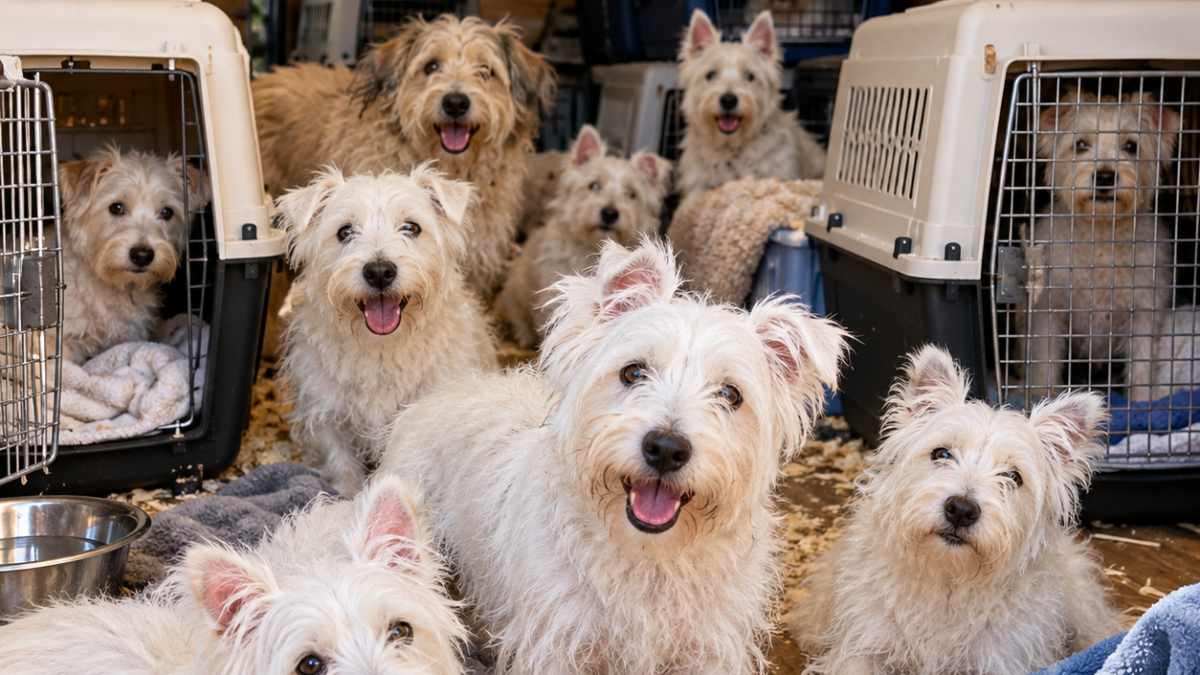
The little female was the first dog I thought about when I woke the next morning.
I hadn’t slept much.
Even after years of shelter work, there are cases that refuse to stay at the shelter when you clock out. You carry them into your kitchen. You hear them when the house goes quiet. You see them when you close your eyes.
For me, it was that puppy’s face.
She had looked at me for only a second before the technician carried her toward the transport vehicle, but I couldn’t forget it.
Dull eyes.
Body limp inside a clean towel.
No understanding of why strangers were suddenly touching her after weeks or months in a place where human hands had not always meant comfort.
I reached for my phone before my feet touched the floor.
There was already a message from Dr. Simmons.
She made it through the night. Still very sick. No new confirmed cases so far.
I read it twice.
Then a third time.
Made it through the night.
Not safe.
Not recovered.
But alive.
At that moment, alive was enough.
By 6:45, I was back at Everett Animal Shelter.
Quarantine had changed the whole rhythm of the building.
Normally there was movement everywhere—dogs being walked, volunteers carrying blankets, families asking questions in the lobby, staff moving between cat rooms and kennel wings.
Now every door connected to the Westies had signs taped across it.
QUARANTINE. AUTHORIZED STAFF ONLY.
Protective gowns hung from hooks.
Disposable gloves filled boxes beside the entrances.
Separate mops had been labeled by room.
Boot covers were stacked in plastic bins.
Foot baths sat at doorways.
Parvovirus does not care whether you are tired, understaffed, emotional, or already overwhelmed.
It only needs one mistake.
One contaminated shoe.
One shared bowl.
One forgotten surface.
When forty-two dogs have lived close together and one begins showing symptoms, the entire group becomes a question you are afraid to answer.
Our supervisor, Melissa Grant, stood in the hallway with a clipboard pressed against her chest.
“You’re early.”
“So are you.”
“I’m always early.”
“That’s unhealthy.”
“So is working in animal rescue.”
Neither of us laughed very hard.
She looked through the quarantine window.
“How many times did you check your phone?”
“Once.”
“Liar.”
“Three.”
“That’s more believable.”
Inside the room, several of the Westies had already awakened.
When people picture forty-two small white terriers, they imagine chaos.
Barking.
Jumping.
Tiny bodies bouncing off doors.
That wasn’t what we had.
Not yet.
Some barked.
Some whined.
But many stayed where they had been placed the night before.
They watched us.
That was the hardest part.
Dogs who understand ordinary household life usually react to people with expectation. Food? Walk? Attention? Door opening?
These dogs watched us as if every movement had to be studied first.
What did the hand mean?
What did the leash mean?
What happened when a cage opened?
Would the person return?
Would there be pain?
Would there be food?
One adult male sat in the rear corner of his enclosure with his body pressed against the wall.
His temporary intake number was 16.
He had one of the worst coats in the group.
The white fur along his belly had become yellow-brown from urine staining, and mats pulled tightly at the skin behind his legs.
I crouched outside his enclosure.
“Morning, Sixteen.”
His eyes shifted toward me.
“That’s terrible. We’re not calling you that.”
Melissa glanced over.
“Don’t start naming forty-two dogs.”
“Why?”
“Because you’ll get attached.”
“I’m already attached.”
“That is precisely my point.”
I looked at the male again.
He had a square little face and dark eyes that made him look older than he probably was.
“You look like a Walter.”
Melissa sighed.
“Of course he does.”
“Walter.”
His ear twitched.
“See? He agrees.”
“He moved an ear.”
“Formal acceptance.”
That was how Walter got his name.
Not officially.
Not legally.
The dogs were still part of an active court case.
But names helped us care for individuals instead of numbers.
And over the next several days, names appeared everywhere.
Pippa was a tiny female whose left ear leaned sideways.
Peanut and Pearl were two puppies who screamed whenever anyone separated them by more than three feet.
Benny had an underbite.
Daisy would not eat unless another dog was eating nearby.
Oscar barked furiously whenever a mop entered the room but hid from actual people.
Louie wanted to sit in every lap he saw.
Maisie was pregnant.
And then there was Annie.
Annie was not the sickest.
She was not the thinnest.
She did not have the worst coat.
But she was the dog who made me understand that neglect is not always visible in wounds.
The first time I opened her kennel, she lowered herself until her stomach touched the floor.
No growl.
No bark.
No attempt to escape.
She simply became small.
I froze.
“Hey,” I whispered. “I’m not going to pull you.”
Her eyes moved toward my hand.
I sat beside the doorway instead.
Five minutes passed.
Then ten.
Behind me, another employee walked by.
“You okay?”
“Fine.”
“You need help?”
“No.”
Annie stayed pressed to the floor.
I talked quietly.
Not important things.
Weather.
Coffee.
How Melissa had once burned microwave popcorn so badly the fire alarm went off and the fire department actually arrived.
Annie didn’t understand the story.
That wasn’t the purpose.
I wanted my voice to stop predicting something bad.
After fifteen minutes, she lifted her head.
That was enough.
I closed the kennel gently.
“I’ll see you later.”
She watched me leave.
People think trust begins when an animal approaches you.
Sometimes it begins when you prove you can walk away.
The work continued.
Every dog received a physical examination.
Vaccines when medically appropriate.
Parasite treatment.
Microchip.
Weight.
Photographs.
Dental assessment.
Skin assessment.
Notes about mobility, eyes, ears, breathing, hydration.
The mats had to be documented before removal because the condition of the coats mattered to the investigation.
That made grooming slower.
You could not simply shave everything and clean the dog.
First photographs.
Then measurements.
Then documentation.
Then treatment.
There was something deeply uncomfortable about photographing suffering.
I hated pointing a camera at matted fur, irritated skin, dirty cages, frightened faces.
But Dr. Simmons reminded us why.
“If this goes to court six months from now, nobody is going to remember every detail.”
She held up the camera.
“This remembers.”
So we documented everything.
Facts.
Not dramatic captions.
Not angry speeches.
Facts.
A mat restricting movement behind a leg.
Urine staining.
Fecal material caught in fur.
Inflamed skin.
Overgrown nails.
Parasites.
Dental disease.
Body condition.
Improvised barriers from the trailer.
Cages stacked vertically.
Air quality.
Cleanliness.
The puppies’ ages.
The pregnant female.
The sick dog.
Every fact became part of a record that the animals themselves could never give.
Meanwhile, Lucy fought.
That was what we eventually named the hospitalized puppy.
Dr. Simmons had objected to Hope because she said it sounded like we were naming a motivational poster.
One technician suggested Miracle.
I rejected that even faster.
Then the puppy tried to chew through an IV line despite barely having enough energy to stand.
I said, “Lucy.”
Nobody asked why.
My grandmother had been named Lucy.
She had been five feet tall, weighed maybe a hundred pounds, and once chased a burglar out of her backyard with a rake.
The puppy deserved the name.
On the second day, Lucy’s fever remained high.
On the third, she stopped vomiting as frequently.
On the fourth morning, my phone rang before seven.
Dr. Simmons.
I answered immediately.
“What happened?”
“She ate.”
I sat upright.
“What?”
“Four bites.”
“That counts.”
“Rachel, she is still hospitalized.”
“I know.”
“She is still medically fragile.”
“I know.”
“We are not celebrating yet.”
“I’m celebrating four bites.”
Dr. Simmons sighed.
“You’re impossible.”
“So is Lucy.”
By afternoon, she ate again.
Small amounts.
Then drank on her own.
Her bloodwork began improving.
There were still no other confirmed parvovirus cases among the forty-one dogs in quarantine.
Every day without another sick animal felt like borrowed luck.
We did not relax.
Not once.
The public response, meanwhile, became overwhelming.
The original news had spread quickly.
Forty-two West Highland White Terriers.
A trailer.
Police seizure.
A shelter caring for all of them.
By the end of the first wave, more than 250 people had contacted us about adoption.
Our phones barely stopped ringing.
Emails arrived from Washington, Oregon, Idaho, and farther away.
One woman offered to fly in from California.
A man said he wanted six.
We said no.
A family wanted “the youngest white puppy.”
That did not narrow the field much.
Another applicant wrote three pages about the Westie she had lost at seventeen years old.
A retired couple offered to adopt any bonded older pair nobody else wanted.
A veterinary technician volunteered to take a medically complicated dog.
A woman who had recently lost her husband told us she did not care about age, appearance, or medical needs.
“I just want one who needs somewhere quiet.”
That message stayed with me.
Still, every caller received some version of the same answer.
“They aren’t available yet.”
People did not understand.
“But they were rescued.”
“Yes.”
“So why can’t we adopt?”
“Because they are part of an active legal proceeding.”
“How long?”
“We don’t know.”
That was the answer everybody hated.
We don’t know.
Safe is not the same as legally released.
Seized is not the same as surrendered.
The dogs had been removed from conditions authorities considered deeply concerning, but the legal ownership question still had to be resolved.
Hearings.
Evidence.
Deadlines.
Responses.
Possible appeals.
The machinery of law moves at a speed completely unrelated to the emotional urgency people feel when they see an animal suffering.
At first, I resented that.
Then one of the investigating officers, Detective Aaron Bell, explained it to me in a way I never forgot.
“You want a case that survives anger.”
“What does that mean?”
He stood beside the shelter’s intake table while photographing evidence bags.
“People get angry fast. Courts don’t run on anger.”
I folded my arms.
“Sometimes they should.”
“No.”
He looked at me.
“They should run on facts. If you rush because everybody is furious, you leave openings. Openings become doubt. Doubt becomes dismissal.”
I looked toward the quarantine wing.
“So we wait.”
“We build.”
That became another phrase I remembered.
We build.
Day after day, we built records.
The dogs built strength.
The veterinarians built treatment plans.
Investigators built a case.
And trust built itself in tiny increments.
Walter learned beds first.
I put a clean fleece bed inside his enclosure after his grooming and bath.
He stood beside it.
Stared.
Sniffed.
Placed one paw on the fleece.
Pulled it back.
Tried again.
Then stepped onto the bed with all four feet.
He turned three circles and lay down.
Within thirty seconds, he was asleep.
I stood outside his enclosure and cried quietly.
Melissa walked past.
“What happened?”
“Nothing.”
She looked at Walter.
“Oh.”
“You see it?”
“Yes.”
A dog sleeping on a bed should not be moving.
That was why it was.
Pippa discovered toys.
Her first squeaker terrified her.
She jumped backward so violently she nearly fell into her water dish.
I put the toy down.
She stared at it.
The toy stared back, as much as a stuffed yellow duck can.
Pippa approached.
Sniff.
Paw.
Squeak.
She jumped again.
Then barked.
Squeak.
Another bark.
Ten minutes later, she was carrying the duck around like she had personally killed it.
Peanut and Pearl learned that people could carry both of them at once.
That created a problem because from then on they expected it.
Benny learned stairs.
Oscar learned that mops were not predators.
Maisie gave birth to three puppies under veterinary supervision.
That raised the count of lives dependent on our care even though the legal case still centered on the original forty-two.
And Annie learned grass.
I will remember that afternoon for the rest of my life.
Her coat had been shaved short because mats around her legs and stomach could not be safely brushed out.
Without all that dirty white fur, she looked smaller.
Vulnerable.
I clipped on a lightweight leash.
She froze.
I waited.
Eventually we reached the door to a private fenced yard.
When it opened, Annie stopped at the threshold.
Outside was nothing extraordinary.
Grass.
A wooden fence.
September sky.
A plastic chair.
Leaves moving in the wind.
To Annie, it might as well have been another planet.
I stepped outside.
She didn’t.
“Okay.”
I sat in the grass.
Annie watched.
One minute.
Three.
Five.
Then one front paw crossed the threshold.
She pulled it back.
Tried again.
Both front paws.
Then one rear foot.
Finally all four.
She froze on the grass.
Her nose went down.
She sniffed.
Then the wind moved across the yard.
Annie lifted her face.
Her eyes narrowed.
The few longer strands of fur around her ears moved.
She stood there with her nose pointed toward the sky.
No fear.
No crouching.
Just wind.
I had worked around animals long enough to know better than to invent human thoughts for them.
I cannot tell you Annie understood freedom.
I cannot tell you she was remembering a cage.
But I can tell you that for almost a full minute, she stood completely still while the breeze crossed her face.
Then she took another step.
And another.
Twenty minutes later, she walked a slow circle around the yard.
That night I wrote in a private notebook I kept in my locker:
Annie stepped onto grass today.
I did not know then how many entries about her would follow.
Lucy came back from hospitalization on the eighth day.
We prepared like a celebrity was arriving.
Technically, she still required careful isolation and monitoring, but medically she had improved enough to leave intensive care.
The carrier entered through a controlled doorway.
Dr. Simmons placed it on the floor.
“Everyone remain calm.”
Nobody remained calm.
Lucy appeared at the front of the carrier.
Thin.
Eyes brighter.
Bandage on one front leg.
She looked around.
Then barked.
A tiny, offended bark.
The room erupted in muffled laughter.
“See?” I said. “Impossible.”
Dr. Simmons opened the carrier.
Lucy walked out.
Three steps.
Stopped.
Then tried to steal the corner of Dr. Simmons’s shoelace.
Someone behind me started crying.
Dr. Simmons looked down at her shoe.
“I spent days trying to keep you alive.”
Lucy pulled harder.
“Gratitude would be appropriate.”
She recovered steadily after that.
September 21 became the date written on every calendar.
If no other dogs became sick, quarantine restrictions were expected to ease.
We counted toward it like children waiting for Christmas.
September 18.
No new cases.
September 19.
No new cases.
September 20.
Nothing.
On September 21, I arrived before sunrise.
Melissa was already there.
“You’re early again.”
“So are you.”
“Don’t start.”
We went through the health board together.
Forty-two original dogs.
Maisie’s three newborn puppies.
Lucy recovered.
No additional parvo.
A few skin infections still under treatment.
Dental procedures scheduled later.
One dog would need eye surgery eventually.
But alive.
All forty-two alive.
Melissa touched the board with two fingers.
“We got them through.”
I swallowed.
“We got them this far.”
She nodded.
“That’s the more dangerous thing to say.”
“Why?”
“Because now you’re thinking ahead.”
She was right.
Quarantine ending did not mean adoption.
The court case remained active.
That became harder emotionally than the disease control.
The dogs were improving.
They were becoming ready for homes.
And yet we could not promise when those homes would come.
People online grew impatient.
Some accused the shelter of “hoarding” the dogs.
Others demanded specific animals.
A few claimed the legal process was an excuse.
One man appeared in person and insisted he had “already chosen” Lucy from a photograph.
Melissa explained that applications were not open yet.
He became angry.
“I drove two hours.”
“I’m sorry.”
“You have more than forty dogs. You’re telling me you can’t give me one?”
“They are not legally available.”
“They’re dogs.”
That sentence changed Melissa’s face.
Her voice stayed polite.
“Yes. They are dogs. They are also living evidence in an active case and individual animals receiving medical and behavioral care. You cannot choose one like merchandise off a shelf.”
He left furious.
Later, Melissa stood in the staff room drinking cold coffee.
“I shouldn’t have said merchandise.”
“You absolutely should have.”
“That wasn’t customer service.”
“We are not selling furniture.”
She smiled.
“Remind me why I hired you.”
“I make excellent decisions.”
“You named a dog Walter because of his eyebrows.”
“Exactly.”
The legal case developed slowly.
Authorities had found the forty-two dogs inside a small trailer in Marysville on August 31.
Cages had been stacked.
Makeshift partitions divided sections of the trailer.
Sanitation was poor.
Several dogs were heavily matted and soiled.
Some had medical problems.
The investigation moved beyond what had been visible on seizure day.
Records were examined.
Veterinary histories.
Sales advertisements.
Breeding records.
Messages.
Financial transactions.
Ownership documents.
Detective Bell returned to the shelter repeatedly to review medical documentation.
One afternoon he watched Annie retreat when a metal kennel door slammed down the hallway.
“She always do that?”
“Sharp noises.”
He wrote something.
“You documenting behavior too?”
“When it’s relevant.”
“Can fear be evidence?”
“Not by itself.”
He closed his notebook.
“But patterns matter.”
That word again.
Patterns.
One unhealthy dog can happen in any kennel.
One accidental mat can happen.
One missed appointment.
One record error.
One frightened animal.
But forty-two animals create patterns.
Patterns of housing.
Patterns of care.
Patterns of breeding.
Patterns of medical decisions.
The court would have to decide what those patterns legally meant.
Our job was not to decide guilt.
Our job was to make sure nobody could later say the animals arrived healthy if they had not.
The public wanted a villain.
Real cases are more complicated.
That frustrated people.
It frustrated me.
I wanted a clean line.
Someone did this.
That person pays.
But Detective Bell reminded me that accountability built on exaggeration is fragile.
“Don’t say what you can’t prove.”
“So if I think a dog has never been outside—”
“You say the dog appeared unfamiliar with grass if that is what you observed.”
“If a dog is terrified of hands?”
“You document the behavior.”
“You don’t say why?”
“Not unless you know.”
That discipline changed me.
I had spent years telling rescue stories emotionally.
Now I learned the power of precise language.
Annie did not “remember being abused.”
I did not know that.
Annie lowered her body when hands reached over her.
That I knew.
Walter had not “never had a bed.”
I could not prove that.
Walter hesitated before stepping onto a bed and then slept deeply.
That I had seen.
The dogs did not need us to invent suffering.
Their actual condition was enough.
Weeks passed.
Then months.
Winter rains came.
The Westies learned coats.
Watching forty small dogs encounter sweaters was one of the few things that kept us sane.
Some loved them.
Some behaved as if clothing violated international law.
Pippa wore a red fleece sweater and walked around proudly.
Benny refused to move until his was removed.
Walter looked resigned.
Lucy tried to eat hers.
Annie tolerated one only if I put it on slowly.
By then, she had begun choosing to approach me.
The first time happened after my shift.
I sat inside her enclosure, reading medical notes.
She had been lying on the opposite side.
I was not calling her.
I was not holding food.
After several minutes, she stood.
Walked toward me.
Stopped.
Then rested her chin on my knee.
I did not touch her.
Every instinct wanted to stroke her face.
But trust is not permission for everything.
So I stayed still.
Ten seconds.
Maybe fifteen.
Then she stepped away.
That night I wrote:
Annie chose contact today.
The next week:
Annie leaned against my leg while standing.
Then:
Annie accepted chin scratches.
Then:
Annie approached another staff member without me present.
Healing is boring if you summarize it honestly.
Tiny improvements repeated until one day you realize the animal in front of you is living differently.
There was no magical morning when Annie became “fixed.”
There were hundreds of ordinary mornings when nothing bad happened.
That accumulation became her therapy.
The court hearing everyone had been waiting for came in late winter.
I was not allowed to attend every portion because shelter operations still needed staff, but Melissa went.
So did Detective Bell.
So did representatives connected to the seizure.
We spent the day pretending not to check our phones.
At 3:17 p.m., mine rang.
Melissa.
I stepped into the supply room.
“Well?”
Her voice sounded exhausted.
“The court authorized transfer of the dogs once final administrative steps are completed.”
I sat down on a bag of unopened blankets.
“Say that again.”
“They can move toward adoption.”
I covered my mouth.
For months, I had imagined cheering.
Instead, I cried.
Quietly.
Relief often arrives looking like exhaustion.
“How long until we can start?”
“Soon. Not this second. Paperwork first.”
“Of course.”
“Rachel?”
“Yes?”
“All forty-two.”
I closed my eyes.
“All forty-two.”
When Melissa returned, the staff gathered in the hallway.
She did not make a speech.
She simply said, “We can start preparing them to go home.”
That sentence destroyed us.
One technician cried into a box of gloves.
Another hugged Melissa so hard the clipboard fell.
Dr. Simmons pretended she needed to examine a dog and disappeared into treatment.
I went to Annie.
She stood when she saw me.
I opened her kennel.
“You have no idea what happened today.”
Tail wag.
“Your life is about to become very complicated.”
Another wag.
“People want you.”
Annie stepped closer.
I sat on the floor.
“So many people want all of you.”
Her head rested against my leg.
I whispered, “You’ll never understand how many.”
Applications officially opened soon afterward.
The 250-plus early inquiries turned into a huge screening process.
Some people assumed we would simply choose first come, first served.
We didn’t.
The dogs were not identical products.
They had different needs.
A confident puppy could thrive in a busy family.
A deeply fearful adult might not.
Some dogs were bonded.
Some needed continued medical care.
Some had never learned house training.
Some reacted badly to confinement.
Some needed adopters willing to accept that progress might take months.
We wanted homes, not simply exits.
That created another kind of conflict.
People became personally invested.
A woman called three times because she wanted Lucy.
“She survived parvo. I feel connected to her.”
I understood.
But dozens of people felt connected to Lucy.
A family wanted Peanut but not Pearl.
We declined.
“They’ll adjust.”
“Maybe.”
“Then why not separate them?”
“Because we have applicants willing to keep them together.”
The family became upset.
Still no.
One man wanted a dog specifically for breeding.
Absolutely not.
Every dog would leave altered when medically appropriate or under enforceable sterilization requirements based on veterinary timing.
He argued.
We ended the conversation.
The dogs had already spent enough of their lives being valued for reproduction.
Walter’s application made me cry.
His prospective adopter was a seventy-year-old widower named James Nolan.
He had owned Westies most of his adult life.
His last dog, Murphy, had died at sixteen.
James came to the shelter wearing an old canvas jacket and carrying no expectations.
“I don’t need a puppy.”
That got my attention.
“No?”
“I’m seventy. A puppy will outlive my knees.”
I smiled.
“What are you looking for?”
“Whichever one people keep overlooking.”
I thought of Walter.
Their meeting lasted forty minutes.
Walter did not climb into James’s lap.
Did not kiss him.
Did not perform some cinematic choosing ritual.
He sniffed James’s pant leg.
Accepted one treat.
Then lay down near his boots.
James looked at me.
“He’s tired.”
“He likes sleeping.”
“Good. So do I.”
Walter went home with him three weeks later.
James sent a photograph that evening.
Walter was upside down in a brown recliner, legs spread in complete disgrace.
Caption:
HE FOUND MY CHAIR.
I printed it.
Pippa went to a family with two daughters, ages twelve and fourteen.
The girls sat on the floor for almost an hour before Pippa approached.
Neither tried to grab her.
That mattered.
When Pippa finally dropped her yellow squeaky duck into the younger girl’s lap, I knew.
Peanut and Pearl went together to a couple from Tacoma.
They had prepared two beds.
The dogs used one.
Of course.
Benny went to a veterinary receptionist.
Oscar went to a quiet home with a retired teacher.
Maisie stayed in foster until her puppies were old enough and she had recovered medically.
Lucy generated the most interest.
By then she had transformed from fragile patient to tiny criminal.
She stole gloves.
Socks.
Pens.
Once Dr. Simmons’s stethoscope.
A nurse named Carmen became her adopter.
Their meeting began with Lucy climbing into Carmen’s purse.
“She’s stealing my wallet.”
“That is her advanced financial assessment.”
Carmen laughed.
“Is she always like this?”
“Yes.”
“I’ll take her.”
“You have to complete the process.”
“I will complete whatever you put in front of me.”
She did.
Lucy left wearing a purple harness.
The puppy whose head had once fallen against a technician’s arm walked out barking because somebody had stopped petting her.
That was one of the happiest sounds I have ever heard.
Then there was Annie.
I helped review her applications.
That was my first mistake.
Applicant one: nice couple, two young children.
Too noisy.
Applicant two: experienced dog owner, lived alone.
Worked ten-hour shifts.
Too long.
Applicant three: fenced yard, another gentle dog.
Maybe too much pressure.
Applicant four: older woman, quiet house.
Too many stairs.
After the sixth rejection, Melissa walked into the office and took the folder away from me.
“What are you doing?”
“Screening.”
“No. You are inventing reasons nobody qualifies.”
“That’s unfair.”
“Is it?”
“Annie needs a specific home.”
“I agree.”
“So—”
“So why haven’t you applied?”
I stared at her.
“This isn’t about me.”
“Rachel.”
“I work long hours.”
“So do applicants you haven’t rejected.”
“I have Winston.”
“Your cat hates every living organism equally.”
“Also true.”
“You own your home.”
“Yes.”
“You understand fearful dogs.”
“Yes.”
“Annie trusts you.”
I looked through the glass.
Annie sat inside her run watching the hallway.
Melissa put a blank adoption application on my desk.
“Either apply or let someone else review her applications.”
“That feels like blackmail.”
“It’s supervision.”
I took the form.
I filled it out.
And I made sure somebody else reviewed me.
No special treatment.
Home assessment.
Veterinary reference.
Plan for Winston.
Fence condition.
Work schedule.
Support system.
Emergency care.
I bought rugs because Annie disliked slippery flooring.
Put a baby gate between the kitchen and living room so Winston could maintain diplomatic distance.
Moved breakable things.
Bought a bed.
Then another because I worried the first looked too enclosed.
Melissa came over for the home check.
She looked at the two beds.
“Why two?”
“I wasn’t sure which she’d prefer.”
“You have lost perspective.”
“I work in animal welfare.”
“Fair.”
The morning Annie was cleared to leave, I arrived before opening.
Her leash was hanging on the kennel door.
Not the shelter’s generic blue slip lead.
A real collar.
A real identification tag.
ANNIE MORGAN.
My hands shook when I fastened it.
“You have my last name.”
Annie sniffed the tag.
“That means if you destroy the house, I’m legally implicated.”
Her tail moved.
We walked toward the exit.
At the threshold, Annie stopped.
Just like the first time she faced grass.
Outside were cars.
Cold air.
People.
My car waiting near the curb.
She looked up at me.
I did not pull.
“Take your time.”
One step.
Pause.
Another.
Then she crossed.
I cried before we reached the car.
Getting her into the car required chicken.
A lot of chicken.
She finally climbed onto the rear seat.
Sat rigidly for the first five minutes.
Then lay down.
At home, Winston met us in the hallway.
He stared at Annie.
Annie stared at him.
Winston turned around and walked away with the expression of a property manager who had discovered a serious lease violation.
“Good start,” I said.
Annie spent the first hour near the front door.
I did not force her farther.
Eventually she explored.
Living room.
Kitchen.
Water bowl.
Back door.
The rugs.
Her bed.
She sniffed everything.
That night, I woke at 2:13.
Annie stood beside my bed.
Silhouette in the darkness.
I patted the rug.
“You okay?”
She lay down.
I listened to her breathe until I fell asleep.
The next morning, she followed me into the kitchen.
That became our life.
Slowly.
Annie was not transformed because she had been adopted.
Homes do not erase trauma.
She startled if I dropped a pan.
She refused to enter the laundry room because the narrow doorway bothered her.
She panicked the first time I left for twenty minutes.
When I returned, she was pressed against the front door.
I sat on the floor.
“I came back.”
Her body trembled.
“I’m going to keep doing that.”
The next absence was ten minutes.
Then fifteen.
Then thirty.
I always returned.
Eventually, Annie learned departures were temporary.
That lesson took months.
Her first real play happened by accident.
I rolled a tennis ball across the living room while cleaning.
Annie watched it.
The ball hit the couch and rolled back.
She pounced.
Then froze, seemingly surprised by herself.
I rolled it again.
She chased.
Three seconds later, she picked it up.
I stayed calm because sudden excitement could shut her down.
Inside my head, I was yelling.
Later I wrote in the old notebook:
Annie played today.
Her first bark at home came two months after adoption.
The mail carrier walked onto the porch.
Annie barked twice.
Then looked at me as though she had broken a rule.
I laughed.
“You’re allowed.”
She barked again.
That created a monster.
Within weeks, she believed every package required formal announcement.
The court case continued even after the dogs left the shelter.
Ownership resolution was only one part.
There were still questions of responsibility, animal-care violations, operating practices, and evidence investigators had collected.
I followed from a distance.
I did not need every courtroom detail.
Annie needed breakfast.
Still, anger remained.
Especially when I looked at photographs from intake.
Stacked cages.
Makeshift dividers.
Dirty coats.
Forty-two dogs in a small trailer.
I wanted the people responsible to understand what they had done.
Not abstractly.
Individually.
Walter had a name.
Pippa had a name.
Lucy.
Annie.
Peanut.
Pearl.
They were not breeding units.
Not stock.
Not inventory.
The legal process eventually produced consequences and restrictions connected to future animal ownership and breeding activity.
Some people thought the outcome was not harsh enough.
Some always will.
I understood that feeling.
But I realized I no longer wanted my satisfaction to depend entirely on punishment.
Because every time I received an adoption update, something more powerful was happening.
Walter’s first Christmas photograph showed him wearing a ridiculous green sweater beside James’s fireplace.
Pippa went camping.
Peanut and Pearl slept together under somebody’s wedding table.
Lucy learned to swim.
Oscar, once terrified of mops, became obsessed with chasing sprinklers.
Maisie gained enough confidence to sleep belly-up in her foster-adopter’s kitchen.
Every photograph was an answer.
The dogs had been treated as replaceable.
Now their absence would devastate specific people.
That was the change.
Annie became possessive of my couch six months after adoption.
For months she would lie beside it.
Never climb up.
I did not encourage her.
One rainy evening, I was watching television when I felt the cushion shift.
Two white paws appeared.
Annie looked at me.
I stayed still.
She climbed up.
Turned twice.
Lay against my leg.
I looked down.
“Well.”
She sighed.
“This is my couch.”
No response.
“Annie.”
She closed her eyes.
I lost the couch permanently that night.
A year after the seizure, the shelter organized a reunion.
We did not invite all forty-two indiscriminately.
Some lived too far away.
Some did not enjoy groups.
We weren’t going to overwhelm dogs just so humans could get emotional photographs.
Seventeen attended.
I arrived with Annie.
At first, she stayed beside me.
Then Lucy appeared.
Healthy.
Bright white coat.
Purple harness.
Carmen was barely holding the leash.
Lucy saw Annie.
Stopped.
Then ran.
They sniffed.
Circled.
Lucy sprinted away.
Annie watched.
Then something I had never seen happened.
Annie chased her.
Full speed.
Across the fenced field.
Ears back.
Mouth open.
Tail high.
She ran around a picnic table.
Cut across the grass.
Lucy chased her back.
I stood frozen.
Melissa came beside me.
“You’re crying.”
“No.”
“You absolutely are.”
“Wind.”
“There is no wind.”
“Allergies.”
“You don’t have allergies.”
I wiped my face.
“I hate working with people who know me.”
We watched Annie run.
A year earlier, she had hesitated to put one paw on grass.
Now I could not catch her.
That became one of my favorite memories.
Not because it proved she had forgotten.
I don’t know what dogs remember.
Because it proved the past no longer controlled every movement.
The media eventually moved on.
That surprised some volunteers.
For months, the forty-two Westies had been a huge story locally.
Then another story came.
Then another.
That is how public attention works.
But the dogs kept living after people stopped watching.
That, to me, became the real story.
Lucy’s adopter sent photographs every August 31.
Year one: Lucy beside a cupcake designed for dogs.
Year two: Lucy on a beach.
Year three: Lucy wearing goggles in a kayak.
Year four: Lucy stealing a sandwich.
Caption:
STILL A SURVIVOR. STILL A THIEF.
I replied:
Perfect.
James called me when Walter was diagnosed with heart disease years later.
His voice shook.
“He’s twelve, maybe thirteen. Hard to know.”
“I know.”
“The vet says medication could give us time.”
“Then take the time.”
He did.
Walter lived another fourteen months.
When he died, James called again.
“I thought because I’d had dogs before, this would be easier.”
“It never is.”
“He slept in my chair last night.”
I remembered the first photograph.
Walter upside down in that recliner.
James whispered, “I don’t know what I’m going to do with the chair.”
“Keep it.”
He did.
Pippa became a therapy dog.
That felt impossible when I first heard.
The dog who had once jumped backward from a squeaky toy now visited residents at an assisted-living center.
Her adopter sent a photo of Pippa asleep on the lap of a ninety-year-old woman.
I printed it and placed it beside Walter’s recliner picture.
Peanut and Pearl never separated.
When Pearl developed a knee problem, Peanut slept beside her recovery pen.
Oscar became fat.
Not dangerously.
But enough that we had to have a conversation with his adopter.
“Treats are not love.”
The adopter looked guilty.
Oscar looked betrayed.
Maisie outlived two of her puppies.
That hurt.
But she lived to fourteen.
And Annie stayed with me.
Years passed.
Gray appeared around her eyes.
She became less fearful and more opinionated.
She learned the refrigerator.
She learned that the sound of cheese packaging required immediate response.
She learned that 6:03 a.m. was breakfast and 6:06 represented neglect.
She learned to stare at Winston until he abandoned warm spots.
Winston, to his credit, learned to tolerate her.
They never became friends.
But one winter afternoon, I found them sleeping on opposite ends of the same rug.
I took twelve photographs.
Annie still had old reflexes.
Metal cages bothered her.
If a door slammed unexpectedly, she flinched.
The laundry room remained suspicious for years.
She preferred open spaces.
But fear stopped being her defining feature.
That distinction mattered.
People often said, “She’s completely healed.”
I never agreed.
Healing does not always mean becoming who you would have been if nothing bad happened.
Sometimes it means building a good life around scars.
Annie did that beautifully.
Seven years after the seizure, I took her back to Everett Animal Shelter for an anniversary visit.
Many staff members from the original intake had moved on.
Young technicians gathered around.
“This is one of them?”
“Yes.”
“One of the forty-two?”
“Yes.”
They looked at Annie as if she were history.
She looked at them as if they might have treats.
One technician crouched.
“She’s so confident.”
I almost laughed.
“You should’ve met her before.”
We walked through a hallway near the old quarantine rooms.
Annie paused.
My heart tightened.
Did she remember?
She sniffed the floor.
Looked toward a door.
Then continued walking.
No dramatic reaction.
No trembling.
No collapse.
For a moment, I was disappointed.
Then I realized how selfish that was.
Annie did not owe me a meaningful reunion with her past.
Maybe healing sometimes looks exactly like that.
A place that once mattered enormously becomes just another hallway.
Outside, we entered the yard.
The same grass.
Or maybe reseeded grass.
Annie pulled toward a bush.
No hesitation.
I followed.
“Apparently nostalgia is less interesting than squirrel urine.”
She wagged.
The shelter eventually incorporated parts of the case into staff training.
Not sensational photographs.
Not the worst images.
Processes.
How to document large-scale seizures.
How to manage quarantine.
How to coordinate medical intake.
How to preserve evidence without compromising care.
How to communicate with hundreds of potential adopters when legal ownership remains unresolved.
How to avoid overclaiming behavior.
How to separate what you know from what you think.
I was asked to teach part of the session.
At first, I refused.
“I’m not a teacher.”
Melissa, now the shelter director, laughed.
“You’ve been lecturing everyone for fifteen years.”
“That’s different.”
“Explain how.”
I couldn’t.
So I taught.
I showed new staff the photograph of Annie’s first day on grass.
Then one from the reunion.
Same dog.
Different body language.
I told them, “Do not promise this.”
They looked confused.
“Recovery isn’t a performance. Some dogs will become social. Some won’t. Some will play. Some may always need quiet. Your job is not to produce a dramatic before-and-after story.”
I clicked to another slide.
Walter asleep in his bed.
“Your job is to create enough safety for the animal to decide what comes next.”
That became one of the most important things the forty-two taught me.
People love transformation because it comforts us.
Dirty to clean.
Scared to happy.
Caged to adopted.
But real recovery is uneven.
A dog can be happy and still afraid of doors.
Loved and still dislike strangers.
Safe and still wake from nightmares.
That does not make the rescue incomplete.
A good life does not require a perfect nervous system.
Then came Annie’s tenth year with me.
She had slowed.
Not dramatically at first.
Longer naps.
Shorter walks.
Less interest in chasing balls.
Then more water.
Less appetite.
Weight loss.
Dr. Simmons had retired by then, but she still worked occasional shifts.
I deliberately scheduled Annie with her.
She ran bloodwork.
Called me that evening.
I knew from her first breath.
“Kidneys?”
“Yes.”
“How bad?”
“Manageable for now.”
That phrase became our next chapter.
Prescription diet.
Medication.
Fluids later.
Regular blood tests.
Annie accepted the treatments because she trusted me.
That made it easier and harder.
Months passed.
Then a year.
She still enjoyed the yard.
Still barked at packages.
Still stole my couch.
But eventually her body began losing the argument.
One morning, I opened chicken.
Annie lifted her head.
Then lowered it again.
That frightened me more than any lab result.
I cooked fresh chicken.
Nothing.
Cheese.
Nothing.
I sat beside her.
“Don’t do this.”
She looked at me.
The veterinarian examined her that afternoon.
Kidney values worse.
Weight down.
Nausea.
Weakness.
We had options for temporary support.
But not a cure.
I asked the question every pet owner eventually fears.
“How much good time?”
The veterinarian looked at Annie.
“Days. Maybe a couple of weeks if she responds. But I would think in days.”
I drove home crying so hard I had to pull over.
Annie sat in the passenger seat.
She had learned to enjoy car rides years earlier.
At first, vehicles terrified her.
Now she rested her head against the window.
I put my hand on her back.
“I’m not ready.”
Of course she didn’t answer.
Animals rarely care whether we are ready.
For three days, I stopped trying to make life normal.
No schedule except medication.
No dietary rules except what she would eat.
Hamburger.
A little egg.
Tiny pieces of cheese.
She slept in sunlight.
I carried her down the steps.
The final morning was clear and cool.
Annie asked to go outside by standing near the door.
I opened it.
She walked slowly into the yard.
Not far.
Just to the center of the grass.
Wind moved through the trees.
Annie stopped.
Lifted her nose.
Closed her eyes.
I froze.
Ten years vanished.
I saw the shelter yard again.
The freshly shaved frightened dog placing one foot on grass.
The wind touching her face.
I sat beside her.
“You remember this?”
Her eyes opened.
I knew she probably did not remember it the way I did.
That did not matter.
“You were terrified of grass.”
Her tail moved once.
“Beds too.”
Another small movement.
“Toys.”
I smiled.
“And Winston.”
She leaned against me.
I put my arm around her.
“They tried to make your life so small.”
My voice broke.
“A trailer. A cage. A number.”
Annie rested her chin on my knee.
“But look what you did.”
Ten years.
A house.
A yard.
Vacations.
Snow.
Beaches.
Camping once, which she hated.
A couch she stole.
Thousands of breakfasts.
Thousands of nights sleeping without urine beneath her body.
Thousands of times hearing my car return.
Thousands of moments nobody photographed because ordinary happiness rarely looks important while it is happening.
I called Dr. Simmons.
She came to my house that afternoon.
Not as Annie’s official veterinarian anymore.
As someone who had been there at the beginning.
When she stepped into the yard, Annie’s tail moved.
Dr. Simmons knelt.
“Hey, troublemaker.”
Annie sniffed her hand.
“You remember stealing my stethoscope?”
I laughed through tears.
“She denies everything.”
We placed a blanket on the grass.
I wanted Annie outside.
I did not want her final ceiling to be above her.
She had spent enough of her early life enclosed.
Dr. Simmons explained the medication even though I knew exactly what would happen.
I needed her to explain it anyway.
Sometimes grief needs procedure.
I held Annie.
Her body relaxed after the sedative.
The tension left her face.
I pressed my forehead against hers.
“You’re not in that trailer.”
Dr. Simmons waited.
“You’re home.”
Annie breathed slowly.
“You were always worth saving.”
Her final breath was so soft I almost missed it.
Dr. Simmons listened.
Then placed one hand over mine.
“She’s gone.”
For a while, I didn’t move.
Wind continued across the yard.
That seemed unfair.
Then comforting.
The same world Annie had once been afraid to enter continued around us.
Open.
Wide.
Safe.
After she died, I discovered how much of the house belonged to her routines.
The spot beside the couch.
The rug near the refrigerator.
The worn section of yard near the fence.
Her bowls.
Her leash.
A half-empty medication bottle.
The tennis ball beneath the coffee table.
For weeks, I woke at six expecting movement.
Nothing.
I still cut pieces of chicken too small because that was how Annie liked them.
Once I dropped cheese and automatically waited for her to appear.
The cheese remained on the floor.
That was the moment I had to sit down.
Grief is rarely most brutal at funerals.
It waits in kitchens.
The shelter planted a white rosebush in a small memorial garden.
I scattered some of Annie’s ashes there and kept the rest at home.
I did not want a dramatic plaque.
Just:
ANNIE
SAFE AUGUST 31. HOME FOREVER AFTER.
At first, I worried “forever” sounded dishonest.
Her forever had ended.
Then I understood.
Forever was never a promise of endless time.
It meant there had never again been a question about whether she belonged.
Months later, Lucy died.
Carmen called me.
Lucy had reached an age none of us expected during the parvo scare.
“She stole a sandwich yesterday.”
I laughed while crying.
“Of course she did.”
“She died in her sleep.”
“That’s good.”
“I know.”
Carmen was quiet.
“She gave me eleven years.”
“No.”
I thought of Walter’s owner.
“You gave each other eleven.”
One by one, the forty-two began reaching old age.
That was its own miracle.
We had first known them as a mass rescue.
Forty-two.
A number large enough to make headlines.
Years later, forty-two became individual phone calls.
Walter died.
Pippa turned thirteen.
Peanut developed heart disease.
Pearl slept beside him through medication changes.
Oscar lost his hearing.
Maisie died at fourteen.
Every ending hurt.
But there was something beautiful about dogs once discussed as victims living long enough to become elderly.
Gray muzzles are not sad when you remember what the alternative was.
Age meant time had passed safely.
The final reunion happened twelve years after the seizure.
Only six of the original forty-two were still alive.
We did not call it a final reunion officially.
Nobody wanted to say that.
But we knew.
Pippa came with her family.
Peanut and Pearl were there, both moving slowly.
Benny arrived in a stroller for part of the afternoon because arthritis made long walks difficult.
Two others, Rose and Tucker, came from across the state.
Their white coats had become cream-gray.
Their eyes cloudy.
Their bodies soft.
The same field where seventeen dogs had once run now held six elderly terriers walking carefully between families.
I sat on a bench.
Melissa joined me.
“Hard to believe.”
“What?”
“That many years.”
I looked at Peanut asleep beside Pearl.
“People called them puppies forever.”
“Some were.”
“Not anymore.”
A little boy approached Pippa.
He was maybe six.
“Can I pet her?”
Pippa’s owner said, “Let her sniff you first.”
The boy held out his hand.
Pippa sniffed.
Then leaned forward.
The boy gently touched her head.
I remembered the terrified little dog and the squeaky yellow duck.
My throat tightened.
Melissa noticed.
“You’re doing it again.”
“Allergies.”
“Still lying after twelve years.”
“Consistency matters.”
We laughed.
Then she grew serious.
“You ever think about the person who kept them?”
“Sometimes.”
“Still angry?”
I looked at the six old dogs.
“Yes.”
There was no reason to lie.
“Just differently.”
“How?”
“Back then I wanted punishment to make me feel better.”
“And now?”
“Now I think this is better.”
I nodded toward the field.
A family lifting Benny carefully.
Pearl licking Peanut’s ear.
Pippa leaning into a child’s hand.
“They were supposed to be useful to somebody until they weren’t.”
Melissa nodded.
“And instead?”
“They became irreplaceable.”
That was the final answer.
Not fines.
Not restrictions.
Not legal paperwork.
Those mattered.
Accountability matters.
But the most complete defeat of the system that had reduced those dogs to production was what happened after.
They became individuals.
Someone knew which blanket Walter preferred.
Someone knew Pippa hated thunderstorms but loved car rides.
Someone knew Lucy stole bread.
Someone knew Annie needed rugs on slippery floors.
Someone knew Peanut could not sleep unless Pearl was near.
Someone knew Benny liked his dinner warmed for eight seconds in the microwave.
Someone knew Oscar barked at snowplows.
Someone knew Maisie hated bananas.
Someone noticed.
That is the opposite of neglect.
Neglect says one life is interchangeable with another.
Love becomes specific.
Years after the original seizure, Everett Animal Shelter created a training scholarship using donations left in memory of several of the Westies.
The program funded advanced education for staff handling large-scale animal seizures, infectious-disease quarantine, fearful-dog behavior, and evidence documentation.
Melissa asked what we should call it.
I said, “Not the Forty-Two.”
“Why?”
“Because they spent enough time being grouped together.”
She thought.
“What then?”
We eventually named the training rooms after individual dogs.
Walter Room.
Lucy Medical Suite.
Annie Quiet Room.
Pippa Enrichment Yard.
People who visited sometimes asked who they were.
We told them.
Not the dramatic version.
The whole version.
Walter discovered beds.
Lucy survived illness and became a thief.
Pippa became a therapy dog.
Annie learned grass.
Their suffering brought them through the door.
Their lives were why we remembered them.
One afternoon, years after Annie died, a new employee asked me something.
“Do you ever think you should have kept more of them?”
I laughed.
“One was enough.”
“I mean, did it feel wrong choosing Annie?”
That question deserved a real answer.
“At first.”
“Why?”
“Because there were forty-two.”
I looked through the window of the quiet room named for her.
A frightened mixed-breed dog was sleeping there after arriving from another cruelty case.
“I thought loving one might mean I was doing less for the others.”
“What changed?”
“Annie taught me that forty-two dogs don’t need one person to love all forty-two.”
I looked at the employee.
“They need forty-two chances to belong somewhere.”
That became another lesson.
Rescue is not collecting suffering.
It is distributing responsibility until the burden becomes survivable.
Police removed the dogs.
Shelter staff stabilized them.
Veterinarians treated them.
Investigators documented.
Courts decided.
Fosters helped.
Adopters opened homes.
Donors paid bills.
Volunteers washed bowls.
Groomers removed mats.
One person could never have done it.
Together, people changed forty-two lives.
That is why the original story’s most important number was not forty-two.
It was all the people who refused to let forty-two remain only a number.
I retired from full-time shelter work at sixty-six.
Melissa threw a party I specifically told her not to throw.
There was cake.
A slideshow.
Photographs from decades of cases.
I hated approximately eighty percent of it.
Then Annie appeared on the screen.
First-day photograph.
Shaved coat.
Low body.
Eyes cautious.
Next photograph.
Annie in my yard.
Then Annie on the couch.
Then Annie running at the reunion.
Then old Annie beneath the tree.
I stopped pretending I was annoyed.
At the end, Melissa handed me my old notebook.
I had forgotten it existed.
The one where I had written early progress notes.
At home that night, I opened it.
The pages smelled like dust.
I found the first entry.
Annie stepped onto grass today.
Then:
Annie chose contact today.
Annie played today.
Annie barked at the mail carrier.
Later entries became less frequent.
Not because Annie stopped progressing.
Because her life became normal.
That was the greatest entry I never wrote.
Nothing special happened today.
Breakfast.
Walk.
Nap.
Mail carrier.
Dinner.
Couch.
Sleep.
For an animal from a difficult beginning, ordinary can be extraordinary.
I still volunteer twice a week.
Older now.
Slower.
The young staff think I tell too many stories.
They are correct.
Whenever a frightened dog refuses to come out of a kennel, somebody eventually says, “Get Rachel.”
I sit.
That is most of what I do.
Sit.
Wait.
Talk about unimportant things.
Sometimes twenty minutes.
Sometimes an hour.
One day, a young volunteer asked, “How do you know when to reach for them?”
“You don’t always reach.”
“But how do they know you’re helping?”
“They don’t need to know.”
She looked confused.
“Then what are we doing?”
“Giving them control.”
I remembered Annie flat against the kennel floor.
The first gift I gave her had not been touch.
It had been leaving without forcing her.
“Sometimes help is proving you will listen when the answer is no.”
That volunteer later became one of our best fearful-dog handlers.
That is how legacy works.
Not dramatically.
Skill passed from experience to another set of hands.
The trailer from Marysville is gone now.
For years, I wondered what happened to it.
Eventually I learned it had been removed from the property and was no longer used for housing dogs.
Good.
I never wanted to see it.
Some staff thought visiting the original location might provide closure.
I didn’t need it.
Annie’s life had already given me closure.
The cages did not deserve more attention than the years after them.
On the fifteenth anniversary of the rescue, the shelter held a quiet memorial.
Not because all forty-two were gone yet, though almost all were.
Because the date had become part of institutional history.
On a wall, we placed forty-two small wooden tags.
Each had a name.
Not intake numbers.
Names.
Walter.
Pippa.
Peanut.
Pearl.
Lucy.
Annie.
Benny.
Oscar.
Maisie.
And every other dog whose adopter had chosen something new.
Below the tags were two photographs.
One from the early intake.
One collage of adopted lives.
A dog on a beach.
A dog under a Christmas tree.
A dog beside a baby.
A dog sleeping beside another dog.
A dog hiking.
A dog gray with age.
The sign beneath them read:
THEY ARRIVED TOGETHER. THEY LIVED AS INDIVIDUALS.
I stood there a long time.
A woman approached.
I did not recognize her.
She had tears in her eyes.
“My mother adopted Rose.”
I turned.
“Rose?”
“She died last year.”
“I’m sorry.”
“My mother died six months before her.”
The woman touched Rose’s wooden tag.
“After Mom died, Rose came to live with me.”
I waited.
“She was already old. I only had her half a year.”
“That’s still time.”
“She slept beside my mother’s sweater every night.”
My chest tightened.
The woman smiled.
“I just wanted you to know she was loved until the end.”
That sentence was everything.
Loved until the end.
Not housed.
Not owned.
Not managed.
Loved.
I thanked her.
After she walked away, I touched Annie’s tag.
Then Lucy’s.
Walter’s.
Forty-two endings I could never know completely.
Forty-two private family stories.
That was how it should be.
The rescue had begun publicly.
Their real lives belonged to the people who loved them afterward.
A few months later, the shelter received another large seizure.
Not Westies.
Thirty-one mixed-breed dogs from a rural property.
The younger staff looked overwhelmed.
Cages arriving.
Medical intake.
Photographs.
Documentation.
Fear.
Noise.
One employee stood beside me.
“How did you do forty-two?”
I watched a nervous brown dog press himself against a carrier door.
“The same way you do thirty-one.”
“How?”
“One dog at a time.”
That sounds simplistic.
It isn’t.
Large numbers can paralyze people.
Forty-two.
Thirty-one.
Eighty.
A hundred.
You begin thinking of logistics instead of lives because logistics are necessary.
But care happens individually.
One temperature.
One bowl.
One examination.
One clean blanket.
One name.
One moment of trust.
Repeat.
That evening, after the last dog was settled, I walked through the quiet hallway.
One kennel contained a small female with dirty white paws.
Not a Westie.
But something about the shape of her face reminded me of Annie.
I sat outside.
She watched me.
I did not reach.
“Long day,” I said.
Her ears shifted.
“You don’t know me.”
She pressed herself closer to the wall.
“That’s okay.”
I sat for twenty minutes.
When I stood to leave, she lifted her head.
I smiled.
“I’ll see you tomorrow.”
Driving home, I realized that was Annie again.
Not reincarnation.
Not some mystical sign.
Training.
Memory.
Habit.
A dog I had loved had changed what I did with the next frightened animal.
That is enough immortality for me.
I am older now than I expected to be when those forty-two arrived.
My hair is mostly gray.
My knees complain.
I no longer work full shifts.
There is another dog in my house.
Of course.
Her name is Maggie.
She is not a Westie.
She is a scruffy terrier mix surrendered after her owner died.
I said I was only fostering.
Melissa, long retired, laughed when I told her.
“Sure.”
Maggie sleeps on the same couch Annie stole.
The first week, she avoided the bedroom.
Now she sleeps at the foot of my bed.
Sometimes, early in the morning, I wake before her.
The house is quiet.
For a few seconds, I remember every dog who has filled that silence before.
Winston.
Annie.
The foster dogs.
Then Maggie moves.
Nails on the floor.
A sigh.
A living creature expecting breakfast.
Ordinary.
Beautiful.
Every August 31, I still think about the trailer door opening.
The smell.
The stacked cages.
The white faces.
I remember the way the room went silent for a second because none of us had been emotionally prepared for what forty-two looked like in one small space.
At the time, I thought that moment was the whole tragedy.
Years taught me something else.
The tragedy was not merely that forty-two dogs had been kept there.
It was that somebody had allowed each dog’s individual life to disappear inside the number.
Forty-two becomes abstract.
Annie was not abstract.
She disliked slippery floors.
Lucy was not abstract.
She stole wallets.
Walter was not abstract.
He loved a brown recliner.
Pippa liked squeaky ducks.
Peanut needed Pearl.
Pearl needed Peanut.
Maisie hated bananas.
Benny liked warm dinner.
Oscar barked at snowplows.
Specificity is what neglect had taken from them.
Love gave it back.
That is why I no longer describe the outcome as simply “forty-two dogs rescued.”
They were removed from danger together.
But rescue continued separately for years.
Walter was rescued again every morning James filled his bowl.
Pippa every time her family let her choose whether to approach a stranger.
Lucy every time Carmen rushed her to the vet because something seemed slightly wrong.
Annie every time I left the house and came back.
Peanut every night Pearl remained beside him.
Rescue became routine.
That is what I wish people understood.
The dramatic moment is only the door opening.
The real work is everything that happens after.
Cleaning.
Medicine.
Patience.
Legal paperwork.
Training.
Veterinary appointments.
Forgiving accidents on rugs.
Waiting outside in rain because a frightened dog will not come in yet.
Replacing chewed shoes.
Learning which touch is welcome.
Respecting the touch that isn’t.
Aging together.
And finally, if you are lucky enough to have enough years, holding them at the end.
People sometimes ask whether working in rescue made me hate people.
No.
It made me more complicated about people.
Humans created the trailer.
Humans also opened it.
Humans let coats become matted.
Humans shaved them gently.
Humans stacked cages.
Humans built clean kennels.
Humans delayed medical care.
Humans treated Lucy through parvo.
Humans reduced dogs to breeding value.
Humans sent more than 250 adoption requests because they wanted to help.
We are capable of both.
That means cruelty is not inevitable.
Neither is kindness.
Both are choices.
That is why accountability matters.
If there had been no consequences, no documentation, no scrutiny, the system could simply have repeated itself.
But accountability without care would also have been incomplete.
The dogs needed more than somebody to lose a case.
They needed lives.
They got them.
That is the part I call the real revenge now.
Not suffering returned.
Not humiliation.
Not destruction.
The person or system that treated those dogs as disposable was answered by decades of evidence that they were anything but.
A dog once kept in filth became the reason a widower laughed again.
A sick puppy grew old enough to steal food from a kitchen counter.
A terrified female learned to sleep on a couch with her feet in the air.
Two puppies stayed together for life.
A fearful little terrier comforted nursing-home residents.
Dogs once confined so tightly they barely understood open space became hiking companions, beach dogs, backyard diggers, bed hogs, stubborn seniors, adored nuisances.
That is satisfying enough for me.
The trailer did not win.
The cages did not win.
The fear did not win.
Even time did not erase what came after.
Sometimes I sit beneath the white rosebush planted for Annie.
Maggie lies beside me.
The shelter is different now.
New staff.
New dogs.
New cases.
But Annie’s quiet room is still there.
Lucy’s medical suite still has her photograph.
Walter’s training room still displays him asleep upside down in James’s recliner.
New employees who never met them know their stories.
Not because they were famous.
Because they became examples of what careful rescue can become when the work continues beyond the headline.
The last time I visited the wall of forty-two names, I stood alone.
I ran my fingers along them slowly.
Some names brought clear memories.
Some dogs I had known less well.
That is okay.
Nobody can be equally close to forty-two lives.
But somebody had been close to each of them.
That was the victory.
I stopped at Annie.
Then Lucy.
Then Walter.
I thought again about that first day.
If I could return to the trailer before we began carrying dogs out, I know exactly what I would say.
Not to the officers.
Not to the staff.
To the dogs.
I would tell Walter there was a recliner waiting.
I would tell Pippa a yellow duck was going to become the greatest enemy of her life.
I would tell Peanut and Pearl nobody would separate them.
I would tell Lucy she was going to survive long enough to become deeply inconvenient.
I would tell Maisie her puppies would sleep in clean homes.
I would tell every frightened adult that the human hands reaching toward them were about to begin learning how to ask instead of take.
And I would find Annie.
I would crouch beside her cage.
Not touch her.
Not force eye contact.
Just sit close enough for her to hear.
Then I would tell her:
“This is not the rest of your life.”
I would tell her there is grass outside she will eventually run across.
There is wind she will lift her face into.
There is a house with rugs because slippery floors make her nervous.
There is a cat she will tolerate.
There is a couch she will steal.
There are tennis balls.
Car rides.
Rainy evenings.
Packages to bark at.
Thousands of breakfasts.
A person who will leave for work and come back.
Again.
And again.
And again.
I would tell her one day she will be old.
Really old.
Her face will turn gray.
Her kidneys will fail.
Her legs will become weak.
And when that day comes, she will not be in a cage.
She will be outside.
On grass.
Under an open sky.
With wind on her face.
And the last hands touching her will be hands she chose to trust.
I would tell her that one terrible chapter does not get to claim an entire life.
Of course I could not tell her any of that then.
None of us knew.
That is what makes rescue terrifying.
You open the door without knowing the ending.
You treat the sick dog without knowing whether she survives.
You sit beside the fearful dog without knowing whether she will trust.
You fight through legal delays without knowing whether the animals will be released.
You screen adopters without knowing what ten years will bring.
You choose hope without proof.
Then sometimes, years later, you look back and realize hope had been quietly building evidence the entire time.
Forty-two lives.
Forty-two answers.
Forty-two reasons the first terrible image was never allowed to become the final one.
That is what happened to the Westies from Marysville.
They did not simply leave a trailer.
They kept going.
Into houses.
Onto couches.
Across beaches.
Through snow.
Into old age.
Into family photographs.
Into people’s routines.
Into people’s grief when they finally died.
They became important enough to be missed.
And after everything they had survived, I can think of no more complete victory than that.
Because the true opposite of being treated as disposable is not merely being saved.
It is becoming irreplaceable.
Those forty-two dogs did.
One home at a time.
One ordinary day at a time.
Until the cages that once defined them became the smallest part of their story.








