PART 2: Forty Shelter Dogs Had Until Friday to Disappear—Then 40 Bikers Rolled In Before Sunrise With One Empty Sidecar for Every Dog
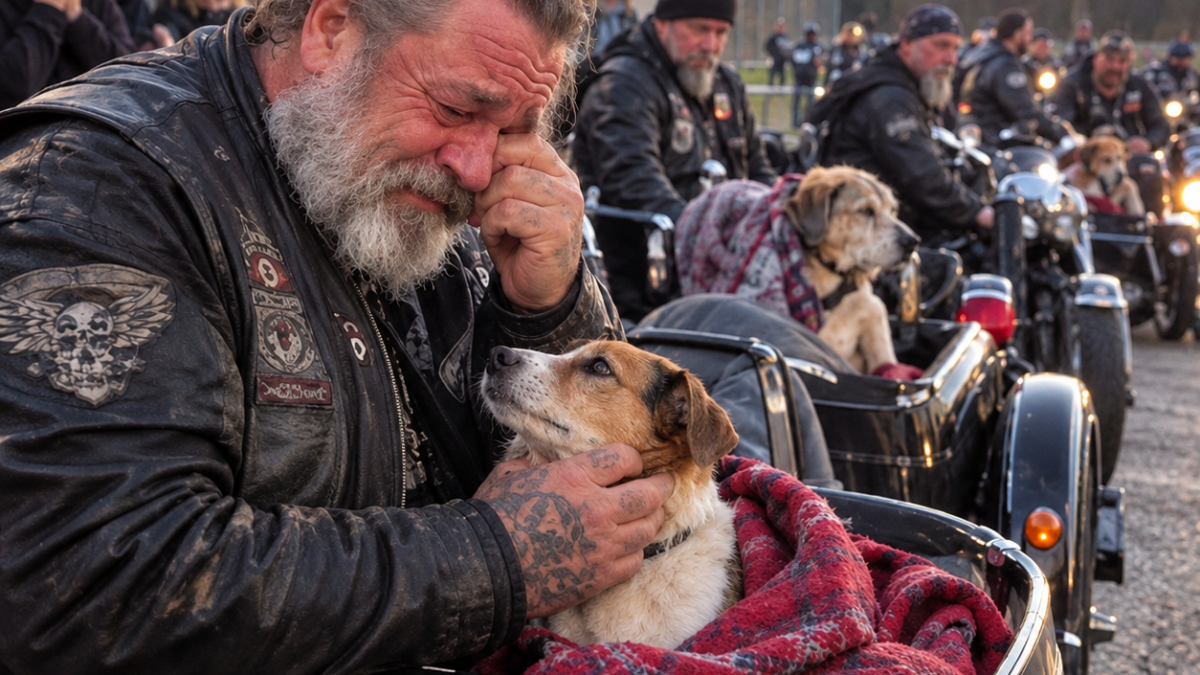
PART 2
For several seconds, I couldn’t speak.
I just stared at the photograph.
Biscotte.
Same crooked ear.
Same white patch under the chin.
Same ridiculous little brown spot over his left eye that made him look permanently suspicious of the world.
I had seen that dog asleep on a hospital blanket.
I had watched him lick soup from my fingers because his owner was too weak to feed him.
I had promised that owner—my friend Michel—that Biscotte would never be abandoned.
Yet there he was.
Kennel 17.
Municipal shelter.
Three days from whatever “classification according to available capacity” really meant.
Claire leaned forward.
“Raymond?”
I looked at the intake date.
“Why didn’t anyone call me?”
“Were you listed as his emergency contact?”
“I was supposed to be.”
She turned the page.
“No.”
I stared at the form.
Owner deceased.
Dog surrendered by property management following apartment clearance.
No family contact provided.
No alternate caretaker listed.
My hands curled into fists.
“That’s impossible.”
“Did Michel have relatives?”
“One sister in Lyon. They barely spoke.”
“Could she have handled the apartment?”
“Maybe.”
Claire waited.
I stood so abruptly my chair scraped backward.
“I was at his funeral.”
“I know.”
“I asked his sister where Biscotte was.”
“What did she tell you?”
“That a neighbor had taken him.”
Claire said nothing.
That silence answered more than words would have.
I took out my phone.
Michel’s sister, Sylvie, answered on the fourth ring.
“Raymond?”
“Where’s Biscotte?”
A pause.
It lasted one second.
Maybe two.
Long enough.
“What?”
“Michel’s dog.”
“Oh.”
“Where is he?”
“I thought someone took care of that.”
“Who?”
“The landlord, perhaps.”
“You told me a neighbor had him.”
“I may have misunderstood.”
My jaw clenched.
“Sylvie.”
She sighed.
“Raymond, I had a funeral, an apartment, paperwork, debts—”
“And a dog your brother loved.”
“I couldn’t take him.”
“I didn’t ask you to.”
“How was I supposed to know you wanted him?”
“I told Michel I would take him.”
“He never wrote that anywhere.”
That hurt because it was true.
Michel and I were the kind of men who trusted handshakes more than paperwork.
Usually, that was enough.
This time, it hadn’t been.
“Which landlord cleared the apartment?”
She gave me the company name.
Before hanging up, she said, “I’m sorry.”
I believed she was.
That didn’t make Biscotte any less alone.
When I returned to Claire’s office, she had forty files spread across her desk.
Forty names.
Forty photographs.
Forty lives summarized into clipped sentences.
**Rex — 11 years — surrendered after owner entered nursing care.**
**Luna — 4 years — stray — fearful of men.**
**Paco — 6 years — three-legged — affectionate.**
**Mona — 9 years — hearing impaired.**
**Thor — 5 years — large breed — no cats.**
**Belle — 2 years — anxious kennel behavior.**
And Biscotte.
I put my finger on his file.
“He comes with me.”
Claire nodded.
“One.”
I looked at the other thirty-nine.
“How many staff do you have?”
“Five today.”
“Volunteers?”
“Seven active.”
“Fosters?”
“Almost full.”
“Other rescues?”
“I’ve called twenty-three.”
“And?”
“Everybody is overwhelmed.”
I leaned against the desk.
“What exactly happens Friday?”
“At six, we close.”
“And the contractor?”
“Truck arrives at seven.”
“A truck?”
Claire looked ashamed even though none of this was her fault.
“They transport animals in secured crates.”
“To where?”
“A holding facility near Orléans first.”
“And then?”
“Some may be redistributed.”
“Some.”
“Yes.”
“What about the others?”
She looked at Biscotte’s photograph.
“You already read the terms.”
I sat back down.
“Who signed this?”
“The intermunicipal council approved the emergency contract.”
“Who pushed it?”
She hesitated.
“Claire.”
“Deputy administrator Vautrin.”
I knew the name.
Bernard Vautrin.
He had spent years managing public works contracts and municipal facilities.
Smooth suits.
Smooth hair.
Smooth voice.
The kind of man who could tell you your house was burning while making it sound like a scheduling adjustment.
“Did he know what the contract allows?”
“Yes.”
“And he still signed?”
“Emergency placement was cheaper than keeping temporary kennels open elsewhere.”
There it was.
Cheaper.
A word that has killed plenty of good ideas and more than a few living things.
“How much time did they give you?”
“Ten days.”
“To place forty dogs?”
“There were fifty-eight originally.”
“You placed eighteen.”
“We tried.”
“And now three days.”
“Yes.”
I looked at the folders again.
“You called the wrong people.”
Claire frowned.
“What?”
“You called shelters.”
“Of course I called shelters.”
“Shelters are full.”
“I know.”
“You need homes.”
“I know that too.”
“No.”
I pointed toward the door.
“You need people with trucks. Vans. trailers. spare rooms. fenced yards. mechanics. carpenters. retired nurses. farmers. pensioners. widowers who complain their houses are too quiet.”
She stared at me.
“You know forty people like that?”
I smiled for the first time.
“I know a lot more than forty.”
I stepped outside and called Jacques.
He answered with an engine roaring behind him.
“Bear?”
“Club meeting tonight.”
“When?”
“Now.”
Silence.
Then, “What happened?”
“Forty dogs.”
“What about them?”
“They run out of time Friday.”
Another pause.
“You need bikes?”
“I need everything.”
Jacques turned off the engine.
“I’ll make calls.”
That was Tuesday afternoon.
By six o’clock, nineteen members of the Asphalt Watchmen were crammed into our clubhouse.
By seven, there were thirty-one.
By eight, people I hadn’t seen in years were standing in the parking lot.
Some weren’t even members.
Word had moved faster than I expected.
Maria arrived in hospital scrubs straight from a twelve-hour nursing shift.
Thomas came from his welding shop with sparks still burned into one sleeve.
A retired trucker named Émile drove forty miles because Jacques had called him.
Sophie, who owned a grooming salon, brought three employees.
And René—seventy-two years old, two artificial knees, still riding a BMW sidecar rig from the 1980s—walked in carrying a notebook.
He looked at me.
“Where are the dogs?”
“Still at the shelter.”
“Good.”
“Why good?”
“Because you people are emotionally unstable and would have brought all forty here without planning.”
He opened his notebook.
“Who has fenced yards?”
That was René.
Never romantic when logistics would work better.
For the next four hours, the clubhouse became an emergency operations center.
One wall became **DOGS**.
Another became **PEOPLE**.
A third became **TRANSPORT**.
We wrote every animal’s needs on sheets of paper.
Large dog.
No cats.
Good with children.
Medical foster.
Quiet home.
Experienced handler.
Senior.
Bonded pair.
Escape risk.
Medication.
We refused to treat the dogs like interchangeable boxes.
That meant we needed more than forty volunteers.
We needed forty appropriate destinations.
Some permanent.
Some foster.
Some rescue transfers with confirmed space.
At midnight, we had twenty-one.
At one in the morning, twenty-seven.
By sunrise Wednesday, thirty-two.
Biscotte’s name was already written beside mine.
I went home at six.
My house had been too quiet since my wife, Isabelle, died four years earlier.
I had told everyone I liked it that way.
That was a lie.
I walked into the kitchen and looked at the empty space beside the radiator.
Michel used to bring Biscotte when he visited.
The dog always slept there.
I suddenly remembered him scratching at my back door because I had refused to share steak.
“Greedy little thief,” I muttered.
Then I looked at the clock.
We still needed eight homes.
At nine, the first problem arrived.
Claire called.
“Raymond, Vautrin knows.”
“Knows what?”
“That your club is organizing placements.”
“Good.”
“No. He’s telling staff nobody leaves without completed authorization.”
“That sounds normal.”
“He means full municipal approval.”
I sat up.
“How long?”
“Normally forty-eight to seventy-two hours.”
“We have less than that.”
“I told him.”
“And?”
“He said procedures can’t be bypassed.”
My blood pressure probably rose twenty points.
“What procedures were they planning to use when the truck arrived Friday?”
“The contractor has blanket transfer authorization.”
“Of course they do.”
“I’m sorry.”
“Don’t be sorry. Send me the adoption requirements.”
“I can’t send internal—”
“Claire.”
She sighed.
“I’ll send the public forms.”
We turned the clubhouse printer into an industrial weapon.
Applications.
Identification copies.
Property confirmations.
Landlord permissions.
Veterinary references.
Every prospective foster or adopter completed paperwork before lunch.
Then we drove it to the municipal office in one stack thick enough to injure somebody.
Bernard Vautrin met me in the lobby.
He was shorter than I remembered.
Late fifties.
Gray suit.
Blue tie.
Perfect little silver glasses.
He looked at the stack.
“What is this?”
“Your paperwork.”
“Excuse me?”
“Forty placement applications.”
His eyebrows lifted.
“All forty?”
“Thirty-four final. Six pending.”
He didn’t touch the folders.
“Mr. Callier, this is not a publicity exercise.”
“Good. I hate publicity.”
“You cannot simply appear with a motorcycle club and distribute municipal animals.”
“We’re not distributing anything.”
“Then what are you doing?”
“Keeping them alive.”
His mouth tightened.
“No animals are scheduled for destruction at the municipal shelter.”
“Nice sentence.”
“It’s accurate.”
“What happens after transfer?”
“That is handled according to the receiving facility’s procedures.”
“Another nice sentence.”
“Mr. Callier—”
“Does the contract guarantee all forty dogs remain alive after transfer?”
He stared at me.
I waited.
People in the lobby began listening.
Vautrin lowered his voice.
“We are not having this discussion here.”
“Then let’s have it upstairs.”
“This is not your jurisdiction.”
“No. It’s my paperwork.”
I placed the stack on a table.
“Stamp it received.”
His jaw tightened.
The receptionist looked between us.
“Mr. Vautrin?”
He gave a tiny nod.
She stamped the first page.
Then the second.
Then all thirty-four packets.
Thunk.
Thunk.
Thunk.
Each sound felt beautiful.
I leaned close enough that only he could hear me.
“You wanted procedures.”
I tapped the stack.
“Now you’ve got procedures.”
That afternoon, six more applications arrived.
Forty dogs.
Forty proposed placements.
But we still had to get them approved.
Wednesday night, Claire called again.
Her voice sounded wrong.
“Raymond.”
“What?”
“They rejected nine.”
“Why?”
“Various reasons.”
“Real reasons?”
“Some.”
“And the others?”
She hesitated.
“One applicant’s fence is twenty centimeters below recommendation.”
“We can fix that.”
“One hasn’t used a veterinarian in five years.”
“He hasn’t owned a dog in six.”
“I know.”
“What else?”
“René.”
“What about René?”
“Age concern.”
I laughed because I thought she was joking.
She wasn’t.
“René is seventy-two.”
“Yes.”
“He walks six kilometers every morning.”
“I know.”
“He has a fenced half-acre.”
“I know.”
“He raised German shepherds for twenty years.”
“I know.”
“Who rejected him?”
“You know.”
Vautrin.
I drove to René’s house.
He was fixing the carburetor on his sidecar motorcycle.
“You heard?” I asked.
He didn’t look up.
“I’m old.”
“You’re seventy-two.”
“That’s old enough to know when someone is being an ass.”
I laughed.
Then he straightened.
“Which dog was mine?”
“Mona. The deaf shepherd.”
He wiped his hands.
“What happens to her now?”
“We appeal.”
“When?”
“Tomorrow.”
“And if they say no?”
I looked at him.
“They won’t.”
He smiled.
“That expression is why people think we’re criminals.”
“They already think that.”
“Fair.”
By Thursday morning, social media had taken over.
We hadn’t planned it.
Sophie posted one photograph.
Not of motorcycles.
Of Mona.
The old shepherd sat behind the bars of her kennel, staring directly into the camera.
Underneath, Sophie wrote:
**She has a home waiting. Paperwork says her adopter may be too old. Her adopter is 72. Mona is 9. Between them, they have enough experience to run the municipality.**
It spread everywhere.
By breakfast, thousands of people had shared it.
By ten, a local reporter called me.
I refused.
By eleven, two reporters were outside the shelter anyway.
Vautrin called.
His voice was ice.
“You’re creating unnecessary public pressure.”
“I posted nothing.”
“Your people did.”
“My people?”
“The motorcycle group.”
“You mean citizens.”
“This situation requires calm.”
“So approve the dogs.”
“Applications require review.”
“You reviewed René fast enough to reject him.”
“Mr. Callier—”
“What exactly scares you about a retired mechanic with a fenced yard?”
He hung up.
At noon, René was approved.
Eight other rejected applications were reopened.
We fixed the low fence.
We obtained a veterinarian letter for another family.
A landlord sent written permission for a tenant.
One dog originally assigned to a home with two cats was rematched when Claire warned us he had shown strong prey drive.
This wasn’t a stunt.
That mattered to me.
If we rushed dogs into the wrong homes just to beat a deadline, we could create forty new problems.
So we slowed down where it mattered and fought where bureaucracy was simply wasting time.
By Thursday evening, thirty-eight placements had final approval.
Two did not.
Thor, the mastiff mix.
And a nervous white-and-brown female named Poppy.
Thomas wanted Thor.
The municipality objected because Thomas lived above his welding shop and the attached yard was technically classified as commercial property.
Maria wanted to foster Poppy.
They objected because her work schedule included night shifts.
I sat at the clubhouse staring at the board.
Forty names.
Thirty-eight green marks.
Two red.
Jacques stood beside me.
“We need backups.”
“I know.”
“What about the farm?”
“No livestock-tested history.”
“Sophie?”
Three dogs already.
“Me?” Jacques asked.
“Your landlord permits one dog.”
“I already have one.”
“Exactly.”
He rubbed his face.
“What time’s the transfer truck?”
“Seven tomorrow evening.”
“So we’ve got twenty-four hours.”
My phone rang.
Claire.
I answered immediately.
“Tell me something good.”
“I can’t.”
I stood.
“What happened?”
“The truck’s coming early.”
“How early?”
“Six tomorrow morning.”
For a moment, I thought I had misunderstood.
“Morning?”
“Yes.”
“They moved it thirteen hours?”
“Yes.”
“Why?”
“Administrative convenience.”
I looked at Jacques.
He saw my face.
“What?”
I put Claire on speaker.
“Say it again.”
“The contractor’s arriving at six in the morning.”
Jacques swore.
“When did they decide that?”
Claire said, “The email was sent twenty minutes ago.”
“Who approved it?” I asked.
She didn’t answer.
She didn’t need to.
Vautrin.
Thirty-eight dogs had places.
Two still did not.
And our deadline had just moved to dawn.
That was when things changed.
Until then, I had been angry.
Now I was furious.
Not motorcycle-movie furious.
Not punch-somebody furious.
Real furious.
The kind that makes you become extremely organized.
“Call everyone,” I told Jacques.
“How many?”
“All of them.”
“Tonight?”
“Tonight.”
I called Maria.
“You still want Poppy?”
“Yes.”
“Even with night shifts?”
“My mother lives downstairs. She agreed to cover nights.”
“Get that in writing.”
“Already did.”
I smiled.
“Good.”
Thomas answered before the first ring finished.
“Thor?”
“Yes.”
“What do they want now?”
“A residential address.”
“I’ve got one.”
“You live above the shop.”
“I own my mother’s old house.”
“You told me it was empty.”
“It is.”
“Fenced?”
“Two acres.”
“Why didn’t you put that on the application?”
“Because I live above the shop.”
“Tonight you don’t.”
He laughed.
“Understood.”
By nine, both updated files were submitted electronically.
Vautrin’s office closed at five.
No one answered.
Claire tried the emergency number.
Nothing.
At ten, our club’s attorney—yes, we had one, mostly because motorcycles and insurance companies have a complicated relationship—called me back.
Her name was Élodie Perrin.
I explained everything.
She asked one question.
“Does the closure order require dogs to be transferred specifically to that contractor?”
“No.”
“Does it require the building to be empty?”
“Yes.”
“Are approved private placements allowed before closure?”
“Yes.”
“Then for the thirty-eight already approved, release is lawful.”
“What about the other two?”
“If their revised applications are not processed, that’s more complicated.”
“Can Vautrin refuse to process them by moving the transfer earlier?”
“I can’t prove motive.”
“Neither can I.”
“Document everything.”
I hated those words.
They usually mean the exciting part is over and paperwork has begun.
This time paperwork was our weapon.
Every email.
Every timestamp.
Every application.
Every unanswered phone call.
At eleven, Sophie asked, “Why motorcycles?”
I looked up.
“What?”
“We have vans.”
“Yes.”
“We have cars.”
“Yes.”
“So why is everyone talking about sidecars?”
René answered from across the room.
“Because people ignore vans.”
Everyone looked at him.
He shrugged.
“They don’t ignore forty motorcycles.”
That old man was right.
We had sidecars available through members, friends, collectors, touring clubs, and two ridiculous vintage enthusiasts who drove overnight from Poitiers.
Not every dog would ultimately travel in a sidecar for long-distance transport. Some medically fragile dogs would leave in vans.
But every dog could be photographed sitting beside the person taking responsibility for them.
Forty bikes.
Forty dogs.
No confusion about whether anyone had been left behind.
At midnight, I made the decision.
“We meet at four-thirty.”
Jacques grinned.
“Outside the shelter?”
“Two streets over. Engines off.”
“Why engines off?”
“Because there are dogs sleeping.”
The room went quiet.
Then Maria smiled.
“That might be the most responsible thing you’ve ever said.”
At three forty-five Friday morning, I woke after maybe forty minutes of sleep.
Biscotte’s old red collar sat on my kitchen table.
I had found it in a box of Michel’s belongings months earlier.
His sister had mailed the box after the funeral.
I never understood why the collar was inside.
Now I did.
Biscotte had probably been wearing a different one when the apartment was cleared.
I put the collar in my jacket pocket.
At four-twenty, I turned onto the industrial road near the shelter.
Motorcycles were already arriving.
One by one.
Headlights in the dark.
No roaring engines.
No theatrics.
Just men and women parking quietly.
Jacques.
Maria.
Thomas.
René.
Sophie.
Émile.
People from three different clubs.
Two independent riders.
A postal worker.
A firefighter.
A schoolteacher who rode a Honda with a sidecar decorated in tiny sunflowers.
A seventy-year-old widow named Hélène who had driven ninety minutes because she had applied for Rex, the old black Lab.
She climbed off her bike and said, “If anybody calls me too old, I’m biting them.”
René pointed at her.
“That’s why I like her.”
At four forty-five, we counted.
Thirty-nine motorcycles.
“Who’s missing?” I asked.
Jacques checked the list.
“Mathieu.”
“What dog?”
“Paco.”
Three-legged small breed.
I called him.
No answer.
Again.
Nothing.
At four fifty-three, headlights appeared.
A tiny Citroën.
Not a motorcycle.
Mathieu stepped out wearing jeans and a sweater.
I stared at him.
“Where’s your bike?”
“Transmission died.”
“You’re a mechanic.”
“I know. That’s how I know it’s dead.”
“Sidecar?”
“In the trailer.”
He opened the rear hatch.
Folded wheelchair ramp.
Blanket.
Harness.
Everything ready.
“I wasn’t missing this.”
“Fine.”
“You’re angry?”
“I’m always angry.”
“Good.”
Thirty-nine motorcycles and one car.
Then René said, “No.”
“What?”
“He wants forty motorcycles.”
“Who?”
He pointed at me.
“You.”
“My bike is here.”
“That makes thirty-nine.”
I recounted.
He was right.
One applicant wasn’t a rider.
Hélène grinned.
“My grandson.”
Ten minutes later, a young man rode up on a borrowed Royal Enfield with an empty sidecar.
Forty.
At five fifteen, Claire unlocked the shelter.
She stopped when she saw us.
In the faint blue light before sunrise, forty motorcycles lined the street.
Some chrome.
Some black.
Some ancient.
Some modern.
All quiet.
Claire pressed both hands over her mouth.
“Oh my God.”
I walked toward her.
“No.”
She looked at me.
“No God.”
I pointed down the line.
“Mechanics.”
She laughed and cried at the same time.
“Come inside.”
The shelter staff had prepared every dog.
Medical records in envelopes.
Medication labeled.
Food portions packed.
Leashes.
Harnesses.
Microchip information.
Emergency contacts.
I went straight to kennel 17.
Biscotte stood at the back.
He saw me.
Did nothing.
I crouched.
“Hey, old man.”
His ears shifted.
I opened my jacket and took out Michel’s collar.
Biscotte stared at it.
I held it through the bars.
He came forward slowly.
Sniffed once.
Then again.
His entire body changed.
His tail moved.
Not much.
One inch.
Then faster.
He pressed his nose against the collar.
I closed my eyes.
“Yeah,” I whispered. “You remember.”
Claire opened the kennel.
Biscotte stepped out.
He sniffed my boots.
Then my jeans.
Then stopped.
I put the old collar around his neck.
The buckle still fit on the loosest hole.
He looked toward the hallway.
For one stupid second, I expected Michel to appear.
Instead, Biscotte looked at me.
“You ready?”
He leaned against my leg.
That was my answer.
At five thirty-eight, the first dog came outside.
Rex.
Hélène waited beside her sidecar.
The old Lab stopped at the doorway.
Maybe he hadn’t been outside that building in weeks.
Hélène knelt painfully.
“Take your time.”
Rex sniffed her hand.
She touched his cheek.
“Me too, sweetheart.”
He climbed into the sidecar with help.
A blanket went over him.
Next came Mona.
René stood straighter than I’d seen him stand in years.
The deaf shepherd couldn’t hear him, so he crouched where she could see his face.
He tapped his chest.
Then pointed toward her.
Then toward the sidecar.
Mona studied him.
Walked past him.
Sniffed the motorcycle.
Then climbed in by herself.
René looked offended.
“I could have helped.”
Maria brought Poppy out.
Her final approval had arrived at five twenty-nine.
Eleven minutes before.
The shelter employee who processed it remotely was apparently a woman named Sandrine who had seen Sophie’s post, woken at five, logged in from home, and completed the review.
Poppy trembled so hard the blanket shook.
Maria sat on the pavement beside her.
No touching.
No pulling.
Just waiting.
Poppy finally crept close enough to sniff Maria’s knee.
Maria whispered, “I work nights, sweetheart. So do half the good people in this world.”
Thomas’s approval for Thor arrived at five thirty-four.
He read the email and yelled so loudly three dogs barked.
“Sorry!”
Thor came out next.
One hundred-plus pounds of mastiff mix.
He looked at Thomas.
Thomas looked at him.
“Oh, we’re going to need a bigger blanket.”
At five forty-eight, thirty-one dogs were outside.
At five fifty-four, thirty-seven.
At five fifty-seven, forty.
Biscotte came last.
Not because his paperwork was late.
Because I wanted Claire to walk him out.
She had cared for him when nobody else had.
She deserved that moment.
She held the leash.
Biscotte wore Michel’s collar and the red shelter blanket.
When he crossed the threshold, Claire stopped.
“You’re the last one.”
Her voice broke.
“Do you understand?”
Biscotte looked at her.
“Everybody made it.”
That was when the bakery woman stopped with her baguette.
That was when the students raised their phones.
That was when the delivery driver rolled down his window.
And that was the moment the street became silent.
Forty dogs outside.
Forty placements.
Forty names crossed off the shelter board.
No truck required.
I lifted Biscotte into my sidecar.
He immediately tried to climb back out.
“Absolutely not.”
He tried again.
“You’re eight years old. Act your age.”
Jacques laughed.
“Coming from you?”
Then headlights appeared at the end of the road.
Large vehicle.
White cab.
Box body.
The transfer truck.
It was early.
Five fifty-nine.
It pulled up behind the motorcycles.
The driver climbed down and stared.
“What the hell?”
I walked toward him.
“You’re here for the dogs?”
“Yes.”
“None left.”
He looked at the shelter.
Then at the bikes.
“All of them?”
“All forty.”
His face changed from confusion to annoyance.
“I have a transport order.”
Claire stepped forward.
“They’ve been lawfully released.”
“I was told forty animals.”
“You were told wrong.”
The driver called somebody.
I didn’t need to guess who.
Two minutes later, my phone rang.
Vautrin.
I answered.
“Morning.”
“What have you done?”
“Drank terrible coffee.”
“Do not play games with me.”
“Then don’t ask vague questions.”
“You have interfered with an authorized transfer.”
“No.”
“Return the animals.”
I looked around.
Rex was asleep.
Mona sat beside René.
Thor had somehow stolen Thomas’s glove.
Biscotte was staring at me.
“No.”
“Mr. Callier, those dogs remain under municipal authority until—”
Claire interrupted loudly enough for the phone to pick up.
“Thirty-eight are fully released. Two final approvals were completed this morning.”
Silence.
Vautrin said, “By whom?”
“Authorized staff.”
Another silence.
Then:
“No one leaves.”
I smiled.
“You should come tell them.”
“What?”
“The dogs.”
I hung up.
At six twelve, a municipal sedan arrived.
Vautrin got out.
No tie this time.
Coat thrown over yesterday’s shirt.
He looked furious.
He marched toward Claire.
“This is unacceptable.”
She stood her ground.
“What is?”
“This spectacle.”
“These are adoptions and foster transfers.”
“You coordinated a demonstration.”
“I coordinated placements.”
“You had no authorization to stage vehicles—”
“They’re parked legally.”
He turned toward me.
“You manipulated the process.”
I held up my phone.
“We submitted forty applications.”
“You pressured staff.”
“We asked them to do their jobs before the deadline you moved.”
His eyes flashed.
“The transfer schedule was an operational decision.”
“Made twenty hours before pickup?”
“Yes.”
“After thirty-eight applications were approved?”
His mouth closed.
That was the first mistake he made.
The reporter standing across the street heard it.
She stepped closer.
“Mr. Vautrin, was the pickup time changed after most private placements had already been approved?”
He turned.
“Who are you?”
“Claire Dumont, *La Nouvelle République*.”
Perfect.
Wrong Claire.
Right question.
Vautrin’s expression changed immediately.
“This is an administrative matter.”
“Why was the transfer moved from seven p.m. to six a.m.?”
“I’m not discussing internal scheduling.”
“Were the animals scheduled for euthanasia?”
“No animals were scheduled for euthanasia at this shelter.”
I almost laughed.
Same sentence.
The reporter didn’t let him escape.
“What about after transfer?”
Vautrin looked at the truck.
Then at the camera.
“That would depend on receiving-facility assessments.”
“And capacity?”
He said nothing.
She asked again.
“Was continued placement guaranteed?”
“No.”
That answer changed everything.
The woman with the baguette stopped pretending not to listen.
The students lowered their phones.
Even the truck driver looked uncomfortable.
The reporter asked, “How many of these forty dogs had confirmed homes or fosters before the transfer time was changed?”
Claire answered.
“Thirty-eight.”
Vautrin snapped, “You are not authorized to disclose—”
Claire looked directly at him.
“Thirty-eight.”
The reporter wrote it down.
I didn’t smile.
This wasn’t a victory yet.
Because public embarrassment makes some people reconsider.
It makes others retaliate.
Vautrin belonged to the second group.
He turned to Claire.
“You’re suspended pending review.”
The street went silent.
Claire blinked.
“What?”
“You released animals during an active administrative dispute and shared internal operational information.”
“They had approved release forms.”
“You will surrender your keys.”
My hands clenched.
Claire saw it.
She looked straight at me.
“Raymond.”
One word.
Don’t.
She knew me well.
I stepped back.
Vautrin held out his hand.
Claire removed the shelter keys from her belt.
She placed them in his palm.
Then she walked inside.
The staff followed.
For a moment, Vautrin looked satisfied.
Then he heard something.
One motorcycle engine.
René started his bike.
Then Hélène.
Then Maria.
Then Thomas.
Then Jacques.
Then forty engines came alive one after another.
Not revving.
Not threatening.
Just starting.
A deep rolling sound filling the street.
Vautrin stood there while forty dogs left under forty blankets.
Biscotte pressed himself low in my sidecar.
I rested one hand on his shoulder.
“You’re okay.”
We pulled away.
The strange thing is, I thought that would be the end.
Forty dogs safe.
Shelter empty.
Mission accomplished.
I was wrong.
The real fight started that afternoon.
At two, Sophie called.
“Turn on the news.”
“I hate the news.”
“Turn it on.”
A local television report showed the motorcycles leaving the shelter.
The headline underneath read:
**BIKERS EMPTY CLOSING SHELTER HOURS BEFORE ANIMAL TRANSFER**
Then came an interview with Vautrin.
He said the municipality had always intended to prioritize rehoming.
He said emergency transport had only been a contingency.
He said “outside activists” had created confusion around a responsibly managed closure.
Outside activists.
I was eating a ham sandwich.
I nearly choked.
Then he said something worse.
“Some placements may now require additional review because we must ensure enthusiasm has not replaced animal welfare.”
I stopped chewing.
That was a threat.
If he couldn’t stop the dogs from leaving, he could challenge the homes afterward.
My phone rang before the report ended.
Élodie.
“I saw it.”
“Can he take them back?”
“Not arbitrarily.”
“What does ‘additional review’ mean?”
“It means document everything.”
“There are those words again.”
“Raymond.”
“I know.”
“Every dog. Every location. Every vet appointment. Every foster agreement. No shortcuts.”
“We already planned that.”
“Plan harder.”
We did.
For the next week, the Asphalt Watchmen became the most annoying rescue organization in France.
Not officially.
We weren’t licensed for that.
But we built records like one.
Every dog received a veterinary exam.
Every adopter sent photographs.
Every foster completed daily notes.
We created emergency contacts.
We collected receipts.
Medication logs.
Fence measurements.
Home photographs.
Microchip transfers.
Behavior updates.
If Vautrin wanted to prove we were irresponsible, he was going to need a microscope.
Biscotte came home with me that first night.
He refused to enter the house.
I opened the front door.
He stood on the step.
“Come on.”
Nothing.
I walked inside.
He stayed outside.
I put food near the doorway.
He ate without crossing.
For fifteen minutes, I sat on the kitchen floor pretending I didn’t care.
Eventually one paw entered.
Then another.
He sniffed everything.
The table legs.
The cabinet.
The old chair where Michel used to sit.
When he reached the radiator, he froze.
That was his old place.
He sniffed the floor.
Turned twice.
Lay down.
I sat beside him.
“Yeah.”
My throat tightened.
“You remember this too.”
He slept for eleven hours.
The next morning, I woke with a weight against my bedroom door.
Biscotte.
Curled outside.
Michel had told me he did that.
Guarded doors.
I opened it.
He looked up.
“Your old man isn’t here.”
His tail moved weakly.
“But I am.”
That became our arrangement.
The first follow-up inspection happened three days later.
Two municipal officers arrived.
Professional.
Polite.
Clipboard.
Biscotte hated them immediately.
He barked from behind my leg.
One officer smiled.
“That’s encouraging.”
“Why?”
“He was withdrawn at the shelter.”
“He’s found opinions.”
They checked the yard.
Food.
Water.
Sleeping area.
Identification.
Vet report.
Then one officer looked at the old collar.
“Is that his original?”
“Yes.”
“Interesting.”
“Why?”
“His shelter file said he arrived without one.”
I thought about the box from Michel’s apartment.
Not important.
Not yet.
They approved the placement.
The other homes passed too.
All but one.
Thor.
Thomas called me.
“They’re challenging him.”
“Why?”
“He chewed a door.”
I waited.
“That’s it?”
“A metal fire door.”
I laughed.
Thomas didn’t.
“He was alone forty minutes.”
“Separation anxiety.”
“Obviously.”
“What are they saying?”
“That the placement may be unsuitable.”
“Get Sophie.”
Sophie came with a behaviorist.
Thor wasn’t dangerous.
He was terrified when left alone.
The shelter records showed it.
We developed a plan.
Short absences.
Crate conditioning only if comfortable.
Chew-resistant safe room.
Camera.
Enrichment.
Veterinary evaluation.
Thomas changed his work schedule.
His mother came during the day.
Thor stopped eating doors.
Placement approved.
Every attempt to paint the rescues as reckless failed.
Then Claire called.
She had been officially dismissed.
I stood in my garage with the phone against my ear.
“For what?”
“Gross insubordination.”
“You saved forty dogs.”
“I apparently damaged public confidence.”
I laughed without humor.
“They damaged public confidence.”
“Raymond.”
“What do you need?”
“Nothing.”
“That wasn’t the question.”
She sighed.
“I have savings.”
“You have a lawyer?”
“No.”
“You do now.”
“I can’t afford Élodie.”
“I didn’t ask if you could.”
“No.”
“Claire.”
“No club money.”
I smiled.
“You think we’re that organized?”
“You just documented forty canine bowel movements for legal defense.”
“Fair point.”
Élodie took Claire’s case at a reduced rate.
Not free.
Claire wouldn’t allow that.
For two weeks, nothing happened.
Then a brown envelope arrived at the clubhouse.
No return address.
Inside were photocopies.
Invoices.
Emails.
Contract drafts.
I read them twice.
Then I called Élodie.
“You need to see this.”
“Where did it come from?”
“I don’t know.”
“Do not send it electronically.”
“Why?”
“Because anonymous internal documents can create problems.”
“What kind?”
“The kind where you don’t know whether they’re authentic, altered, privileged, illegally obtained, or bait.”
I hated competent lawyers.
They ruin dramatic moments.
We met at her office.
She reviewed the pages.
One document showed the emergency animal-transfer contract.
Cost per animal.
Transport.
Intake fee.
Daily holding fee.
Behavioral evaluation fee.
Additional veterinary charges.
Another showed communications between Vautrin’s office and the contractor.
The earliest email was dated almost six weeks before the shelter closure announcement.
That caught my attention.
The public had been told the closure became necessary after an urgent electrical inspection.
But negotiations with the receiving contractor had begun long before that inspection.
Élodie pointed at the date.
“This does not prove anything improper.”
“It proves they knew.”
“It proves they discussed contingency planning.”
I frowned.
“You lawyers can make a bullet wound sound like a weather event.”
She ignored me.
Then she found another email.
I watched her expression change.
“What?”
She turned the page.
An internal note from the contractor:
**Projected intake: 45–60 animals. Capacity limitations may require accelerated disposition after statutory assessment period.**
I knew what accelerated disposition meant.
“Keep reading.”
Another email from Vautrin:
**Municipality understands receiving facility will exercise discretion following intake. Priority is guaranteed vacation of premises by contractual deadline.**
Vacation of premises.
The phrase made me sick.
“Can we use this?”
“Not yet.”
“Why?”
“Authentication.”
“How?”
“Claire’s employment case allows disclosure requests. A journalist may also make public-record requests for municipal contracting documents.”
I thought of the reporter.
Claire Dumont.
Élodie saw my face.
“Do not leak anonymous documents to her.”
“I wasn’t going to.”
“You absolutely were.”
“I was considering responsible citizenship.”
“You were considering revenge.”
Maybe.
I won’t pretend I was noble every second.
I wanted Vautrin embarrassed.
I wanted him to experience one morning of helplessness.
I wanted him to look at forty names and understand what his “operational decisions” had nearly done.
But Élodie was right.
Anger makes you sloppy.
Facts make you dangerous.
So we waited.
The reporter filed requests.
Claire appealed her dismissal.
And something unexpected happened.
The forty dogs began becoming a story larger than the shelter.
Hélène sent me a picture of Rex asleep upside down on her couch, all four legs in the air.
Caption:
**HE HAS CONTRIBUTED NOTHING TO THE HOUSEHOLD. PERFECT RETIREMENT.**
René taught Mona hand signals.
Come.
Stay.
Food.
Walk.
Motorcycle.
The last one wasn’t standard.
Maria discovered Poppy loved laundry baskets.
Not blankets.
Not expensive dog beds.
Laundry baskets.
Thomas bought Thor a reinforced chew toy rated for “extreme power chewers.”
Thor destroyed it in seventeen minutes.
Paco, the three-legged dog, became Mathieu’s shadow.
The mechanic built him a little ramp into the Citroën.
Luna, who had been terrified of men, chose Jacques.
Of course she did.
The biggest, loudest man besides me.
For two weeks she wouldn’t approach him.
He sat on the floor every night reading motorcycle manuals aloud.
One evening she put her head on his knee.
He called me crying.
He denies this.
He was crying.
Even Biscotte changed.
At first, he slept by the radiator.
Then closer to my chair.
Then beside the couch.
Three weeks after he came home, I woke at two in the morning because something heavy landed on my chest.
Biscotte.
He weighed maybe twenty pounds.
He stared at me.
“What?”
He sneezed.
“Get down.”
He lay down.
“I said down.”
He closed his eyes.
That dog had belonged to my best friend.
Now apparently he owned me.
A month after the rescue, Claire Dumont’s article appeared.
She had obtained municipal emails through records requests.
Not the anonymous packet.
Official copies.
Authenticated.
The article didn’t scream.
It didn’t need to.
The timeline did the work.
The municipality had known for months that the shelter building required major repairs.
Temporary relocation options had been proposed.
One option involved modular kennels on county property.
Another involved dividing animals among four regional rescue partners with subsidies.
Both cost more than the contractor transfer.
Vautrin repeatedly argued for the lowest-cost solution.
Nothing illegal about that.
Then came the problem.
Several rescue partners had offered partial capacity.
Those offers had not been fully pursued.
One organization said it could take twelve dogs with a ten-day extension.
The extension was rejected.
Another offered space for seven if the municipality paid vaccinations.
Rejected.
Then the contractor offered immediate bulk intake.
Accepted.
The article quoted the contract language about post-intake discretion.
Public reaction exploded.
People weren’t angry because every animal transferred there would necessarily have died.
That would have been false.
Many would likely have been rehomed.
People were angry because nobody could say which ones.
And because safer alternatives had been abandoned for cost and convenience.
Vautrin responded publicly.
He said decisions were made under difficult financial constraints.
That was true.
He said no outcome for any individual animal could be predicted.
Also true.
Then he blamed “misinformation propagated by activist groups.”
Bad choice.
Because Sophie had kept receipts.
She posted our timeline.
Applications.
Approval timestamps.
The transfer schedule change.
The final two approvals.
No insults.
No threats.
Just facts.
Within twenty-four hours, the intermunicipal council announced an independent review.
Vautrin was placed on administrative leave.
When Jacques heard, he raised a beer.
“To revenge.”
I shook my head.
“No.”
He looked disappointed.
“To accountability?”
“Boring.”
René lifted his glass.
“To paperwork.”
Everybody groaned.
But he was right.
Paperwork had beaten them.
The review took three months.
Claire’s dismissal was overturned before it finished.
The council found her suspension disproportionate.
She received back pay.
They offered to return her to municipal animal services.
She surprised everyone.
“No.”
I stared at her.
“You fought for the job.”
“I fought the firing.”
“Difference?”
“A big one.”
She looked at the old shelter building.
Repairs had begun.
“I don’t want to spend the next ten years begging administrators to care.”
“What will you do?”
She smiled.
“I have an idea.”
That sentence cost me a year of my life.
Her idea became **Forty Roads Rescue**.
The name came from the forty motorcycles.
Not a shelter exactly.
A foster-based network.
Emergency transport.
Senior-dog placement.
Temporary boarding for owners hospitalized unexpectedly.
A specific program for pets belonging to people entering nursing homes or end-of-life care.
That last part mattered to me.
Too many dogs like Biscotte ended up lost because promises were spoken but never written.
We created something called a Pet Continuity Card.
Simple.
Owner name.
Pet name.
Emergency caregiver.
Backup caregiver.
Veterinarian.
Medication.
Legal authorization.
One copy at home.
One in a wallet.
One with the emergency caregiver.
Michel would have laughed at me.
“Paperwork, Bear?”
Yes.
Paperwork.
Because love without a plan can still fail.
I learned that the hard way.
The independent review eventually found no evidence that Vautrin personally profited from the transfer contract.
That mattered.
Rumors online had accused him of taking kickbacks.
Those rumors were unsupported.
I refused to repeat them.
What the review did find was bad enough.
He had concentrated decision-making.
He had not adequately documented why lower-risk alternatives were rejected.
He had accelerated the transfer schedule while adoption applications were still active.
And his department had placed cost and building-vacation deadlines above individualized animal-placement considerations.
The council terminated his appointment.
The contractor agreement was canceled.
New emergency-closure rules were written.
Any future shelter closure had to include:
A minimum public placement period when feasible.
Formal outreach to regional rescues.
Written evaluation of alternatives.
Individualized animal plans.
Independent veterinary input where euthanasia might become a possibility.
And public reporting afterward.
Was that revenge?
Maybe not the kind people imagine.
Nobody punched anybody.
No motorcycle gang surrounded Vautrin’s house.
Nobody threatened him.
Nobody destroyed his career with lies.
We did something much more effective.
We made the truth impossible to hide.
Six months after the rescue, I saw Vautrin once.
I was outside a hardware store buying lumber for new kennels at Forty Roads.
He was getting into a car.
He saw me.
I saw him.
For a moment, neither of us moved.
Then he walked over.
I expected anger.
Instead, he looked tired.
“Mr. Callier.”
“Mr. Vautrin.”
“I suppose you’re pleased.”
I thought about it.
“About what?”
“You won.”
“That’s not how I see it.”
He laughed bitterly.
“Of course not.”
“You want to know what winning looked like?”
He said nothing.
“Rex asleep on a couch.”
His expression shifted.
“Mona learning hand signals.”
I continued.
“Poppy stealing laundry. Thor eating Thomas’s door. Paco riding around in a Citroën like he owns France.”
Vautrin looked away.
“And Biscotte?”
That surprised me.
“You remember him?”
“Small terrier.”
“Lives with me.”
He nodded.
I could have walked away.
Instead I asked, “Did you ever go inside the kennels?”
He looked at me.
“During the closure?”
“Yes.”
“No.”
There it was.
Not evil.
Distance.
Sometimes that is enough.
“You should have,” I said.
He didn’t argue.
Then he said something I never expected.
“I thought the contractor was a practical solution.”
“I know.”
“I did not want animals killed.”
“I know that too.”
“But I knew it was possible.”
I waited.
“And I told myself it wasn’t my decision once they left.”
His voice had changed.
Quieter.
“That was convenient.”
“Yes.”
We stood there beside a shopping cart full of lumber.
Finally, he asked, “Do you hate me?”
I thought about Friday morning.
Claire losing her keys.
The transfer truck.
Biscotte trembling.
Then I thought about what hate would accomplish.
“No.”
He seemed surprised.
“I was furious with you.”
“Were?”
“I don’t have the energy to hate everyone who makes a terrible decision.”
He nodded slowly.
“What should I have done?”
That question came too late.
But I answered.
“You should have looked at the dogs before you turned them into numbers.”
He stared at me.
Then walked away.
I never saw him again.
A year passed.
Forty Roads Rescue grew.
Too quickly.
Claire complained constantly.
“We need money.”
“We have money.”
“No, we have motorcycle people who keep buying dog food and forgetting electricity costs money.”
“Same thing.”
“It is absolutely not the same thing.”
We held a fundraiser.
Five hundred people came.
Most wanted to see the original forty dogs.
Not all could attend.
Some had anxiety.
Some lived far away.
But twenty-six came.
Rex arrived wearing a ridiculous bow tie.
Mona rode beside René.
Paco had a tiny leather vest Mathieu swore he had not purchased.
Thor arrived in a van because Thomas had finally admitted that a mastiff-sized dog in a sidecar looked unsafe.
Poppy came wearing nothing because Maria refused to “dress a grown woman like a doll.”
Biscotte sat beside me.
He had gained three pounds.
His coat shone.
He still slept against the radiator.
Still hated rain.
Still attacked the vacuum cleaner.
During the event, a little boy approached.
Maybe seven.
He looked at Biscotte.
“Is that the famous one?”
I laughed.
“They’re all famous.”
“My mom said he belonged to your friend.”
“He did.”
“Did your friend die?”
Children don’t decorate hard questions.
“Yes.”
“Was the dog sad?”
I looked at Biscotte.
“He was.”
“Is he still sad?”
I started to answer.
Then Biscotte rolled onto his back and demanded that the boy scratch his stomach.
The boy giggled.
I smiled.
“Not right now.”
That was enough.
Two years after the shelter closed, Hélène called.
Rex was failing.
Fourteen, maybe fifteen.
Arthritis.
Kidneys.
A good long life.
She asked if I would come.
When I arrived, Rex lay on a blanket in her living room.
Hélène sat beside him.
“I thought rescuing him meant giving him years,” she said.
“You gave him two.”
“Only two.”
“To him, they were all he had left.”
She cried.
“I hate this part.”
“Everybody does.”
Rex died peacefully with his head in her lap.
The next day, Hélène called again.
“I want another old one.”
I laughed.
“You said yesterday you’d never do this again.”
“I was emotional.”
“You bit me when I suggested fostering.”
“I remain capable of biting you.”
She adopted a twelve-year-old beagle three weeks later.
That became another lesson.
A rescue does not erase death.
It gives life somewhere safe to reach it.
René and Mona had three years together.
He lost her first.
Then, a year later, we lost René.
At his funeral, his daughter placed a photograph on the table.
René on his motorcycle.
Mona in the sidecar.
Both looking equally stubborn.
His daughter told me, “Dad said those were the best years of his retirement.”
“That sounds like him.”
“He also said you were impossible.”
“That definitely sounds like him.”
The club changed too.
We had started as riders.
Then we became transporters.
Then foster coordinators.
Then emergency builders.
We repaired fences for elderly adopters.
Delivered medication.
Drove dogs to chemotherapy.
Built ramps for arthritic animals.
Sat in parking lots during euthanasia appointments because sometimes people shouldn’t drive home alone.
The leather stayed.
The motorcycles stayed.
But people stopped crossing the street when they saw us.
Sometimes they walked toward us carrying dog food.
Jacques hated that.
“Our reputation is ruined.”
“You cried when Luna touched your knee.”
“That is slander.”
“You called me.”
“I had dust in my eye.”
“Both eyes?”
“Very dusty house.”
Luna remained with him for the rest of her life.
Poppy became Maria’s permanent dog after exactly nine days of “temporary fostering.”
Maria denied this was a foster failure.
“It was a strategic reassignment.”
“Sounds municipal.”
She threw a dog toy at me.
Thomas and Thor became local celebrities after Thor learned to carry a small tool pouch around the welding shop.
He carried no useful tools.
Mostly rubber toys.
But customers loved him.
Paco became Mathieu’s shop dog.
Children from the neighborhood stopped by just to see him hop around the garage.
And Biscotte?
Biscotte stayed with me.
Of course he did.
The first year, he waited at the door whenever I left.
The second year, he stopped.
He finally believed I was coming back.
That hurt more than I expected.
Trust is sometimes measured by whether someone watches the door.
On the third anniversary of the rescue, Claire brought a box to my house.
“What’s this?”
“Archive materials from the old shelter.”
“Why?”
“Open it.”
Inside were intake photographs.
Kennel cards.
Copies of medical records.
At the bottom was Biscotte’s original surrender sheet.
I had seen it before.
But something had been attached.
A plastic evidence sleeve.
Inside was a folded note.
Handwritten.
Michel’s handwriting.
My hands started shaking.
“What is this?”
“Found in an old property envelope during record transfer.”
I opened it.
The note was short.
**If anything happens to me, Biscotte goes to Raymond Callier. He complains about the dog, but they love each other. Raymond knows.**
I sat down.
Claire waited.
I read it again.
Then again.
That bastard.
He had written it.
Just not where anyone useful had found it.
I laughed.
Then covered my face.
Claire sat across from me.
“You okay?”
“No.”
Biscotte climbed beside my chair.
I picked him up.
He hated being picked up.
This time he allowed it.
Michel’s note shook in my hand.
“I thought I failed him.”
Claire understood.
“You didn’t know.”
“I promised.”
“And you found him.”
“Three days before—”
“You found him.”
I looked down.
Biscotte stared back at me.
One folded ear.
Gray muzzle.
Same suspicious face.
“I was late.”
Claire shook her head.
“But not too late.”
That became a sentence I carried for years.
Not too late.
Forty dogs had been almost too late.
Not too late.
Claire had nearly lost her career.
Not too late.
The shelter had closed under rules that treated living animals like inventory.
The rules changed.
Not too late.
Michel had died believing Biscotte had somewhere to go.
For a while, the system lost that promise.
But somehow the dog reached me anyway.
Not too late.
Biscotte lived to about fourteen.
No one knew his exact age.
His final years were gentle.
His hearing faded.
His eyesight weakened.
He developed arthritis.
He stopped attacking the vacuum cleaner because eventually he could no longer hear it.
The day that happened, I almost cried.
My old enemy had surrendered.
Biscotte slept more.
Always near the radiator in winter.
Always by the back door in summer.
And every night, before I went upstairs, I checked him.
“Still here?”
His tail would tap.
“Good.”
One winter morning, he didn’t get up.
I knew before touching him.
Not gone.
Just tired.
Very tired.
The veterinarian found advanced heart failure.
Medication might give us weeks.
Maybe months.
But his breathing was already difficult.
I took him home for one night.
He slept on Michel’s old jacket.
I had kept it in a closet for years.
Around midnight, I sat beside him.
“You know, your first owner ruined my life.”
Biscotte opened one eye.
“He made me promise things.”
Tail tap.
“Then he died.”
Another tap.
“And then you showed up.”
Biscotte exhaled.
I rubbed his ear.
“You did all right.”
He looked toward me.
“I hope I did too.”
The next morning, we went back to the vet.
Claire came.
Jacques.
Maria.
Thomas.
I told them they didn’t need to.
They ignored me.
Motorcycle people are bad at boundaries.
Biscotte lay on the red blanket Claire had used the morning he left the shelter.
She had kept it.
Of course she had.
Before the veterinarian gave the final medication, I took Michel’s note from my pocket.
I read the last line quietly.
**Raymond knows.**
I laughed through tears.
“Yeah.”
I looked at Biscotte.
“I knew.”
His breathing slowed.
I rested my forehead against his.
“You’re not going back in there, old man.”
Those had been the first words I said to him outside the shelter.
They became the last promise I made.
He died with my hand on his chest.
No kennel.
No truck.
No strangers.
Home.
Afterward, I walked outside.
Forty Roads Rescue volunteers were waiting in the parking lot.
I hadn’t invited them.
Someone had told someone.
Then everyone knew.
Motorcycles lined both sides of the road.
Not forty.
More than sixty.
No engines running.
No noise.
Just people.
Maria hugged me.
Jacques put a hand on my shoulder.
Thomas said nothing.
Claire held the empty red blanket.
I looked at all those motorcycles.
And suddenly I was back at the old shelter before sunrise.
Forty empty sidecars.
Forty dogs waiting inside.
A transfer truck coming.
A deadline designed to make living beings disappear neatly from a building.
People later called what we did heroic.
It wasn’t.
We were scared.
Disorganized.
Exhausted.
Two of us got lost on the way to the shelter.
One motorcycle broke down.
Three applications were filled out incorrectly.
Someone bought the wrong size harnesses.
Thor ate a door.
Nothing about it was perfect.
That is the part people misunderstand about rescue.
You do not need perfect people.
You need people who show up before the clock runs out.
Years later, a framed photograph still hangs inside Forty Roads Rescue.
It was taken shortly after sunrise on that first Friday.
Forty motorcycles lined along a narrow street.
Dogs in sidecars.
Blankets everywhere.
Riders looking tired and ridiculous.
In the center, Biscotte sits beside my motorcycle wearing Michel’s old collar.
Under the photograph is a small brass plaque.
Claire chose the words.
Not me.
It reads:
**FORTY DOGS.**
**FORTY RIDES HOME.**
**ZERO LEFT BEHIND.**
Every time I see it, I remember what that government notice said.
**ALL ANIMALS MUST VACATE THE PREMISES.**
They did.
Every single one.
Just not in the way anybody expected.
They left in sidecars.
They left wrapped in blankets.
They left with nurses and mechanics, widows and welders, retirees and truck drivers.
They left with people who had stayed awake all night completing paperwork.
They left with names instead of numbers.
And one small terrier left wearing an old collar that smelled like the man who had loved him first.
For years, people asked me why forty bikers showed up before dawn for dogs most of us had never met.
I used to give complicated answers.
About responsibility.
About bureaucracy.
About animal welfare.
About promises.
Now I answer differently.
Because forty cages were full on Thursday night.
And on Friday morning, forty people decided they shouldn’t be.
Sometimes that is all rescue really is.
Someone looking at a deadline that says **too late**…
and arriving early enough to prove it wrong.
[END OF FULL STORY]








