PART 2: For Three Days, a Stray Dog Guarded a Soaked Cardboard Box—Then I Finally Looked Inside
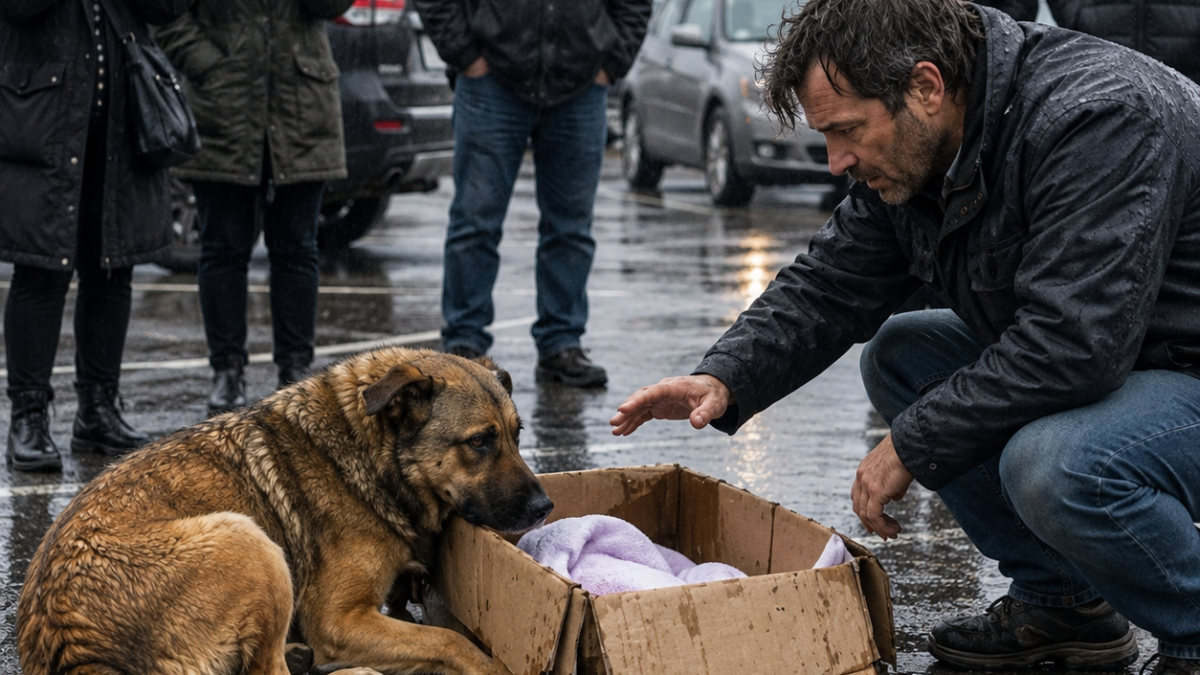
For three days, a brown stray refused to leave a rain-soaked cardboard box in the middle of a supermarket parking lot, and nobody could get close enough to understand why. He never attacked anyone, but every time a stranger stepped toward that box, he silently moved his body between them and whatever was hidden inside. I should have taken my groceries and gone home like everyone else—but then the cardboard moved.
I noticed the dog because nobody around him was talking.
A dozen people stood in a loose circle behind a supermarket outside Lyon, watching an old cardboard box sitting near the edge of the parking lot. Cars rolled past. Shopping carts rattled across the pavement. Automatic doors opened and closed behind us.
Yet around that box, everything felt strangely still.
A medium-sized brown dog lay directly in front of it.
“What happened?” I asked.
An older man holding a grocery bag pointed toward the dog.
“He won’t let anyone near it.”
I looked at the people around us.
“How long has he been here?”
A woman answered, “Since this morning, at least.”
Another man shook his head.
“No. I saw him yesterday.”
Someone farther back said, “A cashier told me he was already here the day before.”
Three days.
That bothered me immediately.
My name is Julien. I was forty-six then, and my own life wasn’t going particularly well. A few months earlier, the small workshop where I had worked for almost fifteen years had closed. Since then, I had been taking temporary jobs whenever I could find them and calculating every expense before paying it.
The plastic bag in my hand contained milk, pasta, two apples, and the cheapest coffee in the store.
I had enough problems.
I didn’t need a strange dog.
But something about him made me stop.
His light-brown coat was filthy and clumped from rain. I could see the outline of his ribs beneath it. His paws were dark with mud, and one ear had an old tear along the edge.
Still, he didn’t look weak.
He looked determined.
He lay in front of the box like a locked door.
Whenever somebody moved closer, he lifted his head.
No barking.
No growling.
No teeth.
Just that stare.
And somehow everyone stepped back.
“Has anyone looked inside?” I asked.
Nobody answered.
That told me enough.
I put my groceries down.
The dog noticed immediately.
His head came up.
I walked forward slowly.
“Easy, buddy.”
I had no idea why I spoke.
Maybe for him.
Maybe for myself.
I crouched several yards away.
The dog didn’t move.
So I edged closer.
This time, he shifted his body.
Only a few inches.
But the movement was deliberate.
He placed more of himself in front of the box.
That was when I understood.
He wasn’t protecting a sleeping place.
He was protecting something.
I stopped.
“Okay.”
His eyes remained fixed on me.
“I get it.”
A few people behind me started whispering.
Someone said animal control had been called.
Someone else said they would probably use a catch pole.
The thought made my stomach tighten.
Not because the dog didn’t need help.
He clearly did.
But rushing him seemed wrong.
I lowered myself all the way onto the pavement.
The dog watched.
I waited.
Five minutes.
Ten.
My groceries were still sitting behind me.
The coffee could wait.
For some reason, so could everything else.
I talked quietly.
Not commands.
Just words.
“I’m not taking it.”
The dog blinked.
“You’ve been here three days?”
His ears moved.
“That’s a long time.”
A woman brought me a bottle of water.
I poured some into an empty plastic container and slid it toward him.
He didn’t touch it.
He wouldn’t leave the box.
I moved back.
Eventually he stretched his neck and drank without standing.
Then he returned his chin to his paws.
Twenty minutes passed.
I managed to move closer.
Then another few feet.
The dog’s body tightened every time I crossed an invisible boundary, and each time I stopped until he relaxed again.
By the time I was only six or seven feet away, I could smell wet cardboard and old rainwater.
Then something happened.
The corner of the box lifted.
Barely.
I froze.
The dog saw my expression change and immediately rose onto his elbows.
The cardboard settled.
For a second, I convinced myself it had been the wind.
There was almost no wind.
Then the box moved again.
This time from the inside.
A soft scraping sound followed.
Something alive was beneath those wet cardboard flaps.
The dog slowly stood and placed his entire body between me and the box.
And that was when I realized he had not spent three days waiting for someone to rescue him.
He had spent three days waiting for someone he trusted enough to finally show them what he had refused to abandon.
PART 2
I stayed where I was.
The dog was standing now, legs stiff, head low, body angled across the front of the box. He still wasn’t growling. Somehow that made the warning stronger.
Behind me, the crowd had become completely silent.
I heard someone whisper, “What’s inside?”
“I don’t know.”
That was the truth.
The cardboard shifted again.
A tiny sound came from under one flap.
Not a bark.
Not a meow.
More like a weak scratch followed by a breath.
The dog looked down at the box.
Then at me.
For the first time, his expression changed.
Until then, I had seen suspicion.
Now I saw exhaustion.
“Okay,” I whispered. “I’m not touching it.”
He didn’t move.
I turned slightly toward the people behind me.
“Can somebody call a rescue instead of just animal control?”
A woman immediately pulled out her phone.
Another man said, “Already called.”
“Who?”
“A local association. My sister volunteers there.”
“How long?”
“Fifteen minutes.”
Good.
I could wait fifteen minutes.
The dog had already waited three days.
I looked at the bowl of water.
“You need to drink.”
He watched me.
I slid it another foot closer.
This time he moved.
One careful step.
Then another.
But he kept one rear paw touching the box.
I had never seen anything like it.
He bent his head and drank.
Not much.
Four or five quick laps.
Then he returned to his position.
That gave me a better view of the box.
It was an ordinary produce carton, once probably used for vegetables. Rain had softened the bottom. One side had collapsed inward.
There were holes punched through two of the flaps.
Not accidental tears.
Round holes.
Air holes.
My stomach tightened.
Someone had put something inside that box deliberately.
And if they had made air holes, they knew it was alive.
I said quietly, “You didn’t find this, did you?”
The dog stared.
“You came with it.”
Of course he couldn’t answer.
But suddenly the entire scene felt different.
I had imagined an abandoned dog discovering an animal and deciding to protect it.
Now another possibility appeared.
Someone had abandoned both.
The rescue van arrived eleven minutes later.
Two women stepped out.
One introduced herself as Sophie, the other as Amélie. They didn’t walk directly toward the dog. That alone made me trust them more than half the people who had been standing around giving advice.
Sophie crouched beside me.
“How close have you been?”
“This close.”
“Any growling?”
“No.”
“Snapping?”
“No.”
“Has he eaten?”
“Not that I’ve seen.”
She studied him.
“How long?”
“People say up to three days.”
Sophie’s face hardened.
“And he stayed with the box the whole time?”
“As far as anyone knows.”
She looked at the holes.
“You noticed those?”
“Yes.”
Amélie brought a bag of cooked chicken.
The smell got the dog’s attention immediately.
His nose lifted.
Sophie handed me a piece.
“You’ve already built some trust.”
“I wouldn’t call it trust.”
“He let you sit there.”
“Low standards.”
“Sometimes that’s how rescue starts.”
I tossed the chicken so it landed a few feet from him.
He looked at it.
Then at me.
Then at the box.
He didn’t move.
Another piece.
Closer.
Still nothing.
Sophie whispered, “He’s starving.”
“How can you tell?”
“Look at the saliva.”
I hadn’t noticed.
A thin line hung briefly from the dog’s mouth.
He wanted the food desperately.
But he wouldn’t abandon the box long enough to take it.
I tossed a third piece almost beneath his nose.
He ate it.
Fast.
I tossed another slightly farther away.
He stretched forward.
A fifth.
This time he had to take one step.
The box moved.
The dog immediately turned back.
Sophie leaned toward me.
“Whatever’s inside matters more than food.”
“I figured that.”
“We need him to allow us access.”
“How?”
“Time.”
I almost laughed.
“Finally, something I’m good at today.”
We worked slowly.
Food.
Distance.
Waiting.
Every time the dog stepped away, one of us moved perhaps an inch closer to the box.
If his muscles tightened, we stopped.
He began accepting chicken from the ground near my hand.
Then directly from my fingers.
That was the first time he touched me.
His mouth was incredibly gentle.
I felt his teeth only because they grazed my fingertips.
“Good boy.”
His ears shifted.
Sophie whispered, “Again.”
Another piece.
This time, while he ate, my other hand rested flat against the pavement.
No reaching.
Just existing.
He smelled it.
Then backed away.
Ten more minutes.
Twenty.
The crowd began dispersing.
People had groceries melting in cars.
Appointments.
Families.
Lives.
I understood.
Two hours earlier, I probably would have been one of them.
Eventually only six or seven people remained.
Then the dog surprised us.
He walked toward me.
Not for food.
He smelled my knee.
My sleeve.
My hand.
Then turned toward the box.
He looked back.
Once.
Sophie inhaled.
“Julien.”
“What?”
“I think he’s asking you to come.”
I almost laughed.
“That seems optimistic.”
“Try.”
I shifted forward on my knees.
The dog didn’t block me.
Another foot.
Still nothing.
He stood beside the box.
I could now hear something clearly from inside.
A soft, irregular breathing sound.
And then a tiny whimper.
Not several animals.
One.
I reached for the cardboard flap.
The dog’s head snapped toward my hand.
I stopped.
“It’s okay.”
His nose touched my wrist.
I waited.
Then I lifted the flap barely half an inch.
Darkness.
Wet cloth.
Something moved.
The dog whined.
That was the first sound he had made.
It went through me.
I lifted the flap farther.
And my entire body went cold.
Inside the box was a puppy.
One puppy.
Tiny.
Maybe four or five weeks old.
Black around the muzzle, brown across the body, white on one front paw.
Its fur was wet.
Its eyes were half-open.
Its body looked much too still.
“Oh, God.”
Sophie moved closer.
The adult dog put himself between her and the box.
I raised one hand.
“Wait.”
She stopped.
I looked at him.
“You know me a little.”
His chest rose and fell.
I touched the cardboard again.
No reaction.
Slowly, I slid one hand inside.
The puppy was cold.
Far too cold.
I felt along its side.
Breathing.
Weak.
Very weak.
“Sophie.”
“Alive?”
“Yes.”
“Can you lift it?”
“I think so.”
The adult dog watched every movement.
I slid both hands beneath the puppy.
The moment I lifted it, he stepped forward so quickly my heart jumped.
But he didn’t bite.
He pushed his nose beneath my wrist.
Checking.
I raised the puppy just enough for him to see.
“Look.”
He smelled the puppy’s face.
Then licked it.
Once.
Twice.
The puppy made a faint noise.
The dog’s entire body trembled.
Sophie’s voice became urgent.
“We need to warm it now.”
I passed the puppy into a towel.
The dog followed.
Sophie wrapped it carefully and moved toward a thermal blanket near the van.
The dog tried to follow but kept looking back at the box.
“There’s something else,” I said.
I looked inside.
At first I thought the box was empty.
Then I saw a second towel.
A small plastic bowl.
And a collar.
Red.
Too small for the adult dog.
Under the collar was an envelope sealed inside a freezer bag.
I picked it up.
The dog did not react.
Sophie called from the van.
“Julien!”
I turned.
“The puppy’s breathing better.”
Relief hit so quickly my knees weakened.
The adult dog heard the puppy squeak.
He abandoned the box instantly and ran toward the van.
So that was it.
The box had only ever mattered because the puppy was inside.
Once the puppy was safe somewhere else, the dog no longer cared about cardboard.
He stood beside Sophie while she warmed the tiny body.
His head hovered over the towel.
Amélie scanned him for a microchip.
Nothing.
Then the puppy.
Nothing.
Sophie looked at me.
“What’s in the bag?”
“An envelope.”
“Open it.”
Inside was a sheet of paper.
The handwriting was uneven, done with a blue pen.
There were only three lines.
I read them aloud.
“His name is Rocky.
The puppy is Nino.
Please don’t separate them.”
Nobody spoke.
I looked at the adult dog.
Rocky.
He was still licking the puppy through the towel.
At the bottom of the page, there was one more sentence.
“I’m sorry.”
I read it twice.
Sophie’s face changed.
“Somebody left them together.”
“Yes.”
“Three days ago.”
Probably.
They had put a half-starved dog beside a box containing a sick puppy, punched holes in the cardboard, written their names on a note, and driven away.
Someone had known Rocky would stay.
That thought bothered me most.
Whoever abandoned them had trusted his loyalty more than they had honored it.
The crowd had almost disappeared by then.
The older man who first spoke to me was still there.
He looked toward the dog.
“He stayed three days?”
“Yes.”
“For the puppy?”
“Yes.”
He shook his head.
“Better man than most men.”
Nobody corrected him.
We took Rocky and Nino to the rescue clinic.
I went too.
At some point I realized my groceries were still in the parking lot.
The milk was probably ruined.
I didn’t care.
Nino’s condition was serious.
Dehydration.
Hypothermia.
Low blood sugar.
Parasites.
An infection beginning in his lungs.
Rocky wasn’t much better.
He was underweight, dehydrated, had cracked paw pads and an untreated wound behind one ear.
The veterinarian estimated he was about four years old.
When they tried to take Nino into another room, Rocky panicked.
He threw himself against the closed door.
Not aggressively.
Desperately.
Sophie said, “Bring the puppy back.”
The veterinarian objected.
“We need sterile space.”
“Then let Rocky see where he is.”
They compromised.
The door stayed partly open.
Rocky lay in the hallway where he could see the examination table.
He never took his eyes off Nino.
I sat beside him.
“You’re not his father.”
Rocky looked at me.
“At least I don’t think you are.”
The puppy looked nothing like him.
Rocky was medium-sized, light brown, with longish legs and a narrow face.
Nino had a stockier build, darker muzzle, shorter ears.
The veterinarian later said they were almost certainly unrelated.
That made the story stranger.
Why was Rocky protecting him?
Had they lived together?
How long?
Had Rocky chosen the puppy?
Had they been abandoned from the same home?
The note said don’t separate them.
Someone knew they were bonded.
The question was why.
Nino survived the first night.
Barely.
I went home around midnight after Sophie practically pushed me out.
When I opened my apartment door, the silence felt wrong.
I lived alone.
That had been my choice after my divorce seven years earlier.
My daughter, Camille, was already grown and studying in Grenoble. We spoke regularly, but my apartment was mine.
Quiet.
Cheap.
Predictable.
Usually I liked it.
That night I hated it.
I kept seeing Rocky lying beside a wet box.
I kept thinking about him ignoring food.
About the note.
Please don’t separate them.
At two in the morning, I gave up sleeping.
I searched local lost-dog pages.
Rocky.
Nino.
Brown dog.
Abandoned puppy.
Nothing.
At six-thirty, Sophie called.
“Nino made it through the night.”
I closed my eyes.
“And Rocky?”
“Guess.”
“Still beside him.”
“Hasn’t moved.”
“I’ll come after I find work.”
A pause.
“You have work today?”
“Temporary warehouse shift.”
“What time?”
“Nine.”
“Julien.”
“What?”
“You were there six hours yesterday.”
“I also enjoy eating.”
She laughed.
“Go to work.”
I did.
But at lunch I checked my phone four times.
Sophie sent a photograph.
Nino sleeping under a warming blanket.
Rocky’s chin resting beside him.
The puppy’s tiny white paw was touching Rocky’s nose.
I stared at that picture for a long time.
My coworker asked, “Your kid?”
“Dog.”
He looked at me.
“Even worse.”
I smiled for the first time that day.
Over the next week, I visited almost every evening.
Nino improved slowly.
Rocky improved only when Nino did.
If the puppy ate, Rocky ate.
If Nino slept peacefully, Rocky rested.
When Nino coughed, Rocky stood.
The rescue staff started calling him Nurse Rocky.
The veterinarian called him exhausting.
“He watches me like I owe him money.”
“You probably do.”
“I saved the puppy.”
“Rocky thinks he did.”
“He has a point.”
On the fifth day, Nino stood on his own.
For perhaps four seconds.
His legs trembled.
Rocky was immediately beside him.
Nino took one step.
Then fell against Rocky’s front leg.
Rocky lowered himself.
The puppy climbed halfway over his paw and went to sleep.
That destroyed everyone in the room.
Sophie wiped her eyes.
“I hate rescue.”
“No, you don’t.”
“I hate this part.”
“What part?”
“The part where I become emotionally invested in animals who don’t pay rent.”
“Relatable.”
Then the supermarket called.
The manager had reviewed security footage.
My stomach tightened immediately.
“Did you find who left them?”
“Maybe.”
Sophie put the call on speaker.
The footage showed a small gray hatchback entering the parking lot at 2:13 in the morning three nights before I found Rocky.
It parked near the far end.
A woman got out.
Then a man.
The man opened the rear hatch and removed the box.
The woman opened the back door.
Rocky jumped out voluntarily.
That detail mattered.
He wasn’t dragged.
He knew them.
He wagged his tail.
Then the man placed the box beside the curb.
Rocky sniffed it.
The woman knelt and held his face in both hands.
For several seconds, she appeared to be crying.
Then both people got into the car.
Rocky followed.
He tried to climb back inside.
The man pushed him away gently but firmly.
They shut the door.
Rocky ran beside the car as it moved.
Then something happened that made my throat close.
From the box came movement.
Rocky stopped.
He looked after the car.
Then back at the box.
The car kept going.
Rocky stood in the empty parking lot for almost a minute.
Then he returned to the box and lay beside it.
He never left.
Not really.
He occasionally moved a few yards.
Drank rainwater.
Ate food someone tossed from a distance.
But every night, he curled around the cardboard.
Three days.
The footage gave us a partial license plate.
Police and animal welfare authorities became involved.
I was surprised.
Sophie explained that abandoning animals in those circumstances—especially a sick young puppy—could lead to charges.
Still, identification took time.
The car had changed ownership recently.
The first registered address led nowhere.
Then a supermarket employee recognized the woman.
Not personally.
From another place.
A small bakery two neighborhoods away.
She worked mornings there.
Her name was Émilie.
That was how we found the first piece of the real story.
I expected cruelty.
Someone cold.
Someone careless.
Reality was more complicated.
Émilie was thirty-two.
The man with her was her older brother, Lucas.
Rocky and Nino had belonged to their father.
His name was Alain.
He had died eleven days before the abandonment.
Suddenly, the note looked different.
I learned this from Sophie before I met them.
Alain had lived alone outside Lyon.
Rocky had been his dog for years.
Nino had appeared only three weeks before Alain died.
A neighbor had found the puppy near a road.
Alain took him in temporarily.
Rocky attached himself almost immediately.
Then Alain suffered a fatal stroke.
His children inherited an apartment full of unpaid bills, a dog, a sick puppy, and a situation neither felt able to manage.
Émilie already lived in a tiny rental where animals were prohibited.
Lucas traveled for construction work.
They contacted two shelters.
Both said they were full.
At least, that was their version.
I didn’t know whether it excused anything.
I knew only that it explained some of it.
Sophie invited them to the rescue office.
I asked if I could attend.
She looked at me.
“You are emotionally unstable about this.”
“Thank you.”
“That wasn’t a compliment.”
“I know.”
“You are not interrogating them.”
“I won’t.”
“Not even one dramatic question.”
“I said I won’t.”
Émilie arrived first.
She looked nothing like the villain I had built in my head.
Small.
Tired.
Hair tied back.
Hands rough from bakery work.
Lucas arrived ten minutes later wearing construction clothes.
He looked defensive before anyone spoke.
Sophie placed the note on the table.
Émilie’s eyes filled.
“I wrote that.”
“I figured.”
“Are they alive?”
Sophie answered, “Both.”
Émilie covered her mouth.
Lucas looked down.
For several seconds nobody spoke.
Then anger returned.
I couldn’t stop it.
“You left a sick puppy in a cardboard box.”
Lucas looked at me.
“We thought someone would find them.”
“At two in the morning?”
“We didn’t know what else to do.”
“You could have stayed.”
“I had work.”
I laughed once.
Hard.
“Rocky had nothing.”
Sophie said, “Julien.”
I stopped.
Émilie began crying.
“He wouldn’t leave Nino.”
“I know.”
“We knew.”
That sentence almost made me stand.
“You knew?”
She nodded.
“Rocky slept beside him from the first day Dad brought him home. Nino was sick almost immediately. Rocky never left him.”
“And you used that.”
“No.”
“Yes, you did.”
She looked at me.
“We thought if we left them together, Rocky would keep him warm until the store opened.”
Three days.
The puppy nearly died.
I wanted to throw that number across the table.
Instead, Sophie asked the questions that mattered.
“Why not leave them at the shelter entrance?”
“We went.”
“When?”
“The day before.”
“Which shelter?”
They named one.
Sophie wrote it down.
“They told you they were full?”
“They said no intake without an appointment.”
“That does not mean leave animals in a parking lot.”
Lucas spoke.
“We know.”
“Do you?”
His jaw tightened.
“I made a mistake.”
I stared at him.
“A mistake is forgetting the milk.”
He looked at me.
“Do you think I don’t know that?”
I didn’t answer.
His eyes reddened.
“My father died.”
The room went quiet.
Lucas continued.
“I found him.”
That changed nothing.
And somehow changed the room.
“He was on the kitchen floor. Rocky was lying next to him.”
Émilie cried harder.
Lucas stared at the table.
“I had to arrange the funeral. Clear his apartment. Deal with debts. My sister was working. I was supposed to leave for a job in Grenoble. The landlord wanted the place empty.”
His voice hardened.
“We called people.”
“Not enough,” I said.
“No.”
He looked at me directly.
“Not enough.”
That admission took some of the fight out of me.
Not the anger.
The fight.
Émilie whispered, “We thought the supermarket workers would see them in the morning.”
“Then why did you leave at two?”
“Because I was ashamed.”
There it was.
Not poverty.
Not grief.
Not lack of shelter space.
Shame.
She couldn’t hand Rocky to a person and say she couldn’t keep him.
So she chose darkness.
She wanted abandonment without witness.
And Rocky paid for it.
Nino almost paid with his life.
I said, “You could have asked someone.”
“I know.”
“You could have stood at the store until morning.”
“I know.”
“You could have left your phone number.”
“I know.”
“Then why didn’t you?”
Her face collapsed.
“Because I didn’t want anyone to see what kind of person leaves her father’s dog.”
Silence.
I looked away.
That was punishment of its own kind.
Not enough.
But real.
The authorities eventually handled the case.
Because Émilie and Lucas cooperated, because they had attempted to contact shelters, and because there was no evidence of earlier abuse, the consequences were not as dramatic as I had imagined when I first saw the footage.
There were fines.
Animal abandonment proceedings.
Restrictions concerning reclaiming Rocky and Nino.
They formally surrendered both animals.
They also agreed to cover part of Nino’s veterinary costs over time.
Lucas protested that at first.
Émilie did not.
“I’ll pay.”
She looked through the office window toward the clinic area.
“Whatever it takes.”
I expected that meeting to make me feel better.
It didn’t.
Justice rarely arrives shaped exactly like anger wants it.
I wanted someone to be unmistakably bad so I could hate them without complication.
Instead, I got two grieving adults who made a cowardly decision and nearly killed a puppy.
Responsibility remained theirs.
But so did their grief.
Both things could be true.
The more important question became what happened next.
Nino began thriving.
By week three, he was eating like every meal was an emergency.
Rocky gained weight.
His coat changed from dull brown to warm gold-brown in sunlight.
The wound behind his ear healed.
His personality appeared.
And it turned out Rocky was ridiculous.
He was afraid of vacuum cleaners.
Loved cheese.
Hated closed doors.
Would carry exactly one shoe from any pair into another room but never chew it.
Sophie called him “a criminal with principles.”
He also remained completely obsessed with Nino.
The puppy could climb onto him.
Bite his ears.
Steal food from his bowl.
Sleep on his face.
Rocky tolerated all of it.
Until Nino tried to steal cheese.
Then apparently family loyalty had limits.
I kept visiting.
At first I told myself it was because I wanted updates.
Then because Rocky knew me.
Then because Nino needed socialization.
Eventually Sophie stopped pretending.
“You know there are forms.”
“What forms?”
“Adoption.”
“No.”
“Foster?”
“No.”
“You’re here five nights a week.”
“I’m unemployed half the time.”
“Perfect. Flexible schedule.”
“I live in a small apartment.”
“They are medium dogs.”
“There are two.”
“Yes.”
“That is twice as many as one.”
“Strong math.”
I ignored her.
Then one evening Rocky refused to leave me.
I stood to go.
He stood.
I walked toward the door.
He followed.
Sophie called him back.
Rocky looked at her.
Then at me.
I opened the door.
He tried to come through.
“Rocky.”
He stopped.
I crouched.
“You live here.”
His tail moved.
“I don’t.”
More tail.
“This is manipulation.”
Nino appeared behind him carrying my glove.
I stared.
Sophie leaned against the wall.
“I’m saying nothing.”
“Good.”
Rocky put one paw on my knee.
“I hate all of you.”
That night, my daughter Camille called.
“You sound strange.”
“I’m fine.”
“You say that exactly like Mom.”
“Thank you for the insult.”
“What happened?”
I told her.
Everything.
The parking lot.
Box.
Puppy.
Rocky.
Alain.
Émilie and Lucas.
When I finished, Camille was quiet.
Then she asked, “Are you adopting them?”
“No.”
“You love them.”
“I met them three weeks ago.”
“You love them.”
“I currently don’t have reliable employment.”
“You have savings.”
“Very little.”
“You have an apartment.”
“Small.”
“You walk everywhere.”
“That is not a qualification.”
“You’re lonely.”
I stopped.
“That is rude.”
“It’s accurate.”
“I’m not lonely.”
“You called me last month because your television remote stopped working.”
“I needed technical support.”
“You wanted company.”
I hated adult children.
“They need someone stable.”
“So do you.”
“I’m hanging up.”
“Dad.”
“What?”
“Maybe stop deciding you have nothing to offer because your job disappeared.”
That hit harder than she intended.
Or exactly as hard as she intended.
My identity had been tied to the workshop.
Fifteen years.
Same bench.
Same tools.
Same people.
When it closed, I had not just lost income.
I had lost the place that proved I was useful.
Since then, every temporary job felt like evidence I had slipped backward.
I looked at my empty apartment.
Camille said softly, “You saved that puppy.”
“No. Rocky did.”
“You helped.”
“I looked in a box.”
“Exactly.”
I didn’t adopt them the next day.
I am not that impulsive.
It took four days.
Technically, I agreed to foster them together.
Temporary.
Sophie smiled so hard when I signed that I almost tore the paper.
“Stop.”
“I’m doing nothing.”
“You’re enjoying this.”
“Enormously.”
Rocky and Nino came home on a Saturday.
My apartment changed in eleven minutes.
Rocky inspected every corner.
Nino peed beside the kitchen.
Rocky stole my left slipper.
Nino discovered electrical cords.
I discovered panic.
“No.”
Nino continued chewing.
“No!”
Rocky looked at me.
“Tell him.”
Rocky yawned.
“Excellent parenting.”
That first night, I prepared two dog beds.
One large.
One small.
They ignored both.
Rocky slept beside the couch.
Nino slept on Rocky.
At three in the morning, I woke because something was breathing against my face.
Rocky.
“What?”
He stared.
“What?”
He walked toward the hallway.
Nino was crying.
I got up.
The puppy had apparently awakened and couldn’t see Rocky.
The moment Rocky returned, Nino stopped.
I stood there in my underwear at three in the morning watching a dog comfort another dog and suddenly understood why the note had said not to separate them.
This wasn’t convenience.
It was attachment.
Rocky had lost Alain.
Nino had likely lost his mother.
Then both lost the home where they had known each other.
Rocky had held onto the only relationship still available.
I sat on the floor.
“You lost him too.”
Rocky looked at me.
“Alain.”
His ears moved.
“Was he good to you?”
No answer.
“I hope so.”
Rocky lay down.
Nino crawled against his stomach.
I touched Rocky’s neck.
He didn’t move away.
“You stayed for him.”
His eyes closed.
That became our life.
For a while.
Temporary, I kept telling myself.
Then Nino learned his name.
Rocky learned my work schedule.
I found a longer warehouse contract.
Then a maintenance job at a small packaging company.
Not glamorous.
Steady.
The first paycheck felt different from the temporary jobs.
I bought better dog food.
Then felt ridiculous about how proud that made me.
Camille visited.
Nino loved her instantly.
Rocky took seven minutes.
She sat on the floor.
He sniffed her.
Then placed his head in her lap.
Camille looked at me.
“Oh, you’re doomed.”
“What?”
“You’re never giving them back.”
“I am fostering.”
“Sure.”
“Don’t start.”
She looked at Rocky.
“You live here now, don’t you?”
His tail moved.
“Traitor.”
Months passed.
Nino grew.
Too quickly.
His legs became long and awkward.
His head seemed too large for his body.
Rocky corrected him when necessary.
Gently.
Always.
Their bond changed from guardian and fragile puppy to something closer to older brother and irritating younger one.
Nino followed Rocky everywhere.
If Rocky lay down, Nino lay beside him.
If Rocky barked at something outside, Nino barked half a second later without knowing why.
If Rocky stopped at a curb, Nino stopped.
If Rocky looked suspiciously at a plastic bag blowing in the wind, Nino treated it like a national emergency.
I laughed more.
That surprised me.
After my divorce, then the workshop closure, I had become quieter without realizing it.
Rocky and Nino made quiet impossible.
One Sunday morning, Nino stole a baguette from my kitchen counter.
He ran into the living room.
Rocky saw him.
I expected solidarity.
Instead, Rocky blocked the doorway.
Nino tried left.
Rocky moved left.
Nino tried right.
Rocky moved right.
I burst out laughing.
I had seen that move before.
Not from Rocky.
From another dog story in some distant part of my memory? No.
From the parking lot.
Rocky had blocked strangers from the box exactly the same way.
I pointed at him.
“You’re using your powers for good now.”
Nino dropped the bread.
Rocky stole it.
“Never mind.”
I officially adopted both dogs six months after finding them.
No ceremony.
No dramatic moment.
Sophie put paperwork in front of me.
“You’ve been paying for everything for four months.”
“I know.”
“They sleep in your apartment.”
“I know.”
“Their veterinary records list your address.”
“I know.”
“Nino has eaten part of your sofa.”
“Unfortunately.”
“Explain foster.”
I signed.
Rocky sat beside my chair.
Nino was under the desk chewing something he absolutely shouldn’t have.
Sophie took the papers.
“Congratulations.”
“Thank you.”
“You’re now legally responsible for that.”
We both looked beneath the desk.
A shredding sound.
“Can I reconsider?”
“No.”
Émilie wrote me a letter after the adoption.
I almost threw it away unopened.
Then I read it.
She didn’t ask for the dogs back.
She didn’t defend what she did.
She told me about Alain.
He had worked as a bus mechanic.
He hated television news.
He cooked the same soup every Sunday.
He found Rocky as a young dog near a construction site and brought him home intending to keep him “until Monday.”
Monday lasted four years.
That made me smile.
Nino had come later.
A neighbor found him wandering alone near a rural road.
Alain fed him from a saucer because he was too young.
Rocky began sleeping beside the puppy that first night.
Émilie wrote:
“My father would have hated what we did.
I think that is the part I struggle with most.
We were trying to empty his apartment because everything felt impossible, and in doing that we abandoned the two things he had chosen to protect.
You don’t owe me forgiveness.
Please just tell Rocky that I am sorry, even if that sounds stupid.”
I put the letter down.
Rocky was asleep near the balcony.
I said, “Émilie’s sorry.”
He opened one eye.
“Apparently.”
The eye closed.
Dogs can be wonderfully efficient with human guilt.
I did not forgive her that day.
Maybe forgiveness isn’t a switch.
But I stopped needing to hate her.
There was another reason.
She kept paying Nino’s vet costs.
Every month.
Small amounts.
Sometimes twenty euros.
Sometimes fifty.
Never missed.
When her bakery closed temporarily during renovations, she sent ten.
Sophie told me.
“She doesn’t have to anymore.”
“I know.”
“Why is she doing it?”
“Because she said she would.”
That mattered.
Responsibility after failure doesn’t erase the failure.
But it tells you what somebody does once they can no longer pretend it didn’t happen.
Lucas took longer.
For nearly a year, nothing.
Then he appeared at a rescue fundraiser.
I almost didn’t recognize him.
He walked directly toward me.
Rocky was beside my chair.
The moment Rocky saw Lucas, he stood.
His tail moved.
That surprised me.
Lucas stopped several feet away.
“Hey, Rocky.”
Rocky pulled toward him.
Not fear.
Recognition.
I loosened the leash.
Rocky approached.
Lucas crouched.
The dog sniffed him.
Then licked his hand.
Lucas broke.
He sat on the ground and cried into Rocky’s neck.
I looked away.
Again.
Some moments don’t need an audience.
After a while Lucas stood.
“Thank you.”
“You don’t need to thank me.”
“I do.”
“He remembered you.”
Lucas nodded.
“That makes it worse.”
I understood.
If Rocky had hated him, maybe guilt would have been simpler.
Instead, the dog forgave before the human could forgive himself.
Lucas looked toward Nino.
The puppy was no longer a puppy.
Nearly full grown.
“That’s him?”
“That’s Nino.”
“He got big.”
“He specializes in eating.”
Lucas smiled.
Then said, “I volunteer now.”
I looked at him.
“Where?”
“Weekend transport. For two shelters.”
That surprised me more than anything else.
“Why?”
He looked at Rocky.
“Because I keep thinking about the excuse that they were full.”
He swallowed.
“If I’d known how rescue networks worked, maybe I would’ve called more places.”
“You could have.”
“Yes.”
There was no defensiveness.
“I can’t change that.”
He looked at me.
“But I can answer the phone now when someone else thinks there’s nowhere to go.”
That was the first time I felt something close to forgiveness.
Not because he suffered.
Because he changed behavior.
I had wanted revenge in the beginning.
I wanted Émilie and Lucas to feel what Rocky felt.
Three cold days.
Hunger.
Waiting.
A car disappearing.
But pain copied onto pain would not have helped a single animal.
What helped was consequence.
They lost legal claim to the dogs.
They paid fines.
Their abandonment was documented.
They paid toward medical care.
Émilie began supporting the rescue financially when she could.
Lucas transported animals.
Their worst decision became something they could not hide from, but also something they could choose not to repeat.
I learned later that one of the shelters they initially contacted had mishandled the call.
There had been an emergency foster slot available.
A volunteer had logged the inquiry incorrectly.
That did not excuse leaving Rocky and Nino.
But the shelter reviewed its intake procedure because of the case.
New protocol.
Urgent cases involving young puppies, nursing animals or bonded animals would be escalated before refusal.
One volunteer told Sophie:
“At least something changed.”
That became the pattern.
Rocky’s three days beside that box changed more than his own life.
The supermarket installed a water station near the entrance for dogs.
Employees were trained on who to call when animals were found.
Sophie’s rescue received donations after the story circulated locally.
Lucas started transporting.
Émilie helped organize a collection at the bakery once it reopened.
And me?
I stopped seeing myself as useless because one employer no longer needed me.
That took longer.
But Rocky helped.
At my new maintenance job, a machine failed one afternoon.
Everyone stood around waiting for the contractor.
I looked.
Found the problem.
Fixed it.
My supervisor said, “Where did you learn that?”
“Fifteen years in a workshop.”
Two months later, they offered me a permanent contract.
I sat in my car afterward with the paper in my hands.
Then I laughed.
Because my first thought was:
I can afford better dog insurance.
That is how completely they had taken over my life.
When I got home, Rocky greeted me at the door.
Nino arrived a second later carrying a sock.
“I have a job.”
Rocky wagged.
“A real one.”
More wagging.
Nino ran away with the sock.
“Thank you for your support.”
I cooked chicken that night.
For all three of us.
Camille called.
I told her.
“I knew it.”
“You knew nothing.”
“I knew the dogs would fix you.”
“They did not fix me.”
“What would you call it?”
I looked at Rocky.
He was lying with Nino pressed against him.
“Interrupted decline.”
She laughed.
“I’ll take it.”
One year after the parking lot, I took Rocky and Nino back.
I had avoided the place.
I didn’t know whether Rocky would remember.
The moment we turned into the supermarket entrance, he did.
His body changed.
Head up.
Ears forward.
He stopped walking near the far end.
Exactly where the box had been.
Nino kept pulling.
Rocky didn’t.
I loosened the leash.
He sniffed the pavement.
The store manager came outside.
“Is that him?”
“Yes.”
He looked at Rocky.
The difference was dramatic.
Weight restored.
Coat clean.
Muscles visible.
The torn ear still there.
Same eyes.
The manager crouched.
Rocky approached.
The man touched his shoulder.
“You stubborn thing.”
Rocky leaned against him.
I looked toward the parking spot.
For a moment I could see the box again.
Wet.
Collapsed.
Rocky lying beside it.
People standing in a circle.
Me with cheap coffee and two apples thinking I had enough problems.
Nino barked at a cart.
The memory broke.
Good.
The past didn’t need to stay in control.
We walked into the store.
The manager gave them both dog biscuits.
I bought coffee.
Not the cheapest brand.
Nothing fancy either.
Progress has limits.
Outside, a woman recognized Rocky from the local article.
“That’s the box dog?”
I hated the phrase at first.
Then Rocky wagged.
I smiled.
“Yes.”
She looked at Nino.
“And that’s the puppy?”
“That’s the former puppy.”
Nino jumped at a pigeon and nearly pulled me over.
“Very former.”
She laughed.
“Lucky dogs.”
I looked at Rocky.
Maybe.
But luck did not keep Nino alive for three days.
Rocky did.
Two years passed.
Then three.
Nino became bigger than Rocky.
He still acted like the puppy.
Rocky became calmer.
More gray around the muzzle.
He developed arthritis in one hip.
Nothing severe at first.
We adjusted.
Shorter walks.
Medication.
A ramp into the car.
Nino hated the ramp and leaped over it.
Rocky used it with dignity.
At night they still slept together.
Not always touching.
But close enough to know.
That was what the note had asked.
Please don’t separate them.
I kept the note.
Framed.
Not because I thought Émilie deserved to have her words honored above everything else.
Because the sentence was true.
They belonged together.
Camille eventually moved back closer to Lyon.
She brought a boyfriend named Marc.
Rocky liked him.
I distrusted that.
“Rocky has poor judgment,” I told her.
“You trusted Rocky with your life choices.”
“Different Marc.”
Nino loved everyone.
He climbed halfway into Marc’s lap.
Marc looked terrified.
“He’s heavy.”
“That’s because he has no respect.”
Camille smiled.
“Dad.”
“What?”
“You’re being weird.”
“I’m evaluating him.”
“Through dogs?”
“Obviously.”
Marc passed.
Barely.
Five years after the parking lot, Sophie called me with news.
Émilie had become a foster.
I thought I had misheard.
“For the rescue?”
“Yes.”
“You approved that?”
“After training. Home check. References. Two years of volunteering.”
I sat down.
“What kind of foster?”
“Bottle babies.”
That surprised me.
“Puppies?”
“Kittens mostly.”
I was quiet.
Sophie asked, “You angry?”
“No.”
I thought about it.
“Confused.”
“She’s good at it.”
“How do you know?”
“Because I inspect everything.”
I smiled.
“That I believe.”
A month later I saw Émilie at the rescue.
She was feeding a tiny kitten with a bottle.
She saw me.
We both hesitated.
Then she said, “I know this looks strange.”
“Very.”
“I didn’t apply because I thought it would make up for Rocky.”
“Good.”
“It doesn’t.”
“No.”
She looked down at the kitten.
“I did it because the first time someone called asking for help with newborns, I realized I knew exactly what not to do.”
That was a terrible sentence.
And a good one.
People are more complicated than the worst thing they have done.
They are also responsible for it.
Those truths can coexist.
I finally said, “Rocky’s good.”
Her face softened.
“Nino?”
“Criminal.”
She laughed.
“I’m glad.”
Years continued.
Rocky slowed.
Nino did not.
That became the next challenge.
The puppy Rocky had once protected grew into a strong, energetic dog who wanted long walks.
Rocky’s body could no longer keep up.
At first Nino refused to leave without him.
If I took Nino alone, he stopped at the building entrance and looked back.
The first time, I had to return upstairs.
Rocky was standing behind the door.
We developed a routine.
Short walk with both.
Then home.
Treat.
Rocky settled.
Then I took Nino farther.
Eventually he understood.
But every time we returned, Nino ran to Rocky first.
Not me.
That never changed.
One winter morning, Rocky couldn’t stand.
He tried.
His back legs folded.
I rushed him to the veterinarian.
Arthritis.
Nerve compression.
Age.
Medication helped for a while.
Then less.
I hated every conversation about quality of life.
“How do I know?”
The veterinarian said, “You know him.”
“That’s not an answer.”
“It is.”
I wanted numbers.
Tests.
A machine that could tell me.
She gave me signs.
Pain.
Appetite.
Movement.
Interest.
Good days versus bad.
I made lists.
Rocky ignored them.
He still ate.
Still enjoyed lying in sunlight.
Still perked up when Nino brought him toys.
Still leaned against my leg.
So we continued.
One afternoon Nino placed a ball beside Rocky.
Rocky didn’t get up.
Nino nudged the ball closer.
Nothing.
Then Nino lay down and pushed the ball against Rocky’s front paws.
I turned away.
History had reversed.
Rocky had once refused to leave a helpless Nino.
Now Nino refused to accept that Rocky needed something different from play.
Camille found me in the kitchen.
“You okay?”
“No.”
She hugged me.
I let her.
That was progress too.
The decision came in spring.
Rocky stopped eating.
Not one meal.
Two.
Then even chicken.
The veterinarian examined him.
There were new problems.
Serious ones.
We could hospitalize.
Test.
Maybe gain days.
Maybe weeks.
At his age, treatment would be difficult.
I asked for time.
We went home.
Nino lay beside him immediately.
I sat on the floor.
The framed note hung on the wall.
Please don’t separate them.
For years, I had treated that sentence like a promise.
Now it felt cruel.
I could keep Rocky physically beside Nino.
But I could not keep him comfortable.
That night Rocky tried to stand and fell.
Nino panicked.
He barked.
Licked Rocky’s face.
Pushed beneath him as if trying to lift him.
Rocky looked at me.
I knew.
I hated knowing.
The next morning, the veterinarian came to our apartment.
Camille came too.
Sophie.
Even the store manager sent a message.
I did not invite Émilie.
Then changed my mind.
I texted Sophie.
“If Émilie wants to say goodbye by message, send it.”
She did.
Émilie wrote:
“Tell him my father loved him.
Tell him I’m sorry I failed him.
And thank him for taking care of Nino when we didn’t.”
I read it aloud.
Rocky’s head rested on my lap.
Nino lay against his side.
When the veterinarian prepared the medication, Nino became restless.
He stood.
Sniffed everything.
The vet allowed him to stay.
That mattered.
Please don’t separate them.
Not until we had to.
I touched Rocky’s torn ear.
“You were supposed to be a temporary problem.”
His tail moved once.
Camille cried.
“You found me at a bad time.”
Another tiny movement.
“You stayed.”
I swallowed.
“So did I.”
The first medication made him sleepy.
Nino pressed closer.
Rocky’s breathing slowed.
I whispered, “You can stop guarding him.”
My voice broke.
“I’ve got him.”
Nino licked Rocky’s muzzle.
Rocky exhaled.
The final medication went in.
He died with Nino touching him.
With my hand on his chest.
With the dog he had guarded for three days safe beside him.
No wet parking lot.
No cardboard.
No strangers.
Home.
Afterward, Nino did something I will never forget.
He stood.
Smelled Rocky from nose to paws.
Then lay down beside him again.
Quiet.
The vet gave him time.
We all did.
Eventually Nino got up and walked to me.
He pressed his head into my stomach.
I wrapped my arms around him.
“He knew.”
Maybe.
I needed to believe it.
The weeks afterward were hard.
Nino searched.
Not constantly.
But enough.
He checked Rocky’s bed.
Paused outside rooms.
Woke at night.
For the first time in his life, he slept without Rocky.
The first night, he cried.
So I moved his bed beside mine.
He ignored it and climbed onto my bed.
I allowed it.
At three in the morning, I woke with his head on my chest.
History repeats in strange shapes.
Years earlier, Rocky had protected Nino through his worst days.
Now I became the thing Nino needed nearby.
We adapted.
Slowly.
Nino changed.
Some of Rocky’s habits appeared in him.
He began stopping at curbs without being asked.
He waited near doors.
He became calmer with nervous dogs.
At a park one afternoon, a frightened little terrier hid beneath a bench.
Nino lay down six feet away.
Did nothing.
Waited.
The terrier eventually came out.
I watched.
“Where did you learn that?”
I knew.
Rocky.
A dog can leave without everything he taught another creature leaving with him.
That comforted me.
On the anniversary of Rocky’s death, I took Nino to the supermarket.
We stood at the same corner of the parking lot.
No box.
No crowd.
I had Rocky’s old collar in my pocket.
The red puppy collar from the cardboard box hung in my apartment.
I never learned why Alain had put it there.
Maybe he planned to use it when Nino grew.
Maybe it was simply one more object his children threw into the box.
Nino sniffed the pavement.
Then sat.
I sat beside him.
People walked past.
Nobody paid attention.
Perfect.
I looked at Nino.
“You have no idea what happened here, do you?”
He licked my cheek.
“Good.”
He didn’t need the story.
I did.
Because memory is not only about pain.
It is also about measurement.
That parking spot showed me the distance between who I had been and who I became.
The man who entered the supermarket had been thinking about bills.
The man who walked out stopped for a dog.
Neither was heroic.
But only one of them knew Rocky.
I liked the second one better.
Nino and I stayed until sunset.
Before leaving, I placed nothing there.
No flowers.
No sign.
No memorial.
Rocky had never cared about the box.
He cared about what was inside.
So I honored him the same way.
I took Nino home.
Years later, Nino grew gray too.
Not as early as Rocky.
But eventually.
Camille married Marc.
Yes, the boyfriend survived my evaluation.
They had a son.
My grandson, Léo, adored Nino.
Nino tolerated toddler affection with the patience Rocky had once given him.
I watched Léo sleep against Nino’s side one afternoon and almost laughed at the symmetry.
Rocky had guarded Nino.
Nino guarded Léo.
The thing being protected changed.
The instinct did not.
When Léo was old enough to understand, he asked about Rocky’s photograph.
“Who’s that?”
“Rocky.”
“Where is he?”
“He died before you were born.”
“Was he Nino’s dad?”
I thought.
“Not exactly.”
“Brother?”
“Not exactly.”
“What was he?”
I looked at the photograph.
“He was the one who stayed.”
Léo accepted that.
Children are often better with definitions that adults overcomplicate.
The one who stayed.
That was Rocky.
Émilie and Lucas both remained connected to rescue work.
Not publicly.
No redemption campaign.
No interviews.
Good.
Lucas eventually became the person shelters called when they needed urgent transport at night.
Émilie fostered more than thirty neonatal animals over several years.
I once asked Sophie whether she thought they had “made up” for what happened.
Sophie looked at me like I had asked whether thirty apples equaled one thunderstorm.
“That’s not how it works.”
“I know.”
“Good deeds don’t erase bad ones.”
“I know.”
“But bad decisions don’t have to become permanent identities either.”
That stayed with me.
Rocky had been abandoned because two people made a terrible choice while overwhelmed by grief and shame.
Their consequences mattered.
Their later choices mattered too.
The satisfying ending was not watching them suffer.
It was watching them become people who would never again leave an animal in a box.
That was better revenge against the version of themselves who had driven away.
One night years later, Lucas called me.
I had no idea how he still had my number.
“There’s a dog.”
I sat up.
“What?”
“Roadside. Injured. I’m taking him to emergency.”
“Why are you calling me?”
A pause.
“I don’t know.”
I almost laughed.
Then understood.
He was standing at the exact kind of decision point where he had once failed.
This time, he stopped.
“Go,” I said.
“I’m going.”
“Stay with him.”
“I will.”
The dog survived.
Lucas fostered him.
Eventually adopted him.
His name was Marcel.
The first time I saw Lucas walking Marcel, I thought about the gray hatchback leaving the supermarket parking lot in darkness.
One decision doesn’t disappear.
But another decision can point in the opposite direction.
That matters.
Nino lived to be thirteen.
His final year was gentler than Rocky’s.
Slower.
No dramatic illness at first.
Just age.
More sleep.
Less distance.
I had retired by then.
Funny.
After years worrying about employment, I eventually worked at the packaging company long enough to retire from it.
Nino spent my first month of retirement confused that I never left.
He followed me everywhere as if waiting for the trick.
Breakfast.
Hallway.
Bathroom door.
Balcony.
Kitchen.
Finally I said, “I live here too.”
He sighed.
His last summer, I drove him to the countryside more often.
Not long hikes.
Just grass.
Sun.
Smells.
He would lie beside me.
Sometimes I talked about Rocky.
“Nobody remembers the box like I do.”
Nino slept.
“You were ugly.”
One ear moved.
“Tiny rat.”
Tail.
“You almost died.”
Eyes opened.
“I’m glad you didn’t.”
He placed his paw on my shoe.
Old dogs know exactly when to end a conversation.
When his time came, it was quieter.
The veterinarian told me his heart was failing.
Medication gave us several months.
Then one morning he stopped halfway across
A Stray Dog Guarded a Soaked Box for Three Days—When I Finally Looked Inside, I Understood Why He Wouldn’t Leave
[FACEBOOK CAPTION — 700–800 WORDS]
For three days, a brown stray refused to leave a rain-soaked cardboard box in the middle of a supermarket parking lot.
People brought food, called animal services, and watched from a distance, but every time someone stepped too close, the dog silently moved his body between them and whatever was inside.
When I finally saw the cardboard move beneath him, I realized everyone had been asking the wrong question.
I noticed him because nobody was talking.
There were maybe ten people standing in a loose circle behind a supermarket on the outskirts of Lyon, but despite the shopping carts rattling over the pavement and cars moving through the lot, the little crowd had gone strangely quiet.
At the center of it all was an old cardboard box.
And in front of the box lay a brown dog.
“What happened?” I asked.
A gray-haired man beside me pointed.
“The dog won’t let anyone near it.”
I looked closer.
The dog was medium-sized, maybe forty-five pounds. His light-brown coat was filthy and stuck together in damp patches, and I could see the outline of several ribs beneath it. He looked like he had been living outside for a while, but there was nothing weak about the way he held himself.
He wasn’t wandering.
He wasn’t begging.
He wasn’t looking for food.
He was guarding.
My name is Julien. I was forty-six at the time, and my own life wasn’t going particularly well. A few months earlier, I had lost my job at a small machine shop. Since then, I had been taking temporary work wherever I could get it, checking my bank balance before buying groceries and pretending I wasn’t worried every time another bill arrived.
That morning, my plastic shopping bag contained milk, pasta, two apples and the cheapest coffee on the shelf.
I had enough problems of my own.
Maybe that was why I hadn’t even noticed the dog when I entered the store.
Sometimes when you’re carrying your own fear, you become very good at walking past everyone else’s.
But this time I stopped.
“How long has he been here?”
A woman holding a grocery bag against her chest answered.
“Since this morning, at least.”
The older man shook his head.
“No. I saw him yesterday.”
Someone farther back added, “A security guard said he was here the day before too.”
Three days.
That bothered me.
“And nobody looked inside the box?”
Nobody answered.
The dog heard my voice and lifted his head.
His eyes found mine immediately.
I took one step forward.
His body shifted.
Not much.
Only a few inches.
But it was enough to cover more of the cardboard.
I stopped.
He didn’t bare his teeth.
He didn’t growl.
He simply looked at me.
It was almost worse.
There was something deeply deliberate in that stare, as if he wasn’t frightened of me so much as deciding whether I could be trusted.
“Easy, buddy.”
I slowly crouched several yards away.
The dog remained motionless.
I waited.
A supermarket employee appeared near the doors.
“Sir, be careful. Animal services already tried earlier.”
“What happened?”
“They couldn’t get close.”
“Did he attack anyone?”
“No.”
“Try to bite?”
The employee hesitated.
“No.”
I looked back at the dog.
“So he just wouldn’t move?”
“That’s about right.”
I lowered myself onto one knee.
“Okay,” I whispered. “I’m not taking anything.”
His ears twitched.
I moved forward perhaps a foot.
Immediately, he slid sideways and pressed more of his body against the front of the box.
That was when I understood.
The dog wasn’t protecting a place to sleep.
He was protecting something inside.
I stayed still for another minute.
Then another.
A few people behind me began talking quietly, but I barely heard them.
My attention had fixed on one corner of the box.
It moved.
Just slightly.
I thought it might be the wind.
Except there was almost no wind.
The cardboard lifted again.
Then dropped.
My mouth went dry.
The dog saw me notice.
His head came up higher.
For the first time, a low warning sound escaped his throat.
Not a snarl.
Not rage.
A plea with teeth behind it.
I whispered, “What are you protecting?”
The cardboard moved a third time.
And then I heard something from inside.
A tiny sound.
Weak.
Alive.
I put my grocery bag down.
Whatever was inside that soaked box had survived three days in a parking lot.
And this exhausted stray had apparently decided that nobody—not hunger, rain, animal control, or a circle of curious strangers—was going to reach it without going through him first.
[END OF FACEBOOK CAPTION]
[FIRST COMMENT / FULL STORY CONTINUATION]
I stayed where I was.
That was the first useful decision I made.
Every instinct told me to get closer, open the box, see what was inside and solve the mystery immediately. But the dog had already made his position clear. If I rushed him, I wasn’t going to help whatever he was protecting. I was going to become one more threat he needed to manage.
So I sat down on the pavement.
The older man behind me said, “What are you doing?”
“Waiting.”
“For what?”
“I don’t know yet.”
That answer earned me several strange looks.
The dog kept watching.
I looked at him more carefully now that I was closer. There was an old scar along his muzzle and another beneath his right eye. His left front paw looked swollen. Dirt had hardened between the pads of his feet. His coat was rough, but beneath the grime I could see that someone had once taken care of him. He wasn’t feral. There was a faded line around his neck where a collar had rubbed away the fur.
Somewhere in his past, he had belonged to someone.
That did not mean someone had deserved him.
I glanced toward my grocery bag and remembered the cheap sliced ham I had bought.
I slowly reached into the bag.
The dog stiffened.
“Food,” I said quietly. “That’s all.”
I tore off a small piece and placed it on the pavement, then pushed it toward him.
He didn’t move.
I pushed another piece slightly closer.
Nothing.
His eyes flicked to the food for half a second, then returned to me.
The cardboard moved.
Immediately the dog turned his head toward it.
Something inside made another tiny sound.
This time several people heard it.
A woman gasped.
“Oh my God.”
The dog lowered his nose to the edge of the box.
Then something appeared between two wet flaps.
A tiny white paw.
It vanished almost immediately.
My heart kicked against my ribs.
“There’s an animal in there.”
The supermarket employee moved closer.
The brown dog instantly rose.
For the first time, I saw his whole body.
He was thinner than I thought.
His legs shook.
His tail hung low.
But he planted himself directly across the front of the box.
“Back up,” I said.
The employee stopped.
“He’s exhausted.”
“That doesn’t mean he won’t bite.”
“I know. Back up anyway.”
The man did.
The dog watched until he had moved far enough away.
Then he lay down again.
That told me almost everything I needed to know.
He wasn’t trying to attack.
He was trying to control distance.
I took out my phone.
The supermarket worker said, “Animal services are supposed to come back.”
“When?”
He shrugged.
“They said when they had a free team.”
“What about a rescue?”
“There’s one outside the city.”
“Name?”
A woman in the crowd gave me the number of a small volunteer organization called Second Chance Rhône.
I called.
A woman named Élodie answered.
I explained what I could see.
“Brown male dog?”
“I think male.”
“Protecting a box?”
“Yes.”
“How long?”
“People say three days.”
There was silence on the phone.
“Can you see inside?”
“No. Something small moved.”
“Puppies?”
“Could be.”
“Is the dog nursing?”
“No. Definitely male.”
Another pause.
“Don’t touch the box.”
“I wasn’t planning to.”
“Don’t let anyone corner him.”
“I’m trying.”
“Any food?”
“Yes.”
“Water?”
I looked around.
There was an empty plastic bowl near the dumpster.
“I think people tried.”
“Put clean water close enough that he doesn’t have to leave the box.”
“Okay.”
“We’re twenty-five minutes away.”
“I’ll stay.”
I don’t know why I said that.
I had a temporary maintenance shift starting at one.
My bank account did not allow me to casually miss work.
My phone already had a message from the agency reminding me to arrive early.
Still, I looked at the dog and knew I wasn’t leaving.
I called my supervisor.
He answered with the enthusiasm of a man who had already had a bad day.
“What?”
“It’s Julien.”
“I know. Your name is on the screen.”
“I’m going to be late.”
“How late?”
“I don’t know.”
“That’s useful.”
“I found a dog.”
Silence.
Then, “You found what?”
“It’s complicated.”
“Julien, we need you at the warehouse.”
“I know.”
“If you don’t show, I call someone else.”
I closed my eyes.
I needed that shift.
It was eight hours.
Eight hours meant groceries and part of the electric bill.
The dog looked at me.
The box moved.
I heard another tiny cry.
My supervisor said, “Well?”
I looked down at the cheapest coffee I could afford.
Then back at the dog.
“Call someone else.”
I hung up before I could change my mind.
For the next twenty minutes, nothing happened quickly.
That was probably why it worked.
I bought a bottle of water from the store and filled the plastic bowl. I pushed it slowly across the pavement with one hand.
The dog’s eyes followed it.
When it was about four feet from him, he growled.
I stopped.
“All right.”
I moved backward.
He waited.
Thirty seconds.
A minute.
Then he stood, keeping one rear leg against the box, stretched his neck, and drank.
He drank for almost a full minute.
When he finished, he returned to exactly the same position.
Three days.
How many times had he chosen the box over food?
Over water?
Over sleep?
I didn’t know.
But I was beginning to understand why his ribs showed.
A little girl in the crowd asked her mother, “Why doesn’t he just let people help?”
Her mother whispered, “Because he doesn’t know they’re helping.”
That sentence stayed with me.
Because he doesn’t know.
People often expect frightened animals to understand our intentions simply because we have decided those intentions are good.
But the dog didn’t know who I was.
He knew what had happened before I arrived.
And whatever had happened had taught him to lie across a wet cardboard box for three days rather than risk another human hand reaching inside.
A small white van entered the lot.
A woman in her early forties stepped out, followed by a younger man carrying equipment.
Élodie.
She walked no closer than I had.
“Julien?”
I raised my hand.
She crouched beside me.
“That him?”
“Yes.”
“What have you seen?”
I told her everything.
No attack.
No lunging.
Only blocking.
Warning.
Protecting.
The tiny paw.
Élodie watched the dog for almost a minute.
“He’s not guarding the parking lot.”
“That’s what I thought.”
“He’s guarding the box.”
“Exactly.”
The younger volunteer, Mathieu, whispered, “We could use the catch pole.”
Élodie shook her head immediately.
“Not unless we have to.”
“If there are injured animals inside—”
“I know.”
She looked at me.
“How close did he let you get?”
“About six feet before he stood.”
“Does he eat?”
“Only if I back away.”
Élodie opened a bag of roasted chicken.
The smell reached all of us.
The dog’s nose lifted.
She gave me a piece.
“He knows you more than us.”
“Barely.”
“That’s still more.”
I tossed the chicken.
It landed about three feet from him.
He looked at it.
Then the box.
Nothing.
Another piece.
Closer.
He ate that one without standing.
Then another.
Then another.
We gradually moved the food farther from the cardboard.
The dog stretched.
One paw left the box.
Then the other.
He stopped.
Looked back.
Something inside moved.
He returned immediately.
Élodie whispered, “He thinks leaving it means losing it.”
“How do we convince him?”
“We don’t convince him. We show him.”
“What?”
“That the box stays.”
She asked Mathieu to bring over a large blanket.
We placed it on the ground several yards away.
Food went on the blanket.
The dog watched.
Nothing.
Time passed.
People began leaving.
The crowd dropped from ten to six.
Then four.
Karim—the assistant manager whose name I learned later—asked whether he should keep customers away from that section of the lot.
“Yes,” Élodie said. “Please.”
He brought two shopping carts and positioned them to create a wide barrier.
Then, to my surprise, he brought me a sandwich.
“You’ve been here two hours.”
“I can’t pay for that.”
“It’s damaged.”
I looked at the perfectly intact sandwich.
“What’s damaged?”
“My patience.”
He handed it to me.
“Eat.”
I did.
The dog watched every bite.
I gave him more chicken.
Finally, around noon, he stood.
Not halfway.
Fully.
He limped toward the blanket.
One step.
Two.
Three.
He stopped and looked back at the box.
Nothing happened.
He took another step.
Then another.
When he reached the chicken, he ate so fast that it hurt to watch.
Élodie whispered, “Now.”
Mathieu moved toward the box.
The dog spun.
I had never seen anything change so quickly.
His shoulders rose.
His lips pulled back.
A deep growl came from his chest.
Mathieu froze.
“Stop.”
He did.
The dog left the food and hurried back to the box.
Élodie sighed.
“He’s not ready.”
I said, “What if I move?”
She looked at me.
“You’re not trained.”
“I know.”
“He could bite.”
“I know.”
“You need your hands.”
“Most days.”
She did not smile.
“This isn’t a joke.”
“I’m not joking.”
I looked at the dog.
“He let me get closer.”
Élodie considered it.
Then she gave me exact instructions.
No reaching over his head.
No touching him.
No sudden movement.
Watch his mouth, eyes and shoulders.
Stop the moment he stiffened.
“If I say back up, you back up.”
“Okay.”
“And if he lunges?”
“I fall over dramatically?”
“Julien.”
“Back up.”
“Good.”
I moved one foot.
The dog stared.
Another.
His ears angled backward.
I stopped.
Waited.
He sniffed.
I whispered, “I’m still not taking anything.”
Another step.
I was perhaps eight feet away.
Then six.
The box smelled terrible now that I was close.
Wet cardboard.
Urine.
Something sour.
The dog’s body shook.
Not anger.
Exhaustion.
I lowered myself.
His head came up.
“Easy.”
I sat.
For several minutes, I did nothing.
The dog looked at me.
I looked slightly away.
Then I noticed his eyes closing.
Only for a second.
Opening.
Closing again.
He was trying not to sleep.
That nearly broke me.
For three days, he had been guarding something so intensely that even exhaustion had become dangerous.
“Buddy,” I whispered. “You can’t keep doing this.”
He blinked.
I held out a piece of chicken on my palm.
Élodie whispered behind me, “Don’t push it toward him. Let him choose.”
I kept my hand still.
The dog smelled it.
One step.
Then another.
He stretched his neck.
Took the chicken.
No teeth against my skin.
He stepped back.
I offered another.
He came again.
This time, after taking it, he didn’t retreat as far.
Third piece.
He stood close enough that I could see amber flecks in his eyes.
The box moved.
He immediately turned.
A tiny gray head appeared under one flap.
Then disappeared.
I almost stopped breathing.
“That looked like a kitten.”
Élodie had seen it too.
“A kitten?”
Mathieu whispered.
The dog looked back at me.
And suddenly the story became stranger.
Why would a stray dog guard kittens?
I waited another five minutes.
Then I moved my hand slowly toward the ground near his paw.
He tensed.
I stopped.
His shoulders lowered again.
Another inch.
Finally, my fingers touched the edge of the wet cardboard.
The dog’s nose came down beside them.
I whispered, “I just need to look.”
He breathed against my knuckles.
No growl.
I lifted one flap.
What I saw inside made every person behind me go silent.
There were four kittens.
Tiny.
Maybe two or three weeks old.
One gray.
One black.
Two striped.
They were pressed together on a soaked towel.
But that wasn’t all.
Behind them, curled against the rear wall of the box, was an adult cat.
A small calico female.
Her eyes were half-open.
She was alive.
Barely.
One hind leg was twisted at an angle that made my stomach turn.
The kittens were trying to crawl against her.
The brown dog lowered his nose into the box and licked the cat’s face.
She didn’t react.
Élodie said softly, “Oh no.”
I looked at her.
“It’s their mother.”
“Yes.”
“And he’s been guarding all of them.”
The pieces came together too quickly.
The dog wasn’t the father.
Wasn’t guarding his own offspring.
He had spent three days protecting an injured cat and four kittens.
Why?
We wouldn’t understand that until much later.
At that moment, the only thing that mattered was getting them out.
Élodie moved closer.
The dog’s body stiffened again.
I touched the pavement beside his paw.
“Hey.”
He looked at me.
“She needs help.”
I pointed toward the cat.
Maybe that meant nothing to him.
Maybe tone was enough.
He looked into the box.
Then back at Élodie.
She stopped several feet away.
“I’m putting the carrier here.”
She slid a plastic carrier across the pavement.
The dog watched.
No growl.
Mathieu placed a second carrier beside it.
I reached carefully for the gray kitten.
The dog’s nose followed my hand.
I lifted the kitten.
The tiny body was cold but moving.
The dog stood.
Élodie whispered, “Slow.”
I placed the kitten inside the carrier.
The dog walked over.
Sniffed the carrier.
Then returned to the box.
We repeated the process.
Black kitten.
First striped kitten.
Second striped kitten.
Each time, the dog inspected the carrier before allowing me to return.
Finally only the injured calico remained.
That was different.
When I slid my hands under her, she cried.
The sound was weak.
But the dog reacted instantly.
He stepped between us.
For the first time, he pressed his shoulder firmly against my arm.
Not biting.
Stopping.
“I know.”
I withdrew my hands.
The cat panted.
Élodie crouched beside me.
“If that leg is fractured, moving her hurts.”
“I know.”
“We need a rigid support.”
Mathieu brought a flat board wrapped in a towel.
We slid it under the cat inch by inch.
The dog watched every movement.
When she cried again, he began licking her forehead.
I had never seen anything like it.
“Does he think she’s his?”
Élodie whispered, “Maybe they belong to the same home.”
That possibility would later prove important.
We transferred the cat into the second carrier.
The moment the door closed, the brown dog panicked.
He circled.
Whined.
Pushed his nose against the plastic bars.
“Open the van,” Élodie said.
We loaded both carriers.
The dog tried to jump inside after them.
His swollen paw slipped.
I caught him beneath the chest instinctively.
He froze in my arms.
For one terrifying second, I thought I had made a mistake.
Then his body sagged.
All the resistance simply disappeared.
He was exhausted.
Completely.
I lifted him into the van.
He immediately crawled toward the cat’s carrier and lay against it.
Élodie looked at me.
“I think he just made our transportation decision.”
I smiled despite everything.
“Where are you taking them?”
“To our veterinary partner.”
“Can I come?”
She looked toward my grocery bag still sitting on the pavement.
“Don’t you have somewhere to be?”
I thought about the warehouse job I had already lost for the day.
“No.”
That was how I ended up sitting in the back of a rescue van with a brown dog whose name I didn’t know, four kittens, and a badly injured calico cat.
The dog refused to leave the carrier.
Every bump in the road made him lift his head.
Whenever the cat made a sound, he pressed his nose to the bars.
I sat across from him.
“You know her?”
His eyes met mine.
“Obviously stupid question.”
His tail moved once.
It was the first time I had seen it move at all.
At the clinic, the veterinarian took the cat immediately.
The kittens were warmed and examined.
The dog tried to follow.
A technician gently blocked him.
He became agitated.
“Let me,” I said.
I knelt.
“Hey.”
He looked at me.
“The cat’s getting help.”
I placed my hand on my chest because I had no idea how else to communicate.
“Stay.”
To my surprise, he did.
The veterinarian, Dr. Lefèvre, examined him next.
Male.
Approximately four years old.
No microchip.
Dehydrated.
Underweight.
Sprained front paw.
Old scars but no fresh serious wounds.
One thing caught the vet’s attention.
“He’s wearing a collar mark.”
“I saw that.”
“Recent.”
“What does that mean?”
“He probably had a collar within the last few weeks.”
“So he wasn’t always stray.”
“Probably not.”
The calico cat was in worse condition.
Her pelvis was fractured.
One hind leg badly injured.
Severe dehydration.
Fever.
She was still producing milk for the kittens despite barely having enough strength to lift her head.
Dr. Lefèvre was careful.
“She can survive, but she needs surgery.”
“How much?”
Élodie looked at me.
“Don’t ask questions you can’t afford.”
I almost laughed.
She knew I had counted coins for groceries without me ever telling her.
The rescue would fundraise.
The clinic would discount treatment.
For now, the cat received fluids, pain medication and antibiotics.
The kittens were stable.
Then came a problem none of us expected.
The dog refused to enter a kennel unless the cat’s carrier came too.
When staff tried putting him in a separate room, he threw himself against the gate.
Not aggressively.
Desperately.
The second they moved the cat near him, he stopped.
Dr. Lefèvre said, “They know each other.”
Élodie nodded.
“This isn’t random.”
The question became: from where?
That evening, the rescue posted carefully selected photographs online.
No exact location.
No accusation.
Just a request:
FOUND TOGETHER: adult brown male dog, adult female calico cat, four nursing kittens. If you recognize them and can provide verifiable ownership information, contact the rescue.
Within hours, hundreds of comments appeared.
Most were useless.
People praised the dog.
People insulted whoever had abandoned them.
People offered homes for the kittens even though adoption was months away.
Then one message changed everything.
A woman named Sandrine wrote privately:
I think I know that dog.
She sent a photograph.
The dog in the picture was cleaner and heavier.
Blue collar.
Standing beside a flower bed.
But it was him.
The scar under the eye matched.
So did a small white patch on his chest.
The name beneath the photograph was Bruno.
I looked at the dog sleeping beside the cat’s temporary recovery crate.
“Bruno.”
His head came up instantly.
Élodie and I stared at each other.
I tried again.
“Bruno.”
He stood.
Tail moving.
That was his name.
The woman came to the clinic the next morning.
She was in her fifties, nervous, and carried a folder of photographs.
She did not claim Bruno belonged to her.
“He belonged to my neighbor,” she said.
“Who?”
“An older woman named Madame Fournier.”
“And the cat?”
Sandrine pulled out another photograph.
There was Bruno on a small patio.
Beside him was the calico cat.
Pregnant.
“Her name is Miette.”
My throat tightened.
They had lived together.
That explained everything.
“Where is Madame Fournier?”
Sandrine’s expression changed.
“She died.”
The room went quiet.
“When?”
“About a month ago.”
“What happened to the animals?”
“Her nephew came.”
Élodie leaned forward.
“Name?”
“Laurent Vasseur.”
Sandrine lowered her voice instinctively.
“He handled the apartment.”
“Did he take Bruno and Miette?”
“I thought he did.”
“You saw him?”
“I saw his van.”
“What kind?”
“Gray delivery van.”
“And after?”
“The apartment was emptied in two days.”
Sandrine looked toward Bruno.
“I asked what would happen to them. He told me they were going to family.”
“They didn’t.”
“No.”
“Do you know where the box came from?”
“No.”
“Did Miette already have kittens?”
Sandrine shook her head.
“She was pregnant when Madame Fournier died.”
A horrible possibility formed.
If Miette had given birth after being removed from the apartment, someone had been caring for—or at least keeping—both animals during the weeks between the owner’s death and the parking lot.
Élodie asked, “Did the nephew like the animals?”
Sandrine made a face.
“He complained about them.”
“Why?”
“He said his aunt spent too much money on pets.”
“Did he inherit the apartment?”
“I don’t know.”
“Anything else?”
Sandrine hesitated.
Then said, “Madame Fournier left instructions.”
My skin prickled.
“What instructions?”
“I don’t know exactly. But she was very worried about Bruno and Miette. She told me once that she had made arrangements.”
“What kind?”
“She said, ‘They won’t end up in a shelter if something happens to me.’”
Élodie and I looked at each other.
The story had just changed again.
If Madame Fournier had made arrangements, why had her animals spent three days beside a supermarket dumpster?
We contacted police.
At first, the response was exactly what you’d expect.
Animals.
Inheritance.
Potential abandonment.
Unclear ownership.
They took the information but warned us that proving who left the box might be difficult.
There was no supermarket camera covering the exact spot.
At least, we thought there wasn’t.
Then Karim called.
“You need to come back.”
“What happened?”
“I found something.”
The supermarket had three cameras overlooking the lot, but the box had been outside the obvious angle.
Karim remembered a delivery camera mounted higher on the side wall.
It was meant to monitor trucks approaching the loading area.
Part of the parking lot appeared in the corner.
He pulled footage from three nights earlier.
At 11:43 p.m., a gray van entered.
It stopped near the dumpster.
A man got out.
Even from a distance, the sequence was clear enough.
First, he removed the cardboard box.
Then Miette.
She could barely stand.
Then Bruno.
Bruno jumped out voluntarily.
The man set down a bowl.
Bruno sniffed it.
The man returned to the van.
For a second, I thought perhaps he was going to unload more supplies.
Instead, he shut the doors.
Bruno realized what was happening.
He ran toward the van.
The man shoved him away with one leg.
Bruno came back.
The man got behind the wheel.
Bruno stood in front of the van.
The headlights flashed.
The horn sounded.
Bruno moved.
The van drove away.
And then came the part that destroyed me.
Bruno chased it.
He ran behind the van until it disappeared from camera view.
For almost a minute, the box sat alone.
Miette barely moved.
Then Bruno returned.
He went straight to her.
He sniffed the kittens.
Circled the box.
Then lay down in front of it.
The position was exactly the one I had found him in three days later.
He had not moved on.
He had chosen them.
Karim paused the footage.
Nobody spoke.
Élodie finally whispered, “Save copies.”
Karim already had.
The plate was visible.
Not perfectly.
But enough.
Police identified the vehicle as registered to Laurent Vasseur.
Madame Fournier’s nephew.
When officers questioned him, Laurent denied abandoning the animals.
He said he had “transferred them to someone.”
Who?
A man he knew.
Name?
He couldn’t remember the surname.
Phone number?
Lost.
Address?
Somewhere outside Lyon.
Then officers showed him the video.
His story changed.
He claimed he left the animals only temporarily while arranging transportation.
“For three days?” I asked when Élodie told me.
“Apparently.”
“Beside a dumpster?”
“Yes.”
“With an injured cat?”
“Yes.”
“And newborn kittens?”
“Yes.”
I stopped pacing.
“Why?”
Élodie had the same answer police did.
They were still figuring that out.
Miette underwent surgery two days later.
Her pelvis could heal.
Her hind leg was saved.
The kittens improved.
Bruno gained nearly three pounds in two weeks.
Physically, he was recovering faster than emotionally.
He slept beside Miette’s enclosure.
If she disappeared for treatment, he paced until she returned.
He didn’t care much about the kittens individually, but he checked the box constantly.
At night, he lay between them and the door.
One afternoon, I visited after finishing a four-hour temporary shift.
Bruno walked to me.
I crouched.
“Hey, buddy.”
He pressed his forehead against my chest.
That was new.
I put one hand on his shoulder.
“You did enough.”
He leaned harder.
“You know that?”
No response.
“You don’t have to guard everybody forever.”
His tail moved slowly.
I knew nothing about dogs beyond what the rescue volunteers had taught me, but I was beginning to understand Bruno.
He had lost his first person.
Then the person who took control of his life abandoned him.
Then Miette was injured.
Then the kittens appeared.
Every piece of his world had become unstable.
So Bruno had made himself the stable thing.
He would stay.
If everybody else disappeared, Bruno would stay.
That realization felt uncomfortably familiar.
After losing my job, I had spent months convincing myself that needing nobody was strength.
Bruno had taken the opposite path.
He had decided being needed was the only thing keeping the world together.
Neither of us was particularly healthy.
We became friends anyway.
My employment situation remained bad.
That part didn’t magically fix itself because I rescued animals.
I still had bills.
Still took warehouse shifts.
Still repaired machines when old contacts called.
Still bought cheap coffee.
But I started spending several evenings a week helping at Second Chance Rhône.
At first Élodie teased me.
“You know volunteers don’t get paid?”
“I noticed.”
“You are objectively bad at personal finance.”
“Thank you.”
“You’re welcome.”
I cleaned kennels.
Moved supplies.
Drove animals to veterinary appointments.
Bruno often rode with me.
He became calmer in the car after he learned every trip did not end in abandonment.
Miette took longer.
She remained cautious with everyone.
But when Bruno entered the room, she relaxed.
Watching them together erased any remaining doubt that they had shared a home.
He gave her space when she needed it.
She rubbed against his legs.
Sometimes she slept with one paw touching his.
Different species.
Same family.
Then police discovered why Laurent had needed them gone.
Madame Fournier had indeed made arrangements.
Not casual ones.
Legal ones.
Her attorney contacted investigators after hearing about the case.
She had created a small fund specifically for Bruno and Miette’s lifetime care.
Twenty-four thousand euros.
Not a fortune.
Enough for food, veterinary bills and reasonable care.
And she had named a caregiver.
Not Laurent.
Sandrine.
The neighbor.
I was there when Élodie called Sandrine.
The woman went completely silent.
“I didn’t know.”
“What do you mean?”
“She asked me once if I would take them if something happened.”
“What did you say?”
“Yes.”
“Did she tell you about the fund?”
“No.”
“Her lawyer says he tried contacting you.”
“My number changed last year.”
That explained part of it.
The attorney had sent a registered letter to an old address.
It came back.
Laurent, meanwhile, had access to Madame Fournier’s apartment and documents as one of the family members handling her belongings.
Investigators found evidence he had discovered the pet-care paperwork.
Then something worse.
He had contacted the attorney himself.
Not to locate Sandrine.
To ask what happened to the money if both animals died.
That question became central.
The attorney had answered that unused funds would pass to an animal-welfare charity.
Laurent gained nothing from the fund.
But he also could not access certain parts of the estate settlement until he provided documentation that Bruno and Miette had been transferred according to his aunt’s instructions.
Suddenly the abandonment made ugly sense.
The animals were inconvenient.
The legal arrangements were inconvenient.
He wanted the apartment cleared.
He wanted the estate finished.
He did not want two animals and newborn kittens complicating anything.
So he removed the complication.
He later claimed he believed someone at the supermarket would rescue them.
Élodie said, “That’s like throwing someone into a river because you assume a fisherman might pass.”
Police discovered another detail.
Miette had not been injured before leaving Madame Fournier’s apartment.
A neighbor’s phone video from two weeks after the death showed her walking normally.
So when had her pelvis been broken?
Laurent said he didn’t know.
Then a witness came forward.
A man named Rémi had rented a storage garage from Laurent’s cousin.
He remembered seeing Bruno and Miette being kept there.
Not in a house.
A garage.
For almost two weeks.
“Was Miette injured?” police asked.
Rémi said yes.
He thought she had been struck by a car.
But he had also seen Laurent chasing her inside the garage after she escaped from a crate.
At one point Laurent kicked a plastic carrier across the floor.
Rémi couldn’t say whether the cat was inside.
That allegation was difficult to prove.
The prosecutor did not pretend otherwise.
What they could establish was neglect.
Miette had been visibly injured for days without veterinary care.
She gave birth while hurt.
Bruno and the cats were then abandoned.
The legal case grew.
So did my anger.
One evening, I found myself outside Laurent’s apartment building.
I had no good reason to be there.
I had looked up the address.
That alone should have told me I was making a bad decision.
I sat in my car for almost twenty minutes.
Then Laurent came outside.
I recognized him from the supermarket footage.
Mid-forties.
Expensive coat.
Phone in one hand.
Nothing remarkable.
He walked toward a black car.
I got out.
“Laurent?”
He turned.
“Who are you?”
“My name’s Julien.”
Nothing.
“The supermarket.”
His face changed.
Not much.
Enough.
“You’re the man who found them.”
“Yes.”
“I’ve been told not to discuss the case.”
“I’m not police.”
“That makes this less appropriate, not more.”
He opened his car door.
I said, “Bruno waited three days.”
He froze.
I don’t know why that sentence came out.
I had imagined shouting.
Accusing.
Calling him a coward.
Instead, that was all.
“Three days.”
Laurent looked at me.
“I left food.”
“One bowl.”
“I expected someone to find them.”
“Miette couldn’t walk.”
“I didn’t know how bad she was.”
“You kept her in a garage.”
His jaw tightened.
“You don’t know everything.”
“No.”
I stepped closer.
“But I know Bruno chased your van.”
Something changed in his eyes.
“You watched the footage.”
“Yes.”
“He was always dramatic.”
I actually felt something inside me go cold.
“Dramatic?”
“He was my aunt’s dog. She treated him like a person.”
“He did more for her cat than you did.”
“Careful.”
“Why?”
“You think you’re some hero because you opened a box?”
“No.”
I meant it.
“I think Bruno was.”
Laurent laughed once.
“Wonderful. Put him on television.”
He got into the car.
I should have left.
Instead, I put one hand on the top of the door before he could close it.
He looked at my hand.
Then at me.
“Move.”
I did.
Immediately.
Because in that second I saw how stupid I was being.
I had gone there wanting to make him understand.
He didn’t.
And I couldn’t force understanding into another person.
The law could force consequences.
That was different.
He drove away.
I sat in my car feeling embarrassed.
When I told Élodie, she stared at me for ten full seconds.
Then she said, “Are you an idiot?”
“Yes.”
“Good. Saves time.”
“I didn’t touch him.”
“You went to his home.”
“Building.”
“Julien.”
“I know.”
“What were you going to accomplish?”
“I don’t know.”
“Exactly.”
She sat across from me.
“Bruno doesn’t need you arrested.”
“That seems dramatic.”
Her stare ended the joke.
She was right.
Again.
I had begun making Laurent too important.
That was easy to do with anger.
You start believing the person who caused harm deserves the center of every scene.
But Bruno didn’t care about Laurent anymore.
Miette didn’t care.
The kittens certainly didn’t.
Their future was happening somewhere else.
I needed to follow them, not him.
The kittens grew quickly.
Their eyes turned from cloudy blue to brighter shades.
They learned to climb.
Then they learned to escape.
The black kitten, whom the rescue named Olive despite my repeated argument that Olive was not a black-cat name, became the specialist.
She escaped every enclosure.
Once we found her asleep inside a box of printer paper.
Another time she somehow climbed into Élodie’s handbag.
The gray kitten, Theo, was fearless.
The striped sisters, Poppy and Minou, were inseparable.
Miette healed.
Slowly.
Her first steps after surgery were painful.
Bruno walked beside the enclosure.
When she limped, he slowed.
When she stopped, he stopped.
Élodie saw me watching.
“Don’t say it.”
“What?”
“You’re thinking they have to stay together.”
“They do.”
“Probably.”
“Probably?”
“We need to evaluate long-term.”
“They’re family.”
“Julien.”
“They are.”
“I know.”
“Then why are we discussing it?”
“Because Miette is a cat. Bruno is a dog. We need a home that can safely care for both.”
“Then find one.”
She smiled.
“You volunteering?”
I looked at Bruno.
He looked back.
“No.”
That answer was less convincing every week.
My apartment was small.
Third floor.
No yard.
My temporary employment meant irregular hours.
I had never owned a dog.
Or a cat.
Certainly not both.
Financially, it was ridiculous.
Emotionally, even worse.
Bruno had attached himself to me.
I knew it.
Everyone knew it.
Miette tolerated me.
For a cat, I considered that passionate devotion.
But love and suitability are not the same thing.
I understood that.
So I tried being responsible.
We opened adoption applications for Bruno and Miette as a bonded pair.
The kittens would go later.
Dozens of messages arrived.
Most people wanted Bruno because of his story.
A few wanted Miette.
Very few genuinely wanted both.
One applicant asked whether they could adopt Bruno and “return the cat to the rescue.”
Rejected.
Another wanted the cat for her barn.
Rejected.
A couple seemed promising until they explained the dog would live mostly outdoors.
Rejected.
Élodie accused me of enjoying the word.
“I do.”
“You’re not even in charge.”
“I am spiritually in charge.”
“You’re spiritually annoying.”
Then came an application from a retired couple named Patrick and Isabelle.
House outside Lyon.
Fenced yard.
Previous dog experience.
Indoor cats for thirty years.
Veterinary references.
No children at home.
Flexible schedule.
Everything.
I hated them immediately.
“Why?”
Élodie asked.
“I don’t trust Patrick.”
“What did Patrick do?”
“He wrote ‘large garden’ three times.”
“That is not suspicious.”
“It’s excessive.”
“He was answering three different questions.”
“Exactly what he wants us to think.”
Élodie stared.
“You want Bruno.”
“No.”
“Yes.”
“I want the correct home.”
“You think the correct home is yours.”
“My home is objectively incorrect.”
“Then stop attacking Patrick’s garden.”
I attended the meeting.
Of course I did.
Patrick sat on the floor.
Bruno approached.
Sniffed.
Patrick did not reach.
Good.
Isabelle sat near Miette.
Also did not reach.
Very good.
I became more annoyed.
They knew what they were doing.
After twenty minutes, Bruno brought Patrick a rope toy.
Traitor.
Miette walked across Isabelle’s lap.
Double betrayal.
Patrick looked at me.
“You’re Julien?”
“Yes.”
“The one from the parking lot.”
“I was there.”
He smiled.
“He watches you.”
I looked at Bruno.
“What?”
“Every time you move.”
I shrugged.
“He knows me.”
Patrick nodded.
“He loves you.”
The word irritated me because it was true.
Isabelle asked, “Why don’t you adopt them?”
Élodie began smiling behind her clipboard.
I said, “My situation isn’t right.”
“What situation?”
“Apartment. Work. Money.”
Patrick nodded.
Those were valid answers.
He did not try talking me out of them.
That made me like him against my will.
They visited twice more.
Each time Bruno seemed comfortable.
Miette too.
A home inspection went perfectly.
The adoption was approved.
I told myself I was relieved.
The night before they were supposed to leave, I sat beside Bruno’s bed at the rescue.
“You won.”
He placed his head on my knee.
“Big house.”
Tail thump.
“Garden.”
Another.
“You’ll have people home all day.”
Bruno looked up.
“You understand none of this.”
He pushed his head beneath my hand.
My throat tightened.
“You’ll be okay.”
I believed it.
That was the problem.
He would be okay without me.
I should have been happy.
Instead, I drove home and sat in my kitchen with the lights off.
I had spent months terrified of losing things.
Job.
Money.
Security.
And now I was grieving a dog I had never technically owned.
The next morning, Patrick called the rescue.
His voice was quiet.
He had chest pain during the night.
Hospital.
Tests.
The adoption had to be postponed.
Not canceled.
Just postponed.
Élodie told me at nine.
I tried very hard not to look relieved.
She said, “You are a bad person.”
“I’m concerned for Patrick.”
“You smiled.”
“Stress response.”
“Terrible person.”
Patrick was okay.
But tests revealed a heart condition that would require treatment and several months of recovery.
He and Isabelle withdrew the application.
“We wouldn’t be able to give Bruno the activity he deserves right now,” Isabelle said.
It was a responsible decision.
I felt awful for them.
And guilty for the tiny part of myself that had wanted Bruno to stay.
Two days later, Élodie handed me a foster form.
“No.”
“Sign.”
“No.”
“Temporary.”
“That’s how you trick people.”
“Yes.”
“I don’t have money.”
“The rescue covers veterinary care during foster.”
“My apartment is small.”
“Bruno is not a horse.”
“Miette?”
“Comes too.”
“No.”
“Julien.”
“No.”
Bruno walked into the office.
No one had called him.
He came directly to me and put his head on my thigh.
Élodie slid the pen closer.
“This is manipulation.”
“Highly effective manipulation.”
I signed.
Temporary foster.
That phrase lasted eleven days.
Bruno adapted to my apartment as if he had designed it.
He slept beside the front door the first three nights.
Miette chose the top of my wardrobe.
The kittens had already gone to separate foster homes in pairs while preparing for adoption, which was probably the only reason I retained any furniture.
Bruno followed me everywhere.
Bathroom.
Kitchen.
Hallway.
If I sat, he sat.
If I stood, he stood.
On the fourth night I woke at 2:00 a.m. and found him beside my bed staring at me.
“What?”
Tail wag.
“Go to sleep.”
He remained.
“I am alive.”
Nothing.
I reached down.
His nose touched my hand.
Then he returned to his bed.
That was when I understood.
Bruno checked.
Because people disappeared.
Madame Fournier had disappeared.
Laurent had disappeared.
The van had disappeared.
Every stable person in his recent life had vanished without explanation.
So now he checked.
I began saying the same words every morning before leaving.
“I’m coming back.”
Ridiculous?
Probably.
But after about two weeks, he stopped blocking the apartment door when I picked up my jacket.
Miette changed too.
At first she hid.
Then she began waiting on the windowsill.
Then on my couch.
Then on my chest at 5:30 in the morning, which seemed excessive.
One evening she jumped onto the table while I was reviewing bills.
“No.”
She sat on the electricity bill.
“Move.”
Nothing.
“You do realize this paper determines whether we continue having lights.”
She began washing one paw.
Bruno watched from the floor.
“You’re both freeloaders.”
His tail thumped.
My finances did not magically improve.
But something else did.
Through Élodie, I met a man who owned a small industrial repair company.
One of their technicians had volunteered at the rescue.
He heard I had worked in machine maintenance.
I interviewed.
Permanent contract.
Not glamorous.
Better pay than the temporary shifts.
Stable hours.
When the owner called to offer the job, Bruno was lying beneath my table.
I said yes.
Then I hung up and stared at him.
“You’re expensive.”
Bruno lifted his head.
“So apparently I needed employment.”
Tail wag.
“This is your fault.”
I told Élodie the next day.
She smiled.
“Good.”
“I can keep fostering longer.”
She stared.
“What?”
“Fostering.”
“Right.”
The adoption papers for Bruno and Miette appeared on my kitchen table that weekend.
Élodie claimed she had “accidentally” left them.
I signed them Sunday night.
Nobody was surprised.
Least of all Bruno.
Miette seemed indifferent, which I later learned was simply her personality.
The kittens found homes too.
Olive went to a young couple with another cat.
Theo went to a family with two teenage boys.
Poppy and Minou were adopted together by a retired teacher.
Every family passed screening.
Every update went into a folder I pretended not to maintain.
The legal case against Laurent continued.
The more investigators looked, the worse it became.
Madame Fournier’s estate records showed she had left specific funds not only for the animals, but also a small cash gift to Sandrine for accepting their care.
Laurent knew.
Emails proved it.
Instead of locating Sandrine or contacting the attorney again, he had moved Bruno and Miette into a garage while clearing the apartment for sale.
The apartment sold quickly.
He wanted the closing completed.
Animals complicated access.
Miette gave birth.
That complicated things more.
He abandoned them days before a scheduled estate review.
Then he submitted a statement claiming the animals had been “transferred to an appropriate private caretaker.”
That statement was false.
Now the issue was larger than animal abandonment.
He had lied in estate documentation.
The amount involved was not enormous, but the deception was clear.
The prosecutor had options.
Laurent’s lawyer began negotiating.
He offered to plead to lesser animal-welfare violations.
The estate issue would be resolved financially.
Élodie hated it.
I did too.
Sandrine surprised us.
“What do you want?” she asked me.
“Accountability.”
“What does that mean?”
“He shouldn’t get to write a check and walk away.”
“Maybe.”
She looked at Bruno, who was asleep under my chair.
“But if the deal includes an animal-ownership ban?”
I stopped.
“It might.”
“And restitution to the rescue?”
“Yes.”
“And the estate corrected?”
“Yes.”
“And a conviction?”
“Yes.”
“Then what exactly are you missing?”
I knew the answer.
Pain.
I wanted Laurent to hurt.
Not physically.
But enough.
Enough to balance the image of Bruno chasing his van.
Enough to balance Miette giving birth with a fractured pelvis.
Enough to balance three days beside a dumpster.
Sandrine saw it on my face.
“He won’t hurt in the same way they did.”
“No.”
“So stop waiting for symmetry.”
That was difficult.
But correct.
The agreement ultimately failed anyway.
Laurent refused one condition.
The ban on owning animals.
His lawyer reportedly urged him to accept.
He wouldn’t.
Why?
Pride.
He claimed he had done nothing that proved he was incapable of caring for animals.
The prosecutor withdrew the offer.
The case proceeded.
That decision became the most expensive mistake he made after the original abandonment.
Because trial meant evidence.
Public evidence.
The video.
The veterinarian.
The estate documents.
The false transfer statement.
Rémi’s testimony about the garage.
Sandrine.
Karim.
Me.
Laurent had spent months trying to reduce the story to one impulsive choice.
Trial displayed the entire sequence.
I testified about the parking lot.
His lawyer asked whether Bruno had attacked anyone.
“No.”
“Growled?”
“Once.”
“So he displayed aggression.”
“He warned me.”
“A growl is aggressive behavior.”
“It can be.”
“Mr. Julien, are you a canine expert?”
“No.”
“Then perhaps we should avoid interpretation.”
I nodded.
“Fine.”
He seemed satisfied.
Then asked, “How long did it take before you could approach the box?”
“About two hours.”
“And during that period, the dog prevented access to an injured cat.”
“Yes.”
“So his behavior delayed medical care.”
I felt anger rise.
Then I looked at the judge.
“No.”
The lawyer frowned.
“You just testified—”
“People had been there for days.”
Silence.
“Bruno wasn’t the reason Miette waited three days for help.”
I looked toward Laurent.
“The person who left her there was.”
The lawyer objected.
The judge instructed me again.
I stopped.
But the sentence was already in the room.
Karim testified about the footage.
The video played.
I had seen it many times.
It never became easier.
Box.
Cat.
Dog.
Van.
Bruno chasing.
Bruno returning.
Lying down.
When the image froze, I heard someone behind me crying.
Then Dr. Lefèvre testified.
She described Miette’s injuries.
The estimated timeline.
The dehydration.
The kittens.
Bruno’s condition.
Laurent’s lawyer suggested Miette might have been injured after being abandoned.
Dr. Lefèvre explained why the degree of inflammation indicated the injury was older.
“How much older?”
“Several days at minimum.”
“So you cannot say my client caused the fracture.”
“No.”
That mattered.
The prosecution did not claim they could prove he did.
“But,” Dr. Lefèvre continued, “the cat required veterinary treatment well before she appeared at the supermarket.”
That mattered too.
Rémi testified next.
The garage.
The injured cat.
Bruno.
The kittens being born.
Laurent visiting irregularly.
Leaving bags of food.
No veterinary visit.
No proper living conditions.
Then Sandrine.
She described Madame Fournier.
Bruno sleeping beside her chair.
Miette on the windowsill.
The owner’s worry about what would happen after her death.
The promise Sandrine had made.
Laurent’s lawyer tried to suggest Sandrine wanted the money attached to the pet-care fund.
Her face hardened.
“I didn’t know there was money.”
“But now you do.”
“Yes.”
“And the estate offered you compensation.”
“The estate offered to reimburse care I never got to provide because he abandoned the animals.”
The lawyer changed direction.
Then the attorney who drafted Madame Fournier’s arrangements testified.
That was devastating.
She produced an email from Laurent.
He had written:
“If the animals cannot be located after my aunt’s death, can the estate treat the pet provision as failed?”
The email was sent six days before the supermarket abandonment.
Six days.
At that point, Bruno and Miette were in the garage.
Not lost.
The attorney had replied:
“No. Reasonable efforts must be made to locate the named caregiver or arrange equivalent lifetime care.”
Laurent had not responded.
Instead, days later, the animals were abandoned.
His argument that he had simply panicked under pressure became harder to sustain.
Then came his estate statement.
Animals transferred to appropriate private caretaker.
False.
He had signed it after leaving them in the parking lot.
The prosecutor asked the obvious question.
“Who was the private caretaker?”
Laurent said he believed someone named Michel had agreed to take them.
No Michel could be located.
No call record.
No message.
No witness.
Nothing.
The prosecutor asked whether Michel was the supermarket.
Even the judge looked up at that.
Laurent’s lawyer objected.
Sustained.
But the point landed.
Then Laurent testified.
I expected arrogance.
Instead, he looked tired.
Human.
That complicated my anger.
He described his aunt’s death.
The apartment.
Family conflict.
Debt.
Pressure to clear everything.
He said Bruno was difficult.
Miette was pregnant.
He had no space.
No experience.
The kittens came unexpectedly.
He felt trapped.
For several minutes, I almost understood him.
Not excused.
Understood.
Then the prosecutor asked why he did not call a shelter.
“They were full.”
“Which shelter?”
“I don’t remember.”
“Which rescue?”
“I called several.”
“Phone records show no calls to any animal welfare organization during those two weeks.”
“I may have used another phone.”
“Whose?”
“I don’t remember.”
The understanding vanished.
Not because he had been overwhelmed.
I believed he probably had.
Because even now, with everything exposed, he preferred another lie to one honest sentence.
I couldn’t handle it.
The prosecutor played the video again.
Bruno chasing the van.
“Did you see the dog behind you?”
Laurent swallowed.
“Yes.”
“Did you stop?”
“No.”
“Why?”
“I needed to leave.”
“Why?”
“I was angry.”
“At whom?”
“The situation.”
“The situation?”
“Yes.”
“Miette?”
“No.”
“The puppies?”
“No.”
“Bruno?”
“No.”
“Your dead aunt?”
His lawyer objected.
The question was reframed.
Laurent finally said, “I felt like everyone had left me with problems.”
That sentence may have been the most honest thing he said.
The prosecutor waited.
“Bruno was one of those problems?”
Laurent looked down.
“Yes.”
“Miette?”
“Yes.”
“The kittens?”
“Yes.”
“And your solution was to leave those problems for strangers.”
Silence.
“Yes.”
There it was.
Not a monster.
A man who saw living creatures as problems once caring for them became inconvenient.
Somehow, that felt worse.
The judgment came weeks later.
Laurent was convicted on the animal-abandonment and welfare charges supported by the evidence, and he faced separate consequences connected to the false estate declaration. He was fined, ordered to reimburse substantial portions of the veterinary and rescue expenses, and prohibited from owning or controlling companion animals for a lengthy period. The estate administration was corrected, and money that had been intended for Bruno and Miette’s care was placed under independent supervision rather than anywhere near Laurent.
The court also ordered part of the remaining pet-care fund to follow Bruno and Miette through an approved trustee arrangement.
When Élodie explained it, I stared at her.
“You mean they have more savings than I do.”
“Yes.”
“That’s humiliating.”
“Bruno made better financial choices.”
“He ate part of my sofa.”
“And still.”
The rescue received reimbursement.
Sandrine received the gift Madame Fournier had intended for her but donated most of it back to Second Chance Rhône.
Laurent appealed portions of the ruling.
He lost the central ones.
His attempt to sell the story later as a misunderstanding went badly when the supermarket video circulated publicly.
I did not celebrate that part.
Not really.
For months I had imagined what revenge would feel like.
Laurent humiliated.
Laurent losing money.
Laurent being forced to see Bruno safe without him.
When consequences arrived, the feeling was smaller than expected.
Relief.
Mostly relief.
He could not legally own more animals for years.
The estate could no longer pretend Bruno and Miette had been responsibly transferred.
Madame Fournier’s wishes were finally honored.
That was enough.
The real satisfaction came at home.
One rainy evening, almost a year after the parking lot, I sat on my couch drinking coffee that was finally slightly better than the cheapest brand.
Miette was asleep on the back cushion.
Bruno lay across my feet.
My new work boots were by the door.
There was a photograph on the wall.
Madame Fournier.
Sandrine had given it to me.
She was sitting in a garden chair.
Bruno beside her.
Miette in her lap.
Same animals.
Different world.
Below it, I had placed photographs of the four kittens in their new homes.
Olive upside down on a sofa.
Theo wearing a ridiculous Christmas collar.
Poppy and Minou curled together in a basket.
I looked at Bruno.
“You realize you’re responsible for all this?”
He opened one eye.
“You could have left.”
Nothing.
“You could have chased the van and kept going.”
His tail tapped once.
“But you came back.”
That was the thing I kept returning to.
He came back.
When Laurent drove away, Bruno followed.
Of course he did.
Bruno had known humans as home.
He had known that van.
That person.
Whatever loyalty remained made him chase.
But somewhere beyond the camera’s view, Bruno stopped.
He had a choice.
Keep following the person abandoning him.
Or return to the injured cat and helpless kittens.
Bruno returned.
He chose the ones who needed him.
Three days later, a broke unemployed man carrying cheap coffee happened to stop long enough to notice.
At the time, I thought I rescued Bruno.
That version is simpler.
It’s also wrong.
Bruno rescued five animals before I ever touched the box.
Then, in a quieter way, he rescued me.
I don’t mean that sentimentally.
He did not solve my problems.
He did not pay my bills.
He did not magically cure the fear that came after losing my job.
What he did was interrupt the belief that my life had become too small to matter to anyone.
For months, I had measured myself through employment.
No job meant failure.
Temporary work meant temporary worth.
Savings disappearing meant I was disappearing.
Then Bruno looked at me from beside a wet cardboard box as if one choice from me mattered enormously.
Stay.
Leave.
Look away.
Help.
For the first time in months, something I did had immediate meaning.
Not career meaning.
Not status.
Not money.
A living thing needed me to stay for ten more minutes.
Then another ten.
Then drive to a clinic.
Then come back tomorrow.
Meaning arrived in very small pieces.
Eventually, life did too.
My permanent job became stable.
I rented a slightly larger apartment the following year.
Mostly because Bruno and Miette had successfully taken control of the first one.
Élodie claimed that was not a legitimate housing reason.
I told her she had never shared a studio-sized living room with a dog who slept diagonally.
Bruno loved the new place.
There was a small balcony.
Miette immediately occupied it.
I installed mesh.
She immediately tested every inch looking for weaknesses.
Cats apparently interpret safety equipment as engineering challenges.
Bruno preferred the hallway.
Every evening, around six, he waited near the door.
Not because I came home exactly at six.
Because I usually did.
If I was late, he waited.
For the first year, that bothered me.
I worried the waiting meant fear.
Then one day Élodie visited.
Bruno was asleep beside the door.
“He’s okay,” she said.
“I didn’t ask.”
“You were thinking it loudly.”
“He waits.”
“He trusts you’ll come through that door.”
“How do you know?”
“Because he sleeps.”
I looked at him.
She was right.
At the supermarket, Bruno had not slept.
He had fought exhaustion for three days.
At home, he waited with his eyes closed.
That difference meant everything.
Miette’s recovery took longer physically.
Her injured leg never moved perfectly again.
She developed a slight hitch when jumping down from furniture.
She compensated by making me lift her whenever she felt lazy.
At least I assumed that was the reason.
The veterinarian said she was capable of jumping onto the couch.
Miette disagreed whenever I was nearby.
Her kittens grew into healthy adults.
We arranged a reunion once.
It went exactly as anyone with cats could have predicted.
Bruno was thrilled.
The kittens, now adults, mostly acted as if everyone else had made an embarrassing scheduling error.
Olive hissed at Theo.
Theo hid under a chair.
Poppy stole food.
Minou fell asleep.
Miette observed from a shelf with visible disappointment.
Bruno moved among them with a wagging tail, apparently convinced it was a perfect family gathering.
I took a photograph.
It remains one of my favorites.
Several years passed.
The supermarket changed ownership.
Karim became manager.
The old dumpster was replaced.
The exact parking space where the box had sat was repainted.
One afternoon Karim called.
“You should come by.”
“Why?”
“Just come.”
I brought Bruno.
He recognized the parking lot.
Immediately.
His body changed.
Only slightly.
He slowed.
Looked toward the rear of the store.
Miette stayed home.
I kept the leash loose.
“You want to leave?”
Bruno smelled the air.
Then walked forward.
We reached the place.
No box.
No crowd.
No rain.
Karim stood there.
He held something behind his back.
“What?”
He smiled.
Then placed a metal water bowl beside the wall.
On it, someone had engraved:
BRUNO’S BOWL.
I stared.
“You’re ridiculous.”
“Customers asked about him for years.”
Bruno sniffed the bowl.
Karim filled it.
He drank.
Then sat.
Karim looked at me.
“Three days.”
“Yes.”
“I still don’t understand.”
“What?”
“How he knew to stay.”
I rubbed Bruno’s neck.
“I don’t think he thought about it.”
“That makes it more impressive.”
Maybe.
Animals don’t write moral philosophies.
They don’t explain loyalty.
They perform it.
Bruno stayed.
That was his argument.
Months after the court case, I saw Laurent once.
Accidentally.
Not outside his home this time.
At a hardware store.
He saw Bruno first.
The dog froze.
No growl.
No bark.
His body simply became still.
I felt the leash change in my hand.
Laurent stopped several yards away.
For a moment, nobody moved.
I considered turning around.
Then Bruno stepped behind my leg.
That broke something in me.
The dog who had once chased Laurent’s van now chose to stand behind me.
Not him.
Me.
Laurent noticed.
His face changed.
He said, “He remembers.”
“Yes.”
“I didn’t expect that.”
I almost laughed.
“Why wouldn’t he?”
Laurent looked at the floor.
“I don’t know.”
Bruno stayed against my leg.
Laurent said, “How’s the cat?”
“Good.”
“The kittens?”
“Good.”
He nodded.
“I’m glad.”
I believed he meant it.
That surprised me.
He looked older.
Less polished.
There was no courtroom.
No lawyer.
No audience.
Just fluorescent store lighting and a dog hiding behind my leg.
Laurent asked, “Do you think he’d let me touch him?”
My answer came immediately.
“No.”
He nodded.
“Right.”
He started to walk away.
Then stopped.
“I know it doesn’t matter, but I’m sorry.”
I looked at Bruno.
“It matters.”
Laurent looked back.
“Really?”
“Not because it fixes anything.”
He waited.
“Because if you mean it, maybe the next living thing that becomes inconvenient to you won’t pay for it.”
He flinched.
I didn’t feel triumphant.
I wasn’t trying to wound him.
It was simply true.
He nodded once.
Then left.
Bruno watched him disappear down the aisle.
He did not follow.
That may have been the most satisfying moment of the entire story.
Years earlier, he had chased the van.
Now he let the man leave.
Then looked up at me.
I said, “Come on.”
And Bruno came home.
No hesitation.
Miette died first.
She was older than we had initially estimated.
Kidney disease.
Manageable for a while.
Then not.
Her final months involved medication, special food, more veterinary visits and increasingly creative methods of convincing a cat to swallow pills.
She won most battles.
When the time came, Bruno stayed beside her.
Of course.
We placed a blanket on the floor.
Miette lay on it.
Bruno lowered himself beside her.
Their bodies touched.
Exactly as they had in the rescue.
Exactly as they probably had in Madame Fournier’s home.
I thought about the box.
Rain.
Wet cardboard.
Her broken pelvis.
Four newborn kittens.
And Bruno stretched across the entrance.
The veterinarian came to my apartment.
Miette left quietly.
Bruno didn’t understand at first.
He nudged her.
Waited.
Nudged again.
I sat on the floor with him.
“I know.”
He looked at me.
There are moments when language becomes embarrassing in its uselessness.
I could not explain death to him.
So I did what he had done for Miette years earlier.
I stayed.
For weeks afterward, Bruno searched.
Under the bed.
Behind the couch.
Near the balcony.
He waited outside the bathroom because Miette sometimes slept there.
He stopped eating his breakfast unless I sat beside him.
Then slowly, he adjusted.
Not forgot.
Adjusted.
There is a difference.
Miette’s ashes went into a small wooden box beside Madame Fournier’s photograph.
Sandrine came over when we placed it there.
She cried.
“I promised her I’d take them.”
“You didn’t know.”
“I still promised.”
I looked at Bruno.
“You helped save them anyway.”
She shook her head.
“You did.”
“No.”
I smiled.
“He did.”
Bruno was gray by then.
His once-light-brown muzzle had turned almost white.
His swollen paw from the parking lot had healed years earlier, but arthritis eventually claimed the same leg.
Our walks became shorter.
He no longer ran.
He inspected.
Every tree.
Every bench.
Every bakery door.
Age made him slower but did nothing to reduce his interest in discarded food.
Some principles survive everything.
When he was around twelve, his heart began failing.
Medication bought us time.
Good time.
Not endless.
One winter evening, I came home later than usual.
Bruno was beside the door.
Awake.
He stood slowly.
Tail moving.
“I told you I’d come back.”
He walked toward me.
Then his legs collapsed.
I caught him.
That was the beginning of the end.
The veterinarian adjusted medication.
For several weeks, Bruno improved.
Then another collapse.
Then difficulty breathing.
I knew.
I hated knowing.
On his last morning, I drove him to the supermarket.
Maybe that was selfish.
Maybe too sentimental.
But I wanted one final place before the clinic.
Karim met us.
Bruno walked slowly toward the rear lot.
His metal bowl still sat near the wall.
Customers used it for dogs now.
Karim cleaned it every morning.
Bruno sniffed the bowl.
Drank.
Then walked toward the parking space.
He stood exactly where the box had once been.
No cardboard.
No kittens.
No Miette.
Just faded paint.
I crouched beside him.
“You stayed here three days.”
Bruno leaned against me.
“Do you know how stupid that was?”
Tail movement.
“Could’ve left.”
He looked toward the store.
“Could’ve saved yourself.”
His ears moved.
“But you didn’t.”
Karim stood behind us crying openly.
I pretended not to notice.
I put both hands around Bruno’s face.
“You were better than all of us.”
That probably wasn’t fair.
Humans do extraordinary things too.
But in that moment, I meant it.
At the clinic, Élodie came.
So did Sandrine.
Dr. Lefèvre was still practicing, though her hair had gone gray.
When she entered, Bruno’s tail moved.
“Still charming everyone?”
I said.
She sat on the floor.
Bruno rested his head on my leg.
I told him about the box.
About Miette.
About the kittens.
About Madame Fournier.
About my terrible coffee.
About the warehouse shift I skipped.
About the apartment he destroyed.
About every morning he waited by the door.
I don’t know what he understood.
I know he heard my voice.
Before the veterinarian gave the final medication, I whispered the sentence I had been saying for years.
“I’m coming back.”
Then I realized it was wrong.
Not this time.
My throat closed.
I changed it.
“You don’t have to wait.”
Bruno looked at me.
His eyes were tired.
I pressed my forehead to his.
“You stayed long enough.”
His breathing slowed.
“You can go.”
And he did.
For a while I held him.
The same dog I had once been afraid to approach.
The dog who had placed his body between strangers and a cardboard box.
The dog who had taught me that loyalty is not a feeling.
It is a position you choose and keep.
Three days in the rain.
Years beside my door.
I buried none of him.
I had him cremated.
Part of his ashes went beside Miette.
Part went to Sandrine, who placed them near Madame Fournier’s grave with permission from the family.
The rest stayed with me.
A small wooden box.
Nothing dramatic.
After Bruno died, I stopped volunteering for almost two months.
I told Élodie work was busy.
She knew better.
She left me alone.
Then one Saturday morning, she called.
“We have a problem.”
“No.”
“I haven’t told you what.”
“I know your voice.”
“Parking lot.”
I closed my eyes.
“No.”
“Different parking lot.”
“Absolutely not.”
“Small dog.”
“Élodie.”
“Under a car.”
“I’m hanging up.”
“Scared of men.”
I said nothing.
She waited.
“That’s manipulation.”
“Yes.”
“Where?”
She gave me the address.
I went.
Of course I did.
The dog was nothing like Bruno.
Tiny.
White.
Terrified.
She had no cardboard box.
No kittens.
No injured cat.
No mystery.
She had simply escaped from an elderly owner three streets away.
We found the woman within two hours.
When they reunited, the little dog screamed with excitement.
The elderly woman cried.
I stood beside Élodie.
“This is not the same.”
“No.”
“Why did you call me?”
She shrugged.
“You notice things.”
That was Bruno’s final gift.
Attention.
Before him, I had become very good at looking away.
My own problems occupied the entire frame.
Job.
Bills.
Failure.
Fear.
Bruno did not fix those things.
He forced me to widen the frame.
There is your fear.
And there is also a dog.
There is your empty bank account.
And there is also a box moving in a parking lot.
There is your lost job.
And there is also something alive five feet away that needs a person to stop.
That shift in attention changed my life more than any inspirational slogan ever could.
Eventually, I became operations coordinator for Second Chance Rhône while keeping part-time industrial repair work.
It was not a career plan.
I had no career plan anymore.
I had a strange life.
A useful one.
Good enough.
Karim remained at the supermarket.
BRUNO’S BOWL stayed outside.
The four kittens grew old in their own homes.
Olive became enormous.
Theo learned to open cupboards.
Poppy died at fourteen.
Minou lived to sixteen.
Their families stayed in touch.
Every birthday photograph felt impossible.
Four tiny shapes moving beneath wet cardboard became sixteen years of couches, windows, Christmas trees, vet visits and ordinary mornings.
That is what abandonment almost erased.
Not one dramatic life.
Thousands of ordinary days.
People often underestimate ordinary days.
We chase dramatic endings.
Justice.
Revenge.
Punishment.
But when you work in rescue long enough, the true victory becomes painfully simple.
Breakfast tomorrow.
Another walk.
A warm bed next week.
A boring Tuesday in five years.
The person who abandons an animal tries to end responsibility in one moment.
Rescue answers by creating years.
That became the real revenge against Laurent.
Not that he was fined.
Not that the court prohibited him from owning animals.
Not that neighbors learned what he had done.
The revenge was time.
Bruno lived years after the parking lot.
Miette lived long enough to sleep in sunlight again.
Four kittens became old cats.
Laurent left them beside a dumpster as if their story was finished.
It wasn’t.
He only left the story.
They continued without him.
One afternoon, more than a decade after I first saw Bruno, I returned to the supermarket carrying milk, pasta, apples and coffee.
I noticed the items halfway through the store.
Almost identical to that first day.
I laughed alone in the aisle.
My coffee was better now.
Small progress.
Outside, a young man stood near Bruno’s Bowl with a black dog drinking from it.
He read the engraved name.
“Who’s Bruno?”
Karim happened to be nearby.
He pointed at me.
“Ask him.”
I almost kept walking.
The story was long.
I had groceries.
Work.
Things to do.
Then I remembered.
Sometimes you stop.
So I told him.
Not everything.
Just enough.
A brown dog.
Three days.
A soaked box.
An injured cat.
Four kittens.
The young man looked at the bowl.
“He stayed three days?”
“Yes.”
“Why?”
I looked toward the parking space.
“Because nobody else had.”
The young man nodded.
His dog finished drinking.
They left.
I picked up my groceries.
For a moment, I stood exactly where I had stood at forty-six.
Broke.
Worried.
Temporary work.
Cheap coffee.
A dozen people around a box.
I could almost see Bruno.
Dirty coat.
Ribs showing.
Head lifting when I approached.
I remembered the first tiny movement beneath the cardboard.
The moment curiosity became responsibility.
I remembered asking:
“What are you protecting?”
It took years to understand the full answer.
Not just Miette.
Not just kittens.
Bruno was protecting the last pieces of the only family he had left.
Madame Fournier was gone.
The apartment was gone.
The person who was supposed to handle things had driven away.
Miette was injured.
The kittens could barely crawl.
Bruno had nothing.
Except the ability to stay.
So he stayed.
That was enough to keep them alive until one stranger finally looked.
I think about all the people who passed him during those three days.
I don’t blame them.
Not anymore.
Some probably thought animal services would handle it.
Some were afraid.
Some were busy.
Some simply didn’t notice.
I almost didn’t notice.
That is the uncomfortable part.
I did nothing heroic by stopping.
I was simply the person whose attention happened to last long enough.
Hero stories make us wait for heroic people.
Real life usually depends on ordinary people staying five minutes longer than planned.
Looking twice.
Asking one more question.
Calling one more number.
Sitting down when everyone else is standing at a distance.
Bruno already had courage covered.
He only needed help with the phone.
Years after his death, Élodie gave me something.
An old flash drive.
“What is this?”
“Karim found another archive when they upgraded the camera system.”
My stomach tightened.
“Parking lot?”
“Yes.”
“I don’t know if I want it.”
“You do.”
At home, I plugged it into my computer.
The video was from the second day.
Not the abandonment night.
Daylight.
Rain.
The cardboard box was there.
Bruno lay in front.
People moved around.
At one point, a woman approached carrying food.
Bruno stood.
She set it down.
Backed away.
He did not eat.
Hours changed quickly in the time-lapse.
Cars came and went.
Night.
Morning.
Then, near dawn, something happened.
Miette tried to crawl from the box.
She dragged her injured body halfway out.
Bruno woke immediately.
He stood over her.
Licked her face.
Then gently pushed his nose beneath her shoulder.
Miette stopped.
Bruno lay down beside her.
Not in front of the box.
Beside her.
Their heads touched.
They remained like that until the footage jumped forward.
I watched it three times.
Then I closed the laptop.
All those years, I had thought Bruno guarded the box.
That wasn’t quite right.
He guarded whoever needed him.
The box was only where they happened to be.
That is why the story stayed with me.
Cardboard falls apart.
Parking lots get repainted.
Court cases end.
People move.
Animals die.
But the choice to stay with someone when leaving would be easier—people remember that.
I remember it every day.
There is one final detail.
After Madame Fournier died, her attorney eventually gave Sandrine permission to review a small folder of personal papers related to the animals.
Inside was a handwritten note.
No legal importance.
Probably written months before her death.
Sandrine gave me a copy.
It said:
“Bruno worries when Miette is outside too long. He waits by the door until she comes back. I sometimes think he believes his job is to make sure everyone gets home.”
I had to stop reading.
That was Bruno.
Before the parking lot.
Before abandonment.
Before me.
He had always been that dog.
Make sure everyone gets home.
Madame Fournier didn’t get to come home.
He couldn’t fix that.
Laurent drove away.
Bruno couldn’t control that either.
But Miette?
The kittens?
Them he could protect.
So when the van disappeared, he came back.
When strangers approached, he stayed.
When rain soaked the box, he stayed.
When hunger hurt, he stayed.
When animal services came, he stayed.
When I sat down, he watched.
When I finally lifted the cardboard, he let me see.
And years later, after everything had changed, Bruno still waited beside my apartment door every evening to make sure I came home too.
The dog everyone first saw as a stray guarding trash turned out to have one simple purpose.
Keep the family together.
He did it longer than anyone had the right to ask.
If there is justice in his story, it is that eventually someone did the same for him.
Bruno spent three days making sure Miette and four tiny kittens were not abandoned completely.
Then for the rest of his life, he never had to wonder whether he would be abandoned again.
I came home.
Every day I could.
And on the days I was late, he waited.
Not in the rain.
Not hungry.
Not beside a dumpster.
On a warm rug by the door.
With a full water bowl.
With Miette on the windowsill.
With his name on a tag.
With a home that belonged to him as much as it belonged to me.
Laurent left him in a parking lot believing he had disposed of a problem.
He was wrong.
He had walked away from the most loyal creature I ever met.
And Bruno’s answer was not revenge.
It was survival.
It was love.
It was four kittens growing old.
It was Miette sleeping safely in sunlight.
It was an unemployed stranger rebuilding a life he thought had already fallen apart.
It was a metal water bowl beside a supermarket wall that still carries his name.
Most of all, it was this:
Three days after someone drove away from him, Bruno was still there.
Years later, when his own time finally came to leave, he went knowing that this time nobody had walked away first.
I was beside him.
And I stayed.








