PART 2: For Six Years They Forced Him to Fight—Then a Golden Retriever Waited at My Gate and Changed Everything
PART 2
I stood at the window for several seconds, phone still against my ear, watching Oscar through the hedge.
He wasn’t pacing.
He wasn’t barking.
He was simply sitting at my gate.
Waiting with the patience of a dog who had somehow made up his mind.
“Sylvie,” I finally said, “bring him over.”
“You’re sure?”
“No.”
She gave a tired laugh.
“Neither am I.”
A few minutes later, she appeared at the front gate with Oscar on his leash.
The strange thing was that Oscar didn’t behave like himself.
Normally, entering my garden meant sniffing every plant, investigating the fence, and trying to convince me that he had not been fed in at least three years.
That morning, he ignored everything.
He walked directly to my front door.
I opened it.
Oscar stepped inside.
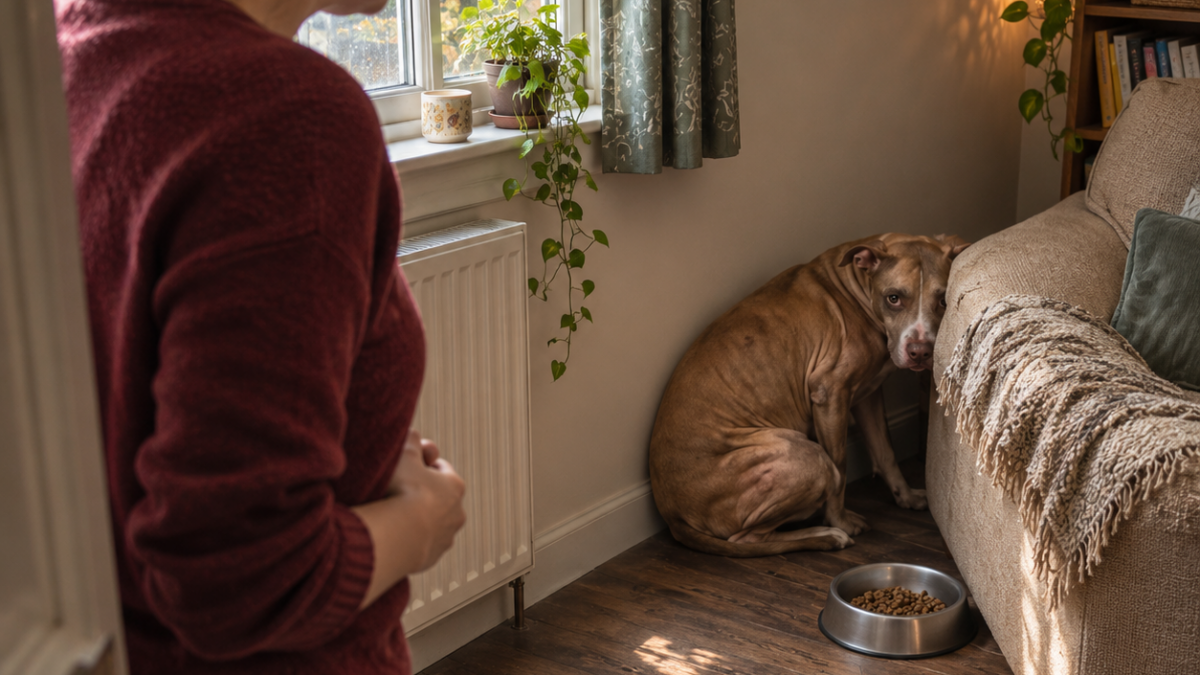
Malo was still behind the armchair.
The moment Oscar saw him, his tail moved.
I held my breath.
I expected him to approach again.
He didn’t.
Instead, Oscar stopped in the middle of the room.
He turned once.
Then he lay down.
No barking.
No play bow.
No attempt to sniff Malo.
He simply placed his head between his front paws.
Sylvie and I looked at each other.
“What is he doing?” I whispered.
“I have absolutely no idea.”
We sat at the kitchen table and waited.
Ten minutes passed.
Then twenty.
Oscar barely moved.
Malo remained hidden.
I was beginning to think nothing would happen when I saw something shift behind the chair.
Malo lifted his head.
His eyes moved toward Oscar.
It lasted perhaps two seconds.
Then he looked away.
My fingers tightened around my coffee mug.
“Sylvie.”
“I saw.”
Neither of us dared move.
Oscar apparently saw it too.
But he did nothing.
That might have been the most important thing he could have done.
He didn’t rush over.
He didn’t wag wildly.
He didn’t demand anything from Malo.
He simply stayed.
When Sylvie finally stood to leave, Oscar followed her.
Malo watched him walk out.
The next afternoon, Oscar came again.
This time, Malo looked at him sooner.
On the third day, Oscar entered, lay on the rug, and began chewing one of his own toys.
Malo watched from behind the chair.
On the fourth day, Oscar fell asleep.
Malo stared at him for nearly half an hour.
It became a routine.
Every afternoon, Sylvie brought Oscar over.
And every afternoon, Oscar did less.
That sounds strange, but it was exactly what Malo needed.
Humans had spent years forcing things on him.
Fights.
Commands.
Pain.
Fear.
Oscar forced nothing.
If Malo wanted to hide, Oscar let him hide.
If Malo wanted to stare, Oscar let him stare.
If Malo looked away, Oscar didn’t follow.
About two weeks after their second meeting, I was washing dishes when I heard the faint clicking of claws against the floor.
I looked over my shoulder.
Malo was standing outside his hiding place.
Oscar was asleep near the fireplace.
There were maybe six feet between them.
Malo’s body was rigid.
His ears were back.
But he was out.
I turned back toward the sink before he noticed me staring.
My hands were shaking.
A few seconds later, I heard another step.
Then another.
I glanced at the reflection in the kitchen window.
Malo had moved closer.
Oscar lifted his head.
My stomach tightened.
Please don’t jump up.
Please.
Oscar’s tail tapped the floor once.
Then he rested his head again.
Malo stared.
Finally, he lowered himself onto the rug.
Three feet from Oscar.
I wanted to cry.
I wanted to call Sylvie.
I wanted to take a picture.
Instead, I did nothing.
For forty seconds, Malo stayed there.
Then a car passed outside.
He jumped up and rushed behind the chair.
But it didn’t matter.
He had come out.
That evening, I called Sylvie.
“He sat beside him.”
“What?”
“Not beside him exactly. Three feet away.”
Sylvie went silent.
Then I heard her sniff.
“Are you crying?”
“No.”
“You’re definitely crying.”
“So are you.”
“I am not.”
She was.
The following day, Malo came out again.
Within another week, he started appearing almost as soon as Oscar entered the room.
Then came the first miracle.
It happened over something completely ordinary.
Food.
Malo still refused to eat if I was in the same room.
I could be upstairs.
I could be outside.
But if I sat anywhere near the kitchen, he would wait.
One afternoon, Oscar was stretched across the rug while I read on the sofa.
Malo’s bowl sat near the doorway.
He appeared.
He looked at me.
Then at Oscar.
Then back at the bowl.
I forced myself to keep reading.
Malo took one step toward the food.
Then another.
He stopped.
Oscar yawned.
Malo approached his bowl.
He ate one piece of kibble.
Then another.
I stared at the same sentence in my book for almost five minutes without understanding a word.
Malo finished half the bowl.
With me still sitting there.
When he eventually walked away, I put the book down and pressed both hands over my face.
I cried silently.
Oscar opened one eye.
He looked at me as though I were being unnecessarily dramatic.
“You have no idea what you just did,” I whispered.
His tail thumped once.
Maybe he did.
The changes were painfully slow.
But they came.
Malo started staying outside his hiding place after Oscar left.
First for a minute.
Then five.
Then twenty.
One morning, I came downstairs and found him sleeping in the bed I had bought before he arrived.
For months, that bed had sat untouched beside the radiator.
I stopped in the hallway.
Malo opened his eyes.
His body tensed.
Normally, I would have backed away.
Instead, I said quietly, “Good morning, sweetheart.”
Then I walked into the kitchen.
I made coffee.
When I returned, Malo was still in the bed.
I nearly cried again.
I was doing a lot of crying in those days.
A month after Oscar began visiting regularly, Sylvie brought him over carrying his favorite blue tennis ball.
Oscar dropped it in front of Malo.
Malo stared.
Oscar picked it up.
Dropped it again.
Malo looked away.
Oscar tried again.
And again.
After the fifth attempt, I laughed.
“Oscar, I think he understands. He just doesn’t care about your ball.”
Oscar picked it up and pushed it closer.
Malo lowered his nose.
He sniffed it.
Oscar’s tail began wagging so violently that his entire back end moved.
Malo jumped backward.
“Oscar,” Sylvie whispered.
The golden retriever froze.
Malo stayed where he was.
After a few seconds, he stepped forward again.
Instead of sniffing the ball, he sniffed Oscar’s muzzle.
For one second, their noses touched.
Oscar remained still.
Malo moved away.
Sylvie covered her mouth.
I whispered, “Did that just happen?”
She nodded.
The next day, Malo sniffed Oscar again.
Three days later, he followed him into the garden.
That frightened me.
Until then, the garden had been one of Malo’s safe places only when he was alone.
Oscar ran toward the fence.
Malo stopped near the back door.
Oscar turned.
He lowered his front legs.
Play bow.
The same invitation Malo had rejected during their first meeting.
I thought he would retreat.
Instead, Malo watched.
Oscar bounced sideways.
Malo’s ears moved forward.
Oscar bounced again.
Then Malo’s tail moved.
Once.
It was such a tiny motion that I almost doubted what I had seen.
Sylvie grabbed my wrist.
“Claire.”
“I saw it.”
Oscar saw it too.
He ran in a loose circle.
Malo took two quick steps after him.
Then stopped.
Oscar circled again.
This time, Malo followed.
A second later, both dogs were running.
Not fighting.
Not surviving.
Playing.
Malo was awkward at first.
He didn’t seem to understand the rules.
Oscar did.
Whenever Malo became uncertain, Oscar slowed down.
Whenever Malo stopped, Oscar stopped.
Whenever Malo chased, Oscar let himself be caught.
I was laughing and crying at the same time.
Then somewhere down the street, a truck door slammed.
Bang.
Malo dropped to the ground.
Everything vanished from his face.
His tail tucked.
His body started shaking.
Oscar stopped immediately.
For several seconds, I was afraid to move.
Then Oscar walked toward him.
He didn’t touch Malo.
He simply lay down beside him.
Malo trembled.
Oscar waited.
After a while, Malo lifted his head.
Then he stood.
The two dogs walked back toward the house together.
That day taught me something I desperately needed to understand.
Malo wasn’t going to wake up one morning healed.
There would be no magical moment when the past disappeared.
Progress could be followed by terror.
A good week could end with a bad hour.
Something ordinary—a loud voice, a raised hand, a metal sound—could pull him back into memories I would never fully understand.
But now he had Oscar.
And slowly, he was beginning to have me.
One evening, nearly four months after I adopted him, I was sitting on the sofa when I felt something touch my knee.
I looked down.
Malo was standing beside me.
I stopped breathing.
He had approached me on his own.
His head was lowered.
His body tense.
But he was there.
I didn’t move.
Malo sniffed my hand.
My fingers trembled.
I wanted to stroke his head more than I could explain.
Instead, I waited.
After several seconds, Malo stepped closer.
His shoulder touched my leg.
My eyes filled.
“Can I?” I whispered.
I slowly lifted two fingers.
The moment they touched the side of his neck, Malo flinched.
I froze.
He did not run.
So I stroked him once.
One slow movement.
Then I stopped.
Malo remained beside me.
Three seconds.
Maybe four.
That was the first time he willingly allowed me to touch him.
When he walked away, I buried my face in my hands.
The following morning, Sylvie came over.
“He let me touch him.”
She stared.
“You’re serious?”
I nodded.
Sylvie hugged me.
Oscar, assuming every hug required his participation, pushed between us.
I started laughing.
Malo stood several feet away.
Then his tail moved.
Once.
Twice.
Three times.
For the first time since I had brought him home, I thought:
He might really be okay someday.
I should have known life would not let us reach that point without testing him again.
The call came from the shelter three weeks later.
The volunteer who had introduced me to Malo sounded unusually serious.
“Claire, do you have a minute?”
I sat down.
“What happened?”
“Malo is safe. This is about the case he came from.”
I knew there was still an investigation, but I had avoided asking questions.
I didn’t want to know the details.
I knew enough.
The men connected to the dog-fighting operation were facing charges, but some of them were denying responsibility.
According to the shelter, prosecutors were collecting veterinary reports and behavioral assessments from the surviving dogs.
“They may want an updated examination of Malo,” she explained.
My immediate answer was no.
“He’s finally trusting people.”
“I understand.”
“I’m not letting strangers hold him down just so someone can photograph his scars.”
“Nobody wants that.”
“Then why does he need to be involved?”
There was a pause.
“Because the defense is arguing that some of these dogs were already injured before they arrived at the property.”
My anger came so quickly it surprised me.
“You’re kidding.”
“I wish I was.”
I looked across the room.
Malo was asleep on the rug.
Oscar had left an hour earlier.
His legs twitched slightly as he dreamed.
“They did this to him,” I said.
“Yes.”
“And now they’re pretending they didn’t?”
“Yes.”
I closed my eyes.
For months, I had tried to avoid hatred.
Hatred felt like another thing those men could take from us.
But in that moment, I hated them.
Not because Malo had scars.
Because every day I had watched the consequences of what they had done.
A dog afraid to eat.
Afraid to sleep deeply.
Afraid of hands.
Afraid of other dogs.
Afraid of being noticed.
Those men had hurt him years ago, yet Malo was still paying for it every morning.
“I’ll allow the examination,” I said. “But it happens here.”
“That can probably be arranged.”
“And Oscar stays with him.”
“I’ll ask.”
“No. That isn’t negotiable.”
The veterinarian arrived the following week.
He was patient.
He sat on my living-room floor for almost half an hour before trying to approach Malo.
Oscar was beside him.
At one point, Oscar shoved his head beneath the veterinarian’s arm and demanded to be petted.
The doctor laughed.
“I see who runs this household.”
“Unfortunately, he doesn’t even live here.”
Sylvie laughed from the doorway.
Malo watched.
Eventually, curiosity brought him closer.
The examination took a long time.
The veterinarian documented scars along Malo’s shoulders.
An old injury near his ribs.
Damage to one tooth.
A poorly healed fracture.
I felt sick.
I had seen those marks every day.
But hearing someone explain what had likely caused them made each scar new again.
“This one is several years old,” the veterinarian said quietly.
I swallowed.
“What about that one?”
“Also old.”
“How many times was he injured?”
He looked at me.
“There’s no way to know.”
I turned away.
For a moment, I couldn’t breathe.
Almost six years.
More than two thousand days.
How many mornings had Malo opened his eyes and found himself still trapped there?
How many nights had he heard dogs barking and known what might happen the next day?
The shelter volunteer followed me into the kitchen.
“You okay?”
“No.”
She nodded.
“That makes sense.”
“I keep thinking I should have found him sooner.”
“Claire, you didn’t know he existed.”
“I know.”
But grief isn’t always reasonable.
I looked toward the living room.
Malo stood beside Oscar.
The veterinarian had stopped examining him.
Oscar licked Malo’s ear.
Malo allowed it.
“He has a life now,” the volunteer said.
I stared at them.
“Yes.”
“And that matters too.”
The medical report was submitted.
For several weeks, nothing happened.
Summer arrived.
Malo improved.
He began taking short walks with Oscar.
At first, he froze whenever strangers approached.
So we crossed the street.
We avoided crowded places.
Oscar walked ahead, and Malo followed.
One Saturday morning, we took them to a fenced field.
Oscar chased his tennis ball.
Malo watched.
On the third throw, Malo ran after him.
Only a few yards.
But he ran.
By late summer, Malo looked different.
His coat had become glossy.
He had gained healthy weight.
The hollow tension around his eyes had softened.
He still had bad days.
But he was starting to have more good ones.
Then, one August evening, the past found my house.
I was watering flowers in the front garden when a gray car slowed outside the gate.
At first, I ignored it.
Then it stopped.
The driver was a man in his fifties.
Broad shoulders.
Short gray hair.
He stared toward the house.
Malo was standing near the back door.
The man rolled down his window.
And whistled.
A sharp, two-note whistle.
Malo collapsed.
Not crouched.
Collapsed.
His stomach hit the ground.
His legs shook.
A sound came from him that I had never heard before.
Half whine.
Half gasp.
I dropped the hose.
The man smiled.
My entire body turned cold.
“Who are you?”
He kept staring at Malo.
“Nice dog.”
“Leave.”
He looked at me then.
“Dogs like that never really change.”
Something about his voice terrified me.
“Get away from my house.”
He whistled again.
Malo tried to crawl backward.
That was when fear became anger.
I walked toward the gate.
“If you don’t leave right now, I’m calling the police.”
The man’s smile disappeared.
For a second, neither of us moved.
Then he started the car.
Before driving away, he said, “Be careful what you think you rescued.”
I memorized everything I could.
Gray car.
Dent near the rear door.
Part of the license plate.
The man’s face.
The moment he disappeared down the road, I ran to Malo.
Then stopped.
I couldn’t touch him.
He was shaking too badly.
So I sat several feet away.
“Okay,” I whispered. “You’re safe. You’re safe.”
He wasn’t listening.
He was somewhere else.
Somewhere years earlier.
I called Sylvie.
She arrived within minutes with Oscar.
Oscar ran through the house.
When he saw Malo, his energy vanished.
He walked over.
Lay down beside him.
For almost an hour, Malo didn’t move.
“What happened?” Sylvie asked.
I told her.
Her face hardened.
“You’re calling the police.”
“What do I say? A stranger whistled at my dog?”
“You tell them that a stranger deliberately terrified a dog connected to an active criminal case and then threatened you.”
The word threatened made my stomach twist.
“I don’t know if that was a threat.”
“Claire.”
I looked at her.
“It was.”
The police came that evening.
I described the man.
The officer wrote everything down.
When I mentioned the dog-fighting case, his expression changed.
“Did he say his name?”
“No.”
“Have you ever seen him before?”
“No.”
“Did Malo seem to recognize him?”
I looked toward the living room.
Oscar was beside Malo.
“Yes.”
The officer stopped writing.
“You’re certain?”
“No dog reacts like that to a stranger.”
Before leaving, he recommended installing cameras.
The next morning, Sylvie arrived carrying two boxes.
“What are those?”
“Cameras.”
“You already bought them?”
“My son had them in his garage.”
I stared.
“He just happened to have security cameras?”
“He buys everything.”
Within an hour, one camera covered my gate.
Another covered the front door.
For days, I barely slept.
Malo regressed badly.
He returned behind the armchair.
He stopped eating if I was nearby.
He refused to enter the front garden.
I was devastated.
Months of progress seemed to have vanished because one man had stopped outside my house for less than two minutes.
But Oscar came every day.
He sat near Malo.
He waited.
Once again, they started from almost nothing.
A glance.
A movement.
A few pieces of food eaten while I remained nearby.
That was when I understood something else about healing.
Sometimes you rebuild the same bridge more than once.
Ten days later, the police called.
“We believe we identified the man.”
My hand tightened around the phone.
“Who is he?”
His name was Pascal Vautrin.
One of the men connected to the property where Malo had been found.
I sat down.
“Was Malo his?”
The officer hesitated.
“There’s evidence connecting him to several of the dogs.”
“Was Malo one of them?”
“We’re still establishing that.”
I already knew.
Malo knew his whistle.
Malo knew his voice.
His body had recognized that man before I did.
“What happens now?”
“He’s been questioned.”
“Questioned?”
“Yes.”
“He came to my house.”
“We know.”
“He frightened my dog deliberately.”
“We’re investigating whether the visit was intended as intimidation.”
I stared through the kitchen window.
Malo was in the garden with Oscar for the first time since Pascal had appeared.
“What am I supposed to do if he comes back?”
“Call immediately. Don’t confront him.”
For the next two weeks, he didn’t return.
I began hoping the police visit had frightened him away.
Then, at 12:43 one night, my phone vibrated.
Motion detected at front gate.
I was awake instantly.
I opened the camera feed.
A figure stood outside.
Dark jacket.
Cap.
My mouth went dry.
He looked around.
Then he placed something beside the gate.
I called the police.
I did not go outside.
Officers arrived within fifteen minutes.
They shined a light toward the object.
One of them looked back at me.
“Stay inside.”
I watched through the window.
It was a chain.
Attached to it was an old leather collar.
Rust on the buckle.
Dark stains in the leather.
The officers placed it in an evidence bag.
Malo appeared behind me.
He saw it.
His legs gave way.
I caught myself before reaching for him.
“Oh, no.”
The officer returned to my door.
“We have the camera footage?”
“Yes.”
“The face is visible.”
I already knew who it was.
Pascal was arrested the following morning.
The police later told me the collar was connected to material seized during the original investigation.
I didn’t ask how they knew.
I didn’t want to know.
But that wasn’t the end.
The search of Pascal’s phone uncovered messages with two other men.
Messages about dogs.
Money.
Fights.
And the people who had adopted some of the surviving animals.
He had found more than one of us.
One message referred to people like me as “thieves.”
Another said the dogs still “belonged” to them.
When I heard that, something inside me changed.
For months, I had been afraid of these men.
Then I became furious.
Belonged to them?
Malo had spent almost six years being treated like an object.
Now that he had finally found safety, they still believed they owned him.
No.
That evening, I sat on the kitchen floor.
Malo stood in the doorway.
Oscar was beside him.
“I’m sorry,” I said.
My voice cracked.
“I brought you here because I thought nobody could ever hurt you again.”
Malo watched me.
“I should have protected you.”
He approached.
Slowly.
I didn’t move.
He stopped directly in front of me.
Then he placed his head against my chest.
For several seconds, I forgot how to breathe.
Malo had never done that.
I lifted my arms very carefully.
I rested them around him.
His body tensed.
I loosened my hold immediately.
Then he leaned closer.
My face crumpled.
I buried my cheek against the top of his head.
“I’ve got you,” I whispered.
Oscar apparently decided this emotional moment required him.
He pushed his giant head between us.
I laughed through tears.
Sylvie was standing near the door.
She wiped her face.
“That dog has terrible timing.”
“No,” I said.
I scratched Oscar’s ears.
“His timing is perfect.”
The investigation expanded.
The prosecutor asked whether I would provide a statement describing Malo’s behavior since adoption.
I agreed.
At first, I wrote facts.
Age.
Dates.
Veterinary appointments.
Weight.
Medication.
Then I read it.
It sounded like Malo was a file number.
I deleted everything.
I started again.
I wrote about the first evening.
The untouched bed.
The full bowl.
The corner behind the chair.
I wrote about reaching for a toy and watching him flatten himself because he expected pain.
I wrote about Oscar’s first visit.
About the night Oscar refused to sleep because he wanted to return.
About those afternoons when he lay several feet away and asked nothing from Malo.
I wrote about the first meal.
The first wag.
The first run.
The first touch.
Then I wrote about Pascal.
The whistle.
The collapse.
The chain outside my gate.
I ended with one sentence:
Malo surviving their cruelty does not mean the cruelty failed to damage him; it means he has spent every day since then doing the work of surviving it.
The prosecutor asked me to read the statement in court.
I almost refused.
I hated public speaking.
I hated the idea of seeing Pascal.
But the night before I had to answer, I watched Malo sleeping.
He was on his side.
Completely exposed.
Years earlier, he would never have slept like that near a human.
Oscar was beside him.
Their paws touched.
“I’ll do it,” I told the prosecutor the next morning.
The hearing took place months later.
Sylvie came with me.
Oscar stayed with Malo at my house.
When I entered the courthouse, my hands were cold.
Then I saw Pascal.
He looked ordinary.
That disturbed me more than if he had looked frightening.
There was no sign on his face announcing what he had done.
He looked like someone you might pass at a grocery store.
Someone who might ask for directions.
Someone who could live three streets away and never draw attention.
Yet Malo had heard his whistle and collapsed.
When my turn came, I carried three pages to the front.
I started reading.
My voice shook at first.
Then I stopped looking at Pascal.
I looked at the judge.
I talked about Malo.
The real Malo.
Not the scarred dog in evidence photographs.
I talked about the dog who loved cheese.
The dog who had slowly learned how to walk through a kitchen without fear.
The dog who watched Oscar whenever he didn’t know what to do.
I explained how long it took before he ate with me in the room.
How long before I touched him.
How long before he played.
Then I reached the part about Pascal appearing at my gate.
My voice cracked.
I stopped.
The room was silent.
I looked at Pascal.
He was staring at me.
So I spoke directly to him.
“When you whistled outside my house, Malo knew who you were before I did.”
Pascal’s expression didn’t change.
“His body remembered you.”
His lawyer shifted.
I continued.
“I don’t know everything you did to him. I probably never will. But I know what he does when someone raises a hand too quickly. I know what he does when metal hits concrete. I know what he does when men shout. And I know what your whistle did.”
I gripped the paper.
“You came to my house because you wanted him afraid again.”
My heart was pounding.
“Maybe you wanted me afraid too.”
I looked at the judge, then back at Pascal.
“But you made a mistake.”
For the first time, I saw something change in his face.
“You thought fear meant he still belonged to you.”
I shook my head.
“He doesn’t.”
My voice grew steadier.
“He sleeps in a warm house now. He runs in a garden. He steals tennis balls from a golden retriever. He waits beside the refrigerator because he learned I sometimes drop cheese. He puts his head in my lap.”
My eyes burned.
“You took almost six years from him.”
I paused.
“But you do not get the rest.”
Sylvie squeezed my hand when I returned to my seat.
The trial continued.
Investigators presented videos and financial records.
I didn’t watch the videos.
I couldn’t.
There were veterinary reports from multiple dogs.
Messages.
Photographs.
Betting records.
Names.
Dates.
The operation had been larger than I had realized.
More organized.
More deliberate.
There were no misunderstandings.
No accidents.
These men had made money from suffering.
And Pascal’s decision to come to my home had hurt his own defense badly.
The security footage showed him outside my gate.
The messages on his phone linked him to the other men.
The chain and collar strengthened the intimidation case.
The very act he had intended to use to frighten me became evidence against him.
That was the kind of revenge I could live with.
Not violence.
Not cruelty returned for cruelty.
Evidence.
Truth.
Consequences.
The verdict came several weeks later.
The prosecutor called me.
The principal men involved in the operation had been convicted.
Pascal received additional punishment connected to the intimidation.
They were prohibited from owning or keeping animals.
Fines and seized funds were directed toward costs associated with the rescued animals and the organizations caring for them.
When the prosecutor finished speaking, I realized I was crying.
“Claire?”
“I’m here.”
“Are you okay?”
I looked through the window.
Oscar and Malo were in the garden.
“I think so.”
I had imagined justice would feel dramatic.
Like victory.
Instead, it felt quiet.
Like putting down a heavy bag after carrying it for miles.
That evening, Sylvie came over.
Oscar was already here.
I opened the garden door.
Malo ran outside.
Oscar chased him.
Within seconds, Malo had stolen the blue tennis ball.
Oscar stopped and looked at me with deep betrayal.
I laughed.
Sylvie leaned over the fence.
“What happened?”
“They were convicted.”
Her smile disappeared.
“All of them?”
“The main ones.”
She came through the gate.
For several seconds, we stood silently.
Then she hugged me.
I looked over her shoulder.
Malo was running.
Actually running.
No chain.
No shouting.
No wall behind him.
Just grass under his feet.
Oscar caught him near the apple tree.
Malo spun around.
Oscar bounced backward.
Malo chased him again.
Sylvie wiped her eyes.
“Does it feel like revenge?”
I thought about it.
“No.”
She looked at me.
“It feels better.”
Because revenge would have meant I had to become something those men understood.
Pain for pain.
Fear for fear.
What happened instead was something they had probably never understood at all.
They lost control.
Malo got a life.
The months after the trial were calmer.
Malo began waiting near the door when I came home.
He didn’t jump.
He didn’t bark.
He simply stood several feet away, tail moving carefully.
For most people, that wouldn’t seem extraordinary.
For Malo, it was a declaration.
I’m glad you came back.
He learned the word “walk.”
He learned “garden.”
He learned “treat.”
But there was one word that caused a reaction faster than all the others.
“Oscar.”
I could whisper, “Do you think Oscar is coming?”
Malo would immediately look at the door.
Sometimes Oscar was already waiting outside.
The first time Malo heard him at the gate and ran there with his tail wagging, I had to sit down.
Because I remembered the beginning.
Oscar sitting at the same gate.
Refusing to leave.
Waiting for a dog who had given him nothing.
Now Malo was the one waiting.
Friendship had finally become something he understood.
A year after the adoption, the shelter invited us to visit before a fundraising event.
I almost declined.
The building might trigger memories.
But the volunteer suggested coming early, before the crowds.
Oscar came too.
When we reached the parking lot, Malo stopped.
His entire body tightened.
I crouched several feet away.
“We can go home.”
Oscar walked toward the entrance.
Then he noticed Malo wasn’t following.
He came back.
He waited.
Malo stared at the shelter.
Then he looked at Oscar.
One step.
Pause.
Another.
We entered.
The volunteer who had first told me Malo’s story saw him from across the room.
She covered her mouth.
“Is that really him?”
I smiled.
“Malo.”
She crouched.
He watched her.
She didn’t call him.
She had learned too.
After a moment, Malo approached.
He sniffed her hand.
Her eyes filled with tears.
“I never thought I’d see this.”
“He still has hard days.”
“I know.”
She looked at his relaxed tail.
“But look at him.”
We walked along the kennel corridor.
Several dogs barked.
Malo stayed close to Oscar.
At the final kennel, I stopped.
A thin black dog sat against the back wall.
Silent.
Head lowered.
My chest tightened.
I knew that posture.
A young couple walked past.
The woman looked inside.
“He doesn’t seem friendly.”
They continued.
I stood there.
“What happened to him?” I asked.
“Neglect case,” the volunteer said. “Nothing like Malo’s background. But he’s terrified of people.”
Malo looked into the kennel.
The black dog looked back.
Then Malo sat down.
I felt my throat tighten.
Oscar sat beside him.
Neither dog barked.
For several minutes, they simply remained there.
The frightened dog slowly raised his head.
Malo didn’t move.
I looked at the volunteer.
She was crying.
“What?”
She smiled.
“You know exactly what.”
I did.
Once, Malo had been the dog against the wall.
Someone had sat nearby without demanding anything.
Now Malo was doing the same.
We stayed for almost twenty minutes.
When we left, the black dog was standing near the front of his kennel.
Three weeks later, the shelter sent me a photograph.
He had been adopted.
I put the photo on my refrigerator.
Two years passed.
Malo’s muzzle began turning gray.
Oscar’s did too, although Oscar continued behaving as though aging was a rumor invented by veterinarians.
The blue tennis ball remained the center of his universe.
The armchair remained in my living room.
It was old.
The fabric had faded.
One wooden leg was scratched.
I probably should have replaced it.
I couldn’t.
Behind that chair was the first place Malo had chosen in my home.
At the time, he had believed it was the only place safe enough to hide.
Now he slept in front of it.
Sometimes on it.
Once, I found him stretched across the seat while Oscar slept on the floor.
“Well,” I told him, “that’s quite a promotion.”
Malo lifted his head.
His tail tapped the cushion.
One rainy evening, I was cleaning a drawer when I found something I had forgotten.
The little rubber toy.
The one I had reached for during Malo’s first week.
I held it in my hand.
Immediately, I remembered him collapsing against the floor.
Eyes closed.
Waiting for a blow.
For a moment, I wanted to put the toy away.
Instead, I placed it on the rug.
Malo was near the fireplace.
He lifted his head.
He saw it.
He stood.
Walked over.
Sniffed it.
Then looked at me.
“It’s okay,” I said.
Malo picked it up.
I stopped breathing.
He carried it toward me.
Then dropped it in my lap.
I stared at the toy.
He stared at me.
“Do you want me to throw this?”
His tail moved.
I picked it up.
I tossed it across the room.
Malo ran after it.
Picked it up.
Brought it back.
I laughed.
“Again?”
He wagged harder.
I threw it.
He returned it.
By the fourth throw, tears were running down my face.
The same toy that once represented fear had become a game.
Then Oscar arrived.
He entered the room.
Saw the toy.
Saw Malo.
And immediately stole it.
Malo froze.
Oscar ran.
Malo chased him through the hallway.
“Not in the house!”
Neither listened.
Sylvie came through the back door just as the two dogs thundered past.
“What is going on?”
“Your dog is stealing.”
“He has always had questionable morals.”
Oscar ran past again.
Malo followed.
We started laughing.
The house that had once been painfully silent was suddenly full of claws hitting the floor.
That sound became one of my favorites.
Years earlier, I had worried Malo might never play.
Now I occasionally had to tell him to stop.
That felt like a privilege.
One summer evening, Sylvie and I sat in the garden while the dogs slept in the grass.
The sun was setting.
She looked toward Malo.
“Do you ever think about what would have happened if you hadn’t gone to the shelter?”
“Yes.”
“Do you think you saved him?”
I looked at Malo.
The easy answer was yes.
But it wasn’t completely true.
“I signed some papers.”
Sylvie laughed.
“You did slightly more than that.”
“I gave him a house.”
“And safety.”
“I tried.”
She waited.
I looked toward Oscar.
“I think he saved part of Malo that I couldn’t reach.”
Oscar was asleep on his back.
One leg twitched.
Sylvie smiled.
“He mostly eats socks.”
“He contains multitudes.”
We laughed.
Then I became serious.
“When Malo first came home, I thought love meant doing something.”
“What do you mean?”
“Touching him. Comforting him. Convincing him. Fixing him.”
I watched Malo sleeping.
“But Oscar didn’t fix anything.”
“No.”
“He just stayed.”
Sylvie nodded.
“That’s sometimes the hardest thing.”
She was right.
Oscar had taught me that love could be patient without being passive.
He had never demanded Malo trust him.
He simply behaved as though Malo was worth waiting for.
And eventually, Malo believed him.
Three years after I adopted him, something happened that brought everything full circle.
A storm had passed during the night.
The garden was covered with leaves.
I opened the back door early in the morning.
Oscar was standing at the gate.
Malo saw him.
He ran outside.
No hesitation.
No checking the yard first.
He ran.
Oscar raced toward the apple tree.
Malo chased.
Oscar stopped.
Then lowered himself into a play bow.
Malo paused.
For half a second, I saw that first meeting again.
Oscar bowing.
Malo pressed against the wall.
Unable even to look at him.
Then present-day Malo lowered his own front legs.
His tail lifted.
He bowed back.
I covered my mouth.
Oscar exploded forward.
Malo chased him.
They disappeared behind the tree.
I stood in the doorway crying.
Not because I was sad.
Because sometimes happiness hurts when you remember how unlikely it once seemed.
The scars on Malo’s body never disappeared.
One remained clearly visible along his shoulder.
Another crossed his muzzle.
His ear would always have that small missing piece.
For years, I had wished I could erase them.
Eventually, I stopped.
The scars were not the ending.
That mattered.
People who met Malo later sometimes asked what happened.
I told them only what they needed to know.
“He had a bad life before he came here.”
Then they would watch him lean against my leg.
Or follow Oscar.
Or sit hopefully beside the refrigerator.
And they would say the same thing.
“He seems happy now.”
Yes.
He was.
Not fearless.
There is a difference.
Malo never became fearless.
Some sounds still bothered him.
Sometimes a man raising his voice across the street made him tense.
Certain metallic noises made him freeze.
On rare nights, he woke suddenly from sleep and looked around the room as though he didn’t recognize it.
When that happened, I never grabbed him.
I turned on a small lamp.
I sat nearby.
And I waited.
Eventually, his eyes would find me.
Then the room would become home again.
One evening, years after Pascal had stood outside my gate, another car slowed in front of the house.
My stomach tightened automatically.
Malo was beside me.
The driver stopped.
A man got out.
For half a second, old fear returned.
Then I recognized him.
He was one of the officers who had taken my original statement.
He was no longer wearing a uniform.
“Claire?”
“Yes?”
He smiled.
“I’m sorry to appear unannounced. I was visiting family nearby.”
I opened the gate cautiously.
He looked toward Malo.
“Is that him?”
“Yes.”
Malo remained beside me.
The officer stared.
“I barely recognize him.”
I laughed softly.
“He’s changed.”
Malo sniffed the man’s hand.
The officer looked genuinely stunned.
“He wouldn’t come within ten feet of me before.”
“He has standards.”
The man smiled.
Then his expression became serious.
“I thought you might like to know something.”
“What?”
“The old property.”
The place where the dogs had been kept.
My body stiffened.
“What about it?”
“It was sold.”
I swallowed.
“Okay.”
“Part of the money recovered through the broader case went toward animal welfare organizations. The property itself is being renovated by the new owner.”
I wasn’t sure why he was telling me.
Then he continued.
“They’re turning the land into a boarding and rehabilitation facility for rescued animals.”
I stared at him.
“What?”
He smiled.
“I thought you might appreciate the irony.”
For several seconds, I couldn’t speak.
The place where men had once brought dogs to suffer would now be used to help animals recover.
I looked at Malo.
He was sniffing grass near my feet.
For the first time, revenge seemed like the right word.
Not because anyone had been hurt.
Because cruelty had lost everything it tried to build.
The men lost control of the property.
They lost the dogs.
They lost their freedom to own animals.
They lost the money.
And the ground where they once created fear would now become a place of healing.
That night, I told Sylvie.
She stared at me.
“You’re kidding.”
“No.”
“What are the chances?”
“I have no idea.”
Oscar was lying at her feet.
Malo was beside me.
Sylvie smiled.
“That is beautiful.”
I looked toward Malo.
“Yes.”
Months later, the rescue organization invited former adopters to visit the new facility before it officially opened.
My first response was absolutely not.
The location alone might trigger Malo.
I had no intention of taking him there.
But I went with Sylvie.
Without the dogs.
The drive made my stomach hurt.
When we turned onto the road, I nearly told Sylvie to turn around.
Then we reached the entrance.
The old fencing was gone.
New wooden gates stood open.
The buildings had been repainted.
There were grassy exercise areas.
Quiet kennels.
Shaded spaces.
A small veterinary room.
Trees had been planted.
I stood near the entrance.
For a moment, I could imagine what had once happened there.
Then I heard barking.
Not frightened barking.
Excited barking.
A volunteer walked past with a young dog wearing a bright red harness.
The dog pulled toward us.
Tail wagging.
Sylvie touched my arm.
“You okay?”
I nodded.
Tears filled my eyes.
“Yes.”
A woman from the organization approached.
“You’re Claire?”
“Yes.”
“Malo’s adopter?”
I nodded.
She smiled.
“We know his story.”
I wasn’t sure how I felt about that.
Then she said, “There’s something we wanted to show you.”
She led us toward a new indoor recovery room.
A small plaque had been mounted beside the door.
It didn’t mention the men.
It didn’t mention the fights.
It listed the names of several dogs recovered from the site.
Malo’s name was among them.
Underneath was one sentence:
**For every animal who survived, and every one who deserved the chance to.**
I put my hand over my mouth.
Sylvie cried openly.
I touched Malo’s name with one finger.
For years, this place had treated dogs as disposable.
Now their names were on the wall.
Not the men’s.
The dogs’.
That felt right.
When I returned home, Malo met me at the door.
Oscar was already there.
Of course he was.
I crouched.
Malo approached.
He pressed his head beneath my hand.
“You won,” I whispered.
He looked at me.
He had no idea what I meant.
Maybe that was better.
Malo didn’t need to know that Pascal had been convicted.
He didn’t need to know about the courtroom.
He didn’t need to know the property had changed hands.
He didn’t need revenge.
What he needed was breakfast tomorrow.
Oscar at the gate.
A warm bed.
A quiet voice.
A hand he trusted.
A life where nothing hurt him simply because someone could.
And that was what he had.
As the years passed, people continued telling me that I had saved Malo.
I always corrected them.
“I helped.”
Because the truth was more complicated.
The shelter saved him from the property.
Police removed him from danger.
Veterinarians repaired what they could.
Oscar taught him another dog could be a friend.
Sylvie taught me patience.
And Malo saved himself every single time fear told him to hide but he tried again anyway.
He walked out from behind the chair.
He ate while I remained in the room.
He touched Oscar’s nose.
He stepped into the garden.
He let me stroke his neck.
He put his head against my chest.
He chose trust.
Again.
And again.
And again.
That took more courage than anything I had ever done.
One night, years after his adoption, rain tapped softly against the windows.
Oscar was asleep near the fireplace.
Malo lay beside the sofa.
I was reading when I felt his head against my knee.
I lowered my book.
He looked up at me.
The gray around his muzzle was more visible now.
I reached down.
My hand rested on his head.
Malo closed his eyes.
His whole body relaxed.
I thought about the first time I reached toward him.
How he had collapsed.
How he had closed his eyes because he believed a hand coming toward him could only mean pain.
Now the same gesture made him lean closer.
I stroked his ear.
“You’re safe,” I whispered.
His tail tapped the rug.
Oscar heard my voice and woke up.
He walked over and pushed himself between us.
I laughed.
“You’re safe too, you idiot.”
Oscar wagged.
Malo lifted his head.
For a second, the two dogs looked at each other.
Then Malo placed his chin on Oscar’s back.
Oscar sighed and went back to sleep.
I sat between them.
Outside, rain fell harder.
Inside, the house was warm.
I looked at Malo’s scars.
They would always tell part of his story.
But only part.
The men who hurt him once controlled almost everything.
When he ate.
When he slept.
Where he stood.
What dogs he faced.
When he was afraid.
They had spent years trying to turn him into something violent.
And in the end, they failed.
Malo became gentle.
They taught him other dogs were enemies.
He found Oscar.
They taught him humans caused pain.
He learned to sleep beside me.
They taught him fear controlled everything.
Eventually, he ran through my garden simply because he could.
That was the ending those men never intended him to have.
And maybe that was the most satisfying justice of all.
Almost six years had been stolen from Malo.
I could never give those years back.
But they did not get the seventh.
They did not get the eighth.
They did not get the ninth.
They did not get the quiet mornings when he waited for me in the kitchen.
They did not get the summer afternoons when Oscar chased him around the apple tree.
They did not get the evenings when he slept by the fire.
They did not get the ridiculous arguments over tennis balls.
They did not get his first tail wag.
His first game.
His first voluntary touch.
His first safe sleep.
They lost all of that.
Malo kept it.
Sometimes I still think about the phone call Sylvie made the morning after Oscar first met him.
At the time, it made no sense.
Oscar had entered my home.
He had tried to play.
Malo had ignored him.
We believed nothing had happened.
But Oscar went home and spent the night beside Sylvie’s door.
He scratched.
He whined.
He refused to sleep in his bed.
The next morning, he ran to my gate and waited.
Why?
I will never truly know.
Maybe Oscar recognized fear.
Maybe he sensed loneliness.
Maybe dogs understand things we complicate with words.
Or maybe he simply looked at Malo and decided:
That dog needs a friend.
Whatever the reason, Oscar did something I had not yet learned how to do.
He refused to mistake silence for rejection.
He refused to mistake fear for emptiness.
He looked at a dog hiding behind a chair and somehow understood there was still someone inside worth waiting for.
Then he waited.
Day after day.
Without demanding anything.
Until one afternoon Malo finally walked out.
Years later, when I open the back door and watch those two older dogs resting together in the sun, I sometimes remember the frightened animal I first saw at the shelter.
Back against concrete.
Head lowered.
Trying to disappear.
If I could go back to that moment, I wouldn’t reach through the kennel.
I wouldn’t promise him everything was going to be okay.
He wouldn’t have believed me.
I would simply sit down.
And I would tell him one thing.
“Someone is going to wait for you.”
Not just me.
A ridiculous golden retriever with a blue tennis ball.
A neighbor who refuses to give up.
People who will fight for the truth of what happened to you.
A home that will ask nothing from you except that you stay.
And one day, Malo, you are going to stop hiding.
One day, a hand will reach toward you and you won’t close your eyes.
One day, another dog will run across a garden and you will chase him.
One day, you will hear your name and know it means you are wanted.
One day, the people who hurt you will discover that surviving them was only the beginning.
Because they may have written the first six years of your life.
But they never owned the ending.
Malo did.
And his ending was not a cage.
It was not a chain.
It was not a fight.
It was an old house outside Angers.
A warm rug beside a fireplace.
A woman who finally learned that love does not always need to reach out first.
And a golden retriever who once sat at a gate all morning because, somehow, he knew a frightened dog on the other side was worth coming back for.
That was how Malo won.
Not by hurting anyone.
Not by becoming what his abusers tried to make him.
He won by living long enough to discover that the world contained more than cruelty.
He won by learning to trust.
He won by finding a friend.
And in the end, the dog who once pressed himself against a wall hoping no one would notice him became the dog I could no longer imagine my home without.








