PART 2: For Four Hours, a Stray Dog Blocked Traffic With a Pink Helmet—Then Seven Bikers Finally Followed Her
PART 2
“Keep her back,” I shouted.
Julien looked at the dog, then at the slope beneath his boots.
“How?”
Fair question.
The dog was already halfway down.
She slid several feet on loose gravel, recovered, and kept coming.
I turned back to the girl.
Experience has a strange effect in emergencies.
It doesn’t remove fear.
It organizes it.
You stop thinking about everything that could go wrong and start reducing the world into immediate problems.
Airway.
Breathing.
Circulation.
Spine.
Bleeding.
Environment.
The girl was breathing.
That was problem number one solved.
Barely.
Her pulse was rapid and weak.
There was blood along the right side of her forehead, but not enough to explain why she was unconscious.
Her left leg lay at an angle I didn’t like.
The bike had fallen near the concrete drainage channel, but she had landed several yards farther down.
That told me momentum had carried her after the bicycle stopped.
She had not simply tipped over.
“Ambulance is coming,” Julien called. “Fire crew too.”
“How long?”
“Twelve minutes.”
Twelve minutes is nothing when you’re sitting at home.
It is an entire lifetime when a child is unconscious at the bottom of a ravine.
The dog reached us.
I expected her to push toward the girl.
She didn’t.
She stopped three feet away.
Her whole body trembled.
“Easy.”
Her nose stretched forward.
The girl’s fingers twitched.
The dog made a sound deep in her throat.
Not a bark.
Almost a whimper.
“You know her?”
The dog looked at me.
Then at the girl.
I didn’t know whether I was talking to her or myself.
Above us, my friends had become an improvised rescue team.
Seven men who usually argued about tire pressure and coffee had suddenly returned to the useful versions of themselves.
Julien had once worked as a mechanic for mountain rescue vehicles.
Pascal had been a volunteer firefighter.
Yves had spent thirty years as an electrician but carried a first-aid certificate because his wife had heart trouble.
Nicolas was directing cars around the bend.
Henri and Luc were bringing ropes and our medical pack down the slope.
Nobody played hero.
That is usually how real rescues work.
The less people care about looking brave, the more useful they become.
I stabilized the girl’s head with both hands.
“Sweetheart, can you hear me?”
Nothing.
“Open your eyes.”
Nothing.
The dog stepped closer.
I glanced at her.
“Stay.”
She froze.
I don’t know whether she understood the word.
But she stayed.
Henri reached me with the emergency pack.
“What do we have?”
“Unconscious. Breathing. Weak pulse. Possible head injury. Possible leg fracture. Unknown time down.”
He looked at the sun lowering behind the ridge.
“Could’ve been hours.”
“Yes.”
That worried me almost as much as the injuries.
The road surface above was hot enough to shimmer.
The ravine was partly shaded, but the afternoon temperature had climbed past ninety degrees.
The girl’s lips were dry.
Her exposed skin felt hot.
Head trauma plus dehydration plus unknown internal injuries was not a combination I wanted.
Then I noticed her right hand.
There was dirt packed beneath the fingernails.
One nail was torn.
Scratches ran along her forearm.
“She tried to climb,” I said.
Henri looked uphill.
“From here?”
“Maybe.”
That meant she had been conscious after the fall.
At least for a while.
The dog moved again.
She came to the girl’s head and lowered herself onto the dirt.
Not touching.
Just close.
I saw dried blood on the fur around her muzzle.
I leaned toward her.
Not her blood.
At least not most of it.
There was a faint smear of the same reddish brown along the girl’s hairline.
The dog had been licking her wound.
Or her face.
Trying to wake her.
“What in the hell happened here?”
Julien had reached us.
I nodded toward the helmet high above.
“That dog has been trying to tell people.”
“How long?”
I looked at the road.
“Long enough.”
The first siren came six minutes later.
Firefighters arrived before the ambulance.
Their team leader, Captain Laurent Besson, recognized me from years earlier.
“Bear?”
“Unfortunately.”
He almost smiled.
Then saw the girl.
Professional faces change when children are involved.
Not much.
But enough.
“What have you got?”
I gave him the assessment.
They moved quickly.
Neck stabilization.
Oxygen.
Vital signs.
Splint preparation.
The dog stayed within arm’s reach.
One firefighter tried to guide her away.
She showed her teeth.
“Leave her,” I said.
“She could bite.”
“She could’ve bitten me ten minutes ago.”
“That’s not reassuring.”
“She’s not protecting territory.”
“What is she protecting?”
I looked at the girl.
He understood.
They decided against moving the child until a controlled extraction could be rigged.
The slope was too unstable.
A rescue litter came down on ropes.
The paramedic reached us next.
She checked the girl’s pupils.
One reacted slower than the other.
Her expression tightened.
“We need helicopter transport.”
Laurent radioed the request.
The dog began panting harder.
I poured a little water into my palm and held it near her.
She backed away.
“You need it.”
Nothing.
I placed the water on a flat rock.
She ignored it.
The only thing she watched was the girl.
The paramedic cut part of the yellow shirt to attach monitoring pads.
That was when we found another bruise.
A long dark mark across the girl’s right side.
Not from the fall.
At least not entirely.
It had a strange horizontal shape.
Laurent looked at me.
I saw the same thought cross his face.
Vehicle contact?
Maybe.
Too early to know.
We lifted the girl into the rescue litter.
The moment her body rose from the ground, the dog stood.
When the firefighters began hauling the litter up the slope, the dog followed.
She slipped.
Scrambled.
Kept climbing.
Nobody stopped her.
At the road, traffic had backed up in both directions.
Drivers stood beside their cars.
Some looked embarrassed.
I wondered how many had passed the dog.
How many had swerved around the pink helmet.
How many had assumed somebody else would deal with it.
That thought made me angry.
Then I remembered how easily I might have done the same.
A dog in a road.
A piece of plastic.
A strange scene.
Most people do not wake up planning to ignore someone in danger.
They simply misread what they see.
The helicopter landed in a nearby field.
The medical crew loaded the girl.
The dog tried to follow.
She reached the aircraft door before a firefighter caught her around the chest.
She screamed.
I have no better word.
That dog screamed.
Her legs kicked.
Her body twisted.
She watched the stretcher disappear inside.
“Easy!”
The firefighter nearly lost her.
I grabbed the dog around the shoulders.
“She’s going with them.”
The dog fought me.
“I know.”
Her claws scraped the pavement.
“I know.”
The helicopter door closed.
Rotors climbed.
Dust exploded across the road.
The dog pulled against my arms until the aircraft lifted.
Then she stopped.
Completely.
She sat.
Watched.
The helicopter disappeared toward Grenoble.
The dog remained facing the empty sky.
I loosened my grip.
She didn’t move.
“Now will you drink?”
Nothing.
I carried the bowl closer.
She stared ahead.
Julien crouched beside us.
“Marc.”
“What?”
He pointed toward the pink helmet.
“Look at the strap.”
I picked it up carefully.
The plastic was scraped.
The edge cracked.
But Julien wasn’t looking at the damage from the fall.
He was looking at a mark near the back.
Blue paint.
A narrow streak.
Metallic.
Too high and too clean to have come from the red bicycle.
“You seeing what I’m seeing?”
“Maybe.”
He looked at the bike.
The rear wheel was bent sideways.
The right handlebar had folded inward.
“Doesn’t look like she just lost control.”
“No.”
Captain Besson heard us.
He came over.
“You think she was hit?”
“I think the police should see this before anyone cleans it.”
He nodded.
The road became a scene.
Photographs.
Measurements.
Statements.
The bicycle was left where it had landed until officers arrived.
The helmet went into an evidence bag.
That upset the dog.
When an officer picked it up, she followed him.
“She attached to the helmet?” he asked.
“No,” I said.
“She used it.”
“For what?”
“To stop traffic.”
He stared at me.
Then at the dog.
“How do you know?”
“We watched her.”
“Before you stopped?”
“No.”
That answer bothered me.
Because we had no idea what happened before 5:54.
We only knew what we saw at the end.
Then a man standing beside a delivery truck raised his hand.
“I might.”
The officer turned.
The driver was in his forties, heavyset, red-faced from the heat.
“My dashcam.”
“What about it?”
“I passed here earlier.”
“What time?”
“After two.”
He looked at the dog.
“I saw her with that helmet.”
Every person near us became still.
“You stopped?”
The man’s face tightened.
“No.”
There was shame in that answer.
“I thought it was trash.”
“Do you still have the footage?”
“My camera loops every eight hours.”
“Don’t drive anywhere.”
The officer and driver climbed into the truck.
Ten minutes later, they called us over.
The screen was small.
The image shook with road vibration.
Timestamp:
14:19:07.
The truck rounded the bend.
There she was.
The dog.
She climbed from the ditch with the pink helmet in her mouth.
She waited on the shoulder.
A car passed.
Then she carried the helmet into the lane.
The truck driver slowed.
On the recording, he could be heard saying:
“What are you doing, girl?”
Then the truck moved around her.
As it passed, the dog turned her entire body toward the ravine.
The camera captured it for less than two seconds.
But once you knew where to look, it was obvious.
She wasn’t wandering.
She was showing.
The officer checked the timestamp.
“You passed at 2:19?”
“Yes.”
“We found the girl at 5:58.”
The driver looked sick.
“Jesus.”
The dog had been doing this for at least three hours and thirty-five minutes.
Probably longer.
The officer rewound.
Frame by frame.
There was another detail.
As the truck approached, the dog dropped the helmet.
Then stepped away from it.
When the truck passed, she picked it up again.
Not random behavior.
She had learned.
Put the object in the road.
Vehicle slows.
Human looks.
Try again.
“How many cars?” Julien whispered.
Nobody answered.
The driver covered his face.
“I should’ve stopped.”
Maybe.
But guilt is easy once the ending is visible.
At 2:19, he saw a skinny dog carrying what looked like garbage.
At 6:15, he knew it was a child’s helmet.
Those were not the same facts.
The police copied the footage.
The dog finally drank water around seven.
Not much.
A few laps.
Then she walked back to the guardrail.
I followed.
“You did enough.”
She looked down toward the ravine.
The girl was gone.
The bicycle remained.
The dog stood there for several seconds.
Then looked at me.
I wish I could tell you I understood immediately.
I didn’t.
But I knew one thing.
She wasn’t going anywhere alone.
Neither was I.
So when the animal control officer arrived, I followed their van to the emergency veterinary clinic.
We still didn’t know the girl’s name.
We didn’t know where her family was.
We didn’t know if she would survive.
And we definitely did not know that the blue paint on that pink helmet would eventually tear open a lie big enough to involve a driver, a company, a missing phone, and one man who believed an unconscious twelve-year-old would never be able to contradict him.
At the clinic, they scanned the dog.
No microchip.
No tattoo.
No collar.
The veterinarian estimated she was around four years old.
Underweight.
Dehydrated.
Cuts on all four paws.
One pad badly split.
She had a healing scar along her left side and several old marks suggesting she had lived rough for a long time.
“What breed?” I asked.
The veterinarian shrugged.
“German Shepherd. Beauceron. Something else. Mostly survivor.”
That sounded right.
“Can I stay?”
“With the dog?”
“Yes.”
“Why?”
Because I had seen the way she screamed when the helicopter left.
Because the child had no known name yet.
Because seven men had stopped on a road and somehow become responsible for a story we didn’t understand.
I gave the only answer I had.
“She stayed.”
The vet studied me.
Then nodded.
“Ten minutes.”
The dog lay on a blanket in a treatment run.
When I entered, she lifted her head.
I sat on the floor outside the open gate.
“I’m Marc.”
No reaction.
“People call me Bear.”
Her ears moved.
“It’s a stupid name.”
Still nothing.
“I don’t know who your girl is.”
That got her.
Her head lifted higher.
“But I’m going to find out.”
She watched me.
“And if she’s alive, I’ll tell you.”
I don’t know why I promised a stray dog something I could not control.
Maybe rescue work ruins your sense of what counts as a reasonable conversation.
I stayed until they closed the public area.
Then I went home.
I didn’t sleep.
At 1:12 in the morning, my phone rang.
Unknown number.
“Mr. Delmas?”
“Yes.”
“This is Captain Besson.”
I sat up.
“The girl?”
“They identified her.”
“Who?”
“Her name is Léa Martin. Twelve years old.”
“How?”
“Her mother reported her missing after work.”
I closed my eyes.
“Condition?”
“Critical but stable.”
That phrase can mean almost anything.
“Is she awake?”
“No.”
“Family there?”
“Mother.”
I looked toward the dark window.
“And the dog?”
“What about her?”
“I think she belongs to Léa.”
Besson was quiet.
“Why?”
“She acted like it.”
“We asked the mother.”
“And?”
“She says Léa doesn’t have a dog.”
I frowned.
“Then why—”
“We don’t know.”
Neither did I.
That question would become almost as important as the crash.
The next morning, I met Léa’s mother.
Claire Martin looked younger than I expected.
Maybe thirty-eight.
Nurse.
Night-shift rotation at a private rehabilitation clinic outside Grenoble.
She had spent half the night believing her daughter might die because she had allowed her to ride six miles to a friend’s house.
Guilt had hollowed her face.
I introduced myself.
She grabbed my hands.
“You found her.”
“The dog did.”
“What dog?”
“The stray from the road.”
Claire shook her head.
“Léa is afraid of big dogs.”
That stopped me.
“Afraid?”
“Since she was little.”
“Are you sure?”
Claire almost laughed.
“She’s my daughter.”
“Sorry.”
“No. I’m sorry.”
She pressed both palms against her eyes.
“I don’t know what I’m saying anymore.”
We sat in the hospital corridor.
I told her everything.
The helmet.
The dog.
The road.
The ravine.
When I told her the dog had apparently been trying to stop cars for at least three and a half hours, Claire cried.
Quietly.
Like someone too exhausted to make sound.
“She stayed with her?”
“We think so.”
“Why?”
“I don’t know.”
Claire looked through the ICU doors.
“Léa would’ve been terrified.”
“Maybe at first.”
She turned toward me.
“What do you mean?”
“The dog had blood on her muzzle. Léa’s blood. Probably from licking her face.”
Claire covered her mouth.
I continued carefully.
“She also had dirt and brush in her coat consistent with the ravine. My guess is she was down there before she came up with the helmet.”
“You think she tried to wake her?”
“I think she tried a lot of things.”
Claire stared at the floor.
“I want to see her.”
“The dog?”
“Yes.”
That afternoon, I drove Claire to the veterinary clinic.
The dog was standing when we entered.
The moment Claire walked into view, nothing happened.
No tail wag.
No recognition.
Claire looked at me.
“I told you.”
Then Claire took Léa’s sweatshirt from a plastic bag.
She had brought it from home.
The dog froze.
Her entire body changed.
She moved forward.
Slowly.
Sniffed the sleeve.
Then pressed her face into it.
Claire began crying.
“Oh.”
The dog closed her eyes.
Claire sat on the floor.
“She knows her.”
“Yes.”
“But how?”
That remained a mystery for two more days.
Léa woke on the third morning.
Only briefly.
Her first words were confused.
Her second were for her mother.
Her third were:
“Where’s Ruby?”
Claire thought she had misheard.
“Who?”
“The dog.”
That is how the stray got her name.
Ruby.
And when Léa was strong enough to explain, we learned the part none of us had seen.
She had met Ruby twelve days before the crash.
Behind a bakery dumpster.
Léa had been riding home when she noticed the dog searching through trash.
She gave her half a sandwich.
The next day, Ruby was there again.
So was Léa.
For nearly two weeks, the girl brought food.
Sometimes bread.
Sometimes chicken.
Sometimes dog biscuits bought secretly with pocket money.
She sat at a distance because she was still afraid.
Ruby ate at a distance because she was afraid too.
They never touched.
Not once.
On the morning of the crash, Ruby followed Léa’s bicycle.
Léa tried to send her back.
Ruby kept following.
“That dog was not mine,” Léa whispered from her hospital bed.
Claire held her hand.
“She decided otherwise.”
Léa almost smiled.
Then she told us about the vehicle.
A blue commercial van.
It came up behind her on the narrow road.
Too close.
She moved toward the shoulder.
The van did not move left enough.
Its mirror struck the back of her helmet.
The bicycle jerked.
She remembered the guardrail.
The front wheel hitting gravel.
Then falling.
“Did the van stop?” the officer asked.
Léa’s face changed.
“Yes.”
Everybody in the room became still.
“You saw the driver?”
“From below.”
“What did he do?”
“He looked over.”
Claire’s hand tightened around her daughter’s.
“Are you sure?”
Léa nodded.
“I yelled.”
“What happened?”
“He said something.”
“What?”
She closed her eyes.
“I couldn’t hear.”
“Then?”
“He left.”
The officer asked one last question.
“Did you see the driver clearly?”
“No.”
That meant we had a blue van.
A damaged helmet.
Paint transfer.
A twelve-year-old witness who had suffered a serious head injury.
Not enough.
Then Julien found something on the bicycle.
Blue paint.
Same metallic shade.
The police laboratory later confirmed both samples were consistent with automotive paint.
Still not enough to identify a vehicle.
The road carried dozens of blue vans every day.
Construction companies.
Delivery services.
Utilities.
Local tradespeople.
The investigation might have stalled there.
Then Patrick—the delivery truck driver whose dashcam had recorded Ruby—called the police.
He had reviewed more footage.
At 2:11, eight minutes before Ruby appeared with the helmet, his camera had passed a blue van parked in a lay-by two miles east.
The van had damage along its passenger-side mirror.
The company name was visible.
Alpes Énergie Services.
An electrical maintenance contractor.
Police contacted the company.
They had eleven blue vans in the region.
Three had been working south of Grenoble that day.
One returned to the depot at 3:06 p.m.
Its driver was named Rémi Caron.
Thirty-nine.
Field supervisor.
No reported accident.
The van had already been repaired.
That mattered.
The passenger mirror had been replaced the morning after Léa was found.
Company records described the damage as “branch impact.”
The old mirror?
Thrown away.
That looked bad.
Rémi was interviewed.
He admitted driving the road.
Denied hitting anyone.
Said he had stopped in the lay-by because he received a work call.
Denied looking into any ravine.
Then police showed him Patrick’s dashcam.
His story changed.
Maybe he had heard something.
Maybe he had stopped briefly.
Maybe he saw the bicycle but believed it had been abandoned.
He never saw a child.
Léa was still too fragile for confrontation.
So the police kept digging.
The company’s GPS records placed Rémi’s van near the crash at 1:47 p.m.
Léa’s fitness watch, recovered from the ravine, recorded a sudden impact at 1:48.
Her movement dropped almost to zero at 1:49.
Ruby first appeared on Patrick’s camera at 2:19.
Thirty-one minutes.
For half an hour, Ruby had apparently remained in the ravine before climbing out with the helmet.
Investigators reconstructed what likely happened.
The van mirror struck Léa’s helmet.
She lost control.
Bike and rider went over the edge.
Ruby ran down.
Léa remained conscious for some period.
She tried to climb.
Couldn’t.
The dog stayed.
At some point, Léa lost consciousness.
Ruby climbed out.
The helmet had come off near the upper slope.
Ruby found it.
Carried it to the road.
Then started trying to stop humans.
Again.
Again.
Again.
For almost four hours.
When Rémi’s attorney heard the timeline, he attacked the weakest point.
Léa’s memory.
He suggested she was confused from concussion.
He suggested the van may have passed after she fell.
He suggested the blue paint came from the guardrail or bicycle rack.
Then the company issued a statement.
That was their mistake.
It said their internal review found “no credible evidence” that an Alpes Énergie vehicle had caused the accident.
It also noted that Léa had been cycling “without adult supervision on a hazardous rural road.”
Claire read that sentence in my workshop.
Then read it again.
Her face went white.
“They’re blaming her.”
I took the paper.
“They’re preparing.”
“For what?”
“Liability.”
“She’s twelve.”
“They don’t care about age. They care about percentages.”
Claire stared at me.
“Marc, she asked permission.”
“I know.”
“She rides that route all the time.”
“I know.”
“There was no sign saying children couldn’t ride there.”
“I know.”
Her hands shook.
“She almost died.”
I put the statement down.
“Then don’t fight their statement with anger.”
“What do I fight it with?”
“Facts.”
That answer sounded simple.
It wasn’t.
The company had lawyers.
Insurers.
Experts.
Claire had hospital bills, lost wages, and a daughter relearning how to walk without dizziness.
But she also had something the company did not understand yet.
Seven bikers.
A truck driver with a dashcam.
A veterinarian.
A dog.
And a road full of ordinary people who had passed Ruby that afternoon.
Police appealed for video.
People responded.
Not because they had seen the crash.
Most hadn’t.
But because they remembered the dog.
A woman submitted footage from 2:46.
Ruby was in the lane.
Helmet down.
A car nearly clipped her.
At 3:12, another camera showed her dragging the helmet from the shoulder after someone had thrown it aside.
At 3:39, a motorcyclist’s camera captured Ruby standing beside the guardrail barking downward.
At 4:05, the man who had tried to take the helmet appeared.
Ruby bared her teeth.
He retreated.
Then—this became important—the camera recorded him walking back to his car and saying to his passenger:
“That dog keeps looking over the edge.”
He still left.
He cried when police later showed him where Léa had been.
“I thought there was an animal down there.”
“There was,” the officer said.
“A child too.”
The footage established something else.
The helmet remained in Ruby’s possession continuously after 2:19.
That meant the blue paint on it existed before any rescuer handled it.
No contamination argument.
Julien was delighted.
Not happy.
Delighted in the specific way mechanics become when somebody tries to explain away physical evidence.
“Paint lies less than people,” he told me.
The breakthrough came three weeks after the crash.
Alpes Énergie had deleted the van’s forward-facing dashcam footage.
Their official explanation was automatic overwrite.
But the van’s system uploaded low-resolution incident clips to a fleet server whenever the onboard sensor detected sudden lateral movement or braking.
Nobody at the local office apparently remembered that.
The insurer did.
Investigators obtained the server files.
There were eight seconds.
Only eight.
The clip began with the road ahead.
Léa’s red bicycle appeared on the right side of the frame.
The van approached from behind.
Too fast.
Léa was riding close to the shoulder.
The van moved left slightly.
Not enough.
At the moment the vehicles aligned, the image jolted.
A sound hit the microphone.
Plastic against metal.
Léa disappeared from view.
The van continued for sixty yards.
Brake lights reflected from a vehicle ahead.
Then the clip ended.
That proved contact.
But not what happened afterward.
Rémi could still claim he did not know Léa went over the edge.
Then investigators recovered his phone.
Not physically.
Cloud data.
At 1:52 p.m., four minutes after the impact, Rémi sent a voice message to his supervisor.
The recording was short.
“I clipped a kid on a bike. She went over the barrier. I don’t know how bad. Call me.”
The supervisor called him.
The call lasted seven minutes.
No emergency services were contacted.
At 2:03, Rémi sent another message.
“I looked. I can’t see her from the road. There’s a dog down there. What do you want me to do?”
The supervisor replied by text:
GET BACK TO DEPOT. WE’LL HANDLE IT.
They did not handle it.
No emergency call.
No police notification.
No ambulance.
They replaced the mirror the next morning.
That was the moment the case changed from accident to something uglier.
Rémi had not simply failed to notice.
He knew.
His supervisor knew.
And while Ruby dragged a pink helmet into traffic, two grown men with phones had chosen silence.
When Claire heard the recording, she didn’t shout.
She sat at her kitchen table.
Léa was still upstairs asleep.
Ruby was lying under the table.
By then, the dog had been released from the clinic but legally remained in temporary foster care.
Temporary became a joke within twenty-four hours.
Ruby followed Léa everywhere.
Bedroom door.
Bathroom door.
Kitchen.
Garden.
If Léa went upstairs too quickly, Ruby stood at the bottom whining until Claire told her everything was fine.
Claire looked down at the dog.
“She had no phone.”
“No.”
“No training.”
“No.”
“She didn’t even belong to us.”
“No.”
“And she tried for four hours.”
“Yes.”
Claire wiped her face.
“While they drove away.”
I had no answer.
There are facts so ugly they do not improve when explained.
Rémi was charged with causing injury through negligent driving and leaving the scene without rendering or summoning aid.
The supervisor, Jérôme Vidal, faced separate charges related to failure to report, obstruction, and evidence handling.
Alpes Énergie suspended both men.
Then publicly claimed the actions had been individual decisions.
Maybe they were.
But their internal emails told another story.
When police seized company records, they found a message sent the afternoon of the crash by Vidal to the regional manager:
RÉMI HAD A MINOR ROAD CONTACT. POSSIBLE CYCLIST INVOLVEMENT. VEHICLE MIRROR DAMAGED. ADVISE ON REPORTING.
The regional manager replied:
IF NO FORMAL CLAIM AND NO POLICE CONTACT, LOG MIRROR AS OPERATIONAL DAMAGE FOR NOW.
That sentence cost the company dearly.
Not because it proved they ordered anyone to abandon Léa.
It didn’t.
But it proved senior management knew there might have been a cyclist involved before the company later claimed it had no information connecting its vehicle to the accident.
Claire’s lawyer filed the civil case.
The company fought.
Hard.
They argued Léa was riding too close to traffic.
The accident reconstruction showed she was within the legal edge of the lane.
They argued her helmet had been improperly secured.
The helmet strap had torn during impact.
They argued the road design contributed.
That one was partly true.
The shoulder was narrow.
The guardrail had a gap near the drainage slope.
The municipality eventually accepted responsibility for improving it.
But dangerous road design did not erase a van striking a cyclist.
Then the defense made the argument that nearly broke Claire.
They claimed the severity of Léa’s injuries resulted partly from delayed discovery.
Technically true.
Then they suggested that delay was “unrelated to the company or driver.”
Claire called me immediately.
“Unrelated?”
I had already read the filing.
“They mean Rémi didn’t cause other motorists to ignore Ruby.”
“He caused her to be down there!”
“I know.”
“He knew she fell!”
“I know.”
“He left!”
“I know.”
“And now they want to say the hours she spent there aren’t connected?”
“They’re trying to separate the collision from what came after.”
Claire’s voice became quiet.
“What do we do?”
I looked across my workshop.
Ruby was there with me that afternoon because Léa had a medical appointment and the dog became anxious if left alone too long.
She was asleep beneath my workbench.
One ear up.
One ear sideways.
“We show what came after.”
That became the heart of the case.
Not emotion.
Timeline.
1:48 — impact.
1:52 — Rémi tells Vidal he clipped a child.
2:03 — Rémi tells Vidal he looked over the barrier and saw a dog.
No emergency call.
2:19 — Ruby enters the road carrying Léa’s helmet.
2:46 — Ruby still trying.
3:12 — still trying.
3:39 — still trying.
4:05 — still trying.
5:54 — seven motorcycles stop.
5:58 — Léa found.
The defense could argue law.
They could argue percentages.
They could argue road design.
They could not make four hours disappear.
Léa spent five weeks in hospital.
Two surgeries.
A fractured femur.
Three broken ribs.
Concussion.
A small bleed in the brain that resolved without surgery.
Months of physical therapy followed.
For weeks, she couldn’t stand without dizziness.
Ruby attended almost every rehabilitation session that allowed dogs.
At first, staff objected.
Then one therapist discovered Léa walked farther when Ruby stood at the end of the parallel bars.
The first time Léa took ten steps without help, Ruby started wagging before anybody clapped.
“She’s cheating,” the therapist said.
Léa smiled.
“She’s motivating me.”
“Same thing.”
The biggest challenge wasn’t physical.
It was the road.
Six months after the crash, Léa could ride a stationary bicycle.
She refused to ride outdoors.
Nobody pushed.
Claire bought her another bicycle anyway.
Red again.
It sat in the garage.
Ruby avoided it.
That interested me.
The dog would walk past tools.
Motorcycles.
Lawn equipment.
But if someone moved that bicycle, Ruby became alert.
Ears up.
Body stiff.
Memory lives in animals differently than it lives in us.
But it lives.
The criminal hearing began the following spring.
Rémi looked ordinary.
That bothered people.
They expected a villain.
He had short dark hair.
Plain jacket.
Wedding ring.
A daughter of his own.
That fact came out during sentencing.
Some people thought it made what he did worse.
I thought it made it more human.
Which was worse in another way.
Monsters are easy.
Ordinary people making cowardly choices are harder.
Rémi eventually admitted the collision.
He cried.
He said panic took over.
He said when he looked into the ravine, he saw the bicycle but not Léa clearly.
Then the prosecutor played his message.
“I clipped a kid on a bike. She went over the barrier.”
Silence.
Rémi lowered his head.
The prosecutor asked:
“So you knew it was a child?”
“Yes.”
“You knew she went over the barrier?”
“Yes.”
“You knew there was a dog below?”
“Yes.”
“You had a mobile phone?”
“Yes.”
“You had a company radio?”
“Yes.”
“And you called your supervisor.”
“Yes.”
“Not emergency services.”
“No.”
“Why?”
Rémi stared at his hands.
“My license.”
“What about it?”
“I had two previous work incidents.”
“So?”
“I thought I’d lose my job.”
The prosecutor let the silence sit.
Then said:
“A twelve-year-old girl was unconscious in a ravine, and you were thinking about your job?”
Rémi began crying harder.
“Yes.”
I looked at Claire.
Her face showed nothing.
Later she told me that was the moment her anger changed.
Not disappeared.
Changed.
“I kept imagining some evil man,” she said.
“And?”
“He was just afraid.”
“That doesn’t excuse it.”
“No.”
She looked toward Ruby.
“That’s what makes it worse.”
Ruby had been afraid too.
Probably terrified.
Cars rushing past.
Horns.
Strangers.
Heat.
Traffic.
Yet she kept returning to the road.
Fear explained both of them.
Choice separated them.
Jérôme Vidal’s hearing came later.
He claimed he believed Rémi had already contacted emergency services.
The text history contradicted him.
GET BACK TO DEPOT. WE’LL HANDLE IT.
When asked what “handle it” meant, he said internal reporting.
The prosecutor asked why the damaged mirror was replaced before any formal incident report.
No good answer.
Why the mirror damage was labeled “branch impact.”
No good answer.
Why the company’s first public statement said there was no credible evidence of involvement when management had known about possible cyclist contact on the day of the crash.
Again, no good answer.
The criminal penalties were not dramatic in the way people expect from stories.
There was no life sentence.
No courtroom screaming.
Rémi received a custodial sentence, partly suspended, loss of professional driving privileges, probation conditions, and restitution orders.
Vidal received penalties for his role in the reporting and concealment.
The company paid administrative fines and faced regulatory review.
The civil case was where the larger consequences landed.
Alpes Énergie eventually settled.
The amount remained confidential.
Claire told me only this:
“Léa’s medical care is covered. Her education is covered. If she needs therapy at thirty, it’s covered.”
“That enough?”
“No.”
I waited.
She smiled slightly.
“But it’s what money can do.”
The settlement also required the company to change its incident procedures.
Any employee involved in a roadway collision with possible injury had to contact emergency services before contacting management.
Fleet dashcam footage had to be retained automatically after impact detection.
Supervisors could not classify vehicle damage connected to possible third-party injury without external reporting.
Claire insisted on one more condition.
Funding for safety improvements along that stretch of road.
The company resisted.
The municipality joined negotiations.
Eventually, they agreed.
The narrow shoulder was widened where possible.
Reflective markers were added.
The damaged guardrail section was replaced.
A warning sign went up before the bend.
But Léa asked for something else.
A small emergency marker beside the road.
Not a memorial.
She was alive.
She hated when people talked about the location like a place where someone died.
The sign read:
IF SOMETHING ON THE ROAD DOESN’T MAKE SENSE, SLOW DOWN AND LOOK AGAIN.
No names.
No accusation.
Just a lesson.
The first time we took Léa there, she was thirteen.
Ruby came.
So did all seven bikers.
Léa stood behind the guardrail.
The ravine looked smaller than I remembered.
Places often do after fear leaves them.
She stared down.
“That’s where I was?”
“Yes.”
“And Ruby climbed up that?”
“Yes.”
Léa looked at the dog.
Ruby refused to go near the edge.
“She hates it.”
“I don’t blame her.”
Léa crouched.
Ruby pressed against her.
“I don’t remember most of it.”
“Probably good.”
“I remember calling her.”
“When?”
“After I fell.”
That was new.
Claire turned.
“You never told me that.”
Léa touched Ruby’s ear.
“I woke up once.”
Everyone stayed quiet.
“I couldn’t move my leg. My head hurt. Ruby was licking my face.”
Her voice trembled.
“I told her to go home.”
Claire covered her mouth.
Léa gave a tiny laugh.
“She didn’t listen.”
Of course she didn’t.
“I think I said it three times.”
“What happened?”
“She went up the hill.”
Léa looked toward the road.
“I thought she left me.”
Ruby leaned harder against her.
“Then she came back with my helmet.”
Every hair on my arms rose.
“You saw that?”
“Just once.”
“What did she do?”
“She dropped it beside me.”
Léa’s eyes filled.
“I told her, ‘No. Take it up.’”
Nobody spoke.
Not one of us.
Léa wiped her face.
“I pointed.”
Claire whispered, “You told her?”
“I don’t know if she understood.”
I looked at Ruby.
“Oh, she understood something.”
Maybe not words.
Maybe direction.
Maybe desperation.
Maybe just the fact that Léa needed help.
But after that, Ruby carried the helmet up the slope.
And kept carrying it into traffic until we stopped.
That revelation changed the way the story spread.
People had already heard about “the helmet dog.”
Local newspapers ran photographs.
A television crew interviewed Claire.
Then national outlets picked it up.
Claire hated most of the attention.
Léa hated all of it.
Ruby hated cameras.
I refused interviews whenever possible.
Julien accepted one and spent half the segment explaining motorcycle maintenance.
Nobody invited him back.
The story people wanted was simple.
Stray dog saves girl.
The real story was more complicated.
A frightened girl trusted a dog she had known for twelve days.
A frightened dog trusted humans she had every reason not to trust.
Dozens of people misunderstood her.
Then seven happened to stop.
A driver made a mistake.
Then made a choice worse than the mistake.
A supervisor made another.
Evidence survived.
A child recovered.
That was not one miracle.
It was a chain of decisions.
Some good.
Some terrible.
Years later, I would still think about that.
Léa returned to school.
At first only mornings.
Ruby waited at home by the front window.
Every day at 12:30, she began pacing.
At 12:42, she stood by the door.
Léa’s bus usually arrived at 12:47.
Dogs may not read clocks.
They read life.
When Léa entered, Ruby spun in circles like she had been gone three months.
Claire eventually stopped calling Ruby a foster.
The adoption papers became official on the anniversary of the crash.
The shelter worker asked Léa if she wanted to rename her.
“No.”
“Ruby was your name for her before?”
“Yes.”
“Why Ruby?”
Léa shrugged.
“Because the first time I saw her, she was digging through trash behind a bakery called Le Rubis.”
I laughed.
“So she’s named after a dumpster?”
“Technically the bakery.”
“Much more dignified.”
Ruby looked at me.
I swear she was offended.
The seven of us remained part of their lives.
Not constantly.
We had our own families.
Jobs.
Aging knees.
But some events weld people together.
Every August, we met for lunch.
Claire.
Léa.
Ruby.
Seven bikers.
Patrick the truck driver eventually joined too.
At first, he refused.
He still blamed himself for passing Ruby at 2:19.
Claire invited him personally.
“You didn’t hit her.”
“I didn’t stop.”
“You didn’t know.”
“I should have.”
Claire looked at him.
“Then spend the rest of your life stopping when something looks wrong.”
He came the next year.
Patrick later became one of the strongest supporters of a regional road-awareness campaign.
He installed upgraded cameras on all his company trucks.
His drivers received a simple instruction:
If an animal repeatedly blocks the road, assume there is a reason until proven otherwise.
A few people mocked it.
Then, three years later, one of Patrick’s drivers found an elderly man who had crashed a mobility scooter behind a hedge because his terrier kept running into traffic.
Nobody mocked the rule after that.
Léa grew.
At fifteen, she finally rode a bicycle on the road again.
It happened without ceremony.
Claire called me afterward.
“You won’t believe what she did.”
“What?”
“She took the red bike.”
“The one in the garage?”
“Yes.”
“Alone?”
“No.”
I smiled before she said it.
“Ruby?”
“Running beside her.”
I drove over.
Léa was sitting on the front step.
Bike against the wall.
Ruby asleep at her feet.
“How far?”
“Three blocks.”
“That’s it?”
She glared.
“I almost died last time.”
“Three blocks is excellent.”
“Thank you.”
“Tomorrow, four.”
“Don’t push it, Bear.”
She had learned that from Julien.
By sixteen, she rode miles.
Ruby couldn’t keep up anymore.
So Léa bought a small bicycle trailer.
Not for carrying a dog like a baby.
Ruby would have considered that an insult.
It was for when her joints became tired.
She ran the first mile.
Rode home.
One ear up.
One ear sideways.
The pink helmet disappeared for a while.
Police returned it after the cases ended.
Claire kept it in a closet.
She hated looking at it.
Léa eventually asked for it.
“What do you want to do with that thing?”
“Keep it.”
“Why?”
“It worked.”
That sentence made Claire cry.
The helmet was damaged beyond safe use.
So Léa mounted it on a shelf above her desk.
Not as a reminder of the crash.
As a reminder of Ruby.
The bite marks remained.
The blue paint remained.
The cracked edge remained.
One afternoon, when Léa was seventeen, she asked me whether I still felt angry at Rémi.
We were in my workshop.
She was helping sand a cabinet.
Ruby lay in the doorway.
“Yes.”
“All the time?”
“No.”
“Why not?”
“Too tiring.”
She smiled.
“I’m serious.”
“So am I.”
I set down the sandpaper.
“Anger is useful for getting through certain doors. It’s terrible furniture. You don’t want to live on it.”
She thought about that.
“Mom says the best revenge was making the company pay for the road.”
“Your mother likes practical revenge.”
“Do you?”
“I like consequences.”
“Difference?”
“Revenge is about making somebody hurt because you hurt. Consequences are about making sure what they did costs enough that people think twice before doing it again.”
Léa nodded toward Ruby.
“What did Rémi lose?”
I knew.
Everyone knew.
Job.
Professional license.
Money.
Reputation.
Freedom for a period.
I didn’t list them.
Instead I said:
“He lost the ability to pretend it didn’t happen.”
Léa stopped sanding.
That mattered more.
The company had tried to turn the accident into paperwork.
Possible contact.
Unverified claim.
Hazardous cycling.
Operational damage.
But the evidence forced plain language back into the story.
A van hit a child.
The driver knew.
He left.
A supervisor knew.
He did not call.
A stray dog stayed.
That was the truth.
And truth is a very specific kind of revenge against people who depend on confusion.
When Léa turned eighteen, she invited all seven of us to her graduation.
We arrived on motorcycles.
Claire threatened to make us park three streets away because Julien revved his engine near the school.
“It slipped,” he claimed.
“Your hand slipped?”
“Mechanical issue.”
“You are the mechanic.”
“Exactly.”
Léa graduated with strong marks.
She had decided to study veterinary nursing.
Nobody was surprised.
“Because of Ruby?” I asked.
“Partly.”
“What’s the other part?”
She looked at me.
“Animals keep telling us things. We’re just bad at listening.”
That sounded familiar.
Ruby was nine by then.
Still strong.
A little gray around the muzzle.
She had become famous locally despite hating attention.
Children recognized her.
Cyclists stopped to say hello.
The bakery where Léa first fed her put a photograph near the register.
RUBY — BEST CUSTOMER WHO NEVER PAID.
Léa thought it was funny.
Ruby cared only because the baker gave her chicken.
The road marker remained.
Over the years, sun faded the lettering.
The municipality replaced it.
Then someone added a small metal silhouette of a dog beneath the words.
IF SOMETHING ON THE ROAD DOESN’T MAKE SENSE, SLOW DOWN AND LOOK AGAIN.
I still rode that road sometimes.
Not often.
Every time I rounded the bend, I saw the same image.
Pink helmet.
Thin black dog.
Front paws planted.
Eyes watching the ravine.
I wondered how many times Ruby carried that helmet into the lane.
The videos showed dozens.
But there were gaps.
Three hours.
Thirty-five minutes.
Maybe forty attempts.
Maybe sixty.
How many times did a horn frighten her?
How many times did tires pass feet from her body?
How many times did someone shout?
How many times did she consider giving up?
We will never know.
We know only that she didn’t.
That is enough.
When Ruby turned twelve, her health began declining.
Arthritis first.
Then kidney disease.
Léa was twenty.
Studying veterinary nursing in Lyon.
She drove home every weekend.
Ruby waited for her.
Of course she did.
One Friday, Claire called me.
“Can you come?”
I understood from her voice.
Ruby was lying on a blanket in the living room.
Léa sat beside her.
The pink helmet was on the floor.
I stared at it.
“Why is that here?”
Léa touched Ruby’s paw.
“I wanted her to see it.”
“Dogs don’t understand objects that way.”
“I know.”
She looked up.
“I do.”
Fair enough.
Ruby’s breathing was slow.
The veterinarian had been there.
Nothing urgent to fix.
Nothing kind to prolong.
Age had finally caught the dog who once outran traffic.
I sat beside Léa.
Ruby opened one eye.
“Hey, roadblock.”
Her tail moved.
Once.
“You almost got me killed that day.”
Léa looked at me.
“What?”
“Seven motorcycles stopping in the middle of a mountain bend? Terrible road safety.”
She laughed through tears.
Ruby’s tail moved again.
“Still no regrets, huh?”
I touched the scar along her side.
“You did good.”
That phrase never feels big enough.
You did good.
For a dog who spent four hours risking her life for a girl she had known less than two weeks.
But dogs don’t need speeches.
Maybe people don’t either.
Léa leaned down.
“You found me.”
Ruby’s ear moved.
“No.”
Léa corrected herself.
“You made them find me.”
Claire turned away.
I stared at the helmet.
Then Léa said something I will never forget.
“I used to think she saved my life that day.”
I looked at her.
“She did.”
“I know.”
She stroked Ruby’s head.
“But I think she saved more than that.”
“What do you mean?”
“She changed what I notice.”
Outside, a car passed.
Ruby’s breathing continued.
Slow.
Soft.
Léa looked at me.
“Before her, I thought help was something people asked for.”
I understood.
“Now?”
“Sometimes help looks like a dog standing in the road with something that makes no sense.”
Ruby died that evening with Léa’s hand on her head.
Claire on one side.
Me on the other.
No fear.
No road.
No horns.
No ravine.
Just home.
Afterward, Léa sat with her for almost an hour.
Nobody hurried her.
Eventually, she picked up the pink helmet.
Ruby’s bite marks ran along the edge.
Léa touched them with one finger.
“She hated this thing.”
“No.”
I looked closer.
“She understood what it was for.”
Léa nodded.
“To protect me.”
“Exactly.”
We buried Ruby beneath an old cherry tree in Claire’s backyard.
Léa chose the marker.
RUBY
SHE KEPT SHOWING US WHERE TO LOOK.
A year later, the town asked permission to install a permanent plaque near the bend.
Léa agreed on one condition.
No dramatic language.
No “hero dog.”
No “miracle.”
She wanted the truth.
The plaque now tells a very short version.
On this road, a stray dog repeatedly used a child’s damaged bicycle helmet to stop traffic after the child was injured below the roadway. Her persistence led rescuers to the victim.
Then one sentence:
NOTICE WHAT OTHERS KEEP TRYING TO SHOW YOU.
That was enough.
Rémi eventually finished his sentence and probation.
I heard he moved away.
Someone once asked Léa whether she wanted to meet him if he apologized.
She said no.
Not angrily.
Just no.
“Why?”
“What would it change?”
Nothing.
He had already admitted what he did.
The court record existed.
The company changed.
The road changed.
Léa survived.
Ruby lived the rest of her life in a home where she was loved.
There was no missing piece left for Rémi to give her.
That may have been the most complete revenge of all.
He became irrelevant.
The girl he left in a ravine grew up without needing anything from him.
The dog he ignored became remembered longer than he ever would.
The road where he chose silence became a place teaching strangers to pay attention.
And the company that tried to reduce everything to “possible contact” spent years funding safety changes because the truth refused to stay hidden.
Not because we were powerful.
Because evidence accumulated.
A paint mark.
A fitness watch.
A server clip.
A voice message.
A dog on dashcam after dashcam.
Truth rarely arrives as one dramatic revelation.
Usually it comes in pieces.
Enough pieces eventually make denial impossible.
I am sixty-seven now.
I ride less.
My knees complain.
My beard has gone almost completely white.
Julien still insists he can rebuild any motorcycle produced after 1975.
Nobody believes him.
The seven of us still meet.
There are six motorcycles now.
Henri stopped riding after surgery.
He follows in a car and complains that we drive too slowly.
Léa sometimes joins us.
Not on the back of somebody else’s bike.
On her own.
Claire hated that development.
I secretly loved it.
Léa rides carefully.
Bright jacket.
Full protective gear.
And always a helmet.
Not pink.
She refused pink.
The old one remains on the shelf in her apartment.
Once a year, usually around the anniversary, we stop at the roadside marker.
The first time Léa rode there herself, she turned off the engine and stood beside the guardrail.
We gave her space.
She looked down.
The red bicycle was long gone.
The drainage channel had been reinforced.
Wildflowers covered part of the slope.
Traffic moved more slowly now.
Reflective signs warned drivers before the bend.
Léa touched the marker.
Then smiled.
“What?”
I asked.
“She’d still stand in the road.”
“Ruby?”
“Definitely.”
“After everything?”
“She was stubborn.”
“So are you.”
“Learned from the best.”
We stood there for a while.
Then a car approached.
It slowed.
Not because of us.
There was something near the opposite shoulder.
A cardboard box moving slightly in the wind.
The driver reduced speed.
Looked carefully.
Drove on.
Léa watched.
“That’s the point, isn’t it?”
“What?”
“Not that every strange thing means an emergency.”
She put on her gloves.
“Just that slowing down long enough to check costs almost nothing.”
I looked at the ravine.
Nearly four hours.
That is what it had cost Ruby to make somebody check.
Four hours of carrying a cracked pink helmet into a road.
Four hours of horns.
Heat.
Cars.
Fear.
Four hours because nobody understood the first time.
Or the second.
Or the twentieth.
Ruby had no language we recognized.
So she built one.
Helmet.
Road.
Look.
Ravine.
Again.
Helmet.
Road.
Look.
Ravine.
Again.
Until seven motorcycles stopped.
People still call us the rescuers.
I correct them whenever I can.
We were the people who finally listened.
Ruby was the rescuer.
She had already found Léa.
She had already stayed with her.
She had already tried to wake her.
She had already climbed the ravine.
She had already found the helmet.
She had already figured out that cars slowed when it was in the road.
Everything important happened before we arrived.
We simply became useful at the right moment.
That is not false modesty.
It is the truth.
And after enough years, truth matters more than looking heroic.
Sometimes I think about Rémi’s first choice.
Not the collision.
Accidents happen.
Bad judgment happens.
A mirror drifts too close.
A wheel slips.
A second destroys a normal afternoon.
His defining choice came afterward.
Stop.
Look.
Call.
Or leave.
Ruby had choices too.
Stay beside Léa where nobody could see either of them.
Leave.
Search for food.
Run from traffic.
Or keep trying.
One human chose silence.
One stray dog chose persistence.
Everything that followed came from those two decisions.
The court handled Rémi.
Time handled the rest.
But Ruby’s answer lasted longer.
A safer road.
A girl who grew up.
A career caring for animals.
Drivers taught to slow down.
A town that remembers.
A pink helmet preserved instead of thrown away.
And an old biker who still looks twice whenever something in the road doesn’t make sense.
That is how I remember her.
Not old.
Not sick.
Not beneath the cherry tree.
I remember 5:54 p.m.
A mountain road.
Seven engines going quiet.
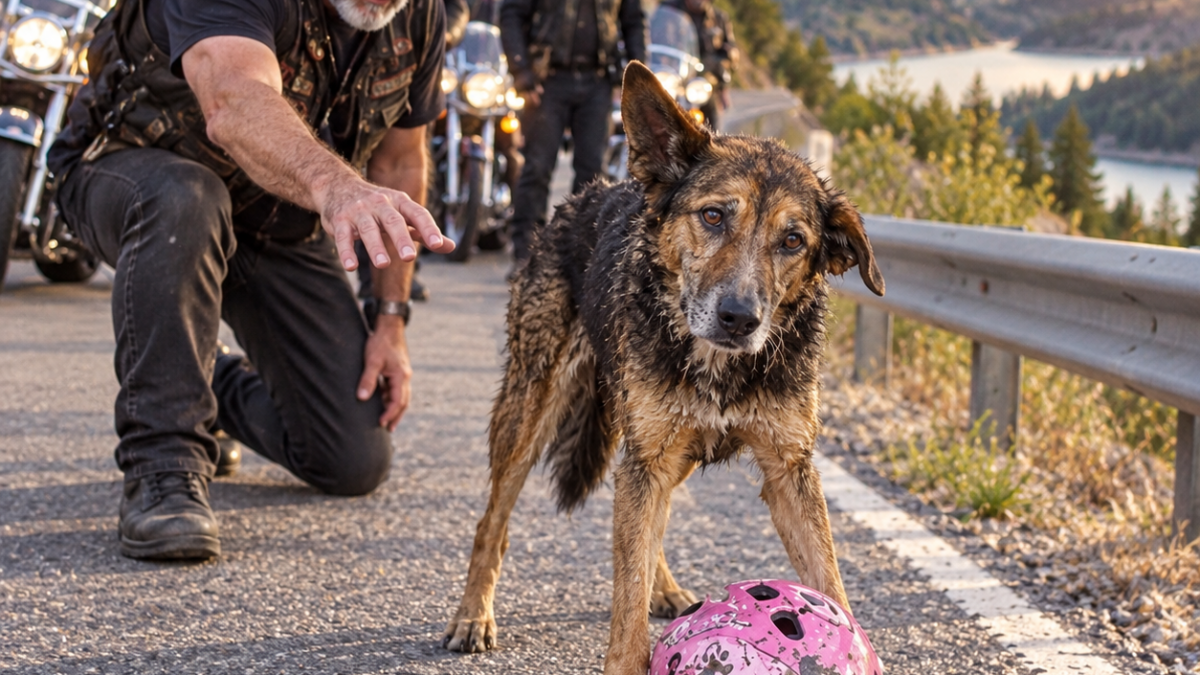
A skinny black-and-brown dog standing behind a pink helmet.
One ear up.
One ear hanging sideways.
Dust covering her back.
Ribs moving with every breath.
She looks at me.
Then at the guardrail.
Then back at me.
I reach toward the helmet.
She growls.
I stop.
She turns toward the ravine.
And for once, finally, somebody follows her eyes.
If I could return to that second knowing everything I know now, I would not try to touch the helmet.
I would not call her over.
I would not wonder why she was blocking traffic.
I would simply say:
“All right, Ruby.
Show me.”








