PART 2: FOR FOUR DAYS, A TINY PUPPY CRIED BENEATH THE CONCRETE—BY THE TIME I FOUND HIM, HE HAD ALMOST GIVEN UP
PART 2
I shoved my face closer to the opening and called to him.
“Hey. Hey, little guy. Stay with me.”
Nothing.
Behind me, the crane engine idled. The workers who had spent hours moving concrete one careful inch at a time stood completely still. A few minutes earlier, that broken little voice had been the sound we were desperate to stop hearing because every cry meant he was suffering.
Now I would have given anything to hear it again.
I called louder.
“Come on, baby. Make a sound.”
One of the men, a heavy-equipment operator named Daniel, crouched beside me and held up a flashlight. He angled the beam through the opening while I tried to see around the slab blocking most of the puppy’s body.
For one terrible second, I thought we had lost him.
Then the light caught his chest.
It moved.
Barely.
“He’s breathing,” I said.
Daniel leaned closer.
“You sure?”
“Yes.”
I watched again.
A tiny rise.
A tiny fall.
“He’s breathing.”
The words moved through the workers behind us, and everyone seemed to release the same breath at once.
But the relief lasted only a moment.
The puppy had stopped crying because he had nothing left.
We had been measuring progress in feet and inches, but his body was measuring time in heartbeats.
Daniel stood up.
“We need to get him out now.”
I grabbed his arm.
“Not fast.”
He looked at me.
“I know.”
There was frustration in both of us because every instinct said hurry, but hurrying was the one thing that could kill him.
The concrete directly above the puppy was different from the larger slabs we had already moved. It was wedged diagonally against another piece, creating the tiny pocket that had probably saved his life. Remove it incorrectly and the second slab could slide into the space where he was trapped.
We stopped using the crane.
The men climbed down with pry bars, wooden blocks, shovels, and their hands.
From that point forward, almost everything was done manually.
They scraped mud away handful by handful. They dug around pieces of broken concrete and wedged supports underneath them before moving anything. Every few minutes someone checked the opening and made sure the puppy was still breathing.
I stayed beside him.
I talked continuously.
I told him things that made no sense.
I told him he was going to sleep somewhere soft that night.
I told him he was going to eat until his belly was full.
I told him that someday he was going to run through grass instead of sitting in a hole filled with filthy water.
I even told him I was sorry.
I knew I had not put him there, but looking at that tiny face made me feel as though somebody needed to apologize on behalf of the entire human race.
“I’m sorry it took us so long to find you,” I whispered. “But we found you. That has to count for something.”
His eyelids moved.
I could not tell whether it was a response or simple exhaustion.
Then Daniel called for me.
“We’ve got a hand-sized opening on this side.”
I crawled around the slab.
One of the workers had managed to clear enough mud that we could finally see part of the puppy’s front leg.
It was frighteningly small.
The fur was plastered flat against the skin, and the paw lay motionless in brown water.
“Can you reach him?” I asked.
“Not yet.”
“How much farther?”
“Maybe six inches.”
Six inches.
After hours of work, six inches sounded both tiny and impossible.
They dug again.
The afternoon light was beginning to fade. Someone brought portable work lamps and ran extension cords from a nearby building. A woman from across the road arrived with bottled water and sandwiches for the crew, but hardly anyone ate.
We had stopped being strangers by then.
There was no formal rescue organization directing us. No television cameras. No crowd cheering from a safe distance.
There was just a group of exhausted people who had heard that a puppy was dying under concrete and had decided that was not how his story was going to end.
At one point Daniel sat back on his heels and wiped his forehead with the sleeve of his shirt.
“I’ve moved buildings easier than this,” he muttered.
I almost laughed.
Instead I looked through the opening again.
The puppy was still breathing.
“We’re not quitting.”
Daniel shook his head.
“Wasn’t planning to.”
Another worker named Marcus reached underneath a slab and began scooping mud away with his fingers.
Suddenly he stopped.
“I can touch him.”
Everything went silent.
“What?”
“I’ve got my hand on his shoulder.”
I dropped beside him.
“Can you pull him?”
“No. He’s still wedged.”
The puppy’s body was trapped at an angle. His hindquarters were lower than his chest, and one section of concrete pressed close enough to his side that there was no room to slide him upward.
Marcus left his hand there.
The puppy made the faintest sound.
Not a cry.
More like a breath with a voice inside it.
Marcus’s expression changed immediately.
“Hey, buddy,” he whispered. “There you are.”
The puppy did it again.
Marcus looked at me.
“He feels cold.”
That scared me more than almost anything else.
The day itself was not cold, but the puppy had been sitting in water for days. His body no longer had the strength to regulate itself properly.
We needed him out.
Daniel placed another wooden support beneath the dangerous slab. Two workers held it steady while Marcus cleared the final section of mud around the puppy’s hind legs.
Then he looked up.
“I think we can move him.”
“Are you sure?”
“No,” he said. “But I think this is our chance.”
He slid both hands inside.
I could see his arms trembling, not from the weight but from the effort to move slowly.
“Easy,” Daniel said.
Marcus shifted one hand underneath the puppy’s chest.
The puppy whimpered.
“Stop.”
Everyone froze.
Marcus waited.
The little body relaxed again.
“Okay.”
He moved another inch.
The puppy’s head appeared first.
Mud covered his face.
His eyes were half closed.
His ears lay flat against his skull.
Then his shoulders came through.
For one frightening moment his back leg caught beneath a ridge of broken concrete.
Marcus stopped immediately.
“Leg.”
Daniel reached down.
“I see it.”
Using two fingers, he cleared a stone from beside the paw.
“Try now.”
Marcus lifted again.
The leg came free.
And suddenly, after four days under the concrete, the puppy was in human hands.
Nobody cheered.
That surprised me later.
I had imagined that if we succeeded, someone would yell. Maybe we would hug one another or clap or celebrate.
But when Marcus lifted that puppy into the light, the condition of his body stole every sound from us.
He looked impossibly small.
Without the darkness around him, we could finally see what those four days had done.
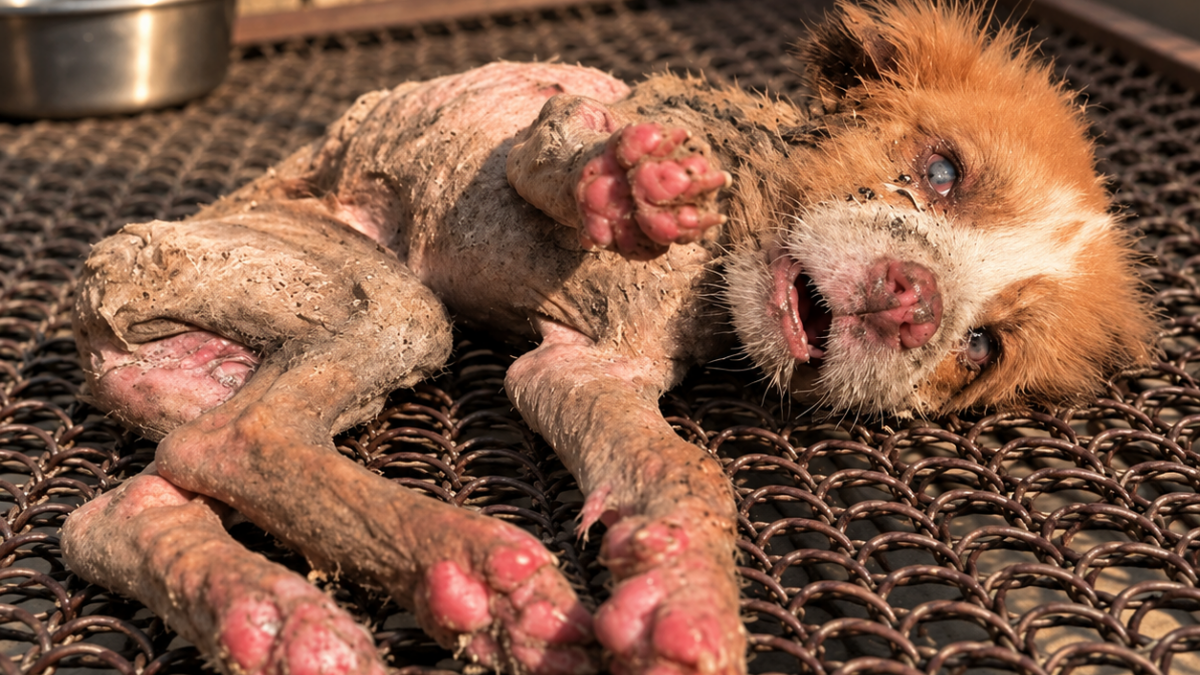
His fur was soaked with mud and dirty water. His belly was thin and drawn upward. Several areas of his skin were raw where insects had gathered around wounds. His paws were pale beneath the dirt. His entire body shook with rapid, involuntary tremors.
Marcus handed him to me.
The moment I felt his weight, something inside me broke.
He weighed almost nothing.
I had expected a puppy.
What I held felt like a damp bundle of bones wrapped in fur.
“Oh, sweetheart.”
His head rolled against my wrist.
I pulled him against my chest while someone wrapped a towel around him.
For the first time, there was nothing above him.
No slab.
No darkness.
No dirty water.
He could see the sky.
But he did not look at it.
He looked at me.
His eyes were cloudy with exhaustion, yet they followed my face as though he was trying to decide whether he could trust what was happening.
“You’re out,” I whispered.
His body trembled against mine.
“You’re out. Nobody is putting you back there.”
Someone handed me a bottle of water.
I poured a small amount into the cap and held it near his mouth.
At first he did nothing.
Then his tongue moved.
Once.
Twice.
He drank a few tiny drops.
I stopped him before he could take too much.
“We’ll get you more,” I said. “Just not all at once.”
He rested his chin against my hand.
That was the moment I knew I was in trouble.
Not practical trouble.
Heart trouble.
I had gone there intending to rescue a puppy.
I had not expected that puppy to reach into my chest and take something with him when he came out.
We wrapped him in another towel, placed him carefully in a box padded with blankets, and carried him to my vehicle.
Before I left, I looked back at the hole.
In daylight it seemed even more impossible.
The space was so small I could not understand how he had survived there for one day, much less four.
Daniel came over and stood beside me.
“You know what bothers me?” he asked.
“What?”
“He didn’t fall through that opening we used.”
I looked at him.
“What do you mean?”
“The angle’s wrong.”
He pointed to the surrounding slabs.
“Something bigger was open when he got in there, or these slabs shifted afterward.”
I stared at the pile.
The thought stayed with me, but the puppy needed a veterinarian more than I needed an answer.
“We’ll figure it out later.”
Daniel nodded.
“Go.”
I drove with the puppy beside me, one hand on the steering wheel and the other resting against the edge of his box whenever traffic allowed.
Every few seconds I looked down to make sure his chest was still moving.
The drive felt endless.
At one red light, he made a weak sound.
“I know,” I said. “I know. We’re almost there.”
He did not cry again.
When I reached the veterinary clinic, I carried him through the door still wrapped in the dirty towel.
A technician took one look at him and disappeared through the treatment-room doors.
“Found trapped under concrete,” I said as I followed. “Four days. Standing water. Open wounds. He’s barely drinking.”
The veterinarian, Dr. Rachel Bennett, came in less than a minute later.
“How old?”
“I don’t know.”
“Owner?”
“I don’t know.”
“Vaccinations?”
“No idea.”
She nodded once.
“Okay. We treat what’s in front of us.”
They placed him on a warming pad.
His temperature was low.
His gums were pale.
He was dangerously dehydrated despite having spent days surrounded by water he could not safely drink. His body condition told them he had probably been hungry even before he became trapped.
Dr. Bennett listened to his chest, checked his abdomen, examined his legs, and then carefully began working through the damaged areas of skin.
She looked up at me.
“There are fly larvae in several wounds.”
My stomach tightened.
“Can you treat it?”
“Yes.”
“Is he going to live?”
She paused.
Doctors sometimes know how heavy a silence can be.
Veterinarians do too.
“I can tell you he’s alive now,” she said. “That’s what I’m willing to promise.”
I hated that answer.
But I respected it.
They drew blood.
They tested him for several common and dangerous viral illnesses because a puppy that weak could be fighting far more than what we could see.
I stood near the treatment table while they placed an IV catheter into his tiny leg.
He barely reacted.
That frightened me.
A healthy puppy would have complained.
This one simply lay there.
Dr. Bennett began fluids slowly.
They cleaned the wounds, removed the larvae, washed away the mud, and treated the inflamed skin. They checked his paws and joints for fractures or crush injuries.
Somehow, there were none.
No broken legs.
No major internal injury they could detect.
His greatest enemies were dehydration, exposure, infection, starvation, and exhaustion.
His body had simply been running out of everything required to stay alive.
About an hour later, Dr. Bennett came toward me holding the first test results.
“Negative.”
I blinked.
“For what?”
“The viral screens we ran.”
“All of them?”
“All negative.”
I covered my mouth with my hand.
It was the first genuinely good news we had received.
Dr. Bennett gave me a tired smile.
“That doesn’t mean we’re finished. He’s still very weak. But it removes some serious problems from the list.”
I looked through the glass door.
The puppy was lying beneath a blanket with the IV line running into his leg.
His eyes were closed.
For the first time since I had found him, he was not shaking.
“What happens now?”
“Now he rests.”
“Can I stay?”
She looked at me.
“You can stay for a while.”
So I did.
I sat beside his kennel after the clinic became quiet.
Every so often a machine clicked. Staff moved through the hallway. Phones rang at the front desk, then gradually stopped as evening became night.
The puppy slept.
I kept staring at him, thinking about the four nights before that one.
Had rainwater dripped onto him?
Had he slept at all?
Had he cried every time footsteps passed overhead?
Had he heard people talking nearby and wondered why nobody came?
Those questions hurt because there would never be answers.
Around nine that night, he opened his eyes.
I was sitting on the floor beside the kennel.
“Hey.”
His gaze moved toward me.
He lifted his head perhaps half an inch.
Then it dropped.
“That’s okay,” I said. “You don’t have to do anything.”
His eyes stayed on me.
I reached through the bars and placed two fingers near his nose.
He smelled them.
Then, very slowly, he rested his chin on them.
I sat there like that for nearly twenty minutes because I was afraid moving my hand would make him think I had left.
The next morning I returned before the clinic officially opened.
Dr. Bennett was already there.
She met me in the hallway.
“He made it through the night.”
Those six words felt enormous.
“How is he?”
“Still critical, but better than when you brought him in.”
“Did he eat?”
“A little.”
She held her thumb and index finger barely apart.
“Very little.”
I smiled anyway.
“Little counts.”
“Yes,” she said. “Today, little counts.”
When I went to his kennel, he was awake.
He looked different.
Not healthy.
Not even close.
But present.
His eyes followed me before I spoke.
“Well, look at you.”
His tail moved.
I stared.
It moved again.
Maybe half an inch against the blanket.
I started laughing and crying at the same time.
“Did you just wag your tail?”
A technician walking behind me smiled.
“He did that for us too.”
I leaned closer.
“You’re showing off now.”
The tail moved once more.
That tiny movement became our first celebration.
Over the next forty-eight hours, the puppy remained hospitalized.
His wounds had to be cleaned repeatedly. He received fluids, medication, carefully measured meals, and constant monitoring. The staff turned him regularly because he was too weak to move himself enough.
The first time he tried to stand, his legs folded underneath him.
He looked startled.
Then embarrassed, if a puppy can look embarrassed.
I put my hands around his chest.
“Easy.”
He pushed again.
His front paws held for perhaps two seconds.
Then he collapsed against me.
Dr. Bennett watched from the doorway.
“Don’t help him too much.”
I looked at her.
“I’m barely touching him.”
“I’m talking to you emotionally.”
I laughed.
She smiled.
“He needs to discover that his legs still belong to him.”
The next attempt lasted three seconds.
By the end of that day, he could stand for nearly ten.
We still had not named him.
The clinic records simply said “male puppy—concrete rescue.”
One technician suggested Rocky.
Another suggested Lucky.
Daniel, who called every day for updates, suggested Jackhammer.
I told him absolutely not.
Then on the third morning I walked into the treatment room and heard a soft little whine coming from behind the kennel door.
The sound stopped when I entered.
A few seconds later it came again.
Something about it took me back to the first moment beneath the concrete, when I had followed his voice from slab to slab because the sound seemed to bounce through the hollow spaces.
“Echo,” I said.
The puppy tilted his head.
Dr. Bennett looked over.
“What?”
“I think his name is Echo.”
She considered it.
Then she smiled.
“Echo it is.”
The name stayed.
By the fourth day after his rescue, Echo could eat a small meal without assistance.
By the fifth, he could walk from one end of the treatment room to the other, although his hind legs wobbled like they belonged to a much younger puppy.
By the sixth, he discovered toys.
A technician placed a soft blue ball near his blanket.
Echo stared at it.
He sniffed it.
Then he looked at us as if we had handed him an unexploded bomb.
I rolled the ball two inches.
He jumped backward.
Everyone laughed.
Echo looked offended.
The ball stopped.
He crept toward it.
Sniffed it again.
Then he placed one paw on top.
It rolled.
He nearly fell over chasing it.
For the first time, I saw the puppy he should have been all along.
Not a victim.
Not a patient.
Not a trembling body under concrete.
Just a baby dog discovering that the world contained things meant for play.
I wish I could say that once Echo was safe, I stopped thinking about the place where I found him.
I didn’t.
Something Daniel had said kept returning to me.
The angle was wrong.
Echo probably had not crawled through the tiny opening where I found him.
So how had he gotten in?
Two days after the rescue, I went back.
The concrete looked different with the major slabs removed. What had seemed like random rubble was clearly part of a larger dumping area. Broken sections of drainage channel, pavement, rebar, and demolished wall panels had been piled beside a shallow runoff trench.
Daniel met me there.
He had taken photographs during the rescue because crane operators routinely documented difficult lifts.
He showed me one.
“See this?”
He pointed to a slab we had removed.
Along one edge was fresh soil.
“What am I looking at?”
“That slab moved recently.”
“How recently?”
“Can’t tell you exactly. But look at the dirt. The underside wasn’t exposed for long.”
We walked around the pile.
About twenty feet away, tire tracks had hardened in the mud.
Large equipment.
A dump truck, maybe.
I began asking questions.
The people living nearby told me trucks had been bringing broken concrete to the lot for weeks.
One older man named Luis remembered hearing Echo for the first time late on a Monday evening.
“He was louder then,” Luis told me. “Much louder.”
“What did you do?”
“I came over with my flashlight. Couldn’t find him.”
“When did you realize he was inside the concrete?”
“Tuesday morning.”
“Did you call anyone?”
He nodded.
“Several people.”
“Who?”
He gave me the name of the company leasing the lot.
I wrote it down.
“Did they come?”
His expression tightened.
“Someone came Wednesday.”
“What happened?”
“He looked at the pile, said moving it required heavy equipment, and left.”
I stared at him.
“That was it?”
Luis nodded.
“He said they would deal with it when equipment was available.”
Echo had been underneath that concrete while someone stood above him and decided the problem could wait.
A strange heat moved through me.
I had spent four days blaming nobody because I assumed everyone had simply been helpless.
Helpless was one thing.
Indifferent was another.
“What company?”
Luis pointed toward a faded sign near the road.
I photographed it.
I still did not know exactly how Echo became trapped. He could have crawled into a hollow area seeking shelter before another load of debris shifted. Nobody had witnessed it. I would not invent an accusation I could not prove.
But one fact was becoming clear.
People had reported a living animal trapped inside the pile.
And someone with access to equipment had known.
I called the company that afternoon.
A receptionist transferred me twice before a man answered.
I introduced myself and explained why I was calling.
There was a pause.
“Yeah,” he said. “I heard about the dog.”
“The puppy.”
“Whatever.”
I gripped my phone tighter.
“When did you hear?”
“I don’t know. Earlier in the week.”
“Did someone from your company inspect the site?”
Another pause.
“Who is this again?”
“The person who rented a crane and pulled him out.”
“Oh.”
That single word told me he had not expected the conversation.
I kept my voice calm.
“People nearby say someone from your company came Wednesday.”
“I don’t manage field scheduling.”
“Did your company know a puppy was trapped?”
“I’m not discussing company operations with you.”
“I’m not asking about operations. I’m asking whether you knew an animal was dying underneath your concrete.”
“It’s not our concrete.”
I looked at the sign I had photographed.
“Your company leases the lot.”
“That doesn’t make everything dumped there ours.”
“Who dumped it?”
“I don’t know.”
“Then maybe the city should.”
Silence.
His tone changed.
“Are you threatening us?”
“No.”
And I meant it.
Threats are emotional.
I had moved past emotion.
“I’m telling you what I’m going to do.”
“What’s that?”
“I’m going to document what happened.”
He hung up.
That decision changed the second half of Echo’s story.
I did not post accusations online.
I did not send an angry mob toward a business.
I did something far more useful.
I collected facts.
Daniel gave me copies of the photographs.
Luis and two other neighbors wrote down when they first heard Echo and whom they contacted.
I saved the crane invoice.
I asked the veterinarian for a written summary of Echo’s condition when he arrived, without exaggeration or speculation.
Then I contacted the local office responsible for illegal dumping and unsafe properties.
An inspector visited the site.
What began as a complaint about one trapped puppy widened almost immediately.
The lot had unsecured debris.
The runoff trench was partially obstructed.
Broken construction material had been dumped close enough to a public path that another animal—or a child—could have crawled inside.
Some of the material had apparently been deposited without the required authorization.
The inspector photographed everything.
“What happens now?” I asked.
“We determine who is responsible.”
“And Echo?”
He glanced at the opening where we had found him.
“He’s evidence that this isn’t theoretical.”
That sentence stayed with me.
Echo was recovering in a warm clinic while strangers investigated the hole that had nearly become his grave.
The contrast was difficult to process.
On the seventh day after his rescue, Dr. Bennett called me.
“You need to come down here.”
My stomach dropped.
“What happened?”
“Just come.”
“Rachel, is he okay?”
“He’s fine.”
“Then why do I need—”
“Come see your dog.”
My dog.
I noticed the words.
I did not correct her.
When I arrived, Echo was standing in the hallway wearing a small harness.
Standing.
Not wobbling in place.
Standing.
His wounds were healing. The worst areas were covered, his coat was beginning to look soft again, and there was a brightness in his eyes I had never seen beneath the concrete.
“Ready?” Dr. Bennett asked.
“For what?”
She unhooked the leash from a cabinet handle.
Echo looked at me.
His tail began moving.
Dr. Bennett handed me the leash.
“Walk.”
I crouched.
“Come here, Echo.”
He took one step.
Then another.
His back legs shook.
He paused.
I could see the uncertainty return to his face.
“Take your time.”
He stepped again.
Then again.
By the sixth step, his tail was wagging.
By the tenth, he was moving faster than I expected.
And then that ridiculous little puppy tried to run.
His legs could not coordinate with his ambition.
He stumbled forward, bounced against my knee, and rolled onto his side.
I panicked.
Dr. Bennett laughed.
“He’s fine.”
Echo scrambled back up.
His tail never stopped.
I sat on the floor.
He climbed directly into my lap.
That was the first time he chose me.
During the rescue, I had reached for him because he needed help.
At the clinic, I had sat beside him because I needed to know he was alive.
But that afternoon, Echo crossed the room because he wanted to be near me.
There is a difference.
A huge one.
He pressed his face underneath my arm and sighed.
I looked at Dr. Bennett.
“When can he leave?”
She folded her arms.
“With whom?”
I looked down at Echo.
Then back at her.
“You already know the answer.”
“I want to hear you say it.”
I scratched behind his ear.
“With me.”
She smiled.
“Good.”
I had not planned to adopt a dog.
In fact, if you had asked me that morning whether I was ready for a puppy, I would have listed a dozen reasons why the timing was terrible.
Work.
Money.
Schedules.
Responsibility.
My house was not puppy-proof.
My yard needed repairs.
I had no food bowls, toys, bed, leash, crate, or plan.
By that evening, I owned all of them.
Echo came home two days later.
Before we left the clinic, every staff member came to say goodbye.
The technician who had given him the blue ball brought it to the front.
“He’s going to need this.”
Echo grabbed it immediately.
“So now he likes it?”
“He loves it.”
I looked at him.
“Traitor.”
His tail wagged around the ball.
Dr. Bennett handed me a folder containing medication instructions, feeding schedules, follow-up appointments, wound-care notes, and enough warnings to make me wonder whether I had adopted a puppy or taken command of a small hospital.
Then her expression became serious.
“He may have behavioral effects from what happened.”
“What should I expect?”
“Fear of confined spaces. Water. Loud machinery. Separation. We don’t know.”
I looked at Echo.
He was chewing the corner of his blanket.
“He seems pretty normal.”
“He’s a puppy. Puppies are resilient. But resilience doesn’t mean nothing happened.”
I understood.
That became clear on our first night.
Echo explored my living room like a scientist arriving on another planet.
He sniffed the couch.
The rug.
The table legs.
My shoes.
He discovered his reflection in a dark window and barked at it, then hid behind me when the other puppy appeared to bark back.
He ate dinner slowly.
He drank water.
He carried his blue ball into the center of the room and fell asleep beside it.
Everything seemed fine.
Then I turned off the lights.
Echo screamed.
Not barked.
Not whimpered.
Screamed.
I switched the lamp back on immediately.
He was standing in the middle of his bed, shaking.
The sound transported me straight back to the concrete.
I sat beside him.
“It’s okay.”
He climbed out and pressed himself against my legs.
I turned the light down instead of off.
That night I slept on the floor beside his bed.
Around three in the morning, I woke up because something was touching my hand.
Echo had placed one paw over my fingers.
He was asleep.
I did not move.
For the next week, we left a lamp on at night.
Then a small light.
Then only the hallway light.
Eventually, darkness became just darkness.
Water took longer.
Echo would drink from a bowl, but he refused to step onto wet ground.
The first time it rained after I brought him home, he reached the open door, smelled the air, saw the wet patio, and backed up so quickly he bumped into the wall.
I tried treats.
Nothing.
I tried going outside first.
Nothing.
I tried carrying him.
That was a mistake.
The moment he felt rain touch his paws, he twisted in my arms and cried.
I carried him inside.
“Okay,” I said. “Not today.”
We worked on it slowly.
I placed a damp towel near his food bowl.
Then beside his bed.
Then near the back door.
He learned that wet did not mean trapped.
Two weeks later he walked across the patio after rain.
A month later he chased droplets coming from the garden hose.
Three months later I watched him jump directly into a shallow kiddie pool and attack his own reflection.
I laughed until my stomach hurt.
“You have got to be kidding me.”
Echo splashed harder.
The dog who had nearly died sitting in dirty water had decided clean water was acceptable as long as he was the one creating the mess.
His physical recovery was faster than anyone predicted.
His wounds closed.
New fur grew over most of the damaged skin.
His appetite became enormous.
He gained weight.
His legs strengthened.
Within six weeks, the fragile puppy who once could not stand was sprinting through my yard with the blue ball in his mouth.
But while Echo healed, the investigation into the dumping site continued.
The company representative who had hung up on me called again.
His tone was different this time.
Professional.
Careful.
“We understand you filed a complaint.”
“I provided information.”
“We would like to resolve any misunderstanding.”
“There isn’t one.”
“We’re not responsible for an animal entering an unsecured area.”
“I never said you put him there.”
“That seems to be the implication.”
“No. The issue is what happened after people told someone he was trapped.”
Silence.
“We don’t have documentation of that.”
“I do.”
Another silence.
“What exactly do you want?”
That question irritated me.
I looked across my living room.
Echo was asleep upside down on the couch, all four paws in the air.
“I want the site made safe.”
“We can arrange cleanup.”
“And I want the authorities to finish determining responsibility without anyone trying to make this disappear.”
His voice sharpened.
“Nobody is trying to make anything disappear.”
“Good. Then we agree.”
He exhaled.
“There were expenses involved in the rescue, correct?”
“Yes.”
“We might be prepared to reimburse—”
“No.”
He stopped.
I had spent money on the crane.
Neighbors had contributed later.
The clinic had reduced part of Echo’s bill after hearing his story.
But I understood exactly what the conversation was becoming.
“If you want to contribute to his medical care,” I said, “you can do it without conditions.”
“What does that mean?”
“It means you don’t buy my silence.”
“I didn’t say that.”
“Then put whatever you’re offering in writing.”
He never did.
Two weeks later, heavy equipment arrived at the lot.
This time I watched from across the road.
Concrete was separated and removed properly.
The trench was cleared.
Temporary fencing went up.
Warning signs were installed.
A crew spent two full days cleaning the property.
Luis stood beside me.
“They could’ve brought that machine the first day,” he said.
I looked at the excavator lifting a slab larger than the one that had trapped Echo.
“Apparently.”
He shook his head.
“If you hadn’t pushed…”
I knew what he meant.
But I had learned something from Echo.
Anger can get your heart moving.
Documentation gets other things moving.
The company and subcontractors were eventually cited for violations connected to the site. The official findings did not say anyone intentionally trapped Echo, and I never claimed they had.
What they established was enough.
The dumping area had not been maintained safely.
Required controls had not been followed.
Complaints about the hazard had not been handled with the urgency they deserved.
Corrective work was ordered.
Fines followed.
The lot could no longer be used as it had been before.
Some people told me I should have demanded more.
Others wanted a villain they could hate.
Life is rarely that clean.
I never learned exactly how Echo ended up beneath those slabs.
Maybe he crawled underneath seeking shade.
Maybe he was following another animal.
Maybe the concrete shifted after he entered.
Maybe somebody abandoned him nearby and he simply chose the worst possible hiding place.
I refused to invent an answer just because uncertainty was unsatisfying.
The truth I did know was terrible enough.
A tiny puppy had cried for four days from underneath concrete.
People had heard him.
Attempts had failed.
The response that could have saved him sooner had not come.
And by the time I found that narrow opening, his body was nearly finished fighting.
That truth deserved action.
Months passed.
Echo became almost unrecognizable.
He grew into a lean, energetic young dog with enormous ears that never seemed to agree about which direction they should point.
One stood upright.
The other leaned sideways whenever he was curious.
His coat filled in thick and healthy, though several small scars remained beneath the fur.
He loved chicken.
He hated vacuum cleaners.
He stole socks with professional skill.
He believed every delivery driver had come specifically to visit him.
He learned to sit, stay, lie down, shake, and ignore all commands whenever a squirrel was involved.
He slept beside my bed.
Not on it.
That distinction lasted four nights.
On the fifth morning I woke up with Echo’s head on my pillow.
“Absolutely not.”
His tail moved underneath the blanket.
“How did you even get up here?”
He closed his eyes.
“Down.”
Nothing.
“Echo.”
One eye opened.
I pointed to the floor.
He rolled onto his back.
I lost the argument.
There were harder moments too.
The first time we walked past a construction site, a loader dropped a bucket.
Metal slammed against concrete.
Echo hit the ground.
His body flattened.
His paws clawed at the pavement as he tried to escape his leash.
I knelt beside him.
“Echo. Look at me.”
He could not.
His eyes were fixed on the machine.
I moved between him and the noise.
“Look at me.”
Eventually his gaze found mine.
“There you are.”
I did not drag him forward.
We walked away.
The next week, we returned from farther down the street.
Then closer.
Then closer again.
Months later, he could walk past the site without freezing.
That became the pattern of his recovery.
We never defeated his past in one dramatic moment.
We made it smaller through repetition.
One safe night.
One safe walk.
One safe rainstorm.
One safe stranger.
One safe noise.
One safe day added to another until the terrible four days became a smaller and smaller fraction of his life.
Almost six months after the rescue, Daniel came to my house.
Echo had not seen him since the day he was pulled from the concrete.
I wondered whether he would remember.
Daniel stepped through the gate.
Echo stopped.
His ears lifted.
Daniel crouched.
“Hey, Jackhammer.”
I groaned.
“Do not start.”
Echo stared at him for three seconds.
Then he ran.
He hit Daniel square in the chest.
Daniel fell backward laughing while Echo climbed over him and licked his face.
“Well,” Daniel said, trying to protect himself with one arm, “I think he remembers.”
I watched them and felt my throat tighten.
The last time those two had touched, Daniel had been reaching into mud and broken concrete to help free a puppy too weak to stand.
Now Echo was strong enough to knock him over.
Daniel noticed me watching.
“Don’t do that.”
“Do what?”
“Get emotional.”
“I’m not.”
“You absolutely are.”
Echo stole his glove.
The moment passed.
Later we sat outside while Echo destroyed a toy that had supposedly been designed for “aggressive chewers.”
It lasted eleven minutes.
Daniel shook his head.
“We spent eight hours trying not to break that dog, and now he can break anything.”
“Seems fair.”
He watched Echo for a while.
“Do you ever think about what would’ve happened if you hadn’t heard him?”
I hated the question.
“Yes.”
“Me too.”
There was no need to say more.
We both knew.
Another day.
Possibly another night.
Maybe less.
Echo had been very close.
That fact never stopped being frightening.
But eventually I realized there was another way to think about it.
What if I had arrived ten minutes earlier?
What if someone else had found him first?
What if the crane had not been available?
What if Daniel had been working somewhere else?
What if Dr. Bennett had discovered a virus on top of everything else?
You can torture yourself with the roads that were almost taken.
Or you can honor the one that was.
Echo survived.
That became enough.
Near the first anniversary of his rescue, I received a call from Luis.
“You should come over.”
“What happened?”
“Nothing bad.”
People really need to stop saying things like that before telling you why they called.
“Then what?”
“Just come.”
I drove to the old site with Echo in the back seat.
I had avoided taking him there.
Maybe I was protecting him.
Maybe I was protecting myself.
The place looked almost nothing like I remembered.
The massive piles were gone.
The drainage channel had been repaired.
The ground had been graded.
A secure fence surrounded the remaining storage area.
Grass had begun growing across the section where the concrete once sat.
I parked across the road.
Echo jumped down.
He sniffed the ground.
His tail moved normally.
Luis approached us.
“Look at him.”
Echo greeted him like an old friend despite never having met him properly.
Luis knelt.
“This is the little guy?”
“Not so little anymore.”
Echo leaned against his legs.
Luis rubbed his chest.
“I heard you for four days,” he whispered.
I looked away.
When I looked back, Luis was wiping his eyes.
“I’m sorry, buddy.”
Echo licked his chin.
Forgiveness is probably a human concept.
Dogs seem more interested in what you are doing with the next ten seconds.
Luis stood.
“There’s something I want to show you.”
He led us toward the edge of the property, outside the new fence.
Several neighbors had planted a small tree.
Beside it was a simple stone marker.
No company name.
No accusations.
No dramatic language.
Just a few words.
FOR THE LITTLE VOICE WE ALMOST LOST.
I read it twice.
“Who did this?”
“People around here.”
“You didn’t need to.”
“We know.”
Echo sniffed the tree.
Then lifted his leg.
“Echo!”
Luis burst out laughing.
I stared at the dog.
“Seriously?”
Echo looked delighted with himself.
Luis laughed even harder.
“Well,” he said, “I guess he has his own opinion of memorials.”
That was Echo.
He could turn the saddest moment into something ridiculous without even trying.
We walked farther along the edge of the old lot.
When we reached the approximate place where the concrete pile had stood, I felt Echo’s leash tighten.
I stopped.
His body had gone still.
I looked at him.
He stared toward the ground.
For a moment I wondered if he remembered.
Could he smell something?
Could a dog carry a physical memory of a place he had experienced as a terrified puppy?
I did not know.
I crouched.
“You don’t have to go closer.”
Echo looked at me.
His ears shifted.
Then he took one step.
Another.
He sniffed the grass.
He circled.
I let the leash remain loose.
He walked to the exact area where I believed the hole had been.
Then he did something incredibly ordinary.
He sat down.
That was all.
No trembling.
No crying.
No attempt to run.
He simply sat in the sunlight.
I lowered myself onto the grass beside him.
A year earlier there had been tons of concrete above his head.
Now there was blue sky.
A year earlier his paws had been submerged in filthy water.
Now they rested on warm grass.
A year earlier flies had covered wounds he could not defend.
Now a butterfly landed near his nose, and he snapped at it badly enough to embarrass every predator in his ancestry.
I laughed.
Echo looked at me.
“Terrible technique.”
His tail thumped against the ground.
I rubbed the scar behind his front leg.
“You did it, buddy.”
He leaned into me.
For months people had called me the person who saved Echo.
I never liked that description.
Too many people had been involved.
Daniel and the workers who moved the concrete.
The neighbors who helped.
The clinic staff who stayed beside him.
Dr. Bennett, who refused to promise me a happy ending but worked like hell to create the possibility of one.
And Echo himself.
People underestimate the work required to survive.
He had spent four days doing nothing that looked heroic.
He had not escaped.
He had not defeated anything.
He had cried.
He had breathed.
He had waited.
Sometimes survival looks exactly like that.
You keep breathing until help reaches you.
Echo taught me that.
He also changed something else.
After the rescue, I began paying more attention to sounds other people dismissed.
A dog barking behind an abandoned house.
A kitten crying near a drain.
An animal limping near traffic.
Most turned out to be ordinary situations.
Some did not.
I started volunteering with local rescuers.
Daniel occasionally helped when heavy equipment was needed.
Dr. Bennett became the veterinarian I called whenever I had found something with four legs and terrible timing.
We became, without planning to, a small network of people who knew one another because a puppy once cried beneath concrete.
The first rescue Echo accompanied me on happened about eighteen months after I found him.
A woman had spotted a frightened dog hiding beneath an abandoned porch.
There was no immediate danger, but the dog refused to come out.
I brought food.
Echo came with me.
He remained on leash several yards away while I sat near the porch.
The frightened dog growled whenever I moved.
Echo lay down.
He did nothing dramatic.
He did not bark.
He did not pull.
He simply watched.
After almost an hour, the dog crawled forward.
Then stopped.
Echo lowered his head.
The dog came farther.
Eventually she emerged.
Later the woman who adopted her asked me what trick I had used.
I looked at Echo.
“No trick.”
Maybe frightened animals recognize something in one another that humans cannot see.
Or maybe Echo was simply unusually good at lying still when snacks were involved.
Either way, he became a quiet presence during several rescues after that.
Never forced.
Never placed in danger.
Just there.
A dog who once waited for somebody to come toward him now helped other frightened animals discover that approaching people could lead somewhere safe.
That felt like the most satisfying kind of revenge against what had happened to him.
Not anger.
Not suffering returned for suffering.
A life so full that the hole no longer defined him.
The company connected to the old site eventually paid its fines and completed the required corrections. A portion of the disputed cleanup costs was settled through the responsible parties. The abandoned dumping stopped.
There was no dramatic courtroom confession.
Nobody stood up and announced that they were sorry.
Real accountability is often less cinematic than people imagine.
It looks like inspection reports.
Invoices.
Photographs.
Deadlines.
Fines.
Fences.
Equipment arriving to repair what should have been handled correctly from the beginning.
Part of me had once wanted somebody to feel exactly what I had felt when I looked through that hole.
I wanted them to hear Echo cry.
I wanted that sound to follow them home.
But over time I stopped wanting revenge that required more suffering.
I wanted the place changed.
It was.
I wanted people to take the next trapped animal seriously.
They did.
I wanted Echo to live long enough that his terrible beginning became almost impossible to see when you looked at him.
He did better than that.
Years passed.
The blue ball finally died.
Echo carried its torn remains around for two additional weeks before I managed to throw them away.
He retaliated by stealing one of my shoes.
Fair trade, apparently.
He grew broader through the chest and calmer in the face, but he never entirely lost the oversized ears.
One still leaned sideways.
People constantly asked what breed he was.
I never had a good answer.
“Concrete retriever,” Daniel said once.
I almost threw a drink at him.
Echo loved children.
He loved old people.
He loved anyone carrying food.
He considered squirrels an organized criminal threat.
He hated baths despite voluntarily jumping into every puddle he encountered.
He snored.
Loudly.
He developed the strange habit of checking every room in the house before settling down at night.
Kitchen.
Living room.
Hallway.
Back door.
Bedroom.
Only then would he circle his bed and lie down.
Maybe it meant nothing.
Maybe it was simply routine.
But sometimes I wondered whether a part of him still needed to know there was always another way out.
So I never closed his crate door.
I never forced him into a narrow space.
And whenever he slept with one paw stretched beyond the edge of his bed, I found myself thinking about the hole.
Not with the same horror.
With gratitude.
Because the image in my mind had changed.
I no longer saw the puppy trapped beneath concrete.
I saw the moment Marcus lifted him into daylight.
I saw the first drops of water touching his tongue.
I saw the IV line.
The tiny tail wag.
The first six steps across the clinic floor.
The blue ball.
The rain.
The grass.
The ridiculous monument incident.
I saw a life unfolding forward instead of ending underground.
One evening, years after the rescue, I was sitting on my porch while Echo slept at my feet.
A storm had passed through earlier, and the air smelled like wet soil.
Water dripped from the roof.
Echo was older now.
There was a little gray around his muzzle.
Not much.
Just enough to remind me that time had been doing what time always does.
I looked down at him.
“You know you weren’t supposed to get old, right?”
His ear moved.
“I rescued a puppy.”
He opened one eye.
“Who authorized this?”
His tail tapped once.
I reached down and rubbed his chest.
The scars were difficult to find now.
I knew where they were.
Most people would never notice them.
I thought about the first night at the clinic and how desperately I had wanted a guarantee.
Tell me he will live.
Tell me this ends well.
Tell me the suffering meant something.
Dr. Bennett had refused.
She could only promise that he was alive in that moment.
Maybe that was the right lesson.
None of us gets more than that.
One moment.
Then another.
And if we are lucky, enough of those moments gather together to become a life.
Echo stood, stretched, and walked toward the wet yard.
He stopped at the edge of the porch.
Years before, rain had terrified him.
I watched him step onto the grass.
Then another step.
He looked back at me.
“Go ahead.”
He ran.
Straight through the wet yard.
Mud sprayed behind him.
He found one of his toys near the fence, grabbed it, and came charging back.
“Don’t you dare.”
He did.
Echo jumped onto the porch, shook his entire body, and covered me with muddy water.
I sat there dripping.
He dropped the toy at my feet.
Then he looked up at me with the happiest face I had ever seen.
I started laughing.
“You are unbelievable.”
His tail hammered against the porch.
I threw the toy.
He chased it.
That was the ending I had wanted for him.
Not simply survival.
Not merely the absence of pain.
Joy.
Ordinary, ridiculous, muddy joy.
The kind a puppy is supposed to know.
Every now and then, someone who remembers the rescue asks me whether Echo understood that we saved him.
I never know how to answer.
Dogs do not tell stories the way we do.
They do not sit around arranging their lives into beginnings, tragedies, turning points, and endings.
Echo did not know that strangers had watched a crane lift concrete above him.
He did not know people had filed reports because of what happened.
He did not know that a stone beside a tree carried a sentence about his voice.
He knew simpler things.
He knew the sound of my car.
He knew where his dinner was kept.
He knew which drawer contained treats.
He knew Daniel was the man who let him steal gloves.
He knew Dr. Bennett smelled like a clinic but could be forgiven because she carried cheese.
He knew rain was no longer something that filled a hole around his body.
He knew darkness did not mean he was alone.
He knew when he cried, somebody came.
Maybe that was enough.
Actually, I think it was everything.
Years earlier, when I lay on the muddy ground and looked through that narrow crack, I had seen two frightened eyes staring back at me.
I had told him, “I see you now.”
At the time, I meant something simple.
I had found him.
But those words became the promise I kept for the rest of his life.
I saw him when he was weak.
I saw him when he was afraid.
I saw him when he took his first steps.
I saw him learn to trust darkness again.
I saw him walk through rain.
I saw him return to the place where he nearly died and sit peacefully beneath an open sky.
I saw him become more than the worst thing that ever happened to him.
And whenever people heard his story and said, “That poor dog,” I understood what they meant, but I always wanted to correct them.
Not poor Echo.
Not anymore.
Echo had food.
A warm bed.
A yard.
People who loved him.
Friends at the clinic.
A collection of stolen socks.
More toys than any reasonable dog needed.
Years of mornings when the first thing he saw was somebody happy he had awakened.
Years of evenings when he fell asleep without having to wonder whether anyone knew where he was.
Years of rainstorms, sunny walks, muddy paws, car rides, treats, belly rubs, and naps in places he absolutely was not supposed to be.
Four days had nearly taken his entire future.
They did not get it.
That was the victory.
That was our revenge.
One afternoon, long after the scars had disappeared beneath his coat, I took Echo back to the little tree near the old site.
It had grown taller.
The branches were beginning to provide real shade.
Echo walked around it, sniffed the grass, and then lay down beside the stone.
I sat next to him.
The inscription was weathered but still readable.
FOR THE LITTLE VOICE WE ALMOST LOST.
I put my hand against Echo’s side.
His breathing was slow and peaceful.
Traffic moved along the road.
Birds called from somewhere behind us.
There was no crying beneath the ground.
No crane.
No desperate workers.
No flies.
No dirty water.
Only a dog resting in the shade.
I remembered kneeling beside that tiny opening and begging for one more sound after Echo suddenly stopped crying.
At the time, silence had terrified me.
Now, sitting beneath that tree, silence felt completely different.
It meant he was comfortable.
It meant he was safe.
It meant he did not need to cry anymore.
Echo rolled onto his side and placed his head across my leg.
I smiled.
“You know what, buddy?”
His eyes stayed closed.
“You were worth every slab.”
His tail touched the grass once.
I looked toward the place where the hole had been.
Then down at the dog who had survived it.
Four days in darkness had almost been the whole story.
Instead, they became only the first pages.
And everything that came afterward belonged to Echo.








