PART 2: For 93 Days, a Starving Dog Waited Outside a Cemetery—Then His Microchip Revealed Why He Wouldn’t Leave
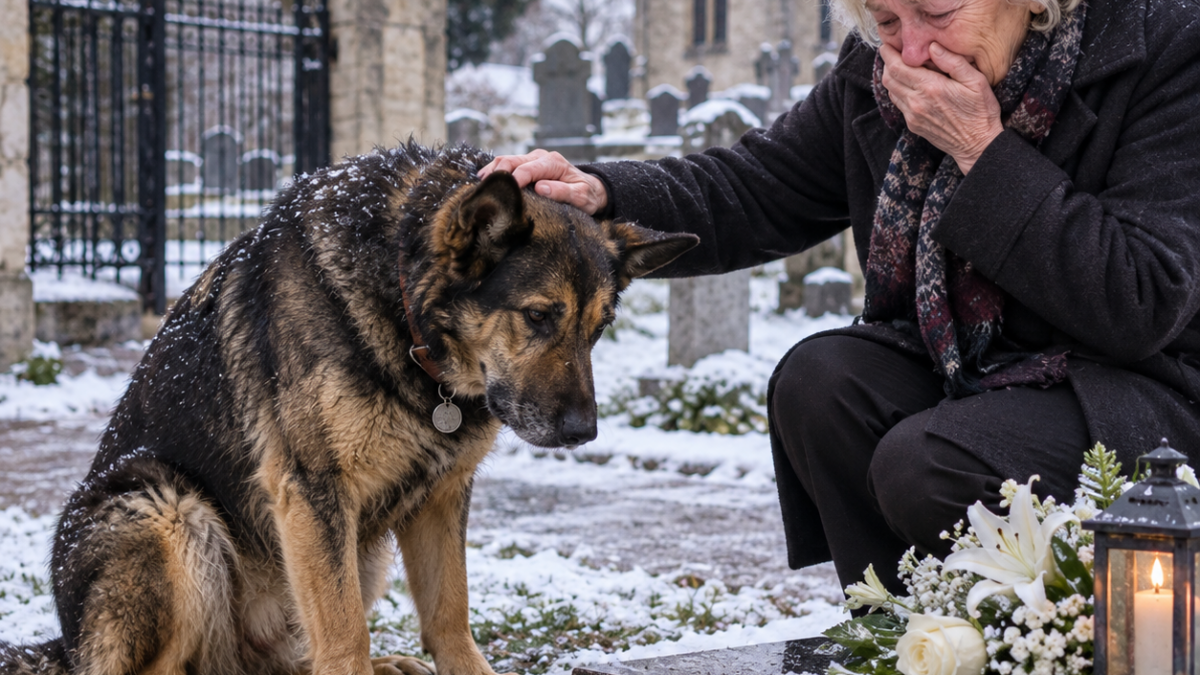
For ninety-three days, a starving dog waited outside a cemetery in Lyon and studied every person who walked back through the iron gate.
He never chased cars, never begged mourners to follow him, and never wandered more than a few yards from the entrance, even when snow began collecting on his back.
The afternoon we finally scanned the microchip beneath his skin, one name appeared on the screen—and suddenly his strange ritual at the gate became much harder to explain.
My name is Madeleine Lefèvre.
I was eighty-one that winter, and every Wednesday afternoon I took the same bus from my apartment in Villeurbanne to visit André.
My husband.
Or, more accurately, his grave.
After forty-seven years of marriage, I still hated using the past tense when I spoke about him.
The dog was always beneath the narrow awning beside the cemetery keeper’s lodge.
Black and tan.
Thin enough that I could count his ribs beneath his coat.
One ear stood perfectly upright while the other folded slightly at the tip. A pale crescent-shaped scar crossed his muzzle, and an old brown leather collar hung loosely around a neck that had obviously once been much thicker.
But his weight was not what bothered me.
Neither was the snow.
It was the way he watched people.
A lost dog looks everywhere.
This one watched only the people coming out.
Around two in the afternoon, when families began leaving funerals and memorial visits, he would rise.
The iron gate opened.
Someone stepped through.
The dog looked first at their shoes.
Then their hands.
Then their face.
If two people came through together, he examined both.
If an elderly man appeared, he sometimes moved closer.
Then, after a few seconds, his tail would drop.
He would step backward.
And wait for the next person.
I had seen him twice before I understood the pattern.
That Wednesday, instead of catching my usual bus home, I sat beside the bus stop and watched until the cemetery was nearly empty.
The final maintenance van drove out.
The gates began closing.
The dog returned to the same patch beneath the awning.
He circled once.
Then lay down in the snow with his face pointed toward the entrance.
The following week, I brought cooked chicken.
I had also soaked several pieces of bread in warm broth.
He ate.
But not the way an animal that thin should have eaten.
He swallowed a few bites, raised his head, checked the gate, ate again, then looked back.
As though food were merely an interruption.
I tied a soft scarf through his collar and tried leading him toward the bus shelter.
He followed me perhaps fifteen feet.
Then stopped.
The scarf became gently taut between us.
He did not growl.
He did not panic.
He simply turned his head toward the cemetery.
So I said the worst possible thing.
“The person you’re waiting for isn’t coming back.”
The words hurt the moment they left my mouth.
Because I realized I wasn’t speaking only to him.
Every Wednesday since André died, I carried flowers through those gates.
Every Wednesday, I talked to a stone.
Every Wednesday, I left alone.
Maybe the dog and I were doing the same thing in different ways.
A cemetery employee named Julien found me sitting beside him.
“He likes you,” he said.
“How long has he been here?”
Julien’s expression changed.
“Since September.”
I stared at him.
“It’s December.”
“Ninety-three days tomorrow.”
“Has nobody tried to help him?”
“Everybody has.”
People had left blankets.
Food.
Water.
A local butcher occasionally brought scraps.
Municipal animal services had come twice, but somehow the dog recognized their van before they reached him. He disappeared between nearby hedges, waited until they left, then returned to the gate.
“Always here?” I asked.
“Always.”
“Even at night?”
“The night guard sees him on the camera.”
I looked at the dog.
“Why?”
Julien shook his head.
“Nobody knows.”
Three days later, a volunteer from an animal rescue organization arrived with a microchip scanner.
Her name was Anaïs.
I happened to be there because Julien had called me.
The dog allowed me to sit beside him while Anaïs slowly passed the scanner over his shoulders.
Nothing.
She tried again.
Then the device beeped.
A number appeared.
Anaïs entered it into her tablet.
For a few seconds, she said nothing.
Then her face changed.
“What?” I asked.
She looked at the cemetery gate.
Then back at the screen.
“We have his name.”
“What is it?”
“Ravel.”
The dog’s upright ear moved instantly.
Anaïs stared at me.
“He knows it.”
I swallowed.
“And the owner?”
She scrolled down.
Then read the name aloud.
“Henri Delmas.”
Behind us, Julien dropped the ring of keys he was holding.
They struck the pavement with a metallic crash.
I turned.
He had gone completely pale.
“You know that name?”
Julien looked through the iron gate toward the rows of graves.
“Yes,” he whispered.
Then he pointed toward the older section of the cemetery.
“Henri Delmas was buried here ninety-three days ago.”
PART 2
For several seconds, nobody moved.
Not Anaïs.
Not Julien.
Not me.
Even Ravel seemed to understand that something had changed.
He was sitting beside my knee now, watching Julien.
I heard traffic passing beyond the cemetery wall.
A bus hissed to a stop farther down the road.
Somewhere inside the cemetery, a metal cart rattled over gravel.
Ordinary sounds.
But the four words Julien had just spoken seemed to have separated that afternoon from every ordinary afternoon that came before it.
“Buried here?” I repeated.
Julien nodded.
“September seventeenth.”
Anaïs looked down at the registration information again.
“That’s the first day you remember seeing the dog?”
Julien rubbed his forehead.
“I found him near the side gate late that afternoon. I thought he belonged to someone attending the funeral.”
“What funeral?”
He stared at us.
“Henri Delmas’s.”
Ravel stood.
His ears lifted.
The sound of Henri’s name did something to him.
Not excitement exactly.
Recognition.
He turned toward the cemetery gate.
Then toward Julien.
Then back to the gate.
I had to sit down.
The bench beneath me was wet with melted snow, but I barely noticed.
Anaïs crouched near Ravel.
“Henri Delmas,” she said gently.
Ravel whined.
It was the first sound I had ever heard him make.
Not a bark.
Not a growl.
A thin, almost embarrassed sound that seemed too small for the grief behind it.
I covered my mouth.
“Oh, sweetheart.”
Ravel walked to the iron gate.
He put his nose between two bars.
And stared inside.
That was the moment I understood what I had been watching every Wednesday.
He wasn’t choosing people.
He was eliminating them.
Every person who came through that gate was someone who was not Henri.
For ninety-three days, Ravel had watched families enter.
Then watched them leave.
He had seen old men in dark coats.
Men with canes.
Men wearing hats.
Men walking slowly beside their daughters.
And every time the gate opened, some part of him must have expected the impossible.
Henri had gone inside.
So Henri should come back out.
Dogs understand absence.
I believe that now.
But I’m not certain they understand death the way we do.
Perhaps Ravel’s world was simpler.
His person had entered this place.
His person had not returned.
Therefore the only reasonable thing to do was wait.
Anaïs looked at me.
“We need to contact the family.”
The registration listed a phone number.
Disconnected.
There was also an address in Sainte-Foy-lès-Lyon.
Julien went into his office and returned with cemetery records.
Henri Delmas.
Seventy-nine years old.
Widower.
The person who had arranged the burial was listed as his son.
Nicolas Delmas.
A mobile number was included.
Anaïs called.
Nobody answered.
She left a message explaining that an animal registered to Henri Delmas had been found alive and asking the family to contact the rescue organization.
Twenty-three minutes later, her phone rang.
She put it on speaker.
“Hello?”
A man’s voice answered.
“You called about a dog.”
“Yes. Are you Nicolas Delmas?”
“Yes.”
“We found a shepherd mix named Ravel. His chip is registered to Henri Delmas.”
Silence.
Then:
“That dog is still alive?”
The words changed the temperature around us.
Anaïs slowly looked at me.
I looked at Julien.
Ravel remained at the gate.
Anaïs’s voice became careful.
“What do you mean by ‘still alive’?”
“I mean he disappeared months ago.”
“When?”
“Around the time my father died.”
“Did you report him missing?”
“No.”
“Why not?”
Another pause.
“There was a lot happening.”
“Where did he disappear from?”
“My father’s house.”
Julien shook his head.
He mouthed one word.
No.
Anaïs saw him.
“Mr. Delmas, cemetery employees say Ravel appeared here on September seventeenth, the day your father was buried.”
“So?”
“So your father’s house is several miles from this cemetery.”
“Dogs walk.”
“They do.”
The man sighed.
“What exactly do you want from me?”
“We’re contacting the registered owner’s family.”
“The registered owner is dead.”
“I understand.”
“So the dog is nobody’s problem now.”
My hand tightened around the edge of the bench.
Anaïs stayed professional.
“Animals don’t become nobody’s problem when their owner dies.”
“Well, I don’t want him.”
Ravel turned at the sound of the voice coming through the phone.
His head tilted.
Did he recognize Nicolas?
Perhaps.
His tail did not move.
Anaïs asked, “Did your father make arrangements for Ravel?”
“I have no idea.”
“You never discussed it?”
“No.”
“Your father owned him for how long?”
“Years.”
“And you don’t know whether he wanted someone to care for him?”
“He was an old man. He said lots of things.”
Something inside me hardened.
I had spent enough time around grief to recognize discomfort.
This was not discomfort.
This was impatience.
Anaïs asked one final question.
“Would you be willing to come identify the dog?”
“No.”
“Mr. Delmas—”
“Take him to a shelter. Give him away. Do whatever you want.”
Then he hung up.
Nobody spoke for several seconds.
I looked at Ravel.
He had returned to watching the cemetery entrance.
“He lied,” Julien said.
Anaïs turned.
“How do you know?”
“The dog didn’t disappear from Henri’s house.”
“Why?”
Julien pointed toward his office.
“We have cameras.”
The cemetery security system was not sophisticated.
Three fixed cameras covered the main gate, the service entrance, and the parking area.
The footage was automatically deleted after several weeks, which meant we could not simply rewind ninety-three days.
But Julien kept an incident notebook.
On September seventeenth, he had written:
4:52 p.m. — unattended dog near main entrance. Possibly belongs to Delmas funeral party. Brown leather collar. Avoids contact. Given water.
“That’s not proof Nicolas brought him,” Anaïs said.
“No.”
Julien hesitated.
“But I remember something.”
“What?”
“A gray van.”
“What about it?”
“It came back after the funeral.”
My stomach tightened.
“When?”
“An hour later. Maybe more.”
“Who was driving?”
“I didn’t see.”
“Why do you remember it?”
Julien looked embarrassed.
“Because I was angry.”
“About what?”
“The driver stopped beside the gate, opened the side door, then pulled away quickly. I thought somebody had dumped trash.”
“What happened next?”
He looked toward Ravel.
“I found the dog.”
Anaïs immediately called the rescue organization’s director.
There was nothing we could prove yet.
Memories become unreliable with time.
A gray van is not evidence.
But the conversation with Nicolas had raised enough concern that Anaïs documented everything.
Then came the immediate problem.
Ravel could not remain outside.
A cold front was arriving that night.
The temperature was predicted to fall well below freezing.
“He needs veterinary care,” Anaïs said. “He’s severely underweight.”
The shelter was full.
They could make space eventually, but not that evening.
“We need an emergency foster.”
I heard myself say, “I’ll take him.”
Anaïs looked at me.
“You?”
I almost became offended.
Then I remembered I was eighty-one.
“I live alone, not underwater.”
She smiled despite herself.
“He may have medical needs.”
“So do I.”
Julien laughed.
It was the first laugh any of us had managed.
Anaïs became serious again.
“Madeleine, he’s been living outdoors for three months. We don’t know how he behaves inside.”
“Neither did André after retirement.”
That earned another laugh.
But I wasn’t joking about taking Ravel.
Something had happened between that dog and me before I knew his name.
Maybe it was because we were both old.
Maybe because we were both waiting.
Maybe because I had spoken to him as though he understood me, and in some uncomfortable way, he had.
The difficult part was getting him away from the cemetery.
Anaïs attached a proper lead to his collar.
Ravel followed me toward her car.
Ten feet.
Twenty.
Thirty.
Then he realized where we were going.
He stopped.
He looked back at the gate.
“Come on,” I whispered.
Nothing.
I stepped closer.
“I know.”
His eyes met mine.
“I know exactly why you don’t want to leave.”
My throat tightened.
“But staying here won’t bring him back.”
He continued staring at the cemetery.
I had told myself those same words many times after André died.
They never worked.
So I tried something different.
“I’m not asking you to stop loving him.”
Ravel’s ear moved.
“I’m asking you to come somewhere warm tonight.”
I held out my hand.
For a long moment he did nothing.
Then he stepped forward.
One step.
Then another.
When he finally climbed into Anaïs’s car, I cried.
Not dramatically.
Just a few silent tears that embarrassed me.
Anaïs pretended not to notice.
The veterinarian estimated Ravel was around nine years old.
He weighed almost twenty pounds less than he should have.
He had arthritis in one hip, cracked paw pads, two infected teeth, and mild anemia.
But his heart was strong.
His lungs were clear.
And somehow, despite ninety-three days of cold, uncertainty, and waiting, he was alive.
The veterinarian removed his old leather collar.
Ravel immediately became restless.
“Put it back,” I said.
“It’s too loose.”
“Then adjust it.”
The veterinarian examined the buckle.
“It’s damaged.”
“We’ll buy him a new one.”
But when she placed the old collar on the examination table, Ravel stared at it.
He would not look away.
So we shortened it temporarily.
“He associates it with his owner,” Anaïs said.
I understood that.
I still wore André’s wedding ring on a chain under my blouse.
That night, Ravel entered my apartment as though crossing into another country.
He stood just inside the door.
Did not sniff.
Did not explore.
He simply listened.
I removed my coat.
“You can come in.”
Nothing.
I walked toward the kitchen.
His nails clicked softly behind me.
I prepared a small meal according to the veterinarian’s instructions.
He ate.
Then drank.
Then walked through the apartment.
Living room.
Kitchen.
Hallway.
Bedroom.
Bathroom.
He inspected every room.
When he reached André’s old armchair, he stopped.
The chair had been empty for nearly eleven months.
I had considered giving it away.
I never could.
Ravel sniffed one armrest.
Then the cushion.
Then he lay down beside it.
I turned away because I did not want a dog watching me cry.
That first night, I placed blankets beside my bed.
Ravel ignored them.
He slept near the apartment door.
Facing outward.
Waiting.
At 5:12 the next morning, I woke to the sound of his collar.
He was standing at the door.
“You need to go outside?”
His tail moved once.
I dressed.
We walked around the block.
The moment we reached the corner from which the distant bus stop was visible, Ravel pulled gently.
Not randomly.
Toward the route that eventually led to the cemetery.
“No.”
He pulled again.
“Not today.”
He looked at me.
Then toward the road.
I suddenly understood.
He knew the way.
Not necessarily every street.
But the direction.
For ninety-three days, the cemetery had been the center of his world.
Over the next week, we learned more about Henri Delmas.
Most of it came from a woman named Colette Perrin.
She had lived across the street from Henri for eighteen years.
Anaïs found her after visiting the address on Ravel’s microchip registration.
The house was empty.
A real estate notice had been placed in the front window.
Colette called the rescue organization the same afternoon.
Then she asked to speak to whoever was fostering Ravel.
My phone rang at seven that evening.
“Madame Lefèvre?”
“Yes.”
“My name is Colette Perrin.”
Her voice trembled.
“You have Henri’s dog?”
I looked at Ravel sleeping beside André’s chair.
“Yes.”
She started crying.
Not quietly.
“I thought he was dead.”
“Ravel?”
“Yes.”
“Why?”
“Because Nicolas said he had been put down.”
I sat straighter.
“What?”
“He told us Ravel was sick after Henri died. Said the veterinarian advised euthanasia.”
My hand became cold around the phone.
“Ravel is not terminally ill.”
“I knew it.”
Colette cried harder.
“I knew something was wrong.”
She told me about Henri.
He had lost his wife six years earlier.
Ravel had belonged originally to both of them.
After she died, the dog became Henri’s constant companion.
They walked every morning at seven.
Again at noon.
Again before dark.
Henri talked to Ravel as though he were another person.
“He ate better than Henri did,” Colette said.
I smiled.
“So André would have approved.”
“Your husband?”
“Yes.”
“What kind of dog did you have?”
“We didn’t.”
The answer surprised even me.
André loved dogs.
I had always said an apartment was too small.
Work made travel complicated.
Later we told ourselves we were too old.
There was always a reason.
Listening to Ravel breathing beside me, I began wondering how many reasonable excuses we accumulate until they become regrets.
“Did Henri have other family?” I asked.
“A granddaughter.”
“Whose daughter?”
“Nicolas’s.”
“Are they close?”
Colette became quiet.
“No.”
“What happened?”
“I don’t know all of it.”
She lowered her voice.
“Élise adored her grandfather. Nicolas hated that.”
“Why?”
“Money.”
That word entered the story quietly.
It would not remain quiet.
Henri had owned the house outright.
He had savings.
Nothing enormous, but enough to matter.
More importantly, he had inherited a small commercial building from his brother years earlier.
The rent provided a comfortable income.
According to Colette, Nicolas had begun pressuring his father to sell it.
Henri refused.
Then Henri became ill.
Colon cancer.
Treatment.
Hospital stays.
Weakness.
Nicolas suddenly became very involved.
“He hardly visited before,” Colette said. “Then he was there every day.”
“Maybe he was helping.”
“Maybe.”
Her tone told me she did not believe it.
“Where was Élise?”
“Paris.”
“Why?”
“Nicolas and she had a terrible argument.”
“About Henri?”
“Yes.”
Colette hesitated.
“Élise thought her father was taking money.”
I looked toward Ravel.
He had opened his eyes.
“What happened?”
“Henri told her not to interfere. Then later he apologized.”
“How do you know?”
“Because he came here afterward.”
“To your house?”
“Yes.”
“He was frightened.”
That word changed everything.
“Frightened of Nicolas?”
“He didn’t say that exactly.”
“What did he say?”
Colette remembered the sentence word for word.
“If anything happens to me, don’t let Nicolas say I had forgotten what I wanted.”
I felt something tighten in my chest.
“Did you tell anyone?”
“I tried.”
“When?”
“After Henri died.”
“Who?”
“The notary.”
“And?”
“They told me family matters were being handled.”
“Did you tell Élise?”
“I couldn’t find her.”
That evening, I sat beside Ravel on the floor.
At my age, getting onto the floor was easier than getting back up, but I did it anyway.
I ran my fingers over the scar on his muzzle.
“What happened in that house, old boy?”
He closed his eyes.
Two days later, Anaïs found Élise Delmas.
She was thirty-two and worked as a pediatric physical therapist outside Paris.
When Anaïs explained about Ravel, Élise stopped speaking.
Then she said one sentence.
“My father told me Ravel died with my grandfather.”
Another lie.
Élise came to Lyon the following morning.
I agreed to meet her at my apartment.
I did not tell Ravel.
Of course I didn’t.
But ten minutes before she arrived, he began pacing.
At first I thought he needed outside.
Then the elevator stopped on my floor.
Ravel froze.
His head rose.
Footsteps came down the hallway.
He began trembling.
Not fear.
His entire body seemed to recognize something before his mind caught up.
There was a knock.
Ravel ran to the door.
He had never done that before.
I opened it.
A young woman stood there wearing a navy coat, her dark hair tied loosely behind her head.
Her eyes were already wet.
For half a second, Ravel stared at her.
Then he made a sound I will never forget.
It was almost a scream.
He threw himself forward.
Élise dropped to her knees.
“Ravel!”
The dog crashed into her.
She wrapped both arms around him.
He pushed his head under her chin, whining, twisting, pawing at her shoulders, licking her face so desperately that she could barely breathe.
“Oh my God.”
She buried her face in his neck.
“You’re alive.”
Ravel’s tail struck the wall.
Again.
Again.
Again.
For ninety-three days I had seen that tail hang low.
Now his entire back end moved with it.
Élise laughed and sobbed at the same time.
“I thought you were dead.”
She looked at me.
“My father told me he was dead.”
I helped her onto the sofa.
Ravel pressed against her legs.
He would not move more than a few inches away.
Élise explained what had happened.
Henri had been diagnosed eighteen months earlier.
At first, treatment worked.
Then it didn’t.
By August, doctors told the family he had little time.
Élise came from Paris as often as she could.
Henri’s greatest worry was Ravel.
“He made me promise,” she said.
“What?”
“That if he died, I would take Ravel.”
“Could you?”
“Yes. My building allows dogs.”
She stroked Ravel’s ear.
“I grew up with him. Grandpa got him when I was in college.”
“So Nicolas knew.”
Her expression hardened.
“My father knew everything.”
Then why had Ravel ended up outside a cemetery?
The answer began with the final week of Henri’s life.
Nicolas had barred Élise from visiting.
He told hospital staff there was a family conflict and that visits upset Henri.
Élise argued.
Hospital administrators eventually allowed a supervised visit.
Henri was weak.
But coherent.
“He kept asking where Ravel was.”
“Where was he?”
“At the house.”
“With Nicolas?”
“Yes.”
“What did Henri tell you?”
Élise looked down.
“He said, ‘Don’t let your father take everything.’”
My stomach tightened.
“Everything meaning?”
“I didn’t know.”
She wiped her face.
“Then he said something stranger.”
“What?”
“‘It’s with Ravel.’”
I looked at the dog.
“With Ravel?”
“I thought he was confused.”
Ravel was wearing the old brown collar.
Élise saw me looking at it.
Her face changed.
“That’s Grandpa’s collar.”
“Ravel’s?”
“No.”
She leaned closer.
“My grandfather made that collar.”
She touched the leather.
“He repaired it himself constantly.”
Anaïs arrived twenty minutes later.
We placed the collar on my kitchen table.
Ravel objected immediately.
Élise kept one hand on him.
“It’s okay.”
The leather was old but unusually thick.
A second strip had been stitched along the inside.
One section near the buckle looked newer than the rest.
Élise ran her thumbnail along the seam.
“Grandpa did this.”
“How do you know?”
“His stitches were terrible.”
Despite everything, she smiled.
Anaïs used a small seam cutter.
Inside the lining was a folded piece of waterproof paper.
And a tiny brass key.
Nobody spoke.
Élise unfolded the paper.
There were six handwritten words.
Maître Valette. Box 214. Ask for Claire.
Élise stared at the handwriting.
“That’s his.”
“Who is Maître Valette?” I asked.
“My grandfather’s old attorney.”
We called.
Claire Valette was not an assistant.
She was Henri Delmas’s notary.
And when Élise explained what we had found, Claire’s reaction frightened me.
“Do not give that key to anyone.”
“We won’t.”
“Especially not Nicolas Delmas.”
Élise’s face went pale.
“Why?”
There was a pause.
“Because your grandfather came to see me two months before he died.”
The next morning, Élise, Anaïs, and I went to Claire Valette’s office.
Ravel stayed with Colette.
I had no official reason to attend.
But Élise asked me.
“You found him.”
“No.”
“He found me.”
She squeezed my hand.
“Come anyway.”
Box 214 was not at Claire’s office.
It belonged to a private document-storage facility.
Henri had rented it six weeks before his death.
The brass key opened the inner compartment.
Inside were bank statements.
Copies of property records.
A handwritten notebook.
A flash drive.
Several envelopes.
And a sealed letter with Élise’s name.
She started crying before she opened it.
My dearest Élise,
If you are reading this, then I was right to be afraid.
I watched her stop.
Claire quietly placed a tissue beside her.
Élise continued.
Henri wrote that he believed Nicolas had been withdrawing money from his accounts.
At first he thought it was confusion.
Then he requested statements.
Transfers had been made using his online banking.
Checks had been written.
One investment account had been liquidated.
Henri confronted Nicolas.
His son denied stealing anything.
He said the money was being “managed for the family.”
Henri changed his banking passwords.
Within days, Nicolas pressured him to sign a power of attorney.
Henri refused.
That was when their relationship became openly hostile.
Henri’s letter continued.
I am not afraid of dying.
I am afraid of leaving behind lies that someone else will be forced to live with.
Élise covered her eyes.
Claire waited.
Inside the box was a newer will.
Properly witnessed.
Properly notarized.
Henri had left Nicolas a modest fixed sum.
The house and most of the estate went to Élise.
A significant charitable donation went to a local cancer-support organization.
And there was a specific provision regarding Ravel.
Élise was to receive funds for his care.
If she could not take him, responsibility passed to an animal welfare association.
Nicolas was specifically excluded from making decisions concerning the dog.
“He knew,” Élise whispered.
Claire nodded.
“Your grandfather was very clear.”
“Then why wasn’t this will used?”
That was where the story became more serious.
Claire had tried contacting Henri after their meeting to complete one additional property transfer.
Nicolas told her his father had changed legal representatives.
After Henri died, Nicolas produced another document.
A later will.
It left nearly everything to him.
Élise received nothing.
“What?” I said.
Claire’s mouth tightened.
“I questioned it immediately.”
“Why?”
“The signature.”
“Was it forged?”
“I could not state that without examination.”
She looked at Élise.
“Nicolas said Henri had executed it privately with two witnesses.”
“Who?”
“Two employees from Nicolas’s company.”
Of course.
Claire had notified the appropriate estate authorities that there was a potential dispute.
But Nicolas claimed the earlier documents were revoked.
He also told everyone Ravel had died.
Why?
Because of the collar.
Nicolas apparently never knew Henri had hidden the key inside it.
But Henri had feared his documents would be taken.
So he placed the only key with the one living creature he trusted completely.
Ravel.
Suddenly Henri’s final words made sense.
It’s with Ravel.
The legal process that followed was neither fast nor dramatic.
Real justice rarely is.
There were interviews.
Document examinations.
Bank audits.
Handwriting specialists.
Requests for records.
Months of waiting.
And gradually, the story Nicolas had built began collapsing.
The supposedly later will contained inconsistencies.
One witness admitted Nicolas had asked him to sign a document without Henri present.
The second eventually told investigators the same thing.
Bank records showed transfers from Henri’s accounts to a business controlled by Nicolas.
Security records showed Nicolas using Henri’s bank card while Henri was hospitalized.
And then came Ravel.
Not his behavior.
A dog cannot testify in court.
But the truth about what Nicolas had done to him was waiting in a place none of us expected.
A gas station camera.
Julien remembered the gray van.
Investigators traced Nicolas’s vehicle.
On September seventeenth, forty-seven minutes after Henri’s burial ended, a traffic camera captured his gray Renault van near the cemetery.
A gas station camera farther down the road gave a clearer view.
The side door opened.
Ravel jumped down.
For several seconds, he stood beside the van.
The recording had no sound.
But we saw Nicolas step out.
He pointed toward the cemetery.
Then returned to the driver’s seat.
Ravel approached the van.
The vehicle pulled forward.
The dog followed.
The van accelerated.
Ravel ran after it until he disappeared from the camera.
Nicolas had not lost him.
He had not rehomed him.
He had not taken him to a veterinarian.
He had dumped his dying father’s dog near the cemetery less than an hour after the funeral.
Why there?
Élise believed she knew.
“He wanted Ravel to disappear.”
“But why the cemetery?”
She looked at me.
“Because it was the last place Grandpa went.”
Nicolas knew the dog had followed the funeral car from the house earlier that day before a relative caught him and put him back into the van.
He knew Ravel associated the cemetery with Henri.
Leaving him there increased the chance that he would remain instead of finding his way back to the house.
The cruelty of it was almost elegant.
That is what disturbed me most.
It was calculated.
Nicolas had cleared Henri’s house immediately.
Changed the locks.
Prepared it for sale.
Ravel could not return there.
So he left him at the one place the dog would refuse to abandon.
The place where his person had vanished.
When Élise saw the camera footage, she stood and walked out of the room.
I followed her.
She made it as far as the stairwell before breaking down.
“My father knew.”
I held her.
“He knew Ravel would wait.”
“Yes.”
She pressed both hands over her face.
“He used the fact that Ravel loved Grandpa.”
There are cruelties committed in anger.
There are cruelties committed through neglect.
And then there are cruelties that require understanding exactly what another living creature loves and using that love against them.
Those are harder to forgive.
Nicolas’s attorney later argued that he had been overwhelmed by grief.
That Ravel was difficult.
That he believed the dog would be found quickly.
But the footage showed something else.
He did not leave Ravel at a shelter.
He did not call animal services.
He did not ask a neighbor.
He left him beside a cemetery.
Then, according to Colette and Élise, he told different people three different stories.
Ravel had run away.
Ravel had been euthanized.
Ravel had died with Henri.
Every lie served the same purpose.
Make the dog disappear.
Because the dog carried the key.
Nicolas may not have known what the key opened, but he knew his father had said things about Ravel near the end.
He had heard Henri tell Élise that something important was “with the dog.”
That possibility was enough.
I eventually learned that two days before the funeral, Nicolas had tried to remove Ravel’s collar.
Ravel bit him.
Not badly.
A warning bite.
After that, Nicolas left the collar alone.
The scar on Ravel’s muzzle had come from an older accident and had nothing to do with Nicolas.
But I began to understand why Ravel had been so wary of certain men.
He had lost Henri.
Then the person who should have protected him had driven him away.
The estate case expanded into a criminal investigation involving fraud and financial abuse.
I will not pretend I understood every legal detail.
At eighty-one, I had discovered there were forms of paperwork more exhausting than arthritis.
But I attended when Élise asked.
Sometimes she needed a witness.
Sometimes she needed someone to drink terrible courthouse coffee with her.
Mostly she needed somebody who had no family history with Nicolas and therefore did not question her memory.
That mattered.
Abusers often survive by convincing everyone around them that reality is negotiable.
Nicolas had told Élise she was greedy.
Unstable.
Vindictive.
He told relatives that Henri’s illness had made him confused.
He said the money transfers were gifts.
He said the disputed will reflected Henri’s “true wishes.”
Then the notebook from Box 214 was introduced.
Henri had dated everything.
Amounts.
Account numbers.
Conversations.
What Nicolas requested.
What Henri refused.
One entry was only three sentences.
Nicolas came again tonight. He wants me to sign. I told him no. Ravel stood between us until he left.
Another:
Élise called. Nicolas told her I was sleeping. I was not.
And the final entry, written in a shaky hand:
If he tells them I forgot, he is lying.
I watched Nicolas when that sentence was read during the hearing.
For the first time since I had seen him, his face changed.
Not sadness.
Not shame.
Recognition.
The dead man had anticipated him.
Henri had known exactly what his son would claim.
Nicolas’s version of events did not collapse because anyone shouted louder.
It collapsed because Henri had documented the truth while he was still alive.
And because Ravel had carried the key to it through ninety-three days of rain, hunger, frost, and waiting.
The court eventually invalidated the disputed will.
Financial investigators identified a substantial amount of money Nicolas had taken without authorization.
Some funds were recovered.
Some property transfers were reversed.
Civil claims followed.
So did criminal charges connected to the forged documents and misuse of Henri’s finances.
The animal abandonment case was smaller on paper.
It did not involve large sums.
There were no complicated accounts.
Just a dog and a video.
But when I watched Nicolas answer questions about Ravel, I understood why that part affected Élise most deeply.
“Why did you leave the dog at the cemetery?” the prosecutor asked.
“I believed someone would find him.”
“Why not take him to a shelter?”
“I was grieving.”
“You drove past an animal clinic on your way there.”
No answer.
“You told Colette Perrin the dog had been euthanized.”
“I don’t remember saying that.”
“You told your daughter the dog died before the funeral.”
“I was confused.”
“You told the rescue worker Ravel disappeared from your father’s house.”
“I may have been mistaken.”
The prosecutor paused.
“So which version is true?”
Nicolas looked toward his attorney.
“Mr. Delmas?”
“I left him.”
“Why?”
“I couldn’t care for him.”
“Why the cemetery?”
Silence.
“Because he kept trying to go back there?”
Nicolas’s jaw tightened.
“He kept whining.”
“Because his owner had just been buried there?”
“I don’t know what a dog thinks.”
“No. But you knew what he did.”
The video played.
Ravel jumping from the van.
Nicolas pointing toward the gate.
The van pulling away.
Ravel running behind it.
I had already seen the footage twice.
The third time hurt worse.
Maybe because Ravel was sleeping beside my bed by then.
Maybe because I knew how politely he waited for me to put down his breakfast.
How he stood by the elevator when he needed outside.
How he rested his muzzle on my knee when I spoke about André.
The starving animal on that screen was no longer “the cemetery dog.”
He was my friend.
Nicolas watched the video with almost no expression.
Then the prosecutor asked:
“Did you know your father had instructed that Ravel be cared for after his death?”
“I don’t remember.”
“His will says so.”
“I didn’t know about that will.”
“Did you know your father had hidden something in Ravel’s collar?”
That did it.
Nicolas looked up too quickly.
A tiny movement.
But obvious.
The prosecutor noticed.
“So you did know he had placed something with the dog.”
“No.”
“You just reacted.”
“I reacted because the question is ridiculous.”
“Did you try to remove Ravel’s collar two days before Henri Delmas died?”
Nicolas said nothing.
Élise had found a witness.
Henri’s home nurse.
She had been present.
The nurse testified that Nicolas became angry when Ravel growled as he reached for the collar.
Henri had told him:
Leave it. It belongs with him.
Nicolas had replied:
It’s a collar, Dad.
Henri answered:
Then you don’t need it.
That exchange had seemed meaningless at the time.
Now everyone understood.
Nicolas had known enough to be suspicious.
But Ravel would not let him take the collar.
So after Henri’s death, Nicolas chose the simplest solution.
Get rid of the dog.
His plan almost worked.
If Ravel had run into traffic, frozen during the first month, been picked up without scanning, or lost the collar, Box 214 might have remained closed for years.
The forged will might have stood.
Henri’s warning might have disappeared.
Instead, Ravel waited.
That was the irony Nicolas could never undo.
He abandoned the dog because Ravel might connect people to the truth.
And by abandoning him at the cemetery, he placed Ravel exactly where someone eventually cared enough to ask why he was there.
The criminal proceedings concluded more than a year after I first met Ravel.
Nicolas was convicted on charges arising from the financial fraud and falsified estate documents. The court also addressed the abandonment of Ravel as part of the broader pattern of conduct.
He did not lose everything.
Life is rarely that neat.
But he lost the estate he had tried to obtain through deception.
He was ordered to repay money.
Assets were seized or sold to satisfy judgments.
His reputation among people who had believed his version of Henri’s final months was destroyed.
More importantly to Élise, the official record no longer described Henri as confused, manipulated by his granddaughter, or incapable of knowing his own wishes.
His own notes proved otherwise.
After one hearing, Élise and I stood on the courthouse steps.
She looked exhausted.
“You know what I thought I wanted?” she asked.
“What?”
“To see him suffer.”
“Nicolas?”
She nodded.
“And now?”
She looked down the street.
“I want him to understand.”
“Do you think he does?”
“No.”
“Then don’t make your peace depend on it.”
She looked at me.
That sentence had come from André.
He used to say it whenever I was angry with someone who would never apologize.
I had not realized I still remembered his exact tone until I heard the words leave my mouth.
Élise smiled faintly.
“Your husband sounds smart.”
“He was unbearable.”
She laughed.
“He can be both.”
“Yes.”
Ravel’s future should have been simple.
Legally, Henri had wanted Élise to take him.
Emotionally, she wanted him.
But life had changed.
Élise traveled frequently for work.
Her mother had recently become ill.
Her small apartment was technically dog-friendly, but Ravel was older and increasingly arthritic.
She came to my apartment one Saturday and sat on the sofa for almost an hour without saying what she had come to say.
Ravel lay between us.
Finally she whispered:
“I think he belongs here.”
I looked at her.
“With me?”
“He sleeps here.”
“He sleeps everywhere.”
“No.”
She smiled through tears.
“He guards your door.”
I looked down at him.
“That’s because he thinks someone might bring food.”
“Madeleine.”
I knew.
I simply did not want to admit it.
“You’re his family.”
“So are you.”
“Yes.”
She stroked his back.
“But when I come here, he’s happy to see me.”
Her voice cracked.
“When you leave the room, he watches the door.”
I had noticed that too.
I hated that she had.
“I don’t want to take Grandpa’s dog away from you.”
“You wouldn’t.”
“What do you mean?”
“He can have both of us.”
Élise began crying.
So did I.
Ravel opened his eyes, looked at each of us, and sighed as though two emotional women were a tremendous inconvenience.
Henri’s will was amended through the estate process so that the funds intended for Ravel’s care could be used while he remained with me, with Élise overseeing veterinary expenses.
I refused most of the money.
Élise ignored me.
“Grandpa would haunt me.”
“I’m eighty-two now. He’d have to get in line.”
In the end, Ravel stayed.
But there was one problem.
Every Wednesday, he knew.
I never understood how.
Perhaps my routine.
The flowers.
My coat.
The particular bus card I placed in my pocket.
At noon every Wednesday, Ravel began waiting near the apartment door.
The first Wednesday after he came home with me, I tried leaving him behind.
He stood at the door and whined.
I made it to the elevator.
Then returned.
“All right.”
His tail moved.
“You’re impossible.”
We went to the cemetery together.
The moment he recognized the street, his breathing changed.
He pulled harder.
When the iron gate appeared, he stopped.
For a second, I thought I had made a terrible mistake.
Ravel stared at the entrance where he had waited ninety-three days.
Julien came out of the lodge.
“Well, look who came back.”
Ravel wagged his tail.
Then walked through the gate.
It was the first time I had ever seen him enter willingly.
Julien showed us Henri’s grave.
Simple gray stone.
HENRI DELMAS
1944–2024
Beloved husband, father, grandfather.
Élise had recently added a small metal photograph.
Henri was smiling.
Ravel saw the picture.
He approached.
Sniffed the stone.
Then the soil.
Then the flowers.
He circled once.
And lay down.
I stood several feet away.
No one spoke.
After a while, Ravel rested his head between his paws.
He did not cry.
He did not scratch.
He simply stayed.
I went to André’s grave.
It was three rows away.
I placed fresh flowers in the holder.
“Hello, darling.”
For months after André died, I had told him everything.
What the neighbors were doing.
What I had cooked.
Which relative had annoyed me.
Whether the bus was late.
How much I hated the silence in our apartment.
That day, I told him about Ravel.
“I finally got a dog.”
I could almost hear André laughing.
Forty-seven years of asking, he would have said.
You wait until I’m dead.
“I know.”
I wiped my eyes.
“You would have loved him.”
Ravel appeared beside me.
I had not heard him approach.
He sniffed André’s grave.
Then sat against my leg.
I placed one hand on his head.
Two widows.
That was how I thought of us then.
One human.
One dog.
Both of us had spent too long returning to a place because the person we loved was there.
There is nothing wrong with visiting the dead.
I still believe that.
But grief becomes dangerous when you start treating the place where someone was buried as the only place your love is allowed to exist.
Ravel taught me that.
Not immediately.
I was stubborn.
So was he.
For several months we visited both graves every Wednesday.
Henri first.
André second.
At first Ravel always hesitated when we left.
He looked backward.
Sometimes twice.
Sometimes five times.
I never pulled him.
I waited.
“Ready?”
Eventually he would turn.
Then we walked out together.
In spring, something changed.
The cemetery gates stood open later.
Trees along the paths had begun producing new leaves.
Ravel had gained weight.
His coat shone again.
The old brown collar had finally become too fragile to use.
Élise bought him a dark green one.
We kept Henri’s collar in a wooden box.
Including the ugly repaired seam that had once hidden the key.
That Wednesday, Ravel visited Henri’s grave.
Sniffed the flowers.
Sat for perhaps thirty seconds.
Then stood.
He looked at me.
I had not called him.
He simply walked away.
Toward André’s grave.
Then toward the gate.
I followed.
When we reached the entrance, Ravel did something he had never done.
He did not look back.
Not once.
We crossed the street.
Waited for the bus.
He sat beside my legs.
The doors opened.
By then the driver knew him.
“Your gentleman coming too?”
“Always.”
Ravel climbed aboard.
He had learned to sit beneath the seat in front of me.
I looked through the window as the cemetery disappeared behind us.
For the first time since André died, leaving did not feel like abandoning him.
That frightened me.
Then it freed me.
Grief had convinced me that moving forward was a kind of betrayal.
If I laughed too loudly, perhaps I had forgotten André.
If I enjoyed dinner, perhaps I was adjusting too well.
If I went somewhere on a Wednesday instead of the cemetery, perhaps forty-seven years of marriage meant less than I claimed.
Ravel did not think like that.
He could love Henri and still eat chicken in my kitchen.
He could sleep beside André’s chair.
He could run toward Élise.
He could walk away from Henri’s grave.
Love remained even when waiting stopped.
That was the lesson.
The following September marked one year since Henri’s burial.
Élise came to Lyon.
Colette came too.
Julien arranged permission for Ravel to enter with us.
We placed flowers on Henri’s grave.
Élise brought a photograph.
Henri sat on his old garden bench.
Ravel was beside him.
One paw resting on Henri’s shoe.
“You know when that was taken?” Élise asked.
“No.”
“Three weeks before Grandpa went into the hospital for the last time.”
Ravel sniffed the photograph.
Élise smiled.
“He wouldn’t let anyone move that dog.”
“Henri?”
“Either of them.”
We laughed.
Then Élise gave me an envelope.
“What’s this?”
“Open it at home.”
I did.
Inside was a copy of Henri’s final letter.
Not the part about Nicolas.
A different paragraph.
If Ravel ends up with someone else because Élise cannot keep him, tell that person he dislikes thunder, loves chicken, steals blankets, and will pretend not to hear you when he does not want to go home. Do not believe the last part. His hearing is excellent.
I laughed so hard I had to sit down.
At the bottom Henri had added:
He saved me from being alone after your grandmother died. I hope someday he can do that for someone else.
I read that sentence several times.
Then looked toward the living room.
Ravel was asleep beside André’s chair.
He had already done it.
Maybe Henri had known he would.
The next years were quieter.
Thank God.
At my age, excitement is overrated.
Ravel became known in our apartment building.
The children upstairs called him Monsieur Ravel.
The baker saved pieces of unseasoned chicken for him.
My neighbor Lucette, who once complained about dogs in the elevator, began carrying biscuits in her handbag.
Ravel developed the comfortable arrogance of an animal who has discovered everyone loves him.
He gained twelve pounds.
The veterinarian finally told me to stop feeding him from the table.
I blamed Élise.
Élise blamed me.
Ravel accepted no responsibility.
On rainy evenings, he slept with his head on my foot.
When thunder came, Henri had been correct.
He hated it.
The first storm sent him trembling into my bathroom.
I sat on the floor beside him.
“You survived ninety-three nights outside and you’re afraid of thunder?”
Ravel pushed his nose beneath my arm.
“Fair enough.”
I stayed.
He was there for my bad nights too.
And there were many.
Grief does not disappear because you adopt a dog.
There is no magical cure.
Some mornings I woke and reached across the bed before remembering André was gone.
Sometimes I cooked enough for two people.
Sometimes I heard a man laugh downstairs and my heart reacted before my mind did.
On those nights, Ravel seemed to know.
He climbed beside my chair.
Not touching me at first.
Just near.
Then eventually his head rested on my knee.
I spoke to him about André.
I told him ridiculous stories.
How André once drove eighty miles before realizing he had forgotten our luggage.
How he proposed during an argument because he said I was already telling him what to do like a wife.
How he danced terribly.
How he never learned to load a dishwasher correctly.
Ravel listened.
Then sometimes I told him about Henri, even though I had never met him.
“I think he was stubborn.”
Ravel’s ear moved.
“You agree.”
He sighed.
“Yes. You’re both difficult.”
Two years after the cemetery winter, Nicolas’s final appeal regarding part of the estate dispute failed.
Élise called me.
“It’s over.”
I expected triumph in her voice.
There was none.
“Are you all right?”
“Yes.”
She paused.
“I just wish Grandpa had known.”
I looked at Ravel.
“He tried to make sure you would.”
“I know.”
“And he succeeded.”
There was silence.
Then Élise said:
“Because of Ravel.”
“Yes.”
The dog who had been treated as disposable became the one piece Nicolas could not erase.
That was justice enough for me.
Not seeing Nicolas humiliated.
Not imagining him suffering.
The real justice was that everything he tried to destroy survived him.
Henri’s wishes survived.
His granddaughter kept the family home.
The charitable gift was honored.
The stolen funds that could be recovered were returned.
His name was cleared of the claim that he had been confused and manipulated.
And Ravel lived.
Lived well.
That mattered more than revenge.
Nicolas had left an old dog beside a cemetery expecting him to disappear quietly.
Instead, Ravel became the reason people looked more closely.
The abandoned creature he considered unimportant carried the key to the truth around his neck.
Three years after I first saw Ravel beneath the cemetery awning, his age began catching him.
His hip worsened.
His muzzle turned almost completely gray.
He slept more.
The apartment stairs tired him, so I moved to a building with a better elevator when my lease ended.
Élise protested.
“You moved for a dog?”
“I moved for both of us.”
“You hate moving.”
“I also hate carrying seventy pounds of stubborn shepherd.”
Ravel weighed sixty-eight.
But I rounded up when complaining.
By then I was eighty-four.
We made quite a pair.
He walked slowly.
So did I.
He stopped to rest.
So did I.
You could not tell which one of us was delaying the other.
Every Wednesday became every other Wednesday.
Then once a month.
Not because Henri and André mattered less.
Because we no longer needed the cemetery to prove we remembered them.
On one autumn afternoon, Julien met us at the gate.
He had more gray hair now.
Ravel’s tail moved when he saw him.
“Still waiting for someone?” Julien asked.
I smiled.
“No.”
Ravel looked up at me.
“Neither of us.”
We visited Henri.
Then André.
Before leaving, I sat on a bench.
Ravel leaned against my legs.
A funeral procession entered.
Black coats.
Flowers.
Quiet voices.
A young woman stood near the gate crying.
For a second, I saw myself years earlier.
Then I saw Ravel as he had been.
Thin.
Snow on his back.
Searching every face.
The woman’s little daughter noticed him.
“Can I pet your dog?”
“If he agrees.”
The girl approached slowly.
Ravel sniffed her fingers.
Then pushed his head beneath her hand.
She smiled.
Her mother smiled too.
Only for a second.
But grief had made room for something else.
When they left, Ravel watched them.
Then looked at me.
“Come on.”
He stood.
We walked through the gate.
No hesitation.
No looking back.
Ravel lived until he was almost thirteen.
His final winter was gentle.
No snowstorms.
No nights outside.
No waiting beneath an awning.
He slept on a thick orthopedic bed beside mine, although most nights he abandoned it for the rug near the bedroom door.
Old habits.
One morning in March, he refused breakfast.
That was how I knew.
Ravel had refused many things in his life.
Municipal vans.
Commands.
New collars.
Certain vegetables.
But never breakfast.
Élise arrived that afternoon.
Colette came.
Even Julien stopped by after work.
The veterinarian examined him at home.
Cancer.
Advanced.
Perhaps only days.
We could have taken him to a clinic.
I refused.
“He waited outside for three months because he didn’t want Henri to be alone.”
My voice shook.
“He isn’t dying alone.”
That night, Élise slept on my sofa.
I stayed beside Ravel.
Around three in the morning, he woke.
He looked toward the apartment door.
For one terrible second, I wondered if he was waiting again.
Then he looked at me.
I sat on the floor.
Getting down there at eighty-five was almost an emergency of its own.
Ravel placed his head in my lap.
I stroked the pale scar across his muzzle.
“You did enough.”
His breathing was slow.
“You can stop waiting.”
I do not know whether dogs understand sentences.
But they understand voices.
Hands.
Presence.
He closed his eyes.
Élise came from the living room and sat beside us.
She placed one hand on his shoulder.
“Tell Grandpa I found you.”
Her voice broke.
“And tell him I kept my promise.”
Ravel opened his eyes once more.
He looked at Élise.
Then at me.
His tail moved against the floor.
Once.
A tiny movement.
Then he rested.
He died shortly after sunrise.
Peacefully.
Warm.
With people touching him.
I cried harder for that dog than I believed possible.
For several days the apartment felt unbearable.
His bowl remained beside the kitchen cabinet.
A few black hairs still clung to André’s armchair.
I kept expecting the click of his nails behind me.
Grief, I discovered, does not become easier because you have practiced.
You simply recognize it sooner.
Élise asked where I wanted Ravel buried.
There was a pet cemetery outside the city.
I said no.
Then she surprised me.
“Grandpa bought a family plot larger than he needed.”
I looked at her.
“Animals can’t simply be buried there.”
“I know.”
She smiled faintly.
“But the cemetery allows memorial plaques.”
So we did not bury Ravel beside Henri.
His ashes remained with Élise for a time, then she scattered them at Henri’s old garden with the property owner’s permission.
But near Henri’s grave, she placed a small stone.
No grand speech.
No claim that he was heroic.
Just:
RAVEL
HE WAITED.
HE WAS FOUND.
HE CAME HOME.
I stood before it with flowers.
Julien stood beside me.
“You remember the first day?” he asked.
“I remember every second.”
“I thought he was just another stray.”
“So did I.”
Julien smiled.
“He had better judgment than we did.”
“That isn’t difficult.”
We laughed.
Then I went to André’s grave.
I sat on the bench between the two sections.
For the first time in years, I had come alone.
And somehow I did not feel alone.
I thought about the first sentence I had ever spoken directly to Ravel.
The person you’re waiting for isn’t coming back.
I had regretted it instantly.
Now I understood why.
It had been only half true.
Henri never walked through that cemetery gate again.
André never walked out beside me.
Ravel never returned to my apartment after that March morning.
But love is not measured only by who comes back.
Sometimes it is measured by what remains after they cannot.
A habit.
A story.
A scar.
A collar.
A key.
A woman who starts taking walks again because a dog needs them.
A granddaughter who learns her grandfather never abandoned her.
A dead man’s truth surviving because he trusted the right living creature.
Nicolas had believed Ravel was the easiest part of Henri’s life to erase.
An old dog.
No voice.
No legal power.
No money.
Nothing anyone important would fight over.
So he opened a van door beside a cemetery and drove away.
That should have been the end of Ravel’s story.
Instead, it became the beginning of everything Nicolas could not control.
Ravel waited ninety-three days.
Long enough for snow to cover his back.
Long enough for his collar to become loose around his neck.
Long enough for strangers to assume he was homeless.
Long enough for one old widow to finally notice that he was not watching the cemetery.
He was watching the gate.
Because someone he loved had gone through it.
And Ravel had not yet learned what took me much longer to understand.
Sometimes the person you love does not come back.
You are still allowed to go home.
On my final visit that spring, I placed flowers at André’s grave.
Then I walked to Henri’s.
Beside his stone sat the small memorial for Ravel.
I touched two fingers to the cold surface.
“Ready?”
For a second, I almost expected to hear his collar behind me.
I smiled.
Then I turned toward the gate.
And this time, neither of us had to wait.








