PART 2: For 9 Years, a Stray Cat Guarded a Rusty Lunchbox—When We Finally Opened It, Every Worker Went Silent
PART 2
Darren wasn’t a bad demolition manager in the technical sense.
He delivered projects on schedule.
Stayed under budget.
Never forgot a permit.
Never missed an opportunity to remind everyone how much an idle excavator cost per hour.
What Darren lacked was any patience for things that did not fit neatly into schedules, spreadsheets, or dumpsters.
He arrived at Benton Farm just after seven the morning after my conversation with Mrs. Harper.
Black pickup.
Polished boots.
Tablet tucked under one arm.
He walked the site with me while I explained the revised equipment route around the oak.
He stopped.
“You rerouted the excavator for a lunchbox?”
“And the cat.”
He stared at me.
“You’re kidding.”
“No.”
“Jack, we’re demolishing a farm, not opening a wildlife sanctuary.”
“I know.”
“Then move it.”
“We moved it thirty-one times.”
“What?”
“The cat moves it back.”
Darren looked toward the oak.
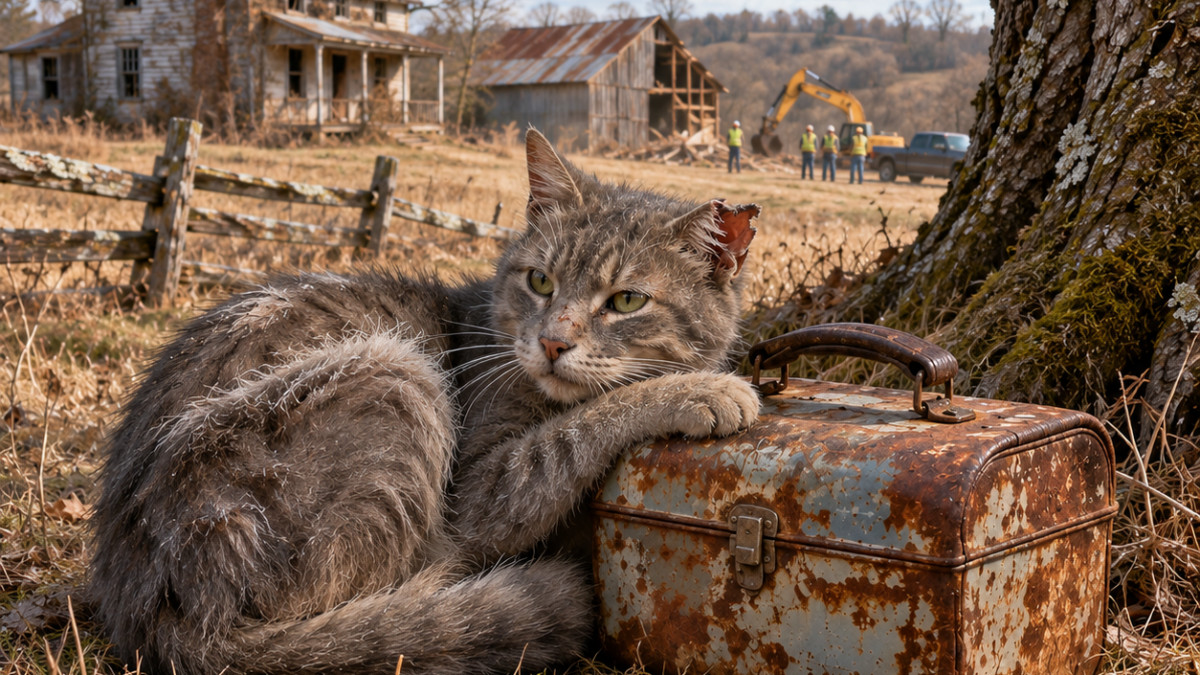
Milo was sitting beside the box.
The cat stared at us.
Darren laughed.
“Then put it in the dumpster where he can’t get it.”
Something in my chest tightened.
“I don’t think that’s a good idea.”
“It’s garbage.”
“It belonged to the old owner.”
“The old owner is dead.”
“Yes.”
“So?”
I looked at Milo.
“Cat doesn’t know that.”
Darren’s expression changed from amusement to irritation.
“You have until eight.”
“Darren.”
“Dumpster.”
He walked away.
Ray had heard everything.
He came over.
“You gonna do it?”
“No.”
“Thought so.”
“Don’t get excited. I need an alternative.”
Ray looked at the lunchbox.
“Open it.”
I frowned.
“What?”
“We’ve all been wondering.”
“That doesn’t make it ours to open.”
“Property belongs to the developer now.”
“Technically.”
“Technically gets things done.”
I hated that he had a point.
If the lunchbox contained identifying documents, perhaps we could return them to family.
If it was empty, maybe we could preserve it somewhere without disrupting work.
And if we didn’t do something, Darren would.
So I called the developer’s local representative and received permission to inspect the abandoned container before disposal.
At 7:42, six grown men gathered beneath an oak tree to watch me open a rusty lunchbox.
Nobody joked.
That was the strange part.
These were demolition workers.
Men who would draw inappropriate pictures on dusty windshields and spend lunch breaks arguing over whether a forklift could outrun a golf cart.
But Milo was watching.
That somehow made everyone behave.
The first latch had rusted almost solid.
Ray sprayed lubricant.
We waited.
I worked it loose with a screwdriver.
The second latch was already broken.
When I lifted the lid, the hinges screamed.
And then—
nothing.
No money.
No hidden letter.
No jewelry.
No old photographs.
Just three things.
A faded leather work glove.
A metal spoon.
And a small square of cloth tied loosely around something inside.
Ray leaned closer.
“What is that?”
I untied the cloth.
Three little brown shapes crumbled under my fingers.
Biscuits.
Or what had once been biscuits.
Small.
Homemade.
Cat treats.
They had dried into dust years ago.
Nobody said anything.
Milo stood.
He came closer than he ever had before.
Five feet.
Four.
Then stopped.
His nose moved.
Smell is powerful.
Nine years had passed.
Whatever scent of Thomas remained must have been unimaginably faint.
But Milo stared at that open box as if the years had collapsed.
Ray cleared his throat.
“Close it.”
I did.
Immediately.
Milo walked forward.
Sniffed the lid.
Then sat beside it.
One of my operators, Marcus, turned away and rubbed his face.
“Nope.”
Ray looked at him.
“You crying?”
“Allergies.”
“In February?”
“Shut up.”
I understood.
Because suddenly the lunchbox wasn’t junk anymore.
It was the reason Milo had stayed.
Thomas had probably packed those little treats every morning.
Maybe he broke them beneath the oak while eating his own lunch.
Maybe Milo had learned that the opening of that metal lid meant Thomas would sit beside him for twenty minutes.
A glove.
A spoon.
Three biscuits.
To us, almost nothing.
To a cat, a whole life in smells and routines.
Darren returned at eight.
He saw the lunchbox still beneath the oak.
His jaw tightened.
“What did I say?”
I stood.
“We opened it.”
“Congratulations.”
“It belonged to Thomas Benton. The cat’s been guarding it for almost nine years.”
Darren stared at me.
“I don’t care if George Washington ate lunch out of it.”
Ray muttered:
“Wrong century.”
I shot him a look.
Darren pointed toward the scrap container.
“Now.”
“No.”
The whole site went silent.
I had worked under Darren four years.
I had disagreed.
Never flat-out refused.
He stepped closer.
“Excuse me?”
“I’m not throwing it away.”
“You work for me.”
“I work for Cole Site Services.”
“I run this project.”
“And I’m responsible for what happens on the ground.”
Darren laughed.
“You’re protecting garbage because of a stray cat.”
“Yes.”
I said it without shame.
That irritated him more.
“Then I’ll do it.”
He walked toward the oak.
Milo stood immediately.
Darren bent for the lunchbox.
The cat hissed.
Not wildly.
A warning.
Darren jerked backward.
“Get animal control out here.”
I stepped between them.
“Don’t.”
“Why?”
“Because he hasn’t hurt anybody.”
“He’s interfering with work.”
“We can work around him.”
“That costs money.”
“Not much.”
“Not your decision.”
I said:
“Give me one day.”
“For what?”
“To figure something out.”
Darren looked at the crew.
Every man was pretending not to listen.
He knew forcing the issue in that moment would make him the villain in every break-room conversation for years.
“One day.”
He pointed at me.
“Tomorrow morning that box is out of the work zone and the cat is gone.”
Then he walked away.
Ray waited until the truck disappeared.
“So.”
“So what?”
“You’ve got twenty-three hours.”
“Helpful.”
“You’re welcome.”
I went back to Mrs. Harper.
She knew more about Thomas Benton than anybody still living nearby.
She invited me into her kitchen, made coffee strong enough to dissolve metal, and opened a drawer full of old church bulletins, photographs, and obituaries.
There was Thomas.
Tall.
Thin.
Weathered face.
Quiet smile.
Beside him in one photograph sat a young gray cat.
Milo.
Same torn-looking ear shape, though back then it was intact.
Mrs. Harper tapped the picture.
“Thomas found him under the tractor shed.”
“How old?”
“Maybe six months.”
“He never had other cats?”
“No.”
“Family?”
“A sister in Ohio. Couple nieces and nephews.”
“Did they want Milo?”
Mrs. Harper’s face tightened.
“They tried.”
That surprised me.
“What happened?”
“Cat disappeared whenever they came.”
“After Thomas died?”
“Yes.”
“One niece left food for a while.”
“What was her name?”
“Rebecca Benton. Married name Lawson, I think.”
I wrote it down.
“Did anyone try taking the lunchbox?”
“One of the nephews did.”
My pen stopped.
“Why?”
“Cleanup.”
“And?”
“Milo attacked the tire of his truck.”
I laughed despite myself.
Mrs. Harper smiled.
“Not the man. The truck.”
“Smart cat.”
“He dragged the lunchbox under the porch afterward.”
That suggested the behavior wasn’t new.
Milo had been protecting it from the beginning.
“Why was it back under the oak?”
“Thomas used to eat lunch there.”
Of course.
That was the original place.
Not where Thomas died.
Where they lived.
Milo wasn’t guarding death.
He was guarding routine.
That somehow hurt more.
I tracked down Rebecca Lawson through social media.
She lived two states away.
When I explained why I was calling, she went silent.
“Milo?”
“Yes.”
“He’s alive?”
“As far as I can tell.”
“Oh my God.”
“You knew him?”
“My uncle loved that cat.”
Her voice changed.
“We tried catching him after Uncle Tom died.”
“What happened?”
“He disappeared into the barn rafters. Then under the house. Then into the fields. Every time.”
“Did you leave the lunchbox?”
She sighed.
“I thought my brother took it.”
“Your brother thought?”
“He probably thought I did.”
Nobody had intentionally abandoned the keepsake.
Just a family sorting grief.
Boxes.
Furniture.
Legal papers.
A farmhouse full of ordinary objects.
One rusty lunchbox slipped through the cracks.
“Milo stayed?”
“We heard he did for a while.”
“Almost nine years.”
Rebecca stopped speaking.
Then:
“Jesus.”
I told her about the lunchbox contents.
The glove.
Spoon.
Biscuits.
She started crying.
“He made those.”
“The treats?”
“Yes.”
“My uncle was ridiculous.”
She laughed through tears.
“He refused store-bought treats because he said Milo ‘deserved real cooking.’”
“What were they made from?”
“Probably tuna and flour. Maybe egg.”
I looked at my notes.
“Would you object if we preserved the box?”
“Object?”
“Developer wants it gone.”
Her voice sharpened.
“Don’t throw that away.”
“I’m trying not to.”
“I’ll drive there.”
“From Ohio?”
“Tomorrow.”
I smiled.
“That might help.”
Rebecca arrived the next afternoon.
Darren arrived first.
Bad timing.
He stepped from his truck at seven fifteen.
“You solve the cat problem?”
“Working on it.”
“Jack.”
“Family member is coming.”
“I gave you one day.”
“She’ll be here by noon.”
He looked at the lunchbox.
Milo beside it.
“Move the oak work to the afternoon.”
“We’re not moving production for a dead farmer’s cat.”
I felt anger rising.
Before I could answer, Darren waved toward Marcus.
“Grab the box.”
Marcus didn’t move.
Darren stared.
“Marcus.”
“Boss, I think Jack should—”
“I didn’t ask what you think.”
The crew stiffened.
I stepped forward.
“Leave them out of it.”
Darren’s eyes narrowed.
“You want to lose this job?”
“Over a lunchbox?”
“You tell me.”
That was the moment the conflict stopped being silly.
It wasn’t about metal anymore.
It was about whether efficiency justified bulldozing anything inconvenient.
I said:
“No equipment touches this spot until Rebecca gets here.”
Darren pointed toward my truck.
“Go home.”
Ray said:
“Seriously?”
Darren turned.
“You want to join him?”
Ray shut up.
I took off my hard hat.
Set it on the hood of the truck.
Milo watched.
“Fine.”
Darren looked almost disappointed that I didn’t argue.
Then he said:
“And take the cat.”
I laughed.
“Good luck.”
I walked toward my truck.
Behind me, metal scraped.
I turned.
Darren had grabbed the lunchbox.
Milo launched himself forward.
Not attacking.
He hooked one paw around the crooked handle and pulled.
Darren jerked.
The box dropped.
The lid popped open.
The old glove fell out.
The spoon rolled across concrete.
The cloth opened.
Brown dust scattered.
Milo froze.
Every man on the site froze too.
The biscuits.
Whatever remained of them—
gone into the dirt.
Milo sniffed frantically.
Moved from one patch to another.
Then looked at Darren.
I will never claim animals understand symbolism the way we do.
But everyone standing there felt the same thing.
Something had been broken.
Darren looked embarrassed.
Then angry because he was embarrassed.
“It was dust.”
That sentence nearly got him hit.
Not by me.
Ray took one step.
I put an arm out.
“No.”
Darren stared.
“What?”
I looked around.
Cameras.
Phones.
Marcus had been recording.
So had one of the younger workers.
“Nothing.”
I picked up the glove.
The spoon.
Closed the lunchbox.
Milo pressed against it.
Darren said:
“You’re done here.”
I answered:
“Maybe.”
Then Rebecca’s rental car pulled into the site.
She got out before fully stopping.
Forties.
Dark coat.
Face already wet with tears.
“Milo?”
The cat looked at her.
No recognition I could see.
Rebecca crouched twenty feet away.
“Oh, sweetheart.”
Milo stayed beside the box.
I explained what happened.
Her eyes moved to Darren.
“You opened it?”
“I did,” I said.
“Why?”
“To identify contents and preserve it.”
“And the biscuits?”
I looked at Darren.
“So he knocked them out.”
Darren said:
“They were garbage.”
Rebecca stood.
“No.”
Her voice was calm.
“They were my uncle’s property.”
“The property belongs to Hollis Ridge Development.”
“The lunchbox was personal property unintentionally left behind.”
Darren rolled his eyes.
“I’m not litigating a rusty container.”
Rebecca took out her phone.
“Good.”
Then she called someone.
I didn’t know who.
Twenty minutes later, the developer’s corporate project director called Darren.
I could hear only his side.
“Yes.”
“No.”
“Because—”
Pause.
“Yes, but—”
Longer pause.
His face changed.
“All right.”
He hung up.
“What happened?” Ray asked.
Darren pointed toward me.
“You’re still suspended pending review.”
Then at the oak.
“Nothing touches this area.”
Rebecca smiled.
Not triumphantly.
Just enough.
Darren drove away.
We built the stand that afternoon.
Not because corporate ordered it.
Because the crew refused to leave without doing something.
Ray found treated lumber in the supply trailer.
Marcus cut it.
I drilled despite technically being suspended.
We made a simple waist-high platform beneath the oak.
A small roof.
Nothing fancy.
We placed the lunchbox there.
Glove inside.
Spoon.
Rebecca had brought one more thing.
A photograph.
Thomas sitting under the oak.
Lunchbox open.
Milo beside his boot.
She slipped a laminated copy beneath the lid.
Then she pulled a small bag from her purse.
Homemade cat biscuits.
“I called my mother.”
“What?”
“She remembered the recipe.”
My throat tightened.
“Tuna. Flour. Egg.”
Rebecca smiled.
“Uncle Tom put three in the box every morning.”
She placed three fresh biscuits on the cloth.
Milo was watching.
We all stepped back.
He approached.
Slowly.
Sniffed the stand.
Jumped up.
Sniffed the lunchbox.
Then the biscuits.
He ate one.
Then another.
Then sat beside the box.
Nobody spoke.
Ray cleared his throat.
“Allergies again.”
“Yep.”
The story would have ended beautifully there if Darren had been capable of letting it.
He wasn’t.
Three days later, corporate reinstated me.
Why?
Because Marcus’s video had traveled farther than anyone expected.
He posted a short clip privately to his wife.
She sent it to her sister.
Her sister posted it publicly.
Within twenty-four hours, more than half a million people had seen an old gray cat trying to pull a rusted lunchbox away from a demolition manager while the caption explained he had guarded it for nine years.
Then local news called.
Then national animal pages.
Then Hollis Ridge Development’s public relations department discovered they had a problem.
A very stupid problem.
One created entirely by Darren refusing to work around twenty square feet of dirt.
Corporate reinstated me and released a statement promising the oak and memorial would remain during construction.
Darren was reassigned pending internal review.
That should have ended it.
It didn’t.
Because people who believe embarrassment is the worst thing that can happen to them sometimes make terrible decisions trying to erase it.
The following Sunday, no crew was scheduled.
I drove past anyway.
Habit.
Milo had become part of my routine.
I brought food.
Water.
Three homemade biscuits Rebecca left with me.
When I reached the property, the stand was gone.
I stopped the truck.
Got out.
The oak remained.
Lunchbox?
Gone.
Milo was pacing around the base of the tree.
Crying.
I had never heard him make that sound before.
My chest turned cold.
I searched the grass.
Nothing.
Then tire tracks near the access road.
Fresh.
I called Ray.
“Did anyone work yesterday?”
“No.”
“Anybody move the memorial?”
“No.”
Silence.
“What happened?”
“It’s gone.”
He swore.
Then:
“Cameras?”
We had two temporary site cameras.
One covered the equipment yard.
The second looked toward the entrance.
Not the oak.
Still, footage showed a truck entering Saturday at 6:18 p.m.
Black company pickup.
Darren’s assigned vehicle.
My anger became very quiet.
I called corporate.
Then the sheriff.
Not because stealing a lunchbox worth practically nothing would become the crime of the century.
Because it wasn’t Darren’s.
And because he had been explicitly told not to interfere.
Deputy Mallory arrived.
We reviewed footage.
He asked:
“Any idea where he might take it?”
“Dumpster.”
Ray said:
“Landfill.”
I looked at the job records.
Saturday disposal ticket.
One company dump truck had entered the county transfer station at 7:04 p.m.
Driver?
Darren.
That made no sense.
Managers didn’t drive dump trucks.
Unless they wanted something disposed of personally.
We went to the transfer station.
The Saturday load had not yet been compacted because part of the facility had shut down for maintenance.
Luck.
Disgusting luck.
We spent two hours searching construction debris.
Broken cabinets.
Insulation.
Rotten wood.
Then Ray shouted.
“Got it!”
The lunchbox lay beneath torn drywall.
Bent.
One side crushed.
But intact.
I picked it up.
My hands shook.
The glove remained inside.
Spoon too.
Photo torn.
Fresh biscuits flattened.
Ray stared at me.
“He drove here just for this.”
“Yeah.”
“Why?”
I knew.
Because by then the lunchbox represented his humiliation.
People are dangerous when they confuse accountability with humiliation.
The company terminated Darren on Monday.
Official reason wasn’t “being mean to a cat.”
It was unauthorized use of company equipment, removal and disposal of property after explicit instruction to preserve it, violation of project controls, and falsification of a disposal log.
Turns out he had marked the extra landfill trip as “hazardous debris removal.”
Corporate accountants hate emotional stories.
They hate inaccurate expense reports more.
The irony was beautiful.
A lunchbox worth maybe five dollars cost Darren a management job paying six figures.
Ray called that revenge.
I didn’t.
Consequences.
Simple.
Darren later sent me a text:
Hope the cat was worth it.
I didn’t answer.
Because the question assumed everything had to be valued in the same currency.
We rebuilt the memorial stronger.
Steel anchors.
Weatherproof roof.
Lunchbox secured with a hidden cable—not locked shut, just protected from being carried away.
Rebecca restored the photograph.
Then she brought something unexpected.
Thomas Benton’s old nameplate from the farmhouse mailbox.
BENTON
We mounted it below the platform.
Milo returned that evening.
For the first time after the lunchbox disappeared, he stopped crying.
He jumped onto the stand.
Sniffed.
Touched his nose to the metal.
Then ate one biscuit.
And walked away.
Not far.
Twenty feet.
He lay beneath another tree.
Rebecca noticed.
“He’s never done that?”
“Not that I’ve seen.”
Maybe the disappearance had changed something.
Maybe the rebuilt stand felt different.
Maybe he was tired.
Or maybe nine years of guarding had become unnecessary because, for the first time, humans were guarding it too.
That idea stayed with me.
For nearly nine years, Milo had been solely responsible for protecting the last object tied to Thomas.
Rain.
Snow.
Summer heat.
Coyotes.
Teenagers.
Cleanup crews.
Demolition workers.
Anyone who moved it, he moved it back.
No one had taken over.
Then suddenly—
we did.
Maybe an animal can recognize that.
Not as abstract responsibility.
As pattern.
The lunchbox stays even when he walks away.
He leaves.
Returns.
Still there.
Again.
Still there.
Trust is often built from boring repetition.
The demolition continued.
We took down the farmhouse carefully.
Rebecca asked to keep the mantel from the living room.
We saved it.
The barn collapsed faster than expected.
The old tractor shed had to be dismantled by hand because bats had moved into the roof and wildlife rules required relocation timing.
Darren would have hated every minute.
I enjoyed that.
Milo watched from safe distances.
But he stopped spending all day beside the lunchbox.
At first, thirty minutes away.
Then an hour.
Sometimes we wouldn’t see him until afternoon.
Then one morning he arrived after we did.
Ray noticed.
“Late for work.”
I smiled.
“Maybe he retired.”
The development plan changed because of the attention.
Not dramatically.
Warehouse still happened.
Concrete still replaced most of the farm.
That bothered some people online.
They wanted the entire property turned into a sanctuary.
That wasn’t realistic.
The land had been legally sold.
Thomas’s relatives supported the project.
But Hollis Ridge agreed to preserve the oak, a small grassy buffer, and the memorial.
They added a bench.
Then community donations paid for landscaping.
Suddenly the most meaningful part of a multimillion-dollar development was a rusty lunchbox beneath a tree.
Funny how value works.
Milo remained technically feral.
We tried trapping him for veterinary care.
The first attempt failed.
Second too.
Third, Megan from a local cat rescue came.
She watched him for an hour.
“He’s not feral.”
“What?”
“He’s unsocialized now.”
“Difference?”
“He knew people once.”
That mattered.
True feral behavior often develops without positive human contact.
Milo’s distance felt learned after loss.
He watched us.
Listened.
Accepted presence.
Just not touch.
Megan set a humane trap differently.
Lunchbox biscuit recipe.
Of course.
Milo entered.
When the door closed, he panicked.
I hated it.
But veterinary care mattered.
At the clinic, he was estimated to be at least fifteen.
Maybe sixteen.
That meant he had been six or seven when Thomas died.
Old enough to remember him clearly.
Milo had severe dental disease, arthritis, early kidney changes, and an old healed fracture in his tail.
No microchip.
He was neutered.
Probably Thomas had done it.
The vet said:
“For an outdoor cat this age, he’s remarkable.”
I answered:
“He’s stubborn.”
Rebecca said:
“Runs in the family.”
After treatment, the question became what to do with him.
Return him to the site?
Adopt?
Sanctuary?
Megan said moving an elderly cat who had lived in the same territory for almost nine years could create enormous stress.
Rebecca wanted him safe.
I did too.
But safety isn’t always the same thing as indoors.
So we compromised.
The development site added a heated insulated cat shelter inside the preserved buffer.
Food station.
Water.
Trail camera.
Milo returned to his territory.
For the first two days after release, we didn’t see him.
I panicked.
Megan did not.
“He’s there.”
“How do you know?”
“Food.”
“Could be raccoon.”
“Camera.”
She showed me footage.
Milo emerging at 2:17 a.m.
Walking straight to the lunchbox.
Touching his nose to the lid.
Then entering the heated shelter.
I watched twice.
“He used it.”
“Yes.”
“First night?”
“Yes.”
Maybe old cats value warmth over principles.
Good.
Winter came.
Snow covered the warehouse foundation.
The preserved oak stood bare.
Lunchbox roof gathered white along the edges.
Milo spent more nights in the shelter.
Workers rotated filling his heated water bowl.
Nobody complained.
Even subcontractors knew him.
“Lunchbox cat.”
I corrected them.
“Milo.”
Names matter.
One morning a concrete driver accidentally parked too close to the memorial.
Ray walked over.
“You gotta move.”
Driver looked confused.
“Why?”
“Cat.”
The man stared.
“You’re kidding.”
Then saw the lunchbox.
Recognition.
“Oh.”
He moved instantly.
The story had become local folklore.
Rebecca visited every few months.
Milo never allowed her to touch him.
That hurt her.
“I probably smell nothing like Uncle Tom.”
“Probably.”
“Thank you, Jack.”
“What?”
“For not lying.”
She smiled sadly.
Then she sat on the bench and talked to him.
Family stories.
Thomas’s bad cooking.
His truck.
How he hated cell phones.
How he once drove twenty miles because Rebecca mentioned wanting a pie from one specific bakery.
Milo sat ten feet away.
Listening.
Maybe the voice pattern reminded him of something.
Maybe not.
But both of them seemed calmer afterward.
One spring morning, nearly a year after demolition began, Milo did something nobody expected.
I was sitting on the bench drinking coffee.
He approached.
Normally he stopped five or six feet away.
That morning:
Three feet.
Two.
One.
I didn’t move.
He sniffed my boot.
Then my jeans.
I held my hand low.
Not reaching.
Just available.
Milo stared.
For a long time.
Then he touched his nose to my fingers.
My breath caught.
He didn’t leave.
He moved forward and pressed the side of his face against my hand.
One second.
Maybe two.
Then walked to the lunchbox.
Ray had seen from fifty yards away.
He came running after Milo left.
“He touched you!”
“Keep your voice down.”
“He touched you!”
“I was there.”
“You gonna cry?”
“Allergies.”
“April?”
“Shut up.”
That first touch changed our relationship slowly.
Milo began allowing me to scratch beneath his chin.
Then behind one ear.
Never long.
Never both hands.
He retained rules.
I respected them.
One day Rebecca visited and watched.
Her eyes filled.
“He picked you.”
“No.”
I shook my head.
“He tolerated me.”
“Uncle Tom used to say the same thing.”
That stayed with me.
Then we learned there was more to the lunchbox than memory.
Not inside it.
Around it.
During landscaping, workers discovered an old metal tag beneath the original dirt patch.
I cleaned it.
A veterinary rabies tag.
Year stamped eleven years earlier.
Number.
We called the clinic.
Records still existed.
Thomas Benton.
Gray male cat.
Name: Milo.
Confirmed.
But the record included something else.
Emergency contact:
Evelyn Harper.
Our elderly neighbor.
I brought the tag to her.
She cried.
“Thomas made me promise.”
“What?”
“If anything happened to him, I’d take Milo.”
My chest tightened.
“What happened?”
“I tried.”
She looked ashamed.
“For months.”
“Why didn’t he stay?”
“He’d come for food. Then go back to the oak.”
“You could have trapped him.”
“I was seventy-nine.”
Fair.
“Animal control tried.”
“He escaped.”
Of course.
Mrs. Harper touched the tag.
“I always felt like I broke my promise.”
I looked at the photograph on her wall.
Thomas and Milo.
“No.”
She looked at me.
“You kept feeding him.”
“Yes.”
“You called people.”
“Yes.”
“You didn’t forget.”
“No.”
“Then maybe the promise changed.”
She smiled through tears.
“That sounds like something old people say to forgive themselves.”
“I’m getting there.”
“Not yet.”
Fair.
Mrs. Harper began visiting the memorial more often.
Milo knew her.
That became obvious once I watched carefully.
He stayed closer to her than most people.
Not touching.
But no tension.
One afternoon she brought a folding chair.
Sat beneath the oak.
Read a book.
Milo slept three feet away.
For the first time, I understood that his nine years had not been absolute loneliness.
People had fed him.
Watched him.
Tried.
Thomas’s absence was enormous.
But Milo had survived partly because a quiet network of neighbors had never completely abandoned him.
That mattered.
It didn’t diminish loyalty.
It explained survival.
The developer eventually opened the warehouse.
Employees moved in.
Trucks came and went.
We assumed Milo might leave because noise increased.
He didn’t.
But his world adjusted.
Morning food.
Nap in shelter.
Lunchbox visit.
Wander fields beyond property.
Return at dusk.
Routine.
Cats are masters of turning human disruption into personal scheduling.
Darren disappeared from the story for almost two years.
Then he came back.
Not physically.
A letter arrived from his attorney.
He claimed wrongful termination.
Corporate lawyers handled it.
I was asked to give a statement about the memorial incident.
Video spoke better than I did.
His claim failed.
Then he emailed me directly.
Against advice, probably.
You ruined my career over a cat.
I stared at the sentence.
Then replied.
Only once.
No. You ruined your job over a lunchbox because you couldn’t stand being told no. The cat just made sure everyone saw it.
Maybe I shouldn’t have.
Felt good.
He never replied.
That was enough revenge for me.
People online wanted Darren to suffer more.
I didn’t.
Losing a good job and reputation was consequence enough.
Milo didn’t care.
That helped me understand something.
We humans can become addicted to watching punishment.
Animals are interested in safety.
Food.
Warmth.
Familiarity.
The best revenge against someone who treats meaning as worthless is to preserve the meaning anyway.
Darren called the lunchbox garbage.
Years later, people still visited it.
Nobody remembered his name unless I told them.
Milo won simply by outlasting his opinion.
Milo’s health began declining during his third winter after the demolition.
Kidneys.
Teeth.
Arthritis.
He was nearly eighteen by then, maybe older.
Megan said outdoor life was becoming harder.
“We need a plan.”
“Inside?”
“Probably.”
I hated the idea of forcing him.
But the heated shelter was no longer enough on freezing nights.
Then Mrs. Harper made the decision easier.
“I’ll take him.”
I stared.
“You’re ninety.”
“Ninety-one.”
“Even better.”
“My granddaughter lives with me now.”
“That helps.”
“Milo knows my house.”
“He does?”
“Thomas brought him when he visited.”
Of course.
History again.
We started leaving food inside Mrs. Harper’s mudroom.
Door open.
Milo entered.
A little.
Then more.
Eventually slept there.
No trap.
No force.
He chose.
That felt right.
The first night he stayed until morning, Mrs. Harper called me at six.
“He’s still here.”
Her voice shook.
“Inside?”
“On Thomas’s old blanket.”
“You still have that?”
“People keep too much when they get old.”
I looked around my garage at useless tools.
“Fair.”
She whispered:
“He finally came home.”
Not Thomas’s home.
Not exactly.
But somewhere from before.
Somewhere connected.
A place holding scent and memory and a woman who had once promised to care for him.
Nine years late.
Still meaningful.
Milo became an indoor-outdoor cat at ninety-one-year-old Evelyn Harper’s house.
That sentence alone made me smile.
She spoiled him shamelessly.
Tuna.
Heated bed.
Window perch.
Veterinary prescription food he hated.
Medicine hidden in chicken.
Every morning, she opened the mudroom door.
Milo could leave.
Often he did.
Where?
The lunchbox.
Always.
But visits became shorter.
He would walk the half mile.
Sit beneath the oak.
Touch the metal with his nose.
Sometimes eat a biscuit.
Then return to Evelyn.
That was exactly the change described in the original story people eventually wrote about him.
He no longer curled beside the lunchbox for hours.
He didn’t guard it.
He visited.
That distinction mattered.
Guarding means responsibility.
Visiting means memory.
Milo had finally transferred from one to the other.
Rebecca noticed too.
On one visit, we watched Milo approach the memorial.
He sniffed the box.
Sat for maybe thirty seconds.
Then turned.
Rebecca whispered:
“He’s done waiting.”
I nodded.
“Yes.”
“Do you think he understands Uncle Tom is gone?”
I looked at the cat walking toward Mrs. Harper’s property.
“I think he understands he doesn’t have to stay there.”
Maybe that was enough.
The lunchbox itself deteriorated despite the roof.
Rust spreads.
Metal thins.
We faced another question.
Preserve the original indoors?
Replace with replica?
Leave it until it fell apart?
Rebecca decided.
“Don’t restore it.”
“Why?”
“It earned the rust.”
That sounded right.
We applied conservation wax to slow deterioration.
Nothing more.
Inside, the glove remained.
Spoon.
Cloth.
Fresh biscuits were replaced weekly.
Not because Milo always ate them.
Because Thomas had packed three.
Three stayed.
Tradition sometimes means repeating something long after practical necessity ends.
A local high school art teacher brought students to sketch the memorial.
One student asked me:
“Why would a cat care about a lunchbox?”
I answered:
“He didn’t.”
She looked confused.
“He cared about what happened around it.”
Meals.
Thomas sitting.
Voice.
Touch.
Routine.
The box became a container for those associations.
Humans do the same thing.
Wedding rings.
Old shirts.
Voicemails.
Recipes.
A chipped mug.
Value migrates into objects.
We call it sentimental when people do it.
We call it strange when animals do.
Maybe the difference isn’t as large as we think.
Milo turned nineteen according to veterinary estimates.
Nineteen.
An outdoor cat who spent almost nine years around an abandoned farm.
Unlikely.
Yet there he was.
Thin again, but healthy enough.
His gray coat now threaded with white.
Eyes cloudier.
Steps careful.
Mrs. Harper joked they were racing.
“Which one of us goes first?”
“Not funny.”
“At ninety-two, everything is funny or terrifying. I choose funny.”
Milo sat on her lap by then.
Yes.
Lap.
The cat who once refused human touch.
I took a photograph.
Mrs. Harper hated it.
“My hair.”
“You’re ninety-two.”
“Not an excuse.”
Milo looked perfect.
Mrs. Harper died first.
Peacefully.
Sleep.
Her granddaughter Anna found her in the morning.
Milo was beside her.
Of course.
When Anna called me, my first question after the obvious one was:
“Milo?”
“He’s here.”
“Eating?”
“No.”
I drove over.
Milo sat on Evelyn’s bed.
I approached.
He allowed me to touch him.
His body felt fragile.
I said:
“She kept her promise.”
His eyes moved toward me.
“She got there.”
Thomas asked.
Evelyn tried.
Nine years of distance.
Then final years together.
Promises rarely unfold the way we imagine when we make them.
Maybe keeping one means continuing to adapt after circumstances destroy the original plan.
Anna couldn’t keep Milo because her husband was severely allergic.
We considered me.
By then, I wanted him.
No hesitation.
My wife, Leah, surprised me.
“Bring him.”
“You sure?”
“You’ve been emotionally married to that cat for three years.”
“Fair.”
Milo moved into our house.
At nineteen.
His third home, if you counted the farm and Evelyn’s.
First week, he stayed beneath a desk.
Second, couch.
Third, our bed.
Cats have excellent retirement instincts.
I still took him to the lunchbox.
Not daily.
Monthly.
He hated the carrier but tolerated it.
We’d park near the oak.
Open the carrier.
He’d step out.
Walk slowly to the stand.
Sniff.
Touch his nose to the metal.
Then return.
One visit lasted twelve seconds.
Leah asked:
“Why do we keep bringing him?”
I thought.
“Maybe for me now.”
That was honest.
Sometimes we continue rituals after the animal no longer needs them because humans are slower at letting meaning change.
Milo’s last year was gentle.
Kidney disease progressed.
Subcutaneous fluids.
Medication.
Soft food.
He slept beside the fireplace.
Followed Leah more than me.
Traitor.
I complained.
Leah said:
“She has better snacks.”
Probably.
He stopped jumping.
We added steps.
Stopped grooming well.
We brushed.
Stopped wanting long visits outside.
We opened windows.
Life narrowed.
Not tragically.
Naturally.
A small world can still be full if it contains what matters.
Rebecca came when she heard he was declining.
She sat on our living-room floor.
Milo approached.
For the first time ever, he climbed partly onto her leg.
Rebecca froze.
“Jack.”
“I see.”
“Don’t move.”
“I’m not.”
She touched his head.
Very lightly.
Tears rolled down her face.
“My uncle would’ve loved this.”
Milo purred.
Maybe because the room was warm.
Maybe because her hand felt good.
Maybe something in her carried the Benton family scent.
We don’t need certainty for every beautiful thing.
She brought a new batch of biscuits.
Thomas’s recipe.
Milo ate half of one.
Then stopped.
Rebecca laughed.
“After nine years guarding them, you don’t even like them anymore?”
I said:
“People change.”
“So do cats.”
Good.
The biscuits had never mattered by themselves.
That was always the point.
His final decline came in late autumn.
He stopped eating.
Then drinking enough.
The vet said kidney failure had reached the point where aggressive hospitalization might buy days, perhaps weeks.
I asked:
“Good weeks?”
The veterinarian gave the look professionals hate giving.
“Probably not.”
I knew.
I had worked around enough rescued animals by then.
Love can turn into selfishness quietly if we insist every extra heartbeat is automatically a gift.
We scheduled an at-home goodbye.
Before that, I wanted one thing.
One final visit.
The lunchbox.
It was a cold morning.
Clear.
Oak leaves mostly gone.
I carried Milo in a blanket.
He weighed almost nothing.
Rebecca came.
Anna came.
Ray.
Marcus.
Megan.
Even a few warehouse employees who knew the story.
No crowd.
I didn’t want performance.
I placed Milo beside the memorial.
He stood.
Barely.
I supported him.
He sniffed the metal.
Then the open lid.
Inside:
Thomas’s glove.
Spoon.
Photograph.
Three fresh biscuits.
Milo touched his nose to the glove.
Stayed there.
A second.
Two.
Then turned away.
He walked toward me.
Not the box.
Me.
I lifted him.
That was the moment I knew the story was complete.
For nine years, he always returned to the lunchbox.
That morning, he left it without looking back.
We brought him home.
The veterinarian arrived after noon.
Milo lay on my chest beneath a blanket.
Leah sat beside us.
Rebecca on the other side.
I had taken Thomas’s old photograph from the memorial temporarily.
Young Milo.
Thomas under the oak.
Lunchbox open.
I showed it to Rebecca.
“Look how young he was.”
She smiled.
“Both of them.”
Milo purred faintly.
I scratched behind his ear.
“You’re terrible at letting things go.”
Tail moved.
“Look who’s talking,” Leah said.
Fair.
I leaned closer.
“You protected it.”
His breathing was slow.
“Long enough.”
Another breath.
“You can stop.”
The veterinarian gave the sedative.
Milo relaxed.
Head in my hand.
I thought about the first time he touched me.
The oak.
The rusty box.
One second of trust.
Now there was no hesitation.
I whispered:
“Thomas knows where it is.”
Ridiculous.
Comforting.
“Rebecca knows.”
Another breath.
“We all know.”
I touched his cheek.
“You don’t have to guard anything.”
Milo exhaled.
The final medication entered.
His body softened.
No tension.
No watchfulness.
No duty.
He died at nearly twenty years old.
Warm.
Held.
And nowhere near an abandoned field.
We buried a small portion of his ashes beneath the oak.
Rebecca kept some.
I kept some.
The rest were scattered on the old Benton property beyond the warehouse buffer, where fields still remained.
The lunchbox stayed.
But we changed the plaque.
The original had simply explained the memorial.
The new one read:
THOMAS BENTON & MILO
ONE CARRIED THE LUNCH.
ONE GUARDED THE MEMORY.
FOR NINE YEARS, MILO KEPT WATCH OVER THIS BOX.
WHEN PEOPLE FINALLY UNDERSTOOD WHY, WE TOOK OVER FOR HIM.
Underneath:
REST NOW. WE’VE GOT IT.
Ray cried.
“Allergies?”
“Shut up.”
Years have passed.
I don’t work demolition anymore.
My knees finally convinced the rest of me.
Ray still sends pictures of the oak.
Warehouse expanded once.
The memorial remained untouched.
Corporate learned that lesson permanently.
Darren never returned.
Last I heard, he worked for a smaller contractor in another state.
I hope he became better.
Not because he deserves a redemption story in Milo’s.
Because becoming better is more useful than staying bitter.
The lunchbox is still rusting.
Slowly.
One day it will probably be too fragile to remain outside.
Rebecca and the developer have already agreed that when that happens, it will go to the county historical society.
Not because Thomas was famous.
He wasn’t.
Not because the box has financial value.
It doesn’t.
Because history is not only presidents and wars and wealthy families.
Sometimes history is one widowed farmer eating lunch under an oak while a gray cat waits for a homemade biscuit.
Sometimes the witness survives longer than the person.
Sometimes the witness has four paws.
People still stop to read the plaque.
They leave cat treats occasionally.
We ask them not to leave food loose because raccoons became a problem.
Humans turn every memorial into snacks eventually.
But sometimes someone places a flower.
A note.
One child left a drawing.
Gray cat.
Blue lunchbox.
Oak tree.
Above it:
HE WAITED BECAUSE IT WAS IMPORTANT.
That might be the best explanation anyone ever wrote.
I used to think loyalty meant refusing to leave.
Milo changed that.
For nine years, yes, loyalty looked like returning.
Rain.
Snow.
Summer grass.
Rust spreading across hinges.
Humans moving the box.
Milo dragging it back.
Again.
Again.
Thirty-one times in three weeks.
Probably hundreds of times over nine years.
But the final part of loyalty looked different.
One morning, old and dying, Milo touched the lunchbox with his nose—
and walked away.
He trusted us.
That is also loyalty.
Trusting someone else to carry what you can’t anymore.
The “revenge” people loved was Darren losing his job.
I understand why.
He mocked the box.
Destroyed the biscuits.
Stole the memorial.
Dumped it.
Then records, cameras, and his own arrogance cost him the authority he had tried to abuse.
Satisfying.
But that wasn’t the ending that mattered.
Darren thought the lunchbox was worthless because it had no resale value.
Years later, the box is preserved.
People know Thomas Benton’s name.
They know Milo’s.
They know the story.
Darren is barely a footnote.
That is the kind of revenge time delivers better than anger.
The things someone dismisses can outlive the person who dismissed them.
Meaning is stubborn.
Almost as stubborn as an old gray cat.
There’s one moment I return to more than any other.
Not opening the box.
Not finding the biscuits.
Not the landfill.
Not Milo’s final day.
It was early in the project, before we understood anything.
We moved the lunchbox maybe the tenth time.
I remember seeing Milo drag it back.
Six inches.
Stop.
Breathe.
Six inches.
Stop.
Again.
He was skinny.
Old.
The handle scraped dirt.
He had no reason to believe humans would eventually understand.
Still, he kept pulling.
At the time I thought:
Why?
Now I think he was doing what all grieving creatures do when the world changes faster than the heart can accept.
He was putting one familiar thing back where it belonged.
Over and over.
Maybe that is grief.
An attempt to restore the arrangement.
Chair here.
Cup there.
Lunchbox under the oak.
Person coming home.
Except the person doesn’t.
So the object carries the shape of the missing one.
Until, eventually, something else becomes strong enough to hold the memory.
People.
Community.
A new home.
A hand.
Then the object can simply become an object again.
Not meaningless.
But no longer the only bridge to love.
Thomas never knew Milo would live nearly two decades.
Never knew a demolition crew would learn his biscuit recipe.
Never knew strangers would preserve his lunchbox.
Never knew his cat would become locally famous.
That’s probably good.
Thomas sounded like the kind of man who would hate attention.
Mrs. Harper once told me he avoided church photographs by pretending he had farm work.
I believe it.
But I think he would have cared about one thing.
Milo wasn’t forgotten.
For almost nine years, the cat stayed with the memory.
Then people finally stayed with him.
That seems like a fair ending.
When Rebecca visits now, she opens the lunchbox.
Checks the glove.
Spoon.
Photograph.
Then places three biscuits on the cloth.
No cat comes to eat them.
Birds sometimes steal them.
Once a squirrel took two.
Rebecca complains.
I tell her Thomas probably wouldn’t mind.
She says:
“Those are Milo’s.”
Old habits.
Promises.
Still continuing.
I asked her once why she keeps making the biscuits.
“Milo’s gone.”
“I know.”
“Thomas is gone.”
“I know.”
“So why?”
She thought about it.
Then said:
“Because somebody should.”
That answer sounded familiar.
It’s how traditions survive.
Not because the original person needs them.
Because the living do.
There is no cat beside the lunchbox now.
That took time for me to accept.
At first the memorial looked incomplete.
Box.
Oak.
Empty dirt.
Then one afternoon I realized emptiness was the proof of the happy ending.
Milo wasn’t there.
He didn’t need to be.
He wasn’t curled in rain beside cold metal.
Wasn’t chasing workers.
Wasn’t dragging five pounds of rust through grass.
Wasn’t guarding.
Wasn’t waiting.
The absence was freedom.
The lunchbox remained.
Milo finally didn’t have to.
So when people tell his story, they often begin:
A stray cat guarded a rusty lunchbox for nine years.
True.
But he wasn’t really guarding a lunchbox.
He was guarding breakfasts.
Field lunches.
A farmer’s rough hand.
The sound of a spoon against metal.
Three homemade biscuits wrapped in cloth.
A familiar voice calling his name across a field.
He was guarding a life that disappeared before he understood why.
And when we finally opened that rusted box, we didn’t discover treasure.
We discovered something more dangerous.
Proof that ordinary things can become sacred when they are the last place love still seems to live.
I used to tear buildings down for a living.
Most days, that meant deciding what was structural and what was debris.
Concrete stays until the excavator reaches it.
Drywall goes.
Metal separated.
Wood sorted.
Everything assigned value by weight, reuse, disposal cost.
Milo taught me there is another category.
Things whose value cannot be calculated by what they are made of.
A glove.
A spoon.
A lunchbox.
Three biscuits turned to dust.
Nothing.
Everything.
You can’t know which until somebody tells you the story.
Or a cat drags it back thirty-one times.
If I could change anything, I would have believed him sooner.
Not because we harmed him.
We didn’t.
But we moved the box again and again because we assumed animal behavior without understanding its history was random.
He kept correcting us.
Put it back.
Put it back.
Put it back.
Finally we listened.
That became one of the biggest lessons of my working life.
When an animal repeats something with that much determination, stop asking how to make the behavior disappear.
Ask what the behavior is protecting.
Sometimes there’s a reason beneath it.
Sometimes an entire life.
The last photograph I have of Milo was taken two weeks before he died.
He is on my couch.
Not outside.
Not beside the lunchbox.
Leah’s blanket under him.
One paw stretched forward.
Eyes closed.
Sunlight through the window.
If you showed it to a stranger, they would see an old gray cat sleeping.
Nothing remarkable.
I love that.
For nine years his story depended on vigilance.
His happy ending was sleep.
Deep enough to stop listening for footsteps that would never come.
Safe enough to let somebody else watch the world.
And that is the part I want people to remember.
Not only that Milo waited.
That eventually he stopped.
Because waiting forever sounds romantic when we tell it from far away.
Living it is different.
Cold.
Hunger.
Age.
Loss.
A promise does not become more beautiful because the one keeping it suffers longer.
The beautiful part is when someone finally says:
You’ve done enough.
We understand.
We’ll carry it now.
Milo needed nine years to hear that in the only language that mattered—
repetition.
The lunchbox remained when he walked away.
Again.
Again.
Again.
Until one day, he believed it.
Some promises are never spoken.
Thomas never told Milo:
Guard my lunchbox when I’m gone.
Milo never promised:
I’ll wait beneath the oak.
Nothing that formal happened.
There was simply a man who packed three biscuits every morning.
A cat who came running when metal opened.
Years of repetition.
Love becoming routine.
Then the routine ended too suddenly.
Milo kept one piece going because it was the only piece he could control.
Humans do the same thing.
We just call it memory.
Almost nine years after Thomas Benton died, a crew arrived to erase the physical remains of his farm.
House.
Barn.
Fences.
Sheds.
We thought the lunchbox would disappear with everything else.
Instead, it became the one thing we protected.
That irony still makes me smile.
The largest structures vanished.
The smallest object survived.
Because one old cat refused to let us misunderstand its importance.
The farm is gone now.
Mostly.
Warehouse lights glow where corn once grew.
Trucks use the road.
Employees eat lunch inside an air-conditioned break room.
But at the edge of the property, there is still an oak.
A bench.
A rusted lunchbox.
Thomas’s glove.
His spoon.
His photograph.
And three biscuits wrapped in cloth.
No cat guarding them.
No cat needs to.
That is how I know we got the ending right.
Milo spent almost nine years protecting the last piece of a man he loved.
Then he spent his final years learning that memory could survive even when he stepped away from it.
And when he finally left that lunchbox for the last time, he did not abandon Thomas.
He simply trusted the rest of us to remember him too.








