PART 2: For 9 Nights, a Scarred Cat Came to Our Door at 6 PM—On the 10th, He Finally Showed Us Why
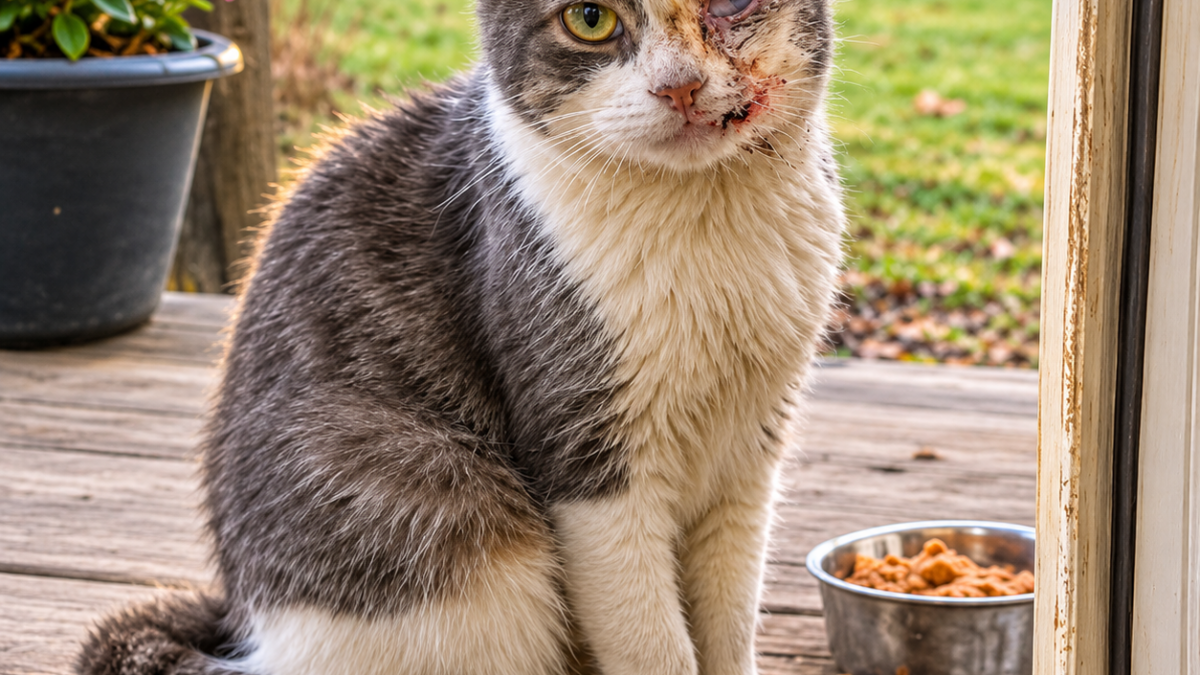
PART 2
The photograph was slightly blurry.
It should have made the details harder to see.
Instead, somehow, it made them worse.
My husband stood beside me in the kitchen, enlarging the picture with two fingers while I stared over his shoulder.
“Go back,” I said.
He zoomed out.
“No. Closer.”
He enlarged the cat’s face.
The room became quiet.
“Oh, God.”
The right side of the cat’s face was badly scarred.
Not injured recently.
Not bleeding.
Whatever had happened had happened long ago.
The fur around his right cheek was thin and uneven, growing in strange directions over thick scar tissue.
A long pale mark began near the corner of his eye, cut diagonally across his cheek, and continued toward his mouth.
His right eye looked cloudy.
Not completely closed.
Not missing.
Just damaged.
His lower lip on that side had healed badly, leaving a portion of his gum exposed. Even in the photograph, I could see the faint line of his lower jaw where his mouth no longer closed correctly.
My husband lowered the phone.
Neither of us spoke.
Outside, the cat sat beside the door exactly as he had for the previous eight evenings.
His damaged side faced the yard.
His healthy side faced our window.
I felt something tighten in my chest.
“He knows,” I whispered.
My husband looked at me.
“What?”
“He knows what he looks like.”
“That’s not—”
“Look at him.”
I pointed through the glass.
“He always sits like that.”
My husband frowned.
I began replaying every evening in my head.
Every time the cat had turned toward us, he had turned only far enough to expose the left side of his face.
Every time we had stepped closer, he had adjusted his body.
Every time the light might have caught his scars, he had moved away.
I thought of the seventh evening.
The way he had accidentally turned too far.
The way he had frozen.
The way he had run.
My husband looked again at the photograph.
“You think he’s hiding it?”
“I think he’s been surviving long enough to know how people react.”
The thought broke something in me.
There is a difference between being frightened of people and expecting rejection from them.
Fear says, Stay away.
Shame says, Don’t look at me.
I had no idea whether cats understood shame in the human sense.
But I knew what I had seen.
He did not want us looking at the right side of his face.
Outside, he remained for another fifteen minutes.
Then he walked away.
The food bowl stayed empty behind him.
That night, I barely slept.
Every time I closed my eyes, I saw that scar.
I wondered who had seen him when the injury was fresh.
Had anyone?
Had he screamed somewhere in a field with no one around?
Had he crawled under a barn?
Had someone found him and decided he was too difficult to help?
Had he once belonged to somebody?
Had somebody looked at that damaged face and stopped wanting him?
The questions became darker the longer I lay awake.
Eventually my husband rolled over.
“You’re still thinking about the cat.”
“Yes.”
“You can’t fix what already happened to him.”
“I know.”
“You can feed him.”
“I know.”
“You can get him to a vet if he lets us.”
“I know.”
He was quiet.
Then he said, “You want him to come inside.”
I stared at the ceiling.
“Yes.”
“He doesn’t want to.”
“Maybe he does.”
“He’s run every time we’ve opened the door.”
“Maybe he wants to come in and is afraid of what happens afterward.”
My husband turned toward me.
“You’ve built an entire psychological profile of this animal in eight days.”
“I know.”
He gave a tired laugh.
Then he reached across the bed and squeezed my hand.
“So what are you going to do?”
“I don’t know yet.”
But by morning, I did.
The ninth evening arrived cold.
The kind of Wisconsin evening that reminds you summer is over even when the calendar insists otherwise.
Wind moved through the grass behind the house.
The maple by the shed had started dropping yellow leaves.
At 5:45, I warmed a small portion of wet cat food.
My husband watched me place it in the bowl.
“You realize this animal eats better than I do.”
“You have access to the refrigerator.”
“So does he, apparently. He just hasn’t accepted the invitation.”
I looked toward the clock.
5:53.
Our indoor cats were already waiting by the window.
Somehow they had learned the schedule too.
At 5:58, nothing.
At 5:59, I felt ridiculous for checking.
Then, almost exactly as the minute hand reached twelve, movement appeared near the old fence.
The gray-and-white cat emerged from the field.
He walked across the grass with that slightly careful gait I had started recognizing.
Six o’clock.
Nine evenings.
Nine appearances.
He climbed the steps.
But instead of immediately sitting beside the door, he stopped when he noticed me behind the screen.
I lowered myself slowly onto the kitchen floor.
“Hi.”
He stared.
I put the bowl down.
Then I backed away.
The cat remained motionless.
“You’re safe,” I whispered.
He looked toward the food.
Then at me.
I moved farther back.
He stepped forward.
A breeze rattled the screen door.
He jumped.
Every muscle in his body tightened.
“It’s okay.”
I hated how useless the words sounded.
He had no reason to believe me.
I was a stranger.
The house was unfamiliar.
Our cats were watching him through the glass.
He did not know whether there was a dog behind the next doorway.
He did not know whether hands reaching toward him would pet him or hurt him.
He had learned whatever lessons the world had taught him long before he came to us.
And judging by his face, those lessons had been brutal.
He ate quickly.
Then he left.
No progress.
At least that was what I thought.
But before walking into the field, he stopped halfway across the yard.
He turned around.
For several seconds, he looked back at the house.
Then he disappeared into the grass.
I watched until there was nothing left to see.
My husband stood behind me.
“That was different.”
“Yes.”
“He looked back.”
“I know.”
“You’re going to sit out there tomorrow, aren’t you?”
“Yes.”
He sighed.
“I’ll bring you a coat.”
The tenth evening was a Sunday.
I remember because the entire day seemed unusually quiet.
We spent the morning doing chores.
I cleaned the kitchen.
My husband repaired a section of fence near the equipment shed.
But every few minutes, I glanced at the clock.
By late afternoon I had begun questioning the entire idea.
Maybe sitting outside would frighten him.
Maybe the open door would make him suspicious.
Maybe he would not come at all.
At 5:40, I carried a bowl of freshly warmed food onto the porch.
Then I sat on the wooden floor with my back against the wall.
I left the kitchen door open behind me.
Warm light spilled through the doorway.
Our two cats were shut in another room so they would not rush toward him.
My husband remained inside.
“No sudden movements,” I told him.
He raised both hands.
“I have been given my instructions.”
“I’m serious.”
“So am I.”
I pulled my jacket tighter around me.
The porch boards were cold beneath my legs.
5:47.
5:51.
5:56.
I could hear cows somewhere in the distance.
A truck moved along the county road.
The wind stirred dry leaves across the yard.
At 6:00, I saw nothing.
6:01.
My heart sank.
Maybe I had frightened him the night before.
6:02.
Then the grass near the fence moved.
A gray head appeared.
He stopped immediately when he saw me.
We stared at each other across twenty yards of lawn.
“Hi,” I said.
He did not move.
I did not reach for the food.
For nearly a minute, we remained like that.
Then he took one step.
Stopped.
Another.
Stopped.
By the time he reached the porch, five minutes had passed.
He stood at the bottom step.
His body was angled away from me.
Healthy side forward.
Scarred side hidden.
The bowl sat two feet from my leg.
He looked at it.
Then at the open doorway behind me.
Then at me.
His tail twitched.
“Whatever you decide,” I whispered, “I’m not going to make you do anything.”
He could not understand the sentence.
But perhaps he understood my voice.
He climbed the first step.
Then the second.
I could hear my own heartbeat.
He reached the porch.
One step.
Two.
Three.
Then he lowered his head and began eating.
I kept my hands on my knees.
He was less than two feet away.
Close enough that I could see the small notch in his ear.
Close enough to see dirt between his white toes.
Close enough to see how thin he really was beneath the thick autumn fur.
And close enough to see the edge of the scar he had spent nine days hiding.
I wanted desperately to touch him.
I did not.
Trust offered under pressure is not trust.
So I waited.
He finished the food.
Licked the bowl.
Then raised his head.
Usually, this was when he left.
Instead, he sat down.
Right beside the empty bowl.
I barely breathed.
He looked toward the yard.
Then toward me.
Slowly, his head turned.
Farther.
Farther.
Until the damaged side of his face was completely visible.
I had seen it in the photograph.
Seeing it from two feet away was different.
The scar was deeper than I had realized.
His eye was milky around the edge.
The right side of his lower lip pulled downward, exposing gum and two small teeth.
His face was permanently uneven.
I felt tears fill my eyes.
But I did not gasp.
I did not turn away.
I did not reach toward him.
I simply looked.
He looked back.
For a few seconds, the world seemed strangely still.
I remember thinking that he was waiting.
Not for food.
Not for the door.
For my reaction.
So I smiled.
“You’re beautiful,” I whispered.
His ears shifted forward.
Behind me, I heard my husband inhale sharply.
I knew he was watching from the kitchen.
The cat blinked.
Then he stood.
My first thought was that he was leaving.
Instead, he stepped around the bowl.
Walked directly past my knee.
And crossed the threshold.
I twisted around.
He entered the kitchen slowly.
He stopped on the rug just inside the door.
Looked left.
Looked right.
Then lowered himself onto his stomach.
Just like that.
As though he had already made the decision somewhere out in the field.
My husband stood frozen beside the counter.
Neither of us dared move.
The cat looked at him.
Healthy side first.
Then, after a moment, turned completely.
My husband’s face softened.
“Hey, buddy.”
The cat closed his eyes.
Not fully.
Just a slow blink.
I crawled carefully through the doorway and closed the screen behind me.
The sound made him look up.
But he did not run.
For the first time in ten nights, six-thirty came and went.
He remained on the kitchen rug.
At seven, he was still there.
At eight, he accepted another small meal.
At nine, he drank water.
At ten, I placed a folded blanket near the radiator.
He stared at it suspiciously for several minutes.
Then walked over, circled twice, and curled into a tight ball.
My husband crouched a few feet away.
“You know,” he whispered, “we still don’t know where he belongs.”
I looked at the sleeping cat.
“I know.”
“We should check for a microchip.”
“I know.”
“And ask around.”
“I know.”
He smiled.
“You’re hoping nobody claims him.”
I did not answer.
I did not need to.
That night, we left the kitchen light on.
I woke three times.
Each time I walked downstairs expecting the blanket to be empty.
Each time he was still there.
At 2:17 in the morning, I found him sitting awake on the rug.
The house was silent.
When I entered, his head snapped toward me.
He immediately positioned his healthy side forward.
I stopped.
“It’s just me.”
He watched.
I sat on the floor.
For a long time, nothing happened.
Then he slowly turned his entire face toward me.
Both sides.
The message felt unmistakable.
I know you saw.
And you stayed.
I sat there until he went back to sleep.
The following morning, we called the veterinary clinic.
Getting him into a carrier turned out to be easier than expected.
I placed the carrier on the kitchen floor with the door open and a little food inside.
He sniffed it.
Walked around it.
Then stepped in.
My husband stared.
“That cannot possibly be the same cat who spent nine days acting like our doorway was a death trap.”
“He trusts food.”
“He trusts you.”
I wanted to believe that.
But trust seemed too fragile a word.
What he had given us felt more like an experiment.
He was testing us one decision at a time.
At the clinic, the waiting room frightened him.
A dog barked from behind a partition.
His entire body went rigid.
His claws dug into the towel inside the carrier.
I crouched beside him.
“It’s okay.”
Another bark.
He pressed himself against the back of the carrier.
That reaction stayed with me.
Later, the veterinarian would say his injuries could have been caused by a dog.
In that moment, before we knew anything, I saw pure panic in him.
Not irritation.
Not normal feline dislike.
Terror.
When we entered the examination room, I warned the veterinarian.
“He’s friendly with us, but he’s been outside for who knows how long.”
She nodded.
“We’ll go slowly.”
I explained how he had appeared every evening.
How he refused to enter the house.
How he hid one side of his face.
The veterinarian listened while examining him from a distance.
Then she crouched.
“Hi, handsome.”
The cat stared at her.
Healthy side forward.
She waited.
He turned slightly.
She saw the scar.
Her expression changed.
Not disgust.
Concern.
“That’s old.”
“How old?”
“Very old.”
She held out one finger.
He sniffed it.
Then allowed her to touch the top of his head.
I felt myself release a breath I had not realized I was holding.
The examination took nearly forty minutes.
She checked his heart.
His lungs.
His teeth.
His paws.
His ears.
His cloudy eye.
She felt gently along the scarred cheek and jaw.
He flinched once when her fingers moved near the corner of his mouth.
But he did not scratch.
He did not bite.
He did not even hiss.
At one point she touched his healthy ear.
A low vibration filled the room.
I looked at my husband.
“Is he—”
The veterinarian smiled.
“He’s purring.”
I laughed.
Then, without warning, I cried.
I turned away, embarrassed.
My husband placed his hand on my shoulder.
The veterinarian continued examining him.
Finally, she stepped back.
“Considering what he’s been through, he’s doing remarkably well.”
“What happened to his face?”
She looked closely again.
“I can’t tell you with certainty. The pattern is consistent with a serious bite injury, possibly from a large dog.”
My stomach tightened.
“There are other possibilities. He could have been caught in machinery, dragged against something, maybe injured around farm equipment. But whatever happened, it caused major trauma.”
“How long ago?”
“Two years, maybe three.”
I stared at the cat.
Two or three Wisconsin winters.
Two or three summers.
Storms.
Snow.
Coyotes.
Farm equipment.
Dogs.
Cars.
And somehow he had survived.
“Would someone have treated it?”
The veterinarian shook her head slowly.
“I don’t see evidence of surgical repair.”
“So he healed like that?”
“It appears so.”
My husband looked horrified.
“How?”
“Cats can be extraordinarily resilient.”
She paused.
“But injuries this severe are dangerous. Infection alone could have killed him.”
She examined his mouth again.
“He must have had trouble eating while it healed.”
I pictured him hiding beneath a barn somewhere, hungry and injured, trying to chew through pain.
I had to look away.
The veterinarian continued.
“The eye is damaged, but he still has some vision. I don’t see a reason to remove it unless it becomes painful later. The lip healed incorrectly, but he has adapted. He’s slightly underweight, but otherwise he’s in surprisingly good condition.”
“Can we take him home?”
She smiled.
“I think he already decided where home is.”
We checked for a microchip.
There was none.
We contacted nearby farms.
No one claimed him.
We posted a photograph online using his healthy side because, strangely, I felt protective of the scar.
I did not want the first thing strangers saw to be the worst thing that had happened to him.
We called the county shelter.
We checked missing pet reports.
Nothing.
It was as though the cat had simply stepped out of the fields carrying a history no one could explain.
Before we left the clinic, I asked the veterinarian one more question.
“Why do you think he waited so long?”
She looked at him.
He was sitting calmly on the examination table while my husband scratched his neck.
“That’s difficult to answer scientifically.”
“I know.”
She smiled.
“But animals learn patterns.”
She glanced at the damaged side of his face.
“They learn which movements lead to danger. Which sounds matter. Which people are safe.”
Then she looked at me.
“Animals who survive severe trauma without human care often become extremely fearful. Some can’t tolerate being handled at all.”
“But he let you examine him.”
“Exactly.”
She gently touched his good ear again.
The cat purred.
The veterinarian’s smile widened.
“He wanted help.”
My throat tightened.
“He was afraid.”
“Yes.”
She paused.
Then she said the sentence I would remember for the rest of my life.
“He chose you. He just had to make sure you wouldn’t flinch first.”
The drive home was quiet.
The cat remained in the carrier between us.
Every few minutes, I looked down.
He watched the road through the small metal door.
I kept thinking about the veterinarian’s words.
Wouldn’t flinch first.
Maybe that was too human an explanation.
Maybe he had not deliberately hidden his scars.
Maybe his positioning was simply a habit built from impaired vision.
Maybe we were placing meaning where there was only instinct.
But when I remembered that tenth evening—when he deliberately turned and showed me his entire face—I could not dismiss it.
Something had changed between us.
I had seen him.
And he had stayed.
Back home, I opened the carrier.
He stepped out.
Our two cats were watching from behind a baby gate.
The newcomer froze.
One of our cats hissed.
The gray-and-white cat immediately backed toward the carrier.
“That’s enough,” I said.
We separated them.
For the first week, he lived mainly in the kitchen and laundry room.
He slept near the radiator.
He ate like a cat who had spent years uncertain where the next meal would come from.
Not wildly.
Not greedily.
Carefully.
He would take a few bites, stop, look around, then continue.
Sometimes he carried pieces of dry food away from the bowl and hid them beneath a towel.
The first time I saw it, I nearly cried again.
“You don’t have to save it,” I told him.
He stared at me.
“There will be more tomorrow.”
Of course, he did not understand.
So I showed him.
Every morning.
Every evening.
The bowl was filled.
Water appeared.
No one took it away.
No one chased him from it.
For the first several nights, he woke whenever footsteps approached.
If my husband entered wearing heavy boots, the cat disappeared behind the washing machine.
If a door slammed, he flattened himself to the floor.
If a dog barked on television, he ran.
But there were also moments that made us laugh.
On his fourth day inside, I found him on the kitchen counter staring at the butter dish.
“Absolutely not.”
He looked at me.
“You may be traumatized, but you are not allowed to become a criminal.”
He tapped the butter dish with one paw.
“No.”
He tapped it again.
My husband walked in.
“What’s going on?”
“Your new son is attempting dairy theft.”
“He’s from Wisconsin. It’s cultural.”
The cat knocked the lid off.
That was the first time I heard my husband laugh so hard he had to grab the counter.
We still had not named him.
Nothing seemed right.
Scar was cruel.
Smokey was too obvious.
Lucky felt inappropriate.
He had survived, yes.
But calling survival luck seemed to erase everything it had cost him.
My husband suggested a dozen names.
None stayed.
Then one evening he asked, “What day did he come inside?”
“Sunday.”
He looked at me.
I looked at the cat.
The cat was sleeping beside the radiator with his damaged cheek resting openly against the blanket.
“Sunday,” I said.
One ear moved.
My husband smiled.
“I think that’s it.”
Sunday.
The day he stopped waiting outside.
The day he crossed the threshold.
The day he finally let someone see the whole truth.
The name stayed.
Introducing Sunday to our cats took nearly three weeks.
At first there was hissing through doors.
Then staring through the baby gate.
Then supervised meetings.
Sunday never attacked.
If the other cats became tense, he backed away.
He seemed almost overly careful.
Our older cat eventually became the first to accept him.
One afternoon I walked into the living room and found them sitting on opposite ends of the couch.
Neither looked comfortable.
Neither looked willing to admit the other existed.
But they were sharing the couch.
“That counts,” I told my husband.
The next week, they slept three feet apart.
Then one foot.
Then, one morning, I found our older cat grooming the top of Sunday’s head.
Sunday sat completely motionless.
His eyes were closed.
When the grooming stopped, Sunday leaned toward him as though asking for more.
I took a photograph.
It remains one of my favorites.
Not because it is dramatic.
Because it is ordinary.
Sunday had spent years surviving extraordinary things.
Ordinary was what he deserved.
But healing was not simple.
There were nights when his past surfaced without warning.
One evening, several weeks after he came inside, my husband dropped a metal pan.
The crash echoed through the kitchen.
Sunday launched himself from the chair.
He hit the floor running.
By the time I reached the laundry room, he had squeezed behind the dryer.
“Sunday?”
Silence.
I lay on the floor.
“I’m sorry.”
I could see one eye in the darkness.
The cloudy one.
His body trembled.
My husband appeared behind me.
“Is he hurt?”
“No.”
“What do we do?”
“Nothing.”
So we waited.
Ten minutes.
Twenty.
Thirty.
Eventually Sunday crawled forward.
He stopped just beyond my reach.
I did not move.
After several seconds, he walked to me and pressed the healthy side of his head against my hand.
I scratched his ear.
Then he turned.
Scarred side.
I touched him there too.
Very gently.
He closed his eyes.
That became our ritual.
At first, I never touched the damaged side unless he offered it.
Sometimes he did.
Sometimes he did not.
I let him decide.
There is something humbling about earning the trust of an animal who has every reason not to give it.
Humans like to imagine rescue as a single heroic moment.
A door opens.
A hand reaches out.
An animal is saved.
But that is not how Sunday taught me to understand it.
Rescue happened every morning when he woke up and discovered he was still safe.
It happened every time the food bowl returned.
Every time a loud noise was followed by comfort instead of pain.
Every time a hand came toward him slowly.
Every time he showed the scar and no one recoiled.
Trust was not one decision.
It was thousands.
Winter arrived early that year.
The first heavy snow covered the field behind our house overnight.
I stood at the kitchen window looking toward the place Sunday used to disappear every evening.
The grass was gone beneath white drifts.
Wind moved loose snow across the yard.
Sunday jumped onto the bench beside me.
He followed my gaze.
For a moment, I wondered what he remembered.
Had he slept in barns?
Under machinery?
Inside drainage pipes?
Had he survived winters beneath abandoned sheds?
Had he found warm places near livestock?
Had someone once left him outside intentionally?
I would never know.
He looked at the snow.
Then at me.
Then hopped down and walked toward the living room where the fireplace was burning.
I laughed quietly.
“Yeah,” I said. “I’d choose the fireplace too.”
That winter transformed him.
By December, Sunday had discovered blankets.
By January, he had discovered the heated vent in our bedroom.
By February, he had discovered that if he pushed himself between us at night, neither of us had the heart to move him.
The first time he climbed onto our bed, I woke to a weight near my feet.
I turned on the lamp.
Sunday froze.
He clearly expected to be removed.
Instead, I lifted the blanket.
“Come on.”
He stared.
One of our other cats was already sleeping beside my pillow.
Sunday looked at him.
Then at me.
He walked cautiously up the mattress.
He settled between us.
That was where he slept from then on.
Some nights I woke and found his face inches from mine.
Both sides visible.
No hiding.
No turning away.
He snored softly because of the old damage around his mouth.
My husband complained about it.
“You brought home a forty-decibel cat.”
“He weighs nine pounds.”
“He sounds like a tractor.”
Sunday opened one eye.
“See?” my husband said. “Even he knows.”
But strangers were different.
The first time friends visited after Sunday moved in, he disappeared before they had taken off their coats.
We found him beneath the bed.
I explained his history.
“Poor thing,” one friend said.
When Sunday eventually emerged, he did what he had always done.
Healthy side first.
He positioned himself carefully.
One of our friends noticed.
“Does he always stand like that?”
“With people he doesn’t know.”
She crouched.
Sunday backed away.
She immediately stood.
“Sorry, buddy.”
Twenty minutes later, he appeared again.
Then again.
By the end of the evening, he sat ten feet away.
No closer.
After our friends left, he walked into the living room.
He jumped onto the couch.
Then turned his damaged side toward me.
I scratched beneath his chin.
“I know,” I whispered. “People are complicated.”
Over time, he became braver.
But the habit never completely disappeared.
Years later, whenever a repairman entered the house, Sunday still turned his healthy side outward.
When the mail carrier came to the door, he did the same.
When relatives visited for holidays, healthy side first.
Always.
But with us?
Never.
That difference mattered more than I can explain.
There was one incident, several months after we adopted him, that brought his past painfully close.
A neighboring farmer stopped by one afternoon to return a tool.
He was an older man who had lived in the area for decades.
Sunday happened to be sitting in the kitchen window.
The man stopped mid-sentence.
“That cat yours?”
“He is now.”
He stepped closer to the window.
Sunday immediately jumped down.
The man frowned.
“I’ve seen a cat like that.”
My pulse quickened.
“Where?”
“Couple years ago.”
My husband looked at me.
“Are you sure?”
“Gray and white. Crooked tail.”
He thought for a moment.
“There used to be one around the old dairy place north of Miller Road.”
My stomach tightened.
“Did he belong to someone?”
“Not sure. That farm changed hands. There were always barn cats around.”
“What happened?”
The man hesitated.
“There was a dog problem out there for a while.”
Every hair on my arms seemed to rise.
“What kind of dog problem?”
“Couple dogs from another property kept getting loose. Chased livestock. Killed chickens.”
He looked toward the doorway where Sunday had disappeared.
“Got some cats too, if I remember right.”
I swallowed.
“Did anyone do anything?”
“Sheriff got involved eventually. Dogs were removed.”
“Eventually?”
The man’s expression became uncomfortable.
“That was a long time ago.”
I felt anger surge through me.
Not at him personally.
At the word eventually.
How many things happen because somebody waits until eventually?
How many animals disappear before somebody decides the problem is serious?
My husband placed a hand lightly against my back.
“Do you know whether this cat was attacked?”
“No.”
The farmer shook his head.
“I’m not saying he was. Just saying I remember a gray-and-white barn cat around there.”
He left twenty minutes later.
That evening I sat beside Sunday on the couch.
I stared at his face.
Was that where it happened?
Had a dog cornered him near a barn?
Had he fought back?
Had he escaped with half his face torn open?
I imagined it until I could hardly breathe.
Then I stopped myself.
Sunday did not need me to reconstruct his nightmare.
He needed me to respect the life he had now.
Still, I was angry.
For days.
I wanted someone to blame.
An owner.
A careless farmer.
A person who had failed to control a dog.
Someone who had seen an injured cat and walked away.
But there was no villain standing in front of me.
Only Sunday.
Alive.
Sleeping.
Safe.
And slowly I understood something.
The most satisfying revenge against whatever had hurt him would never be punishment.
It would be this.
Warm floors.
Full bowls.
A bed.
Hands he trusted.
Years he had not been expected to have.
Sunday’s revenge would be surviving long enough to become loved.
Spring came.
The snow melted.
The field turned green again.
On the first warm evening of April, I opened the back door to carry something onto the porch.
Sunday was behind me.
He stopped at the threshold.
My heart jumped.
For months, he had shown no interest in going outside.
Now he stood exactly where he had crossed into our home the previous fall.
The screen door was open.
Nothing blocked him.
He looked toward the field.
The same field he used to disappear into every night.
I froze.
My husband was across the kitchen.
“Don’t move,” I whispered.
“I’m not.”
Sunday took one step onto the porch.
Then another.
He walked to the place beside the door where he had once sat at six o’clock.
My throat tightened.
He sat down.
Same position.
Same porch.
But different cat.
For several minutes, he stared toward the field.
The wind moved through his fur.
A bird landed near the fence.
Our two cats watched from inside.
I wondered if he would leave.
I knew we could not truly keep him by force.
If he wanted to return to whatever life he had known before us, I would have to accept it.
Sunday stood.
He walked down the first step.
Then the second.
He paused.
My heart hurt.
“Sunday?”
He turned.
Both sides of his face visible.
Then he walked back up the steps.
Passed me.
Entered the kitchen.
And headed directly toward his food bowl.
My husband laughed.
I started crying.
Again.
“You cry over this cat more than you cried at our wedding,” he said.
“I cried at our wedding.”
“Not this much.”
Sunday looked up impatiently.
“He wants dinner.”
“Of course he does.”
That evening, at exactly six o’clock, Sunday ate inside.
I looked at the clock and smiled.
The ritual was over.
Or so I thought.
For months afterward, I continued turning on the porch light around six.
It became automatic.
Five fifty-five.
Light on.
I told myself it was habit.
My husband knew better.
“You’re looking for another one.”
“No.”
“You are.”
“I’m just turning on the light.”
“For whom?”
I stared through the window.
The porch was empty.
“I don’t know.”
Maybe that was the point.
Sunday had taught us that sometimes the creature waiting outside your door does not know how to ask.
Sometimes they do not cry.
Sometimes they do not scratch.
Sometimes they do not throw themselves into your arms.
Sometimes they sit four feet away and run when you approach.
Sometimes they hide the part of themselves they expect you to reject.
Sometimes trust looks like refusal.
Sunday became part of our family so completely that it became difficult to remember the house before him.
He learned the sound of my husband’s truck.
He learned that opening the refrigerator might produce turkey.
He learned exactly which cabinet contained treats.
He learned that one of our cats hated having his tail touched and used this information irresponsibly.
He learned how to open the bathroom door if it was not fully latched.
He learned that sleeping in the center of the bed guaranteed the humans would arrange themselves around him.
And gradually, he learned something else.
He learned that nobody in our home was going to punish him for existing.
That may sound dramatic.
But I saw it happen.
At first, if Sunday knocked something over, he ran.
If he jumped onto a counter and we said his name sharply, his body flattened.
If he accidentally scratched us while playing, he disappeared.
Each reaction suggested the same expectation.
Mistake equals danger.
So we became careful.
Not indulgent.
Careful.
“No, Sunday,” we would say when he climbed somewhere he should not.
Then we would redirect him.
No shouting.
No chasing.
No sudden grabbing.
Month by month, his responses changed.
One afternoon, about a year after he arrived, Sunday knocked a ceramic mug from the kitchen table.
It hit the floor and shattered.
He jumped.
I turned around.
He stared at me.
For one brief second, I saw the old panic.
Then I said, “Well, that was rude.”
He remained where he was.
I grabbed the broom.
“Move your paws before you cut yourself.”
He stepped aside.
That was all.
He did not run.
He did not hide.
I swept up the pieces.
Sunday watched.
My eyes filled with tears.
My husband walked in and looked at the floor.
“What happened?”
“He broke the mug.”
“Okay.”
“He stayed.”
My husband understood immediately.
He crouched beside Sunday.
“Good boy.”
Sunday head-butted his hand.
People sometimes laughed when I explained moments like that.
But trauma is often measured in tiny things.
A slammed door.
A raised voice.
A hand moving too quickly.
A broken mug.
And healing is measured the same way.
Staying.
Eating.
Sleeping.
Turning your face toward someone.
The veterinarian continued seeing him twice a year.
His damaged eye remained stable.
His scar caused occasional irritation during dry winter months, but nothing severe.
His jaw never worked perfectly.
He ate more slowly than our other cats.
Sometimes food fell from the right side of his mouth.
At first, he seemed embarrassed by it.
He would stop eating if someone stood nearby.
So I began sitting several feet away while he ate.
Not watching.
Just existing.
Eventually, he stopped caring.
He ate beside the other cats.
He ate while we talked.
He ate while guests were in the kitchen.
The exposed gum on his right side never looked normal.
But normal stopped mattering.
Children sometimes asked what happened to his face.
I never said, “He’s ugly because he was hurt.”
I said, “Sunday survived something very serious.”
That was the truth.
His face was not evidence that he was damaged.
It was evidence that he lived.
Three years after Sunday arrived, the veterinarian took a new photograph for his record.
She compared it with the photograph my husband had taken through the kitchen window during that first week.
We stood side by side looking at the two images.
Physically, Sunday looked similar.
Same crooked mouth.
Same cloudy eye.
Same bent tail.
But the cat in the first photograph looked ready to disappear.
Body low.
Muscles tight.
Head turned.
The cat in the new photograph sat upright on the examination table.
Relaxed.
Looking directly at the camera.
Both sides of his face visible.
The veterinarian smiled.
“That’s quite a difference.”
“It’s the same face.”
“Yes.”
She looked at me.
“Different life.”
I carried those words home.
Different life.
That was all we had ever been able to give him.
We could not undo the attack.
Could not repair years-old scars.
Could not know where he had slept during winter storms.
Could not erase every frightening memory.
Could not make his eye clear again.
Could not straighten his mouth.
But we could change what came next.
And sometimes that is the only part of a story anyone has the power to change.
As Sunday grew older, he became unexpectedly affectionate.
Not with everyone.
Never everyone.
But with us, he became almost ridiculous.
If I sat down with a book, he climbed onto my chest.
If my husband worked at the kitchen table, Sunday sprawled across the papers.
If one of us closed a door, he waited outside it.
At night, he slept between us and our two other cats until the bed felt less like furniture and more like a badly organized animal shelter.
One winter night, a storm knocked out power.
The wind howled outside.
Snow covered the windows.
The house became dark and cold.
We lit candles and started the fireplace.
Sunday became restless.
He paced near the kitchen.
Then the porch.
Then the kitchen again.
At 5:57, he sat beside the back door.
I checked the clock.
My husband noticed too.
“Six o’clock.”
I nodded.
Sunday stared at the door.
Something about it hurt.
Years had passed, but somewhere inside him, the hour remained.
I opened the door a crack.
Snow blew against the screen.
The porch was empty.
Sunday sniffed the air.
Then looked up at me.
I crouched.
“No one’s there.”
He remained beside the door.
At exactly six, I turned on a battery lantern and placed it near the window.
My husband smiled.
“The porch light.”
“Close enough.”
Sunday sat for another minute.
Then walked back to the fireplace.
I watched him settle onto the rug.
Maybe the schedule had never been about us.
Maybe six o’clock had once belonged to somebody else.
Maybe someone had fed him at that hour.
Maybe he had waited at another door before ours.
Maybe someone had promised safety once and failed him.
We would never know.
The unanswered questions used to torment me.
Eventually, I learned to leave them unanswered.
Sunday was not a mystery to solve.
He was a life to share.
And he gave us more years than anyone at the veterinary clinic had expected.
Years of ordinary mornings.
Years of paw prints on clean floors.
Years of fur on black sweaters.
Years of stolen turkey.
Years of sleeping with his feet pressed against my husband’s back.
Years of our friends saying, “He’s still here?” as though Sunday had once been expected to vanish.
He never did.
He stayed.
That word mattered.
Stayed.
The cat who would not cross our doorway became the cat who hated being left alone in a room.
The cat who ate only when no one watched eventually demanded food by sitting directly in front of the refrigerator.
The cat who hid half his face slept with that scar pressed against my cheek.
The cat who disappeared every evening at six eventually learned there was nowhere else he needed to go.
One afternoon, years after he arrived, I found an old folder on my phone.
Inside was the photograph my husband had taken through the window on the eighth evening.
I had not looked at it in a long time.
There he was.
Thin.
Dirty.
Guarded.
His injured side turned away.
I enlarged the image.
Then Sunday jumped onto the couch beside me.
Older now.
A little heavier.
His gray fur beginning to silver around his ears.
He pushed his head beneath my hand.
I looked from the old photograph to the cat beside me.
“You had no idea, did you?”
He purred.
“You had no idea you were already home.”
Sunday turned his damaged cheek toward my fingers.
I traced the fur carefully beside the scar.
He closed his eyes.
For years, I had imagined his tenth evening as the night we rescued him.
I no longer believed that.
Sunday had rescued himself long before us.
He had survived the injury.
Survived infection.
Survived hunger.
Survived weather.
Survived whatever happened to him.
He had carried himself to our porch.
He had returned nine times despite his fear.
He had taken the risk of trusting people again.
All we had done was keep the door open long enough for him to decide.
And perhaps that was why his story stayed with me so deeply.
Because love did not arrive dramatically.
There was no heroic chase through a storm.
No impossible surgery.
No villain brought to justice.
No cinematic moment when everything became perfect.
There was simply a scarred cat.
A kitchen door.
A bowl of food.
And ten evenings.
On the first evening, he watched us.
On the second, he returned.
On the third, he accepted food.
On the seventh, we glimpsed the truth.
On the eighth, we saw his scars clearly.
On the ninth, he looked back at the house.
And on the tenth, he stopped hiding.
People sometimes asked me whether I wished we could find whoever had hurt him.
For a long time, part of me did.
I imagined confronting someone.
Demanding answers.
Making them look at the animal they had failed.
But anger did not heal Sunday.
Justice, whatever it might have looked like years later, could not change his face.
What changed Sunday was safety repeated until it became believable.
And in the end, I decided he had already won.
Whatever had tried to kill him failed.
Whatever made him fear people failed.
Whatever taught him to hide failed.
Because that scarred little cat lived long enough to sleep in a warm bed surrounded by people and animals who loved him.
He lived long enough to stop flinching when something broke.
Long enough to learn that food always came back.
Long enough to sit in sunlight without watching every exit.
Long enough to grow old.
That was his revenge.
He lived.
He trusted again.
He became happy.
And nothing that happened before our porch could take that away from him.
Even now, when I think about Sunday, I remember the sixth hour of the evening.
The kitchen light.
The screen door.
The little gray-and-white shape sitting outside.
I remember thinking he was waiting for somebody.
Maybe I was right.
I had simply misunderstood who.
Perhaps he was waiting for the people who would finally see him and stay.
Perhaps he was waiting until hunger became stronger than fear.
Perhaps he was waiting for proof that this doorway was different from all the others.
Whatever the reason, we kept the porch light on every evening at six for years afterward.
My husband used to tease me.
“You know he’s already inside.”
“I know.”
“There is no cat outside.”
“I know.”
“Then why are you turning the light on?”
I would look through the glass at the empty porch.
“Just in case.”
He stopped teasing me eventually.
Sometimes he turned it on before I did.
Because Sunday taught both of us something we never forgot.
Not every abandoned animal will run toward you.
Not every frightened creature knows how to ask for help.
Some will hide.
Some will growl.
Some will refuse to eat while you watch.
Some will stand just beyond your reach.
And some will come back at exactly six o’clock for nine straight evenings, never making a sound, hoping you understand the question they are too frightened to ask.
Can I trust you?
With Sunday, the answer took ten days.
But once he believed it, he gave us everything.
His trust.
His strange crooked purr.
His bent tail.
His stubbornness.
His affection.
His whole scarred, beautiful face.
And for the rest of his life, whenever he looked at us, he never turned away again.








