PART 2: For 812 Days, Rocky Waited Outside an Abandoned Factory—Then One Morning He Put His Head in a Stranger’s Hand
PART 2
For several seconds, nobody moved.
Rain from the previous night still clung to the bare branches around us, and somewhere behind the factory a loose sheet of metal knocked softly in the wind.
The man remained on one knee.
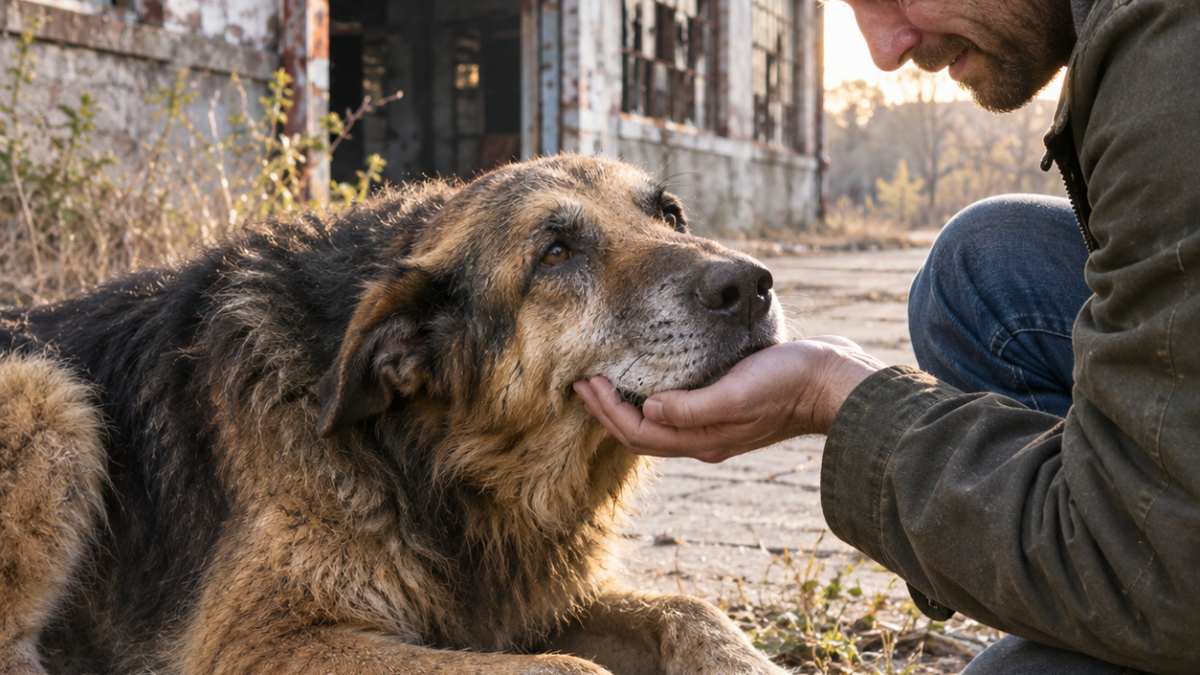
Rocky pressed his head into his palm.
Then the dog made a sound.
I had heard dogs bark in fear, howl in grief, whine from pain, and scream during seizures.
This was none of those.
It was low.
Almost breathless.
A broken sound from somewhere deep in his chest.
The man closed both hands around Rocky’s face.
“Jesus Christ.”
Rocky licked his wrist.
The man laughed through tears.
“You’re alive.”
I stepped closer.
Rocky didn’t retreat from me.
He barely seemed to know I was there.
“Sir?”
The man looked up.
His face was wet.
Whether from tears or the mist, I couldn’t tell anymore.
“My name’s Catherine. I’m with Second Chance.”
He nodded.
“Michael.”
His voice shook.
“Michael Avery.”
He looked back at Rocky.
“He’s mine.”
My chest tightened.
“You’re his owner?”
“I was.”
Rocky leaned harder against him.
Michael swallowed.
“I thought he was dead.”
That stopped me.
“You thought he was dead?”
Michael’s fingers moved over Rocky’s ears as though checking each piece of him.
“I was told he died.”
“By who?”
He looked toward the factory.
Something changed in his expression.
“A man I should’ve stopped trusting a long time ago.”
—
I knew better than to bombard someone during an emotional reunion.
But I also knew Rocky’s story had just changed dramatically.
Michael was in no condition to explain everything at the gate.
Neither was I.
And Rocky, after nearly three years of surviving outside, needed medical care before anything else.
I expected him to resist when I brought out the slip lead.
He did.
The moment he saw the loop, he stepped behind Michael.
Michael looked at me.
“He hated leashes even before.”
“That’s useful information.”
“He’d wear one. Just complain about it.”
“He hasn’t allowed anyone to put one on him since we found him.”
Michael touched Rocky’s neck.
“You remember this?”
Rocky looked at him.
Michael held out his hand.
“Stay.”
Rocky stayed.
A simple command.
No force.
I slowly slipped the lead over his head.
He flinched.
Then looked at Michael.
Michael whispered:
“It’s okay.”
Rocky relaxed.
I almost cried.
For months, every effort to get a leash near him had ended with Rocky disappearing into the woods behind the factory.
One sentence from Michael and he allowed it.
Trust doesn’t disappear completely.
Sometimes it gets buried beneath survival.
—
We drove to the rescue clinic.
Rocky refused my van at first.
Then Michael opened the rear door and climbed halfway inside despite his bad leg.
“Come on.”
Rocky stared.
Michael patted the floor.
“Same as the truck, buddy.”
Rocky climbed in.
I sat in the driver’s seat staring at the rearview mirror.
Michael had one hand buried in Rocky’s coat.
Rocky pressed against his hip.
Neither looked comfortable.
Both looked exactly where they belonged.
—
Dr. Elena Moss examined Rocky.
He was underweight but not dangerously so.
Arthritis in both hips.
Old scar beneath his left shoulder.
Several broken teeth.
Ear infection.
A healed fracture in his right rear leg.
And a microchip.
That made me angry.
Not because he had one.
Because we had scanned for one.
Twice.
Animal control had too.
The chip had migrated unusually low near his shoulder blade.
Our handheld scanner had missed it.
Dr. Moss used a newer wide-range scanner.
The number appeared.
Michael Avery.
Registered address:
42 Mill Lane.
Phone number disconnected.
Dr. Moss looked at Michael.
“You never updated it?”
“I didn’t know I needed to.”
“When did you move?”
Michael looked down.
“After the accident.”
I caught that word.
Accident.
“What accident?”
He stared through the glass toward the abandoned factory visible in the distance.
“That’s why Rocky was there.”
—
Michael agreed to come back to the shelter with me after Rocky’s examination.
Not because Rocky needed the shelter.
Rocky wasn’t going anywhere without Michael.
But Michael said there were things I should know.
We sat in my office.
Rocky lay beneath Michael’s chair, one paw resting on his boot.
For the first time since I had known him, Rocky was not watching a door.
That detail nearly broke me.
Michael ran one hand over his face.
“I worked at Ashcroft for eighteen years.”
“The brick factory?”
He nodded.
“Maintenance foreman.”
“What happened 812 days ago?”
Michael looked surprised.
“You counted?”
“I know the first confirmed day neighbors saw Rocky at the gates.”
His expression shifted.
“When?”
I gave him the date.
He closed his eyes.
“That was the day after the explosion.”
My stomach tightened.
“What explosion?”
He looked at me.
“You really don’t know?”
“No.”
Apparently the accident had been reported locally, but I had lived in another county at the time and the story disappeared quickly.
Michael explained.
Ashcroft Brickworks had been dying financially for years. Orders had dropped. Equipment was old. Repairs were delayed.
The plant manager, Victor Hale, was under pressure to complete one final commercial order before shutting down a production section.
One furnace had a faulty pressure-control system.
Michael documented it.
Repeatedly.
“I told Victor it needed to stay offline.”
“And?”
“He told me the replacement valve cost eighteen thousand pounds.”
“What did you tell him?”
“That funerals cost more.”
Michael gave a humorless laugh.
“Apparently not persuasive enough.”
The furnace ran.
The pressure system failed.
A line ruptured.
Steam and debris tore through part of the maintenance corridor.
Michael was inside.
“So were two others.”
My stomach dropped.
“Were they killed?”
“One.”
His name was Paul Hendricks.
Twenty-seven.
Married.
His wife was pregnant.
The second worker survived with burns.
Michael was thrown into a concrete support and suffered multiple fractures, internal bleeding, and traumatic brain injury.
He spent six weeks in a medically induced coma.
Then months in hospital.
Then rehabilitation.
Almost a year before he could walk with a cane.
“What about Rocky?”
Michael looked at the dog.
“He came to work with me most days.”
“At a factory?”
“Security office had a kennel behind it. Everyone knew him.”
Rocky lifted his head at his name.
“The morning of the explosion, he was in my truck.”
“What happened after?”
“That’s where Victor comes in.”
—
When Michael woke from the coma, his memory was fractured.
He remembered the explosion.
Not immediately.
He remembered Rocky.
Immediately.
The first coherent question he asked his sister was:
“Where’s the dog?”
His sister, Joanne, didn’t know.
Victor did.
“He visited me.”
Michael’s jaw tightened.
“Brought Rocky’s collar.”
I stopped breathing for a second.
“What did he say?”
“That Rocky escaped when the ambulance took me. Ran into the road. Got hit by a truck.”
Michael’s voice changed.
“He said they found him dead near the industrial estate.”
“Did you see him?”
“No.”
“Veterinary record?”
“No.”
“I was on morphine, Catherine.”
His eyes filled.
“I could barely remember what year it was.”
He looked at Rocky.
“And Victor put the collar in my hand.”
I understood.
Physical proof.
Or what looked like proof.
“Why would he lie?”
Michael looked toward the floor.
“At first I thought because he didn’t want responsibility for Rocky.”
“And now?”
“Now I think Rocky was only one lie in a much larger pile.”
—
The official report blamed equipment failure complicated by “maintenance oversight.”
Michael’s maintenance oversight.
His signature appeared on a document acknowledging the furnace was safe to operate.
Michael insisted he never signed it.
But he was hospitalized.
Confused.
Unable to fight.
Ashcroft’s insurer offered a settlement covering rehabilitation.
Victor told him accepting it would be faster than years in court.
Michael signed.
“I thought Paul was dead because I failed.”
His voice broke.
“For two years.”
Rocky lifted his head.
Michael touched him.
“I stopped talking to Paul’s wife because I couldn’t look at her.”
I said quietly:
“You were injured too.”
“I was the foreman.”
“You warned them.”
“I couldn’t prove it.”
“Maybe you can now.”
Michael laughed weakly.
“That’s optimistic.”
I looked at Rocky.
“A dog waited 812 days outside a dead factory.”
“I’ve become optimistic.”
—
I asked the obvious question.
“How did you find Rocky?”
Michael pulled out his phone.
My post.
The viral photograph.
Rocky beside the factory gates under snow.
Michael had seen it two nights earlier.
At first he thought grief was tricking him.
Then he noticed Rocky’s folded ear.
White chest patch.
A scar above the right eye from running into barbed wire as a young dog.
“I didn’t sleep.”
“Why didn’t you call?”
“I was scared.”
“Of what?”
“That I’d be wrong.”
He looked ashamed.
“I’d already buried him in my head.”
Then:
“What if I came here and it was another dog?”
“So you drove three hours instead.”
“Yes.”
“Reasonable.”
“No.”
“No.”
We both laughed.
Rocky’s tail moved beneath the chair.
The sound surprised Michael.
He looked down.
Rocky was wagging.
That made Michael cry again.
—
Rocky went home with Michael that afternoon.
I followed them.
Michael lived in a small ground-floor cottage outside Banbury.
Accessible ramp.
Wide doors.
Simple furniture.
Photographs everywhere.
One showed a much younger Michael sitting beside a river with Rocky as a puppy.
Another showed Rocky inside a pickup truck, head out the passenger window.
On a shelf sat the collar Victor had returned.
Red leather.
Brass tag.
Michael picked it up.
Rocky saw it.
Stopped.
His body lowered slightly.
Interesting.
Michael noticed too.
“He doesn’t like it.”
“No.”
“Why?”
“I don’t know.”
Michael placed it back.
Rocky turned away.
That collar had a story too.
We just didn’t know it yet.
—
The first night, Rocky would not enter Michael’s bedroom.
He slept against the front door.
Michael called me at 2:13 a.m.
“Is this bad?”
“No.”
“He keeps looking at me.”
“You’re the thing he spent 812 days waiting for.”
Silence.
“Give him time.”
“What if I fall asleep and he thinks I disappeared?”
That question hurt.
“Leave the bedroom door open.”
“I already did.”
“Sleep on the sofa.”
“I’m fifty-one with three screws in my pelvis.”
“Then don’t.”
Pause.
“I’m already on the sofa.”
I smiled.
“Of course you are.”
Rocky slept beside him.
—
The next morning Michael tried going outside to collect the newspaper.
Rocky panicked.
He pushed through the doorway.
Nearly knocked Michael over.
Michael froze.
Rocky pressed against his leg.
“Okay.”
Michael looked at me.
I had arrived early.
“He thinks you’re leaving.”
“Yes.”
“What do I do?”
“Come back.”
“I’m standing here.”
“Exactly.”
We practiced.
Step outside.
Return.
Ten seconds.
Twenty.
One minute.
Rocky paced.
But Michael returned.
Again.
Again.
Again.
The same lesson rescue dogs often need.
Leaving is not abandonment.
Not every closed door lasts 812 days.
—
Three days after the reunion, a woman named Lucy Hendricks called our rescue.
Paul’s widow.
She had seen the story online.
Her voice was calm.
Too calm.
“I need to speak to Michael.”
I asked whether she had his number.
“No.”
“Can I ask what this is about?”
“Rocky.”
I waited.
“And the factory.”
My chest tightened.
“What about it?”
Lucy said:
“My husband sent me something the morning he died.”
—
We met at the rescue.
Lucy arrived carrying a small external hard drive.
She was thirty-one.
Paul would have been thirty.
Their daughter, Emily, was two.
Paul never met her.
Lucy placed the drive on my desk.
“I couldn’t open this for years.”
“What is it?”
“Paul backed up work documents at home.”
Michael was sitting beside me.
Rocky beneath the table.
Lucy looked at Michael.
“I hated you.”
He lowered his eyes.
“I know.”
“I thought you signed off on that furnace.”
“I didn’t.”
“I know that now.”
Michael looked up.
Lucy took a breath.
“The morning of the accident, Paul messaged me.”
She opened her phone.
An archived screenshot.
**Michael says Line 3 is unsafe. Hale is making them run it anyway. If this place blows up, remember I told you.**
My skin went cold.
Michael stared.
Lucy continued.
“Paul was joking.”
Her voice broke.
“He joked when he was nervous.”
Michael covered his mouth.
Rocky stood.
Pressed against him.
Lucy pushed the hard drive forward.
“There are maintenance reports.”
Michael’s hands shook.
“How?”
“Paul copied everything because he thought Victor would change records.”
Silence.
Michael whispered:
“He knew.”
“Apparently.”
“Why didn’t you give this to investigators?”
Lucy looked at him.
“Because I didn’t know it mattered.”
She started crying.
“I had a newborn, funeral bills, lawyers, reporters, and a company telling me Paul died because maintenance failed to follow procedure.”
She looked at Michael.
“Your name was on that procedure.”
Michael nodded.
“I understand.”
“No.”
She shook her head.
“I don’t think you do.”
She wiped her face.
“I watched that dog wait outside the factory for two years in local posts, and I never once wondered whether the company lied about him too.”
Rocky looked at her.
Lucy reached down cautiously.
He sniffed her fingers.
Then let her touch his head.
“I’m sorry,” she whispered.
Not to Michael.
To Rocky.
Maybe both.
—
The hard drive changed everything.
There were inspection reports documenting the faulty pressure-control valve.
Emails from Michael to Victor Hale.
Three warnings in six weeks.
One email:
**Line 3 must remain shut down until valve replacement. I will not sign restart approval.**
Victor’s reply:
**We have three days left on Calder order. Get it running.**
Michael:
**Not under my name.**
Then a scanned “approval” dated two days later bearing Michael’s signature.
Except the metadata showed the document had been created after the explosion.
Using an office computer registered to Victor’s assistant.
Michael stared at the screen.
“For two years.”
He whispered it.
“For two years I thought maybe I’d forgotten signing it.”
Lucy sat across from him.
“You didn’t.”
He began crying.
Rocky climbed halfway into his lap.
Michael buried his face in the dog’s neck.
Lucy cried too.
That was the first time I realized Rocky’s return wasn’t only about a dog coming home.
He had reopened a case everybody thought was finished.
—
We contacted a solicitor.
Then the workplace safety authority.
Then police.
The hard drive was copied, verified, and preserved.
Michael gave a new statement.
Lucy did too.
Former employees were contacted.
That was when people began talking.
Once the first person breaks silence, others sometimes discover they had been waiting for permission.
A former furnace operator named Stephen Walsh said Victor ordered the alarm bypassed.
A maintenance technician named Priya Desai confirmed Michael refused to approve operation.
Victor threatened layoffs if workers stopped production.
Another employee remembered Victor removing files from the maintenance office after the explosion.
Then we learned about Rocky.
—
A former security guard named Alan Moore contacted me.
“I know why the dog stayed at the gate.”
I nearly dropped the phone.
“Tell me.”
We met the next morning.
Alan was sixty-seven.
Retired.
He had worked at Ashcroft for twelve years.
The day after the explosion, Victor called him.
“Rocky was still at the factory?”
“Yes.”
“Where?”
“Security kennel.”
“Who fed him?”
“I did.”
“What happened?”
Alan looked ashamed.
“Victor said Michael’s sister wouldn’t take him.”
We later learned that was false.
Joanne had never been asked.
“He told me to load Rocky into his car.”
“Did you?”
“Yes.”
“Where did Victor take him?”
Alan stared at the table.
“The front gate.”
I felt sick.
“He drove a few hundred yards?”
“Yes.”
“Why?”
“He said the company wasn’t paying to feed a dog.”
“What happened?”
“Rocky wouldn’t get out.”
Michael sat beside me.
His breathing changed.
Alan continued.
“Victor took Michael’s work jacket from the office.”
Michael froze.
“My green one?”
Alan nodded.
“He threw it outside the car.”
Rocky jumped out.
Of course.
Michael’s scent.
Victor closed the door.
Drove away.
Rocky followed the car briefly.
Then returned to the jacket.
Alan’s voice cracked.
“I thought somebody would collect him.”
“Did you?”
“No.”
“Why?”
“Victor told me animal control had been called.”
“Had they?”
“No.”
Alan shook his head.
“I checked later.”
“What happened to the jacket?”
“Rocky slept on it for weeks.”
Michael lowered his head.
I had to look away.
“Then?”
“Eventually it disappeared. Rain, probably. Or someone threw it away.”
“Why didn’t you tell Michael?”
Alan looked at him.
“I was told you were barely conscious.”
“That was true.”
“Then later Victor said Rocky had been taken.”
Michael’s jaw tightened.
“He told me Rocky was dead.”
Alan went pale.
“What?”
“He gave me his collar.”
Alan stared.
“That’s impossible.”
“Why?”
“Rocky was wearing the collar when Victor left him.”
Everything stopped.
Michael looked at me.
The red collar.
The one Rocky disliked.
Victor had supposedly removed it from Rocky’s dead body.
But Alan saw Rocky wearing it at the factory gates.
“What happened later?”
Alan closed his eyes.
“I saw Victor return two nights later.”
Michael went very still.
“And?”
“He approached Rocky.”
“What did he do?”
“Couldn’t catch him.”
“Then how did he get the collar?”
Alan swallowed.
“He used a catch pole.”
—
The old scar beneath Rocky’s neck.
His terror of looped leashes.
Suddenly it made sense.
Alan described watching Victor corner Rocky against the factory gate.
Rocky panicked.
Victor used a catch pole to restrain him long enough to remove the collar.
Then released him.
“Why?”
Michael whispered.
Alan’s face twisted.
“I think he wanted proof.”
Proof to give Michael.
A collar.
A story.
A dead dog that wasn’t dead.
Michael stood so abruptly his chair fell backward.
Rocky jumped.
I reached for Michael.
He pulled away.
“Don’t.”
He walked outside.
Rocky followed.
I found them ten minutes later behind the building.
Michael sat on the ground.
Rocky’s head in his lap.
“I believed him.”
I crouched nearby.
“You were critically injured.”
“I held that collar.”
His voice cracked.
“I cried into it.”
Rocky licked his hand.
“I mourned you while you were sitting at that gate.”
There are no useful words for that.
So I didn’t offer any.
—
The authorities reopened more than the workplace investigation.
Victor’s conduct toward Rocky was documented separately.
The lying itself wasn’t the biggest legal issue.
But the abandonment, use of the catch pole, and evidence that company funds had been used to falsify records all became pieces of a much larger case.
Victor Hale responded exactly the way men like him often do when control starts slipping.
He denied everything.
Then he attacked everyone.
He called Michael confused from brain injury.
Lucy emotional.
Alan senile.
Paul irresponsible.
Me an “animal activist looking for publicity.”
I was actually offended by how boring the insult was.
Then Victor made a much bigger mistake.
He went to the factory.
At night.
—
The property had been sealed while investigators reviewed archived files stored in the old administrative building.
Security cameras had been installed because of vandalism.
At 1:14 a.m., a black SUV entered through the rear service road.
Victor had retained an old access key.
He went inside carrying two bags.
Twenty minutes later, smoke appeared from an office window.
The alarm triggered.
Fire services arrived before flames spread far.
Victor was found behind the building.
One bag contained paper records.
The other contained shredded documents and an old laptop.
He claimed he had gone there because “company property needed securing.”
At one in the morning.
During an active investigation.
While an office burned.
Even his solicitor reportedly struggled with that explanation.
The attempted destruction of records changed everything.
Now it wasn’t only an old workplace accident.
It was obstruction.
Evidence tampering.
Fraud.
Potential falsification of safety documents.
And one dead worker.
—
Victor was arrested.
Released under conditions.
Then made another mistake.
He came to Michael’s cottage.
I happened to be there.
So did Rocky.
We were working on Rocky’s separation anxiety.
Michael had just managed a five-minute walk to the mailbox without Rocky panicking.
Then a dark SUV stopped outside.
Rocky froze.
His entire body lowered.
Michael saw the vehicle.
His face changed.
“That’s him.”
“Victor?”
“Yes.”
I pulled out my phone.
“Call the police.”
Michael said:
“I’m not hiding.”
“You’re not hiding. You’re documenting.”
Victor walked toward the gate.
Rocky backed into the hallway.
That told me enough.
Victor knocked.
Michael opened the inner door but kept the storm door locked.
“What do you want?”
Victor smiled.
“You look better.”
Michael didn’t answer.
Victor glanced behind him.
Saw Rocky.
His smile disappeared.
“So it really is him.”
Michael’s hand tightened.
“You knew it was.”
Victor looked toward me.
“You the rescue woman?”
“Catherine.”
“Right.”
He turned back.
“This whole thing has gone too far.”
Michael laughed once.
“Paul is dead.”
“I know.”
“You forged my signature.”
“That hasn’t been proven.”
“You burned the office.”
“Allegedly.”
Michael leaned closer to the glass.
“You left my dog at the gate.”
Victor’s face hardened.
“It was a dog.”
Rocky flinched at his voice.
Michael saw it.
“So you remember him.”
“I remember an animal that should’ve been somebody else’s problem.”
My phone was recording.
Victor didn’t know.
Michael asked:
“You told me he was dead.”
Victor shrugged.
“You were barely conscious. You needed fewer things to worry about.”
The words were so casually cruel that even I stopped breathing.
Michael stared.
“You decided grief was easier for me?”
“I decided the company had bigger issues than feeding a mutt.”
“What about the collar?”
Victor’s eyes flicked toward Rocky.
“He wouldn’t come quietly.”
There.
Michael’s breathing changed.
I stepped closer.
Victor realized too late.
“What did you do?”
Michael asked.
Victor said:
“Don’t act sentimental now. You brought that dog to a factory every day like it was a child.”
Rocky growled.
Low.
Victor laughed.
“Still remembers me.”
Michael’s voice became quiet.
“Yes.”
“Apparently.”
Police lights appeared at the end of the lane.
Victor turned.
I smiled.
“For someone who thinks everyone else is stupid, you talk a lot.”
He looked at my phone.
His face changed.
The police arrived before he could say anything else.
—
That recording became evidence.
Not the most important evidence.
The maintenance files mattered more.
Paul’s messages.
Metadata.
Financial records.
Witness statements.
The attempted fire.
But Victor’s own words helped establish that he had knowingly handled and abandoned Rocky and lied to Michael afterward.
For Michael, the recording did something more personal.
It removed doubt.
He had spent years wondering whether confusion from the brain injury had distorted his memories.
Victor’s voice confirmed it.
Michael had not forgotten some secret arrangement.
He had been deceived.
—
Rocky’s recovery continued while the case built.
That became important because legal cases move slowly and dogs do not care about court calendars.
Rocky gained weight.
His coat softened.
His ear infection cleared.
His arthritis responded to medication.
He discovered Michael owned a sofa.
That became Rocky’s sofa.
Michael objected for approximately two days.
Then bought a larger blanket.
“He sheds.”
“He’s a shepherd mix.”
“He didn’t used to shed this much.”
“He did. You were younger and less observant.”
Michael glared.
Rocky slept through the argument.
—
The biggest behavioral challenge was still separation.
Michael could not leave without Rocky panicking.
At first, thirty seconds triggered pacing.
One minute triggered whining.
Three minutes made him scratch the door.
We went slowly.
Michael put on shoes.
Sat down.
Picked up keys.
Made tea.
Opened door.
Closed door.
No departure.
Then ten seconds.
Twenty.
Thirty.
Rocky hated it.
But Michael returned.
Every time.
Weeks became months.
Rocky learned.
Five minutes.
Ten.
Half an hour.
One day Michael went to physical therapy for forty-five minutes while I stayed outside in my car, ready to intervene.
Rocky paced twice.
Then lay down.
When Michael returned, Rocky greeted him.
Excited.
But not frantic.
Michael crouched.
“I came back.”
Rocky wagged.
Michael looked at me.
“He believes me.”
I smiled.
“He’s learning.”
Michael’s eyes filled.
“Wish I could tell him I didn’t leave the first time.”
“He knows the part that matters now.”
“What part?”
“That you come back.”
—
Lucy became part of our lives too.
At first, she visited because of the case.
Then because Michael and she shared something nobody else understood.
Both had lost years to Victor’s lie.
Michael carried guilt for Paul.
Lucy carried anger at Michael.
When truth shifted, neither knew what to do with the old emotions.
One afternoon Lucy brought Emily, now three.
Rocky adored her.
That surprised us.
He lay flat while she decorated his back with plastic toy animals.
Michael watched.
“He never had patience with children before.”
Lucy smiled.
“Maybe 812 days gives perspective.”
Emily placed a plastic elephant between Rocky’s ears.
Rocky sighed.
Everyone laughed.
It was the first time Michael and Lucy laughed together since before the accident.
That mattered.
—
The trial began fourteen months after Rocky’s reunion.
By then, Michael walked better.
Still used a cane for long distances.
Rocky stayed home during court.
Michael said:
“He waited enough.”
The prosecution built the case around the furnace first.
That was where criminal liability mattered most.
Safety warnings.
Emails.
Altered approval.
Pressure logs.
Witnesses.
Then the fire.
Then financial falsification.
Rocky’s story was smaller legally.
Emotionally, everyone in town knew it.
—
Priya Desai testified that Michael refused to restart Line 3.
Stephen Walsh testified Victor ordered a bypass.
Lucy testified about Paul’s message.
The digital expert confirmed the approval document was created after the explosion.
The defense suggested Michael might have verbally approved operation.
Michael said:
“No.”
“Are you certain?”
“Yes.”
“You suffered traumatic brain injury.”
“Yes.”
“So your memory may be unreliable.”
“Yes.”
The barrister seemed pleased.
Then Michael added:
“That’s why I wrote three emails before the accident.”
Silence.
I wanted to stand and applaud.
Didn’t.
Barely.
—
Alan testified about Rocky.
He admitted loading him into Victor’s car.
He admitted watching the abandonment.
The defense asked:
“Why wait more than two years before saying this?”
Alan looked toward Michael.
“Cowardice.”
“You suddenly became brave?”
“No.”
He shook his head.
“The dog did.”
That answer stayed with me.
He explained the jacket.
The gate.
Victor returning.
The catch pole.
The collar.
Then the defense asked:
“You cannot prove the dog at the factory was the same dog Mr. Avery owned.”
The prosecutor produced the microchip report.
Same dog.
The room went quiet.
—
Victor testified.
Against advice, I assume.
He insisted production pressures were normal.
Said Michael had agreed verbally.
Said the forged document was administrative reconstruction.
Said burning old files was an accident caused by an electrical fault.
The prosecution asked:
“An electrical fault inside a room you entered at 1:14 a.m. carrying company records?”
Victor’s face tightened.
Then they moved to Rocky.
“Did you take Michael Avery’s dog to the factory gate?”
“I arranged for the dog to be released.”
“Released?”
“He was not company property.”
“Why not contact Mr. Avery’s sister?”
“She didn’t want him.”
Joanne testified later.
She did.
“Why tell Mr. Avery the dog was dead?”
Victor said:
“I don’t recall exact words.”
The recording played.
**You were barely conscious. You needed fewer things to worry about.**
Victor stared at the table.
Then:
**The company had bigger issues than feeding a mutt.**
No explanation repaired that.
—
Michael was allowed to make a victim statement at sentencing after Victor was convicted on multiple fraud, safety, obstruction, and evidence-related counts connected to the factory accident and cover-up.
Not every count.
Enough.
Michael stood with his cane.
He did not bring Rocky.
He looked directly at Victor.
“I spent more than two years believing Paul died because of me.”
His voice was steady.
“I spent those same years believing my dog died because I wasn’t there to protect him.”
Victor looked down.
“You took two things from me.”
Michael paused.
“Truth and time.”
The courtroom became silent.
“You can repay money.”
“You can serve a sentence.”
“You cannot give Paul his daughter.”
Lucy closed her eyes.
“You cannot give Rocky back the 812 days he spent at those gates.”
Michael swallowed.
“But there is one thing you don’t get to keep.”
Victor looked up.
Michael said:
“Control of the story.”
That was all.
He sat down.
—
Victor received a substantial custodial sentence, financial penalties, and orders connected to restitution and compensation. The company’s remaining assets were placed under administration. Civil actions followed on behalf of Michael, Lucy, and other workers.
The factory never reopened.
The falsified report that blamed Michael was formally withdrawn.
That mattered more to him than the money.
Paul’s official record was corrected too.
The death was recognized as the result of preventable safety failures, not maintenance negligence.
Lucy took Emily to Paul’s grave after the decision.
Michael went with them.
So did Rocky.
—
At the cemetery, Michael stood a few feet from Paul’s stone.
Rocky beside him.
Lucy held Emily’s hand.
Michael said:
“I’m sorry.”
Lucy answered:
“You didn’t kill him.”
“I was responsible for that line.”
“You tried to stop it.”
“I still wish I had done more.”
Lucy looked at him.
“Everybody who survives wishes that.”
Then Emily let go of her hand and walked to Rocky.
She hugged his neck.
Rocky sat perfectly still.
Lucy smiled through tears.
“Paul would’ve liked him.”
Michael laughed softly.
“Paul thought Rocky stole sandwiches.”
“He did.”
“He absolutely did.”
For the first time, Michael talked about Paul without guilt swallowing the story.
That was another thing Rocky brought home.
—
The civil settlement came months later.
Michael received compensation for lost income, rehabilitation costs, and damages connected to the falsified safety findings.
Lucy and Emily received a separate settlement.
Michael did something nobody expected.
He bought part of the old factory property.
Not the buildings.
The front parcel.
Including the gates.
I thought he was insane.
“Why?”
He looked at Rocky.
“Because I don’t want this place owned by people who think waiting is wasted.”
“What does that mean?”
“Come Saturday.”
—
Saturday morning, half the rescue staff showed up.
So did Lucy.
Alan.
Priya.
Stephen.
Mrs. Ellis from the hardware store.
Neighbors who had fed Rocky over the years.
Workers who remembered Michael.
A contractor removed the dangerous security booth.
Another crew cleared debris.
We planted grass.
Installed fencing.
Built a small walking trail.
Michael donated the parcel to Second Chance.
I stared at him when he signed the transfer.
“You bought land to give it away?”
“Apparently.”
“You’re terrible with money.”
“Rocky waited there.”
“That’s not financial reasoning.”
“No.”
He smiled.
“It’s better.”
We called it **Rocky’s Field**.
A safe outdoor rehabilitation space for fearful and long-term rescue dogs.
The old factory gates remained.
Restored.
Not closed.
Always open during daylight.
Beside them we installed a plaque:
**ROCKY WAITED HERE FOR 812 DAYS.**
**NOT BECAUSE HE WAS ABANDONED BY LOVE,
BUT BECAUSE LOVE HAD BEEN KEPT FROM HIM.**
**MAY EVERY ANIMAL WHO WAITS HERE LEAVE THROUGH THESE GATES TOWARD HOME.**
Michael hated the plaque.
“Too sentimental.”
I knew he loved it.
—
Rocky came to the opening.
Of course.
The moment he reached the gates, his body changed.
He stopped.
Looked down the road.
Michael stood beside him.
For almost a minute, Rocky stared at the exact direction he had watched for 812 days.
I wondered what memory meant to dogs.
Did he remember cold nights?
Rain?
Michael’s jacket disappearing?
Cars passing?
People approaching?
Or only the pattern:
Wait.
Listen.
Watch.
Then Michael said:
“Rock.”
Rocky turned.
Michael began walking away from the gate.
Rocky looked back once.
Then followed him.
No hesitation.
People cried.
I did too.
That was the second time his waiting ended.
The first was when Michael returned.
The second was when Rocky realized he no longer needed the place where he had waited.
—
Rocky became a strange kind of ambassador for fearful dogs.
Not formally.
Michael brought him to Rocky’s Field occasionally.
He never rushed other animals.
He simply existed nearby.
One terrified shepherd named Ava refused human contact for six weeks.
Rocky lay outside her enclosure.
Day after day.
Ava eventually approached him.
Then followed him toward Michael.
Then Catherine.
Sometimes dogs translate safety better than humans do.
Rocky had learned that language the hard way.
Now he used it gently.
—
Michael volunteered too.
He hated paperwork.
Loved fixing things.
Shelter gates.
Broken latches.
Leaking taps.
Dog beds.
Anything mechanical.
One afternoon I found him replacing a heater.
“You know you’re working for free.”
“So are you half the time.”
“True.”
Rocky slept nearby.
Michael looked at him.
“I used to bring him to Ashcroft because he hated staying home.”
“Now?”
“Now he hates when I leave.”
“Progress is complicated.”
“Apparently.”
He smiled.
—
We eventually learned Rocky’s exact age.
Old veterinary records put him at around three when Michael adopted him from a rescue.
That meant he was about eleven when they reunited.
Older than I thought.
Michael hated hearing that.
“He’s not eleven.”
“He is.”
“He has youthful energy.”
“He slept fourteen hours yesterday.”
“Recovery day.”
“He needs arthritis medication.”
“Professional athlete.”
I stopped arguing.
Denial is sometimes harmless if medication still gets taken.
—
Rocky lived four more years.
Four.
After 812 days of waiting, he got nearly fifteen hundred days at home.
I know because Michael counted those too.
Not officially.
He had a calendar.
Every anniversary of the reunion, he cooked Rocky a steak.
Dr. Moss complained.
Michael ignored her.
“Once a year.”
“You gave him steak last month.”
“Birthday.”
“You don’t know his birthday.”
“Exactly. Could be any month.”
There is no winning against that logic.
—
The first year after reunion, Rocky still slept by the front door.
The second year, halfway between the door and Michael’s bedroom.
The third, beside Michael’s bed.
By the fourth, on it.
Michael sent me a photograph.
Rocky occupied most of the mattress.
Caption:
**812 days outdoors and apparently he learned nothing about personal space.**
I replied:
**Looks healed to me.**
Michael wrote:
**My back disagrees.**
—
One winter night, Michael was hospitalized unexpectedly.
A blood clot.
Not life-threatening once treated.
But serious enough for three nights.
Rocky stayed with me.
The first night was bad.
He paced.
Checked every door.
Refused dinner.
My heart sank.
Not again.
I video-called Michael from the hospital.
He looked terrible.
Rocky heard his voice.
Stopped.
Michael said:
“Hey, buddy.”
Rocky stared at the phone.
“I’m coming back.”
His ears moved.
“You hear me?”
Rocky pressed his nose against the screen.
Michael smiled.
“I’m coming back.”
After the call, Rocky ate.
Not much.
Enough.
The second night he slept.
The third, too.
When Michael returned home, Rocky greeted him wildly.
Then calmed.
No shutdown.
No two-year wait.
He had learned.
People can leave.
Hospitals happen.
Love can return.
That lesson felt like victory.
—
The former employees stayed connected.
Paul’s daughter Emily grew up knowing exactly what happened to her father.
Not in cruel detail.
In truth.
Lucy refused to let the company’s original lie become family history.
On Emily’s eighth birthday, Michael gave her Paul’s old maintenance badge.
He had kept it.
She asked:
“Did Dad save people?”
Michael thought.
“He tried.”
“Did you?”
“Sometimes.”
She looked at Rocky.
“Did he?”
Michael smiled.
“Mostly me.”
I was there.
I remember that.
—
Victor appealed.
Some parts failed.
Some sentences were adjusted through legal processes.
People asked whether Michael was angry.
He shrugged.
“He already lost.”
“What do you mean?”
Michael scratched Rocky’s head.
“For years he controlled what I believed.”
He looked at me.
“He doesn’t anymore.”
That was enough.
I began understanding something through Michael and Rocky.
Revenge is often imagined as making the person who hurt you suffer.
But the more satisfying version is smaller and harder.
They stop controlling your future.
Victor became irrelevant to Rocky.
Eventually he became irrelevant to Michael too.
—
Rocky’s health declined gradually.
First hearing.
Then hips.
Then kidneys.
At fourteen, he needed help climbing into the car.
Michael built a ramp.
At fourteen and a half, Rocky stopped wanting long walks.
At nearly fifteen, he preferred the garden.
Still watched roads sometimes.
But differently.
Not waiting.
Observing.
There is a huge difference.
—
One morning, I visited Michael and found Rocky asleep in sunlight.
Michael sat beside him.
“He didn’t eat breakfast.”
My chest tightened.
“When?”
“Today.”
“Anything yesterday?”
“Half.”
We went to Dr. Moss.
Bloodwork confirmed what we already feared.
Kidney failure progressing rapidly.
Medication could help temporarily.
Fluids.
Diet.
Maybe weeks.
Maybe a few months.
Michael asked the right question.
“Good months?”
Dr. Moss hesitated.
“Maybe.”
“Good weeks?”
“More likely.”
Michael nodded.
“Then give me the good weeks.”
—
Rocky got six.
Six beautiful weeks.
Michael took him to Rocky’s Field.
Not every day.
Twice.
The second time, Rocky walked slowly through the restored gates.
He stopped at his old spot.
Michael sat beside him.
I stayed back.
Michael talked.
I couldn’t hear everything.
Only pieces.
“You stubborn idiot.”
Then:
“I’m sorry it took me so long.”
Then:
“Wasn’t my choice.”
Then:
“Wasn’t yours either.”
Rocky rested his head on Michael’s leg.
They sat there for nearly an hour.
No one disturbed them.
—
The final day came in early spring.
Rocky wouldn’t stand.
He drank a little water.
Refused steak.
That was when Michael knew.
“If he won’t eat steak, he’s filing paperwork.”
“Michael.”
“I need jokes.”
“I know.”
Dr. Moss came to his cottage.
I came too.
Lucy asked to come.
Michael said yes.
Emily, now seven, stayed with her grandmother.
This goodbye belonged mostly to adults.
Rocky lay on Michael’s bed.
The same bed he once refused to approach.
His head rested in Michael’s lap.
I sat on the floor.
Lucy beside me.
On the bedside table was Rocky’s old red collar.
Michael had kept it but never put it on him again.
He picked it up.
Looked at it.
Then placed it in a drawer.
“No.”
He said it quietly.
“That belongs to the lie.”
Instead he took Rocky’s current blue collar.
Soft.
Worn.
Tag:
**ROCKY AVERY**
**HOME**
No phone number on the front.
The number was on the back.
The word was enough.
—
Michael stroked Rocky’s face.
“You know what you did wrong?”
Rocky breathed slowly.
“You waited too long.”
His voice broke.
“Should’ve gone home with Catherine the first week.”
I said:
“He tried to bite my catch pole.”
“Good judgment.”
Rocky’s tail moved weakly.
We laughed.
Then Michael became serious.
“I need you to know something.”
Rocky looked at him.
“I didn’t leave you.”
A breath.
“I know you don’t understand.”
Another.
“But I didn’t.”
Michael’s tears fell onto Rocky’s fur.
“They kept us apart.”
He pressed his forehead to Rocky’s.
“I would’ve come.”
Another breath.
“I would’ve come the first day.”
My throat closed.
Lucy turned away.
Michael whispered:
“You never had to wait.”
Maybe that was the cruelest part.
Rocky didn’t know.
So he did.
—
Dr. Moss gave the sedative.
Rocky relaxed.
Michael kept one hand beneath his head.
I remembered the first morning.
The rusted gate.
A man I didn’t know lowering himself painfully onto one knee.
An open palm.
Rocky placing his head there.
Same position now.
Four years later.
Michael looked at me.
“812.”
I nodded.
“Then four years.”
“Yes.”
He smiled through tears.
“Not bad.”
“No.”
“Could’ve used five.”
“Yes.”
“Greedy?”
“Completely.”
Rocky breathed out.
Michael whispered:
“No gates this time.”
Another breath.
“No waiting.”
The final medication entered.
Michael closed his eyes.
Rocky’s breathing slowed.
Stopped.
Michael did not move his hand.
Neither did I.
—
Afterward, Michael said something I will never forget.
“He knew I came back.”
“Yes.”
“That’s enough.”
I think it was.
Not because 812 days didn’t matter.
They did.
But the ending got years.
Ordinary years.
Warm floors.
Steak.
Arthritis pills hidden in cheese.
Walks.
Annoying vet visits.
Sofa arguments.
Hospital reunions.
Sleeping on Michael’s bed.
Boring mornings.
That is what rescued animals deserve.
Not just survival.
Ordinary life.
Rocky got it.
—
We scattered part of his ashes at Rocky’s Field.
The rest Michael kept.
At the gate, we buried a small portion beneath the old spot where he used to sit.
Not because Rocky belonged there.
Because that part of his story did.
Michael stood beside the plaque.
Lucy.
Emily.
Me.
Dr. Moss.
Alan.
Several former factory workers.
No Victor.
He didn’t belong in that moment.
Michael placed the blue collar around the base of the plaque temporarily.
Emily read the words aloud.
**ROCKY WAITED HERE FOR 812 DAYS.**
Then she asked:
“Why didn’t he go somewhere else?”
Michael knelt carefully.
“Because he thought I was coming back.”
“Were you?”
Michael looked at her.
“Yes.”
His voice broke.
“I just didn’t know where he was.”
Emily thought about that.
“So neither one gave up.”
Michael smiled.
“No.”
“Then why is it sad?”
Children ask questions adults spend years avoiding.
Michael looked toward the open gates.
“Because sometimes loving someone doesn’t stop bad things from happening.”
Emily waited.
“But?”
He smiled.
“But it can give you somewhere to go after they do.”
She nodded like that made perfect sense.
Maybe it did.
—
Rocky’s Field continued.
Long after Rocky.
Fearful dogs came there.
Bonded pairs.
Dogs who froze around buildings.
Dogs that needed open space before they could tolerate human touch.
Catherine Hart—me—eventually became director of Second Chance.
I never planned that.
Neither did Rocky.
Life doesn’t care much about our plans.
We added a small rehabilitation cabin near the field.
Michael volunteered there until his mobility made heavy work difficult.
Then he became the person who sat quietly with dogs nobody else could reach.
That suited him.
He understood waiting.
—
One particular dog arrived three years after Rocky died.
Her name was Fern.
Young.
Terrified.
Found beside a motorway.
She would not allow human touch.
For twenty-six days, nobody got closer than ten feet.
Michael sat in Rocky’s Field every afternoon.
Did nothing.
No food in hand.
No leash.
No reaching.
Day twenty-seven, Fern approached.
Sniffed his boot.
Day thirty-one, she lay six feet away.
Day thirty-eight, beside his chair.
Day forty-two, she placed her head into his palm.
I saw it through the office window.
I stopped breathing.
Same gesture.
Open hand.
Dog’s head.
Trust.
Michael looked toward me.
Neither of us spoke.
We didn’t need to.
Rocky’s lesson had moved forward.
—
People still tell his story online.
Details become distorted.
Some say Rocky waited five years.
He didn’t.
Some say Michael was imprisoned.
He wasn’t.
Some say Rocky chased Victor through the factory.
Absolutely not.
People like dramatic endings.
The truth is dramatic enough.
Eight hundred and twelve days.
That number is real.
I checked twice.
From the morning after the explosion to the morning Michael came through those gates.
812.
There were 812 nights when Rocky did not know whether Michael was alive.
812 mornings when he looked down the road.
812 days when people thought loyalty was stupidity.
Then one man got out of a blue sedan.
Rocky knew.
That is enough.
—
Sometimes visitors ask:
“Why didn’t Rocky eventually stop waiting?”
I can explain behavior.
Location attachment.
Scent memory.
Intermittent reinforcement.
Food sources.
Familiar territory.
Routine.
All true.
None feels complete.
Rocky knew his life with Michael had ended without the pattern of an ending.
No goodbye.
No death he could understand.
No new person taking him somewhere safe.
One day Michael was there.
Then he wasn’t.
So Rocky returned to the last place where return made sense.
Humans do versions of that too.
We revisit old messages.
Keep phone numbers.
Leave rooms unchanged.
Replay final conversations.
We call it grief.
When a dog does it beside a factory gate, we call it loyalty.
Maybe those words are closer than we think.
—
I used to believe rescue meant removing an animal from danger.
Then I thought it meant finding a home.
Rocky complicated that.
Rescue can also mean correcting a lie an animal has been forced to live inside.
Rocky’s lie was:
Michael left.
Michael chose not to come back.
Michael was gone forever.
His body lived according to that lie for 812 days.
Then Michael’s hand opened.
And the lie ended.
Not all at once.
Rocky still feared departures.
Still slept by doors.
Still watched roads.
Truth has to be repeated before the nervous system trusts it.
Michael repeated it for four years.
I leave.
I come back.
I leave.
I come back.
I go to therapy.
I come back.
I go to hospital.
I come back.
I walk to the mailbox.
I come back.
Eventually Rocky stopped counting.
That was healing.
—
The most dramatic justice in the story belonged to the courts.
Victor lost his freedom for a time.
Money.
Reputation.
Control of the company.
He was publicly exposed as the man who ignored safety warnings, helped falsify records, lied to an injured worker, abandoned his dog, and later tried to destroy evidence.
People often call that revenge.
I don’t.
The real revenge was a photograph Michael sent me three years after the reunion.
Rocky asleep on his back.
Four legs in the air.
Mouth slightly open.
Michael’s slippers beside his head.
Completely vulnerable.
A dog who once refused to close both eyes beside the factory gate was sleeping so deeply that Michael vacuumed around him without waking him.
That defeated Victor more completely than any sentence.
Victor taught Rocky that people disappear.
Michael spent years proving otherwise.
Michael won.
Rocky won.
That was enough.
—
After Rocky died, Michael eventually adopted Fern.
Yes.
The fearful dog from Rocky’s Field.
I saw it coming before he did.
“You’re taking her.”
“No.”
“You are.”
“I’m too old.”
“You’re fifty-eight.”
“Ancient.”
“You use that excuse whenever convenient.”
“Works sometimes.”
Fern sat beside him.
Not touching.
Yet.
Michael looked at her.
“I don’t want another dog.”
I said:
“That’s usually when they get you.”
Three weeks later, Fern went home with him.
Not as Rocky’s replacement.
Nobody could replace Rocky.
She inherited his blue blanket.
Not his collar.
That belonged in Michael’s drawer.
She inherited his spot beside the bed.
Eventually the bed itself.
Michael complained.
History repeats selectively.
—
Years later, Michael told me something I had never considered.
We were sitting at Rocky’s Field while Fern wandered nearby.
He said:
“You know the morning I came back?”
“Yes.”
“I almost didn’t get out of the car.”
“What?”
“I sat across the road for ten minutes.”
I remembered the blue sedan.
Maybe I had not noticed how long.
“Why?”
“I was terrified it wasn’t him.”
“That makes sense.”
“No.”
He looked toward the gate.
“I was also terrified it was.”
I stared.
“Why?”
“Because if it was Rocky, then I had to face the fact he’d been waiting while I believed he was dead.”
His eyes filled.
“I didn’t know if I could carry that.”
I understood.
“What made you get out?”
Michael smiled.
“He looked at the road.”
“Rocky?”
“Yes.”
“Same way he did when I’d leave the factory for lunch.”
He swallowed.
“And I realized if I drove away without knowing, I’d become part of the waiting.”
That sentence stayed with me.
So he got out.
Rocky stood.
Eight hundred and twelve days ended.
Sometimes courage is not running into danger.
Sometimes it is opening a car door.
—
Rocky taught me not to romanticize loyalty too much.
That may sound strange.
His waiting was beautiful in one sense.
It was also terrible.
No animal should have to prove devotion through suffering.
I hate when people say:
“Look how loyal he was.”
As though the suffering made the love more valuable.
Rocky loved Michael before the gate.
Before hunger.
Before snow.
Before 812 days.
The waiting did not create loyalty.
It exposed what was already there.
The goal should never be to admire how long an animal can endure.
The goal should be to end the endurance.
Michael did.
Eventually.
That is the part I celebrate.
—
The old Ashcroft factory was demolished several years later.
Only the restored gates remain.
Rocky’s Field expanded over part of the site.
Grass replaced concrete.
Trees were planted.
The old furnace building came down.
Michael watched demolition from a distance.
He did not seem sad.
I asked:
“You okay?”
He nodded.
“I thought I’d feel something.”
“And?”
“I do.”
“What?”
“Relief.”
The excavator pulled down the last wall.
Michael exhaled.
“Good.”
No ceremony.
No dramatic speech.
Sometimes a building is just a building once its ghosts lose their power.
—
We saved a few bricks.
Of course we did.
Second Chance sold engraved memorial bricks to fund veterinary care.
Michael bought one.
It reads:
**ROCKY — 812 DAYS LATE, STILL HOME.**
I told him the grammar was weird.
He told me to mind my business.
We placed it near the gate.
Fern sniffed it.
Then peed beside it.
Michael was offended.
I laughed for five minutes.
Rocky would have approved.
—
I am older now than I was when I first saw him in the rain.
Eleven years at Second Chance became fifteen.
Then eighteen.
Some days I still arrive before sunrise.
Coffee.
Kennel noise.
Paperwork.
New dogs carrying old stories.
Rocky’s photograph hangs in my office.
Not the famous snow photograph.
A different one.
The morning he reunited with Michael.
Rocky’s head inside Michael’s palm.
Michael on one knee.
Both trembling.
Behind them:
the factory gate.
On the bottom of the frame, I wrote:
**812 DAYS.**
No explanation.
Staff eventually learn.
—
New volunteers sometimes ask me:
“What if Michael never saw the post?”
I hate that question.
Because the answer is uncomfortable.
Maybe Rocky would have waited longer.
Maybe his health would have failed.
Maybe eventually we would have sedated him, removed him from the site, and tried to rehabilitate him.
Maybe he would have adapted.
Maybe not.
Life depends on fragile chains.
A photographer stopped.
Someone shared.
Someone else shared.
An old coworker recognized the factory.
The post reached Michael.
Michael opened it.
He noticed an ear.
A white patch.
A scar.
Then drove.
Miracles are often ordinary decisions stacked on top of one another.
That doesn’t make them less miraculous.
—
There is one other thing I learned from Rocky.
Silence is not absence.
Rocky rarely barked.
Never begged.
Never chased cars dramatically.
He simply sat.
For months, that made him easy for people to turn into scenery.
“That dog by the factory.”
Not Rocky.
Not hungry.
Not grieving.
Not waiting.
Just part of the landscape.
Rescue often begins when someone stops treating suffering as scenery.
I happened to pull over.
But I did not save Rocky alone.
Michael did.
Lucy did.
Paul did, with records he never knew would matter.
Alan did, late.
Workers did.
Investigators did.
Dr. Moss did.
People online did by sharing one photograph.
Rescue is usually a relay race.
Nobody carries the whole distance.
—
If you ask Michael what the happiest day of his life was, he won’t say the reunion.
I asked once.
He said:
“Third year.”
“What happened?”
“Nothing.”
I thought he was joking.
Then he explained.
He had gone grocery shopping.
Rocky stayed home.
No Catherine.
No sitter.
No camera alerts.
Michael was gone forty-two minutes.
When he returned, Rocky was asleep.
Didn’t hear the car.
Didn’t hear the key.
Michael walked into the living room.
Rocky woke.
Stretched.
Walked over.
Wagged.
No panic.
No frantic checking.
No desperation.
Michael started crying in the grocery bags.
“That was the day he stopped waiting.”
I understood.
The factory reunion ended the physical wait.
Three years of reliable return ended the one inside him.
—
That may be why Rocky’s ending satisfies me more than any revenge story ever could.
Victor paid.
The company paid.
Records were corrected.
Money was recovered.
Truth became public.
Good.
Necessary.
But Rocky’s true victory was forgetting to be afraid.
He got old enough to sleep through Michael leaving.
Old enough to become annoyed when medication came late.
Old enough to bark at the postman for no reason.
Old enough to steal chicken.
Old enough for his gray muzzle to become almost white.
Old enough to die in the hand he had waited for.
That was the justice no court could manufacture.
—
On the morning Rocky died, his head was in Michael’s palm.
Exactly where it had been the morning they reunited.
I noticed that immediately.
Michael did not until later.
Weeks later, actually.
He called me.
“Catherine.”
“What?”
“The picture.”
“What picture?”
“From the gate.”
I knew.
“What about it?”
“My hand.”
Silence.
“He did the same thing at the end.”
“Yes.”
Michael began crying.
I let him.
Then he said:
“Maybe that was his safe place.”
Maybe.
We can’t know what dogs think.
I’m careful about that.
But sometimes a gesture repeats often enough that meaning becomes reasonable.
Rocky had refused every hand.
Then Michael’s hand appeared.
He placed his head there.
Four years later, when his body was tired and he no longer needed to watch any road, he put his head in the same place.
Beginning.
Ending.
Home.
—
So when people tell me Rocky’s story is about loyalty, I say yes.
But not only.
It is about what lies cost.
Victor lied for convenience.
That lie lasted 812 days in a dog’s body and more than two years in Michael’s mind.
It is about how late truth can still matter.
It is about people who failed to speak at first and later chose differently.
It is about grief.
Trust.
Guilt.
Return.
And the difference between being abandoned and being prevented from coming home.
Rocky never knew that difference intellectually.
But eventually, through repetition, he learned it emotionally.
Michael had not chosen to leave.
Michael returned.
Again.
Again.
Again.
Until the fact became stronger than the fear.
—
The final time I stood at the restored gate with Michael, years after Rocky died, the field was full of rescue dogs.
One was running after a tennis ball.
Another was asleep under a tree.
Fern was beside Michael.
A volunteer opened the gate for an adopter leaving with a timid old shepherd.
The dog hesitated.
Then stepped through.
Toward a car.
Toward home.
Michael watched.
“You know what I used to think every time I saw Rocky at this gate?”
“What?”
“That it was proof I failed him.”
I waited.
“And now?”
He looked around.
“Now I think it proves he believed in me longer than I believed in myself.”
I smiled.
“That’s very sentimental.”
“Your plaque started it.”
“Fair.”
Fern leaned against him.
Michael rested his hand on her head.
Same hand.
Different dog.
Life continuing.
—
Rocky waited 812 days because he believed one person belonged at the end of that road.
He was right.
Michael just needed longer than either of them deserved to get there.
And when he finally did, Rocky didn’t punish him.
Didn’t hesitate.
Didn’t demand an explanation.
He simply crossed the road, lowered his head, and placed it into the hand he remembered.
That is the image I carry.
Not Rocky in the rain.
Not Rocky starving beside a locked factory.
Not Victor in court.
Not even Rocky’s final breath.
The hand.
The dog.
The moment waiting became recognition.
Because after 812 days, Rocky didn’t need proof that love had suffered enough.
He only needed proof that it had come back.
And once it did, he spent the rest of his life learning the most important lesson anyone—dog or human—can learn after abandonment:
You do not have to keep watching the road forever.
Sometimes the person you love really does come back.
And when they do, you are allowed to leave the gate behind.








