PART 2: **For 47 Days, an Old German Shepherd Waited at the Same Corner—Then She Dragged a Blood-Stained Blanket Into Traffic and Exposed the Truth**
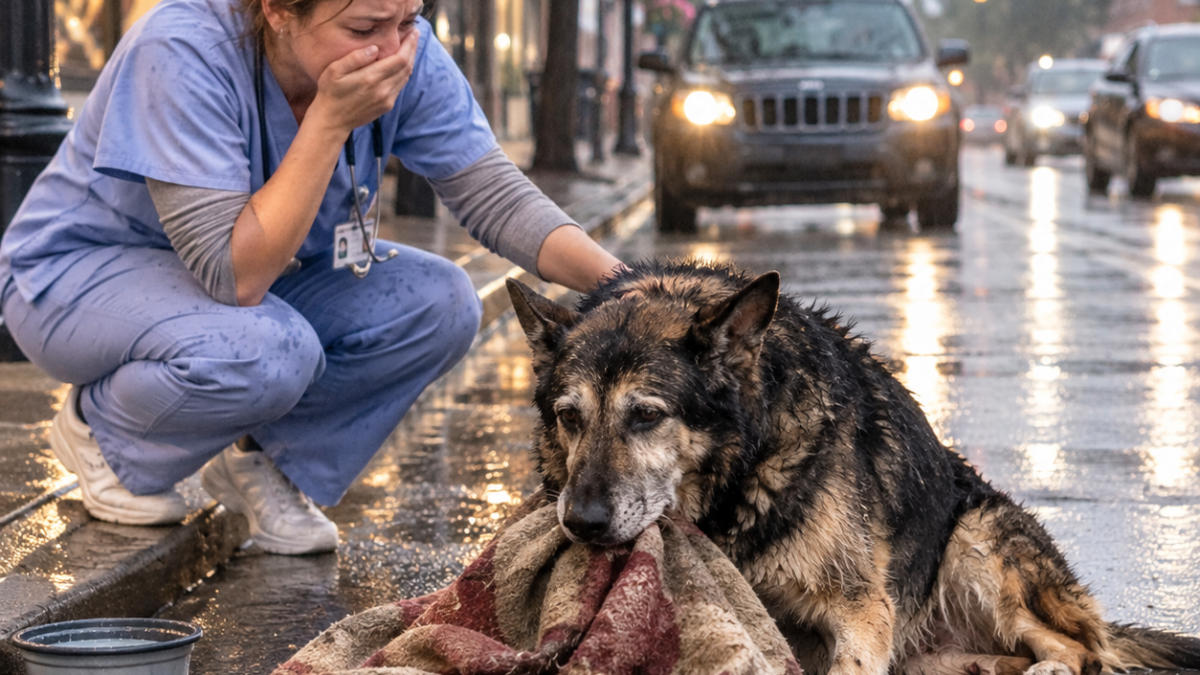
For forty-seven mornings, Belle waited at the same intersection for a man who never came back.
People fed her, tried to rescue her, even tried carrying her away, but the old German Shepherd always fought her way back to the same patch of sidewalk before sunrise.
Then, at exactly 6:15 on the forty-eighth morning, she dragged a second blanket into four lanes of traffic—and when I saw where it had come from, I knew Marcel’s disappearance had never been what we thought.
My name is Julien Morel.
At the time, I was a police sergeant in Lyon, forty-six years old, divorced, and certain that after twenty-two years in uniform there weren’t many surprises left in my job.
I was wrong.
The call came over the radio at 6:21 a.m.
“Dog in roadway. Multiple vehicles stopped. Possible blood on an object beside the animal.”
The dispatcher started giving me the intersection.
I already knew which dog she meant.
Belle.
I shut off my siren before I reached the corner.
She hated sirens.
Everyone in that neighborhood knew that.
For nearly three years, Belle had lived beside a seventy-two-year-old man named Marcel Delorme.
Marcel wasn’t the kind of homeless man who approached strangers.
He never rattled a cup.
Never followed people.
Never shouted.
Most mornings he sat against the wall of a closed storefront with an old paperback balanced on one knee.
Tall.
Thin.
Face deeply lined.
A faded green military-style jacket buttoned high against the cold.
An old cap tilted slightly to one side.
People knew he had served in the military years earlier, though nobody seemed certain where or for how long.
Marcel himself avoided the subject.
Whenever someone asked, he gave the same answer.
“That was another lifetime.”
After the military, he spent more than twenty years working as a pipefitter for municipal technical services.
Then his wife died.
His health declined.
There were debts.
A pension dispute.
Eventually, the apartment disappeared.
The furniture disappeared.
Most of the paperwork disappeared.
By the time the neighborhood knew Marcel, his life fit into two bags, several books and a gray wool blanket.
But Belle was always beside him.
She was an aging German Shepherd, probably eleven years old.
Her hips were stiff.
Her left ear folded near the tip.
A pale scar ran from her jaw toward her neck.
But the first thing most people noticed was her eyes.
She watched Marcel constantly.
If he stood, she stood.
If he coughed, her head lifted.
If he slept, she positioned herself facing outward.
If somebody approached too quickly, Belle quietly moved between them.
Marcel always fed her first.
Always.
Even when he barely had enough for himself.
Nadia Benali, who ran the grocery store across the intersection, once brought them two bowls of stew on a winter afternoon.
Marcel placed the first bowl in front of Belle.
Nadia said, “Marcel, you’re shaking. Eat yours first.”
He looked at Belle.
“She waited longer.”
“That dog ate this morning.”
“She says otherwise.”
Nadia rolled her eyes.
Marcel lifted his cap.
“Thank you, ma’am.”
Always those words.
Never more.
Then, forty-seven days before the morning I was called to the intersection, Marcel vanished.
Nadia arrived just before dawn and found Belle alone.
Marcel’s gray blanket was folded beside the wall.
His paperback lay open on the pavement, swollen from rain.
One of his bags was still there.
The other was gone.
Belle sat beside the blanket.
Everyone assumed Marcel would return.
That afternoon.
Then that evening.
Then the next morning.
He didn’t.
A missing-person report was filed.
We checked hospitals.
Emergency shelters.
Police contacts.
Transit stations.
Temporary accommodation centers.
Nothing.
Marcel had disappeared.
Belle had not.
The first night, neighbors tried bringing her inside Nadia’s store.
She refused.
The second night, a volunteer tried guiding her toward a van.
Belle flattened herself over Marcel’s blanket and growled until the volunteer backed off.
A local rescue organization returned with a crate.
Same result.
One man tried lifting her.
Belle snapped beside his hand without making contact.
He immediately put her down.
After that, people stopped forcing the issue.
They built a small plywood shelter beside the storefront.
Someone added a tarp.
Someone else brought thick cardboard.
Nadia supplied food.
A retired mechanic named Gérard changed the water twice daily.
And Belle waited.
Rain came.
She waited.
The temperature dropped.
She waited.
Snow fell twice.
Each morning, Nadia found her in the same place.
Sometimes Belle left for ten minutes.
Maybe fifteen.
But she always returned before anybody could follow.
Nobody knew where she went.
By the third week, people began saying Marcel was probably dead.
By the fifth, some stopped mentioning him at all.
Belle didn’t.
Every vehicle slowing near the intersection made her raise her head.
Every man in a green jacket made her stand.
Every footstep behind the wall made her turn.
I visited her several times.
I had grown up with shepherds.
I knew enough to understand that a dog refusing to leave a place isn’t always lost.
Sometimes she is waiting.
Sometimes she is protecting something.
And sometimes she is trying to tell you something you are too stupid to understand.
That forty-eighth morning, Belle was no longer waiting on the sidewalk.
She sat directly on the center line.
Cars stopped in all directions.
A delivery van leaned on its horn.
A woman had opened her window and was shouting.
Belle didn’t move.
Between her front paws lay a blanket.
Small.
Brown.
Dirty.
Torn along one edge.
Dark stains marked the fabric.
I stepped from my patrol car.
“Easy, Belle.”
Her head turned toward me.
No bark.
No growl.
Her body trembled.
I knew Marcel’s blanket.
Gray wool.
Large.
Heavy.
The one beneath Belle’s shelter was still there.
This brown blanket was different.
And when I crouched close enough to see tiny flakes of blue paint embedded in the torn fabric, something cold moved through my chest.
Because one detail from Marcel’s disappearance suddenly came back to me.
A witness had reported a blue maintenance van parked near the intersection shortly after midnight.
The witness never got a plate.
We had never established whether it mattered.
Now Belle was sitting beside a torn blanket carrying blue paint.
I looked at her.
Then at the fabric.
For the first time in forty-seven days, Belle’s vigil stopped looking like grief.
It looked like evidence.
“Close the road.”
Officer Renard, who had just arrived behind me, stared.
“All four lanes?”
“All four.”
“Traffic will back up three blocks.”
“I know.”
“Julien—”
“Close it.”
He began positioning the patrol vehicle.
Drivers immediately complained.
I ignored them.
Belle remained beside the blanket.
Not on top of it.
Beside it.
Straight-backed.
Still.
Exactly the way she had once sat beside Marcel.
I pulled on gloves.
“Belle.”
Her ears moved.
“I need to see this.”
I reached toward the blanket.
She stood.
I stopped.
No growl.
No teeth.
Just tension.
“Okay.”
I lowered my hand.
“You brought it here. I understand.”
Of course, I didn’t understand.
Not yet.
But saying it felt important.
Nadia appeared from the sidewalk.
“Belle!”
The dog turned instantly.
Nadia pushed under the police tape before Renard could stop her.
“I told her—”
“It’s fine.”
Nadia froze when she saw the blanket.
“That isn’t Marcel’s.”
“You’re sure?”
“Of course I’m sure.”
“When did you first see Belle this morning?”
“Around five thirty.”
“With that blanket?”
“No.”
“Where was she?”
“Usual place.”
“Then she left?”
“I went inside to start the ovens.”
“For how long?”
“Maybe thirty minutes.”
“And when you came back?”
“Traffic had stopped.”
Belle looked toward the northern side of the intersection.
Then lowered her nose to the blanket.
Then north again.
Blanket.
North.
Blanket.
North.
Nadia saw it too.
“She wants something.”
“Yes.”
Beyond the intersection stood several old commercial properties.
A garage.
A plumbing supplier.
A storage yard.
And an abandoned municipal maintenance depot.
Its steel gates were painted blue.
I crouched again.
This time, Belle allowed me to lift one edge of the blanket.
The smell was immediate.
Oil.
Dirt.
Mildew.
And something metallic.
Blood, maybe.
Rust, maybe.
No assumptions.
Then I saw a small object trapped inside a fold.
Brass.
I lifted it with forceps.
A button.
Stamped with a tiny anchor.
Nadia inhaled.
“That’s his.”
“Whose?”
“Marcel’s.”
“You recognize one button?”
“He replaced them himself. Bought an old set from a military surplus place.”
I had seen Marcel’s jacket dozens of times.
Four brass buttons.
In the last photograph taken before his disappearance, the lowest button was missing.
I held the small brass piece inside an evidence bag.
“Where did you get this, Belle?”
The dog looked north again.
I stood.
“Renard, call for another unit and crime scene.”
He followed my gaze.
“The depot?”
“Start there.”
Nadia tightened her grip on Belle’s temporary lead.
“I’m coming.”
“No.”
“Then she isn’t.”
“This could become a crime scene.”
“And Belle has spent forty-seven days refusing to follow anybody except Marcel.”
She took one step.
Belle moved beside her.
I took one.
Belle didn’t.
Nadia raised one eyebrow.
I hated when civilians were right.
“You stay behind us.”
We crossed the road.
Belle moved with determination.
Past the plumbing supplier.
Past the garage.
Past the front gate of the old depot.
She didn’t stop.
She pulled Nadia toward a narrow service lane behind the property.
Weeds broke through cracked pavement.
Old pallets leaned against a wall.
The rear fence sagged in two places.
At one corner, the wire had been bent upward.
Just enough for a dog to crawl beneath.
Belle went directly to it.
Nadia stopped her.
“She’s been through there.”
“Looks like it.”
Beyond the fence, an old steel service door stood slightly open.
Blue paint flaked from its lower edge.
The same color as the fragments caught in the brown blanket.
My pulse accelerated.
We didn’t crawl under.
We waited for municipal property services to bring a key.
Inside, the depot smelled like damp concrete.
Renard and I entered first.
“Police!”
Our voices echoed.
Nothing.
We cleared an office.
Workshop.
Storage room.
Locker area.
No Marcel.
Behind an old boiler room, though, we found something else.
A foam mattress.
Empty water bottles.
Food wrappers.
A plastic shopping bag.
Medication packaging.
And an old paperback.
I photographed it.
Then brought Nadia close enough to see through the doorway.
She covered her mouth.
“That’s his.”
“You’re sure?”
“He was reading it the week before he vanished.”
A battered edition of The Count of Monte Cristo.
Marcel apparently had a sense of humor.
On a shelf nearby was a faded municipal employee card.
MARCEL DELORME.
The photograph was twenty years younger.
But there was no question.
“He was here.”
Renard looked around.
“Maybe he slept here before disappearing.”
“Maybe.”
Then my flashlight reached the floor.
A dried brown smear crossed the concrete beside an old metal cart.
More stains marked the lower edge of the wall.
And on one rusted wheel, a strip of brown fabric remained snagged.
Same weave.
Same color.
As the blanket in the roadway.
We backed out.
No touching.
Forensics on the way.
When I stepped outside, Belle was pacing.
The moment she saw Marcel’s employee card in my gloved hand, she surged forward.
She smelled it.
Whined.
Then pulled away from the depot entrance.
Not inside.
Around the building.
“Where are you going?”
She followed the wall toward a row of attached garages.
First garage.
Nothing.
Second.
Empty.
At the third, she stopped.
Scratched once.
Then twice.
Renard looked at the lock.
Fresh steel.
Everything else on the property was rusted.
“This lock doesn’t belong here.”
We checked with property services.
No authorized tenant.
No active maintenance contract.
We cut it.
The garage door rose six inches.
A smell came through.
Urine.
Stale food.
Human waste.
Then a sound.
Scrape.
From inside.
“Police!”
Another scrape.
Renard and I raised the door.
Morning light entered.
A cot stood against the far wall.
Plastic containers.
A bucket.
Blankets.
And a man.
For a second, I couldn’t reconcile him with the photographs.
He had lost weight.
His beard was long.
Hair dirty.
One wrist wrapped in filthy cloth.
Face pale.
Bruises.
But it was Marcel.
Alive.
Belle made a sound I had never heard from any dog.
Not barking.
Not howling.
Something between a scream and a cry.
Nadia lost the leash.
Belle ran.
She crossed the garage and hit Marcel’s chest.
He tried lifting his arms.
They barely moved.
“Belle.”
Just her name.
Barely audible.
She climbed halfway onto the cot.
Licked his face.
Whined.
Marcel pressed his forehead against hers.
“Belle.”
Nadia began crying.
Renard looked away.
I crouched beside Marcel.
“Mr. Delorme, I’m Sergeant Morel.”
His eyes struggled to focus.
“Police?”
“Yes.”
He looked at Belle.
“Don’t take her.”
“We won’t.”
His eyelids fluttered.
“Stay with me.”
They opened.
“Who did this?”
Fear crossed his face.
Real fear.
Not confusion.
He whispered:
“Blue van.”
“What blue van?”
“City.”
Then he passed out.
The ambulance arrived seven minutes later.
Belle tried climbing inside.
One paramedic stopped her.
“No dogs.”
I stared at him.
“That man spent forty-seven days locked in a garage and the first thing he said was not to take her away.”
“Hospital policy.”
“Put a blanket on the floor.”
“Sergeant—”
“Put a blanket on the floor.”
Belle rode beside him.
I followed.
Marcel was severely dehydrated.
Malnourished.
Two cracked ribs.
A healing fracture in his left wrist.
An infected cut near his scalp.
Respiratory infection.
Pressure sores.
Bruising at different stages.
The doctor used the phrase “remarkably resilient.”
I didn’t feel like we had witnessed resilience.
I felt like we had uncovered deliberate cruelty.
The garage walls were thick.
The surrounding businesses closed or under renovation.
Anybody shouting from inside would have been nearly impossible to hear.
More importantly, someone had been returning.
There were fresh food containers.
Recent water bottles.
Medication dated during Marcel’s captivity.
Somebody wanted him alive.
That made the case worse.
Belle slept beneath the hospital chair.
Technically, animals weren’t allowed on the ward.
Practically, every nurse who tried enforcing that policy took one look at Marcel and gave up.
Twelve hours later, he woke.
His first word was:
“Belle?”
She was on her feet immediately.
Front paws against the mattress.
Marcel touched her folded ear.
Tears moved sideways toward his temples.
I left the room.
Some things shouldn’t have witnesses.
Two days later, doctors allowed a short interview.
I sat beside his bed.
Belle lay against the frame.
“Do you remember what happened the night you disappeared?”
“Yes.”
“What were you doing at the depot?”
“Sleeping.”
“You had been using it?”
“When weather got bad.”
“Anyone know?”
He shrugged.
“Maybe nobody cared.”
That sentence hurt more than he intended.
“What happened that night?”
He looked toward the window.
“I found boxes.”
“What boxes?”
“Old work orders.”
My pen stopped.
“What kind?”
“Municipal water maintenance.”
“You used to work those systems.”
“Yes.”
“How old were the records?”
“Several years.”
“And why did they matter?”
Marcel took a slow breath.
“Same company.”
“What company?”
“Valmont Infrastructure.”
I knew the name.
Major city contractor.
Water lines.
Road repairs.
Emergency infrastructure.
Millions in public contracts.
“What about them?”
“Billing replacements that weren’t replacements.”
“Explain.”
“They charged for new mains. New valves. Full excavation.”
“And?”
“Sometimes they patched.”
“Do you know that from the records?”
“I know because I worked some locations.”
“You’re saying invoices show complete replacement where you personally knew only partial repairs were done?”
“Yes.”
“Anything else?”
“Inspection signatures.”
He looked at me.
“People signed work complete when it wasn’t.”
“Why would those files still be there?”
“Depot closure happened fast.”
“Did you photograph them?”
“Yes.”
“With your phone?”
“Yes.”
“Where is the phone?”
“They took it.”
“Who?”
“Two men.”
“Describe them.”
“One wore Valmont work clothes.”
“And the other?”
“Dark coat. Older.”
“What happened?”
“I was leaving. Blue van stopped.”
“The same type reported at the intersection?”
“Probably.”
“They searched you?”
“Yes.”
“Why?”
“They saw me photographing documents.”
“Then?”
“They wanted the phone.”
“You gave it?”
“They took it.”
“Why didn’t that end it?”
“Backup.”
I understood.
“Cloud account.”
Marcel nodded.
“They wanted the password.”
“And you refused.”
“Yes.”
I looked at his injuries.
“For forty-seven days?”
“Apparently.”
“Why keep you alive?”
“They thought I’d break.”
“Did they threaten Belle?”
His eyes moved toward her.
“Yes.”
“What did they say?”
“That she was still at the corner.”
“They knew?”
“One of them drove past.”
My stomach tightened.
“They told you she was waiting?”
“Every few days.”
“And that was supposed to pressure you?”
“Yes.”
“Did it?”
Marcel looked at Belle.
“Almost.”
“Why didn’t you give them the password?”
He was silent for several seconds.
“If the photos mattered enough for this…”
He touched his ribs.
“…then maybe they mattered.”
“That’s all?”
“No.”
“What else?”
“They said they would let me see Belle if I cooperated.”
He looked at me.
“I didn’t believe them.”
Belle put her nose beneath his hand.
He stroked her.
“What happened to her that night?”
“One man grabbed me.”
“And Belle?”
“She went at him.”
“Bit?”
“No. Jacket.”
“What happened?”
“They kicked her.”
His voice hardened for the first time.
“I yelled at her to go.”
“You sent her away.”
“Yes.”
“To save her.”
“Yes.”
That explained why Belle survived.
Marcel had driven her off himself.
The one command she obeyed because it came from him.
“Did you think she left the area?”
“I hoped.”
“But they later told you she stayed.”
He closed his eyes.
“Yes.”
The next question was difficult.
“Where did the brown blanket come from?”
“Garage.”
“Yours?”
“No.”
“One of them?”
“Used for equipment.”
“How did your blood get on it?”
“They hit me early on.”
“Then why was it outside?”
“Yesterday, somebody opened the garage. Cleaning things. I heard a dog.”
His eyes opened.
“Belle.”
“You heard her?”
“I thought I was imagining it.”
“What happened?”
“I started hitting the wall.”
“Could she reach you?”
“No.”
“But she found the blanket.”
“Maybe.”
There it was.
Belle had eventually followed Marcel’s scent beneath the fence.
She couldn’t get into the garage.
Couldn’t open the lock.
Couldn’t tell us with words.
So she found something carrying his scent and blood.
Dragged it beneath the fence.
Across the service lane.
Past the depot.
Across the intersection.
Then placed it where cars had no choice but to stop.
She had turned herself into a roadblock because everything quieter had failed.
We accessed Marcel’s cloud storage with his permission.
The files were there.
Dozens of photographs.
Invoices.
Maintenance logs.
Inspection documents.
Contract codes.
Dates.
The first discrepancies were obvious.
Valmont had billed the city for complete pipe replacement at an apartment complex on Rue des Tilleuls.
Marcel’s photographs showed the old pipe still in place months after the claimed replacement.
Another contract billed six full crews for an emergency water-main project.
Site access logs showed two crews.
A third invoice listed imported high-grade valves.
Photos showed cheaper domestic units.
One discrepancy might have been administrative.
Ten were suspicious.
Thirty were a pattern.
Then we found payments.
A consulting company linked to a municipal inspector had received monthly transfers from a Valmont subcontractor.
Another official’s brother-in-law owned a company paid for “site verification” that never appeared on physical work records.
The fraud grew.
Hundreds of thousands.
Then millions.
Marcel had been right years earlier.
He had complained about discrepancies while still employed.
We found emails.
His concerns had been dismissed.
Then his performance reviews changed.
Write-ups appeared.
Absences questioned.
His pension became entangled in disputes.
He hired a lawyer.
Bills grew.
His wife developed cancer.
The money disappeared.
By the time she died, Marcel was already close to losing their apartment.
The man everyone assumed had simply fallen apart had actually been pushed downward one bureaucratic step at a time after challenging people far more powerful than he was.
That did not prove conspiracy in every part of his downfall.
I refused to invent what evidence could not establish.
But it explained why Marcel carried bitterness he almost never voiced.
The van from the night he disappeared was captured by traffic cameras.
Blue Valmont maintenance vehicle.
Plate clear enough to identify.
Assigned to two employees.
Éric Savin.
Paul Giraud.
Both claimed they had been home.
Phone records disagreed.
Giraud’s phone remained near the depot for forty minutes.
Savin had turned his phone off shortly before midnight and switched it back on later.
Then we got lucky.
At 1:22 a.m., the same blue van had been photographed by an automated parking enforcement camera three streets from the garage.
A twenty-eight-euro parking violation.
People imagine criminal cases collapse or succeed because of brilliant detective work.
Sometimes they do.
Sometimes the thing that breaks them open is an unpaid parking ticket.
We arrested Savin and Giraud.
Giraud said nothing beyond requesting counsel.
Savin talked.
Too much.
He initially claimed Marcel voluntarily got into the van.
Then claimed they only wanted to scare him.
Then claimed they were following instructions.
“From whom?”
“I can’t say.”
“You’re facing kidnapping charges.”
He looked at his lawyer.
His lawyer looked unhappy.
“We didn’t plan forty-seven days.”
That phrase froze the room.
I leaned forward.
“So how many days of imprisoning a seventy-two-year-old man were planned?”
His attorney objected.
Savin looked down.
“You don’t understand.”
“Then help me.”
“We needed the password.”
“To delete the cloud files.”
Silence.
That was the first direct acknowledgment.
“Who knew about the files?”
He shook his head.
“Éric.”
“Who else?”
Nothing.
I slid photographs across the table.
Marcel’s ribs.
Wrist.
Scalp.
The garage.
Belle waiting on frozen pavement.
Savin looked away from the dog photograph.
“You knew she was there?”
He said nothing.
“Marcel says one of you told him.”
No answer.
“You drove past?”
His jaw tightened.
“Why?”
No answer.
“To see if she was still waiting?”
He finally looked up.
“We needed him to cooperate.”
“You used his dog.”
His lawyer said, “Sergeant—”
I ignored him.
“You knew that old dog was sitting outside every day and you used it to pressure a man you had locked in a garage.”
Savin whispered, “It wasn’t my idea.”
There it was.
“Whose?”
His attorney put one hand on his arm.
Too late.
Savin had already made the decision.
“Henri Valmont.”
Chief operations officer.
Nephew of Valmont Infrastructure’s founder.
The name appeared repeatedly in disputed contracts.
According to Savin, Henri believed Marcel had photographed files that could expose years of fraudulent billing.
He ordered the employees to recover the phone and determine whether copies existed.
“Did he order the kidnapping?”
Savin hesitated.
“He said solve the problem.”
“What did that mean?”
“I don’t know.”
“Yes, you do.”
“We were supposed to get the password.”
“And then?”
“Let Marcel go.”
“Where?”
“Outside the city.”
“Alive?”
Silence.
I leaned forward.
“Was he supposed to be alive?”
The attorney terminated the interview.
Henri Valmont was arrested six days later.
News cameras filled the street outside headquarters.
He emerged in an expensive dark coat, hands cuffed in front.
When he passed me, he stopped.
“You’re Morel?”
“Yes.”
“The officer with the dog.”
I almost smiled.
“That’s me.”
He looked toward reporters.
“This entire circus because of one stray animal.”
“No.”
I kept my voice quiet.
“This happened because you assumed a homeless man could disappear and nobody important would care.”
His face hardened.
I nodded toward the cameras.
“His dog disagreed.”
He was moved toward the vehicle.
That moment mattered less to me later than I expected.
At the time, yes, it felt satisfying.
But revenge fades quickly when you are still visiting the person who nearly died.
Marcel spent almost three weeks in the hospital.
Belle remained whenever staff allowed.
Nurses brought her food.
One physician initially complained.
Then Belle rested her head on his shoe during rounds.
The policy became flexible.
When Marcel was strong enough to sit, Belle put her front paws on his knees.
When he walked for the first time with a physical therapist, she followed beside him.
Slowly.
Matching his pace.
One afternoon I found him seated beside the window.
Belle asleep against his leg.
“You know people are calling her a hero.”
Marcel frowned.
“She hates attention.”
“She loves chicken.”
“Different thing.”
“National newspaper wants a photograph.”
“No.”
“Television?”
“No.”
“A local school?”
“No.”
“What if they bring chicken?”
He considered.
“Maybe.”
It was the first time I saw humor return.
The next problem was housing.
Returning Marcel to the sidewalk after forty-seven days of unlawful confinement was unthinkable.
Nadia started a neighborhood fundraiser before anyone could stop her.
I told her police couldn’t formally endorse it.
She said:
“You’re police. You don’t control my cash register.”
Within seventy-two hours, enough money existed for temporary accommodation.
Then a veterans’ support organization contacted us.
Marcel had served longer than anyone in the neighborhood knew.
He was eligible for benefits he had never claimed.
A social worker named Elise Fournier took his case.
Elise was tiny.
Soft-spoken.
Terrifying to bureaucrats.
She recovered service records.
Pension documents.
Medical entitlements.
Emergency housing status.
Backdated assistance applications.
Identity paperwork.
At one appointment, Marcel stared at the stack of forms.
“I should have been kidnapped years ago.”
I looked at him.
He smiled.
I laughed before I could stop myself.
Elise did not.
“Don’t encourage him.”
Marcel eventually moved into a small ground-floor apartment less than ten minutes from Nadia’s store.
One bedroom.
Tiny kitchen.
Small fenced patio.
Nothing luxurious.
The first day I visited, he gave me a tour.
“Hot water.”
“Yes.”
“Heat.”
“Congratulations.”
“Indoor toilet.”
“Very advanced.”
“Window that closes.”
“Now you’re bragging.”
He opened the bedroom.
Belle’s bed occupied most of the available floor.
His own mattress was pushed against the wall.
“You gave the dog more space.”
“She waited forty-seven days.”
That became his answer to everything.
Why does Belle get chicken?
She waited forty-seven days.
Why does Belle sleep on the bed?
Forty-seven days.
Why did you spend half your monthly budget on an orthopedic dog mattress?
Forty-seven days.
Impossible to argue with.
But Belle did not simply recover because Marcel returned.
The first time he left the apartment without her, she panicked.
He had gone to a medical appointment with Elise.
Nadia called me.
“Julien, she’s losing her mind.”
I arrived to find Belle pacing.
Whining.
Scratching at the door.
“Belle.”
Nothing.
“Marcel is coming back.”
Words meant nothing.
For almost an hour, she refused food.
Then a car stopped outside.
Belle froze.
Marcel opened the gate.
She ran.
Her old hips failed halfway.
She stumbled.
Got up.
Kept going.
Marcel dropped his cane and knelt.
Belle hit him hard enough to nearly knock him over.
“You idiot,” he whispered.
She whined against his chest.
“I told you I was coming back.”
After that, they practiced.
Five minutes apart.
Marcel returned.
Ten.
Returned.
Twenty.
Returned.
Belle gradually learned that absence did not always become forty-seven days.
Marcel had to learn the same thing.
The first time Belle went to the veterinarian without him for X-rays, he called the clinic three times in forty minutes.
Nadia finally took his phone.
“You’re worse than the dog.”
“I have reasons.”
“So does she.”
They healed in parallel.
The corruption investigation kept expanding.
Financial auditors reviewed years of Valmont contracts.
Buildings were reinspected.
Several pipe systems required emergency work because supposedly replaced components were still decades old.
Municipal officials resigned.
Two inspectors were charged.
A subcontracting executive accepted a plea agreement.
The city froze Valmont’s active contracts.
Employees who had nothing to do with the scheme were furious because they feared losing jobs.
That complicated the public story.
Fraud cases rarely divide the world neatly into villains and heroes.
Hundreds of ordinary workers depended on the company.
Some had families.
Some had done honest work for years.
Marcel understood this better than the journalists.
When one reporter asked whether he wanted Valmont Infrastructure destroyed, he said:
“No.”
The reporter seemed disappointed.
“You don’t?”
“I want people who stole to answer for stealing.”
“What about the company?”
“People pouring concrete didn’t kidnap me.”
That statement became one of the reasons people trusted him.
He never seemed interested in vengeance for its own sake.
He wanted accountability to land on the right people.
Henri Valmont’s lawyers attacked Marcel publicly.
Not directly at first.
Anonymous statements.
Questions about reliability.
Alcohol use.
Homelessness.
Mental stability after trauma.
One columnist wrote that the prosecution depended heavily on “the recollections of an elderly transient.”
I brought the article to Marcel.
He read three paragraphs.
Then used it beneath Belle’s water bowl.
“You’re not angry?”
“Should I be?”
“They’re trying to discredit you.”
“Paper absorbs water.”
That was Marcel.
The trial began fourteen months after his rescue.
By then, his beard was trimmed.
He had gained weight.
Walked with a cane.
Still wore the green jacket, though Nadia had replaced the missing brass button.
I noticed it outside court.
“You repaired it.”
“Nadia did.”
“Same anchor?”
He looked down.
“Yes.”
Belle waited outside with Nadia.
Before Marcel entered, he crouched beside her.
Painfully.
“You stay.”
Belle’s ears lowered.
“I’m coming back.”
He paused.
“This time, I’m coming back.”
I looked away.
The defense attacked Marcel’s credibility exactly as expected.
“Mr. Delorme, you were unhoused when these events occurred?”
“Yes.”
“You sometimes slept without permission in municipal property?”
“When cold.”
“You consumed alcohol?”
“Occasionally.”
“You had disagreements with city management before retiring?”
“Yes.”
“So you had grievances.”
“I had invoices.”
A few people in the gallery shifted.
The defense attorney continued.
“You considered yourself a whistleblower?”
“No.”
“What would you call yourself?”
“A pipefitter.”
That answer landed harder than any speech.
Then the attorney asked about Belle.
“She was your primary companion?”
“Yes.”
“You were emotionally dependent on her?”
Marcel considered.
“She depended on me too.”
“Could fear for the animal have influenced your memory during confinement?”
Marcel became still.
The attorney leaned closer.
“You were injured, dehydrated and under extreme stress.”
“Yes.”
“So your recollection might not be reliable.”
Marcel looked at the judge.
Then at the attorney.
“I spent forty-seven days in a garage while your client’s employees told me my dog was sitting on the same sidewalk waiting.”
Silence.
“I had cracked ribs.”
He lifted his left hand.
“A broken wrist.”
He touched his chest.
“I was hungry.”
His voice remained quiet.
“I didn’t know whether anybody knew where I was.”
The attorney tried interrupting.
Marcel continued.
“Every few days they told me Belle was still there.”
His hands trembled.
“They thought that would make me give them the password.”
“Did it?”
Marcel looked toward the courtroom doors.
“No.”
“Why not?”
He swallowed.
“Because if an old dog could stay on a frozen sidewalk forty-seven days waiting for me…”
His voice cracked.
“…I could stay in that garage forty-seven days refusing them.”
Nobody moved.
Then Marcel smiled faintly.
“I wasn’t brave.”
He looked down.
“I was trying not to disappoint my dog.”
That sentence was quoted everywhere the next morning.
Henri Valmont was convicted on multiple charges related to conspiracy, unlawful confinement, fraud and corruption.
Savin received a reduced sentence after cooperating.
Giraud fought the charges and lost.
Several financial cases continued separately.
Valmont Infrastructure underwent restructuring and lost major public contracts.
Did all of that satisfy Marcel?
Not in the way journalists expected.
Outside court, one reporter shouted:
“Do you feel justice has been done?”
Marcel looked confused.
Then down at Belle.
“I got my dog back.”
That answer traveled farther than any legal analysis.
The next years became quieter.
That mattered.
People like dramatic endings.
Arrest.
Verdict.
Applause.
Life after trauma is rarely dramatic.
It is appointments.
Medication.
Rent.
Groceries.
Nightmares.
Physical therapy.
Forms.
Slow walks.
Trying again.
Marcel began volunteering at a veterans’ center.
Not formally at first.
He would sit in the lobby with coffee.
Other older men sat near him.
Some talked.
Some didn’t.
Marcel was good with people who didn’t want to talk.
Maybe because he understood how exhausting explanations can become.
One former soldier named André had been living in his car.
Marcel helped Elise persuade him to accept temporary housing.
Another man, Malik, had stopped attending medical appointments.
Marcel started accompanying him.
Whenever anyone praised him, he became annoyed.
“I sit in chairs.”
Elise said, “You sit very effectively.”
Belle became part of the center too.
She lay beneath Marcel’s chair.
Veterans who refused eye contact with staff often scratched her ears.
One man who had not spoken during group meetings for weeks whispered to her:
“You understand.”
Belle probably didn’t.
But she stayed.
Sometimes staying is enough.
A year after the trial, a school invited Marcel to speak about loyalty.
He refused.
Then they mentioned thirty children had written letters to Belle.
He agreed.
The children asked better questions than reporters.
“Did Belle know you were alive?”
“I don’t know.”
“Did she save you?”
“Yes.”
“Did you save her first?”
Marcel thought.
“Maybe we took turns.”
A little girl asked:
“Why didn’t she leave?”
Marcel looked at Belle.
“Because dogs don’t understand when sensible people tell them to give up.”
A boy raised his hand.
“Are dogs better than people?”
Marcel smiled.
“Some dogs.”
The room laughed.
Another child asked:
“Why didn’t you tell the bad men your password?”
Marcel became serious.
“Because sometimes people try to make you feel small so you’ll believe resistance is pointless.”
The children watched.
“I knew one creature in the world still believed I was coming back.”
He nodded toward Belle.
“That was enough.”
Belle’s health began declining gradually.
Her hips worsened first.
Long walks became short loops around the block.
Then kidney disease appeared.
Medication.
Special diet.
Frequent veterinary checks.
Marcel worried constantly.
One afternoon he called me.
“Belle won’t eat.”
I went over.
She lay beside the patio door.
Dr. Lefèvre examined her.
“Kidneys are declining.”
“How long?” Marcel asked.
“We can’t know.”
“I hate that answer.”
“So do I.”
After the veterinarian left, Marcel sat at the kitchen table.
Belle rested beneath his hand.
“I thought we’d have longer.”
“You may.”
He looked at me.
“That’s what people say when they don’t know.”
“Yes.”
He scratched Belle’s ear.
“Do you know I wanted her to forget me?”
“When?”
“In the garage.”
“Why?”
“Because every day they told me she was still waiting.”
His voice tightened.
“Day one, I thought she’d leave.”
“She didn’t.”
“Day three, I hoped Nadia would take her.”
“She tried.”
“Day ten…”
He looked down.
“I wanted Belle to think I was dead.”
I said nothing.
“So she could live.”
He wiped one eye angrily.
“Forty-seven days on pavement because of me.”
“No.”
“Don’t give me police words.”
“I’m retired from convincing people.”
“You’re not retired.”
“Emotionally.”
That got the smallest smile.
I leaned forward.
“She stayed because you were home to her.”
“That isn’t better.”
“It is from her side.”
Marcel remained quiet.
“You did the same.”
He looked up.
“What?”
“You stayed alive because you believed she was waiting.”
“That’s different.”
“How?”
“I had a choice.”
“So did Belle.”
He stared at her.
“Two stubborn idiots.”
“Exactly.”
Belle lived almost two more years.
Good years.
Not young years.
Slow years.
Marcel placed rugs across slippery floors.
I built a wooden ramp for the patio.
He inspected it.
“Too steep.”
“It’s six degrees.”
“Belle’s hips don’t know geometry.”
I rebuilt it.
He was right.
I never forgave him.
Nadia cooked chicken twice a week.
Marcel claimed it was for himself.
Belle received most of it.
She became mildly famous.
People recognized her on walks.
Belle responded to celebrity by expecting snacks.
Marcel hated attention but tolerated it because Belle profited.
One Sunday morning, I visited and found him brushing her.
She lay on the patio.
Sunlight across her gray muzzle.
“You ever think about the intersection?”
I asked.
“Every day.”
“Bad memories?”
“Some.”
“What do you remember most?”
He thought.
“The first night in the garage.”
“Why?”
“I thought Belle was dead.”
He continued brushing.
“Then one of them came back two days later and said she was sitting at the corner.”
“You believed him?”
“No.”
“Later?”
“When he mentioned Nadia feeding her.”
He smiled.
“That’s when I knew.”
“Knew what?”
“She was alive.”
I looked at Belle.
“So the information meant to break you helped you.”
“Yes.”
He paused.
“People are stupid.”
“Dogs?”
“Also stupid.”
Belle opened one eye.
“Sorry,” he said.
The final winter came quietly.
Belle began sleeping more.
Some days she refused walks entirely.
One morning Marcel called.
His voice told me before his words.
“Julien.”
“Yes?”
“It’s time.”
I drove over.
Nadia was already there.
Dr. Lefèvre sat on the floor.
Belle lay on the orthopedic bed Marcel had spent too much money buying years earlier.
Her breathing was shallow.
Marcel sat beside her.
One hand resting on her ribs.
I crouched.
“Hey, old girl.”
Belle opened her eyes.
Tail moved once.
“You caused a lot of paperwork.”
Marcel laughed through tears.
“Don’t insult her.”
“She knows.”
Dr. Lefèvre explained the injection.
Marcel nodded.
Then said:
“One minute.”
He leaned close.
For several seconds, he couldn’t speak.
Belle looked at him.
He finally whispered:
“You waited for me.”
Her ear twitched.
“Forty-seven days.”
He pressed his forehead against hers.
“I came back.”
His voice broke.
“You can stop waiting now.”
Nadia covered her face.
I looked at the wall.
Dr. Lefèvre waited.
Marcel stayed with Belle until he was ready.
Then he nodded.
Belle died with his hand over her heart.
No street.
No snow.
No garage.
No horns.
No fear.
Home.
For almost an hour after, Marcel didn’t move.
Then he looked around his tiny apartment.
“It feels too big.”
I understood.
He kept Belle’s collar hanging beside the front door.
The gray blanket from the sidewalk had been cleaned years earlier and stored in a wooden chest.
The brown blanket remained evidence through every appeal.
When the evidence office finally released it, they called me.
“What should we do with this?”
I asked Marcel.
“Bring it.”
He spread the fabric on a worktable behind Nadia’s brother’s garage.
The stains had faded.
One edge remained torn.
He cut a small square from the cleanest corner.
“What’s that for?”
“The part she carried.”
Then he placed the rest into a metal barrel.
We burned it.
I expected ceremony.
Marcel watched quietly.
When the final corner curled into ash, he put the small square into his pocket.
“No more evidence.”
“No.”
“Good.”
The abandoned depot was eventually demolished.
The city converted part of the site into a small public square.
Officials suggested naming it after Marcel.
He refused.
Then Belle.
He refused that too.
“She was a dog.”
Nadia nearly hit him with her handbag.
“Exactly.”
Eventually, they compromised.
A simple bronze plaque beside one bench.
No names.
Just:
FOR THOSE WHO WAIT,
AND FOR THOSE WHO COME BACK.
Marcel approved.
He visited often.
Not because he wanted to stare at the site where he had been held.
Because the bench faced the intersection.
The place where Belle waited.
Sometimes I joined him.
We stopped discussing the case.
Survivors don’t always want to keep explaining their worst days.
Mostly we complained about coffee.
Weather.
Soccer.
Nadia’s prices.
My knees.
One morning I asked:
“Why do you think Belle dragged the blanket into traffic?”
Marcel looked at me.
“You’re the dog expert.”
“I’m police.”
“You talk to dogs more politely than suspects.”
Fair.
I watched vehicles cross.
“She found your scent.”
“Probably.”
“She couldn’t open the garage.”
“No.”
“She tried bringing us something.”
“Maybe.”
“But why traffic?”
Marcel smiled.
“You police ignored her on the sidewalk forty-seven days.”
I stared at him.
“She improved the delivery method.”
I laughed.
He was probably right.
Marcel lived another seven years.
Long enough to become more than “the homeless man who was kidnapped.”
That mattered to him.
He volunteered.
Helped veterans.
Argued with Nadia.
Read novels.
Complained about bureaucrats.
Collected exactly two pieces of furniture too large for his apartment.
He never got another dog.
People asked him.
He always said:
“One Belle was enough for a lifetime.”
His health weakened in his late seventies.
Heart.
Lungs.
Years of sleeping outdoors had left damage.
At eighty-one, Marcel died peacefully in his sleep.
By then, I had retired.
Nadia called me.
“Julien.”
I knew from her voice.
I went to the apartment.
Everything was neat.
Book on the table.
Tea mug in the sink.
Belle’s collar hanging beside the door.
On Marcel’s nightstand was an envelope.
JULIEN written across the front.
Inside, one page.
His handwriting had become shaky.
Julien,
If you’re reading this, I suppose I’ve finally managed to leave without Belle making a scene.
Thank you for listening to her when the rest of us couldn’t understand what she was saying.
People always say she waited for me.
They’re wrong.
Waiting sounds passive.
Belle worked.
Every day.
She kept my place.
Watched the road.
Found the depot.
Found the blanket.
Dragged the truth into traffic because apparently humans need things put directly in front of their cars before they notice.
I laughed.
Then kept reading.
Don’t let anyone call her just loyal.
Loyalty is not big enough.
She was stubborn.
That saved me.
And when they put up that stupid plaque, make sure nobody adds my name.
I laughed until I cried.
Marcel’s funeral was larger than he would have tolerated.
Former city workers.
Veterans.
Police.
Nurses.
Neighbors.
People he had helped find housing.
Families whose buildings had undergone safety repairs because the fraud investigation forced new inspections.
Nadia sat beside me.
Afterward, we walked to the little square.
Flowers had been left beside the plaque.
Someone had placed a dog leash there.
Nadia touched the bronze words.
FOR THOSE WHO WAIT,
AND FOR THOSE WHO COME BACK.
“Do you think he found her?”
I looked at her.
“You’re asking a retired police sergeant theological questions?”
“Yes.”
“Terrible decision.”
She smiled.
Then I looked toward the intersection.
For one second, I could see that morning again.
Stopped cars.
A coffee cup on the pavement.
People shouting.
An old German Shepherd sitting on the white line.
A dirty brown blanket between her paws.
Everyone thinking she was confused.
Everyone thinking grief had finally broken her routine.
We had been wrong.
Belle wasn’t lost.
She wasn’t wandering.
She wasn’t creating trouble.
For forty-seven days, she had done everything a dog could do.
Wait.
Watch.
Return.
Search.
Then waiting stopped being enough.
She followed Marcel’s scent beneath a fence.
Found a blanket carrying his blood.
Dragged it across concrete.
Across a service road.
Through an intersection.
And placed it where humans could no longer step around the problem.
Henri Valmont had money.
Lawyers.
Contracts.
Connections.
A company large enough to hide fraudulent invoices inside mountains of paperwork.
He believed a homeless seventy-two-year-old man could disappear without consequence.
He was nearly correct.
What he failed to account for was an old German Shepherd.
Eleven years old.
Bad hips.
One folded ear.
A dog too stubborn to accept that Marcel was simply gone.
That was what stayed with me through retirement.
Not the arrests.
Not court.
Not press conferences.
Not headlines.
Belle.
Dragging that blanket while drivers honked.
People called it loyalty.
Marcel was right.
The word never felt big enough.
Loyalty sounds like sitting quietly beside someone.
Belle did that.
But she did more.
She remembered.
She searched.
She followed scent.
She brought back evidence.
And when nobody understood her, she changed tactics.
In the end, the men who imprisoned Marcel lost freedom, money, positions and reputations.
Marcel recovered something far more valuable than revenge.
Years.
He got seven more after Belle.
Two of them with her.
A home.
Heat.
Hot water.
Dry books.
Sunday chicken from Nadia.
Arguments with social workers.
Veterans who became friends.
A little patio.
A ramp I had to build twice because he complained about the angle.
Ordinary life.
That was the victory.
Not seeing his captors suffer.
Getting back the time they tried to erase.
And Belle got something too.
She did not die beneath a tarp on frozen pavement waiting for Marcel to return.
She died in his apartment.
On her own bed.
With Marcel’s hand over her heart.
Warm.
Safe.
Home.
Sometimes I still pass the old intersection.
The grocery store changed owners.
The storefront where Marcel once slept became a bakery.
A new apartment building replaced the old plumbing warehouse.
Most drivers crossing that road have no idea what happened there.
That is fine.
Stories do not require everyone to remember them.
But sometimes somebody sits on the bench beside the plaque.
Sometimes an elderly man.
Sometimes a young couple.
Sometimes a woman holding a dog leash.
And every time I see a dog sitting patiently beside someone it trusts, I remember Belle.
Forty-seven days.
Rain.
Snow.
Frozen pavement.
People trying to take her away.
Still she stayed.
Until one morning she understood that staying alone would not bring Marcel back.
So she found something.
And an old dog who could barely cross a busy road anymore dragged a stained blanket into four lanes of traffic and made an entire city stop long enough to listen.
That is how I remember her.
Not as the dog who waited.
As the dog who refused to let the man she loved disappear.
Years after Marcel died, people still asked me about Belle.
Not often.
The case had faded from the news.
Henri Valmont had become a name in old court archives.
The company had been reorganized under different leadership.
The depot was gone.
The intersection had changed.
New traffic lights.
New storefronts.
Different people rushing past with coffee in their hands.
But every so often, someone recognized my name.
A journalist.
A young police officer.
A volunteer from an animal rescue group.
And the question was always almost the same.
“Did Belle really understand what she was doing?”
I never knew how to answer that properly.
If they meant, did Belle understand evidence, criminal procedure, corruption, cloud storage, kidnapping or public contracts?
Of course not.
She was a dog.
But if they meant, did Belle know Marcel was alive somewhere?
Did she know the blanket carried his scent?
Did she know dragging it back to the place where people gathered might force someone to notice?
Then my answer was different.
I believe she knew exactly enough.
Maybe not what the rest of us knew.
Maybe not in words.
But enough.
And sometimes enough is all it takes.
After retirement, I began helping train younger officers who handled animal-related calls.
Not because I was an expert.
I wasn’t.
But Belle had taught me something police work rarely teaches clearly.
Animals can be witnesses without being witnesses in the legal sense.
Behavior is information.
Routine is information.
Sudden changes are information.
A dog that refuses food.
A dog that keeps returning to one location.
A dog that becomes terrified when a certain vehicle appears.
None of those things prove a crime.
But they can tell you where to look.
I told every class the same thing.
“Don’t build a case around an animal’s behavior.”
Then I paused.
“But don’t ignore it either.”
One young officer asked me:
“How do you know the difference?”
“You don’t.”
He frowned.
“That’s not helpful.”
“No. Police work rarely is.”
A few people laughed.
I continued.
“You observe. Document. Verify. An animal can point. Humans still have to prove.”
That was exactly what Belle had done.
She pointed.
The blanket pointed.
The paint.
The button.
The depot.
The garage.
Then the human evidence took over.
I never exaggerated Belle’s role.
She didn’t convict anyone.
She didn’t uncover the bank transfers.
She didn’t identify corrupt inspectors.
She didn’t testify.
But without her, I sometimes wondered how long Marcel would have remained in that garage.
Another day?
A week?
Longer?
Would his captors eventually have moved him?
Killed him?
Abandoned him somewhere?
We would never know.
That uncertainty followed me for years.
Not because I enjoyed imagining the worst.
Because it reminded me how narrow the distance had been between survival and disappearance.
One old dog.
One blanket.
One traffic jam.
That was the distance.
Nadia understood that better than most people.
After Marcel died, she kept his photograph behind the counter of her grocery store.
Not a newspaper photograph.
Marcel hated those.
It was one taken on his patio.
He was sitting in a cheap plastic chair, holding a mug of tea.
Belle was beside him.
Both looked annoyed at the camera.
“That’s perfect,” Nadia always said.
“It shows their personalities.”
Her store became an unofficial place people went if they wanted to hear the real story.
Nadia would correct them.
“No, Belle did not ‘attack’ traffic.”
“No, Marcel was not some secret commando.”
“No, Julien did not solve everything in one morning.”
I once heard her tell a customer:
“The real story took years. People only like the part that fits in a headline.”
She was right.
The headline was Belle dragging the blanket.
The story was everything before and after.
It was Marcel refusing a password.
It was Belle refusing to leave a sidewalk.
It was nurses bending hospital rules.
It was Nadia cooking chicken.
It was Elise fighting forms.
It was city auditors reopening records.
It was inspectors checking old pipe systems.
It was a retired man learning how to sleep in a room with a locked door without panicking.
It was an old dog learning that when Marcel left for thirty minutes, he came back.
Those things were less dramatic.
They mattered more.
The first winter after Belle died was difficult for Marcel.
He never admitted it.
That made it worse.
I would visit and find the apartment too clean.
Dog bowls gone.
Blankets folded.
No hair on the furniture.
No sound when I knocked.
Marcel would sit at the kitchen table with a book.
Sometimes the same page for an hour.
“You reading?”
“Yes.”
“What happens?”
He would look at the page.
Then at me.
“None of your business.”
Translation:
He wasn’t reading.
He was missing her.
One evening I arrived with Nadia.
She carried soup.
I carried bread.
Marcel opened the door.
“No.”
Nadia pushed past him.
“Yes.”
“I’m not hungry.”
“That’s convenient. I’m not asking.”
She put the pot on the stove.
Marcel looked at me.
“You brought her?”
“I value my life.”
He sat.
For ten minutes nobody mentioned Belle.
Then Nadia saw the empty hook beside the door.
Her collar used to hang there.
Marcel had moved it.
“Where is it?”
“What?”
“Belle’s collar.”
“Drawer.”
“Why?”
Marcel shrugged.
Nadia stared at him.
“Put it back.”
“No.”
“Why not?”
“Because every time I see it, I expect her to come around the corner.”
That silenced us.
Marcel looked embarrassed.
He hated admitting pain.
Nadia softened.
“Then leave it in the drawer.”
He nodded.
A month later, the collar was hanging beside the door again.
I never asked why.
Grief has its own schedule.
One year after Belle died, Marcel returned to the school that had once invited him.
This time, he went willingly.
I asked why.
He said:
“They wrote again.”
“You ignored three letters.”
“The fourth had a drawing.”
“Of what?”
“Belle.”
“That changed your mind?”
“The ears were wrong.”
I laughed.
“So you’re going to correct their anatomy?”
“Someone has to.”
The children were younger than before.
Most hadn’t been born when Marcel disappeared.
To them, Belle was almost a legend.
They expected a dramatic story.
Instead, Marcel asked them a question.
“If you see someone waiting somewhere every day, what do you think?”
One child said:
“They’re waiting for a bus.”
Another:
“For their mom.”
Another:
“They’re lost.”
Marcel nodded.
“Maybe.”
Then he said:
“Sometimes people look at something every day until they stop seeing it.”
The room became quieter.
“That happened to me.”
He explained that for years, hundreds of people passed his corner.
Most were not cruel.
They were busy.
Late.
Tired.
Worried about their own lives.
“People think the opposite of kindness is cruelty,” Marcel said.
“It isn’t always.”
A teacher leaned forward.
“What is it?”
Marcel answered:
“Not noticing.”
That sentence stayed with me.
Not noticing.
That was the beginning of so many things.
People not noticing a homeless man.
Officials not noticing—or choosing not to notice—fraud.
Drivers not noticing an old dog until she stood in the road.
Marcel looked at the children.
“You cannot notice everything.”
He knew better than anyone that guilt was useless if it became performative.
“But when something strange repeats itself…”
He paused.
“…look twice.”
Years later, I would use that phrase myself.
Look twice.
The first look gives you the surface.
The second sometimes gives you the story.
Belle had become the second look for an entire neighborhood.
After Marcel’s death, the veterans’ center created a small emergency fund in his memory.
Not officially called the Marcel Delorme Fund at first.
He would have hated that.
They called it the Second Look Fund.
Its purpose was simple.
Short-term help for older veterans at immediate risk of losing housing.
Utility bills.
Temporary lodging.
Emergency transport.
Medication.
The kinds of small costs that can push someone from struggling into homelessness.
When Nadia heard the name, she smiled.
“He would complain.”
“Yes.”
“So it’s perfect.”
A small silhouette of a German Shepherd appeared on the paperwork.
No explanation.
Those who knew understood.
The fund helped eleven people in its first year.
Thirty-two by the fifth.
That affected me more than the plaque.
Because a plaque remembers.
A fund intervenes.
Marcel would have preferred intervention.
One winter, I met a veteran named Claude through the center.
Sixty-eight.
Widowed.
Behind on rent.
Facing eviction after a hospital stay.
He reminded me of Marcel.
Not physically.
In posture.
Pride wrapped around fear.
When a social worker offered help, Claude said:
“I’m not a charity case.”
Marcel had once said almost the same thing.
I sat beside him.
“No.”
He glared.
“You agree?”
“Yes.”
That surprised him.
“You’re a man who needs help with rent.”
“I can handle it.”
“Good.”
I handed him the application.
“Handle this.”
He stared.
Then laughed despite himself.
He accepted assistance.
Stayed housed.
Six months later, he became a volunteer.
That was how Marcel’s story continued.
Not as tragedy.
As interruption.
A break in a chain that might otherwise repeat.
Years after the trial, a city engineer contacted me.
Her name was Camille.
She had been assigned to infrastructure auditing after the Valmont scandal.
We met for coffee.
“I wanted you to know something,” she said.
“What?”
“The apartment complex on Rue des Tilleuls.”
I remembered it.
One of Marcel’s original complaints.
“What about it?”
“The old main finally failed.”
“That doesn’t sound like good news.”
“It isn’t.”
She smiled slightly.
“But because of the post-Valmont inspection rules, deterioration had already been documented.”
“So?”
“We had emergency replacement funding ready.”
“No flood?”
“Minor damage only.”
“Anyone hurt?”
“No.”
She stirred her coffee.
“If those rules hadn’t changed, it could have been much worse.”
I thought of Marcel.
The photographs.
The old pipe.
His complaints ignored years earlier.
“Would he have understood what that meant?”
Camille nodded.
“Better than anyone.”
I wished he had lived to hear it.
Then realized maybe he didn’t need to.
Not every good consequence arrives in time for the person who started it.
That doesn’t make it less real.
The little square beside the former depot became part of neighborhood life.
Children rode scooters there.
Older people played chess.
Workers ate lunch on benches.
Dogs drank from a small public water fountain added years later.
Nobody officially called it Belle Square.
Everyone did anyway.
The city never approved the nickname.
That made people use it more.
One morning, I walked through and heard a mother tell her son:
“Don’t run into Belle Square without looking.”
I stopped.
Smiled.
Marcel would have hated that.
Belle would have expected snacks.
I sat on the bench beside the plaque.
FOR THOSE WHO WAIT,
AND FOR THOSE WHO COME BACK.
A man sat beside me.
Young.
Maybe thirty.
A shepherd mix lay at his feet.
He looked at the plaque.
“Who’s it for?”
I could have told him.
The kidnapping.
The dog.
The corruption.
The blanket.
Instead I said:
“A man and his dog.”
“What happened?”
“They kept waiting for each other.”
He nodded.
“That’s nice.”
I smiled.
“Yes.”
Sometimes that was enough.
I had spent years telling the detailed version.
It felt good to tell the simple one.
A man and his dog.
They kept waiting for each other.
Eventually, the young man left.
His dog stood.
They walked away together.
I watched until they disappeared around the corner.
Then I noticed something under the bench.
A tennis ball.
Old.
Dirty.
I picked it up.
For a second, absurdly, I thought of Belle.
She had never cared much for toys.
Food, yes.
Marcel, obviously.
Tennis balls?
Not really.
I laughed at myself.
“You’re getting sentimental.”
Nobody answered.
I left the ball beside the dog fountain.
Some other animal would find it.
That felt appropriate.
I used to think cases ended when files closed.
Arrest.
Trial.
Sentence.
Archive.
Belle taught me otherwise.
Some cases end legally but keep moving through people.
A social worker changes how she handles housing.
A police officer looks twice at an animal’s behavior.
A city changes inspection rules.
A veteran accepts help because another veteran once did.
A neighborhood puts out water for dogs.
A school teaches children that invisibility can be created by habit.
Those are not court outcomes.
But they are consequences.
The older I became, the more I cared about those.
The legal consequences had been necessary.
Henri Valmont had faced prison.
Others had lost careers.
Money was recovered.
Contracts were canceled.
People answered for what they had done.
That mattered.
But punishment stops at the person being punished.
Repair travels farther.
That was why I stopped describing the case as revenge.
For a while, reporters used that word.
“An old dog’s revenge.”
“Belle gets revenge.”
I hated it.
Belle didn’t want revenge.
Belle wanted Marcel.
That distinction matters.
She did not drag the blanket into traffic because she wanted Henri Valmont ruined.
She had no idea who Henri Valmont was.
She wanted the world to do one thing.
Find him.
Everything else came later.
Human systems added justice.
Belle’s goal was simpler.
Bring Marcel back.
In the end, she succeeded.
That was enough for her.
Maybe it should have been enough for us too.
On the fifteenth anniversary of the morning Belle stopped traffic, Nadia and I met at the intersection.
We were both older.
She walked with a cane now.
I complained about my knees.
She complained about everything else.
“You still telling people that I broke police tape?”
“You did.”
“I was helping.”
“You committed a minor offense.”
“You never charged me.”
“Professional mercy.”
“Cowardice.”
We stood near the white line where Belle had sat.
Traffic flowed normally.
Nobody stopped.
Good.
I didn’t want reenactments.
Nadia carried a small paper bag.
“What’s that?”
“Chicken.”
“For who?”
She looked offended by the question.
“You think Belle’s spirit wants flowers?”
I laughed.
She opened the bag.
Placed one small piece beside the plaque.
“That will be gone in five minutes.”
“Then something hungry gets it.”
Marcel would have approved.
We sat.
For a while, neither of us spoke.
Then Nadia asked:
“Do you remember how thin she was?”
“Yes.”
“Last year she looked good.”
“Which year?”
“The last year.”
I knew what she meant.
Belle’s final summer.
Her coat glossy despite gray.
Body heavier.
Eyes calmer.
A dog who no longer scanned every passing vehicle.
Nadia said:
“I used to think saving an animal meant getting them out of danger.”
“That’s the first part.”
“What’s the second?”
I thought.
“Giving them enough ordinary days that danger stops being the biggest thing that ever happened to them.”
She smiled.
“That’s good.”
“Write it down.”
“No.”
“Why?”
“You’ll become unbearable.”
Fair.
But the thought stayed.
Enough ordinary days.
Belle had received them.
Marcel too.
That was their real ending.
Not the blanket.
Not the garage.
Not court.
Breakfast.
Books.
Walks.
Medicine.
Arguments.
Sunlight on a patio.
A wooden ramp.
An old dog sleeping while an old man read beside her.
Ordinary days.
Trauma makes people imagine recovery as transformation.
It often isn’t.
Sometimes recovery is repetition without danger.
Morning.
Nothing bad happens.
Afternoon.
Nothing bad happens.
Night.
Nothing bad happens.
Again.
Again.
Until the nervous system slowly believes what the calendar has been proving.
Belle learned Marcel came back.
Marcel learned doors could close without someone locking him inside forever.
That took years.
That was work.
The newspapers never covered that.
They should have.
One evening, not long before Nadia moved in with her daughter outside the city, she gave me Marcel’s old green jacket.
I stared at it.
“What am I supposed to do with this?”
“He left it to the veterans’ center. They don’t want to display it.”
“Why?”
“Marcel specifically wrote: ‘Do not put my clothes in a museum like I’m Napoleon.’”
I laughed.
That sounded exactly right.
“So why me?”
“Nobody else wants it.”
“Wonderful.”
The brass anchor buttons were still attached.
Including the replacement Nadia had sewn on.
I ran my thumb across the lowest one.
The original matching button had been found inside Belle’s blanket.
That tiny object had helped connect fabric, man, place and disappearance.
I thought about keeping the jacket.
Then decided against it.
“What are you doing?” Nadia asked.
“Donating it.”
“To where?”
“A winter shelter.”
She smiled.
“Marcel would like that.”
“I think so.”
The shelter removed the old brass buttons before distributing the jacket because they were decorative and slightly damaged.
They gave them back to me.
I kept one.
Just one.
It sits in my desk drawer beside my old police badge.
Two pieces of metal.
One represented authority.
The other represented attention.
I know which one mattered more that morning.
Every few years, some new story about Belle appears online.
Usually wrong in several details.
She becomes a police dog.
She becomes Marcel’s military service dog.
Marcel becomes a decorated war hero.
The blanket becomes soaked in blood.
Belle supposedly bites a kidnapper.
None of that happened.
Reality was enough.
A homeless retired pipefitter.
An old companion dog.
A corrupt contractor.
Two employees willing to do terrible things.
A blanket with stains.
A brass button.
A dog who knew one person was missing and refused to accept silence as an answer.
Why add more?
The truth already had everything it needed.
Love.
Fear.
Greed.
Endurance.
Chance.
Consequences.
And one very stubborn dog.
When I tell the story now, I always end at the same place.
Not with Henri Valmont in handcuffs.
Not with the verdict.
Not with Belle dying.
I end with something Marcel said one evening on his patio.
Belle was asleep between us.
It was summer.
The windows were open.
Somebody nearby was grilling meat, and Belle kept waking up every few minutes to smell the air.
Marcel looked at her and said:
“You know what people get wrong?”
“What?”
“They say she waited forty-seven days.”
“She did.”
“No.”
He shook his head.
“She lived forty-seven days.”
I didn’t understand immediately.
He continued.
“She ate when Nadia brought food.”
Belle’s ear moved at Nadia’s name.
“She slept.”
“Yes.”
“She watched.”
“Yes.”
“She searched.”
I looked at him.
Marcel nodded.
“Waiting makes it sound like nothing happened.”
He was right.
Belle had not paused her life.
She had been working with the only tools she had.
Nose.
Memory.
Routine.
Persistence.
Forty-seven days of choosing the same place because it was the last place Marcel belonged to her.
Then one morning, she found a new clue.
And changed the plan.
That is what I remember most.
Not blind loyalty.
Adaptation.
She waited until waiting failed.
Then she searched.
When searching found something, she acted.
It was more than instinct.
Not human reasoning.
Something else.
Something honest.
Marcel once told me dogs have one advantage over us.
“What?”
“They don’t waste time pretending they don’t care.”
Maybe that was why Belle succeeded where people failed.
We had explanations.
Procedures.
Assumptions.
She had one fact.
Marcel was gone.
That was unacceptable.
Everything she did began there.
Decades later, I still sometimes wake before sunrise.
Old police habits.
On cold mornings, especially, I think about Belle on that sidewalk.
Snow collecting on her back.
Nadia arriving with food.
Traffic lights changing.
Men and women heading to work.
The entire city moving while one dog remained.
It would be easy to make that image tragic.
I don’t anymore.
Because I know what came next.
The blanket.
The road.
The garage door opening.
Marcel saying her name.
Belle running.
Two survivors colliding in a place neither expected to leave alive.
That moment answered the forty-seven days.
And everything afterward answered the years before.
Marcel had spent too long being overlooked.
Belle made him visible.
Belle had spent too long guarding Marcel without anyone guarding her.
Marcel came back and gave her a home.
They repaired each other in ways no official report could measure.
When Belle finally died, Marcel told her she could stop waiting.
When Marcel finally died years later, his last letter still argued that she had never really been waiting at all.
Maybe both were true.
Love can look like waiting from the outside.
From inside, it is often work.
Remembering.
Returning.
Refusing to give up.
Holding a place.
Looking again.
And sometimes dragging the truth into the middle of the road because nobody listened the first forty-seven days.
So when people ask me whether Belle knew what she was doing, I tell them this:
She knew Marcel was missing.
She knew the blanket belonged to the place where his scent had been.
She knew people gathered at the intersection.
And she knew sitting quietly beside a wall had not brought him back.
That was enough knowledge to change everything.
The rest was our job.
And for once, when a dog asked human beings to pay attention, we did.








