PART 2: For 4 Days, a Tiny Puppy Cried Beneath the Concrete—When We Finally Pulled Him Out, He Couldn’t Even Stand
PART 2
The opening created by the crane was still far too narrow for any of us to climb into, but it was enough to show us what we were dealing with.
The puppy had not simply fallen into an open hole.
He had slipped through a narrow break between stacked concrete sections and dropped into a shallow drainage channel underneath. Over time, mud had washed around him, trapping his hindquarters against one side while the concrete above prevented him from raising himself fully upright.
One of the workers, a broad-shouldered man named Luis, lay flat on his stomach beside me.
“Can you see his back legs?”
“Barely.”
“Are they pinned?”
“I don’t think so.”
That mattered.
If part of his body had been trapped beneath the slab, moving anything without knowing exactly where he was could cause catastrophic injury.
I reached my flashlight farther inside.
“Buddy?”
The puppy blinked.
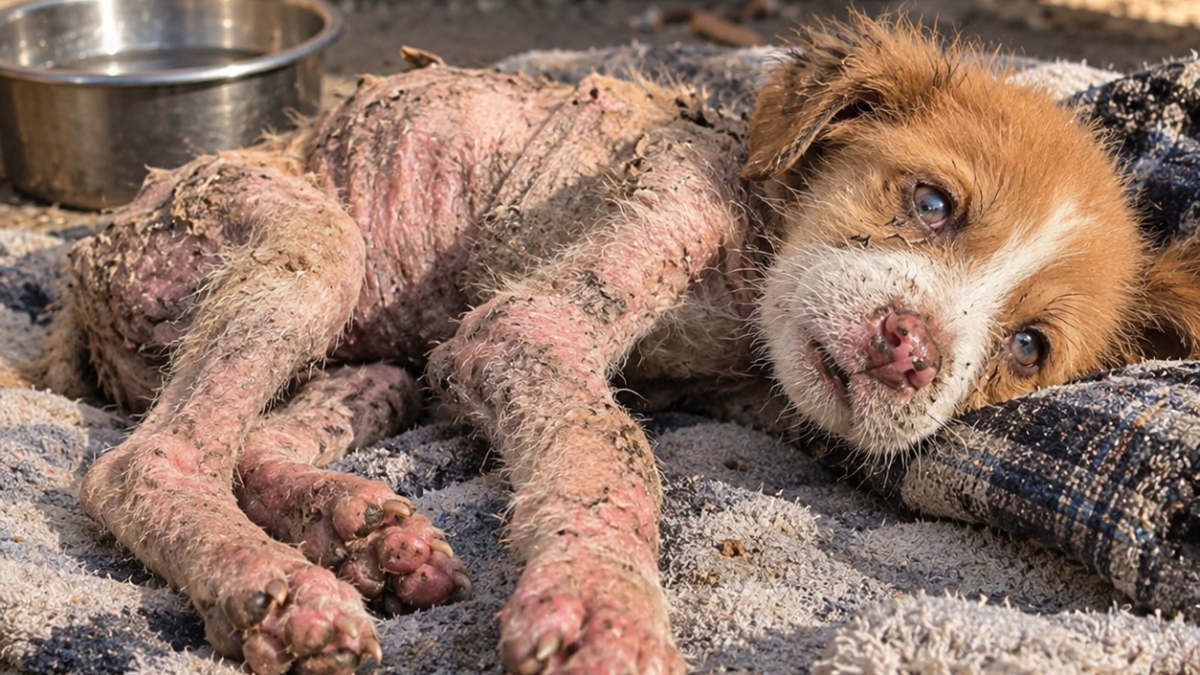
His muzzle was coated with mud.
His ears were flattened against his head.
His body looked impossibly small.
I could see insects moving around the irritated skin along his back and ears, but I forced myself not to focus on that yet.
First we had to get him out.
Luis whispered, “Jesus.”
I knew what he was seeing.
The puppy wasn’t fighting.
That was the worst sign.
Animals with strength often struggle when frightened.
They bark.
They bite.
They claw.
This little dog was doing none of those things.
He was simply waiting.
I looked toward the other volunteers.
“Water.”
Someone handed me a small bottle.
I poured a little into the cap and attached it to a long plastic spoon we had taped to a thin wooden handle.
It looked ridiculous.
It was also the only thing we could fit through the remaining gap.
I slowly pushed it toward him.
“Come on.”
His nose moved.
The spoon touched his mouth.
At first, nothing happened.
Then his tongue appeared.
Once.
Twice.
He drank perhaps two teaspoons.
I pulled it back.
“Not too much,” I said.
A volunteer named Rachel nodded.
“He could aspirate if he’s too weak.”
We gave him a few drops at a time.
Every swallow felt like a victory.
The crane operator waited while engineers and workers studied the remaining concrete.
There were three major slabs around the hole.
The first had been lifted.
The second was partially supported by compacted soil and a rusted metal beam.
The third rested at an angle that made everyone nervous.
If the wrong section shifted, the entire cavity could collapse.
Luis stood and wiped mud from his hands.
“We can’t pull number two straight up.”
“Why?”
“It’s catching under the edge of number three.”
“So what do we do?”
“We dig.”
For the next hour, six grown adults worked on their knees with hand tools because machinery was too risky.
We removed dirt.
Broken stone.
Pieces of old timber.
Twisted wire.
Every few minutes, someone stopped and listened.
No crying.
Just the distant hum of traffic and the scrape of tools.
I kept talking anyway.
“My name’s Daniel,” I told the puppy.
I had no idea why.
Maybe because I needed him to hear a human voice that wasn’t disappearing.
“You don’t know me, but I’m going to be really annoying until you come out of there.”
Rachel smiled faintly.
“You talk to all of them like that?”
“Only the difficult ones.”
Luis looked down.
“This one isn’t difficult.”
“No.”
I lowered my voice.
“He’s just tired.”
Another twenty minutes passed before Luis suddenly raised his hand.
“Stop.”
Everyone froze.
He pointed toward the base of the concrete.
“I can move this piece by hand now.”
Three of us crouched around it.
“Slow,” I said.
We lifted.
It shifted perhaps two inches.
Mud collapsed from underneath.
The puppy made a sound.
A sharp, frightened cry.
Every person stopped instantly.
“There.”
Rachel pointed.
For the first time, I could see one of his front legs.
“Is it caught?”
“No. I think he moved.”
That cry was terrible.
And beautiful.
Because it meant there was still strength inside him.
“Easy, buddy.”
We removed more soil.
The opening widened.
I could now fit my shoulder through.
Luis grabbed my belt.
“Don’t get yourself stuck.”
“Good advice.”
I slid one arm forward.
The puppy was maybe eighteen inches beyond my fingertips.
I stretched.
Nothing.
“Another six inches.”
Luis looked at the slab above me.
“No.”
“I’m close.”
“That’s several thousand pounds over your head.”
I knew he was right.
Frustration burned through me.
The puppy was right there.
Close enough that I could see him breathing.
Too far away to touch.
We pulled back.
Another section had to move.
The crane operator repositioned his machine.
Heavy chains were wrapped around the second slab.
Luis checked them twice.
Then a third time.
The operator leaned from the cab.
“I lift until you tell me stop.”
“Slow as you can.”
The engine deepened.
The chain tightened.
Nothing happened.
Then the concrete shifted.
One inch.
Two.
Dust poured from underneath.
The puppy whimpered.
“Keep going.”
Three inches.
Four.
A gap opened near the ground.
“Stop!”
The concrete hung there.
Nobody moved.
Luis crouched.
“Stable.”
“You sure?”
“No.”
That answer didn’t inspire confidence.
But it was honest.
We slid wooden cribbing blocks under the raised edge to prevent the slab from dropping completely if the crane lost tension.
Then we dug again.
This time, I was able to reach farther.
My fingers touched fur.
The puppy flinched.
“I got him.”
Rachel immediately knelt beside me.
“Don’t pull.”
“I know.”
I slid my hand beneath his chest.
His body was frighteningly cold.
And light.
Far too light.
“Hey.”
He tried to move away.
There was nowhere to go.
“It’s okay.”
His head turned.
For one brief second, his eyes met mine.
I have worked around animals long enough to know we sometimes project human emotions onto them.
We see fear and call it betrayal.
We see stillness and call it sadness.
We see attachment and call it gratitude.
But I don’t need a human word for what I saw in that puppy’s eyes.
I only know that he was exhausted.
Terrified.
And still trying to remain alive.
I felt along his body as carefully as I could.
His hind legs were not pinned.
But mud had packed tightly around him.
“He’s stuck in suction.”
Luis understood immediately.
Wet clay can hold an animal almost like glue.
If I simply pulled, I could injure him.
“Water?”
Rachel asked.
“Maybe.”
We used small amounts of clean water to loosen the mud around his body while I worked my fingers beneath him.
Slowly.
Very slowly.
The puppy began moving.
Half an inch.
Then another.
“Come on.”
His front paws scraped weakly against my glove.
“That’s it.”
Luis held my ankles now because half my upper body was inside the cavity.
“You have him?”
“Almost.”
The mud released suddenly.
The puppy slid forward.
I caught him against my chest.
“Got him!”
The people behind me shouted.
Luis pulled me backward.
I came out of that hole covered in mud, holding a tiny trembling dog against my shirt.
For a second, nobody celebrated.
Because seeing him fully was worse than seeing him in the darkness.
He was little more than a puppy.
Maybe ten or twelve weeks old.
His ribs were visible beneath his wet coat.
His skin was irritated in several places from moisture, insects, and prolonged exposure.
His paws were swollen.
He smelled like stagnant water and mud.
And the moment the open air touched him, his body seemed to give up whatever strength had kept him alive underground.
He collapsed in my arms.
“Blanket!”
Rachel already had one.
We wrapped him immediately.
His entire body shook.
Not little tremors.
Violent shivering.
“Temperature’s low.”
“We need to move.”
I carried him toward the vehicle.
Someone brought water.
“No,” Rachel said. “Small amounts only.”
The puppy lifted his head weakly when the bottle cap touched his mouth.
He drank.
Then his head dropped again.
One of the workers stood nearby, his face pale.
“That little thing was under there four days?”
“That’s what we were told.”
He looked back at the concrete.
“How?”
I understood the question.
How did he survive?
I had no answer.
Sometimes animals die from injuries that look survivable.
Sometimes they endure things no body should withstand.
Survival isn’t always logical.
We placed the puppy in a plastic crate lined with warm towels.
I sat beside him during the drive to the veterinary clinic.
Rachel drove.
Every few minutes I touched two fingers gently against his side.
Breathing.
Still breathing.
At one red light, Rachel looked over.
“You naming him?”
“Absolutely not.”
“You always say that.”
“We don’t know if he has an owner.”
“He spent four days under concrete.”
“That doesn’t mean he was abandoned.”
She glanced back.
“What would you call him?”
“I’m not calling him anything.”
The puppy made a tiny sound.
Rachel smiled.
“Sounds like he disagrees.”
I looked down.
“All right, little man. You get through today, and then we negotiate names.”
His eyes stayed closed.
At the clinic, Dr. Sarah Bennett met us at the side entrance.
She had treated enough animals from our rescue calls that she stopped asking what strange situation we had brought her.
She took one look at the puppy.
“Treatment room two.”
We moved fast.
The blanket came off.
A technician checked his temperature.
Sarah frowned.
“Hypothermic.”
Another technician started preparing warmed fluids.
Sarah examined his gums.
“Dehydrated. Anemic-looking.”
She listened to his chest.
“How long submerged?”
“Not submerged completely. He had his head above water. Reportedly four days.”
Her eyes lifted.
“Four?”
“Yes.”
“That’s a long time.”
“I know.”
She checked his paws, abdomen, mouth, ears, and skin.
The irritated areas were cleaned carefully.
The insects were removed.
Wounds were flushed.
I stayed near his head.
His eyes opened once when antiseptic touched a sore area.
“I know.”
He tried to pull away.
“Sorry, buddy.”
Sarah looked at me.
“He’s responding. That’s good.”
“What are you worried about?”
“Everything.”
Not the answer I wanted.
She continued.
“Exposure. Infection. Dehydration. Parasites. Aspiration. Tissue damage. We need bloodwork, fecal testing, infectious disease screening, probably radiographs if he can tolerate them.”
“Do it.”
One of the technicians looked at me.
“Rescue covering?”
“Yes.”
I said it before checking our account balance.
Rachel gave me a look.
“We’ll figure it out.”
That was something animal rescuers say frequently.
Usually it means we have absolutely no idea how we’re going to pay for something but have already decided the animal will receive it.
The first fluids went in slowly.
Warm blankets surrounded him.
A heating pad was placed beneath half the bedding so he could be moved away from the heat if necessary.
Sarah was careful.
Rapid warming can create its own problems in severely chilled animals.
Everything had to happen gradually.
After forty minutes, his shaking became less violent.
That frightened me until Sarah explained.
“Temperature is coming up.”
“Not because he’s crashing?”
“No. Right now his heart rate looks better.”
Right now.
I hated those words.
But in rescue, right now is sometimes all you get.
We waited for blood results.
I walked outside.
The sun was bright.
Cars passed.
Somebody across the street was eating lunch at a picnic table.
Normal life.
I looked down at my clothes.
Mud covered my jeans from hip to ankle.
There was dried blood from a scratch on my forearm.
My shirt smelled terrible.
I had never felt less interested in any of that.
My phone rang.
Luis.
“How is he?”
“Alive.”
“That good?”
“For now.”
There was silence.
Then he said, “You know what bothers me?”
“What?”
“We work near that site every day.”
I leaned against the wall.
“Okay.”
“Nobody knew there was an open drainage gap under those slabs.”
“You think that’s how he got in?”
“I think he fell through from the back side. There’s a broken section of temporary fencing.”
“You saw it?”
“After you left.”
My jaw tightened.
“Could a person fit through?”
“A kid could.”
That changed the conversation immediately.
“This needs to be reported.”
“Already told the supervisor.”
“What did he say?”
“He told me they’d fix it.”
“Fixing it now doesn’t explain why it was open.”
Luis sighed.
“I know.”
I didn’t want to turn the puppy’s rescue into a hunt for someone to blame.
Accidents happen.
Construction sites are dangerous.
Animals slip through gaps.
But four days of crying raised another question.
If people had heard him earlier, why had the response taken so long?
I asked Luis.
He hesitated.
“Somebody told the property manager two days ago.”
“And?”
“He thought the noise was wildlife.”
“Did anyone check?”
“I don’t know.”
I closed my eyes.
That angered me more than the broken fencing.
Not because every mysterious sound requires a major rescue operation.
But because something had been crying beneath concrete for days.
A ten-minute inspection might have changed everything.
“Can you send me pictures of the opening and fencing?”
“Yeah.”
“And names of whoever reported hearing him.”
“Why?”
“Because after he’s stable, I want to know what happened.”
Luis understood.
“I’ll send everything.”
I returned inside.
The puppy was sleeping.
Sarah stood over a computer.
“Some good news.”
I moved closer.
“Tell me.”
“Parvo negative. Distemper screening negative. No obvious major fractures on the images we were able to get.”
I exhaled.
“And the bad?”
“His red blood cell count is low. He’s dehydrated, obviously. There’s skin damage and a significant parasite burden. We need to monitor kidney values and watch for infection.”
“Will he make it?”
Sarah looked at the puppy.
“I think he has a chance.”
A chance.
I would take it.
“What can I do?”
“Right now? Let us work.”
So I sat.
Rescue is strange that way.
Hours of frantic action.
Then helpless waiting.
I sat in a plastic chair outside the treatment room for almost three hours.
Rachel brought coffee.
I forgot to drink it.
At some point, she said, “He needs a name in the chart.”
“Put Puppy.”
“They already have three Puppies today.”
I looked through the glass.
A technician had tucked a small blue blanket around him.
“What about Milo?”
Rachel considered it.
“Why Milo?”
“No idea.”
She smiled.
“Milo it is.”
The name stayed.
By evening, Milo’s temperature had reached a safer range.
He had taken a small amount of recovery food from a syringe.
He was still too weak to stand.
Sarah wanted him hospitalized overnight.
I agreed.
Before leaving, I approached the kennel.
Milo opened his eyes.
“Hey.”
His head stayed down.
“You did your part today.”
One ear twitched.
“Now you let them do theirs.”
I touched the blanket near his paw instead of touching him directly.
“I’ll come back tomorrow.”
That sentence felt important.
I didn’t know why yet.
Maybe because after four days of being heard and not reached, Milo deserved people who returned when they said they would.
The next morning, I was at the clinic before eight.
Sarah saw me and shook her head.
“You people ever sleep?”
“Did he?”
“Some.”
“That’s enough.”
She led me back.
Milo was awake.
Not standing.
But awake.
His eyes followed me as I approached.
“Morning.”
His tail moved.
Barely.
One tiny tap against the blanket.
Sarah saw it too.
“Well, look at that.”
I crouched.
“You remember me?”
Another tail movement.
I felt something tighten behind my ribs.
“He ate overnight,” Sarah said. “Not much, but voluntarily.”
“That’s good.”
“Very.”
“Can he stand?”
“Not yet.”
My excitement faded.
“Should he be able to?”
“After what he’s been through, weakness isn’t surprising. His muscles have been cold and cramped. His paws are sore. Give him time.”
Time.
For four days, time had been Milo’s enemy.
Now it became part of his treatment.
The first forty-eight hours were slow.
He slept.
Ate small meals.
Received fluids and medication.
His wounds were cleaned.
The damaged skin was treated.
By the second afternoon, he could hold himself upright on his chest.
By the third morning, he tried to stand.
His front legs straightened.
His hindquarters rose halfway.
Then he collapsed.
I reached automatically.
Sarah stopped me.
“Let him try.”
Milo looked offended.
He tried again.
One second.
Two.
Then down.
“That’s enough,” she said.
But Milo disagreed.
He pushed again.
This time all four paws touched the floor.
His legs trembled.
His body swayed.
I held my breath.
Three seconds.
Four.
Five.
Then he sat heavily.
Sarah smiled.
“There you go.”
I crouched outside the kennel.
“Show-off.”
His tail moved.
That afternoon I received the photographs from Luis.
The broken temporary fence was worse than I expected.
One panel had been bent backward, creating a gap near the drainage area.
Behind it, weeds hid the narrow opening between the concrete sections.
Anyone walking casually past could miss it.
A small puppy following food, scent, or another animal could easily slip through.
I also received messages from two nearby residents.
One woman named Maria wrote that she first heard crying Monday evening.
She assumed it was a kitten.
Tuesday morning, she heard it again and told a security worker.
He reportedly said he would check.
Tuesday night, the crying continued.
Wednesday, another resident called the property office.
Nothing changed.
By Thursday, several people were searching themselves.
Friday morning, Milo was finally located.
That timeline stayed with me.
Not because every individual had done something wrong.
Maria had reported what she heard.
The residents who searched had tried.
The workers who helped us risked themselves to get Milo out.
But somewhere between the first warning and the final rescue, responsibility had dissolved into assumptions.
Someone else will check.
It’s probably nothing.
Maybe the sound will stop.
It did stop eventually.
Milo had become too weak to cry.
That fact bothered me deeply.
I called the local animal control office and reported the situation, not as an accusation of intentional cruelty but as a safety and welfare concern.
I also contacted the municipal building department regarding the unsecured area.
The next day, fencing crews arrived.
The drainage opening was covered.
Warning barriers were installed.
The stacked concrete was reorganized.
It would have been easy to feel satisfied.
I didn’t.
Milo had already paid for the delay.
Three days after his rescue, the property management company contacted me.
A man named Richard Blake asked whether we could “clarify online” that the site had not deliberately endangered the puppy.
“We haven’t accused anyone of deliberately doing anything,” I said.
“There are posts circulating.”
“I don’t control other people’s posts.”
“They’re saying management ignored reports.”
“Were reports made?”
A pause.
“We’re reviewing the timeline.”
“That sounds like something you should complete before asking me to clarify it.”
His tone hardened slightly.
“We’re concerned about reputational damage.”
I looked through the clinic window.
Milo was taking four shaky steps toward a technician holding food.
“I’m concerned about why an animal cried under your property for four days.”
“That’s not a fair characterization.”
“Then give me the accurate one.”
Silence.
Finally he said, “The first report may not have clearly indicated an animal was trapped.”
“The second?”
“We’re still reviewing.”
“And the third?”
Another pause.
“We’re improving procedures.”
“That’s good.”
“We would appreciate avoiding inflammatory language.”
“So would I.”
He seemed relieved.
Then I continued.
“That’s why I’m sticking to the timeline.”
He didn’t like that.
But the conversation ended without shouting.
I didn’t need shouting.
I needed the gap closed.
I needed future reports taken seriously.
And I needed nobody to pretend Milo’s four days underground had simply happened without missed opportunities.
By day four in the clinic, Milo walked six steps.
On the seventh, he walked across the treatment room.
His gait was awkward.
His paws were still tender.
But he walked.
Rachel recorded the moment.
I was sitting on the floor several feet away.
Sarah placed Milo down.
He stood.
Looked at me.
And came forward.
One trembling step.
Then another.
Then another.
Halfway across, his back legs nearly gave out.
He stopped.
I resisted every instinct to reach.
“Come on.”
He looked at me.
“You’ve done harder things than this.”
One more step.
Then another.
When he reached me, he put both front paws against my knee and leaned his entire tiny body forward.
I picked him up.
“All right.”
He tucked his face beneath my chin.
“You win.”
Sarah laughed.
“You said you weren’t naming him.”
“I also said I wasn’t adopting him.”
Rachel looked over.
“You said that?”
“I’m saying it now.”
Milo licked my neck.
Rachel raised an eyebrow.
“Convincing.”
I had fostered enough animals to know the danger.
You tell yourself they are temporary.
Then they sleep on your chest.
Then they learn your schedule.
Then one day you realize you are discussing what kind of food they prefer as if they have signed a lease.
Still, Milo wasn’t ready to leave the clinic yet.
He needed several more days of monitoring.
His appetite improved.
His blood values slowly moved in the right direction.
His skin began healing.
And his personality started appearing.
That was perhaps the most beautiful part.
The puppy from the hole had been silent because survival left no energy for personality.
Once he felt better, we met Milo.
Milo hated thermometers.
Milo loved chicken.
Milo believed shoelaces were enemies.
Milo attempted to bite the corner of every blanket placed near him.
Milo barked at his reflection, then hid behind me when the “other puppy” barked back.
The first time he wagged his whole body instead of only his tail, Sarah clapped.
“Trouble,” she said.
“Definitely.”
“That’s a healthy puppy.”
Exactly.
I had never been so happy to see trouble.
A week after rescue, Milo was cleared for foster care.
I took him home.
The drive was twenty minutes.
He cried for the first three.
Then he curled inside a towel on the passenger seat and slept.
My house had seen many foster animals.
I had crates.
Baby gates.
Washable blankets.
Bowls in multiple sizes.
A collection of toys that made my living room look like the aftermath of a pet-store explosion.
Still, bringing Milo inside felt different.
I set him on the floor.
He froze.
His nose moved.
Kitchen.
Couch.
Rug.
Door.
Me.
He took one step.
Then another.
He walked toward the water bowl and drank.
After that he discovered a plush duck.
He stared at it.
The duck squeaked when he stepped on it.
Milo jumped backward.
Then attacked it.
I laughed.
There it was.
Life returning in real time.
That first night, I placed his crate beside my bed.
At two in the morning, he cried.
Not the weak moans from the hole.
A puppy cry.
Sharp.
Demanding.
Offended.
I reached down.
“You need to go outside?”
More crying.
I took him out.
He peed.
Then attempted to chase a moth.
“Excellent priorities.”
Back inside, he refused the crate.
He cried again.
I sat on the floor beside it.
His face pressed against the door.
For a moment, the sound brought me back to the concrete site.
Dark opening.
Mud.
Those exhausted eyes.
I opened the crate.
Milo climbed directly into my lap.
“You’re training me badly.”
He fell asleep.
I remained on the floor for almost an hour.
Over the next weeks, Milo gained weight.
His coat changed from dull and rough to soft and glossy.
The irritated areas healed.
His paws stopped hurting.
His energy became ridiculous.
This puppy who had once been unable to stand began racing through my hallway as though personally offended by gravity.
He chased tennis balls.
He wrestled towels.
He dragged one of my slippers into the yard.
He discovered that the refrigerator sometimes produced cheese and began appearing whenever the door opened.
But certain things remained.
Running water frightened him.
The first time I filled the bathtub while he was nearby, he panicked.
His body dropped to the floor.
He scrambled backward.
I shut the faucet immediately.
“Okay.”
He pressed against the wall.
“No bath.”
I sat several feet away.
“You’re safe.”
It took weeks before he would enter the bathroom voluntarily.
Even puddles made him hesitate.
When rain collected near the curb, Milo stopped and stared.
I never pulled him through.
We walked around.
People sometimes think recovery means forgetting.
It doesn’t.
Healing often means learning that the thing that once hurt you does not control every future moment.
So we gave Milo choices.
Small ones.
Walk left or right.
Sleep on the bed or rug.
Approach water or step away.
Meet a stranger or stay behind me.
Every choice built confidence.
Meanwhile, the investigation into the construction site continued.
Animal control found no evidence that anyone had intentionally trapped Milo.
That was important.
I never wanted a villain invented where there wasn’t one.
But the municipal inspection documented inadequate site barriers and an unsecured drainage hazard.
The property manager was ordered to correct several issues.
More importantly, the company instituted a written process requiring security staff to investigate reports of trapped or distressed animals on the property rather than simply forwarding complaints.
Was it dramatic punishment?
No.
Nobody went to jail.
Nobody stood before a judge.
But I had learned something from rescue work.
Accountability is most useful when it prevents the next suffering.
Richard Blake called me again after the inspection report.
His voice was different this time.
Less defensive.
“I wanted to update you.”
“I received the report.”
“We replaced all temporary fencing.”
“I saw.”
“We also changed our overnight reporting policy.”
“That’s good.”
There was a pause.
“How is the dog?”
That surprised me.
“Milo?”
“That’s his name?”
“Yes.”
“How is he?”
“He’s currently trying to destroy a cardboard box in my kitchen.”
Richard laughed softly.
“That sounds promising.”
“It is.”
Another silence.
Then he said, “We should have checked sooner.”
I didn’t answer immediately.
He continued.
“I read the reports. Someone should have gone down there Monday night.”
“Yes.”
“I was focused on whether anyone had technically violated procedure.”
I waited.
“That wasn’t the point.”
“No.”
He sighed.
“I’m sorry.”
There was no audience.
No camera.
No public humiliation.
Just a man admitting a failure.
It mattered.
“Thank you.”
“I’d like to cover his veterinary costs.”
I had not expected that.
“The company?”
“Yes.”
“Why?”
“Because regardless of how he got onto the site, we had opportunities to respond sooner.”
I looked toward Milo.
He had succeeded in tearing a cardboard box into approximately forty pieces and looked extremely proud.
“That would help.”
“Send the invoices.”
So I did.
The payment covered Milo’s treatment and left enough that our rescue was able to help two other animals that month.
That was the kind of ending I preferred.
Not revenge that created another victim.
Responsibility that created something useful.
Milo’s transformation continued.
At six weeks after rescue, Sarah examined him and smiled.
“Weight looks good.”
“Bloodwork?”
“Normal.”
“Skin?”
“Healed.”
She checked his paws.
“Good.”
I looked at him sitting on the examination table.
“Anything else?”
“Yes.”
My stomach tightened.
“What?”
“He’s spoiled.”
I stared at her.
“That’s not medical.”
“Severe case.”
Milo licked her stethoscope.
“Prognosis?”
“Permanent.”
I laughed.
When we walked outside, Milo stopped in the sunlight.
For a moment, he stood completely still.
Then a bird landed near the parking lot.
Milo exploded into motion.
I nearly lost the leash.
“Hey!”
He bounced after it.
The bird flew away.
Milo looked personally betrayed.
Six weeks earlier, I had carried him from darkness because he couldn’t stand.
Now he was trying to chase the sky.
I sat on the curb.
Milo climbed against my leg.
“Good problem to have.”
That evening, I received a message from Maria, the woman who had first reported hearing him.
She asked if she could meet Milo.
I invited her over.
When she arrived, she stood on my porch holding a small bag of treats.
The moment she saw him, she covered her mouth.
“Oh.”
Milo approached cautiously.
She crouched.
“That’s him?”
“That’s him.”
Her eyes filled.
“I heard him that first night.”
I knew.
“I thought somebody else would check.”
She looked ashamed.
“I told security. Then I went home.”
“You reported it.”
“But I heard him again later.”
I didn’t say anything.
“I should have gone back.”
“Maybe.”
She looked at me.
I continued gently.
“But you can’t change Monday.”
She wiped her face.
“No.”
“What you can change is what you do next time.”
Milo sniffed her hand.
Then took the treat.
Maria laughed through tears.
“He’s so small.”
“Not in personality.”
Milo put his front paws on her knee.
She stroked his ears.
“I’m sorry, little guy.”
He took another treat.
Forgiveness apparently came cheaply when chicken was involved.
Maria began volunteering with us two months later.
Not because I asked.
She said hearing Milo had changed how she thought about distress.
“If something sounds wrong,” she told me, “I don’t assume someone else will handle it anymore.”
That stayed with me.
The same happened to Luis.
He persuaded his employer to add daily hazard checks for animals at active work sites.
Workers began checking drainage areas, open pipes, pits, storage containers, and fencing at the start and end of every shift.
One supervisor joked that they had become “animal detectives.”
Luis didn’t laugh.
“Better than another Milo.”
Exactly.
Milo had no idea any of this was happening.
His concerns were simpler.
Breakfast.
Socks.
Leaves.
Squirrels.
Whether my lap was available.
Whether every visitor had brought him something.
At three months after rescue, I took him back near the construction site.
Not inside.
Just along the public sidewalk across the road.
I wanted to know how he would react.
The concrete had been reorganized.
New fencing stood around the drainage area.
Bright barriers marked the hazards.
Milo walked beside me.
Then he stopped.
His ears lowered.
He stared across the road.
I don’t know what dogs remember in images, scents, or sensations.
Maybe he recognized the smell.
Maybe the machinery.
Maybe nothing at all.
His body leaned backward.
I crouched.
“We don’t have to go closer.”
He looked at me.
Then at the site.
Then back at me.
I offered my hand.
He stepped toward me.
We turned around.
That was enough.
Healing did not require him to prove he could stand beside the place that almost killed him.
He had already proven enough.
By then, people had begun asking whether Milo was available for adoption.
Technically, he was.
Emotionally, I was becoming dishonest with myself.
Rachel noticed first.
“You’ve rejected three applications.”
“They weren’t right.”
“The couple with the fenced yard?”
“They travel.”
“They work from home.”
“They travel twice a year.”
“With their dogs.”
“Exactly.”
She stared at me.
“What?”
“You’re keeping him.”
“I foster.”
“You foster-failed.”
“I have standards.”
“You bought him a personalized collar.”
“That proves nothing.”
“It says MILO on it.”
“For identification.”
“And underneath?”
I knew what she meant.
The small metal tag read:
HOME WITH DANIEL.
Rachel crossed her arms.
“You’re ridiculous.”
Milo walked into the room carrying one of my shoes.
“Give me that.”
He ran.
Rachel smiled.
“Congratulations on your dog.”
Three days later, I signed the adoption papers.
I had rescued hundreds of animals without keeping them.
Why Milo?
I could give complicated answers.
Maybe because I had been the first person to touch him after four days alone.
Maybe because his cries stayed with me.
Maybe because I had watched every small piece of him return.
Or maybe there doesn’t always need to be a grand reason.
Sometimes an animal simply becomes part of the map of your life before you realize the route has changed.
Milo became my dog.
A year passed.
If someone met him then, they would never have guessed how his life began.
He grew into a medium-sized mixed-breed dog with tan fur, white paws, and ears that never agreed on which direction to point.
He loved people.
He loved dogs.
He hated baths.
He tolerated rain.
He still refused to walk through deep puddles.
I never made him.
Every anniversary of his rescue, I took him somewhere open.
A field.
A beach.
A wooded trail.
Somewhere with sky above him and no concrete overhead.
On the first anniversary, we went to a large meadow.
I unclipped his long training line.
Milo ran.
Not desperately.
Not away from anything.
Just because he could.
He crossed the grass, turned, and came flying back toward me.
I crouched.
He hit me full force.
We both went down.
“You’re supposed to slow down!”
He licked my face.
I laughed.
Then, unexpectedly, I cried.
For four days, this animal had lived in a space where he couldn’t turn around.
Now there was more space around him than he knew what to do with.
That felt like justice.
The construction company sent a small donation to our rescue on the anniversary.
No press release.
No logo.
Just a check and a note.
FOR ANIMALS WHO NEED SOMEONE TO CHECK.
I kept the note.
Years passed.
Milo became known around our rescue network.
Not because he performed miracles.
Because his story changed procedure.
When volunteers received reports of unidentified crying from drains, buildings, abandoned lots, or construction areas, nobody dismissed them.
We verified.
We listened.
We followed up.
Once, the sound was a raccoon.
Another time, kittens.
Once, it turned out to be a squeaking machine belt.
Nobody complained about wasted time.
Because sometimes the difference between an unnecessary inspection and a rescue is simply whether something is actually alive on the other side.
Milo sometimes came with me on safe outreach visits.
He loved meeting crews.
Luis became one of his favorite people.
Every time they saw each other, Luis crouched and said the same thing.
“You cost us a crane.”
Milo wagged.
“Do you know what cranes cost?”
More wagging.
“You don’t care.”
Milo jumped onto him.
Luis laughed.
“No. Of course you don’t.”
On the third anniversary, I returned to the original site with Milo for an organized safety event.
The place looked completely different.
Landscaping had replaced the weeds.
Drainage openings were secured.
Concrete storage areas were fenced.
Signs instructed workers to report trapped animals or wildlife immediately.
Richard Blake was there.
He knelt when Milo approached.
“This is him?”
“You’ve seen photos.”
“Photos don’t show how energetic he is.”
Milo attempted to steal Richard’s glove.
I smiled.
“He’s toned it down.”
Richard looked at me.
“You’re joking.”
“A little.”
He scratched Milo’s neck.
“I still think about that week.”
“So do I.”
“If we had checked the first night…”
I knew where that sentence was going.
“You can’t live there forever.”
He looked at me.
“That’s what you told Maria.”
“She tells everybody everything.”
He laughed.
Then became serious.
“We changed things.”
“I know.”
“Does that count?”
“Yes.”
Not as erasure.
Not as absolution.
But as responsibility.
It counted.
That afternoon, several workers gathered while I talked about confined-space animal rescue.
I showed them how to avoid entering unstable voids.
How to call emergency services or trained responders.
How to observe without shifting debris.
How to provide information about sound location, access, water, and hazards.
Milo slept beneath the table during most of it.
The dog whose rescue had required a crane had become the reason other people learned how not to need one.
Afterward, a young worker approached me.
“My kid asked why we’re doing all this for animals.”
“What did you tell him?”
“That if something’s trapped and scared, you don’t decide its life matters less because it’s small.”
I looked down at Milo.
“That’s a pretty good answer.”
Milo lived like a dog who had no interest in wasting time.
He dug holes.
He stole food.
He once escaped a perfectly secure yard because apparently “perfectly secure” had not included the six-inch space beneath a loose gate.
When I found him, he was sitting on my neighbor’s porch being fed turkey.
“Traitor.”
He wagged.
My neighbor laughed.
“He seemed hungry.”
“He ate twenty minutes ago.”
Milo accepted another piece of turkey.
“He says otherwise.”
At home, he slept pressed against my legs.
If I shifted, he shifted.
If I got up, he followed.
Some people might call that clingy.
I called it Milo.
At night, when storms came, he sometimes woke.
Heavy rain on the roof made him restless.
He would pace.
I never knew whether it reminded him of water collecting around his body underground.
I would sit on the floor.
He would eventually lie beside me.
Not every scar can be seen.
Not every old fear disappears simply because the present is safe.
But fear changes when it no longer has to be carried alone.
One especially violent summer storm knocked out power.
Thunder shook the windows.
Milo climbed halfway into my lap.
“You are forty pounds now.”
He tried to climb farther.
“You understand you’re not a puppy?”
He did not care.
I wrapped a blanket around him.
We sat together until the storm passed.
When the rain finally stopped, Milo walked to the back door.
I opened it.
The yard was wet.
Puddles reflected the porch light.
Years earlier, Milo would have refused to step outside.
That night he hesitated.
Then placed one paw in the wet grass.
Another.
He walked to the edge of a puddle.
Stopped.
Looked back at me.
“You don’t have to.”
He looked down.
Then stepped through it.
Only one step.
Then another.
He crossed.
I stood in the doorway smiling like an idiot.
Milo turned and wagged his tail.
People imagine healing as a straight line.
It isn’t.
Sometimes healing is a forty-pound dog deciding at midnight that water beneath his feet no longer means he is trapped.
On the fifth anniversary of Milo’s rescue, Maria organized a small fundraiser.
She wanted to raise money for emergency animal extraction equipment—cameras, ropes, protective gloves, portable lighting, and medical supplies.
We gathered at a park.
Luis came.
Rachel came.
Sarah came.
Richard came.
Several workers from the original site attended.
Milo wore a blue bandanna and spent most of the afternoon attempting to convince strangers he had never been fed.
At one point, Maria stood beside me watching him charm a family out of half a hot dog.
“You know what I remember most?”
“What?”
“The sound.”
I knew immediately.
“Me too.”
“I still hear it sometimes.”
“So do I.”
She looked across the park.
“Do you ever get angry?”
“Yes.”
“At us?”
“Sometimes.”
She nodded.
“That’s fair.”
“But anger changed.”
“How?”
I thought about it.
“At first, I wanted to know whose fault those four days were.”
“And now?”
“Now I care more about whether the next animal waits four days.”
Maria watched Milo.
“That sounds healthier.”
“Probably.”
She smiled.
“Boring, though.”
“Extremely.”
But there was truth in it.
Revenge would have been simple.
Find someone.
Blame them.
Humiliate them.
Make them hurt because Milo hurt.
But suffering doesn’t reverse suffering.
The only revenge against neglect that ever satisfied me was attention.
More people listening.
More people checking.
More people refusing to assume someone else would help.
Milo’s nightmare became procedures.
Training.
Fencing.
Equipment.
Volunteer shifts.
Emergency phone numbers.
It became people moving sooner.
That mattered more than anger.
One winter, almost seven years after Milo’s rescue, Luis called me.
His voice was excited.
“You’re not going to believe this.”
“What happened?”
“Another dog.”
My chest tightened.
“Where?”
“Different site. Storm culvert.”
“Trapped?”
“Yeah, but listen—we heard it this morning. Crew stopped work. Called animal control immediately. Used a camera. Dog was out in forty minutes.”
I sat down.
“Alive?”
“Totally fine. Wet and furious.”
I laughed.
Luis did too.
“We didn’t need a crane.”
“Congratulations.”
“You know why everybody moved so fast?”
I already knew.
“One of the old guys said, ‘Remember Milo.’”
I looked across my living room.
Milo was asleep in a patch of sunlight.
White fur had begun appearing around his muzzle.
“That’s good.”
“No,” Luis said. “That’s really good.”
He was right.
After we hung up, I sat beside Milo.
He opened one eye.
“You did something today.”
Tail thump.
“You slept through it.”
Another thump.
“A dog got out because people remembered you.”
Milo yawned.
I scratched behind his ear.
“You’re impossible to impress.”
As he aged, Milo changed slowly.
His sprint became a jog.
His jumps onto the couch became calculated climbs.
His face grew silver.
He still hated baths.
Some convictions survive age.
At ten, he developed arthritis.
At eleven, his hearing softened.
At twelve, he sometimes stood at the wrong side of the door waiting to be let in.
But he remained Milo.
Food thief.
Sock collector.
Storm worrier.
Professional lap dog.
On warm afternoons, he slept in the yard.
Always in the open.
Never beneath furniture.
Never inside enclosed spaces if he could choose otherwise.
I wondered if that was coincidence.
Maybe.
I stopped needing to know.
One afternoon, Sarah examined him and smiled sadly.
“He’s old.”
“Take it back.”
“He’s twelve.”
“Fake news.”
“Daniel.”
“I reject the diagnosis.”
She laughed.
Milo rested his head against my arm.
His heart was still strong.
His bloodwork was respectable for his age.
But time was doing what time does.
I drove home more slowly than usual.
At a red light, I remembered carrying him in a blanket.
Tiny.
Cold.
Unable to stand.
I looked in the mirror.
Old Milo was asleep across the back seat.
Twelve years.
Nobody looking into that concrete hole would have dared imagine twelve years.
I reached back at the next stop and touched his paw.
“Not bad, little man.”
His eyes opened.
Tail thump.
When Milo was thirteen, we returned to the meadow where I had taken him after his recovery.
I brought a long line but barely needed it.
He no longer ran far.
The grass moved in the wind.
Milo walked slowly beside me.
At the center of the field, I sat.
He lay down.
For a while we watched clouds.
There was nothing dramatic about it.
That was exactly why I loved it.
Rescue stories are often told around the emergency.
The hole.
The crane.
The clinic.
The impossible survival.
But the real victory was never one spectacular day.
It was thirteen ordinary years.
Thirteen years of breakfast.
Vet visits.
Destroyed toys.
Rainstorms.
Car rides.
Naps.
Bad breath.
Muddy footprints.
Birthday treats.
Arguments about furniture.
Walks that grew shorter.
Mornings that began with his nose against my hand.
That was what we rescued him for.
Not to become a symbol.
To become ordinary.
At fourteen, Milo began having difficult days.
He slept more.
Sometimes his back legs trembled after standing.
Medication helped.
Ramps helped.
Rugs helped.
I adjusted everything.
I had once moved concrete to reach him.
Moving furniture seemed easy.
Then came a morning when Milo didn’t want breakfast.
I knew.
People who live with animals long enough learn the difference between a skipped meal and a message.
I called Sarah.
We went in.
Tests followed.
She sat beside me afterward.
There were problems we could treat.
And one we could not.
Cancer.
Advanced.
Quiet.
The kind that grows while life continues around it.
“How long?”
“I don’t know.”
“Days?”
“Could be weeks.”
“Months?”
“Maybe, but I wouldn’t promise it.”
I looked at Milo.
He was lying on a blanket, eyes closed.
Four days beneath concrete.
Fourteen years above it.
It still wasn’t enough.
I took him home.
For the next three weeks, Milo received everything he loved.
Chicken.
Sunlight.
Slow walks.
Car rides with the windows cracked just enough for him to smell the air.
Luis visited.
Milo remembered him.
Of course he did.
Luis sat on my floor.
“You cost me a crane.”
Milo’s tail moved.
Luis laughed, then cried.
“You old thief.”
Maria came next.
She brought chicken.
“You remember me?”
Milo took the chicken.
“That’s a yes.”
Rachel lay beside him.
Sarah stopped by outside work.
Richard mailed a note.
I read it aloud.
“Because of you, we learned to listen sooner.”
Milo was sleeping.
He didn’t hear.
That was okay.
The lesson was never his responsibility.
It was ours.
On his final morning, rain fell gently outside.
For a moment I hated that.
Water had surrounded the beginning of his story.
I didn’t want rain at the end.
Then I opened the back door.
The sound was soft.
Milo lifted his head.
I helped him stand.
He walked onto the covered porch.
He smelled the air.
The yard was shining.
A shallow puddle sat beside the steps.
Years ago, Milo would have backed away.
He stepped down.
Slowly.
Carefully.
One paw entered the water.
Then another.
He crossed the puddle.
Walked into the grass.
And stood in the rain.
I followed.
He looked at me.
I knelt.
“You’re not scared anymore?”
His tail moved once.
Maybe that meant nothing.
Maybe it meant everything.
I sat in the wet grass beside him.
Milo leaned against my leg.
Fourteen years earlier, I had reached into darkness and felt a tiny body trapped in mud.
Now the same dog stood beneath an open sky.
Nothing above him.
Nothing holding him.
No concrete.
No walls.
No hole.
Just rain.
Grass.
Air.
And me.
When the time came later that day, Sarah came to the house.
Milo lay on his favorite blanket near the patio doors.
The rain had stopped.
Sunlight had broken through the clouds.
I sat beside him.
My hand rested on his chest.
His breathing was slow.
“Remember our deal?”
His eyes opened slightly.
“You got through that first day.”
I swallowed.
“And I said we’d negotiate names.”
Tail movement.
“You won.”
I laughed through tears.
“You won everything.”
I pressed my forehead against his.
“You were supposed to be one rescue.”
My voice broke.
“You turned into fourteen years.”
Sarah gave me all the time I needed.
Finally, Milo rested his head against my arm.
Exactly as he had done when he first learned I was safe.
I whispered the last words he heard from me.
“You’re not trapped anymore.”
And then he was gone.
For weeks, I hated the silence.
No paws.
No tags.
No scratching at the bedroom door.
No dramatic demands for breakfast.
No suspicious absence followed by the discovery of a stolen shoe.
My house had space everywhere.
Too much space.
I returned to rescue work because I didn’t know what else to do.
The first call came nine days after Milo died.
A kitten was trapped behind a retaining wall.
I almost told another volunteer to handle it.
Then I heard Milo in my memory.
Not barking.
That faint little moan from beneath the concrete.
I grabbed my equipment.
We found the kitten in twenty minutes.
She was frightened but healthy.
When I handed her to her owner, the woman cried.
“Thank you for coming so fast.”
I looked at the wall.
“Someone taught me not to wait.”
A year after Milo died, the emergency rescue fund was renamed.
I didn’t suggest it.
Maria did.
Luis seconded it.
Rachel organized the paperwork.
Even Richard contributed.
THE MILO RESPONSE FUND.
Its purpose was simple.
When someone reported an animal trapped somewhere difficult—drainage pipe, concrete cavity, abandoned structure, deep ditch, machinery space—we would help responders get the equipment they needed quickly.
No waiting for days while everyone decided whose responsibility it was.
No assuming the sound was probably nothing.
No tiny animal spending four nights wondering whether the footsteps above would ever stop and come closer.
The fund paid for inspection cameras.
Portable lights.
Protective gear.
Specialized ropes.
Emergency veterinary transport.
And yes, once, part of another crane.
When I received that invoice, I laughed for the first time in days.
“Of course.”
Milo would have approved.
Today, a photograph hangs above my desk.
It is not the rescue photo.
Not the image of him covered in mud.
Not the clinic photograph where his frightened eyes look enormous in his tiny face.
I chose a picture taken years later.
Milo is standing in an open field.
His body is healthy.
His mouth is open.
His ears are flying backward because he is running toward me.
Behind him, there is nothing but grass and sky.
That is how I want to remember him.
People sometimes tell me his story is about survival.
They’re partly right.
It is about a puppy who survived four days in a place that should have killed him.
But that is only the beginning.
His story is about what happened when survival stopped being enough.
When his body became strong.
When fear loosened.
When trembling legs learned to run.
When water stopped meaning terror.
When a temporary foster became home.
When a rescue became a family.
And it is about the uncomfortable lesson those four days left behind.
People heard him.
Not everyone ignored him.
Some reported the cries.
Some searched.
Some assumed someone else had checked.
Some believed the sound was probably an animal that could get itself out.
Nobody woke up planning to leave a puppy trapped under concrete.
That is exactly why the story matters.
Neglect does not always arrive looking like cruelty.
Sometimes it looks like delay.
Assumption.
Passing responsibility.
Thinking someone else will handle it.
Waiting until tomorrow.
Milo taught us what tomorrow can cost.
The people around that site changed.
The company changed.
Workers changed.
Neighbors changed.
I changed.
And because they changed, other animals were reached sooner.
That became the only revenge I ever wanted for him.
Not punishment.
Prevention.
Not more suffering.
Less.
Not making somebody feel what Milo felt.
Making sure fewer animals ever had to feel it.
Whenever someone asks me whether moving tons of concrete, renting equipment, calling workers, digging for hours, paying veterinary bills, and organizing a rescue for one tiny puppy was “worth it,” I think of fourteen years.
Fourteen birthdays.
Fourteen winters.
Thousands of walks.
Thousands of meals.
A dog crossing a puddle for the first time without fear.
A worker remembering Milo and stopping a construction crew because another animal was trapped.
A woman who once assumed someone else would investigate becoming the first person to respond the next time she heard an animal cry.
A company changing its procedures.
A rescue fund carrying his name.
An old dog standing beneath rain where a terrified puppy once lay surrounded by dirty water.
Was it worth moving several tons of concrete for one tiny life?
Yes.
Because the size of a life has nothing to do with how much space that life can eventually fill.
For four days, Milo had almost no space at all.
By the end, he had filled an entire community.
He had filled my house.
He had filled fourteen years of my life.
And long after his little body was gone, he was still making people stop, listen, and move toward the sound instead of walking away.
That is the part of his story I carry with me.
Not the hole.
Not the mud.
Not even the crane.
I remember the field.
I remember unclipping his line.
I remember him looking across all that open space as if he couldn’t believe it belonged to him.
Then he ran.
He ran until his ears flew behind him.
He ran until I started laughing.
And when he had crossed nearly the entire field, he turned around.
For one second, he stood beneath that huge open sky and looked back at me.
Then Milo came running home.








