PART 2: For 3 Years, This Pit Bull Guarded One Broken Basketball—Then He Rolled It to My Feet, and I Realized Who He Was**
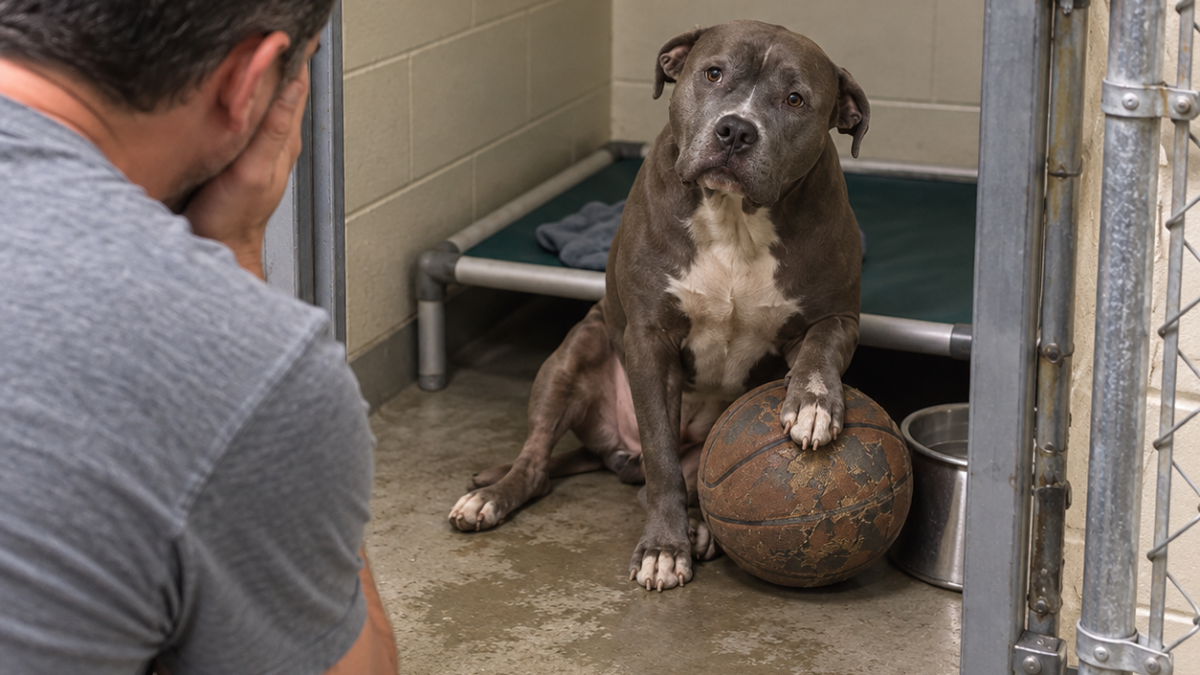
PART 2
I remained on my knees with Buster’s head pressed against my chest.
His entire body trembled.
Not violently.
It felt deeper than fear.
Like something that had been locked inside him for three years had finally found a way out.
Leo kept one hand against Buster’s shoulder.
“Dad?”
I wiped my face.
“Yeah?”
“Who is he?”
I looked at my son.
There are names you can say casually.
Then there are names that carry entire pieces of your life inside them.
“His owner was Julian.”
Leo’s eyes widened.
“Your Julian?”
I nodded.
Leo knew about Julian.
Not everything.
A nine-year-old doesn’t need every detail of death.
But he’d heard enough stories to know the name.
Julian stealing my bike when we were eleven.
Julian breaking my mother’s kitchen window with a baseball.
Julian giving the worst best-man speech in recorded history.
Julian sitting beside me in a hospital hallway when Leo was born.
Julian.
My oldest friend.
My brother in every way except blood.
Leo looked at Buster differently now.
“This was his dog?”
“Yeah.”
Buster pulled away from me only long enough to retrieve the basketball.
Then he rolled it back toward my hands.
My throat closed.
I remembered Julian teaching him that trick.
Buster had been barely a year old.
Julian would sit on his apartment floor, roll the basketball across the carpet, and say, “Bring it to family.”
Buster would chase it.
At first he bit it.
Then dragged it.
Eventually he learned to push it with his nose and paws.
Julian thought it was hilarious.
“Watch this,” he’d say whenever anyone visited.
Then he would point to me.
“Family.”
Buster would roll the ball toward me.
I hadn’t remembered that in years.
But Buster had.
Claire stood a few feet away, watching us.
“You really know him.”
It wasn’t a question anymore.
I nodded.
“I was at his house all the time.”
“When?”
“Before Julian died.”
Her expression changed.
“You knew Mr. Reynolds?”
“Since second grade.”
Claire sat on the bench beside the visitation area.
Then she said quietly, “You should probably hear how Buster came here.”
Leo looked at me.
I knew what I should have done.
Taken my son outside.
Handled the adult parts without him.
But Leo put his hand on my arm.
“I’m staying.”
I almost said no.
Then Buster lay across his shoes.
So I let him.
Claire took a breath.
“Julian died three years and four months ago.”
“September nineteenth.”
She looked at me.
“You remember.”
“Of course.”
I remembered everything.
Where I was.
What I was holding.
The sound my phone made.
Julian had finished an evening practice session at the community basketball center.
He collapsed in the parking lot.
Sudden cardiac arrest.
Thirty-two years old.
No warning.
By the time I reached the hospital, he was gone.
The weeks afterward were chaos.
Funeral arrangements.
Julian’s mother screaming when she saw the casket.
His younger sister Melissa flying in from Arizona.
Former teammates everywhere.
People bringing food nobody ate.
Flowers filling rooms.
Then my own life exploded.
My marriage had already been failing.
Two weeks after Julian’s funeral, my wife told me she wanted to separate.
Within months, Leo and I were living in a two-bedroom apartment while I worked mornings at a warehouse and evenings repairing heating systems.
I barely knew what day it was.
I had asked once about Buster.
Julian’s older brother, Mark, told me their mother couldn’t handle having the dog because seeing him made her cry.
“Where did he go?” I had asked.
“Good family outside Columbus,” Mark told me.
I believed him.
Why wouldn’t I?
Claire looked at me carefully.
“Mark Reynolds brought Buster here.”
The words didn’t make sense at first.
“What?”
“Three weeks after Julian died.”
I stared at her.
“No.”
She nodded.
“No. Mark said he found him a family.”
Claire’s jaw tightened.
“He didn’t.”
Something cold spread through me.
“What did he say when he surrendered him?”
She hesitated.
“Claire.”
“I wasn’t working here yet. But his intake notes are still in the file.”
“What do they say?”
She stood.
“I’ll show you.”
She disappeared behind the front desk.
I sat beside Buster.
Leo had become very quiet.
“Dad?”
“Yeah?”
“Are you mad?”
“Yes.”
“At Buster?”
I looked at him.
“No, buddy.”
Never.
Claire returned with a paper file.
She sat and opened it.
“Intake date: October tenth.”
I remembered that day.
I had worked fourteen hours.
Leo had been sick.
I had probably microwaved dinner and fallen asleep in my clothes.
Meanwhile Buster had entered this building.
Claire read.
“Owner deceased. Family unable to maintain animal. Reported behavior: calm. No bite history. House trained.”
She turned the page.
Then she paused.
“What?”
She read the handwritten note.
“Surrendering party states dog is overly attached to deceased owner and old basketball. Requested basketball be discarded because attachment is unhealthy.”
I felt my teeth clench.
Leo hugged Buster.
Claire continued.
“Shelter staff chose not to discard it after Buster became distressed when separated from it.”
“What kind of distressed?”
“He stopped eating. Paced all night. Scratched at the kennel door until his paws bled.”
I closed my eyes.
“Jesus.”
“Dad,” Leo whispered.
“Sorry.”
Buster rested his chin against my knee.
Claire turned another page.
“There were multiple adoption attempts.”
“How many?”
“Four applications.”
I stared at her.
“You said he’s been here three years.”
“He has.”
“What happened?”
“The first family changed their minds after meeting him because of his age.”
I nodded bitterly.
“The second had another male dog and introductions didn’t go well.”
“Okay.”
“The third wanted him.”
“What happened?”
“They weren’t comfortable with his obsession with the basketball.”
I almost laughed.
“You’re serious?”
“They tried taking it away during the meeting. Buster panicked.”
“And the fourth?”
Claire’s expression changed again.
“That one is complicated.”
“What’s complicated?”
“They passed the screening.”
“And?”
“A family representative contacted the shelter before finalization and claimed Buster had possible aggression issues that hadn’t been disclosed.”
“Who?”
Claire didn’t need to answer.
I knew.
“Mark.”
She nodded.
My hands went cold.
“Why would he do that?”
“We didn’t know whether the claim was true. The adoption was suspended for review. No evidence supported it, but the family withdrew.”
I looked at Buster.
Three years.
Not simply forgotten.
Interfered with.
“Has Mark contacted you since?”
Claire looked toward the front desk.
“Yes.”
“When?”
“Several times.”
“For what?”
“At first, updates.”
That didn’t sound evil.
Then she continued.
“Later he asked whether anyone had removed the basketball.”
My eyes narrowed.
“The ball?”
“Yes.”
“Why?”
“He said it was technically family property.”
I looked at the cracked ball.
Number 24.
Julian’s old practice ball.
“That thing is worth maybe ten dollars.”
“That’s what we assumed.”
“Did he ever ask for Buster?”
“No.”
The anger in me changed.
People can make awful decisions when they’re grieving.
I understood that.
Maybe Mark had been overwhelmed.
Maybe his house wouldn’t take dogs.
Maybe he couldn’t look at the animal who had belonged to his dead brother.
But three years of asking about a basketball while never taking the dog home?
That was something else.
I picked up the ball.
It was heavier than I remembered.
Not much.
Just enough for my mind to register it.
I turned it over.
Cracks.
Old marker.
Number 24.
One panel looked slightly different.
There was a narrow cut near the seam.
“Claire.”
“What?”
“Has anyone repaired this ball?”
“I don’t think so.”
I pressed the panel.
Something shifted inside.
A faint sound.
Paper.
Or plastic.
Buster immediately stood.
He nudged my hands.
Protective.
“Easy.”
I gave the ball back.
Buster placed one paw over it.
Claire and I looked at each other.
“What was that?” she asked.
“I don’t know.”
But I remembered something.
Julian liked hiding things.
Not valuable things.
Notes.
Birthday money for Leo.
Keys.
He once taped my wedding ring inside a cereal box on the morning of my wedding because he said I looked too calm.
He had a running joke about “safe places nobody would ever search.”
And suddenly I remembered the last conversation we’d had.
Three days before he died.
We were sitting outside the rec center.
Julian spun a basketball in his hands.
He looked tired.
“Alex, if anything happens to me, make sure Leo gets that Bulls jersey.”
“Stop talking like you’re ninety.”
“I’m serious.”
“You’re thirty-two.”
“And unbelievably handsome.”
“Debatable.”
He laughed.
Then he looked down at Buster.
“If anything happens, look after my idiot too.”
I thought he was joking.
I kicked his shoe.
“Nothing’s happening.”
“Promise.”
“Fine.”
“Say it.”
“I promise.”
Then life happened.
Julian died.
My marriage collapsed.
Mark lied.
And I forgot.
Standing in that shelter, three years later, the memory hit me like a fist.
I had promised.
I crouched in front of Buster.
“I’m sorry.”
He looked at me.
“I should’ve found you.”
Leo touched my back.
“Dad.”
“I should have asked more questions.”
Claire shook her head.
“You were told he had a home.”
“I should’ve checked.”
Buster rolled the basketball against my foot again.
Leo said, “Maybe he’s saying he forgives you.”
Children say impossible things with complete confidence.
I stared at my son.
Then at Buster.
Maybe.
I stood.
“I’m adopting him.”
Claire smiled.
“I thought you might.”
“No maybe. No twenty-four-hour hold. No thinking period.”
“We still have paperwork.”
“Give me everything.”
Leo threw both arms around Buster’s neck.
“We’re taking you home.”
Buster did something I had never seen him do before.
He licked Leo’s face.
Leo screamed with laughter.
For one brief second, the anger left me.
The adoption took nearly two hours.
Vaccination records.
Medical history.
Behavior review.
Housing verification.
References.
Buster had arthritis in both hips.
A mild thyroid problem.
A benign lump near his shoulder.
Dental disease.
I signed anyway.
Claire looked at me before stamping the final sheet.
“One more thing.”
“What now?”
“If Mark challenges the adoption, the shelter’s legal team will support the transfer. He surrendered ownership three years ago.”
“Good.”
“But keep copies of everything.”
“I will.”
Buster walked out through the shelter’s front doors at 3:47 that afternoon.
He carried nothing.
Leo carried the basketball.
The moment Leo picked it up, Buster walked beside him.
No panic.
No resistance.
He trusted him already.
In the car, Buster sat in the back beside Leo.
The ball rested between them.
Leo talked the entire way home.
“You can sleep in my room if you want. Dad says dogs aren’t allowed on furniture, but Dad says lots of things.”
“I can hear you.”
“He also says I can’t eat cereal for dinner.”
“You can’t.”
“I did Thursday.”
“That was because I was working late.”
“Still counts.”
Buster looked from Leo to me.
His mouth opened slightly.
For a second, I could have sworn he was smiling.
When we reached the house, Buster didn’t immediately go inside.
He stood in the driveway.
Looked at the porch.
Then the yard.
Then me.
I remembered that Julian had brought him to my old house hundreds of times.
But this was different.
Different neighborhood.
Different life.
Different version of me.
I opened the door.
“Home.”
He entered.
Slowly.
He checked every room.
When he reached Leo’s bedroom, he stopped.
A basketball poster hung above the bed.
Buster stared.
Leo whispered, “He likes it.”
“Maybe.”
Then Buster walked toward the corner beside Leo’s bookshelf.
He lay down.
Leo placed the old ball between his paws.
Buster lowered his head onto it.
Exactly as he had done at the shelter.
That evening, we ordered pizza.
Buster refused dog food until Leo sat beside the bowl.
Then he ate.
Afterward, Leo asked the question I had been expecting.
“Tell me about Julian.”
So I did.
I told him about the boy who could make a basketball sing against pavement.
About the first time we met in second grade when Julian punched a kid for stealing my lunch and then stole half my dessert.
About high school.
Girls.
Bad haircuts.
Broken-down cars.
The semi-pro team.
The number 24.
The night Leo was born.
Julian had walked into the maternity ward carrying a tiny basketball.
My ex-wife had said, “Absolutely not.”
Julian placed it beside the bassinet anyway.
“He loved you,” I told Leo.
“Me?”
“Before you could even talk.”
Leo stroked Buster’s head.
“What about him?”
“Julian loved him too.”
Buster opened his eyes when I said the name.
Julian.
His ears shifted.
Then he pushed the basketball toward me.
Leo noticed.
“Dad.”
“I know.”
“He does that every time you say Julian.”
I swallowed.
“I know.”
That night, Buster slept in Leo’s room.
At 2:11 a.m., I woke to scratching.
I checked the hallway.
Buster stood at the front door.
The basketball was beside him.
My heart hurt.
He wasn’t trying to leave.
He was waiting.
I sat on the floor.
“He’s not coming, buddy.”
Buster stared at the door.
I hated saying it.
Three years in a shelter had apparently not taught him what death meant.
Or maybe dogs understand death differently.
Maybe memory does not have a calendar.
I placed my hand on his back.
“But you’re not waiting alone anymore.”
Buster sat beside me.
We remained there until sunrise.
The first week was cautious.
Buster followed Leo everywhere.
School mornings were hardest.
When Leo left, Buster paced.
The first day he waited at the front window until 3:28 p.m.
When the school bus arrived, Buster barked.
A real bark.
Deep.
Powerful.
Leo ran through the door.
Buster’s tail went crazy.
The old basketball rolled across the floor.
Leo dropped his backpack.
“BUSTER!”
He knelt.
Buster nearly knocked him over.
I stood in the kitchen pretending onions were responsible for my eyes.
The ball began changing meaning.
At the shelter, it had been grief.
At our house, slowly, it became a toy again.
Leo rolled it across the backyard.
Buster chased it.
Not quickly.
He was older.
His hips hurt.
But his whole body changed when he played.
He pushed the ball with his front paws.
Leo ran ahead.
Buster followed.
Sometimes they spent twenty minutes moving it from one side of the yard to the other.
One Saturday, Buster pushed the ball toward Leo and sat.
Leo froze.
“Dad!”
I came outside.
“What?”
“He did it.”
“What?”
“The trust thing.”
I smiled.
Julian used to say Buster rolled the ball only to people he considered family.
Leo knelt.
“Really?”
“Really.”
His face lit up.
“He chose me?”
I looked at Buster.
“Yes.”
Leo hugged him.
Buster tolerated it with the solemn patience of an elderly man being squeezed by an enthusiastic child.
For the first time since my divorce, the house felt whole.
Not repaired exactly.
Whole in a new shape.
Then Mark Reynolds called.
I hadn’t spoken to him in almost three years.
His number appeared on my phone one Tuesday evening.
I almost didn’t answer.
Something told me to.
“Alex.”
“Mark.”
“I heard you adopted Buster.”
Straight to it.
“How?”
“Small town.”
“We don’t live in a small town.”
He ignored that.
“How is he?”
I looked into the living room.
Buster was asleep beside Leo.
“Better than he was in the shelter.”
Silence.
Then:
“That wasn’t my fault.”
“You told me he went to a family.”
“I couldn’t explain everything.”
“You lied.”
“I was trying to deal with my brother dying.”
“So was I.”
“You had no idea what my family was going through.”
“And apparently you had no idea what his dog was going through.”
His voice hardened.
“I didn’t call to fight.”
“Good.”
“I need the basketball.”
There it was.
I sat straighter.
“What?”
“Julian’s old ball.”
“No.”
“Alex, it belonged to him.”
“So did Buster.”
“That isn’t the same.”
“Apparently.”
“I’m serious.”
“So am I.”
Mark exhaled.
“There may be something inside it.”
I stared at the ball beside Buster.
“What?”
“Nothing important to you.”
“Then you don’t need it.”
“Alex.”
“What is inside the ball?”
“I don’t know.”
“Then why have you been asking the shelter about it for three years?”
Silence.
My anger sharpened.
“Claire told me.”
Mark cursed softly.
“You need to stay out of this.”
“You made it my business when you dumped Julian’s dog and spent three years trying to track down his basketball.”
“I didn’t dump him.”
“What do you call it?”
“My mother couldn’t keep him.”
“You could’ve found him a home.”
“I tried.”
“You blocked an adoption.”
“That family wasn’t right.”
“According to who?”
“According to me.”
“You surrendered him.”
“He was my brother’s dog.”
I stood.
“You don’t get to abandon something and then keep controlling who loves it.”
Mark said nothing.
I continued.
“What is in the ball?”
His voice became quiet.
“A key.”
I looked at the basketball.
“A key to what?”
“I don’t know.”
“Bull.”
“I’m telling you.”
“Then why do you want it?”
“Because Julian told me before he died that he had put something away for Leo.”
My breath stopped.
“What?”
“He said if anything ever happened, you would understand.”
I sat down slowly.
“You waited three years to tell me?”
“I thought he meant money.”
“For Leo?”
“Yes.”
“And you searched for it.”
Silence.
My stomach turned.
“You searched Julian’s apartment.”
“Of course I did. We had to clear it.”
“His storage unit?”
Another pause.
“You searched everything.”
“I was handling the estate.”
“And when you couldn’t find whatever he hid, you remembered the basketball.”
Mark didn’t answer.
I had my answer.
“Don’t call me again.”
“Alex, listen—”
I hung up.
That night, after Leo fell asleep, I took the basketball into the garage.
Buster followed me.
The ball had a narrow split near one seam.
I examined it beneath the work light.
Someone had cut it deliberately and glued it shut.
Buster paced.
“Easy.”
I sat on the floor.
I didn’t want to destroy it.
It had kept him alive emotionally for three years.
But if Julian had hidden something inside…
I used a small utility knife.
Carefully.
The rubber separated.
Buster whined.
“I know.”
I reached inside.
My fingers touched plastic.
I pulled out a sealed sandwich bag.
Inside was a brass key.
And a folded piece of paper.
My hands shook so badly I nearly dropped it.
I opened the note.
The handwriting was Julian’s.
Alex—
If you ever find this, something probably went wrong.
First: don’t laugh. I know this is dramatic.
Second: the key is for locker 24 at Eastwood Athletic Club. The rent is paid through 2030 because I don’t trust Mark with paperwork, money, secrets, or anything more complicated than a microwave.
There are things inside for you, Mom, Melissa, and Leo.
Especially Leo.
If I’m around, I’ll probably eventually confess and ruin the surprise.
If I’m not around, make sure everybody gets what belongs to them.
And keep Buster.
He knows who family is better than most people do.
—J
I sat on the garage floor.
For a while, I couldn’t move.
Buster placed his head against my shoulder.
Julian had asked me twice.
Once in person.
Once in writing.
Keep Buster.
I had failed him for three years without knowing it.
But there was something else.
Locker 24.
Eastwood Athletic Club had closed two years earlier.
Or so I thought.
I searched online.
The basketball facility had changed owners and reopened as Eastwood Sports Complex.
Storage lockers remained in the basement.
The next morning, I called.
The manager confirmed locker 24 still existed.
Rent had indeed been prepaid years in advance.
“Who has access?” I asked.
“The registered renter or designated emergency contact.”
“Who is that?”
“I’m sorry, sir, I can’t disclose that.”
“What if he’s dead?”
“We’ll need documentation.”
I called an attorney.
Not because I expected treasure.
Because Mark had already lied once.
I wasn’t giving him another chance.
My attorney, Rachel Kim, contacted the sports complex.
Two days later, she called.
“You’re listed.”
“What?”
“As the secondary authorized party on the locker.”
I closed my eyes.
Julian.
Of course.
“When can we open it?”
“Friday.”
We went Friday morning.
Rachel came.
I brought Leo.
And Buster.
The manager led us into the basement.
Rows of old metal lockers lined one wall.
Number 24 stood near the end.
I held the key.
Leo whispered, “Is there treasure?”
“Probably old socks.”
“Could be money.”
“Could be worse socks.”
Buster sniffed the locker.
My hand trembled as I turned the key.
Click.
Inside were four boxes.
Each labeled.
MOM.
MELISSA.
ALEX.
LEO.
And beneath them sat Julian’s old red duffel bag.
Leo looked at me.
“That’s my name.”
“I see it.”
His box was the largest.
I opened mine first.
Inside were photographs.
Dozens.
Me and Julian at eight.
Twelve.
Seventeen.
Twenty-one.
My wedding.
Leo’s birth.
A letter.
And Julian’s semi-pro championship ring.
The letter began:
Brother,
If you’re reading this without me standing over your shoulder making fun of you for crying, then I’m sorry.
I stopped.
I couldn’t continue.
Rachel looked away.
Leo touched my arm.
“It’s okay, Dad.”
I breathed.
Then read.
Julian wrote about our childhood.
About my marriage problems, which apparently he had understood better than I thought.
About Leo.
Then near the end:
You always think you’re supposed to rescue everybody.
You’re not.
Sometimes the only thing you’re supposed to do is stay.
If Buster is with you, you’ll understand.
I laughed through tears.
Buster sat beside me.
Leo opened his box.
Inside were basketball shoes several sizes too large.
A jersey.
The tiny ball Julian brought to the hospital when Leo was born.
Savings bonds.
And a letter.
Leo read the first line aloud.
Dear Leo,
You are probably old enough to make fun of your dad by now, so we’re going to get along great.
He laughed.
Then cried.
There was money too.
Not millions.
Nothing absurd.
But a custodial investment account Julian had created for Leo.
Forty-seven thousand dollars.
College money.
Mark had apparently suspected something existed but had never known where.
The box for Julian’s mother contained jewelry that had belonged to his grandmother.
Melissa’s contained family photographs, documents, and money Julian had intended to help her start a business.
Everything was carefully labeled.
Everything had instructions.
Nothing belonged to Mark.
That explained more than I wanted it to.
Mark had spent three years looking for something his brother had deliberately kept away from him.
The revenge, if you want to call it that, began with paperwork.
Rachel documented everything.
We contacted Julian’s mother and Melissa.
We photographed the contents before removing them.
We notified the attorney who had handled Julian’s estate.
Then we learned why Julian had excluded Mark.
Months before his death, Julian had discovered Mark had taken money from their mother’s account.
Not once.
Repeatedly.
Their mother had early-stage cognitive problems and trusted her oldest son to manage bills.
Julian found unexplained withdrawals.
Nearly twenty-eight thousand dollars.
He confronted Mark.
Mark claimed it was repayment for expenses.
Julian didn’t believe him.
He quietly removed Mark from several beneficiary arrangements.
He set aside property for the rest of the family.
And he hid the locker key inside Buster’s basketball.
Because, as Julian wrote in another note:
Mark never plays with Buster and would never touch that disgusting ball.
He had been right.
Almost.
After Julian died, Mark searched everything except the dog.
Then, months later, he apparently realized his mistake.
That was why he kept asking about the basketball.
Why he interfered with Buster’s adoption.
He wanted the dog available.
Accessible.
Contained.
Not because he loved him.
Because Buster was attached to the one object Mark believed might expose him.
Rachel advised me not to confront Mark.
I didn’t.
I didn’t need to.
Melissa did.
She called him with their mother on the line.
I wasn’t present.
But she told me afterward.
Mark denied everything first.
Then claimed Julian had misunderstood.
Then threatened legal action.
Then demanded a portion of the locker contents.
He got none.
The documents Julian had preserved included copies of their mother’s bank records.
There were also text messages.
Emails.
Dates.
Amounts.
Enough for an attorney to reopen questions about the money Mark had handled.
Julian had not simply hidden gifts.
He had preserved evidence.
Their mother cried when she learned the truth.
Not because of the money.
Because Mark had spent three years telling her Julian had distrusted everybody near the end.
“He made me think my own son was paranoid,” she told me.
I didn’t know what to say.
Some betrayals are too ugly for comfort.
Mark eventually repaid a substantial portion of the money as part of a civil settlement.
He lost control of his mother’s finances.
Melissa became the appointed manager with independent oversight.
Mark threatened me twice through attorneys.
Both letters went nowhere.
Then he made one final attempt to reclaim Buster.
His attorney claimed Buster had been “wrongfully transferred” by the shelter because Mark had surrendered him during emotional distress.
The shelter’s lawyer responded with the signed surrender document.
Three years of veterinary records.
Documentation of Mark’s refusal to reclaim Buster.
And records showing his repeated interest in the basketball rather than the dog.
The claim disappeared.
I framed one piece of paper from the entire mess.
Not the settlement.
Not the attorney letter.
Buster’s adoption certificate.
Owner:
Alex Carter.
The day the legal threat ended, Leo taped a handwritten note underneath.
AND LEO.
I left it there.
Mark’s punishment was not dramatic.
Nobody dragged him away in handcuffs.
Nobody applauded in a courtroom.
His consequence was simpler and, I think, more appropriate.
The secrets he had tried to control reached the people Julian intended.
His mother knew the truth.
Melissa knew the truth.
I knew.
Leo received what Julian left him.
And Buster?
Buster finally stopped waiting.
Over the following months, he changed so much that Claire cried the first time she visited.
He met her at the door.
Tail moving.
Basketball in his mouth.
“Well,” she said, wiping her eyes. “Look at you.”
Buster dropped the ball.
Then pushed it toward Leo.
Claire laughed.
“Not me?”
Leo grinned.
“He only does that with family.”
I leaned against the doorway.
“Apparently.”
Buster still slept with the basketball.
We repaired the cut carefully.
I didn’t replace it.
I couldn’t.
That ruined old ball had carried Julian’s last gifts.
It had survived three years in a kennel.
It had been Buster’s pillow, memory, and promise.
But gradually, it stopped being something he guarded.
Some afternoons, he left it in the yard.
The first time that happened, I noticed before anybody else.
Buster had fallen asleep on the porch.
The basketball sat twenty feet away in the grass.
He wasn’t watching it.
I stared.
Leo came outside.
“What?”
“Nothing.”
He followed my eyes.
Then understood.
“He left it.”
“Yeah.”
“Is that good?”
I looked at Buster.
His breathing was deep.
Peaceful.
“I think so.”
Buster didn’t need to guard the past every second anymore.
He knew where home was.
A year passed.
Then another.
Leo grew taller.
Buster’s muzzle became almost entirely white.
His hips worsened.
We built a ramp off the porch.
He hated it.
Then discovered it required less effort than the steps and pretended he’d supported the idea all along.
Every evening, Leo did homework on the floor beside him.
Sometimes Buster rested his head on a math worksheet.
Leo would say, “He ate my homework.”
I’d say, “He’s lying on it.”
“Emotionally, same thing.”
The house that had once felt too quiet became noisy again.
Not constantly.
But enough.
Basketball bouncing in the driveway.
Buster barking at delivery trucks.
Leo laughing.
Me yelling about mud.
Normal things.
Beautiful things.
When Leo turned twelve, he joined a youth basketball league.
His jersey number was 24.
He chose it himself.
The first game nearly broke me.
Buster couldn’t attend inside the gym, so after the game Leo came running outside still wearing his uniform.
Buster stood from the back seat of my SUV.
Leo opened the door.
“We won!”
Buster licked him.
Leo held up the old basketball.
“Julian’s number.”
I looked at him.
“Your number now.”
He shook his head.
“Ours.”
That night, Leo asked something I’d been avoiding.
“Do you think Julian knew he was going to die?”
“No.”
“Then why did he hide all that stuff?”
I thought about it.
“Because adults sometimes make plans even when they hope nobody ever needs them.”
“Like a will?”
“Kind of.”
“Why didn’t he trust Mark?”
“That was complicated.”
Leo was old enough now to understand that complicated often meant painful.
“He trusted you.”
“Yes.”
“And Buster.”
I smiled.
“Especially Buster.”
Leo looked toward the dog sleeping beside his bed.
“Buster waited for us.”
I shook my head.
“No.”
“What?”
“We took too long finding him.”
Leo considered that.
Then said, “But we did.”
“Yes.”
We did.
Buster turned eleven.
Then twelve.
His body slowed.
One morning, he couldn’t stand.
Leo found him.
“Dad!”
There are sounds from your child that make your body move before your brain catches up.
I ran.
Buster lay beside the bed.
His back legs wouldn’t support him.
He looked frightened.
“Easy.”
Leo was crying.
“What’s wrong?”
“I don’t know.”
We carried him to the car.
The vet diagnosed a spinal problem aggravated by arthritis.
Medication helped.
Physical therapy helped more.
Buster walked again.
Slowly.
But the veterinarian was honest.
“He’s getting old.”
I hated that sentence.
I had already lost Julian.
I had spent years watching Buster become the living connection between my past and Leo’s future.
I wasn’t ready.
Nobody cared whether I was ready.
Age kept moving.
We bought an orthopedic bed.
Then another because Buster preferred Leo’s rug.
We installed nonslip runners.
Leo learned how to support Buster’s hips with a sling.
The basketball remained beside his bed.
One evening, I found Leo sitting with Buster.
“What’s wrong?”
“Nothing.”
His voice said otherwise.
I sat.
He stared at Buster’s white face.
“How long do pit bulls live?”
I could have lied.
I didn’t.
“Usually not as long as we’d like.”
“That isn’t an answer.”
“No.”
“How old is he?”
“About twelve.”
Leo swallowed.
“Is he going to die?”
“Someday.”
“Soon?”
“I don’t know.”
Leo looked furious.
Kids often look angry when they’re scared.
“That’s stupid.”
“Yeah.”
“Julian already died.”
“I know.”
“So Buster shouldn’t.”
“I know.”
“That’s not fair.”
“No.”
Buster lifted his head.
Leo wrapped both arms around him.
“I hate this.”
I placed my hand on my son’s back.
“So do I.”
Buster lived another fourteen months.
Good months.
Not perfect.
Good.
Short walks.
Long naps.
Soft food.
Pain medication hidden inside peanut butter.
Basketball games watched from the car when weather allowed.
He became something of a legend at Leo’s school.
The old pit bull with the basketball.
Kids brought him treats.
One parent complained because pit bulls were “dangerous.”
Leo overheard.
He walked up to the woman and said, “He’s spent more years being abandoned than your dog has been alive, and he’s still kinder than most people.”
I pulled him away before he added anything that would get us expelled from youth basketball.
I was secretly proud.
Then, one Sunday morning, Buster refused breakfast.
He also left the basketball untouched.
That scared me more.
The veterinarian came to our house that afternoon.
Blood tests.
Examination.
Long silence.
Cancer.
Advanced.
I sat in the kitchen after she left.
Leo stood in the doorway.
“How bad?”
I looked at my son.
He was thirteen now.
Not nine.
Tall.
Trying to be brave.
“Bad.”
His face folded.
“No.”
I stood.
He came into my arms.
We cried together.
Buster lay in the living room.
His basketball beside him.
That night, Leo slept on the floor.
I slept there too.
At two in the morning, I woke.
Buster was watching us.
I touched his forehead.
“You kept him safe.”
His tail moved.
“You kept me safe too.”
Another small movement.
“You did your job.”
I thought about Julian.
How often he’d said that when Buster brought the ball.
Good job, man.
The next three weeks were borrowed time.
Buster had good mornings.
Bad afternoons.
One final trip to the old neighborhood.
We drove past the basketball court where Julian and I had grown up.
I parked.
Leo helped Buster out.
The court was empty.
I brought the basketball.
Buster stood on the asphalt.
He looked around.
I wondered what he remembered.
Julian running.
Sneakers squeaking.
Laughter.
Summer.
Maybe nothing.
Maybe everything.
Leo rolled the ball gently.
Buster watched.
Then walked toward it.
He put one paw on top.
For a moment, he looked young again.
Not physically.
Somewhere behind the eyes.
I crouched.
“This is where it started.”
Leo sat beside me.
“Julian played here?”
“Every day.”
“With you?”
“Almost.”
Buster nudged the ball.
It rolled toward Leo.
Leo stopped it.
Then Buster looked at me.
He walked over.
Rested his head against my chest.
I nearly lost it.
“I kept my promise,” I whispered.
That wasn’t completely true.
I had been three years late.
But maybe promises aren’t only measured by whether we fail at first.
Maybe they’re measured by what we do when we finally understand what we owe.
“I’ve got him,” I whispered, looking at Leo.
“I’ve got everybody.”
Buster breathed against me.
The following morning, he couldn’t stand.
This time, medication didn’t change it.
The veterinarian came back.
Leo knew before I told him.
He carried the basketball into the living room.
Placed it beside Buster.
Then sat.
“I don’t want him scared.”
“He won’t be.”
“How do you know?”
“Because we’re here.”
We opened the curtains.
Sunlight covered the floor.
Buster lay on his favorite blanket.
Leo had one hand on his chest.
I had the other near his head.
The old basketball rested between his front paws.
I thought about the shelter.
Last kennel.
Gray dog.
Cracked ball.
Three years.
Then the moment he recognized me.
The ball rolling toward my knees.
Family.
That was what it had always meant.
The veterinarian explained what would happen.
Leo nodded.
Then he leaned close.
“Buster?”
One ear moved.
Leo’s voice broke.
“Thank you for choosing me.”
Buster opened his eyes.
His tail tapped the blanket.
Once.
I bent forward.
“Tell Julian I found you.”
My throat closed.
“Tell him I’m sorry it took me so long.”
Buster breathed.
Slow.
Easy.
“And tell him Leo has number twenty-four now.”
Leo cried harder.
I rested my forehead against Buster’s.
“You can give him the ball again if you want.”
Then I realized something.
“No.”
I smiled through tears.
“You know what? Keep it here.”
Buster’s breathing softened.
“We’ll keep it safe for you.”
He died with both of us touching him.
The house became silent.
A silence I recognized.
But this time I didn’t run from it.
Leo and I sat together until dark.
The basketball remained where Buster had left it.
For three days, neither of us moved it.
Then on the fourth morning, Leo picked it up.
“Dad?”
“Yeah?”
“Can I use it?”
I looked at the old cracks.
The faded 24.
The repaired seam.
All those years.
“Use it for what?”
“To play.”
That question nearly healed something in me.
Because for three years, that ball had represented waiting.
Then it became evidence.
Then memory.
Then home.
And now my son wanted it to become a basketball again.
I nodded.
“Yeah.”
We went outside.
Leo bounced it once.
The ball was old and soft.
The bounce was terrible.
He laughed.
“This thing sucks.”
I laughed too.
“Don’t let Julian hear you.”
Leo shot.
Missed badly.
“You suck too.”
“Dad!”
We played until dinner.
A year later, Leo’s team reached the regional youth championship.
He was fourteen.
Number 24.
Before the game, he carried the old ball in his gym bag.
Not to play with.
Just to have it there.
His team won by two points.
Leo made the final free throw.
Afterward, he didn’t run to teammates first.
He came to me.
I hugged him.
“Julian would’ve lost his mind.”
Leo smiled.
“Buster too.”
“Yes.”
He reached into his bag.
Pulled out the ball.
Then rolled it toward my feet.
Exactly as Buster had done in the shelter.
I stared down.
Leo sat beside me on the bench.
“What?”
“You know what that means?”
He smiled.
“Family.”
I put my arm around him.
Across the gym, people shouted.
Shoes squeaked.
Cameras flashed.
But for a second, all I could hear was Julian laughing.
I understood then that people had been wrong about Buster’s basketball.
It had never been a symbol of grief alone.
It was a message.
Julian had trained Buster to roll that ball toward the people he trusted.
Toward family.
Buster guarded it for three years because it was the last thing left connecting him to the person who taught him what home meant.
Then one Sunday, in the last kennel of a crowded shelter, he saw me.
He remembered.
And he gave it back.
Mark tried to take that connection and turn it into money.
He failed.
The evidence he wanted hidden protected the people Julian loved.
The money reached Leo.
Julian’s mother got control of her life back.
Melissa received what her brother had left her.
And Mark had to live with a truth no lawyer could erase:
He had thrown away the one living creature who had been guarding his brother’s final wishes.
Buster’s revenge was not biting him.
Not attacking him.
Not making him suffer.
Buster’s revenge was surviving him.
Loving again.
Choosing again.
Going home.
And proving that everything Mark treated as disposable—Julian’s dog, Julian’s promises, Julian’s battered old basketball—was exactly where Julian had hidden what mattered most.
Today, the ball sits inside a glass case in our living room.
Not because it’s valuable.
Financially, it’s worthless.
The rubber is cracked.
The color is faded.
It barely bounces.
Number 24 is almost gone.
But beside it are three photographs.
Julian at seventeen, holding the ball on the neighborhood court.
Buster at our house, pushing it toward Leo across the grass.
And Leo wearing number 24 after his championship game.
Beneath them is Julian’s note.
Only one line is visible.
KEEP BUSTER. HE KNOWS WHO FAMILY IS BETTER THAN MOST PEOPLE DO.
Julian was right.
Buster knew.
He knew when Julian was alive.
He knew when he spent three years waiting behind metal bars.
He knew when he saw me again.
And somehow, through grief, abandonment, betrayal, and time, that old dog managed to guide all of us back to where we belonged.
I went into that shelter because I had promised my son we would adopt a dog.
I thought we were going there to rescue one.
I was wrong.
Buster had been waiting three years to rescue something for us.
A friendship I thought death had ended.
A promise I had forgotten.
A truth someone tried to hide.
And a piece of Julian that had never really left.
Sometimes I still remember the first second Buster looked into my eyes.
The shelter noise disappearing.
His ears lifting.
That tired tail beginning to move.
Then the basketball rolling slowly across the floor until it touched my knees.
At the time, I thought he was saying:
I remember you.
Years later, I understand he was saying something bigger.
I waited.
I kept it safe.
Now take me home.
And I finally did.
The old basketball stayed in the glass case for almost a year before Leo asked me to take it out again.
By then, the rubber had hardened even more. The orange was almost completely gone. The black number 24 Julian had written across one panel had faded into something that looked like a shadow.
But the ball still carried everything.
Julian’s hands.
Buster’s teeth marks.
Three years in a shelter kennel.
The key hidden inside.
Leo’s childhood.
And the last afternoon Buster had rested his white muzzle beside it before leaving us.
I had assumed the ball belonged behind glass now.
Protected.
Preserved.
Untouched.
Leo disagreed.
He was fifteen when he walked into the living room one Saturday morning and stood in front of the display case.
“Dad?”
I looked up from my coffee.
“What?”
“Can we take it out?”
“The ball?”
“No, Julian’s championship ring. Yes, the ball.”
I lowered the newspaper.
“What for?”
Leo looked through the glass.
“I want to take it somewhere.”
That sentence immediately made me suspicious.
“Where?”
“The old court.”
I didn’t answer.
The neighborhood court where Julian and I had spent half our childhood had been renovated the previous summer.
New asphalt.
New backboards.
New lights.
A local foundation had even painted the sidelines and repaired the chain-link fence.
Leo had started going there with teammates.
I had avoided it.
Not intentionally.
At least that’s what I told myself.
But grief has a way of disguising avoidance as coincidence.
“Why the old ball?”
Leo shrugged.
“I just want it there.”
“It’s falling apart.”
“We won’t play with it.”
“Then why take it?”
He turned toward me.
“Because everything started there.”
I hated when my own child said something simple enough to expose the complicated excuses I had spent years constructing.
I finished my coffee.
“All right.”
I unlocked the case.
The moment I lifted the basketball, I felt the familiar uneven seam where I had cut it open years before.
I remembered sitting on the garage floor.
Buster pacing beside me.
My fingers finding that plastic bag.
Julian’s handwriting.
The brass key.
KEEP BUSTER.
HE KNOWS WHO FAMILY IS BETTER THAN MOST PEOPLE DO.
Even now, I could hear Julian saying it.
Probably laughing while he wrote it.
Probably convinced there was a ninety-nine percent chance nobody would ever read the note.
That was Julian.
He prepared for disaster while joking about it as if preparation could keep disaster from happening.
Leo held out both hands.
I hesitated.
“Careful.”
“Dad, I’m fifteen.”
“Which historically is not an age associated with careful decisions.”
He rolled his eyes.
I handed him the ball.
He held it against his chest.
For a second, I saw the nine-year-old boy who had knelt beside Buster in the shelter.
Then we drove to the court.
It was early enough that only a few kids were playing.
The autumn air had that clean coldness that makes every sound travel farther.
Shoes against asphalt.
A ball hitting metal.
Someone laughing at the far end.
Leo walked to the sideline and placed Julian’s basketball beneath the bench.
I stopped.
The court looked different.
But the pole was in almost the same place.
And suddenly I was seventeen again.
Julian stood under the basket.
Sweat dripping from his hair.
“Game point.”
“You said that three points ago.”
“That was previous game point.”
“You can’t keep inventing game points.”
“I can if I’m winning.”
“You’re not winning.”
“I am spiritually dominating you.”
Then he’d steal the ball.
Lay it in.
And scream as if he’d just won the NBA Finals.
I blinked.
Leo was looking at me.
“You okay?”
“Yeah.”
“You disappeared for a second.”
“Just remembering.”
He picked up a newer ball.
“Play me.”
“I have knees older than your math teacher.”
“You’re forty-one.”
“Exactly.”
“That’s not old.”
“Say that again when you’re forty-one.”
He bounced the ball toward me.
I caught it.
And we played.
Badly, in my case.
Leo beat me eleven to four.
Then eleven to two.
By the third game, I accused him of exploiting the elderly.
He informed me forty-one was not elderly.
“I’ve changed my position.”
We sat on the bench afterward.
Julian’s ball rested between us.
Leo looked at the court.
“Did you ever think about what would have happened if we hadn’t gone to the shelter that day?”
I had.
Many times.
But I rarely said it.
“Buster probably would’ve stayed there longer.”
“Maybe somebody else would’ve adopted him.”
“Maybe.”
“But they wouldn’t have known about the ball.”
“Probably not.”
“And Mark might’ve gotten it.”
I looked at my son.
“Maybe.”
Leo rubbed his palms together against the cold.
“That’s weird.”
“What?”
“How close everything was.”
I knew what he meant.
One different Sunday.
One different shelter.
One different dog catching Leo’s attention first.
One employee deciding not to mention Buster.
One damaged basketball finally being thrown away.
Our lives might have gone in a completely different direction.
“Life is mostly close calls we don’t know about,” I said.
Leo looked at me.
“That sounds depressing.”
“It wasn’t meant to.”
“It was.”
I laughed.
He stared at the old ball.
“Do you still hate Mark?”
The question surprised me.
I considered lying.
“No.”
“Did you?”
“Yes.”
“A lot?”
“Yes.”
Leo nodded.
“Me too.”
“You barely knew him.”
“I knew what he did.”
“That isn’t the same.”
“He left Buster there.”
“Yes.”
“And he tried to steal what Julian left.”
“Yes.”
“And he lied.”
“Yes.”
“So why don’t you hate him now?”
I watched a group of younger kids arguing over whether a shot counted.
“Because hate requires maintenance.”
Leo frowned.
“What does that mean?”
“It means you have to keep feeding it.”
“With what?”
“Memory. Anger. Imagination. All the things you wish you’d said.”
I nudged the old basketball with my shoe.
“I got tired.”
Leo was quiet.
“And Buster didn’t hate anybody.”
“No.”
“Even Mark.”
“No.”
“I still think that’s crazy.”
“So do I.”
The truth was, Buster had taught me more about revenge than any attorney or settlement ever could.
For months after we discovered the contents of locker 24, I had imagined Mark losing everything.
Money.
Reputation.
Family.
I wanted him exposed.
Humiliated.
Punished.
Then I watched Buster live.
He didn’t wake up every morning thinking about the man who had left him.
He woke up looking for Leo.
He cared about breakfast.
Sunlight.
The backyard.
The cracked basketball.
The sound of my truck pulling into the driveway.
That was his revenge.
He had lost three years.
He refused to lose the years that remained.
And eventually, I understood that if I kept hating Mark, I was giving him more time too.
Leo touched the faded number 24.
“Do you think Buster knew Julian was dead?”
I had asked myself that question a thousand times.
“I think he knew Julian was gone.”
“That’s different.”
“Maybe.”
“Do dogs understand forever?”
I looked toward the court.
“I don’t know if people do.”
Leo accepted that.
We sat there until the other players left.
Before we went home, Leo picked up the old basketball.
Instead of carrying it against his chest, he tucked it under one arm.
Exactly the way Julian used to.
I almost told him.
Then decided not to.
Some echoes are better left alone.
A month later, I received a letter from Mark Reynolds.
Not an email.
Not something from an attorney.
A handwritten letter.
I recognized the return address but almost threw it away.
Leo saw it on the kitchen counter.
“You opening that?”
“I haven’t decided.”
“Can I?”
“No.”
“Then open it.”
“You are disturbingly invested in other people’s mail.”
“You’re disturbingly dramatic.”
I opened it.
The handwriting was nothing like Julian’s.
Tighter.
More controlled.
Alex,
I don’t expect you to answer this.
I have been trying to decide whether writing it is selfish.
It probably is.
There are things I should have said years ago.
I didn’t put Buster in that shelter because I hated him.
I put him there because every time I looked at him, I saw Julian.
That isn’t an excuse.
It’s just the truth.
Mom cried whenever Buster walked into the room.
I couldn’t take him to my apartment because of the lease, and I told myself a shelter would find him a home.
Then when I discovered Julian had hidden things from me, I became convinced the ball might contain something.
By that point, I stopped thinking about Buster as a dog and started thinking about him as a problem connected to the estate.
That might be the ugliest thing I’ve ever admitted.
I knew an adoption had been delayed because of what I told the shelter.
I told myself I was protecting the family until I figured out what Julian had done.
The truth is, I was protecting myself.
I lost money.
I lost Mom’s trust.
Melissa barely speaks to me.
Those are consequences I earned.
But there is one thing I cannot fix.
I took three years from that dog.
You gave him the rest.
Thank you.
There was more.
Not much.
At the bottom, Mark wrote:
I saw the photo Melissa posted of Leo wearing 24.
Julian would have loved that.
I’m glad the number ended up where it should.
I read the letter twice.
Leo watched me.
“Well?”
I handed it to him.
He read slowly.
When he finished, he placed it on the table.
“Do you believe him?”
“Most of it.”
“Are you going to forgive him?”
“I don’t know.”
Leo frowned.
“You always say Buster forgave him.”
“No. I say Buster didn’t spend his life being angry at him.”
“Isn’t that forgiveness?”
“Maybe. Maybe dogs are smarter about definitions.”
He looked at the letter again.
“You should answer.”
“Why?”
“Because Buster would.”
That made me smile.
“What exactly would Buster write?”
Leo thought seriously.
“Probably nothing.”
“Exactly.”
“He’d just roll the ball at him.”
We both laughed.
But that evening, I wrote Mark back.
Five sentences.
Mark,
I believe you regret it.
That matters, but it doesn’t change what happened.
Buster had good years with us.
He was loved until the end.
Take care of your mother.
—Alex
I never heard from him again.
I didn’t need to.
The following spring, something happened that made Julian’s old basketball matter to more people than our family.
Claire called me from the shelter.
“You free Saturday?”
“Depends.”
“We’re doing an adoption event.”
“Congratulations.”
“And I volunteered you.”
“For what?”
“Speaking.”
“No.”
“You don’t know what you’re speaking about.”
“Still no.”
She ignored me.
“We’re launching a senior-dog adoption program.”
That got my attention.
“What kind?”
“Reduced fees. Sponsored medical exams. Foster support. We’re calling it Last Good Years.”
I was quiet.
Claire continued.
“We want people to understand that older dogs aren’t broken inventory.”
The phrase bothered me because I knew how true it was.
“And you want me to talk about Buster.”
“Yes.”
“I don’t do speeches.”
“You’ve been telling everyone who will listen about that dog for years.”
“That is different.”
“How?”
“I don’t have to stand behind a microphone.”
Claire won.
She usually did.
The adoption event was held in the shelter parking lot.
There were tents.
Food trucks.
Volunteers.
Twenty-three senior dogs.
Some gray.
Some limping.
Some sleeping through their own marketing campaign.
I stood beside a banner with Buster’s photograph.
Not the sad shelter picture.
A later one.
He was in our backyard.
Basketball between his paws.
Mouth open.
Eyes bright.
Underneath it were the words:
THEY DON’T NEED THEIR WHOLE LIFE BACK.
THEY JUST NEED THE REST OF IT.
I had to look away the first time I saw it.
When it was my turn to speak, I walked to the microphone.
Leo stood off to the side.
He had brought Julian’s basketball.
I looked at the crowd.
Then at Claire.
“I hate you.”
People laughed.
Claire bowed.
So I started.
“I met Buster in the last kennel of this shelter.”
The crowd grew quiet.
“He had been here three years.”
I told them about Julian.
The basketball.
The recognition.
The adoption.
I did not tell every part.
Not the legal battle.
Not all the ugliness.
That wasn’t why we were there.
I told them about Buster waiting at the door for Leo’s school bus.
About the backyard.
About the ball turning from an object he guarded into something he played with again.
About arthritis.
The ramp.
The final afternoon.
Then I said something I hadn’t planned.
“When people talk about adopting an old dog, they often ask the wrong question.”
I looked at the dogs resting beneath the tents.
“They ask, ‘How long will I have him?’”
I paused.
“The better question is, ‘What can we do with the time he has?’”
A woman in the front row began crying.
So did I.
I hated that.
I continued.
“Buster didn’t need twelve more years. He needed one person to stop walking past his kennel.”
I looked toward Leo.
“He got a boy instead.”
Leo smiled.
“Pretty good deal.”
People laughed through tears.
By the end of that day, fourteen senior dogs had adoption applications.
Eleven went home within the week.
The shelter later added Buster’s name to the program.
The Buster Fund paid initial veterinary costs for senior dogs adopted by qualified families.
We helped raise money.
Julian’s mother contributed.
Melissa contributed.
Even Mark sent a donation anonymously.
I knew it was him because Melissa told me.
I let it stay anonymous.
Some things don’t need a public redemption scene.
Three years after Buster died, the shelter installed a permanent display.
Not huge.
Just a photograph.
A copy of the old number 24.
And a short paragraph about an abandoned pit bull who waited for years beside a basketball before recognizing someone from his old life.
The original ball stayed with us.
That had never been negotiable.
By then, Leo was seventeen.
College applications had started.
The money Julian left him had grown.
He wanted to study physical therapy.
Sports medicine, maybe.
I asked him once whether basketball had anything to do with it.
He shrugged.
“Everything has something to do with basketball.”
He still wore 24.
During his final high school season, he became team captain.
I tried not to turn into the embarrassing father yelling from the bleachers.
I failed.
Spectacularly.
At one game, the referee actually looked at me and said, “Sir.”
Just “sir.”
It was devastatingly effective.
After the game, Leo walked toward me.
“You got warned by a referee and you weren’t even playing.”
“Bad call.”
“It was absolutely a foul.”
“You’ve been brainwashed.”
“Go home, Dad.”
I could almost hear Julian laughing.
That spring, Leo’s team held senior night.
Parents walked onto the court with players.
Leo wore number 24.
As we waited in the hallway, he handed me something.
A small patch.
BUSTER.
I stared at it.
“What is this?”
He turned around.
On the inside hem of his jersey, he had sewn another patch.
JULIAN.
“Been there all season.”
“You never told me.”
“You would’ve made it weird.”
“I am emotionally offended by that accusation.”
“You’re already crying.”
“I have allergies.”
“In February?”
“Severe.”
We walked onto the court together.
The announcer read Leo’s name.
The crowd applauded.
For a second, I saw another player wearing 24.
Julian.
Young.
Healthy.
Alive.
Then the image was gone.
Leo squeezed my shoulder.
“You good?”
“Yeah.”
I meant it.
For years, memories of Julian had felt like doors closing.
Now they were doors opening.
That was what Buster had changed.
He made remembering safe again.
Leo graduated that June.
After the ceremony, we went home.
Family filled the yard.
Food.
Music.
Laughter.
At sunset, Leo disappeared inside.
He returned carrying the old basketball.
I watched him walk toward the maple tree.
Julian’s mother was sitting nearby.
She was older now.
Fragile.
But when she saw the ball, she smiled.
“Still have that ugly thing?”
Leo laughed.
“Yes, ma’am.”
“Julian loved ugly things.”
“Mom,” Melissa said.
“What? He drove a 1997 Taurus.”
Everyone laughed.
Leo handed the ball to Julian’s mother.
She turned it over slowly.
Her thumb found the faded 24.
Then she saw the repaired seam.
Her eyes filled.
“He really put the key inside this?”
“Yeah,” I said.
She shook her head.
“Idiot boy.”
Her voice broke.
She kissed the ball.
Then handed it back to Leo.
“He’d be proud of you.”
Leo swallowed.
“Thanks.”
She pointed at me.
“Not him.”
I laughed.
“I assumed.”
“Though maybe a little him.”
“I’ll take it.”
That night, after everyone left, Leo and I sat on the porch.
The basketball rested between us.
“College is going to be weird,” he said.
“For me or you?”
“Both.”
“You’ll be fine.”
“You’ll be alone.”
That sentence hit harder than he meant it to.
“I was alone before you were born.”
“Not the same.”
“No.”
“Maybe you should get another dog.”
I looked at him.
“Absolutely not.”
“Why?”
“Because I’m not emotionally prepared to have an animal control my life.”
Leo looked pointedly toward the living room.
The display case contained Buster’s collar.
Photos.
Julian’s note.
“Too late.”
“I mean another animal.”
“Claire says there’s a nine-year-old boxer—”
“No.”
“Named Walter.”
I turned.
“That is emotional manipulation.”
“I know.”
“Did Claire put you up to this?”
“Maybe.”
Three weeks later, I met Walter.
He was nine.
Brindle.
One ear stood up.
The other did not.
He had been surrendered after his owner entered assisted living.
He did not have a basketball.
He had a filthy stuffed duck.
I sat outside his kennel.
He stared at me.
I sighed.
“This is how they get you.”
Walter sneezed.
I took him home four days later.
He never replaced Buster.
That wasn’t his job.
He became Walter.
He chewed one couch cushion.
Stole sandwiches.
Barked at vacuum cleaners.
And slept in Leo’s room until Leo left for college.
Then he moved into mine.
The first night after I drove Leo to campus, the house felt too quiet.
I stood in the doorway of his empty bedroom.
Desk cleared.
Closet half empty.
Basketball posters still on the wall.
For a moment, I felt that old silence returning.
The silence from after the divorce.
The silence from after Julian died.
The silence Buster had first entered.
Then Walter walked into the room carrying his disgusting stuffed duck.
He dropped it on my foot.
I laughed.
“Fine.”
We went downstairs.
Life continued.
That is the lesson nobody tells you when you’re grieving.
It feels offensive when people say it.
Life goes on.
As if continuing means forgetting.
It doesn’t.
Life continued after Julian.
It continued after Buster.
It continued when Leo grew up.
It continued when people changed, failed, apologized, left, returned.
Love did not become smaller because time moved.
It became layered.
Years later, when Leo came home from college for Thanksgiving, he walked into the living room and stopped in front of the glass case.
The old basketball was still there.
He smiled.
“Still looks terrible.”
“Respect your inheritance.”
“Can I have it someday?”
I looked at him.
“Someday?”
“When you’re dead.”
“Happy Thanksgiving to you too.”
He laughed.
“I’m serious.”
“So am I. Ask less cheerfully.”
He opened the case.
I expected him to touch the ball.
Instead, he touched Buster’s collar.
“I miss him.”
“Me too.”
“Still.”
“Still.”
He nodded.
Then he said, “That’s weird.”
“No.”
“I was nine.”
“You loved him.”
“Yeah.”
“That doesn’t expire.”
He looked at the basketball.
“Neither does this stuff, I guess.”
“No.”
One day the rubber will probably crack completely.
The number 24 will disappear.
The photographs will fade.
Julian’s handwriting may become harder to read.
That’s what objects do.
They fail.
People do too.
Dogs definitely do.
But the meaning doesn’t have to.
I know that now.
When I walked into that shelter years ago, I thought I was looking at an old pit bull guarding a broken basketball because he couldn’t let go of his past.
I was wrong.
Buster wasn’t trapped by the past.
He was carrying it.
Keeping it safe until somebody came along who understood what it meant.
That ball carried a key.
The key opened a locker.
The locker opened secrets.
Those secrets restored money, exposed betrayal, and returned Julian’s final gifts to the people he loved.
But none of that was the greatest thing Buster protected.
He protected a connection.
Between Julian and me.
Between Julian and Leo.
Between the boy I had been and the father I was becoming.
Between a dead man’s promise and a living dog’s loyalty.
Mark once believed the valuable thing hidden inside that basketball was whatever Julian had put away.
Money.
Jewelry.
Documents.
Proof.
He was wrong too.
The valuable thing had been sitting beside the ball the whole time.
Buster.
The dog he left behind.
The dog who waited.
The dog who remembered me when I had nearly forgotten the promise I’d made.
And the dog who, after three years of being passed by, still found enough trust inside himself to push that old ball across the shelter floor toward my feet.
I sometimes wonder what would have happened if Buster hadn’t recognized me.
Maybe I would have walked past.
Maybe Leo would have chosen another dog.
Maybe the basketball eventually would have split open in a trash bin.
Maybe Julian’s letters would still be sitting in locker 24.
Maybe Mark would have kept lying.
Maybe I would still believe the worst thing I did after Julian died was fail to grieve correctly instead of realizing the real mistake was assuming someone else had taken care of what mattered.
But Buster recognized me.
He lifted his head.
His tail moved.
And that ball rolled across the concrete.
That was all.
No dramatic rescue.
No miracle.
Just a dog remembering family.
And because he remembered, eventually so did I.
Years later, Leo asked me what I thought Buster had been trying to say in that moment.
I gave him different answers over time.
I remember you.
Don’t leave me.
Take this.
Take me home.
But now I think Buster’s message was simpler.
He had spent three years guarding the last thing Julian gave him.
Three years waiting beside it.
Three years hoping, in whatever way a dog hopes, that somebody from before would walk through that door.
Then one Sunday, I did.
So he gave me the ball.
And with it, he gave me everything else.
The past.
The promise.
The truth.
The chance to make something right.
I had gone into that shelter hoping to give my son a dog.
Instead, Buster gave my son a history.
He gave me my best friend back in pieces I could finally carry without breaking.
And for the rest of his life, every time that battered basketball rolled across our floor, I heard Julian’s voice again.
Bring it to family.
Buster always did.








