PART 2: For 3 Weeks, an Old Mastiff Waited Outside a Closed Restaurant—Then I Learned Who He Was Waiting For
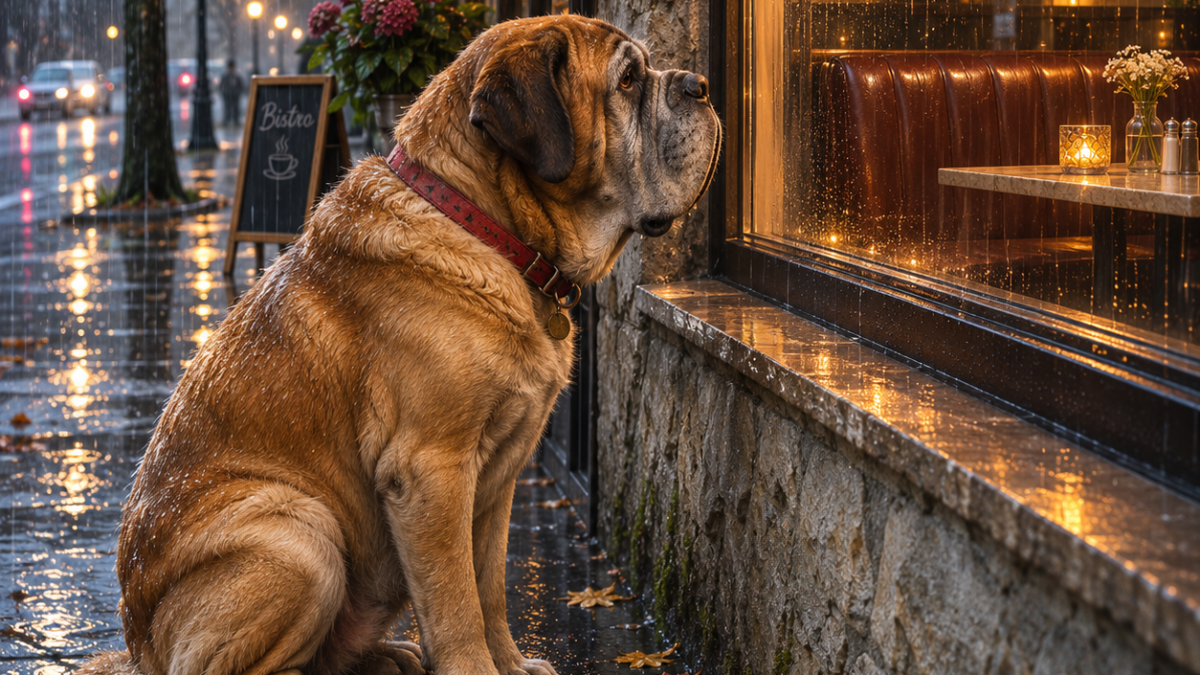
For nearly three weeks, an old English Mastiff returned every night to the same closed roadside restaurant in Burgundy, sitting through freezing rain with his graying face inches from the glass, refusing almost every scrap of food anyone offered him while staring at one empty booth in the back as if the person who belonged there had simply stepped away and might walk through the door at any second.
The night his back legs finally gave out beneath his enormous body, I ran across the wet parking lot expecting him to let me carry him somewhere warm, but Hector dragged himself upright, staggered two painful steps away from my hands, and planted himself in front of that window again with such desperate determination that I suddenly understood he wasn’t staying there because he had nowhere else to go—he was terrified that the one moment he left might be the exact moment someone came back for him.
I had driven that road for years and thought I knew every broken sign, every dark field, every lonely building between those little Burgundy towns, but nothing prepared me for the secret behind the empty booth Hector watched every night—or for the people who had worked very hard to make sure he would wait there forever.
The restaurant was called **Le Relais des Tilleuls**.
It sat just outside a small town, where the departmental road curved between vineyards, low stone walls, and open fields that turned almost black after sunset in November.
It wasn’t fancy.
There was a gravel lot big enough for six trucks, a faded illuminated sign over the entrance, and six brown vinyl booths inside. Drivers stopped there for coffee, stew, eggs, and whatever Marguerite had cooked that morning.
Marguerite was seventy-two and had owned the place for more than thirty years.
Lately, she closed at seven.
That was when Hector appeared.
The first time I noticed him, rain was blowing sideways across the parking lot.
I had pulled in around eight to check my paperwork before the last stretch of my delivery route. When I climbed down from my cab, I saw something huge under the awning.
At first I thought he belonged to a nearby farm.
Then he lifted his head.
He was an English Mastiff, brindle-coated, massive even though he had lost too much weight. His muzzle had gone almost completely white. A faded red collar hung loose around his neck.
His ribs showed beneath his dirty coat.
His hind legs trembled.
But his eyes were clear.
And they weren’t looking at me.
They were fixed on the restaurant window.
“Hey, big guy,” I said. “What are you doing out here?”
One ear twitched.
That was all.
I had half a sandwich left in the truck, so I tore off some bread and held it out.
Hector sniffed it politely, took one bite, and turned away.
I brought him water instead.
He drank.
Then he went straight back to staring through the glass.
I followed his gaze.
Inside, the lights were off. Chairs had been pushed in. The counter was empty.
At the far end of the dining room, beside an old radiator, was a booth.
Nobody was sitting there.
The next evening, Hector was back.
Two nights later, he was there again.
By the end of the week, I had started carrying dog food in my cab.
Sometimes he ate a few mouthfuls.
Sometimes he refused everything.
But whenever headlights slowed near the restaurant, his entire body changed.
His head came up.
His ears moved forward.
For a few seconds, the tired old dog became alert again.
Hope gave him strength that food couldn’t.
Then a stranger would step out.
And Hector would quietly return to the window.
One evening, I opened my passenger door and laid a blanket across the step.
“Come on,” I told him. “Just tonight. You’ll freeze out here.”
He walked toward me.
For one second, I thought I had him.
Then he looked over his shoulder.
The restaurant window was ten yards away.
Hector stopped.
He turned around.
And he went back.
That was when his waiting began to bother me.
Not because it was inconvenient.
Because I had started to recognize it.
There are some kinds of waiting that aren’t really waiting.
They’re faith.
And faith can become cruel when the person you’re trusting isn’t coming.
A few nights later, Hector’s back legs collapsed.
I ran to him.
“Easy. Easy, buddy.”
He was breathing hard. Rain ran off his face. I put one arm beneath his chest.
He resisted.
Not aggressively.
Desperately.
Then he forced himself up.
He took two shaking steps.
And returned to the same place in front of the window.
That was enough.
The next Friday, I arrived before closing.
Marguerite was behind the counter drying cups.
I ordered coffee, waited until the last customer left, then pointed through the glass.
“Do you know that dog?”
She froze.
Outside, Hector had just settled into position.
His pale muzzle faced the booth near the radiator.
Marguerite slowly put the cup down.
“Is he still coming every night?”
Her voice sounded different.
“You know him?”
She walked toward the window.
For several seconds, she said nothing.
Then she whispered, “My God, Hector.”
I felt the hairs rise on my arms.
“Why does he keep looking at that booth?”
Marguerite’s eyes filled with tears.
“Because that was their table.”
“Their table?”
She walked behind the register, opened a small drawer, and took out an old photograph.
She placed it in front of me.
A smiling elderly man sat in the booth beside the radiator.
Next to him, younger and heavier and without a gray hair on his muzzle, sat Hector.
The man’s broad hand rested against the dog’s head.
Marguerite looked at me.
“He’s waiting for Marcel.”
I stared at the photograph.
Then at Hector outside.
“Where is Marcel?”
Marguerite swallowed.
And for the first time since I had met her, the old restaurant owner looked genuinely afraid.
“I was told he was dead.”
PART 2
For a moment, I thought I had misunderstood her.
The refrigerator behind the counter hummed.
Rain tapped against the windows.
Outside, Hector hadn’t moved.
“What do you mean, you were told?”
Marguerite sat down across from me.
“Marcel Duret had been coming here for seventeen years.”
She touched the photograph with one finger.
“Same booth. Same time. Almost every evening.”
“With Hector?”
“For the last eight years.”
She smiled faintly.
“When Hector was a puppy, he could barely fit under that table without knocking everything over. By the time he was two, customers had to step around him.”
I looked at the picture again.
Marcel was probably in his early seventies there. Thick white hair. Weathered face. Big hands.
A trucker’s hands.
Marguerite confirmed it.
“He drove freight for almost forty years. France, Belgium, Germany, Spain. After his wife died, he retired to his parents’ farmhouse about twelve kilometers from here.”
“And Hector?”
“His wife had always wanted a Mastiff. Marcel bought Hector a few months after she died.”
Marguerite’s expression softened.
“He used to say the house sounded too empty without footsteps.”
That sentence stayed with me.
I looked out the window.
Hector was sitting exactly where he always sat.
Waiting for footsteps.
“What happened to Marcel?”
Marguerite leaned back.
“Three weeks ago, he was here.”
The timing hit me immediately.
Three weeks.
The same length of time Hector had been appearing outside after closing.
“What happened?”
“He arrived around six. Hector was with him. Marcel looked tired, but that wasn’t unusual. He ordered soup and coffee.”
She paused.
“Then his son came in.”
I hadn’t expected that.
“His son?”
“Luc.”
The way she said the name told me more than the name itself.
“You don’t like him.”
“I don’t like men who smile only when they want something.”
Marguerite folded her hands.
“Luc had barely visited his father for years. Then, about six months ago, he suddenly became very interested in Marcel’s health, Marcel’s bank accounts, Marcel’s land.”
“What land?”
“The farmhouse sits on nearly twelve hectares.”
I let out a slow breath.
Land in that area wasn’t worthless.
Not anymore.
“There were rumors about a development project,” Marguerite continued. “Warehouses. A transport company had been buying property near the main road.”
“And Marcel didn’t want to sell?”
“He hated the idea.”
Her voice grew firmer.
“He was born in that house. His wife died in that house. He intended to die there too.”
“What did Luc want?”
“What do you think?”
I looked at the photograph.
Money.
Marguerite continued.
“That night, they argued.”
“About selling?”
“I didn’t hear everything. Marcel was trying not to make a scene.”
She pointed toward the booth.
“Luc sat across from him. Hector was under the table. At one point Luc raised his voice and said, ‘You can’t manage that place anymore.’”
“What did Marcel say?”
Marguerite’s jaw tightened.
“He said, ‘Then help me. Don’t steal it from me.’”
I stopped breathing for half a second.
“Steal?”
“That was the word.”
She looked toward the door.
“I went over to ask if everything was all right. Luc smiled and said it was a family disagreement.”
“What happened next?”
“Marcel stood up.”
Her eyes closed briefly.
“He took two steps.”
Then she opened them.
“And collapsed.”
I looked outside at Hector.
“He had a heart attack?”
“That’s what I assumed. I called an ambulance.”
“Did he die here?”
“No.”
The word came quickly.
“He was alive when they took him.”
“And Hector?”
Marguerite looked down.
“That is the part I haven’t been able to forgive myself for.”
I waited.
“Hector tried to follow the stretcher.”
Her voice broke.
“He was frantic. Not barking. Not biting. Just trying to stay beside Marcel. The paramedics couldn’t take him.”
“So Luc took him?”
Marguerite nodded.
“He said he would take care of Hector.”
I felt something cold settle inside me.
“When did Luc tell you Marcel was dead?”
“Two days later.”
“How?”
“He came here.”
“What exactly did he say?”
Marguerite thought carefully.
“He said his father had suffered another cardiac episode at the hospital and didn’t make it.”
“Did you go to the funeral?”
Her face changed.
“There wasn’t one.”
“No funeral?”
“Luc said Marcel had asked to be cremated privately.”
“Did Marcel ever mention wanting that?”
“No.”
“Any obituary?”
“I couldn’t find one.”
“And you didn’t think that was strange?”
“I did.”
She sounded defensive now, but mostly at herself.
“I called the hospital.”
“What did they say?”
“Nothing. I’m not family.”
Fair enough.
“And Hector showed up when?”
“The first time I saw him was four nights after Marcel collapsed.”
Four nights.
“Without Luc?”
“Alone.”
“In that condition?”
“He wasn’t this thin yet.”
“Did you call Luc?”
“Yes.”
“What did he say?”
“That Hector had run away.”
“Did he come get him?”
Marguerite looked at me.
“No.”
That one word changed everything.
I pushed my coffee aside.
“What kind of man doesn’t come get his dead father’s dog?”
Marguerite’s voice was barely audible.
“The kind who never wanted the dog in the first place.”
I stood and walked to the window.
Hector saw my movement in the reflection but didn’t turn around.
“Do you have Luc’s phone number?”
“Yes.”
“Call him.”
Marguerite hesitated.
“Now?”
“Now.”
She went behind the counter, found an old address book, and dialed from the restaurant phone.
She put it on speaker.
It rang five times.
Then a man answered.
“Hello?”
“Luc? It’s Marguerite from Le Relais.”
Silence.
Then, “Yes?”
“Hector is here again.”
Another silence.
“I told you. He ran away.”
“He’s been here almost every night for weeks.”
“That isn’t my problem.”
I looked at Marguerite.
She looked back at me.
“How can it not be your problem?” she asked. “He belonged to your father.”
“He belonged to my father. My father is dead.”
Hector suddenly raised his head outside.
A car had turned onto the access road.
For an absurd second, hearing Luc say those words while watching Hector hope for another set of headlights made anger climb into my throat.
Marguerite kept her voice steady.
“Should we take him to you?”
“No.”
“Why not?”
“I don’t have room.”
“You live in a house.”
“I said no.”
“He’s old, Luc.”
“So?”
“He’s sick.”
“Then call a shelter.”
I stepped closer to the phone.
“What’s the name of the crematorium?”
Luc stopped talking.
Marguerite stared at me.
I continued.
“You said Marcel was cremated privately. Where?”
“Who is this?”
“My name is Laurent. I knew your father from the restaurant.”
That wasn’t exactly true.
But I had already decided I wasn’t going to let him dismiss us.
“His arrangements are none of your business.”
“You’re right. Hector is.”
“The dog ran away.”
“From where?”
“What?”
“Where did he run away from?”
Another silence.
“My property.”
“Address?”
“You don’t need my address.”
“Your father lived at the farmhouse near Montbertrand, didn’t he?”
His voice sharpened.
“How do you know that?”
“Small town.”
“That dog is dangerous.”
I looked through the glass at the trembling animal who had barely eaten half a bowl of kibble in two days.
“No,” I said. “He’s heartbroken.”
Luc hung up.
For several seconds, neither Marguerite nor I spoke.
Then I said, “Marcel isn’t dead.”
Marguerite looked shocked.
“You can’t know that.”
“No.”
I picked up the photograph.
“But I know Luc didn’t sound like a man protecting a private family tragedy.”
“What did he sound like?”
“Like a man protecting a lie.”
—
That night I didn’t leave Hector outside.
It took nearly an hour.
I brought the blanket from my truck again, but he refused to follow me.
So I did something different.
I went inside, asked Marguerite to turn on the lights near the back booth, and opened the restaurant door.
Hector immediately stood.
His legs shook.
He stared inside.
“Come on, boy.”
He took one step.
Then another.
His nails clicked against the tile.
The moment he crossed the threshold, he stopped.
His nose lifted.
He could smell something.
Old grease.
Coffee.
Cleaning solution.
People.
Maybe, beneath all of it, Marcel.
Hector walked past me.
He didn’t explore.
He didn’t sniff the counter.
He went straight to the booth beside the radiator.
Then he lowered himself onto the floor beside it.
Exactly where Marguerite said he used to lie.
His body made a heavy sound when it touched the tile.
Marguerite covered her mouth.
I sat across the room.
Nobody spoke.
Five minutes later, Hector fell asleep.
Not the half-alert dozing I had seen outside.
Real sleep.
Deep enough that his jowls twitched.
Marguerite turned away and wiped her eyes.
“He thinks Marcel might come back if he stays here.”
I watched the old dog.
“No.”
She looked at me.
“I think he knows this is the last place they were together.”
—
The next morning, I changed my route.
I’m not proud of skipping part of a delivery schedule, but sometimes your priorities get rearranged by an eight-year-old Mastiff.
I drove to Marcel’s farmhouse.
Marguerite had given me directions.
The place sat at the end of a narrow lane bordered by bare chestnut trees. The house was old but solid, built from pale stone with dark shutters.
A large barn stood behind it.
There was a red-and-white real estate sign near the road.
**SALE PENDING.**
I stopped the truck.
That sign told me more than any conversation could.
I walked toward it.
There was a number for an agency in Dijon.
The front gate was chained.
No vehicle in the yard.
No lights.
But something bothered me.
The doghouse beside the barn had been overturned.
A heavy chain lay in the mud.
I crouched.
The chain wasn’t attached to anything.
I found a cracked stainless-steel water bowl nearby.
Empty.
There were tire tracks in the wet ground.
Recent.
I was standing when a voice called from behind me.
“You lost?”
A man in a dark jacket stood near the lane.
He was perhaps sixty.
Thin.
Gray mustache.
“I was looking for Marcel Duret.”
His face changed immediately.
“You family?”
“No.”
“Then who’s asking?”
“Laurent. Truck driver.”
He studied my truck.
Then me.
“I’m René. I own the place across the field.”
I nodded toward the house.
“Do you know what happened to Marcel?”
He hesitated.
“Luc says he died.”
“You believe Luc?”
That was the right question.
René gave a humorless laugh.
“I wouldn’t believe Luc if he told me it was raining while we were both standing in a storm.”
We stood in silence.
Then he walked closer.
“You know about Hector?”
“I’ve been feeding him.”
René closed his eyes.
“Poor bastard.”
“You’ve seen him?”
“I saw Luc take him.”
My pulse jumped.
“Take him where?”
“I don’t know.”
“When?”
“The morning after Marcel went to the hospital.”
“Tell me exactly what you saw.”
René looked toward the farmhouse, almost as if someone might be listening.
“Luc came with a white van. Hector wouldn’t get in. He kept pulling back toward the house.”
“What did Luc do?”
“Dragged him by the collar.”
My jaw tightened.
“He hit him?”
“No. Not while I watched.”
René looked uncomfortable.
“But he was angry.”
“Did Hector come back?”
“Two days later.”
“Here?”
René nodded.
“I found him at the gate.”
That didn’t fit.
Marguerite had first seen Hector four days after Marcel collapsed.
“What happened then?”
“I gave him water. He stayed here most of the day.”
“And Luc?”
“Came back around sunset.”
René’s voice dropped.
“He loaded Hector into the van again.”
“Did you ask what he was doing?”
“I did.”
“What did he say?”
“That he was taking him to a shelter.”
I felt the answer before I asked.
“There isn’t a shelter near here, is there?”
“Nearest proper one is almost forty kilometers in the opposite direction.”
“Which direction did Luc drive?”
René pointed toward the departmental road.
Toward the restaurant.
“South.”
My stomach tightened.
“So Hector was abandoned.”
René stared at the ground.
“That’s what I think.”
“How far away?”
“I couldn’t tell you.”
But Hector could.
Somewhere, that old dog had been dumped.
And instead of returning to the farmhouse, he had returned to the restaurant.
To the last place he had seen Marcel conscious.
I looked again at the **SALE PENDING** sign.
“When did that go up?”
“Five days after Marcel went to the hospital.”
Five days.
“You can’t legally sell someone’s property just because they’re hospitalized.”
René gave me a long look.
“Unless you have authority.”
“Power of attorney?”
“Luc claimed he did.”
“Did Marcel ever tell you he planned to sell?”
René laughed.
This time there was anger in it.
“Marcel once told a property broker he’d rather let the roof fall into the kitchen than sell that land for warehouses.”
I stared at the house.
Something was wrong.
Very wrong.
“Do you know which hospital took him?”
René did.
—
The hospital wouldn’t tell me anything.
Of course it wouldn’t.
I had expected that.
I gave Marcel’s name to the receptionist and said I was an old friend.
She checked her screen.
Her expression changed slightly.
Then she repeated the standard line.
“I can’t confirm whether a patient is or has been admitted here.”
I nodded.
“Understood.”
I left.
But as I walked toward the parking lot, an elderly man in a blue volunteer vest came after me.
“Monsieur?”
I turned.
He lowered his voice.
“Are you looking for Mr. Duret?”
I didn’t answer immediately.
“You know him?”
“I helped transport patients between wards.”
My heart started beating harder.
“Was he here?”
The volunteer glanced toward the entrance.
“I can’t discuss medical information.”
“I don’t want medical information. I want to know if my friend’s father is alive.”
The man studied me.
Then said something very careful.
“You should ask why someone would tell you otherwise.”
That was all.
But it was enough.
Marcel had left that hospital alive.
—
I drove straight to Le Relais.
Marguerite was feeding Hector pieces of cooked chicken.
He ate from her hand.
Not much.
But more than before.
I walked in and shut the door.
“He’s alive.”
Marguerite’s hand froze.
“What?”
“I don’t know where he is. But he didn’t die at the hospital.”
She stared at me.
“How do you know?”
“I know enough.”
Her face went pale.
Then anger replaced the shock.
“That lying son of a—”
She stopped herself.
Hector looked up.
Marguerite sat beside him.
“Where would Luc take him?”
“Some kind of care facility, maybe.”
“Marcel hated nursing homes.”
“That doesn’t mean Luc gave him a choice.”
She suddenly stood.
“The drawer.”
“What?”
“The other drawer.”
She hurried behind the register.
I followed.
She pulled out several old folders, receipts, menus, and envelopes.
“What are you looking for?”
“Something Marcel gave me.”
“When?”
“About a month before he collapsed.”
That stopped me.
“What did he give you?”
“An envelope.”
“Why?”
“He told me not to open it unless he asked for it.”
“And you never opened it?”
“No.”
“You still have it?”
“I think so.”
She dug deeper.
Then stopped.
Her hand came out holding a large brown envelope.
On the front, in shaky handwriting, were six words.
**Marguerite — keep this somewhere Luc cannot find.**
My skin went cold.
“Open it.”
She looked at me.
“Marguerite, open it.”
She tore the envelope.
Inside were photocopies of bank statements, a property deed, several printed emails, and a handwritten letter.
Marguerite unfolded the letter.
She read the first paragraph silently.
Then sat down.
“What?”
She handed it to me.
I read.
Marcel had written that he believed Luc had accessed one of his accounts without permission.
He had noticed two withdrawals.
Then a transfer.
Then documents from a real estate company he did not remember signing.
He had confronted Luc.
Luc claimed Marcel was becoming forgetful.
Marcel didn’t believe him.
Near the end of the letter was a sentence that made my stomach turn.
**If Luc tells anyone I agreed to sell the farm, he is lying.**
Below it:
**If anything happens to me, contact Claire.**
“Who’s Claire?” I asked.
Marguerite looked at the paper.
“I don’t know.”
There was a phone number.
I called it.
A woman answered after three rings.
“Hello?”
“Claire?”
“Yes.”
“My name is Laurent. I’m calling about Marcel Duret.”
She stopped breathing.
I could hear it.
Then she said, “Where is my grandfather?”
Grandfather.
I looked at Marguerite.
“We were hoping you could tell us.”
—
Claire arrived that evening from Lyon.
She was thirty-one, a pediatric nurse, exhausted from a three-hour drive and angrier than any person I had seen in a long time.
The moment she entered the restaurant, Hector lifted his head.
Claire stopped.
Her face collapsed.
“Hector.”
The old Mastiff struggled upright.
For the first time since I had known him, his tail moved.
Once.
Twice.
Then harder.
Claire dropped to her knees.
Hector pressed his enormous head against her chest.
She buried both arms around him.
“Oh my God.”
Her voice cracked.
“Oh, Hector.”
The dog whimpered.
It was the first sound I had ever heard him make.
Claire started crying.
Marguerite turned away.
I pretended to study the coffee machine.
For several minutes, there was nothing to say.
Finally Claire sat on the floor beside Hector.
“I haven’t been able to reach Grandpa for almost a month.”
“Why didn’t you come?” I asked.
The question sounded harsher than I intended.
She didn’t become defensive.
She looked ashamed.
“My father told me Grandpa didn’t want to speak to me.”
“Your father is Luc.”
“Yes.”
There it was.
“Why would he tell you that?”
“Because my grandfather and I were close.”
Claire stroked Hector’s white muzzle.
“And my father hated it.”
She told us the rest.
Luc was Marcel’s only son.
Claire was Luc’s only daughter.
Her parents had divorced when she was thirteen. Afterward, Claire had spent weekends and summers at Marcel’s farmhouse.
Marcel had taught her to drive in an old Renault on the dirt lane.
He had attended every school concert, every graduation, every birthday.
When Claire moved to Lyon for nursing school, she still called him twice a week.
Then, six weeks earlier, Marcel started sounding worried.
“He said Dad was pressuring him to sign papers.”
“The farm,” I said.
Claire nodded.
“Grandpa said Dad had debts.”
“How much?”
“I don’t know.”
“Gambling?”
“No. Business.”
Luc had invested in a construction partnership that had failed.
He owed money.
A lot of it.
“And Marcel’s land could cover it,” I said.
Claire nodded again.
“Grandpa told me he would never sell.”
“Then what happened?”
“Dad called me three weeks ago and said Grandpa had a cardiac event.”
“Did he say Marcel died?”
“No.”
That surprised us.
“What did he say?”
“That Grandpa was recovering and didn’t want visitors.”
Marguerite’s expression hardened.
“He told me Marcel was dead.”
Claire looked at her.
“What?”
“He told me your grandfather died.”
The color drained from Claire’s face.
“Why would he—”
Then she stopped.
Because we all knew.
Different lies for different people.
If Marguerite believed Marcel was dead, she wouldn’t expect him at the restaurant.
If Claire believed Marcel didn’t want her around, she wouldn’t keep looking.
And if everyone stayed separated, Luc controlled the information.
Claire pulled out her phone.
“I called hospitals. They wouldn’t tell me anything.”
“Same problem I had.”
“He blocked my number on Grandpa’s phone.”
“How do you know?”
“I tried calling from a coworker’s phone two days ago.”
“And?”
“Someone answered.”
“Who?”
“My father.”
The restaurant became very quiet.
“What did he say?”
“That Grandpa’s phone belonged to the family and I needed to stop harassing him.”
I looked down at Hector.
The dog was resting his head on Claire’s knee.
“Then we find Marcel.”
—
It took Claire less than twenty-four hours.
Family changes things.
Hospitals won’t talk to truck drivers.
But a granddaughter with identification, records, dates, and the name of a patient can ask better questions.
Marcel had been discharged six days after admission.
He had not gone home.
His discharge address belonged to a private rehabilitation and assisted-living facility outside Beaune.
Claire called.
She was told Marcel Duret was a resident.
Alive.
The relief hit so hard she had to sit down.
Then came the next surprise.
“No visitors,” the receptionist told her.
“Excuse me?”
“Mr. Duret has restricted visitors.”
“I am his granddaughter.”
“I understand.”
“He would never restrict me.”
“I’m sorry.”
“Who made that request?”
“I can’t discuss—”
“Was it my father?”
Silence.
Claire closed her eyes.
We already had the answer.
The next morning, we went anyway.
I drove.
Marguerite came too.
Hector stayed at the restaurant with René because the facility did not allow animals except approved therapy dogs.
I hated leaving him.
He stood at the entrance watching us go.
“Bring him back,” René told us.
Not Hector.
Marcel.
—
The facility was beautiful in the way expensive places often are.
Stone buildings.
Trimmed hedges.
Warm lobby.
Soft music.
Everything designed to make difficult things look peaceful.
Claire approached reception.
“I’m here to see Marcel Duret.”
The woman behind the desk checked her computer.
“I am sorry. Mr. Duret is not receiving visitors.”
“I want to speak to whoever is in charge.”
A supervisor came.
Then another conversation.
Then documents.
Then refusal.
Finally Claire said, “I believe my grandfather is being isolated by someone who is financially exploiting him.”
That changed the atmosphere.
The supervisor stopped smiling.
“Ms. Duret, that’s a serious allegation.”
“I know.”
She placed Marcel’s letter on the desk.
“That’s why I’m making it.”
Twenty minutes later, we were sitting in an office.
A doctor joined us.
Then a social worker.
I didn’t hear every detail because Claire was family and I was not, but I heard enough.
Marcel had arrived weak, confused, and recovering from cardiac surgery.
Luc had represented himself as primary caregiver.
He had brought legal documents.
He had told staff that Marcel suffered from cognitive decline.
But medical evaluations had shown something else.
Marcel was tired.
Depressed.
Occasionally disoriented from medication.
But he was not incapable of making decisions.
“Can I see him?” Claire asked.
The social worker looked at the doctor.
The doctor nodded.
“Yes.”
Claire started crying before she stood up.
Then she turned to me.
“Come with me.”
The staff hesitated.
“Please,” she said. “He’s the reason we found him.”
So they let me.
—
Marcel was sitting beside a window.
I recognized him instantly from the photograph.
But the man in the picture had been broad-shouldered.
This man looked smaller.
Older.
He wore a gray sweater over pajama pants.
A walker stood beside him.
His hands rested in his lap.
Claire stopped in the doorway.
“Grandpa?”
Marcel turned his head.
For two full seconds, he did nothing.
Then his entire face changed.
“Claire?”
She crossed the room so fast a nurse had to move aside.
Marcel tried to stand.
He couldn’t.
Claire knelt and wrapped her arms around him.
I looked away.
There are moments you don’t need to watch to understand.
I heard Marcel say her name again.
Then I heard Claire crying.
Then Marcel asked one question.
“Where’s Hector?”
Not how did you find me.
Not why are you here.
Not what happened to the farm.
“Where’s Hector?”
Claire laughed through her tears.
“He’s alive.”
Marcel’s eyes closed.
His chin dropped.
For a second I thought he was fainting.
Then I saw tears sliding down his face.
“Luc said he was gone.”
Claire’s voice changed.
“What do you mean?”
“He said Hector ran into the road.”
My fists closed.
“He told you Hector was dead?”
Marcel nodded.
“He said there was nothing they could do.”
I stepped forward.
“Mr. Duret?”
He looked at me.
“My name is Laurent.”
I took the photograph from my jacket.
“Your dog has been waiting for you.”
Marcel stared at the picture.
Then at me.
“Where?”
“Le Relais.”
His lips parted.
“The restaurant?”
“Every night.”
Marcel covered his mouth with one hand.
“He went back.”
“Yes.”
“He went back to our table.”
I nodded.
Marcel bowed his head.
And cried.
—
We brought Hector the next day.
The facility made an exception after hearing the circumstances.
I drove him in René’s van because my truck cab was too difficult for his legs.
Hector seemed restless the entire journey.
He stood twice.
Lay down.
Stood again.
At the facility entrance, Claire was waiting.
“Ready?”
I opened the rear doors.
Hector stepped down using a ramp.
He sniffed the air.
Then froze.
His nose lifted.
The change was immediate.
He pulled forward.
“Hector. Slow.”
He ignored me.
Not aggressively.
He simply knew.
We entered the hallway.
His nails clicked against the floor.
One turn.
Then another.
A nurse opened Marcel’s room.
Hector stopped.
Marcel was sitting in a chair.
For a moment, neither moved.
“Hector.”
The dog made a sound I will never forget.
Not a bark.
Not a whine.
Something deeper.
Almost a cry.
Then he ran.
An eight-year-old Mastiff whose back legs had collapsed on a wet sidewalk two nights before ran.
He crossed the room and hit Marcel’s knees with his chest.
Marcel folded over him.
Hector tried to climb into his lap despite weighing more than a small person.
“Easy, boy.”
Marcel laughed and cried at the same time.
“My boy.”
Hector licked his face.
His tail struck the chair.
Again.
Again.
Again.
Claire was crying.
The nurse was crying.
I was pretending I had something in my eye.
Marcel gripped Hector’s collar.
“I thought you were dead.”
Hector shoved his head beneath Marcel’s arm.
Marcel buried his face against him.
“I thought I’d lost you.”
I had spent weeks watching that dog stare at an empty booth.
Now I understood why he had refused to leave.
Hector had not been waiting because he failed to understand Marcel was gone.
He had been waiting because the last truth he knew was that Marcel had left from that place.
And until someone gave him another truth, he refused to accept anything else.
—
The reunion should have been the end.
It wasn’t.
It was the beginning.
Because once Marcel had Hector back, his mind seemed to sharpen.
That might sound sentimental.
It wasn’t magic.
His doctors said familiar routines and emotional stability could help.
But even they admitted the change was remarkable.
Marcel started eating more.
Participating in therapy.
Walking farther.
As his strength returned, so did his anger.
And Marcel had a lot to be angry about.
Claire brought him the envelope.
He read his own letter.
Then he looked at her.
“I thought Marguerite would keep it safe.”
“She did.”
“Luc found the originals.”
“What originals?”
“Bank records. The first contract.”
He looked toward me.
“I wasn’t imagining it.”
“No,” I said. “You weren’t.”
He explained everything.
Six months earlier, Luc had approached him about selling part of the farm.
Marcel refused.
Then paperwork began appearing.
A valuation request he hadn’t authorized.
A preliminary agreement.
Bank correspondence redirected to Luc’s address.
At first Marcel assumed it was a mistake.
Then he checked one of his accounts.
Money was missing.
Not enough to ruin him.
Enough to scare him.
He confronted Luc.
Luc said Marcel had forgotten authorizing the transfer.
“I knew what he was doing,” Marcel said. “He was building a story.”
“What story?” Claire asked.
“That I was losing my mind.”
Luc had started telling neighbors Marcel was confused.
He persuaded Marcel’s doctor at the time to evaluate him.
He offered to “help” with bills.
He repeatedly brought documents to sign.
Marcel refused most of them.
But one evening, after a minor fall, Luc arrived while Marcel was taking pain medication.
“He put papers in front of me.”
“Did you sign?”
Marcel’s face tightened.
“I signed something.”
Claire went pale.
“You didn’t know what?”
“I thought it was related to insurance.”
A property authorization had later appeared bearing Marcel’s signature.
Marcel disputed it.
Luc argued.
Then came the night at Le Relais.
“I told him I was calling a lawyer,” Marcel said.
Marguerite nodded.
“That was the argument I heard.”
Marcel looked at her.
“I was going to come back the next morning and get the envelope.”
Instead, he collapsed.
“And while you were hospitalized,” I said, “Luc moved.”
Marcel stared out the window.
“He always did hate waiting.”
—
The farmhouse sale was scheduled to close in nine days.
Nine.
Luc had moved fast.
The buyer was a development company planning a distribution depot near the departmental road.
Their attorney claimed they had negotiated in good faith.
Maybe they had.
Maybe they hadn’t.
That part would have to be investigated.
But Marcel’s lawyer filed an emergency challenge immediately.
The sale was frozen.
Luc learned about it within hours.
He called Claire.
I was sitting beside her when her phone rang.
She looked at the screen.
“Dad.”
Marcel looked up.
“Answer.”
Claire put him on speaker.
“What are you doing?”
No hello.
No concern.
Just anger.
Claire stayed calm.
“I’m visiting Grandpa.”
Silence.
Then, “Where?”
Marcel leaned toward the phone.
“Somewhere you told people I couldn’t be found.”
Luc went quiet.
His father continued.
“You told Marguerite I was dead.”
“I was trying to keep people from interfering.”
“You told me Hector was dead.”
“That animal ran away.”
“You abandoned him.”
“I didn’t.”
“I have a witness.”
That was me.
Luc’s breathing changed.
“Who is there?”
Marcel looked at me.
I leaned toward the phone.
“The truck driver.”
Luc cursed.
“Stay out of my family.”
I felt my temper rise.
Marcel raised one hand.
He didn’t need me fighting for him now.
He could fight for himself.
“You’re right,” Marcel said. “It is family.”
Then his voice hardened.
“And you’ve spent six months stealing from yours.”
“I haven’t stolen anything.”
“The farm is not for sale.”
“You signed the authorization.”
“Under medication.”
“You knew what you were signing.”
“Then why did you tell everyone I was losing my mind?”
Silence.
Marcel smiled without humor.
“That’s what I thought.”
Luc hung up.
Marcel handed Claire the phone.
Then he looked at Hector, sleeping beside his chair.
“We’re going home.”
—
The doctors wouldn’t release him immediately.
Marcel needed two more weeks of rehabilitation.
Luc, however, didn’t wait.
Three days after the call, René phoned me at five in the morning.
Someone was at Marcel’s farmhouse.
I drove there before my first delivery.
A white van stood beside the barn.
Luc.
I parked across the gate.
He came out carrying a cardboard box.
It was the first time I had seen him.
Early fifties.
Expensive coat.
Controlled face.
He looked like the kind of man who practiced appearing reasonable.
“You Laurent?”
“Yes.”
“Move your truck.”
“No.”
“This is private property.”
“Your father’s property.”
“I have authority to be here.”
“Your father says you don’t.”
His jaw moved.
“Move.”
“What are you taking?”
“Personal belongings.”
“Whose?”
“None of your business.”
I looked at the box.
Documents.
Folders.
“Those look like your father’s business.”
Luc stepped toward me.
“You think because you fed a stray dog you know something about us?”
“Hector wasn’t stray.”
“He became stray.”
“Because you dumped him.”
“I drove him to a shelter.”
“Which shelter?”
Luc stopped.
“Name it.”
His eyes narrowed.
“You need to be careful.”
“Why?”
“You drive for a living. Your employer know you’re harassing people?”
There it was.
The threat.
Small.
Clean.
Plausibly deniable.
I smiled.
“You really do only smile when you want something.”
His expression changed.
Marguerite had been right.
I pulled out my phone.
Luc glanced at it.
“You recording me?”
“I am now.”
He walked toward the van.
I stepped aside.
I wasn’t going to physically stop him.
But neither was René.
And René had already called the police.
The patrol car arrived before Luc could leave.
Luc became charming instantly.
Misunderstanding.
Family dispute.
Legal documents.
Concerned son.
The officers listened.
They couldn’t arrest him just for being on property he claimed authority over.
But they could document what he had removed.
And because Marcel’s lawyer had already notified authorities about suspected financial exploitation, those boxes suddenly mattered.
Luc left without them.
I watched his van disappear.
René stood beside me.
“He’ll come back.”
“Yes.”
“Men like that always do.”
I looked at the farmhouse.
“Then next time we’ll be ready.”
—
The criminal investigation moved slowly.
The emotional damage didn’t.
Hector stayed with Marcel almost every day.
He gained weight.
A veterinarian examined his hips and found arthritis but no severe neurological problem.
His collapse had been caused by exhaustion, cold, poor nutrition, and pain.
With medication and rest, he improved quickly.
The veterinarian also found abrasions around his neck.
Consistent with his collar being pulled hard.
Marcel saw them.
He didn’t say anything for a long time.
Then he asked me, “Where did you find him?”
I told him.
Every detail.
The rain.
The window.
The food Hector refused.
The passing cars.
The way he stood every time headlights turned in.
Marcel listened without interrupting.
When I finished, his eyes were wet.
“He always hated being alone.”
“So did you.”
He looked at me.
I regretted saying it.
Then he smiled.
“That’s why we understood each other.”
He rested one hand on Hector.
“My wife, Elise, used to say I could spend twelve hours driving through three countries without speaking to anyone and still come home complaining the house was too quiet.”
“She wanted the dog?”
“She wanted a Mastiff for twenty years.”
Marcel laughed softly.
“I always said they were too big.”
He scratched Hector’s head.
“Turns out she was right again.”
—
The most important evidence came from Marguerite.
Or more accurately, from a camera nobody remembered existed.
Ten years earlier, after several break-ins in the parking lot, Marguerite’s late husband had installed a security camera above the kitchen service door.
It wasn’t sophisticated.
The picture was grainy.
The date sometimes drifted.
But the recording unit was still connected.
Marguerite assumed it had stopped working years ago.
It hadn’t.
A technician recovered footage from the night Marcel collapsed.
We watched it at the restaurant.
Marcel’s ambulance left at 6:47 p.m.
At 6:52, Luc came out holding Hector’s collar.
Hector resisted.
Luc pulled.
Hector turned repeatedly toward the road where the ambulance had disappeared.
At one point, the old dog planted all four feet.
Luc jerked the collar so hard Hector stumbled.
Marguerite covered her mouth.
Then Luc forced him into the van.
That alone was ugly.
The next recording mattered more.
Two days later, Luc returned to the restaurant after closing.
He parked behind the building.
Entered through the side entrance when Marguerite was taking out trash.
We had no audio inside.
But the dining-room camera showed him talking to her.
That was when he told her Marcel was dead.
When we showed Marcel the footage, his face became completely still.
“He rehearsed it.”
Claire looked at him.
“What?”
“He didn’t say it because he was confused.”
Marcel pointed to Luc on the screen.
“He came here specifically to make her believe I was dead.”
The lie was deliberate.
That mattered.
Then the technician found something else.
A van passed the camera at 3:11 a.m. the following night.
Same white van.
It stopped at the far edge of the parking lot for seventeen seconds.
The rear doors opened.
A large dark shape jumped—or fell—onto the gravel.
The van drove away.
The shape remained.
Hector.
Nobody spoke.
The recording showed him stand slowly.
Look around.
Then walk toward the restaurant.
He went straight to the window.
Straight to the booth.
Marcel broke.
He leaned forward and covered his face.
“Hector.”
Claire put an arm around him.
Marguerite walked out of the room.
I stayed.
I watched the screen.
At 3:14 in the morning, after being taken from his home, separated from his owner, driven through the dark and abandoned, that old dog had chosen one place.
The last place he remembered being with Marcel.
And he waited.
—
Luc’s attorney tried to explain the footage.
Hector had been “released near a familiar location.”
Those were the words.
Released.
As if dumping an elderly dog beside a closed restaurant at three in the morning was an act of kindness.
The judge overseeing the property dispute wasn’t impressed.
Neither were investigators.
But Luc still wasn’t finished.
He claimed Marcel lacked mental capacity.
That claim was the foundation of everything.
If Marcel was incompetent, Luc could argue that his actions had been necessary.
So Marcel underwent an independent medical evaluation.
Then another.
He passed both.
He knew the date.
His finances.
His property boundaries.
His medical history.
He could describe the disputed documents.
He could name every field surrounding his farm.
He could remember the registration number of the first truck he drove in 1973.
When the physician asked whether he understood why the examination was being conducted, Marcel replied:
“Because my son needs me to be stupid.”
The doctor wrote something down.
Marcel looked at me afterward.
“Think I passed?”
“I think you scared him.”
“Good.”
—
The bank investigation uncovered transfers.
The handwriting expert questioned two signatures.
The notary who had handled the preliminary sale admitted that most communication had gone through Luc.
Then the development company produced an email.
It had supposedly been written by Marcel.
The email said he was eager to sell quickly because maintaining the property had become too difficult.
Marcel read it.
Then laughed.
Claire looked confused.
“What?”
“I didn’t write this.”
“We know.”
“No.”
He pointed at one sentence.
“Look.”
The email used the phrase **‘our family holding.’**
Marcel shook his head.
“I don’t know what a family holding is.”
Despite everything, I laughed.
Marcel did too.
Then his face hardened.
“My son does.”
Investigators traced the message.
It had been sent from an account created eleven days before Marcel’s collapse.
The recovery phone number was Luc’s.
That was the crack.
After that, the wall started coming down.
—
Luc still believed he could control the story.
He began telling people his father was being manipulated.
By Claire.
By Marguerite.
By me.
He called my employer.
He told them I had threatened him.
My manager asked me to come in.
I expected trouble.
Instead, he closed the office door and said, “Did you threaten him?”
“No.”
“Did you block his driveway with a truck?”
“Yes.”
He stared at me.
“Why?”
“He was removing documents from his father’s property during a fraud investigation.”
My manager rubbed his forehead.
“Laurent.”
“I know.”
He stared at me for another five seconds.
“Next time, don’t use my truck.”
I blinked.
“That’s it?”
“No.”
He leaned forward.
“If he calls again, I’m charging him for wasting my morning.”
I laughed for the first time in days.
Luc’s revenge against me had failed.
So he tried something worse.
He went after Hector.
—
The facility called Claire one afternoon.
A man claiming to be Hector’s legal owner had arrived demanding the dog.
Luc.
I was forty minutes away.
Claire was at work.
Marcel was in physical therapy.
Luc had brought paperwork showing he had paid for one of Hector’s old veterinary visits years earlier.
He claimed that established ownership.
It didn’t.
But he was loud.
Confident.
And insistent.
A nurse called Marcel.
Marcel came down with his walker.
Hector was beside him.
Luc stood in the lobby.
Father and son faced each other for the first time since the hospital.
I learned the details afterward from Claire and the staff, but Marcel later told me the exact conversation.
Luc said, “That dog belongs to me.”
Marcel answered, “Say his name.”
Luc frowned.
“What?”
“If he’s your dog, say his name.”
Luc stared at him.
“Hector.”
Hector didn’t move.
Marcel tapped his leg.
Hector immediately crossed to him.
Marcel placed one hand on the dog’s head.
“No,” he said. “He knows who he belongs to.”
Luc demanded the dog again.
The facility called police.
Then Luc made a mistake.
He grabbed Hector’s collar.
Hector didn’t bite.
He didn’t growl.
He simply recoiled so violently that his back legs slipped.
Marcel shouted.
A nurse stepped between them.
And the lobby security camera recorded the entire thing.
By the time I arrived, Luc was gone.
Hector was lying beside Marcel.
Marcel was furious.
“He put his hands on my dog.”
I had never heard him sound like that.
“I know.”
“No.”
He looked at me.
“You don’t understand.”
His hands were shaking.
“He already took everything he thought he could take from me.”
His money.
His home.
His independence.
His granddaughter.
His dog.
He looked toward the door.
“He isn’t taking anything else.”
—
Marcel left rehabilitation six days later.
He couldn’t return to the farmhouse immediately because the investigation was ongoing and the heating system needed repairs.
Marguerite had an apartment above the restaurant that had been empty since her husband died.
She offered it.
Marcel refused.
Marguerite ignored him.
“You have two choices,” she said. “Upstairs, or I put you in the pantry.”
“You’re seventy-two. You can’t threaten an old man.”
“I’m younger than you.”
“By four years.”
“Exactly. Respect your elders.”
Marcel moved upstairs.
Hector followed.
For the first week, he still went downstairs at seven.
Every evening.
He walked to the booth beside the radiator.
Marcel sat there with him.
Sometimes I joined them after my route.
We drank coffee.
Marguerite complained that we were using electricity after closing.
Then she brought us pie.
Hector slept beneath the table.
The difference was simple.
He wasn’t waiting anymore.
—
The hearing over the farm took place in January.
Cold morning.
Gray sky.
Marcel wore his best jacket.
Claire sat beside him.
I sat behind them with Marguerite.
Luc sat across the room.
He looked smaller than I expected.
Not physically.
Men sometimes shrink when the truth enters the room.
His lawyer argued that Luc had acted out of concern for an elderly father whose health was deteriorating.
Then Marcel’s attorney played the video.
Luc dragging Hector.
Luc returning to tell Marguerite Marcel had died.
The van at 3:11 a.m.
Hector being abandoned.
The courtroom was silent.
Then came the bank records.
The fake email.
The disputed signatures.
The medical reports establishing Marcel’s capacity.
René’s testimony.
Marguerite’s testimony.
Claire’s testimony.
Mine.
When Luc testified, he insisted everything had been misunderstood.
He said Hector had been released near the restaurant because it was familiar.
The judge interrupted.
“You released an elderly domestic dog at three o’clock in the morning?”
Luc hesitated.
“Yes.”
“In November?”
“Yes.”
“With no person present?”
“I believed someone would find him.”
The judge looked over her glasses.
“Someone did.”
Luc’s face tightened.
Then Marcel testified.
He walked slowly to the witness chair.
No theatrics.
No shouting.
His voice was quiet.
That made it stronger.
“My son spent months telling people I could not remember my own decisions.”
He looked at Luc.
“But he forgot something.”
The judge waited.
“I taught him to lie.”
Luc’s head snapped up.
Marcel continued.
“When Luc was a child, he broke a window with a soccer ball. He told me the wind did it. I made him stand there until he admitted the truth.”
A few people smiled.
Marcel didn’t.
“I told him then that lying has a problem.”
“What problem?” his attorney asked.
“You have to remember every version.”
He looked directly at his son.
“The truth only has one.”
No one smiled after that.
—
The property sale was voided.
Marcel retained the farm.
A separate criminal investigation continued.
Luc was eventually charged with fraud, attempted financial exploitation of a vulnerable adult, document falsification, and animal abandonment.
Not every accusation resulted in conviction.
Cases like that are complicated.
But enough did.
Enough to end the lies.
Enough to force repayment.
Enough to destroy Luc’s claim that he had simply been helping his father.
He received a custodial sentence, part suspended, financial penalties, and an order to repay money taken from Marcel’s accounts.
The business debt that had driven him to chase the farm became his problem again.
Exactly as it should have been.
But the part people around town remembered wasn’t the sentence.
It happened outside the courthouse.
Luc was being escorted down the steps after one of the final hearings.
Marcel stood at the bottom.
Claire beside him.
Hector beside Claire.
Luc stopped.
For a second, I thought Marcel might say something cruel.
After everything Luc had done, nobody would have blamed him.
Instead, Marcel looked at his son.
“You know what the worst part was?”
Luc said nothing.
“You didn’t need the farm.”
Luc frowned.
“You needed money.”
Marcel’s voice remained calm.
“You could have asked me for help.”
Luc looked away.
“I would have said no to paying your debts.”
Marcel continued.
“But I would have helped you find a way through them.”
Luc’s face tightened.
“You chose this.”
There it was.
Not rage.
Not hatred.
Something worse.
Truth.
Then Marcel rested his hand on Hector’s head.
“You told me he was dead because you knew losing him would make me weak.”
Luc finally looked at the dog.
Marcel’s voice cracked for the first time.
“You were wrong.”
Hector pressed against his leg.
“He brought me back.”
Luc had no answer.
Marcel turned away.
That was his revenge.
Not seeing Luc hurt.
Not destroying him.
Taking back every thing Luc had tried to erase.
His home.
His money.
His judgment.
His granddaughter.
His dog.
His name.
His life.
And leaving Luc alone with the consequences of what he had done.
—
By spring, Marcel returned to the farmhouse.
Claire wanted him to move closer to Lyon.
He refused.
They compromised.
A home nurse visited twice a week.
Claire came every other weekend.
René checked on him daily.
I stopped by whenever my route allowed.
And Hector?
Hector became fat.
Not dangerously fat.
Marcel called it “recovered dignity.”
The veterinarian called it eight unnecessary pounds.
“He earned them,” Marcel argued.
“He has arthritis.”
“So do I.”
“You’re not supposed to gain eight pounds either.”
Marcel stared at the veterinarian.
“Traitor.”
Hector sneezed.
We all laughed.
The farmhouse changed too.
Marcel canceled every conversation about development.
Instead, he leased part of the land to a neighboring farmer.
The barn roof was repaired.
The broken gate was replaced.
And Marcel put up one small sign near the lane.
**NOT FOR SALE.**
Underneath, in smaller letters:
**DON’T ASK.**
I told him that was unnecessary.
He told me to mind my own business.
—
Le Relais des Tilleuls stayed open.
Marguerite claimed she was retiring every six months.
Nobody believed her.
The booth beside the radiator remained Marcel’s.
Every Thursday evening, he and Hector came for dinner.
Not every night anymore.
Marcel had learned that routine could become a prison too.
But Thursdays mattered.
Sometimes truckers who knew the story would recognize Hector.
They would approach carefully.
“Is that the dog?”
Marcel always pretended not to understand.
“What dog?”
“The one who waited.”
Marcel would look beneath the table.
Hector would be asleep, usually drooling on the floor.
“Doesn’t look like he’s waiting for much now.”
Then Marguerite would bring Hector a bowl of water and Marcel his soup.
Same table.
Same radiator.
Same old red collar, though Claire had reinforced it so it wouldn’t break.
Marcel refused to replace it.
“Elise bought that collar.”
His wife.
That ended every argument.
—
A year after I first found Hector outside the restaurant, I pulled into the parking lot on a rainy November night.
Same kind of rain.
Cold.
Slanting beneath the awning.
For a second, memory played a trick on me.
I saw the empty window.
I remembered Hector sitting there.
Thin.
Exhausted.
Watching headlights.
Waiting for a man who wasn’t coming.
Then the restaurant door opened.
Warm light spilled onto the wet pavement.
Hector walked out.
He was slower now.
But stronger.
Marcel followed with his cane.
“You’re late,” he called.
“I have a job.”
“So did I. Never stopped me from being on time.”
“You were a truck driver.”
“A better one than you.”
I laughed.
Hector came toward me.
I crouched and scratched his heavy neck.
“You remember me?”
He leaned against my knees with enough weight to nearly knock me over.
Marcel smiled.
“He remembers everyone who fed him.”
“That explains why he barely remembered you at first.”
Marcel pointed his cane at me.
“Careful.”
We went inside.
Marguerite had already set three coffees on the table.
Claire was there too.
She had driven down from Lyon.
For an hour we talked about ordinary things.
Road construction.
Fuel prices.
Claire’s hospital.
Marguerite’s latest argument with a supplier.
Nothing dramatic.
Nothing important.
And somehow that made it perfect.
Because ordinary life was what Luc had nearly stolen from Marcel.
Not just property.
Not money.
Ordinary mornings.
Coffee.
Arguments.
A dog sleeping under the table.
The right to decide where you live.
The right to choose who sits beside you.
People think revenge has to be loud.
Sometimes it is.
Sometimes it’s a courtroom.
A verdict.
A locked door.
A man losing what he tried to steal.
But sometimes the best revenge is quieter.
It’s surviving long enough to sit again in the place where someone expected your absence to become permanent.
—
Hector lived another two years.
His hips worsened slowly.
His muzzle went completely white.
He started sleeping more.
Marcel bought three expensive orthopedic beds.
Hector ignored all of them and slept beside Marcel’s chair.
On warm days, they sat outside the farmhouse.
Marcel in an old wooden chair.
Hector in the grass.
Claire once took a photograph of them from behind.
An old man.
An old dog.
Two fields stretching toward the horizon.
She gave me a copy.
I still have it.
The last winter was difficult.
Hector struggled with stairs.
Marcel struggled too.
“Race you,” Marcel would tell him.
Neither moved quickly enough for anyone to win.
Then, one February morning, Claire called me.
“Can you come?”
I knew from her voice.
I drove to the farmhouse.
Hector was lying on a blanket beside the stove.
Marcel sat on the floor with him.
That alone told me how serious it was.
Marcel couldn’t easily get down there anymore.
But he had.
Hector’s breathing was slow.
His eyes were open.
The veterinarian had already come.
There was no emergency.
No trauma.
No cruelty.
Just age.
The heart that had waited through freezing rain had finally become tired.
Claire sat nearby.
René stood by the door.
Marguerite had brought a thermos nobody touched.
Marcel rested one hand against Hector’s head.
“You don’t have to wait anymore.”
His voice broke.
Hector blinked.
Marcel leaned closer.
“You hear me?”
He rubbed the white fur above Hector’s eye.
“You found me.”
Hector’s tail moved once against the blanket.
Marcel laughed softly through his tears.
“Yeah.”
He lowered his forehead to Hector’s.
“I found you too.”
Hector died with Marcel’s hand on him.
Not alone.
Not beside a road.
Not outside a locked restaurant.
Home.
Exactly where he belonged.
—
We buried him beneath a linden tree behind the farmhouse.
Marcel chose the spot.
From there, you could see the lane.
The fields.
And part of the road toward Le Relais.
The stone was simple.
**HECTOR**
**2016–2026**
Marcel wanted another line.
He argued with Claire about it for two days.
Finally, they agreed.
Beneath Hector’s name were the words:
**HE WAITED.**
**WE CAME BACK.**
—
Marcel stopped going to Le Relais for several weeks after Hector died.
The booth hurt too much.
I understood.
Marguerite didn’t pressure him.
Neither did Claire.
Then one Thursday evening, I pulled into the restaurant and saw Marcel’s old car.
I went inside.
He was sitting in the booth beside the radiator.
Alone.
A cup of coffee in front of him.
The space beneath the table was empty.
I sat across from him.
“You okay?”
“No.”
I appreciated the answer.
For a while we said nothing.
Then Marcel looked down beside his feet.
“I kept thinking I’d hear him breathe.”
I nodded.
“He breathed like a tractor.”
Marcel smiled.
“Worse.”
“He drooled.”
“Constantly.”
“He stole half my sandwich once.”
“You offered it.”
“I did not.”
“He said you did.”
I laughed.
Marcel laughed.
Then his eyes filled.
For a moment, the empty space beneath that table seemed enormous.
“I don’t know how a dog does that,” Marcel said.
“Does what?”
“Turns a place into home.”
I looked around the restaurant.
The worn booths.
The old radiator.
Marguerite behind the counter.
Rain against the glass.
“Maybe they don’t.”
Marcel looked at me.
“Maybe they just show us where home already is.”
He considered that.
Then nodded.
—
Marcel lived at the farmhouse for several more years.
He never sold.
When he eventually became too old to manage it safely, he didn’t wait for someone else to decide for him.
He transferred the property into a protected arrangement that allowed Claire to manage it without selling unless certain conditions were met.
He joked that Luc had taught him one useful lesson.
“Never trust a signature you haven’t read twice.”
The field closest to the house remained open.
No warehouses.
No concrete.
No trucks.
Marcel said he’d had enough trucks for one lifetime.
I told him that was insulting.
He said I would survive.
And I did.
—
Years later, after Marguerite finally retired for real, a younger couple bought Le Relais des Tilleuls.
They renovated almost everything.
New floor.
New counter.
New lights.
New kitchen.
But one booth stayed.
Brown vinyl.
Near the radiator.
The owners wanted to replace it.
Marguerite refused to sign the sale papers unless they agreed to keep it.
When they asked why, she told them the story.
So the booth remained.
They framed the old photograph.
Marcel sitting there.
Hector beside him.
It hangs on the wall now.
Beneath it is a small brass plaque.
It doesn’t mention Luc.
It doesn’t mention fraud.
It doesn’t mention courtrooms, forged signatures, money, property, or revenge.
It says only:
**HECTOR’S TABLE**
**For those who wait for the people they love.**
—
Sometimes, when I drive that road after dark, I still stop.
I park where I did the first night.
I look through the window.
For a second, I can still see him.
A huge brindle Mastiff beneath the awning.
Red collar.
Gray face.
Eyes fixed on the back of the restaurant.
People had passed him for days.
Some gave him food.
Some gave him water.
Some assumed he was lost.
But Hector wasn’t lost.
He knew exactly where he was.
The rest of us were the ones who didn’t understand.
He was keeping a promise no human had asked him to make.
The last time Hector saw Marcel, his person had disappeared from that booth and been carried away through the restaurant doors.
So Hector returned to the last place their lives had still made sense.
Night after night.
Rain after rain.
Car after car.
He stayed.
When his body weakened, he stayed.
When hunger hurt, he stayed.
When strangers offered warmth somewhere else, he stayed.
And in the end, that stubborn old dog accomplished something none of us had managed to do.
He made us ask the right question.
Not:
**Why won’t this dog leave?**
But:
**Who is missing?**
That question exposed a lie.
Then another.
Then another.
It stopped a stolen farm from being sold.
It reunited a granddaughter with her grandfather.
It forced a frightened old man to realize he wasn’t helpless.
It brought a son face-to-face with the consequences of his own greed.
And most importantly, it brought Marcel home.
People often say dogs are loyal because they don’t understand betrayal the way humans do.
I don’t believe that anymore.
I think they understand more than we give them credit for.
Hector knew he had been abandoned.
He knew Marcel was gone.
He knew he was tired.
Cold.
Hungry.
In pain.
He simply refused to believe abandonment was the end of the story.
Maybe that is what loyalty really is.
Not blindness.
Not ignorance.
A decision.
A decision to keep showing up when every reasonable part of you says there is no point.
A decision to stay beside the door.
Watch the road.
Remember the person you love as they were—not as someone else claims they are.
And sometimes, against every expectation, that kind of loyalty changes the ending.
Hector waited almost three weeks outside a closed restaurant for a man he had been told, in the only way a dog can be told, would never return.
He never knew about the forged documents.
He never understood the money.
He never knew that Luc lied about Marcel’s death, or that Marcel had been told Hector was dead.
He didn’t know about judges, lawyers, bank records, property contracts, or criminal charges.
He knew one thing.
Marcel had left.
So Hector waited for him to come back.
And eventually, because Hector refused to stop waiting, we went looking.
We found Marcel.
Marcel found Hector.
And the man who tried to erase them both learned the one lesson he should have remembered from childhood:
A lie can move fast.
It can frighten people.
Separate them.
Confuse them.
It can even make the truth disappear for a while.
But a lie has to keep running.
The truth can stay in one place.
Sometimes all it has to do is wait.








