PART 2: For 3 Frozen Days, an Old Dog Guarded His Dead Owner—Then He Raised One Trembling Paw and Changed the Entire Investigation
PART 2
Opening the van took less than thirty seconds.
Getting the dog to let us do it took nearly twenty minutes.
Every time I reached for the handle, he shifted his body into the space between my hand and the door.
Never snapping.
Never growling.
Just insisting.
Émilie tried food.
Nothing.
The veterinarian tried approaching from behind.
The dog noticed immediately and repositioned himself.
Finally I sat down on the frozen shoulder.
Actually sat.
My uniform trousers were wet within seconds.
The dog stared at me.
“I don’t know your name,” I said.
His ears moved.
“But I know you’re tired.”
Nothing.
“I know he isn’t answering you.”
The dog’s head turned toward the window.
“I’m sorry.”
His eyes came back to me.
“We need to open the door.”
I slowly extended my hand.
This time he didn’t raise his paw.
He sniffed my fingers.
Then, unexpectedly, he put his forehead against my palm.
That was permission.
Or at least I chose to understand it that way.
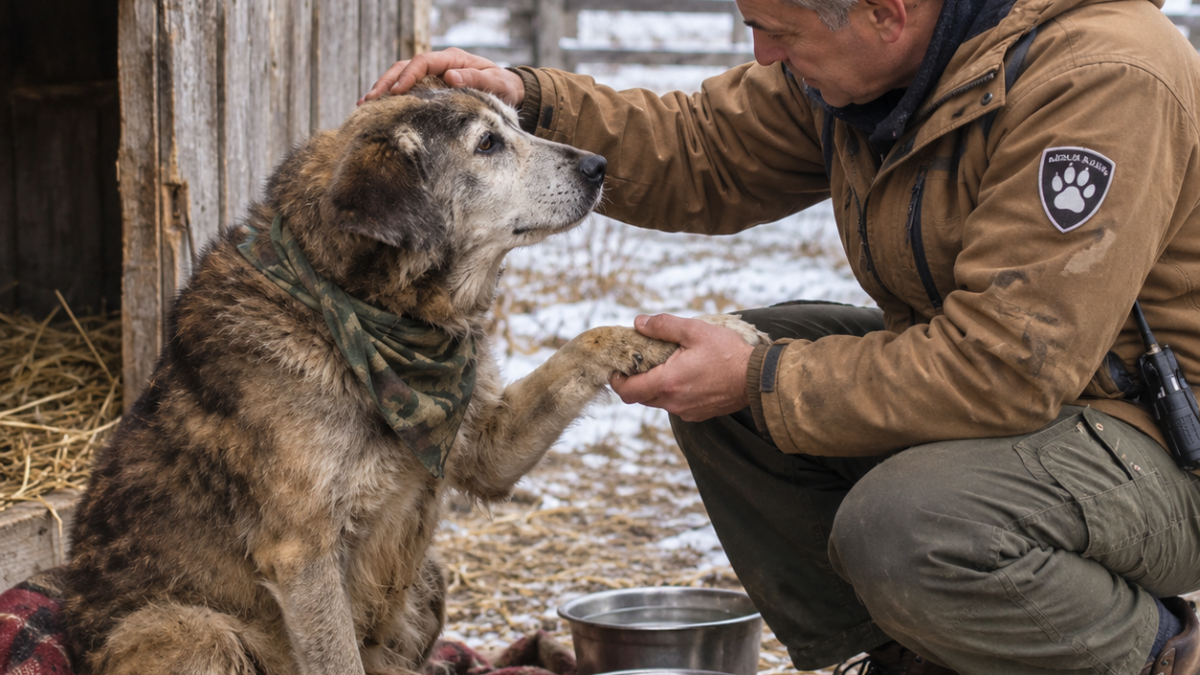
Émilie clipped a leash gently to the collar beneath the military scarf.
The dog resisted when I touched the handle.
I opened the door anyway.
The old man’s body shifted slightly toward us.
The dog made one raw sound and tried to climb inside.
Émilie held him.
“Easy.”
He fought her for perhaps three seconds.
Then stopped.
Not because he accepted it.
Because he had no strength left.
The paramedics confirmed what I already knew.
The man had been dead for some time.
Wallet identification gave us his name.
**René Valette.**
Seventy-four.
Residence: a small village outside Decize.
Retired.
No emergency contact in his wallet.
The dog’s collar had a brass plate.
**MARCEL**
Underneath:
**R. VALETTE**
Telephone number.
So the dog was Marcel.
I crouched near him.
“Marcel.”
His head lifted immediately.
Finally.
A word he understood.
“You’re Marcel.”
His tail moved once.
A tiny sweep against frozen gravel.
Émilie looked at me.
“Well, that’s something.”
I glanced at the dead man being carefully removed from the vehicle.
Marcel watched every movement.
When the paramedics transferred René to the stretcher, Marcel tried to follow.
His legs buckled.
The veterinarian caught him.
“He’s done.”
Marcel struggled once.
Then collapsed into her arms.
That was the first time he left the van.
Not because he chose to.
Because his body could no longer keep its promise.
—
# THE PAW
Marcel was transported to a veterinary clinic.
I should have returned to ordinary procedure.
Document the scene.
Arrange removal of the van.
Notify next of kin.
Wait for the medical examiner.
Roadside death.
Possibly cardiac.
Possibly stroke.
Sad.
But straightforward.
Except for the paw.
I kept seeing it.
Raised.
Held.
Lowered.
Not random.
That night I called the veterinarian.
“How is he?”
“Alive.”
“That bad?”
“Very dehydrated. Cold. Exhausted. His kidneys are stressed, but I think he’ll recover.”
“Eating?”
“Not much.”
“Does he still raise his paw?”
Silence.
Then:
“Yes.”
I sat straighter.
“When?”
“When his heart rate monitor beeps.”
“What?”
“That’s why I wanted to call you tomorrow.”
I waited.
The veterinarian continued.
“One of my technicians noticed something. Marcel raises his right paw whenever the monitor alarm sounds.”
“Why?”
“I don’t know yet.”
I thought of René.
“What kind of dog is he?”
“Mixed shepherd, probably thirteen or fourteen.”
“Can you check for a chip?”
“Already did.”
“And?”
“Registered to René Valette.”
“Anything else?”
“There’s a secondary contact listed. A training organization.”
“What kind?”
Another pause.
“Medical assistance dogs.”
I stopped writing.
“What kind of medical assistance?”
“We’re checking.”
An hour later she called again.
“Laurent?”
“Yes.”
“Marcel was trained as a cardiac alert dog.”
Everything inside me went still.
“Explain.”
“René had a serious heart condition. Marcel was trained to detect physiological changes associated with cardiac episodes.”
“And the paw?”
“That was the alert.”
I looked at the notes from the roadside.
Marcel had raised his paw before I touched the door.
“He wasn’t asking me to wait.”
“No.”
“He was warning me.”
“Yes.”
“About René.”
“Most likely.”
My throat tightened.
For three days, the dog had been performing the behavior he was trained to perform.
Alert.
Wait for response.
Alert again.
But René could no longer respond.
And when I approached the body, Marcel gave the signal to me.
As though saying:
Something is wrong with him.
Help him.
I leaned back in my chair.
The veterinarian said quietly, “There’s more.”
“What?”
“The training organization has records. René reported that Marcel had successfully alerted him to two cardiac events in the past.”
“So René knew what the signal meant.”
“Absolutely.”
That changed something.
Maybe not legally.
Not yet.
But it changed the picture in my mind.
If Marcel had alerted René before he died, René may have known he was in danger.
Why hadn’t he called emergency services?
His phone was sitting in the cup holder.
Battery at forty-one percent.
No outgoing emergency call.
No unfinished text.
Nothing.
Maybe the cardiac event had been too sudden.
That was the obvious explanation.
I should have accepted it.
Instead, I drove back to the impound lot the next morning.
—
# THE VAN
The van smelled of cold vinyl, old tobacco, dog hair, and coffee.
René had kept it clean in the practical way older men often keep work vehicles.
Not spotless.
Organized.
Blanket behind the seats.
Tools in a plastic crate.
Old road map.
Thermos.
Receipts.
Dog treats.
Two empty water bottles.
A pair of gloves.
I looked at the driver’s seat.
For three days, René had remained there while Marcel guarded the door.
I tried not to imagine it.
The forensic technician had already photographed everything.
I was not looking for evidence of a crime.
I told myself that.
I was looking because the dog bothered me.
That sounds ridiculous.
It was true.
I opened the glove compartment.
Registration documents.
Veterinary receipts.
Medication list.
René took several heart medications.
One name had been circled in pen.
Beside it he had written:
**new tablets — different color**
I stared.
Not evidence.
Patients notice changes in generic medication all the time.
Still.
I photographed it.
Then I found a folded appointment card.
**Maître Cécile Arnaud — Attorney**
**Nevers**
**Monday, 10:00 a.m.**
The date was the morning René had apparently died.
I checked the estimated time of death.
Early Monday.
He had been driving toward Nevers.
Toward an attorney.
I called her.
She answered on the fourth ring.
“Maître Arnaud.”
“Adjudant Laurent Perrin, gendarmerie.”
A pause.
“Yes?”
“I’m calling about René Valette.”
Her voice changed immediately.
“What happened?”
“You were expecting him Monday?”
“Yes.”
“He never arrived.”
“Is he all right?”
I looked through the windshield of the empty van.
“No.”
Silence.
Then:
“Oh God.”
I heard a chair move.
“He’s dead?”
“Yes.”
“How?”
“We’re still waiting for the final medical finding.”
Another silence.
Then she said something unexpected.
“Was the dog with him?”
“Yes.”
“Marcel?”
“Yes.”
“Is Marcel alive?”
“He is.”
She exhaled.
“Thank God.”
I wrote it down.
“You know the dog?”
“Only from René talking about him.”
“What was Mr. Valette meeting you about?”
This time the pause was different.
Professional.
Guarded.
“I can’t disclose client communications casually, Adjudant.”
“He’s dead.”
“That doesn’t automatically eliminate confidentiality.”
“Was he afraid?”
Another pause.
“Yes.”
I stopped writing.
“Of what?”
“I think we should speak in person.”
—
# THE ATTORNEY
Cécile Arnaud’s office overlooked a narrow street in Nevers.
She was in her late forties.
Precise.
Calm.
The type of person who used silence deliberately.
She placed a file on the desk.
“I can tell you some things because René specifically authorized disclosure to law enforcement if he died or became incapacitated.”
That sentence made the room feel colder.
“He anticipated that?”
“He said he was being dramatic.”
“Were you convinced?”
“No.”
She opened the file.
“René was treasurer for an association supporting former service members and their families.”
I knew the organization.
**Fraternité Nivernaise des Anciens Combattants.**
Small.
Local.
Fundraisers.
Emergency grants.
Funeral assistance.
Medical equipment.
“He discovered missing money,” Arnaud said.
“How much?”
“Initially about forty thousand euros.”
“That’s not small.”
“It got larger.”
“How large?”
“Potentially over two hundred thousand across several years.”
I whistled quietly.
“Who had access?”
“Several officers of the association.”
“Names?”
She slid a page across the desk.
The first was René.
The second was president Claude Ménard.
The third:
**Benoît Lavigne — Secretary / Financial Coordinator.**
I knew the name.
Local businessman.
Insurance broker.
Town council connections.
Fundraising events.
Photographs with veterans.
I looked up.
“René suspected Lavigne?”
“He suspected someone.”
“That’s careful wording.”
“I’m an attorney.”
“What did he find?”
“Payments to suppliers that may not exist. Reimbursements for veterans who never received money. Duplicate invoices. Cash withdrawals.”
“And why not go directly to police?”
“He wanted a complete package.”
“Why?”
Arnaud’s mouth tightened.
“Because he had already confronted Lavigne.”
I stopped.
“When?”
“Two weeks before his death.”
“What happened?”
“Lavigne told him he was confused.”
“Meaning?”
“Old. Forgetful. Paranoid.”
“That’s convenient.”
“Very.”
She pulled out another paper.
“Three days later, Lavigne contacted René’s daughter.”
“Daughter?”
I had not yet found next of kin.
“Amélie Valette. Lives in Tours.”
“What did he tell her?”
“That her father was showing signs of dementia.”
I sat back.
“Did he?”
“No diagnosis.”
“And René?”
“He was furious.”
Arnaud looked down.
“He and his daughter already had a difficult relationship.”
“Why?”
“After René’s wife died, he became isolated. Proud. Hard to help.”
I understood the type.
“And Lavigne used that?”
“I believe so.”
“What was René bringing you Monday?”
“Original account ledgers and a digital recording.”
“Where are they?”
“He said he would bring them himself.”
I thought of the van.
We had not found a ledger.
No recorder.
“Did he hide things?”
“Constantly.”
“Why?”
“He didn’t trust Lavigne.”
“Did he have reason to think someone would search his home?”
Arnaud looked at me.
“Yes.”
—
# MARCEL WANTED TO GO BACK
That afternoon I visited the veterinary clinic.
Marcel was standing.
Barely.
But standing.
The military scarf had been removed and washed.
Émilie had brought it from the roadside.
I held it.
The colors were faded blue, red, and gold.
“Was René military?” I asked.
The veterinarian nodded.
“Army medical corps. According to the assistance-dog records.”
Marcel saw the scarf.
His ears lifted.
I crouched.
“Hey, old man.”
He came toward me.
Slowly.
His right paw lifted.
I froze.
Then realized the veterinarian’s monitor was beeping behind me.
Marcel looked toward it.
Medical alert.
Again.
Even exhausted, the behavior remained.
I stroked his neck.
“You did your job.”
He stared at me.
“You did it for three days.”
His head lowered.
I tied the scarf loosely around his neck.
Something changed.
His body relaxed.
Home smell, perhaps.
René’s smell.
Memory.
The veterinarian said, “He keeps trying to get out.”
“Out where?”
“We don’t know.”
“Maybe the van.”
“Maybe.”
I thought about the missing ledger.
The missing recorder.
Then had an idea that felt foolish enough that I almost didn’t say it.
“Can he travel?”
“Short distance.”
“I want to take him to the van.”
The veterinarian stared at me.
“Why?”
“Because René trusted him.”
“That’s not police methodology.”
“No.”
“What is it?”
“Desperation.”
She smiled despite herself.
“Twenty minutes.”
—
# WHAT MARCEL SHOWED ME
The impound yard was quiet.
I opened the passenger door.
Marcel stopped six feet away.
His entire body stiffened.
For a moment I regretted bringing him.
Then he walked forward.
He sniffed the step.
The seat.
The ground.
Then went directly around to the driver’s side.
The door was open.
He stood looking at the empty seat where René had died.
A sound came from him.
Soft.
Painful.
I looked away.
“Sorry.”
Marcel put his front paws on the step.
Then dropped back down.
He moved toward the rear of the van.
Sniffed.
Returned to the front.
Then he scratched once at the floor behind the driver’s seat.
I crouched.
“What?”
Scratch.
There was a rubber mat.
I pulled it aside.
Metal floor.
Nothing.
Marcel scratched again.
Same spot.
I tapped it.
Different sound.
Hollow.
The van had an aftermarket storage panel beneath the floor.
Tools, I assumed.
We removed two screws.
Lifted the panel.
Inside was a waterproof document pouch.
My pulse accelerated.
A notebook.
A flash drive.
A small digital recorder.
And an envelope.
Across the front:
**IF I DON’T MAKE IT TO CÉCILE — GIVE THIS TO THE GENDARMERIE**
I sat back on my heels.
Marcel lowered himself beside me.
I looked at him.
“You knew.”
Of course he didn’t understand the words.
But he knew that compartment.
Maybe René had trained him to indicate it.
Maybe Marcel had watched him open it.
Maybe scent drew him there.
It didn’t matter.
The dog had just found what we were missing.
Inside the envelope was a single handwritten line:
**Benoît knows I found the transfers. If anything happens, start with the coffee meeting at La Charrette, Saturday, 4 p.m.**
René died early Monday.
Two days after the coffee meeting.
—
# THE RECORDING
We listened at the brigade.
René’s voice was quiet.
Benoît Lavigne’s was clearer.
The recording had been made secretly.
At first, ordinary conversation.
Weather.
Veterans’ dinner.
A broken boiler at the association hall.
Then René said:
“You took money from men who needed oxygen tanks.”
Lavigne laughed.
“You need to be careful with accusations.”
“I have the transfers.”
“You have spreadsheets you don’t understand.”
“I understand numbers.”
“You’re seventy-four.”
“I’m not stupid.”
“No one said stupid.”
“You told my daughter I have dementia.”
Silence.
Then Lavigne:
“I told her you’ve become obsessive.”
“You stole the money.”
“You should go home.”
“I’m taking everything to Arnaud Monday.”
Long silence.
Then Lavigne’s voice changed.
Lower.
“You really want to do that?”
“Yes.”
“Think about Amélie.”
René said nothing.
Lavigne continued.
“She already thinks you’re difficult. You want her to spend the next year watching people call you senile in public?”
“I don’t care.”
“You will.”
“Not as much as you will when they see the accounts.”
Chair movement.
Then Lavigne:
“You always were stubborn.”
The recording ended.
No explicit murder threat.
But motive.
Pressure.
Fear.
And the coffee meeting.
We pulled surveillance footage from La Charrette.
There they were.
René.
Lavigne.
Marcel lying beside René’s chair.
At 4:37, Lavigne left for the restroom.
René remained seated.
At 4:41, Lavigne returned.
At 4:45, he handed René a small paper bag.
Medication?
Documents?
We zoomed.
Couldn’t tell.
René placed it in his coat.
The bag was not found in the van.
That bothered me.
—
# THE AUTOPSY
René had severe coronary disease.
That alone could have killed him.
But toxicology delayed the final report.
Then the medical examiner called.
“We found something.”
I went in person.
She placed the report down.
“René had a high concentration of a beta-blocking medication in his blood.”
“He took heart medication.”
“Not this one.”
I looked at the medication list.
She pointed.
“This drug was not prescribed to him.”
“Could it have been given accidentally?”
“Possible.”
“Could it kill him?”
“In someone with his cardiac history, a high dose could produce profound bradycardia, hypotension, collapse.”
My skin prickled.
“Would Marcel detect the physiological change?”
“The dog?”
“Cardiac alert dog.”
The medical examiner thought.
“Potentially. Depends what he was trained to detect.”
I remembered the paw.
Alert.
Again.
Again.
For three days.
“What about the timing?”
“Could fit ingestion several hours before death.”
I thought about Saturday.
Coffee meeting.
But René died Monday.
Too long.
Unless the drug was taken later.
“Any evidence he took it himself?”
“No prescription. No container.”
“Could someone have switched his tablets?”
“Yes.”
The note in the glove compartment came back to me.
**new tablets — different color**
We sent René’s medications for analysis.
One bottle was labeled correctly.
The tablets inside were not.
Half were his prescribed medicine.
Half contained the unprescribed beta blocker.
Mixed.
Deliberately or accidentally?
Pharmacy records showed his prescription had been dispensed correctly.
Same manufacturer.
Same appearance as usual.
Somebody had changed the tablets afterward.
Now we had a suspicious death.
—
# RENÉ’S HOUSE
René’s home was small.
Stone walls.
Wood stove.
Photographs.
Military certificates.
A framed picture of a younger Marcel beside René’s chair.
Amélie arrived while we were searching.
She was forty-two.
Dark hair.
Tired eyes.
She looked at the photograph before she looked at me.
“Where’s Marcel?”
“At the clinic.”
“Is he okay?”
“Recovering.”
She nodded quickly.
“My father loved that dog more than people.”
“That’s what I’m hearing.”
She almost smiled.
Then it disappeared.
“How did he die?”
“We’re investigating.”
Her eyes narrowed.
“What does that mean?”
“It means we don’t believe we have the full answer yet.”
She sat.
I asked about Lavigne.
Her expression changed instantly.
“Benoît?”
“Yes.”
“What about him?”
“When did he tell you your father was developing dementia?”
She looked uncomfortable.
“About ten days ago.”
“Did you believe him?”
“I…”
She looked at her hands.
“My father and I weren’t close.”
“Why?”
“He made everything difficult.”
Her voice hardened defensively.
“After Mom died, he pushed everyone away. He refused help. He criticized my husband. He stopped visiting because he said Tours had too much traffic. He could turn a birthday dinner into an argument.”
I nodded.
“Did he ever forget who you were?”
“No.”
“Get lost?”
“No.”
“Miss bills?”
“No.”
“Repeat conversations?”
“Everyone repeats conversations.”
“Exactly.”
Her eyes filled.
“You think Benoît lied to me.”
“I think Benoît benefited if people questioned your father’s judgment.”
She stared at the floor.
“I told Dad he needed a medical evaluation.”
“How did he react?”
“He hung up.”
“Last conversation?”
She nodded.
The guilt in her face was immediate.
I knew that look.
Families carry unfinished sentences like stones.
“He called again Sunday,” she whispered.
“The day before he died?”
“Yes.”
“Did you answer?”
She shook her head.
“I was angry.”
Her eyes filled.
“He left a voicemail.”
“Do you still have it?”
“Yes.”
We listened.
René’s voice:
**Amélie, it’s Dad. I’m sorry I shouted. I’m going to Nevers tomorrow. After that, maybe things will make more sense. Don’t worry about me. Marcel’s here. He always knows before I do when something’s wrong. I love you. Call when you’re ready.**
The message ended.
Amélie covered her mouth.
I looked away.
Marcel always knows before I do.
The dog had alerted.
René trusted him.
And yet René had died alone in a van while the dog kept signaling to people who didn’t understand.
That detail became personal.
I wanted whoever had done this.
If someone had.
But wanting is not proof.
So we kept digging.
—
# LAVIGNE
Benoît Lavigne arrived voluntarily for interview.
That was the first thing I disliked about him.
Too comfortable.
Early sixties.
Expensive overcoat.
Soft voice.
He carried sadness like an accessory.
“René was my friend.”
“Were you?”
“Twenty years.”
“You argued Saturday.”
“Old men argue.”
“You told his daughter he had dementia.”
“I said he seemed confused.”
“His doctor disagrees.”
“I’m not a doctor.”
“Correct.”
He smiled faintly.
“What did you give him in the paper bag?”
The smile disappeared for half a second.
“Supplements.”
“What kind?”
“Vitamins.”
“Brand?”
“I don’t remember.”
“Why?”
“He complained about fatigue.”
“Did he ask you for vitamins?”
“I offered.”
“Where did you buy them?”
“I don’t remember.”
“You don’t remember the brand or where you bought them?”
“I buy many things.”
“Did you touch his medication?”
“No.”
“Ever enter his home?”
“Of course.”
“When last?”
“Maybe a month ago.”
We knew that was false.
A neighbor’s security camera showed Lavigne’s car outside René’s house four days before the coffee meeting.
He stayed eighteen minutes.
René was at a veteran’s luncheon.
When confronted later, Lavigne said he had stopped by to drop off documents.
“Inside?”
“René had given me a key.”
“Why?”
“He trusted me.”
“Enough for you to enter when he wasn’t home?”
No answer.
We obtained a warrant.
At Lavigne’s home, investigators found association files.
Nothing illegal at first.
Then financial records.
Duplicate invoices.
Shell vendors.
Cash transfers.
And in a bathroom cabinet:
The same beta-blocking medication found in René’s blood.
Prescription belonged to Lavigne’s wife.
She had stopped taking it eight months earlier.
Lavigne said that proved nothing.
He was right.
Not yet.
—
# MARCEL CAME HOME
Amélie visited the clinic.
I was there.
Marcel saw her before she reached the room.
He stood so quickly the veterinarian tried to stop him.
His tail began moving.
Not the weak single sweep I had seen roadside.
A full wag.
Amélie froze.
“Oh, Marcel.”
The dog pulled toward her.
She dropped to her knees.
Marcel reached her and pressed his entire head against her chest.
She broke.
Not delicate crying.
The kind that folds a person.
“I’m sorry.”
Marcel stayed against her.
“I’m sorry I didn’t answer him.”
The dog whined.
Amélie held his face.
“You were there, weren’t you?”
I stood back.
“You stayed with him.”
Marcel’s paw lifted.
Right paw.
The alert.
Amélie stared.
“What is he doing?”
I explained.
Her face changed.
“That’s what Dad meant.”
“Yes.”
“He always knows before I do.”
“Yes.”
She cried harder.
“He tried to tell people.”
“For three days.”
Amélie pressed her forehead to Marcel’s.
“I’m taking him home.”
The veterinarian looked at me.
Then at her.
“He’ll need medication. Kidney monitoring. Slow feeding.”
“I’ll do it.”
“He’s old.”
“I know.”
“He may not have much time.”
Amélie looked at the dog.
“Then he shouldn’t spend any of it alone.”
That was how Marcel left the clinic.
Not to a shelter.
Not to a kennel.
To René’s daughter.
—
# THE MONEY
The fraud investigation moved faster than the death investigation.
The numbers were ugly.
Lavigne had been stealing for six years.
Small amounts first.
Then larger.
He created false vendors.
Submitted fabricated reimbursement requests.
Used dormant member accounts.
Some of the missing money was meant for widows.
Some for veterans with mobility problems.
One payment labeled for home oxygen equipment had gone to a company registered to Lavigne’s cousin.
The equipment never existed.
René noticed because a veteran named Gérard asked why his application for an electric wheelchair had been denied.
René checked the account.
The money had been marked as paid.
That was the beginning.
We interviewed Gérard.
He was eighty.
He cried when we told him René had died.
“He told me he would fix it.”
“He tried.”
“I called him stubborn.”
“He was.”
Gérard laughed through tears.
“Yes.”
Then his expression hardened.
“Benoît stole from us?”
“The investigation is ongoing.”
“He stole from dead men’s wives?”
I didn’t answer.
Gérard understood anyway.
Word began spreading through the veterans’ community.
Lavigne’s reputation cracked.
Not because we leaked information.
Because questions travel.
People who had trusted him began checking.
More discrepancies appeared.
More witnesses came forward.
And suddenly René no longer looked like a confused old man obsessing over spreadsheets.
He looked like the only person who had bothered to check them.
—
# THE THERMOS
One missing object bothered me.
René’s thermos.
We had found it in the van.
Coffee residue inside.
Forensics tested it.
Nothing unusual.
Then Émilie called me.
The animal-services worker from the roadside.
“I found something in my van.”
“What?”
“When we loaded Marcel that day, we picked up a small plastic container beside the front tire. I thought it belonged to the veterinarian.”
My stomach tightened.
“What container?”
“Pill organizer.”
I was on my feet.
“Don’t touch it.”
Too late, obviously.
But we processed it.
Seven-day pill organizer.
René’s initials written on tape.
Monday compartment empty.
Tuesday through Sunday contained tablets.
We tested them.
Wrong medication.
Every single tablet.
The bottle at René’s house had been partially switched.
The organizer had been completely switched.
Someone wanted René taking the wrong drug daily.
Maybe not enough to kill immediately.
Enough to weaken him.
Slow his heart.
Make him dizzy.
Make him appear confused.
I thought of what Lavigne had told Amélie.
Your father seems cognitively unwell.
Poison a man gradually.
Then tell his daughter he has dementia.
That was not only murder.
It was narrative control.
Make the victim look unreliable before he can accuse you.
That realization made me furious in a way I rarely allowed professionally.
But anger still wasn’t proof of who had switched the pills.
Then the lab found a partial fingerprint inside one compartment.
Lavigne’s.
His attorney argued innocent transfer.
Maybe he had handled René’s organizer while helping him.
Possible.
Then we found something else.
René’s home camera.
—
# THE CAMERA
René had installed a cheap motion camera after the confrontation with Lavigne.
It was hidden inside a shelf.
Not connected to cloud storage.
The memory card remained inside.
The first clips were useless.
René walking.
Marcel.
Mail carrier.
Nothing.
Then:
Lavigne entering René’s house.
The date matched the neighbor’s camera.
René was away.
Lavigne used a key.
He went directly to the kitchen.
Opened a cabinet.
Removed the medication bottle.
The angle did not show exactly what he did.
But he stood there for three minutes.
Then opened a drawer.
René’s weekly pill organizer.
He handled it.
Closed it.
Left.
No documents.
No folder.
Nothing delivered.
The lie from interview was now obvious.
When we showed Lavigne the footage, he stopped smiling.
“I was helping him.”
“Helping him with medication?”
“He was forgetful.”
“His doctor says he managed medication independently.”
“He asked me to organize it.”
“Then why did you lie about going inside?”
“I forgot.”
“You forgot a visit where you handled the medication of a man you later described as demented?”
Silence.
“Interesting memory problem.”
His attorney ended the interview.
We arrested him later that afternoon.
—
# HE STILL DENIED IT
People imagine arrests create confessions.
Mostly they create lawyers.
Lavigne denied poisoning René.
Denied intent.
Denied fraud until financial records made denial ridiculous.
Claimed accounting errors.
Claimed shared passwords.
Claimed committee decisions.
As for the medication, he said he had sorted René’s tablets after René complained about confusion.
He could not explain why the wrong medication was present.
He suggested René mixed them himself.
Then the prosecutor asked a simple question.
“Why was your wife’s discontinued medication in René Valette’s pill organizer?”
No good answer.
The forensic accountant connected Lavigne to the theft.
The video connected him to the pills.
Toxicology connected those pills to René’s death.
The recording established conflict and motive.
The lawyer meeting established René was about to expose him.
And Marcel’s medical-alert history gave context to the final hours.
The dog had not solved the case.
Evidence did.
But without Marcel, we might never have looked beyond a seventy-four-year-old man with heart disease dying by the roadside.
That distinction mattered to me.
—
# WHAT HAPPENED IN THE VAN
We reconstructed the likely sequence.
René woke early Monday.
Took his medication from the organizer.
Except it was not his medication.
He fed Marcel.
Loaded the van.
Put the evidence under the floor panel.
Drove toward Nevers.
Somewhere along the departmental road, his heart rate began dropping.
Marcel detected the physiological change.
Raised his paw.
Alert.
René pulled over.
Maybe he understood immediately.
Maybe he thought he could rest.
Maybe he reached for the phone.
But the drug acted on a heart already damaged by disease.
His blood pressure collapsed.
He lost consciousness.
Died.
Marcel remained beside him.
The driver’s door had not fully latched after René stopped.
That explained how Marcel got outside.
He could have left.
He didn’t.
The dog stayed at the door.
Alerting.
Waiting.
Watching cars.
Three days.
Three nights.
Cold.
Hungry.
Thirsty.
When I arrived and reached for René, Marcel did what training had taught him.
He raised his paw.
Something is wrong with him.
That was the true meaning.
Not aggression.
Not goodbye.
Not “stay away.”
Help.
—
# AMÉLIE’S ANGER
When we told Amélie her father had likely been poisoned, she became very quiet.
That frightened me more than shouting.
She sat at her kitchen table.
Marcel lay beneath it.
“He told me Benoît was stealing.”
“When?”
“Three weeks before he died.”
I stopped.
“You didn’t mention that.”
“I didn’t believe him.”
She began crying.
“He called Benoît a thief. I told him he was becoming paranoid.”
“Amélie—”
“No.”
She looked at me.
“I said exactly what Benoît wanted me to say.”
“You didn’t know.”
“I should have known my father.”
There was nothing useful I could say.
Guilt is stubborn.
Facts rarely remove it.
Marcel got up.
Walked to her.
Placed his head on her knee.
Then raised his paw.
Amélie stared.
The dog put the paw gently on her leg.
She broke into tears.
I looked away.
Later she told me René used to joke that Marcel had only two professional skills:
Knowing when his heart was in trouble.
And knowing when Amélie was upset.
That day, the old dog used both.
—
# THE TRIAL
It began eleven months later.
By then, Marcel had gained weight.
His coat looked better.
He slept beside Amélie’s bed.
He had arthritis medication.
A custom orthopedic mattress.
And a new habit of stealing cheese.
René would have approved.
Lavigne faced charges related to fraud, poisoning, and René’s death.
The courtroom was packed with veterans.
Some wore medals.
Some used canes.
Gérard arrived in the electric wheelchair the association eventually paid for after recovered funds were returned.
He parked in the front row.
Lavigne entered without looking at them.
The prosecution did not romanticize René.
That mattered.
René was stubborn.
He had argued with people.
He could be suspicious.
He did not manage relationships gently.
None of that made him wrong.
The defense tried to emphasize his age.
His heart disease.
The possibility of accidental medication error.
Then the video played.
Lavigne in René’s kitchen.
Handling the pill organizer.
The prosecutor displayed the toxicology result.
Then the financial evidence.
Then the audio recording.
**I’m taking everything to Arnaud Monday.**
Then Lavigne:
**You really want to do that?**
The courtroom was silent.
The defense argued no recording captured a threat to kill.
True.
No camera captured pills being swapped.
Also true.
But criminal cases are often mosaics.
No single tile shows the picture.
Together, they do.
—
# MARCEL WAS NOT IN COURT
Some journalists wanted photographs of him.
I refused.
So did Amélie.
Marcel was not a prop.
He had already done enough.
During the trial, he stayed at home with a neighbor.
But his training records were introduced.
A veterinarian explained cardiac-alert behavior.
The prosecutor asked:
“What was Marcel trained to do when he detected dangerous physiological changes?”
“Raise his right front paw and make physical contact with the handler.”
My chest tightened.
“What if the handler failed to respond?”
“Repeat the alert.”
Again.
And again.
Exactly what he had done.
The prosecutor continued.
“Could he have understood that René was dead?”
The expert answered carefully.
“We cannot know what an animal cognitively understands about death. We can say the dog continued performing the behavior associated with medical distress.”
That was enough.
Truth did not need sentimentality.
The sentiment was already unbearable.
—
# THE VERDICT
Lavigne was found guilty on the major fraud counts.
And guilty in connection with René’s poisoning and death.
I watched his shoulders drop when the verdict was read.
For months, I had imagined satisfaction.
It came.
But not the way I expected.
I did not feel joy because Lavigne was going to prison.
I felt relief because René would no longer be remembered as the confused old man who died alone after making accusations nobody believed.
His last weeks made sense now.
He had been right.
Someone had tried to make him look unreliable.
Someone had stolen from people who trusted him.
Someone had manipulated his daughter.
And when René refused to stop, that person tried to silence him.
The plan worked for seventy-two hours.
Then an old dog raised his paw in front of the wrong gendarme.
—
# THE MONEY CAME BACK
Asset seizures recovered a significant portion of the stolen funds.
The veterans’ association reorganized completely.
New controls.
Independent accounting.
Two-signature withdrawals.
Annual audits.
No single person would ever hold the power Lavigne had again.
They renamed the emergency assistance program.
**The René Valette Fund.**
Amélie resisted the idea.
“My father would hate that.”
Gérard laughed.
“Exactly why we’re doing it.”
At the dedication ceremony, someone placed a photograph of René on a table.
Not formal.
Not military.
René sitting on the hood of the van.
Marcel beside him.
The dog’s head was turned toward René.
René was laughing.
That photograph destroyed me.
I had only known René as a body behind glass.
Seeing him alive felt almost intrusive.
Amélie stood beside me.
“That was taken last summer.”
“He looks happy.”
“He was, sometimes.”
She smiled.
“He complained professionally.”
“I’ve heard.”
“He complained about weather, government paperwork, supermarket cheese, fuel prices…”
“Everything?”
“Everything.”
She looked at the photograph.
“But he never complained about Marcel.”
—
# THE PEOPLE WHO DROVE PAST
The roadside became part of local memory.
People felt guilty.
One driver contacted us.
He was the man who had shouted:
“Move your vehicle!”
He came to the brigade voluntarily.
“I keep thinking about it.”
“You didn’t know.”
“I looked right at the van.”
“You saw a stopped vehicle.”
“I could have stopped.”
“Yes.”
I didn’t lie to make him feel better.
He nodded.
“I should have.”
“Probably.”
He swallowed.
“What happened to the dog?”
“He’s alive.”
The man closed his eyes.
“Good.”
Then he asked whether he could donate to the veterans’ fund.
He did.
Others did too.
The story spread.
Not because we wanted publicity.
Because people recognized something uncomfortable in it.
How many times do we pass something strange because we assume somebody else will handle it?
A stopped vehicle.
A dog beside a road.
An elderly neighbor not collecting mail.
A cry behind a wall.
Most of the time, nothing terrible is happening.
Sometimes it is.
René’s story changed behavior in our area for a while.
People stopped more.
Called more.
Checked.
Maybe that annoyed dispatchers.
I was fine with that.
—
# MARCEL’S FIRST RETURN TO THE ROAD
Amélie asked me if it would be cruel.
“To take him back there?”
I thought about it.
“Why?”
“Dad has a memorial marker near the turnout.”
The local veterans had placed a small plaque beside the road.
Nothing elaborate.
Just René’s name.
Amélie wanted to visit.
She didn’t want to leave Marcel alone.
“I don’t know how he’ll react.”
Neither did I.
We went together.
Spring had come.
The frozen fields were green.
The shoulder looked smaller than I remembered.
Amélie parked well off the road.
Marcel got out slowly.
He sniffed.
Immediately, his body changed.
He knew.
He walked toward the place where the van had been.
Stopped.
Sniffed the ground.
There was nothing there.
No van.
No René.
Just grass.
Amélie knelt.
Marcel stood beside her.
She touched the memorial plaque.
“Dad.”
The dog looked down the road.
A vehicle passed.
Marcel did not run toward it.
Another passed.
Nothing.
Then he sat.
Amélie cried quietly.
I stood several yards away.
After a while, Marcel raised his right paw.
My heart stopped.
Then he scratched his ear.
I laughed.
Amélie looked at me.
“What?”
“Nothing.”
For the first time, the paw meant nothing.
That felt like freedom.
—
# THE SCARF
The military scarf remained part of Marcel’s life.
Amélie washed it carefully.
The colors never returned fully.
Blue.
Red.
Gold.
René had received it from his regiment association years earlier.
Marcel wore it only on special days after the rescue.
Veterans’ ceremony.
René’s memorial.
The fund dedication.
People began recognizing him.
“There’s René’s dog.”
I disliked that phrase at first.
Then I realized Marcel seemed to love the attention.
Especially because veterans carried biscuits.
He became shameless.
One old soldier named Michel always brought pieces of dried sausage.
“You’re ruining him,” Amélie said.
Michel shrugged.
“He’s fourteen. Let him be ruined.”
Fair argument.
—
# MARCEL STOPPED WAITING AT THE DOOR
For months, Amélie told me Marcel slept near the front door.
Not in his expensive bed.
Not beside the radiator.
Door.
Every engine made his ears lift.
Every footstep in the hallway made him stand.
Waiting.
Maybe for René.
Maybe simply because years of routine said René belonged on the other side.
Then one evening Amélie sent me a photograph.
Marcel asleep on the sofa.
Completely stretched out.
Head on a pillow.
The front door visible in the background.
She wrote:
**He stopped waiting.**
I stared at that photograph longer than I should admit.
Then replied:
**Good.**
She answered:
**It hurts.**
I understood.
Healing often feels disloyal at first.
—
# AMÉLIE FORGAVE HERSELF SLOWLY
The hardest part was not Lavigne’s conviction.
It was Amélie.
She carried the missed phone call.
Sunday night.
Her father’s last voicemail.
For almost a year, she replayed it.
I told her to stop.
She told me that was easy for me to say.
She was right.
Eventually, she saw a counselor.
Eventually, she stopped listening every day.
Then every week.
Then only on René’s birthday.
Marcel helped.
Dogs are useful that way.
They demand breakfast regardless of grief.
They need walks regardless of guilt.
They throw up on carpets during existential crises.
Life keeps insisting.
One morning Amélie called laughing.
“Marcel stole an entire baguette.”
“Impressive.”
“He can barely climb stairs, but apparently bread gives him athletic ability.”
“René’s influence.”
She went quiet.
Then laughed again.
That was progress.
René could enter a conversation without destroying it.
—
# MY OWN REGRET
I had one too.
I kept thinking:
What if I had stopped sooner?
First day.
Second day.
What if any of us had checked the van?
Would René have been alive?
Probably not.
The medical examiner believed he died within hours of stopping.
Still.
Marcel would not have spent three days in the cold.
That mattered.
I had driven that road Monday afternoon.
I learned that later from my duty log.
Same road.
Other direction.
I had probably passed the van.
Maybe I looked at it.
Maybe not.
For twenty-three years, I had believed experience made me observant.
Then an old dog taught me how much we fail to see.
That lesson stayed.
—
# TWO YEARS LATER
I was nearing retirement when Amélie invited me to René’s house.
She had kept it.
Renovated parts.
Left others exactly the same.
Marcel was fifteen or perhaps sixteen.
No one knew precisely.
His hearing was poor.
His eyesight worse.
But he recognized me.
I walked through the gate.
He was asleep in the sun.
I called:
“Marcel.”
Nothing.
Louder.
“Marcel!”
His head lifted.
He stared.
Then his tail began moving.
Slowly.
He stood.
That took effort.
He walked toward me.
I crouched.
“You’re still here.”
He put his head against my chest.
Then lifted his right paw.
I laughed.
“No medical emergency.”
He put it on my knee.
Amélie smiled from the doorway.
“He does that now when he wants attention.”
“You ruined the signal.”
“He retired.”
Fair enough.
—
# THE LAST WINTER
Marcel’s final winter was mild.
That felt like mercy.
His kidneys were failing.
Arthritis worsened.
He slept more.
Ate less.
Except sausage.
Sausage remained sacred.
One evening Amélie called.
“I think it’s time.”
I knew what she meant.
I drove over.
Not as a gendarme.
I had retired three months earlier.
Just Laurent.
Marcel lay on his bed near the fireplace.
Military scarf around his neck.
Amélie sat beside him.
“He hasn’t stood today.”
I lowered myself onto the floor.
“Hey, old man.”
His eyes opened.
Tail moved once.
Exactly like the roadside.
One small sweep.
The veterinarian arrived later.
Home visit.
No clinic.
No cage.
No cold.
Marcel ate three pieces of sausage.
Then refused the fourth.
That was when Michel, the veteran, started crying.
“If he refuses sausage, we’re finished.”
Even Amélie laughed.
Marcel’s breathing became slow.
I put my hand near his paw.
He lifted it.
Trembling.
Old.
The same right paw.
For a second, every memory returned.
Frozen road.
Van.
Fogged glass.
René inside.
Marcel alerting.
Trying.
Again and again.
I whispered:
“You don’t have to warn us this time.”
His paw lowered into my hand.
“You did enough.”
The veterinarian gave the final injection.
Amélie held his head.
I held his paw.
Marcel died warm.
Surrounded.
Not guarding anyone.
Not waiting for anyone to wake.
Just resting.
—
# WHAT AMÉLIE FOUND AFTERWARD
Two weeks after Marcel died, Amélie cleaned his old bed.
Underneath she found something.
A leather tag.
Probably fallen from the military scarf years earlier.
Small.
Stamped with René’s handwriting on the back.
She called me.
“You need to see this.”
I drove over.
She handed it to me.
The writing was faded but readable.
**MARCEL — IF I FALL, STAY. HELP WILL COME.**
I stared at it.
My throat closed.
“If I fall, stay.”
René had trained him.
Maybe during medical-alert work.
Maybe as reassurance.
Stay.
Help will come.
Marcel had obeyed for three days.
René died.
Marcel stayed.
Cars passed.
Marcel stayed.
Cold came.
Marcel stayed.
Hunger.
Thirst.
Exhaustion.
Still he stayed.
Because René had told him help would come.
Eventually, it did.
Too late for René.
But not too late for the truth.
Not too late for Marcel.
Not too late for dozens of veterans whose money was recovered.
Not too late for Amélie to know her father had not been losing his mind.
That small piece of leather became the final piece of the story for me.
Not legal evidence.
Something better.
An explanation of loyalty.
—
# THE REVENGE PEOPLE WANTED
When the case became public, people loved one word.
Revenge.
They said Marcel got revenge on Lavigne.
The loyal dog exposed his master’s killer.
It made a good headline.
It wasn’t accurate.
Marcel did not want revenge.
He wanted René to wake up.
That was all.
The rest belonged to us.
Investigators.
Lawyers.
Forensic scientists.
Accountants.
Witnesses.
The court.
Marcel’s role was simpler.
He refused to leave.
Sometimes persistence is enough to change what humans notice.
If Marcel had wandered away after René died, we still would have found the body eventually.
Maybe.
The van might have been towed.
The death might have been certified as cardiac.
The hidden evidence might have remained undiscovered.
Lavigne might have kept stealing.
People might have remembered René as paranoid.
But Marcel stayed.
He made the scene impossible to dismiss.
Then he showed us the compartment.
The dog did not take revenge.
He kept a promise.
Justice followed.
—
# LAVIGNE’S FINAL LOSS
Years later, after I retired, I heard Lavigne had applied for early release.
I felt almost nothing.
That surprised me.
Once, I had wanted him punished as severely as possible.
Then time changed the shape of anger.
The stolen money had been recovered as much as possible.
The association was stronger.
René’s name was restored.
Amélie had healed.
Marcel had died loved.
Lavigne could never undo any of that.
That was the real consequence.
He had tried to make René look confused.
Instead, René became the man who exposed him.
He tried to silence an old veteran.
Instead, every veteran in the region knew René’s name.
He tried to exploit Amélie’s doubts.
Instead, she became the person who managed the René Valette Fund.
And he had counted on an old man dying quietly.
He forgot about the dog.
—
# THE FUND
Amélie expanded it.
Not dramatically.
Practical things.
Emergency heating bills.
Mobility equipment.
Transport to medical appointments.
Support for widows.
And one unusual category.
Veterinary assistance for elderly veterans’ animals.
When I asked why, she looked at me as if I were stupid.
“Because of Marcel.”
Of course.
An elderly person sometimes delays their own care because they are afraid of what will happen to a dog or cat.
The fund created temporary foster arrangements.
Veterans could go to hospital knowing their animal would be cared for.
That program became Marcel’s legacy.
René would have complained about the paperwork.
Then donated anyway.
—
# THE PLAQUE
The roadside plaque remained.
Small.
Most drivers never noticed.
Eventually someone added another beneath it.
Not officially.
A little brass plate.
**RENÉ VALETTE**
**AND MARCEL**
**HE STAYED**
Nobody admitted who installed it.
I suspected Michel.
He denied everything.
Badly.
I visited once a year.
Not because I enjoy memorials.
Because that road changed the way I worked, the way I retired, and the way I understood attention.
I always stop.
Even now.
—
# THE THING I REMEMBER MOST
People assume it is the body.
It isn’t.
Or the hidden documents.
No.
The arrest?
No.
The verdict?
Not even close.
I remember the paw.
A shaking old paw held in the air.
At first, I interpreted it as human beings often interpret animals:
Through ourselves.
Wait.
Stop.
Don’t touch.
I was wrong.
Marcel had a language.
We simply didn’t know it.
The paw meant:
His heart is wrong.
Something is happening.
Help.
For three days, Marcel said the same thing to a world that did not understand.
Then finally, someone stopped long enough to ask.
—
# EPILOGUE — STAY
I served twenty-three years before I met Marcel.
I thought experience had taught me what loyalty looked like.
Soldiers beside one another.
Partners entering dangerous buildings.
Parents protecting children.
Colleagues refusing to leave someone behind.
Then I found an old dog beside a frozen van.
Marcel was dehydrated.
Hungry.
His paws were cracked from ice and road salt.
His body shook from exhaustion.
Food sat ten feet away.
He ignored it.
Water sat beside him.
He barely looked.
Because René was still inside.
Three days earlier, René had pulled over after Marcel gave the alert he had been trained to give.
Right paw raised.
Something is wrong.
René’s heart slowed.
His blood pressure collapsed.
The medication inside his body was not the medication his doctor prescribed.
It had been switched by a man Renault trusted.
A man who stole from veterans.
A man who believed an elderly treasurer could be discredited, weakened, and silenced.
René died before he could reach his attorney.
But he had prepared.
Documents beneath the floor.
A recording.
Bank records.
A warning.
And beside him, Marcel.
The dog did not understand fraud.
He did not understand poisoning.
He did not know what a beta blocker was.
He did not know why René’s hand stopped moving.
He knew one thing.
If René’s body changed, raise the paw.
If René fell, stay.
Help will come.
So he stayed.
Monday night.
Tuesday.
Wednesday.
Cars passed.
People shouted.
The temperature fell.
Marcel curled beside the wheel when his legs no longer held him.
Then stood again whenever he heard an engine.
Maybe every approaching car sounded like rescue.
Maybe every departing car felt like another failure.
We cannot know.
What we do know is that he never abandoned the door.
When I arrived Thursday morning, I thought he was protecting a dead man.
I was only partly right.
He was still trying to save him.
That is why he raised his paw.
The same warning.
The same job.
The same promise.
Over and over, long after saving René was impossible.
That gesture opened everything.
It made us ask about his training.
His training made us look differently at René’s final moments.
René’s final moments led us to the attorney.
The attorney led us to the missing evidence.
Marcel led us to the compartment.
The documents led us to the stolen money.
Toxicology led us to the medication.
The medication led us to Lavigne.
And truth did what revenge never could.
It corrected the story.
René was not a confused old man inventing accusations.
He was right.
Amélie was not a cruel daughter for doubting him.
She had been manipulated.
Marcel was not a stray guarding an abandoned van.
He was a working dog still doing his job.
And Benoît Lavigne was not the generous community figure he had spent years pretending to be.
In the end, he faced the consequences of everything he had done.
That was satisfying.
But it was not the part I carried with me.
I carried Marcel.
Years later, when the old dog died with his paw in my hand, I finally understood why his story affected so many people.
Because everyone has passed something.
A van.
A person.
A warning.
A chance to stop.
Most of the time, our decision makes no difference.
Sometimes it makes all the difference.
There is a little brass plaque beside that road now.
Most people never see it.
I do.
Whenever I pass, I slow down.
Sometimes I stop.
And I remember the frozen morning when a tired old dog looked directly at me and lifted one trembling paw.
I thought he was telling me not to come closer.
He wasn’t.
He had been waiting three days for somebody to understand.
He was saying:
**Please.**
**Something is wrong.**
**Help him.**
And although we were too late to save René Valette, we were not too late to hear what Marcel had been trying to tell us.
Not too late for the truth.
Not too late for justice.
Not too late for a daughter to know her father had been right.
Not too late for an old dog to finally leave the roadside.
René had written the command years earlier:
**If I fall, stay. Help will come.**
Marcel obeyed.
He stayed.
And eventually, we came.








