PART 2: For 3 Days, a Stray Dog Refused to Leave a Crushed Cardboard Box in a Parking Lot—When I Lifted One Corner, My Hands Started Shaking
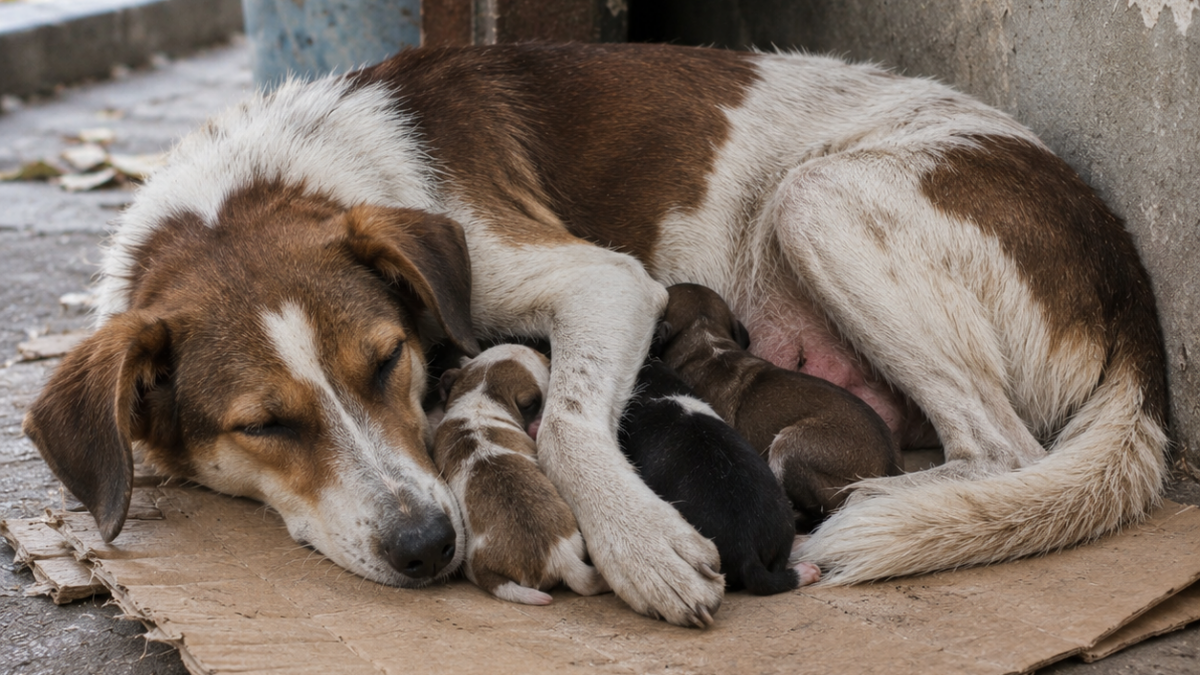
PART 2
For several seconds, I couldn’t move.
I’d worked security for almost twenty years.
I’d seen fights.
Shoplifters.
Accidents.
People collapse in the parking lot.
I’d even helped catch abandoned dogs before.
But those four puppies beneath that flattened cardboard made my hands shake.
They couldn’t have been more than three or four days old.
Maybe less.
Their eyes were sealed.
Their ears still folded.
They barely made any sound.
One tiny body moved against another.
That was all.
I lowered the cardboard carefully.
The mother immediately shifted her body over them again.
Not crushing them.
Covering them.
I finally understood everything.
The empty food bowls.
Why she wouldn’t leave.
Why she’d chosen the same exact spot.
Why she’d tolerated rain.
Why she’d barely eaten.
If she wandered far enough to search for food, the puppies would lose their only source of warmth.
November nights were dropping close to freezing.
Those puppies had no chance without her.
I reached for my radio.
“Maria?”
Static.
Then:
“Yeah, Victor?”
“Get Tom.”
“What happened?”
“Just get Tom. And bring blankets.”
Something in my voice must have scared her.
Within three minutes, Maria, Tom from receiving, and our assistant manager, Caleb, were standing several yards away.
Maria whispered:
“Oh my God.”
The mother growled when everyone arrived.
I raised one hand.
“Stay back.”
Caleb stared at the cardboard.
“There are puppies under there?”
“Four.”
“How long?”
“I don’t know.”
Maria’s eyes filled.
“She was out here in the rain last night.”
“I know.”
“Why didn’t we see them?”
“Because she made sure we didn’t.”
Tom crouched.
“What do we do?”
“Call a rescue.”
Caleb looked toward the store.
“We can’t leave them here.”
“No.”
“Can we move her?”
“Not by force.”
Maria asked:
“What if she bites?”
I looked at the dog.
“She might.”
Nobody volunteered after that.
I couldn’t blame them.
A mother with newborn puppies could be extremely protective.
But something about her behavior didn’t feel unpredictable.
She had been warning people.
Not attacking.
There was a difference.
I sat back down.
Same distance.
Same position.
“I need you to trust me.”
She watched.
Her eyes were brown.
Tired.
Deeply tired.
There was something in them I had seen in working dogs, injured animals, and people who had stayed awake too long because someone they loved needed them.
Exhaustion held together by responsibility.
Maria returned with a plastic container of warm chicken.
She set it beside me.
I pushed the container forward.
The dog sniffed.
Didn’t move.
I pushed it closer.
“No one is touching them.”
Her eyes stayed on my hands.
“You need to eat.”
Nothing.
I picked up a piece of chicken.
Held it out.
She hesitated.
Then stretched her neck.
Took it.
Chewed.
Immediately looked down toward the cardboard.
“You’re okay.”
Another piece.
This time she came half a step closer.
By the fifth piece, she was standing.
That gave me the first full look at her stomach.
Her mammary glands were enlarged.
Recently nursing.
Her legs trembled.
She was even thinner than I’d realized.
Maria whispered:
“She’s exhausted.”
“Yes.”
The dog ate more.
Then returned to the puppies.
The rescue group arrived about forty minutes later.
Two women.
One man.
Crates.
Blankets.
A portable heat pad.
Slip leads.
Food.
They approached slowly.
The older woman introduced herself as Dana.
“How long has she been here?”
“Since Monday.”
“With the puppies?”
“I’m guessing.”
Dana crouched at a distance.
“Did anyone see her give birth?”
“No.”
“Any blood?”
“Not that anyone reported.”
She studied the dog.
“She may have delivered somewhere else and moved them.”
“Why here?”
“Could’ve been chased.”
“From where?”
Dana looked toward the buildings across the street.
“Anywhere.”
That answer bothered me.
The mother watched every movement.
Dana asked:
“Has she let you touch her?”
“No.”
“But she let you lift the cardboard?”
“Barely.”
Dana smiled.
“That’s more than nothing.”
The plan was simple in theory.
Get the puppies into a warm carrier.
Use their scent and sounds to encourage the mother to follow.
Simple in theory.
The moment Dana reached toward the cardboard, the mother stood over it.
Growl.
Not louder.
But different.
Dana stopped.
“Okay.”
She backed away.
“We’re not stealing them.”
The dog didn’t relax.
Dana looked at me.
“You try.”
“Me?”
“She trusts you more.”
I almost laughed.
“She doesn’t know me.”
“She knows you didn’t take her puppies.”
Apparently that counted.
I knelt.
The dog watched.
“I’m going to move them somewhere warm.”
Her ears pulled back.
I touched the cardboard.
No growl.
Lifted it.
Four tiny puppies.
One sandy brown.
One almost white.
One darker, with a black muzzle.
And the smallest—a pale female with a white stripe down her face.
I slid my hands beneath the first puppy.
The mother whined.
I froze.
“I’m not hurting him.”
Her nose touched my wrist.
For one terrifying second, I thought she might bite.
Instead, she sniffed the puppy.
Then my hand.
I lifted him.
The puppy squeaked.
The mother stood.
Dana moved the carrier closer.
We placed the puppy inside on warm towels.
The mother followed instantly.
Nose against the carrier.
Good.
Second puppy.
Third.
Then the smallest.
She was cold.
Too cold.
When I lifted her, she barely moved.
“Dana.”
“I see it.”
The mother’s panic intensified.
She pressed against my knee.
“She knows.”
Dana took the puppy.
Wrapped her.
Placed her beside the portable warmer.
“We need to go.”
The mother saw her baby leave my hands.
For the first time, she barked.
Sharp.
One bark.
Then another.
She lunged toward Dana.
Not to attack.
Toward the puppy.
I caught myself before grabbing her.
“Wait.”
Dana stopped.
The mother rushed to the carrier.
Sniffed.
The puppy squeaked weakly.
The mother started licking through the opening.
Dana looked at me.
“She needs to ride with them.”
“No argument.”
We had a large crate.
Getting the mother inside was another problem.
Food didn’t work.
Leash didn’t work.
Every time the crate door moved, she backed away.
But when we moved the puppy carrier inside the larger transport enclosure, something changed.
The mother approached.
Sniffed.
One paw inside.
Then another.
She hesitated.
Looked at me.
I don’t know why I did it.
I tapped the side of the crate.
“Go with them.”
She entered.
Dana quietly closed the door.
No panic.
The mother immediately curled around the puppy carrier.
She never looked at us again.
All her attention returned to them.
As the rescue van pulled away, Maria stood beside me.
“Do you think they’ll make it?”
I watched the taillights.
“I don’t know.”
That was the truth.
The smallest puppy was dangerously cold.
The mother looked dehydrated.
We had no idea whether she had infection, parasites, internal injuries, or whether she could produce enough milk.
Maria wiped her eyes.
“What are you going to do?”
“What?”
“You’re going to call them every hour.”
“I am not.”
She smiled.
“You already have Dana’s number in your phone.”
I looked at her.
“Go back inside.”
I called forty-five minutes later.
Dana answered.
“Victor.”
“How’d you know?”
“You’re the only seventy-year-old security guard who gave me his number three times.”
“I’m sixty-eight.”
“My apologies.”
“How are they?”
“Mom is stable.”
“And the puppies?”
“Three are doing well.”
My stomach dropped.
“The little one?”
“Still warming.”
“Meaning?”
“Meaning we don’t know yet.”
I sat in the security office.
The cardboard spot was visible through the monitor.
Empty now.
It looked wrong.
“Call me.”
“I will.”
“Even if—”
“I will.”
She called at 2:17 a.m.
I answered before the first ring finished.
“The puppy is nursing.”
I closed my eyes.
“Good.”
“Very good.”
“And the mother?”
“She ate two full meals.”
I laughed.
“She wouldn’t eat out here.”
“She doesn’t have to cover four babies in freezing rain anymore.”
Right.
Of course.
“What are you calling her?”
“We haven’t.”
“You need a name.”
“Then name her.”
I looked at the empty parking space.
Monday.
Three days.
Rain.
Cardboard.
Stubbornness.
I said:
“Hope.”
Dana went quiet.
“Too obvious?”
“No.”
I heard a smile in her voice.
“Hope works.”
So she became Hope.
The next morning, I drove to the rescue center after my shift.
I told myself I was only checking.
Maria said:
“You’re visiting your dog.”
“She isn’t my dog.”
“Sure.”
Hope was in a quiet maternity room.
Blankets.
Heat.
Food.
Water.
No cars.
No rain.
The moment I opened the observation door, she raised her head.
Her body tightened.
Then she recognized me.
I know people will say dogs don’t recognize someone after a few hours.
They’re wrong.
Her ears changed.
Her eyes softened.
Her tail moved once.
Not much.
But I saw it.
“Hey.”
I sat on the floor.
Hope watched.
The puppies were lined against her belly.
All four alive.
The smallest female was latched on.
Dana stood behind me.
“She’s doing better.”
“Can I go closer?”
“Slowly.”
I moved.
Hope didn’t growl.
I stopped three feet away.
She stretched her neck.
Sniffed my hand.
Then, very quietly, rested her chin on my wrist.
That did something to me.
I had thought she tolerated me because I didn’t take her babies.
But maybe trust had already started.
“Good girl.”
Her eyes closed.
Just for a second.
Then a sound came from the hallway.
Her head snapped up.
Body over the puppies.
Instant protection.
Trauma doesn’t disappear because one night is safe.
We learned that quickly.
Over the next week, Hope reacted to men wearing heavy boots.
She hated brooms.
Raised voices made her flatten herself over her puppies.
If anyone reached toward her neck too quickly, she flinched.
And there was one thing she absolutely could not tolerate.
Pickup trucks.
The rescue had a small fenced outdoor exercise area.
On day six, Dana tried walking Hope outside for the first time.
A dark blue pickup drove past the fence.
Hope dropped flat.
Then pulled backward so violently she nearly escaped the harness.
Dana called me.
“You need to see this.”
I arrived later.
We tested nothing deliberately.
We weren’t going to terrorize her to satisfy curiosity.
But the reaction mattered.
“Someone dumped her,” I said.
“Maybe.”
“She came from somewhere.”
“All strays do.”
“No collar.”
“No chip on the initial scan.”
“Could’ve never had one.”
Dana looked at me.
“You’re trying to solve her whole life.”
“Yes.”
“Why?”
I didn’t have a good answer.
Maybe because I’d spent years watching people come and go from a supermarket.
You see patterns.
You learn when something doesn’t fit.
Hope didn’t move like a dog born wild.
She knew cars.
Doors.
Food bowls.
Human voices.
She had understood immediately when I’d offered chicken from my hand.
She knew houses existed.
She simply didn’t trust them.
That meant somebody had taught her.
And somebody had failed her.
Two weeks after the rescue, we found the first clue.
A volunteer was brushing Hope.
She felt a small lump near her shoulder.
Not a tumor.
Something harder.
They rescanned her.
The microchip had migrated.
It was there.
Registered.
The owner listed was a woman named Cassandra Bell.
Address twenty-three miles away.
Phone disconnected.
My stomach tightened.
Dana called me.
“We found her history.”
“Maybe.”
“Registration is four years old.”
“Could Cassandra still own her?”
“We’ll find out.”
The shelter contacted the listed address.
New tenants.
They had never heard of Hope.
The veterinary clinic attached to the chip still existed.
They couldn’t release private information.
But they confirmed the dog had been treated there.
Different name.
“Sadie.”
That was Hope’s original name.
The clinic’s last record was fourteen months earlier.
Owner listed as Cassandra Bell.
Then we found Cassandra.
Not through some dramatic detective work.
Through social media.
She lived in another county.
Dana contacted her.
The response came within twenty minutes.
**Sadie is alive?**
Not:
I don’t want her.
Not:
Wrong dog.
Alive?
Dana called immediately.
Cassandra was crying before the conversation really started.
She had lost Hope—Sadie—nine months earlier.
At least, that was what she’d been told.
The dog had been living with Cassandra’s former boyfriend, a man named Derek Shaw.
Cassandra had moved temporarily while caring for her mother after surgery.
Derek agreed to keep Sadie.
Three weeks later, he called.
Said she’d escaped.
Cassandra drove back.
Searched.
Posted flyers.
Called shelters.
Nothing.
“Did you believe him?” I asked when I eventually spoke to her.
“At first.”
“Then?”
“He wouldn’t show me where she supposedly got out.”
“Why?”
“He said he was done talking about it.”
“What was their relationship like?”
“Derek never liked her.”
“Why?”
Cassandra’s voice became smaller.
“Because she was mine before him.”
That sentence sounded familiar.
Human jealousy directed at an animal.
It happens more than people think.
“Was she pregnant when she disappeared?”
Silence.
“I don’t know.”
“You didn’t know?”
“She wasn’t when I left. At least not visibly.”
“Was there an intact male around?”
“Derek’s brother had one.”
My stomach tightened.
“Did Derek know?”
“Maybe.”
Hope had disappeared nine months earlier.
That meant she hadn’t spent all nine months continuously pregnant.
She may have gone through other people.
Other places.
Or the timeline Derek gave Cassandra may have been false.
We needed more information.
Cassandra visited.
I was there.
Hope sat behind a baby gate with the puppies.
Cassandra entered the room.
Hope froze.
Not fear.
Recognition.
Her nose lifted.
Cassandra whispered:
“Sadie?”
Hope stood.
Her entire body started trembling.
“Baby?”
Hope whined.
Then ran.
Cassandra dropped to her knees.
Hope hit her chest.
Nearly knocked her backward.
Licked her face.
Cried.
Jumped away.
Returned.
Cassandra sobbed into her fur.
“I thought you were dead.”
Hope’s tail moved so hard her entire body twisted.
I stepped out.
Some reunions don’t need witnesses.
But this one didn’t end simply.
Hope loved Cassandra.
That was obvious.
Yet whenever Cassandra tried to lead her toward the parking lot, Hope froze.
Cassandra noticed.
“What happened to her?”
We didn’t know.
“Who did this?” she whispered.
We didn’t know that either.
But now we had somewhere to start.
Cassandra still had old text messages from Derek.
One from nine months earlier said:
**Your dog took off. Not my problem.**
Another:
**Stop calling me about that mutt.**
Another, after Cassandra threatened to involve police:
**Come search the yard if you want. She’s not here.**
Cassandra had searched.
No Sadie.
No sign.
But now Hope had appeared twenty-three miles from Derek’s old property, newly postpartum, dangerously thin, and terrified of trucks.
Maybe unrelated.
Maybe not.
Then Cassandra remembered something.
“Derek drives a blue pickup.”
My skin prickled.
Dana immediately stopped her.
“That doesn’t prove anything.”
“I know.”
“We can’t accuse him because of a truck.”
“I know.”
But we all thought the same thing.
Hope’s four puppies meant something else too.
If Derek had abandoned Hope recently, he might have known she was pregnant.
Or she might have been dumped by someone else entirely.
The story could have passed through multiple hands.
So we did what mattered most first.
We cared for the dogs.
The puppies grew.
The sandy male became Atlas.
The white female became Pearl.
The black-muzzled male became Otis.
The smallest puppy—the one we’d nearly lost—became June.
June was stubborn.
The veterinarian said she had probably been mildly hypothermic and undernourished but had no major congenital problems.
By week three, she screamed louder than all her siblings combined.
“That’s the one we thought wouldn’t survive?” I asked.
Dana nodded while June attacked a blanket.
“Unfortunately.”
Hope became a different dog indoors.
Not instantly.
But noticeably.
She began eating normally.
Then enthusiastically.
She gained weight.
Her coat changed.
The dull sandy fur became warmer, almost golden.
She learned the routine.
Breakfast.
Puppy care.
Walk.
Rest.
Dinner.
Visitors.
What she struggled with was separation.
If the puppies cried, Hope panicked.
If one left the room for weighing, she paced.
That was understandable.
For three days in the parking lot, she had kept them alive by never leaving.
Her mind had learned a brutal equation.
Distance equals danger.
We had to teach her otherwise.
One puppy leaves.
One puppy comes back.
Again.
Again.
Again.
The first time Dana took Atlas into the hall for ten minutes, Hope scratched at the door.
When he returned, she checked every inch of him.
Nose.
Ears.
Feet.
Belly.
Then she lay across him as if humans were irresponsible idiots.
Maybe we were.
By six weeks, the puppies started becoming individuals.
Atlas was fearless.
Otis followed people everywhere.
Pearl liked quiet corners.
June climbed things that made no physical sense.
Hope tolerated all of them with exhausted dignity.
One afternoon, June tried biting Hope’s tail.
Hope stood.
Moved.
June followed.
Bit again.
Hope looked at me.
Her expression said:
You saved this?
I laughed.
“Your problem.”
She sighed and lay down.
June climbed onto her face.
That was the first time Hope looked like an ordinary mother instead of a survivor.
I wish the story could have stayed there.
But Derek found out Hope was alive.
Cassandra had told one mutual friend.
The friend told someone else.
Information moved.
Then one afternoon, a man arrived at the rescue.
Tall.
Mid-thirties.
Work boots.
Dark jacket.
Blue pickup.
Hope saw the truck through the window.
She disappeared under the desk.
Not walked.
Not backed away.
Disappeared.
Her body slammed into the wall trying to get behind furniture.
Dana rushed to her.
I was in the lobby.
The man approached the desk.
“I’m here for Sadie.”
Everything in me went cold.
“Who are you?”
“Derek Shaw.”
I didn’t move.
“Why are you here?”
“She’s my dog.”
“No.”
He looked at me.
“Excuse me?”
“She is registered to Cassandra Bell.”
“She gave me the dog.”
“Do you have proof?”
He laughed.
“Who are you?”
“Victor.”
“That supposed to mean something?”
“No.”
He looked toward the hallway.
“I know she’s here.”
Dana appeared.
Her face told me Hope had reacted badly.
“Mr. Shaw?”
“Yeah.”
“I manage the rescue.”
“I want the dog.”
“She’s under medical and ownership review.”
“She belongs to me.”
“Documentation?”
“She lived at my house.”
“That doesn’t establish ownership.”
“Cassandra left her.”
Cassandra arrived twenty minutes later after Dana called.
That was a mistake emotionally.
Maybe necessary legally.
The moment Derek saw her, his face hardened.
“You did this?”
Cassandra stared.
“You told me she ran away.”
“She did.”
“Then why are you here claiming she’s yours?”
Silence.
Derek looked at Dana.
“I took care of that dog for months.”
Cassandra laughed.
“You hated her.”
“Because she destroyed everything.”
“She chewed one shoe.”
“She wasn’t trained.”
“She was trained.”
Derek pointed toward the hallway.
“She ran off.”
“Where?”
“I told you.”
“No. You never did.”
“She got through the gate.”
“Which gate?”
His face changed.
Cassandra stepped closer.
“You had three gates.”
“Back.”
“Which one?”
“Does it matter?”
“Yes.”
“She was gone.”
“And now?”
He shrugged.
“Someone found her.”
“Twenty-three miles away.”
“Dogs travel.”
“Pregnant?”
He looked toward her.
That look lasted half a second.
Half a second was enough for Cassandra.
“You knew.”
“Knew what?”
“That she was pregnant.”
“I didn’t even know she was alive.”
“Then why aren’t you surprised?”
Derek turned toward Dana.
“This is ridiculous.”
Hope barked from behind the hallway door.
Derek froze.
Hope barked again.
Not excited.
Not welcoming.
Deep.
Fearful.
Derek’s eyes moved toward the sound.
Cassandra saw.
“So she remembers you.”
“Of course.”
“No.”
Her voice changed.
“She is terrified of you.”
Derek’s face hardened.
“You don’t know what that dog is like.”
“I do.”
“You weren’t there.”
“No.”
Cassandra’s eyes filled.
“You made sure I wasn’t.”
Dana ended the confrontation.
No dog transfer.
No access.
Legal documentation required.
Derek left furious.
As he walked toward the blue pickup, Hope screamed from the back room.
I heard it through two doors.
That sound removed any lingering doubt from me emotionally.
But emotion isn’t evidence.
We needed evidence.
And then the supermarket gave us something unexpected.
Our parking lot cameras stored footage for thirty days.
I asked our manager to check the morning Hope appeared.
Not because I expected anything.
Just to see which direction she had come from.
At 4:48 a.m. Monday, the camera facing the south entrance captured a pickup truck.
Dark blue.
It entered.
Drove toward the far end.
Stopped.
For less than two minutes.
The image wasn’t perfect.
The truck parked beyond the brightest lights.
But the driver’s door opened.
A man stepped out.
Then the passenger door.
A dog jumped down.
Hope.
Pregnant? No.
She had already given birth.
The footage showed something else.
The man removed a flattened cardboard box from the truck bed.
Placed it on the pavement.
Then bent down.
Once.
Twice.
Four times.
My stomach turned.
He was placing the puppies under the cardboard.
Hope circled him.
Confused.
Then he got into the truck.
Hope tried to follow.
The truck moved.
She ran several yards.
Stopped.
Turned.
Ran back to the puppies.
I watched the video three times.
I had assumed Hope chose our parking lot.
She hadn’t.
Someone had abandoned an exhausted nursing mother and four newborn puppies there deliberately.
The camera captured the truck leaving.
License plate partly visible.
Dana called animal control.
Police were contacted because of the active ownership dispute.
Cassandra arrived.
I didn’t want to show her.
She insisted.
The video played.
Blue pickup.
Derek’s model.
Derek’s build.
Hope.
Puppies.
Truck leaves.
Cassandra put one hand over her mouth.
“He had them.”
No one answered.
“He had her this whole time.”
That wasn’t proven yet.
But the abandonment was becoming much clearer.
The plate was enhanced by investigators using the original recording.
It matched Derek’s truck.
He changed his story.
He claimed he had found Hope roaming near his property days earlier.
Claimed she had already given birth.
Claimed he couldn’t care for them.
So why not call a shelter?
He said the shelters were full.
Why not contact Cassandra?
No answer.
Why abandon newborn puppies in November?
He said he thought the supermarket was safe.
That answer made animal control Officer Ramirez stare at him for a long time.
“A parking lot?”
“People are always there.”
“At 4:48 in the morning?”
Derek said nothing.
“You left four neonatal puppies under cardboard between parking spaces.”
“I thought someone would find them.”
“And if a car parked there first?”
Silence.
That possibility haunted me.
Cars had already crushed the edges of the cardboard.
Another foot.
Maybe six inches.
The story could have ended before I ever lifted the corner.
The investigation uncovered more.
Derek had not kept Hope for nine months.
After claiming she escaped, he had given her to his cousin who lived outside town.
The cousin admitted it.
Why?
“She was pregnant.”
That statement caused confusion.
Hope couldn’t have been pregnant nine months earlier with the same litter.
Then the cousin clarified.
She had gone into heat recently.
An intact male dog on the property bred her.
The cousin didn’t want puppies.
He told Derek.
Derek collected Hope shortly before she gave birth.
Why didn’t he call Cassandra?
Because, according to the cousin:
“Derek said she didn’t deserve the dog back.”
There it was.
Not neglect born only from laziness.
Control.
Punishment.
For months, Cassandra believed her dog was missing.
Derek knew where she was.
When Hope became pregnant, he moved her again.
After she gave birth, he dumped her with newborns in a parking lot.
Not because no options existed.
Because involving Cassandra would mean admitting he’d lied.
The cruelty case became much stronger.
Derek’s attorney advised him to stop contacting the rescue.
He didn’t.
He sent Cassandra messages.
First angry.
Then pleading.
Then blaming.
**You caused all this.**
**You should’ve taken her when you left.**
Cassandra replied once.
**I tried. You said she was gone.**
He answered:
**You could’ve tried harder.**
That sentence almost destroyed her.
She showed it to me one afternoon.
“What if he’s right?”
“No.”
“I left without Sadie.”
“You tried to take her.”
“I should’ve called the police immediately.”
“Maybe.”
She looked at me.
That wasn’t the answer she expected.
I continued:
“But not doing every possible thing perfectly doesn’t make what he did your fault.”
She stared at the puppies.
“What if I’d been more aggressive?”
“What if he’d been less cruel?”
Silence.
“Why is the responsibility always moving toward you?”
She looked down.
“Because I loved her.”
“That doesn’t make you responsible for his choices.”
Hope walked toward Cassandra.
By then, she had begun responding to both names.
Sadie.
Hope.
Cassandra preferred Hope.
“Sadie was the dog I lost,” she told me.
“Hope is the dog who survived.”
The custody hearing occurred when the puppies were almost eight weeks old.
By then, they were old enough for adoption planning.
But nothing could move forward until ownership was resolved.
Derek claimed he had been Hope’s lawful caretaker after Cassandra abandoned her.
Cassandra produced messages showing she had repeatedly tried to retrieve the dog.
Derek claimed he abandoned Hope at the supermarket only because he believed someone would immediately help.
The video showed 4:48 a.m.
Cold rain began less than six hours later.
Weather records became evidence.
The prosecutor asked:
“Did you leave food?”
“No.”
“Water?”
“No.”
“A proper shelter?”
“The cardboard.”
I heard someone behind me gasp.
The prosecutor paused.
“You considered a flattened cardboard box an appropriate shelter for a nursing dog and four neonatal puppies?”
Derek looked irritated.
“It was temporary.”
“How temporary?”
“I don’t know.”
“You drove away.”
“Yes.”
“Did you call anyone?”
“No.”
“Did you notify store employees?”
“No.”
“Animal control?”
“No.”
“Police?”
“No.”
“Rescue groups?”
“No.”
“Ms. Bell?”
“No.”
“Then who exactly did you believe would know these animals were there?”
Derek didn’t answer.
The prosecutor played the footage.
The courtroom watched Hope run after the truck.
Then stop.
Turn around.
Race back to her puppies.
That detail hit me harder than the abandonment itself.
She had a choice for maybe three seconds.
Follow the man who left her.
Or return to four helpless babies.
She chose the babies.
The prosecutor paused the frame.
Hope halfway between the truck and the cardboard.
Then asked:
“Is that your vehicle?”
“Yes.”
“Is that you?”
“Yes.”
“Is that Sadie?”
“Yes.”
“Those are her puppies?”
“Yes.”
“And you drove away.”
“Yes.”
No story left.
Just truth.
The judge ruled that Derek had no valid ownership claim.
Cassandra’s prior ownership was established.
Because Cassandra voluntarily transferred the puppies into rescue care for proper placement, the rescue gained authority to adopt them when medically ready.
Hope would legally return to Cassandra.
The criminal welfare case resulted later in fines, restitution, probation, mandatory animal-care restrictions, and a court order limiting Derek’s ability to possess animals for a specified period.
People online wanted more.
They always do.
Prison.
Public humiliation.
Losing his job.
Some wanted his address.
Cassandra wanted none of that.
“Why?” I asked once.
“Because I already let him occupy too much of my life.”
She scratched Hope behind the ear.
“I don’t want revenge that requires me to keep thinking about him.”
That was wiser than anything I would have done.
The real consequences came quietly.
Derek lost his claim to Hope.
He had to pay toward veterinary and rescue costs.
The abandonment became part of a legal record.
Future rescues checking his history could see it.
And most importantly, he never controlled Hope again.
The puppies were adopted one by one.
Atlas went first.
A family with two teenagers and a fenced yard.
He immediately stole a soccer ball and refused to give it back.
Otis went to an older couple.
He became a professional couch sleeper within twenty-four hours.
Pearl was adopted by a veterinary technician who loved shy dogs.
June took longer.
Not because nobody wanted her.
Because I kept finding reasons every applicant was wrong.
Dana finally confronted me.
“Victor.”
“What?”
“You are rejecting perfectly good people.”
“They don’t understand her.”
“One woman has raised three rescue dogs.”
“She owns white furniture.”
Dana stared.
“So?”
“June is destructive.”
“Victor.”
“I’m being responsible.”
“You’re adopting her.”
“No.”
“You visit every day.”
“I work nearby.”
“You bought her a bed.”
“She needed one.”
“You bought her a collar with daisies.”
“It was on sale.”
Dana smiled.
“You’re adopting her.”
I went home that night.
My house had been quiet for seven years.
Since my wife, Elena, died.
We’d had dogs when we were younger.
After she died, I told myself I was too old.
Too tired.
Too comfortable with silence.
Then I thought about June.
The puppy who had nearly frozen under cardboard.
The puppy I had carried in one hand.
The puppy who now attacked my shoelaces every time I visited.
The next morning, I filled out the paperwork.
Dana didn’t say anything.
She simply slid the form toward me.
I signed.
Then she said:
“Told you.”
“Don’t ruin this.”
June came home with me.
The first night she cried for two hours.
I slept on the floor beside her.
At 1:15 a.m., she climbed onto my chest.
At 1:17, she peed on me.
I called Dana.
She answered sleepily.
“Something wrong?”
“She urinated on my shirt.”
Silence.
Then laughter.
“I hate all of you.”
“You adopted a puppy.”
“I made a mistake.”
“You’ll survive.”
I did.
Barely.
June chewed a chair leg.
A shoe.
Two remote controls.
Part of a newspaper.
And, somehow, the corner of a kitchen cabinet.
She followed me everywhere.
Bathroom.
Kitchen.
Garage.
If I sat, she slept on my foot.
If I stood, she stood.
The house stopped being quiet.
At first, I thought that would hurt.
Elena had filled that house with sound.
Music.
Cooking.
Talking to herself.
After she died, silence became almost sacred.
I thought keeping the silence meant keeping something of her.
June destroyed that idea in less than a week.
She barked at the vacuum.
Dropped toys down the stairs.
Raced through the hall at midnight.
One afternoon, she discovered Elena’s old knitted blanket.
I almost took it away.
Then June curled up on it.
Just like that.
No ceremony.
No understanding of grief.
She slept.
I stood in the doorway crying.
Then I laughed.
Because Elena would have loved her.
Especially the destruction.
“Serves you right,” she would have told me.
Cassandra took Hope home.
That transition was harder.
Hope remembered her.
Loved her.
But houses frightened her now.
The first night, she refused to enter the bedroom.
She slept near the front door.
Not on the bed Cassandra had bought.
On the floor.
Blocking the exit.
For several weeks, she woke at every car sound.
Blue pickups caused her to freeze.
Rain was worse.
If rain started after dark, Hope paced.
Cassandra eventually realized why.
Parking lot.
Cardboard.
Cold puppies.
She began sitting with her.
No commands.
No corrections.
Just presence.
“You don’t have to protect anyone tonight.”
Hope paced.
“The puppies are safe.”
She didn’t understand the words.
But over time, the tone became familiar.
“Everybody is safe.”
Weeks passed.
Then one rainy night, Cassandra woke around two.
Hope was not by the door.
Panic.
She checked the living room.
Nothing.
Kitchen.
Nothing.
Then bedroom.
Hope was asleep on the rug beside the bed.
Not guarding the door.
Not listening to cars.
Sleeping.
Cassandra sat on the floor and cried.
Hope woke.
Licked her face.
Then went back to sleep.
That was progress.
A month later, Hope climbed onto the couch.
Cassandra sent me a picture.
**She finally believes furniture is allowed.**
I replied:
**Don’t tell June. She believes everything is chewable.**
Cassandra laughed.
Hope gained nearly twenty pounds.
Her coat became glossy.
The scar on her side remained.
Her torn ear remained.
Those things didn’t bother anyone.
The emotional scars took longer.
But something beautiful happened.
Hope began visiting the supermarket.
Not immediately.
Almost a year later.
Cassandra asked whether I thought it was a terrible idea.
“Maybe.”
“That isn’t helpful.”
“I specialize in parking lots, not psychology.”
She brought Hope on a quiet Sunday morning.
No puppies.
No rain.
No cardboard.
Just a leash.
Cassandra.
Me.
Hope stopped at the edge of the lot.
Her nose lifted.
I watched her body.
Tail low.
Ears back.
Then she walked.
Slowly.
Toward the far parking spaces.
The place where I had found her.
The pavement had changed.
New lines.
Fresh paint.
No trace of the cardboard.
Hope stopped.
Sniffed.
Circled once.
Then looked at Cassandra.
Cassandra crouched.
“You don’t live here anymore.”
Hope walked toward her.
Pressed against her legs.
I felt my throat tighten.
A customer passed.
“Beautiful dog.”
Cassandra smiled.
“She is.”
Not stray.
Not abandoned.
Not nursing mother under cardboard.
Beautiful dog.
We walked to the store entrance.
Maria came running outside.
“That can’t be her.”
“It is.”
Hope recognized Maria too.
At least, I think she did.
She sniffed.
Tail wag.
Maria cried immediately.
“Look at you.”
Hope leaned against her.
Then something unexpected happened.
A delivery truck arrived.
Dark blue.
Not Derek’s.
But similar.
Hope froze.
One second.
Two.
Then she looked at Cassandra.
Cassandra touched her shoulder.
“I’m here.”
Hope exhaled.
The truck meant nothing.
Not yet completely.
But less.
That was healing too.
Months later, the supermarket installed a small weatherproof donation box near the entrance for a local animal rescue.
Our manager blamed me.
“You caused this.”
“I found dogs.”
“You turned the staff into lunatics.”
Maria had started fostering cats.
Tom adopted a senior Beagle.
Caleb donated dog food monthly.
“Good.”
The manager shook his head.
“We sell groceries.”
“Apparently we also create problems.”
The donation box had a small plaque.
**HOPE’S BOX**
Beneath it:
**For animals who need someone to notice.**
We didn’t put the whole story there.
No need.
But customers knew.
People donated food.
Blankets.
Money.
Once, someone left a sealed envelope with three hundred dollars.
Another person donated heating pads.
A child dropped in four dollars and a drawing of a sandy-colored dog lying beside four puppies.
I kept that drawing in the security office.
Derek’s court case eventually ended.
He moved away.
I heard through Cassandra that he was furious because people in his circle learned why he was prohibited from possessing animals during probation.
She didn’t celebrate.
Neither did I.
By then, he felt smaller than the story.
That’s what people don’t understand about revenge.
At first, you want balance.
You want the person who caused suffering to suffer equally.
You want them cold.
Afraid.
Abandoned.
But what would that change?
Hope wouldn’t understand.
The puppies wouldn’t care.
June would still chew my furniture.
Eventually, the most satisfying revenge was that Derek became irrelevant.
Hope no longer reacted every time a blue truck passed.
Cassandra stopped checking his social media.
No one needed his explanation.
The court had one.
The video had one.
Hope’s body had one.
And Hope herself moved on.
Three years after the parking lot, Cassandra married a man named David.
The first time Hope met him, she hid behind Cassandra.
David didn’t approach.
He sat on the floor.
Waited.
Hope eventually sniffed his hand.
Month by month, he earned her.
Not because Cassandra told Hope to trust him.
Because he behaved like someone worth trusting.
When David proposed, Hope was there.
When they married in a small backyard ceremony, Hope wore a ridiculous floral collar.
I attended.
June came too.
June tried to eat part of the floral arrangement.
Of course.
Someone asked Cassandra:
“Is that the dog from the parking lot?”
She looked at Hope.
Then smiled.
“That was where her old life ended.”
She touched Hope’s head.
“It isn’t who she is.”
I remembered that sentence.
Because rescue stories often freeze animals at their worst moment.
The chained dog.
The starving cat.
The abandoned puppies.
The dog beneath cardboard.
But animals keep living.
Hope wasn’t forever the desperate mother in a parking lot.
She became a dog who loved cooked carrots.
A dog who hated baths.
A dog who slept upside down.
A dog who snored.
A dog who stole David’s side of the bed.
A dog who learned that rain could be heard from indoors.
The puppies grew too.
Atlas became huge.
Otis became fat.
His owners insisted he was “sturdy.”
Pearl remained gentle.
June remained criminal.
Every year, on the weekend closest to their rescue anniversary, we brought them together.
Not because the dogs needed it.
Because we did.
First year:
Chaos.
Second year:
More chaos.
Third year:
Atlas knocked over a picnic table.
June stole a hamburger.
Hope watched her grown puppies run through the park.
Sometimes she played.
Mostly she sat near Cassandra.
I always wondered whether she recognized them as the newborns she’d nearly frozen herself to protect.
Maybe.
Maybe not in the human sense.
But when June approached Hope, something always happened.
June became calmer.
She pressed her head beneath Hope’s chin.
Hope licked one ear.
Every time.
That was enough for me.
On the fifth anniversary, Maria brought the old photo.
It was from that first Monday.
Hope lying on the crushed cardboard.
No one knew what was underneath.
She showed it to Cassandra.
Cassandra stared.
“I’ve never seen this.”
“I forgot I had it.”
Hope was thin in the image.
Dirty.
Tense.
Eyes watching the photographer.
The cardboard beneath her looked worthless.
Cassandra began crying.
David put an arm around her.
“I almost don’t recognize her.”
I looked toward present-day Hope.
She was lying beneath a tree.
Thicker coat.
Healthy weight.
Gray around the muzzle now.
June beside her.
“They’re both her.”
Cassandra nodded.
“I know.”
“She just had different things to survive.”
Cassandra held the picture.
“What do you think she was thinking?”
I looked at the old image.
Probably nothing poetic.
Dogs don’t narrate themselves the way we do.
Warm them.
Stay.
Watch.
Protect.
Eat later.
Maybe that was all.
“I think she was counting on herself.”
Cassandra looked at me.
“And now?”
I looked at the people around us.
David.
Maria.
Dana.
The adopters.
Four grown dogs.
My ridiculous June.
“She doesn’t have to.”
Hope aged well.
Until she didn’t.
Around eleven or twelve—her exact age remained uncertain—she developed arthritis.
Then kidney disease.
Cassandra handled it.
Medication.
Special food.
Fluids.
Veterinary visits.
Hope hated every part.
Especially the diet.
“She survived abandonment but draws the line at prescription food,” Cassandra complained.
Hope stared at her bowl like an insult had been committed.
David secretly added tiny pieces of chicken.
Cassandra pretended not to know.
One winter, Hope stopped wanting to go outside during rain.
No one pushed her.
She had earned the right to choose.
She spent more time sleeping.
Then came the call I had been dreading for years.
“Victor.”
Cassandra’s voice was wrong.
“What happened?”
“Hope isn’t getting up.”
I drove over.
June was with me.
Hope lay on a blanket in the living room.
Cassandra sat beside her.
David nearby.
The veterinarian had already come.
Kidneys.
Age.
Body tired.
No emergency catastrophe.
No sudden violence.
Just the quiet ending that eventually reaches every good life.
June approached.
For once, she didn’t explode into the room.
She sniffed Hope.
Hope opened her eyes.
Tail moved.
One slow tap.
June lay beside her.
Head against Hope’s front leg.
Cassandra whispered:
“She knows.”
Maybe.
I sat down.
Hope lifted her head slightly.
I put my hand near her nose.
“Hey.”
She sniffed.
I wondered whether she remembered me.
Old parking lot security guard.
Chicken.
Wet cardboard.
My jacket on the pavement.
The first human she had allowed near the puppies.
Hope stretched forward.
Licked my fingers.
That was enough.
“You scared the hell out of me, you know.”
Cassandra smiled through tears.
Hope breathed.
“You wouldn’t eat.”
Another breath.
“You wouldn’t move.”
I stroked her head.
“And underneath you were four little idiots.”
June’s tail thumped once.
“Especially that one.”
We laughed.
Then cried harder.
Cassandra leaned close.
“You did your job.”
Her voice broke.
“You hear me?”
Hope’s eyes stayed half open.
“You kept them warm.”
Cassandra kissed her forehead.
“You kept all four alive.”
David covered his mouth.
“You don’t have to protect anybody now.”
That was the sentence that broke me.
Because Hope’s entire life, at least the part I knew, had been protection.
Body over puppies.
Growl at strangers.
Watch the doors.
Fear the trucks.
Stay near exits.
Make sure everyone came back.
And now, finally:
“You can rest.”
Hope died at home.
Warm.
On blankets.
June beside her.
Cassandra’s hand on her chest.
No parking lot.
No cardboard.
No rain.
No cars passing inches away.
Just family.
Afterward, Cassandra asked me what we should do with Hope’s ashes.
I said:
“Whatever feels right.”
She thought for several weeks.
Then came to the supermarket.
I was retired by then, but Maria called me.
“Come here.”
“Why?”
“Just come.”
Near the far end of the parking lot, the store had converted one unused strip of pavement into a small landscaped area.
A tree.
Bench.
Flowers.
Nothing dramatic.
At the base of the tree was a small marker.
**HOPE**
**SHE STAYED BECAUSE FOUR LITTLE LIVES DEPENDED ON HER.**
**WE NOTICED BECAUSE SHE REFUSED TO LEAVE.**
Part of her ashes were buried beneath the tree.
Cassandra kept the rest at home.
I sat on the bench.
“Who approved this?”
Maria grinned.
“Our manager.”
“The same one who said dogs were ruining his parking lot?”
“He’s softened.”
I laughed.
June, older now, sniffed the tree.
Then lay down.
Not on cardboard.
Grass.
Soft grass.
I thought back to the first morning.
A dog nobody knew.
A crushed box.
Drivers complaining.
People laughing.
One man calling her crazy.
How little we understood.
We thought she wouldn’t move because she was stubborn.
She wouldn’t move because moving could kill her babies.
We thought she was aggressive.
She was protecting.
We thought she ignored food.
She was choosing warmth over hunger.
We thought the cardboard was trash.
To four newborn puppies, it was the only roof they had.
And for three nights, Hope’s body was the only wall between them and the cold.
People still ask me whether I believe she knew someone would eventually help.
No.
I don’t think she did.
That’s what makes her story matter.
Hope wasn’t waiting confidently for rescue.
She had no guarantee.
She did what she could with what she had.
A crushed box.
Her body heat.
A growl.
A few pieces of food.
Nothing more.
She kept going without knowing whether anyone was coming.
Maybe that’s why we named her Hope.
Not because hope means believing everything will work out.
Sometimes hope is much less beautiful.
Sometimes it’s lying awake in the rain because four small bodies beneath you are still breathing.
Sometimes it’s refusing to leave.
Sometimes it’s staying one more hour.
Then another.
Until someone finally notices.
Derek tried to make Hope disappear.
Instead, the parking lot where he abandoned her became a place collecting food and money for animals like her.
He tried to hide four puppies beneath cardboard.
Instead, all four grew up surrounded by people who knew exactly where they came from.
He tried to keep Cassandra from ever seeing her dog again.
Instead, Cassandra got years with Hope that he could never control.
The court punished him according to law.
But life delivered the part that felt more complete.
He became irrelevant.
Hope did not spend the rest of her life defined by the man who abandoned her.
She was defined by everything that came afterward.
Home.
Food.
Rain heard through windows.
A couch.
A husband she learned to trust.
Four surviving puppies.
Reunions in a park.
Gray fur around her muzzle.
A family beside her when she took her final breath.
That was the revenge.
A good life.
A life so full that the worst night became only one chapter.
And June?
June is asleep beside me as I tell this.
Older.
Slower.
Still occasionally destructive.
Her face has gone gray.
She has Hope’s eyes.
Sometimes, when it rains at night, June goes to the window.
She listens.
Then comes back to her bed.
Years ago, her mother couldn’t do that.
Hope had no window.
No bed.
No choice.
She stayed on wet cardboard beneath an open sky because leaving wasn’t an option.
June can walk away from the rain whenever she wants.
Maybe that is the simplest measure of everything we changed.
Not whether we punished the person who caused the suffering.
Whether the next generation got something better.
The cardboard disappeared years ago.
The parking lines have been repainted several times.
Most shoppers have no idea what happened between those two spaces.
But I remember.
I remember lifting one wet corner.
I remember four tiny bodies.
I remember Hope looking at me, trembling, exhausted, terrified.
And I remember thinking she was asking me not to take them.
Now, after all these years, I think maybe I misunderstood.
Maybe the look in her eyes wasn’t:
Don’t take them.
Maybe it was:
Please help me keep them alive.
We did.
All four.
And then, eventually, Hope allowed us to help her live too.








