PART 2: Everyone Thought the Dog Tied Outside the Grocery Store Was Dangerous—Until I Knelt Down and Saw What She Was Protecting
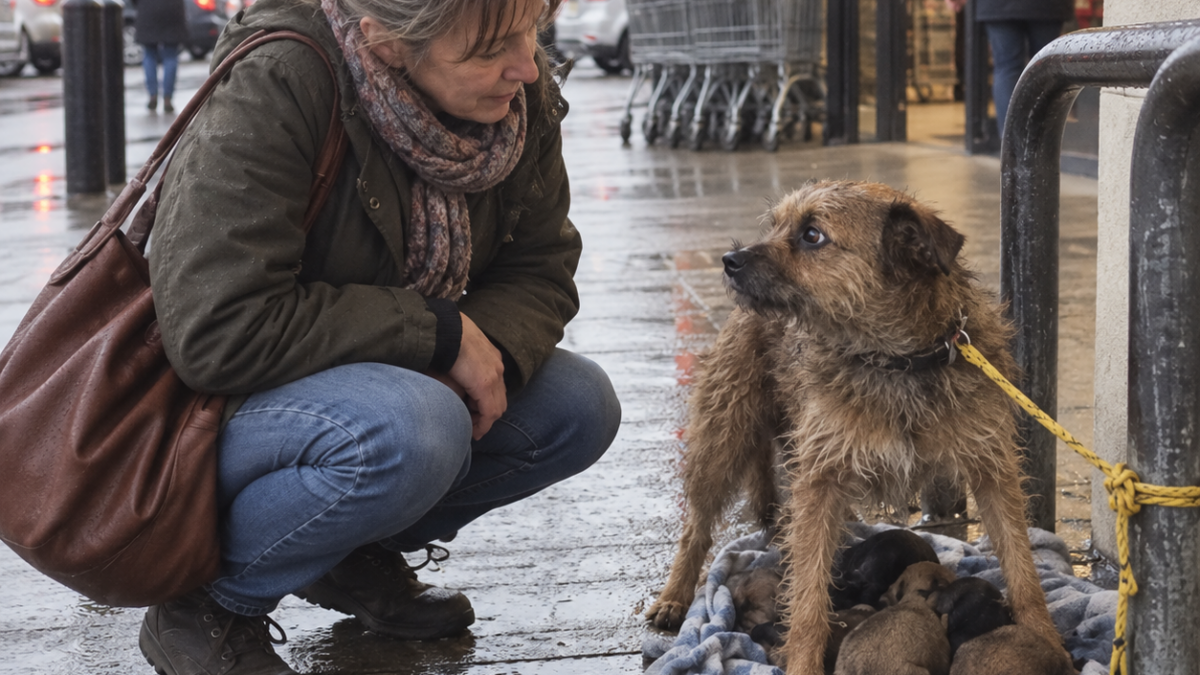
Everyone thought the little dog tied outside the grocery store was dangerous, and for the first few minutes, so did I.
She lunged at every stranger who came near, barking until her voice broke, but the second they backed away she turned toward the brick wall as if something behind her mattered more than her own life.
Then I finally lowered myself far enough to see beneath her trembling body, and everything I believed about that dog changed.
“Somebody needs to do something about that animal before she bites someone!”
The man who shouted it was already halfway through the automatic doors.
The dog kept barking.
She couldn’t have weighed more than twenty-five pounds.
A scruffy brown terrier mix with rough fur tangled around her muzzle, narrow legs, and a body so thin I could see the shape of her ribs beneath her coat.
Someone had tied her to the bicycle rack outside the grocery store with a yellow rope.
Two tight knots.
The rope gave her maybe eighteen inches of movement.
Every time someone approached the entrance, she exploded.
Barking.
Lunging.
Showing her teeth.
A woman carrying grocery bags made a wide circle around her.
A teenager laughed and pretended to kick toward her.
The dog nearly strangled herself trying to reach him.
“Crazy mutt,” he said.
I almost kept walking.
My name is Laura Bennett.
I was fifty-eight years old, worked the front desk at a medical clinic ten minutes away, and had twenty minutes left on my lunch break.
My shopping list was open on my phone.
Coffee.
Eggs.
Laundry detergent.
Applesauce for my mother.
My mother was eighty-two and still living alone in the apartment where I had grown up.
Lately, she had started forgetting small things.
Turning off the stove.
Where she left her glasses.
Whether she had already called me that morning.
Since my father died five years earlier, my life had quietly reorganized itself around her.
Appointments.
Groceries.
Sunday dinners.
Phone calls.
Worry.
The last thing I needed was to become involved with an aggressive abandoned dog.
That was exactly what I assumed she was.
Abandoned.
Someone had tied her outside and driven away.
You hear about that kind of thing.
Dogs left at shelters.
Cats dumped in parking lots.
Animals tied to fences because someone didn’t have the courage to surrender them properly.
I took three steps toward the entrance.
Then the little dog did something that made me stop.
An older woman rolled her shopping cart past her.
The dog lunged.
The woman jerked backward.
“Oh, for heaven’s sake!”
The second she moved far enough away, the dog stopped.
Completely.
She turned.
Took two quick steps toward the brick wall.
Lowered her head.
For several seconds, her nose hovered near the concrete.
Then she spun back toward the parking lot.
Alert again.
I watched.
A man approached.
Same thing.
Barking.
Teeth.
Rope snapping tight.
He moved away.
The dog immediately turned toward the wall.
That was when something clicked.
She wasn’t guarding the entrance.
She wasn’t even guarding herself.
She was protecting something behind her.
I put my phone away.
Then I crouched.
About nine feet from her.
No closer.
Her lips lifted.
I froze.
“Okay,” I whispered. “I’m not coming any closer.”
Her eyes stayed locked on me.
I lowered myself farther.
Enough to see beneath her belly.
That was when I noticed the towel.
Faded blue.
Old.
Folded carefully against the wall.
Not thrown there.
Arranged.
Like a nest.
And inside it, something moved.
Barely.
At first, I thought it was a piece of plastic shifting in the wind.
Then a tiny pink nose appeared from beneath one fold.
Another body moved.
My stomach dropped.
I leaned slightly sideways.
One.
Two.
Three.
Four.
Puppies.
So young their eyes were barely open.
Pressed together beneath their mother while she stood between them and every stranger crossing that sidewalk.
The “dangerous” dog wasn’t trying to attack the world.
She was exhausted.
Terrified.
Tied so tightly she couldn’t reach the puddle of water near the curb.
And she had four newborn puppies depending on her.
“Oh, sweetheart.”
Her growl deepened.
I lifted both hands.
“I know. I know.”
I didn’t touch her.
I called my coworker instead.
“Laura, where are you?” Melissa answered. “Your break is almost over.”
“I need you to tell Dr. Harris I’m going to be late.”
“How late?”
I looked at the little dog.
“I don’t know.”
“What happened?”
“Someone tied a nursing mother outside the grocery store.”
There was silence.
Then Melissa said, “Do you need help?”
Before I could answer, the terrier suddenly whipped toward the parking lot and began barking harder than before.
A gray pickup had just turned into the far lane.
The driver’s window was down.
The instant the dog saw it, her entire body changed.
Not aggression.
Terror.
She threw herself backward over the puppies as if she knew exactly who had just come back.
PART 2
I stood so quickly that pain shot through my knees.
The gray pickup rolled slowly through the parking lot.
The terrier’s barking changed.
Until then, every warning she gave strangers had been sharp and defensive.
This was different.
Higher.
Frantic.
Almost desperate.
She flattened herself over the towel, covering the puppies with as much of her body as she could.
I looked toward the truck.
The driver slowed.
A man in a dark baseball cap glanced in our direction.
For one second, I thought maybe I was imagining the connection.
Then his head turned directly toward the bicycle rack.
Toward the dog.
The terrier shrank lower.
Then the truck accelerated.
“Hey!”
I don’t know why I shouted.
The truck didn’t stop.
It crossed the far end of the lot and disappeared onto the road.
I pulled out my phone and snapped several pictures.
Most were useless.
One caught the rear of the truck.
The license plate was blurry, but a few characters looked readable.
The dog kept staring after it long after it was gone.
Then she turned.
One puppy.
Two.
Three.
Four.
She touched each tiny body with her nose.
Checking them.
I felt something tighten in my chest.
“You thought he was coming back.”
The dog looked at me.
For the first time, I wasn’t afraid of her.
I was afraid for her.
A grocery store employee finally came outside.
His name tag said KEVIN — ASSISTANT MANAGER.
He was young, maybe twenty-five, holding a clipboard like it could somehow solve the situation.
“Ma’am?”
“Yes?”
“You need to move away from the dog.”
“Why?”
“We’ve had complaints.”
“I know.”
“She’s acting aggressively.”
“She has newborn puppies.”
Kevin stopped.
“What?”
I pointed toward the towel.
He leaned slightly.
His face changed.
“Oh.”
“Exactly.”
He took one step closer.
The terrier erupted.
Kevin immediately backed away.
“Okay. Wow.”
“She’s terrified.”
“She almost bit that guy earlier.”
“That guy pretended to kick her.”
Kevin frowned.
“He did?”
“Yes.”
He looked toward the entrance.
“I didn’t see that.”
“I did.”
The dog had stopped barking again.
She turned toward the puppies.
Kevin lowered his voice.
“Someone called animal control.”
“When?”
“Maybe ten minutes ago.”
“What did they say?”
“Someone would come.”
“When?”
“I don’t know.”
I checked the dog again.
Her tongue hung from the side of her mouth.
She was panting hard.
“Do you have water?”
“Inside.”
“A bowl?”
“Yes.”
“Bring it.”
He hesitated.
“And food. Something high-protein. Wet dog food. Plain chicken if your deli has it.”
“Am I allowed to just take that?”
I stared at him.
“Kevin.”
He blinked.
“There are four ten-day-old puppies lying on concrete outside your store.”
“Right.”
He turned and nearly ran inside.
I crouched again.
The terrier watched me.
“I’m not leaving.”
Her ears twitched.
“You don’t know what that means, but I do.”
An elderly man in a work jacket had stopped near the cart return.
He had been watching quietly.
Finally he said, “I saw that truck earlier.”
I stood.
“What truck?”
“The gray pickup.”
My heart started beating faster.
“You saw it before?”
He nodded.
“About forty minutes ago.”
“What happened?”
He pointed toward the far end of the parking lot.
“Man parked over there.”
“Did you see him?”
“Pretty well.”
“What did he do?”
The man looked at the dog.
“He had a cardboard box.”
I felt cold.
“What was in it?”
“Couldn’t tell.”
“And the dog?”
“Walking beside him.”
“On that yellow rope?”
“Yes.”
My eyes went back to the terrier.
“Did he bring her here?”
“Looked like it.”
“What happened next?”
“He carried the box over. Put it down. Then tied the dog to the rack.”
“With the puppies already here?”
The man frowned.
“No.”
My stomach dropped.
“What do you mean?”
“He set the box down first.”
I already knew the answer before asking.
“What was inside the box?”
He shook his head.
“I didn’t see.”
But we both looked toward the towel.
The puppies.
The man hadn’t found a dog outside and tied her up temporarily.
He had brought a mother and four newborn puppies to the grocery store.
Prepared the towel.
Tied her.
And driven away.
“Did he go inside?”
“No.”
“Talk to anyone?”
“No.”
“He just left?”
The older man nodded.
Then looked toward the road.
“He drove back through once later.”
“The same truck that just passed?”
“Probably.”
Checking.
He had come back to see whether she was still there.
I called animal control myself.
The dispatcher answered after three rings.
“Animal services.”
“I’m at the grocery store on Mason Avenue. There’s a nursing dog tied outside with four newborn puppies.”
“We have an existing call.”
“I need to add information.”
“What information?”
“I have a witness who saw the owner bring them here and leave.”
There was a pause.
“Do you have a description?”
“Yes.”
The older man gave me what he remembered.
Male.
Forties.
Dark cap.
Gray pickup.
Cardboard box.
Yellow rope.
Then I told the dispatcher about the truck returning.
“Did you get the plate?”
“Partially.”
“Keep the image.”
“I will.”
“Do not approach the animal.”
“I’m staying back.”
“An officer is en route.”
“How long?”
“Approximately twelve minutes.”
Twelve minutes felt like an hour.
Kevin returned with water, canned dog food, and a container of plain shredded chicken.
Another employee came with him.
Her name was Marisol.
She looked to be in her forties.
The moment she saw the puppies, she put one hand over her mouth.
“Oh my God.”
The terrier barked.
Marisol stopped.
“She’s scared.”
“Yes.”
We poured water into a metal bowl.
The dog looked at it.
Her tongue moved across her nose.
But she refused to leave the puppies.
The rope was too short for her to reach the bowl without exposing them.
I found a flattened cardboard box beside the wall and used one corner to push the bowl closer.
Slowly.
An inch.
Stop.
Another inch.
The dog growled.
I stopped.
Then pushed again.
Eventually, the bowl was close enough.
She drank.
Fast.
Too fast.
Water spilled over the edge as she gulped.
“Slow down.”
She ignored me.
Then she turned to the puppies.
Checked them.
Drank again.
Kevin opened the dog food.
The smell reached her immediately.
Her eyes locked onto the can.
Hunger and fear fought across her face.
I put some food into another bowl and pushed it toward her.
She ate like she hadn’t seen a full meal in days.
Maybe she hadn’t.
People started gathering.
That made everything worse.
Phones came out.
A woman stepped closer to record.
“Oh, poor thing.”
The dog lunged.
“Please back up,” I said.
The woman barely moved.
“I’m not touching her.”
“She doesn’t know that.”
“I just want a video.”
“She doesn’t care.”
The woman looked at me.
I stood.
“She’s nursing four newborn puppies and someone tied her here. Give her room.”
That embarrassed her enough to move.
Another man asked, “Is she vicious?”
“No.”
“She looks vicious.”
“No. She looks terrified.”
There is a difference.
People forget that.
We use words like aggressive because they make behavior easier to judge.
Sometimes aggression is real.
Sometimes it is fear wearing teeth.
The animal control vehicle arrived with flashing amber lights.
A woman stepped out.
She was maybe forty, calm, short dark hair pulled back under a cap.
“Dana Price,” she said. “Animal services.”
“I’m Laura.”
She looked at the dog.
“Any bites?”
“No.”
“Contact?”
“No.”
“She approached anyone?”
“Only lunges when people approach.”
“Good.”
“Good?”
“It means she’s warning before acting.”
Dana crouched beside me.
“How old are the puppies?”
“Maybe a week or two. I don’t know.”
“Mother lactating?”
“Yes.”
“Any bleeding?”
“No.”
“Vomiting?”
“No.”
Dana watched the dog for almost a full minute.
Then she said, “Protective mom.”
“That’s what I think.”
“Any name?”
“Nothing on the collar.”
“We’ll scan her later.”
Dana reached into a bag and pulled out small pieces of chicken.
“Now we negotiate.”
She tossed one.
The terrier stared at it.
Then ate.
Another.
Closer.
The dog took it.
Dana moved forward perhaps six inches.
The dog growled.
Dana stopped instantly.
“Okay.”
Another piece of chicken.
“You can tell me no.”
The dog ate.
Dana sat down completely.
Ten minutes passed.
People began losing interest and going back inside.
That helped.
Another five minutes.
Then the dog allowed Dana within six feet.
Four.
Three.
Dana never looked directly into her eyes for long.
Never reached suddenly.
Never treated the growling as disobedience.
I learned something watching her.
Respecting fear made the dog calmer.
Punishing it would have confirmed everything she already believed.
Dana held chicken in her palm.
The terrier stretched toward her.
The yellow rope tightened.
She took the food.
Dana didn’t touch her.
Another piece.
Then another.
Eventually, Dana moved one hand toward the rope.
The dog froze.
So did Dana.
No sudden correction.
No command.
Just patience.
Another piece of chicken.
Finally, Dana’s fingers touched the rope.
The dog trembled.
But didn’t snap.
Dana took out a small rescue knife.
One cut.
The rope fell open.
For half a second, none of us moved.
The dog looked down.
She was free.
She could have run.
She didn’t.
She spun around and curled over the puppies.
That one movement told me more about her than any behavior test ever could.
She didn’t want escape.
She wanted them safe.
Dana brought a large crate.
We placed blankets inside.
Then came the difficult part.
Moving the litter.
The moment Dana reached toward a puppy, the mother barked sharply.
Dana stopped.
“We need to move the towel with them on it.”
We positioned the crate beside the nest.
Then, little by little, lifted the towel corners.
The puppies squeaked.
Their mother became frantic.
I spoke to her even though she didn’t know me.
“They’re okay.”
One corner.
Then another.
The towel slid toward the crate.
The mother followed.
When the puppies were inside, she climbed after them immediately.
Dana closed the door.
The terrier turned in a tight circle, then lay around them.
She began licking their faces.
Marisol was crying openly now.
Kevin turned away, pretending something interesting had happened near the shopping carts.
Dana scanned the dog in the van.
The reader beeped.
“Chip.”
I felt relief.
Then immediately wondered whether I should.
“Registered?”
Dana checked her tablet.
“Trevor Malloy.”
She read an address.
Four miles away.
Phone number disconnected.
Alternate number went to voicemail.
“Do you think he’s the man in the truck?”
“We’ll find out.”
“What happens now?”
“Veterinary exam.”
“Can I follow?”
Dana looked at me.
“You family?”
“No.”
“Rescue volunteer?”
“No.”
“Veterinarian?”
“No.”
“Then technically you have no reason to be there.”
I must have looked disappointed.
Dana smiled.
“Fortunately, it’s a public clinic.”
I followed the van.
The veterinary hospital smelled like antiseptic and wet fur.
A doctor named Kim Alvarez examined the mother.
“Underweight,” she said.
“How underweight?”
“Probably fifteen to twenty percent below what I’d like.”
“Dehydrated?”
“Yes.”
She checked the dog’s ears.
“Infection.”
Skin.
“Fleas.”
Then her mammary glands.
“One area is inflamed. Early mastitis, maybe.”
“Serious?”
“Potentially. We caught it early.”
“What about the puppies?”
We weighed them.
Four tiny bodies.
Two boys.
Two girls.
One little male was significantly smaller.
“He’s not nursing well,” Dr. Alvarez said.
“Will he survive?”
She didn’t answer immediately.
That frightened me.
“We’ll supplement him.”
“That wasn’t my question.”
She looked at me.
“We’ll give him every chance.”
I worked in medicine.
I knew what that meant.
There are sentences professionals use when hope is real but certainty isn’t.
That was one of them.
The shelter named the mother Daisy.
The puppies became Bean, Clover, Scout, and Milo.
Milo was the weak one.
I went back to work three hours late.
Dr. Harris looked over his glasses.
“You’re late.”
“I know.”
“Very late.”
“I know.”
Melissa was trying not to smile behind the reception counter.
Dr. Harris sighed.
“Is the dog alive?”
“Yes.”
“Puppies?”
“Four.”
“All alive?”
“Yes.”
He nodded.
“Then we’ll discuss your time sheet tomorrow.”
He walked away.
I looked at Melissa.
“He likes dogs.”
“I know.”
“He pretends he doesn’t.”
“I know.”
That evening, I went to my mother’s apartment.
She was wearing two different slippers.
“You know those don’t match.”
She looked down.
“They both fit.”
I couldn’t argue with that.
I put away her groceries.
She watched me for a while.
“You’re upset.”
“Tired.”
“Same thing?”
“Not always.”
We sat at the kitchen table.
I told her about Daisy.
The barking.
The rope.
The towel.
The four puppies.
The truck.
My mother listened without interrupting.
When I finished, she said, “She wasn’t mean.”
“No.”
“She was afraid.”
“Yes.”
My mother stirred her tea.
“People confuse those.”
“What?”
“Fear and meanness.”
She shrugged.
“Animals. People. Same mistake.”
I looked at her.
She had begun forgetting appointments and names, but sometimes she still cut straight through things more clearly than anyone I knew.
Over the next few weeks, Daisy proved her right.
At the shelter, she barked whenever people approached.
She stood between the kennel door and the puppies.
If anyone moved too fast, she snapped at the air.
Some staff called her difficult.
Not cruelly.
But the word bothered me.
Difficult.
As if her behavior existed without context.
I started visiting after work.
I told myself I was checking on Milo.
That was only partly true.
The first evening, Daisy barked for five minutes.
I sat six feet from the kennel.
Didn’t look directly at her.
Didn’t move.
Eventually she stopped.
The second evening, three minutes.
The third, less than a minute.
By the fifth visit, she watched me enter and didn’t bark at all.
I brought chicken.
That helped.
“You only tolerate me because I have food.”
Daisy ate the piece.
“Honestly, I respect that.”
Milo needed supplemental bottle feeding.
He was tiny.
His ribs were visible.
The shelter staff rotated feeding shifts overnight.
I volunteered once.
Then again.
Soon, I was showing up at ten in the evening with coffee.
Claire, the adoption coordinator, laughed when she saw me.
“You know you’re not technically a volunteer.”
“I’m volunteering.”
“That makes you a volunteer.”
“Then stop complaining.”
“I’m not complaining.”
Milo fought the bottle.
Then suddenly figured it out.
He drank so aggressively that milk bubbled at the corner of his mouth.
“Slow down.”
He ignored me.
Daisy watched every second.
The first time I picked Milo up, she growled.
I froze.
“Okay.”
I placed him back down.
Next feeding, I let her sniff my hands first.
Then the bottle.
Then Milo.
The third night, she allowed me to hold him while she watched.
That felt enormous.
Trust didn’t arrive as affection.
It arrived as permission.
You may stand here.
You may touch this.
You may help my baby.
That was enough.
Milo gained an ounce.
Then another.
The following week, he shoved Bean out of the way to nurse.
I called Dr. Alvarez over.
“Is that good?”
She smiled.
“Extremely rude. Extremely good.”
The investigation into Trevor moved forward.
The supermarket had cameras.
More than I realized.
Parking lot footage showed the gray pickup arriving at 11:07 a.m.
A man exited.
Trevor.
The footage was clear enough to identify him.
He removed a cardboard box.
Then Daisy.
She walked beside him on the yellow rope.
Her tail was low but wagging slightly.
That detail hurt more than I expected.
She trusted him.
He placed the faded towel beside the brick wall.
Then took the puppies out of the box.
One by one.
Daisy immediately moved toward them.
Trevor tied the rope around the bicycle rack.
He pulled both knots tight.
Then he stood.
For several seconds, he looked at Daisy.
She looked at him.
He walked away.
She followed.
The rope stopped her.
Trevor never turned around.
At 11:16, his pickup left the lot.
At 11:39, it returned.
He drove slowly past the entrance.
Daisy threw herself backward over the puppies.
He kept driving.
Eleven minutes later, I appeared in the video.
When Dana showed me the footage, I felt sick.
“He knew exactly what he was doing.”
Dana nodded.
“Looks that way.”
“Why come back?”
“Maybe to see whether someone had taken them.”
“Or whether anyone had noticed.”
“Maybe.”
“Did you find him?”
“Yes.”
“What did he say?”
Dana opened her notebook.
First, Trevor claimed Daisy wasn’t his.
The microchip contradicted that.
Then he claimed he had sold her.
No buyer.
No receipt.
No messages.
Then he blamed his former girlfriend.
She gave a statement.
They had separated two months earlier.
Daisy remained with Trevor afterward.
Finally, confronted with the video, he admitted he had left the dogs.
His explanation?
Daisy had become too expensive.
The puppies were unexpected.
She barked too much.
His landlord was complaining.
“I figured somebody would take them,” he said.
That sentence stayed with me.
Somebody.
He turned five lives into a stranger’s responsibility.
Somebody would feed them.
Somebody would untie her.
Somebody would treat the infection.
Somebody would bottle-feed Milo.
Somebody would fix what he had done.
The part that made me angriest was that he had been right.
Somebody did.
But that did not make his choice acceptable.
One Friday evening, I visited the shelter and found Daisy lying on her side while all four puppies crawled over her.
Clover bit her ear.
Scout attacked her tail.
Bean tried to climb across her neck.
Milo, now much stronger, pushed between everyone.
Daisy made a strange snorting sound.
Then wagged her tail.
I laughed.
She looked at me.
For half a second, she stopped.
Then wagged again.
“You’re actually funny.”
I crouched near the gate.
Daisy approached.
I held out my fingers.
Usually she would sniff them and retreat.
This time, she stayed.
Then slowly pressed her forehead against my hand.
Two seconds.
Maybe three.
That was all.
Then she returned to the puppies.
I drove home crying.
My mother looked at me when I entered.
“What happened?”
“Nothing.”
“You’re crying.”
“The dog touched me.”
She stared.
Then smiled.
“Oh.”
No explanation required.
A week later, I brought my mother to meet Daisy.
That decision worried me.
Mom moved slowly.
Sometimes unpredictably.
Daisy was still sensitive.
We sat outside the kennel.
Mom placed both hands in her lap.
“Don’t reach for her,” I said.
“I know.”
“You say that about everything.”
“Because you tell me everything twice.”
That was probably true.
Daisy watched her.
Mom watched Daisy.
Neither moved.
Then Mom said softly, “You’re tired, aren’t you?”
Daisy’s ears shifted.
“I know.”
I looked at my mother.
She wasn’t performing.
That was how she spoke to animals.
Always had.
Daisy stepped forward.
Sniffed her shoe.
Then her hand.
Mom stayed perfectly still.
Daisy sat.
My mother smiled.
“She knows I’m old.”
“That isn’t a thing.”
“Animals know.”
Daisy placed one paw against the kennel gate.
Mom touched it with one finger.
I looked away because I knew I was going to cry again.
The puppies grew quickly.
Their eyes opened fully.
They learned to walk.
Then run.
Then create chaos.
Bean was fearless.
Clover watched everything before joining.
Scout climbed.
Milo ate.
That was his entire personality for several weeks.
Food.
If food existed anywhere within twenty feet, Milo knew.
People began applying to adopt them.
Dozens of applications.
Puppies are easy to love.
Small bodies.
Round bellies.
Funny ears.
Daisy received three applications.
The first applicant withdrew after hearing Daisy barked when frightened.
The second asked whether medication could “fix” her.
The third wrote in an email:
“We’re looking for a friendly dog, not one with baggage.”
I read the line twice.
Then again.
Daisy was asleep with Milo’s head across her neck.
“Baggage.”
Claire heard me.
“Don’t.”
“She guarded four babies while tied to a bicycle rack.”
“I know.”
“And someone thinks she’s baggage.”
Claire leaned against the wall.
“They just told us they’re not right for her.”
“I still hate them.”
“Temporarily hate them.”
“Why temporarily?”
“Because they withdrew instead of taking her home and returning her later.”
That stopped me.
She was right.
Sometimes rejection protects an animal.
That doesn’t make it hurt less.
Bean was adopted first.
An older couple named Howard and Nancy.
They had lost their fifteen-year-old spaniel six months earlier.
Nancy cried when she held Bean.
Howard pretended he had dust in his eye.
Before they left, they asked to meet Daisy.
We let them sit outside her kennel.
They didn’t touch her.
Nancy whispered, “We’ll take care of him.”
Daisy watched.
Bean left.
Daisy paced for almost an hour.
She searched the corner.
The bedding.
The food bowl.
Then settled with the remaining puppies.
Clover left next.
A veterinary technician adopted her.
Scout went to a family with another terrier.
Each departure changed the kennel.
More space.
Less noise.
Daisy seemed unsettled after Bean.
Less after Clover.
By Scout, she watched him leave and then returned to Milo.
Maybe she understood more than I gave her credit for.
Milo stayed an extra week because Dr. Alvarez wanted to monitor his weight.
By then he was the strongest puppy in the litter.
That felt like revenge against every grim prediction we had made during his first few days.
His adopters were a couple named Jenna and Marcus.
Before taking him, Jenna crouched several feet from Daisy.
“Thank you for keeping him alive.”
Daisy stared.
Then looked at Milo.
Marcus swallowed hard.
“I promise he’s going to be spoiled.”
I laughed.
“He already expects that.”
Milo left.
For the first time since I met Daisy, the kennel was silent.
She walked around once.
Twice.
Then curled on the bed.
No puppies.
The space around her looked enormous.
I sat outside.
“Just you now.”
Daisy looked at me.
I stayed for almost two hours.
That night, I couldn’t stop thinking about her.
At nine fourteen, my mother called.
“You should take the dog.”
I sat upright.
“What?”
“The little mother dog.”
“How do you know what I’m thinking?”
“You’ve called me four times this week about her.”
“I call you every day.”
“Not about one dog.”
I rubbed my forehead.
“Mom, I work full-time.”
“So?”
“My apartment isn’t huge.”
“The dog isn’t huge.”
“She has behavior issues.”
“So do you.”
“Thank you.”
“You’re welcome.”
I laughed.
Then she became serious.
“She trusts you.”
“That doesn’t mean I’m the right person.”
“No.”
“What if I can’t give her what she needs?”
“Then don’t take her.”
Simple.
My mother had always been good at simple.
I spent the next night making a list.
Reasons to adopt Daisy.
Reasons not to.
Under reasons not to:
Full-time job.
Apartment.
Behavioral needs.
Mother’s increasing care needs.
Vet expenses.
Training.
Under reasons to:
I already loved her.
That was useless as practical analysis.
I crossed it out.
Then wrote:
She trusts me.
Also emotional.
Crossed it out.
Then:
I’m willing to learn.
That stayed.
The next afternoon, I asked Claire for an application.
She didn’t even pretend surprise.
“You’ve been adopting this dog emotionally for six weeks.”
“Can you not make this worse?”
“You want me to act shocked?”
“Yes.”
She widened her eyes theatrically.
“Laura! You?”
I glared.
“That’s better.”
The shelter did not waive the process because I had been visiting.
Good.
Daisy deserved careful placement.
Home inspection.
References.
Behavioral consultation.
Emergency plan.
Veterinary plan.
Training plan.
We discussed trigger management.
Visitors.
Cars.
Men in hats.
Food guarding.
Puppy separation.
The yellow rope.
“Yellow rope?” the behaviorist asked.
“She panicked when she saw one near the loading area.”
“Then don’t use yellow rope.”
“That easy?”
“Some things are.”
I liked her.
My mother insisted on being listed as Daisy’s grandmother.
“That isn’t a category,” I told her.
“It should be.”
Daisy came home on a rainy Saturday.
She wouldn’t leave the transport crate for twenty minutes.
I sat across the room.
No coaxing.
No pulling.
Eventually she stepped out.
She sniffed the entryway.
Living room.
Kitchen.
Then returned to the front door.
She stood there.
Waiting.
“For what?”
Her ears moved.
I realized.
She expected another transition.
Another vehicle.
Another place.
Another goodbye.
I sat on the floor.
“You’re staying.”
She looked away.
“I know. Words don’t mean much yet.”
That first night, Daisy slept beside the apartment door.
The second, in the hallway.
The fourth, near the couch.
Two weeks later, I woke at two in the morning and found her curled on the rug beside my bed.
I lay there listening to her breathe.
I didn’t touch her.
Didn’t want to risk waking her.
In the morning, she behaved as though nothing significant had happened.
That was fine.
I knew.
Daisy still barked when strangers moved too quickly.
Men in baseball caps bothered her.
Pickup trucks were worse.
The first gray pickup we passed on a walk made her drop to the ground.
I crouched beside her.
“It’s not him.”
Of course she didn’t understand.
So I waited.
The truck left.
We went home.
Next time, she recovered faster.
The time after that, faster again.
Healing was repetition.
Safe truck.
Safe doorway.
Safe hand.
Safe morning.
Safe evening.
Again.
Again.
Again.
One afternoon, a neighbor named Tom approached me in the hallway.
He was tall, loud, and wore a baseball cap.
Daisy immediately backed behind me.
Tom laughed.
“She scared of men?”
“Some.”
“Dogs like me.”
“Great.”
He reached down.
I blocked him.
“Don’t.”
He looked surprised.
“I was just letting her sniff me.”
“She’ll decide if she wants to.”
“It’s okay. I know dogs.”
“Then you know not to corner one.”
He looked offended.
Daisy trembled behind my legs.
I held my ground.
Tom shrugged and left.
Three days later, he apologized.
“I thought you were being overprotective.”
“I am protective.”
He nodded.
“Fair.”
After that, he ignored Daisy completely.
For two weeks.
Then one morning, she walked over and sniffed his shoe.
Tom didn’t move.
A month later, she accepted a treat from him.
Two months later, she let him scratch her chest.
“You were right,” he said.
“I know.”
He laughed.
“You enjoy saying that.”
“Very much.”
Sundays belonged to my mother.
Daisy came with me.
At first, she stayed beneath the kitchen table.
Mom dropped chicken.
“Accidentally,” she said.
Every Sunday.
Exactly beside Daisy.
“You’re teaching her to beg.”
“She suffered.”
“That doesn’t make mayonnaise healthy.”
Mom looked down.
Daisy looked up.
I had lost the argument before speaking.
Over time, Daisy began waiting beside Mom’s chair.
My mother would scratch her ears.
Sometimes she forgot Daisy’s name.
Then remembered.
Then forgot again.
I started noticing changes in Mom beyond the small things.
She repeated questions within minutes.
Missed appointments even when written on the calendar.
Once, she put a saucepan in the oven and couldn’t explain why.
Another time, she called me frightened because she couldn’t find Dad.
Dad had been dead six years.
I drove over.
She was standing beside the front window.
“He should be home.”
“Mom.”
“He said he was going to the hardware store.”
I didn’t know what to say.
Correcting her felt cruel.
Lying felt worse.
Daisy walked over.
Sat beside her.
My mother touched Daisy’s head.
Her breathing slowed.
I watched.
Something about Daisy grounded her.
Maybe animals ask less of people.
No dates.
No explanations.
No remembering who died when.
Just presence.
We scheduled neurological evaluations.
Memory testing.
Blood work.
Imaging.
The doctor used careful words.
Early cognitive decline.
Likely progressive.
Safety planning.
Support.
Possibly medication.
I nodded like someone taking notes for another patient.
Then sat in my car afterward and cried.
Daisy was in the back seat.
She pushed her nose between the front seats.
“I’m okay.”
She stared.
“You don’t believe me.”
She licked my cheek.
“Smart dog.”
As Mom’s memory worsened, Daisy became more important.
On bad evenings, Mom became restless around sunset.
She called me convinced someone was outside.
Or that she needed to get to work.
Or that I was still in school.
Daisy would sit beside her.
Lean into her leg.
Sometimes Mom would talk to her for half an hour.
Stories about Dad.
Stories about me as a child.
Stories she told differently each time.
Daisy never corrected her.
Maybe that was why Mom trusted her.
One night, my mother looked at Daisy and asked, “Is she mine?”
I swallowed.
“She belongs to both of us.”
Mom smiled.
“Good.”
Then gave Daisy half her sandwich.
“Mom!”
“What?”
“That has mayonnaise.”
“She likes mayonnaise.”
“That’s not the issue.”
Daisy swallowed the evidence.
I was outnumbered.
Meanwhile, Trevor’s court case crawled forward.
It took months.
Hearings postponed.
Documents filed.
Statements collected.
Eventually he pleaded guilty to animal abandonment and neglect-related violations rather than challenge the security footage.
He received fines.
Probation.
Restitution toward the veterinary care.
Restrictions on possessing animals for a defined period.
Some people thought it wasn’t enough.
Part of me agreed.
I had imagined consequences as something dramatic.
Then I looked at Daisy sleeping on my couch.
The court’s most important decision, for me, was permanent surrender.
Trevor had no legal claim to her.
No right to appear years later and ask for her back.
That helped me breathe.
Eighteen months after the supermarket, I saw him.
Daisy and I were walking near my mother’s apartment.
A gray pickup slowed.
Daisy froze.
Instantly.
Her tail dropped.
Her body lowered.
I stepped between her and the street.
The window rolled down.
Trevor.
I knew him from the footage.
He looked at Daisy.
“So that’s where she ended up.”
I shortened the leash.
“Keep driving.”
“She looks good.”
“Keep driving.”
“I’m just talking.”
“She doesn’t need anything from you.”
He frowned.
“I didn’t come looking for her.”
“Good.”
He looked down at Daisy.
“Does she still bite?”
Something in me went cold.
“She never bit anyone.”
“She was always nuts around people.”
“No.”
My voice became calm.
“She was afraid.”
Trevor rolled his eyes.
“She was a dog.”
“Yes.”
“And you tied her outside a grocery store with four newborn puppies.”
“I paid my fine.”
There it was.
As though suffering became balanced once money changed hands.
“I know.”
“So what do you want?”
“Nothing from you.”
He looked irritated.
“You’re the one standing here.”
“You stopped.”
Daisy was behind my leg.
Not barking.
Not lunging.
She trusted me to handle it.
That realization changed the entire moment.
Trevor said, “She was my dog first.”
I almost laughed.
Instead I looked down at Daisy.
Then back at him.
“You owned her.”
He frowned.
“That’s what I said.”
“No.”
I tightened my grip on the leash gently.
“You possessed her.”
I turned away.
“Come on, Daisy.”
We walked.
He shouted something behind us.
I didn’t turn around.
Daisy did once.
Then followed me.
That was enough.
The most satisfying revenge wasn’t watching Trevor suffer.
It was watching him become irrelevant.
Three weeks later, my mother disappeared.
The call came at 2:17 on a Wednesday afternoon.
Her neighbor, Mrs. Greene.
“Laura?”
“Yes?”
“Your mother’s apartment door is open.”
My stomach dropped.
“Is she there?”
“I don’t think so.”
I was already standing.
“When did you notice?”
“Just now.”
“Call the police.”
“I will.”
“I’m coming.”
I left the clinic without my coat.
Melissa called after me.
I didn’t hear what she said.
Ten minutes later, I reached Mom’s building.
Apartment empty.
Handbag on the table.
Phone charging.
Coat in the closet.
One shoe missing from the pair she normally wore.
The other was gone.
Police arrived.
Questions.
Last seen.
Medication.
Favorite places.
Routes.
Transportation.
Photo.
Description.
My hands shook so badly I dropped my keys.
Daisy was at home.
I almost left her there.
Then something told me not to.
I drove back and got her.
When we entered Mom’s apartment, Daisy became restless.
She moved room to room.
Bedroom.
Kitchen.
Bathroom.
Then returned to the open door.
Whined.
Scratched once.
An officer looked at me.
“Does she do that normally?”
“No.”
“Tracking trained?”
“No.”
“Then we can’t rely on—”
“I know.”
I looked at Daisy.
“But she’s walked with Mom dozens of times.”
The officer hesitated.
“Fine. We’ll follow, but don’t assume she knows where your mother is.”
I didn’t.
I hoped.
There is a difference.
Daisy pulled toward the rear exit.
Across the courtyard.
Past the mailboxes.
Toward the church.
Then stopped.
Sniffed.
Turned left.
Behind a row of garages was an old service path.
I had never taken Daisy there.
“Mom!”
Nothing.
Daisy moved faster.
The officer radioed our direction.
We crossed behind some hedges.
Daisy barked.
Once.
Sharp.
Then again.
We rounded the corner.
My mother was sitting on the ground beside a locked maintenance shed.
No coat.
One shoe missing.
Hands shaking.
Alive.
“Mom!”
She looked up.
For one awful second, there was no recognition.
Then Daisy reached her.
My mother wrapped both arms around the little dog.
“Oh,” she whispered. “There you are.”
I dropped beside her.
“Where did you go?”
She looked frightened.
“I was trying to find home.”
That sentence broke me.
Paramedics wrapped her in a blanket.
She was cold.
Mildly dehydrated.
Scraped knee.
Nothing worse.
One officer looked at Daisy.
“She brought us right here.”
I buried my face against Daisy’s neck.
Years earlier, people had stepped around her because they thought she was dangerous.
Now that same dog had led police to my mother.
After that, I could no longer pretend Mom was safe living alone.
Moving her into memory care was one of the hardest things I ever did.
She hated the idea.
Then hated the room.
Then forgot why she hated it.
That was its own kind of grief.
Daisy visited constantly.
The staff loved her.
Residents loved her.
At first, I worried she would be overwhelmed.
Wheelchairs.
Walkers.
Sudden noises.
People reaching unpredictably.
Instead, she became gentler.
Not universally social.
Daisy still had boundaries.
But she learned to move slowly from person to person.
An old man named Walter barely spoke.
The first time Daisy sat beside him, he placed one hand on her back.
He whispered, “Good girl.”
The nurse cried.
Another resident, Mrs. Bailey, always asked if Daisy was her childhood dog.
We stopped correcting her.
Daisy didn’t care what name she was called.
She only cared that the hands were gentle.
My mother sometimes forgot me.
Not completely.
Not at first.
She knew my face but not why she knew it.
Once she introduced me to a nurse as her sister.
I smiled.
Went into the bathroom.
Cried silently.
When I came back, Daisy was sitting beside Mom’s chair.
Mom scratched her ear.
“What’s her name?”
“Daisy.”
“Daisy.”
She repeated it.
Then smiled.
“She’s a good dog.”
“The best.”
“The best?”
I looked at Daisy.
Her head rested on Mom’s slipper.
“The best.”
My mother died two years later.
Early morning.
Quietly.
I was there.
Daisy was there.
Mom’s hand rested in her fur.
That mattered to me more than I expected.
Afterward, I took Daisy home.
For days, she waited near the door at the times we usually left for memory care.
On Sunday, she brought me her leash.
I sat on the floor.
“We’re not going today.”
She wagged.
“She’s not there.”
The wag slowed.
I cried.
Daisy climbed into my lap.
All twenty-five pounds of her.
I held her.
For once, I did not try to make grief productive.
I didn’t clean.
Didn’t organize.
Didn’t answer calls.
I just sat with the dog who had helped me carry my mother through the last years of her life.
Months later, I returned to the grocery store.
Coffee.
Eggs.
Laundry detergent.
A painfully ordinary list.
Daisy was with me because we were headed to the park afterward.
As we approached the entrance, she slowed.
The bicycle rack was new.
But in almost the same location.
Daisy stopped.
Her ears went back.
I crouched.
“You remember.”
Shopping carts rattled.
People passed.
Automatic doors opened and closed.
Nobody knew.
Nobody knew that years earlier a little brown dog had been tied right there.
Nobody knew four puppies had been hidden against that wall.
Nobody knew people had called her vicious.
Nobody knew the dog now standing quietly beside me had once thought she had to fight the whole world.
I didn’t pull.
Didn’t lure.
Didn’t command.
We waited.
Then Daisy took one step.
Another.
She approached the rack.
Sniffed it.
Looked at me.
“You don’t have to prove anything.”
She walked past anyway.
Inside, Kevin still worked there.
Older now.
Different uniform.
He looked down.
His mouth fell open.
“No way.”
I smiled.
“Way.”
“Is that her?”
Daisy stood beside me.
No barking.
Kevin crouched carefully.
Daisy approached.
Sniffed his fingers.
Allowed him to scratch under her chin.
He laughed.
“She used to want to kill me.”
“No.”
I smiled.
“She wanted you away from her babies.”
“How are they?”
“All four adopted. Healthy.”
“And her?”
I looked down.
Daisy leaned against my leg.
“She found my mother when she went missing.”
Kevin stared.
“What?”
“Long story.”
I bought the same things I had intended to buy the day I met Daisy.
Coffee.
Eggs.
Laundry detergent.
And applesauce.
I still bought applesauce for months after Mom died.
Habit.
At checkout, I noticed it in the cart.
For a second, I couldn’t move.
Kevin quietly took the jar.
“You want me to put this back?”
I nodded.
“Please.”
He did.
No questions.
When Daisy and I left, she paused near the bicycle rack once.
Then kept walking.
No barking.
No fear.
No dramatic moment.
That was what made it beautiful.
Real healing rarely announces itself.
Sometimes it just walks past the place where everything once went wrong.
Years moved faster after that.
Daisy’s muzzle became gray.
The bark that once frightened shoppers grew hoarse.
Her walks shortened.
I retired.
Our mornings became slow.
Coffee on the porch.
A walk around the block.
Breakfast.
Daisy sleeping in the sun.
Sometimes I wondered where Trevor was.
Then realized months had passed without thinking about him.
That felt like justice.
He had once been central to Daisy’s suffering.
He was no longer central to her story.
The puppies’ families stayed loosely connected.
Every birthday, someone sent photos.
Bean became round and spoiled.
Clover loved hiking.
Scout slept in a little boy’s bed.
Milo grew into the largest of them.
The puppy we feared might die became nearly thirty-five pounds.
One spring, all four families agreed to meet at a park.
I brought Daisy.
I worried she wouldn’t remember them.
Maybe she didn’t.
Maybe dogs remember scent differently.
The four adult dogs approached.
Chaos.
Sniffing.
Running.
Milo immediately tried to climb onto Daisy as though still ten days old.
She barked at him.
Everyone laughed.
“Still his mother,” Marcus said.
We spent the afternoon together.
At one point, Daisy lay beneath a tree.
Her four grown puppies scattered across the grass.
Bean with Nancy.
Clover beside her technician.
Scout chasing a ball.
Milo lying upside down.
I sat beside Daisy.
“You did that.”
She closed her eyes.
“You kept all of them alive.”
Her tail moved once.
I took a photograph.
It became my favorite.
Not because the composition was good.
It wasn’t.
Half the dogs were looking away.
One person had closed their eyes.
Milo was blurry.
But Daisy was in the center.
Calm.
Surrounded by the lives she had protected.
I framed it.
Placed it beside a still image from the grocery store security footage.
Daisy tied to the rack.
The towel beneath her.
I hated that old image.
But I kept it.
Because together, the two photographs told the whole story.
What people saw.
What became possible.
When Daisy was almost thirteen, she stopped finishing breakfast.
At first, I blamed the food.
Changed brands.
Added chicken.
Then noticed her breathing.
Slower.
Heavier.
Dr. Alvarez examined her.
She was older too now.
Gray at the temples.
She listened to Daisy’s chest longer than usual.
I already knew.
“Heart?”
“Yes.”
“How bad?”
She looked at me.
“Manageable for a while.”
“For a while.”
“I’m sorry.”
“No.”
I scratched Daisy’s neck.
“Not yet.”
Medication gave us months.
Good months.
Not perfect.
But good.
We walked slowly.
She slept more.
Some mornings, I carried her down the porch steps.
She hated being carried.
Still.
That made me smile.
“Thirteen years and you still have opinions.”
One evening, we sat in the yard.
Sun low.
Daisy against my chest.
“You know something?”
Her ear moved.
“You terrified me when I met you.”
Tail tap.
“I almost walked right past you.”
Another tap.
“I had eggs to buy.”
Nothing.
“Laundry detergent.”
She sighed.
“Fine. Weak excuse.”
I stroked the gray fur around her muzzle.
“Everyone thought you were dangerous.”
She closed her eyes.
“I did too.”
That was harder to say.
“You were just scared.”
A bird landed on the fence.
Daisy watched it.
“You were just a mother.”
The next morning, she couldn’t stand.
I called Dr. Alvarez.
She came to the house.
I had already decided there would be no last car ride.
No clinic.
No metal table.
Daisy lay on a soft blue blanket.
Years earlier, I had bought it because it reminded me of the faded towel beneath her puppies.
Dr. Alvarez sat beside us.
“No rush.”
I held Daisy’s head.
Her eyes were tired.
But calm.
No fear.
That mattered more than anything.
“You don’t have to guard anything anymore.”
Her breathing slowed.
“The puppies are safe.”
I stroked her ear.
“Bean is fat.”
Dr. Alvarez smiled through tears.
“Clover hikes more than I ever did.”
Daisy’s tail moved slightly.
“Scout has his family.”
I swallowed.
“And Milo turned into a tank.”
Another small movement.
“Mom’s safe too.”
My voice broke.
“And I’ll be okay.”
That was the only lie.
But I think she forgave me.
“You did enough.”
I pressed my forehead against hers.
“More than enough.”
Daisy died with my hand over her heart.
For a long time afterward, I stayed on the floor.
The house became unbearably quiet.
No nails clicking.
No bark when a delivery truck stopped.
No body following me into the kitchen.
Nothing.
People sent messages.
Flowers.
Cards.
The shelter mailed a framed picture of Daisy with all four puppies.
Claire wrote one sentence on the back:
“She protected them until somebody finally protected her.”
I cried harder reading that than I had at the veterinarian’s visit.
For weeks, I thought I would remember Daisy’s death when I thought of her.
I didn’t.
I remembered the supermarket.
Yellow rope.
Brick wall.
A woman pulling a child away.
A teenager pretending to kick.
A man complaining.
Me almost walking past.
Then Daisy turning around.
Again.
Again.
Again.
Checking the towel.
That was the moment everything changed.
Not when we cut the rope.
Not when Trevor signed the surrender.
Not when I adopted her.
The real turning point came when I stopped asking:
Why is this dog acting like this?
And started asking:
What is she protecting?
That question followed me long after Daisy was gone.
Because people are like that too.
Behavior tells you something.
But not always the thing you think.
Anger can be fear.
Silence can be grief.
Defiance can be desperation.
Aggression can be protection.
You don’t excuse harmful behavior.
But understanding what sits beneath it changes how you respond.
Daisy had been ready to fight the entire world because four tiny lives were behind her.
The world saw teeth.
I eventually saw love.
Trevor paid fines.
He lost legal ownership.
He faced restrictions.
Those consequences mattered.
But they were never the ending.
The ending was Bean asleep on an elderly couple’s couch.
Clover hiking mountain trails.
Scout growing up with children.
Milo surviving long enough to become the biggest puppy of them all.
The ending was my mother laughing because Daisy stole turkey.
The ending was a terrified dog slowly learning that doors opened and people came back.
The ending was Daisy guiding police to my mother when none of us knew where she was.
The ending was an old woman with fading memory resting one hand on a dog who never asked her to remember anything.
The ending was returning to the supermarket years later and watching Daisy walk past the bicycle rack.
The ending was the gray around her muzzle.
The slow mornings.
The naps.
The ordinary life she almost never got.
And maybe that was the strongest kind of revenge after all.
Not suffering returned for suffering.
Not cruelty answered with cruelty.
But the person who discarded her becoming completely irrelevant while Daisy built a life so full of love that the parking lot became only one chapter.
She survived him.
She outgrew what he did.
She raised her babies.
She trusted again.
She became family.
She saved someone else.
She grew old.
That last one matters more than people realize.
Abandoned animals are often photographed at their worst.
Thin.
Dirty.
Terrified.
We celebrate the rescue.
But sometimes the greatest victory comes years later when that same animal becomes old.
Gray hair.
Stiff joints.
Slower steps.
Because growing old means someone gave them enough tomorrows.
Daisy had enough tomorrows.
Thousands of them.
And when her last one finally came, she wasn’t tied outside a grocery store wondering whether the truck would return.
She wasn’t barking at strangers.
She wasn’t lying over four newborn puppies because nobody else would protect them.
She was home.
On a soft blue blanket.
In a quiet room.
With my hand over her heart.
And no reason left to be afraid.
For several months after Daisy died, I couldn’t bring myself to move her things.
Her leash still hung beside the front door.
Her food bowl remained under the kitchen cabinet.
The blue blanket had been washed and folded, but I couldn’t put it in a closet.
I left it on the back of the couch.
Some mornings, I would wake before sunrise and instinctively listen for her nails clicking across the floor.
Nothing.
That silence had a physical weight.
People who have never loved an animal sometimes think grief should be smaller because the one you lost wasn’t human.
It isn’t.
Love does not measure itself by species.
It measures itself by repetition.
The creature who met you at the door.
The bowl you filled every morning.
The body beside your chair.
The sound you expected in the hallway.
The face that looked at you through years of ordinary days.
When those things disappear, the house remembers before you do.
For a while, I avoided the grocery store.
Not because the bicycle rack frightened me.
Because without Daisy beside me, the place felt unfinished.
Then one morning, nearly six months after she died, I needed coffee.
I could have driven somewhere else.
Instead, I turned into the same parking lot.
I sat inside my car longer than necessary.
People moved through the automatic doors.
Shopping carts rattled.
A delivery truck backed toward the loading area.
Everything looked painfully normal.
The world had continued.
I finally got out.
The bicycle rack stood where it always had.
I stopped several feet away.
For the first time, I could see the entire memory without Daisy in it.
No barking.
No rope.
No towel.
Just metal bars anchored into concrete.
I walked closer.
Someone had tied a red bicycle there.
For a moment, I saw yellow rope instead.
Then I remembered something Dr. Alvarez had told me after Daisy died.
“Don’t let the worst day of her life become the only place you go when you remember her.”
At the time, I had nodded.
I hadn’t really understood.
Standing there, I did.
The grocery store was where I found Daisy.
But it was not where Daisy became herself.
That happened later.
On my mother’s kitchen floor.
In my apartment.
At the park.
In the memory care hallway.
Beside four grown puppies beneath a tree.
On the couch stealing half my blanket.
At the door waiting for Sunday visits.
The parking lot was one chapter.
Not the whole book.
I touched the cold metal rack.
“Okay,” I whispered.
Then I went inside.
Kevin was no longer working there.
A younger cashier scanned my groceries.
Coffee.
Eggs.
Laundry detergent.
No applesauce.
That still caught me sometimes.
At the exit, I heard barking.
My heart jumped.
A woman was standing near the parking lot with a small white dog on a leash.
The dog barked at a man pushing a cart.
The woman pulled sharply on the leash.
“Stop it!”
The dog barked again.
I almost kept walking.
Then I noticed its tail.
Tucked tightly beneath its body.
Fear.
Not confidence.
Not challenge.
Fear.
I approached carefully.
“Excuse me.”
The woman looked embarrassed.
“Sorry. She’s horrible with strangers.”
“No.”
I stopped at a distance.
“She looks scared.”
The woman blinked.
“What?”
I nodded toward the dog.
“Look at her tail.”
She looked down.
The white dog had pressed against her leg.
“She was rescued three weeks ago,” the woman said.
“Do you know anything about her past?”
“Not much.”
I smiled.
“Give her time.”
The woman sighed.
“Some days I wonder if I made a mistake.”
I understood that sentence.
More than she knew.
“Maybe.”
She seemed surprised.
I continued.
“Sometimes people do adopt the wrong animal. And sometimes they’re just meeting that animal before they feel safe enough to become who they really are.”
The little dog looked at me.
I didn’t offer my hand.
Didn’t crouch.
Didn’t ask to pet her.
I had learned.
The woman rubbed her forehead.
“How long does that take?”
“There’s no schedule.”
“That isn’t encouraging.”
“No.”
I smiled.
“But neither is giving up too early.”
She looked at the dog.
“What was yours like?”
I looked toward the bicycle rack.
“Terrifying.”
She laughed.
“No, really.”
“So am I.”
I told her only a little.
A nursing terrier.
A rope.
Four puppies.
Nothing about Trevor.
Nothing about court.
Just enough.
When I finished, she looked down at her dog differently.
Not cured.
Not reassured.
But curious.
Sometimes curiosity is enough to interrupt judgment.
“Thank you,” she said.
I nodded.
As I walked away, the little white dog barked once.
I smiled.
Daisy would have understood.
A few weeks later, Claire from the shelter called.
We had remained in contact through the years.
“I’m not calling to pressure you,” she said immediately.
“That means you’re about to pressure me.”
“No.”
“Yes.”
“Well, maybe a little.”
I sat at my kitchen table.
“What happened?”
“We have an older dog.”
“No.”
“You don’t even know the story.”
“I know you.”
“Fair.”
I looked toward Daisy’s leash hanging by the door.
“I’m not ready.”
Claire’s voice softened.
“I know.”
Silence.
Then she said, “I wasn’t going to ask you to adopt him.”
“What did you want?”
“Just come sit with him.”
I should have said no.
Instead, two days later, I drove to the shelter.
The dog was named Archie.
Eleven years old.
Black muzzle turning white.
His owner had died.
No family member wanted him.
Archie wasn’t aggressive.
He wasn’t even particularly frightened.
He was simply waiting.
That hurt in a different way.
When I entered the visitation room, Archie lifted his head.
Then put it back down.
I sat across from him.
“I’m not taking you home.”
His ear moved.
“Just making that clear.”
Nothing.
“I have a history of making bad decisions in shelters.”
Still nothing.
I sat there for twenty minutes.
Finally, Archie stood.
Walked over.
And placed his chin on my knee.
I closed my eyes.
“That’s unfair.”
He sighed.
I did not adopt Archie.
Not that day.
I did something else.
I started volunteering.
One afternoon a week.
Then two.
I sat with frightened dogs.
Walked older ones.
Washed bowls.
Folded blankets.
Helped frightened people understand frightened animals.
Whenever someone complained that a dog was “mean,” I asked one question.
“What happened right before the behavior?”
Sometimes the answer mattered.
Sometimes it didn’t.
But asking changed how people looked.
That was Daisy’s legacy in me.
Not that every aggressive behavior should be excused.
Not that every dog should be approached.
Not that love fixes everything.
She taught me something more useful.
Context matters.
Fear matters.
History matters.
And sometimes the thing standing between danger and safety is one person willing to look a little longer.
Archie was adopted two months later by a widower named Frank.
I watched them leave together.
Frank had come to the shelter saying he wanted “a dog too old to destroy the furniture.”
Archie walked beside him like they’d always belonged together.
I cried in the supply room.
Claire found me.
“You okay?”
“Fine.”
“You’re crying.”
“I do that here now.”
“Good.”
“How is that good?”
“Means you’re useful.”
I rolled my eyes.
Then she handed me a towel.
Blue.
Faded.
Not Daisy’s.
Just a shelter towel.
But for a second, my breath caught.
Claire noticed.
“You want another color?”
I held it.
“No.”
I folded it carefully.
“No, this one’s fine.”
The four puppies kept growing older too.
Bean developed arthritis early but remained shamelessly food-obsessed.
Nancy sent me pictures of him sleeping under blankets like an old man.
Clover became the adventurous one.
Her family took her hiking through several states.
Scout grew up beside two children and reportedly slept outside whichever bedroom contained the child having the hardest day.
And Milo—the puppy we once thought might not survive his first week—became enormous.
Nearly forty pounds.
When Marcus sent me a photo of him sprawled across an entire couch, I laughed aloud.
“You ridiculous miracle.”
Once a year, when schedules allowed, we met.
Not always everyone.
But enough.
The dogs didn’t behave like some magical reunited family.
Sometimes they barely seemed to recognize one another.
That never disappointed me.
Their lives had moved forward.
They had homes.
Routines.
People.
That’s what Daisy had fought for without knowing it.
Not a permanent reunion.
A future.
At one gathering, Milo came running toward me.
Gray had begun appearing around his muzzle.
That shocked me.
Daisy’s puppies were getting old.
I knelt.
Milo put both paws on my shoulders.
“Absolutely not.”
He licked my face.
Marcus laughed.
“He still thinks he’s eight pounds.”
“He was barely two when I met him.”
Milo dropped beside me.
I rubbed his ears.
For a moment, I saw the warming pad again.
The bottle.
Daisy watching every movement.
“You scared us.”
Milo panted happily.
“You have no idea.”
That afternoon, I sat beneath the same kind of tree where I’d once photographed Daisy surrounded by all four grown puppies.
I pulled out my phone.
The old picture was still there.
Daisy in the center.
Eyes half closed.
Four dogs scattered around her.
I held the screen beside Milo.
Same brown around the eyes.
Same narrow muzzle.
My throat tightened.
Marcus noticed.
“You okay?”
“Yes.”
Then I corrected myself.
“No.”
He sat beside me.
“I still miss her.”
“I know.”
He looked at Milo.
“Without her, we wouldn’t have him.”
“Without her, none of them would be here.”
Marcus nodded.
Then said something I hadn’t considered.
“Without you, either.”
I shook my head.
“She did the hard part.”
“Maybe.”
He looked toward the dogs.
“But someone still had to stop.”
Those words followed me home.
Someone had to stop.
Not save the world.
Not solve everything.
Stop.
Look.
Ask why.
Call someone.
Stay long enough.
That was how Daisy’s life changed.
And slowly, I started noticing how often life offered versions of that moment.
At the shelter.
At the clinic.
With my mother.
With strangers.
Someone afraid.
Someone inconvenient.
Someone acting in a way that made people step around them.
Sometimes stepping around is necessary.
Sometimes safety requires distance.
But sometimes one person stopping makes all the difference.
Years passed.
My volunteer badge became worn.
I learned names.
Staff came and went.
Claire eventually retired.
On her last day, we sat in the shelter break room eating terrible cake.
She looked at me.
“Remember when you weren’t a dog person?”
“I was always a dog person.”
“No. You were a ‘one dog would fit my schedule’ person.”
“I had structure.”
“You had denial.”
“That’s rude.”
“I’m retiring. I can be rude.”
We laughed.
Then she reached into a bag.
“I have something for you.”
It was a small wooden frame.
Inside was the original intake photograph of Daisy.
Not the worst one.
Not tied outside the grocery store.
This was after the rope had been cut.
Daisy was inside the transport crate.
Curled around the puppies.
Eyes tired.
But no longer fighting.
Beneath it, Claire had written:
SOMEBODY STOPPED.
I stared at the words.
“That’s cruel.”
“What?”
“Making me cry at your retirement.”
“Tradition.”
I hugged her.
Claire whispered, “She changed you.”
“Yes.”
Then I pulled back.
“But she changed because people helped her.”
Claire nodded.
“That’s usually how it works.”
I put the photograph beside the one of Daisy with her grown puppies.
Two moments.
Beginning and later.
Fear and peace.
For years, I had thought of her story as a rescue.
Eventually, I saw it differently.
Daisy rescued things too.
Her puppies, obviously.
My mother, literally.
But also parts of me.
The part that rushed.
The part that judged.
The part that thought being busy was the same as being needed.
The part that organized life so tightly there was little room for interruption.
Daisy had been an interruption.
The greatest one of my life.
On the tenth anniversary of the day I found her, I went back to the grocery store.
I brought nothing.
No flowers.
No plaque.
No ceremony.
I stood near the bicycle rack.
A teenager locked his bike there.
An older woman passed carrying bread.
A child complained about wanting candy.
The automatic doors opened.
Closed.
Opened again.
Nobody knew why I was standing there.
That felt right.
I touched the metal.
“You would hate all this attention anyway.”
I smiled.
Then I imagined her beside me.
Gray muzzle.
Rough little coat.
One ear slightly tilted.
The same dog who had once been tied there so tightly she could barely move.
I remembered Trevor’s truck.
I remembered my anger.
For years, part of me had wanted his punishment to become the most satisfying piece of the story.
It never did.
I barely knew what became of him after the court order ended.
I didn’t care anymore.
That surprised me most.
His part in Daisy’s life shrank with every good year she lived.
By the end, he occupied almost nothing.
One bad decision.
One chapter.
One name in paperwork.
Daisy occupied everything after.
That was justice.
He had treated her as disposable.
She became unforgettable.
He had decided five lives were someone else’s problem.
Those five lives became beloved family members.
He had tied her down.
She spent the rest of her life moving forward.
That was enough.
More than enough.
Before leaving the parking lot, I noticed a small metal water bowl beside the wall.
It hadn’t been there before.
I went inside and asked the manager.
“What’s the bowl outside?”
“For dogs.”
“Always there?”
“Started a few years ago. Employees refill it.”
“Why?”
He shrugged.
“Apparently something happened here years ago with an abandoned dog.”
I smiled.
He didn’t recognize me.
Didn’t know I had been there.
Didn’t know Daisy’s name.
That made the moment better somehow.
“Good idea,” I said.
He nodded.
“We think so.”
Outside, I filled the bowl from my water bottle even though it was already half full.
Then I left.
Years later, when my own hair had turned almost entirely gray, people at the shelter still occasionally heard Daisy’s story.
Not the internet version.
Not the dramatic version.
The real one.
A frightened mother.
Four puppies.
A woman in a hurry.
A moment of hesitation.
Sometimes new volunteers would ask:
“How did you know she was protecting something?”
“I didn’t.”
“But you stopped.”
“Yes.”
“Why?”
For a long time, I had different answers.
Her behavior looked strange.
I noticed where she kept turning.
Something felt wrong.
Eventually, I settled on the simplest truth.
“Because I looked twice.”
The first look showed me a dangerous dog.
The second showed me a mother.
That is the image I carry now.
Not Daisy dying.
Not Daisy tied.
Not even Daisy finding my mother.
I remember her later.
Old.
Gray.
Sleeping in sunlight.
No puppies to protect.
No rope.
No truck.
No strangers frightening her.
Just warmth.
A home.
Enough food.
A life that had become ordinary.
And I think that was everything she had been fighting for on the day I met her, even if she had no way to know it yet.
She thought she was protecting four tiny lives.
In the end, she created something much bigger.
Four families loved her puppies.
My mother found comfort in her final years.
A shelter changed the way it talked about frightened dogs.
A grocery store kept water outside for animals passing by.
I learned to stop judging the first thing I saw.
And other frightened dogs received a little more patience because Daisy had existed.
One little dog.
Twenty-five pounds.
Scruffy brown fur.
A broken bark.
A faded blue towel.
And a love fierce enough to make strangers call her dangerous.
They were wrong.
Daisy was never dangerous because she wanted to hurt the world.
She was dangerous only to anyone who tried to reach what she loved while she still believed she had to defend it alone.
Once she learned she wasn’t alone, the teeth disappeared.
The barking softened.
The fear loosened.
And what had always been underneath finally had room to show itself.
She was gentle.
Funny.
Stubborn.
Protective.
Loyal.
Sometimes demanding.
Terrible around mayonnaise.
Far too willing to steal turkey from an old woman.
And braver than anyone who walked past her that first afternoon could possibly have understood.
I almost walked past too.
That part matters.
I was not some heroic person who arrived knowing what to do.
I was tired.
Busy.
Distracted.
Holding a grocery list.
I judged her.
Then I looked again.
Sometimes a life changes in the distance between those two things.
The first glance.
And the second.
Daisy lived because enough people eventually gave her that second look.
And she spent the rest of her years proving how much can be hidden behind fear.
The last thing I ever told her was that she didn’t have to guard anything anymore.
I understand now that wasn’t entirely true.
Long after she was gone, she was still protecting something.
Not puppies.
A lesson.
A memory.
A small piece of compassion that might otherwise have disappeared in a busy parking lot.
And every time I stopped for another frightened animal after that, every time I told someone to give a scared dog space, every time I asked what happened before the growl instead of simply condemning the growl, Daisy was there.
Not literally.
But in the question.
What is she protecting?
Sometimes the answer was food.
Sometimes pain.
Sometimes fear.
Sometimes nothing I could identify.
But sometimes, behind all the noise, there was something fragile waiting for somebody to notice.
That was Daisy’s gift.
She taught me that the thing we fear at first glance may be standing in front of something worth saving.
And because I happened to stop long enough to see it, one abandoned mother got to grow old.
Four puppies got entire lives.
My mother got home one terrible afternoon.
And I got years with a dog I had almost walked past because I was worried about coffee, eggs, laundry detergent and being late for work.
I still think about that.
How close I came.
Three more steps.
Automatic doors.
Shopping cart.
A normal afternoon.
Instead, I stopped.
And everything after that became Daisy’s life.
A long one.
A loved one.
Exactly the kind of life the person who tied her there had almost taken away.
That is the ending I choose.
Not the rope.
Not the abandonment.
Not the court case.
An old dog sleeping peacefully in sunlight because somebody finally convinced her there was nothing left she needed to fight.








