PART 2: Everyone Thought Isabela Was Pregnant—Then the Vet Drained Nearly 4 Liters From Her Belly and Revealed She Was Dying**
PART 2
For several seconds after the drainage stopped, nobody moved.
The room had the strange silence that follows something so shocking that your brain needs time to accept what your eyes have just seen.
Nearly four liters.
I kept looking from the containers back to Isabela.
Her abdomen had already changed shape.
The enormous tension was gone.
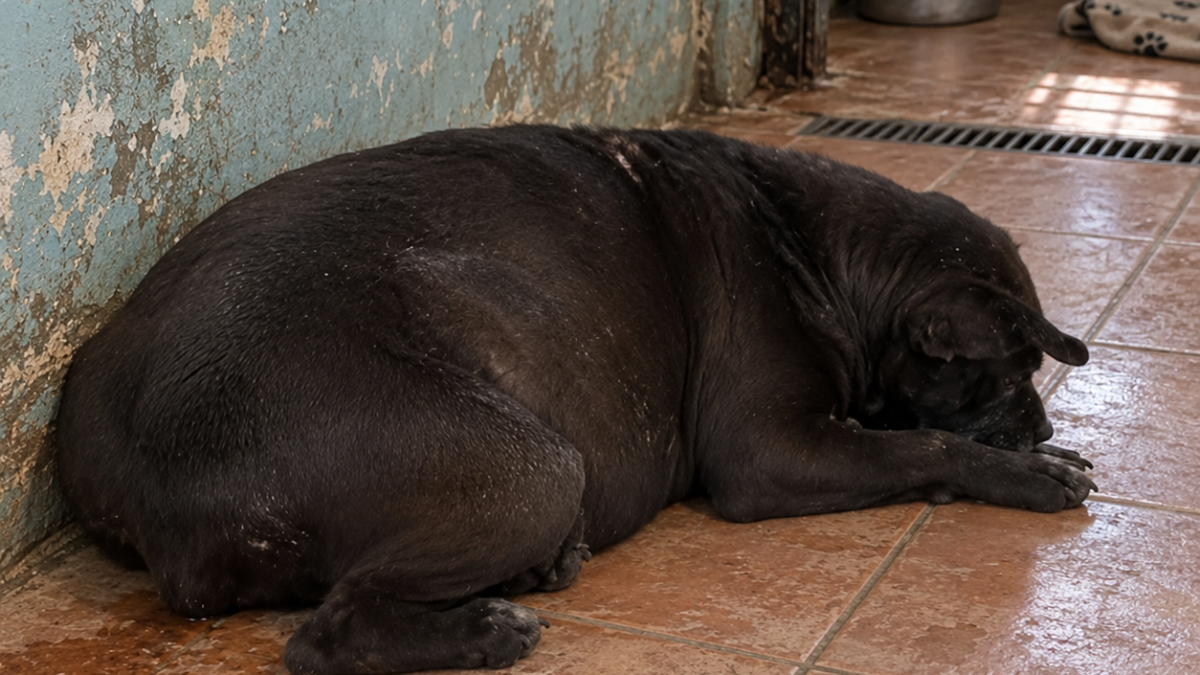
She was still thin beneath it all—far thinner than we had realized—but now her body finally looked like the body of a sick dog instead of a dog about to give birth.
Eduarda stood beside me.
“That was inside her?”
The veterinarian nodded.
“Almost all of it.”
“How was she walking?”
The doctor glanced at Isabela.
“I don’t know.”
That answer stayed with me.
We often imagine survival as strength.
Muscle.
Speed.
Fight.
Isabela had none of those things when we found her.
Her survival had been quieter.
One breath.
Then another.
One step.
Then another.
Standing when lying down might have meant never getting back up.
Walking while the pressure inside her abdomen increased every day.
Enduring the wound behind her while infection consumed tissue.
Remaining alive long enough for someone to finally stop.
The veterinarian crouched beside her.
“Her breathing should become easier now.”
I watched Isabela’s chest.
Slow rise.
Slow fall.
For the first time since we met her, there was space between those breaths.
She closed her eyes.
Not from collapse.
From relief.
I reached toward her, then stopped.
I had learned something from frightened animals: help can still feel like danger when every hand in your past has taught you to expect pain.
Instead of touching her, I sat on the floor.
“You don’t have to do anything now.”
One ear moved slightly.
“You made it here.”
Eduarda sat beside me.
Isabela remained between us, exhausted.
The veterinarian began explaining what came next.
Blood tests.
Medication.
Wound management.
Investigation into what had caused the ascites.
Monitoring for infection.
Nutrition.
Rest.
A lot of rest.
“What causes this much fluid?” I asked.
“There are several possibilities,” she said. “Liver disease. Heart problems. Severe inflammation. Low protein. Infection. We need more information.”
I looked at Isabela.
“So draining it doesn’t fix everything.”
“No.”
That was the first emotional blow after the relief.
I had watched almost four liters leave her body and instinctively wanted to believe we had removed the danger.
But the fluid was a symptom.
Not the whole disease.
And the wound remained.
When the veterinary staff began cleaning the tail again, I moved closer.
The infestation was terrible.
There are things photographs cannot communicate.
The smell.
The movement.
The knowledge that an animal has been walking through the world while living tissue is being consumed.
Eduarda covered her mouth for a moment.
“Who did this to her?”
Nobody answered.
The tail had clearly suffered severe trauma.
Whether someone had intentionally cut it, whether an attempted home docking had gone catastrophically wrong, or whether there had been another injury, we could not prove.
What we could prove was neglect.
A wound like that did not become infested in one afternoon.
It had been left untreated.
And Isabela had paid for every hour.
I felt anger rising.
Not useful anger.
The kind that searches for a person even when facts have not provided one.
I wanted a face.
A name.
Someone to blame.
Someone who had watched her suffer and decided she wasn’t worth the cost of treatment.
But Isabela did not need my imagination.
She needed medicine.
So I swallowed the anger and asked the only question that mattered.
“What can we do?”
The veterinarian looked at me.
“Today? Keep her stable.”
That became the mission.
Not solve her entire life.
Not reconstruct her history.
Keep her stable.
One hour.
Then another.
Isabela was started on medication.
Fluids were managed carefully because of the ascites.
Her wound was treated.
Blood was drawn.
She was offered food.
At first, she only smelled it.
I felt panic immediately.
“Is that bad?”
The technician smiled gently.
“She’s exhausted.”
We waited.
Five minutes.
Ten.
Then Isabela lifted her head.
She took one bite.
Stopped.
Another.
By the fifth bite, I realized everyone in the room was watching.
“Don’t stare at her,” Eduarda whispered.
“I’m not.”
“You are.”
“So are you.”
We both looked away.
Behind us, Isabela continued eating.
The sound was small.
Wet food against the bowl.
But after everything we had just seen, it felt like applause.
That first night, she stayed at the clinic.
I went home and could still smell the infection on my clothes.
I showered.
Changed.
Sat at my kitchen table.
Then opened the photographs on my phone.
Isabela before drainage.
The swollen abdomen.
The missing tail.
The exhaustion in her eyes.
Then one photograph taken afterward.
She looked smaller.
Fragile.
Almost deflated.
But her breathing looked easier even in the still image.
I zoomed in on her face.
What had happened to you?
No answer.
There never is.
Dogs do not arrive with statements.
They carry evidence.
Scar tissue.
Fear.
Malnutrition.
Reactions to raised voices.
Bodies that remember more than we know.
I went to sleep thinking about four liters of fluid.
I woke before dawn thinking about whether it had returned.
At 6:02 a.m., I called the clinic.
“Isabela?”
The receptionist didn’t need more explanation.
“She’s stable.”
I sat on the edge of my bed.
“Stable?”
“Yes.”
“Did she eat?”
“A little.”
“Is the belly filling again?”
“Not significantly overnight.”
I finally breathed.
“When can I come?”
“Whenever we open.”
I was there almost exactly then.
Isabela was lying on a clean blanket.
Her eyes opened when she heard my voice.
“Morning.”
Nothing.
I crouched.
“Remember me?”
Her nose moved.
Then something happened that I had not expected.
Her head shifted slightly toward my hand.
Not touching.
Just toward it.
I extended my fingers.
She sniffed them.
That was all.
But after the way she had surrendered on the street, choosing to investigate a person felt enormous.
A veterinary assistant entered.
“She’s sweet.”
“She’s scared.”
“Both can be true.”
That became another lesson Isabela taught me.
Fear does not erase gentleness.
Gentleness does not mean an animal was treated gently.
Some of the softest dogs I have known carried the hardest histories.
The blood tests gave us a clearer picture.
Her body was depleted.
Protein levels were poor.
There were signs consistent with prolonged illness and neglect.
The exact cause of the fluid accumulation required continued monitoring, but nutritional support and treatment began immediately.
The veterinarian was cautious.
“Ascites can return.”
“How quickly?”
“Depends on the cause.”
“So we watch the belly.”
“We watch everything.”
I nodded.
“And the tail?”
The veterinarian exhaled.
“That’s going to take time.”
The damaged tissue needed repeated cleaning.
Some areas were already necrotic.
The infestation had to be fully eliminated.
Infection needed controlling.
Surgery might eventually be necessary to revise what remained of the tail, but Isabela was too weak for anything unnecessary right then.
Again, the plan was patience.
That frustrated me.
Rescue teaches you to want action.
Find problem.
Fix problem.
Move on.
Bodies do not work that way.
Trust definitely does not.
For the first week, Isabela lived by tiny measurements.
Temperature.
Appetite.
Fluid accumulation.
Wound appearance.
Protein levels.
Body weight.
Stool.
Urine.
Breathing.
Every ordinary biological function became news.
“She ate half the bowl.”
Good.
“She stood without help.”
Good.
“She slept for four hours.”
Very good.
“The belly looks slightly fuller.”
Fear.
“She’s still stable.”
Breathe.
On the third day, Eduarda arrived while Isabela was eating.
She stopped in the doorway.
“Look at her.”
Isabela glanced up.
Then returned to the bowl.
Eduarda sat beside me.
“When we found her, I thought she had given up.”
“So did I.”
“Maybe she was just tired.”
That sentence changed the way I thought about her.
Given up.
We use that phrase too easily.
Animals lying still.
People no longer fighting visibly.
But exhaustion can look like surrender.
Isabela had not stopped wanting to live.
Her body had simply run out of dramatic ways to show it.
The evidence was in the bowl.
In every bite.
The next several days improved.
Her appetite strengthened.
Her abdomen remained manageable.
The wound looked cleaner.
The maggots were gone.
That alone changed the entire atmosphere around her.
No flies.
No movement inside the tissue.
No smell filling the room.
The first time I realized the odor was gone, I cried.
I did not expect that.
I was standing beside Isabela while the technician changed her dressing.
Suddenly I noticed I could smell only antiseptic.
I turned away.
Eduarda saw me.
“What?”
“The smell.”
“What smell?”
“Exactly.”
She understood.
We both cried then.
Isabela looked at us like humans were ridiculous.
She was probably right.
After about a week, she began wagging the small portion of her tail area she could still move.
It was barely visible.
More of a shift through the hips.
But we saw it.
“There,” I said.
Eduarda smiled.
“She did it again.”
Isabela looked between us.
Her eyes were changing.
That was the thing I noticed most.
On the street they had seemed distant.
Not empty exactly.
Guarded beyond reach.
Now she tracked us.
If I entered, she watched.
If Eduarda spoke, her ears moved.
If a veterinarian approached, Isabela still became tense—but she no longer disappeared emotionally.
She remained present.
That mattered.
Trust returned before strength.
Or maybe they returned together.
When she was medically stable enough to leave the clinic for foster care, we had to decide where she would go.
Eduarda offered first.
“I can take her.”
I looked at her.
“You already have three rescues.”
“Four.”
“When did four happen?”
She waved that away.
“Not relevant.”
It was very relevant.
“I can take Isabela,” I said.
Eduarda smiled.
“You already prepared a room, didn’t you?”
I said nothing.
“You did.”
Maybe.
Clean blankets.
Low bed.
Washable pads.
Food approved by the veterinarian.
Medication chart.
I had bought everything two days earlier.
I suppose the decision had already been made.
The veterinarian gave me a long list.
“Monitor abdominal size.”
“Yes.”
“Breathing rate.”
“Yes.”
“Appetite.”
“Yes.”
“Wound.”
“Yes.”
“Temperature if she seems off.”
“Yes.”
“No strenuous activity.”
“She barely wants to walk.”
“That may change faster than you expect.”
I looked at Isabela.
At that point she still moved slowly.
I could not imagine her wanting to run.
The veterinarian smiled.
“You’ll see.”
The drive home was quiet.
Isabela lay in the back beside Eduarda.
At one stoplight, I looked in the mirror.
“She asleep?”
Eduarda checked.
“Almost.”
Isabela’s head rested against the blanket.
Her eyes were half closed.
Cars moved around us.
Horns.
Engines.
People.
And for once, nobody was passing her on a sidewalk.
She was going somewhere.
Home.
Temporary, I told myself.
Foster.
Temporary.
I would learn later that “temporary” is one of the lies rescuers tell themselves for emotional self-defense.
At my house, Isabela stood in the doorway.
Her posture reminded me of another kind of fear.
Not panic.
Confusion.
Dogs who have lived without secure shelter sometimes do not understand rooms.
Walls can feel like traps.
Doorways can feel like decisions.
I walked inside and sat down.
No pulling.
No pushing.
Eduarda remained behind her.
“Come on, Bella.”
That was the first time anyone shortened her name.
Isabela.
Bella.
Her ears moved.
She took one step.
Then another.
Entered.
Stopped.
Looked around.
The bed was in the corner.
Water beside it.
Food farther away.
The back door visible.
I had made sure she could see an exit.
She walked toward the water.
Drank.
Then stood still.
“What now?” Eduarda whispered.
“We let her decide.”
Isabela walked to the bed.
Sniffed.
Turned away.
Lay directly on the floor.
Of course.
I laughed softly.
“Good money spent.”
Eduarda smiled.
“Give her time.”
That first night, I slept on the couch.
Not because she required constant supervision.
Because I did.
Every sound made me sit up.
Was she breathing?
Was the belly swelling?
Was she licking the wound?
Was she uncomfortable?
At 1:20 a.m., I checked her.
Eyes open.
“Sorry.”
At 2:45.
Eyes open again.
“Go back to sleep.”
At 4:10, I woke without meaning to.
Isabela was asleep.
Deeply.
Her chest moved slowly.
I lay back down.
Then realized something.
She had chosen the bed.
Sometime after 2:45, she had climbed into it.
I smiled into the dark.
Small victories.
Morning brought a larger one.
I walked into the kitchen.
Isabela stood up.
Then followed me.
Only a few steps.
But followed.
I put breakfast down.
She ate.
Slower than the first day.
No desperation.
Still hungry, but not frantic.
Then she walked back to the bed and rested.
Routine began.
Medication.
Food.
Cleaning.
Short bathroom trips.
Rest.
Repeat.
For several days, her world remained small.
That was fine.
Recovery does not need entertainment.
It needs consistency.
The wound slowly changed.
Healthy tissue appeared.
Swelling decreased.
Her body gained condition.
The abdomen remained under close observation.
There were moments of concern.
One afternoon, it looked larger.
I panicked and called the clinic.
“Bring her in.”
We did.
Ultrasound.
Examination.
Some fluid had returned.
Not nearly four liters.
But enough to remind us the battle was not finished.
I felt defeated.
“We’re going backward.”
The veterinarian shook her head.
“No.”
“It’s back.”
“A little. That’s not the same as going backward.”
“What if it keeps coming?”
“Then we keep treating the cause and managing the symptom.”
I hated the uncertainty.
“Can’t you tell me she’ll be fine?”
“No.”
I appreciated her for that.
False hope is not kindness.
She could tell me Isabela was stronger.
She could tell me the wound was improving.
She could tell me the fluid burden was smaller.
She could not promise an outcome.
So we continued.
The second drainage was much smaller.
Isabela tolerated it better.
Afterward, she ate.
That became our benchmark.
If Bella ate, I could breathe.
Weeks passed.
Her coat improved.
Her body shape changed.
She was never actually fat beneath the swollen abdomen.
Once the fluid was controlled, her ribs became visible.
Not skeletal.
But clearly undernourished.
We increased nutrition carefully.
Bella loved chicken.
This discovery nearly ruined all discipline.
I could hide medication in ordinary food and she would inspect it.
Chicken?
Gone.
Pill included.
“Traitor,” Eduarda said once while Bella swallowed medication perfectly.
“She’s practical.”
“Manipulative.”
Bella stared at the chicken container.
“Definitely manipulative.”
Then came the first real sign that she was becoming a dog again instead of merely a patient.
She stole a kitchen towel.
I walked into the living room and found her lying on her bed with the towel between her paws.
“What are you doing?”
Bella froze.
I approached.
She lowered her head.
The fear returned instantly.
That broke my heart.
I stopped.
“No.”
Her body remained tense.
“You’re not in trouble.”
I sat down.
The towel stayed between us.
Bella watched me.
After several seconds, I picked up a toy and placed it beside the towel.
“You can take things.”
Her ears moved.
“Just maybe not my towel.”
Tail area wiggled.
I laughed.
That evening I bought her more toys.
She ignored all of them.
Stole another towel two days later.
Fine.
Apparently towels were toys.
Her personality emerged in pieces.
She was quiet.
Affectionate.
Stubborn.
Suspicious of men wearing hats.
Terrified of brooms.
Interested in every sound from the kitchen.
Loved sun.
Hated rain.
Would tolerate baths only if bribed shamelessly.
And once she trusted someone, she wanted physical contact constantly.
Not at first.
The first touch had been endured.
Then permitted.
Then sought.
One evening I sat on the floor beside her.
Bella moved closer.
Her shoulder touched my knee.
I stayed still.
She leaned harder.
Then placed her head in my lap.
I looked down.
“Really?”
Eyes closed.
That was it.
I became furniture.
For nearly forty minutes, I refused to move.
My leg went numb.
Worth it.
Eduarda came over and found us.
“She owns you.”
“Quiet.”
“She absolutely owns you.”
Bella opened one eye.
“See?”
I tried to deny it.
Poorly.
The medical progress continued.
Her blood values improved.
Protein increased.
Fluid accumulation decreased.
The veterinarian became more optimistic.
“Her body is stabilizing.”
I almost asked, “So she’s safe?”
I stopped myself.
Nothing in rescue is guaranteed.
Instead I asked, “What’s next?”
“The tail.”
That word carried us back to the beginning.
The wound had improved dramatically, but the damaged tissue needed definitive treatment.
A surgical revision would remove unhealthy tissue and create a cleaner closure.
Bella was finally strong enough.
I felt fear immediately.
Another procedure.
Another anesthesia.
Another recovery.
“Does she need it?”
“Yes.”
“Then we do it.”
Bella sat beside my chair during the consultation.
Her head rested against my leg.
The veterinarian smiled.
“You two bonded.”
“She uses me for chicken.”
“Sure.”
The night before surgery, I thought about the person responsible for the original tail injury.
Again, anger surfaced.
I imagined confrontation.
A confession.
Police.
Justice.
But there was no evidence identifying anyone.
We had no owner.
No witness.
No verified history.
To manufacture a villain would turn Bella’s real suffering into fiction.
She deserved better.
The only revenge available to us was factual.
Her body would heal despite what happened.
The infected tissue would be removed.
The wound that had once attracted flies would become a scar.
Human hands would finish what neglect had refused to begin.
Treatment.
That was enough.
On surgery morning, Bella knew something was wrong because breakfast disappeared.
She stood beside her empty bowl.
Looked at me.
Then at the bowl.
“Don’t.”
She looked again.
“I know.”
She followed me through the house as if searching for evidence of food.
“Doctor’s orders.”
Bella sighed.
Dogs can sigh with remarkable accusation.
At the clinic, she hesitated.
Then walked inside.
That difference mattered.
Weeks earlier, she had been carried because she barely reacted to anything.
Now she made choices.
Good.
Fear and preference are privileges when compared with collapse.
The veterinarian took her back.
I waited.
Surgery lasted long enough to make me hate clocks.
When the call came, the news was good.
The damaged tail tissue had been addressed.
Bella woke safely.
No complications.
I saw her later that afternoon.
She looked insulted.
Bandage.
Medication.
No breakfast.
Worst day ever, according to her expression.
I crouched.
“You’re okay.”
She turned her head away.
“Still mad?”
No response.
I opened a container.
Chicken smell reached her.
Bella looked back immediately.
“Thought so.”
The staff laughed.
Recovery from the tail procedure was easier than the first weeks of rescue.
Her body was stronger now.
Her immune system worked with us instead of against us.
The wound closed.
The infection stayed away.
Her abdominal fluid remained controlled.
And for the first time, appointments began to sound less urgent.
“Come back in two weeks.”
Not tomorrow.
Not three days.
Two weeks.
Then a month.
The calendar itself became proof of recovery.
Urgency was leaving our lives.
One morning, Bella ran.
It was not planned.
I opened the back door.
She stepped into the yard.
A bird landed near the fence.
Bella saw it.
Her entire body changed.
Head up.
Ears forward.
Then she took off.
I shouted.
“Bella!”
She sprinted perhaps twenty feet.
Not far.
But fast.
Too fast for my heart.
The bird escaped.
Bella stopped.
Turned.
And ran back.
Her mouth open.
Eyes bright.
I crouched.
“You’re insane.”
She pushed into me.
I laughed.
“You couldn’t stand when we found you.”
Tail-end wiggle.
“Now you’re chasing birds?”
She licked my chin.
I sat in the grass and cried.
That run became one of those moments that divides a story.
Before.
After.
Before, Bella’s body was something she endured.
After, it became something she enjoyed.
She began walking farther.
Sniffing more.
Exploring.
On good days, she trotted through the yard with the energy of a dog making up for stolen time.
Her belly never again reached anything close to the enormous size we had seen on the street.
That visual transformation was almost difficult to comprehend.
I kept one photograph from the first day.
Bella standing with an abdomen so distended she looked ready to deliver a litter.
Then I took another photograph months later.
Healthy body.
Normal abdomen.
Bright eyes.
The scar where the tail wound had healed.
I put them side by side.
Eduarda stared.
“That cannot be the same dog.”
“It is.”
“You know what gets me?”
“What?”
“Everyone thought the big belly meant puppies.”
I knew.
That was the cruelest misunderstanding.
Pregnancy is associated with life.
Hope.
New beginnings.
Bella’s swollen belly had been the opposite.
It had been a warning that her own life was failing.
People saw one thing.
Reality was another.
The same had been true of Bella herself.
People saw a stray.
Reality was an individual.
People saw damaged.
Reality was recoverable.
People saw quiet.
Reality was exhausted.
People saw surrender.
Reality was survival.
The more she healed, the angrier I became about how easy it had been for the world to misread her.
But Bella did not carry anger.
She carried appetite.
Excellent appetite.
Her obsession with chicken increased.
She learned the refrigerator sound.
Not the refrigerator itself.
The specific sound of the drawer containing cooked meat.
If I opened vegetables, no reaction.
Chicken drawer?
Bella appeared from another room.
“How?”
Tail wiggle.
“You were asleep.”
She stared.
“I don’t understand you.”
She understood me perfectly.
Her adoption question arrived gradually.
At first, we discussed potential families.
Quiet home.
Patient people.
Reliable veterinary follow-up.
No rough handling.
Somebody comfortable with a dog who might always carry fear around certain objects or movements.
We received inquiries.
One family visited.
They were kind.
Bella remained beside me.
They sat on the floor.
She eventually accepted food from them.
Good.
Another couple came.
Bella hid.
Not necessarily a rejection.
But information.
I told myself we were searching for the right home.
Then Eduarda asked the obvious question.
“Why are you pretending?”
I looked at her.
“Pretending what?”
“That you’re placing her.”
“I’m fostering.”
“No.”
“Yes.”
“No.”
“She could be happy somewhere else.”
“I’m sure she could.”
“Then?”
Eduarda pointed.
Bella was asleep with her head on my foot.
“You tell me.”
I looked down.
“This proves nothing.”
Bella rolled slightly and pressed closer.
Eduarda laughed.
“Absolutely nothing.”
The truth was frightening.
Keeping her meant responsibility.
Years of it.
Medical monitoring.
Possible recurrence.
Unknown long-term issues.
Behavioral care.
Expense.
Attachment.
Loss someday.
But letting her go because I feared future loss would be another form of abandonment.
So I stopped pretending.
At her next veterinary appointment, I asked, “What paperwork do I need?”
“For what?”
“To make her mine officially.”
The veterinarian smiled like she had been waiting.
“I wondered how long that would take.”
“Everyone is very smug about this.”
“Because everyone knew except you.”
Bella sat beside me.
“Did you know?”
Tail wiggle.
Of course she did.
The adoption became official.
Isabela.
My dog.
Not the abandoned dog.
Not the swollen-belly case.
Not the tail-wound rescue.
Mine.
I bought her a tag.
The full name barely fit.
ISABELA.
Phone number.
Address.
I clipped it to her collar.
She shook her head at the sound.
“You have an address.”
Another shake.
“You’re supposed to appreciate this.”
She walked toward the kitchen.
Fine.
Emotional moment concluded.
The first night after the adoption became official was identical to the night before.
Same bed.
Same house.
Same food.
Same person.
Nothing changed for Bella.
Everything changed for me.
There was no more “when she gets adopted.”
No more “future family.”
We were the future family.
Several months later, we returned to the area where she had been found.
I debated whether to bring her.
Not because I believed dogs need symbolic closure.
That is often a human idea.
But Bella had become confident enough for a controlled visit, and Eduarda wanted to see the difference.
We chose a quiet time.
Bella stepped out wearing a harness.
She sniffed.
No dramatic reaction.
No obvious memory.
I looked toward the place where we had first seen her.
For me, it was immediate.
The enormous belly.
Flies.
The smell.
The way she stood still.
Bella pulled lightly toward a patch of grass.
I followed.
That was the difference.
I was living in the past.
She was interested in a smell.
Good.
We passed a small shop.
A woman outside stared at Bella.
“Is that the dog?”
I stopped.
“You remember her?”
“The pregnant one?”
I felt the old correction rise.
“She wasn’t pregnant.”
The woman looked confused.
“That huge belly?”
“Fluid.”
Her face changed.
“Oh.”
“Nearly four liters.”
She covered her mouth.
“I thought…”
“I know.”
“I saw her several times.”
I looked at her.
“Did you?”
The woman became uncomfortable.
“She was around here.”
“Did anyone know where she came from?”
“No.”
“Did anybody feed her?”
“Sometimes.”
“Did anybody call for help?”
She looked away.
“I don’t know.”
Bella sniffed her shoes.
The woman crouched carefully.
“Can I pet her?”
“Let her decide.”
The woman extended a hand.
Bella smelled it.
Then leaned slightly closer.
The woman touched her neck.
“She looks beautiful.”
I watched Bella.
Healthy.
Calm.
No swollen abdomen.
No flies.
No open tail wound.
The woman’s eyes filled.
“We thought she was going to have puppies.”
“She was dying.”
“I’m sorry.”
I believed her.
Regret is complicated.
It cannot change what happened.
But sometimes it can change what someone does next.
The woman looked at me.
“What should I have done?”
“Called someone.”
“I didn’t know who.”
“Anyone. A rescue. Animal control. A clinic. Keep asking until somebody answers.”
She nodded.
“I won’t ignore it next time.”
That mattered.
Not punishment.
Change.
Bella’s story did not need an enemy dragged into the street.
It needed fewer dogs becoming Bella.
We continued walking.
Another man recognized her.
“That dog survived?”
“Yes.”
He stared.
“I thought she’d die.”
“So did we.”
Bella wagged at him.
He smiled.
“She’s friendly.”
“She always was.”
That sentence hit me harder than I expected.
She always was.
Even when infected.
Even when frightened.
Even when abandoned.
Pain had not made her cruel.
The world had failed her, and she still offered softness.
That was not weakness.
It was remarkable.
The most dramatic confrontation came later, but not in the way I expected.
A man approached us near the vehicle.
He looked at Bella for a long time.
“I know that dog.”
My body tightened.
“How?”
“I used to see her farther down the road.”
“Was she yours?”
“No.”
“Do you know whose she was?”
He hesitated.
“Maybe.”
Every nerve in me sharpened.
“Maybe who?”
He named a property nearby.
Eduarda and I looked at each other.
“Are you sure?”
“No.”
“Did you ever see her inside that property?”
“A dog like her.”
“With a tail?”
He frowned.
“I don’t remember.”
That mattered.
A similar dog.
No certainty.
We could not turn rumor into proof.
Still, we asked around.
Not publicly.
Carefully.
The trail led nowhere solid.
No microchip.
No verified owner.
No photographs.
No veterinary records.
No witness able to say with confidence, “That was Isabela.”
My anger wanted certainty.
Reality refused.
So I let it go.
That was difficult.
Part of me wanted someone held responsible for the tail.
For the neglect.
For the months leading to the street.
But justice without evidence becomes accusation.
Bella had already suffered enough because humans acted carelessly.
I would not honor her by doing the same.
The “revenge” came another way.
A local rescue group used her case in an educational campaign about ascites and severe neglect.
Not with graphic exploitation.
With facts.
A dog who looks pregnant may be critically ill.
A silent dog may be too weak to cry.
A wound attracting flies is a medical emergency.
Do not assume.
Do not pass by.
Call.
That message spread.
People contacted the rescue with similar cases.
One elderly dog with an enormous abdomen turned out to have severe fluid accumulation.
A young stray with an infected wound received treatment before infestation became advanced.
A pregnant dog truly was pregnant and was moved somewhere safe before giving birth.
Bella never knew any of this.
She didn’t need to.
Her suffering had already cost enough.
But knowing her story helped other animals receive attention sooner felt like the only justice worth chasing.
Her own life kept getting smaller in the best way.
Not small as in limited.
Small as in ordinary.
Breakfast.
Walk.
Nap.
Chicken negotiations.
Sunlight.
Visitors.
Towels stolen from the bathroom.
The dramatic rescue slowly became background history.
That is the goal.
You do not want a rescued dog to spend every day performing recovery for you.
You want them bored.
Spoiled.
Annoying.
Safe enough to be inconvenient.
Bella achieved this magnificently.
She learned how to open the laundry basket.
Not the lid.
She pushed it over.
Towels everywhere.
I walked in.
“Isabela.”
She froze.
A towel hung from her mouth.
“What did we discuss?”
Tail wiggle.
“That is not an answer.”
She walked toward me still holding it.
I laughed despite myself.
“You have toys.”
She dropped the towel at my feet.
Then looked toward the kitchen.
Transactional relationship.
Fine.
Chicken appeared.
I had lost control completely.
One rainy afternoon, thunder shook the house.
Bella jumped.
She hated sudden noises.
I expected her to hide.
Instead, she came toward me.
That was new.
She pressed herself beside my chair.
I placed one hand on her shoulder.
Storm outside.
Safety inside.
Her body gradually relaxed.
I remembered the first time Eduarda touched her chest on the street.
Bella had simply stood there because she lacked the strength to resist.
Now she chose touch.
That difference is everything.
Months became a year.
Her medical follow-ups stretched farther apart.
The ascites did not return in the catastrophic way we had feared.
Whatever combination of illness, nutritional depletion and inflammation had driven her body into crisis was now controlled under veterinary supervision.
Her weight became healthy.
Her coat became soft.
Her abdomen remained normal.
The tail healed into a small, imperfect shape.
I loved it.
Not the injury.
The scar.
It told the truth without controlling her future.
One morning, I found Bella stretched on her back in a patch of sunlight.
Belly exposed.
Legs loose.
Eyes closed.
I stood there.
That belly.
Once enormous with almost four liters of fluid.
Once the reason strangers dismissed her as pregnant.
Now rising and falling normally beneath sunlight.
I knelt beside her.
She opened one eye.
“Do you know what you put us through?”
Tail-end wiggle.
“You almost died.”
She yawned.
“Very moving.”
She closed her eyes again.
I laughed.
Maybe that was the best possible response.
She did not live every day beneath the shadow of almost.
Almost dead.
Almost too late.
Almost abandoned forever.
Those were human measurements.
Bella measured the present.
Warm floor.
Full stomach.
Person nearby.
Enough.
Around the anniversary of her rescue, Eduarda visited.
We brought out the old photos.
I rarely looked at them anymore.
The first one silenced us.
Bella standing beside the road.
Belly massive.
Head low.
Flies visible near the tail.
Then another photograph from the clinic after the drainage.
Her abdomen drastically smaller.
Body frail.
Eyes exhausted.
Then current Bella walked into the room carrying a stolen towel.
Eduarda laughed through tears.
“Perfect timing.”
Bella dropped the towel.
I held up the phone.
“Look at this.”
She sniffed it.
“That’s you.”
She walked away.
Eduarda smiled.
“She doesn’t care.”
“Good.”
We scrolled farther.
The containers holding the fluid.
Nearly four liters.
“I still can’t believe it,” Eduarda said.
“Neither can I.”
“She was carrying that through the street.”
“I know.”
“And nobody realized.”
“I know.”
We became quiet again.
Then Bella returned.
She pushed her head under Eduarda’s hand.
Eduarda began scratching behind her ears.
“Look at you now.”
Bella leaned harder.
The dog who once stood silently while strangers passed now demanded attention.
That was revenge.
Bella’s revenge.
Not destruction.
Expectation.
She expected people to notice her now.
Expected food.
Expected affection.
Expected doors to open.
Expected someone to return.
The world had once taught her she was invisible.
We spent a year teaching her the opposite.
One afternoon, a little girl visiting with her mother asked about Bella’s tail.
“What happened?”
I kept the answer simple.
“She was hurt before she came here.”
“Did someone cut it?”
“We don’t know exactly what happened.”
“Did it hurt?”
“Yes.”
The girl looked sad.
Bella approached her.
The mother asked, “Can she pet her?”
“Let Bella choose.”
The girl held her hand low.
Bella sniffed.
Then moved closer.
The child stroked her shoulder.
“Does she still hurt?”
I looked at Bella.
“No. Not like she did.”
The girl smiled.
“Then she won.”
I stopped.
Children sometimes say the cleanest thing.
Then she won.
Yes.
That was it.
We had spent months talking about treatment.
Healing.
Neglect.
Responsibility.
Evidence.
But the simplest truth was this:
Pain had been temporary.
Bella remained.
She won.
That evening I sat outside with her.
No storm.
No emergency.
Just quiet.
She rested near my feet.
The sun disappeared behind the houses.
I thought about all the endings I had once imagined.
Maybe we would discover who abandoned her.
Maybe there would be charges.
Maybe some dramatic confrontation would satisfy the anger I carried.
Life did not give us that ending.
And eventually, I became grateful.
Because the best ending was not about the person who hurt or neglected Bella.
It was about Bella.
Too many rescue stories spend the final chapter on the human who caused suffering.
Bella deserved the final chapter.
Her appetite.
Her trust.
Her ridiculous towel theft.
Her love of chicken.
Her healed belly.
Her quiet confidence.
Her insistence on sleeping diagonally across the couch.
The person responsible for her suffering, whoever they were, had already occupied enough of her life.
They did not deserve her ending too.
So the ending belonged to the dog.
A year and a half after I first saw her, Bella came with me to the veterinary clinic for a routine check.
No emergency.
Routine.
That word still felt luxurious.
The veterinarian examined her.
Heart.
Lungs.
Abdomen.
Blood work.
Tail.
Everything.
Bella stood patiently.
Then demanded chicken.
The veterinarian laughed.
“She looks excellent.”
I smiled.
“Say that again.”
“She looks excellent.”
No warning.
No urgent plan.
No “bring her back tomorrow.”
Excellent.
I thought about the first consultation.
“There aren’t any puppies.”
“Then what is that?”
“Fluid.”
Nearly four liters.
I looked at Bella now.
Normal abdomen.
Strong body.
Bright eyes.
“She’s really okay?”
The veterinarian nodded.
“She’ll always need normal monitoring, but yes. She’s living a good life.”
A good life.
Such plain words.
Such an enormous achievement.
Outside the clinic, Bella stopped near the grass.
She sniffed.
Then suddenly ran toward the vehicle because she knew treats were inside.
I laughed.
“Slow down!”
She ignored me.
Her body moved easily.
No giant abdomen dragging beneath her.
No infection consuming her from behind.
No flies.
No collapse.
Just a dog running because snacks existed.
I opened the car door.
Bella jumped in.
That alone would have been impossible when we found her.
I sat beside her for a moment before starting the engine.
“You know, everyone thought you were pregnant.”
Bella panted.
“No puppies.”
Tail wiggle.
“Four liters.”
She nudged my arm.
“Yes, I know. Chicken.”
I gave her one small piece.
She swallowed it instantly.
“You have learned nothing about patience.”
She looked toward the bag.
I started the car.
On the drive home, Bella fell asleep.
Her head rested against the seat.
I glanced at her at a red light.
There are moments when the beginning and the ending overlap.
For a second, I could see both dogs.
The one on the street.
The one in my car.
Same eyes.
Different expectations.
The first expected nothing.
The second knew exactly where we were going.
Home.
That might be the greatest transformation of all.
Not physical.
Expectation.
A neglected animal learns not to expect.
Food may not come.
Help may not come.
Pain may not stop.
People may leave.
Rescue reverses that one ordinary promise at a time.
Breakfast comes.
Medicine comes.
A person returns.
Night passes.
Morning comes.
The bowl fills again.
Bella learned slowly.
Then completely.
Today, if dinner is five minutes late, she appears beside me with the expression of a union representative filing a grievance.
That is success.
The dog who once accepted starvation and infection silently now believes inconvenience should be addressed immediately.
Good.
She has standards.
She has demands.
She has a life valuable enough to complain about.
Sometimes visitors ask why I kept her.
I never know how to answer.
Because she needed me?
True at first.
Because I loved her?
Eventually.
But neither explains everything.
I kept Bella because somewhere between the first bite of food and the first stolen towel, she stopped being a rescue project.
She became part of the shape of my days.
Morning felt incomplete without her nails against the floor.
The kitchen sounded wrong without her appearing whenever chicken was opened.
The couch looked empty without her stretched across it.
Home adjusted around her.
That is how belonging happens.
Not in one dramatic decision.
Through repetition.
Then one day you realize removing someone would leave a hole.
Bella had already survived too many holes.
She deserved permanence.
Two years after her rescue, we returned once more to the road where she had been found.
This time, not because I needed closure.
A nearby rescue group was holding a small awareness event.
Bella came as a calm adult dog.
People met her.
Some knew the story.
Others did not.
A woman looked at the old photograph on a display and then at Bella.
“Is that really her?”
“Yes.”
She pointed at the abdomen.
“Pregnant?”
“No.”
“What happened?”
I explained.
Ascites.
Nearly four liters.
Severe tail wound.
Maggot infestation.
Infection.
The woman covered her mouth.
“How did she survive?”
I looked down.
Bella was accepting a treat from a volunteer.
“I think she kept waiting for one thing to go right.”
The woman nodded slowly.
“And it did.”
“Yes.”
One thing.
A rescuer stopped.
Then another.
A clinic acted.
Medication worked.
Food continued.
The wound closed.
Fluid drained.
Strength returned.
Trust followed.
One right thing became another.
That is how lives change.
Not usually through miracles.
Through chains.
The event organizers asked if I wanted to say a few words.
I almost refused.
Public speaking was not the point.
Then I looked at Bella.
Maybe there was one thing worth saying.
I stood in front of a small group.
No stage.
No microphone.
Bella beside me.
“I want you to remember what she looked like.”
People glanced at the photograph.
“Most of us would have assumed pregnancy.”
Nods.
“But she was critically ill.”
I paused.
“She didn’t bark for help. She didn’t collapse in front of the right person. She didn’t make a dramatic scene.”
Bella sat.
“She stood there quietly.”
I looked around.
“So if you see an animal who looks wrong, trust that instinct. You do not need to know the diagnosis. You do not need to solve everything. You just need to make the call.”
That was all.
No speech about heroes.
No morality performance.
Just a practical truth.
See.
Call.
Do something.
Afterward, Bella tried to steal food from a table.
Educational ambassador of the year.
I pulled her back gently.
“You are embarrassing me.”
Tail wiggle.
A volunteer laughed.
“She’s definitely recovered.”
“Yes.”
We returned home before sunset.
Bella slept almost the entire drive.
At the house, she walked inside ahead of me.
No hesitation at the doorway.
No checking for escape.
No confusion about whether she belonged.
Straight to the kitchen.
I filled her water bowl.
Then dinner.
She ate.
Left three pieces behind.
Walked away.
I stared at them.
Another quiet miracle.
The abandoned dog who had once lived without guarantees now had enough confidence to leave food unfinished.
She knew tomorrow existed.
I left the pieces there for a while.
Not because they mattered.
Because they did.
Later that night, Bella climbed beside me.
She placed her head against my leg.
I ran a hand over her side.
Normal abdomen.
Healthy ribs beneath muscle.
Soft coat.
My fingers reached the scar where her tail had been damaged.
Bella did not flinch.
The scar remained.
It always would.
But scars are not open wounds.
That difference is the entire story.
An open wound is suffering happening now.
A scar is proof suffering became past tense.
I sat there thinking about the flies.
The infestation.
The pressure inside her abdomen.
The strangers who believed she was pregnant.
The clinic screen showing no puppies.
The containers filling one by one.
One liter.
Two.
Three.
Almost four.
The moment Bella exhaled.
That exhale may be the sound I remember most.
Not crying.
Not barking.
Relief.
As if her body said something her voice never had.
Finally.
Years later, Bella still breathes deeply when she settles to sleep.
Sometimes I watch.
Not because I fear she will stop.
Not anymore.
Because I remember when every breath had to push against a body full of fluid.
Now breathing is effortless.
Ordinary.
Free.
That is her victory.
People often ask for the most emotional part of a rescue.
Was it the moment we found her?
The drainage?
The surgery?
The first wag?
The adoption?
For me, it is none of those.
It is an ordinary morning.
Bella wakes before me.
She walks into the kitchen.
Her tag jingles.
She drinks water.
Waits for breakfast.
After eating, she goes outside.
Sun on her back.
She sniffs the yard.
Then returns through the door without being called.
She finds her bed.
Turns in a circle.
Lies down.
Sleeps.
Nothing bad happens.
That is the beautiful part.
Nothing.
No emergency.
No flies.
No fever.
No swelling.
No open wound.
No abandonment.
No stranger trying to decide whether she is worth saving.
Just a dog sleeping because she expects to wake up safe.
I used to think the most satisfying revenge would be discovering who had hurt her.
Looking that person in the eyes.
Showing them what they had done.
Watching consequences arrive.
Maybe part of me still wishes we had enough evidence for accountability.
But Bella taught me another kind of revenge.
The person or circumstance that left her suffering reduced her world to pain.
We expanded it again.
Neglect told her she did not matter.
She became the center of a home.
Hunger told her food was uncertain.
She became picky.
Fear told her hands were dangerous.
She learned to push her head beneath them for affection.
Disease filled her abdomen until she could barely breathe.
She learned to run.
The wound behind her attracted flies.
It became a scar beneath healthy fur.
Abandonment told her nobody was coming.
Someone came.
Then stayed.
That is a kind of justice no cruel person can undo.
Bella survived long enough to become unrecognizable to her own tragedy.
And that is how I prefer to remember her.
Not standing beside the road with an enormous belly.
Not trembling under the weight of infection.
Not allowing strangers to touch her because she no longer had the strength to resist.
I remember Bella running toward me across the yard.
Her ears moving with each stride.
Her eyes bright.
Her body light.
I remember kneeling.
I remember her reaching me.
I remember her pushing her forehead into my chest as though the distance between us had always belonged to her.
And I remember thinking:
This is what four liters of pain could not take.
This is what neglect could not destroy.
This is what abandonment failed to erase.
Her ability to trust.
If I could return to that first day and speak to the exhausted dog beside the road, I would not tell her everything.
She would not need the details.
I would not tell her about needles.
Tests.
Drainage.
Surgery.
Medication.
Setbacks.
I would keep it simple.
I would crouch far enough away that she did not feel trapped.
And I would say:
“Isabela, I know you think nobody is coming.
“You’ve stood here long enough to believe that.
“You are tired.
“Your body hurts.
“You cannot understand what is happening inside your belly.
“You probably think the pain is just part of being alive now.
“It isn’t.
“Someone is going to see you.
“Not the belly.
“Not the wound.
“You.
“We are going to lift you into a car.
“You will be frightened.
“That is okay.
“You will arrive at a place where strangers touch the wound, but this time their hands will be careful.
“They will look inside your belly expecting puppies.
“There won’t be any.
“They will discover the truth.
“And then they will begin removing the weight you have been carrying.
“One liter.
“Then another.
“Then another.
“You will breathe easier.
“You will sleep.
“You will eat.
“The flies will disappear.
“The wound will become clean.
“People will come back tomorrow.
“And the day after.
“You will learn the strange thing nobody taught you before.
“Help can repeat.
“Food can repeat.
“Kindness can repeat.
“A hand can touch you today and still be gentle tomorrow.
“You will steal towels.
“You will chase birds.
“You will become obsessed with chicken.
“You will complain when dinner is late.
“You will have a tag with your name and an address.
“You will walk through a door and know which side is home.
“And one day, the belly everyone mistook for pregnancy will be normal.
“You will lie on your back in the sun with that belly exposed because you will finally believe nobody is coming to hurt you.
“You won’t understand why the humans around you cry when they see it.
“That’s okay.
“You don’t need to understand.
“You only need to keep breathing until we reach you.”
That is what I would tell her.
Because she did keep breathing.
Long enough.
Long enough for Eduarda to kneel beside her.
Long enough for us to reach the clinic.
Long enough for the veterinarian to recognize that the huge abdomen was not pregnancy.
Long enough to remove almost four liters of fluid.
Long enough for antibiotics to work.
Long enough for the infestation to disappear.
Long enough for the wound to close.
Long enough for trust to return.
Long enough for home.
Today, Isabela no longer waits for someone to notice her.
She walks into a room expecting to be noticed.
If I am busy, she nudges my hand.
If I stop petting her too soon, she presses closer.
If I open the refrigerator, she appears.
If I leave the room, sometimes she follows.
Sometimes she doesn’t.
That last part matters too.
Following is love.
Staying behind is security.
Bella can let me leave a room because she knows I come back.
She can sleep while I am gone.
She can finish a meal later.
She can close her eyes completely.
Those are privileges fear once stole.
Now they belong to her again.
Every so often, somebody sees her scar and asks whether I wish her past had never happened.
Of course.
I would erase every painful moment if I could.
But I cannot.
All I can do is make sure the pain does not receive credit for the dog she became.
People sometimes say suffering makes animals stronger.
I don’t like that.
Bella did not need suffering to become worthy.
She was worthy before.
Pain did not improve her.
Care allowed the dog who was always there to come forward.
The affectionate dog.
The stubborn dog.
The towel thief.
The chicken addict.
The sun sleeper.
That is who she was beneath the disease.
We did not create her sweetness.
We simply stopped pain from burying it.
And perhaps that is the ending I wanted from the beginning without knowing it.
Not a transformed dog.
A revealed one.
The real Isabela had been hidden beneath fluid, infection, fear and neglect.
Nearly four liters of pressure had changed her shape.
Pain had changed her posture.
Exhaustion had changed her eyes.
Healing removed those layers.
What remained was her.
One evening, years after rescue, Bella stood beside the open back door.
Rain had just stopped.
The yard smelled wet.
She looked outside.
Then at me.
“Go ahead.”
She stepped onto the porch.
No fear.
No hesitation.
Water dripped from the roof.
Bella walked into the grass.
She stood there breathing.
I watched from the doorway.
A dog with a healed scar.
A normal belly.
A full life.
She turned.
For a second, our eyes met.
Then she ran back toward me.
I opened my arms.
Bella did not slow down.
She collided gently with my knees.
I laughed.
“Easy.”
Tail wiggle.
I scratched behind her ears.
And there it was again.
The ending.
Not revenge through anger.
Revenge through abundance.
The street gave her neglect.
Life gave her a home.
The wound gave her pain.
Healing gave her touch without fear.
Her swollen abdomen made people assume she was carrying puppies.
Instead, she had been carrying almost four liters of fluid and one stubborn little life that refused to disappear.
That life won.
Isabela won.
And when she sleeps beside me now, breathing slowly with her healed body stretched across a bed she once did not understand how to use, I no longer see the dog everyone passed by.
I see the dog someone finally stopped for.
Sometimes the entire difference between dying unnoticed and living long enough to become deeply loved is one person who refuses to keep walking.
On the day we found Isabela, Eduarda stopped.
Then I stopped.
Then the veterinarian stopped.
Then an entire chain of people refused to leave her where suffering had placed her.
And eventually Isabela stopped too.
She stopped expecting abandonment.
Stopped bracing for every hand.
Stopped eating like tomorrow might not contain food.
Stopped sleeping with one eye open.
Stopped carrying the weight of a life nobody had bothered to understand.
She stopped surviving.
And finally—
she started living.








