PART 2: Everyone Heard the German Shepherd Cry for a Week—When I Climbed the Fence, His Owners Came Back to Threaten Me
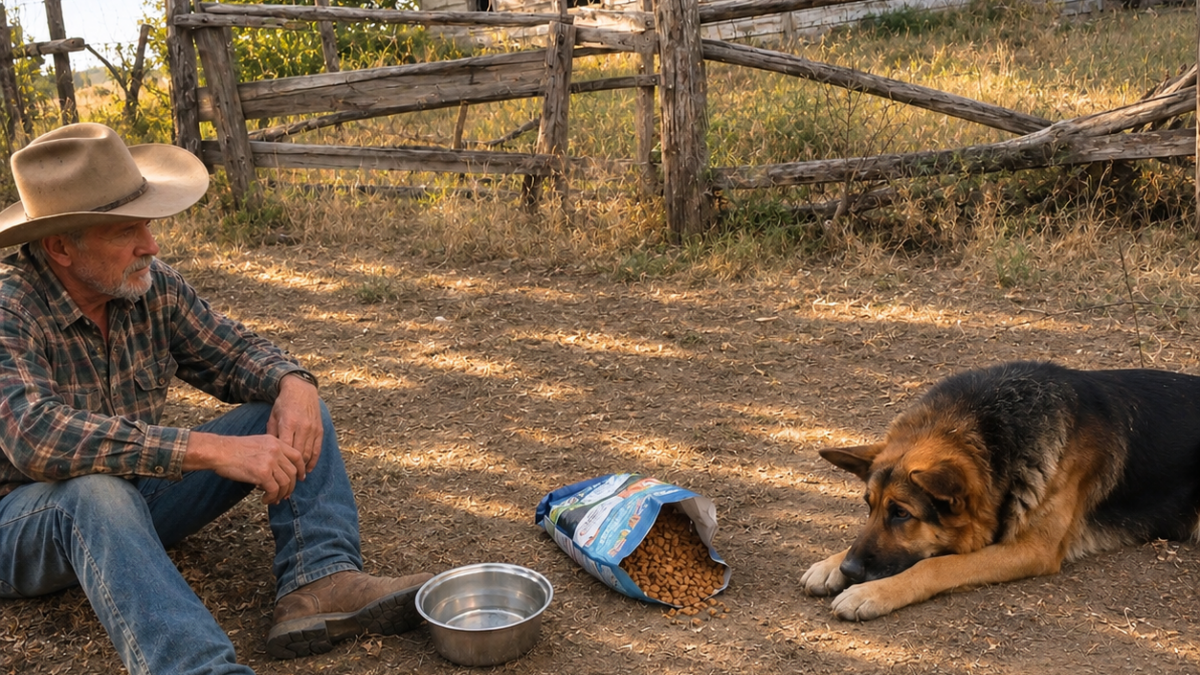
PART 2:
I didn’t try to drag the Shepherd out of the yard.
At my age, I’ve learned there are moments for determination and moments for accepting that your spine has opinions.
Instead, I called animal services again.
“I am currently inside the yard.”
The woman on the phone paused.
“Sir, you entered the property?”
“Yes.”
“We advised—”
“The dog cannot stand.”
Silence.
“I gave him water. He is severely underweight, possibly dehydrated, and there is an empty food container.”
“Sir—”
“You can discuss my trespassing after you get somebody here.”
Another pause.
“Don’t give him large amounts of food.”
“I know.”
“Don’t move him unless he’s in immediate danger.”
“He’s been in immediate danger for a week.”
This time, she didn’t argue.
An animal-control truck arrived twenty-eight minutes later.
I know because I counted.
A young officer named Miguel Santos came through the side gate with a catch pole, blankets and a medical crate.
I immediately pointed at the pole.
“You’re not putting that around his neck.”
Miguel looked at me.
“Sir, it’s equipment.”
“He let me touch him.”
“That’s good.”
“He hasn’t threatened me.”
“Also good.”
“And I’m telling you if you come at him with that thing—”
“Mr. Hayes.”
I stopped.
“How do you know my name?”
“You gave it to dispatch.”
Right.
“I’m not planning to use it unless I need to.”
That was reasonable.
I didn’t like reasonable people when I was angry.
Miguel crouched several feet from the dog.
“Hey, buddy.”
The Shepherd’s eyes followed him.
No growl.
No attempt to rise.
Miguel looked toward me.
“How long has he been like this?”
“People heard him about a week.”
“House vacant?”
“Yes.”
“Owners?”
“Moved.”
“Who has been feeding him?”
There was the question none of us wanted.
“I don’t know.”
Miguel examined the torn food bag without touching it.
A fifty-pound bag.
Empty.
The water bucket was bone dry.
“No automatic feeder?”
“Not that I see.”
He photographed everything.
The yard.
Dog.
Buckets.
Chain.
Back porch.
Fence.
Then he called the veterinary clinic.
“Can we move him?”
I asked.
“We need to.”
“How?”
“We’ll use the blanket.”
Between the two of us, we carefully slid a heavy blanket beneath the Shepherd.
He made a weak noise.
“Easy.”
I kept one hand near his head.
“You’re going somewhere warm.”
His eyes stayed on mine.
I don’t know why.
Maybe I was simply the first person who had remained beside him long enough that morning.
We lifted.
The dog weighed less than he should have.
Far less.
That scared me.
Miguel noticed too.
“God.”
“What?”
“Nothing.”
“Don’t say God while holding a dying dog and then say nothing.”
“He’s light.”
“Yes.”
We carried him to the truck.
The dog did not fight.
He didn’t have enough strength.
As Miguel secured the crate, I climbed into my pickup.
“Where are you going?”
“With you.”
“You don’t need to.”
“I know.”
Miguel looked at me for a moment.
Then nodded.
“Follow me.”
The veterinarian was Dr. Laura Bennett.
She was somewhere in her forties and had the calm, efficient manner of someone who had already seen three emergencies before breakfast.
They carried the Shepherd through a side entrance.
I followed until a technician stopped me.
“We need room.”
“I’m not in the way.”
“You are.”
I looked through the doorway.
The Shepherd raised his head slightly.
His eyes searched.
Maybe for me.
Maybe for anything familiar.
“I’ll be right here,” I said.
Dr. Bennett glanced toward me.
“You can stay near his head if you stay quiet.”
“I can do quiet.”
Miguel laughed once.
I ignored him.
They started fluids.
Took blood.
Checked his gums.
Temperature.
Heart.
Lungs.
Paws.
Dr. Bennett’s expression became more serious as she worked.
“How bad?”
“Let me finish.”
“That means bad.”
“Walter.”
I hadn’t told her my first name.
Apparently everyone had been briefed.
I stood beside the table.
The Shepherd’s head rested near my hand.
I stroked one ear.
His coat was dirty but soft underneath.
“Any name?” Dr. Bennett asked.
“No.”
Miguel held up the microchip scanner.
“Let’s find out.”
He passed it over the shoulders.
Beep.
Everyone stopped.
“He’s chipped.”
“Good,” I said.
Miguel looked at the number.
“Maybe.”
I didn’t understand then.
I would.
The records came back twenty minutes later.
His name was Ranger.
Six years old.
Registered to a man named Douglas Crane.
The address listed on the chip was the abandoned house.
So there was no longer any mystery about whether Ranger had belonged there.
He had.
“What did you find medically?” I asked.
Dr. Bennett held Ranger’s bloodwork.
“Severe dehydration. Significant weight loss. Electrolyte imbalance. Early kidney stress, though that may reverse with fluids. Pressure sores on the hips. Parasites. His paw pads are inflamed.”
“Anything else?”
“He’s anemic.”
“Will he live?”
She didn’t answer immediately.
My chest tightened.
“Laura.”
“He has a good chance.”
“That’s not what I asked.”
“Then don’t ask questions medicine can’t answer with certainty.”
I disliked her too.
Apparently that was becoming my theme.
She softened.
“If you had waited much longer, I’d be considerably less optimistic.”
“How much longer?”
“Impossible to say.”
“A day?”
“Possibly.”
“Two?”
“Possibly.”
I looked at Ranger.
All week, people had heard him.
Ruth.
Me.
The family across the road.
The gas delivery driver.
A teenager walking home.
Everyone.
Someone should have done something.
That thought became dangerous because it was so easy to aim outward.
Then I remembered Wednesday.
I’d seen him.
I’d gone home.
I was part of “everyone.”
That knowledge stayed.
Dr. Bennett touched my shoulder.
“He’s here now.”
“Yes.”
“You can’t treat yesterday.”
Farmers understand that principle.
Weather does what it does.
Calves get sick before you notice.
Fences fail at the worst time.
Regret does not rewind anything.
You handle what’s standing in front of you.
Or lying on a table, in Ranger’s case.
“How long will he stay?”
“Minimum forty-eight hours.”
“I’ll pay.”
Miguel looked at me.
“Animal control covers emergency stabilization during investigation.”
“Then I’ll pay whatever that doesn’t.”
“Walter—”
“I said I’ll pay.”
Dr. Bennett smiled faintly.
“You always this agreeable?”
“Ask anyone.”
Ranger remained hospitalized for four days.
I visited every morning.
The first day, he barely lifted his head.
The second, he ate from Dr. Bennett’s hand.
I pretended not to be jealous.
The third, he stood.
His back legs trembled.
But he stood.
I was sitting near the kennel when he saw me.
His ears lifted.
Then his tail moved.
Once.
Slowly.
It struck the blanket.
I looked toward Dr. Bennett.
“Did you see that?”
“I did.”
“He knows me.”
“Probably.”
“Probably?”
“Walter, I am not going to scientifically certify every emotional interpretation you make.”
“Then why did you become a veterinarian?”
She laughed.
Ranger’s tail moved again.
That one made my throat tighten.
“Hey, boy.”
I crouched.
“Look at you.”
He walked two unsteady steps.
Pressed his head into my chest.
That was the first time I knew I was in trouble.
I had spent three years telling people I didn’t want another dog.
Jake had been enough.
Fourteen years.
My wife, Martha, died six years before Jake did.
After that, Jake became the last living piece of the life Martha and I had built together.
When Jake died, I said no more.
I was seventy.
I didn’t want to bring home a dog I might not outlive.
That’s the practical argument older people make.
It’s a fair one.
Then Ranger put his head against me.
Practicality lost ground quickly.
Miguel visited that afternoon.
“We contacted Crane.”
I stood.
“And?”
“He says Ranger was supposed to be checked by someone.”
“What someone?”
“A friend.”
“Name?”
“He hasn’t given one.”
“Why?”
“Claims he needs to find the messages.”
I folded my arms.
“He left town how long ago?”
“Seven weeks.”
The number hit me.
“Seven weeks?”
Miguel nodded.
“That house has been empty almost two months.”
“So Ranger was alone seven weeks?”
“We don’t know. The bag of food suggests somebody may have left supplies.”
“A fifty-pound bag and a bucket?”
“Yes.”
“That doesn’t last seven weeks.”
“No.”
“Where was Crane?”
“Two states over.”
“Did he come back?”
“He says no.”
“Did he call anyone?”
“He claims he did.”
“Claims.”
Miguel watched me carefully.
“Don’t get ahead of the investigation.”
“I’m seventy-two. Getting ahead is difficult.”
He almost smiled.
“Crane says he wants Ranger back.”
That removed every trace of humor.
“No.”
“Walter.”
“No.”
“It’s not your decision.”
“Then whose?”
“For now, animal control.”
“And after?”
“Depends.”
“On what?”
“Evidence. Ownership. Condition. Whether there’s a surrender. Whether charges are filed.”
“He abandoned him.”
“That has to be established.”
I pointed through the glass toward Ranger.
“You need more evidence than a dog who nearly died in an empty yard?”
“The legal standard isn’t emotion.”
“That’s convenient.”
“It can also protect innocent people.”
“Is Douglas Crane innocent?”
Miguel sighed.
“I don’t know yet.”
I looked at Ranger.
He was asleep.
For the first time since I found him, he looked peaceful.
“He’s not going back there.”
Miguel didn’t answer.
That frightened me.
Two days later, Douglas Crane called me.
I still don’t know exactly how he got my number.
Our town is small enough that privacy is mostly theoretical.
“Walter Hayes?”
“Yes.”
“This is Doug Crane.”
I stepped onto my porch.
Ranger was still at the clinic.
“What do you want?”
“My dog.”
“Your dog nearly died.”
“That’s not what happened.”
“Good. Explain it.”
“I left food.”
“An empty bag.”
“And water.”
“An empty bucket.”
“My cousin was supposed to check.”
“Name?”
“Why?”
“Because animal control asked.”
“That’s between me and them.”
“Then this conversation can end.”
“Wait.”
I remained silent.
Crane exhaled.
“You went onto my property.”
“I did.”
“You trespassed.”
“Yes.”
He apparently wasn’t prepared for that answer.
“And you took my dog.”
“Animal control took your dog.”
“Because you interfered.”
“Your dog couldn’t stand.”
“You don’t know the whole story.”
“Then tell me.”
“My new rental doesn’t allow Shepherds.”
I closed my eyes.
There it was.
“And that makes leaving him behind acceptable?”
“I was coming back for him.”
“When?”
“Once I figured something out.”
“Seven weeks?”
“You don’t know what I’ve been dealing with.”
“You’re right.”
My voice went quiet.
“I only know what Ranger was dealing with.”
Crane paused.
“You named him?”
“That’s the name on his chip.”
Another silence.
“He’s mine.”
I had spent my whole life around animals.
I never liked that sentence.
Mine.
Property language.
Useful for paperwork.
Dangerous when confused with love.
“You had seven weeks to act like it.”
Crane’s voice hardened.
“You better understand something. If they give him to you, I’ll fight it.”
“Why?”
“Because he’s my dog.”
Not because I miss him.
Not because I’ve been sick with worry.
Not because he sleeps at the foot of my bed.
Because he’s mine.
I looked across my fields.
My barn door needed paint.
The fence near the pond leaned.
Jake used to lie beside the porch steps on afternoons exactly like this one.
“You can fight whoever you want.”
“You think being old makes you untouchable?”
“No.”
I almost smiled.
“It makes threats boring.”
I hung up.
Crane called twice more.
I blocked the number.
Then something happened that turned the entire case.
Ruth called.
“Walter, I found something.”
“What?”
“My door camera.”
Ruth lived across the road from the abandoned house.
Her security camera wasn’t pointed at the property, but it captured part of the driveway.
“What about it?”
“I went back through the old recordings.”
“How old?”
“Seven weeks.”
I stood.
“Ruth.”
“I have the moving truck.”
My heart accelerated.
“And?”
“I have Crane’s pickup.”
“Leaving?”
“Yes.”
“Anything else?”
There was a pause.
“I think I have the dog.”
We went to her house.
The video was grainy.
No audio.
But the date was clear.
Douglas Crane’s pickup backed out of the driveway.
A moving truck followed.
Then Ranger appeared.
He ran alongside the pickup.
Crane stopped.
For one second, hope rose.
The driver’s door opened.
Crane stepped out.
Ranger ran toward him.
Crane walked the dog back toward the property.
Then, instead of loading Ranger into the truck, he closed the gate.
Ranger jumped against it.
Crane returned to the pickup.
Drove away.
Ranger ran along the fence until the vehicle disappeared.
Then he remained there.
Watching the road.
Ruth covered her mouth.
“I didn’t know.”
Neither did I.
The video continued.
Ranger eventually walked back toward the house.
No cousin appeared.
Not that day.
Not on the other recordings Ruth had saved automatically.
We gave everything to Miguel.
He watched twice.
Then sat back.
“This matters.”
“You think?”
“Walter.”
“Sorry.”
“No, you’re not.”
“No.”
He copied the footage.
Two other neighbors gave statements.
One remembered seeing Crane at the house five weeks earlier.
Not feeding Ranger.
Collecting a toolbox from the garage.
Ranger had been in the yard.
“He saw the dog?” Miguel asked.
The neighbor nodded.
“Dog came right up to the fence.”
“Did Crane interact with him?”
“No.”
“Did he enter the yard?”
“Garage side. Maybe ten minutes.”
“Did he leave food?”
“Not that I saw.”
That visit became crucial.
Crane could no longer argue he didn’t know Ranger remained at the property.
He had returned.
Seen him.
Left again.
Ranger’s legal status changed within days.
Animal control issued a formal seizure pending the neglect investigation.
Crane hired an attorney.
That’s when things became ugly.
A letter arrived at my house claiming I had illegally entered private property, interfered with ownership rights and caused reputational damage by discussing Ranger’s condition with neighbors.
I read it twice.
Then called my nephew, who is an attorney.
His response was shorter.
“Don’t respond.”
“That’s it?”
“Yes.”
“He’s threatening me.”
“Paper isn’t lightning, Uncle Walter.”
“I climbed his fence.”
“To save a dying animal after you had contacted authorities.”
“Yes.”
“Let them make an issue of it.”
“You sound very calm.”
“Because I bill other people for panic.”
I didn’t fully understand that sentence.
I trusted it.
Ranger came to my farm under temporary foster placement nine days after I first crossed the fence.
Miguel delivered him.
“You sure?”
“No.”
“That’s reassuring.”
“I’ve got a farm. I’m seventy-two. My knees sound like gravel.”
“Ranger’s six.”
“I know.”
“He could live another eight years.”
“I know.”
Miguel looked at me.
“That’s what you’re worried about?”
I didn’t answer.
He understood.
“What happens to him if you don’t outlive him?”
“My daughter takes him.”
“You discussed it?”
“Before I agreed.”
“Good.”
I had.
My daughter Emily lived forty minutes away with her husband and two teenagers.
When I called, she immediately said:
“Dad, you’re keeping him.”
“I’m fostering.”
“You named him when you read his chip.”
“His name was already Ranger.”
“You bought three dog beds.”
“One is for the barn.”
“You bought three.”
“Your point?”
“You’re keeping him.”
She was right.
I hated when my children were right.
Ranger’s first night at the farm was difficult.
He walked through the house.
Kitchen.
Living room.
Mudroom.
Then back to the front door.
He sat there.
Watching.
I placed his bed nearby.
He ignored it.
At ten, I went upstairs.
At eleven, I came back down.
Ranger was still sitting.
“Who are you waiting for?”
His ears moved.
I sat beside him.
“You know, I did this too.”
He looked at me.
“After Martha died.”
I had not spoken to a dog like that since Jake.
The words came easier than I expected.
“For months, I’d hear a car and think maybe she’d forgotten something.”
That was ridiculous.
Martha died in a hospital.
She wasn’t coming back because she forgot her purse.
Grief is not logical.
Neither is abandonment.
“You keep expecting the world to correct itself.”
Ranger lowered his head.
“It doesn’t.”
I rubbed his shoulder.
“But sometimes it gives you something else.”
He leaned against me.
We slept downstairs.
The first week, Ranger followed me everywhere.
Not the healthy kind of following dogs do because they enjoy company.
This was surveillance.
If I went into the barn, he came.
If I walked behind the house, he came.
If I closed the bathroom door, Ranger scratched until I opened it.
“Absolutely not.”
Scratch.
“Privacy.”
Scratch.
“You’re a German Shepherd. Maintain some dignity.”
Scratch.
I opened the door.
He sat outside.
Progress.
Leaving the farm was worse.
The first time I drove to the feed store, I left Ranger inside for twenty minutes.
Emily stayed with him.
She called after five.
“He’s pacing.”
“Is he panicking?”
“Not yet.”
“Give him time.”
At fifteen minutes:
“He’s whining.”
I almost turned around.
Emily said:
“Don’t.”
“I didn’t ask.”
“I heard your truck slow down.”
My daughter inherited her mother’s ability to irritate me accurately.
I continued.
When I came back, Ranger was at the window.
He saw my pickup.
His entire body changed.
He raced to the door.
I walked in.
Ranger jumped against my chest.
I nearly fell.
“Easy!”
He whined.
Licked my hands.
My jacket.
My face.
Everything.
Emily smiled.
“He thought you left.”
I held Ranger’s head.
“I came back.”
That became our work.
I leave.
I return.
Again.
Again.
At first, ten minutes.
Then thirty.
An hour.
Two.
Eventually Ranger learned the rhythms of the farm.
My truck started at 7:00.
Sometimes I left.
Sometimes he came.
If I left, I returned.
Always.
Within three months, he stopped waiting at the front door.
He slept on the rug instead.
That mattered more than anyone else understood.
One afternoon, I pulled into the driveway and found Ranger asleep on the porch.
He didn’t even wake until I shut the truck door.
I stood there smiling like a fool.
The dog had learned boredom.
That is one of the greatest gifts a rescued animal can receive.
Nothing happening.
No crisis.
No hunger.
No person disappearing.
Just another afternoon.
Ranger also discovered the farm.
He loved cattle.
Too much.
The first time he saw my neighbor’s calves through the fence, every Shepherd instinct in his body activated.
He crouched.
Stared.
Started circling.
“No.”
Ranger ignored me.
“Absolutely not.”
He attempted to herd livestock he did not own.
I spent twenty minutes explaining property law to a German Shepherd.
It was ineffective.
We worked on recall.
Boundaries.
Leash manners.
He learned quickly.
Within months, Ranger walked beside me during morning chores.
He carried sticks.
Chased grasshoppers.
Rolled in substances I prefer not to identify.
He gained seventeen pounds.
His coat filled out.
Dr. Bennett called him “unrecognizable.”
I disagreed.
The eyes remained.
But even those changed.
Less searching.
More watching.
There is a difference.
Then Douglas Crane showed up at my farm.
It was a Saturday morning.
I was repairing a gate near the driveway.
Ranger lay beneath the oak tree.
A dark SUV stopped.
Crane climbed out.
I knew him immediately from Ruth’s video.
He looked toward Ranger.
Ranger stood.
His ears rose.
Crane’s face changed.
“Ranger.”
The dog froze.
My stomach tightened.
There are emotions humans don’t like admitting.
Mine was jealousy.
Not because Ranger belonged to me.
Because I had seen what Crane did.
And I was afraid one familiar voice might erase every morning I had come back.
Crane stepped forward.
“Hey, boy.”
Ranger took one step.
I said nothing.
He deserved the choice.
Crane crouched.
“Come here.”
Ranger’s tail moved.
Once.
My heart sank.
Of course he remembered.
Six years of life before abandonment could not simply disappear because I wanted a morally clean ending.
Ranger walked closer.
Crane smiled.
“That’s my dog.”
I looked at him.
“Don’t.”
Ranger sniffed his hand.
Crane reached toward his collar.
Ranger backed away.
Crane’s expression changed.
“Come on, Ranger.”
The dog looked at him.
Then at me.
Then moved backward until his hind leg touched mine.
He sat beside me.
Crane stared.
“You trained him to do that.”
“No.”
“You turned him against me.”
“I fed him.”
“I fed him for six years.”
“And left him for seven weeks.”
Crane stood.
“You stole my dog.”
“Animal control placed him here.”
“Temporary.”
“For now.”
“He comes home with me eventually.”
Ranger leaned against my leg.
I felt the weight.
Steady.
Crane saw it.
Something bitter entered his face.
“You think he loves you?”
I looked down at Ranger.
Then back at him.
“I don’t need him to answer that for me.”
Crane’s jaw tightened.
“That dog is worth nearly four thousand dollars.”
There.
The sentence.
I had wondered how long before money appeared.
“Worth?”
“Purebred Shepherd. Good lines.”
“Then you should have valued him before.”
“You don’t know what I paid.”
“I know what he almost paid.”
Crane stepped closer.
Ranger stood.
Not aggressive.
Alert.
I put my hand on his shoulder.
“Stay.”
He did.
Crane looked at my hand.
Then Ranger.
For the first time, something like shame crossed his face.
It vanished quickly.
“My attorney will deal with you.”
“Good.”
I pointed toward his SUV.
“You can leave.”
“This is public—”
“My driveway isn’t.”
He almost laughed.
“You trespassed on my property.”
“And saved your dog.”
“You don’t get to play hero.”
That touched a nerve.
“I’m not.”
I stepped toward him.
“I heard Ranger cry on Tuesday.”
Crane fell silent.
“I checked Wednesday.”
My voice tightened.
“And I went home.”
Ranger looked up.
“I waited too.”
Crane didn’t understand.
“I don’t get to pretend I’m better because I finally climbed the fence Friday.”
I pointed toward Ranger.
“The only innocent one in this story is him.”
Crane said nothing.
“Now leave.”
This time, he did.
The hearing was scheduled six weeks later.
County animal-welfare cases are not like television courtrooms.
No dramatic jury.
No pounding music.
Fluorescent lights.
Folding chairs.
Paperwork.
But to me, it might as well have been the Supreme Court.
Because Ranger’s future sat beside me on a leash.
Crane’s attorney argued that his client had intended the arrangement to be temporary.
He claimed food and water had been provided.
He claimed an acquaintance had agreed to check Ranger.
The acquaintance never appeared.
There were no texts.
No payment.
No written agreement.
Then they argued the dog had always lived partly outdoors.
Dr. Bennett testified.
She described Ranger’s condition.
Severe dehydration.
Malnutrition.
Kidney stress.
Pressure sores.
Anemia.
Parasites.
The attorney asked:
“Can you state with medical certainty exactly how long Ranger had been without adequate water?”
“No.”
“How long without adequate food?”
“No exact duration.”
“So you cannot prove Mr. Crane intentionally starved his animal.”
Dr. Bennett looked at him.
“I can prove the animal was starving.”
The room went quiet.
The attorney tried again.
“Intent and condition are different.”
“Medically?”
She shook her head.
“My job is condition.”
Then Ruth’s video played.
Crane leaving.
Ranger following.
Gate closing.
Truck disappearing.
I watched Ranger during the video.
He heard Crane’s voice from the recording.
His ears rose.
Then he pressed against my leg.
I put my hand on his neck.
When the later footage played showing Crane returning weeks after the move, retrieving tools and leaving again while Ranger remained behind the fence, Crane stared at the table.
That was the moment the case changed.
Miguel testified.
Neighbors testified.
I testified last.
Crane’s attorney asked why I had entered private property after being told not to.
“Because the dog had stopped crying.”
“That was your justification?”
“Yes.”
“You understood you did not own that property.”
“Yes.”
“You understood you had no warrant.”
“I’m a farmer, not Batman.”
A few people laughed.
The hearing officer did not.
I continued.
“I also understood that every person on our road had spent a week assuming someone else would help.”
The attorney interrupted.
“Please answer only—”
“I am answering.”
The hearing officer nodded.
“Let him finish.”
I looked toward Ranger.
“That morning, I realized ‘someone else’ wasn’t a real person. It was an excuse.”
Nobody spoke.
“I climbed the fence because if I didn’t, I was going to sit on my porch that night and listen to nothing.”
My voice cracked.
“And I knew what that nothing would mean.”
Crane finally looked at me.
I continued.
“If you want to fine me for crossing that fence, fine me.”
My nephew shifted beside me.
Probably wishing I would stop volunteering legal theories.
“But I would climb it again.”
The decision came that afternoon.
Douglas Crane’s ownership rights were terminated.
Ranger was formally surrendered to county custody.
Crane was cited for animal abandonment and neglect under local law, ordered to reimburse a portion of veterinary and emergency costs, placed under restrictions regarding animal ownership for a period determined by the court, and referred for additional misdemeanor proceedings.
It wasn’t prison.
It wasn’t a dramatic felony conviction.
Real accountability is often paperwork, money and rules.
Crane looked furious.
I felt strangely calm.
Miguel walked toward me.
“Congratulations.”
“Not yet.”
The county still had to finalize Ranger’s adoption.
Crane approached before leaving.
His attorney tried to stop him.
He ignored him.
“Can I say goodbye?”
My first instinct was no.
Then I looked at Ranger.
This couldn’t be about me.
Controlled.
Leashed.
Public.
Miguel nearby.
“All right.”
Crane crouched.
“Ranger.”
The dog looked at him.
Crane held out his hand.
Ranger approached.
Slowly.
Sniffed.
Crane touched the side of his face.
His expression cracked.
For one second, he wasn’t the man from the hearing.
He was simply someone who had once had a dog who loved him.
“I’m sorry.”
Ranger stood still.
Crane whispered:
“I messed up.”
That was the first honest sentence I heard from him.
Ranger licked his fingers once.
Crane began crying.
Then Ranger stepped backward.
He turned.
Walked toward me.
Sat on my boot.
Crane stared at him.
There was no triumph in me.
No satisfaction at another person’s pain.
Just clarity.
Crane whispered:
“He picked you.”
I shook my head.
“No.”
He looked at me.
“He picked safety.”
That distinction mattered.
Crane nodded once.
Then left.
Ranger watched him walk through the door.
For perhaps five seconds.
Then looked up at me.
I scratched behind his ears.
“Ready?”
His tail moved.
We went home.
The adoption became official eight days later.
Emily brought a cake.
“For me?”
“For Ranger.”
“Dogs don’t eat cake.”
“This one is dog-safe.”
“Then it isn’t cake.”
My grandson hung a banner in the barn:
**WELCOME HOME RANGER**
I pretended it was excessive.
Ranger loved the attention.
At some point during the celebration, I realized something.
Nobody had said “poor Ranger” all afternoon.
They argued over whether he should wear a ridiculous bandana.
They laughed when he stole a hot dog.
They yelled when he chased a chicken.
He had become a dog.
Not a victim.
That is the goal.
Over the following year, Ranger changed.
Rain stopped frightening him.
At first, every heavy storm sent him to the front door.
Maybe because he remembered the empty yard.
I’d sit beside him.
“Inside.”
He’d look toward the windows.
“Roof.”
Then toward me.
“Food.”
Eventually, thunderstorms became something he slept through.
He learned that water bowls refill.
Breakfast comes every morning.
Doors open.
People return.
Most importantly, he learned that silence at night did not mean he had been forgotten.
One evening, Ruth visited.
Ranger ran toward her.
She crouched.
“So this is the dog we all ignored.”
The sentence hurt.
I sat beside her.
“We didn’t ignore him.”
She looked at me.
“Walter.”
“All right.”
“We did.”
Neither of us liked admitting it.
“But people fed him before the owners moved, right?” she asked.
“Yes.”
“And everybody assumed somebody had called.”
“Yes.”
She shook her head.
“Why do people do that?”
“Because ‘someone else’ is convenient.”
That conversation started something.
Nothing grand.
No viral charity.
No enormous organization.
We created a neighborhood phone tree.
If someone saw an animal in distress, one person contacted animal control.
Another checked whether water was available.
Another documented.
Another followed up.
Most calls turned out to be nothing serious.
Loose farm dogs.
A barn cat with an owner.
Once, a goat who simply hated fences.
But one call mattered.
A woman named Teresa saw a dog chained behind a trailer during a heat advisory.
Normally, she admitted, she would have assumed the owner knew what he was doing.
Instead, she called.
The dog’s water had overturned.
His chain had wrapped around a post.
He couldn’t reach shade.
He survived.
When I heard, I sat beside Ranger on my porch.
“That one’s yours.”
He looked at me.
I gave him cheese.
Over the next two years, the story spread locally.
People called our little group **Someone Else** as a joke.
Then it stuck.
The slogan became:
**IF YOU’RE WAITING FOR SOMEONE ELSE, CALL US.**
I hated slogans.
This one worked.
The county shelter started printing the number on refrigerator magnets.
A farm-supply store donated water bowls.
Dr. Bennett volunteered one Saturday a month for basic welfare checks.
Miguel gave talks at schools.
I reluctantly spoke once.
Only once.
Children asked better questions than adults.
A ten-year-old boy raised his hand.
“Mr. Walter, why didn’t the dog just jump the fence?”
I thought.
“Maybe he couldn’t.”
“But German Shepherds can jump.”
“Physically?”
“Yes.”
I looked at Ranger lying beside my chair.
“Sometimes an animal doesn’t leave because the place hurting him is also the last place he remembers belonging.”
The room became quiet.
The boy nodded.
Children understand certain truths quickly.
Ranger became something of a local celebrity.
He hated the attention.
Actually, that’s not true.
He adored it.
Especially if attention involved chicken.
People came to farm events asking:
“Is that Ranger?”
I would say:
“No. Different starving German Shepherd rescued from that exact property.”
Then I’d get yelled at by Emily for sarcasm.
Ranger loved children.
He would lie down so they could pet him.
One little girl asked:
“Does he remember the bad people?”
I looked toward Ranger.
“I don’t know.”
“Do dogs forgive?”
Another difficult one.
“Maybe.”
“Would you?”
That child had no respect for boundaries.
I smiled.
“I think forgiveness and trust are different.”
She considered that.
“Like I forgive my brother but don’t let him use my markers.”
“Exactly.”
That became my best explanation.
I don’t know whether Ranger forgave Douglas Crane.
I know Ranger stopped organizing his life around him.
Maybe that’s enough.
Crane remained mostly out of our story.
About two years after the hearing, I received a letter.
No return address.
I recognized the name inside.
Walter,
I don’t expect you to answer.
I completed the animal care course and the court requirements. At first I thought it was ridiculous. I thought everyone was treating me like some monster because I had gotten overwhelmed and made a bad decision.
Then they showed a video about abandonment stress.
I thought about Ranger waiting behind that gate.
I had seen him there when I came back for my tools.
I told myself I would arrange something the next day.
I didn’t.
The truth is I kept telling myself I had time because admitting I had already failed him would have meant doing something immediately.
I am not writing to ask for him.
I know he is yours.
I am writing because I finally understand that I did not “leave a dog temporarily.”
I left a living thing waiting for me.
I am sorry.
Douglas
I read it twice.
Then put it in a drawer.
I didn’t answer.
He hadn’t asked me to.
That mattered.
People sometimes think apology requires forgiveness.
It doesn’t.
An apology can simply be a person finally telling the truth without demanding that the injured party make them feel better.
Ranger didn’t need the letter.
I did not read it to him.
He was busy digging a hole beneath my pear tree.
Life had moved on.
At age eight, Ranger developed the annoying belief that my bed belonged partly to him.
I disagreed.
He disagreed with my disagreement.
We compromised by giving him seventy percent.
At nine, he became afraid of the vacuum cleaner.
A seventy-pound German Shepherd who had survived abandonment would flee from a household appliance.
At ten, he stopped chasing cattle.
Not from wisdom.
Arthritis.
Dr. Bennett started medication.
I built a ramp to the porch.
Ranger ignored it for two weeks.
Then used it when nobody watched.
Pride.
I understood.
I was seventy-six by then and had installed a railing beside my bathtub while telling everyone it was for visitors.
Ranger and I were aging badly together.
Emily worried.
“Dad, maybe you should move closer.”
“I live forty minutes away.”
“You live alone.”
“I have Ranger.”
“Ranger cannot call 911.”
“He knows things.”
“Not numbers.”
I hated logic.
We compromised.
She installed an emergency alert system.
I complained.
Ranger barked when the technician arrived.
Two old men resisting change.
My grandson said we were perfect for each other.
He was right.
Ranger’s world shrank gradually.
When he first recovered, we walked the whole farm.
Then half.
Then only to the barn.
Eventually, the porch became enough.
But he never seemed unhappy.
That’s something humans struggle to understand about old dogs.
They don’t mourn the five-mile walk while enjoying a patch of sunlight.
They accept today.
We could learn from that.
I turned seventy-nine.
Ranger was around thirteen.
His muzzle had gone almost silver.
One evening, rain began.
Heavy.
The kind that drummed against the roof.
Years earlier, rain made Ranger pace.
That night, he slept beside my chair.
Completely relaxed.
I watched him.
“Remember?”
His eyes opened.
“The yard?”
Nothing.
“The bucket?”
His tail moved once.
I smiled.
“No.”
I stroked his head.
“Good.”
Maybe remembering wasn’t the point.
The fact that rain had become ordinary was victory enough.
That winter, Dr. Bennett found a mass near Ranger’s spleen.
She called me into the consultation room.
I knew before she spoke.
“Cancer?”
“Likely.”
“Operable?”
“Yes.”
“Risk?”
“At his age, meaningful.”
“Outcome?”
“Could give him another year. Could give him less. Surgery itself could take him.”
I stared through the window.
Ranger was lying near a technician.
I had decisions like this with livestock all my life.
But livestock weren’t Ranger.
“What would you do?”
“I hate that question.”
“I know.”
“Walter, I would look at the dog in front of me.”
I waited.
“He’s eating. Comfortable. Still interested in life.”
“Yes.”
“If we can manage symptoms without putting him through a major surgery, that’s reasonable.”
“So don’t operate.”
“That’s what I would choose.”
I nodded.
We went home.
Ranger lived another eleven months.
Good months.
Not borrowed misery.
Actual life.
Breakfast.
Porch.
Slow walks.
Children visiting.
Cheese he wasn’t supposed to have.
Ruth scratching his ears.
Emily complaining that I gave him too many table scraps.
Then, one October morning, Ranger didn’t get up.
I knew.
His eyes followed me.
His tail moved.
His body didn’t.
I sat beside him.
“Not today.”
He breathed.
I called Dr. Bennett.
She came to the farm.
No clinic.
No stainless-steel table.
Just home.
Ranger lay beneath the oak tree.
Leaves moved above us.
The sky was clear.
It was almost offensively beautiful.
Emily came.
Her husband.
My grandchildren, grown now.
Miguel came during his lunch break.
Ruth walked down the road.
I hadn’t asked everyone.
News travels.
They stood back.
No crowd around Ranger.
Just people he knew.
Dr. Bennett examined him quietly.
Then looked at me.
“We can transport him.”
“For what?”
“Hospitalize. Fluids. Maybe a day.”
“A day?”
“Possibly.”
“Would he come home?”
She didn’t answer.
I understood.
I looked at Ranger.
For years I had insisted dignity was the one thing animals asked of us.
Now I had to prove I believed it.
“No hospital.”
Dr. Bennett nodded.
“I think that’s kind.”
Kind.
What an awful word in moments like that.
I lowered myself onto the grass.
My knees protested.
Ranger’s head rested near my thigh.
I took his face in both hands.
“You know something?”
His eyes stayed on mine.
“Everybody heard you.”
My voice cracked.
“That week.”
Ruth started crying behind me.
“I heard you too.”
Ranger breathed slowly.
“And I waited.”
I swallowed.
“I want you to know that.”
Because the story people told later made me sound better than I had been.
Old farmer climbs fence.
Saves abandoned Shepherd.
Nice story.
Incomplete.
“I waited until Friday.”
My fingers trembled against his fur.
“I should have come Tuesday.”
Ranger moved his nose against my palm.
I laughed through tears.
“You don’t care, do you?”
Tail.
One small movement.
“No.”
I leaned closer.
“You only care that somebody came.”
Dr. Bennett prepared the sedative.
I continued.
“Then you spent seven years following me around like I might get lost.”
Emily cried harder.
“You ruined my floors.”
Ranger’s ear moved.
“Ate part of my couch.”
Another breath.
“Harassed livestock.”
Tail.
“You were a terrible farmhand.”
I pressed my forehead to his.
“And the best dog I could have asked for.”
The first medication entered.
Ranger relaxed.
His head grew heavier.
I whispered:
“Jake would’ve liked you.”
That broke me.
For years, part of me had worried loving Ranger somehow meant leaving Jake behind.
Ridiculous.
Love does not evict old love to make space.
It expands the house.
Ranger’s eyes became heavy.
“You don’t have to worry about the house anymore.”
Another breath.
“No empty bucket.”
Another.
“No fence.”
My voice dropped.
“No waiting.”
Dr. Bennett looked at me.
I nodded.
The final medication entered.
I kept my hand beneath Ranger’s head.
His breathing slowed.
One breath.
Then another.
Then one last long exhale.
Silence.
Seven years earlier, silence had terrified me because it meant the crying had stopped behind an abandoned fence.
That morning, silence meant something different.
Ranger was not alone.
He had not been forgotten.
There was no empty house.
No locked gate.
No unanswered howl.
He was home.
I stayed on the grass long after he died.
Nobody rushed me.
Eventually Ruth sat beside me.
“I’m sorry.”
“Me too.”
She looked toward Ranger.
“We should have gone sooner.”
“Yes.”
No comforting lie.
We should have.
Then Ruth said:
“But somebody went.”
I looked at her.
She smiled through tears.
“You.”
I shook my head.
“No.”
I looked toward all of them.
“We did.”
Because that became the truth over the years.
The neighborhood that failed to act quickly once became a neighborhood that stopped waiting.
That mattered.
We buried Ranger beside Jake near the edge of my pasture.
Emily asked what I wanted on the stone.
I thought for a long time.
Not:
RESCUED.
That was one event.
Not:
ABANDONED.
That was something done to him.
Neither word deserved to define his entire life.
I chose:
**RANGER**
**HE WAITED FOR SOMEONE TO COME.**
**THEN HE TAUGHT US TO BE THE ONES WHO DID.**
Underneath, smaller:
**GOOD DOG. TERRIBLE FARMHAND.**
My grandson insisted.
Ranger would have approved.
The Someone Else network grew after Ranger died.
More than I expected.
The county adopted a formal welfare-check process for animals reported at vacant properties.
Utilities agreed to flag certain long-term vacancy cases when animals were observed.
Realtors received information about reporting pets left behind.
Nothing glamorous.
Procedures.
Phone numbers.
Responsibility assigned to actual people instead of imaginary “someone elses.”
That’s how change works most of the time.
Not speeches.
Checklists.
Names.
Follow-up.
One year after Ranger died, a house across town was foreclosed.
A utility worker heard barking inside.
Before, he might have assumed the bank or owner had arrangements.
Instead, he called.
Animal control entered legally that afternoon.
Two dogs were inside.
Both dehydrated.
Both alive.
Miguel, who had been promoted by then, sent me a photograph.
Two dogs drinking water.
His message:
**This is Ranger.**
I stared at the words.
Then walked to the pasture.
Sat beside Ranger’s stone.
“You got two.”
Wind moved through the grass.
I smiled.
“Not bad for a terrible farmhand.”
Douglas Crane died several years later.
I learned from the newspaper.
I felt no satisfaction.
No grief either.
Just a strange quiet.
His obituary said he had volunteered during his last years with a regional food pantry and an addiction-recovery program.
Maybe he changed.
Maybe the Ranger case was part of it.
Maybe not.
People want clean endings.
Bad person punished.
Good person rewarded.
Life usually offers something more complicated.
Crane failed Ranger badly.
Then apparently tried to fail less elsewhere.
I can live with both truths.
Accountability is not the same as permanent damnation.
The most important thing remained:
He never got Ranger back.
Not as revenge.
Because Ranger had already found home.
I’m in my eighties now.
The farm is smaller.
Emily and her husband handle most of the heavy work.
My knees predicted this future long before I accepted it.
I still live in the farmhouse.
Jake and Ranger are both outside beneath the trees.
There is another dog inside.
Of course there is.
Her name is Molly.
She’s an old hound mix with ears far too large for her head.
I swore I wasn’t adopting again.
Nobody believed me.
Molly came from a senior owner who entered assisted living.
This time, nobody abandoned anybody.
The owner called.
A foster family helped.
Then I met Molly.
That’s how things are supposed to work.
The first night she came home, Molly stood in the mudroom looking uncertain.
I placed a bed near the kitchen.
“That’s yours.”
She ignored it.
Slept beside my chair.
Dogs don’t care about interior planning.
Some mornings, Molly walks with me to Ranger’s grave.
She sniffs the stone.
Then Jake’s.
Then wanders away.
She doesn’t know them.
That’s fine.
Legacy doesn’t require recognition.
People ask me sometimes what Ranger taught me.
They expect something sentimental about loyalty.
Yes.
He was loyal.
Too loyal, perhaps.
But that isn’t the lesson I carry most.
Ranger taught me that compassion delayed can become cruelty by accident.
Nobody on our road woke up thinking:
Let’s let that dog suffer.
We were ordinary people.
Decent people.
That was the frightening part.
We heard him.
Then created reasons not to act.
Maybe the owners were coming.
Maybe somebody called.
Maybe authorities knew.
Maybe it wasn’t as bad as it sounded.
Maybe tomorrow.
Maybe someone else.
Ranger nearly died inside all those maybes.
So now, when something feels wrong, I ask one question.
**If everyone else makes the same assumption I am making, what happens?**
Sometimes the answer is:
Nothing.
Fine.
Sometimes the answer is:
An animal dies.
Then you act.
You don’t need to be reckless.
Call authorities.
Document.
Ask.
Follow up.
But don’t confuse waiting with responsibility.
They’re not the same.
I crossed a fence.
I don’t recommend seventy-two-year-old men make a habit of climbing fences.
My hip reminded me of that for several weeks.
But I would do it again.
Not because laws don’t matter.
They do.
Because laws work best when paired with judgment.
There was a dying dog ten feet away.
No property line could make him less thirsty.
That morning, Ranger drank because someone finally stopped asking whose job it was.
Years later, after his death, I found the old metal water bowl in my barn.
The one I carried over that Friday morning.
I had forgotten I kept it.
Dented.
Scratched.
A little rust near the bottom.
I sat on an overturned bucket holding it.
For a while, I was back there.
Empty house.
Cold ground.
Ranger crawling.
Water.
His nose touching my knee.
I cried.
At eighty-something, you stop being embarrassed about crying.
Anyone who judges you can wait until their knees hurt as much as yours.
I cleaned the bowl.
Didn’t polish the dents.
Then I mounted it on the wall inside the barn.
Emily saw it.
“What are you doing?”
“Decoration.”
She stared.
“You hate decorations.”
“Historical artifact.”
She smiled.
“What are you putting under it?”
I had a small wooden sign made.
Only five words:
**SOMEBODY ELSE WAS ME.**
That’s all.
People who know Ranger understand.
People who don’t sometimes ask.
Then I tell them.
I tell them about the week of crying.
About the empty house.
About my phone calls.
About the Friday morning.
I tell them honestly that I was not some fearless rescuer who acted instantly.
I tell them I waited too.
Because I think that part matters.
Heroes are easy to admire and easy to excuse ourselves from becoming.
Ordinary people are more dangerous.
If an ordinary seventy-two-year-old farmer can finally get over a fence, maybe somebody else can make a call.
Knock on a door.
Stop a car.
Ask a question.
Come back.
I tell them about Ranger gaining weight.
Chasing cattle.
Fearing vacuum cleaners.
Sleeping through storms.
Choosing my leg when Crane came back.
Growing old enough to develop arthritis.
Because that’s the real happy ending.
Not the rescue.
The years.
A starving dog being saved is dramatic.
A rescued dog becoming old is beautiful.
People rarely frame it that way.
They should.
Ranger got gray.
Slow.
Demanding.
Expensive.
He needed medication.
Ramps.
More veterinary visits.
Those inconveniences were privileges.
They meant he had lived long enough to need them.
The abandoned dog got old.
That sentence is victory.
Sometimes, on summer evenings, I sit on the porch while Molly sleeps near my chair.
Sound travels across the fields exactly as it did all those years ago.
Cattle.
Birds.
Tractors far away.
Occasionally a dog barking somewhere.
Every time, I listen.
Not because every bark is an emergency.
Because Ranger taught me not to stop hearing.
There is a difference between hearing a sound and accepting responsibility for what it might mean.
Our entire neighborhood learned that.
Ruth is gone now.
Her daughter lives in the house.
Miguel is close to retirement.
Dr. Bennett sold her clinic to a younger veterinarian but still appears occasionally because apparently veterinarians are incapable of truly retiring.
The road changed.
Houses changed.
People moved.
The abandoned house where I found Ranger was eventually demolished.
A young couple bought the lot.
Built a small home.
They have two children and a Golden Retriever.
One afternoon, I walked past.
Their dog was lying in the yard beneath a tree.
Full water bowl.
Shade.
The little boy was throwing a ball.
The dog kept refusing to return it.
I stood by the road watching.
The father noticed me.
“Everything okay, Mr. Hayes?”
“Yes.”
I looked toward the yard.
“Just remembering something.”
He knew.
Everyone nearby knew Ranger’s story.
The father looked toward the old fence line.
“Hard to believe.”
“Yes.”
The boy threw the ball again.
The Golden ran.
Happy.
Ordinary.
I smiled.
Some places should be allowed to have new memories.
I don’t need the yard preserved as a monument to suffering.
Ranger didn’t.
If he had been there, he probably would have stolen the child’s ball and refused to return it.
That is how I prefer to imagine him.
Not lying beside an empty bucket.
Running.
One evening, my granddaughter asked me a question.
“Grandpa, did Ranger save you too?”
I rolled my eyes.
“That’s the kind of question people put in movies.”
She waited.
Young people know silence works on old men.
Finally I answered.
“Yes.”
“How?”
I looked across the pasture.
“When Jake died, I decided I was finished with dogs.”
“Because it hurt?”
“Yes.”
“And Ranger changed that?”
“Ranger needed me.”
She smiled.
“That isn’t the same thing.”
Annoyingly perceptive child.
“No.”
I thought longer.
“He made me useful in a way I hadn’t felt for a while.”
After Martha died, I had the farm.
After Jake died, the farm became quieter.
I still had family.
Work.
Neighbors.
But being needed daily by another living creature is its own form of medicine.
Ranger needed food at six.
Walks.
Medicine.
Training.
Company.
Then eventually I realized I needed those things too.
Not the kibble.
Routine.
Presence.
A reason to walk outside on cold mornings.
Someone waiting at the door.
Ranger didn’t replace Martha.
Didn’t replace Jake.
He filled a space that became available because life kept moving.
That’s different.
My granddaughter nodded.
“So he rescued you.”
“Don’t become a writer.”
She laughed.
I did too.
Maybe she was right.
But I still resist making rescue stories too neat.
Ranger didn’t arrive because fate sent him to heal an old farmer.
His owners made a terrible choice.
People failed to act.
He suffered.
Then circumstances changed.
We made something good afterward.
That does not make the bad necessary.
It only proves bad things do not get exclusive ownership of what happens next.
That may be the most important thing I’ve learned in eighty-plus years.
You can’t always choose the storm.
You choose what you build after.
You can’t choose that somebody leaves a dog.
You can choose whether you keep walking.
You can’t undo the week Ranger cried.
But you can make the next call come sooner.
You can build a phone tree.
Change a procedure.
Teach a child.
Keep a bowl ready.
You can refuse to let guilt become the end of the story.
Years ago, I thought revenge meant making Douglas Crane hurt the way Ranger hurt.
I was angry enough to want that.
The hearing changed my mind.
Ranger didn’t care about Crane’s fine.
Didn’t know about legal ownership.
Didn’t celebrate when the case ended.
He wanted dinner.
He wanted my porch.
He wanted to know whether my pickup would return.
The real revenge was simpler.
Crane left Ranger behind as if his life could be postponed.
Ranger built a life too full to wait for him.
That was enough.
Crane returned and saw a dog who remembered him but did not need him.
That was enough.
The abandoned property became the reason vacant-home animal checks changed.
Enough.
Other animals survived because Ranger almost didn’t.
Enough.
The person who had reduced Ranger to an inconvenience eventually had to see him become the center of an entire community’s attention.
Not because Ranger sought revenge.
Because survival itself can expose the poverty of someone else’s decision.
The best revenge was never punishment.
It was Ranger asleep during the rain.
Ranger stealing food.
Ranger growing gray.
Ranger’s head heavy in my hand at the end of a long, safe life.
Nobody who abandoned him could take those years back.
They belonged to him.
That is satisfying enough for me.
This morning, before writing this, I walked to the barn.
Molly followed.
I stopped beneath the old water bowl mounted on the wall.
The sign beneath it is fading.
**SOMEBODY ELSE WAS ME.**
Molly sniffed around.
Found nothing interesting.
Walked away.
I stood there thinking about the Friday morning when I climbed a fence believing I was doing one urgent thing.
Give a dog water.
That’s all.
I didn’t know the dog would become mine.
Didn’t know there would be an investigation.
A hearing.
A neighborhood program.
Seven years of companionship.
A grave beside Jake.
I didn’t know Ranger would teach an entire road full of people to stop assuming.
You rarely know where one decent decision will lead.
That’s not why you make it.
You make it because there is a thirsty dog ten feet away.
Sometimes morality is complicated.
Sometimes it is a bowl of water.
Ranger taught me that.
And if I could return to that Tuesday evening when his first howl reached my porch, I would not wait until Friday.
I would stand immediately.
Grab the water.
Walk down that road.
Call whoever needed calling.
Climb if I had to.
Because now I know what those cries meant.
He wasn’t asking who owned the house.
He wasn’t asking which agency had jurisdiction.
He wasn’t asking whether helping him would inconvenience anyone.
He was asking the only question abandoned animals ever really ask:
**Is anybody coming?**
For one week, all of us answered with silence.
Then, finally, I climbed the fence.
And Ranger looked at me as if he had been waiting specifically for me.
He hadn’t.
He would have accepted kindness from anyone.
That’s what makes the story harder.
And more important.
It didn’t have to be me.
It just had to be somebody.
That morning, somebody finally came.
For the rest of Ranger’s life, I made sure he never had to ask the question again.








