PART 2: Everyone Feared the Scarred Old Tomcat Nobody Wanted—Until a Lonely Widower Walked Into Our Shelter and Changed Both Their Lives
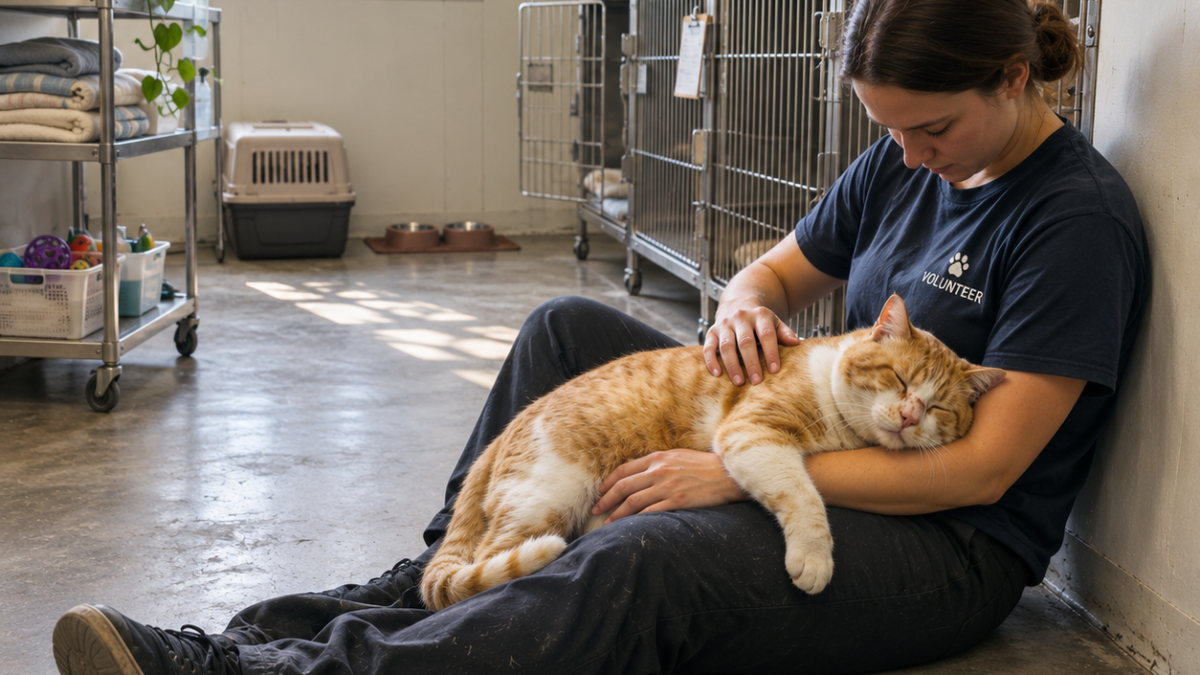
Everyone warned me not to touch the enormous, battle-scarred tomcat that arrived at our shelter, but the moment I opened his cage, he did something that brought tears to my eyes.
For years, the world had given him nothing but hunger, loneliness, and reasons to fear human hands, yet somehow, he still had more love to give than any animal I had ever rescued.
I thought the hardest part would be finding someone willing to look beyond his scars, but I had no idea what was about to happen inside our little shelter.
I’d been volunteering at the animal shelter for nearly six years when Hank arrived on a cold Tuesday morning, inside a battered plastic carrier that smelled of damp cardboard and garbage.
A man had discovered him behind an abandoned convenience store on the outskirts of town, curled beside a dumpster with his enormous head resting against a dirty piece of cardboard.
He hadn’t tried to escape when the man approached. He hadn’t even hissed.
He had simply opened his eyes.
When my coworker Sarah placed the carrier on the examination table, I understood why everyone was nervous.
The cat was enormous. His orange-and-white fur was filthy and uneven, his left ear was torn, and an old scar stretched across the bridge of his nose. His oversized cheeks made his battered face look even more intimidating.
“Be careful,” Sarah warned. “He’s probably spent his entire life fighting.”
I pulled on a pair of protective gloves and slowly opened the carrier.
“Hey, big guy,” I whispered. “Nobody’s going to hurt you here.”
For several seconds, he didn’t move. Then he stepped forward, carefully lowering one stiff leg after another until he stood outside the carrier.
I prepared myself for a frightened swipe.
Instead, he walked toward my hand, lowered his massive head, and pressed his scarred cheek against my palm.
Then came the deepest, roughest purr I had ever heard.
I removed my gloves and gently scratched beneath his chin. His eyes closed immediately, and his entire body seemed to surrender beneath my fingertips.
“Oh, sweetheart,” I whispered. “What happened to you?”
Sarah turned away to wipe her eyes.
We named him Hank.
Our veterinarian estimated that he was at least twelve years old. He was underweight beneath his thick coat, suffered from arthritis, and had several damaged teeth. His body carried the evidence of years spent surviving outdoors.
But nothing about his personality matched his appearance.
Whenever someone approached his kennel, Hank greeted them with a rumbling purr. He rubbed against our shoes, leaned into our hands, and followed volunteers whenever we allowed him into the cat room.
His desperation for affection was almost painful to witness.
Eating was different.
Hank would take a mouthful, glance over his shoulder, and then continue eating. Sometimes, he placed one enormous paw beside his bowl as though he expected someone to steal his dinner.
At night, he slept sitting upright, his chin gradually sinking toward his chest before he startled awake.
I wondered how many nights he had spent outside, too frightened to close his eyes completely.
As the weeks passed, younger cats arrived and disappeared into loving homes.
Hank remained.
Visitors frequently stopped beside his kennel.
“Look at those cheeks!” they exclaimed.
“He’s adorable in such an unusual way.”
“What a funny-looking old man!”
They scratched his head, laughed at his expression, and moved on.
Every departure seemed to leave him watching the doorway a little longer.
One Saturday, a young couple spent nearly ten minutes petting him. Hank rolled onto his side, exposed his belly, and purred so loudly that several volunteers came over to watch.
I allowed myself to believe his time had finally arrived.
But the couple adopted a gray kitten instead.
After they left, Hank sat beside his kennel door until closing time, staring toward the empty hallway.
That evening, I stayed behind.
I opened his kennel, sat on the floor, and patted my lap.
“Come here, old man.”
He climbed onto me with considerable effort, rested his enormous head against my stomach, and slowly closed his eyes.
For the first time since arriving, Hank fell asleep lying down.
I remained there until my legs went numb.
“You deserve somebody who stays,” I whispered, stroking his torn ear.
A week later, a gray-haired man carrying two bags of cat food walked through our shelter doors.
He introduced himself as Walter and explained that his late wife had always fed stray cats.
“I’m just making a donation,” he said firmly. “I’m not looking to take anything home.”
I thanked him and offered to show him around.
When we entered the cat room, Hank abandoned his favorite blanket and slowly approached the stranger.
He stopped beside Walter’s worn work boots and lowered his enormous head onto one of them.
Walter froze.
His expression changed so suddenly that I wondered whether something was wrong.
Then he bent down, touched Hank’s battered cheek, and whispered something I never expected to hear.
PART 2
“My wife would’ve loved you.”
Walter’s voice was so quiet that I almost missed the words. He remained bent over Hank, his fingers moving gently through the thick orange fur beneath the old cat’s chin, while Hank pressed himself against the man’s leg as though he had known him for years.
I had watched hundreds of people meet shelter animals. Some immediately fell in love, some needed time to make a decision, and others simply enjoyed spending a few minutes with an animal before continuing with their day.
But this felt different.
Walter wasn’t smiling in the way most visitors did when they encountered a particularly affectionate cat. His mouth trembled slightly, his shoulders had stiffened, and there was something in his expression that made me instinctively step backward.
Whatever was happening between them didn’t need an audience.
Hank shifted his weight and rubbed his enormous cheek against Walter’s boot again. His gravelly purr filled the otherwise quiet room.
“He’s an old fellow, isn’t he?” Walter asked.
“At least twelve,” I replied. “Possibly older.”
Walter nodded.
“Well, I suppose neither of us is exactly new.”
For the first time since entering the shelter, he smiled.
It was a small smile, barely visible beneath his gray stubble, but it changed his entire face.
He lowered himself onto a wooden bench against the wall, moving with the same careful stiffness I had noticed in Hank. The moment he sat down, Hank positioned himself between his boots and looked up expectantly.
“Does he always follow strangers around?”
“He likes people,” I explained. “But he’s usually more patient than this. Apparently, he’s decided you’re worth investigating.”
Walter chuckled.
“That’s unfortunate. I’m not particularly interesting.”
Hank raised his front paws against Walter’s knee.
Without thinking, Walter reached down and lifted him.
The old cat immediately settled against his chest.
Walter stopped laughing.
I saw him swallow.
Then he placed one large, weathered hand across Hank’s back and stared toward the opposite wall.
Neither of us spoke for several minutes.
Eventually, Walter broke the silence.
“My wife used to tell me that every animal deserves somewhere warm to sleep,” he said. “Didn’t matter whether it was a cat, a dog, or some half-frozen creature she’d found behind the grocery store. She was always bringing something home.”
“What was her name?” I asked.
“Margaret.”
He smiled again, though this time his eyes were wet.
“Forty-three years we were married. Forty-three years of finding cat food in my truck, blankets disappearing from the linen closet, and hearing her tell me not to complain because some poor animal needed them more than I did.”
“She sounds wonderful.”
“She was.”
His voice broke on the last word.
Hank adjusted himself in Walter’s arms and pressed his forehead beneath the man’s chin.
Walter closed his eyes.
I looked away.
There are moments when grief becomes so visible that watching feels like intruding on someone’s private life. I could see that Walter wasn’t merely holding a cat. Something about Hank’s warmth, his weight, and that ridiculous old-fashioned purr had reached a part of Walter that had been untouched for a long time.
After several minutes, Walter cleared his throat.
“How long has he been here?”
“Several weeks.”
“And nobody wants him?”
I hesitated.
“People like him. They just haven’t chosen him.”
Walter looked down at Hank.
“There’s a difference, isn’t there?”
There was.
A painful difference that every shelter volunteer understood.
Animals could receive hundreds of affectionate compliments without ever receiving a home. Visitors could admire them, photograph them, laugh at their personalities, and tell us how wonderful they were.
Then they could walk away without changing a single thing about those animals’ lives.
Hank had experienced that disappointment more times than I wanted to count.
Walter scratched the old cat behind his torn ear.
“What’s wrong with him?”
“Nothing that makes him unlovable.”
He looked at me.
“I meant medically.”
“Oh. Arthritis, mostly. Some dental problems that we’ve already treated. He needs a comfortable indoor environment and regular veterinary care. He’s not a kitten, and he isn’t going to pretend he is.”
Walter nodded thoughtfully.
“Sounds familiar.”
I laughed.
Hank purred louder.
For one beautiful moment, the shelter didn’t feel like a place full of abandoned animals. It felt like an ordinary living room where an elderly man had settled into his favorite chair with his favorite companion.
But then Walter glanced toward the door.
His expression tightened.
“I should probably get going.”
Hank remained curled against his chest.
Walter looked down at him.
“Come on, buddy. You’ve got to let me leave.”
He gently returned Hank to the floor.
Hank looked up, confused.
Walter stood, straightened his jacket, and reached for the empty shopping bag he had brought with him.
As he walked toward the hallway, Hank followed.
Walter stopped.
Hank stopped.
Walter took another step.
Hank followed again.
I had to turn my face away.
“I’m sorry,” Walter whispered.
He crouched and scratched Hank’s forehead one final time.
“You’re a good boy.”
Then he stood and walked out of the room.
Hank remained beside the doorway.
I watched Walter disappear through the shelter entrance, and something inside me sank.
I’d seen this happen before.
The affection.
The hesitation.
The goodbye.
The animal left waiting.
I returned to Hank and picked him up.
“It’s okay, sweetheart.”
He didn’t struggle.
He simply rested his head against my shoulder, looking past me toward the front door.
For the remainder of the afternoon, I kept thinking about Walter.
There had been something genuine in the way he held Hank, something different from the casual affection of other visitors. But I also understood why someone grieving the loss of a spouse might hesitate to bring another living creature into his home.
Love could feel dangerous after loss.
It could feel like inviting another heartbreak into a life that already contained too much of it.
Still, I wished Walter had stayed.
I wished he had seen Hank the way I did when nobody else was watching.
I wished he knew how hard that old cat tried every morning, despite having every reason to give up.
Most of all, I wished someone would finally choose him.
The first night Hank spent at our shelter remained one of my most painful memories.
Although he had allowed us to handle him without protest, his body told a different story from his affectionate behavior.
When our veterinarian, Dr. Emily Carter, examined him, she discovered several old injuries beneath his tangled fur.
There were small scars along his neck, patches of damaged skin near his shoulders, and one healed wound on his hind leg that suggested he had survived something particularly painful.
His torn ear had healed long ago.
His nose bore the permanent mark of another encounter.
Several of his teeth were broken, and his gums were inflamed.
“He must have been uncomfortable for quite a while,” Emily told me.
“Can we help him?”
“Absolutely. But he’s going to need time.”
While Emily examined his mouth, Hank remained remarkably cooperative. Occasionally, he flattened his ears or pulled his head away, but he never tried to bite.
Whenever she stopped, he leaned toward my hand.
It was as though he needed reassurance that we weren’t angry with him for being frightened.
“You’re doing so well,” I whispered.
Emily listened to his heart, examined his joints, and carefully felt along his spine.
“He’s a survivor,” she finally said.
I looked at the old cat.
Survivor.
It was a word we used frequently at the shelter, but with Hank, it seemed particularly appropriate.
We couldn’t know how he had ended up behind that abandoned store. He might once have belonged to a family. He might have spent his entire life outdoors. Someone might have cared for him before moving away, or perhaps he had never experienced a permanent home at all.
His history was a collection of unanswered questions.
But his condition made one thing unmistakably clear.
Life hadn’t been easy.
After his examination, we prepared a quiet enclosure with clean blankets, fresh water, and a shallow food dish.
When I placed his dinner inside, Hank approached it cautiously.
He smelled the food, took a small bite, and immediately looked behind him.
Then he ate another mouthful.
Another glance.
Another mouthful.
I sat several feet away, watching him.
“It’s all yours,” I told him. “Nobody’s taking it.”
Of course, he couldn’t understand the words.
But I hoped he would eventually understand the truth behind them.
When he finished eating, he positioned himself near the kennel entrance instead of settling onto the thick blanket we had provided.
I moved the blanket closer.
He sniffed it but didn’t lie down.
Nearly an hour later, when I checked on him before leaving, his eyes were closed, yet he was still sitting upright.
His head drooped.
Then he startled awake.
I watched it happen three times.
Finally, I asked Emily about it.
“Why won’t he lie down?”
“It could be discomfort,” she said. “It could also be stress. He’s in an unfamiliar place. We shouldn’t assume we know exactly what he’s thinking.”
I appreciated her honesty, although it didn’t make the sight any easier.
Whatever the reason, I wanted Hank to feel safe enough to rest.
He deserved that much.
Over the following days, his appetite improved. His fur became cleaner, and after receiving treatment for his dental problems and arthritis, his movements gradually became less stiff.
But the most remarkable change happened whenever someone approached him.
At first, Hank simply rubbed against our hands.
Then he started greeting us at the kennel door.
Soon, he recognized the sound of my footsteps.
Every morning, when I entered the cat room, he was already waiting.
“Good morning, handsome.”
His tail would rise.
His eyes would soften.
And that familiar rumble would begin before I even touched him.
He behaved as if our arrival was the greatest event in his entire world.
It was impossible not to love him.
Or at least, I thought it was.
Hank wasn’t the only elderly animal at our shelter, and he certainly wasn’t the first to be overlooked.
But something about his eagerness made his repeated rejection particularly difficult.
There was a small white kitten named Daisy who arrived two days after him.
Daisy had bright blue eyes, immaculate fur, and an adorable habit of grabbing people’s fingers through the kennel bars.
Within forty-eight hours, three families had submitted adoption applications.
Hank watched from the opposite enclosure.
Then came Oliver, a fluffy black kitten with enormous ears.
Oliver was adopted before we finished preparing his information sheet.
Two tabby sisters arrived the following week.
They left together.
Every adoption was good news. Every empty kennel meant another animal could be rescued.
I celebrated each one.
But whenever I returned to Hank’s enclosure, I found myself wondering when it would finally be his turn.
One afternoon, a woman wearing a bright yellow sweater stopped in front of him.
“Oh, look at this face!” she exclaimed.
Hank rose immediately.
She crouched beside him.
“He’s wonderful.”
“He really is,” I said. “He’s one of our friendliest cats.”
“How old is he?”
“We estimate twelve or older.”
Her expression changed.
“Oh.”
It was such a small word.
Yet I had learned exactly what it meant.
She continued scratching Hank’s cheeks for another minute.
Then she stood.
“I think I’d rather have something younger. My children want a cat they can grow up with.”
“I understand.”
And I did.
I wasn’t going to pressure anyone into adopting an animal whose needs didn’t fit their circumstances.
But Hank didn’t understand.
He remained beside the kennel door after she left, staring at the place where her hand had been.
Later, another visitor asked whether he had been involved in catfights.
“Probably,” I answered. “We don’t know his entire history.”
“Is he dangerous?”
“No. He’s extremely affectionate.”
The man looked at Hank’s enormous head.
“He certainly doesn’t look affectionate.”
As if determined to prove otherwise, Hank rolled onto his back.
His paws curled toward his chest.
His belly was exposed.
The visitor laughed.
“Well, that’s unexpected.”
Then he continued toward the kittens.
I watched Hank slowly return to his feet.
That evening, I took several photographs of him.
I captured him resting beside a colorful blanket, leaning against Sarah’s hand, and standing with his oversized cheeks pressed against the kennel door.
I wanted people to see more than the scars.
I wanted them to see his gentleness.
Sarah helped me choose the best photograph.
“That one,” she said, pointing toward an image in which Hank’s eyes were closed while I scratched his chin. “He looks completely happy.”
We shared his adoption profile.
The response was encouraging at first.
People commented on his cheeks. They described him as handsome, distinguished, adorable, and deserving of a loving family.
But days passed.
No suitable applications arrived.
It was difficult to reconcile the number of people who said they loved Hank with the fact that he still went to sleep inside a shelter kennel every night.
One afternoon, I asked Sarah a question that had been troubling me.
“Do you think he’s going to spend the rest of his life here?”
She immediately shook her head.
“Don’t say that.”
“I’m just worried.”
“So am I,” she admitted. “But his person is out there.”
“What if they never come?”
She looked toward Hank.
“Then we’ll keep taking care of him until they do.”
I appreciated the determination in her voice.
But after watching so many people leave without him, I was beginning to fear that love alone might not be enough.
The morning after Walter’s visit, I arrived early.
I carried a fresh blanket, checked our treatment schedule, and walked directly into the cat room.
Hank was sitting beside his enclosure door.
“Good morning, handsome.”
He greeted me with a purr.
I opened his kennel and began our usual routine.
For some reason, I couldn’t stop thinking about the previous afternoon.
Walter’s expression.
His trembling hand.
The way Hank had followed him toward the door.
I had considered asking Walter for his contact information before he left, but I didn’t want to pressure a grieving stranger. He had come to donate food, not to make a life-changing decision.
If he wanted to return, he knew where we were.
If he didn’t, I had to respect that.
Around ten that morning, I was washing food dishes when Sarah hurried into the room.
“You’re going to want to come out front.”
“What’s wrong?”
“Nothing. Just come.”
She was smiling.
I dried my hands and followed her.
Walter was standing beside the reception desk.
He wore the same work boots and a faded brown jacket. In one hand, he carried a folded piece of paper.
He looked uncomfortable.
“Morning,” he said.
“Good morning, Walter.”
He cleared his throat.
“I’ve got a few questions.”
“Of course.”
He unfolded the paper.
There were handwritten notes covering both sides.
I glanced at Sarah.
She was already struggling to hide her excitement.
Walter adjusted his glasses.
“First thing. How much does an old cat generally eat?”
I answered.
“And the arthritis. Does he need medication every day?”
I explained that Emily would provide a treatment plan appropriate for Hank’s condition.
“Right. What about stairs?”
“Some older cats prefer to avoid them. We recommend making sure everything he needs is easy to reach.”
Walter nodded and looked at his paper again.
“Can he jump onto furniture?”
“Sometimes. But a small pet step or ramp might make things easier for him.”
He wrote that down.
Then he asked about litter boxes, bedding, veterinary visits, transportation, feeding schedules, and whether Hank would be comfortable living with someone who spent most of his time at home.
After nearly fifteen minutes, he lowered the paper.
“I haven’t had a cat in a while.”
“That’s okay. We’ll help you.”
He looked toward the hallway.
“Is he still here?”
I smiled.
“He’s waiting for visitors.”
Walter followed me into the cat room.
Hank was sleeping on his blanket when we entered.
I called his name.
His eyes opened.
The moment he noticed Walter, he stood.
He stretched one front leg, then the other, and walked toward the open enclosure door.
Walter crouched.
“Hello again, old man.”
Hank rubbed against his knee.
Walter laughed.
It was a genuine laugh this time, warm and surprised.
“Well, apparently you haven’t forgotten me.”
He sat on the bench.
Hank placed his front paws against his leg.
Walter lifted him.
Within seconds, the old cat was purring against his chest.
I remained nearby, pretending to organize a stack of towels.
Finally, Walter spoke.
“I went home yesterday and sat in my chair.”
I looked toward him.
“That’s what I usually do. Eat something. Watch television. Turn the lights off. Same thing every night.”
He paused.
“Yesterday, I couldn’t stop thinking about this fellow.”
Hank closed his eyes.
Walter continued.
“I kept wondering whether somebody had adopted him after I left. I wondered whether he had eaten his dinner. I wondered if he was sitting here waiting for another person who wasn’t coming back.”
His voice grew quieter.
“I know what that feels like.”
I set the towels down.
Walter stared at Hank.
“I haven’t rearranged much in the house since Margaret died. Her slippers are still beside the bedroom door. Her gardening gloves are on the shelf in the garage. Sometimes I buy something at the grocery store because she liked it, and I don’t realize what I’ve done until I’m putting the groceries away.”
I didn’t know what to say.
He shook his head.
“Must sound ridiculous.”
“No,” I replied. “It doesn’t.”
He looked relieved.
For a long moment, he stroked Hank’s back.
Then he whispered, “I don’t know if I’m ready to love something again.”
Hank raised his head.
He lifted one enormous paw and rested it against Walter’s knee.
It was a simple movement.
A cat adjusting his position.
But Walter stared at that paw as though it carried an answer he had been searching for.
His face crumpled.
He removed his glasses and covered his eyes.
“I miss her,” he whispered.
I sat beside him.
“I know.”
Hank remained completely still.
His paw rested against Walter’s leg, and his purr continued beneath the man’s trembling hand.
Walter cried quietly for several minutes.
Nobody interrupted him.
Nobody told him to be strong.
Nobody tried to explain why everything happened for a reason.
We simply allowed him to grieve.
When he finally lowered his hand, he looked embarrassed.
“I’m sorry.”
“You don’t need to apologize.”
He wiped his face with a handkerchief.
Then he looked down at Hank.
“What do you think, buddy?”
Hank pushed his forehead against Walter’s chest.
Walter laughed through his tears.
“All right.”
He looked at me.
“What do I need to sign?”
Sarah cried when I told her.
She tried to pretend she was merely rubbing something out of her eye, but I knew better.
“Are you serious?”
“He’s filling out the application now.”
She pressed both hands against her mouth.
“Oh, Hank.”
I had to remind myself that an application wasn’t the same as a completed adoption. We still needed to follow our normal process, discuss Hank’s medical needs, and make sure Walter understood what caring for a senior cat involved.
But for the first time, I allowed myself to imagine Hank leaving our shelter.
Not because another rescue organization had taken him.
Not because his condition had deteriorated.
Not because we needed to transfer him somewhere with more room.
Because somebody wanted him.
Walter sat at the reception desk, completing each section of the application carefully.
When he reached the question asking why he wanted to adopt, he stopped writing.
He stared at the paper for several seconds.
Then he wrote a single sentence.
I didn’t read it until he handed the application back.
Because I have an empty home, and he deserves a home that isn’t empty of love.
I had to excuse myself.
In the supply room, I pressed a hand against my mouth and cried.
For weeks, I had watched Hank offer affection to people who never returned. I had watched him struggle through meals, sit beside his kennel door, and sleep with his head hanging forward.
I had worried that he might never experience the ordinary comforts other cats took for granted.
A sunny window.
A familiar voice.
A comfortable chair.
A person who came home every evening.
Now those things were within reach.
I wanted to celebrate immediately.
But I also wanted to make sure this adoption was right for both of them.
Walter was grieving. Hank was elderly. Their relationship would involve responsibilities, expenses, adjustments, and perhaps difficult days.
Love was important, but preparation mattered too.
Emily joined us to discuss Hank’s health.
Walter listened attentively.
When she explained that older animals could require additional medical care, he nodded.
“I understand.”
“We can’t promise how many years he’ll have,” Emily added gently.
Walter looked at Hank through the open doorway.
“Nobody ever promised me how many years I’d have with Margaret, either.”
Emily became quiet.
Walter continued.
“Doesn’t mean I would’ve chosen not to marry her.”
I looked down at the desk.
There was nothing more I needed to say.
Walter understood.
He understood that loving Hank might eventually mean facing another loss.
But he also understood that avoiding love wouldn’t protect him from loneliness.
It would only guarantee it.
Before taking Hank home, Walter returned to his house to prepare.
He purchased a low-sided litter box, food and water bowls, a comfortable cat bed, and several soft blankets.
I suggested keeping Hank’s initial surroundings quiet and allowing him to explore at his own pace.
Walter took notes.
“I’ve got a spare bedroom,” he explained. “It’s downstairs, so he won’t need to climb anything. Plenty of sunshine in the afternoon.”
“That sounds wonderful.”
“And there’s a chair by the window.”
“He’ll probably enjoy that.”
Walter hesitated.
“There’s something else.”
“What is it?”
He looked slightly embarrassed.
“I’ve got this old recliner in the living room. Margaret hated the thing. Said it was ugly enough to frighten company.”
I laughed.
“Is it comfortable?”
“Most comfortable chair in the world.”
“Then Hank might approve.”
Walter smiled.
“I was hoping you’d say that.”
He left with a copy of Hank’s care information and the promise that he would return the following afternoon.
When the front door closed behind him, Sarah rushed into the cat room.
She crouched beside Hank.
“You hear that, big guy?”
Hank blinked.
“You’re getting out of here.”
She scratched his cheeks.
“Somebody finally figured out what we’ve known all along.”
I joined her on the floor.
Hank stepped between us, rubbing against our knees.
For the remainder of the day, every volunteer who had cared for him stopped to offer a little affection.
Some brought him an extra blanket.
Others took photographs.
One volunteer slipped a small toy into the bag we were preparing for him.
Hank seemed unaware that anything unusual was happening.
He simply enjoyed the attention.
That evening, I stayed later than usual.
I sat beside his enclosure and watched him finish his dinner.
He still glanced over his shoulder between bites.
But not as often.
When he finished, he walked into my lap.
I scratched behind his damaged ear.
“Tomorrow’s a big day, sweetheart.”
His purr vibrated through my chest.
“You’re going to have somebody who comes home just to see you.”
I thought about the enormous number of animals that entered shelters carrying stories we would never fully know.
Some had been abandoned.
Some had lost their owners.
Some had been born outside and never experienced a home.
We couldn’t erase their pasts.
We couldn’t explain to them why the people they trusted had disappeared.
But sometimes, if we were fortunate, we could help them begin again.
Hank closed his eyes.
I held him a little longer.
I knew I would miss him.
But missing him because he had found a home was the best kind of sadness I could imagine.
Walter arrived the following afternoon precisely when he said he would.
He carried a brand-new pet carrier lined with a thick green blanket.
“I hope this one’s big enough.”
Sarah examined it.
“Should be plenty of room.”
“Good. I nearly bought one meant for a small dog.”
I laughed.
“Hank might consider that a compliment.”
Walter smiled.
Then he looked toward the cat room.
“Is he ready?”
I nodded.
We walked down the hallway together.
Hank was resting beside the front of his enclosure.
When Walter appeared, the old cat immediately stood and began purring.
Walter crouched.
“Well, old man. What do you say we get out of here?”
Hank leaned against his hand.
I opened the kennel and lifted him carefully.
For a moment, I held his enormous body against my chest.
He smelled like clean blankets and the gentle shampoo we had used to remove the dirt from his fur.
I kissed the top of his head.
“Be happy,” I whispered.
Then I placed him inside the carrier.
I expected some hesitation.
Instead, Hank settled onto the green blanket and looked out through the door.
Walter knelt beside him.
“I’m right here.”
Hank pressed his cheek against the carrier opening.
Walter slipped two fingers through the bars and scratched his forehead.
The purr began again.
We completed the paperwork, reviewed his care instructions, and gave Walter a bag containing familiar food, medical records, and a few items that carried the scent of his shelter bedding.
Walter thanked every member of staff individually.
When he reached me, he hesitated.
“I don’t know whether I’m doing this right.”
“You’re already doing something right,” I told him. “You came back.”
He looked down at Hank.
“Couldn’t leave him here.”
Sarah opened the front door.
Cold afternoon sunlight stretched across the reception floor.
Walter lifted the carrier carefully.
Hank’s eyes remained fixed on him.
As they stepped outside, I felt something tighten in my throat.
“Take good care of each other,” I called.
Walter turned.
“We’ll do our best.”
Then he carried Hank toward his truck.
I stood beside the window until they drove away.
For weeks, Hank had watched other animals disappear through that entrance.
Now it was finally his turn.
That evening, the shelter felt strangely quiet.
I knew it was irrational. We had dozens of animals, plenty of work, ringing telephones, barking dogs, and volunteers moving constantly through the building.
But Hank’s absence changed the room for me.
When I entered with the food cart, I automatically looked toward his enclosure.
It was empty.
There was no enormous orange face waiting for me.
No rusty purr.
No scarred cheek pressed against the door.
Just a freshly cleaned blanket.
Sarah appeared beside me.
“Feels weird, doesn’t it?”
I nodded.
“That’s the problem with this job.”
“Getting attached?”
“Getting attached to the ones you’re supposed to let go.”
She smiled.
“Wouldn’t want us to do it any other way.”
Neither would I.
I wondered what Hank was doing at Walter’s house.
Was he hiding?
Was he frightened?
Had he eaten?
Had he discovered the recliner?
I resisted the temptation to contact Walter immediately. We had agreed on a follow-up, and I didn’t want him to feel monitored or overwhelmed.
A new home could be a significant adjustment, especially for an elderly cat.
Hank needed time.
Walter needed time.
I needed patience.
For the first time in weeks, I locked the shelter without worrying about whether Hank would sleep sitting upright.
I hoped he was somewhere warm.
I hoped he was finally resting.
Three days later, Walter called.
I recognized his voice immediately.
“Everything okay?” I asked.
“Well, I think I’ve been taken advantage of.”
My stomach tightened.
“What happened?”
“Bought him a perfectly good bed.”
I waited.
“Cost me forty dollars,” he continued. “Nice and soft. Supposed to be excellent for old joints.”
“Is he not using it?”
“Hasn’t touched it.”
I smiled.
“Where is he sleeping?”
“In my chair.”
I laughed so loudly that Sarah looked up from the reception desk.
Walter continued with exaggerated indignation.
“Not even beside my chair. Right in the middle of it. If I get up to make coffee, he takes my spot. And when I come back, he looks at me like I’m the one being unreasonable.”
“Sounds like he’s getting comfortable.”
“Comfortable? He’s practically taken ownership of the property.”
I could hear him laughing.
Then his voice softened.
“He’s eating well. Used his litter box without any trouble. Takes his medicine. Follows me around quite a bit.”
“That’s wonderful.”
“Yesterday, I went into the kitchen to make breakfast. He came in and sat beside my feet. Just sat there purring.”
Walter became quiet.
“I forgot what that sounded like.”
I rested my hand against the desk.
“I’m glad he’s settling in.”
“Me too.”
Before ending the call, Walter asked another question.
“Sometimes he walks into a room and looks around until he finds me. Is that normal?”
“He’s still learning that he’s home. Some cats like to stay near familiar people, especially during an adjustment.”
Walter thought about that.
“Well, he doesn’t have to worry about finding me. I’m usually in one of about three places.”
We laughed.
When the call ended, I found Sarah standing beside me.
“How’s our boy?”
“He’s stolen a recliner.”
She grinned.
“Good for him.”
Over the following weeks, Walter sent occasional updates.
Nothing elaborate.
He wasn’t particularly comfortable with technology, and his messages were generally short.
Hank ate all his breakfast.
Bought him steps for the chair.
He likes the front window.
Old fellow is snoring.
Each update delighted me.
What mattered most wasn’t that Hank had found an extraordinary home.
He hadn’t gone to live in a mansion filled with expensive furniture and endless cat toys.
Walter lived in a modest house on a quiet residential street. His furniture was old, his garden needed attention, and his favorite recliner had clearly seen better decades.
But the house was warm.
The meals arrived regularly.
The doors remained closed to the dangers outside.
And there was someone who noticed when Hank entered the room.
For an animal who had spent years being overlooked, those ordinary things were extraordinary.
One afternoon, Walter called to ask whether Hank’s occasional reluctance to jump was something to worry about.
I suggested contacting Emily so she could assess whether his arthritis care needed adjustment.
Walter didn’t hesitate.
“I’ll make an appointment.”
He brought Hank in the following week.
Seeing the enormous orange cat again nearly made me cry.
Walter opened the carrier, and Hank stepped out onto the examination table.
His fur looked healthier.
His eyes were brighter.
He had gained some much-needed weight.
But the biggest difference was his posture.
At the shelter, even when he appeared relaxed, Hank had often seemed ready to move if something startled him.
Now he looked around with mild curiosity, then turned toward Walter.
The old man placed a hand beside him.
Hank rubbed his cheek against it.
“See?” Walter said. “Doesn’t matter where we go. He’s always got to check I’m still there.”
Emily examined Hank carefully.
She discussed his mobility, monitored his weight, and reviewed his ongoing care.
Walter listened to every word.
Before leaving, he asked whether Hank was doing well.
“He’s doing very well,” Emily assured him.
Walter’s shoulders relaxed.
“Good.”
He scratched Hank beneath the chin.
“Can’t have my roommate falling apart on me.”
Then he laughed.
“Although I suppose that’s a bit unfair, considering the condition I’m in.”
As they prepared to leave, I asked Walter how he was doing.
Not Hank.
Walter.
He looked surprised.
“Me?”
“Yes.”
He thought for a moment.
“Better.”
There was no dramatic speech.
No declaration that everything was suddenly wonderful.
Just one quiet word.
Better.
And somehow, it meant more than anything else he could have said.
Exactly three weeks after Hank’s adoption, I received the photograph that I would eventually print and keep beside my desk.
It arrived on my phone early one morning.
The message beneath it read:
Think he’s finally figured out who’s in charge around here.
I opened the picture.
Hank was stretched across Walter’s battered recliner.
Completely on his back.
His enormous belly faced the ceiling, his front paws curled loosely against his chest, and his hind legs were positioned without the slightest concern for dignity.
His torn ear had folded sideways.
His cheeks spread against the faded upholstery.
Walter’s hand rested gently along his side.
I stared at the photograph.
Then I enlarged it.
Then I stared again.
Hank was asleep.
Not sitting upright.
Not crouched beside a bowl.
Not pressed against a kennel door, waiting for somebody to stop.
He was completely sprawled out in the middle of a chair, trusting the warmth beneath him and the man beside him.
I remembered his first night at the shelter.
His head drooping.
His body startling awake.
His inability—or unwillingness—to settle onto a perfectly comfortable blanket.
Now here he was.
Sound asleep.
His most vulnerable position exposed without apparent concern.
I put my phone down and covered my face.
Sarah found me a minute later.
“What happened?”
I showed her the picture.
“Oh, my goodness.”
She pressed her lips together.
Then her eyes filled.
“Look at him.”
We stood beside the reception desk, smiling and crying over an elderly cat sleeping in an ugly recliner.
To anyone else, it might have been an amusing photograph.
To us, it represented everything we had wanted for him.
Safety.
Comfort.
Trust.
Home.
I called Walter later that morning.
“That photograph made our entire day.”
He laughed.
“He’s been doing that quite a bit.”
“Sleeping on his back?”
“Like he owns the place.”
I swallowed.
“Walter, when he first came to us, he wouldn’t sleep lying down.”
There was silence.
“What do you mean?”
I explained how Hank used to sit upright, repeatedly waking as his head drooped toward his chest.
Walter listened without interrupting.
“He finally fell asleep in my lap one evening,” I continued. “But it took him a long time to become comfortable.”
Walter’s voice changed.
“He really did that?”
“Yes.”
He remained quiet.
Then I heard a small rustling sound, as though he was reaching toward Hank.
“Well,” he said eventually, “he won’t have to do that here.”
I closed my eyes.
“No. He won’t.”
Several weeks later, Walter invited me to visit.
“I figured you might like to see where your old friend ended up.”
I accepted immediately.
His house was a modest brick home with white shutters and a small front porch. A narrow flower bed ran beneath the front windows, and a wooden bird feeder hung from a tree near the driveway.
Walter opened the door before I knocked.
“Come on in.”
The house smelled of coffee and clean laundry.
Family photographs covered the living room walls.
In one, Walter and Margaret stood beside an old truck, both considerably younger, smiling beneath a summer sky.
In another, Margaret held a small gray kitten.
There were photographs from birthdays, vacations, anniversaries, and ordinary afternoons that had somehow become precious memories.
And beside Walter’s recliner, in a small wooden frame, was a photograph of Margaret sitting in a garden.
She had kind eyes.
I understood immediately why Walter had spoken of her with such tenderness.
“Where’s Hank?” I asked.
Walter pointed toward the chair.
“Where do you think?”
The enormous orange cat was curled against a faded cushion.
He opened his eyes when I spoke.
“Hank!”
His ears shifted.
He stood, stretched, and climbed down using the pet steps Walter had placed beside the chair.
Then he walked toward me.
I crouched.
The moment he reached my hand, he pressed his enormous cheek against my palm.
Just as he had on the day we met.
I laughed through sudden tears.
“Hello, handsome.”
His purr returned.
Walter watched us.
“He remembers you.”
I scratched Hank’s chin.
“I missed you, buddy.”
He remained beside me for a few moments.
Then he turned and returned to Walter.
The old man looked at me apologetically.
I smiled.
“That’s exactly what I wanted.”
Hank belonged here.
He could remember me, enjoy seeing me, and still choose Walter’s side as his favorite place.
That was how it was supposed to be.
Walter showed me around the house.
Hank’s food station was in the kitchen, where his bowls rested on a small washable mat.
His litter box was easily accessible.
A folded blanket lay beneath the front window.
There were toys scattered beside the fireplace, although Walter admitted Hank seemed more interested in cardboard boxes.
And in the downstairs bedroom, the expensive cat bed remained almost completely untouched.
“Should’ve saved my money,” Walter grumbled affectionately.
I laughed.
He had clearly thought about everything.
Nothing was extravagant, but everything had been chosen with Hank’s comfort in mind.
We returned to the living room and sat down with coffee.
Hank immediately climbed onto Walter’s lap.
Walter adjusted the blanket beneath him.
“He’s got me trained pretty well.”
“Most cats do.”
We watched Hank settle.
After a while, Walter began telling me more about Margaret.
She had loved gardening, old movies, and animals that nobody else wanted.
Whenever she found an injured bird or an abandoned kitten, she insisted they couldn’t simply leave it behind.
Walter used to complain about the inconvenience.
Then he would quietly drive to the store for supplies.
“She knew I’d help,” he said. “Didn’t matter how much I complained.”
His eyes drifted toward her photograph.
“She used to tell me that being needed was one of the greatest privileges a person could have.”
He stroked Hank’s back.
“I didn’t understand how much I’d miss it until she was gone.”
I listened.
Walter described the first months after Margaret’s death.
The endless paperwork.
The casseroles delivered by neighbors.
The sympathy cards.
The visits that gradually became less frequent as everyone returned to their own lives.
And then the quiet.
That was what hurt most.
Not a dramatic, overwhelming silence, but an ordinary one that appeared in every room.
Nobody asked whether he wanted another cup of coffee.
Nobody laughed at the television.
Nobody complained when he forgot to take his muddy boots off.
Nobody asked him to pick up cat food for the strays.
For forty-three years, Margaret had been woven into the smallest details of his existence.
After she died, those details became reminders.
“I started sleeping in this chair sometimes,” he admitted.
“Why?”
He looked toward the hallway.
“Didn’t like the bedroom much anymore.”
Hank shifted against his stomach.
Walter looked down.
“Then this old fellow showed up.”
He smiled.
“Now I’m getting up earlier. He’s got opinions about breakfast. I’ve started opening the curtains again because he likes looking outside. Sometimes I sit here talking to him about nothing important.”
“Does he answer?”
“Constantly.”
We laughed.
Then Walter became serious.
“He doesn’t replace Margaret.”
“Of course not.”
“But he gives me somewhere to put all the affection I’ve been carrying around since she died.”
I felt tears rise again.
Walter looked at the sleeping cat.
“And I think he had quite a bit of affection he’d been carrying around himself.”
There was one particular habit Hank developed that Walter found both amusing and touching.
Every time Walter left the house, Hank positioned himself beside the front window.
He watched the driveway.
When Walter returned, Hank appeared near the entrance.
Sometimes he meowed.
Sometimes he simply rubbed against Walter’s boots.
But he always came to greet him.
One afternoon, Walter returned from buying groceries and found Hank waiting near the door.
He placed the bags on the kitchen counter and bent down.
“Did you think I’d forgotten you?”
Hank pushed his head against Walter’s hand.
Walter scratched his cheeks.
“Not a chance.”
When he told me about it later, I remembered every visitor Hank had watched leave the shelter.
The young couple who chose the gray kitten.
The woman who wanted a younger cat for her children.
The man who thought Hank looked frightening.
Each of those people had disappeared through a doorway.
None had returned for him.
Now there was a doorway that meant something different.
Walter would leave.
But Walter would come back.
Day after day, departure stopped being the end of the story.
Sometimes, healing happens through nothing more complicated than a promise that is kept repeatedly.
A meal arrives.
A light turns on.
A door opens.
A familiar person returns.
And the world becomes a little more predictable.
A little less frightening.
A little kinder.
At the shelter, Hank’s adoption continued to influence the way I introduced senior cats to visitors.
I had always believed older animals deserved loving homes, but after watching Hank and Walter find each other, that belief became more personal.
One afternoon, a woman approached me while searching for a kitten for her elderly father.
“He’s been lonely since Mom passed away,” she explained. “I thought a kitten might cheer him up.”
I asked about her father’s lifestyle.
He enjoyed quiet evenings, had some mobility limitations, and lived alone.
“A kitten could be wonderful,” I told her. “But would he enjoy caring for an adult or senior cat with a calmer personality?”
She looked surprised.
“I hadn’t considered that.”
I introduced her to several cats whose personalities might suit her father.
Then I told her about Hank.
I explained how people had repeatedly overlooked him because of his age and appearance, even though he had turned out to be an extraordinary companion for someone whose life had become painfully quiet.
The woman listened.
“I guess I’ve been thinking about what looks cute,” she admitted, “instead of what would actually fit his life.”
“That’s easy to do.”
She eventually arranged for her father to visit the shelter and meet the animals himself.
I didn’t know which cat he would choose.
But I was glad she had begun considering possibilities beyond the youngest face in the room.
Hank had taught me that compatibility could be more important than appearance, and that sometimes the animal people initially overlook might be precisely the companion they’re looking for.
His story wasn’t about making people feel guilty for adopting kittens.
Kittens needed homes too.
It was about recognizing that affection didn’t belong exclusively to the young, beautiful, or physically perfect.
Age didn’t erase a creature’s need for companionship.
Scars didn’t diminish its capacity for love.
And a difficult past didn’t mean its future had to be difficult as well.
Months passed.
Hank grew increasingly accustomed to his new routine.
Walter described him as a creature of habit.
Breakfast came first.
Then a lengthy inspection of the windows.
Then a nap.
At some point during the afternoon, Hank relocated to the recliner, where he remained until Walter decided to sit down.
Sometimes Walter negotiated for half the chair.
Sometimes Hank refused to cooperate.
On those occasions, Walter simply lifted him and settled him onto his lap.
Hank rarely objected.
He had become quite fond of Walter’s company.
His health still required attention. Arthritis didn’t disappear simply because he had found a loving home, and his age meant Walter needed to remain observant.
There were days when Hank moved slowly.
There were mornings when he seemed particularly stiff.
Walter followed the veterinarian’s recommendations and contacted the clinic whenever he noticed a concerning change.
He never treated Hank’s age as an inconvenience.
He treated it as part of caring for him.
One day, Walter told me that someone had questioned his decision to adopt such an old animal.
The conversation had occurred while he was speaking with an acquaintance.
“Why would you take home a cat that old?” the person had asked. “You’re just setting yourself up for another heartbreak.”
Walter had remained quiet for a moment.
Then he replied, “Would you rather he spend whatever time he has left alone?”
The acquaintance hadn’t known how to answer.
Walter continued.
“I’m old, too. Should somebody decide I’m not worth caring about because I don’t have another forty years ahead of me?”
When he told me the story, I found myself smiling.
“What did they say?”
“Not much after that.”
Walter chuckled.
“Some folks think the value of something depends on how long they get to keep it.”
He paused.
“I don’t see things that way anymore.”
Neither did I.
There was no villain in Hank’s story whose punishment could erase what had happened to him.
We didn’t know who might have neglected him, whether someone had abandoned him, or how many people had walked past him during those years outside.
We had no names to confront.
No dramatic reckoning.
No way to recover the time he had lost.
For a while, that bothered me.
I wanted answers.
I wanted to know how such a gentle animal had ended up starving behind a dumpster.
I wanted to understand why a cat so desperate for affection had apparently spent so much of his life without it.
But I eventually accepted that I might never know.
And perhaps knowing wouldn’t have changed what Hank needed from us.
He didn’t need someone to spend the rest of his life angry on his behalf.
He needed food.
Medical care.
Patience.
A comfortable place to sleep.
Someone who would remain beside him when he grew older and slower.
Hank’s greatest victory wasn’t revenge against the people who had failed him.
It was that their failures no longer defined his life.
Every morning he woke inside Walter’s house was another morning the past had lost its power over him.
Every peaceful nap was another small triumph.
Every time Walter returned through the front door, Hank experienced something he had been denied for far too long.
Someone had chosen him.
And someone kept choosing him.
On one of my later visits, I found Walter sitting on his front porch.
A warm breeze moved through the trees.
The bird feeder swayed gently.
Through the closed living room window, I could see Hank resting on a blanket in a patch of afternoon sunlight.
Walter waved.
“Coffee?”
“Always.”
He brought out two mugs, and we sat together watching the quiet street.
The flower bed looked considerably better than it had during my first visit.
New plants had appeared beside the walkway.
The weeds were gone.
A pair of gardening gloves rested on the porch railing.
“Have you been gardening?” I asked.
“Trying.”
He smiled.
“Margaret would’ve criticized practically everything I’ve done.”
I laughed.
“Then she’d probably have fixed it.”
“Absolutely.”
Walter looked toward the flower bed.
“These were her favorites.”
For a while, neither of us spoke.
Then he said, “I’ve been thinking about volunteering.”
“Really?”
“Nothing complicated. Maybe bringing supplies. Helping with repairs. Whatever needs doing.”
“That would be wonderful.”
He shrugged.
“Figure I’ve got some time on my hands.”
Through the window, Hank stretched.
Walter immediately noticed.
“There’s my supervisor.”
The old cat stood and positioned himself where he could see us.
Walter waved through the glass.
“Relax. I’m not going anywhere.”
I watched him.
There was still sadness in his face when he spoke about Margaret.
There always would be.
Grief wasn’t something Hank had magically cured.
But Walter was living again.
He was planting flowers.
Talking to neighbors.
Thinking about helping others.
Making plans.
And perhaps most importantly, he no longer seemed to regard the days ahead as empty stretches of time he simply needed to endure.
Hank had brought a new responsibility into Walter’s life, but also a new source of pleasure.
The old man looked forward to coming home.
He had stories to tell.
He had someone to worry about, care for, and laugh at.
Walter hadn’t stopped missing Margaret.
He had simply discovered that missing her didn’t prevent him from loving someone else.
Before I left that afternoon, Walter invited me inside.
Hank greeted us near the doorway.
I bent down to scratch his chin.
“You’ve got quite a life now, don’t you?”
He purred.
Walter hung his jacket beside the entrance.
“Come on, buddy. Time to relax.”
He settled into the recliner.
Hank climbed the small steps and positioned himself across Walter’s lap.
His enormous head rested against the man’s stomach.
One paw dangled over his knee.
I recognized the position immediately.
It was exactly how Hank had fallen asleep in my lap on that evening at the shelter.
The evening my leg went numb because I couldn’t bear to disturb him.
I remembered whispering that he deserved somebody who stayed.
Now he had that somebody.
Walter scratched his torn ear.
Within minutes, Hank’s eyes closed.
His body relaxed.
His breathing became slow and steady.
Walter lowered the television volume.
“Old fellow needs his beauty sleep.”
I smiled.
“He’s already handsome.”
“Don’t tell him that. His head’s big enough.”
We laughed quietly.
Then I gathered my things.
Walter started to rise.
“Don’t get up,” I told him.
He glanced down at Hank.
“Probably shouldn’t.”
I walked toward the doorway.
Before leaving, I turned for one final look.
Walter sat beneath a photograph of Margaret, one hand resting on the sleeping cat.
Sunlight reached across the carpet.
The television murmured softly.
The room was filled with the ordinary warmth of a home occupied by two companions who had discovered something precious in each other.
I felt an overwhelming sense of gratitude.
Not because Hank’s life was perfect.
Not because Walter would never experience another painful day.
But because, despite everything they had endured, both had found reasons to welcome another morning.
I still volunteer at the shelter.
There are still days when I go home exhausted.
Days when I struggle to understand how people can abandon animals that depend on them.
Days when I watch a wonderful senior cat receive affectionate compliments from visitors who ultimately choose someone else.
When those days become particularly difficult, I look at the photograph beside my desk.
An enormous orange-and-white tomcat lies on his back in a faded recliner.
His scarred nose points toward the ceiling.
His oversized cheeks look ridiculous.
His torn ear is folded sideways.
A weathered human hand rests gently on his fur.
Nothing about the picture is conventionally beautiful.
The chair is ugly.
The lighting isn’t perfect.
Hank isn’t young.
His scars are still visible.
But to me, it remains one of the most beautiful photographs I have ever seen.
Because I know what happened before it was taken.
I know about the dumpster behind the abandoned store.
The damaged teeth.
The hungry meals.
The frightened nights.
The visitors who walked away.
I know about an elderly man who entered our shelter carrying two bags of cat food because he couldn’t think of a better way to honor the woman he had loved for forty-three years.
I know about the moment an old cat rested his head on that man’s work boot.
And I know about the trembling voice that whispered, “I don’t know if I’m ready to love something again.”
Whenever I look at that photograph, I remember that neither Hank nor Walter needed somebody perfect.
They needed somebody present.
Somebody who wouldn’t disappear after a few minutes of affection.
Somebody who understood that age, pain, and loss didn’t make a life worthless.
They needed another living soul who could turn an empty room into a home.
And they found each other.
I had spent weeks believing that Hank’s greatest challenge was finding someone willing to overlook his battered appearance.
Eventually, I realized that the right person didn’t need to overlook anything.
Walter loved Hank with his enormous cheeks, his torn ear, his stiff legs, and his scarred nose.
Every mark belonged to the cat he had chosen.
Every imperfection was part of the companion who greeted him each morning.
Hank didn’t have to become younger.
He didn’t have to become prettier.
He didn’t have to prove that he deserved a home by being anything other than himself.
He had always been enough.
It simply took the right person to recognize it.
And Walter, who had believed the happiest years of his life were behind him, discovered that his heart still had room for another extraordinary friendship.
Perhaps Margaret would have smiled if she could have seen them together.
Perhaps she would have laughed at the sight of that enormous cat occupying the recliner she had spent years complaining about.
I like to imagine she would have approved.
Because the kindness she practiced throughout her life hadn’t disappeared when she died.
Walter had carried it into our shelter that afternoon in two bags of cat food.
And he had carried it home again inside a pet carrier containing one very old, very affectionate, very deserving cat.
Sometimes, love survives in unexpected ways.
Sometimes, it arrives looking nothing like we imagined.
Sometimes, it has gray whiskers, enormous cheeks, a torn ear, and a purr that sounds like a worn-out engine.
Hank had spent years surviving.
Walter had spent months learning how to exist without the woman he loved.
Neither could change what had happened before they met.
But together, they could make the days ahead gentler.
And somewhere inside a modest brick house on a quiet street, a scarred old tomcat finally discovered that the sound of a closing door didn’t have to mean abandonment.
It could mean his favorite person had come home.
He never had to guard his dinner again.
He never had to search behind dumpsters for somewhere warm.
He never had to watch another stranger disappear through the shelter entrance and wonder whether anyone would return for him.
He had his window.
His blankets.
His ridiculous old recliner.
Most importantly, he had Walter.
And whenever I remember the enormous, intimidating cat everyone warned me not to touch, I think about how gently he pressed his battered cheek into my hand that first morning.
He had every reason to stop trusting the world.
Yet he offered love anyway.
After everything life had taken from him, love was the one thing he had refused to surrender.
In the end, that became his greatest triumph.
The world had given Hank scars.
Walter gave him somewhere safe to close his eyes.
And neither of them had to face another lonely evening alone.








