PART 2: Every Time I Swung My Hammer, a Starving Dog Came Running—Then I Learned Who He’d Been Waiting for All Year
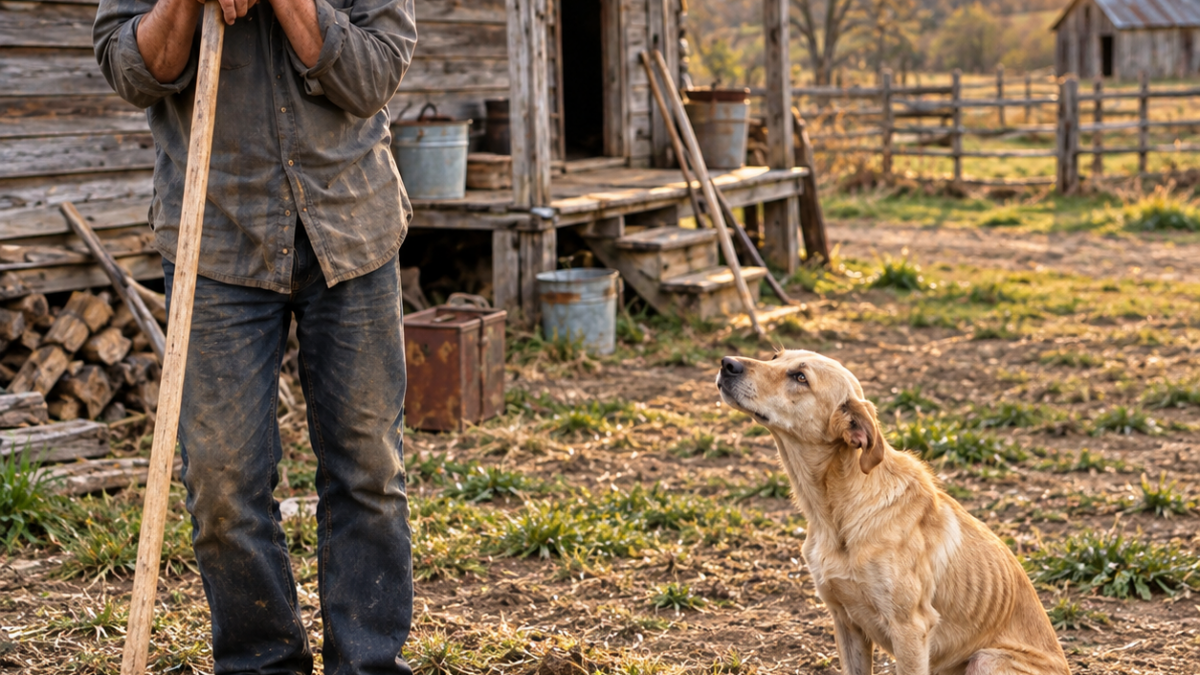
Every time my hammer struck the old boards behind my father’s abandoned farmhouse, a starving brown dog came tearing down the road as if somebody he loved had finally returned.
But the instant he reached the edge of my yard and saw my face, the hope seemed to drain out of his body.
By the fifth day, I understood that dog wasn’t running toward me at all—he was answering a sound connected to someone who had vanished a long time before I arrived.
My name is George Hartley.
I was sixty-three years old when I moved into that farmhouse, although “moved” makes it sound more intentional than it was.
The truth was, I was running away.
Four months earlier, my wife Ellen had died.
Thirty-seven years together, and then one cold October morning, I woke beside her and realized the person who had occupied half my life was no longer breathing.
There was no dramatic final sentence.
No last-minute confession.
No cinematic goodbye.
The night before, she had complained that I had forgotten to close the kitchen cabinet again.
Then she kissed my forehead and told me not to stay up watching baseball.
Those were almost the last words she ever said to me.
The doctors called it a sudden cardiac event.
I called it impossible.
After the funeral, everyone went home.
That was the part nobody had warned me about.
People know what to do around death for the first week.
They bring casseroles.
They stand in your living room holding paper plates.
They squeeze your shoulder and say things they hope are comforting.
Then they return to their lives.
And you remain inside yours.
Except yours no longer makes sense.
For thirty-seven years, Ellen and I had coffee together every morning.
After she died, I kept making two cups.
Not intentionally.
My hands just remembered before my mind did.
The first time I realized what I had done, I stood at the counter looking at her mug until the coffee went cold.
Three weeks after the funeral, I drove to the grocery store and put her favorite yogurt in the cart.
I didn’t notice until checkout.
I left the store without buying anything.
At night, the house was worse.
Every sound became her.
The pipes settling.
The refrigerator motor.
A branch touching the siding.
Once, around two in the morning, I heard something in the hallway and called her name.
“Ellen?”
The silence afterward was so complete that I sat on the edge of the bed until sunrise.
My daughter Rachel wanted me to stay with her family in Ohio.
My son Michael wanted me to come to Arizona.
I refused both.
I loved my children.
But grief made company exhausting.
Everybody watched me like they were waiting to see whether I would break.
Eventually, I decided I needed something physical to do.
Something that required my hands.
My father had left me an old farmhouse forty miles north of town.
It had been empty for nearly twelve years.
The roof leaked.
The fence leaned.
The porch sagged.
Half the windows barely opened.
Perfect.
I packed work clothes, tools, coffee, canned food, and enough stubbornness to convince myself I had a plan.
I told Rachel I would spend two weeks there.
I stayed much longer.
The first morning, I walked into the backyard shortly after sunrise.
The property looked worse in daylight.
Dead branches covered the grass.
Rusty metal leaned against the shed.
Weeds had swallowed the old stone walkway.
A wooden gate near the rear fence hung crooked from one hinge.
I carried my father’s hammer outside.
Then I hit the first rotten board.
Bang.
Before the echo had finished crossing the field, I heard something.
Running.
Fast.
At first, I thought it might be a deer.
Then a dog appeared from beyond the curve in the county road.
He was sprinting toward my yard.
Light brown.
Short-haired.
Thin enough that I could count his ribs from twenty yards away.
His ears bounced as he ran.
His tail whipped violently from side to side.
He wasn’t running like a stray looking for food.
He was running like somebody who was late.
Like someone was waiting.
The dog reached the edge of my property.
Then he saw me.
He stopped so suddenly his paws slid across the gravel.
For several seconds, he stared.
His tail slowed.
Then stopped.
I still remember that moment.
I had owned dogs growing up.
I knew fear.
I knew aggression.
I knew excitement.
But what I saw on that dog’s face looked almost human.
Disappointment.
“Hey there,” I said.
He took one step forward.
Then another.
His nose lifted.
Maybe he was checking my scent.
Maybe confirming what his eyes had already told him.
Wrong man.
He lowered his head.
Sat down.
And looked at the ground.
I crouched.
“You hungry?”
He didn’t react.
I went inside and found some sliced turkey.
When I returned, he was still there.
I put it on the grass and backed away.
He sniffed it.
Then looked beyond me toward the house.
He didn’t eat.
After perhaps a minute, he stood.
Turned.
And walked away.
Not running.
Not frightened.
Just defeated.
I watched until he disappeared around the bend.
The next morning, I forgot about him.
I was tearing out another section of fence.
I dropped three boards.
Crash.
Within seconds, I heard paws.
Same dog.
Same desperate run.
Same sudden stop when he saw me.
“Buddy,” I said softly.
His tail moved twice.
Then he looked past me.
At the farmhouse.
At the maple tree.
At the shed.
Then back at me.
That disappointment again.
He left.
The third day it happened when I slammed the truck tailgate.
PART 2
The fourth when I knocked loose a porch railing.
The fifth when I started hammering before breakfast.
Every loud sound brought him.
Every time, he arrived expecting somebody.
Every time, he found me.
By then, I had started waiting for him too.
I put out water.
He drank when I stayed far enough away.
I left bread.
He ignored it.
I tried canned beef.
He sniffed it but sat beside the bowl watching the road.
That bothered me more than anything.
A dog that thin should have devoured food.
Instead, he waited.
As though eating alone would violate some agreement.
Across the road lived an elderly woman named Evelyn Bell.
I had seen her checking her mailbox every morning.
On the sixth day, I walked over.
She was cutting dead roses beside her porch.
“Mrs. Bell?”
She looked up.
“You’re Harold Hartley’s boy.”
I smiled.
“At sixty-three, I’m not sure anybody’s boy anymore.”
“You are when I remember changing your diaper.”
That shut me up.
She pointed her shears toward my property.
“You fixing the place?”
“Trying.”
I hesitated.
“There’s a brown dog that keeps coming into the yard.”
Her expression changed.
Not dramatically.
But enough.
“You mean the skinny one?”
“Yes.”
She looked toward the road.
“Still coming, is he?”
The question chilled me.
“You know him?”
Mrs. Bell lowered the shears.
“How long have you been staying there?”
“Almost a week.”
She nodded slowly.
“That dog’s been coming to your father’s place for about a year.”
“A year?”
“Yes.”
“Why?”
She didn’t answer immediately.
Instead, she wiped her hands against her pants.
“You should talk to Daniel Mercer.”
“Who?”
“The young fellow two houses down.”
“What does he know?”
“More than I want to explain.”
That evening I walked to Daniel’s place.
He was maybe twenty-eight.
Tall.
Work boots.
Grease on his forearms.
He had been repairing a lawn mower in the garage.
“You George Hartley?”
“That’s me.”
“Mrs. Bell said you might come.”
I looked at him.
“That fast?”
“Nothing happens on this road without Evelyn Bell knowing before the people involved.”
Fair enough.
I asked about the dog.
Daniel’s face became serious.
“You want the whole story?”
“Yes.”
He shut the garage.
“Come inside.”
His kitchen was small and clean.
He poured me water.
Then sat across from me.
“That dog isn’t really a stray,” he said.
“Then whose is he?”
Daniel looked toward the window.
“He belonged to a man named Samuel.”
“Samuel what?”
“We didn’t know then.”
I waited.
Daniel rubbed the back of his neck.
“Samuel was homeless.”
About fourteen months earlier, Samuel had appeared in the area carrying an old green backpack and a rolled sleeping bag.
He was close to sixty.
Gray beard.
Thin.
Quiet.
He collected cans sometimes.
Did odd jobs other times.
Fixed a porch step for Mrs. Bell.
Cleared weeds for Daniel.
Refused money whenever people offered too much.
“He wasn’t drunk,” Daniel said. “People assumed that. But I never saw him drinking.”
“Where did he sleep?”
“Around.”
Daniel hesitated.
“Sometimes behind your farmhouse.”
I leaned back.
“My place?”
“It was empty.”
“Did he break in?”
“Never.”
“Take anything?”
“Nothing.”
“He slept under that maple near your back fence. Said it kept the rain off better than the highway overpass.”
I pictured the tree immediately.
Large trunk.
Wide branches.
The same place where the dog often sat.
“Was the dog already with him?”
“Far as I know.”
Daniel smiled faintly.
“They were inseparable.”
Samuel would sit beneath the tree and share whatever food he had.
If he got a sandwich, half went to the dog.
If somebody gave him chicken, the dog ate first.
Every morning, they walked the same route along the county road.
Every evening, they came back.
Nobody knew the dog’s name because Samuel apparently never used one.
“He’d whistle twice,” Daniel said. “Dog came immediately.”
“What happened?”
Daniel stopped smiling.
“One morning last fall, Samuel didn’t wake up.”
I felt something tighten in my chest.
Daniel had been driving to work before seven when he saw the dog standing in the middle of the road.
The dog ran toward his truck.
Then away.
Back toward the farmhouse.
Then toward Daniel again.
“He kept doing it,” Daniel said. “Like he wanted me to follow.”
Daniel did.
He found Samuel beneath the maple.
Lying on his side.
One hand near the dog.
Already dead.
An ambulance came.
So did the sheriff.
The county coroner.
The dog watched everything.
When the stretcher moved toward the ambulance, he panicked.
“He tried getting inside,” Daniel told me.
My throat tightened.
“They pushed him away?”
“Nobody hurt him. But obviously they couldn’t take him.”
When the ambulance drove off, the dog chased it.
“How far?”
“Half a mile, maybe more.”
Daniel’s voice lowered.
“He came back that evening.”
The dog went directly beneath the maple.
And waited.
One day.
Then two.
Then three.
Mrs. Bell brought water.
Daniel brought food.
The dog barely ate.
After several days, he started wandering to survive.
But he always returned.
Any time a vehicle stopped near the farmhouse.
Any time somebody walked onto the property.
Any time contractors came to inspect the roof.
And apparently any time somebody made noise.
“He thinks Samuel is coming back,” Daniel said.
I looked through the window.
The dog was visible in the distance.
Sitting beside the road.
Facing my farmhouse.
Waiting.
I suddenly remembered his expression the first morning.
The tail.
The excitement.
Then the collapse.
“Has anybody tried taking him?”
“Several.”
“What happened?”
“He ran.”
“Animal control?”
“Picked him up once.”
My stomach sank.
“Then?”
“Some family adopted him from the shelter. He escaped their yard less than a day later.”
“Where did they live?”
“Eleven miles from here.”
I stared.
“He came back?”
“Straight to the maple.”
Neither of us said anything for a while.
Finally I asked, “Did Samuel have family?”
“Nobody knew.”
“Full name?”
“No.”
“Where was he buried?”
Daniel shook his head.
“County handled everything.”
I walked home just before dark.
The dog was beneath the maple.
I stopped fifteen feet away.
He watched me carefully.
For the first time, I understood him.
Not fully.
You never fully understand another creature’s grief.
But enough.
I sat on the grass.
“You know,” I said, “I’ve been waiting too.”
His ears moved.
“My wife’s name was Ellen.”
The dog didn’t come closer.
That was okay.
“She died four months ago.”
I stared toward the road.
“I still listen for her key in the front door.”
The dog looked in the same direction.
“I know it’s stupid.”
He blinked.
“No. Actually, maybe you don’t think it’s stupid.”
I laughed once.
Then my eyes filled.
That surprised me.
I hadn’t cried much since the funeral.
Not because I wasn’t hurting.
Because sometimes pain becomes too large for tears.
But sitting beneath that tree beside a dog who had spent a year waiting for a dead man, something inside me cracked.
“I guess we’re both pretty bad at letting go.”
The dog stayed until sunset.
The next morning, I changed my routine.
I put clean water beneath the maple.
Then cooked two eggs.
One for me.
One for him.
I sat on the porch.
The dog came when he heard the screen door.
He sniffed the bowl.
Looked at me.
Then at the road.
I started eating.
After a minute, he took one bite.
Then another.
He finished half.
Progress.
The next day, I did the same.
Day three, he ate everything.
Day four, he came ten feet closer to the porch.
Day five, seven feet.
Day six, five.
I never reached for him.
Never cornered him.
Never tried to make him trust me.
I simply existed nearby.
That seemed to matter.
Then came the storm.
Cold November rain started before noon.
By dark, water ran across the backyard.
I kept checking for the dog.
No sign.
At eight, I couldn’t stand it anymore.
I pulled on a raincoat.
Ellen’s raincoat, I realized only after I had zipped it.
Yellow.
Too small across my shoulders.
I almost took it off.
Then I could practically hear her.
For heaven’s sake, George. It’s a coat.
I kept it on.
I searched beneath the maple.
Empty.
The shed.
Empty.
Then I heard a faint whine near the ditch.
I found the dog curled beneath two fallen boards.
Soaked.
Shaking.
“Hey.”
He backed away.
“I’m not grabbing you.”
Rain ran into my eyes.
“You’ll freeze out here.”
He trembled.
I crouched.
Nothing.
I sat.
In mud.
At sixty-three.
Wearing my dead wife’s bright yellow raincoat.
Trying to negotiate with a dog.
“Ellen would enjoy this.”
One ear lifted.
“She always said I was stubborn.”
Another shiver.
“She’d say you’re worse.”
I stayed ten minutes.
Then went inside.
I opened the mudroom door.
Put down a blanket.
Placed food beside it.
And walked away.
Around ten, while reading at the kitchen table, I heard claws.
Click.
Click.
Click.
I turned slowly.
The dog stood halfway inside.
Water dripped from his belly.
I looked away so he wouldn’t feel watched.
“Door’s open.”
He stepped onto the blanket.
Circled twice.
Lay down.
And spent the entire night staring at the doorway.
By sunrise he was gone.
But that evening, he returned.
The next day too.
Three nights later, he slept with his back to the door.
A week later, I finally named him.
Brownie.
Not my proudest creative achievement.
But it fit.
“Brownie,” I called one morning.
His head lifted.
I smiled.
“There you go.”
By then, he had started eating regularly.
His ribs were still visible, but his eyes looked brighter.
The breakthrough came on a Tuesday.
I was sitting on the porch drinking coffee.
Brownie had eaten.
Instead of going to the maple, he stood ten feet away.
He looked at me.
Then the road.
Then me again.
Finally, he walked forward.
Three steps.
Five.
He stopped beside my boot.
I held completely still.
His nose touched the leather.
He sat.
Then, slowly, he lowered himself.
His shoulder pressed against my leg.
My throat closed.
A minute later, he rested his head across my foot.
That was all.
A skinny dog’s head.
Maybe ten pounds of pressure.
But it broke me.
I put down my coffee.
Covered my face.
And cried harder than I had at Ellen’s funeral.
Brownie lifted his head.
For a moment I thought he would retreat.
Instead, he leaned his body against me.
I lowered one hand.
Touched his head.
He flinched.
Then stayed.
“I know,” I whispered.
My voice shook.
“I know.”
From that day forward, something changed.
Not instantly.
Healing never works that way.
Brownie still visited the maple.
Still watched the road.
Still froze when trucks slowed near the property.
But now he returned to me afterward.
He started sleeping inside.
First the mudroom.
Then the kitchen.
Then directly outside my bedroom.
I bought him a dog bed.
He ignored it.
He preferred Ellen’s yellow raincoat, which I had dropped near the mudroom bench.
For reasons I couldn’t explain, I let him keep it.
A week later, I called Dr. Patterson, the veterinarian in town.
Getting Brownie into my truck was nearly impossible.
The moment I opened the passenger door, he backed away.
I tried treats.
Nothing.
Then I understood.
A vehicle had taken Samuel away.
Of course.
So I stopped trying.
For four days, I left both truck doors open.
Placed food on the floorboard.
Let him explore.
No engine.
No movement.
Eventually he climbed in.
The following day, I sat behind the wheel while he sat beside me.
The next, I started the engine for five seconds.
He tensed.
I shut it off.
“It’s okay.”
A few days later, we drove to the mailbox.
Then back.
Next trip, Mrs. Bell’s house.
Then Daniel’s.
Finally, Dr. Patterson’s clinic.
Brownie weighed thirty-one pounds.
“He should be forty-three to forty-six,” she said.
I looked at him.
“Can we fix that?”
She smiled.
“Very likely.”
He had worms.
A skin infection.
Damaged paw pads.
A badly healed toe fracture.
Several broken teeth.
Nothing immediately life-threatening.
When she listened to his heart, Brownie pressed his body against my knee.
“How old?”
“Five, maybe six.”
“Can dogs recover from something like what happened to him?”
She knew I wasn’t asking about his body.
“Dogs can recover from a lot,” she said. “But trust isn’t medicine, Mr. Hartley. You can’t force a dose down his throat.”
“What do I do?”
“Keep showing up.”
I nodded.
That sounded familiar.
Over the next month, Brownie gained weight.
His coat became smooth.
His energy returned.
Then one morning, something happened I never expected.
I tossed an old tennis ball aside while cleaning the shed.
Brownie watched it bounce.
He stared at me.
Then the ball.
“Go ahead.”
Nothing.
I threw it again.
He trotted after it.
Sniffed.
Walked away.
Three days later, he picked it up.
A week after that, he discovered fetch.
Not normal fetch.
Brownie fetch.
Which meant I threw the ball, he retrieved it, then ran past me while I chased him.
The first time he did it, I laughed.
Actually laughed.
The sound startled me.
I stopped.
Brownie stopped too.
We looked at each other.
I hadn’t heard myself laugh like that since Ellen died.
Immediately, guilt arrived.
How could I laugh?
How could something feel good when she was gone?
Then a memory surfaced.
Years earlier, after Ellen’s sister lost her husband, Ellen had said something while we drove home from visiting her.
“Grief shouldn’t become a prison sentence.”
At the time, I hadn’t thought much about it.
Now I understood.
Loving Ellen did not require me to punish myself for surviving her.
I picked up the ball.
Brownie crouched.
His tail wagged.
I threw it.
He ran.
I laughed again.
By Christmas, the farmhouse barely resembled the wreck I had entered.
I repaired the porch.
Painted the shutters.
Rebuilt part of the fence.
Daniel helped replace rotten shed beams.
Mrs. Bell gave me bulbs to plant in spring.
Brownie supervised everything.
He followed me room to room.
If I crawled under the sink, his head appeared next to mine.
If I climbed a ladder, he sat beneath it looking worried.
“You’re becoming Ellen,” I told him.
His ears lifted.
“She used to stare at me exactly like that.”
Christmas itself scared me.
First one without her.
Rachel insisted on visiting.
She arrived with her husband and my two grandsons.
Brownie hid initially.
Eight-year-old Tyler wanted desperately to pet him.
“Don’t chase him,” I said.
“But Grandpa—”
“Sit down.”
Tyler did.
He opened a book on the living-room floor.
For nearly an hour, he ignored Brownie.
Eventually Brownie came closer.
Sniffed Tyler’s shoe.
Then his sleeve.
Twenty minutes later, Brownie slept beside him.
Rachel found me watching from the kitchen.
“You look better,” she said.
“I’m still sad.”
“I know.”
“I miss your mother every morning.”
“I know.”
I looked at Brownie.
“But somebody needs breakfast now.”
Rachel smiled.
“Maybe that’s not the only reason you get up.”
“No.”
She squeezed my shoulder.
“Good.”
Christmas morning brought light snow.
Brownie went insane.
He ran circles through the yard.
Tyler threw snowballs.
Brownie tried catching them.
I stood on the porch laughing.
Then later, near sunset, Brownie walked beneath the maple.
His joy disappeared.
He sat.
Looked down the road.
Whined.
I understood immediately.
Samuel.
I walked over.
Sat beside him in the snow.
“You remember.”
Brownie leaned against me.
“He must’ve loved you.”
His eyes stayed on the road.
“You don’t have to forget him.”
I rubbed his neck.
“I’m not forgetting Ellen either.”
We sat together until dark.
That winter should have been peaceful.
It wasn’t.
Our first real trouble arrived in January.
A county animal-control truck pulled into my driveway.
Brownie saw the uniform through the window and immediately backed into the hallway.
The officer introduced himself as Rick Danner.
“We received a complaint regarding an unrestrained stray dog.”
“He isn’t a stray.”
Rick glanced past me.
“Licensed?”
“I’m handling that.”
“Registered owner?”
“Me.”
“Paperwork?”
I had veterinary records but nothing official yet.
Rick sighed.
“Mr. Hartley, somebody reported that this dog has a history of roaming and previously escaped an adoption placement.”
“Who?”
“I can’t disclose complainants.”
“Has Brownie bitten anyone?”
“No report.”
“Attacked livestock?”
“No.”
“Damaged property?”
“Not that I know of.”
“Then what’s the issue?”
“Technical compliance.”
He handed me a form.
I disliked bureaucracy.
But the man was doing his job.
So I completed everything.
License.
Microchip.
Rabies certificate.
Ownership declaration.
Photographs.
I created a folder.
BROWNIE.
Ellen would have laughed mercilessly.
A few days later, I discovered who had complained.
Curtis Vale.
Curtis owned thirty acres behind my property.
He had recently started clearing land for storage buildings.
He pulled beside my mailbox one afternoon.
Big white pickup.
Mirrored sunglasses.
Voice loud enough to suggest he had spent a lifetime assuming volume created authority.
“That dog yours?”
“Yes.”
“He’s been on my land.”
“When?”
“Couple weeks back.”
Before Brownie had begun staying with me.
“I’ll keep him home.”
Curtis spat into the ditch.
“Should’ve been hauled off long ago.”
I looked at him.
“Excuse me?”
“Feral dog. Trouble waiting.”
“He’s not feral.”
“He lived outside a year.”
“So did Samuel.”
Curtis frowned.
“Who?”
I realized he didn’t even know.
“The man he belonged to.”
Curtis shrugged.
“Don’t care. Keep the mutt away from my crews.”
“Gladly.”
He drove off.
What bothered me wasn’t his request.
He had a right to keep animals off his land.
It was his contempt.
The way he spoke about Brownie as if survival itself made him dirty.
I added a second latch to the gate.
For two weeks, nothing happened.
Then one morning Brownie disappeared.
I had let him into the fenced backyard at six.
At six-thirty, I called him.
Nothing.
The gate was closed.
I searched the porch.
Shed.
Maple.
Nothing.
Then I saw the fence.
Two wires had been cut cleanly near the rear corner.
Not broken.
Cut.
My stomach dropped.
“Brownie!”
I called Daniel.
Mrs. Bell.
Dr. Patterson.
We searched the road.
Fields.
Creek.
At ten-thirty, my phone rang.
Animal control.
“We have your dog.”
I nearly collapsed with relief.
“Where?”
“At the shelter.”
“How?”
Silence.
Then Rick said, “Curtis Vale brought him.”
My hand tightened around the phone.
I looked at the cut fence.
“I’m coming.”
Brownie was in a kennel.
When he saw me, he exploded.
Barking.
Whining.
Throwing himself against the gate.
Not angry.
Terrified.
“I’m here!”
He shoved his nose between the bars.
“I’m here, buddy.”
Rick walked over.
“He’s been agitated since he arrived.”
“Open it.”
“We need a release signature.”
“Hand it to me.”
“George—”
“Rick, that dog spent a year watching vehicles take people away. Somebody dragged him into one and dumped him here. Give me whatever I need.”
Rick handed me the papers.
When the kennel opened, Brownie jumped against my chest.
His whole body shook.
I held him.
“You’re coming home.”
At the truck, he froze.
Old fear.
I opened both doors.
Sat inside.
Waited.
Five minutes.
Then Brownie climbed in.
When I returned home, Curtis was standing near the back fence.
“Found your mutt?”
I got out slowly.
“Did you cut my fence?”
He smirked.
“You accusing me?”
“I asked a question.”
“Old wire breaks.”
“Wire cutters leave cleaner edges.”
His face hardened.
“Careful, Hartley.”
I felt rage rise.
For one second, I imagined hitting him.
Then I saw Brownie watching from inside the truck.
I smiled.
Curtis frowned.
“What?”
“Nothing.”
“What’s funny?”
“You reminded me of something.”
“What?”
“I need cameras.”
His expression changed.
The next day, Daniel helped me install six.
Front driveway.
Rear fence.
Maple.
Side yard.
Shed.
Road.
We replaced the damaged wire with welded fencing.
I added motion lights.
“Think he’ll come back?” Daniel asked.
“I hope he’s smarter than that.”
He wasn’t.
Three weeks later, at 2:14 in the morning, my phone buzzed.
Motion alert.
I opened the camera feed.
A figure in a hood approached the rear fence.
Bolt cutters in hand.
Brownie woke beside the bed.
He growled.
I didn’t go outside.
I called the sheriff.
The figure cut one wire.
Brownie barked.
The person froze.
Then ran toward the back property line.
The footage wasn’t clear enough to identify his face.
But direction mattered.
A deputy arrived.
I showed him everything.
The original cut.
Animal-control report.
Camera footage.
My dispute with Curtis.
“We’ll talk to him.”
Next afternoon, Curtis came to my gate furious.
“You sent cops to my place?”
“I reported someone cutting my fence.”
“You gave them my name.”
“They asked who had threatened me.”
“I never threatened you.”
I looked at the camera above the porch.
Curtis noticed.
His voice dropped.
“You’re making an enemy.”
“No.”
I pointed toward Brownie.
“You made one when you started messing with my dog.”
Curtis laughed.
“All this for a worthless roadside mutt?”
Brownie stood beside me.
Quiet.
Calm.
“He has a name.”
Curtis rolled his eyes.
“He has a county license.”
I stepped closer to the gate.
“He has a microchip.”
Another step.
“He has a veterinarian.”
Curtis stopped smiling.
“He has a home.”
I looked directly at him.
“And he has me.”
Curtis stared.
“If you touch him or my property again, I won’t argue with you. I’ll document it.”
He left.
I thought that would be the end.
I was wrong.
A month later, I drove to Rachel’s for the afternoon.
Brownie stayed home because she had contractors working inside.
When I returned, he met me at the door.
Normal.
Excited.
Then he ran toward the fence.
Sniffed something.
A plastic bag lay in the grass.
Inside was raw hamburger.
Brownie moved toward it.
“Leave it!”
He stopped.
Thank God.
I put him inside.
Checked the camera footage.
At 1:17 p.m., Curtis’s white pickup stopped near my property.
Curtis stepped out.
Looked toward the house.
Threw the bag across the fence.
Then drove away.
My hands started shaking.
I called the sheriff.
They collected the meat.
Testing later found anticoagulant rodent poison.
Enough to seriously injure or potentially kill a dog Brownie’s size.
That changed everything.
Curtis claimed somebody else had borrowed his truck.
The video showed his face clearly.
He was arrested.
Not dramatically.
No shouting.
No chase.
Two deputies arrived at his property with paperwork.
But when they put him in the cruiser, I watched from my porch.
Brownie sat beside me.
I didn’t celebrate.
I didn’t smile.
But I felt something settle.
For once, the person being taken away wasn’t Brownie.
It was the man who had tried to hurt him.
Curtis eventually pleaded guilty to criminal trespass, property damage, and an animal-cruelty-related charge.
He paid restitution.
Received probation.
Was ordered to stay away from my land.
And his development project drew scrutiny because county inspectors discovered unrelated permit violations.
Several structures had been started improperly.
Work stopped.
Curtis blamed me.
I never responded.
The best revenge was visible every morning.
Brownie lived.
He gained weight.
His coat shone.
His ribs disappeared.
He became shamelessly spoiled.
He learned the refrigerator door.
He learned exactly which cabinet held treats.
He learned that delivery drivers were potential friends.
He learned squirrels were criminals.
He learned my recliner belonged to him between noon and four.
He learned Rachel’s children carried snacks.
Most importantly, he learned I returned.
That took months.
Any time I drove away without him, panic appeared in his eyes.
So I created a ritual.
I knelt beside him.
Touched his chest.
“I come back.”
Then I left for five minutes.
Returned.
Ten minutes.
Returned.
Half an hour.
Returned.
Every time, same words.
“I come back.”
One morning I put on my coat.
Brownie watched.
Instead of pacing, he walked to his bed.
I knelt.
“I come back.”
He sighed.
A long, dramatic sigh.
I laughed.
“All right, apparently we’ve covered this.”
When I returned forty minutes later, he was asleep.
That ordinary sight nearly made me cry.
Because trust is sometimes nothing more than being able to sleep while somebody you love is gone.
Spring came.
I planted tomatoes.
Mrs. Bell brought roses.
Daniel helped build Brownie an outdoor doghouse.
Brownie never used it.
Not once.
Apparently surviving outdoors for a year had convinced him air conditioning was a human invention worth respecting.
I started displaying Ellen’s photographs again.
For months they had remained boxed because seeing them hurt too much.
Now I put one above the fireplace.
Brownie would sometimes sit beneath it.
“She would’ve liked you,” I told him.
He wagged.
“She also would’ve complained about the hair.”
More wagging.
“You’re lucky she isn’t here.”
That sentence used to break me.
Now it made me smile and ache at the same time.
I learned grief could contain both.
October arrived.
One year since Ellen died.
I woke before dawn feeling heavy before I remembered why.
The body remembers dates.
Brownie stood when I sat up.
I dressed.
Drove to the cemetery.
He came.
Ellen’s grave sat beneath a red maple.
I placed flowers beside the stone.
For several minutes, I couldn’t speak.
Then I said, “I’m okay.”
My voice cracked.
Brownie leaned against me.
“I didn’t think I would be.”
Wind moved through the branches.
“I thought being okay meant leaving you.”
I touched her name carved into the stone.
“But it doesn’t.”
Tears came.
“You’re still coming with me.”
Brownie sneezed on my trousers.
I laughed.
“Very respectful.”
His tail moved.
When we returned home, Brownie went directly beneath Samuel’s maple.
He lay down.
The timing struck me.
Samuel had died almost exactly a year earlier too.
Two dead people.
Two survivors.
Except Ellen had a grave.
Samuel?
I still didn’t know.
That began another journey.
I called the county coroner.
Then records.
Then the sheriff’s department.
Samuel had initially been unidentified.
But fingerprints eventually revealed his name.
Samuel Joseph Beckett.
Fifty-nine.
Born in Kentucky.
Former roofer and carpenter.
Widowed.
One deceased brother.
And a surviving daughter.
I sat very still when the clerk said that.
“A daughter?”
“Yes.”
“Does she know he died?”
“I can’t discuss next-of-kin notifications.”
“Can you tell me where he was buried?”
County cemetery.
Indigent section.
Fifteen miles away.
I drove there the next morning with Brownie.
A groundskeeper led us to a distant row of small markers.
Samuel’s was simple.
SAMUEL J. BECKETT
1965–2025
Brownie wandered across the grass sniffing.
Then he froze.
His nose lifted.
He walked toward Samuel’s marker.
I stopped.
Maybe there was some scent.
Maybe coincidence.
Maybe I was seeing what I wanted to see.
But Brownie lowered himself beside the stone.
Placed his head between his paws.
And stayed.
I sat next to him.
“There you are,” I whispered.
Brownie looked at the marker.
“You found him.”
We remained almost an hour.
Before leaving, I made a decision.
Samuel deserved more.
I ordered a proper headstone.
Not expensive.
Not elaborate.
It read:
SAMUEL JOSEPH BECKETT
BELOVED FRIEND
HE WAS NEVER ALONE
At the bottom, I requested a small engraved dog.
Daniel cried when I showed him.
Mrs. Bell did too.
But I kept thinking about Samuel’s daughter.
I did not want to intrude.
So I gave my phone number to the county investigator.
“If she wants to know about her father’s dog, give her this.”
Three weeks later, an unknown number called.
“Is this George Hartley?”
“Yes.”
“My name is Claire Beckett.”
My chest tightened.
“I think you have my father’s dog.”
I looked toward Brownie sleeping beside the fireplace.
“Yes,” I said.
“I think I do.”
Claire began crying quietly.
“I didn’t know Dad was dead.”
“I’m sorry.”
She told me Samuel had not always lived on the road.
He once owned a small roofing company.
Had employees.
A mortgage.
A wife.
A daughter.
A normal life.
Then his wife died from cancer.
Samuel unraveled.
He drank.
Lost jobs.
Lost the company.
Accumulated debt.
Claire tried helping.
Samuel became ashamed.
Then defensive.
Eventually, he disappeared.
For years, he called occasionally.
Never gave an address.
Never asked for money.
The last time Claire heard from him was nearly two years before.
“He told me he had found a dog,” she said.
I looked at Brownie.
“He said the dog saved his life.”
My eyes filled.
“What did he call him?”
Claire gave a tiny laugh.
“That’s the funny thing. Dad never liked naming dogs.”
“Daniel told me.”
“He said dogs didn’t need names to understand love.”
“Did he whistle?”
Silence.
Then Claire whispered, “Twice.”
I closed my eyes.
“Yes.”
She started crying harder.
“Can I see him?”
“Of course.”
Claire arrived Saturday.
Four-hour drive.
When she stepped from her car, Brownie stood on the porch.
Claire stopped.
Covered her mouth.
“Oh my God.”
Brownie stared.
She took one step.
I raised my hand.
“Let him decide.”
Claire nodded.
Then she whistled.
Two short notes.
Brownie’s head snapped upward.
His entire body became still.
Claire whistled again.
Brownie ran halfway across the yard.
Stopped.
Stared.
Then approached slowly.
Claire knelt.
“Hey, sweetheart.”
Brownie sniffed her hands.
Her sleeves.
Her face.
Then he made a sound I had never heard.
A deep, broken whine.
Claire collapsed onto both knees.
Brownie pushed his head against her chest.
She wrapped her arms around him.
“I’m sorry.”
I turned away.
“I’m so sorry I couldn’t find him.”
Brownie stayed against her.
Then, after several minutes, he stepped back.
Looked at me.
Walked over.
Pressed against my leg.
Claire saw.
A complicated expression crossed her face.
“I came here wondering whether…”
She stopped.
I understood.
“You wanted to take him.”
“He’s the last living thing I know that was with Dad.”
I looked down.
Brownie leaned against me.
“I would never keep you from him.”
Claire wiped her face.
“But he’s home.”
I said nothing.
“He chose you.”
“I think we chose each other.”
Claire nodded.
“Then he stays.”
Relief and guilt hit together.
“You can visit whenever you want.”
She looked surprised.
“You mean that?”
“Your father was his family. That makes you family.”
We spent the afternoon beneath the maple.
Claire told me who Samuel had been before grief hollowed him out.
Funny.
Generous.
Awful singer.
Excellent carpenter.
Pancakes every Sunday.
Hated neckties.
Once drove six hours because Claire called from college crying after a breakup.
“He wasn’t always the man people saw here,” she said.
I looked at Brownie.
“I know.”
“How?”
“Because he loved this dog.”
Claire smiled through tears.
“And the dog loved him.”
“That tells me enough.”
We visited Samuel’s grave together.
When Claire saw the new headstone, she pressed both palms against it.
“You did this?”
“He mattered.”
She hugged me.
Two strangers.
Connected by two people who had died and one dog who refused to forget.
Claire began visiting every few months.
She brought photographs of Samuel.
One showed him younger beside a fishing boat.
I framed it.
It hangs near Ellen’s photograph now.
Not because they knew each other.
Because they both belong to the story of the home Brownie and I created afterward.
Years passed.
The farmhouse changed.
So did Brownie.
His muzzle turned white.
He stopped racing after tennis balls.
Then stopped chasing them entirely.
He preferred walks.
Slow ones.
Every morning we followed the same road.
Past the maple.
Across the field.
Down to the bend.
Then home.
Sometimes Brownie stopped.
Looked into the distance.
I never pulled him.
Maybe he remembered Samuel.
Maybe old dogs simply know the value of standing still.
Eventually he would look at me.
Tail moving slowly.
Then continue.
I grew older too.
My knees complained.
My back stiffened.
Rachel started calling more often.
“Dad, you need to consider moving closer.”
“I’m fine.”
“You say that even when you’re not.”
“That’s because I’m your father.”
Brownie supported my position by snoring.
Eventually Rachel stopped arguing.
Instead, she visited.
Tyler grew taller than me.
Brownie still treated him like the eight-year-old who once sat on the floor reading.
One evening, many years after my first hammer strike, Brownie climbed the porch steps slowly.
I was watching the sunset.
He walked over.
Turned twice.
Lowered himself beside me.
Rested his head on my knee.
I stroked his white muzzle.
“You know something?”
His eyes moved toward me.
“You saved my life.”
Tail tap.
“Samuel said you saved his too.”
Another tap.
“That’s a remarkable career for a skinny roadside mutt.”
His eyes closed.
I looked toward the maple.
For years I thought our story began when Brownie came running toward the sound of my hammer.
It didn’t.
It began before me.
With Samuel.
A grieving man.
A dog who became his reason to keep moving.
Then Samuel died.
The dog survived.
Then came me.
Another grieving man.
Another life half abandoned.
Brownie became the bridge between two people who never met.
Samuel had given him love when neither had much else.
Brownie carried that love forward.
And handed some of it to me.
People sometimes ask whether I rescued Brownie.
No.
I fed him.
I took him to the veterinarian.
I gave him shelter.
But rescue?
That went both ways.
When I arrived at the farmhouse, I thought I was fixing wood.
Replacing boards.
Straightening fence posts.
Repairing windows.
I believed if I kept my hands busy enough, my mind would stop hurting.
Instead, Brownie taught me something.
Grief cannot be repaired like a fence.
You don’t hammer it straight.
You don’t replace the broken section.
You learn how to build around it.
You make room.
Morning walks.
Food bowls.
Dirty paw prints.
Vet bills.
Christmas snow.
Grandchildren.
Claire.
Flowers beside graves.
Photographs above fireplaces.
Laughter returning without permission.
That is what healing looked like for us.
Not forgetting.
Never forgetting.
Living anyway.
Then came the day I feared.
Brownie stopped eating breakfast.
He was old by then.
Much older than anyone could precisely calculate.
Dr. Patterson had retired.
Her daughter, Emily, now ran the clinic.
Brownie had arthritis.
Kidney problems.
A heart murmur.
Still, until that morning, he had always eaten.
Especially eggs.
I put his bowl down.
“Come on.”
Brownie sniffed.
Turned away.
My chest tightened.
By noon, he could barely stand.
I carried him to the truck.
Funny.
Years earlier, he had feared that vehicle more than almost anything.
Now he rested his head against my arm while I drove.
Emily examined him.
Bloodwork.
Heart.
Lungs.
Then she looked at me with the expression doctors use when they wish medicine could change reality.
“George.”
I knew.
“How long?”
“Could be hours. Maybe a day.”
I looked at Brownie.
He was watching me.
“Pain?”
“Some discomfort. We can control it.”
“Can I take him home?”
“Yes.”
So I did.
Claire drove down immediately.
Rachel came too.
Daniel, older now and grayer, stopped by.
Mrs. Bell had died several years earlier.
Her roses still climbed my fence.
We carried Brownie outside beneath Samuel’s maple.
Sunset.
Warm breeze.
He lay on Ellen’s yellow raincoat.
Yes.
I still had it.
Faded.
Frayed.
But intact.
Claire sat on one side.
Me on the other.
Brownie’s breathing was slow.
Claire stroked his ear.
“He loved Dad.”
“I know.”
“You loved him too.”
I swallowed.
“I do.”
Present tense.
Always present tense until there is absolutely no choice.
Rachel knelt behind me.
“Dad…”
“I’m okay.”
She put her hand on my shoulder.
“No, you’re not.”
She was right.
I bent closer.
Brownie opened his eyes.
I touched his chest.
The place I used to touch before leaving.
“I come back,” I whispered.
Then stopped.
The words hurt.
Because this time, one of us wouldn’t.
I pressed my forehead against his.
“You waited for Samuel a long time.”
Brownie breathed.
“You don’t have to wait anymore.”
Claire began crying.
I could barely speak.
“If he’s somewhere…”
My throat closed.
“If there is somewhere…”
I looked toward the maple branches.
“Maybe he’s waiting for you now.”
Brownie’s tail moved once.
Tiny.
Maybe reflex.
Maybe not.
I choose not to argue with miracles.
His breathing slowed.
One breath.
Another.
Another.
Then nothing.
I stayed with my forehead against his for a long time.
Nobody rushed me.
Nobody said he was in a better place.
Nobody told me he’d had a good life.
They simply stayed.
Exactly what Brownie had done for me years before.
We buried him beneath the maple.
Not directly where Samuel had died.
A few feet away.
I placed a stone there.
BROWNIE
HE WAITED.
HE FOUND.
HE WAS LOVED.
For weeks, the farmhouse sounded empty again.
I hated that.
No claws on wood.
No sigh beside the fireplace.
No collar.
No breathing outside my bedroom.
The first morning after he died, I cooked two eggs.
Habit.
I stared at the second egg.
Then laughed and cried at the same time.
“Still doing this,” I told the empty kitchen.
But the emptiness was different from after Ellen died.
Back then, I thought loneliness was proof that the best of life was over.
Now I knew better.
Pain meant something had mattered.
And something mattering did not become a mistake because it ended.
A month later, Claire visited.
We sat beneath the maple.
Between Samuel’s memory and Brownie’s grave.
“I used to feel angry at Dad,” she said.
“You had reason.”
“I thought he chose leaving over me.”
I waited.
“Now I think maybe he was ashamed.”
“Probably.”
“I wasted years being angry.”
“No.”
She looked at me.
“You survived those years however you could.”
Claire stared at Brownie’s stone.
“He taught us both something, didn’t he?”
“Brownie?”
“Yes.”
“What?”
She smiled faintly.
“That waiting and loving aren’t the same thing.”
I thought about it.
She was right.
Brownie had waited for Samuel because he couldn’t understand death.
I had waited for my grief to disappear because I couldn’t understand survival.
Neither happened.
Instead, life asked us to move.
Not away from love.
Forward with it.
The following spring, I repaired one final section of the old back fence.
Same place I had worked the first week.
I lifted my father’s hammer.
For several seconds, I couldn’t swing.
I remembered everything.
That first sound.
Paws hitting gravel.
A starving dog running as fast as he could.
Certain that Samuel had returned.
I finally struck the board.
Bang.
The sound traveled across the yard.
Across the road.
Into the field.
I waited.
Nothing came running.
My eyes filled.
Then I heard a car.
Rachel pulled into the driveway.
Tyler was driving now.
He climbed out.
“Grandpa!”
I smiled.
“You’re late.”
“Traffic.”
Rachel got out carrying lunch.
The farmhouse filled with voices.
That evening Claire called.
Daniel stopped by.
We ate on the porch.
The roses Mrs. Bell planted were blooming.
Ellen’s picture stood inside.
Samuel’s photograph beside it.
Brownie’s collar hung from a small hook underneath.
I looked around at all of it.
The people.
The house.
The life that had grown out of loss.
And finally understood something.
A home isn’t walls.
It isn’t land.
It isn’t furniture.
It isn’t even the people who remain there forever.
Nobody remains forever.
A home is the place where love has happened so deeply that even after someone leaves, the shape of that love remains.
Ellen remained.
Samuel remained.
Brownie remained.
Not physically.
But in every part of me that had changed because they existed.
Sometimes strangers still ask why there is a dog’s grave beneath that maple.
I tell them the short version.
“A dog lived here.”
But that isn’t really true.
A dog taught me how to live here.
There is a difference.
I am older now.
Much older than sixty-three.
My hands shake sometimes.
My knees aren’t interested in long walks.
I don’t repair much anymore.
But on good evenings, I sit on the same porch.
I watch the road.
Not because I am waiting for Brownie.
I learned better than that.
I watch because the road reminds me where he came from.
Every once in a while, a dog barks somewhere in the distance.
And for one impossible second, my heart remembers before my mind does.
I look up.
Then I smile.
I don’t feel betrayed by that reflex anymore.
Love has habits.
That is all.
One summer evening, Tyler sat beside me.
He was a grown man by then.
“Grandpa?”
“Yeah?”
“You ever think about getting another dog?”
I looked toward Brownie’s stone.
“For a while, I thought that would be replacing him.”
“And now?”
I smiled.
“Now I think Brownie would probably be annoyed I waited this long.”
Two weeks later, Tyler drove me to the county shelter.
I told myself we were only looking.
That lasted eleven minutes.
In the last kennel sat an older black dog.
Gray muzzle.
Quiet.
While every other dog barked, he simply watched.
I crouched.
“Hey.”
The dog stood.
Walked toward the gate.
Pressed his forehead against the bars.
My throat tightened.
Tyler looked at me.
“Grandpa?”
“I know.”
“You okay?”
I laughed.
“No idea.”
The employee told us the dog’s name was Walter.
Ten years old.
Owner had died.
Family couldn’t take him.
He had been at the shelter almost four months.
“People want puppies,” she said.
I looked into Walter’s eyes.
“Yeah.”
I knew something about being left behind after death.
I knew something about old creatures nobody expected to start over.
“Open the gate.”
Walter came home that afternoon.
When we reached the farmhouse, I walked him toward the maple.
He sniffed Brownie’s grave.
Then sat.
I stood beside him.
“All right,” I said quietly. “There are a few people you should know about.”
Walter looked up.
I pointed toward the house.
“Ellen ran everything.”
Tail movement.
“Samuel technically never owned this place, but his dog disagreed.”
Walter sniffed.
“And Brownie…”
I looked at the stone.
“Brownie saved everybody.”
Walter leaned against my leg.
I laughed.
“You’ll fit in.”
That evening, for the first time in years, claws clicked across my kitchen floor.
I sat in my chair.
Walter settled near my feet.
The farmhouse was no longer silent.
And I finally understood the last gift Brownie had given me.
He had not taught me to hold on forever.
He had taught me that loving again does not betray what came before.
It honors it.
Because love that teaches you to close your heart was never love’s purpose.
Love expands the house.
Even when the house is just an old farmhouse with crooked floors, roses along the fence, photographs above the fireplace, and graves beneath a maple tree.
Sometimes I think about the first time Brownie saw me.
How fast he came running.
How completely his face changed.
He believed he had found Samuel.
Instead, he found a stranger.
He had no way of knowing that stranger needed him almost as badly as he needed Samuel.
Neither did I.
That is the strange thing about the most important moments of your life.
They rarely announce themselves.
No music.
No warning.
No sign.
Sometimes they sound like a hammer hitting an old board.
Sometimes they look like a starving brown dog sprinting down a road.
Sometimes the thing racing toward you is not what you expected.
And sometimes neither of you understands that you are about to become home for each other.
My name is George Hartley.
I lost my wife.
Samuel lost his life.
Claire lost her father.
Brownie lost the man he trusted most.
For a while, every one of us believed loss was the end of the story.
We were wrong.
Loss was part of it.
A brutal part.
An unfair part.
But not the last page.
Brownie spent a year running toward every sound because he believed Samuel was coming back.
Then one morning, my hammer made the wrong man appear.
Me.
I thought his disappointment was the saddest thing I had ever seen.
Years later, I realized it might also have been the beginning of something beautiful.
Because eventually Brownie stopped looking over my shoulder for Samuel.
And I stopped looking over life’s shoulder for Ellen.
We didn’t forget them.
We simply learned to see who was still standing in front of us.
That may be the hardest thing grief asks.
Not to let go.
Not to move on.
Simply to look forward without feeling guilty.
To recognize that another sunrise is not betrayal.
Another laugh is not betrayal.
Another friendship is not betrayal.
Another dog sleeping beside your chair is not betrayal.
Life continuing is not disrespectful to the dead.
Sometimes continuing is the greatest evidence that their love mattered.
Brownie taught me that.
A starving dog who didn’t even know his own name taught an old widower how to come home.
And if there is one moment I will carry for whatever remains of my life, it isn’t the day Curtis was arrested.
It isn’t the day Brownie finally climbed into my truck.
It isn’t even the day Claire whistled and Brownie recognized something of Samuel in her.
It is one ordinary morning years after we met.
I was repairing the fence again.
Brownie was sleeping beneath the maple.
I lifted my hammer.
Bang.
Years earlier, that sound would have made him explode into a desperate sprint.
That morning, he merely lifted his head.
He looked toward the road.
Only for a second.
Then he looked at me.
And relaxed.
A few moments later, he stood.
Stretched.
Walked across the yard.
No panic.
No desperate searching.
He came directly to me.
I knelt.
He pressed his head against my chest.
“I’m here,” I whispered.
His tail moved.
At the time, I thought I was reassuring him.
Now I realize Brownie was answering me.
I’m here too.
For two creatures who had spent so long waiting for someone who could never return, those words were enough.
They were more than enough.
They were home.
Years after Brownie was gone, I still kept his collar hanging beneath the photograph over the fireplace.
The leather had cracked with age. The little county tag had lost most of its shine. If I touched it, the metal made the faintest sound against the buckle.
I didn’t touch it often.
I didn’t need to.
Just seeing it was enough.
Walter, the old black dog Tyler had helped me adopt, eventually learned the rhythms of the farmhouse in his own way.
He wasn’t Brownie.
That mattered.
At first, I had unconsciously compared them.
Brownie had slept beside the mudroom door his first weeks with me. Walter chose the rug beside the fireplace.
Brownie had been obsessed with tennis balls.
Walter looked at a thrown ball as if I had made a poor financial decision.
Brownie followed me everywhere.
Walter preferred to keep me within eyesight while maintaining what seemed to be a dignified distance.
And Brownie had once spent a year chasing sounds because he believed a dead man might return.
Walter had a different wound.
He had spent months at a shelter after the elderly woman who owned him died.
He didn’t panic when I left.
He panicked when evening came.
The first few nights, around seven o’clock, Walter would walk to the front window.
Then the door.
Then back to the window.
He would sit there staring outside.
Waiting.
The shelter employee had told me his previous owner’s daughter usually visited her mother after dinner.
Maybe Walter remembered headlights in a driveway.
Maybe he remembered a car door.
Maybe he was waiting for the woman he had loved to walk through one more time.
The first evening I noticed it, I almost laughed at the cruelty of coincidence.
“Seriously?” I said.
Walter looked at me.
“I seem to collect dogs waiting for dead people.”
He continued staring through the glass.
I walked over and sat beside him.
For nearly an hour, neither of us moved.
Then I said quietly, “She’s not coming, is she?”
Walter lowered his head.
I understood.
More than I wished I did.
So we began another ritual.
At seven every evening, I sat near the front window with him.
Sometimes I read.
Sometimes I drank coffee I had no business drinking that late.
Sometimes I talked.
I told him about Ellen.
About Samuel.
About Brownie.
About a man named Curtis who had once been stupid enough to throw poisoned meat into my yard.
Walter usually fell asleep somewhere around the part where Curtis got arrested.
Maybe justice bored him.
Or maybe he simply liked the sound of a voice staying nearby.
Weeks passed.
Eventually seven o’clock came and Walter didn’t go to the window.
He remained beside my chair.
I looked at the clock.
Then at him.
“Well,” I said, “look at you.”
His tail moved against the floor.
That was when I realized Brownie’s story had not ended when Brownie died.
It was still teaching me how to recognize grief in another living creature.
It had taught me patience.
Taught me not to force trust.
Taught me that somebody who has lost everything doesn’t always need rescuing in the dramatic sense.
Sometimes they just need somebody who keeps appearing tomorrow.
I was approaching seventy-five by then.
My world had become smaller.
I no longer climbed onto roofs.
Rachel had forbidden ladders after she caught me replacing a gutter alone.
“You’re seventy-four.”
“I know my age.”
“Apparently not.”
“It was eight feet.”
“You fell off a ladder at fifty-three.”
“That was different.”
“How?”
“I was younger.”
She stared at me.
I realized midway through the sentence that I had not constructed a strong defense.
Tyler took over most of the heavy repairs after that.
The boy who once sat on my floor reading quietly until Brownie trusted him was now broad-shouldered, married, and annoyingly capable of lifting things I could no longer move.
One Saturday, he came over to repair part of the porch.
The same porch where Brownie had first rested his head on my boot.
I sat nearby pretending to supervise.
Walter slept in the sun.
Tyler pulled up one rotten board.
Then stopped.
“Grandpa?”
“What?”
He reached beneath the porch.
When his hand came back, he was holding something yellow.
My breath caught.
Ellen’s old raincoat.
Or what remained of it.
I had thought Claire packed it away after Brownie died.
Apparently part of the sleeve had slipped beneath the porch years before.
The fabric was faded almost white.
There were tiny tears along the cuff.
Tyler looked at it.
“Wasn’t this Grandma’s?”
“Yes.”
“And Brownie slept on it, right?”
I nodded.
Tyler sat beside me.
For a while, neither of us spoke.
Then he asked, “Do you ever think all of this was supposed to happen?”
I looked at him.
“What do you mean?”
“Grandma dying. You coming here. Brownie showing up. Finding Samuel’s daughter.”
I watched Walter’s chest rise and fall in the sunlight.
“No.”
Tyler seemed surprised.
“I don’t think Ellen was supposed to die when she did. I don’t think Samuel was supposed to end up homeless. I don’t think Brownie was supposed to spend a year starving beside a road.”
I picked at a loose thread on the yellow cloth.
“I don’t think pain becomes good just because something good grows after it.”
Tyler stayed quiet.
“But I do think we get choices after the bad things happen.”
“What kind of choices?”
I looked toward the maple.
“Whether we close the door.”
He followed my eyes.
Brownie’s marker was visible beneath the branches.
I continued.
“When your grandma died, I almost closed mine.”
“To people?”
“To everything.”
I smiled faintly.
“Then some ridiculous dog kept showing up.”
Tyler laughed.
“And he wouldn’t leave.”
“No. Worse. At first he wouldn’t stay.”
That made us both laugh.
After a moment, I said, “Maybe that’s the point.”
“What?”
“Life doesn’t always replace what it takes.”
I looked down at Ellen’s raincoat.
“It gives you a chance to love something else without pretending the first thing didn’t matter.”
Tyler was quiet a long time.
Then he folded the fabric carefully.
“We should frame this.”
“The raincoat?”
“Part of it.”
I almost told him that was absurd.
Then I remembered I had framed a picture of a homeless man I never met and displayed a dead dog’s collar beneath it.
Our definition of absurd had changed considerably.
So we did.
Tyler built a simple wooden shadow box.
Inside went a piece of Ellen’s yellow raincoat.
Brownie’s collar.
One old photograph of Samuel.
And a picture Claire had taken years earlier.
In it, I was sitting beneath the maple.
Brownie beside me.
Claire on the grass.
Rachel standing behind us.
Everyone was laughing about something I no longer remembered.
At the bottom Tyler placed a small brass plate.
I didn’t know he had ordered it.
The words read:
SOME HOMES ARE BUILT.
OTHERS FIND US.
I stared at it for a long time.
“That’s good,” I finally said.
Tyler smiled.
“I had a good teacher.”
I assumed he meant me.
Then he looked toward Brownie’s grave.
Maybe he didn’t.
A year later, Daniel organized a small neighborhood gathering beneath the maple.
Nothing formal.
Barbecue.
Folding chairs.
Children running through the yard.
Claire drove down with her husband.
Rachel brought dessert.
Walter spent most of the afternoon stationed strategically near anyone holding meat.
At sunset, Claire came and sat beside me.
She had a folder in her hands.
“I found something.”
“What?”
She opened it.
Inside was a photograph I had never seen.
Samuel.
Much younger.
Maybe forty.
Clean-shaven.
He was kneeling beside a little brown puppy.
The puppy wasn’t Brownie.
Wrong markings.
Wrong era.
But Samuel’s face stopped me.
He looked completely happy.
Claire touched the photograph.
“Dad always loved dogs.”
“I can see that.”
“She was named Maggie.”
I looked at Claire.
“I thought your father didn’t name dogs.”
Claire laughed.
“My mother did.”
That sounded right.
She studied Samuel’s face.
“You know what used to bother me?”
“What?”
“That Brownie was with him at the end instead of me.”
I said nothing.
“For years I thought that made me a bad daughter.”
“It didn’t.”
“I know that now.”
She looked toward Brownie’s marker.
“Brownie was exactly who Dad needed at the end.”
Then she looked at me.
“And you were exactly who Brownie needed afterward.”
I swallowed.
Claire smiled.
“Maybe none of us got to be there for everyone we wanted to save.”
Her eyes became wet.
“But maybe being there for the next one counts too.”
That sentence stayed with me.
Being there for the next one.
Months later, a woman from the county shelter called.
Her name was Emily.
“Mr. Hartley?”
“Yes?”
“I hope this isn’t inappropriate, but Tyler said I could contact you.”
I immediately suspected Tyler had done something without permission.
“What did my grandson volunteer me for?”
She laughed.
“We have an older gentleman here who surrendered his dog before entering assisted living.”
I looked at Walter sleeping beside my chair.
“What’s wrong with the dog?”
“Nothing.”
“Then why call me?”
“The gentleman is devastated. He keeps asking whether we can tell him where his dog ends up.”
I understood.
“You want me to adopt another dog?”
“No. Not necessarily.”
She hesitated.
“He just needs someone to tell him that losing his dog doesn’t mean he failed him.”
I closed my eyes.
Suddenly I understood what Tyler had been thinking.
The next afternoon, I went to the shelter.
The man’s name was Arthur.
Eighty-two.
Thin hands.
Oxygen tube beneath his nose.
Beside him sat a twelve-year-old spaniel named Rosie.
Arthur kept one hand on her back.
“I promised her,” he said.
“What?”
“That I’d take care of her until the end.”
I sat across from him.
“Sometimes taking care of somebody means admitting you can’t do it alone anymore.”
His eyes filled.
“She’ll think I left her.”
That sentence struck somewhere deep.
Brownie beside the road.
Walter at the window.
Me standing in an empty kitchen making two cups of coffee.
I leaned forward.
“No.”
Arthur looked at me.
“She may wait for you for a while.”
His mouth trembled.
“That’s what I’m afraid of.”
“I know.”
I put my hand on his shoulder.
“But somebody can sit beside her while she waits.”
Arthur began crying.
So did I.
Rosie eventually went home with a retired teacher named Margaret who lived ten minutes from Arthur’s facility.
Margaret brought Rosie to visit him every Sunday.
I know because Arthur sent me photographs.
That became a small tradition.
Tyler and I began helping the shelter match older dogs whose owners had died or entered nursing care with older adopters who understood loss.
Nothing official at first.
Just phone calls.
Transportation.
Vet bills when we could help.
Then Claire offered money.
Rachel handled paperwork.
Daniel built kennel runs for temporary fosters.
We called it Brownie’s Bridge.
I objected to the name.
Everyone ignored me.
Over the next few years, dozens of older dogs passed through those homes.
Dogs nobody wanted because they were ten.
Twelve.
Fourteen.
Dogs who had lost people.
People who had lost spouses.
People who woke in silent houses.
Not every match worked.
But many did.
And whenever somebody asked why an old widower had started helping unwanted senior dogs, I told them the truth.
Because once, I was sixty-three years old and repairing a broken fence.
I raised a hammer.
I struck an old board.
And somewhere down the road, a starving dog heard that sound and ran toward me with everything he had left.
He thought I was someone else.
At first, I thought he was just a stray.
We were both wrong.
He was looking for home.
So was I.
Neither of us found the home we had lost.
Instead, we built another one.
And years later, long after his paw prints disappeared from the porch, Brownie was still building homes for others.
One dog at a time.
One lonely person at a time.
One second chance at a time.
Sometimes, late in the afternoon, I still sit beneath Samuel’s maple with Walter beside me.
The farmhouse is older.
So am I.
The roses climb higher every year.
Brownie’s stone has weathered around the edges.
Samuel’s photograph has faded slightly inside the house.
Ellen’s yellow raincoat remains behind glass.
And when the wind moves through the tree, I sometimes hear something strike the old fence.
A branch.
A loose board.
A sound almost like a hammer.
For one second, I remember paws racing up the road.
Then I look beside me.
Walter is there.
Somebody is usually coming up the driveway.
Rachel.
Tyler.
Claire.
Daniel.
One of the volunteers.
Someone bringing another old dog toward another person who thinks their best days ended when someone they loved disappeared.
And I smile.
Because now I know better.
Sometimes the sound that breaks your heart is the same sound that eventually leads you home.
You just may not recognize it the first time you hear it.








