PART 2: Every Morning at 6:15, an Old German Shepherd Waited for a Homeless Veteran—Then I Followed Her
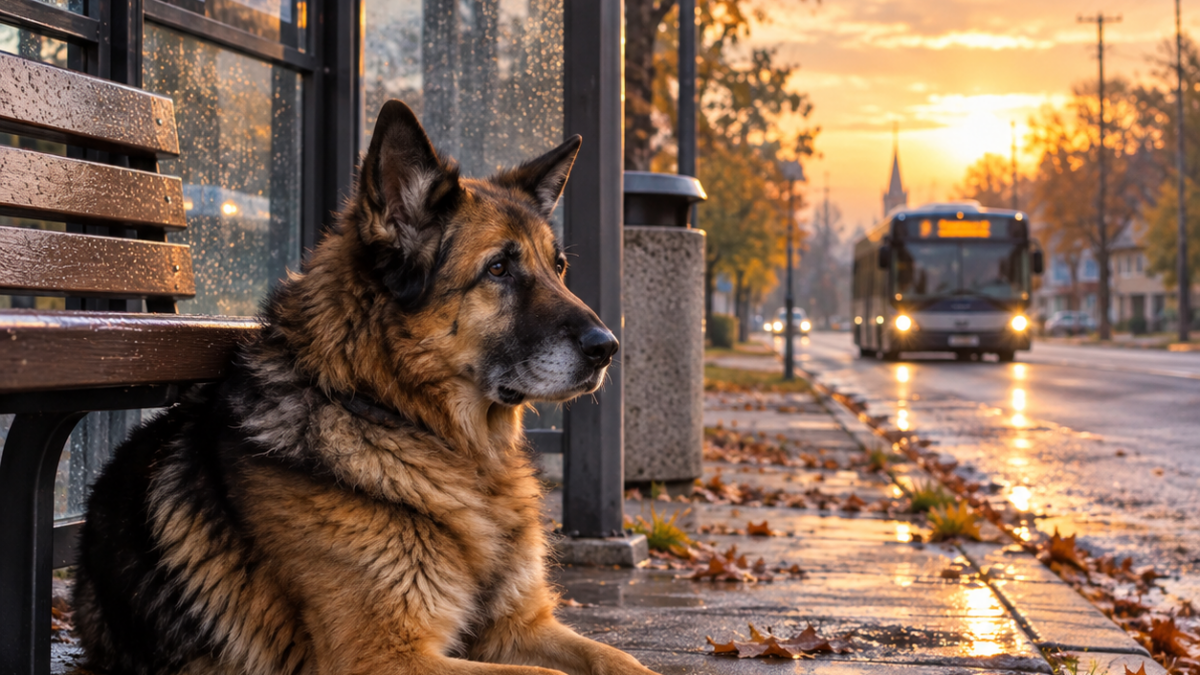
Every morning at exactly 6:15, the old German Shepherd came back to the same bus stop and waited for a man nobody had seen in almost four months.
Rain, frost, snow, hunger—nothing stopped her from crossing the empty street before the first bus arrived and taking her place beside the bench where he used to sit.
The morning I finally followed her after she walked away, I thought I was going to discover where she slept, but within twenty minutes I realized we had all been asking the wrong question about Nicolae’s disappearance.
My name is Elena Popescu, and at the time I worked an early shift at a private clinic on the outskirts of Bucharest.
That was why I knew the dog.
Every weekday, I reached the bus stop around six.
She was almost always there before me.
An elderly German Shepherd with a graying muzzle, stiff back legs, and one torn ear that folded slightly when she looked up at you.
She never begged.
Someone had placed a water bowl near the bench.
The bakery owner across the street sometimes brought sausage.
An older woman once tried to lead her home with a rope.
The dog went perhaps fifty feet before stopping.
She waited until the woman released her.
Then she walked straight back to the bench.
At 6:15, the bus arrived.
The Shepherd stood.
Every single time.
She watched the front door open.
She studied the passengers.
Then the driver closed the doors and pulled away.
Only afterward would the dog lower herself beside the bench again.
Before Nicolae disappeared, everyone knew why she was there.
His name was Nicolae Stoica.
He was in his seventies and had been living rough around the neighborhood for several years.
Some nights he slept in an old sleeping bag behind a row of abandoned garages.
Other nights he disappeared somewhere nobody seemed to know.
We knew he had once served in the military because he still wore an old field jacket with the insignia removed, and one winter morning I saw identification papers when he dropped his wallet.
He almost never asked anyone for money.
If somebody gave him a sandwich, he broke off the first piece for the dog.
If someone offered him a blanket, he wrapped her before himself.
Her name was Zara.
Every morning, they came to the bus stop together.
Nicolae sat on the bench.
Zara lay across his boots.
When the 6:15 arrived, Nicolae sometimes boarded and disappeared into the city for several hours.
Zara stayed behind.
By evening, they were together again.
Then one Monday, Nicolae vanished.
At first nobody panicked.
A man without a permanent address can disappear for a few days without attracting much attention.
A week passed.
Then two.
The bakery owner called hospitals.
One of the regular commuters contacted the police.
Someone checked the shelters.
Nothing.
But every morning Zara returned.
Six fifteen.
Always.
By January, almost four months had passed.
She had become thinner.
Slower.
But still she came.
Then one freezing Tuesday morning, something changed.
The bus arrived.
Zara stood.
The doors opened.
She searched the faces.
The bus left.
Normally she would lie down again.
Instead, she remained standing.
Her nose lifted.
Then she turned away from the bench and started walking.
I do not know why I followed her.
Perhaps because I had watched that dog wait longer for one person than many people wait for anything.
Perhaps because Nicolae had once given me his own umbrella during a thunderstorm while he stood in the rain.
Or perhaps I was simply tired of everyone saying, “There’s nothing more we can do.”
Zara crossed three streets.
I stayed about thirty feet behind her.
She passed a repair shop, an empty warehouse, and a row of garages covered in rust.
Then she turned onto an overgrown lot.
At the far end stood a tiny wooden structure I had never noticed before.
Half shack.
Half abandoned workshop.
One window was boarded.
The roof sagged in the middle.
Zara stopped at the door.
For several seconds, she simply stared at it.
Then she looked back at me.
“Is this where he lived?” I whispered.
She pushed her nose beneath the door.
Whined.
Then moved to the side of the porch.
She began scratching at a loose wooden plank.
Once.
Twice.
Again.
I crouched beside her and pulled at the board.
It shifted.
Something underneath reflected the gray morning light.
Metal.
Zara started whining harder.
I reached into the narrow space beneath the porch and closed my fingers around the handle of a small rusted box.
And when I dragged it into the light, I saw a name scratched across the lid.
NICOLAE STOICA.
PART 2
For a few seconds, I simply stared at the name.
Zara pressed against my shoulder.
The box was about the size of an old lunch tin, rusted along the corners and secured by a tiny brass latch that had already broken.
I should have called the police before opening it.
I know that now.
At the time, I was cold, nervous, and standing beside a dog who had spent four months trying to tell everyone that the man she loved had not simply wandered away.
I lifted the lid.
There was no money inside.
No jewelry.
No weapon.
The first thing I saw was a photograph.
It showed Nicolae perhaps thirty years younger.
He was wearing a military uniform, standing between four other men in front of an armored vehicle.
He had one hand on the shoulder of a much younger soldier.
On the back, written in faded blue ink, were five names.
Beneath them, Nicolae had written:
Bosnia, 1996. We brought everyone home.
I swallowed.
Under the photograph was a military identification booklet, several old medals wrapped in cloth, a folded birth certificate, and an envelope filled with bank statements.
There was also a red folder.
Across the front Nicolae had written one word in black marker.
ADRIAN.
Zara sniffed the folder.
Then she looked toward the shack.
The door was locked, but one of the windows had a broken lower pane covered with cardboard.
I called the police.
Then I called my supervisor and told her I would be late.
For once in my life, I did not apologize.
The officers arrived twenty-five minutes later.
One was a young man I had seen near the bus stop before.
The other was a woman named Inspector Cristina Marinescu.
She crouched immediately when she saw Zara.
“This is the dog?”
“Yes.”
“The one from the missing-person report?”
“Yes.”
Cristina looked at the box.
“You opened it?”
“I did.”
She gave me the expression police officers reserve for civilians who have made their jobs more complicated.
Then she sighed.
“Don’t touch anything else.”
“I won’t.”
Zara walked to the shack door again.
Cristina followed.
There was no sign of forced entry.
A neighbor from the repair yard eventually told us Nicolae had used the structure for years with permission from the previous landowner.
It had once been a guard hut.
When the property was abandoned, nobody bothered him.
The police obtained permission to enter.
The inside was cleaner than I expected.
A narrow cot.
Two blankets.
A camping stove.
Dog food in a plastic container.
A shelf of books.
A photograph of a woman who must have been Nicolae’s wife.
And beside the bed, two stainless steel bowls.
One for him.
One for Zara.
The most disturbing part was not what we found.
It was what we did not.
Nicolae’s heavy winter coat was there.
So were his spare boots.
His shaving kit.
A half-used bag of coffee.
A bottle of medication.
The tiny things people take when they intend to be gone were untouched.
On the table sat a calendar.
September 18 had been circled.
Next to it, Nicolae had written:
6:15 bus.
Legal office.
Bring statements.
Tell them everything.
Inspector Marinescu opened the red folder.
The papers inside changed the case.
For more than eighteen months, money had been disappearing from Nicolae’s military pension account.
The withdrawals were small at first.
Two hundred lei.
Three hundred.
Five hundred.
Then larger transfers began.
Several went to an account belonging to Adrian Stoica.
Nicolae’s nephew.
There were handwritten notes beside some transactions.
I did not authorize.
Bank said PIN used.
Adrian had card when I was sick.
Another page contained the name of an attorney who volunteered with a veterans’ legal assistance program.
Nicolae had an appointment at seven o’clock on the morning he disappeared.
He had planned to take the 6:15 bus.
That was why Zara kept returning at exactly that time.
I felt the realization move through me like cold water.
For four months, we thought Zara was waiting for Nicolae to come back.
Perhaps she was.
But she was also returning to the last routine she remembered.
The morning he was supposed to leave and return.
Cristina asked whether anyone knew Adrian.
The mechanic next door did.
“Nice car,” he said immediately.
That was almost all he knew.
Adrian visited Nicolae occasionally.
Usually after pension day.
They argued.
Once, the mechanic heard Nicolae shouting:
“You already took enough.”
When asked why he had never mentioned it before, the man looked ashamed.
“I thought it was family business.”
That sentence would stay with me.
Family business.
Two words capable of hiding an extraordinary amount of cruelty.
The police found Adrian that afternoon.
He lived less than fifteen miles away in a new apartment complex.
He drove a black SUV.
He owned a small logistics company.
And according to him, he had not seen Nicolae for nearly six months.
That was the first lie.
Phone records eventually proved they had spoken repeatedly during the week Nicolae disappeared.
Adrian changed his story.
Yes, they had spoken.
But only because Nicolae kept calling to complain about money.
Then investigators found a text sent from Nicolae’s phone two days before he vanished.
I know what you did. I’m meeting someone Tuesday. After that, you won’t be able to call me confused anymore.
Adrian claimed he had never seen the message.
Another lie.
His phone showed it had been opened thirty-two seconds after delivery.
Still, none of that told us where Nicolae was.
Days passed.
Then weeks.
Zara stayed with me temporarily because animal services did not want to place an elderly dog in a crowded shelter.
Temporary became a dangerous word.
The first night, she slept beside my front door.
The second night too.
On the third, she moved to the hallway.
By the end of the week, she was sleeping beside my bed.
But every morning before six, she woke.
She walked to the front door.
And waited.
I began taking her to the bus stop.
At 6:15, she stood.
Every morning.
Sometimes I hated it.
Because the ritual felt like watching hope injure her one day at a time.
“Zara,” I told her once as the bus pulled away, “he isn’t on it.”
She looked at me.
“I’m sorry.”
Her ears dropped.
Then she walked back to the bench.
One morning, the bus driver stepped down.
His name was Sorin.
He had driven that route for years.
“You’re the woman with Nicolae’s dog?”
“Yes.”
He looked at Zara.
“She still comes.”
“Every day.”
Sorin crouched and let her smell his hand.
“She used to chase my bus for half the block when Nicolae got on.”
“You remember the last day?”
He became quiet.
“I remember the morning before.”
“Why?”
“Because Nicolae asked me something strange.”
“What?”
“He asked whether there were cameras inside the bus.”
My heart began pounding.
“Why?”
“He said he might need proof that he was somewhere at a certain time.”
“Did he say why?”
“No.”
Sorin stood.
“But there was something else.”
“What?”
“The day he disappeared, I saw him.”
I froze.
“You did?”
“Not at the stop.”
“Where?”
“About twenty minutes later.”
Sorin pointed south.
“Near the old freight road.”
That made no sense.
The 6:15 bus traveled north toward the city center.
“What was he doing there?”
“I don’t know. I was driving the return loop.”
“Was he alone?”
Sorin frowned.
“No.”
My stomach tightened.
“Who was with him?”
“I didn’t see the person clearly.”
“Man or woman?”
“Man.”
“Car?”
“A black SUV.”
I stared at him.
“Are you certain?”
Sorin’s face changed as he understood why I was asking.
“I thought somebody had picked him up.”
“Did he look okay?”
He hesitated.
“No.”
That one word changed the investigation.
“What do you remember?”
“Nicolae was beside the passenger door.”
“Standing?”
“Leaning.”
“Could he have been injured?”
“Maybe.”
“Did you see the driver?”
“No.”
“License plate?”
“No.”
Sorin looked sick.
“I should have stopped.”
“You didn’t know.”
“I knew him.”
“You saw him for maybe three seconds from a moving bus.”
“I still should have stopped.”
Inspector Marinescu interviewed Sorin that afternoon.
The freight road became the new center of the search.
Police checked traffic cameras.
Most recordings had been overwritten months earlier.
A gas station had kept only sixty days.
A warehouse had gone out of business.
Then someone remembered a private recycling facility.
It used cameras for insurance purposes.
The owner kept one year of recordings on an off-site server.
At 6:34 on September 18, a black SUV entered the freight road.
At 6:41, it appeared again traveling the opposite direction.
The plate was difficult to read.
But investigators enhanced enough frames to identify the make, model, and a partial registration.
It matched Adrian’s vehicle.
Adrian’s attorney said coincidence.
Adrian operated a logistics company.
His vehicles traveled industrial roads all the time.
Except GPS records from the company showed that SUV had been officially assigned to Adrian that morning.
And his phone disconnected from the mobile network for forty-three minutes beginning at 6:21.
When investigators asked why, he said the battery died.
His phone records showed it had been charged to eighty-three percent fifteen minutes earlier.
Another lie.
But a liar is not automatically a kidnapper.
Police still needed Nicolae.
Winter deepened.
Christmas came.
I bought Zara a thick red blanket.
She refused to sleep on it for three days.
Then one night I found her curled in the middle of it.
I took a photograph.
I almost sent it to nobody.
Then I remembered the papers in Nicolae’s box.
There was a phone number beside the name of a woman.
Maria Stoica.
I asked Cristina about her.
“Nicolae’s sister.”
“Alive?”
“Yes.”
“Does she know?”
“She lives near Constanța. Officers contacted her.”
“Why hasn’t she come?”
Cristina looked uncomfortable.
“They haven’t spoken in thirteen years.”
“Why?”
“Family dispute.”
“What kind?”
“Adrian.”
Maria was Adrian’s mother.
That complicated everything.
Two days later, she called me.
I do not know how she got my number.
“Elena?”
“Yes.”
“I’m Nicolae’s sister.”
Her voice sounded older than I expected.
“Is Zara really with you?”
“Yes.”
“Is she safe?”
“Very.”
Maria began crying.
I waited.
Eventually she said, “Nicolae loved that dog more than he loved most people.”
“I noticed.”
“He had reason.”
There was bitterness in her voice.
“Why did you and Nicolae stop speaking?”
Silence.
“Mrs. Stoica?”
“Because I believed my son.”
“About what?”
“That Nicolae was losing his mind.”
My grip tightened around the phone.
“Was he?”
“No.”
The answer came immediately.
“I know that now.”
Maria explained.
Years earlier, Nicolae had allowed Adrian to help manage some paperwork.
Taxes.
Pension documents.
A bank account.
Adrian was younger and good with computers.
At first there were no problems.
Then Nicolae began accusing Adrian of taking money.
Maria defended her son.
Nicolae became furious.
He stopped attending family gatherings.
Maria assumed pride had taken over.
Years passed.
Then three months before Nicolae disappeared, he called her.
“He said Adrian was stealing again.”
“What did you say?”
“I told him he was paranoid.”
Her voice broke.
“I told my own brother that.”
“Did he have proof?”
“He said he did.”
“And you didn’t ask to see it?”
“No.”
The word was barely audible.
Then Maria told me something nobody else knew.
Nicolae had not always been homeless.
He had owned an apartment with his wife, Daniela.
After she died, Nicolae sold it.
Most of the money went into savings.
He planned to buy a small place outside the city.
Adrian offered to help.
The property deal collapsed.
A large portion of the money disappeared.
Adrian claimed Nicolae had authorized investments that lost value.
Nicolae said he had not.
“Why didn’t he go to police?”
“He was ashamed.”
“Of what?”
“Trusting family.”
I understood that better than Maria probably realized.
People often imagine victims stay silent because they are weak.
Sometimes they stay silent because betrayal is humiliating.
It forces you to admit that the person you defended, fed, trusted, or loved knew exactly how to use that trust against you.
Maria came to Bucharest two days later.
Zara recognized her.
Not the way she would later react to Nicolae.
But enough.
She sniffed Maria’s coat and wagged slowly.
Maria dropped to her knees.
“I’m sorry.”
She said it to the dog.
Then she said it again.
“I’m so sorry.”
I stood in my kitchen pretending to make tea.
Maria looked at Zara’s gray muzzle.
“Nicolae got her from a military friend.”
“When?”
“Eight years ago.”
“She was already grown?”
“Yes. The friend was sick and couldn’t keep her.”
Maria smiled.
“She destroyed Nicolae’s sofa the first week.”
“That sounds unlike her.”
“It was a very ugly sofa.”
We both laughed.
Then Maria became serious.
“He used to say Zara saved him.”
“From what?”
“Being alone.”
Daniela had died two years earlier.
Nicolae stopped seeing friends.
Stopped shaving.
Stopped answering calls.
Then Zara arrived.
Suddenly he had to walk.
Buy food.
Keep a routine.
Talk to neighbors.
“She gave him somewhere to be every morning,” Maria said.
I looked toward the hallway.
At 5:50 the next morning, Zara was waiting beside the door.
Somewhere to be.
Maybe that is all some of us need to survive certain years.
A place.
A routine.
Someone expecting us.
The investigation stalled in January.
Police knew Adrian had lied.
They knew he had taken money.
They could pursue the financial crimes.
But there was still no proof he had physically harmed Nicolae.
No body.
No confirmed hospital admission.
No eyewitness who saw violence.
Then Inspector Marinescu did something simple.
She widened the hospital search.
The original missing-person inquiry had focused mostly on Bucharest and nearby emergency rooms.
Cristina searched admissions from the morning Nicolae vanished through facilities along every road connected to the freight district.
She also checked patients admitted without identification.
There were dozens.
Most were quickly identified.
One was not.
Male.
Approximately seventy.
Found unconscious beside a rural road forty-eight miles from Bucharest.
September 18.
7:52 a.m.
No wallet.
No phone.
Severe head injury.
Broken wrist.
Bruising along one side of his body.
Transferred after stabilization to a neurological rehabilitation hospital in Ploiești.
Listed internally as Unknown Male 47.
He had regained consciousness.
But there were complications.
Memory problems.
Difficulty speaking.
Confusion.
He could not provide a reliable name or address.
I was standing in my kitchen when Cristina called.
My coffee slipped from my hand.
The cup broke.
Zara jumped.
“Say that again.”
“There’s a patient.”
“Is it him?”
“We don’t know.”
“You have a photograph?”
“Older intake image. Similar age. Similar build.”
“Send it.”
“I can’t send confidential medical—”
“Cristina.”
“Elena.”
“I have had this man’s dog staring at a bus every morning for four months.”
“I know.”
“Is it him?”
A pause.
“We’re going now.”
“I’m coming.”
“You are not part of the investigation.”
“Then I’ll drive behind you.”
“You don’t even know where—”
“Cristina.”
She sighed.
“You are exhausting.”
“So I’ve been told.”
“Bring Maria.”
“What about Zara?”
“No.”
That surprised me.
“Why?”
“We don’t know what condition he’s in.”
I looked at the dog.
She was watching me.
“I’m bringing Zara.”
“Elena—”
“If it isn’t Nicolae, she stays in the car.”
Cristina was silent.
Then:
“Fine.”
The drive felt endless.
Maria sat beside me.
Zara was in the back seat.
Normally she hated long drives.
That morning she remained standing for almost the entire trip, nose between the front seats.
The rehabilitation hospital was a low concrete building surrounded by bare trees.
A physician met us inside.
Police showed documents and photographs.
The doctor looked at Nicolae’s military photo.
Then at the recent image Cristina carried.
“I think it may be him.”
Maria gripped my arm.
“Can I see him?”
The doctor hesitated.
“He may not recognize you.”
“I understand.”
“He has periods of clarity and confusion.”
“I understand.”
“He becomes agitated when asked about his identity.”
“Please.”
The doctor led Maria and Cristina down the corridor.
I remained near reception with Zara.
She paced.
Five minutes.
Ten.
Fifteen.
Then Maria came back.
Her face was covered in tears.
“It’s him.”
I closed my eyes.
“Oh, thank God.”
“He didn’t know my name.”
My relief broke slightly.
“But it’s him?”
“Yes.”
She nodded hard.
“The scar on his hand. His shoulder. It’s Nicolae.”
Zara began whining.
She had not seen him.
She had not smelled him yet.
But she heard Maria crying.
The doctor approached.
“Is that his dog?”
“Yes.”
“Animals normally aren’t permitted.”
I looked at him.
He looked at Zara.
Then Maria said, “She waited one hundred and twenty-seven mornings for him.”
The doctor’s expression changed.
“One minute.”
He walked away.
When he returned, he opened a side door.
“Keep her close.”
I could barely hold the leash.
Zara entered the corridor.
At first she walked beside me.
Then her nose lifted.
She stopped.
Every muscle in her body became rigid.
Her ears rose.
She pulled.
“Easy.”
She pulled harder.
A sound came from her throat.
Not barking.
Not whining.
Something deeper.
She knew.
Before any door opened.
Before she saw him.
She knew.
At the end of the hall, an orderly pushed a wheelchair from a room.
The man in it was thinner than Nicolae had been.
His hair had been cut short.
His face looked older.
One wrist rested awkwardly against his lap.
He stared toward the floor.
Zara froze.
The leash went slack.
For half a second, she did nothing.
Then Nicolae lifted his head.
His eyes found her.
He whispered one word.
“Zara.”
The leash burned through my fingers.
She ran.
The sound that came from that dog filled the hallway.
She hit the wheelchair so hard the orderly had to steady it.
Zara pushed her entire body against Nicolae’s legs.
Whining.
Crying.
Scratching gently at his knees.
Trying to climb into him.
Nicolae bent forward.
His hands shook.
“Zara.”
She licked his face.
His forehead.
His hands.
He buried both hands in the fur around her neck.
And then this man who had survived war, homelessness, betrayal, a head injury, and four months without knowing his own name began sobbing into his dog’s coat.
“I’m sorry.”
Zara’s tail struck the wheelchair.
“I’m sorry, girl.”
Everyone in the corridor stopped.
Nurses.
Patients.
An orderly carrying towels.
Cristina turned away.
Maria covered her mouth.
I cried openly.
I did not care.
Nicolae kept saying the same thing.
“I came back.”
Zara would not let go of him.
Neither did he.
That reunion did more than return Nicolae’s name.
It returned pieces of his memory.
Not instantly.
Life is not a movie.
He did not touch Zara and suddenly remember every detail.
But doctors noticed the difference within hours.
He remembered the bus stop.
His shack.
The bakery.
Sorin.
He remembered Maria slowly.
He remembered me only after I told him about the umbrella.
“You kept it?” he asked.
“No.”
“Then how do I know you’re telling the truth?”
For the first time, I heard the dry humor everyone had described.
I laughed.
“You sound healthy enough to leave.”
He smiled.
Then his expression changed.
“Adrian.”
Cristina, who was sitting nearby, leaned forward.
“What about Adrian?”
Nicolae’s hand tightened in Zara’s fur.
“He knew.”
“Knew what?”
“That I was going.”
“To the lawyer?”
He nodded.
“What happened that morning?”
Nicolae closed his eyes.
The doctor warned us not to push.
Cristina stopped questioning.
Over the following weeks, his memory returned in fragments.
Enough to reconstruct the morning.
Nicolae arrived at the bus stop before six.
Zara was with him.
He carried the red folder inside his jacket.
At approximately 6:10, Adrian arrived in his SUV.
He told Nicolae Maria had been injured.
Nicolae did not believe him.
They argued.
Adrian said he wanted to “fix everything” before lawyers became involved.
Nicolae refused.
The 6:15 bus approached.
Adrian grabbed the folder.
Nicolae grabbed it back.
Zara barked and lunged between them.
Adrian opened the rear door of his SUV and threw a piece of food across the street.
Zara followed it only far enough to lose sight of Nicolae for several seconds.
In that time, Adrian forced Nicolae into the passenger seat.
Not with a gun.
Not through some elaborate kidnapping.
With a lie.
“Your sister needs you.”
Nicolae entered because there was still enough love between him and Maria for fear to overcome suspicion.
Once inside, Adrian drove south.
Nicolae realized quickly they were not going toward Maria.
He demanded Adrian stop.
Adrian refused.
They argued.
Near the freight road, Nicolae tried to open the passenger door.
Adrian stopped the vehicle.
Both men got out.
Sorin saw them there.
Nicolae demanded his phone.
Adrian told him to withdraw the complaint and sign documents stating that previous transfers had been gifts.
Nicolae refused.
“He said I was destroying his life,” Nicolae told Cristina.
“What did you say?”
“I told him he had done that himself.”
Then Adrian shoved him.
Nicolae fell backward against the edge of a concrete drainage barrier.
He remembered pain.
Then nothing.
Adrian later admitted he panicked.
But his panic lasted long enough for him to make several deliberate decisions.
He took Nicolae’s wallet.
His phone.
The red folder.
He placed Nicolae into the SUV.
Then drove nearly fifty miles.
Not to the closest emergency room.
Not to a police station.
Not to an ambulance center.
He left him beside a rural road near a medical clinic.
A delivery driver found Nicolae twenty minutes later.
Adrian believed leaving him near medical help would protect him from the worst charge if Nicolae died.
At the same time, removing the identification would make it difficult for Nicolae to be connected to the missing-person report.
He was correct.
For four months.
But he forgot about Zara.
Dogs do not understand bank fraud.
They do not understand missing-person databases.
They do not understand why one hospital fails to connect an unidentified patient with a homeless veteran reported missing in another district.
They understand routine.
Scent.
Loyalty.
Where someone is supposed to be.
Every morning at 6:15, Zara went back to the last place where Nicolae’s ordinary life still made sense.
And eventually somebody followed her.
Adrian was arrested three days after Nicolae gave a formal statement.
His attorney immediately attacked Nicolae’s memory.
Head injury.
Age.
Months of confusion.
Unreliable witness.
That might have worked if Nicolae’s testimony had been the only evidence.
It was not.
The bank records existed.
The messages existed.
The red folder existed because Nicolae had hidden copies in the metal box before leaving.
The recycling facility camera placed Adrian’s SUV on the freight road.
Sorin placed Nicolae beside a black SUV.
The hospital documented injuries consistent with a fall against concrete.
Most damaging of all, investigators recovered old location data from Adrian’s vehicle navigation system.
At 7:31 that morning, the SUV had traveled along the exact rural road where Nicolae was found.
Adrian’s defense changed.
He admitted Nicolae had been in the car.
But now he claimed Nicolae had fallen accidentally.
Then why take the wallet?
No answer.
Why take the phone?
He said he forgot they were in the vehicle.
Why lie about seeing him for six months?
Panic.
Why tell Maria that Nicolae had probably left town voluntarily?
Concern.
Why access Nicolae’s bank account two days after the disappearance?
Another misunderstanding.
There is a point at which excuses stop creating doubt and start building a pattern.
Cristina called it “the staircase.”
“One lie is one step,” she told me. “Eventually he builds the staircase we use to climb directly to the truth.”
Nicolae spent another six weeks in rehabilitation.
Zara visited four times a week.
On days she could not go, she became restless.
On visiting days, she somehow knew before I touched the leash.
The first time Nicolae stood with a walker, Zara remained beside his left leg.
He took three steps.
Stopped.
Took another.
Zara matched every one.
“Look at her,” he muttered.
“What?”
“She thinks I’m old.”
“You are old.”
He glared at me.
“You’re older.”
“Which means I’m allowed to say it.”
We became friends that way.
Not through dramatic conversations.
Through irritation.
Coffee.
Bus schedules.
Veterinary appointments.
Arguments about whether he was following his doctor’s instructions.
When he learned I had paid for Zara’s medication, he became furious.
“I’ll repay you.”
“No.”
“I will.”
“No.”
“I have a pension.”
“That everyone except you seems to have used.”
He stared at me.
Then laughed so loudly a nurse came in.
The laughter felt like victory.
Maria visited every weekend.
Repairing their relationship was harder.
Nicolae forgave her faster than she forgave herself.
One afternoon I found them arguing quietly in the hospital garden.
“You should hate me,” Maria said.
“I don’t have enough years left to waste them hating my sister.”
“You warned me.”
“I also called you stubborn.”
“You were right.”
“That doesn’t make you evil.”
“You were sleeping outside because of my son.”
Nicolae looked toward Zara.
“No. I was sleeping outside because I was too proud to ask for help.”
“Adrian stole your money.”
“Yes.”
“You lost the apartment.”
“Yes.”
“And I believed him.”
Nicolae reached for her hand.
“Then believe me now.”
Maria cried.
“What?”
“When I tell you I want my sister back.”
That was Nicolae.
I began understanding why Zara had waited.
By the time he was discharged, the abandoned shack was no longer an option.
The land had been sold.
The structure was scheduled for demolition.
Maria asked Nicolae to live with her.
He refused.
Élena? Wait narrator Elena. Need not repeat.
I offered my spare room.
He refused even faster.
“I lived alone before you knew me.”
“You lived in a wooden box behind garages.”
“It had excellent ventilation.”
“It had a hole in the roof.”
“Natural lighting.”
Eventually, a veterans’ organization Cristina contacted arranged a small subsidized apartment on the ground floor of an older building.
The first question Nicolae asked was not about rent.
“Dogs?”
“Yes.”
“Large dogs?”
“Yes.”
“Old difficult dogs?”
The caseworker looked at Zara.
“She seems polite.”
“You don’t know her.”
Zara moved in before Nicolae did.
We carried her blanket.
Her bowls.
A cheap bed I had bought.
Nicolae’s military photograph went onto a shelf.
The rusted metal box stayed under his bed.
He refused to throw it away.
“Why keep that ugly thing?”
“Because it worked.”
“So would a filing cabinet.”
“A filing cabinet would not fit under a porch.”
I stopped arguing.
On Nicolae’s first morning in the apartment, I arrived at 6:05.
He was already dressed.
Zara stood beside the door.
“Where are you going?”
“The bus stop.”
I stared at him.
“You just got home.”
“I know.”
“You spent months learning to walk again.”
“I know.”
“And your first idea is to go stand in the cold?”
“Yes.”
I sighed.
“You are impossible.”
“That is what Zara says.”
We walked slowly.
Nicolae used a cane.
Zara stayed beside him.
At 6:13, we reached the bench.
The bakery owner saw us through the window.
He dropped whatever he was holding.
Then ran outside.
“Nicolae?”
Within minutes, people began gathering.
Commuters who had watched Zara wait.
Sorin stepped down from the bus when he arrived.
He stared at Nicolae.
Then hugged him.
Nicolae stiffened.
“Careful. I’m fragile.”
“You always were.”
“That is slander.”
People laughed.
Some cried.
Someone brought coffee.
The bakery owner gave Zara an entire sausage before I could stop him.
At exactly 6:15, the bus doors opened.
For one strange second, everyone became quiet.
Zara stood beside Nicolae.
She looked at the bus.
Then at him.
The ritual was still there.
But this time Nicolae did not board.
He lowered himself onto the bench.
Zara lay across his shoes.
He scratched behind her ear.
“Not today, girl.”
The doors closed.
The bus pulled away.
Zara did not watch it.
She kept her eyes on Nicolae.
I wish I could say that was the end.
It was only the beginning of the part Nicolae feared most.
Court.
Adrian’s trial began nine months later.
By then, the financial investigation had uncovered more than anyone expected.
He had taken money from Nicolae for years.
Not millions.
There was no dramatic fortune.
That almost made it worse.
Pension deposits.
Savings.
Small transfers.
Emergency funds.
Money accumulated by a man who had spent decades working and serving.
Adrian stole it a little at a time because he assumed nobody cared enough about a homeless old veteran to notice.
He used some to cover business debts.
Some for car payments.
Some for vacations.
He had even used Nicolae’s bank card to pay for dinner on Nicolae’s birthday.
Maria saw that transaction in court.
She left the room and vomited.
Adrian had another strategy by then.
He blamed Nicolae.
He described him as unstable.
Difficult.
Paranoid.
He said Nicolae chose homelessness despite family efforts.
Some of that contained pieces of truth.
Nicolae was proud.
He did refuse help.
He could be difficult.
Truth becomes dangerous when somebody uses one accurate detail to support ten lies.
Adrian’s attorney asked Nicolae:
“You had disagreements with your family, correct?”
“Yes.”
“You stopped speaking with your sister?”
“Yes.”
“You sometimes slept outdoors even when shelter beds were available?”
“Yes.”
“You distrusted banks?”
“After your client stole from me, yes.”
The judge warned Nicolae to answer only the question.
I almost laughed.
Adrian’s attorney continued.
“Isn’t it possible you willingly gave your nephew access to those funds?”
“I gave him access to help pay bills.”
“So he was authorized.”
“To pay bills.”
“What was he not authorized to do?”
Nicolae looked directly at Adrian.
“Buy himself a car.”
A few people in the courtroom shifted.
The attorney continued.
“You accused my client of stealing before you had proof.”
“No.”
“You didn’t?”
“I had proof before I accused him.”
That answer landed better than any dramatic speech.
Then came September 18.
Adrian’s attorney suggested Nicolae had voluntarily entered the SUV.
“Yes,” Nicolae said.
“So my client did not kidnap you.”
“I got in because he told me my sister was hurt.”
“Did he physically force you into the vehicle?”
“No.”
“Then you entered voluntarily.”
“Yes.”
“And later you exited voluntarily?”
Nicolae stared at him.
“I tried.”
“What happened?”
“Your client shoved me into concrete.”
Adrian’s attorney changed direction.
“No independent witness saw a shove.”
“No.”
“You suffered a head injury.”
“Yes.”
“You had memory loss.”
“Yes.”
“Isn’t it possible you fell?”
Nicolae became very still.
“It is possible.”
I felt everyone tense.
The lawyer seemed encouraged.
“Then you cannot state with certainty that Adrian pushed you.”
Nicolae waited.
Then said, “I can state with certainty what happened immediately before I fell.”
“And what was that?”
“I told him I was going to the police.”
“And?”
“He said, ‘Then you’ll be dead before they hear you.’”
Adrian’s face changed.
Only slightly.
But Maria saw it.
So did I.
The prosecutor later introduced evidence from Nicolae’s phone backup.
A voice memo.
He had begun recording before entering Adrian’s vehicle.
Apparently Sorin’s comment about cameras had given him the idea.
The recording lasted seven minutes.
Most of it was road noise.
Then Adrian’s voice.
Give me the folder.
Nicolae:
No.
Adrian:
You think they’re going to believe a man sleeping behind garages?
Nicolae:
They don’t have to believe me. They have statements.
Adrian:
You’ll destroy everything.
Nicolae:
You destroyed it.
Then the recording became chaotic.
A door.
Wind.
Footsteps.
Nicolae saying:
Give me my phone.
Adrian:
Sign the papers.
No.
Sign them and this ends.
No.
Then:
You go to police and I swear you’ll regret it.
A scraping sound.
Nicolae:
Get your hands off—
The recording ended.
Adrian’s attorney argued it proved no shove.
He was correct.
It did not prove the physical act.
But combined with everything else, it proved motive.
Threats.
Presence.
Deception.
And a confrontation Adrian had denied for months.
Then came the most painful witness.
Maria.
She testified against her own son.
Before taking the stand, she sat beside me in the hallway.
“I don’t know if I can do this.”
“You can.”
“He’s my child.”
“I know.”
“What kind of mother helps send her son to prison?”
I looked at her.
“What kind of sister lets her brother be erased because the person responsible shares her blood?”
She closed her eyes.
“That was cruel.”
“Yes.”
“Thank you.”
When Maria took the stand, Adrian would not look at her.
She told the truth.
About the warnings.
About defending him.
About Nicolae calling.
About Adrian telling her Nicolae was confused.
About the phone call after Nicolae disappeared.
“What did your son say?” the prosecutor asked.
Maria answered:
“He said, ‘Maybe this is for the best. Uncle Nicky was becoming a problem.’”
The courtroom became silent.
The prosecutor asked, “What did you understand that to mean?”
“At the time?”
“Yes.”
“I thought he meant Nicolae had chosen to leave.”
“And now?”
Adrian’s attorney objected.
Sustained.
Maria looked toward her son anyway.
Her face was not angry.
That made it harder to watch.
It looked broken.
The financial charges were the easiest to prove.
The assault and abandonment required more argument.
In the end, Adrian was convicted of fraud, theft, unlawful use of financial information, coercion, assault causing serious injury, evidence concealment, and abandoning an injured person without obtaining appropriate emergency help.
Not every charge prosecutors initially considered survived.
That is how courts work.
But enough did.
At sentencing, Nicolae was permitted to speak.
Everyone expected anger.
Even me.
He walked slowly to the front with his cane.
Zara was not allowed inside the courtroom, so she waited with a volunteer outside.
Nicolae placed one hand on the lectern.
Then looked at Adrian.
“My nephew thinks the worst thing he took from me was money.”
Adrian stared ahead.
“It wasn’t.”
Nicolae continued.
“Money comes and goes. Houses too. I learned that sleeping outside.”
He glanced toward Maria.
“He took years from my sister and me because he made each of us believe the other had stopped loving us.”
Maria began crying.
“He made me ashamed to ask for help.”
Nicolae paused.
“And on the morning I finally tried to stop him, he took my name.”
Nobody moved.
“For four months, I was a number in a hospital because the person who knew exactly who I was removed everything that could tell people.”
He took a breath.
“But he forgot one thing.”
I knew what was coming.
“Zara knew my name.”
My throat tightened.
Nicolae looked toward the courtroom doors.
“For one hundred and twenty-seven mornings, that dog went back to the same bench because it was the last place where my life still had a schedule.”
He turned toward Adrian.
“You thought nobody would look for a homeless old man.”
Adrian finally raised his eyes.
“You were almost right.”
Nicolae’s voice stayed calm.
“But a dog did.”
Then he stepped away.
That was his revenge.
Not shouting.
Not violence.
Not wishing suffering on Adrian.
Standing in the same room with the man who tried to reduce him to nobody and speaking his own name into the record.
Nicolae Stoica.
Veteran.
Brother.
Friend.
Zara’s person.
Alive.
Adrian received a substantial prison sentence and was ordered to repay what could be traced.
Several of his business assets were seized.
The black SUV was eventually sold as part of restitution proceedings.
When Nicolae learned that, he laughed.
“What?”
I asked.
“That ugly car finally did something useful.”
The recovered money did not make him wealthy.
It did allow him to remain in the veterans’ apartment without worrying about every utility bill.
He also created a small emergency fund through the veterans’ organization.
“What for?” I asked.
“People without addresses.”
“That is very specific.”
“So are problems.”
The fund helped pay for identification replacements, transportation to legal appointments, and temporary animal boarding when homeless veterans entered hospitals.
The last part was Zara’s contribution.
Nicolae insisted.
“No one should avoid a hospital because they’re afraid they’ll lose their dog.”
I thought of the bus stop.
The water bowl.
The sausage.
The old Shepherd lying beside the bench.
He was right.
Two years passed.
Zara became slower.
Her hips stiffened badly in winter.
Nicolae’s walking improved, which created the ridiculous situation of him waiting for her.
“Come on, old lady.”
I would remind him, “She waited four months for you.”
“Yes, and she has mentioned it every day since.”
Zara looked at him.
“See?”
I laughed.
Every few weeks, we still met at the old bus stop at 6:15.
Nobody planned it at first.
It simply happened.
The bakery owner would bring coffee.
Sorin sometimes arranged his break around the route.
Maria came when she visited Bucharest.
People who had once left food for the anonymous dog became friends.
A small brass tag appeared on the bench one spring.
Nobody admitted placing it there.
It read:
SOMEONE IS ALWAYS WORTH LOOKING FOR.
Nicolae hated it.
“Too sentimental.”
I caught him polishing it a week later.
“You hate it?”
“Terrible.”
“Then why are you cleaning it?”
“Because whoever installed it did a bad job.”
Of course.
That was Nicolae.
Zara died three winters after he came home.
She was nearly fourteen.
Her decline was gradual.
More sleeping.
Less appetite.
Longer pauses before standing.
One Sunday morning, she could not get up.
Nicolae called me before sunrise.
“Elena.”
I knew immediately.
“I’m coming.”
When I arrived, Zara was lying on her red blanket.
The same blanket she had refused when she first came to my apartment.
Nicolae sat on the floor beside her.
His back against the wall.
One hand resting on her ribs.
“She waited until today,” he whispered.
“For what?”
He looked at the clock.
6:08.
I understood.
We carried her carefully to my car.
The veterinary clinic had an emergency entrance.
The veterinarian examined her.
Cancer.
Internal bleeding.
Very little could be done without causing more suffering.
Nicolae listened.
Then asked:
“Can I stay?”
“Of course.”
I stood near the door.
He looked at me.
“You too.”
So I stayed.
At 6:15, his phone alarm sounded.
He had never disabled it.
For years, the alarm had reminded him of medications.
Before that, it reminded him to catch the bus.
Zara’s eyes opened.
Nicolae smiled through tears.
“You hear that?”
Her ear moved.
“It’s the bus.”
He lowered his forehead against hers.
“You don’t have to wait today.”
Her breathing slowed.
“I’m here.”
He repeated it.
“I’m right here.”
Zara died with his hand around the old leather collar she had worn before I met her.
The veterinarian had replaced it years earlier because it was cracked.
Nicolae had kept it in a drawer.
That morning, he put it beside her.
He cried without embarrassment.
So did I.
The man who once disappeared without a name now had enough people around him that there was no possibility of disappearing again.
Zara was cremated.
Nicolae kept her ashes for several months.
Then one morning he called me.
“Six fifteen tomorrow.”
“You want coffee?”
“No.”
“What are we doing?”
“You’ll see.”
I should have known better than to expect an explanation.
The next morning, we met at the bus stop.
Maria was there.
So was Sorin.
The bakery owner.
Inspector Marinescu.
Even the veterans’ caseworker.
Nicolae carried a small wooden box.
We took the 6:15 bus.
For the first time, I understood the route Nicolae had taken before he disappeared.
It ended near a military memorial on the edge of the city.
Behind it was a small wooded area with permission for commemorative plantings.
Nicolae had arranged everything legally.
Of course he had.
Cristina laughed when I expressed surprise.
“He learned paperwork.”
We planted a young linden tree.
Nicolae placed a small amount of Zara’s ashes beneath the roots.
Not all of them.
He kept some.
On a stone near the tree, he placed her identification tag.
Nothing else.
No dramatic inscription.
No speech.
Maria eventually asked, “Aren’t you going to say something?”
Nicolae looked at the tree.
“I already did.”
“When?”
“Every morning for thirteen years.”
We stood quietly.
Then I asked him what he meant.
He shrugged.
“Good morning.”
That was all.
Good morning, Zara.
Every day.
Before cold sidewalks.
Before food.
Before buses.
Before hospitals.
Before courtrooms.
A life can be built from words that small.
On the ride home, Nicolae sat beside the window.
At one stop, an elderly man boarded with a young Labrador.
The dog looked at Nicolae.
Nicolae looked back.
“You’re thinking about another one,” I said.
“No.”
“You are.”
“I’m seventy-eight.”
“So?”
“I am too old.”
“You said the same thing about apartments.”
“That was different.”
“You need supervision.”
He glared at me.
“I have you.”
“Exactly why you need a dog.”
Six months later, a veterans’ shelter called.
A mixed-breed shepherd had been surrendered after her owner entered long-term care.
Seven years old.
Nervous.
Nobody wanted a dog that size.
Nicolae said no.
Then he went to “look.”
He came home with her.
Her name was Luna.
When I laughed, he pointed at me.
“Not one word.”
“I said nothing.”
“You’re thinking loudly.”
Luna never replaced Zara.
That was important.
Living things are not replacements.
They are additions.
Zara remained in every part of Nicolae’s new life.
In the emergency fund.
In the bench.
In the morning alarm.
In the way he checked Luna’s bowl before filling his own plate.
In the fact that when one of the veterans from his building disappeared for two days, Nicolae did not say, “He probably went somewhere.”
He called hospitals.
Shelters.
Police.
He found the man in an emergency clinic before sunset.
“You learned from Zara,” I told him.
“No.”
He smiled.
“She trained me.”
Five years have passed since the morning I followed an old German Shepherd away from a bus stop.
Nicolae is still here.
So am I.
Maria visits twice a month.
Luna has become overweight because Nicolae insists she is “big-boned.”
Cristina was promoted.
Sorin retired from driving buses and complains constantly that retirement is exhausting.
The abandoned garages are gone.
Apartments stand there now.
The little shack was demolished.
Before it disappeared, Nicolae removed one piece of wood.
The loose porch plank.
The one Zara scratched.
He keeps it in his apartment.
I asked him why.
He said:
“That dog spent four months trying to get someone to look under it.”
He mounted the rusted metal box on the wall above the plank.
The red folder is gone.
He burned copies after the case ended.
He said he never wanted Adrian’s name occupying space in his home again.
I understood.
Revenge had finished its job.
Justice had happened.
After that, carrying hatred would only allow Adrian to steal more time.
The black SUV is gone.
The stolen money is mostly gone.
The bruises healed.
The hospital number disappeared from Nicolae’s records once his identity was restored.
But the good things remained.
The bench.
The friends.
The fund.
The apartment.
Maria.
Luna.
And the memory of a German Shepherd who refused to accept that the person she loved had simply vanished.
Sometimes people ask why Zara kept returning to that exact bus stop.
They expect some mysterious explanation.
There wasn’t one.
It was simply where her world had always made sense.
At 6:15, Nicolae sometimes got on a bus.
He always came back.
Until one day he didn’t.
Zara had no police database.
No bank records.
No phone-location history.
She could not understand that the man who fed her before feeding himself was lying unconscious forty-eight miles away without identification.
All she knew was the rule their life had taught her.
Go to the bench.
Wait for Nicolae.
So she did.
In rain.
In frost.
In snow.
When people tried to take her somewhere safer, she returned.
When the bus came, she stood.
When the doors opened, she searched.
And when another morning ended without him, she came back the next day.
For almost four months.
People called it loyalty.
I think it was something even simpler.
Love does not know when everyone else has stopped looking.
That was Zara’s gift.
She did not know enough to give up.
The police had files.
We had assumptions.
Hospitals had an unknown patient.
Adrian had lies.
Zara had one fact.
Nicolae was supposed to be there.
And because she kept insisting on that fact long after the rest of us had adjusted to his absence, one freezing morning I followed her.
She led me past the repair shop.
Across the overgrown lot.
Behind the garages.
To a broken shack.
Then she scratched beneath one loose wooden plank until I reached down and pulled out a rusted metal box.
That box did not contain Nicolae.
But it contained enough of his life to make us search for him as a person instead of a missing homeless man.
That distinction saved him.
I think about it every time I pass the bus stop.
A person can become invisible surprisingly quickly.
Lose an address.
Lose a phone.
Wear the same coat too many winters.
Sleep somewhere respectable people prefer not to look.
Soon strangers stop asking who you are and start describing what you appear to be.
Homeless.
Old.
Difficult.
Lost.
Nicolae had almost been reduced to those words.
Zara never reduced him.
To her, he was simply Nicolae.
The man whose boots she slept across.
The man who gave her the first bite.
The man who wrapped her in blankets.
The man who always returned.
That was enough identity for her.
One morning last winter, Nicolae and I met again at the bench.
6:15.
Old habits.
Luna was beside him.
The bus arrived.
Doors opened.
Passengers stepped off.
Nicolae watched them.
Then he looked at me.
“Do you know what I used to think when Zara waited here?”
“What?”
“That she was wasting her time.”
I smiled.
“You weren’t here to see it.”
“I’ve seen the pictures.”
He looked down the road.
“I thought she should have found somewhere warm. Someone else. A better life.”
“And now?”
He bent to scratch Luna’s ears.
“Now I think she was doing the only thing that made sense.”
“Waiting?”
“No.”
He looked at me.
“Refusing to let me disappear.”
The bus doors closed.
It drove away.
For a few seconds, none of us moved.
Then Nicolae stood.
“Coffee?”
“You’re paying.”
“I’m a pensioner.”
“So am I.”
“You have more money.”
“How do you know?”
“I’ve learned to recognize financial exploitation.”
I laughed so loudly Luna barked.
We walked toward the bakery.
Nobody remained at the bench.
Nobody needed to.
At 6:15 for almost four months, an old German Shepherd had sat there because she believed one man would come back.
In the end, she had been right.
Just not in the way any of us expected.
Nicolae came home because Zara kept waiting long enough for someone else to start looking.
And after everything Adrian tried to take from him—his money, his family, his identity, even the chance that anyone would know where he had gone—the one thing he could never steal was the creature who still knew exactly who Nicolae was.
To Zara, he had never been homeless.
Never been unknown.
Never been a hospital number.
Never been forgotten.
He was simply the man she loved.
And every morning, at exactly 6:15, she made sure the world remembered him too.
The first few weeks after Zara died were harder on Nicolae than he admitted.
He still woke at 5:50 every morning.
Still reached for the leash hanging beside the door.
Still turned toward the kitchen expecting to hear nails against the floor.
The first time I visited after the cremation, I found two bowls beside the wall.
One full.
One empty.
“You know she isn’t coming back for breakfast,” I said.
Nicolae looked at the bowls.
“I know.”
“Then why is that still there?”
He shrugged.
“Because yesterday it was there.”
That answer told me everything.
Grief does not always arrive as tears.
Sometimes it is a bowl nobody has the courage to remove.
Sometimes it is a leash hanging beside the door.
Sometimes it is an old man pretending he forgot to put something away.
I sat across from him.
The apartment felt wrong without Zara.
Too quiet.
For years I had heard her breathing before I noticed any other sound.
Now the refrigerator hummed loudly.
A pipe clicked behind the wall.
Someone upstairs dragged a chair.
Nicolae poured coffee.
Two cups.
Then, without thinking, he opened the cabinet where he kept Zara’s treats.
His hand stopped.
He closed the door.
Neither of us said anything.
Finally, he asked, “Do you think dogs know when they’re dying?”
“I don’t know.”
“She looked at me differently that morning.”
“How?”
“Like she wasn’t worried anymore.”
I thought about the veterinary clinic.
6:15.
The alarm.
Zara lifting one ear.
Nicolae bending over her and saying, You don’t have to wait today.
Maybe he was right.
Maybe she had spent years believing her job was to make sure he came back.
And only at the very end did she understand he was finally safe without her.
Nicolae kept part of her ashes in a simple wooden box.
No decorations.
No engraving.
He placed it beside the photograph from Bosnia.
The photograph where he was young.
Straight-backed.
Strong.
Before Daniela died.
Before the stolen money.
Before the garage.
Before the hospital number.
Before Zara.
I asked why he put them together.
“Because those are two versions of me she never knew.”
“What do you mean?”
“She never knew that soldier.”
He tapped the photograph.
“And she never knew the man before Daniela.”
He looked toward the box.
“She only knew the version who needed her.”
“That may have been the most important version.”
Nicolae smiled slightly.
“You sound like someone who owns greeting cards.”
“I hate greeting cards.”
“So do I.”
We sat there until the coffee went cold.
For months afterward, Nicolae continued waking at 5:50.
At first he went to the bus stop alone.
Then I began joining him again.
No reason.
Just habit.
At exactly 6:15, the bus would arrive.
Doors open.
Doors close.
Then Nicolae would sit another minute.
Sometimes two.
Then stand.
“Ready?”
“For what?”
“Coffee.”
We never discussed Zara there.
Not at first.
The bench already held too much of her.
That changed one cold morning in February.
Snow had fallen overnight.
Not much.
Just enough to make the pavement white.
Nicolae stood looking at the patch beside the bench where Zara used to lie.
“She hated snow.”
“She waited in it.”
“That doesn’t mean she liked it.”
He stared at the ground.
“She was too thin that winter.”
“You didn’t know where she was.”
“I should have.”
“You were unconscious.”
“I still should have.”
I looked at him.
“That makes absolutely no sense.”
“I know.”
“Then stop punishing yourself with it.”
He sat down.
“I remember almost nothing from the first month in the hospital.”
I waited.
“But sometimes I think I remember her.”
“Zara?”
He nodded.
“Not seeing her. Hearing her.”
“Could she have been in your dreams?”
“Maybe.”
“What did you hear?”
“Her collar.”
He looked embarrassed.
“That little metal sound.”
I knew exactly what he meant.
The tags touching when she walked.
A soft clink.
“I would hear it and think I had to wake up.”
He laughed bitterly.
“Then I’d open my eyes and not know who I was.”
I sat beside him.
“But some part of you remembered her.”
“Maybe.”
I looked at the snow.
“And some part of her remembered you.”
He did not answer.
The bus arrived.
Doors opened.
For once, neither of us looked.
A month later, the veterans’ organization contacted him about the shepherd mix who would eventually become Luna.
He said no immediately.
Then again.
Then more aggressively.
“I had one dog.”
The caseworker said, “That is usually how numbers work.”
“I don’t want another.”
“She needs a home.”
“So do hundreds of dogs.”
“She ignores everyone.”
“Smart animal.”
“She followed me only after I said your name.”
That made him stop.
“What?”
“She came from another veteran.”
Nicolae looked at me.
I stayed silent.
The caseworker continued.
“Her owner entered long-term care. He has advanced dementia. He can’t take her back.”
Nicolae’s face softened for half a second.
Then hardened again.
“I’m too old.”
“So is she.”
“How old?”
“Seven.”
“That’s not old.”
“You just called yourself old.”
“I’m seventy-eight.”
“Exactly.”
Nicolae glared at her.
She smiled.
“Just meet the dog.”
“That’s how people get trapped.”
I laughed.
He pointed at me.
“You’re not helping.”
The next day we visited.
Luna was smaller than Zara.
Dark sable coat.
One white patch on the chest.
Nervous eyes.
She sat in the back corner of the kennel while other dogs barked around her.
Nicolae stood outside.
Luna looked at him.
He looked at her.
For almost a minute, neither moved.
Then Nicolae said, “You look miserable.”
Luna’s ears shifted.
“Don’t start.”
She stood.
Walked slowly toward the gate.
Nicolae crouched.
His knees cracked loudly enough for me to hear.
Luna pushed her nose through the bars.
He touched it.
That was all.
Ten minutes later, he was filling out adoption paperwork.
I said nothing until we reached the parking lot.
Then:
“That was a very convincing refusal.”
“Temporary foster.”
“You signed the adoption section.”
“Clerical error.”
“The clerk circled it twice.”
“Overenthusiastic bureaucracy.”
Luna rode home in the back seat.
At the apartment, she stopped beside Zara’s bowls.
Sniffed both.
Then walked away.
Nicolae watched carefully.
That evening, I noticed he had removed the second bowl.
Not Zara’s.
The other one.
He washed it.
Filled it.
Placed it near the wall.
Luna ate.
I understood.
That was when the apartment became a home again.
Not the same home.
A different one.
People often say a new animal “fills the hole” left by an old one.
I never liked that expression.
Nothing fills such a hole.
The shape remains.
You simply build around it.
Luna never waited at 6:15.
She had her own habits.
She barked at motorcycles.
Stole socks.
Hated elevators.
Loved apples.
She slept on the sofa despite being forbidden.
Every time Nicolae caught her, he said:
“Zara never did that.”
I finally told him:
“Zara also destroyed your sofa.”
“That was one time.”
“Maria said it lasted six months.”
“Maria exaggerates.”
Luna raised her head from the sofa.
“See?” I said. “Even she doesn’t believe you.”
Maria became part of Nicolae’s life again in ways neither of them expected.
Their reconciliation had begun during the hospital months.
After the trial, it deepened.
She visited twice a month.
Sometimes more.
They argued constantly.
About salt.
Medication.
Television.
Money.
Whether Nicolae should still carry his own groceries.
Whether Maria should drive at night.
Normal sibling arguments.
Ordinary.
Beautiful.
One afternoon, Maria arrived carrying an old cardboard box.
“What’s that?” Nicolae asked.
“Things from Mama’s apartment.”
“Our mother died twenty years ago.”
“Yes.”
“You kept this for twenty years?”
“I was busy.”
He laughed.
Inside were photographs.
School papers.
Old military letters.
A photograph of Nicolae at seventeen standing beside Maria.
He was thin.
She had braids.
Both looked angry at whoever took the picture.
Maria sat beside him.
“We wasted thirteen years.”
Nicolae stared at the photograph.
“Yes.”
“Because of Adrian.”
“No.”
She looked at him.
“He started it.”
“Yes.”
“But we let it continue.”
Maria’s eyes filled.
“I didn’t believe you.”
“I didn’t forgive you.”
“You should have hated me.”
“I tried.”
He gave a tired smile.
“It was exhausting.”
She laughed through tears.
Then he handed her the photograph.
“Keep this.”
“Why?”
“So next time we fight, you remember we were annoying each other before Adrian was born.”
That became their way forward.
Not pretending the betrayal had never happened.
Not pretending Maria’s choices had caused no damage.
But refusing to give Adrian permanent ownership of their relationship.
The emergency fund Nicolae created grew quietly.
At first it helped three people.
Then eight.
Then fourteen.
A local veterans’ group matched donations.
A veterinarian offered discounted care for animals belonging to homeless veterans.
A legal clinic agreed to help replace stolen identification.
A transportation company donated rides to hospitals.
Nobody named the fund after Zara.
Nicolae refused.
“Too sentimental.”
But everyone called it the Zara Fund anyway.
He pretended not to know.
One winter, a former mechanic named Petru entered the hospital with pneumonia.
He had been sleeping in a shelter with an old terrier named Max.
Petru refused treatment because he believed Max would be taken away permanently.
The hospital social worker called the veterans’ organization.
They called Nicolae.
Within an hour, Max was in temporary foster care.
Petru agreed to stay.
He recovered.
The day he was discharged, Nicolae brought Max to the hospital entrance.
The terrier pulled so hard on the leash that Nicolae nearly fell.
Petru dropped his bag.
Max jumped into his arms.
I watched Nicolae watching them.
His face changed.
Later, I asked:
“That looked familiar.”
He shrugged.
“I don’t know what you mean.”
“You know exactly what I mean.”
He stared out the car window.
“Everyone should get that moment.”
“What moment?”
“The one where something still recognizes you.”
I never forgot that sentence.
Because that had been the deepest wound Adrian inflicted.
Not the money.
Not even the injury.
For four months, Nicolae lived without his own name.
Unknown Male 47.
Nobody in that hospital knew he had served.
Nobody knew Daniela.
Nobody knew Maria.
Nobody knew about the bus stop.
Nobody knew what coffee he drank.
Nobody knew he hated onions.
Nobody knew he laughed at terrible jokes.
He existed without context.
Zara had preserved the context.
She knew the man behind the missing wallet.
That was what the reunion restored.
Not just identity.
Belonging.
Years later, when Nicolae and I talked about the trial, he rarely mentioned Adrian.
That surprised me.
I once asked why.
“I thought the verdict would matter more.”
“It mattered.”
“But?”
He looked toward Luna sleeping near the window.
“I spent too long letting him decide what my life was about.”
He tapped his cane against the floor.
“I don’t want the last chapter to be him.”
“What should it be?”
He considered.
“Something boring.”
I laughed.
“Boring?”
“Yes.”
“Like what?”
“Coffee. Bus stop. Complaining about prices. Maria calling too much.”
“That sounds terrible.”
“Perfect.”
He meant it.
After everything, ordinary life was victory.
The first time he paid a utility bill with money earned from a small consulting job he took through the veterans’ center, he kept the receipt.
I found it on the refrigerator.
“Why is this here?”
“Proof.”
“Of electricity?”
“Of independence.”
The day he bought Luna a new harness, he kept that receipt too.
Then a pharmacy receipt.
Then a grocery receipt.
Within months, the refrigerator looked like the office of a nervous accountant.
I removed three.
He put them back.
“Don’t touch my evidence.”
“That is not evidence.”
“It proves nobody stole this.”
I stopped arguing.
One summer, the city replaced the old bus bench.
Nicolae nearly declared war.
“They’re removing it?”
“It’s rotten,” the worker explained.
“It still works.”
“One leg is broken.”
“So is mine.”
“Sir—”
“I’ve used this bench longer than you’ve worked here.”
The worker looked at me.
“Can you help?”
“No.”
Eventually, the city allowed Nicolae to keep one wooden plank from the bench.
He took it home.
Now his apartment contained a porch plank from the shack, a rusted metal box, and part of a bus bench.
I told him he was becoming a museum.
He said admission was expensive.
The replacement bench was where the brass tag later appeared:
SOMEONE IS ALWAYS WORTH LOOKING FOR.
Nicolae blamed me.
“It wasn’t me.”
“Maria?”
“No.”
“Cristina?”
“No.”
“Sorin?”
“Maybe.”
He polished it anyway.
Every anniversary of the day he was found, we met there at 6:15.
Not to mourn.
Not exactly.
To count.
One year.
Two.
Three.
Each year meant something Adrian had failed to take.
On the fifth anniversary, Nicolae arrived early.
Luna was beside him.
Maria came.
Cristina came.
Sorin.
Petru and Max.
Several people from the veterans’ group.
Even the bakery owner came carrying coffee.
Nicolae hated crowds.
“What is this?”
“Nothing,” Maria said.
“This is clearly something.”
Sorin handed him an envelope.
Inside was a photograph.
Zara at the bus stop.
Snow on her back.
Head raised.
Eyes fixed on the road.
Someone had taken it during the months Nicolae was missing.
He stared at it for a long time.
“I’ve never seen this one.”
“That’s why we gave it to you.”
He ran his thumb along one edge.
“She looks terrible.”
“She looked determined,” I said.
“She was skinny.”
“She was waiting.”
He shook his head.
“That dog.”
Then his eyes filled.
No one spoke.
Finally, he turned the photograph over.
On the back, Maria had written:
She kept your place until you could come back to it.
Nicolae sat on the bench.
Luna placed her head on his knee.
He looked down at her.
“You’re getting sentimental too.”
Luna sighed.
He laughed.
At exactly 6:15, the bus arrived.
The doors opened.
For a few seconds, the scene looked exactly like every morning Zara had waited.
The same curb.
The same route.
The same hiss of the brakes.
But everything else was different.
Nicolae was there.
Maria was there.
Friends were there.
Luna was there.
Zara was not.
And somehow, that absence no longer felt like failure.
It felt like evidence that she had completed what she came to do.
The doors closed.
The bus pulled away.
No one watched it disappear.
Later, after the others left, Nicolae and I remained on the bench.
He held Zara’s photograph.
“You know what still bothers me?”
“What?”
“That she had to wait so long.”
“One hundred and twenty-seven days.”
“I know.”
“You couldn’t come.”
“I know.”
“She didn’t know that.”
“No.”
He looked down.
“I wonder how many mornings she thought, ‘Maybe today.’”
I did not answer immediately.
Then I said, “Probably every one.”
He nodded.
“That hurts.”
“Yes.”
“But maybe that’s why it worked.”
“What do you mean?”
“She never adjusted.”
He looked toward the road.
“We adjusted.”
“To you being missing?”
“Yes.”
“The bakery man thought I left town. Police had other cases. Maria thought I didn’t want her. Everyone found an explanation.”
His thumb moved over the photograph.
“Zara didn’t.”
“She only knew you were missing.”
“She only knew I belonged somewhere.”
I looked at him.
“That is more than some people know about themselves.”
He smiled faintly.
Then he stood.
His movement was slow now.
Older than when I first met him.
Luna stood too.
“Come on.”
“Where?”
“Coffee.”
“We just had coffee.”
“That was social coffee.”
“What is this?”
“Private coffee.”
I rolled my eyes.
We walked toward the bakery.
Halfway there, Nicolae stopped.
He turned back toward the bench.
For a second I thought he had forgotten something.
Then he lifted one hand toward the empty seat.
A small gesture.
Goodbye.
Or thank you.
Maybe both.
Then he kept walking.
That is the image I carry now.
Not Zara starving in snow.
Not Nicolae unconscious in a hospital.
Not Adrian in court.
Not the rusted box.
I remember Nicolae walking away from the bus stop beside another dog.
Older.
Slower.
Alive.
The place where he had once vanished no longer belonged to his disappearance.
It belonged to his return.
And that was the part Adrian could never undo.
He stole money.
He stole time.
He nearly stole a life.
But he failed to erase the man.
Because one old German Shepherd refused to accept a world in which Nicolae simply stopped existing.
Every morning at 6:15, she came back.
Not because she understood what had happened.
Because she understood what was missing.
That was enough.
She waited until people noticed.
She waited until someone followed.
She waited until a rusted box came out from beneath a broken porch.
She waited until investigators looked beyond the obvious places.
And somewhere forty-eight miles away, a man without a wallet, without a phone, and without his own name stayed alive long enough to be found.
People sometimes ask me whether Zara saved Nicolae.
I used to say yes immediately.
Now I think the truth is larger.
Zara saved more than his life.
She saved his place in the world.
She kept telling us, in the only way she knew how:
He belongs here.
Someone is missing.
Keep looking.
And eventually, we did.
That is why the bus stop still matters.
Not because it is where Zara waited.
Because it is where the rest of us finally learned to stop giving up on people simply because their absence becomes inconvenient.
At 6:15, the doors still open.
Passengers still step down.
Most of them know nothing about Nicolae.
Nothing about Zara.
Nothing about the winter she waited.
And that is fine.
Stories do not have to be remembered by everyone to remain true.
Sometimes it is enough that a bench remains.
A brass tag catches the morning light.
An old man walks past with a new dog.
And somewhere in the life he rebuilt, every ordinary morning carries the quiet proof that the one creature who refused to let him disappear had been right all along.
Nicolae was always worth looking for.








