PART 2: Every Morning, an Old Man Carried His 70-Pound Dog to the Lake—When I Finally Asked Why, His Answer Broke Me
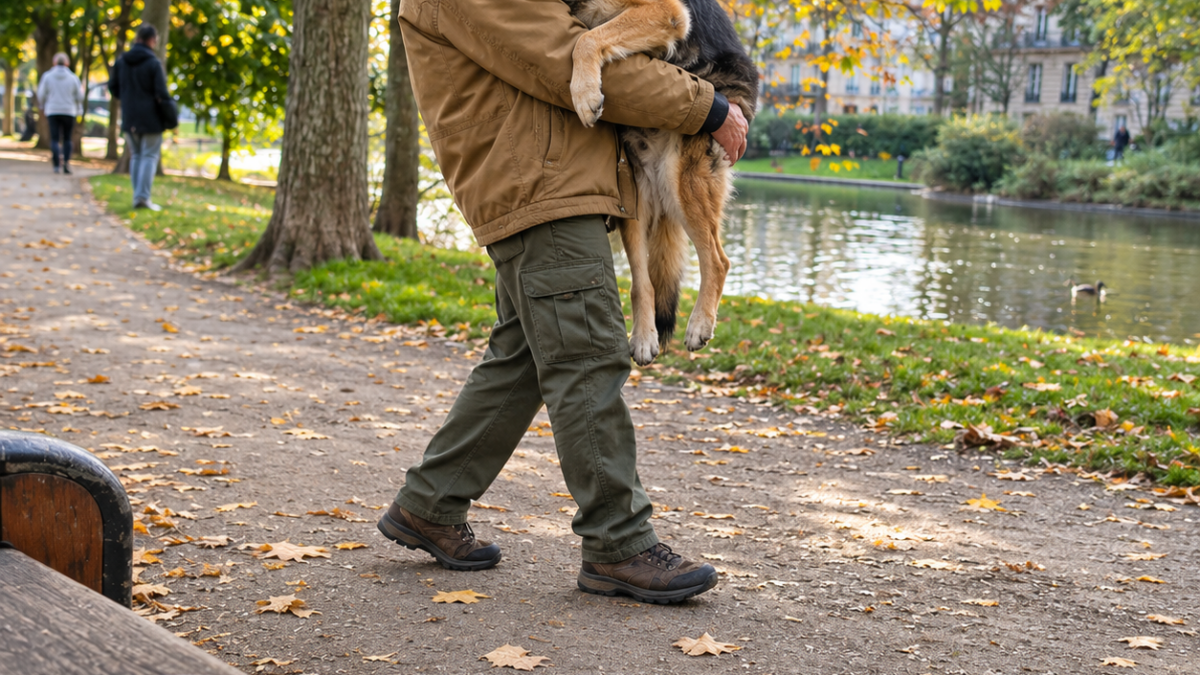
PART 2
I missed the first half of my lecture that morning.
I told myself it was because Henri’s story had taken longer than five minutes.
The truth was I did not want to leave.
We eventually stood.
Henri shifted Max against his chest.
His face tightened with effort.
I reached for his bag.
“Let me carry that.”
He looked at me.
“The bag?”
“Yes.”
He handed it over.
We walked toward the lake.
At the water, Henri stopped.
Max’s ears lifted.
The cold breeze moved through his coat.
The old dog inhaled.
Long.
Slow.
A cyclist passed.
A duck splashed.
Two children laughed somewhere behind us.
Max’s tail moved.
Henri looked at me.
“That.”
I nodded.
“That’s why.”
After that day, my mornings changed.
I still brought my books.
I still pretended to study.
But at eight, I watched for Henri.
The next morning, he looked surprised when I stood.
“You again?”
“I’m here every morning.”
“So am I.”
I took his bag.
He allowed it without argument.
For a week, that became our routine.
Henri carried Max.
I carried the bag.
We walked.
Sometimes we spoke.
Sometimes not.
I learned Henri was seventy-seven.
Retired railway engineer.
Two adult children.
One daughter in Grenoble.
One son near Paris.
Three grandchildren.
He talked about Elise more as the days passed.
Not only her illness.
That mattered.
At first, every story ended with cancer.
Then gradually he began telling me who she had been before.
She hated mayonnaise.
Loved old detective movies.
Always carried tissues.
Could not keep houseplants alive.
Once drove forty kilometers before realizing her phone was on the roof of the car when they left.
“What happened to it?”
“Found on the road.”
“Destroyed?”
“Completely.”
“Did you tell her ‘I told you so’?”
Henri looked offended.
“I wanted to remain married.”
Max had loved Elise differently than Henri did.
Dogs do not ask questions when grief changes a house.
After her death, Max continued sleeping near her side of the bed for months.
Then one day he stopped.
Henri noticed.
“It upset me.”
“Why?”
“It felt like he was forgetting her.”
“Do you think he was?”
“No.”
Henri looked ahead.
“I think he was adapting before I was.”
That sentence stayed with me.
One rainy Tuesday, Henri was slower than usual.
He stopped near my bench.
I took his bag.
He continued.
Twenty yards later, he stopped again.
“Let me carry Max.”
“No.”
“Henri.”
“No.”
“You’re breathing like you ran a marathon.”
“I am old.”
“That’s not an argument.”
“It is an explanation.”
Max rested against his shoulder.
I stepped in front of them.
Henri glared.
“Move.”
“Give him to me.”
“No.”
“Why?”
Silence.
There was more beneath the refusal.
I waited.
Finally, Henri said, “Because I carry him.”
“Yes.”
“That is my job.”
“Why?”
He did not answer.
“You think if somebody else carries him, you’re failing?”
“No.”
“That sounded very convincing.”
Henri looked away.
I softened.
“You don’t have to prove anything.”
His jaw tightened.
“I know.”
“Then let me help.”
Max lifted his head.
I put one hand beneath his chest.
Henri hesitated.
Then he carefully transferred the dog into my arms.
I nearly dropped my confidence immediately.
Max was heavy.
Much heavier than he looked.
My arms sank.
“Oh.”
Henri smiled.
“Yes.”
“How much does he weigh?”
“Thirty-two kilos.”
“That’s not a dog. That’s furniture.”
Max stared at me.
“Sorry.”
I adjusted my grip.
Henri became serious.
“Support his back.”
“I am.”
“More.”
I repositioned.
“Like that?”
“Yes.”
Max settled against me.
His body was warm.
I could feel the weight of his useless rear legs.
For the first time, I understood physically what Henri was doing every morning.
After fifty yards, my shoulders burned.
After a hundred, I was sweating.
Henri walked beside me looking far too pleased.
“This is funny to you?”
“Very.”
“How do you do this every day?”
“Bad knees and stubbornness.”
At the lake, I turned Max toward the water.
His ears lifted.
His nose worked.
Tail.
Two weak taps.
That tiny movement felt like applause.
“There it is,” Henri said.
I smiled.
For the next month, I carried Max more often.
Henri resisted at first.
Then less.
We developed a system.
Henri carried him from home to the park gate.
I took over near the first bench.
Sometimes another regular helped.
The woman with the terrier was named Colette.
The runner was Pascal.
The park employee was Alain.
They all knew pieces of Henri’s story.
Not all of it.
I became part of a strange morning circle.
Nobody planned it.
People simply started helping.
Colette sometimes brought Henri coffee.
Pascal carried the bag on mornings I was late.
Alain always made sure the bench near the lake was dry after rain if he could.
One morning, a stranger stopped us.
A woman in her forties.
She looked at Max.
Then at Henri.
Her expression tightened.
“Excuse me.”
Henri stopped.
“That dog shouldn’t be out here.”
I recognized the tone.
It was mine from weeks earlier.
Henri remained calm.
“He enjoys coming.”
The woman shook her head.
“He can’t even walk.”
“That’s true.”
“Then why are you dragging him around?”
Something inside me flared.
Henri touched my arm before I could speak.
He answered gently.
“I’m not dragging him.”
“Look at him.”
“I do.”
“Every day.”
She seemed surprised by his calmness.
Henri continued.
“He has a neurological disease. His pain is managed. His veterinarian monitors him. He eats, sleeps, plays in the ways he can, and every morning he asks to come here.”
“How does a dog ask?”
I spoke this time.
“He goes to the door.”
The woman looked at me.
“He drags himself there at seven forty-five.”
I pointed toward Max.
“He knows this route better than I do.”
She looked uncomfortable.
“I just don’t like seeing animals suffer.”
Henri smiled sadly.
“Neither do I.”
The woman looked at Max again.
A duck passed.
His head lifted.
Tail.
One tap.
She noticed.
Her expression changed.
“I’m sorry.”
Henri nodded.
“I used to think the same thing,” I told her.
She gave me a small smile.
Then left.
Henri looked at me.
“You were ready to fight her.”
“No.”
“Yes.”
“Maybe.”
“Very mature.”
“I’m twenty-two.”
“That excuse has limits.”
But the encounter stayed with me.
I began thinking about how easily we confuse visible weakness with misery.
Max could not walk.
That was tragic.
But he still had pleasure.
Interest.
Connection.
Choice.
His world had become smaller.
It had not become empty.
Henri knew the difference because he had lived through something similar.
After Elise died, his life had become smaller.
No wife.
No shared meals.
No travel.
No one in the other room.
But Max kept one part from becoming empty.
Morning.
The park.
The lake.
I started to understand that the walk was not only for Max.
It had never been only for Max.
And perhaps that was okay.
Then came the morning Henri did not appear.
Eight o’clock.
I waited.
8:03.
Nothing.
8:07.
No Henri.
No Max.
At 8:10 I called.
No answer.
I told myself not to panic.
At 8:15 I called again.
Nothing.
By 8:20, I was already walking toward Henri’s apartment.
He had once shown me roughly where he lived.
Ten or twelve minutes from the park.
I ran.
At the building, I pressed his buzzer.
Nothing.
Again.
Nothing.
I called.
From somewhere upstairs, I heard faint barking.
My heart started pounding.
I pressed every intercom button until someone answered.
“Yes?”
“Sorry. I’m looking for Henri on the third floor.”
“Who?”
“Older man. German Shepherd.”
“Oh. Monsieur Lambert.”
“Can someone open?”
The lock buzzed.
I ran upstairs.
I knocked.
“Henri!”
A bark.
Weak.
Again.
“Henri!”
No answer.
A woman opened the apartment across the hall.
“What’s happening?”
“Do you have a key?”
“No.”
“The building manager?”
“Downstairs.”
She saw my face.
“What happened?”
“I don’t know.”
Minutes later, the building manager arrived.
He opened the door.
Max was in the hallway.
Dragging himself toward us using his front legs.
He barked once.
Then turned his head toward the kitchen.
I ran.
Henri was on the floor.
Conscious.
Barely.
“Henri.”
His eyes opened.
“Mathis?”
“What happened?”
“Got dizzy.”
“Don’t move.”
“I wasn’t planning a dance.”
Even collapsed on the floor, he was sarcastic.
I called emergency services.
Max dragged himself close.
Pressed his head against Henri’s hand.
Henri’s fingers moved weakly through the fur.
“He found you,” I said.
Henri looked at Max.
“He always does.”
The hospital determined it was not another stroke.
Dehydration.
Exhaustion.
Low blood pressure.
And physical strain.
The doctor asked about Henri’s routine.
I told him.
The doctor stared at me.
“He carries a thirty-kilogram dog every morning?”
“Yes.”
“At seventy-seven?”
“Yes.”
The doctor rubbed his forehead.
“No.”
Henri was furious when I repeated that.
“No?”
“No more carrying him that distance.”
Henri sat in the hospital bed with his arms crossed.
“He needs the park.”
“That’s not what the doctor said.”
“He needs it.”
“So find another way.”
Henri looked toward the window.
“I promised him.”
“What?”
“When?”
Henri stayed silent.
I sat.
“What did you promise?”
He looked exhausted.
“The day the specialist told me what he had.”
“What did you say?”
Henri swallowed.
“I told him I’d carry him when he couldn’t walk.”
I closed my eyes.
There it was.
“That’s what this is?”
“He carried me.”
“In the lake?”
“After Elise.”
“Henri.”
“He carried me for years.”
“And now you think you owe him.”
“Yes.”
At least he admitted it.
I leaned closer.
“You don’t.”
His eyes hardened.
“You weren’t there.”
“No.”
“You don’t know what it was like.”
“No.”
“I wanted to die after Elise.”
His voice became quiet.
“I never made a plan.”
He stared at his hands.
“I never tried anything.”
“But there were mornings when I would have been fine not waking up.”
I said nothing.
“Max would stand there.”
Henri’s eyes filled.
“Barking.”
“Needing breakfast.”
“Needing me.”
He shook his head.
“So don’t tell me I don’t owe him.”
I waited.
Then I said, “What does Max want?”
Henri frowned.
“The park.”
“Yes.”
“Does he care who carries him?”
Silence.
“Does he care if you destroy your back?”
No answer.
“Does he care whether you personally suffer enough to make the debt feel paid?”
Henri looked away.
I continued.
“You’re making this about repayment.”
“It is repayment.”
“No.”
My voice came out harder.
“It’s guilt.”
He looked at me sharply.
I almost apologized.
I did not.
“You survived.”
He survived.
Elise didn’t.
“That’s not your fault.”
Henri’s mouth tightened.
I kept going.
“You think if you carry Max until your body breaks, then somehow you’ve earned the fact that he saved you.”
His eyes were wet now.
“That’s not how love works.”
“How does it work, professor?”
There was anger in the word.
I let it pass.
“I don’t know.”
I took out my phone.
“But I know Max doesn’t need a martyr.”
Henri looked at the screen.
During the hours he was at the hospital, Colette, Pascal, Alain, and others had been messaging.
I had told them briefly what happened.
Pascal knew someone who worked with disabled dogs.
Alain’s brother could modify a stroller.
Colette had found a secondhand large canine mobility cart.
Another regular offered money.
Someone else offered morning transport.
Henri stared.
“What is this?”
“Help.”
“I don’t need charity.”
“It’s not charity.”
“What is it?”
“People who care about you.”
His expression changed.
That frightened him more than the doctor’s warning.
Henri had built his life around needing very little from anyone.
Max was the exception.
Now Max had somehow created a community around him.
“You don’t have to carry everything yourself,” I said.
Henri looked at the messages.
Then at me.
“I hate you.”
“I know.”
“No, I mean right now.”
“I know.”
He smiled despite himself.
Three days later, Henri returned home.
The modified stroller arrived the next morning.
He hated it immediately.
“It looks ridiculous.”
“It has proper support.”
“He is a German Shepherd.”
“He’s an old German Shepherd.”
“He has dignity.”
Max was already sniffing the entrance.
I opened the side.
Max pulled himself closer.
Henri stared at him.
“Don’t you dare.”
Max put his front paws inside.
I smiled.
“He seems interested.”
“Traitor.”
We padded the bottom.
Supported his hips.
Secured him safely.
At eight, Henri pushed the stroller through the park.
For the first time, he was not gasping after a hundred yards.
People stared.
Henri pretended not to care.
At the lake, we opened the front.
Max lifted his head.
Wind.
Ducks.
Trees.
His tail moved three times.
Henri’s eyes filled.
He crouched beside him.
“I’m sorry.”
I stepped away.
Henri stroked his face.
“I thought carrying you was the point.”
Max watched him.
Henri smiled through tears.
“But the point is getting you here, isn’t it?”
Tail.
One tap.
“Fine.”
From then on, we used the stroller.
Henri still lifted Max for the last few yards.
I never argued.
That part had become ritual.
He would stop near the bench.
Open the stroller.
Slide one arm beneath Max’s chest.
One beneath his hips.
Lift.
Then walk slowly to the water.
Maybe twenty yards.
Enough to keep the promise without destroying himself.
October ended.
November came.
The air became colder.
Max’s condition continued progressing.
Some mornings he seemed almost energetic.
Other mornings he slept through breakfast.
Henri tracked everything.
Food.
Water.
Bathroom habits.
Sleep.
Interest.
Pain.
He had a notebook.
I teased him.
“You’re worse than my professors.”
“My data is useful.”
“What’s this?”
I pointed.
“Twelve minutes watching ducks.”
“That matters.”
He was right.
Max’s life had become measured in small pleasures.
He still loved cheese.
He still hated vacuum cleaners.
He still barked at the delivery man.
One afternoon I visited Henri’s apartment.
Max was sleeping near the sofa.
Henri was making tea.
There were photographs everywhere.
Elise.
Children.
Grandchildren.
And Max.
Young Max.
Strong Max.
Wet Max after swimming.
Max wearing a ridiculous birthday hat.
Max asleep upside down.
One picture stopped me.
Elise standing by the lake.
Max beside her.
Henri had taken it.
“She looks happy.”
“She was.”
“When?”
“Six months before diagnosis.”
I looked at Max now.
Old.
Weak.
Henri saw the contrast.
“Don’t do that.”
“What?”
“Compare.”
“I wasn’t.”
“Yes, you were.”
He handed me tea.
“The old body does not cancel the young one.”
I remembered that sentence.
December arrived.
The park changed.
Bare trees.
Thin ice on puddles.
People wearing scarves.
Max seemed more tired.
But at 7:45, he still moved toward the door.
On Christmas morning, I assumed Henri would stay home.
At 8:02, I saw him.
He was wearing a red hat.
I laughed.
“No.”
“What?”
“Absolutely not.”
“It was a gift.”
“From who?”
“My granddaughter.”
Max had a green scarf.
“This is humiliating.”
Henri looked at him.
“He likes it.”
Max looked indifferent.
We walked to the lake.
Colette appeared with her terrier wearing antlers.
Pascal brought coffee.
Alain had hung a tiny wooden ornament from the bench.
We stood there in freezing air laughing like idiots.
Henri looked around.
I saw something in his face.
“What?”
“Nothing.”
“Henri.”
He smiled.
“Elise would have liked this.”
Nobody spoke for a moment.
Then Max barked.
One deep sound.
Henri laughed.
“Yes. You too.”
New Year passed.
Max made it into January.
Every extra week surprised Henri.
“Stubborn dog.”
“You sound disappointed.”
“I had a schedule.”
“No, you didn’t.”
He smiled.
One morning, Henri brought the old photograph of Elise and Max.
He gave it to me.
“Why?”
“Keep it.”
“No.”
“I have copies.”
“I still don’t need it.”
Henri looked at me.
“One day you will remember Max only like this.”
He pointed toward the stroller.
“That’s not fair.”
I looked at the photograph.
Young Max standing tall beside Elise.
Dark muzzle.
Bright eyes.
Powerful body.
Henri continued.
“Disease is greedy.”
“What do you mean?”
“It tries to take the whole story.”
I looked at him.
“When someone is sick long enough, you forget how they laughed before.”
His eyes moved toward the lake.
“I did that with Elise.”
He swallowed.
“For a while, all I remembered was the hospital.”
“Then?”
“Time gave other memories back.”
He touched the photograph.
“Remember Max before the legs.”
I took it.
February was harder.
Max began having days when he did not want breakfast.
The first time, Henri called the veterinarian immediately.
By dinner, Max ate.
The next morning, he wanted the park.
Then came a day when he did not.
Henri called me at 7:50.
“He’s still in bed.”
I went over.
Max was awake.
He looked at me.
Tail moved.
But he did not attempt to move toward the door.
Henri stood beside him fully dressed.
“Do we take him?”
“No.”
Henri looked at me.
“He might want to go.”
“Then ask him.”
Henri crouched.
“Max.”
Ear movement.
“Park?”
Nothing.
He tried again.
“Lake?”
Max blinked.
No movement.
Henri sat beside him.
“We stay home.”
It was the first time he made that decision without arguing.
We spent the morning in the apartment.
Max slept.
The next day, at 7:45, he dragged himself halfway toward the door.
Henri laughed like he had won the lottery.
“Fine.”
We went.
Good days.
Bad days.
That became the rhythm.
I began understanding something Henri had learned earlier.
You cannot judge quality of life from one moment.
Not one good morning.
Not one bad evening.
You watch the pattern.
The balance.
The animal.
Dr. Bernard, Max’s veterinarian, visited more often.
She was patient.
Direct.
Henri both liked and hated her for that.
One afternoon, she asked him:
“Is Max still eating?”
“Usually.”
“Drinking?”
“Yes.”
“Resting comfortably?”
“Mostly.”
“Interested in you?”
Henri looked offended.
“He never stops interfering.”
“Good.”
“Interested in his surroundings?”
“The park.”
“Pain?”
“Managed.”
Then she asked:
“Are there still more good days than bad?”
Henri did not answer immediately.
“Yes.”
She nodded.
“For now, that matters.”
“For now.”
Henri hated those words.
After she left, he sat by the window.
“What happens when the answer is no?”
I knew better than to lie.
“Then you’ll know.”
“What if I don’t?”
“You will.”
“What if I wait too long?”
Silence.
“What if I do it too soon?”
There was no perfect answer.
I sat beside him.
“Then don’t decide alone.”
He looked at me.
“You.”
“The vet.”
“Your children.”
“People who see Max.”
Henri nodded slowly.
“I promised Elise I wouldn’t let him suffer.”
“You did?”
“She said it before she died.”
“What exactly?”
Henri looked toward Max.
“She told me, ‘Don’t keep him for yourself when he’s tired.’”
The sentence hit harder than anything else.
Henri covered his face.
“I hated her for saying it.”
“Why?”
“Because she knew me.”
He laughed bitterly.
“She knew I would.”
I understood.
Henri had already lost Elise.
Max was the last living piece of that life.
Letting him go would not only mean losing a dog.
It would mean losing the creature who had known the marriage.
The house before cancer.
The walks with Elise.
The grief afterward.
The lake.
Everything.
“You’re not only afraid of losing Max,” I said.
Henri stared ahead.
“You’re afraid of losing the last witness.”
His eyes filled.
“Yes.”
That night, I thought about memory.
We imagine memories belong to us alone.
But some belong between people.
Or between a person and an animal.
Someone else remembers the room.
The voice.
The routine.
When that someone disappears, part of the world becomes impossible to verify.
Henri could remember Elise.
Max could too.
In whatever way dogs remember.
That mattered.
March 3 arrived quietly.
Henri called me at 6:42 a.m.
“Mathis.”
I was awake instantly.
“What happened?”
“He tried to go to the door.”
His voice shook.
“But?”
“He couldn’t lift his head.”
I dressed without turning on most lights.
When I arrived, Max lay on his favorite blanket.
His eyes were open.
Henri sat on the floor.
“He ate?”
“Yesterday.”
“Water?”
“Some.”
“Pain medication?”
“Yes.”
Max looked at me.
His tail moved once.
“Hi, old man.”
I sat.
His breathing was calm but different.
Shallower.
Henri said, “I called Bernard.”
Dr. Bernard arrived an hour later.
She examined Max gently.
Listened.
Touched.
Watched.
Then she sat back.
Henri saw the answer before she spoke.
“No.”
She said nothing.
“No.”
“Henri.”
“He went to the park yesterday.”
“I know.”
“He ate chicken.”
“I know.”
“He watched the ducks.”
“I know.”
“So no.”
Dr. Bernard waited.
Max’s eyes moved toward Henri.
The room felt impossibly small.
Finally she said, “I think we are very close.”
“To what?”
Henri knew.
He still asked.
“To the point where his body is giving him more burden than pleasure.”
Henri stood abruptly.
“He is not in unbearable pain.”
“No.”
“Then why?”
“Because pain is not the only suffering.”
Silence.
“He is exhausted.”
Henri looked away.
“He cannot reposition himself well.”
“I do it.”
“He is struggling to eat.”
“I feed him.”
“He cannot lift his head today.”
Henri’s face collapsed.
“I lift it.”
Dr. Bernard’s voice remained gentle.
“I know.”
She looked at him.
“The question is whether you are helping him live, or helping his body continue.”
Henri turned toward the window.
I hated the veterinarian in that moment.
Not because she was wrong.
Because she was right enough to hurt.
After several minutes, Henri asked, “Can he go to the lake?”
She looked at Max.
“One last time?”
“Yes.”
She considered.
“If we can move him comfortably.”
“We have the stroller.”
“If he becomes distressed, stop.”
Henri nodded.
Dr. Bernard touched his shoulder.
“And Henri?”
He looked at her.
“Do it for Max.”
Not for Elise.
Not for the promise.
Not for guilt.
For Max.
At 9:15, I sent one message to the small group of park regulars.
LAST WALK. 10 A.M.
I did not explain.
Nobody asked.
At 9:50, Colette was there.
Pascal.
Alain.
My mother, whom Henri had met by then.
My younger sister.
Two people from Max’s rehabilitation clinic.
Henri’s daughter arrived from Grenoble faster than seemed possible.
His son was still driving from Paris.
At 10, Henri appeared.
Pushing Max.
No one clapped.
No one crowded him.
We simply walked.
The morning was cold but bright.
No rain.
Bare branches.
Sunlight across the water.
Max’s head rested on a padded cushion.
His eyes were open.
He watched.
Slowly.
We passed my old bench.
The one where I first judged them.
I touched the back of it as we walked.
At the final twenty yards, Henri stopped.
He opened the stroller.
“I’ve got him.”
I stood close.
He slid his hands beneath Max.
Lifted.
His arms trembled immediately.
I wanted to help.
I did not.
This belonged to him.
One step.
Two.
Max’s head rested against Henri’s shoulder.
Henri breathed heavily.
Ten yards.
Eight.
Five.
At the water, I pulled the bench closer.
Henri sat.
Max lay across his lap.
For a moment, nothing happened.
Then three ducks moved from the reeds.
Max’s ear lifted.
Everybody saw it.
Henri laughed.
“You see them?”
Max’s tail moved.
One tap.
Then another.
Henri bent over him.
“Good boy.”
His face disappeared into Max’s fur.
Nobody looked away.
There was no reason to protect him from being seen grieving.
Henri whispered:
“You carried me once.”
His hand moved slowly over Max’s chest.
“I carried you as long as I could.”
He cried openly.
“I thought I had to pay you back.”
Max blinked.
“You never asked me to.”
His voice shook.
“You just wanted the park.”
Tail.
Tiny movement.
Henri smiled.
“You stubborn old thing.”
He pressed his forehead against Max’s.
“You saved me.”
Wind moved across the lake.
“You saved me when Elise left.”
Henri swallowed.
“You saved me in the water.”
“You saved me every morning after.”
He closed his eyes.
“I’m sorry I thought love meant keeping you forever.”
Max breathed slowly.
Henri whispered:
“You can be tired now.”
That sentence broke everyone.
Colette turned away.
Pascal stared at the ground.
My mother put a hand over her mouth.
I cried without caring.
We stayed by the lake for nearly an hour.
Max slept most of it.
Then Henri carried him back to the stroller.
Not home immediately.
We took the long path.
Slowly.
As if the park itself needed time to say goodbye.
Back at the apartment, Henri’s son arrived.
The family gathered.
Dr. Bernard returned that afternoon.
Max was on the blanket.
Henri sat beside him.
I stood to leave.
He grabbed my wrist.
“Stay.”
I did.
The veterinarian explained the process.
First medication to relax him.
Then, when Henri was ready, the final injection.
“Will he be afraid?”
“No.”
“Will it hurt?”
“No.”
“Will he know I’m here?”
“Yes.”
Henri nodded.
He struggled to lower himself onto the floor.
I helped this time.
He did not resist.
He lay beside Max.
Face level with his.
“Remember the lake?”
Max’s eyes opened slightly.
Henri smiled through tears.
“Elise will be furious.”
His daughter began crying harder.
“You took too long.”
Henri stroked Max’s ear.
“You find her, okay?”
His voice cracked.
“You know where she is better than I do.”
Dr. Bernard gave the sedative.
Max relaxed.
Henri kept talking.
Not grand words.
Ordinary things.
The destroyed slippers.
The stolen baguette.
The garden hose.
The first time Max barked at a statue.
The way Elise used to accuse him of taking her side.
“Which you did.”
Max breathed.
Slow.
Henri laughed.
“You always did.”
Then he thanked him.
Not once.
Many times.
“Thank you.”
Breath.
“Thank you.”
His hand never stopped moving.
“Thank you.”
When Dr. Bernard looked at Henri, he nodded.
She gave the final medication.
Max’s breathing slowed.
Pause.
Another breath.
Pause.
Then stillness.
Henri waited.
“What?”
Dr. Bernard listened.
Her face softened.
“He’s gone.”
Henri pressed his face into Max’s neck.
No sound came out at first.
Then a sound I will never forget.
Not a scream.
Something lower.
Broken.
His daughter knelt beside him.
His son put one hand on his back.
I looked away.
It felt private.
Then Henri reached blindly.
His hand found mine.
I sat down.
We stayed.
Long after Dr. Bernard had finished.
Long after there was anything left to do.
The next morning, I went to the park.
I did not plan to.
My body simply followed the routine.
7:55.
I sat on my bench.
Eight o’clock.
Nothing.
Of course.
8:03.
Empty path.
8:08.
A runner.
Not Pascal.
8:12.
A woman with a Labrador.
I felt ridiculous.
Then at 8:17, I saw Henri.
Alone.
Same navy jacket.
Hands in pockets.
Walking slowly.
I stood.
He reached the bench.
Neither of us spoke.
He sat.
I sat.
After a while, he said, “I woke at seven.”
I waited.
“At seven forty-five I was standing by the door.”
His mouth trembled.
“He wasn’t there.”
I put my hand on his shoulder.
Henri cried.
No Max between us.
No bag.
No stroller.
His arms looked wrong empty.
Eventually he said, “I don’t know what I do now.”
“You walk.”
“Why?”
I looked toward the lake.
“Because he brought you here.”
Henri stared at me.
Then stood.
We walked.
Same path.
Same lake.
At the water, he stopped.
For years, Max had given him a reason to arrive there.
That morning, the reason changed.
Not obligation.
Memory.
We came back the next day.
And the next.
For weeks.
At eight.
Henri sometimes talked about Max.
Sometimes Elise.
Sometimes nothing.
People in the park noticed.
Colette brought flowers once.
Alain placed a small smooth stone near the bench.
No inscription.
Henri did not want one.
“He didn’t need a plaque.”
I disagreed.
But respected it.
Spring arrived.
The park turned green again.
Henri looked healthier.
Physically.
Emotionally, grief moved unpredictably.
Some mornings he laughed.
Then felt guilty.
“I laughed all morning yesterday.”
“So?”
“It felt wrong.”
“Why?”
“Because Max is dead.”
I stared at him.
“So you’re supposed to be miserable forever?”
“No.”
“Then what?”
“I don’t know.”
“Henri.”
“Yes?”
“Would Max have preferred you miserable?”
He smiled.
“He preferred food.”
“Exactly.”
Henri began volunteering once a week at an animal rescue.
The idea came from Colette.
He refused initially.
“I am not getting another dog.”
“Nobody asked.”
“They’ll try.”
“Then say no.”
The rescue put him with senior dogs.
Not walking them.
Sitting.
Reading.
Petting.
Giving treats.
Dogs visitors often passed.
Cloudy eyes.
Stiff joints.
Old scars.
One day I visited.
Henri sat in a kennel beside a twelve-year-old mixed breed named Lola.
“She doesn’t like men,” the volunteer told me.
Lola was asleep with her head on Henri’s shoe.
“I can see that.”
Henri glared.
He changed there too.
He stopped talking about Max only with sadness.
He told stories.
People laughed.
That mattered.
Nearly a year after Max died, Henri called.
“Are you busy?”
“Yes.”
“Good. Come with me.”
“That sentence makes no sense.”
“I’m old.”
“You abuse that excuse.”
We went to the rescue.
A German Shepherd mix was waiting.
Ten years old.
Name: Paco.
Owner had died.
One bad hip.
Partially deaf.
No applications in five months.
Henri sat outside his enclosure.
“No.”
He looked at me.
“What?”
“No.”
“I haven’t done anything.”
“You are thinking.”
“I am always thinking.”
“Dangerous.”
Paco approached slowly.
Sniffed Henri’s fingers.
Then rested his head against the bars.
Henri froze.
I watched his face.
“No,” I repeated.
“I am only saying hello.”
Paco leaned harder.
Henri stroked him.
“Hello.”
We stayed forty minutes.
Henri returned two days later without telling me.
Then again.
I found out from the shelter.
“You liar.”
“I never lied.”
“You said you were only visiting.”
“I was.”
“Three times?”
“Very thorough visit.”
Two weeks later, he adopted Paco.
I confronted him at the park.
“You told me you didn’t want another dog.”
“I changed my mind.”
“You’re seventy-eight.”
“Excellent arithmetic.”
“Paco is ten.”
“Yes.”
“You could lose him soon.”
Henri’s expression became serious.
He looked down at Paco.
“People said that about Max.”
“Not when you adopted him.”
“No.”
He paused.
“But I learned something.”
“What?”
“Young people think love is valuable because you might get many years.”
He scratched Paco’s ear.
“Older people learn one year is valuable because it is a year.”
I said nothing.
Henri smiled.
“Besides, he is slow.”
“So are you.”
“Exactly.”
Paco did not replace Max.
He could not.
He had his own habits.
He hated water.
The first morning Henri took him to the lake, Paco ignored it completely.
Instead, he noticed a squirrel.
He nearly pulled Henri sideways.
Henri shouted.
“Traitor!”
I laughed.
“He doesn’t care about your sacred lake.”
“He has no culture.”
Paco loved bread.
Disliked rain.
Snored.
Preferred sleeping beside the radiator.
He was affectionate in a quieter way than Max.
Henri did not compare them.
At least not often.
That surprised me.
One afternoon I asked, “Do you ever feel guilty?”
“For what?”
“Loving another dog.”
Henri thought.
“No.”
“Not at all?”
“Sometimes at first.”
“What changed?”
He pointed toward Paco.
“He isn’t Max.”
“I know.”
“That is why it’s okay.”
Love had not been a chair with one seat.
That was another thing Henri taught me.
My university years ended.
I graduated.
Found work outside Lyon.
Leaving became harder than expected.
Not because of the city.
Because of Henri.
He had become part grandfather, part friend, part annoying moral philosopher.
Before I moved, we met at the park.
Same bench.
Paco beneath it.
I held the photograph Henri had given me.
Young Max beside Elise.
“Do you remember the first thing I asked you?”
Henri smiled.
“You accused me of torturing a dog.”
“I did not.”
“Emotionally.”
“I asked why you didn’t let him rest.”
“Same thing.”
“I was worried.”
“You were arrogant.”
“I was twenty-two.”
“You still are.”
“Not twenty-two.”
“You remain arrogant.”
I laughed.
Then became serious.
“Do you ever wish I hadn’t asked?”
Henri looked surprised.
“No.”
“Why?”
“Because then you would have stayed a stranger.”
I looked at him.
He nodded toward the lake.
“Max was good at finding people.”
Even after his legs failed.
Especially after.
We sat quietly.
A young woman passed pushing an elderly dog in a stroller.
I watched.
Henri noticed.
“You going to question her?”
“No.”
“Good.”
“I might ask the dog’s name.”
“Better.”
Before I left, Henri hugged me.
He had never done that.
It was awkward.
Too long.
Neither of us knew how to end it.
Finally he stepped back.
“You come visit.”
“I will.”
“People say that.”
“I mean it.”
“So did my son.”
“Where is he?”
“Paris.”
“How often does he visit?”
“Not enough.”
“I am regretting this conversation.”
Henri smiled.
I did visit.
Not as often as I promised.
But enough.
We spoke by phone.
He sent photographs of Paco.
Paco gained weight.
Then lost it after I complained.
Henri accused me of becoming Dr. Bernard.
Years passed.
Paco eventually developed more severe hip problems.
Henri was different this time.
Still emotional.
Still afraid.
But he did not make promises about carrying him forever.
He watched.
Listened.
Asked.
When Paco stopped enjoying walks, Henri shortened them.
When he stopped liking the park, they stayed near home.
When food no longer interested him much, Henri talked to the vet early.
He told me, “Max taught me the first time.”
“What?”
“That letting go is not betrayal.”
Paco died at home at almost thirteen.
Henri grieved.
But differently.
Not less.
Differently.
He had learned grief did not mean the world ended.
It changed shape.
One day, years after Max, Henri called me.
His voice was weaker.
“Mathis.”
“Yes?”
“I found the old stroller.”
I laughed.
“Why?”
“Storage room.”
“Throw it out.”
“No.”
“Why keep it?”
“Memory.”
“You have photographs.”
“Photographs don’t have wheels.”
“That is the least sensible thing you’ve ever said.”
“Probably.”
He donated the stroller to the rescue.
A few months later, a volunteer sent him a photograph.
A paralyzed Labrador using it.
The dog was at a park.
Tail wagging.
Henri forwarded it to me.
Only one message beneath:
MAX WOULD APPROVE.
I kept that photograph too.
As I got older, I understood the story differently.
At twenty-two, I thought the most important part was that Max saved Henri from the freezing lake.
It was dramatic.
Heroic.
Easy to explain.
A dog jumps into freezing water.
Holds his owner near the bank.
Barks until help arrives.
That is the kind of story people remember.
But that was not Max’s greatest rescue.
His greatest rescue happened slowly.
After Elise died.
Morning by morning.
When Henri did not want to get out of bed.
When food tasted like nothing.
When the apartment felt too quiet.
When the future had no shape.
Max needed breakfast.
Max needed the door.
Max needed the park.
Max needed Henri.
That need became a rope.
Not dramatic.
Not heroic-looking.
But strong enough to pull a grieving man back into life.
Years later, when Max’s legs failed, Henri became the rope.
That was the part I once misunderstood.
I saw a man carrying a broken dog.
I thought the story was about burden.
It was about reciprocity.
Not repayment.
Not debt.
Love taking turns.
First Max had legs.
Henri did not, metaphorically.
Then Henri had legs.
Max did not.
So one carried the other.
Simple.
Difficult.
Beautiful.
I also learned that letting go is part of carrying.
That sounds contradictory.
It isn’t.
Henri carried Max until the day carrying him farther would have meant asking him to remain for Henri instead of for himself.
Then Henri did the hardest thing.
He put him down.
Not physically.
Emotionally.
Released the debt.
Released the promise.
Released the last living witness to Elise.
And allowed Max to be tired.
That was love too.
Possibly the deepest version.
Many years after I first saw them, I returned to Lyon for work.
Henri was in his eighties.
Older.
Thinner.
No dog then.
We met at the park.
He walked with a cane.
I offered my arm.
He refused.
“Still stubborn.”
“Still intrusive.”
We reached the old bench.
The small stone Alain had once placed was gone.
Weather.
Park maintenance.
Time.
Henri did not seem upset.
We sat.
The lake looked exactly the same.
That felt insulting somehow.
How could the world preserve water and trees while people and dogs disappeared?
Henri looked at me.
“You’re thinking too much.”
“You can tell?”
“Yes.”
“Max could too.”
He smiled.
We watched ducks.
After a while, Henri said, “I’m glad you asked me.”
“The rude question?”
“Yes.”
“Why?”
“Because telling the story changed it.”
I turned toward him.
“How?”
He thought.
“Before you asked, every time I carried Max, I thought about what I owed him.”
“And after?”
“I started thinking about what he enjoyed.”
I had not known that.
“You changed because of me?”
“Don’t become unbearable.”
“I need this moment.”
Henri rolled his eyes.
“But yes.”
He looked at the water.
“You made me realize I was carrying more than the dog.”
Guilt.
Debt.
Fear.
Max’s body weighed thirty-two kilograms.
The rest weighed more.
Henri had eventually set some of it down.
We sat there until the afternoon.
Before leaving, he touched the bench.
“Funny.”
“What?”
“The first morning, you thought I was carrying him because I couldn’t let go.”
“Yes.”
“You were partly right.”
I looked at him.
Henri smiled sadly.
“I just didn’t know it yet.”
That was Henri.
He allowed me to be wrong for years before admitting I had been slightly right.
“Thank you.”
“For what?”
“Giving me one percent.”
“Don’t get excited.”
We walked back toward the gate.
Slowly.
Henri stopped once.
Not because he carried a dog.
Because he was old.
I waited.
He caught his breath.
Then continued.
I thought about Max in his arms.
The gray muzzle.
The useless legs.
The ears lifting at the lake.
For years, when people asked me the saddest animal story I knew, I refused to give them this one.
It was not sad.
It contained sadness.
That is different.
Max died.
Elise died.
Paco died.
Henri grew old.
Those facts are sad.
But the story itself?
A rescued dog found a home.
A woman loved him.
A reluctant husband became his person.
The dog saved that man’s life.
Then saved him again from grief.
When the dog became disabled, the man carried him to his favorite place.
Strangers became friends.
A young student learned not to judge what he had not understood.
An old man learned receiving help did not make his love smaller.
A dog died surrounded by people who knew exactly what he had meant.
Then his life continued affecting other animals.
That is not tragedy.
That is a full life.
The last conversation I ever had with Henri about Max happened over coffee.
He was older then.
His hands shook slightly.
We were looking through photographs.
He stopped at one.
Max at the lake.
Old.
In the stroller.
Head lifted.
Eyes toward the water.
“That one.”
“What about it?”
“If somebody asks.”
“What?”
“When I’m gone.”
I looked at him.
“Henri.”
“Don’t be dramatic.”
“You started talking about dying.”
“I’m eighty-something. It is not a plot twist.”
I laughed despite myself.
He tapped the photograph.
“If anyone asks about Max, show them that.”
“Not the young one?”
“No.”
I was surprised.
Years earlier, he had insisted I remember Max before the disease.
“Why this one?”
Henri studied it.
“Because he was still himself.”
The body was failing.
The legs were gone.
The muzzle gray.
But the eyes remained interested.
The lake still mattered.
Henri continued.
“People think dignity means looking strong.”
He shook his head.
“Sometimes dignity means being weak and still being allowed to love things.”
I said nothing.
“Show them that.”
I promised.
And I have.
In my mind, anyway.
Whenever I see an old dog in a stroller.
A disabled animal in a cart.
Someone carrying a pet.
Someone feeding an elderly cat by hand.
I do not immediately think poor thing anymore.
I wonder.
Is there pain?
Is there joy?
Is the animal still choosing?
What does the whole story look like?
Because I learned how wrong a single image can be.
An old man carrying a paralyzed German Shepherd through a park looked like sadness from far away.
Up close, it was gratitude.
Habit.
Memory.
Partnership.
And one last season of joy.
Years later, I became a father.
That surprised the twenty-two-year-old version of me more than anything.
My daughter loved animals immediately.
When she was six, she found the photograph Henri had given me.
Young Max beside Elise.
“Who’s the dog?”
“Max.”
“Was he yours?”
“No.”
“Grandpa’s?”
“No.”
She frowned.
“Then why do you have his picture?”
I sat with her.
“That’s a long story.”
“Tell me.”
So I did.
Not all of it.
A six-year-old does not need every detail.
I told her about an old man.
A dog who could not walk.
A lake.
A rescue.
She asked one question.
“Why did the man carry him if he was heavy?”
“Because Max wanted to see the lake.”
She thought.
“Couldn’t someone else carry him?”
I laughed.
“Yes.”
“Did they?”
“Eventually.”
She nodded, satisfied.
Then she said, “The dog saved him, so he saved the dog.”
I stopped.
Children make complicated things irritatingly simple.
“Yes.”
“That’s nice.”
“Yes.”
“Did Max die?”
“Yes.”
She became sad.
“Then it’s not nice.”
I thought about Henri.
“Both can be true.”
She looked confused.
I showed her another photograph.
Old Max by the lake.
“Look at him.”
She studied it.
“He looks happy.”
“He was.”
“But he died.”
“Yes.”
She leaned against me.
“Still happy?”
“Yes.”
I think that was the best explanation I ever managed.
Sad ending.
Happy life.
Those are not opposites.
Henri died several years later.
Peacefully.
His daughter called me.
I went to Lyon for the funeral.
There were photographs of Elise.
Henri.
Children.
Grandchildren.
Max.
Paco.
One picture stood near the entrance.
Henri holding Max in the park.
I had taken it.
I had forgotten.
It was late autumn.
Henri was smiling.
Max’s head rested against his shoulder.
Behind them, the lake.
I stood in front of it for a long time.
Henri’s daughter came beside me.
“He kept that one in his bedroom.”
“I didn’t know.”
“He talked about you.”
“That’s dangerous.”
She laughed through tears.
“He said you were the annoying student who taught him how to use a dog stroller.”
“That sounds accurate.”
Then she gave me an envelope.
“My father wanted you to have this.”
Inside was a short note.
Mathis,
You were right once. Do not become proud.
A person cannot carry everything alone.
Thank you for carrying the bag.
And sometimes the dog.
Take care of the photograph.
H.
I laughed and cried at the same time.
Of course that was his goodbye.
No grand speech.
No sentimentality without an insult.
In the envelope was also Max’s old identification tag.
I held it in my palm.
MAX.
A phone number long disconnected.
I still have it.
Not because I knew Max longest.
I did not.
Not because I saved him.
I did not.
Because he changed the way I looked at love.
Before Max, I thought love was mostly feeling.
After Max, I understood it was often logistics.
Getting up.
Showing up.
Carrying.
Accepting help.
Medication.
Ramps.
Veterinary appointments.
Adjusting routines.
Watching carefully.
Knowing when to continue.
Knowing when to stop.
Love was Henri at seven forty-five asking, “Park?”
Love was Max dragging himself toward the door.
Love was me carrying the bag.
Love was Colette bringing coffee.
Love was a stroller someone found secondhand.
Love was Dr. Bernard saying the words Henri did not want to hear.
Love was Henri listening anyway.
Love was the final walk.
Love was the final injection too.
I know some people hate hearing that.
They think love should always fight death.
Sometimes it should.
Sometimes love fights for one more day.
Sometimes it fights against one more day.
Wisdom is knowing which battle belongs to the animal and which belongs to your fear.
Henri learned that.
Slowly.
Painfully.
Max taught him.
I learned by watching.
Whenever I return to Lyon, I still visit the park.
Not every trip.
But often.
I find the old bench.
It has been replaced once.
Maybe twice.
The original wood is gone.
The path has changed slightly.
Trees have grown.
Some have been removed.
The lake remains.
Ducks still move across the same water.
At eight in the morning, I sometimes sit there.
And for one second, especially in autumn, I can almost see them.
Henri in the navy jacket.
Max against his chest.
Slow steps.
Pause.
Breath.
Continue.
If I could return to that first morning, I would not stop him sooner.
I have wondered about that.
Maybe I should have helped earlier.
But perhaps I needed those weeks of misunderstanding.
I needed to see from a distance.
To judge.
To be wrong.
Then to learn.
Henri needed someone to ask.
Max needed someone younger to eventually carry thirty-two kilograms when Henri’s body could not.
Maybe none of it was planned.
Most meaningful things are not.
A dog became disabled.
An old man refused to stop taking him to a lake.
A student noticed.
That was enough.
People ask whether I believe dogs understand sacrifice.
I do not know.
I am not a scientist.
I cannot tell you what Max understood when he jumped into freezing water.
Maybe he did not think:
Henri will die if I do not save him.
Maybe he only heard panic.
Saw his person fall.
Reacted.
Does that make it less brave?
I do not think so.
Courage does not require language.
Neither does love.
Max did not need to understand mortality to hold Henri near the bank.
Henri did not need Max to understand gratitude in order to carry him years later.
They simply responded to each other.
That was enough.
The final lesson came long after both were gone.
My daughter was older.
We had adopted a dog ourselves.
A mixed-breed rescue named Milo.
When Milo became old, his hips weakened.
One morning, he stopped at the bottom of a hill on our usual walk.
My daughter looked at me.
“He’s tired.”
“Yes.”
“Should we go home?”
I looked at Milo.
He looked up the hill.
Tail moved.
He tried one step.
Then stopped.
I crouched.
“Want help?”
Of course he did not answer.
I lifted him.
He weighed less than Max.
Still heavy.
My daughter laughed.
“You look ridiculous.”
“Thank you.”
Halfway up, my arms burned.
I thought of Henri.
At the top was a field Milo loved.
I put him down on the grass.
He sniffed.
Rolled onto his side.
Tail moving.
My daughter sat beside him.
“Worth it?”
I looked at her.
“What?”
“Carrying him.”
I laughed.
“Yes.”
She nodded toward Milo.
“He still wanted the field.”
I froze.
The words could have come from Henri.
Or from me at twenty-two after finally understanding.
“Yes.”
“He still wanted the field.”
That night, I took out Max’s tag.
I had not looked at it for months.
Maybe years.
I held it.
Thought about the lake.
Then placed it back in the box.
Stories do not end when the characters disappear.
Sometimes they become instructions.
Carry when you can.
Ask for help when you cannot.
Do not confuse weakness with absence.
Do not mistake disability for despair.
Look for the tail movement.
The lifted ear.
The interest in ducks.
The desire for the door.
And when those things disappear, love enough to notice that too.
Henri once thought he had to repay Max for saving his life.
He never could.
Nobody can repay love that way.
But he gave Max something just as meaningful.
He gave him access to the world after his legs could no longer provide it.
He became Max’s legs.
Max had once been Henri’s reason to keep moving.
Henri became Max’s way to keep moving.
Not forever.
Nothing is forever.
But long enough.
Long enough for more mornings.
More ducks.
More cold air.
More familiar paths.
Long enough for an arrogant twenty-two-year-old student to become their friend.
Long enough for Max’s last months to mean something beyond decline.
Long enough for Henri to learn he did not have to carry grief alone.
That is the part I tell people now.
Not only that Max saved Henri from freezing water.
Not only that Henri carried Max through the park.
I tell them that for years, I misunderstood which one was carrying which.
Max carried Henri out of a lake.
Then through grief.
Henri carried Max when his legs failed.
I carried Max when Henri’s body needed rest.
The park regulars carried Henri when Max died.
Henri carried Max’s memory into a rescue shelter.
Paco carried Henri forward again.
And decades later, I carried the lesson into my own family.
That is how love survives.
Not by defeating death.
By being passed from one life into another.
So when I remember the old man walking through the park at eight every morning, I no longer see what I saw at twenty-two.
I do not see an exhausted man refusing to accept reality.
I do not see a broken dog being forced through a routine.
I see two lives that had already saved each other more than once.
I see an old dog whose legs no longer worked but whose eyes still brightened at the lake.
I see a widower keeping a promise, then learning to change the promise when his own body could not carry it.
I see friendship forming on a bench.
I see a community appearing around one quiet act of devotion.
I see a final walk where an old German Shepherd heard ducks and moved his tail twice.
And I see Henri leaning over him, finally understanding that the debt had never existed.
There was nothing to repay.
There had only ever been love.
Taking turns.
One carrying the other.
Then switching places.
Again and again.
Until one of them could not go farther.
And when that day came, Henri did not fail Max.
He carried him to the lake one last time.
He held him.
He thanked him.
And then, at last, he let him rest.
That is why, whenever somebody asks me why an old man would carry a seventy-pound dog through a park every single morning, I no longer answer with the story about the stroke first.
I say something simpler.
Because once, when that man could not carry himself through life, the dog did it for him.
And when the dog’s legs finally stopped working, the man understood that it was simply his turn.








