PART 2: Developer Promised 23 Buyers a Road Across My Land for Christmas—Then Closing Day Exposed the Missing Easement
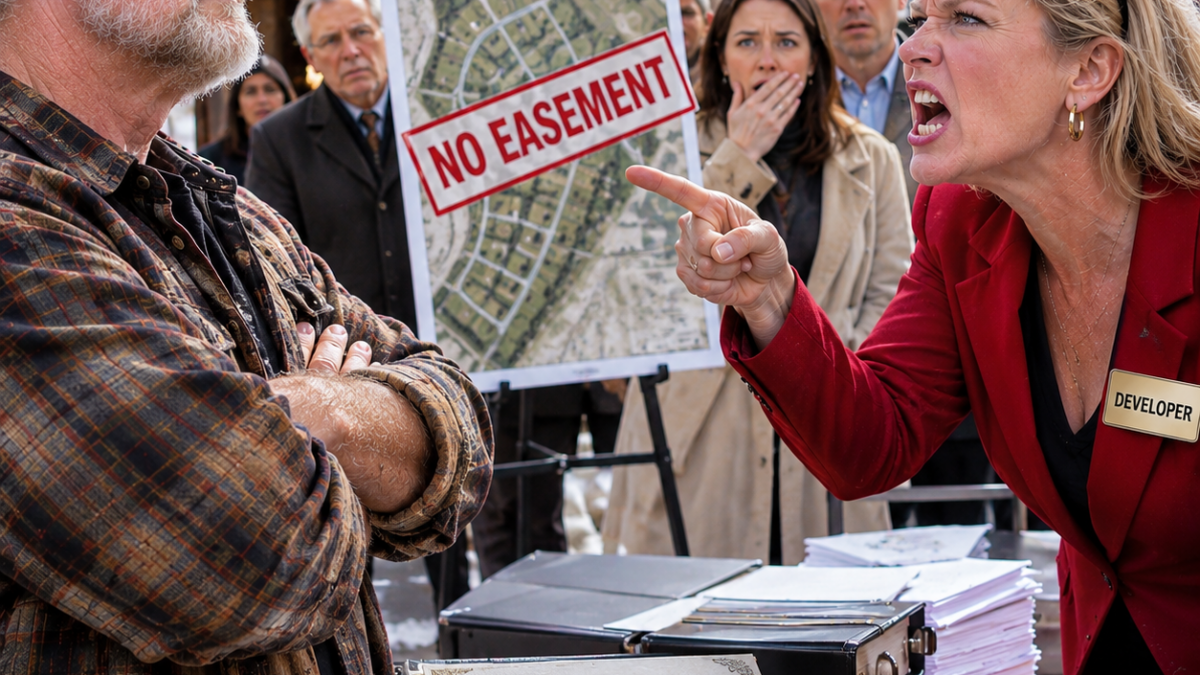
PART 2
I didn’t sleep much that night.
Not because I doubted my deed.
I had owned that land long enough to know where every corner monument sat, where the drainage swale crossed the north pasture, where the oak line turned toward County Road 9.
What kept me awake was the number twenty-three.
Twenty-three families.
Twenty-three mortgages.
Twenty-three sets of movers and utility transfers and children asking which bedroom would be theirs.
I had spent years avoiding neighborhood politics, and now a developer I barely knew had somehow arranged for me to become the man standing between twenty-three families and their front doors.
At 6:15 the next morning, I made coffee and walked down the lane.
The snow had stopped.
Juniper Lane on the other side of my steel gate looked almost picturesque beneath the streetlights.
A wreath hung from one of the new lamp posts.
Someone had wrapped red ribbon around the neighborhood entrance sign.
Nothing about it looked like the beginning of a property dispute that could tear apart an entire development.
I reached the gate and checked the chain.
Still locked.
For a second I considered opening it.
Just temporarily.
Let people through.
Avoid the confrontation.
Then I imagined how that would sound in court.
You opened the road.
They relied on that.
Residents began using it.
The association maintained it.
The developer promised it.
Maybe they would argue long use.
Reliance.
Emergency necessity.
Anything that transformed my temporary kindness into another piece of evidence against me.
I stepped back.
Merritt had said it clearly:
“Change nothing until we know exactly what rights exist.”
So I changed nothing.
At 7:32 my phone rang.
Vivien.
“Merry Christmas,” I said.
“This isn’t funny.”
“I didn’t say it was.”
“We have buyers scheduled to close this morning.”
“I know.”
“Then open the gate.”
“Show me the easement.”
“You’ve already been told the developer secured access.”
“Told isn’t recorded.”
She exhaled sharply.
“Calder, do you really want twenty-three families losing their homes because you’re angry about a strip of gravel?”
That hit exactly where she wanted it to.
“I’m not angry about gravel.”
“Then stop behaving like you are.”
“Did Dorian Kesler show your board a recorded easement?”
Silence.
“Vivien?”
“He told us access had been finalized.”
“That’s not what I asked.”
“Our attorney is handling this.”
“Good. Have your attorney send Merritt the instrument number.”
She hung up.
Ten minutes later, Merritt called.
“Don’t go to Harlo Title.”
“I wasn’t planning to.”
“I am.”
“Why?”
“Because the association’s attorney is preparing an emergency petition to force your gate open.”
“On what basis?”
“They’re still assembling it.”
“That sounds promising.”
“It usually means they’re trying to find a legal theory that matches a result they already want.”
I sat at the kitchen table.
“Can they get an emergency order?”
“Anything is possible if a judge receives only one side of a complicated story.”
“So what do we do?”
“I make sure the title company sees the chain before anyone signs.”
“What chain?”
“Your deed. Your survey. Their plat. Their sales contracts. Their marketing.”
She paused.
“And I ask a very boring question.”
“What?”
“Show me the easement.”
That was Merritt.
Other lawyers could turn a two-word dispute into forty pages.
She preferred the sentence that made everyone uncomfortable.
At 8:48 she texted me.
**I’m at Harlo. Stay available.**
Then nothing.
I tried drinking coffee.
Tried feeding cattle.
Tried checking the barn heater.
Every five minutes I looked at my phone.
At 9:21 it rang.
Merritt.
“What happened?”
She didn’t answer immediately.
I could hear voices behind her.
Lots of them.
Then:
“They stopped the closings.”
I gripped the phone.
“All of them?”
“All twenty-three.”
“Why?”
“You know why.”
“Say it.”
“There is no recorded easement across your parcel.”
I sat down on the edge of the feed bin.
“What did Dorian say?”
“He said the road existed.”
“That isn’t what I asked.”
“Exactly what I told him.”
Despite everything, I smiled.
Merritt continued.
“Janet Puit at Harlo Title searched every instrument associated with parcel seventeen for thirty years. No easement. No right-of-way. No access agreement in favor of Kesler Ridge.”
“What about the petition?”
“The association attorney closed his portfolio.”
I could almost see it.
“What happens now?”
“Now everyone discovers whether Dorian Kesler has another legal access route.”
“And if he doesn’t?”
“We start separating the people who caused this problem from the people who bought homes believing it was already solved.”
I walked outside.
The wind had picked up.
Snow slid from the barn roof in a soft sheet.
Across the pasture, beyond the trees, I could see the upper floors of Kesler Ridge.
Beautiful houses.
Half empty.
Waiting.
For the first time since Christmas Eve, I didn’t feel angry at the people behind my gate.
I felt sorry for them.
A little after noon, Grant Whitaker called.
I had given him my number the night before.
“We’re still at Harlo.”
“I heard.”
“My wife is crying.”
“I’m sorry.”
“They’re telling us nobody can close.”
“I’m sorry about that too.”
There was a pause.
“Did you know?”
“Know what?”
“That the developer didn’t have the easement.”
“I knew I never granted one.”
“Same thing.”
“No.”
I leaned against the fence post.
“That distinction matters. Maybe they had another right I didn’t know about. Maybe something was recorded before I bought. That’s why I hired Merritt to check. But nobody had ever shown me one.”
Grant breathed heavily.
“Dorian says you refused to cooperate.”
“Dorian called me last night.”
“He offered to buy the easement?”
“Yes.”
“How much?”
“That’s between him and me.”
“Did you refuse?”
“Yes.”
Grant’s voice rose.
“Then how is this not your fault?”
I let him finish.
His anger was understandable.
He had probably sold his old house.
Scheduled movers.
Taken time off work.
Maybe his family was living out of boxes.
“I refused to sell him something after he had already sold it to you.”
Silence.
I continued.
“If Dorian had come to me a year ago and said, ‘Calder, I’m building twenty-three homes and need legal access,’ we could have negotiated before anybody signed a purchase agreement.”
“He says you wouldn’t have.”
“He never asked.”
Grant said nothing.
I looked toward the gate.
“You paid him for access, Grant.”
“Yes.”
“I didn’t receive a dollar.”
Another long silence.
Then:
“I need to go.”
The call ended.
Two hours later, Merritt arrived at my farmhouse carrying three bankers’ boxes worth of photocopies and wearing the expression she got when paperwork had offended her personally.
“That bad?”
“Worse.”
We sat at the kitchen table.
She placed the preliminary Kesler Ridge plat in front of me.
There was my lane.
County Road 9.
My pasture.
Juniper Lane.
A dotted line crossed parcel seventeen.
Beside it:
**PROPOSED ACCESS.**
I tapped the words.
“Proposed.”
“Exactly.”
“Not existing.”
“No.”
“Not secured.”
“No.”
“So when did this get filed?”
“Almost two years ago.”
“Before most houses sold?”
“Yes.”
Merritt pulled out another page.
Blue handwritten note beside a drainage section.
**Need owner cooperation before final recording.**
I read it.
Then again.
“Whose handwriting?”
“Engineering consultant’s internal notes, apparently.”
“Can we prove Dorian saw it?”
“Not from this alone.”
“What can we prove?”
“That his project file recognized owner cooperation was required.”
“He knew.”
“His company knew.”
“That sounds like lawyer language.”
“It’s careful language.”
“He sold anyway.”
“Yes.”
She opened another folder.
“The engineering consultant’s cover letter went to Kesler Ridge Development’s legal department.”
“So legal knew.”
“They received the file. We’ll need more before saying what individual lawyers understood.”
I pushed the paper away.
“Twenty-three families.”
Merritt watched me.
“I know.”
“I don’t want them losing their homes.”
“Then what do you want?”
The question surprised me.
Until then, I had been reacting.
Close gate.
Answer letter.
Call attorney.
Protect deed.
I hadn’t thought past winning.
“I want them to know what they bought.”
“Good.”
“I want Dorian to stop pretending I caused this.”
“Also good.”
“And if that road eventually opens…”
She waited.
“…I want it real.”
“What does real mean?”
“Surveyed.”
She nodded.
“Recorded.”
Another nod.
“Defined width. Maintenance. Snow removal. Liability. Residential use. Emergency access.”
“Anything else?”
“Compensation.”
“Good.”
“And construction traffic stays off it unless there’s a separate agreement.”
“Very good.”
I looked toward the window.
“I’m not trying to get rich.”
“Fair compensation isn’t getting rich.”
“I know.”
“Do you?”
I looked at her.
“You’re about to tell me something.”
“Yes.”
She folded her hands.
“Do not punish yourself financially because somebody put innocent families between you and the developer.”
I said nothing.
“That is exactly why developers create urgency. It changes negotiation from ‘What is this right worth?’ to ‘How can you charge money when children need their homes?’”
“That sounds cold.”
“It’s supposed to. Good contracts are often what keep emotional pressure from becoming permanent property rights.”
My phone buzzed.
Vivien.
Merritt glanced at the screen.
“Answer.”
I put it on speaker.
“Calder.”
“Vivien.”
“We need to meet.”
“About?”
“The road.”
“Is Dorian coming?”
“No.”
That interested both of us.
“Where?”
“County Line Diner.”
“When?”
“Tomorrow. Noon.”
“I’ll be there.”
She hesitated.
“Calder?”
“Yes?”
“I think I owe you part of an apology.”
Merritt raised an eyebrow.
“Save it for tomorrow.”
Vivien hung up.
Merritt leaned back.
“That was fast.”
“She believed Dorian.”
“Maybe.”
“You don’t?”
“I think she also liked believing him.”
“What’s the difference?”
“One makes her mistaken.”
Merritt packed the documents.
“The other makes her useful.”
At noon the next day, Vivien sat in the back booth of County Line Diner with tea untouched in front of her.
She looked different without the HOA board around her.
Smaller somehow.
Not weak.
Just human.
I slid into the booth.
“You wanted to talk.”
She stared at her cup.
“Do you intend to keep the gate closed forever?”
“No.”
She looked up quickly.
“No?”
“I intend to keep it closed until a legal right exists.”
“That sounds like the same thing.”
“It isn’t.”
“If Dorian won’t pay?”
“Then there’s nothing to negotiate.”
“What about the homeowners?”
“What about them?”
“They need access.”
“They need the developer to provide what he sold them.”
Her jaw tightened.
“You know he’s saying this is your fault.”
“I know.”
“He says he offered you fair money.”
“He called after selling twenty-three contracts.”
“How much did he offer?”
“I’m not discussing it.”
Vivien looked out the window.
“He told us you were impossible.”
I waited.
“He said you were a recluse.”
“Not entirely wrong.”
“He said you hated the subdivision.”
“I barely thought about the subdivision.”
“He said you’d refuse any deal just to prove nobody could tell you what to do.”
“That sounds more dramatic than I am.”
She smiled despite herself.
Then the smile disappeared.
“He told us access was secured.”
“That part matters.”
“I stood at your gate and threatened you.”
“Yes.”
“I left that letter on your porch Christmas morning.”
“Yes.”
“I told neighbors you were hurting property values.”
“Yes.”
“You could enjoy this a little less.”
“I’m trying.”
That earned a small laugh.
Then she became serious.
“Why didn’t you just explain everything that first night?”
“I did.”
“No. You said, ‘Show me the easement.’”
“Because that was everything.”
She stared.
I continued.
“You didn’t need my biography. You didn’t need to know whether I liked Kesler Ridge. You didn’t need to know whether Dorian lied. Either a right to cross my property existed or it didn’t.”
She looked down.
“The board adopted a maintenance budget.”
“For my road?”
“Yes.”
“You budgeted for maintaining something you didn’t control.”
Her face reddened.
“When Dorian delivered the community documents, the north road was shown as permanent access.”
“Did anyone ask for the recorded easement?”
“No.”
“Why?”
“Because we trusted him.”
There it was.
The entire disaster in four words.
Vivien pushed her tea away.
“If we negotiate directly, will you deal with the association instead of Dorian?”
“No.”
Her face tightened again.
“Why?”
“Because Kesler Ridge Development created the obligation and collected money from buyers.”
“You know that?”
“Merritt’s checking.”
Vivien became very still.
“What money?”
“I don’t know yet.”
That evening, Norah Ellison answered the question.
She sent Merritt an email chain accidentally left attached beneath a message from a sales coordinator.
The critical line came from Dorian Kesler’s account.
Three weeks before Christmas.
**Do not discuss the easement issue with buyers until after closing.**
Merritt forwarded it to me.
I read it at my kitchen table.
Three times.
This was no misunderstanding.
Not anymore.
Dorian knew there was an easement issue before Christmas.
Knew while buyers were preparing to close.
Knew while his brochures said guaranteed access.
Knew while his promotional video called it permanent.
And instead of fixing it before closing, he told staff to wait until after the money changed hands.
The next meeting happened at Harlo Title.
Dorian arrived with in-house counsel.
I sat at the far end of the table.
Vivien stood at the front.
She held the email in a clear sleeve.
“Did you know there was no easement?”
Dorian removed his gloves.
“Vivien, I don’t know what Calder’s attorney has been telling you—”
“This came from your account.”
She slid it down the table.
His attorney picked it up.
Read it.
The room quieted.
Vivien said:
“Read it aloud.”
The attorney didn’t.
Grant did.
“Do not discuss the easement issue with buyers until after closing.”
He looked at Dorian.
“What easement issue?”
Dorian sat.
“The access was being finalized.”
Vivien’s voice shook.
“You told us it was finalized.”
“The distinction is technical.”
“No.”
Merritt finally spoke.
She didn’t stand.
“It is the entire distinction.”
Dorian looked toward her.
Merritt continued.
“You cannot advertise guaranteed legal access while your own project documents identify that access as proposed and dependent on owner cooperation.”
Dorian looked at me.
“There is an existing road.”
“My road.”
“It has historically existed.”
“On my land.”
“Access needs can create legal rights under certain circumstances.”
Merritt said:
“Then identify the right.”
Dorian’s attorney touched his sleeve.
He ignored it.
“You’re holding an entire development hostage.”
I leaned forward.
“No.”
Twenty heads turned.
“You sold a road before buying the right to use it.”
“That’s a cute line.”
“It’s also accurate.”
“I offered you substantial compensation.”
“After you sold it.”
“You refused.”
“Yes.”
He stood.
“Everybody has a price, Calder.”
I looked around the table.
Grant.
Norah.
Vivien.
Janet from Harlo Title.
Loan officers.
People who had spent Christmas wondering whether they could move into their homes.
Then back at Dorian.
“That’s your problem.”
“What?”
“You think every no is just a number you haven’t increased yet.”
His face hardened.
“You enjoy this.”
“No.”
I meant it.
Nothing about twenty-three families stuck in closing felt enjoyable.
“I wanted Christmas morning with coffee and cattle. You put me in this room.”
Dorian spread his hands toward the buyers.
“Then tell them why you won’t help.”
That was clever.
Put the pressure back on me.
I looked at the homeowners.
“I’ll help.”
Dorian stopped.
Vivien blinked.
Grant leaned forward.
I continued.
“If Kesler Ridge needs lawful residential access across my lane, I’m willing to negotiate an easement.”
A murmur spread.
Dorian smiled.
“Excellent.”
“Not with a brochure.”
His smile thinned.
“Professional survey.”
Merritt started taking notes.
“Exact width and route.”
I counted on my fingers.
“Residential and emergency use defined. Maintenance responsibility. Snow removal. Drainage. Liability. My cattle crossings protected. My ownership of the land underneath unchanged. No commercial construction traffic unless separately approved.”
Dorian sat back.
“And price.”
“Yes.”
“How much?”
“Independent appraisal.”
He laughed.
“Convenient.”
“It keeps you from claiming I extorted you.”
Merritt added:
“And it keeps Mr. Voss from having to accept whatever number a developer with twenty-three stalled closings chooses under duress.”
Dorian looked toward the buyers.
“We can resolve this.”
“Good,” I said.
“Then open the gate today.”
“No.”
His smile disappeared.
“We just agreed.”
“We agreed to negotiate.”
“The homes cannot wait.”
“Then you should have negotiated two years ago.”
His chair scraped backward.
“This meeting is over.”
At the door, he stopped.
“I’ll send a final proposal tomorrow.”
He wasn’t looking at me.
He was looking at Vivien.
That told me who the proposal was designed to pressure.
It arrived at her house the next morning.
She called Merritt before she called me.
Dorian wanted the HOA to take responsibility for the access dispute.
The association would fund litigation against me through a special assessment.
The association would accept responsibility for the north road.
Kesler Ridge Development would receive a release from claims connected to the missing access right.
In exchange, residents would get dues credits and a promised pool completion by summer.
It was breathtaking.
He had sold access he didn’t own.
Now he wanted the buyers to pay lawyers to force me to provide it.
Vivien brought the proposal to my farmhouse that afternoon.
She looked furious.
“He thinks I’m going to do this.”
“Were you?”
“A week ago?”
She sat down.
“Yes.”
I appreciated the honesty.
She handed the pages to Merritt.
“What should we do?”
Merritt looked at me.
“This isn’t my association.”
Vivien nodded.
“I’m asking both of you.”
I poured coffee.
“First, figure out what he told you.”
“We have the board packets.”
“All of them?”
“Yes.”
“Contracts?”
“Some.”
“Budgets?”
“Yes.”
“Closing statements?”
“Homeowners have those.”
Merritt looked interested.
We met at the Kesler Ridge clubhouse that afternoon with the association’s attorney present.
That mattered to Merritt.
She wanted no one claiming later that she had secretly manipulated an adverse party.
Files covered the conference table.
Board budgets.
Developer presentations.
Maintenance projections.
Purchase contracts residents volunteered.
Closing statements from homes already completed.
Vivien found the line first.
“Access infrastructure contribution.”
Amounts varied.
One household paid a little over nine thousand.
Another more than eleven.
Another slightly less.
We totaled the samples.
Then projected across the development.
Several hundred thousand dollars had been collected under a line associated with access infrastructure.
Vivien looked pale.
“He charged them for the road.”
Merritt corrected her.
“He charged buyers something described as access infrastructure contribution.”
“He didn’t pay Calder.”
“No.”
“He didn’t buy an easement.”
“No.”
“So where did it go?”
“That is a question for Kesler Ridge Development.”
Vivien covered her face.
“This gets worse every hour.”
“Yes.”
That night she called an emergency HOA meeting.
I stood near the back.
Christmas lights still hung from the ceiling.
A tree stood in the corner.
Half the decorations looked painfully cheerful against the tension in the room.
Vivien stepped to the front.
No speechwriter.
No polished confidence.
“I owe you the truth.”
People quieted.
“Our board relied on the developer’s representation that permanent north access had been secured.”
A man shouted:
“You told us it was!”
“I know.”
She didn’t defend herself.
“We never asked to see the recorded easement.”
Murmurs.
“We should have.”
She held up Dorian’s proposal.
“He now wants this association to fund litigation against Mr. Voss to force access across his private property.”
The room erupted.
“Can we win?”
“What happens to our closings?”
“Who pays?”
Vivien raised her voice.
“I will not recommend that we sue a man for land he never sold us.”
A man in the second row stood.
“Then what do we do, Vivien? My daughter and son-in-law sold their home already.”
“I know.”
“You’re going to let one farmer ruin everyone?”
That was when Merritt stepped forward.
She displayed the preliminary plat.
**PROPOSED ACCESS.**
Then the engineering note.
**Need owner cooperation before final recording.**
Then Dorian’s email.
**Do not discuss the easement issue with buyers until after closing.**
Then the contracts.
Guaranteed access on the front.
Third-party rights disclaimer in the back.
Then the access infrastructure contributions.
By the time she finished, people were no longer looking at me.
They were looking at Dorian’s empty chair.
Vivien called me forward.
I hated public speaking.
Still do.
I walked only as far as the first row.
“I’m not against anybody who bought a home here.”
The room stayed quiet.
“I’m against somebody selling rights across my property without asking me.”
I looked at the man whose daughter had already sold her home.
“If you need access, I’m willing to sign a real easement.”
He frowned.
“Then why is the gate locked?”
“Because a real easement doesn’t exist yet.”
“When?”
“As fast as lawyers, surveyors, title people, and the developer can put one together honestly.”
“Who pays?”
“The person who caused the problem.”
Vivien looked at me.
“Kesler Ridge Development.”
“Yes.”
The man sat down.
An hour later, Dorian’s attorney responded.
No.
The developer would not pay for the easement.
Would not pay my compensation.
Would not pay survey or recording costs.
Would not reimburse buyers.
The letter reminded everyone that the temporary haul road closed December 31.
A deadline.
That was Dorian’s strategy.
Let the calendar do the threatening.
December 27.
December 28.
Snow.
Families in hotels.
Mortgages frozen.
The road closing.
He believed somebody would break.
Then Harlo Title found another problem.
Owen Starling, senior counsel, called Merritt.
Appraisals.
Several homes had been valued partly on the basis of guaranteed private access from the main road.
Access that did not legally exist.
Two lenders suspended funding pending review.
Now Dorian had a bigger problem.
This was no longer a farmer versus a developer.
Lenders were asking questions.
Title insurers were asking.
Appraisers were asking.
Buyers had attorneys.
The HOA had outside counsel.
Merritt spent December 29 assembling everything on the long conference table at Harlo Title.
She invited me.
I arrived carrying nothing.
She pointed at the table.
“Your land has generated enough paper.”
In one line:
My deed.
My survey.
Thirty-year title search.
Preliminary plat.
Engineering note.
Brochures.
Promotional transcript.
Purchase contracts.
Third-party-rights disclaimer.
Access charges.
Dorian’s email.
Loan documents.
Appraisals.
When documents sit separately, people can explain them.
Put them side by side and explanations become harder.
Dorian arrived that evening.
No promotional smile.
Vivien asked him three questions.
“Do you own parcel seventeen?”
“No.”
“Do you hold a recorded easement over it?”
“No.”
“Did you send this email?”
She held it up.
He read it.
“Yes.”
Nobody shouted.
That surprised me.
The room simply went still.
Vivien asked:
“Why?”
Dorian looked exhausted.
“Because access negotiations were ongoing.”
“With whom?” I asked.
He looked at me.
“You.”
“No.”
His attorney whispered something.
Dorian’s jaw tightened.
“You were always going to be approached.”
“That isn’t negotiation.”
“We had every reason to believe access would eventually be secured.”
“Eventually is not guaranteed.”
He looked toward Merritt.
She said nothing.
He turned toward the buyers.
“We can still solve this.”
Grant stood.
“I want my hotel costs reimbursed.”
Norah stood beside him.
“I want my appraisal fee.”
Another buyer:
“I want the purchase price reconsidered.”
Another:
“I want the access guarantee removed unless it’s real.”
Dorian’s face tightened with every demand.
I watched him.
Until then, he had treated the buyers as pressure directed at me.
Now the pressure turned around.
That was the first moment I felt the balance change completely.
Not revenge.
Consequences.
Vivien asked if I wanted to speak.
I stood.
“I don’t want anybody losing their home.”
I looked around.
“I also don’t want anybody buying a home based on a road that legally belongs to somebody else.”
Then I looked at Dorian.
“You can fix this.”
His expression was unreadable.
“Pay what it costs to create the right you already sold.”
Negotiations started that night.
They went until after midnight.
Licensed surveyor.
Title counsel.
HOA counsel.
Kesler Ridge counsel.
Merritt.
Owen Starling.
Me.
The proposed easement followed my existing lane.
No additional land beyond what was necessary.
Fixed width.
Residential ingress and egress.
Emergency vehicles.
Utility repair where specifically necessary.
No general commercial staging.
No construction convoy rights.
HOA responsible for snow removal and routine road maintenance after turnover.
Drainage obligations defined.
Any future widening required separate written consent.
My fences remained mine.
My cattle crossing remained protected.
My right to use every part of the property remained intact.
The easement burdened the land.
It did not transfer ownership.
By two in the morning, there was one unresolved question.
Who paid?
Dorian’s attorney suggested a three-way split.
Developer.
HOA.
Me.
Merritt stared at her notes.
I almost admired her restraint.
I said:
“No.”
The lawyer leaned forward.
“Mr. Voss, everyone is compromising.”
“I am.”
“You’re receiving compensation.”
“For a permanent legal burden.”
“The homeowners are taking maintenance.”
“Good.”
“The developer is willing to contribute.”
“Contribute?”
I looked at Dorian’s attorney.
“Your client collected money from buyers to secure access.”
He didn’t answer.
“Your client’s engineer wrote that owner cooperation was necessary.”
Silence.
“Your client sold homes anyway.”
Silence.
“Your client told staff not to discuss the issue until after closing.”
Silence.
I slid the draft back.
“The buyers didn’t create this.”
I looked at Vivien.
“The HOA made mistakes. But it didn’t create the original promise.”
Then at Merritt.
“And I definitely didn’t.”
Finally back to Dorian’s counsel.
“Kesler Ridge Development pays.”
He asked for a recess.
Twenty minutes later he returned.
His face told us the answer before he spoke.
“Developer accepts.”
I didn’t smile.
I didn’t cheer.
I just breathed.
The final agreement was signed December 30.
Kesler Ridge Development paid for the survey.
Legal preparation.
Title work.
Recording fees.
Independent appraisal.
My compensation.
Buyer reimbursements tied to the delayed closings.
The HOA accepted future maintenance obligations.
The buyers received the access they had paid to receive.
And I retained ownership of all sixty-two acres, including the dirt beneath the lane.
At eleven that morning, Merritt carried the easement to the courthouse.
I went with her.
The clerk stamped it.
Book.
Page.
Instrument number.
The sound of that stamp was not dramatic.
Just a dull mechanical thump.
But I had never heard anything more satisfying.
Merritt handed me a certified copy.
“There.”
I looked at the recording information.
“So now it exists.”
“Now it exists.”
Not because Dorian said so.
Not because a brochure said guaranteed.
Not because Vivien threatened me.
Not because thirty people stood in snow at Christmas.
Because the owner had granted a defined right.
Signed.
Notarized.
Recorded.
That afternoon, Dorian signed the settlement.
He sat at the Harlo Title table looking older than he had in the promotional video.
When he finished, he capped his pen.
“I should have secured the easement before selling the houses.”
No one answered immediately.
I finally said:
“Yes.”
He looked at me.
“That’s it?”
“What do you want?”
“I don’t know.”
“An argument?”
He almost smiled.
“No.”
“That should have happened from the beginning.”
He nodded once.
I put on my coat.
Outside, Vivien caught up with me.
Snow had begun falling over the courthouse lawn.
Christmas lights were still wrapped around the trees.
“Calder.”
I stopped.
She stood beside me.
“For what it’s worth, I really thought you were trying to hurt us.”
“I know.”
“I thought Dorian had bought access and you were using a technicality.”
“I know.”
“I called you selfish.”
“Several times.”
“That too.”
She looked toward Harlo Title.
“On Christmas Eve, I was ready to take you to court.”
“You threatened that on Christmas morning.”
She winced.
“I did.”
I waited.
“I’m sorry.”
She held out her hand.
I looked at it.
Then shook it.
“I thought you were trying to take my land.”
“I was trying to force the gate.”
“Same feeling from my side.”
She nodded.
“Maybe we were both told different stories.”
“No.”
She looked at me.
“You were told the wrong story.”
I released her hand.
“I was standing on the land.”
That made her laugh softly.
It was the first time I heard anything warm in it.
We walked back inside.
Janet Puit had reopened the closing files.
Grant and his wife were first.
Before he signed, he looked at me.
“You sure?”
“About what?”
“The easement.”
I held up the certified copy.
“Recorded this morning.”
He stared at the instrument number.
Then laughed.
“I’ve never been so happy to see a bunch of numbers.”
“Neither have I.”
His wife signed.
Then him.
Norah followed.
Then another family.
And another.
One by one, the homes started closing.
Not on promises.
On recorded rights.
Late that afternoon, I drove home.
The steel gate stood closed.
I parked at the farmhouse and walked the lane.
Fresh snow crunched beneath my boots.
On the far side, several homeowners waited.
Grant.
Norah.
The young father with the little girl in the red hat.
The girl recognized me.
“Are you opening it now?”
Her father looked embarrassed.
“Sorry.”
I smiled.
“Yes.”
I took the key from my coat.
The padlock felt cold in my hand.
I turned it.
The lock opened.
I removed the chain.
Then swung the gate toward the fence post.
The hinges creaked.
I fastened it open.
No one rushed through.
That surprised me.
They just stood there.
Grant finally said:
“Feels different.”
“It is.”
Norah held up her closing folder.
“We actually have it now.”
“Yes.”
The little girl stepped close to the edge of the lane.
“Can we go home?”
Her father squeezed her hand.
“Yeah.”
I stepped aside.
“Go home.”
Their SUV came through first.
Grant lifted a hand from the wheel.
Norah followed.
Then the young family.
The girl waved through the back window.
I waved back.
I stood by the open gate while headlights moved down my lane toward County Road 9.
For the first time, strangers were legally crossing my property.
I thought I would resent it.
Instead I felt relieved.
Because they weren’t strangers with somebody else’s promise anymore.
They were neighbors with a defined right.
That mattered.
The temporary haul road closed December 31 exactly as scheduled.
Nobody cared.
Kesler Ridge had permanent access now.
Real access.
Over the next few weeks, the consequences for Dorian continued.
Buyers demanded reimbursement.
Lenders reviewed the project’s representations.
Kesler Ridge Development had to correct marketing materials.
The words **GUARANTEED PRIVATE ACCESS** disappeared from brochures until the new easement had been recorded.
Several buyers renegotiated terms because their original appraisals relied on representations that were not true when made.
I didn’t follow every legal claim.
Merritt told me not to.
“This part belongs to them.”
“Who?”
“Buyers and developer.”
“I’m curious.”
“Curiosity is expensive.”
That was probably lawyer humor.
I stayed out.
I had what mattered.
My ownership.
A recorded easement with limits.
Compensation.
A gate that no longer represented a war.
Vivien changed too.
I expected her apology to last until the first inconvenience.
Instead, she surprised me.
The HOA hired an independent attorney to review every property right connected to the community.
No more relying on developer summaries.
They reviewed maintenance obligations.
Storm drainage.
Utilities.
Common areas.
Emergency access.
At the next HOA meeting, Vivien invited me.
“I’m not a member.”
“I know.”
“Then why?”
“We’re discussing lane maintenance.”
“That I care about.”
“Exactly.”
I attended.
For the first time, I entered the Kesler Ridge clubhouse.
The building was decorated with framed architectural renderings.
One old rendering showed the north access.
My lane.
Painted like subdivision pavement.
I stopped in front of it.
Vivien came beside me.
“I asked them to take that down.”
“Why?”
“Because it makes me angry now.”
I studied it.
“Leave it.”
She looked surprised.
“Why?”
“It reminds people why paperwork matters.”
She smiled.
“Your lawyer has infected you.”
“No. I was already like this.”
The HOA contracted snow removal.
I insisted plows stay within the easement.
They did.
Maintenance crews fixed two potholes near the back gate.
They notified me first.
That shouldn’t have felt extraordinary.
But after Christmas Eve, simple permission felt almost luxurious.
The first problem came in February.
A contractor working on one of the unfinished homes tried to route a heavy concrete truck across the lane.
I stepped outside.
Stopped him before the gate.
“Residential and emergency only.”
The driver showed me a work order.
“Site manager says this is the access.”
“Not for construction traffic.”
He called his dispatcher.
Ten minutes later, Dorian’s project manager called me.
“Calder, it’s one truck.”
“No.”
“It’ll save forty minutes.”
“No.”
“The road can handle it.”
“That’s not the issue.”
He sounded irritated.
“You really enjoy the word no.”
“I enjoy contracts people actually read.”
He hung up.
The truck turned around.
That was the beauty of a real agreement.
No argument needed.
Paragraph.
Definition.
Done.
Spring came.
Snow melted.
The lane turned muddy.
Kesler Ridge residents began using it every day.
At first, I noticed every vehicle.
Then fewer.
Eventually, headlights passing my farmhouse became background noise.
People slowed.
Most waved.
Grant stopped occasionally.
Norah brought me blueberry muffins one Sunday.
I told her the easement did not require baked goods.
She said:
“Maintenance contribution.”
I accepted.
The little girl in the red hat was named Sophie.
In summer, she rode past with her father and shouted from the back seat:
“Hi, road man!”
Her father looked horrified.
I laughed for ten minutes.
Vivien called me that night.
“I’m so sorry.”
“Best title anybody’s given me.”
She laughed too.
Those small things mattered.
Because Christmas Eve had almost turned us into permanent enemies.
Dorian’s lies depended partly on that.
If homeowners hated me, pressure increased.
If I hated homeowners, negotiation became harder.
Fear is efficient when it keeps people from talking directly.
Once we did, the whole structure weakened.
Grant told me months later:
“I thought you were rich.”
“Why?”
“Dorian said you were holding out for millions.”
I almost dropped my coffee.
“What?”
“At closing.”
“He said that?”
“Not directly. He said the landowner had unrealistic expectations and was trying to exploit the situation.”
“I never gave him a number.”
Grant frowned.
“Seriously?”
“Seriously.”
“He made it sound like you wanted some insane payout.”
“Merritt proposed independent appraisal.”
Grant stared.
“That’s what we ended up using.”
“Yes.”
He shook his head.
“I spent Christmas night hating you.”
“I noticed.”
“My wife told me not to go back to your gate.”
“She sounds smart.”
“She is.”
He looked embarrassed.
“I’m sorry.”
“We’re past it.”
“I’m not.”
I understood.
Sometimes apologies are for the person giving them.
“All right.”
I held out my hand.
“We’re past it now.”
He shook it.
The legal fallout around Kesler Ridge Development took longer.
Merritt occasionally forwarded public filings if they affected my easement.
Several buyers filed claims based on misrepresentation.
The developer’s lender demanded revised disclosures.
The sales department stopped using phrases like “guaranteed access” unless title counsel had verified them.
Dorian remained involved in the project for a while, but his reputation in Asheford County changed.
People checked.
That was his real consequence.
Before Christmas, Dorian could walk into a room and say:
“Handled.”
And everyone relaxed.
Afterward, people asked:
“Recorded where?”
“Signed by whom?”
“Instrument number?”
It is hard to quantify the value of unquestioned confidence until it disappears.
One afternoon, nearly a year later, Dorian drove to my farmhouse.
Alone.
No attorney.
No project manager.
He parked outside the gate to my yard.
Not the access gate.
My smaller private gate near the house.
He waited.
I walked out.
“Need something?”
He looked toward the lane.
“Just wanted to see it.”
“The road?”
“Yes.”
“Why?”
He shrugged.
“Cost me a lot.”
“Cost other people more.”
He nodded.
For the first time, I didn’t see the polished developer from the videos.
I saw a tired man.
“I thought you’d sell eventually.”
“That was obvious.”
“I’d built developments before. Access problems get solved.”
“They did.”
“Usually with money.”
“Money works better before you sell the thing.”
He smiled without humor.
“Yes.”
We stood there.
Finally he said:
“I told myself we were helping the county grow.”
“Maybe you were.”
He looked surprised.
“I don’t think growth was the problem.”
“What was?”
“You started treating the future as if it already belonged to you.”
He looked toward Kesler Ridge.
“Fair.”
I didn’t expect that.
He continued.
“Do you hate me?”
“No.”
“Why not?”
“Too much work.”
That made him laugh.
Then he grew serious.
“I’m sorry.”
“For?”
“Putting you in that position.”
“That’s broad.”
“For selling access before I secured it.”
Better.
“For telling buyers not to ask until after closing.”
Better still.
“For letting them blame you.”
That one mattered most.
I nodded.
“Thank you.”
He looked toward the private yard gate.
“You’re not going to invite me in?”
“No.”
He laughed again.
“Still Calder Voss.”
“Still my gate.”
He left.
I never became his friend.
I didn’t need to.
Not every story ends with reconciliation.
Sometimes accountability is enough.
Vivien remained HOA president through the following year.
She changed the way meetings worked.
Board packets included source documents instead of developer summaries.
Any property claim required a recorded reference.
Maintenance budgets had to identify who owned whatever was being maintained.
Those rules sounded painfully obvious.
Most useful rules do after somebody breaks them.
At the next Christmas party, I received an invitation.
I stared at it for two days.
Merritt called.
“You’re going.”
“How do you know?”
“Vivien told me you’re being difficult.”
“I’m not an HOA member.”
“You can attend a party without joining.”
“Dangerous precedent.”
“Calder.”
“What?”
“Go eat free food.”
So I went.
The clubhouse was warm.
Christmas lights.
Music.
Kids running everywhere.
The first thing I saw was Sophie.
No red hat this year.
She pointed.
“Road man!”
Everyone within twenty feet turned.
Grant covered his face.
I laughed.
Vivien brought me cider.
“Welcome to Kesler Ridge.”
“I’m visiting.”
“Yes, Calder.”
“Important distinction.”
“I know.”
She pointed toward the wall.
The old watercolor rendering still hung there.
The road across my property painted seamlessly into the community.
Below it, someone had mounted a small framed copy of the recorded easement cover page.
Book.
Page.
Instrument number.
I looked at Vivien.
“You did this?”
“Board voted.”
“Why?”
“So when somebody asks what changed, we can show them.”
The rendering was promise.
The easement was reality.
Side by side.
I liked that more than I expected.
Grant raised a glass.
“To Calder.”
I immediately said:
“No.”
Too late.
People turned.
Vivien laughed.
Grant continued.
“To the man who ruined Christmas for twenty-four hours and saved us from signing bad paperwork for thirty years.”
I pointed at him.
“That first half was unnecessary.”
People laughed.
Even me.
Then Norah said:
“He’s right.”
The room quieted slightly.
“If those closings had gone through without legal access, imagine what would’ve happened later.”
She looked toward me.
“We were angry because Calder forced the question before we signed.”
I shook my head.
“Harlo Title forced the question.”
“Merritt forced Harlo.”
Merritt, across the room, lifted her cider.
“I prefer that version.”
More laughter.
I looked around.
A year earlier, many of these people had stood in snow outside my gate convinced I was their enemy.
Now we were joking about it.
That felt like the ending.
But land stories don’t really end.
Documents outlive arguments.
The easement stayed.
So did my ownership.
Kesler Ridge matured.
Trees grew.
Construction finished.
The temporary haul road disappeared into farmland.
Residents changed.
Some sold.
New buyers arrived.
Their title reports showed the easement clearly.
Nobody had to rely on Dorian’s brochure.
Every new closing contained an instrument number.
Every lender could verify it.
Every buyer could see the road burdened my parcel while ownership remained mine.
Exactly how it should have been from the start.
Years later, I sold a small section of timber from the western edge of my acreage.
The buyer’s forester asked about access.
I showed him the recorded easement.
He studied the terms.
“Construction trucks prohibited?”
“Through the Kesler route.”
“How do we haul?”
“County Road 9 side.”
He nodded.
No fight.
No confusion.
That small exchange satisfied me almost embarrassingly.
A document doing its boring job.
Merritt retired several years after the dispute.
I attended her retirement dinner.
She hated speeches as much as I did.
When it was my turn, I stood.
“I called Merritt on Christmas morning.”
She shouted from her seat:
“Still haven’t forgiven you.”
People laughed.
“She answered by saying somebody better be trying to steal my land.”
“That part is true.”
“And she spent the next week proving nobody had.”
Merritt shook her head.
“You proved it. You kept the deed.”
“I hired you.”
“Which was wise.”
“That was the whole speech.”
I sat down.
Afterward she handed me an envelope.
Inside was a copy of the first certified easement.
The one recorded December 30.
“You already have copies,” she said.
“I know.”
“Keep another.”
“Why?”
“Because the only thing better than one recorded document is knowing where three copies are.”
That was very Merritt.
I framed that one.
Not because I worship paperwork.
Because I remembered what existed before it.
Nothing.
Promises.
Maps.
Marketing.
Pressure.
After it:
Rights.
Limits.
Responsibilities.
A road can look identical before and after an easement.
Same gravel.
Same turns.
Same trees.
But legally, they are different worlds.
That understanding stayed with me.
Years later, another developer contacted me about utility access.
He came to the farmhouse with a surveyor and a proposed agreement.
Before discussing money, he placed the document on my table.
“We need a thirty-foot temporary construction easement for six weeks.”
I almost smiled.
“Recorded?”
“If you agree.”
“Compensation?”
“Independent appraisal if you prefer.”
“Restoration?”
“Section nine.”
I read it.
He waited.
No threats.
No brochures.
No promises to strangers.
Just an ask.
I signed after Merritt’s successor reviewed it.
The project happened.
They restored the ground.
The easement expired.
Nobody made a story out of it.
That was the lesson Dorian should have learned before Kesler Ridge existed.
Most property disputes are preventable when people ask before acting.
One December evening, years after Christmas Eve, snow began falling heavily again.
I walked down the lane.
The oak branches were white.
My red barn looked almost black against the snow.
Headlights approached from Kesler Ridge.
A car slowed.
The driver waved.
I waved back.
The gate between Juniper Lane and my property had been replaced.
The old steel one still worked, but years of weather had taken their toll.
The new gate stayed open for normal easement traffic.
A separate smaller gate protected my private farmyard.
I stopped beside the post.
For a moment, I could see Christmas Eve again.
Eleven cars.
Thirty people.
Vivien in her camel coat.
Grant holding papers.
Sophie in her red hat.
A contract pushed through bars.
**Buyer shall have guaranteed access.**
Back then, those words looked powerful.
They weren’t.
They were a promise made by someone who lacked the right to keep it.
What mattered was what eventually replaced them.
A surveyed strip.
Defined rights.
My signature.
Recording stamp.
Book.
Page.
Instrument number.
A car came down the lane.
Grant.
Older now.
He stopped beside me and rolled down the window.
“You planning to close the gate?”
“No.”
“Good. I left my purchase contract at home.”
“Wouldn’t help you.”
He laughed.
“Still miserable.”
“Still trespassing emotionally.”
“See you tomorrow.”
He drove toward County Road 9.
I continued to the farmhouse.
Snow collected on my shoulders.
From the porch, I could see Kesler Ridge lights through the trees.
Once, I thought those lights represented people trying to take something from me.
For a while, those families thought my locked gate represented a man trying to take their homes from them.
Neither picture had been completely true.
The real problem had been simpler.
Somebody had promised both sides a future built on a right that did not exist.
The developer thought he could secure it later.
The HOA assumed it had already been secured.
The buyers trusted the contract.
I trusted my deed.
Only one of those things described reality on Christmas Eve.
The deed.
I went inside.
On the wall near my desk hung Merritt’s framed copy of the easement.
Next to it, my original survey.
Not because I expected another fight.
Because after everything, I liked seeing the story in two documents.
One showed what I owned.
The other showed what I later chose to grant.
That distinction was the entire point.
Ownership first.
Permission second.
Never the other way around.
Outside, another set of headlights moved down the lane.
No one stopped at the gate.
No one argued.
No one held up a brochure.
No one asked whether the developer had promised anything.
They didn’t need to.
The right was there.
On paper.
In the county books.
Exactly where it should have been from the beginning.
[END OF STORY]








