PART 2: Both of His Front Legs Were Broken—But the Cat Who Crawled Through Garbage Refused to Stay Invisible
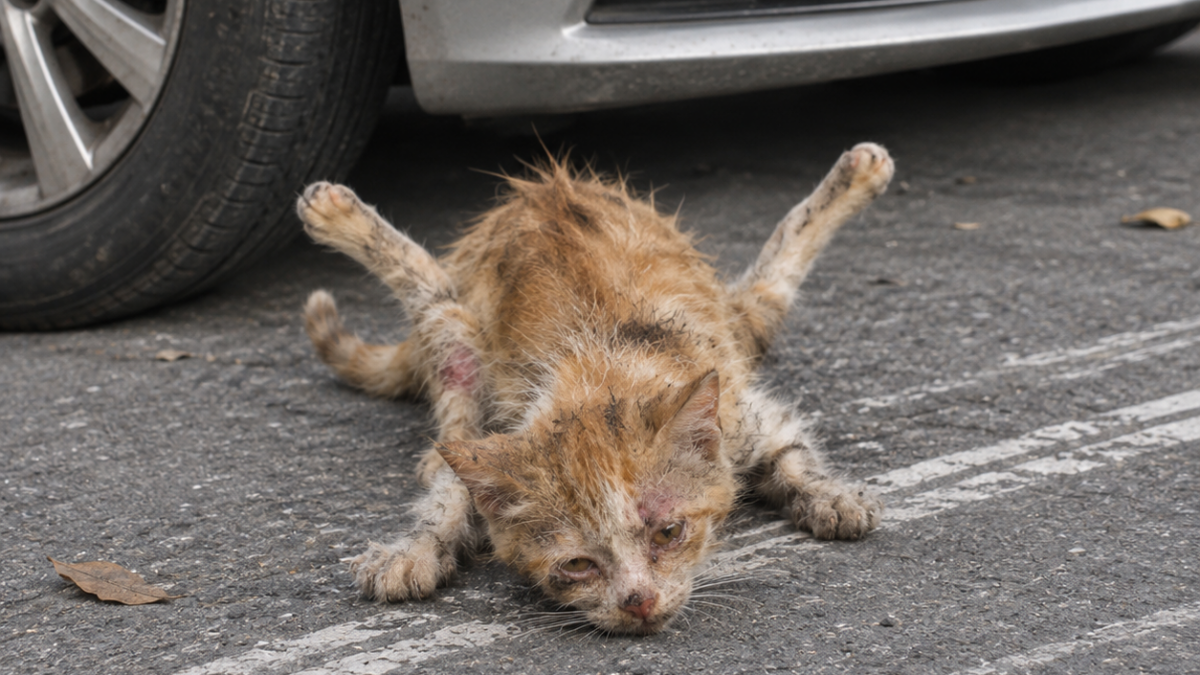
PART 2
The veterinary hospital was quieter than I expected when we arrived.
It was late, and the waiting room had only a few people.
But the moment the staff saw Fu Bao trying to reposition himself inside the carrier, everything changed.
One technician crouched.
“Oh.”
That single sound told me enough.
“You see his front legs?”
“Yes.”
“We don’t know what happened.”
“How long has he been like this?”
“We don’t know that either.”
Fu Bao stayed pressed against the back of the carrier.
The technician opened the door slowly.
“Hey, buddy.”
No movement.
“We’re going to help you.”
Fu Bao didn’t believe her.
I could see it in the way his body shrank farther into the corner.
They lifted him onto a padded table.
His front legs extended in front of him strangely.
Not naturally.
Not comfortably.
The veterinarian touched one gently.
Fu Bao flinched.
“Easy.”
Then the other.
Another reaction.
The veterinarian’s face tightened.
“We need X-rays.”
I already knew the answer would be bad.
Still, nothing prepares you for seeing bones on a screen.
The veterinarian called me over.
“This is the right front leg.”
A fracture.
Then she moved to another image.
“And this is the left.”
Another fracture.
I stared.
“Both?”
“Yes.”
“Both are broken?”
“Yes.”
My chest felt tight.
“How does that even happen?”
The veterinarian shook her head.
“There are several possibilities.”
“Could a car do this?”
“Possibly.”
“A fall?”
“Possibly.”
“Someone?”
She looked at me carefully.
“Also possible.”
I wanted a definitive answer.
I didn’t get one.
There was no witness.
No history.
No owner standing there explaining what happened.
Just Fu Bao.
And two broken front legs.
“How old are the fractures?”
“Not fresh.”
That was the sentence that hurt most.
“Meaning?”
“He’s been compensating for a while.”
I pictured him again.
Back legs pushing.
Front body dragging.
Garbage.
Pavement.
“How long?”
“I can’t give you an exact number.”
“Days?”
“Possibly longer.”
I looked at Fu Bao.
He had curled himself awkwardly on the blanket.
“His muscles?”
“That’s another concern.”
The veterinarian showed me how much muscle mass he had lost.
Because he hadn’t been using his front legs normally, the muscles had weakened dramatically.
“So once the fractures heal, he walks again?”
The veterinarian didn’t answer immediately.
I hated that pause.
“It’s not that simple.”
“What does that mean?”
“The joints are stiff. The muscles are weak. Depending on how much function he has lost and how healing progresses, returning to normal movement may be difficult.”
“Difficult or impossible?”
“We don’t know yet.”
That answer followed us home.
We don’t know.
Rescue seems full of those words.
You want certainty.
You get possibilities.
I wanted someone to tell me Fu Bao would walk normally again.
No one could.
I wanted someone to tell me exactly who hurt him.
No one could.
I wanted someone to tell me how long rehabilitation would take.
No one could.
All we had was a cat who had survived long enough to be found.
That had to be enough to start.
The first night at home, I prepared a quiet room.
Low bedding.
Food.
Water.
A litter area he could access without climbing.
Soft towels.
No high furniture.
No unnecessary noise.
I opened the carrier.
Fu Bao didn’t move.
“Okay.”
I sat several feet away.
“You don’t have to come out.”
He stared at me.
His eyes were enormous.
“Food is right there.”
Nothing.
“Water too.”
Nothing.
I left the room.
When I came back an hour later, the food remained untouched.
Fu Bao had moved only enough to press himself into a corner behind a blanket.
I sat again.
“You really don’t trust me.”
His ears flattened.
“Fair.”
I had no idea what humans had taught him before.
Maybe nothing.
Maybe worse than nothing.
I wasn’t going to demand that he trust me simply because I had decided I was safe.
Trust isn’t granted by declaration.
It’s built through repetition.
Food appears.
Hands don’t hurt.
Doors open.
Voices remain soft.
The same thing happens tomorrow.
And tomorrow.
And tomorrow.
That first evening, Fu Bao stayed in the corner.
The second day, he stayed in another corner.
If I entered, his body tightened.
If I sat too close, his eyes followed every movement.
If I reached toward him, he tried to retreat.
So I stopped reaching.
I cleaned around him.
Changed water.
Placed food.
Talked quietly.
Then left.
The hardest thing about helping a frightened animal is accepting that your desire to comfort them can become another source of pressure.
I wanted to pick him up.
I wanted to hold him and tell him everything was over.
Fu Bao didn’t want that.
So I respected it.
“Your choice,” I told him.
He stared.
“I’ll be here anyway.”
On the third morning, I walked into the room expecting another untouched bowl.
It was empty.
Completely.
I stopped at the doorway.
“Fu Bao?”
His head appeared from behind the blanket.
I pointed at the bowl.
“You ate.”
He watched me.
“You ate everything.”
I knew it was ridiculous to sound so excited.
But food was more than food.
It meant he had felt safe enough, at least for a few minutes, to lower his guard.
“Good.”
His ears moved.
“That’s really good.”
I replaced the food.
Then deliberately walked away.
Later, the bowl was empty again.
I smiled.
We began to learn each other.
Fu Bao liked food but hated being watched while he ate.
He preferred corners.
He didn’t like footsteps approaching quickly.
He watched hands.
Always.
That detail stayed with me.
When I moved my hand, his eyes followed it.
Maybe it was simple fear.
Maybe it was history.
I didn’t know.
I refused to invent what he couldn’t tell me.
But I could see the result.
Hands meant uncertainty.
We had to change that.
The first time I had to hold him for medical care, my heart hurt.
Fu Bao stiffened.
“I know.”
My friend supported his body carefully.
“We have to check your legs.”
He tried to pull away.
“Easy.”
The specialist had given us instructions for gentle handling.
No forcing.
No rough bending.
Everything controlled.
Everything gradual.
I touched one paw.
Fu Bao tensed.
Then I stroked it.
Slowly.
One finger across the fur.
Again.
His eyes stayed wide.
“You’re okay.”
Again.
Something changed.
Not much.
His shoulders relaxed perhaps half an inch.
I continued.
His breathing slowed.
Then I heard it.
At first, I thought I imagined it.
A tiny vibration.
I looked at my friend.
“Do you hear that?”
She smiled.
“He’s purring.”
I froze.
Fu Bao was purring.
The cat who had hidden from my hands was now purring while I touched one of the paws connected to a broken leg.
My throat tightened.
“Hey.”
The purring continued.
“That’s a pretty big decision.”
He blinked.
I picked him up carefully with proper support.
I expected him to tense again.
Instead, he settled.
Just slightly.
Then more.
His body pressed against my chest.
I didn’t move.
I barely breathed.
“Don’t ruin it,” my friend whispered.
“I’m not.”
Fu Bao’s eyes closed.
Then opened.
Then closed again.
Within minutes, he was asleep.
In my arms.
The same cat who had vanished into bushes because a human approached him was sleeping against a human body.
I looked down.
His face looked younger when he slept.
Less guarded.
Less like a survivor.
More like a cat.
He shifted.
Then did something that nearly broke me.
He snuggled deeper.
His head tucked closer against me.
One back paw relaxed.
I swallowed.
“You really don’t do anything halfway.”
My friend smiled.
“Don’t cry on him.”
“I’m not crying.”
“You are.”
I was.
That was the day I stopped thinking only about his legs.
The fractures mattered.
The muscles mattered.
The joints mattered.
But Fu Bao’s recovery was going to happen in two places.
His body.
And his trust.
The specialist we saw next focused on the joints and the damage caused by disuse.
Fu Bao’s front limbs had remained stiff for so long that movement itself had become unfamiliar.
The specialist manipulated one leg gently.
Fu Bao objected.
“I know.”
The veterinarian nodded.
“There’s a lot of stiffness.”
“Can you fix it?”
“We can work on mobility.”
“Can he bend it again?”
“We’ll see.”
Again.
No guarantees.
I hated that phrase.
We’ll see.
It sounded passive.
The actual work was anything but passive.
Daily stretching.
Careful joint movement.
Controlled positioning.
Monitoring discomfort.
Stopping before pain turned exercise into trauma.
Starting again the next day.
The specialist showed me exactly what to do.
“Support here.”
“Here?”
“Lower.”
“Like this?”
“Yes.”
“How far do I bend?”
“Only to his comfortable range.”
“How do I know?”
“He’ll tell you.”
Fu Bao looked at me.
“I don’t love that answer.”
The specialist smiled.
“You need to learn his signals.”
So I did.
Fu Bao’s ears.
His eyes.
His breathing.
How his muscles changed under my hands.
A small twitch meant one thing.
A full-body tension meant stop.
A soft purr meant maybe we were okay.
Every day, we stretched.
At first, the movement seemed microscopic.
I would gently work one leg.
Nothing.
Try again.
A tiny bend.
Then resistance.
Stop.
The other leg.
Almost nothing.
“Come on.”
Fu Bao stared at me.
“I know.”
I stroked his paw.
“You didn’t survive roadside garbage so you could be defeated by physical therapy.”
He looked unimpressed.
My friend laughed.
“Motivational speeches don’t work on cats.”
“They should.”
“Food works.”
She was right.
We started pairing some exercises with treats.
Fu Bao became more cooperative.
Not generous.
Cooperative.
There is a difference.
He learned quickly.
Stretch.
Treat.
Stretch.
Treat.
At one point, he began looking toward the treat before I had finished.
“No.”
He stared.
“We’re not done.”
Stare.
“You cannot negotiate medical care.”
Fu Bao blinked slowly.
I sighed.
“Fine. One.”
He ate.
My friend shook her head.
“He’s training you.”
“I am aware.”
Weeks passed.
Progress came so slowly that I sometimes thought I imagined it.
One morning, while stretching his right front leg, I felt the joint move farther than usual.
I stopped.
“Wait.”
Fu Bao looked at me.
I tried again.
Carefully.
The leg bent.
Not fully.
But clearly.
I called my friend.
“Come here.”
“What happened?”
“Watch.”
I repeated the movement.
She smiled.
“Oh.”
“He’s bending.”
“He is.”
I laughed.
“Fu Bao.”
He wanted the treat.
“You don’t care?”
No.
He cared about payment.
I gave him the treat.
Then sat on the floor with tears in my eyes.
It wasn’t walking.
It wasn’t standing.
It was one leg bending.
To anyone else, almost nothing.
To us, weeks.
Hours.
Worry.
Appointments.
Exercises.
Patience.
Trust.
All contained in one movement.
That evening, Fu Bao climbed—or rather dragged and pushed himself—toward the little sofa I had placed low to the floor.
I had bought it because I wanted him to have somewhere soft he could reach without jumping.
At first, he ignored it.
Then one day, I found him on it.
His sofa.
I laughed.
“Of course.”
Fu Bao looked at me as if I had entered his room without permission.
“So this is yours now?”
He settled deeper.
“Apparently.”
The sofa became his territory.
If another cat approached, Fu Bao watched.
Most respected his space.
Two did something unexpected.
They began grooming him.
The first time, I thought it was random.
One of the cats walked over.
Sniffed Fu Bao.
Then began licking the fur along the side of his neck.
Fu Bao froze.
I froze too.
The grooming continued.
Fu Bao relaxed.
Later, another cat joined.
They cleaned places Fu Bao had difficulty reaching because his front legs limited his balance and movement.
I watched in silence.
My friend whispered, “They’re helping him.”
“I know.”
“Do they understand?”
“Maybe not the way we do.”
It didn’t matter.
They saw another cat.
They groomed him.
Fu Bao closed his eyes.
For a street cat who had spent so much time alone, receiving care from other cats seemed almost as important as receiving it from us.
His world expanded.
Not quickly.
But steadily.
Room.
Sofa.
Other cats.
People.
Routine.
Trust.
He began making sounds when he wanted things.
At first, a small meow near feeding time.
Then more.
One afternoon, I was in another room.
I hadn’t seen Fu Bao for perhaps an hour.
I heard a call.
Not loud.
Distinct.
I walked toward him.
“What?”
Fu Bao called again.
“You have food.”
Another meow.
“Water.”
Meow.
“Are you just looking for me?”
He stared.
I sat beside him.
Fu Bao immediately relaxed.
I laughed.
“Seriously?”
Purr.
The cat who once disappeared into bushes because I came too close now called for me when I was gone too long.
That reversal never became ordinary.
Every time he did it, part of me returned to that night.
Dark bushes.
Tiny movement.
Two frightened eyes.
Now he wanted to know where I was.
Trust had become expectation.
He expected me to return.
There is something enormous in that.
A street animal may learn that people leave.
A rescued animal slowly learns:
This person comes back.
Fu Bao learned.
The front legs remained our hardest physical problem.
One leg improved faster than the other.
He could bend it.
Then gradually, with support, he began placing part of it beneath himself.
The first time, he pulled away immediately.
The second, he tolerated it.
Eventually, he pushed.
Barely.
I felt it under my hand.
“Did you do that?”
Fu Bao stared.
Again.
A small push.
I called the specialist.
At the next appointment, she confirmed it.
“He’s beginning to accept some weight.”
My heart jumped.
“On the front?”
“Yes.”
“Both?”
“More on one side right now.”
“Is that bad?”
“No. It’s progress.”
Progress.
My favorite word.
I took Fu Bao home with new exercises.
Weight shifts.
Supported stance.
Gentle strengthening.
We worked every day.
Not perfectly.
Some days, Fu Bao was done after minutes.
Some days, he cooperated longer.
Some days, I got frustrated.
Not at him.
At time.
I wanted faster.
His body didn’t care what I wanted.
One evening, I stopped an exercise too early.
My friend noticed.
“You’re discouraged.”
“No.”
“You are.”
I looked at Fu Bao.
“He barely did anything today.”
“He did something.”
“Yesterday was better.”
“So?”
“So what if we’re losing progress?”
“You’re measuring him like a machine.”
I knew she was right.
That irritated me more.
“He’s allowed bad days,” she said.
“I know.”
“Then act like you know.”
I sighed.
Fu Bao was licking his fur.
Completely unconcerned.
I sat beside him.
“Sorry.”
He ignored me.
“You’re allowed to be lazy.”
He looked up.
“Within reason.”
My friend laughed.
Recovery isn’t a straight line.
I learned that with Fu Bao.
You can see a joint move farther one week.
Less the next day.
Better again later.
Muscles need time.
Nerves need time.
Fear needs time.
Trust needs time.
The mistake is believing the only meaningful moment is the finish line.
Fu Bao taught me to celebrate the middle.
The first empty food bowl.
The first purr.
The first nap in my arms.
The first leg bend.
The first weight shift.
The first time another cat groomed him.
The first time he called for me.
Tiny moments.
Each one was a piece of a larger life.
Eventually, the specialist recommended more mobility support.
That was when we began discussing a wheelchair.
I had mixed feelings.
I don’t know why.
Part of me saw the chair as admitting defeat.
The specialist corrected me immediately.
“A wheelchair isn’t surrender.”
“I know.”
“You don’t sound like you know.”
I looked at Fu Bao.
“I wanted him to walk normally.”
“We all want maximum function.”
“But?”
“But mobility matters now too.”
She explained that a properly fitted device could help him move more independently while rehabilitation continued.
It wasn’t replacing therapy.
It was giving him access to his environment.
“Think about what he wants,” she said.
I looked at Fu Bao.
He was watching something outside the room.
“He wants to go everywhere.”
“Exactly.”
We measured him.
The wheelchair arrived later.
It looked enormous beside him at first.
Not physically enormous.
Emotionally.
Metal.
Straps.
Wheels.
Something medical.
Something that made his injury impossible to ignore.
Fu Bao sniffed it.
Then looked away.
“Same.”
My friend laughed.
“You’re more dramatic than he is.”
“Maybe.”
The first fitting took patience.
Fu Bao did not appreciate being strapped into anything.
“Easy.”
He squirmed.
“We’re not trapping you.”
He did not believe that.
Once positioned, he froze.
No movement.
I crouched in front.
“Come on.”
Nothing.
I held food.
His nose moved.
“You know you want this.”
No.
I moved farther back.
Fu Bao stared at me.
Then pushed.
The wheels moved.
He stopped instantly.
His eyes widened.
I laughed.
“You did that.”
Fu Bao looked behind himself.
“What is that?”
My friend smiled.
“He’s offended by physics.”
We tried again.
A small push.
Wheels.
Stop.
Another.
Soon, he understood enough to move forward.
Not gracefully.
Not far.
But forward.
I walked backward in front of him holding food.
“Come on.”
Fu Bao moved.
“Good.”
Another push.
“Good.”
By the end of the session, he was tired.
But something in his expression had changed.
He had gone farther under his own power than he had in a long time.
The wheelchair did not magically fix him.
It gave him something almost as important.
Choice.
He could explore.
He could decide where to go.
He could follow movement.
He could participate.
The first time he crossed the room in it, I cried.
Again.
My friend rolled her eyes.
“You cry constantly.”
“Be quiet.”
Fu Bao headed toward the food area.
“Of course.”
He was still Fu Bao.
Mobility improved his confidence.
He became more curious.
He wanted to know what was happening beyond his usual room.
We took him into safe areas.
Different floors.
Different smells.
Different cats.
Fu Bao observed everything.
Sometimes he moved forward eagerly.
Sometimes he simply sat supported and watched.
He no longer tried to disappear.
That was what struck me most.
Early Fu Bao had been defined by escape.
Hide.
Corner.
Bushes.
Carrier corner.
Room corner.
Now he wanted to see.
To be included.
If we went somewhere without him, he complained.
One afternoon, I walked toward the door.
Fu Bao meowed.
“I’ll be back.”
Another call.
“Five minutes.”
He stared.
“You are not coming to the store.”
Meow.
“Absolutely not.”
I left.
When I returned, Fu Bao was on his sofa looking offended.
“I’m back.”
He turned his head away.
“Oh, come on.”
Nothing.
I picked him up carefully.
“You’re ridiculous.”
He started purring.
Apparently forgiveness was immediate once physical contact resumed.
The sofa became more crowded over time.
A rescue litter arrived.
Tiny kittens.
Too curious for their own good.
The first time one approached Fu Bao, I watched carefully.
I didn’t know how he would react.
The kitten sniffed his bed.
Fu Bao watched.
The kitten climbed in.
I held my breath.
Fu Bao did nothing.
A second kitten followed.
Then another.
Within minutes, Fu Bao was surrounded.
I laughed.
“This is not your daycare.”
The kittens did not care.
One climbed partly over Fu Bao’s side.
Another settled near his back legs.
Fu Bao gave me a look that seemed to say:
Why have you done this?
“You let them in.”
He stayed.
Eventually, his body relaxed.
The kittens slept.
Fu Bao slept too.
I took a picture.
One injured adult cat.
A pile of babies.
One small bed.
It became one of my favorite images.
Not because it was cute, though it was.
Because Fu Bao had once hidden alone in bushes.
Now young cats treated his bed like the safest place in the room.
His disability did not make him less part of the group.
If anything, it made others gentler around him.
The two adult cats still groomed him.
The kittens climbed into his space.
Humans carried him.
Fu Bao’s world became full of care.
People sometimes asked whether I was angry about what happened to him.
Of course.
Both front legs broken.
Muscles wasted.
Street survival.
Garbage.
Fear.
How could I not be angry?
But I didn’t know who had caused the fractures.
The original information suggested someone had broken his legs, but I did not have evidence that allowed me to tell a detailed story about a specific person or motive.
I refused to create one.
Fu Bao’s suffering was real enough.
It did not need fictional cruelty added to make people care.
When I imagined revenge, I stopped imagining a human face.
The most satisfying answer was Fu Bao himself.
Whoever or whatever had reduced him to dragging himself through roadside garbage had failed to define his entire life.
That was revenge.
His sofa was revenge.
His wheelchair was revenge.
The empty food bowl was revenge.
The purr was revenge.
The kittens sleeping in his bed were revenge.
The meow calling for me was revenge.
Every joint that regained movement was revenge.
Every gram of weight placed back onto a front paw was revenge.
Not violent.
Not cinematic.
Better.
Permanent.
Fu Bao’s life continued.
That was the victory.
There were difficult days.
One rehabilitation session went badly.
Fu Bao was uncomfortable.
He resisted.
We stopped early.
I went home upset.
“What if this is as far as he gets?”
My friend looked at me.
“Then this is as far as he gets.”
“That doesn’t bother you?”
“No.”
I stared.
She continued.
“Would you stop loving him?”
“Obviously not.”
“Would he stop enjoying the sofa?”
“No.”
“Food?”
“No.”
“Being held?”
“No.”
“The other cats?”
“No.”
“Then why are you talking like walking is the only ending that counts?”
I had no answer.
Because she had found the fear underneath all of my effort.
I had turned walking into a symbol.
If Fu Bao walked normally, then everything had been fixed.
But some things don’t get fixed.
Some bodies heal differently.
Some injuries leave permanent marks.
That doesn’t make the life afterward incomplete.
I sat beside Fu Bao.
He looked up at me.
“You heard all that?”
Purr.
“Apparently I’m the problem.”
My friend laughed.
“Correct.”
I kissed the top of Fu Bao’s head.
He endured it.
From then on, I changed how I thought about rehabilitation.
We still worked hard.
Absolutely.
But I stopped treating each session like a test of whether we had succeeded in rescuing him.
Fu Bao had already succeeded.
He was safe.
He was loved.
He had choices.
He had friends.
He had comfort.
Mobility mattered.
Perfection didn’t.
That difference made the work gentler.
When he bent one leg, we celebrated.
When he had a stiff day, we rested.
When he bore weight, we encouraged him.
When the wheelchair helped, we used it.
No shame.
No failure.
Just tools.
One afternoon, Fu Bao moved across the room in his wheelchair toward his sofa.
I stood nearby but didn’t help.
He reached it.
Stopped.
Looked at me.
“You want up?”
Meow.
I lifted him out of the chair.
Placed him on the cushion.
Fu Bao immediately curled into his favorite spot.
I sat beside him.
“You know you own this, right?”
He closed his eyes.
“Of course you know.”
A second cat jumped onto the sofa.
Groomed Fu Bao’s ear.
Fu Bao leaned into it.
I smiled.
This was a cat who once hid from every approach.
Now he accepted care casually.
That may have been the greatest transformation.
Not the leg.
Not the wheelchair.
Casual trust.
The ability to receive kindness without bracing for what came next.
You cannot measure that on an X-ray.
But I saw it every day.
Fu Bao’s paws became less frightening to touch.
Early on, he watched my fingers constantly.
Later, he allowed me to massage them while half asleep.
Sometimes he purred through the entire session.
One evening, I held a paw and remembered the first hospital visit.
Broken.
Thin.
Weak muscle.
Uncertain future.
“Look at you.”
Fu Bao slept.
I gently flexed the leg.
More movement than before.
Still not normal.
Still progress.
“You’re doing okay.”
He snuggled closer.
My voice lowered.
“Better than okay.”
He had begun to enjoy being held so much that it became a problem.
If I sat down without him, Fu Bao sometimes called.
“I’m right here.”
Meow.
“You can see me.”
Meow.
“You want up?”
Another call.
I picked him up.
Instant purr.
“You are manipulative.”
Purr.
“You know that?”
Purr.
The cat who once refused food because he was too afraid to leave the corner had become demanding.
I loved every demand.
There is a stage in rescue when inconvenience becomes joy.
The animal stops acting grateful.
Good.
They shouldn’t have to perform gratitude.
Fu Bao did not owe me quietness because I helped him.
He didn’t owe me perfect behavior.
He didn’t owe me affection.
He gave affection anyway.
But he also complained.
Claimed furniture.
Rejected certain food.
Demanded attention.
That was security.
He no longer behaved as though everything good could vanish if he made a mistake.
He trusted abundance.
Food tomorrow.
Hands tomorrow.
Sofa tomorrow.
Me tomorrow.
That trust was the opposite of the bushes.
I thought about that often.
The night we found him, Fu Bao believed hiding was safer than food.
Later, he believed calling out would bring me closer.
Those two beliefs could not be more different.
Rehabilitation eventually gave us another milestone.
Fu Bao put weight through both front legs at the same time.
Only partially.
Only with support.
But clearly.
The specialist smiled.
“That’s better.”
I stared.
“Both?”
“Yes.”
“Say it again.”
“Both front limbs are participating more.”
I laughed.
Fu Bao wanted the treat.
“Do you hear that?”
He stared at my hand.
“You are emotionally unavailable.”
I gave him food.
On the drive home, I felt lighter.
Not because I suddenly believed full recovery was guaranteed.
I didn’t.
But because Fu Bao was still moving forward.
At his pace.
In his body.
With his limitations.
That mattered.
We continued daily stretching.
Some exercises became routine enough that Fu Bao practically knew the sequence.
Right leg.
Treat.
Left leg.
Treat.
Weight shift.
Treat.
Rest.
He occasionally tried to skip the work and go straight to payment.
“No.”
He looked at the treat.
“Exercise first.”
Stare.
“No.”
Longer stare.
“You are not intimidating.”
Slow blink.
I sighed.
“Fine. Half.”
My friend laughed from the doorway.
“Strong leadership.”
“I hate both of you.”
Fu Bao ate.
Even disability could become ordinary.
That was another thing I learned.
At first, every aspect of his care felt medical.
Equipment.
Schedules.
Stretching.
Specialist visits.
Wheelchair fittings.
Eventually, these things became part of life.
The wheelchair stopped looking tragic.
It looked like Fu Bao’s wheels.
Exercises became something we did before dinner.
The sofa remained his.
The other cats knew his movements.
Everyone adapted.
That is what good care often becomes.
Not constant sadness.
Routine.
Fu Bao did not spend his day thinking:
I am disabled.
He spent his day thinking:
Where is my food?
Why is that kitten in my bed?
Where did my person go?
Can I get onto the sofa?
Who will hold me?
Can I explore that room?
Life.
Simple.
I admired that.
Humans sometimes turn injury into identity because we know the before.
Fu Bao lived in the now.
He didn’t compare himself to the cat he might have been.
We did.
He didn’t.
I tried to follow his lead.
One day, we took him somewhere new.
A quiet outdoor location where he could experience fresh air safely.
Not the seaside yet.
That would come later.
Just a peaceful open space.
Fu Bao looked around.
Wind touched his fur.
His nose worked constantly.
I supported him.
He seemed fascinated.
Grass.
Bird sounds.
Different smells.
For several minutes, he was completely focused.
Not on his legs.
Not on therapy.
The world.
I watched him.
“This is why mobility matters.”
My friend nodded.
Not because walking normally was a moral victory.
Because movement gave Fu Bao access to experiences.
A breeze.
Sunlight.
Another room.
A sofa.
A person.
A new smell.
That was the goal.
Access.
The wheelchair helped with that.
Our hands helped too.
Whatever worked.
I stopped caring what it looked like.
Fu Bao began going farther in the chair.
He developed preferences about direction.
If I tried steering him somewhere he didn’t want to go, he resisted.
“You cannot have opinions about traffic.”
He did.
He wanted the food area.
Always.
One day, another cat walked by.
Fu Bao turned his wheels and tried to follow.
I laughed.
“Look at you.”
The other cat stopped.
Fu Bao approached.
They sniffed.
Normal interaction.
No dramatic music.
No miracle.
Just cats.
That made me happier than almost anything.
Fu Bao’s body did not exclude him from being part of the social world.
His friends adjusted.
He adjusted.
We adjusted.
One of the adult cats that groomed him became particularly attached.
If Fu Bao rested, the other cat often sat nearby.
Sometimes they slept touching.
I wondered whether animals understand disability.
Probably not in human terms.
They understand movement.
Scent.
Behavior.
Need.
Maybe that’s enough.
The cat knew Fu Bao had places he couldn’t groom easily.
So he groomed them.
No speech.
No pity.
Just care.
That felt pure.
When the kittens arrived, the social dynamic became louder.
They had no respect for Fu Bao’s personal space.
One climbed directly over his back.
I gasped.
“Hey!”
Fu Bao looked annoyed.
The kitten settled against him.
Fu Bao sighed.
I laughed.
“Welcome to parenthood.”
He was not their father.
They did not care.
Fu Bao’s bed became a kitten pile.
Sometimes he called until we removed one particularly energetic baby.
Other times, he seemed content.
I took too many photos.
There was something healing about seeing vulnerable kittens trust Fu Bao.
The injured cat had become someone else’s safe place.
Think about that.
Once, he had no safe place.
Now his body itself was safe enough for babies to sleep against.
That was revenge against the entire beginning.
Later, when we discussed taking Fu Bao to the seaside for the first time, I felt unexpectedly nervous.
“Will he like it?”
My friend laughed.
“He’s a cat.”
“That doesn’t answer anything.”
“He may hate it.”
“Then we leave.”
“Exactly.”
We planned carefully.
Safe carrier.
Support.
Wheelchair.
Quiet location.
No crowds.
Short duration.
Fu Bao did not need an inspirational photo shoot.
He needed an experience he could enjoy or reject.
When we finally brought him near the water, he was cautious.
The sound was new.
The smell of salt.
Wind.
Movement.
He looked toward the sea.
I watched his ears.
“Too much?”
He stayed.
“Okay.”
We let him observe.
No forcing.
The wheelchair helped him explore a small safe stretch.
The surface required care.
I stayed close.
Fu Bao looked around.
For a second, the image became surreal.
The same cat who had crawled through roadside garbage was now near the sea.
Not abandoned.
Not searching for food.
Exploring.
I crouched beside him.
“You have traveled farther than you think.”
He did not understand.
Good.
The moment belonged to him, not my symbolism.
He sniffed the wind.
Then looked at me.
“Want to go back?”
No movement.
We stayed a little longer.
That day became one of my favorite memories.
Not because he performed some dramatic act.
He didn’t run.
He didn’t suddenly walk.
He simply existed somewhere beautiful.
Disabled animals deserve beautiful places too.
That thought sounds obvious.
It isn’t always treated that way.
Sometimes people assume a disabled animal’s life should shrink to medical care.
Fu Bao’s didn’t.
He had therapy.
Yes.
But also sofa naps.
Kittens.
Friends.
Food.
Fresh air.
The sea.
Being carried around because he demanded it.
A life can contain treatment without becoming only treatment.
That mattered.
Fu Bao’s front legs continued showing gradual improvement.
One remained stronger.
The weaker leg lagged behind.
We kept working.
The specialist adjusted exercises.
“Don’t compare the two constantly,” she told me.
“Hard not to.”
“I know.”
“What if the weaker one never catches up?”
“Then we support what he has.”
There it was again.
The philosophy Fu Bao kept teaching me.
Support what exists.
Do not withhold joy while waiting for perfection.
I became better at that.
Not perfect.
Better.
Months into his rehabilitation, someone showed me an old video.
Fu Bao on the street.
Back legs pushing.
Front half sliding.
I had seen it before.
This time, it hurt differently.
I looked at his current body.
Healthy weight.
Brighter eyes.
Front paws more flexible.
I thought about the distance between those images.
Not measured in miles.
Measured in trust.
I closed the video.
Fu Bao called from another room.
I laughed.
“There he is.”
I went to him.
He wanted the sofa.
Of course.
I lifted him.
Placed him in his spot.
A few minutes later, one of the other cats joined him and began grooming his head.
Fu Bao purred.
That was the video I wanted now.
Not because the street footage didn’t matter.
It did.
But rescue should not freeze an animal forever at their worst moment.
Fu Bao deserved to be remembered as more than the cat dragging himself through garbage.
He was also the cat who owned a sofa.
The cat who purred during paw massages.
The cat who let kittens invade his bed.
The cat who explored the seaside.
The cat who called when his person was missing.
The cat who learned to use wheels.
The cat whose front legs slowly remembered how to carry part of him.
A life is larger than the injury.
Fu Bao proved that.
Sometimes people asked, “Did you ever find out who broke his legs?”
The answer remained no.
Not with certainty.
I never wanted to turn speculation into fact.
Was I angry?
Yes.
But anger without truth can become another kind of harm.
I focused on what I knew.
Fu Bao was injured.
He had been left outside.
He had survived by dragging himself.
He had searched garbage.
He had hidden because he was afraid.
Those facts were enough.
I didn’t need a fabricated villain to make his transformation powerful.
The enemy was everything that told his body and mind to give up.
He answered by continuing.
If there was revenge in his story, it looked like this:
He was once hungry enough to search trash.
Now he sometimes rejected food until he got the one he preferred.
He once hid from hands.
Now he fell asleep in them.
He once disappeared into bushes.
Now he called when I disappeared into another room.
He once dragged broken legs behind him.
Now those legs could bend and bear some weight.
He once had nowhere.
Now he had a sofa everyone recognized as his.
That was enough.
More than enough.
One evening, after therapy, Fu Bao lay in my arms.
His body was heavier than when I found him.
I noticed that every time.
“You’re getting chunky.”
Fu Bao purred.
“That’s a compliment.”
Purr.
“Mostly.”
He slept.
I looked at the paws resting against me.
The first time I saw them, I thought only about damage.
Now I thought about history.
These paws had been broken.
Dragged.
Stiff.
Touched cautiously.
Massaged.
Stretched.
Placed on padded surfaces.
Supported.
Encouraged.
They had become part of our daily language.
“Good paw position.”
“Too much tension.”
“Better bend.”
“More weight.”
Eventually, I stopped seeing broken legs.
I saw Fu Bao’s legs.
They belonged to him.
Not to the injury.
That distinction took time.
One day, during a supported standing session, Fu Bao stayed upright long enough that I forgot to speak.
The specialist smiled.
“You’re quiet.”
“Don’t ruin it.”
Fu Bao held.
Front legs trembling.
But supporting.
He shifted.
One paw adjusted.
I inhaled sharply.
Then he lowered himself.
I picked him up.
“That was good.”
He purred.
“Very good.”
The specialist nodded.
“Strength is improving.”
“Do you think—”
She raised an eyebrow.
I stopped.
“I know. No guarantees.”
“Exactly.”
I smiled.
“I hate you.”
“You’ll thank me later.”
I already did.
Hope is healthiest when it doesn’t demand certainty.
Fu Bao might gain more function.
He might plateau.
Either way, he had a life worth protecting.
That was the foundation.
Everything else was bonus.
As time passed, Fu Bao’s fear of new people lessened.
Not completely.
He remained cautious.
But he no longer automatically vanished.
Visitors sat quietly.
Fu Bao watched.
Sometimes approached.
Sometimes not.
Both were allowed.
One guest reached too quickly.
Fu Bao pulled back.
I immediately said, “Let him decide.”
The person stopped.
“Sorry.”
Fu Bao watched.
After a few minutes, he approached on his own.
That mattered.
Choice was part of healing.
Street Fu Bao had little control.
Pain decided where he could go.
Hunger decided what he ate.
Fear decided where he hid.
Now he could choose.
Touch or no touch.
Sofa or bed.
Food.
Person.
Direction in the wheelchair.
Choice restores dignity.
I saw that clearly with him.
The kittens eventually grew.
Some left for homes.
The bed became less crowded.
Fu Bao seemed relieved.
I teased him.
“Miss them?”
No response.
One final kitten climbed beside him.
Fu Bao sighed.
“That’s what I thought.”
The little one groomed Fu Bao’s ear.
Fu Bao closed his eyes.
Fine.
Maybe he missed them slightly.
The other adult cats continued helping him with grooming.
That became normal.
I would walk into a room and find Fu Bao receiving what looked like a spa treatment.
“Must be nice.”
He purred.
“Some of us bathe ourselves.”
The grooming cat ignored me.
Fu Bao leaned closer.
“Unbelievable.”
His life had become full of ridiculous ordinary moments.
I treasured them.
People expect rescue stories to be about dramatic turning points.
Sometimes the best part is routine.
Breakfast.
Stretch.
Nap.
Grooming.
Wheelchair.
Sofa.
Purr.
Dinner.
Call for human.
Sleep.
Ordinary is what the injured animal almost lost.
Fu Bao got it back.
One rainy day, he refused to leave his sofa.
I needed to do his exercises.
“Come on.”
He looked away.
“Therapy.”
Nothing.
I touched his paw.
He pulled it back.
“Are we negotiating?”
Yes.
We were.
I brought a treat.
Fu Bao looked.
“Traitor.”
He cooperated.
The session went well.
Afterward, he went right back to the sofa.
I covered him with a light blanket.
“Your work ethic is questionable.”
Purr.
“Fine.”
I sat beside him.
Rain tapped the window.
Fu Bao slept.
I thought about the bushes.
Rain would have been terrifying then.
Cold.
Wet.
No shelter.
Now weather was something happening outside.
Safety changes the meaning of everything.
Rain becomes sound.
Darkness becomes sleep.
A corner becomes a choice, not a hiding place.
A box becomes a toy.
A hand becomes comfort.
Fu Bao’s world had been redefined one ordinary thing at a time.
One afternoon, I came home later than usual.
The moment I entered, Fu Bao called.
Loud.
I laughed.
“I’m here.”
Another meow.
“I know.”
He called again until I reached him.
Then quiet.
“You are ridiculous.”
He purred.
“You survived alone on the street and now thirty extra minutes is unacceptable?”
Yes.
Apparently.
I picked him up.
He pressed against me.
That moment summarized everything.
Once, he had survived because nobody came.
Now he expected someone to come.
That expectation was a gift.
I hoped never to betray it.
Eventually, Fu Bao’s wheelchair became scratched from use.
The first marks upset me.
Then I laughed at myself.
It was supposed to be used.
Scuffs meant movement.
Places visited.
Corners turned.
Things investigated.
Fu Bao had earned every scratch.
We adjusted the fit as his body changed.
He gained weight.
Muscles developed.
The chair needed small modifications.
“You’re growing,” I told him.
He looked toward lunch.
“Of course that’s what matters.”
There were moments when the wheelchair allowed him to move so confidently that strangers assumed he had used it forever.
That was another lesson.
Adaptive equipment can become natural when the environment accepts it.
No pity.
No spectacle.
Just mobility.
Fu Bao didn’t know he was supposed to feel embarrassed.
Good.
He had more important things to do.
Like reaching the food before another cat.
He became competitive about that.
One feeding time, another cat moved toward his bowl.
Fu Bao vocalized.
The other cat stopped.
I laughed.
“Territorial now?”
Fu Bao looked at me.
“From garbage scraps to food ownership.”
That contrast would never stop amazing me.
He had learned abundance strongly enough to defend preference.
The street no longer defined his psychology.
At least not completely.
Some habits remained.
He still preferred walls nearby while sleeping.
He still startled at certain sounds.
He still watched unfamiliar hands.
Healing does not erase history.
It gives history less control.
That was enough.
One of the most emotional days came when Fu Bao managed to push through both front legs during a supported transfer.
It happened quickly.
We were moving him from one padded surface to another.
I positioned him.
He pushed.
Not dragged.
Pushed.
His chest lifted.
His body moved forward.
I froze.
“Do that again.”
Fu Bao stared.
The therapist laughed.
“He doesn’t perform on command.”
“I need proof.”
“No.”
Later, he repeated it.
I saw it clearly.
His front legs participated.
Not perfectly.
But functionally.
I cried.
Again.
No one even mocked me this time.
They understood.
Months earlier, those legs had looked like things attached to him rather than tools he could use.
Now they were returning to the conversation.
I held him after the session.
“You did good.”
Purr.
“Really good.”
He slept.
No celebration mattered to him more than being held afterward.
That was fine.
I learned to celebrate in his language.
Food.
Touch.
Warmth.
Rest.
Eventually, I stopped asking, “Will he ever be normal?”
I hated the question.
Normal compared to what?
Fu Bao was Fu Bao.
His gait.
His wheels.
His stretches.
His sofa.
His preferences.
His friends.
His voice.
His life was complete without matching another cat’s body.
The real question became:
Is he comfortable?
Interested?
Engaged?
Loved?
Does he have choices?
Does he have good days?
Yes.
That was enough.
His first seaside trip made me understand this fully.
Fu Bao looked at the water.
Wind lifted his fur.
He did not need to run across the sand to have the experience.
He only needed access.
We gave him that.
He smelled the air.
Watched the movement.
Listened.
Then eventually looked back toward me.
I lifted him.
He settled in my arms.
“Ready?”
Purr.
We left.
No miracle.
No tragedy.
A day at the sea.
Fu Bao had collected experiences.
That was the point of saving him.
Not merely maintaining a heartbeat.
Giving him a life.
The rescue community sometimes uses the phrase “quality of life.”
Fu Bao turned it from a medical phrase into something visible.
Quality looked like his sofa.
His cats.
His kittens.
His wheelchair.
His seaside wind.
His purr.
His annoying calls.
His food preferences.
His sleep.
His trust.
One day, a volunteer who had never met him asked, “Isn’t it sad?”
I knew what she meant.
The legs.
The wheelchair.
The limitations.
I looked at Fu Bao.
He was asleep while another cat groomed his forehead.
“No.”
She looked surprised.
“What happened to him is sad.”
I pointed.
“This isn’t.”
She watched.
Fu Bao woke.
Meowed at me.
I picked him up.
“That part is actually very annoying.”
She laughed.
Important distinction.
Injury is tragic.
Disability does not automatically make a life tragic.
Fu Bao’s life contained joy.
That was visible.
We didn’t need to pretend his body was uninjured.
We also didn’t need to pity him every second.
He deserved normal affection.
Normal irritation.
Normal boundaries.
Though I was terrible at the boundaries.
Fu Bao knew it.
He called.
I came.
He stared.
I gave treats.
He wanted the sofa.
I lifted him.
My friend said I had created a tyrant.
She was correct.
I had no regrets.
Several months after finding him, I returned to the alley.
Only once.
I stood near the entrance.
The bushes were still there.
Different leaves.
Same place.
I remembered the movement.
So tiny.
If I had looked away—
No.
I refused to finish the thought.
Fu Bao had been there.
We found him.
That was the timeline.
I took a photograph of the empty bushes.
Then looked at a picture on my phone from that morning.
Fu Bao on his sofa.
One kitten asleep partly across his back.
Another cat grooming his ear.
I smiled.
“You lost,” I whispered toward the alley.
Not to a person.
To the place.
To fear.
To everything that had tried to make Fu Bao invisible.
The bushes lost.
The street lost.
The garbage lost.
Fu Bao had a sofa.
I left.
Never went back.
His story didn’t live there anymore.
It lived at home.
In scratches on the wheelchair.
In fur on the sofa.
In food bowls.
In therapy notes.
In kitten photos.
In videos from the sea.
In the sound of him calling when I was late.
That was where Fu Bao belonged.
As he grew stronger, the specialist reduced some assistance during exercises.
Fu Bao resisted less.
His body understood more.
One session, he held part of his weight through both front legs longer than ever.
I watched his shoulders.
There was actual engagement.
Muscle working.
Not enough to erase the past.
Enough to change the present.
The specialist said, “You can see the difference.”
“I can.”
“You used to ask me every five minutes.”
“I’ve matured.”
She laughed.
“No.”
Fair.
Fu Bao received his treat.
Then another.
“Don’t overfeed him,” she warned.
“He earned it.”
“He earns everything according to you.”
“Correct.”
We went home.
Fu Bao immediately demanded his sofa.
Progress had not made him humble.
Good.
One evening, I found him asleep alone.
No cat nearby.
No kitten.
No person.
Just Fu Bao.
Completely relaxed.
That image stayed with me.
Trust can be measured in how an animal sleeps when nobody is touching them.
His body wasn’t pressed into a defensive corner.
He was stretched out.
Exposed.
Comfortable.
The room was quiet.
I stood at the doorway.
Didn’t disturb him.
A cat who once hid to survive now slept openly.
That was healing.
Later, he woke and called for me.
Of course.
I went in.
“You ruined the poetic moment.”
Purr.
“Fine.”
I picked him up.
His head tucked beneath my chin.
I thought about revenge again.
People love revenge because it promises balance.
Something bad happens.
Something equally dramatic happens back.
Life rarely works that way.
Fu Bao never received his old body back exactly as it had been.
We never got a perfect explanation.
We never got to erase the pain.
But balance came differently.
For every night he hid alone, there were now nights he slept against someone.
For every meal searched from garbage, there were bowls prepared specifically for him.
For every place he couldn’t reach, there were wheels or hands.
For every moment he disappeared, there were now people searching the house because they hadn’t heard him in ten minutes.
For every person who once failed him, there were now people who rearranged their day to do his exercises.
Maybe justice isn’t always subtraction.
Sometimes it’s addition.
Add enough love.
Add enough safety.
Add enough good days.
The bad day remains real.
But it no longer dominates the sum.
Fu Bao’s life became larger than his injury.
That was our revenge.
One morning, he rejected breakfast.
I panicked immediately.
“Why isn’t he eating?”
My friend looked at the bowl.
“Because that’s not the one he likes.”
“He ate it last week.”
“He changed his mind.”
“This cat ate garbage.”
“Past tense.”
We offered another food.
Fu Bao ate immediately.
I stared.
“You have become unbearable.”
He continued.
My friend laughed.
“This is what healing looks like.”
She was right.
Being picky is a luxury.
Fu Bao had learned he could afford luxuries.
Another rescue anniversary passed.
I didn’t celebrate the date he was injured.
We didn’t know it.
I celebrated the night we found him.
His “found day.”
I bought him a new cushion for the sofa.
He sniffed it.
Then sat beside it.
“You don’t like it?”
No response.
“You have terrible taste.”
Eventually, another cat slept on the new cushion.
Fu Bao stayed on the old one.
Of course.
I left both.
His house.
His rules.
We also bought him a new toy.
He barely cared.
Then a cardboard box arrived later.
Fu Bao became obsessed.
“Why do I spend money?”
He sat inside the box.
His front legs stretched comfortably.
I laughed.
There was something strange about seeing him enjoy a confined space.
But unlike the carrier corner, this was chosen.
He could leave.
Choice changes everything.
He slept there for an hour.
Then called for me.
I picked him up and moved him back to the sofa.
Ordinary.
Perfect.
Over time, the kittens that had once piled into his bed found homes.
I worried Fu Bao would miss them.
For two days, he seemed to search the room more.
Then the adult cats spent more time nearby.
One groomed him longer.
Maybe animals notice absence.
Maybe they simply follow routine.
Either way, Fu Bao was not alone.
That mattered.
A new foster kitten arrived later.
It walked straight toward Fu Bao.
I groaned.
“Here we go again.”
The kitten climbed into his bed.
Fu Bao looked at me.
“Apparently you have a reputation.”
He tolerated it.
Soon they slept together.
Fu Bao had become a magnet for tiny cats.
Perhaps because he was calm.
Perhaps because he stayed in one place long enough.
Perhaps because warmth attracts warmth.
I didn’t need an explanation.
I liked the image.
The injured cat becoming somebody’s comfort.
That was enough.
When Fu Bao called for me, his voice grew stronger over time.
At first, a soft meow.
Later, a clear complaint.
One day, I spent too long talking to a visitor.
Fu Bao yelled.
I looked over.
“Excuse me?”
Another call.
The visitor laughed.
“Does he want you?”
“No. He’s just controlling.”
Fu Bao called again.
I went to him.
Immediate purr.
The visitor said, “Definitely wants you.”
I pretended to be annoyed.
Inside, I felt the same ache I always did.
The bushes.
The silence.
The fear.
Now he announced his needs.
That was confidence.
I never wanted him silent again.
Medical follow-ups gradually became less dramatic.
X-rays.
Joint checks.
Muscle assessment.
Rehab updates.
No emergency.
No sudden crisis.
Boring medicine.
My favorite kind.
One veterinarian looked at Fu Bao’s chart.
“He’s come a long way.”
“Yes.”
“Still doing daily exercises?”
“Yes.”
“Wheelchair?”
“Regularly.”
“Any skin issues?”
“No.”
“Appetite?”
I laughed.
“Too much personality.”
She looked up.
“Meaning?”
“Selective.”
Fu Bao stared at us.
The vet smiled.
“Good problem.”
Exactly.
His front-limb strength improved enough that we sometimes gave him short supported periods without the chair.
He pushed.
Balanced.
Rested.
Never rushed.
The goal wasn’t to prove something.
The goal was useful function.
I finally understood that.
Functional movement can look different.
Fu Bao’s body created its own version.
That deserved respect.
One day, he surprised us by repositioning himself on the sofa more easily than usual.
Normally, he used mostly his back legs and body momentum.
This time, one front leg helped.
I noticed.
“Did you see that?”
My friend hadn’t.
“See what?”
“His paw.”
Fu Bao moved again.
There.
Small.
Intentional.
I smiled.
“No one else would notice.”
“But you did.”
“Yes.”
I had spent enough hours watching those legs that a millimeter felt like fireworks.
Fu Bao settled.
I touched his paw.
He purred.
“You keep surprising me.”
That became true beyond his body.
He surprised me with trust.
With tolerance for kittens.
With his attachment.
With adaptability.
With how quickly a wheelchair became normal.
With how completely an animal can build a good life around permanent differences.
He surprised me by becoming happy.
Maybe that sounds sad.
I had assumed trauma would remain visible forever.
It didn’t.
Not always.
Sometimes Fu Bao simply looked content.
No shadow.
No symbolism.
Content.
That was the best outcome.
A visitor once looked at old pictures and asked, “Do you think he remembers?”
I looked at Fu Bao.
“I don’t know.”
“Do you hope he doesn’t?”
I thought.
“Maybe.”
Then I changed my mind.
“Actually, I hope it doesn’t matter.”
Maybe memory remains.
Maybe not.
The important thing is what memory can do.
If Fu Bao remembers the street but no longer expects it, then the past has lost authority.
That was enough.
He no longer woke up searching for garbage.
He woke up waiting for breakfast.
He didn’t disappear from touch.
He leaned into it.
He didn’t hide when I entered.
He called when I didn’t.
Whatever he remembered, the present was stronger.
Years—or what felt like years—of emotional change happened inside relatively ordinary days.
That is why long-form rescue stories matter to me.
The dramatic moment is easy.
Broken legs.
Street.
Bushes.
Hospital.
The real transformation occurs later.
A cat deciding to eat when nobody watches.
A paw relaxing in a hand.
A purr.
A nap.
One leg bending.
A cat grooming him.
A kitten climbing into his bed.
A wheelchair becoming scratched.
A seaside breeze.
A meow when you leave the room.
Those moments are not dramatic alone.
Together, they are a life.
Fu Bao’s story became exactly that.
A life.
Not just a rescue.
One evening, after the house was quiet, I sat beside his sofa.
Fu Bao was awake.
I placed my hand near his paw.
He let it rest there.
“Do you remember when you wouldn’t eat because I was in the room?”
His eyes half closed.
“Now you scream if I don’t bring the right food.”
Purr.
“Progress?”
He blinked.
“Definitely.”
One of the other cats jumped up.
Groomed Fu Bao’s forehead.
He relaxed.
I watched them.
“You’re spoiled.”
No disagreement.
I thought about the word “revenge.”
This was it.
Not cruelty returned with cruelty.
Not some invented confrontation.
This.
A warm room.
Full stomach.
Cats.
Sofa.
A person close enough to answer.
The person or event that broke Fu Bao’s legs had shaped his body.
It did not get to shape his entire future.
We took that privilege away.
That was enough.
If whoever hurt him imagined he would disappear on the street, they were wrong.
If they imagined pain would be the only thing his body knew, wrong.
If they believed nobody would search through the night for him, wrong.
If they believed broken legs made him worthless, wrong.
Everything after the bushes proved them wrong.
The specialist once told me something simple.
“Don’t underestimate compensation.”
“What do you mean?”
“Animals adapt.”
Fu Bao did.
Physically.
Emotionally.
Socially.
He learned to use what worked.
Back legs.
Wheelchair.
Human arms.
Sofa edges.
He accepted help without letting help erase his personality.
That may have been his greatest skill.
He became not “the broken cat.”
Just Fu Bao.
If visitors stared at the wheelchair too long, Fu Bao didn’t care.
If someone pitied him, he was more interested in whether they had food.
Good priorities.
I followed his example.
One day, we went outside for a short supervised session.
Fu Bao used his wheelchair.
Sunlight.
Quiet.
He moved toward a patch of shade.
I let him choose.
He stopped.
Looked around.
I sat nearby.
No speech.
No lesson.
Just company.
He eventually called.
I picked him up.
“Done?”
He settled.
We went inside.
That was a good day.
No milestone.
No new range of motion.
No dramatic improvement.
Good because Fu Bao enjoyed it.
I learned to count those too.
A life cannot be only progress.
There must be living between exercises.
Fu Bao lived.
Fully.
His little sofa eventually wore out.
The fabric thinned.
One corner sagged.
I bought a replacement.
He rejected it.
Of course.
“You cannot keep this forever.”
He sat on the old sofa.
“It is falling apart.”
No movement.
I placed the new one beside it.
Another cat took the new sofa.
Fu Bao stayed.
“You’re impossible.”
Eventually, I repaired the old one.
Problem solved.
His territory remained intact.
People laughed at me.
I deserved it.
But every time I saw Fu Bao curled there, I remembered when he had no place.
Let him keep the sofa.
He had earned permanence.
Another litter of kittens arrived months later.
I already knew what would happen.
They found Fu Bao.
Climbed into his space.
He looked resigned.
I laughed.
“You are officially furniture.”
The kittens slept.
Fu Bao purred.
Maybe he liked it.
Maybe he simply accepted that babies have no boundaries.
Either way, the bed filled again.
I took another photograph.
It looked almost identical to the first kitten pile.
Except Fu Bao looked stronger.
His coat better.
His posture more comfortable.
Progress hidden inside repetition.
I loved that.
At a later specialist appointment, we compared early and current joint mobility.
The difference was measurable.
One leg significantly more flexible.
The other improved too.
Muscle mass increased.
Still limitations.
Still work.
But real change.
The vet said, “You were consistent.”
“We tried.”
“And he tolerated it.”
“Barely.”
Fu Bao looked offended.
I smiled.
“You screamed for treats.”
The vet laughed.
Consistency.
Not miracle.
That was the truth of his body.
Weeks and months of small work.
The kind of work people don’t see in a short video.
Hands stretching.
Paws positioned.
Rest.
Repeat.
A good rescue ending often rests on boring labor.
Fu Bao’s did.
We continued.
Because he was worth boring labor.
He was worth every day.
Eventually, I could hold him and gently touch both front paws without his body tensing at all.
That was when I realized trust had reached somewhere very deep.
Early Fu Bao watched every hand.
Current Fu Bao slept through touch.
I remembered the first purr.
The first time his body softened.
Now relaxation was routine.
I whispered, “You don’t even care anymore.”
He slept.
I wanted to cry.
Instead, I smiled.
Routine trust.
Better than dramatic trust.
One night, I woke because Fu Bao was calling.
I went out.
“What happened?”
He was on his sofa.
Food fine.
Water fine.
Cats nearby.
I sat.
Fu Bao immediately settled.
“You just wanted me?”
Purr.
I laughed quietly.
“You used to hide when you saw me.”
His eyes closed.
“Now I’m being summoned at midnight.”
Purr.
“This is an abuse of power.”
He slept.
I stayed for a while anyway.
Maybe some debts are worth paying.
Fu Bao had spent enough nights without someone coming.
I could answer this one.
As his recovery stabilized, I thought less often about the unknown person who caused or allowed his injuries.
That surprised me.
At first, anger occupied a huge part of the story.
Later, it felt smaller.
Fu Bao had filled the space.
You cannot stay obsessed with a villain when the survivor keeps doing interesting things.
Fu Bao had rehab.
Kittens.
Food drama.
Wheelchair adventures.
Sofa politics.
The unknown cruelty became background.
That’s how I wanted it.
Not forgotten.
Reduced.
Cruelty does not deserve the largest role in a survivor’s story.
Fu Bao deserved that role.
So I gave it back to him.
If I ever could speak to the person who hurt him, maybe I would not yell.
I would show them Fu Bao now.
Then say:
You failed.
You broke bones.
You did not break the whole life.
You made him crawl.
He still found his way to people who would carry him.
You left him searching garbage.
He now rejects dinner when it isn’t to his standards.
You taught him to hide.
He learned to call.
You gave him pain.
You did not get the ending.
Then I would walk away.
Because Fu Bao didn’t need their regret.
He had something better.
A life that no longer depended on what they thought.
That is a satisfying ending.
One morning, Fu Bao was stretching on the sofa.
He moved one front leg farther than usual by himself.
I noticed.
“Look at that.”
He yawned.
“You don’t need me for that one.”
His paw flexed.
I smiled.
Independence sometimes arrives quietly.
Not walking across a room.
A stretch.
A reposition.
A little weight.
Every piece mattered.
Fu Bao may never move exactly like another cat.
That’s fine.
He moved like Fu Bao.
That became the standard.
On another seaside visit later, he seemed more confident.
He looked around.
The wheelchair moved more smoothly.
He investigated the air.
I watched him from behind.
Wheels.
Back legs.
Front paws participating where they could.
A complete system.
His own.
I felt no sadness.
Only affection.
This was his body.
Modified.
Supported.
Working.
We returned home tired.
Fu Bao went straight to the sofa.
Two cats greeted him.
One groomed him.
“Celebrity treatment.”
Purr.
“Of course.”
I sat nearby.
The sea trip would look dramatic in a transformation video.
But what mattered most happened afterward.
Home.
He knew where he belonged.
The cat who once had no safe place now returned from outings to his own sofa.
That was the real transformation.
Home is not just shelter.
It’s expectation.
Fu Bao expected his place to remain.
He expected food bowls.
Cats.
Me.
That permanence changed him.
Eventually, a new volunteer asked why his name was Fu Bao.
I told the story of the sponsor naming him.
She smiled.
“He looks like a Fu Bao.”
I laughed.
“What does that look like?”
“Like that.”
Fu Bao was asleep.
One paw stretched out.
A kitten partly covering his back.
“I guess so.”
His name had become attached to everything after rescue.
At first, he was just “the injured cat.”
A label.
Then Fu Bao.
Names matter.
They turn a case into a relationship.
You stop saying:
The broken cat needs stretching.
You say:
Fu Bao needs stretching.
Fu Bao hates this food.
Fu Bao wants to be held.
Fu Bao’s leg moved more.
Fu Bao is calling.
A name holds a life together.
One afternoon, I found an old note from the first vet.
“Severe bilateral front-limb fractures, significant muscle atrophy.”
Clinical.
Accurate.
I compared it with Fu Bao sleeping on his sofa.
The note described the problem.
It did not describe the cat.
No medical record could.
It didn’t say he loved being held.
That he tolerated kittens.
That he became demanding.
That he liked a particular corner of the sofa.
That he learned to call for me.
That he purred when his paws were stroked.
A diagnosis can explain what needs treatment.
It cannot tell you whether the life is worth living.
Fu Bao answered that himself.
Yes.
Clearly yes.
Later, when a new rescue came in with a disabled animal, someone asked me how I knew whether the effort would be worth it.
I hated the question.
Not because it was cruel.
Because it was impossible.
“Worth it to whom?”
They didn’t understand.
I explained.
“If you’re asking whether the animal will become normal, I can’t answer.”
“What if the disability stays?”
“Then the disability stays.”
“And quality of life?”
“That’s what you evaluate.”
I thought of Fu Bao.
“Don’t confuse different with miserable.”
That was one of the biggest things he taught me.
Fu Bao was different.
He was not miserable.
He had bad days.
So do healthy animals.
He also had very good days.
That was enough.
The new volunteer later met Fu Bao.
Within ten minutes, Fu Bao had convinced them to hold him.
I laughed.
“Excellent demonstration.”
“Of what?”
“Quality of life.”
Fu Bao purred.
Case closed.
Years may pass and I may forget some details.
Exact dates.
Exact measurements.
The order of certain appointments.
But I will never forget the bushes.
The tiny movement.
Almost invisible.
I will never forget the carrier corner.
The untouched food.
The empty bowl days later.
The first purr.
The weight of him sleeping in my arms.
The first bend.
The first front-leg weight.
The wheelchair moving.
The sofa.
The cats grooming him.
The kittens piling into his bed.
The first call when I had been gone too long.
Those are the bones of the story.
Not the broken bones.
The other kind.
The structure holding everything together.
Fu Bao’s life became a sequence of choices toward connection.
Eat.
Purr.
Sleep in arms.
Accept touch.
Move.
Explore.
Call.
Stay.
That is why the ending satisfied me.
He did not magically return to the cat he had been before injury.
We never even knew that cat.
He became someone new.
Someone who understood humans could be safe.
Someone who understood other cats could care for him.
Someone who knew where home was.
That is enough transformation for one lifetime.
One evening, I sat beside him while the house settled.
Fu Bao was awake.
No kittens in his bed that night.
No grooming cat.
Just us.
I touched one paw.
He relaxed.
The joint moved under my fingers.
Limited.
But moving.
“You know what I used to think?”
Fu Bao looked at me.
“I thought the best ending would be you walking perfectly.”
He blinked.
“I was wrong.”
Purr.
“The best ending is this.”
I looked around.
Food bowl.
Wheelchair.
Sofa.
Warm room.
Fu Bao.
“You stayed.”
His eyes closed.
“And you made us rearrange everything around you.”
Purr.
“Very impressive.”
I leaned back.
Outside, traffic moved somewhere far away.
I thought about the road where he had searched garbage.
The cars.
The pavement.
The alley.
The bushes.
That world felt distant now.
Not erased.
Distant.
Fu Bao belonged here.
He had turned home into something so ordinary that sometimes I almost forgot how impossible it once seemed.
Maybe that is the final stage of rescue.
When safety stops feeling miraculous to the animal.
When it simply becomes reality.
Fu Bao expected warmth.
Expected food.
Expected help.
Expected love.
Good.
He should.
The next morning, I was late entering the room.
Fu Bao called.
Once.
Then again.
Louder.
I smiled before I even saw him.
“I’m coming.”
Another meow.
“Yes, yes.”
I walked in.
Fu Bao was on his sofa.
One of the adult cats beside him.
A kitten asleep near his back legs.
His wheelchair waiting nearby.
Breakfast ready.
His front paws rested comfortably in front of him.
The paws that had once dragged uselessly along the street.
Not perfect.
Not untouched by history.
But his.
I picked him up.
Fu Bao immediately began purring.
“Good morning.”
He settled against me.
No fear.
No corner.
No bushes.
No disappearing.
Just a cat who had called because he knew his person would come.
And in the end, that was the revenge I wanted for him.
Not blood.
Not punishment.
Not some invented confrontation designed to make the story louder.
Something stronger.
The person who hurt him, whoever they were, had once reduced his world to pain, hunger, pavement, garbage, and hiding.
Fu Bao answered by building a world filled with food, wheels, soft furniture, cats who groomed him, kittens who trusted him, people who stretched his legs every day, arms he could fall asleep in, and a voice he used whenever he wanted someone close.
He went from being a cat trying not to be seen—
to a cat who demanded to be noticed.
From hiding—
to calling.
From dragging himself alone—
to being carried without fear.
From garbage—
to being picky about food.
From broken legs—
to putting weight back through them.
From the bushes—
to the seaside.
From nowhere—
to home.
That was enough.
More than enough.
I looked down at Fu Bao in my arms.
His eyes were already closing.
“You won.”
He purred.
Maybe he didn’t know what I meant.
Maybe he didn’t need to.
His whole life answered for him.
Fu Bao had survived the street.
He had survived whatever broke both front legs.
He had survived fear.
He had survived losing strength.
He had survived hiding.
Then he did something even more difficult.
He trusted again.
That was the part nobody could force.
Medicine could treat bones.
Specialists could work on joints.
Exercises could build muscle.
A wheelchair could give mobility.
But trust?
Fu Bao had to choose that.
He chose it one empty food bowl at a time.
One gentle touch.
One purr.
One nap in someone’s arms.
One call when I left the room.
And every time he calls now, someone answers.
Every time.
Because the cat who once vanished into the bushes no longer has to disappear to stay alive.
He only has to make a sound.
And home comes to him.








