PART 2: Blind, Starving, and Alone in the Forest, Halo Couldn’t Stand—Then She Heard the Footsteps That Changed Everything
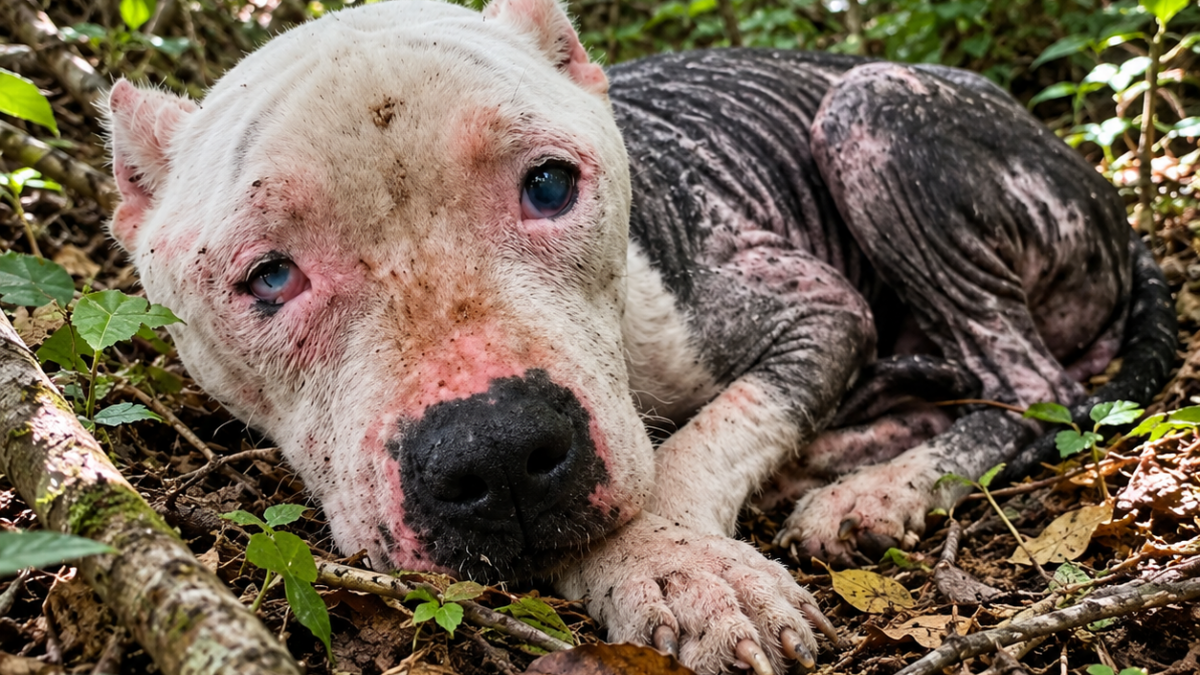
PART 2
For several seconds, I could not speak.
The photograph lay between us on the stainless-steel counter while Halo slept twenty feet away, unaware that a single image had just changed the questions we were asking about her past.
“Where did you get this?”
Marcus lowered his voice.
“A woman named Denise Harper sent it through the rescue page. She says she used to live two houses down from the property.”
I picked up the printout.
The photograph was not perfect. It appeared to have been taken from a distance through a fence, probably with a phone. But there was no mistaking the dog.
Same tan-and-white coat.
Same narrow stripe of white down the center of her face.
Same right ear that folded slightly at the tip.
And those eyes.
Cloudy even then.
Halo stood beside a weathered wooden shed with a chain leading from her collar to a metal stake in the ground.
She looked thinner than a healthy dog should.
Not as skeletal as when we found her.
But thin.
“How old is this picture?”
“About eight months.”
My stomach tightened.
“Eight months?”
“That’s what Denise says.”
I looked toward Halo’s kennel.
If the date was correct, then Halo had already been blind while living at that house.
Someone had known.
Someone had seen her moving through life without vision.
And somehow she had ended up nine miles away in a forest.
“Did Denise say who owned her?”
Marcus nodded.
“A man named Raymond Pike.”
The name meant nothing to me.
“Does he still live there?”
“No. Property was sold about three months ago.”
“Where is he now?”
“She doesn’t know.”
I took out my phone.
Marcus raised a hand.
“Don’t.”
“What?”
“I know that look.”
“What look?”
“The one where you decide that because you rescue animals, you’re also a detective.”
“I wasn’t going to do anything.”
“You were absolutely going to search his name.”
“That’s not illegal.”
“No. Showing up at someone’s door while angry is the part I’m worried about.”
I glanced toward Halo again.
Her breathing was even.
Soft.
She had spent most of the morning sleeping after physical therapy.
“I’m not going to his door.”
Marcus stared at me.
“I promise.”
That satisfied him only slightly.
We contacted animal control instead.
Officer Jenna Ruiz had already opened an incident report because of where Halo was found and the severity of her condition. Until then, there had been no evidence connecting her to any particular person.
Now there was.
Denise agreed to speak with investigators.
So did another neighbor.
And while that part of Halo’s story moved quietly into official hands, we focused on the one thing she needed most from us.
Recovery.
For the first ten days, Halo’s life was deliberately small.
Food.
Sleep.
Medication.
Water.
Gentle contact.
Nothing else mattered.
Starvation changes the way you think about food.
People see an emaciated animal and instinctively want to fill a bowl.
You can’t.
A body that has gone too long without adequate nutrition needs to relearn how to receive it safely.
Dr. Kim calculated every portion.
Small meals.
Several times a day.
Protein adjusted carefully.
Electrolytes monitored.
Blood work repeated.
Halo quickly learned the sound of her stainless-steel bowl.
The moment it touched the counter, her ears rose.
“That’s yours,” I would say.
Tail.
I would set it down directly in front of her and tap the floor beside it.
Halo learned the sound.
Tap.
Food.
Soon I didn’t need to guide her nose.
She found the bowl herself.
One evening, I watched her eat an entire small portion without stopping.
Marcus leaned against the doorway.
“Remember the first night?”
I nodded.
She had taken three bites, then fallen asleep with her chin almost touching the food.
Her body had been too exhausted even to finish eating.
Now she licked the bottom of the bowl.
I laughed.
“Apparently starvation did not destroy her opinions about dinner.”
Halo’s head turned toward my voice.
Her tail tapped the blanket.
That tail became our measurement for everything.
Food?
Wag.
Marcus?
Wag.
Dr. Kim?
Sometimes wag.
Medication?
Absolutely not.
Halo began detecting patterns before we realized she was doing it.
Blind dogs do not live in darkness the way sighted people imagine.
They build maps from smell, sound, texture, air movement, memory.
At first, Halo’s map consisted of one kennel.
She learned the location of the water bowl.
The soft bed.
The door.
Then we expanded it.
A short hallway.
We placed textured mats at turns.
One rubber mat outside her kennel.
Another beside the treatment room.
A carpet runner leading toward the small indoor exercise area.
I wore a tiny bell clipped to my shoe during early sessions.
“Come on, Halo.”
Step.
Pause.
Bell.
Step.
She followed.
The first few attempts exhausted her.
Her muscles had wasted so severely that standing for more than a minute made her back legs shake.
We used a support harness.
I held part of her weight.
Marcus stayed beside her.
“Three steps,” I said.
Halo took one.
Then two.
On the third, her left hind leg buckled.
I caught the harness.
“Got you.”
Halo froze.
I waited.
“Nothing happened.”
Her ears turned backward.
“You didn’t fall.”
She stood there for several seconds.
Then took another step.
Four.
I almost cried.
Marcus smiled.
“Don’t celebrate yet. She’ll think four gets her out of therapy.”
“It should.”
Halo’s tail moved.
“She agrees with me.”
Week two brought the first real scare.
Halo developed vomiting overnight.
With her nutritional state still fragile, every setback felt dangerous.
Dr. Kim ran tests.
We adjusted the feeding schedule.
Fluids.
Anti-nausea medication.
Observation.
For twelve hours, Halo refused food.
I sat beside her.
The bowl remained untouched.
“You have spent two weeks training me to believe you would sell state secrets for chicken.”
Nothing.
I placed a piece near her nose.
She turned away.
Fear rose instantly.
Marcus saw it.
“She’s tired.”
“She was tired yesterday and ate.”
“Emily.”
“What?”
“You are staring at her like you can force her stomach to work.”
“I’d like to.”
Dr. Kim entered.
“She needs rest.”
“What if she doesn’t eat tonight?”
“Then we reassess.”
“What if—”
“Emily.”
I stopped.
“You cannot panic her healthy.”
That sentence stayed with me.
I moved away from Halo’s bowl.
Sat on the floor near her bed.
And talked.
Not about food.
Not about treatment.
I told her about my terrible apartment.
My mother’s obsession with calling me during rescue emergencies because she believed that was when I had the most free time.
My first dog, Bailey.
The fact that Marcus thought pineapple belonged on pizza.
“It does,” he called from the hallway.
“No, it doesn’t.”
Halo’s ear moved.
“See? Even the blind dog knows.”
Marcus stepped in.
“She is literally facing the wall.”
“She’s still judging you.”
Several hours later, Halo stood.
Slowly.
Walked toward her bowl.
And ate.
Only half.
Enough.
By morning, she was asking for more.
I learned not to celebrate recovery as a straight line.
Halo could walk ten feet one day and five the next.
She could finish every meal on Monday and need coaxing Tuesday.
Her body had been pushed too far for too long.
It deserved patience.
The investigation moved slowly too.
Jenna called me several days after receiving the photograph.
“I need to ask you about identification.”
“What do you need?”
“Does Halo have a microchip?”
“No.”
“Tattoo?”
“No.”
“Any unique marks?”
I described the white stripe.
The folded ear.
A small black patch near the base of her tail.
The slight deformity in her left hind leg.
“We have old veterinary records we’re trying to obtain.”
My grip tightened on the phone.
“You found the vet?”
“I didn’t say that.”
“You just said records.”
Jenna sighed.
“I’m not discussing details until things are verified.”
“So you did.”
“Emily.”
“Fine.”
But two days later, Jenna came to the clinic.
She carried a file.
Halo was in the rehabilitation room.
She could now walk almost twenty feet with minimal support.
When Jenna entered, Halo stopped.
New footsteps.
New scent.
Her posture changed immediately.
Head low.
Body still.
Jenna remained near the doorway.
“Should I stay here?”
“Yes.”
I sat beside Halo.
“It’s okay.”
Jenna spoke softly.
“Hi, girl.”
Halo listened.
Then relaxed slightly.
Only then did Jenna show me the file.
“Veterinary records.”
I read the name.
Dog: Hazel.
Female mixed breed.
Estimated age: eight years.
Owner: Raymond Pike.
Eye condition: progressive retinal degeneration with mature cataracts.
Blindness documented.
Three years earlier.
I stared.
“Halo was called Hazel?”
“Apparently.”
“When was her last veterinary appointment?”
“Almost two years ago.”
“What for?”
“Eye evaluation, weight loss, and a leg injury.”
I looked at Halo.
Her crooked hind leg.
“Treatment?”
“Anti-inflammatory medication. Follow-up recommended.”
“Did he return?”
“No records showing it.”
“Anything about her being chained?”
“No.”
“Anything about her disappearing?”
Jenna met my eyes.
“That’s where it gets more concerning.”
My stomach tightened.
“What?”
“Pike told one former neighbor the dog died.”
I stared at her.
“When?”
“About six months ago.”
Halo had been photographed alive eight months earlier.
Found alive now.
And according to a neighbor, her owner had told people she was dead.
“Why would he say that?”
“We don’t know.”
“Did he report her missing?”
“No report we found.”
My anger came fast.
“So he knew she was blind, knew her leg was injured, and—”
“Stop.”
Jenna’s tone sharpened.
“We know certain things. We suspect others.”
I hated that distinction.
I also knew she was right.
“We know Halo was owned by Pike. We know she was medically documented as blind. We know at least one photograph appears to show her chained at his former residence. We know a neighbor says Pike later claimed she died. We know she was eventually found abandoned or lost in severe condition.”
“And you need to prove what happened between those points.”
“Yes.”
“What does Pike say?”
Jenna’s face revealed nothing.
“We’re trying to speak with him.”
“Meaning?”
“We have not completed that interview.”
I looked down at the record again.
Hazel.
The name felt strange.
I crouched beside Halo.
“Were you Hazel?”
She turned toward me.
Tail.
Marcus, standing behind us, said, “She likes Halo.”
“She likes food.”
“That too.”
I touched the side of her face.
The name Halo had started as a temporary one.
A volunteer chose it because when we first found her under the trees, pale light filtered through the branches and made the fur around her head look almost silver.
Now the name belonged to her.
Whatever had happened to Hazel, Halo was becoming someone else.
Not replacing the past.
Surviving it.
By week four, her coat started changing.
Nutrition does amazing things quietly.
At first, all we noticed was less shedding.
Then the fur over her shoulders became softer.
The dull tan color deepened.
Her ribs remained visible, but not as sharply.
Her hip bones no longer looked as if they might break through the skin.
She gained six pounds.
Then nine.
The day the scale showed a double-digit gain, I raised both hands.
“Halo!”
She stood beside me.
Completely unimpressed.
Marcus leaned into the room.
“What?”
“Ten pounds.”
“Nice.”
“Nice?”
“What reaction were you hoping for?”
“Confetti.”
Halo walked toward the sound of his voice.
He crouched.
“Congratulations on becoming heavier.”
She licked his chin.
“See?” he said. “She appreciates professionalism.”
Her confidence grew faster than her muscles.
Once she learned the layout of our main recovery room, she stopped walking like every step might lead off a cliff.
She counted distances.
Seven steps from bed to water.
Four from water to the textured mat.
Turn left.
Five to the door.
We tried not to move furniture.
If we did, we guided her through the new layout.
She adapted.
One afternoon, a volunteer accidentally left a cardboard box near the hallway wall.
Halo approached.
Her whiskers touched it.
She stopped.
Sniffed.
Moved around it.
No panic.
No collision.
I watched with tears in my eyes.
She was no longer helpless because she couldn’t see.
She was learning to trust everything else she had.
Her nose.
Her ears.
Her memory.
Us.
Then, for the first time, Halo barked.
Not fear.
Demand.
I was late with breakfast.
Thirty seconds.
Apparently unacceptable.
I entered the room carrying the bowl.
“Did you just yell at me?”
Halo barked again.
Marcus started laughing.
“You created that.”
“I saved her life.”
“And now she owns you.”
Halo wagged.
“She has become incredibly ungrateful.”
That was exactly what we wanted.
We didn’t want permanent gratitude from a traumatized dog.
We wanted entitlement.
Security.
The assumption that breakfast would arrive because breakfast always arrived.
That was healing.
Trust is not a dog thanking you every day for rescue.
Trust is a dog complaining when you are late.
Around the fifth week, Jenna called.
“We located Pike.”
I stopped walking.
“Where?”
“Different county.”
“Did you talk to him?”
“Yes.”
My heart accelerated.
“And?”
“He says Halo ran away.”
I laughed once.
Not because anything was funny.
“A blind dog.”
“That’s his statement.”
“Nine miles away?”
“He says she escaped the yard before he moved.”
“When?”
“He gave an approximate date.”
“Before or after he told the neighbor she died?”
Jenna paused.
“That inconsistency is being examined.”
I closed my eyes.
“Did he look for her?”
“He says he did.”
“Missing-dog posts?”
“None we’ve found.”
“Shelters?”
“No documented reports.”
“Microchip?”
“You know she wasn’t chipped.”
“Did he tell the people buying his house that his blind dog was missing?”
“Emily.”
I stopped.
“We’re investigating.”
I hated those words because I wanted certainty.
I wanted someone to blame.
I wanted a clean villain because clean villains make emotional stories simple.
But real cases need evidence.
So I waited.
Halo got stronger.
The case got stranger.
Denise, the former neighbor, gave investigators old text messages.
One included a conversation about Halo.
Denise had offered to take the dog months before the property sale.
She had noticed Halo getting thinner.
According to the messages, she wrote:
If you don’t want Hazel anymore, I can take her.
Pike replied:
She’s fine.
Two weeks later, Denise asked again.
No answer.
Later, Pike told another neighbor the dog had “passed.”
But Halo had not passed.
She had ended up in a forest.
Still wearing a worn collar.
No identification.
No leash.
No tracking device.
Nothing that would help anyone return her.
The investigators searched for cameras near the service road where she had been found.
There was one.
A private timber company used a security camera near a locked equipment gate.
Most footage had already overwritten itself by the time Halo was rescued.
Most.
Not all.
Jenna called me on a Wednesday afternoon.
Her voice sounded different.
“We found video.”
My hand tightened around the phone.
“Of Halo?”
“We believe so.”
“What does it show?”
“I can’t send it to you.”
“What does it show?”
Silence.
Then:
“A pickup truck.”
I sat down.
“Halo?”
“A dog matching her appearance exits or is removed near the edge of the frame.”
“Removed?”
“The angle is poor.”
“Who is driving?”
“We’re working on that.”
“License plate?”
“Partial.”
My anger became cold.
This was no longer a vague story about a blind dog possibly wandering away.
Somebody had taken a vehicle into that area.
A dog matching Halo’s markings appeared near the truck.
The truck left.
Halo stayed.
“How long before we found her?”
“Camera timestamp is eighteen days before the rescue.”
I stopped breathing.
“Eighteen days?”
“We believe so.”
Eighteen days.
Blind.
Underweight already.
In a forest.
No familiar sounds.
No walls to map.
No predictable food bowl.
No human footsteps she knew.
I looked at Halo sleeping nearby.
“How did she survive eighteen days?”
“I don’t know.”
Neither did anyone.
Maybe puddles.
Maybe runoff.
Maybe scraps.
Maybe luck.
Maybe the same stubbornness that now made her bark when breakfast was thirty seconds late.
I wanted to see the video.
Jenna refused.
“Not while the case is active.”
“Is it Pike’s truck?”
“We’re comparing.”
“Jenna.”
“Emily.”
I hated when she used my own tone against me.
“Let us do this correctly.”
So I did.
The next major step in Halo’s recovery was moving into foster care.
She no longer needed hospitalization.
She needed a home environment.
Routine.
Space.
Confidence.
We had several qualified fosters.
I reviewed them.
Then rejected each one for increasingly ridiculous reasons.
One had stairs.
Valid.
One had two large dogs.
Possibly manageable but complicated.
One lived forty minutes from the clinic.
Not terrible.
One rearranged furniture frequently.
Marcus stared at me.
“You’re keeping her.”
“No.”
“You have invented objections to five foster homes.”
“They are reasonable.”
“You rejected Susan because her coffee table has sharp corners.”
“Blind dog.”
“She said she would move the coffee table.”
“Then Halo’s map changes.”
“You haven’t even placed Halo there.”
“Exactly.”
Marcus folded his arms.
“What?”
“I said exactly.”
“You’re fostering her.”
I sighed.
“I have stairs.”
“You live in a one-story bungalow.”
“Front steps.”
“Three.”
“Still stairs.”
“Build a ramp.”
“I’m not building a ramp.”
Two days later, I built a ramp.
Halo came home with me Friday afternoon.
I had spent the previous evening preparing.
Textured rugs.
Baby gate near the laundry room.
Soft barriers on sharp furniture edges.
Food and water in fixed locations.
A bed beside my couch.
Another in my bedroom.
Small scent markers using dog-safe lavender near one doorway and a tiny amount of vanilla near the back exit.
Nothing overwhelming.
Just information.
The first hour, Halo barely moved.
New place.
New echoes.
New air.
I walked beside her with the bell.
“Kitchen.”
Step.
“Rug.”
Step.
“Turn.”
She bumped lightly into my shin.
“Sorry.”
Tail.
We walked the layout three times.
Then she slept for four hours.
That evening, I sat on the floor beside her bed.
“You know this is temporary.”
Halo snored.
“I mean it.”
Nothing.
“You are going to a proper adopter.”
Her paw twitched.
“This is foster care.”
Marcus had texted me earlier:
Sure.
I ignored him.
The first night, Halo woke at 2:13 a.m.
I heard her nails on the bedroom floor.
Then a soft bump.
I sat up.
“Halo?”
She stopped.
I turned on the light out of habit.
Then realized the absurdity.
“I’m here.”
Her ears turned.
I tapped the mattress.
She followed the sound.
Reached the side of the bed.
Rested her chin on it.
“Oh, no.”
Tail.
“You have a bed.”
Tail.
“A very expensive orthopedic bed.”
Tail.
“I’m not lifting you up.”
She stood there.
I lasted twenty seconds.
Then I helped her onto the mattress.
Halo circled twice.
Nearly sat on my face.
Found the pillow.
And fell asleep.
I stared at the ceiling.
“This is still foster care.”
She snored.
Her confidence at home developed quickly.
By day three, she knew the route from bedroom to kitchen.
By day five, she navigated to the backyard door.
By the end of week two, I stopped wearing the bell indoors.
She didn’t need it.
She knew me.
The sound of my breathing.
My steps.
My voice.
My scent.
When I came home from the rescue, she recognized my car before I opened the door.
Her tail would start hitting the wall.
Thump.
Thump.
Thump.
The blind dog who once lay alone under trees now waited for a person she knew would come back.
One evening I stood outside the front door listening.
Thump.
Thump.
I started crying before I entered.
Halo greeted me with her entire body.
Not elegantly.
She bumped my knee.
Stepped on my shoe.
Then pressed her head into my stomach.
I dropped to the floor.
“Hi.”
She leaned against me.
For almost a minute, neither of us moved.
I remembered that first forest.
The trembling legs.
The cloudy eyes.
The damp leaves beneath her body.
The fact that she could not see who was approaching.
Now she didn’t need to see.
She knew.
That was more powerful.
The investigation reached its turning point three months after Halo’s rescue.
Jenna asked me to come to animal control.
Marcus joined me.
We sat in a small conference room.
Jenna placed several photographs on the table.
First, the original image from Denise.
Halo chained behind Pike’s property.
Second, a still frame from the timber-company video.
A pickup near the service road.
Third, an enlarged image of the truck.
White.
Older Ford.
Damage along the passenger-side rear quarter panel.
Fourth, a photograph of Raymond Pike’s truck obtained during the investigation.
Same model.
Same damage.
I looked up.
“That’s his truck.”
Jenna remained careful.
“It is consistent with the vehicle in the footage.”
“License plate?”
“Partial characters are consistent.”
Marcus asked, “And the dog?”
Jenna placed another still image down.
Blurry.
A tan dog beside the truck.
White facial marking visible.
My stomach twisted.
“Halo.”
“We believe so.”
“What does the video show exactly?”
Jenna sat back.
“The truck stops. A person exits. The dog appears near the passenger side. The person returns to the vehicle. The truck leaves.”
“Does Halo follow?”
“No.”
“Could she?”
Jenna said nothing.
I knew the answer.
She was blind.
Weak.
In unfamiliar terrain.
“What did Pike say when you showed him?”
“He changed his statement.”
My anger sharpened.
“To what?”
“He now says he took Halo to the area because he believed someone there would find her.”
For several seconds, I thought I had misunderstood.
“What?”
Marcus swore quietly.
Jenna continued.
“He claims he could no longer care for her medical needs and believed leaving her near a frequently used access road was preferable to surrendering her to a shelter.”
I stood so quickly that my chair struck the wall.
“Preferable?”
“Emily.”
“She almost died!”
“I know.”
“She was blind!”
“I know.”
“He drove a blind, starving dog into a forest and—”
“Emily.”
Jenna’s voice was firm.
I stopped.
“You cannot contact him.”
“I don’t want to contact him.”
That was almost true.
“Do not post his address. Do not encourage people to confront him. Do not do anything that damages the case.”
I looked at Halo’s blurry figure in the still image.
“Is he being charged?”
“The prosecutor is reviewing evidence.”
“Jenna.”
“Yes. We are recommending charges.”
I sat slowly.
Marcus rested a hand on my shoulder.
I expected satisfaction.
Instead, I felt sick.
Because now I knew.
Halo had not wandered.
She had not gotten lost.
Someone had driven her somewhere she could not possibly navigate and left.
Eighteen days.
Every hour suddenly became imaginable.
Rain.
Cold.
Branches scraping her face.
The sound of animals moving nearby.
Her inability to understand where shelter was.
Her injured leg weakening.
Hunger.
Thirst.
Then finally her body giving out beneath the cedar tree.
The photograph in front of me blurred.
“Why didn’t he take her to a shelter?”
Jenna’s voice softened.
“He says he was embarrassed.”
I laughed bitterly.
“Embarrassed.”
“He says he believed he would be judged for her condition.”
“So he did something worse to avoid being judged.”
No one answered.
That evening I went home early.
Halo was asleep beside the couch.
When I entered, her head rose.
Tail.
She stood.
Walked toward me.
No hesitation.
She reached my legs and pressed into them.
I sank to the floor.
For a long time, I held her.
“You were waiting for him to come back, weren’t you?”
Halo licked my chin.
“I’m sorry.”
Of course, none of it had been mine to apologize for.
But grief does that.
It makes you apologize on behalf of humanity.
I put my forehead against hers.
“He doesn’t get to be your ending.”
Halo’s tail moved.
That became my promise.
The case moved forward.
Pike was charged under state and county animal-cruelty statutes related to abandonment and failure to provide necessary care.
The charges were not the fantasy version people online wanted.
There was no attempted-murder charge.
No decades in prison.
Law works through statutes, evidence, elements.
Jenna explained it repeatedly.
I learned to accept that justice had to be accurate to mean anything.
The rescue posted only verified information.
No mob.
No addresses.
No threats.
That mattered to me.
Halo had experienced enough cruelty.
I did not want her story used to manufacture more.
But I wanted accountability.
And I wanted him to see what she became.
While attorneys filed motions and court dates moved around calendars, Halo kept healing.
Her weight returned to normal.
Her coat became thick and soft.
People who saw only later photographs could barely believe she was the same dog.
Her hind leg improved dramatically with therapy, though she retained a slight unevenness when tired.
Blindness remained permanent.
We never tried to “fix” what couldn’t be fixed.
Instead, we built her world around it.
She learned verbal cues.
“Step.”
“Careful.”
“Left.”
“Right.”
“Wait.”
“Up.”
“Down.”
“Door.”
My favorite was “friend.”
Whenever a familiar person approached, I said it.
“Friend.”
Halo’s body relaxed.
Marcus.
Friend.
Dr. Kim.
Friend.
Jenna.
Eventually friend.
One Saturday, Denise came to visit.
The neighbor who had taken the photograph.
She stood outside my house crying before she even entered.
“I should’ve done more.”
I knew that guilt.
“Come in.”
Halo was on her bed.
Denise stopped several feet away.
“Halo?”
Halo’s head rose.
Denise’s voice broke.
“Hazel.”
Halo froze.
I watched carefully.
The old name meant something.
Her ears changed.
Her nose lifted.
Denise crouched.
“Baby.”
Halo walked toward the voice.
Slowly.
Then sniffed Denise’s hands.
Her tail began moving.
Denise covered her mouth.
“She remembers me.”
Maybe.
Or maybe she remembered a scent.
A voice.
A person who once stood near the fence.
It did not matter.
Halo placed her head beneath Denise’s hand.
Denise cried openly.
“I used to slip treats through the fence.”
I sat across from her.
“You tried to take her.”
“She was getting thinner. I kept asking him.”
“I saw the texts.”
“He said she was fine.”
Denise stroked Halo’s shoulder.
“Then one week she disappeared. He told me she died.”
Her face tightened.
“I believed him.”
“You had no reason not to.”
“I should’ve called somebody.”
“Yes.”
The answer surprised her.
I continued.
“You probably should have.”
Tears filled her eyes.
“But you took a photograph. You kept the messages. And when you saw her rescue post, you spoke up.”
I looked at Halo.
“That mattered.”
Denise nodded.
“I’m sorry, girl.”
Halo leaned against her.
That was enough.
Not absolution.
Connection.
Recovery.
Six months after Halo came home with me, Marcus arrived carrying a folder.
“What’s that?”
“Adoption applications.”
I immediately disliked him.
“Why?”
“Because Halo is medically cleared for adoption.”
“She’s still in therapy.”
“Routine maintenance.”
“She needs a specialized home.”
“We know.”
“She’s blind.”
Marcus stared at me.
“That information has somehow reached us.”
“She knows my house.”
“She can learn another.”
“She knows my voice.”
“She can learn another.”
“She sleeps in my bed.”
“That sounds like a you problem.”
I folded my arms.
“How many applications?”
“Twenty-seven.”
I stared.
“For Halo?”
“Yes.”
“Twenty-seven?”
“The video about her navigation training reached a lot of people.”
I hated this development.
We reviewed applications.
Some were unsuitable.
People meaning well but underestimating the responsibility of a blind dog.
Others were excellent.
One couple had raised two visually impaired dogs.
A retired veterinarian applied.
A woman who worked from home and had a quiet fenced yard.
Every good application made me increasingly miserable.
Marcus watched.
“You know what this is called?”
“Quality control.”
“Foster failure.”
“I haven’t failed.”
“Not yet.”
We scheduled a meeting with the retired veterinarian, Dr. Susan Miller.
She was wonderful.
I disliked her immediately for being wonderful.
Halo liked her.
That was worse.
Susan sat on my living-room floor.
Did not reach.
Spoke calmly.
Halo approached.
Sniffed.
Tail.
My heart dropped.
Susan understood scent mapping.
Furniture stability.
Eye care.
Mobility.
Diet.
Everything.
When she left, Marcus said, “Perfect home.”
I said nothing.
“Emily.”
“I heard you.”
“You look like someone died.”
“She would take good care of Halo.”
“Yes.”
Halo walked into the room.
Bumped gently against my knee.
Then lay on my foot.
Marcus looked down.
Then up.
“Oh, for God’s sake.”
“What?”
“Adopt your dog.”
I swallowed.
“I’m her foster.”
“You built your entire house around her.”
“She needed adaptation.”
“You bought three identical rugs in case one wears out because changing texture might confuse her.”
“That’s responsible.”
“You haven’t taken a vacation because you don’t trust anyone else to maintain her routine.”
“I’m busy.”
“Halo has your mother’s phone number on her emergency card.”
“That is practical.”
Marcus laughed.
Then became serious.
“What are you afraid of?”
The answer came too quickly.
“Losing her.”
He stopped.
I looked at Halo.
She was asleep against my shoe.
“I rescue them. I help them. They leave.”
“That’s foster care.”
“I know.”
“But this one?”
My throat tightened.
“This one came home.”
Marcus smiled.
“Exactly.”
I completed Halo’s adoption papers two days later.
Susan was gracious when we called.
“I suspected,” she said.
“What gave me away?”
“You asked me seventeen questions about where I would place her water bowl.”
I laughed.
“Sorry.”
“Don’t be. She already belongs with you.”
We celebrated adoption day with chicken, a new bed, and a tag Halo could not read but I could.
HALO CARTER.
My phone number.
Underneath:
I AM BLIND. PLEASE HELP ME HOME.
That last word almost broke me.
Home.
Pike’s court case began several weeks later.
I did not bring Halo.
She did not need to be evidence in person.
Photographs were enough.
Veterinary records.
The security video.
Neighbor statements.
His own interview.
The prosecution called Dr. Kim to explain Halo’s condition at rescue.
I sat behind her.
She described malnutrition.
Dehydration.
Muscle wasting.
The medical consequences of prolonged lack of food and water.
The judge asked a question.
“In your professional opinion, could the dog’s blindness have made survival after abandonment more difficult?”
“Yes.”
“How?”
Dr. Kim remained clinical.
“She could not visually identify water, shelter, hazards, roads, predators, or a route back toward human activity. A blind dog can navigate extremely well in a familiar environment, but this was not familiar terrain.”
That distinction mattered.
Halo was not helpless because she was blind.
She had been made helpless by being placed somewhere without a map she could understand.
The prosecutor showed the camera still.
The truck.
The dog.
The departure.
Pike’s attorney argued his client believed the dog would be found quickly.
That the road was used by forestry employees.
That Pike had become financially overwhelmed by veterinary needs.
That he had made a terrible decision under pressure, not acted with sadistic intent.
I listened carefully.
Because neutrality was difficult when you love the victim.
Was he overwhelmed?
Possibly.
Had Halo needed expensive care?
Yes.
Was surrender available?
Also yes.
Multiple shelters.
Rescues.
Veterinary surrender assistance.
Neighbor Denise had literally offered to take her.
That mattered.
When Pike testified, I saw him for the first time.
He was not what my anger had created.
Not a monster.
Not frightening.
A tired man in his late fifties wearing a gray suit that didn’t fit well.
That almost made me angrier.
Ordinary people can do terrible things.
He admitted driving Halo to the service road.
He said he thought someone would find her within hours.
The prosecutor asked:
“You knew she was blind?”
“Yes.”
“You knew she had difficulty walking?”
“She had bad days.”
“You knew she was underweight?”
“She wouldn’t eat right.”
“Did you contact a shelter?”
“No.”
“A rescue?”
“No.”
“Your veterinarian?”
“No.”
“Did your neighbor offer to take her?”
Silence.
Then:
“Yes.”
“Why didn’t you give the dog to Ms. Harper?”
Pike looked down.
“I don’t know.”
That answer stayed with me.
I don’t know.
Sometimes there is no dramatic motive.
No secret plot.
No complicated explanation.
Just selfishness.
Shame.
Avoidance.
And a choice.
The prosecutor showed the photograph of Halo found beneath the cedar tree.
Bones visible.
Body collapsed.
Then the security timestamp.
Eighteen days.
Pike closed his eyes.
I expected satisfaction.
I felt none.
Halo’s suffering could not be refunded through another person’s shame.
During a later hearing, I was allowed to provide a victim-impact statement on behalf of the rescue and as Halo’s adopter.
I walked to the front carrying two photographs.
One from the forest.
One from the previous week.
I placed the first where the judge could see it.
“This was Halo when we found her.”
Then the second.
Halo standing in my kitchen.
Healthy weight.
Coat full.
Head lifted toward my voice.
“This is Halo now.”
I looked toward Pike.
For months, I had imagined this moment.
I had imagined telling him exactly what I thought of him.
Instead, when I finally saw him, I understood anger was too small for what I wanted.
“You left a blind dog in a forest.”
The courtroom was silent.
“She could not see the truck leave. She could not see the road. She could not see water. She could not see the people who eventually found her.”
My voice shook.
“But she could hear.”
I swallowed.
“For eighteen days, I wonder how many engines she heard and thought might be yours.”
Pike lowered his head.
“That is the part I cannot forget.”
I looked at the healthy photograph.
“Halo now recognizes my car. She waits at my door before I enter. She knows my footsteps. She knows which sound means breakfast, which rug leads to the backyard, and which voice tells her she is safe.”
My anger softened into something else.
“You took away every familiar sound she had.”
I paused.
“We gave her new ones.”
I held the photograph slightly higher.
“This is not evidence that what happened wasn’t serious.”
My eyes filled.
“It is evidence that you did not get to decide how her story ended.”
Then I sat down.
The final disposition included a conviction under applicable animal-abandonment and neglect provisions, fines, restitution toward veterinary expenses, probationary conditions, and restrictions on animal ownership during the period imposed by the court.
Some people wanted more.
Some thought less would have been appropriate.
For me, the most important order was simple.
He could not take responsibility for another vulnerable animal during the restriction period.
That was accountability.
But it was not Halo’s revenge.
Her revenge was waiting at home.
When I returned from court, I stood outside my front door.
Before my key entered the lock, I heard it.
Thump.
Thump.
Thump.
Halo’s tail against the wall.
I opened the door.
She came toward me.
Confident.
No bell.
No harness.
No hesitation.
She followed the familiar runner.
Turned exactly where she knew the hallway opened.
Stopped in front of me.
I knelt.
“You want to know what happened?”
Halo licked my face.
“I thought not.”
She pushed closer.
I wrapped my arms around her.
That was revenge.
Not the sentence.
Not the fine.
Not somebody lowering his head in court.
This.
A blind dog knowing exactly where she was.
A dog once abandoned in a place she could not see confidently crossing a house she had never visually known.
A dog once too weak to stand using her own legs to find the person she loved.
Halo’s life became wonderfully ordinary after that.
Morning began at six thirty.
Not six twenty-nine.
Not six thirty-one.
Six thirty.
If I was late, she barked.
Her breakfast was served in the kitchen beside the textured blue mat.
She walked outside afterward.
Seven steps down the hall.
Turn right at the rug.
Pause at the door.
“Step.”
One ramp.
Then grass.
She loved dew.
Hated heavy rain.
Snow confused her the first time.
She stepped into it.
Stopped.
Sniffed.
Then sneezed so violently that I laughed.
She barked at me.
“You’re blaming me?”
Another bark.
“I don’t control weather.”
She returned inside.
Halo learned the backyard better than most sighted dogs.
She knew the fence line.
The maple tree.
The little patch where afternoon sun stayed longest.
She knew exactly where squirrels usually moved because she heard them.
She never caught one.
That did not stop her from planning.
My mother came to visit.
At first, Halo was cautious.
Then Mom opened a bag containing cheese.
Friendship became immediate.
“You bribed my dog.”
My mother looked offended.
“I introduced myself.”
“With cheddar.”
“It’s a universal language.”
Halo agreed.
Marcus remained one of her favorite people.
He would enter without speaking.
Halo’s head would come up.
Tail.
“How does she know?”
“Your footsteps are loud.”
“They are not.”
“You walk like you’re angry at the floor.”
Halo approached him.
He crouched.
“She loves my angry floor walk.”
Dr. Kim visited too.
Halo had mixed feelings because Rachel’s scent probably meant vaccinations, examinations, and indignities.
Still, she wagged.
The rescue occasionally asked whether Halo could participate in educational events about special-needs dogs.
We kept appearances limited.
Her comfort came first.
But when she attended, something remarkable happened.
People expected pity.
Halo gave them confidence.
She navigated around chairs.
Followed verbal cues.
Located water.
Found me in a crowded room by scent and voice.
Children asked:
“Does she know she’s blind?”
I never knew how to answer that.
Halo knew her world.
That was enough.
One little girl asked, “Is she sad because she can’t see you?”
I crouched beside them.
“I don’t think so.”
“How does she know you?”
I smiled.
“Probably better than some dogs who can see me.”
The girl touched Halo gently.
Halo leaned toward her.
“She knows my voice?”
“Yes.”
“My smell?”
“Yes.”
The girl thought.
“That’s kind of like seeing.”
I never forgot that.
Halo did not need my face.
She knew whether I was tired by the way I walked.
Knew when I was crying before I spoke.
Knew when I came home carrying groceries.
Knew if Marcus was standing on the porch.
Knew the difference between my work shoes and sneakers.
She had her own version of sight.
I simply had to stop measuring it against mine.
A year after her rescue, we returned to the edge of the forest.
Not the location where she had been abandoned.
I would never force that.
A different trail.
Wide.
Quiet.
Safe.
Halo wore a harness attached to me.
Marcus walked beside us.
“Think she’ll like it?”
“I don’t know.”
The moment we reached the trees, Halo stopped.
Her body stiffened.
My heart dropped.
“We can leave.”
Marcus nodded.
I crouched.
“Halo.”
She listened.
Wind through leaves.
Birds.
Branches moving.
The smells must have been overwhelming.
I waited.
She took one step.
Then another.
Sniffed the ground.
I did not pull.
Did not encourage.
Her decision.
Halo moved forward.
Slowly.
We walked perhaps fifty yards.
Then she sat.
I sat beside her.
Marcus leaned against a tree.
The forest was quiet.
But this time Halo was not alone.
She rested her head against my leg.
“We can go home.”
Her tail moved.
So we did.
People later asked why I took her near a forest at all.
Because I didn’t want woods to belong only to the worst thing that happened to her.
But I also learned something important that afternoon.
Healing does not require conquering everything.
Halo didn’t need to love forests.
She didn’t need a dramatic cinematic moment where she ran through trees free of fear.
She simply needed the choice to leave.
Choice matters.
The first time, someone chose the forest for her.
The second time, she chose home.
That was enough.
Two years passed.
Halo became gray around her muzzle.
Her age remained uncertain.
The veterinary records suggested she was probably around ten or eleven.
Her hind leg developed arthritis.
We adjusted medication.
Added rugs.
Shortened walks.
The ramp stayed.
Her appetite did not diminish.
If anything, retirement increased her focus on food.
One morning I found the pantry door open.
Halo was inside.
Her head buried in a bag of treats.
I stared.
“How?”
She froze.
“How did you open that?”
Nothing.
“You are blind.”
Tail wag.
“That was not praise.”
Marcus suggested she had been pretending to be helpless for years.
Halo supported his theory by learning to open the same door again.
We installed a latch.
She considered this a personal attack.
Years three and four were quiet.
Beautifully quiet.
No court.
No investigation.
No headlines.
That was the part I loved most.
Rescue stories often stop at transformation.
But transformation is only the doorway.
Life afterward is the reward.
Halo became part of my mornings.
My work schedule.
My holidays.
My mother’s Christmas photographs.
Marcus’s complaints.
She had favorite blankets.
Favorite treats.
Favorite people.
She disliked vacuum cleaners and men wearing heavy work boots.
We never fully understood the boots.
Perhaps memory.
Perhaps sound.
We respected it.
She loved music.
Soft guitar especially.
Whenever I played old folk songs, she slept near the speaker.
One night the power went out during a storm.
No television.
No lights.
Rain hammered the windows.
Halo became restless.
I sat on the floor.
“Come here.”
She found me.
I sang badly.
Halo relaxed.
I stopped.
She nudged my hand.
“You want more?”
Nudge.
“You have terrible taste.”
I sang until the electricity returned.
She did not care when it did.
At some point, I realized I no longer introduced Halo by saying, “She’s blind.”
I said, “This is Halo.”
Blindness was still part of her.
But not her introduction.
That felt important.
At twelve or thirteen, her health began changing more quickly.
Her kidney values shifted.
Nothing catastrophic.
Medication adjustments.
Diet.
More frequent blood work.
Then her hearing started to fade.
That scared me.
Sight had never been her map.
Sound was.
When she failed to hear my key one evening, I stood outside the door for several seconds waiting for the familiar tail thump.
Nothing.
I entered.
Halo was asleep.
“Halo?”
No response.
I walked closer.
Her nose moved.
Then her head lifted.
Tail exploded.
Relief and sadness hit together.
Dr. Kim tested her hearing.
Age-related loss.
Not complete.
But progressing.
I sat in the exam room.
“How does a blind dog manage if she loses hearing too?”
“Smell. Touch. Vibration. Routine.”
“She depends on voices.”
“She depended on sight once too.”
I looked at Rachel.
“Halo has been adapting longer than we’ve known her.”
We changed again.
A vibrating collar designed only as a gentle cue—not punishment.
Floor taps.
Touch signals.
Stronger scent landmarks.
I learned to announce myself by placing a hand near her nose before touching her.
Halo learned.
Of course she did.
The dog who survived a forest adapted to old age.
One evening Marcus watched her navigate from bedroom to kitchen mostly through scent and memory.
“She’s incredible.”
“No.”
He looked at me.
“No?”
“She’s Halo.”
He smiled.
“That’s what I meant.”
During her fifth year with me, Denise visited again.
She was moving out of state.
Halo was sleeping near the window.
Denise sat beside her.
“Do you think she remembers the old place?”
“Maybe.”
“Do you think she remembers him?”
I knew who she meant.
Pike.
“I don’t know.”
“Would you want her to forget?”
I thought about it.
“No.”
Denise looked surprised.
“I want her past to belong to her.”
I stroked Halo’s fur.
“I just don’t want it controlling what comes next.”
That had become the lesson.
For Halo.
For me.
For Denise, who had carried guilt.
Maybe even for Pike, though I did not follow his life after court.
Justice had been handled.
I had no need to watch him forever.
Halo deserved my attention more than he did.
Her final year came gently at first.
She slept more.
Her arthritis worsened.
We added another bed.
Then another because apparently my house had become a dog-furniture showroom.
Her hearing faded almost completely.
But her nose remained remarkable.
I could walk in after work without speaking, and within seconds she knew.
She would rise slowly.
Tail.
Always the tail.
That tail had become the first and last language between us.
The first tiny wag in the clinic.
Then years of greetings.
One cold January morning, Halo did not stand for breakfast.
My entire body went still.
I crouched beside her.
She was awake.
Breathing normally.
But tired.
I touched her shoulder.
Tail.
“Food?”
Tail.
She tried to rise.
Her back legs failed.
I supported her.
She ate.
We went to Dr. Kim.
Blood work.
Exam.
Imaging.
Rachel sat beside me afterward.
“Halo’s kidneys have progressed.”
I knew.
“How much?”
“Significantly.”
“What can we do?”
“Supportive treatment. Medication. Fluids if needed. Diet. Comfort.”
“How long?”
Rachel hated that question.
“I don’t know.”
“Weeks?”
“Could be months.”
“Years?”
She did not answer.
That was answer enough.
I drove Halo home.
She slept in the passenger-side bed we had built for car rides.
At a traffic light, I placed my hand near her nose.
She sniffed.
Tail.
“Still here.”
The next three months became deliberate.
No wasted good days.
Sunlight whenever it appeared.
Cheese in medically reasonable quantities.
Visits from Marcus.
Mom.
Denise called by video even though Halo could neither see the screen nor hear much.
I held the phone near her.
“Denise says hi.”
Halo sniffed it.
Then sneezed.
Denise laughed through tears.
“That seems accurate.”
We took short walks.
Sometimes only to the mailbox.
Sometimes just the yard.
Every trip was Halo’s choice.
Some mornings she wanted to explore.
Others she wanted the warm rug.
I stopped thinking success meant movement.
Comfort was success.
Presence was success.
Then, one afternoon, Halo found the patch of sun near the living-room window and stretched out.
I sat beside her.
Her coat was thick now.
Soft.
Nothing like the loose fur covering bones in the forest.
I ran my hand across her side.
“You know, people still share your first picture.”
Tail.
“I hate that picture.”
Ear movement.
“Not because it isn’t important.”
I looked at her.
“But that’s not you anymore.”
Halo breathed deeply.
I thought of what image I would choose instead.
Not the courtroom.
Not her first steps.
Not even the first tail wag.
This.
An old blind dog sleeping safely in sunlight because she knew exactly where she was.
That was everything.
Her decline accelerated in spring.
She became nauseated.
Food interested her less.
We managed it.
Then she stopped enjoying walks.
We stopped asking.
She spent more time resting.
Her tail still moved when I came close.
Until one morning, it didn’t.
I sat beside her bed.
Placed my hand near her nose.
She sniffed weakly.
No tail.
I knew.
People talk about knowing when it is time.
Sometimes you don’t know.
Sometimes you simply recognize that every option is becoming about your fear rather than their comfort.
I called Rachel.
She came to the house.
Marcus came too.
Mom arrived with no makeup because she had been crying since I called.
Halo lay on her favorite bed.
The afternoon sun had just reached the window.
Rachel examined her gently.
Then looked at me.
I asked the only question that mattered.
“Can we make her feel good again?”
Rachel’s eyes filled.
“Not in a lasting way.”
I nodded.
Halo breathed beside us.
Slow.
Tired.
I sat on the floor.
For almost six years, I had promised her home.
This was part of that promise too.
Marcus knelt.
He placed his hand near Halo’s nose.
She recognized him.
Her tail moved.
Once.
A tiny tap.
Marcus broke.
“Oh, Halo.”
He pressed his forehead against her shoulder.
My mother whispered, “Sweet girl.”
I carried Halo outside.
Not because she needed a final adventure.
Because the sun was warmer there.
I placed her bed on the porch.
She lifted her nose.
Spring air.
Grass.
Flowers.
Home.
I sat behind her so she could rest against me.
Rachel waited.
No rush.
I spoke close to Halo’s ear even though I knew she probably heard little.
Maybe nothing.
That was okay.
She knew my vibration.
My touch.
My scent.
“You remember when we found you?”
Tail barely moved.
“I was terrified of touching you.”
I smiled through tears.
“You were skin and bones and somehow still judging us.”
Marcus laughed softly.
Halo breathed.
“You couldn’t see me then.”
My voice broke.
“You never saw me.”
I placed my hand gently over hers.
“And somehow you knew me better than almost anyone.”
Tears fell into her fur.
“I need you to know something.”
Halo’s nose moved.
“You are not in the forest.”
I swallowed.
“You are not alone.”
Her body relaxed against mine.
“You’re home.”
Rachel moved closer.
I nodded.
The medication entered quietly.
Halo did not struggle.
Her breathing became deeper.
Then softer.
I rested my face against the top of her head.
The final thing I felt was her tail.
One tiny movement against my leg.
Then stillness.
I stayed there long after her heart stopped.
The dog who once died a little every day from hunger and abandonment had finally left this world without fear.
No forest.
No damp ground.
No unfamiliar footsteps.
No wondering who was approaching.
Only people she knew.
Only hands she trusted.
Only home.
We cremated Halo.
I scattered part of her ashes beneath the maple tree in the backyard where she liked to sleep.
The rest I kept in a small wooden box.
No photograph from the forest sits beside it.
Instead, I chose one Marcus took three years after rescue.
Halo is crossing my living room.
Head up.
Tail raised.
Walking confidently through a world she cannot see.
That is her.
Several months after she died, Jenna sent me an email.
The county had updated its animal-abandonment training materials.
Halo’s case—without sensational photographs—was included as an example of why abandoning disabled animals in unfamiliar environments creates extraordinary risk.
I read the message twice.
Then closed it.
That was meaningful.
But Halo’s legacy was not a policy.
Not a court case.
Not even the prosecution.
Her legacy lived in smaller things.
A volunteer at our rescue started fostering blind dogs because she had met Halo.
A family who attended one educational event later adopted a visually impaired senior beagle.
Susan, the veterinarian who nearly adopted Halo, eventually took in two special-needs dogs.
Denise began donating to a fund helping owners who were overwhelmed by medical costs, because she wanted people to have an option before desperation became abandonment.
Those things mattered.
One year after Halo died, a blind puppy arrived at our rescue.
Congenital blindness.
Perfectly healthy otherwise.
He walked into a chair during his first hour.
Backed up.
Tried again.
I watched from the doorway.
Marcus appeared beside me.
“No.”
I looked at him.
“I didn’t say anything.”
“You have the face.”
“What face?”
“The Halo face.”
“I do not have a face.”
The puppy heard us.
Turned.
Walked toward the voices.
Bumped my shoe.
Sniffed.
Tail.
I closed my eyes.
“Absolutely not.”
Marcus laughed.
Three weeks later, the puppy went to another family.
I did not adopt him.
That mattered too.
Halo had taught me love without possession.
He found an excellent home.
I cried anyway.
Eventually, another dog came into my life.
Not blind.
Not dramatic.
A nine-year-old mutt named Rosie whose owner had died.
She disliked strangers.
Loved naps.
Had one bad tooth and no interest whatsoever in inspirational storytelling.
Perfect.
The first night Rosie came home, she found Halo’s old spot near the window.
I almost moved her.
My hand reached out.
Then stopped.
Rosie circled.
Lay down.
Sunlight reached her back.
I sat on the couch.
The room felt strange.
Then full.
Halo did not lose anything because Rosie was there.
Love does not work like territory.
The past does not need an empty bed to remain important.
Sometimes I still think about the eighteen days in the forest.
I wish I didn’t.
I imagine Halo hearing that truck disappear.
Maybe she waited.
Maybe she tried to follow.
Maybe she stayed near the road at first.
Maybe hunger eventually drove her deeper into the trees.
I will never know.
For years, that uncertainty haunted me.
Now I try to imagine something else.
The moment rescuers approached.
Halo could not see us.
She did not know who we were.
She heard footsteps.
Felt hands.
And she let us lift her.
That was her first act of trust.
Not because humans had earned it.
Because Halo still had enough hope left to allow one more possibility.
Everything after that grew from it.
The food bowl.
The blanket.
The first tail wag.
The first assisted steps.
My house.
The textured rugs.
The adoption.
The barking when breakfast was late.
The snow she hated.
The pantry she learned to open despite being blind.
The porch.
The maple tree.
Six years.
People often describe Halo as the blind dog abandoned in a forest.
I understand why.
It is dramatic.
It makes people feel something.
But if you had known her, that description would sound incomplete.
Halo was the dog who memorized an entire house in less than two weeks.
The dog who recognized people by footsteps.
The dog who discovered exactly which cabinet held treats.
The dog who barked when I sang badly.
The dog who knew Marcus before he spoke.
The dog who taught children that seeing is only one way of knowing the world.
The dog who grew old in a home she never once saw.
That is the part I want remembered.
Someone once drove her into a forest because caring for her felt difficult.
That was his decision.
It lasted minutes.
Halo’s response lasted years.
She survived.
She trusted again.
She gained weight.
She learned.
She loved.
She became demanding.
She grew old.
She died at home.
That is why I no longer think of her story as one about abandonment.
It is about ownership in the deepest sense.
Not humans owning animals.
Halo owning her life again.
The forest did not own it.
Pike did not own it.
Her blindness did not own it.
Her weakness did not own it.
And neither did I.
I was simply lucky enough to walk beside her for the part that came next.
Sometimes people ask whether I got revenge for Halo.
The answer depends on what they mean.
If revenge means making another person suffer because she suffered, no.
That would not have fed her.
It would not have repaired her muscles.
It would not have taught her a hallway.
It would not have made her tail move.
The law handled accountability.
Halo handled the rest.
Her revenge was that she lived long enough for the forest to become a small chapter instead of the entire book.
Her revenge was learning that footsteps could mean dinner instead of abandonment.
Her revenge was becoming so secure that she complained when routines changed.
Her revenge was resting her head against the people she trusted and never again wondering whether they would disappear.
Her revenge was home.
I still walk beneath trees sometimes.
When wind moves through leaves, I think of her.
A blind dog lying on damp ground, unable to know whether the sound coming toward her meant danger or rescue.
Then I remember the tail.
That tiny first wag.
Barely visible.
A movement most people would have missed.
That was Halo saying something before any of us understood her language.
Maybe you came back.
Maybe this time I’m not alone.
Maybe I can trust one more person.
And we did come back.
Every meal.
Every morning.
Every night.
Until the last one.
That is the promise Halo deserved from the beginning.
In the end, it was the promise we kept.








