PART 2: Before the Ambulance Doors Closed, He Told His Black Lab, “Stay Here—I’ll Come Back.” Two Days Later, the Dog Was Still Sitting in the Rain Beside His Bag
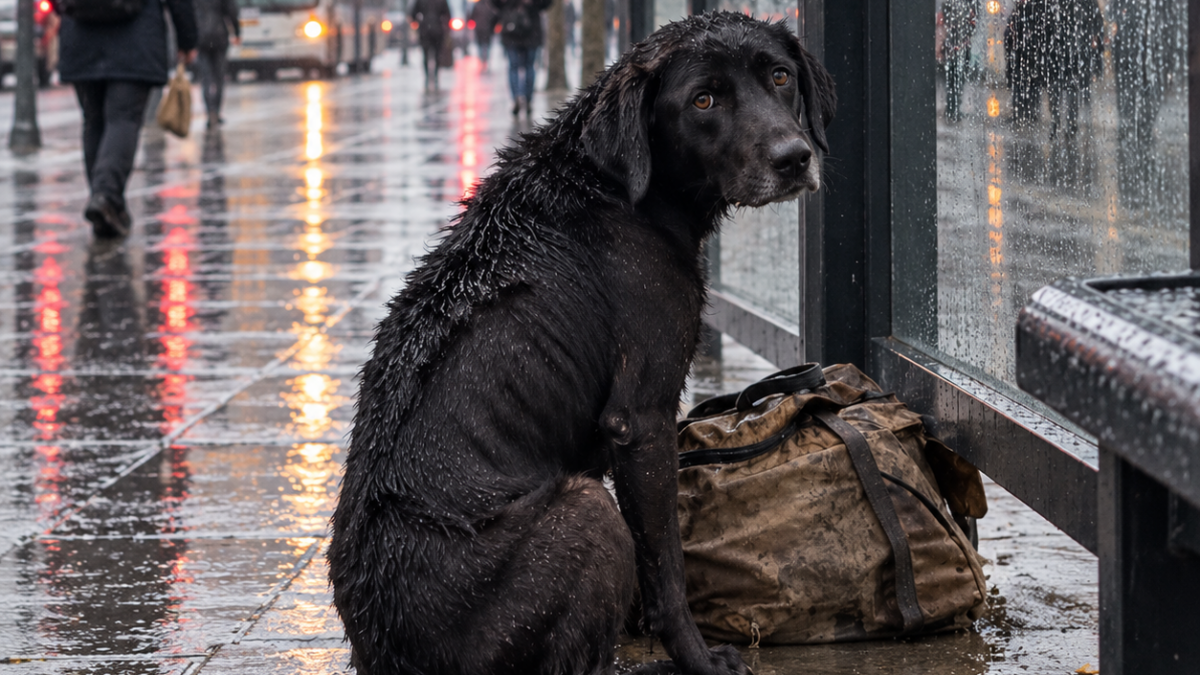
The black Labrador had been sitting at the same bus stop for two days, soaked to the skin, guarding a battered canvas bag as if his life depended on it.
Before the ambulance doors closed, his owner had looked straight into his eyes and whispered, “Stay here… I’ll come back,” and the dog had apparently decided that a promise from the only person he loved was worth waiting for.
I thought I had been sent there to move a stray out of the rain, but one phone call would reveal why that old bag—and the man who had disappeared with nothing but hospital clothes on his back—were far more important than anyone realized.
My name is Emma Hartford, and I work in county outreach services. Most mornings begin with somebody else’s emergency: an elderly woman without heat, a family facing eviction, a man sleeping behind a grocery store because the shelter is full. That Tuesday, a convenience-store clerk called our office and said a dog had been sitting beside the Route 16 bus stop since Sunday afternoon.
“He hasn’t left,” she told me. “Not even when it started pouring.”
By the time I arrived, rain was bouncing off the pavement hard enough to blur the traffic lights.
The dog sat under the narrow shelter roof, though the wind had soaked him anyway. He was a large black Lab, maybe seven or eight, with a graying chin and tired brown eyes. Beside him lay an old canvas duffel with one broken zipper. Every few seconds he stared down the road.
I approached slowly.
“Hey, sweetheart.”
Nothing.
I crouched and set down food.
He didn’t sniff it.
I offered water.
He didn’t touch that either.
His whole body trembled, but he refused to move.
The clerk came outside with an umbrella.
“That’s how he’s been,” she said. “People tried taking him home. He growled once when a man grabbed the bag, but otherwise he just sits there.”
“The bag belongs to his owner?”
“I think so.”
I reached toward it carefully. The Lab watched my hand but didn’t object.
Inside were two shirts, a threadbare towel, medication bottles with the labels rubbed nearly white, several folded receipts, and a cheap plastic wallet containing no cash. Tucked behind an old transit card was a photograph.
A thin, bearded man sat on a park bench with the same Labrador, only younger. The dog had one paw across the man’s knee. Both looked directly at the camera.
On the back someone had written:
THOMAS & MACK — STILL TOGETHER.
I looked at the dog.
“Mack?”
His ears lifted.
That was the first real reaction I got.
I spent the next hour asking questions. The cashier remembered the man. A taxi driver did too. Finally, an older woman who sold newspapers near the station pointed at the wet pavement.
“He collapsed right there Sunday,” she said. “Ambulance came fast.”
“Did the dog go with him?”
She shook her head.
“The medics tried. The dog panicked. Then the man woke up for maybe ten seconds.”
“What did he say?”
The woman’s face changed.
“He reached toward the dog and said, ‘Mack, stay here. I’ll come back.’”
I felt cold despite my raincoat.
I called dispatch, then two hospitals.
At St. Vincent’s, a nurse finally confirmed that a John Doe matching the description had been admitted Sunday after a cardiac event.
“Is he alive?”
A pause.
“Yes.”
I closed my eyes.
“Can he speak?”
“No. He’s still unconscious.”
I looked through the rain toward Mack.
He was still watching the road.
Two days. That animal had spent two nights beside a bus stop because one frightened, sick man had asked him to stay. Cars had sprayed him. Rain had soaked through his coat. Strangers had offered food, whistles, leashes, even a warm back seat. None of it mattered. He had been given one instruction by the person he trusted most, and abandoning that spot apparently felt to him like abandoning the man himself.
The nurse added, “We haven’t been able to identify family.”
I stared at the battered duffel at my feet and the photograph in my hand.
“He has family,” I said quietly.
Then I hung up, sat beside that soaking-wet dog, and realized I had just made a promise of my own.
“Mack,” I whispered, “I’m going to find a way to bring him back to you.”
For the first time, he turned away from the road and looked directly at me.
PART 2
The problem was that Mack had absolutely no intention of helping me keep that promise.
By six that evening, the temperature had dropped into the forties.
The rain was getting harder.
Mack had finally drunk a little water from my hand, but he still refused food and would not move more than a few feet from the bench.
I had called our county animal-services liaison, a woman named Denise Parker, and explained the situation.
“He can’t stay there another night, Emma.”
“I know.”
“He could become hypothermic.”
“I know.”
“And if he’s guarding the bag, eventually somebody is going to get bitten trying to take it.”
“I know.”
There was a pause.
“You’re sitting out there with him, aren’t you?”
“Yes.”
“In the rain?”
“Yes.”
Denise sighed.
“I’ll bring a transport crate.”
“Don’t bring the catch pole.”
“I wasn’t going to.”
“Good.”
“You do realize I’ve been doing this twenty-two years?”
“I realize you’ve been threatening to retire for the last nine.”
“That too.”
She arrived forty minutes later in the county van.
By then the convenience-store clerk had brought me coffee and a dry towel.
I had draped the towel over Mack’s back.
He allowed it, but he kept his eyes fixed on the street.
Every bus that approached made his ears rise.
Every set of headlights made him stand.
Every time the vehicle passed, he sat again.
That was the worst part.
He never looked angry.
He never looked confused.
He simply seemed to believe that Thomas had not returned yet.
Not that he wouldn’t return.
Not that he had lied.
Not that something terrible had happened.
Just not yet.
Denise opened the van.
Mack immediately noticed the crate.
His body stiffened.
“Easy,” I whispered.
He backed toward the bench.
Denise stopped.
“He’s scared.”
“No,” I said.
“What?”
“He thinks if he leaves, Thomas won’t know where to find him.”
Denise looked at me.
Then at Mack.
“Okay,” she said quietly. “So don’t make him think we’re taking him away.”
I sat on the wet pavement.
“Mack.”
His eyes moved toward me.
I placed the photograph beside my knee.
“I found him.”
His ears lifted.
“I found Thomas.”
Of course I knew he couldn’t understand the words the way a person would.
But he knew Thomas.
The name changed him.
“He’s alive.”
Mack took one step toward me.
“I’m going to see him.”
Another step.
“But you can’t stay here.”
He looked toward the road again.
My throat tightened.
“I know he told you to wait.”
Mack stood perfectly still.
“I know.”
I reached out slowly.
“But sometimes people make promises before they know how hard they’ll be to keep.”
His nose touched my fingers.
“I’m not asking you to stop waiting for him.”
I pointed toward the van.
“I’m asking you to wait somewhere warm.”
His eyes moved between me and the road.
I will never claim a dog understood an entire speech.
But I will say this.
When I stood and walked toward the van, Mack followed me.
One step.
Then another.
Halfway there he stopped and looked back at the bench.
The old duffel remained beneath it.
I turned around, picked it up, and showed it to him.
“It’s coming too.”
Only then did he continue.
Denise opened the crate.
Mack hesitated.
I put the duffel inside.
He stared at it for several seconds.
Then he climbed in.
By himself.
Denise closed the door gently.
I sat beside the crate all the way to the shelter with my fingers between the bars.
At first Mack remained upright.
Ten minutes into the drive, his legs finally gave way beneath him.
He lay down.
Then, almost cautiously, he placed his chin on my hand.
His body trembled.
I don’t think it was from the cold.
I think that dog had spent forty-eight hours refusing to relax because relaxing meant he might miss the moment Thomas came back.
At the shelter, the veterinarian found mild dehydration, an irritated paw pad, and the beginnings of hypothermia.
Nothing irreversible.
Physically, Mack was lucky.
Emotionally, I wasn’t so sure.
They gave him a quiet kennel away from the barking dogs.
We put Thomas’s duffel outside the gate where Mack could see it.
He sat facing the door.
I offered him chicken.
Nothing.
Peanut butter.
Nothing.
Wet food warmed in the microwave.
Nothing.
At ten-thirty that night, I was still there.
Denise leaned against the kennel wall.
“You have work tomorrow.”
“This is work.”
“You know what I mean.”
I looked at Mack.
Every time footsteps approached, he raised his head.
Every time the person passed, he lowered it again.
“He’s going to make himself sick.”
“He may.”
“What am I supposed to do?”
“Find Thomas.”
“I already did.”
“No,” Denise said. “You found the building he’s in.”
She nodded toward the dog.
“Mack needs to know where his person went.”
The next morning, I went to St. Vincent’s.
I carried Thomas’s photograph and the few identification papers I had found in his bag.
The hospital’s social-services department helped confirm his identity as Thomas Mercer, fifty-two years old.
No permanent address.
No emergency contact.
No active insurance.
The cardiologist explained that he had suffered a serious arrhythmia complicated by untreated hypertension and exhaustion.
“Will he recover?”
“We hope so.”
“Will he wake up?”
“He’s already showing signs of improvement.”
“When?”
The doctor gave me the look doctors give when they want to be truthful but know the truth is unsatisfying.
“We don’t know.”
I entered Thomas’s room shortly before noon.
The man in the bed barely resembled the photograph.
Without the old jacket and knit cap, he looked smaller.
His beard had been trimmed for medical care.
His cheeks were hollow.
There were bruises on one arm from needles.
Machines clicked and hummed around him.
I sat beside the bed.
“Mr. Mercer?”
No response.
“My name is Emma Hartford. I’m with county outreach.”
Nothing.
“This is going to sound strange.”
I placed the photograph on the table.
“I’m here because of Mack.”
His fingers moved.
I stopped.
“Thomas?”
Nothing else happened.
I leaned closer.
“Mack is safe.”
His eyelids remained closed.
“He waited for you.”
The words caught in my throat.
“He waited at that bus stop for two days.”
One finger twitched against the blanket.
“I found him there.”
I swallowed.
“You told him you were coming back.”
The heart monitor maintained its steady rhythm.
“And I think he believed you more than he has ever believed anything.”
I felt ridiculous talking to an unconscious stranger.
But then I remembered Mack refusing chicken because he was waiting for a man nobody else even knew by name.
So I kept talking.
“I moved him.”
Thomas’s brow tightened.
“I know. I’m sorry. But it was cold.”
His fingers moved again.
“He’s at the county shelter.”
I placed my hand gently over his.
“He has your bag. He has your blanket. He’s safe.”
Thomas’s eyelids fluttered.
A tear formed at the outer corner of one eye.
I stopped breathing.
“Can you hear me?”
His lips moved.
No sound came out.
A nurse entered.
I stepped aside.
She checked him, then looked at me.
“That’s more response than we had this morning.”
“Was that because he heard me?”
“We can’t know.”
But I knew what I wanted to believe.
Before I left, I leaned close.
“I’m going back to Mack.”
Thomas’s fingers curled weakly around mine.
“I’ll tell him you’re still here.”
At the shelter, Mack was exactly where I had left him.
Facing the door.
He stood when I entered.
Not because he wanted me.
Because he hoped I had brought Thomas.
When he realized I was alone, he sat again.
I opened the kennel and lowered myself beside him.
“I saw him.”
Mack’s ears came forward.
“He’s alive.”
He stared at me.
“I talked to him.”
Then I did something that felt stupid until it worked.
I took Thomas’s hospital wristband.
The nurse had replaced it after correcting his identification information, and with permission I had brought the original paper band.
I held it near Mack.
He sniffed once.
Then again.
His whole body changed.
He grabbed my wrist gently with his mouth, pulling the band toward himself.
“Oh, honey.”
He sniffed it over and over.
Then he pressed his face against my knees.
For the first time since I met him, Mack stopped watching the door.
He lowered himself beside me.
His head came down across my lap.
A few minutes later, Denise brought food.
Mack ate six bites.
Then eight.
Then nearly half the bowl.
Denise stood in the doorway wiping her eyes.
“I have allergies.”
“Of course.”
“Severe.”
“To Labradors?”
“To emotionally manipulative social workers.”
That night, Mack slept.
I stayed until after midnight.
The next morning, I started looking into Thomas Mercer’s life.
Not because I was nosy.
Because if he woke up, being reunited with Mack would solve only one problem.
He had no home to return to.
The address on an old state identification card led to a rooming house that had closed the previous winter.
An address written on a pharmacy receipt led to a church shelter.
A man named Pastor Joel remembered him immediately.
“Thomas?”
“Yes.”
“With the black dog?”
“Mack.”
The pastor smiled sadly.
“Those two were inseparable.”
“How long was he staying here?”
“Off and on. Almost six months.”
“What happened?”
“He found construction work and thought he had enough for a weekly motel.”
“Did he?”
“For a while.”
The pastor looked uncomfortable.
“Then his employer stopped paying him.”
“What?”
“He told me there was some dispute.”
“What company?”
“Halpern Restoration.”
I wrote it down.
The name meant nothing to me then.
It would mean a great deal later.
Pastor Joel continued.
“Thomas wasn’t always homeless.”
“What happened?”
“His wife died.”
That stopped me.
“When?”
“Seven years ago.”
“Children?”
“One daughter. They lost contact after the funeral.”
“Why?”
“I don’t know the details.”
Pastor Joel folded his arms.
“Thomas doesn’t talk badly about people. That makes getting the truth out of him difficult.”
“How did he get Mack?”
“His wife brought Mack home as a puppy.”
I looked down at my notes.
“So Mack is the last thing he has from her.”
“Pretty much.”
Suddenly the photograph in the bag made more sense.
THOMAS & MACK — STILL TOGETHER.
“What kind of worker was Thomas?”
“Good.”
“Reliable?”
“Too reliable. The kind of man people take advantage of because he’d rather work an extra three hours than argue over three hours of pay.”
“Did Halpern owe him money?”
Pastor Joel’s jaw tightened.
“Thomas claimed more than seven thousand dollars.”
I looked up.
“That isn’t a payroll mistake.”
“No.”
“Did he report it?”
“He tried.”
“What happened?”
“He was told the company records showed he had quit.”
“Did he?”
“No.”
“How do you know?”
“Because the day he supposedly quit, he was standing in this room crying because they wouldn’t let him back onto the jobsite.”
My pen stopped.
“Why?”
“They accused him of stealing tools.”
“Did he?”
Pastor Joel gave me a hard look.
“No.”
“How can you be certain?”
“Because the tools were in my garage.”
I stared at him.
He explained.
“Thomas had permission to store company tools here overnight because he didn’t have a vehicle. The supervisor knew. Then suddenly the owner claimed tools were missing and blamed Thomas.”
“What happened to the tools?”
“I called the company. They picked them up.”
“So the accusation disappeared?”
“The criminal accusation did.”
“But his wages?”
“Those disappeared too.”
I sat back.
“And Thomas just accepted it?”
“He didn’t have money for a lawyer. He was sick. He was ashamed.”
Pastor Joel shook his head.
“You need to understand something about homelessness. People think losing housing happens in one dramatic moment. Sometimes it does. More often, it happens like a rope fraying. One strand at a time.”
He counted on his fingers.
“Wife dies. Medical debt. Car breaks down. Rent increases. Hours get cut. Blood-pressure pills become too expensive. Someone doesn’t pay what they owe you.”
He looked toward the sanctuary door.
“Eventually the rope breaks.”
That afternoon, I searched Halpern Restoration.
The company owner was a man named Jace Halpern.
Local contractor.
Commercial roofs, flood restoration, municipal repair work.
The website showed him smiling in a white hard hat beside city officials.
There were photographs of charity events.
Veterans’ fundraisers.
Food drives.
Under one photograph was the slogan:
WE TAKE CARE OF OUR OWN.
I stared at that sentence for a long time.
Then I closed the page.
My job was to help Thomas recover.
Not investigate an employer.
Not seek revenge.
Not assume Pastor Joel knew the entire story.
I reminded myself of that repeatedly.
Then I opened Thomas’s duffel again.
At the bottom, inside a folded plastic grocery bag, I found an envelope.
LABOR CLAIM.
There were handwritten hours.
Dates.
Jobsite addresses.
Copies of text messages.
One said:
JACE, I STILL HAVE NOT RECEIVED THREE WEEKS PAY. I NEED MY MEDICATION.
Another reply:
STOP HARASSING ME. ACCOUNTING SAYS YOU WERE PAID.
Thomas had written underneath:
NO CHECK. NO DIRECT DEPOSIT.
Another message from Jace:
YOU WALKED OFF THE JOB. BE GLAD I’M NOT CHARGING YOU FOR THE TOOLS.
Beneath that was a photograph.
Tools stacked inside Pastor Joel’s garage.
Date stamped the day before Halpern’s company collected them.
My stomach tightened.
The final document was a notice from the state labor office.
CLAIM CLOSED — INSUFFICIENT DOCUMENTATION.
Thomas had circled the words twice.
Then written:
CAN’T FIGHT PEOPLE WITH MONEY.
I sat at my desk until everyone else had gone home.
That sentence bothered me.
Not because it was dramatic.
Because I had heard versions of it hundreds of times.
People with money can wait longer.
Hire better attorneys.
Take more days off work.
Make more phone calls.
Send certified letters.
A man deciding between blood-pressure medication and dog food cannot always do those things.
I picked up the phone and called Monica Reyes.
Monica was an attorney who volunteered twice a month at our housing clinic.
“Please tell me you’re not volunteering me for another mold case.”
“No.”
“Good.”
“This one is wage theft.”
Silence.
“Emma.”
“What?”
“I said don’t volunteer me for mold.”
“So wage theft is available?”
She laughed despite herself.
“What do you have?”
I told her.
She became serious very quickly.
“Does Thomas authorize you to pursue anything?”
“He’s unconscious.”
“Then right now you do nothing with the claim.”
“I know.”
“You preserve the documents.”
“I know.”
“You don’t contact Halpern.”
“I know.”
“You especially don’t accuse him publicly.”
“I know.”
“Why do I feel like you’re about to say something beginning with ‘but’?”
“But if Thomas wakes up?”
“Then I’ll talk to him.”
I looked through the glass wall of my office toward the rain outside.
“Thank you.”
“Emma?”
“Yes?”
“Your job is to help him decide what he wants. Not decide for him.”
“I know.”
That was important.
Because by then I was angry enough to forget it.
Three days passed.
Mack began eating regularly.
He slept on Thomas’s old towel.
Every morning before work, I visited him.
Every afternoon, I went to the hospital.
Thomas remained unconscious.
Then, on the fifth day, his eyes opened.
I was not there.
A nurse called me at 6:12 the following morning.
“Mr. Mercer is awake.”
I sat straight up in bed.
“Can he speak?”
“A little.”
“Does he know where he is?”
“Yes.”
“Does he remember what happened?”
“We’re still assessing that.”
I was already putting on shoes.
At the hospital, Thomas looked frightened.
That was the first thing I noticed.
Not confused.
Frightened.
His eyes moved across the room until they found me.
“Mr. Mercer?”
His voice was barely audible.
“Mack.”
I moved closer.
“He’s safe.”
“Mack.”
“He’s safe.”
Thomas tried to sit up.
The monitor alarmed.
A nurse hurried in.
“Mr. Mercer, please stay back.”
“My dog.”
I put both hands where he could see them.
“Thomas, listen to me.”
His eyes locked onto mine.
“I found Mack.”
His breathing slowed slightly.
“He waited at the bus stop for two days.”
Thomas closed his eyes.
Tears appeared immediately.
“I told him…”
“I know.”
“I told him stay.”
“I know.”
“I was coming back.”
“I know.”
His face crumpled.
“I was coming back.”
I had heard grown men cry many times in my career.
There is a particular sound people make when guilt and love arrive at the same time.
Thomas made that sound.
“He thought…”
His voice broke.
“He thought I left him.”
“No.”
Thomas looked at me.
“No?”
“No.”
I pulled out my phone.
Denise had sent me a photograph that morning.
Mack was sitting beside his food bowl wearing a ridiculous green blanket because he hated the shelter sweater she had tried to put on him.
I showed Thomas.
“He’s waiting.”
Thomas touched the screen with two fingers.
“Mack.”
“He hasn’t forgotten you.”
Thomas began to cry again.
I sat beside him until he calmed down.
Then he asked the question I had expected.
“Can I see him?”
The hospital initially said no.
Then they said absolutely not.
Then I did what social workers do when “absolutely not” appears to mean “nobody has figured out the paperwork.”
I called infection control.
Risk management.
The attending physician.
Hospital administration.
Animal services.
Volunteer services.
Facilities.
I discovered there was a process for approved therapeutic animal visits.
It usually applied to certified therapy dogs.
Mack was not certified in anything except stubbornness.
So we waited.
Thomas improved slowly.
He could sit upright.
Then stand with assistance.
Then take six steps.
Every day I brought him new photographs of Mack.
Every day I brought Mack something carrying Thomas’s scent.
A pillowcase.
A T-shirt.
Once, a hospital washcloth.
The effect was immediate.
Mack would sniff it, circle twice, lie down, and sleep.
Ten days after Thomas woke up, St. Vincent’s finally approved a meeting in the hospital courtyard.
Denise bathed Mack that morning.
He hated it.
She brushed him.
He tolerated it.
She put a blue bandanna around his neck.
He removed it.
She put it back.
He removed it again.
“Fine,” she said. “Go emotionally reunite with your person naked.”
I drove Mack myself.
As soon as we turned onto the hospital street, something changed.
He stood in the back seat.
His nose pressed against the cracked window.
When we entered the parking garage, he began whining.
“Mack?”
The whine became louder.
“How do you know?”
He paced in a tight circle.
By the time we reached the courtyard entrance, I could barely hold the leash.
Thomas sat in a wheelchair twenty yards away.
He wore sweatpants donated by the hospital and an oversized gray sweatshirt.
A nurse stood beside him.
Thomas looked smaller than ever.
Mack stepped through the doorway.
He froze.
Thomas whispered one word.
“Mack.”
The leash tore through my hand.
I let go.
Mack ran.
Not the careful, tired trot I had seen at the shelter.
He ran like a dog half his age.
Thomas tried to stand.
The nurse caught his shoulder.
“Don’t.”
Mack reached him.
For one second, the dog stopped.
Just stopped.
He stared at Thomas as though he needed to be absolutely certain.
Then Thomas opened his arms.
Mack climbed halfway into the wheelchair.
Thomas buried his face in the dog’s neck.
And both of them made sounds I will remember until I die.
Thomas sobbed.
Mack whimpered.
Not barked.
Not howled.
Whimpered.
His entire body shook.
Thomas kept saying the same words.
“I came back.”
Over and over.
“I came back, buddy.”
Mack licked his face.
“I told you I’d come back.”
The nurse turned away to wipe her eyes.
Denise openly cried.
I cried.
A groundskeeper standing thirty feet away cried.
Nobody pretended otherwise.
Then Thomas held Mack’s face in both hands.
“I’m sorry.”
Mack pressed his forehead against Thomas’s chest.
That dog did not need an apology.
He needed the man.
For forty-five minutes they sat together.
Thomas barely spoke to me.
I didn’t mind.
When it was time to take Mack back, I expected another disaster.
Instead Thomas touched his head.
“Go with Emma.”
Mack looked at him.
“I’m coming.”
Thomas swallowed.
“I promise.”
Mack hesitated.
Then he walked to me.
That moment mattered almost as much as the reunion.
The first time Thomas told him to wait, Mack had obeyed because Thomas was all he had.
This time, Mack could walk away because he finally believed someone else would help bring them back together.
Two weeks later, Thomas was discharged.
But discharge did not mean the problem was solved.
He had no apartment.
No vehicle.
No savings.
No job.
Nearly eleven thousand dollars in medical and consumer debt.
And one black Labrador who had no interest in being separated from him ever again.
The hospital wanted to place Thomas in a recuperative-care facility.
Pets were prohibited.
Thomas refused.
“I’ll go to the street.”
“Thomas.”
“I’m not leaving him.”
“You just survived a serious cardiac event.”
“I survived because I thought I had to get back to him.”
“You cannot sleep outside.”
“I’ve done it before.”
“And nearly died.”
He looked away.
“Mack stayed.”
I understood what he meant.
Mack had honored his promise.
Now Thomas felt obligated to honor his.
So we looked for another option.
Pastor Joel called churches.
Denise called foster networks.
I called every transitional housing program in three counties.
The answer was always almost the same.
We can take Thomas, not the dog.
We can take the dog, not Thomas.
A society capable of creating seventy-eight-page funding applications had apparently never imagined a poor man might love an animal.
Then an eighty-year-old widow named Evelyn Price called me.
“My husband died in January,” she said.
“I’m sorry.”
“He left me a garage apartment.”
I waited.
“It’s empty.”
“That’s kind of you, but Thomas has a dog.”
“I know.”
“A large dog.”
“I know.”
“A black Labrador.”
“Emma, Denise already showed me seventeen photographs.”
I smiled.
“Is there rent?”
“When he’s working again, we’ll discuss it.”
“I don’t want him feeling like charity.”
“Neither do I.”
Evelyn’s voice sharpened.
“My husband and I were broke at twenty-eight. Somebody gave us a room above a hardware store for six months. We paid it forward for fifty-two years. Tell Mr. Mercer he isn’t charity. Tell him he’s late on a debt to somebody he hasn’t met yet.”
I wrote that down.
When I told Thomas, he stared at me.
“She said that?”
“Exactly.”
“What’s the catch?”
“No catch.”
“There’s always a catch.”
“Mack has to behave.”
Thomas looked at the dog.
Mack was sleeping upside down with one foot against the shelter wall.
“That could be a problem.”
They moved into Evelyn’s garage apartment on a Friday.
It had one bedroom.
A tiny kitchen.
A worn sofa.
A shower that whistled.
And a small fenced yard.
To Thomas, it might as well have been a mansion.
He stood in the doorway holding Mack’s leash.
“You sure?”
Evelyn folded her arms.
“If you ask me that again, I’ll raise the rent.”
“What rent?”
“Exactly.”
Thomas laughed.
It was the first time I heard him laugh.
Mack entered first.
He inspected every room.
Then returned to Thomas and leaned against his leg.
Thomas looked at me.
“We have an address.”
“Yes.”
He said it again.
“We have an address.”
I nodded.
His eyes filled.
For people who have never lost one, an address is ordinary.
For Thomas, it meant medical forms could be mailed somewhere.
A potential employer could call him housed.
He could receive prescriptions.
Register Mack’s license.
Sleep without worrying a police officer would tell him to move at two in the morning.
It meant a front door he was allowed to close.
That night, Thomas slept in a bed.
Mack slept on the floor beside him.
At 5:40 the next morning, Thomas woke and found Mack sitting upright, staring at him.
Thomas laughed.
“What?”
Mack’s tail thumped.
“I came back.”
The tail thumped harder.
Thomas later told me that was the first morning in years he woke without wondering where he would sleep that night.
For a while, I thought perhaps the story would end there.
It would have been enough.
It should have been enough.
Then Monica Reyes met Thomas.
I had warned him first.
“There are documents in your bag related to Halpern Restoration.”
His face changed.
“I don’t want trouble.”
“You don’t have to do anything.”
“He’ll say I stole.”
“Pastor Joel has records showing the tools were returned.”
Thomas shook his head.
“You don’t know Jace.”
“No.”
“He knows people.”
“That isn’t a legal defense.”
“You think that matters?”
“Sometimes.”
He laughed bitterly.
“People like Jace don’t lose.”
I remembered the sentence Thomas had written on the labor claim.
CAN’T FIGHT PEOPLE WITH MONEY.
“You’re right about one thing,” I said.
“What?”
“You shouldn’t fight him alone.”
Thomas stared at me.
“I’m not asking you to sue anyone. I’m asking you to talk to a lawyer.”
“Why?”
“Because those wages were yours.”
He looked at Mack.
“I got through it.”
“That does not make what happened acceptable.”
“I’m alive.”
“Yes.”
“Mack’s back.”
“Yes.”
“We have somewhere to sleep.”
“Yes.”
“So maybe I should leave it alone.”
I could hear fear underneath every sentence.
Not cowardice.
Experience.
Poor people learn quickly that asserting a right can create three new problems.
Miss work for court.
Lose transportation.
Get blacklisted.
Pay filing fees.
Explain yourself to people behind desks.
Thomas had survived by avoiding doors that might slam in his face.
“I’ll respect whatever you decide.”
He looked surprised.
“You will?”
“Yes.”
“I thought you wanted me to go after him.”
“I want you to have the choice.”
Thomas was quiet.
Then he said, “One conversation.”
Monica met us at Evelyn’s apartment because Thomas still tired easily.
Mack positioned himself between Monica and Thomas.
“Does he always conduct background checks?” she asked.
“Only on lawyers.”
“Smart dog.”
Monica reviewed the documents.
She asked careful questions.
Dates.
Hours.
Locations.
Supervisors.
Payment methods.
Thomas remembered everything.
“What exactly did Halpern owe you when employment ended?”
“Seven thousand eight hundred and forty dollars.”
Monica looked up.
“You’re sure?”
“I wrote every hour.”
He showed her a notebook.
Page after page.
Day after day.
Rain delays.
Overtime.
Weekend calls.
One line was underlined:
MACK FOOD — $21.46.
Monica noticed.
“What’s that?”
Thomas looked embarrassed.
“The week he stopped paying me, I had twenty-three dollars.”
“And?”
“I bought Mack food.”
“What did you eat?”
Thomas shrugged.
“Church had soup on Tuesdays.”
I looked away.
Monica didn’t.
She continued softly.
“Your messages say you needed blood-pressure medication.”
“Yeah.”
“Did you stop taking it?”
“For a while.”
“How long?”
“Couple months.”
My stomach tightened.
“Thomas.”
“I couldn’t afford everything.”
“So you chose dog food.”
He looked down at Mack.
“He had to eat.”
Monica closed the notebook.
“I want to be careful here. I cannot say Halpern caused your medical emergency. That’s for physicians and evidence. But unpaid wages mattered. And if these records are accurate, the company may have violated multiple wage laws.”
Thomas looked toward the window.
“What would happen?”
“We begin with a demand letter and possibly reopen the state claim.”
“He’ll retaliate.”
“You don’t work for him.”
“He’ll tell every contractor in town I steal.”
“If he knowingly makes false statements, that creates additional legal issues.”
Thomas gave a tired smile.
“You lawyers always have another phrase.”
“We do.”
“What if I lose?”
“You might.”
I appreciated Monica for saying it.
No promises.
No dramatic certainty.
“What if I win?”
“You may recover unpaid wages, statutory penalties, and fees.”
Thomas looked at me.
Then at Mack.
“I don’t want revenge.”
Monica nodded.
“Good.”
“I just…”
He rubbed both hands together.
“I want him to stop acting like what he did didn’t matter.”
Monica leaned forward.
“That is something the legal system is sometimes capable of addressing.”
Thomas signed the representation agreement.
Three days later, Jace Halpern received the demand letter.
The response arrived within forty-eight hours.
He denied everything.
Thomas had been paid in cash.
Thomas had abandoned his position.
Thomas had stolen tools.
Thomas was unreliable.
Thomas had substance-abuse problems.
Thomas’s records were fabricated.
Thomas was attempting to extort a respected local business owner.
I watched Thomas read the letter.
His hands began shaking.
“There.”
“What?”
“That’s what he does.”
Monica remained calm.
“Claims are not evidence.”
“He’ll make everyone believe it.”
“Maybe.”
Thomas looked at her.
“Maybe?”
“I’m not going to lie to you.”
He stood abruptly.
Mack stood too.
“This was a mistake.”
“Sit down.”
“No.”
Monica’s voice remained level.
“Thomas, fear is allowed. Panic is allowed. Quitting is allowed. But do not decide while you’re having the reaction he expected you to have.”
Thomas stopped.
“What?”
“This letter was written to frighten you.”
He stared at the pages.
“Read the last paragraph.”
Thomas did.
Monica said, “They threaten a defamation claim if you speak publicly.”
“I saw that.”
“You haven’t spoken publicly.”
“No.”
“So why include it?”
Thomas looked at her.
“To scare me.”
“Yes.”
Mack pressed against his leg.
Thomas slowly sat again.
Monica gathered the papers.
“We answer facts with facts.”
The first fact came from Pastor Joel.
He had kept the receipt signed by Halpern’s foreman when company tools were collected from the church garage.
The second came from a former coworker named Miguel Santos.
Miguel had worked beside Thomas.
When Monica contacted him, he hesitated.
Then he asked a question.
“Is Thomas really alive?”
“What do you mean?”
“I heard he died.”
“Who told you that?”
“Jace.”
That changed everything.
Miguel met us at a diner.
He was thirty-nine, married, two children.
He kept looking toward the window.
“Jace still owes me money.”
“How much?” Monica asked.
“About three thousand.”
“Why didn’t you file?”
Miguel laughed without humor.
“Same reason Thomas didn’t win.”
Then he told us Halpern had paid crews partially off the books.
Sometimes cash.
Sometimes checks.
Sometimes not at all.
Employees complaining about shortages were removed from schedules.
Workers with uncertain immigration status were threatened with reporting.
Older laborers were told nobody else would hire them.
“Can you prove any of this?”
Miguel looked at Thomas.
“I have texts.”
Thomas stared at him.
“Why didn’t you say anything?”
Miguel’s eyes filled with shame.
“Why didn’t you?”
Neither man spoke for a long time.
Then Thomas nodded.
Fair enough.
Monica reopened the wage claim.
The state Department of Labor initiated a broader review.
Two more workers came forward.
Then five.
Then eleven.
Jace Halpern called Thomas directly.
That was a mistake.
Thomas put the phone on speaker.
I was sitting at Evelyn’s kitchen table when it happened.
“Thomas.”
Thomas went pale.
“Jace.”
“I hear you’ve been telling stories.”
“I filed for wages you owe me.”
“You were paid.”
“No.”
“You signed receipts.”
“No.”
There was a pause.
“You really want to do this?”
Thomas looked at me.
I shook my head slightly.
Don’t argue.
“Talk to my lawyer.”
Jace laughed.
“Your lawyer.”
Thomas’s jaw tightened.
“Yeah.”
“So now you have a dog, a free apartment, a lawyer. Everybody feeling sorry for poor Thomas?”
I saw the hit land.
Thomas’s face fell.
Jace continued.
“You were a mess before you worked for me, and you were a mess after. Don’t blame me because you couldn’t manage your life.”
Mack stood.
A low growl came from his chest.
Thomas touched his head.
Then something changed in Thomas’s face.
Maybe hearing contempt out loud was different from carrying it privately.
“Jace.”
“What?”
“You owe me $7,840.”
“Prove it.”
Thomas looked at his notebook.
“Okay.”
He ended the call.
I stared at him.
“That’s it?”
“That’s it.”
“You’re not going to call him back?”
“No.”
“You’re not going to yell?”
“No.”
A small smile appeared.
“He said prove it.”
Thomas looked at Mack.
“So we will.”
The investigation lasted months.
Thomas recovered.
Slowly.
He began taking his medication regularly.
A community clinic monitored his heart.
He walked Mack every morning.
At first one block.
Then two.
Then nearly a mile.
Evelyn pretended not to watch from her window.
One morning, Thomas repaired her broken gate.
She scolded him.
“You are not paying rent with free labor.”
“I was bored.”
“Be bored in a chair.”
The following week, he fixed the porch light.
She raised his rent to one dollar a month.
He paid twelve dollars in advance.
Meanwhile, Monica discovered something larger than unpaid wages.
Halpern Restoration held contracts with the county.
Those contracts required certified payroll records.
If Halpern had falsified them, this was no longer simply Thomas’s dispute.
The county auditor became involved.
Jace’s attorney suddenly wanted mediation.
The first offer was $10,000.
Thomas refused.
The second was $20,000 with a confidentiality clause.
Thomas stared at the number for a long time.
Twenty thousand dollars was enormous to him.
It could buy a used car.
Pay debts.
Cover Mack’s care.
Build savings.
Monica said nothing.
Neither did I.
It was his choice.
Thomas looked down at the confidentiality clause.
“What does this mean?”
“You cannot publicly discuss the settlement or underlying allegations, subject to the exact language.”
“What happens to Miguel?”
“His claim is separate.”
“The others?”
“Separate.”
“If I take this, does Jace keep the county contracts?”
“That depends on the audit.”
Thomas rubbed his forehead.
Then he asked, “Can the agreement require him to admit what he did?”
“Probably not at that amount.”
Thomas pushed the paper away.
“No.”
Monica raised an eyebrow.
“You’re declining?”
“Yes.”
“Why?”
Thomas looked almost embarrassed.
“Because if I take money to disappear, I’m doing what he expected me to do.”
“That isn’t necessarily true.”
“I know.”
He looked toward Mack sleeping beside his chair.
“But I spent too much of my life disappearing.”
The case proceeded.
Then Jace made his second mistake.
He appeared on local television.
The reporter had asked about the labor investigation.
Jace stood outside his company headquarters in a navy coat and said:
“These allegations come from disgruntled former workers attempting to exploit our company’s reputation. We have always paid every employee fairly.”
Monica called me.
“Did you see it?”
“Yes.”
“Good.”
“Why good?”
“Because he chose to speak.”
Within twenty-four hours, two former payroll clerks contacted the Department of Labor.
One had saved spreadsheets.
The other had emails.
Among them was a message from Jace regarding Thomas.
The subject line read:
MERCER.
The message said:
DO NOT CUT FINAL CHECK UNTIL HE RETURNS TOOLS. IF HE MAKES TROUBLE, SAY HE QUIT.
I read it twice.
Thomas read it once.
Then put it down.
“That’s it.”
Monica nodded.
“That is extremely significant.”
“He knew.”
“Yes.”
“All that time…”
Thomas’s voice disappeared.
He walked outside.
I found him sitting on Evelyn’s back steps.
Mack was beside him.
“You okay?”
“No.”
I sat down.
“I kept thinking maybe there was a mistake.”
“Thomas…”
“Not the whole thing.”
He wiped his face.
“Just enough of it. Maybe payroll messed up. Maybe Jace really thought I had the tools. Maybe if I had handled it differently…”
“People blame themselves when blaming themselves feels more controllable.”
He looked at me.
“Social-worker line?”
“Yes.”
“Thought so.”
I smiled.
He didn’t.
“I stopped taking my pills because I couldn’t pay for them.”
“I know.”
“I slept behind that bus station.”
“I know.”
“Mack got sick once because it was freezing.”
I waited.
“And Jace knew.”
Thomas looked toward the street.
“He knew I hadn’t quit.”
That truth hurt more than the lost wages.
The hearing was scheduled for June.
Jace arrived with three attorneys.
Thomas arrived with Monica.
Miguel came.
Pastor Joel came.
Evelyn came wearing a bright red jacket and told me she had chosen the color “so dishonest men could see consequences approaching.”
Denise came carrying a folder of photographs of Mack because she claimed they were “moral support.”
Mack himself had to stay outside the hearing room.
The administrative judge began with payroll records.
Halpern’s attorney argued that Thomas had been an inconsistent temporary worker whose own records could not be trusted.
Then Monica introduced the notebook.
Every date corresponded to jobsite records.
Weather logs matched.
Delivery tickets placed Thomas at the sites.
Text messages confirmed overtime instructions.
Miguel testified.
Then the former payroll clerk testified.
Finally, Monica displayed the email.
DO NOT CUT FINAL CHECK UNTIL HE RETURNS TOOLS. IF HE MAKES TROUBLE, SAY HE QUIT.
Jace’s attorney objected.
The objection failed.
Jace had to explain it.
He leaned toward the microphone.
“I was frustrated.”
“Did Mr. Mercer quit?”
“I believed he intended to.”
“That is not my question.”
Jace shifted.
“No.”
“Did you instruct payroll not to issue his final check?”
“Temporarily.”
“Was withholding wages authorized as leverage for disputed tools?”
His attorney objected again.
Overruled.
Jace’s face reddened.
“No.”
“Were the tools ultimately returned?”
“Yes.”
“When?”
“I don’t recall.”
Pastor Joel’s receipt showed the exact date.
Three days after Thomas was removed from the schedule.
Monica asked, “After the tools were returned, did you issue Mr. Mercer’s check?”
“No.”
“Why?”
“I believed there were other discrepancies.”
“What discrepancies?”
“I don’t remember.”
“Yet you remembered enough to tell your staff that if Mr. Mercer complained, they should say he quit?”
Jace’s attorney stood.
“Argumentative.”
“Sustained.”
Monica nodded.
“No further questions.”
Thomas sat beside her without moving.
I could see his hands beneath the table.
They were shaking.
The hearing continued for hours.
When it ended, there was no dramatic immediate ruling.
Real justice is often disappointingly administrative.
Forms.
Deadlines.
Findings.
Calculations.
But six weeks later, the order arrived.
Thomas had been unlawfully denied wages.
The company owed back pay.
Overtime adjustments.
Statutory damages.
Penalties.
Interest.
The total award to Thomas exceeded $31,000.
Separate claims and the audit produced far larger consequences for Halpern Restoration.
The company was ordered to correct payroll practices.
Additional workers received settlements.
The county suspended Halpern from bidding on certain contracts pending compliance review.
The state assessed penalties.
And the accusation that Thomas had stolen tools was formally contradicted by the company’s own records.
When I brought Thomas the decision, he was sitting in Evelyn’s yard.
Mack lay in the grass.
I handed him the envelope.
He read the first page.
Then the second.
Then went back to the first.
“Thirty-one thousand?”
“Yes.”
He looked at me.
“That’s mine?”
“After legal arrangements and any applicable obligations, the award is yours.”
He laughed.
Then immediately stopped laughing.
“What?”
I asked.
Thomas stared at the paper.
“I thought this would feel better.”
“It doesn’t?”
“It does.”
He struggled for words.
“I thought I’d feel like I beat him.”
“You did prove your claim.”
“No.”
Thomas shook his head.
“That’s different.”
He looked at Mack.
“I used to imagine Jace losing everything.”
I said nothing.
“When I was sleeping outside, I’d imagine him begging me for something.”
He smiled sadly.
“That was my revenge in my head.”
“And now?”
“Now I don’t care if he begs.”
He folded the decision carefully.
“I just wanted somebody official to write down that I wasn’t lying.”
That sentence was the real victory.
Not the money.
Not the penalties.
Not the county contracts.
Somebody had written down that Thomas Mercer was telling the truth.
For a man who had spent years feeling invisible, that mattered.
Still, Jace had one final attempt left.
He appealed part of the ruling.
During settlement negotiations, his attorneys offered Thomas $40,000 to resolve the remaining disputes.
No admission of wrongdoing.
No personal meeting.
Thomas countered with something unexpected.
“I want my medical bills paid.”
Monica nodded.
“Reasonable.”
“And Miguel’s claim settled fairly.”
“We cannot condition your individual settlement entirely on another claimant, but we can discuss global resolution.”
“And one more thing.”
“What?”
Thomas looked at me.
“I want him to donate to the church shelter.”
Monica almost smiled.
“How much?”
“Ten thousand.”
“Thomas, settlements don’t usually work as revenge fantasies.”
“It isn’t revenge.”
“What is it?”
Thomas looked toward Pastor Joel.
“It’s rent.”
“For what?”
“For every night the church let me sleep inside when his company didn’t pay me.”
The final agreement was more complicated than that.
But Thomas got his medical debt addressed.
He received additional compensation.
Halpern funded a wage-compliance program required under the broader resolution.
And through a separate charitable contribution negotiated without buying silence from Thomas, money went to the church’s emergency housing fund.
Jace never apologized.
Thomas eventually accepted that he probably never would.
The most dramatic confrontation came months later.
And it happened by accident.
Thomas had found part-time work with a property-maintenance company.
The owner knew about his heart condition and scheduled him carefully.
One afternoon, Thomas and I were leaving the community clinic after an appointment.
Mack was with us.
A black SUV pulled into the lot.
Jace Halpern stepped out.
Thomas froze.
Mack moved closer to his leg.
Jace saw us.
For several seconds, nobody moved.
Then Jace walked over.
I expected anger.
Instead, he looked tired.
“Thomas.”
“Jace.”
Jace glanced at me.
“You’re the social worker.”
“Yes.”
Then he looked at Mack.
“So that’s the dog.”
Thomas placed a hand on Mack’s head.
“That’s Mack.”
“I heard about the bus stop.”
Thomas didn’t answer.
Jace shoved his hands into his coat pockets.
“You got your money.”
Thomas’s face remained calm.
“I got wages you owed me.”
Jace’s jaw tightened.
“Whatever.”
There it was.
The man still could not say it.
Could not admit it plainly.
I saw something old flash in Thomas’s eyes.
Anger.
The kind that had kept him awake on cold nights.
Jace continued.
“You caused me a lot of trouble.”
Thomas stared at him.
Then looked almost amused.
“I caused you trouble?”
“You know what I mean.”
“No.”
Jace exhaled.
“Workers started lining up with claims. County froze contracts. Reporters—”
Thomas interrupted.
“Did I write your payroll records?”
Jace said nothing.
“Did I write the email telling them to say I quit?”
Silence.
“Did I decide not to pay Miguel?”
Jace looked away.
Thomas stepped closer.
Not threatening.
Just unwilling to shrink.
“You know what happened after you kept my check?”
Jace’s expression changed.
“I lost the motel room.”
No response.
“I stopped buying medication.”
Jace looked at the pavement.
“I slept at a bus station with my dog.”
Thomas’s voice trembled now.
“Then my heart quit working in the rain.”
I wanted to intervene.
I didn’t.
Thomas continued.
“Mack sat there for two days because I told him I was coming back.”
Jace finally looked at him.
“I didn’t know.”
“No.”
Thomas nodded.
“You didn’t.”
For a second, I thought Thomas might shout.
Instead, his voice became softer.
“That was the problem.”
Jace swallowed.
“I’m sorry you got sick.”
Thomas gave a small sad laugh.
“That isn’t an apology.”
“I don’t know what you want me to say.”
“Nothing.”
Thomas tightened his hand around Mack’s leash.
“I used to want something from you.”
“What?”
“I wanted you to understand what you did.”
“And now?”
Thomas looked down at Mack.
“Now I have people who already do.”
He turned away.
Jace called after him.
“Thomas.”
Thomas stopped.
“You ruined my company.”
Thomas looked back.
“No.”
His voice was steady.
“I kept a notebook.”
Then he walked away.
That was the revenge Thomas never planned.
He didn’t destroy Jace.
He didn’t threaten him.
He didn’t become cruel.
He simply stopped carrying responsibility for another man’s choices.
And Jace had to live with the record those choices created.
Thomas used part of his settlement to buy a twelve-year-old pickup truck.
The truck was ugly.
The passenger door was a slightly different shade of blue.
The radio worked only when the heater was off.
Mack adored it.
Thomas installed a wide padded platform behind the front seats.
The first time Mack climbed inside, he circled twice and immediately went to sleep.
Thomas also paid Evelyn six months of actual rent.
She returned the money.
He paid again.
She returned it again.
Eventually they compromised.
Thomas paid a modest amount monthly and handled yard maintenance.
“I won,” Evelyn told me.
“How?”
“I get rent and free landscaping.”
Thomas called from across the yard.
“I can hear you.”
“I know.”
By autumn, nearly a year had passed since the bus stop.
Thomas was stronger.
Still thin.
Still cautious.
Still embarrassed whenever anyone called his story inspiring.
“I collapsed,” he told a reporter once. “Mack did the inspiring part.”
The reporter asked whether Mack saved his life.
Thomas thought about it.
“The first time?”
“What do you mean?”
Thomas looked at the dog.
“He saved it more than once.”
Years earlier, after Thomas’s wife, Rachel, died of ovarian cancer, Thomas had stopped functioning.
He told me the whole story one evening.
Rachel had been forty-four.
Mack had been three.
Thomas would sit at the kitchen table after the funeral and stare at nothing.
One night he drove to a lake.
He sat in the truck for hours.
Mack was in the passenger seat.
“I didn’t have a plan,” Thomas said.
“But you didn’t want to go home.”
“No.”
“What happened?”
“Mack put his head on my lap.”
Thomas smiled faintly.
“Wouldn’t move.”
“So you went home?”
“Eventually.”
Then came debt.
The house had been in Rachel’s family but carried a mortgage.
Medical bills accumulated.
Thomas sold it.
Then the truck.
Then furniture.
He worked wherever he could.
Mack came with him.
“How did you feed him when things got bad?”
Thomas looked almost offended.
“He always ate.”
“That isn’t what I asked.”
“I know.”
There were days Thomas didn’t.
That part he admitted later.
I once asked if he had ever considered surrendering Mack.
He looked at me as though I had asked whether he had considered surrendering his own arm.
“No.”
“Never?”
“Rachel gave him to me.”
He corrected himself.
“To us.”
His eyes softened.
“She found him outside a grocery store. Somebody was giving puppies away.”
“You didn’t want a dog?”
“I told her absolutely not.”
I laughed.
“What happened?”
“She put Mack in my lap.”
“And?”
“He peed on me.”
“That convinced you?”
“Apparently.”
The three of them had eleven years together if you counted Rachel’s years and Thomas’s years after her death.
Mack had become the final living connection between the life Thomas lost and the life he was trying to rebuild.
That was why the bus-stop promise mattered.
When Thomas said, “Stay here. I’ll come back,” he wasn’t giving a command to a pet.
He was promising the last piece of his old family that he would not disappear too.
On the anniversary of the collapse, Thomas wanted to return to the bus stop.
I wasn’t sure why.
Neither was he.
We met there at eight in the morning.
The sky was clear.
No rain.
Mack got out of the truck.
He walked toward the bench.
Then stopped.
His body became rigid.
Thomas noticed.
“You remember.”
Mack sniffed the pavement.
Then the bench.
Thomas sat.
Mack immediately sat beside him.
For several minutes, we said nothing.
The convenience-store clerk, Jenny, recognized them.
She came outside.
“Oh my God.”
Thomas stood.
“You called Emma?”
Jenny nodded.
“You saved my dog.”
She shook her head.
“He wouldn’t let anybody save him.”
Thomas laughed.
“That sounds right.”
She looked at Mack.
“He waited right there.”
Thomas’s eyes filled.
“I know.”
Jenny hesitated.
“Do you want to know something?”
“What?”
“On the second night, a bus driver tried to get him inside.”
Thomas listened.
“He opened the door and put sausage on the steps.”
“Didn’t work?”
“No.”
Jenny smiled.
“But Mack walked up to the bus.”
Thomas frowned.
“Why?”
“He looked inside.”
Her voice softened.
“I think he was checking whether you were on it.”
Thomas looked down.
Mack leaned against him.
Thomas covered his eyes.
I turned away.
Some grief deserves privacy even when it happens in public.
That day Thomas replaced the old canvas duffel.
Not because he hated it.
Because it had finally fallen apart.
He kept one thing from it.
The photograph.
THOMAS & MACK — STILL TOGETHER.
Evelyn framed it.
It hung beside the front door of the garage apartment.
Life settled into something ordinary.
That was the miracle.
Not television interviews.
Not legal victories.
Ordinary mornings.
Medication at seven.
Coffee at seven-ten.
Mack’s breakfast at seven-fifteen because he considered seven-sixteen a human-rights violation.
Work three days a week.
Cardiac therapy twice a week.
Church on Sundays.
Dinner with Evelyn when she cooked too much food, which happened suspiciously often.
Thomas reconnected with his daughter, Sarah.
That took longer.
I found her only because Thomas eventually gave permission.
She lived in Oregon.
Married.
One child.
The first phone call lasted four minutes.
Afterward, Thomas sat on Evelyn’s porch for nearly an hour.
“How was it?”
“Bad.”
“I’m sorry.”
“She cried.”
“So did you.”
“Yeah.”
“Why is that bad?”
“Because I wasted seven years.”
“You both survived seven years.”
Thomas looked at me.
“Social-worker line?”
“Yes.”
“Getting tired of those.”
“No, you aren’t.”
He smiled.
The second call lasted twelve minutes.
The third lasted an hour.
At Christmas, Sarah came to visit.
Thomas was terrified.
He cleaned the garage apartment three times.
Then again.
Evelyn finally took away the mop.
“You’re removing varnish from the floor.”
When Sarah arrived, Thomas stood beside the driveway.
Mack beside him.
Sarah stepped out of the rental car.
She looked like Rachel.
I knew because Thomas had shown me photographs.
Thomas went pale.
Sarah stopped several feet away.
Neither moved.
Then Mack solved it.
He walked straight to Sarah.
She crouched.
“Oh, Mack.”
The dog knew her.
Maybe not immediately.
But after smelling her hands, he began wagging so hard his entire body moved.
Sarah started crying.
“You remember me?”
Thomas covered his mouth.
Sarah hugged Mack.
Then stood.
She looked at her father.
“I’m sorry.”
Thomas shook his head.
“No.”
“Dad—”
“I’m sorry.”
They crossed the distance at the same time.
Mack stood between them as they embraced.
Later Sarah told me she had blamed Thomas for disappearing after Rachel’s death.
Thomas had believed Sarah wanted nothing to do with him.
Both had waited for the other to make the first move.
It struck me then how often humans ruin years doing what Mack had done nobly for two days.
Waiting.
Waiting for someone else to return.
Waiting for someone else to apologize.
Waiting because moving feels like betrayal.
The difference was that Mack had no telephone.
We did.
Sarah visited three more times that year.
Thomas flew to Oregon once.
He hated flying.
Mack stayed with Evelyn.
Thomas called eleven times from the airport.
“He’s fine,” Evelyn said.
“Did he eat?”
“Yes.”
“Walk?”
“Yes.”
“Medication?”
“Mack does not take medication.”
“My medication?”
“I’m considering giving yours to the dog just to simplify this conversation.”
Thomas came home two days early.
Mack acted as though he had returned from war.
That was their relationship.
Every separation mattered.
Every reunion mattered.
Then, three years after the bus stop, Mack began slowing down.
At first, it was little things.
He hesitated before jumping into the truck.
Thomas built a ramp.
He stopped finishing long walks.
Thomas shortened them.
He slept more.
Thomas bought an orthopedic bed.
Mack refused to use it and continued sleeping beside Thomas.
One morning, his back leg buckled.
The veterinarian diagnosed arthritis.
Medication helped.
For a while.
Then came the lump.
Thomas found it while rubbing Mack’s chest.
Tests followed.
Cancer.
Lymphoma.
The oncologist discussed treatment.
Thomas asked every question.
Cost.
Side effects.
Time.
Quality of life.
He called me that night.
“I can pay for it.”
“I know.”
“That settlement money…”
“I know.”
“What would you do?”
“That isn’t my decision.”
“I hate when you say that.”
“I know.”
“What would you do?”
I looked through my kitchen window.
“I would ask the veterinarian what gives Mack the best days, not just the most days.”
Thomas became quiet.
The next morning, he chose treatment.
Mack responded well for several months.
There were good days.
Very good days.
Mack turned eleven.
Sarah flew in with her son, Luke.
Luke made Mack a paper birthday crown.
Mack ate the crown.
Everybody agreed that counted as enthusiasm.
Then winter came.
One evening, Thomas called.
“Emma.”
I knew.
Something in his voice told me.
“He won’t get up.”
I drove over.
Mack lay on his blanket near the heater.
Thomas sat beside him.
“I called the vet.”
“When is she coming?”
“Morning.”
Mack opened his eyes when I touched him.
His tail moved once.
“Hi, stubborn boy.”
Thomas smiled through tears.
“He remembers you.”
“I bribed him with chicken for three years.”
“That’ll do it.”
We sat on the floor.
Evelyn came down wearing her robe.
She saw Mack and stopped.
“Oh.”
That one word was enough.
She lowered herself into a chair.
Around midnight, Sarah called by video.
Thomas held the phone near Mack.
Sarah cried.
Luke told Mack he was “the best dog in Grandpa’s whole world.”
Thomas looked away.
At three in the morning, Mack became restless.
Thomas carried him outside.
I followed with a blanket.
Snow had begun falling.
Softly.
Thomas lowered him onto the grass.
Mack sniffed the cold air.
Then looked toward the driveway.
Thomas noticed.
“You waiting for somebody?”
Mack looked back at him.
Thomas sat in the snow.
“You don’t have to wait anymore.”
His voice broke.
“You hear me?”
Mack’s head lowered into his lap.
“I came back.”
Thomas stroked his ears.
“I came back, buddy.”
I turned my face away.
“You waited like I told you.”
Tears fell from Thomas’s face onto Mack’s black fur.
“But this time you don’t wait.”
He pressed his forehead to Mack’s.
“You can go first.”
Mack exhaled.
Thomas held him until sunrise.
The veterinarian arrived at seven.
She examined Mack.
Then looked at Thomas.
“You know what I’m going to say.”
Thomas nodded.
“Will it hurt?”
“No.”
“Can he stay here?”
“Yes.”
“On his blanket?”
“Yes.”
“And I can hold him?”
“Absolutely.”
Thomas asked everyone else to leave except me.
“I need you to remind me I’m doing the right thing.”
“I will.”
Mack lay with his head across Thomas’s legs.
The veterinarian gave the first injection.
Mack relaxed.
His breathing slowed.
Thomas talked constantly.
About Rachel.
About the puppy who peed on his pants.
About the house they lost.
About motel rooms.
Church basements.
Rain.
The bus stop.
Evelyn’s apartment.
Sarah.
Everything.
“You were there for all of it.”
Mack’s eyes remained on him.
Thomas stroked his gray muzzle.
“You were the only one who stayed.”
I knelt beside them.
Thomas shook his head.
“No.”
“What?”
His eyes found mine.
“You stayed too.”
I couldn’t answer.
The veterinarian gave the final medication.
Mack’s breathing became slower.
Thomas whispered, “I’m right here.”
One breath.
“I’m not leaving.”
Another.
“You don’t have to wait.”
Then stillness.
Thomas did not make a sound.
That frightened me more than crying would have.
He remained bent over Mack.
Finally, he whispered:
“Good boy.”
Then he broke.
I held Thomas while he held Mack.
For nearly an hour.
Mack was cremated.
Thomas kept the ashes in a plain wooden box.
On top he placed the old photograph.
THOMAS & MACK — STILL TOGETHER.
For weeks, Thomas automatically filled two bowls in the morning.
Then stared at the second.
He stopped driving the truck because looking into the back seat hurt.
He took Mack’s leash down once.
Put it back.
Took it down again.
Grief does not move logically.
It circles.
It returns.
It sits where the food bowl used to be.
But Thomas had learned something from the first great grief of his life.
This time, he did not disappear.
He went to counseling.
He called Sarah.
He ate dinner with Evelyn.
He walked even without a dog beside him.
And six months after Mack died, Thomas did something I never expected.
He went back to the shelter.
Not to adopt.
He said that at least twelve times.
“I’m not getting another dog.”
“I didn’t say you were.”
“You’re thinking it.”
“I’m thinking about lunch.”
“You have that social-worker face.”
“I have one face.”
“No, you have seven. That’s number four.”
Denise met us.
She hugged Thomas.
Then took him to the kennel wing.
There were old dogs.
Young dogs.
Scared dogs.
Loud dogs.
At the end was a brown Labrador mix named Rosie.
Ten years old.
Her owner had entered a nursing facility.
Rosie had stopped eating.
Thomas stopped walking.
“No.”
Denise said nothing.
“No.”
Still nothing.
Thomas looked at me.
“Don’t.”
“I am literally silent.”
“You’re doing it loudly.”
Rosie lifted her head.
Thomas crouched.
She stared at him.
He whispered:
“Hey, girl.”
Rosie stood.
Slowly.
She walked toward the kennel door.
Thomas’s eyes filled.
“No.”
Rosie pressed her nose between the bars.
Thomas touched it.
“I can’t.”
Denise finally spoke.
“You don’t have to.”
“I already lost one.”
“I know.”
“I can’t do that again.”
Denise nodded.
“That’s okay.”
Thomas remained crouched.
Rosie licked his finger.
He laughed through tears.
“This is unfair.”
I looked away.
“I’m still not saying anything.”
Thomas sat there twenty minutes.
Then an hour.
At closing time, Denise asked if he wanted an adoption application.
“No.”
“A foster application?”
Thomas stared at Rosie.
“How long?”
“As long as she needs.”
“That’s how you people get you.”
“Probably.”
Thomas sighed.
“Give me the foster paper.”
Rosie went home with him that night.
A month later, the foster application became an adoption.
Evelyn pretended to object.
“You’re running a dog hotel.”
Thomas pointed toward her bird feeders.
“You operate a squirrel buffet.”
Neither won.
Years passed.
Thomas eventually moved out of Evelyn’s garage apartment.
Not far.
Three blocks away.
He rented a small house with a fenced yard.
He kept working.
Not full-time.
His heart wouldn’t allow that.
But enough.
He volunteered twice a month at Pastor Joel’s shelter helping unhoused people care for their animals.
That program grew.
A veterinarian offered free clinics.
A pet-food company donated bags.
The county established temporary pet-friendly emergency beds.
It wasn’t because of one dog.
Programs are never that simple.
But inside the office, everyone knew the photograph that had started the conversation.
Mack at the bus stop.
Wet.
Waiting beside the duffel.
Thomas hated that photograph.
Then loved it.
Then learned to live with it.
He asked that it be displayed with another photograph.
Mack years later, asleep on a sofa with his head on Thomas’s chest.
Beneath the two pictures, the shelter posted:
SOMETIMES KEEPING A FAMILY TOGETHER MEANS REMEMBERING THAT FAMILY CAN HAVE FOUR LEGS.
Thomas never became wealthy.
He never wanted fame.
The local news tried to interview him on the fifth anniversary of the bus-stop story.
He declined.
Instead, he wrote a short statement.
They printed it.
It said:
“My dog waited because he trusted me. The people who helped us gave me a chance to become worthy of that trust again. If you see somebody struggling, don’t assume they need a lecture. Sometimes they need one door that stays open.”
I still work in social services.
I still receive calls nobody wants to receive.
Families losing housing.
People without medication.
Older adults with nobody nearby.
Some days are difficult enough that I wonder whether anything we do matters.
Then I remember a rainy Tuesday.
A black Labrador under a bus shelter.
A torn canvas bag.
A photograph.
A promise.
I remember how certain Mack was.
His person said he would come back.
Therefore, Mack waited.
The world could rain on him.
Cars could splash him.
People could tempt him with food.
Strangers could pull at his leash.
It made no difference.
Thomas had said he was returning.
And Mack believed him.
For years, I thought that story was about loyalty.
I was wrong.
Loyalty was only the beginning.
It was about promises.
The promises we make carelessly.
The promises we keep at great cost.
The promises other people help us keep when we cannot keep them alone.
Thomas promised Mack he would return.
He almost died trying.
I promised Mack I would find Thomas.
Dozens of strangers eventually helped me do it.
Evelyn promised Thomas a temporary home.
He turned that chance into a life.
Monica promised only that Thomas would be heard.
She made sure the truth entered the record.
Thomas once dreamed of revenge against the man who had taken advantage of him.
In the end, the most powerful revenge was not destruction.
It was rebuilding everything Jace Halpern had assumed Thomas would never have again.
His health.
His dignity.
His daughter.
His home.
His name.
His ability to look another person in the eye without feeling ashamed of being poor.
And, for a few precious years, Mack.
A year after Rosie came home, Thomas and I returned to the bus stop one final time.
The city was replacing it.
A construction crew had removed the old bench.
Thomas asked the foreman whether he could have one of the wooden slats.
The man looked confused.
“Why?”
Thomas smiled.
“My dog once waited for me here.”
The foreman studied him.
Then recognition appeared.
“You’re that guy.”
“I’m that guy.”
The foreman removed one slat and handed it over.
Thomas sanded it.
Sealed it.
Mounted it on the wall of the pet-friendly shelter program.
Beneath it he placed Mack’s old collar.
No dramatic plaque.
Just four words.
I SAID I’D RETURN.
One afternoon, I found Thomas standing beneath it.
Rosie slept near his boots.
“You okay?”
“Yeah.”
He touched the wooden slat.
“You know what bothers me?”
“What?”
“I never got to tell Mack I was sorry for making him wait two days.”
I thought about that.
Then shook my head.
“I don’t think Mack measured it that way.”
“How did he measure it?”
“You came back.”
Thomas looked at me.
“That was enough?”
“For him?”
I smiled.
“I think it was everything.”
Thomas stood quietly for a moment.
Then Rosie woke and nudged his hand.
He scratched behind her ears.
“Come on, old girl.”
They walked toward the door.
Thomas opened it.
Rosie stepped through.
Then stopped and looked back to make sure he was following.
He laughed.
“I’m coming.”
She waited.
Thomas looked at me.
For half a second, we both remembered another dog.
Another promise.
Another day.
Then he followed Rosie outside.
I stayed behind for a moment.
My hand rested on the old piece of bus-stop wood.
Five years earlier, I had arrived in the rain because a stranger called about a dog who would not move.
I thought the problem was simple.
Get the animal somewhere warm.
Instead, that dog led me to an unconscious man nobody knew how to identify.
That man led me to a church shelter.
A stolen paycheck.
A lawyer.
Eleven workers who had been afraid to speak.
A widow with an empty garage apartment.
A daughter waiting three states away.
A community that eventually changed its rules because one homeless man refused to abandon the only family he had left.
None of that happened because Mack understood laws.
Or medicine.
Or poverty.
Or wage theft.
Mack understood only one thing.
Thomas said he would come back.
So Mack stayed where Thomas could find him.
Sometimes I wonder what would have happened if Mack had wandered away.
Maybe someone would have adopted him.
Maybe Thomas would have awakened and spent months searching.
Maybe they never would have found each other.
But Mack stayed.
Two nights.
Cold pavement.
Rain.
Hunger.
Traffic.
A battered bag beside him.
His eyes fixed on the road.
Waiting.
Years later, shortly before Thomas moved into his own house, I finally asked him the question that had stayed with me since the beginning.
“Why did you tell Mack to stay?”
Thomas knew immediately what I meant.
“At the bus stop?”
“Yes.”
He became quiet.
“I could hear the paramedics saying they couldn’t put him in the ambulance.”
“So you thought you’d come back?”
“I thought they’d check me out and bring me back.”
“You were having a cardiac emergency.”
“I didn’t know that.”
“Why not tell Mack to go with someone?”
Thomas looked surprised.
“Who?”
I had no answer.
“There was nobody.”
Then he smiled sadly.
“That bus stop was the closest thing we had to a home that week.”
That sentence cut deeper than almost anything else in the story.
A metal bench beside a highway.
That was home.
Because home, at that moment, was not a building.
It was simply the last place the two of them had been together.
Thomas continued.
“I knew Mack wouldn’t leave if I told him to stay.”
“You were that sure?”
“Emma.”
He looked at me as if the answer were obvious.
“That dog trusted me.”
Then he added quietly:
“I just didn’t know he’d have to trust me for two days.”
I think about that often.
Trust is easy when somebody comes back in ten minutes.
Harder after an hour.
Harder after dark.
Harder in rain.
Harder when hunger arrives.
Harder when strangers tell you the person is gone.
Mack waited anyway.
And when Thomas finally returned, that dog did not demand an explanation.
He did not punish him.
He did not care that the promise had taken longer than expected.
He simply walked toward the man he loved and put his head on Thomas’s knees.
That was enough.
Thomas came back.
The promise survived.
And for the rest of Mack’s life, wherever Thomas went, Mack went too.
Until the final morning.
The one journey Mack had to make first.
But even then, Thomas kept the other half of their promise.
He stayed.
He stayed until Mack no longer had to look for him.
And that, more than anything else, is what I remember.
Not the rain.
Not the lawsuit.
Not the money.
Not Jace Halpern.
Not the television cameras or court papers.
I remember a frightened man bending over an old black dog and whispering:
“I’m right here.”
Because maybe that is what love really is.
Not never leaving.
Life makes that impossible.
People get sick.
People die.
Ambulances come.
Doors close.
Years change everything.
Maybe love is making sure that when separation comes, the person—or the animal—you love never has to wonder whether they mattered.
Mack knew.
Thomas knew.
And because one wet dog refused to leave a bus stop, a lot of other people learned it too.
Somewhere in my office, I still have the first photograph.
The one from the duffel.
Thomas on a park bench.
Mack younger beside him.
One paw across Thomas’s knee.
On the back, in faded ink:
THOMAS & MACK — STILL TOGETHER.
The first time I saw those words, I thought they were simply a caption.
Now I know better.
They were a promise.
And in every way that mattered, they kept it.








