PART 2: At Two Weeks Old, Valentine Was Screaming in Pain—Then His Tiny Body Began to Seize
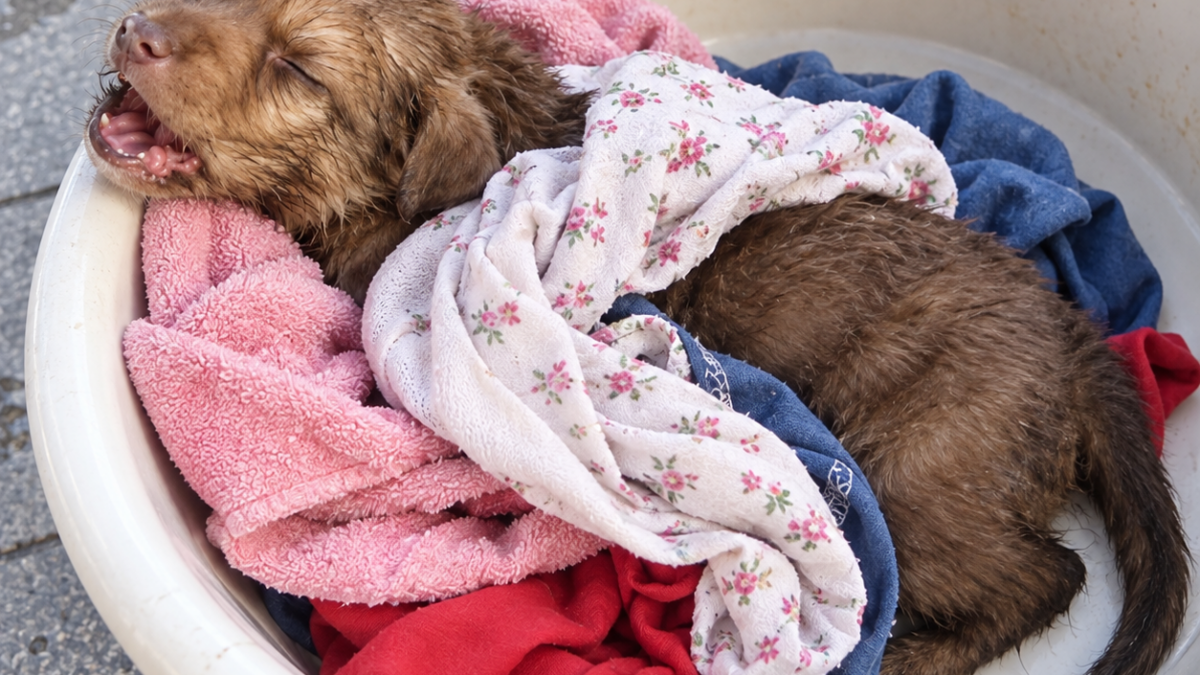
PART 2
“Is he going to die?”
The question left my mouth before I could stop it.
I hated hearing myself say it.
I hated that Valentine was two weeks old and I was already asking someone whether his life was ending.
The veterinarian did not give me the easy answer I wanted.
She watched his breathing.
Listened to his heart.
Checked his gums.
Then she looked at me.
“I don’t know yet.”
Three words.
Not yes.
Not no.
Not the comforting lie that everything was going to be fine.
I don’t know yet.
Valentine’s body gradually stopped convulsing.
His legs relaxed first.
Then his neck.
His breathing remained fast for several minutes, tiny ribs moving beneath the thin blanket.
I stood beside him with both hands pressed together because I was afraid to touch him.
Finally, the veterinarian nodded.
“The seizure has stopped.”
I released a breath I hadn’t realized I was holding.
“Can he hear me?”
“Probably.”
“Can I touch him?”
“Gently. Keep everything quiet.”
I placed one finger beside his paw.
His toes moved against my skin.
Such a tiny reaction.
It nearly broke me.
“Hey, Valentine.”
That wasn’t his name yet.
Not officially.
At that moment he was simply a wounded puppy on an examination table.
But something about the name had been in my mind since the moment I picked him up.
Maybe because this puppy had encountered pain before he had even experienced a normal life.
Maybe because I wanted to believe the next thing he learned would be love.
“Valentine,” I repeated.
His eyes opened halfway.
They didn’t focus correctly.
But he was there.
The veterinarian began explaining what came next.
Head trauma could be unpredictable.
Symptoms could worsen after the initial injury.
There could be swelling.
Neurological complications.
More seizures.
Loss of consciousness.
Difficulty eating.
Damage we could not immediately see.
Valentine was also dangerously young.
A grown dog had reserves.
A healthy adult could miss a meal without collapsing.
A two-week-old puppy did not have that luxury.
Everything about him was fragile.
His blood sugar.
His hydration.
His body temperature.
His ability to handle medication.
His ability to recover.
“What does he need?”
“Monitoring. Quiet. Nutrition. Medication to control the symptoms. And time.”
“How much time?”
“I can’t tell you.”
I looked down at Valentine.
His eyes had closed.
“What are his chances?”
The veterinarian paused.
“That depends on how severe the internal injuries are.”
It was the kindest answer she could give without pretending.
I nodded.
“Then we start.”
She looked directly at me.
“You understand this may become very intensive.”
“I understand.”
“And we may still lose him.”
I swallowed.
“I understand.”
But I didn’t really.
How do you understand losing someone you have only known for an hour?
How do you become attached that quickly?
I didn’t know.
I only knew that Valentine had spent the first two weeks of his life depending entirely on others, and somehow he had arrived in front of me bleeding, confused, and screaming.
Whatever had happened before that moment was beyond my control.
What happened next was not.
“We start,” I repeated.
So we did.
The clinic prepared a warm, quiet space for him.
The lights remained low.
Voices stayed soft.
Every medication had to be calculated carefully because Valentine weighed almost nothing.
He looked smaller once the medical equipment surrounded him.
A tiny puppy.
A blanket.
A monitor.
A few syringes.
And adults walking around him as though the entire room depended on keeping him alive.
The first night taught me how helpless rescue can feel.
People imagine rescue as action.
Breaking chains.
Opening cages.
Running into danger.
Carrying an animal away from somewhere terrible.
Sometimes that happens.
But there are other nights when rescue is simply sitting in a chair.
Waiting.
Listening.
Watching.
Knowing the animal beside you hurts and being unable to remove the pain with your hands.
Valentine cried.
For hours.
The cries changed.
Sometimes they were sharp.
Sometimes they were exhausted little whimpers.
Sometimes he became quiet long enough for me to think he was finally comfortable.
Then another cry came.
Each one felt like an accusation against the world.
At eleven that night, one of the veterinary technicians brought me water.
“You need this.”
“I’m okay.”
“You’ve said that three times.”
“I’m still okay.”
She placed the bottle beside me anyway.
Her name was Rachel.
She had dark hair pulled into a messy bun and the tired expression of someone who had worked too many emergency shifts but still cared about every patient.
She crouched beside Valentine.
“How’s our tiny guy?”
“He keeps crying.”
“I know.”
“Shouldn’t the medication stop it?”
“It helps.”
“But it isn’t stopping it.”
“No.”
I looked at her.
“Then he’s still hurting.”
Rachel didn’t insult me by pretending otherwise.
“Yes.”
I stared at Valentine.
His mouth opened.
Another cry.
“Can you increase the dose?”
“Not safely without the veterinarian reassessing him.”
“Can you give him something else?”
“They’re evaluating everything.”
“I just need somebody to make it stop.”
Rachel remained quiet.
I immediately regretted the sharpness in my voice.
“I’m sorry.”
“You don’t need to apologize.”
“I know you’re helping.”
“I know.”
She sat in the chair beside me.
For a few minutes, neither of us spoke.
Valentine cried again.
I covered my face.
“How is he supposed to understand any of this?”
Rachel looked toward him.
“He isn’t.”
“That’s the worst part.”
“Yes.”
“He doesn’t know that the needles are helping him. He doesn’t know why strangers keep touching him. He doesn’t know why his head hurts.”
“No.”
“He just knows everything hurts.”
Rachel leaned forward.
“But he also knows when he’s warm.”
I looked at her.
“He knows when someone is holding him gently. He knows when a voice is quiet. He knows when he smells food. He knows when he isn’t alone.”
I looked at Valentine again.
“You think that matters?”
“Yes.”
I wanted to believe her.
So I stayed.
Near midnight, Valentine finally slept for twelve minutes without crying.
I counted every one.
At minute thirteen, his body jerked slightly.
I stood.
Rachel was already there.
“Is it another seizure?”
“No. Wait.”
We watched.
Nothing else happened.
Valentine remained asleep.
I sat back down.
I began learning the difference between every movement.
Normal sleep twitch.
Pain response.
Startle.
Possible neurological sign.
Breathing change.
I learned things I never wanted to know.
At two in the morning, Valentine woke and began crying again.
I placed my hand beside him.
His nose moved toward my finger.
Not much.
Just enough to touch.
“There you are.”
He stayed against my hand.
I remained like that until my shoulder hurt.
I didn’t move.
The second day brought no miracle.
Valentine survived the night.
That was the victory.
His temperature was stable.
His heart remained strong.
He had not had another obvious seizure.
Those facts became precious.
The veterinarian examined him again.
“His neurological responses are still abnormal.”
“Worse?”
“Not clearly.”
“Better?”
“Not clearly.”
I sighed.
She gave me a sympathetic look.
“You’re going to hear that answer a lot.”
“I hate that answer.”
“I know.”
Valentine was too young and his injury too complicated for quick certainty.
We had to watch trends.
Was he more responsive?
Could he swallow?
Did his pupils react?
Could he regulate his temperature?
Was the bleeding worsening?
Would another seizure come?
Hour after hour, our entire world narrowed to those questions.
I called him Valentine consistently now.
Nobody objected.
By the end of the day, the name had become his.
A puppy who needed love.
Valentine.
On the second night, he cried almost constantly.
The medication softened the worst moments, but it could not erase whatever was happening inside his head.
I went home for an hour to shower.
The silence of my house felt wrong.
I stood beneath the water and still heard him.
Not literally.
But his cries had lodged themselves inside my head.
I dried off.
Changed clothes.
Returned to the clinic.
Rachel saw me enter.
“That was fast.”
“I couldn’t stay home.”
“He’s stable.”
“I know.”
“You could sleep.”
“No.”
She did not argue.
Instead, she handed me coffee.
I sat beside Valentine.
“You’re ruining my life already,” I whispered.
His eyes remained closed.
“Two weeks old and you’re already high maintenance.”
One tiny paw twitched.
I smiled.
“Exactly.”
The third day was when I started doubting myself.
Not the decision to treat him.
I never regretted that.
But I began wondering whether we were helping enough.
Valentine was still crying.
Still confused.
Still unable to move normally.
His body seemed exhausted.
I watched him struggle to lift his head.
It rose perhaps an inch.
Then dropped.
He whimpered.
I picked him up carefully.
His head rested against my palm.
“You don’t have to prove anything.”
He cried again.
The veterinarian entered.
She examined him.
I waited until she finished.
“Tell me the truth.”
“I always do.”
“Is this cruel?”
She understood what I meant.
“Continuing treatment?”
“Yes.”
“No. Not based on what I’m seeing right now.”
“He’s suffering.”
“He is in pain. We’re treating that. But he is also responding. His vital signs are stable. He is still swallowing. He has had no further seizure activity. He is not deteriorating in the ways that would tell me treatment is futile.”
I looked down.
“I need you to tell me if that changes.”
“I will.”
“Promise me.”
“I promise.”
That mattered.
Loving an animal does not mean keeping them alive at any cost.
Sometimes love means knowing when treatment becomes suffering without hope.
I needed the veterinarian to be the person who could see that line clearly when I could not.
For now, we had not reached it.
So we continued.
That afternoon, Valentine smelled food.
His head moved.
Rachel noticed first.
“Wait.”
She brought a small amount of formula and soft food prepared for his condition.
Valentine’s nose twitched.
My heart jumped.
“Is he hungry?”
“Maybe.”
We positioned him carefully.
His coordination was poor.
He could not simply walk to a bowl and eat.
Rachel offered a tiny amount.
Valentine licked.
Then stopped.
“Come on,” I whispered.
Another lick.
A swallow.
Rachel smiled.
“There.”
I stared.
“Again.”
Valentine swallowed another tiny amount.
I started crying.
Rachel looked at me.
“Seriously?”
“He ate.”
“He had three licks.”
“He ate.”
“You’re going to be impossible.”
“I don’t care.”
It was the first thing Valentine had done that looked less like surviving a crisis and more like choosing life.
I knew hunger was biology.
I knew instinct drove him.
I knew I was turning a few licks into something poetic because I desperately needed good news.
I did not care.
Valentine had eaten.
That night, he cried again.
But in my mind, something had changed.
We had a sign.
Small.
Fragile.
Real.
The next morning, his bloodwork revealed another problem.
Anemia.
His red blood cell count was lower than we wanted.
The veterinarian explained what they would monitor and how his tiny body needed support.
I listened.
Asked questions.
Took notes.
Then sat beside Valentine.
“Could you stop collecting diagnoses?”
He blinked.
“We have enough.”
His nose touched the blanket.
“I’m serious.”
For the first time, I noticed his crying had changed.
It was still frequent.
Still painful to hear.
But there were longer spaces between episodes.
He slept.
Really slept.
Twenty minutes.
Then thirty.
I watched his chest rise and fall.
Every quiet stretch felt like borrowed peace.
By the third night, I was so exhausted that Rachel found me asleep upright in the chair.
My head had fallen sideways.
One hand rested near Valentine.
She woke me gently.
“Go lie down somewhere.”
“I’m fine.”
“You’re drooling.”
“I was not.”
“You absolutely were.”
“Where’s Valentine?”
“Right where he has been all night.”
I looked down.
He was asleep.
His nose rested against my finger.
I smiled.
“See? He needs me.”
Rachel rolled her eyes.
“He needs you conscious.”
“I can be conscious later.”
But I did sleep for two hours on a small couch in the staff room.
When I woke, panic hit before memory.
I sat up.
Valentine.
I hurried down the hall.
Rachel was feeding him.
He was swallowing.
“He’s okay,” she said before I could ask.
I leaned against the doorway.
“Why does it feel wrong when I’m not watching him?”
“Because you’re scared.”
“I don’t like being scared.”
“No one does.”
I went to him.
His eyes moved toward my voice.
That was new.
“Did he just look at me?”
Rachel paused.
“Do it again.”
“Valentine?”
His eyes shifted.
Not perfectly.
Not smoothly.
But toward me.
Rachel smiled.
“I think so.”
I moved slightly to the other side.
“Valentine.”
His gaze attempted to follow.
A tiny movement.
But it was purposeful.
I covered my mouth.
Rachel pointed at me.
“Don’t start.”
“I’m not crying.”
“You’re crying.”
“I have dry eyes.”
“That makes no sense.”
Valentine made a soft noise.
We both looked at him.
Rachel grinned.
“He’s judging you.”
“He can judge me all he wants if he keeps doing that.”
Recovery did not arrive dramatically.
It arrived in fragments.
A better swallow.
A longer sleep.
Eyes tracking a voice.
A paw pressing against the bedding.
One less cry.
No seizure today.
Then no seizure tomorrow.
Then several days.
Each improvement created room for hope.
And every time hope grew, something happened to frighten me again.
The ultrasound came after we thought Valentine had finally begun stabilizing.
The veterinarian wanted to investigate his persistent weakness, anemia, and signs that the trauma might have affected more than his head.
I stayed while they prepared him.
“Do you expect something?”
“We want to rule things out.”
“That means yes.”
“It means we want more information.”
I had learned veterinary language well enough to know when not to push.
I waited.
The scan felt endless.
Valentine was tiny beneath the equipment.
The veterinarian moved the probe carefully over his abdomen.
Her face became more serious.
My stomach dropped.
“What?”
She continued scanning.
“What do you see?”
“Give me a moment.”
I hated those four words almost as much as *I don’t know yet*.
Finally, she stepped back.
“His liver has significant bruising.”
For a second, I didn’t process it.
“His liver?”
“Yes.”
“From the same trauma?”
“It could be.”
“How severe?”
“Enough that I’m concerned.”
I pulled the chair toward me and sat.
Head injury.
Bleeding.
Seizure.
Anemia.
Now internal organ trauma.
I stared at Valentine.
“How can that much damage happen to something that small?”
The veterinarian did not answer.
There was no useful answer.
“What happens now?”
“We support him. We monitor his liver function. We watch for signs of internal bleeding or worsening damage. We repeat bloodwork.”
“Can it heal?”
“The liver has a remarkable ability to recover, especially in a young animal.”
“Can.”
“Yes.”
Not will.
Can.
I closed my eyes.
“What would make you stop treatment?”
She understood the question.
“If his condition deteriorated despite intervention and we believed he was experiencing uncontrolled suffering without a reasonable path forward, we would have that conversation.”
“But we’re not there.”
“No.”
“Not close?”
She paused.
“He is seriously injured.”
“That wasn’t my question.”
“No,” she said carefully. “We are not at the point where I think continuing is unreasonable.”
I nodded.
“Then continue.”
That evening was one of the hardest.
Valentine cried more.
Whether from the head injury, abdominal discomfort, or simply exhaustion, we could not know.
I held him against a towel on my chest while Rachel adjusted his bedding.
His whole body fit between my hand and forearm.
“I’m sorry,” I whispered.
He whimpered.
“I’m sorry you had to learn pain before anything else.”
Rachel looked at me.
“Don’t do that to yourself.”
“Do what?”
“Try to carry what happened before you got him.”
“I keep imagining it.”
“You don’t know what happened.”
“I know somebody failed him.”
“Maybe.”
“Rachel.”
She sighed.
“Yes. Whatever happened, somewhere along the way he wasn’t protected.”
I looked down at him.
His eyes were closed.
“That makes me furious.”
“Good.”
I looked up.
“Good?”
“Anger means you care.”
“It isn’t helping him.”
“Then turn it into something that does.”
“How?”
She nodded toward Valentine.
“This.”
So I did.
I fed him.
Cleaned him.
Sat with him.
Recorded every change.
Asked questions.
Learned his medications.
Helped reposition him.
Let the anger become patience because patience was what Valentine needed.
For the next several days, the liver results remained frightening but did not worsen catastrophically.
That became another strange victory.
Stable.
Not good.
Not normal.
Stable.
I learned to celebrate stable.
One week after Valentine arrived, he received his first gentle bath.
It sounds insignificant.
It wasn’t.
He had been too fragile before.
Now the medical team felt he could tolerate it.
Rachel filled a shallow basin with warm water.
“We’re making you presentable.”
Valentine looked unimpressed.
I supported his body.
The first touch of water made him tense.
“Easy.”
His legs moved weakly.
Rachel worked quickly but gently.
Dried blood disappeared from his fur.
Dirt washed away.
For the first time, I saw him without the physical evidence of those first terrible hours covering him.
Underneath it all was just a puppy.
A tiny face.
Soft fur.
Little paws.
An absurdly round belly beginning to appear as nutrition improved.
Rachel wrapped him in a towel.
“Oh.”
“What?”
“He looks like a burrito.”
I laughed.
The sound surprised me.
I had not laughed much that week.
Valentine’s eyes opened.
He looked toward the sound.
“You heard that?”
Rachel held him up slightly.
“Our first Valentine burrito.”
He let out a small protest.
“There’s the attitude,” she said.
Attitude.
That word felt wonderful.
Pain had been his personality for days because pain consumed everything.
Now we were beginning to see something underneath.
Valentine did not enjoy baths.
He had strong opinions about being dried.
He preferred one type of food over another.
He slept better if a rolled blanket touched his side.
He became quieter when he heard my voice.
He disliked taking medication.
Especially one particular medication.
The first time he resisted it, I nearly celebrated.
He turned his head away.
Rachel tried again.
Valentine pushed weakly with one paw.
She laughed.
“Oh, now you have opinions?”
I leaned closer.
“Take your medicine.”
He turned away again.
“Valentine.”
Nothing.
“You spent a week scaring me to death. You are not winning this argument.”
Rachel looked at me.
“He’s two weeks old.”
“He knows what he’s doing.”
Valentine eventually took the medication.
Then stared at us with what I decided was betrayal.
“That face,” I said.
Rachel smiled.
“That is definitely personality.”
By the second week, his crying had decreased significantly.
There were still episodes.
Sometimes he woke suddenly and cried.
Sometimes touching his head seemed uncomfortable.
But the endless screaming had faded.
One morning I entered his room and stopped.
Silence.
Valentine was asleep.
Comfortably.
No tension in his tiny face.
No whimpering.
No trembling.
I stood there for several minutes without approaching.
Rachel came behind me.
“Why are you blocking the door?”
“Look.”
She looked.
“He’s sleeping.”
“I know.”
“He does that now.”
“I know.”
“But?”
“I’ve never seen him look that peaceful.”
Rachel’s expression softened.
“Then remember this.”
I did.
Because later, when fear returned, I needed that image.
Valentine asleep without pain controlling every breath.
His bloodwork slowly improved.
The anemia began correcting.
His liver remained damaged, but the values stopped moving in the wrong direction.
The veterinarian was cautiously encouraged.
I had learned that “cautiously encouraged” was veterinary medicine’s version of dancing on a table.
“So that’s good?” I asked.
“It’s good.”
“Actually good?”
“Yes.”
“Not ‘not terrible’?”
She smiled.
“Actually good.”
I wanted to hug her.
I settled for crying again.
The next battle appeared when Valentine became active enough for us to evaluate him more clearly.
His legs did not work properly.
He could stand for brief moments, but his balance was poor.
His movements looked disconnected.
Sometimes a front paw moved while the corresponding back leg seemed to receive the message late.
He fell sideways.
He tired almost immediately.
And then we noticed his vision.
At first, everyone expected some visual confusion.
He was extremely young.
His nervous system was still developing.
He had also experienced head trauma.
But as he became more alert, the inconsistency was impossible to ignore.
He followed sound better than movement.
He sometimes bumped into the padded edge around his exercise area.
A hand moved silently in front of him did not always get a response.
I watched him one afternoon and felt the old fear return.
“Can he see me?”
The rehabilitation technician looked at Valentine.
“He has some response.”
“That wasn’t what I asked.”
She glanced toward the veterinarian.
More testing followed.
Light response.
Tracking.
Neurological examination.
Reflexes.
Finally, the veterinarian sat beside me.
“His vision is impaired right now.”
My throat tightened.
“How impaired?”
“Difficult to quantify.”
“Blind?”
“I wouldn’t say that.”
“Permanent?”
“Too early to know.”
There it was again.
Too early to know.
I stood and walked to the window.
“What if the trauma damaged his brain?”
“It may have caused neurological injury.”
“May have?”
“Yes.”
“What does that mean for him?”
“It could mean the vision problems persist.”
I turned around.
“Could.”
“Yes.”
“Could he walk normally?”
“We have reason to hope he will improve.”
“That sounds different from yes.”
“It is different.”
I crossed my arms.
“What are you not telling me?”
“Nothing.”
“Then tell me the worst possibility.”
She took a breath.
“The worst possibility is that he has permanent neurological deficits affecting vision, balance, coordination, or some combination.”
The words landed one by one.
Vision.
Balance.
Coordination.
Valentine was lying in his padded bed, chewing weakly at the corner of a cloth.
He looked so normal for three seconds that the conversation felt impossible.
“If that happens?”
“We adapt.”
I looked at her.
“That’s it?”
“That’s it.”
“He could still have a life?”
“Of course.”
I stared.
The veterinarian leaned forward.
“Permanent disability would change what he needs. It would not erase his ability to have a good life.”
I knew that.
Intellectually.
But fear had turned every possible limitation into catastrophe.
I sat back down.
“What do we do now?”
“Exactly what we’ve been doing. Nutrition. Time. Controlled exercise. Neurological monitoring. Let his body heal.”
So rehabilitation began.
The exercises looked almost absurdly simple.
We placed Valentine on surfaces with enough traction for his paws.
Supported his chest.
Encouraged him to shift his weight.
Let him take one or two steps toward a familiar voice.
Rested.
Repeated.
Valentine hated some of it.
The first time the rehabilitation specialist positioned his back legs correctly beneath him, he protested loudly.
“That sounds familiar,” I said.
She smiled.
“He has lungs.”
“He always had lungs. That was the first thing we learned.”
Valentine pushed forward.
His legs trembled.
“Come on,” I whispered.
He took one step.
Collapsed.
The specialist caught him.
“Good.”
I stared at her.
“He fell.”
“He moved his weight correctly first.”
“That counts?”
“Absolutely.”
Everything counted.
We had learned that lesson already.
A lick of food counted.
A quiet hour counted.
A tail movement counted.
Now one correctly placed paw counted.
The next day, Valentine took two steps.
Then fell.
The following day, he managed three.
Then he slept almost two hours from the effort.
Progress was exhausting.
Sometimes he had a better morning followed by a terrible afternoon.
Sometimes his balance seemed improved, then vanished when he became tired.
There were days when I convinced myself we were moving forward.
Then I watched him fall and felt as though we had returned to the beginning.
The rehabilitation specialist corrected me.
“He isn’t going backward because he gets tired.”
“It feels like it.”
“Muscles fatigue. The nervous system fatigues. He’s learning.”
“But what if this is as good as it gets?”
“Then this is as good as it gets.”
I looked at her.
She shrugged.
“And tomorrow we work with whatever he gives us.”
That philosophy saved me.
I stopped demanding a future Valentine.
I worked with the one in front of me.
Today, he could stand four seconds.
Good.
Today, he followed my voice from three feet away.
Good.
Today, he found the food bowl without bumping into the padded barrier.
Good.
Tomorrow belonged to tomorrow.
His vision exercises became part of our routine.
We used movement.
Contrast.
Soft toys.
Sound paired with visual cues.
Sometimes Valentine tracked perfectly.
Sometimes his gaze drifted.
When he lost something visually, he compensated with smell and hearing.
He was already adapting before we knew whether adaptation would be permanent.
One afternoon, I sat on the floor several feet away.
“Valentine.”
His ears moved.
“Come here.”
He took one shaky step.
Then another.
His body drifted left.
I tapped my fingers against the floor.
“This way.”
He corrected.
Three more steps.
He reached my knees.
His tail moved.
I picked him up.
“You found me.”
He pushed his nose beneath my chin.
I closed my eyes.
“You always find me.”
By the third week, Valentine’s appetite became one of the strongest things about him.
The puppy who once had to be coaxed through a few tiny bites now behaved as if every meal had been delayed for years.
Rachel carried his food into the room.
Valentine smelled it.
He began making an impatient little noise.
“Excuse me?” she said.
He tried to stand.
His legs slipped.
He tried again.
I steadied him.
“Apparently near-death experiences have not taught you patience.”
Rachel lowered the bowl.
Valentine ate.
Aggressively.
I laughed.
“You’re going to inhale it.”
Rachel moved the bowl slightly.
“Slow down.”
Valentine followed.
His head moved with the bowl.
His eyes tracked it.
Rachel froze.
I noticed.
“Do that again.”
She moved the bowl right.
Valentine followed.
Left.
His eyes followed.
Right again.
Perfectly.
My heart started pounding.
“Is that his vision?”
“It looks like it.”
“Do it without the food.”
Rachel moved her hand.
Valentine’s eyes followed partway.
Not as confidently.
She smiled.
“Food appears to improve his medical performance.”
“He’s bribable.”
“Very.”
I leaned down.
“You can see that, can’t you?”
Valentine continued searching for the bowl.
It was not proof that his vision would recover completely.
But it was another sign.
And signs were what we lived on.
Weeks passed.
The liver bruising began resolving.
His blood values improved.
No new seizure occurred.
The medication plan changed as the veterinarian adjusted to his progress.
His crying became rare.
When he vocalized now, it was often because he wanted food, warmth, or attention.
Those cries did not break my heart.
They made me smile.
One evening, I was speaking with another volunteer while Valentine rested in a playpen.
Suddenly, a sharp squeak interrupted us.
We both turned.
Valentine had found a soft toy.
He had bitten it.
The toy squeaked again.
Valentine jumped backward.
Then stared.
I laughed.
He approached cautiously.
Bit it.
Squeak.
He jumped again.
The volunteer covered her mouth.
“He thinks it’s alive.”
Valentine attacked the toy with a level of determination completely disproportionate to his size.
Squeak.
Pounce.
Fall.
Stand.
Squeak.
Pounce.
Fall.
Again.
I watched him for several minutes.
Something changed inside me.
Until then, I had seen Valentine through the lens of survival.
Every movement was a symptom.
Every sound was data.
Every nap was monitored.
Every meal was measured.
That evening, for the first time, I watched him simply be ridiculous.
A puppy fighting a squeaky toy.
No medical meaning.
No diagnostic significance.
No survival calculation.
Play.
I sat on the floor.
Valentine carried the toy toward me.
At least, I think he intended to.
He lost his balance halfway and rolled onto his side.
I reached for him.
He stood before I could help.
Then continued.
That mattered even more.
He no longer expected someone to rescue him from every stumble.
He was learning that falling was not disaster.
Sometimes falling was just part of running toward a toy.
By the fourth week, the clinic staff started using a phrase I had been afraid to say.
“When he goes home…”
Not *if*.
When.
The first time Rachel said it, I interrupted.
“What did you say?”
She looked confused.
“When he goes home?”
“You said when.”
“Yes.”
“Not if.”
She smiled slowly.
“Not if.”
I looked at Valentine.
He was chewing her shoelace.
“Do you really think he’s going to make it?”
Rachel’s expression softened.
“I think he already has.”
I knew what she meant.
There were still unanswered questions about vision and neurological function.
He still needed rehabilitation.
His body was still fragile.
But the immediate fight for survival had changed.
We were no longer waiting to see whether Valentine would live through the night.
We were discussing what his life might look like.
That difference was enormous.
I should have felt only joy.
Instead, another fear appeared.
What if he survived but remained permanently impaired?
I hated myself for worrying about that because I knew a disabled dog could have a wonderful life.
But I didn’t fear disability because I thought Valentine would be worth less.
I feared it because I wanted back every possibility that had been stolen from him.
I wanted him to see.
I wanted him to run.
I wanted him to chase a ball and miss because he was clumsy, not because his brain couldn’t process what his eyes were showing him.
I wanted him to have choices.
The veterinarian understood.
During one follow-up examination, I asked the same questions I had asked too many times.
“Do you think his vision will recover?”
“His responses are improving.”
“That isn’t yes.”
“No.”
“Do you think the coordination problems will disappear?”
“He’s improving there too.”
“Again, not yes.”
She took off her glasses.
“You want certainty.”
“Yes.”
“I don’t have it.”
“I know.”
“You’re going to make yourself miserable trying to get it before his body is ready to give it.”
I stared at Valentine.
“What am I supposed to do instead?”
“Watch him.”
“I do nothing but watch him.”
“No. You monitor him.”
I looked at her.
“There’s a difference.”
She pointed.
Valentine was attempting to climb over a rolled towel because the toy he wanted was on the other side.
He put one paw over.
Then another.
His back legs slid.
He grunted.
Tried again.
Made it.
Grabbed the toy.
“Watch him,” she repeated.
So I did.
He did not look like a puppy worrying about permanent neurological damage.
He looked like a puppy who wanted a toy.
Maybe I needed to learn from that.
Valentine’s world existed in moments.
Warm.
Hungry.
Tired.
Play.
Safe.
Curious.
He had no concept of prognosis.
He did not compare himself to the puppy he might have been.
He did not know that his gait looked different.
He simply kept moving.
So I tried to meet him there.
A few days later, Valentine wagged his tail at me for the first time.
Not an accidental twitch.
A real wag.
I entered the room.
“Hey, Valentine.”
His head turned.
His eyes found me.
Then his tail moved.
Once.
Twice.
Three times.
I stopped.
Rachel was behind me carrying towels.
“What?”
“His tail.”
“What about it?”
“He wagged.”
She leaned around me.
“Valentine?”
His tail moved again.
Rachel gasped dramatically.
“Oh, no.”
“What?”
“I’m emotional.”
“You made fun of me when I cried because he ate.”
“I take it back.”
She dropped the towels on a chair and knelt.
“Do it again.”
Valentine stared at her.
Nothing.
“Come on.”
Still nothing.
I crouched beside her.
“Valentine.”
His tail wagged.
Rachel looked offended.
“That’s rude.”
“He has taste.”
“You’ve been bribing him.”
“I call it bonding.”
Valentine wagged harder.
The movement made his whole back end sway.
His balance failed.
He sat abruptly.
We both laughed.
Valentine stared at us.
Then barked.
A tiny, sharp sound.
Rachel fell backward laughing.
“What?”
“He told us off.”
“He absolutely did.”
There it was.
More personality.
More life.
Every week, illness surrendered another piece of him.
Pain had taken up all the room at first.
Then appetite pushed into that space.
Curiosity.
Annoyance.
Affection.
Play.
Stubbornness.
Valentine was becoming himself.
The investigation into how he had been injured remained uncertain.
We documented everything.
The bleeding.
The suspected head trauma.
The internal bruising.
The seizure.
The condition in which he arrived.
But there was no reliable witness who could tell us exactly what happened.
The possibility of deliberate harm was horrifying.
So was the possibility that someone had stepped on him and failed to seek help immediately.
So was any scenario that ended with a two-week-old puppy suffering for that long.
I wanted an answer.
Some nights, I wanted it badly enough to become angry at everyone.
“Somebody knows,” I told Rachel once.
“Maybe.”
“Somebody knows what happened.”
“Possibly.”
“And they get to go on with their life while he has to relearn how to walk.”
Rachel remained quiet.
“It isn’t fair.”
“No.”
“That’s it?”
“What do you want me to say?”
“I don’t know.”
“If I tell you the world is fair, you’ll know I’m lying.”
I looked at Valentine sleeping.
“So there’s no justice.”
Rachel followed my gaze.
“I didn’t say that.”
“What justice is there if nobody can prove what happened?”
She nodded toward him.
“That depends on what you think justice looks like.”
At the time, I didn’t understand.
I thought justice required somebody else losing.
A punishment.
A consequence.
A moment where the scales visibly balanced.
Valentine would teach me something different.
But not yet.
First, he had to survive the next phase.
Around five weeks into treatment, Valentine experienced a setback.
It began with weakness.
He had been doing well that morning.
Ate.
Played.
Completed a short rehabilitation session.
Then by afternoon, he seemed tired.
Not normal puppy tired.
Different.
He did not respond as quickly when I called.
His legs trembled more.
My stomach tightened immediately.
“Rachel.”
She saw my face.
“What happened?”
“He’s off.”
She examined him quickly and called the veterinarian.
Within minutes, we were back in the emotional place I thought we had escaped.
Temperature.
Bloodwork.
Neurological checks.
Abdominal examination.
I stood against the wall.
“What is it?”
“We don’t know yet.”
I almost laughed.
Of course.
The phrase had returned.
“Is his liver worse?”
“We’re checking.”
“Another seizure coming?”
“No sign of one right now.”
“Blood sugar?”
“Being checked.”
Valentine lay quietly.
I moved closer.
“Hey.”
His eyes found me, but slowly.
My heart hurt.
“You don’t get to do this.”
Rachel glanced at me.
“Don’t get to do what?”
“Scare me again.”
Valentine closed his eyes.
I placed my hand beside him.
The blood tests eventually showed that he was anemic again and depleted after a period of rapid growth and recovery. The medical team adjusted his nutrition and treatment.
There was no catastrophic new injury.
But for almost twenty-four hours, I lived inside the fear of losing him again.
It taught me something uncomfortable.
Recovery is not a straight road.
I had been treating every improvement as a door that closed behind us.
No more seizures meant seizures were over forever.
Better liver values meant the liver scare was finished.
Walking meant weakness was finished.
But healing does not work like that.
It loops.
It pauses.
It frightens you.
Sometimes yesterday’s fear returns wearing a slightly different face.
Valentine improved after rest and treatment.
The next afternoon, he demanded food again.
I wanted to lecture him.
Instead, I laughed.
“You almost gave me a heart attack.”
He ate.
“You don’t care.”
He continued eating.
“Of course you don’t.”
By the sixth week, he had gained enough strength to spend longer periods on his feet.
His gait remained unsteady.
But now when he fell, he often stood without assistance.
One afternoon, he tried to chase Rachel.
She was carrying his food.
He took four quick steps.
His front legs moved faster than his back legs.
He nearly somersaulted.
Rachel caught him.
“Absolutely not.”
Valentine barked.
“You cannot run.”
Another bark.
“You can barely walk.”
He squirmed.
I laughed.
“He disagrees with your medical assessment.”
“He’s reckless.”
“He’s a puppy.”
“That’s the same thing.”
We began taking him outside briefly when the weather was mild.
The first outing lasted only a few minutes.
I carried him to a patch of grass.
Set him down.
Valentine froze.
Grass was new.
His paws spread.
He smelled the ground.
Wind touched his face.
A bird called from somewhere above us.
Valentine’s ears moved.
He looked upward, though I wasn’t sure whether he could see the bird.
Then a dry leaf rolled across the lawn.
His eyes followed it.
I stopped breathing.
The leaf moved again.
Valentine turned his head.
“Rachel.”
She looked.
“What?”
“The leaf.”
“What about it?”
“He’s watching it.”
The leaf skittered another foot.
Valentine’s gaze moved with it.
Rachel smiled.
“He is.”
I crouched.
“Go get it.”
Valentine took a step.
Then another.
The leaf moved.
He followed.
Slow.
Unsteady.
Determined.
He reached it and placed one paw on top.
The leaf crunched.
Valentine jumped backward.
Rachel laughed.
He stared at the leaf as though it had betrayed him.
Then pounced again.
I began crying.
Rachel heard.
“Seriously?”
“Leave me alone.”
“It’s a leaf.”
“He saw it.”
She stopped teasing.
“I know.”
“He saw it.”
I wiped my face.
“Do you understand what that means?”
“It means he sees something.”
“No. It means six weeks ago I was afraid he would die without ever understanding why he hurt. Now he’s outside attacking landscaping.”
Rachel smiled.
“When you put it that way.”
Valentine grabbed the leaf.
Immediately tried to eat it.
“No.”
I took it from his mouth.
He looked offended.
“Vision restored enough to find garbage. Wonderful.”
That leaf became one of the most important things I ever saw.
Not because it proved Valentine’s vision was completely normal.
It didn’t.
But it showed us that his world was becoming visible.
From then on, outdoor sessions became part therapy, part adventure.
Grass challenged his balance.
Different textures forced his paws and brain to communicate.
Gentle slopes made him shift weight.
He sniffed everything.
At first he stayed close.
Then curiosity began pulling him farther away.
Five feet.
Ten.
He always returned when I called.
Sometimes because he recognized my voice.
Sometimes because I had food.
I did not care about his motivation.
“Valentine.”
Turn.
Step.
Step.
Step.
Reach me.
Good.
Again.
By the seventh week, the veterinarian repeated several neurological tests.
I had been waiting for that appointment with equal parts hope and dread.
Valentine was stronger.
His vision seemed dramatically better.
His coordination had improved.
But I wanted confirmation.
I wanted someone with medical training to say what I was afraid to believe.
The examination lasted forever.
At least it felt that way.
The veterinarian checked his pupils.
Moved objects through different parts of his field of vision.
Observed him walking.
Tested postural reactions.
Watched how quickly he corrected a misplaced paw.
Valentine tried to chew the examination towel.
She moved it.
He followed it.
“That’s encouraging,” she said.
“What part?”
“All of it.”
“Define encouraging.”
She laughed.
“You’ve become difficult.”
“I was always difficult.”
“That’s true.”
She finished.
Then sat.
I immediately leaned forward.
“Well?”
“I’m very pleased.”
“With?”
“His neurological recovery.”
I waited.
She knew what I wanted.
“There is currently no clear evidence that he will be left with the severe permanent neurological deficits we were worried about.”
For a moment, I didn’t understand the sentence.
“No permanent damage?”
“I’m saying that at this stage, his progress makes significant permanent impairment look much less likely.”
“His vision?”
“Improving very well.”
“Could it become normal?”
“Yes.”
“His walking?”
“Also improving appropriately.”
“So he might…”
My voice broke.
She smiled.
“He may grow into a very normal, very active dog.”
I covered my face.
There it was.
The sentence I had been afraid to hope for.
Not a guarantee.
Nothing in medicine was.
But for the first time, the future was not being described primarily in terms of damage.
Valentine might run.
Really run.
He might see normally.
He might grow up without his first trauma controlling the rest of his life.
I cried so hard the veterinarian passed me an entire box of tissues instead of one.
She waited.
When I finally looked up, she said, “Better?”
“No.”
“Good tears?”
“I hate that phrase.”
She smiled.
“Then what kind?”
“Relief.”
Valentine crawled toward me.
I picked him up.
“You hear that?”
He tried to bite my necklace.
“You’re going to be normal.”
He grabbed the chain.
“Well. Medically normal.”
The veterinarian laughed.
We were not finished.
Recovery still required time.
Valentine’s muscles needed strength.
His coordination needed repetition.
His liver needed continued monitoring.
His vision needed follow-up.
But the fear had changed shape.
For almost two months, I had been afraid of losing him.
Now I was beginning to be afraid of letting him go.
I had not admitted that yet.
Not even to myself.
Valentine continued getting stronger.
His walks changed from wobbling to toddling.
Toddling became trotting.
The first time he truly ran happened outside.
We were on the same patch of grass where he had attacked the leaf.
Rachel had a soft ball.
She rolled it.
Valentine watched.
The ball crossed the lawn.
He moved.
At first, three normal steps.
Then faster.
His back legs found rhythm.
His front legs stretched.
And suddenly—
He ran.
Six feet.
Eight.
Ten.
I froze.
Rachel froze.
Valentine reached the ball.
Overshot it.
Turned too quickly.
Fell onto his side.
I started toward him.
He bounced up.
Then ran again.
I covered my mouth.
“Oh my God.”
Rachel was crying now.
I pointed.
“Look who’s crying.”
“Shut up.”
“He’s running.”
“I know.”
“He’s actually running.”
Valentine returned toward us with the ball awkwardly trapped in his mouth.
His gait was still puppy clumsy.
But not neurologically broken.
Not collapsing.
Running.
He reached me.
I dropped to my knees.
He crashed into my legs.
“You did it.”
His tail whipped against my arm.
“You actually did it.”
I held him against my chest.
For a second, the entire journey existed at once.
The screaming newborn.
Blood near his ear.
The seizure.
The nights of crying.
The ultrasound.
The liver bruising.
The fear of blindness.
The unstable legs.
The first tiny meal.
The first tracked movement.
The leaf.
Now this.
A puppy running badly because he was happy.
I pressed my face into his fur.
“You won.”
I meant it.
Not against a person.
Against everything that had tried to define him before he had even learned what life was.
By the end of two months, Valentine no longer looked like the puppy we had received.
He had gained weight.
His eyes were bright.
His fur looked healthy.
His legs were stronger.
He had become loud.
Demanding.
Playful.
And almost comically confident.
The puppy who once could not stand now believed every room belonged to him.
Rachel entered one morning holding paperwork.
Valentine charged toward her.
She stepped over him.
“I remember when we begged you to take three steps.”
Valentine attacked her shoelace.
“This is what gratitude looks like?”
I smiled.
“He’s healed enough to be ungrateful.”
Rachel crouched.
“I’m proud of you.”
Valentine climbed into her lap.
I looked away.
Something hurt.
Not fear.
Something else.
The veterinarian had begun talking seriously about discharge.
Not temporary discharge.
Not overnight observation.
Real life.
Valentine did not need hospital-level care anymore.
He would still require follow-ups.
He still needed a thoughtful home.
But medically, he was crossing the threshold we had once barely dared imagine.
He was becoming a puppy instead of a patient.
That should have made me happy.
It did.
And it terrified me.
One evening, after most of the clinic staff had gone home, I sat on the floor with Valentine.
He was chewing the same squeaky toy he had once been startled by.
“You’re leaving soon.”
Squeak.
“You don’t know that.”
Squeak.
“You’re supposed to be emotional.”
Squeak.
“I almost lost my mind over you.”
Squeak.
“You could at least look concerned.”
Valentine crawled onto my leg.
Then fell asleep.
I ran my hand over his back.
There had been a time when touching him meant checking for pain.
Now he leaned into it.
“You’re supposed to belong to somebody.”
I whispered it as though saying it quietly would make the problem smaller.
The rescue had already begun receiving interest.
People had heard about Valentine.
A miracle puppy.
A survivor.
A dramatic before-and-after story.
I hated that description sometimes.
Not because it was wrong.
Because I knew the messy middle.
People saw the puppy running.
I remembered the third night.
People saw bright eyes.
I remembered asking whether he would be blind.
People saw a playful dog.
I remembered him screaming until medication finally let him sleep.
I worried potential adopters would want the miracle.
Not the responsibility.
“What if his symptoms come back?” I asked the veterinarian.
“They’re not likely to suddenly recreate the original trauma.”
“But seizures?”
“We can never promise zero risk in any animal, but he has been seizure-free and his neurological examinations are very encouraging.”
“What about his liver?”
“Continuing to recover.”
“Vision?”
“Excellent.”
“Balance?”
“Age-appropriate more and more.”
“What if somebody doesn’t notice the things I notice?”
She folded her arms.
“You mean what if somebody else isn’t you?”
I stared at her.
She smiled.
“That’s the question, isn’t it?”
“No.”
“Yes.”
“I just want him safe.”
“Of course.”
“What’s wrong with that?”
“Nothing. Until safe becomes afraid to let him live.”
That irritated me because I knew she was right.
Valentine had fought for a normal life.
I could not reward him by treating him as permanently breakable.
We reviewed adoption applications.
I became unbearable.
One house had stairs.
“No.”
Rachel looked at me.
“Half the houses in America have stairs.”
“He could fall.”
“He can learn stairs.”
Another family had children.
“No.”
“They’re older children.”
“Children move unpredictably.”
“You move unpredictably.”
“That is different.”
“How?”
“I am me.”
Rachel stared.
“You hear yourself, right?”
Another applicant worked outside the home.
“No.”
“They have a dog walker.”
“No.”
“You understand most adults have jobs?”
“I don’t like this process.”
“That is obvious.”
Then we received an application from Emily and Marcus.
I disliked them immediately.
Not because they did anything wrong.
Because their application was too good.
Quiet home.
Secure fenced yard.
One older, gentle dog.
Experience with rescue animals.
One adult worked from home.
Long-term relationship with a veterinarian.
Willingness to follow Valentine’s medical recommendations.
No expectation that he be perfect.
They asked to receive all medical records before deciding.
That caught my attention.
Most people asked whether he was “fully recovered.”
Emily asked what signs of neurological fatigue they should recognize.
Marcus asked whether Valentine still needed special exercises.
They wanted to understand the animal we actually had.
Not the story they imagined.
Their first meeting was arranged at the rescue.
I sat on the floor.
Rachel sat beside me.
“You look hostile.”
“I am not hostile.”
“You’re interrogating them with your face.”
“I haven’t said anything.”
“Exactly.”
Emily entered slowly.
Marcus stayed near the door with their older dog.
The dog was calm.
No lunging.
No frantic excitement.
Emily did not immediately reach for Valentine.
She sat.
Waited.
That helped.
Valentine noticed her.
His nose moved.
He approached.
Sniffed her shoe.
She smiled but did not grab him.
“Hi, Valentine.”
He sniffed her knee.
Then Marcus.
Then the older dog through a controlled introduction.
Everything remained calm.
I hated how well it was going.
Rachel leaned toward me.
“You’re ridiculous.”
“I know.”
Valentine returned to Emily.
Climbed awkwardly into her lap.
Curled up.
Closed his eyes.
I stared.
“That’s betrayal.”
Rachel bit her lip to stop herself laughing.
Emily looked at me.
“Is this okay?”
I wanted to say no.
Instead, I nodded.
“He chooses warm people.”
Marcus smiled.
“He has good instincts.”
I crossed my arms.
“Debatable.”
They stayed almost two hours.
They asked about his seizure.
His liver.
His anemia.
His vision.
His diet.
His exercise.
What frightened him.
What comforted him.
Whether sudden noise bothered him.
How he slept.
What toys he liked.
Whether he preferred a crate, bed, or open room.
Emily took notes.
Actual notes.
Before leaving, she asked the question that changed something for me.
“What does he love?”
Not what does he need.
What does he love?
I looked at Valentine.
“Food.”
She laughed.
“What else?”
“Warm blankets. That squeaky toy. Grass. People sitting on the floor. He likes to climb into laps.”
Marcus nodded.
“We can provide all of that.”
I looked at him.
“You’ll have to understand that I may call.”
“That’s fine.”
“A lot.”
“That’s fine.”
“Too much.”
Emily smiled.
“That’s fine too.”
Their home visit passed.
Veterinary references passed.
Everything passed.
I ran out of rational reasons to say no.
So I invented emotional ones.
“He knows us.”
Rachel sighed.
“He’ll know them.”
“What if he thinks we abandoned him?”
That silenced her.
It was the first question she did not tease me about.
I looked at Valentine.
“He already had one terrible beginning. What if handing him to strangers feels like another loss?”
Rachel sat beside me.
“You know what abandonment is?”
I looked at her.
“Leaving someone without preparing for what happens next.”
She nodded toward the paperwork.
“This isn’t that.”
“I know.”
“You found people. You checked them. You told them everything. He’ll have food, safety, medical care, companionship.”
“I know.”
“You’re not disappearing from his life because he became inconvenient.”
“I know.”
“You’re letting him go because the rescue worked.”
That sentence hurt.
Because it was true.
The goal had never been to make Valentine dependent on me forever.
The goal was to give him a life.
A life had room for more people than the person who saved him.
The adoption day arrived far too quickly.
I packed his things.
Medication information, though he needed very little by then.
Medical records.
Food.
Favorite blanket.
Squeaky toy.
A smaller toy he preferred at night.
Instructions.
Then more instructions.
Then an entire extra page of instructions.
Rachel took the papers from me.
“You wrote ‘He sometimes gets hiccups after eating too fast.’”
“That matters.”
“You wrote it in bold.”
“It matters a lot.”
“His adopters are adults.”
“I’m aware.”
“You wrote their veterinarian’s phone number on the same page where the veterinarian’s phone number was already printed.”
“Backup.”
Rachel placed the papers down.
“You’re spiraling.”
“Yes.”
She hugged me.
I resisted for one second.
Then held on.
“He was supposed to die.”
“I know.”
“He didn’t.”
“I know.”
“I don’t know how to send him away after that.”
“You don’t send him away.”
She pulled back.
“You send him forward.”
Emily and Marcus arrived.
Valentine recognized them.
Of course he did.
His tail wagged.
Traitor.
They had prepared a secure carrier for the drive.
Blankets.
Water.
A soft toy.
Everything correct.
I checked the carrier three times.
Marcus watched quietly.
Finally he said, “Would you like to check it again?”
“Yes.”
Emily laughed gently.
“You can.”
I did.
Then I picked Valentine up.
He licked my chin.
I almost changed my mind.
“You listen to me.”
He chewed the collar of my shirt.
“These are good people.”
Chew.
“You are going to behave.”
Chew.
“You are not going to eat anything you’re not supposed to.”
He paused.
“That includes furniture.”
He resumed chewing.
I laughed through tears.
“Perfect.”
Emily stepped closer.
“We’ll send updates.”
“You’d better.”
“Every day if you want.”
“For the first week.”
“Done.”
I looked down at Valentine.
His eyes were bright.
Focused.
The same eyes that once looked confused beneath the weight of pain.
I remembered asking whether he could see me.
Now he could.
I remembered wondering whether his legs would work.
Now he was squirming because he wanted down.
I remembered wondering whether he would live.
Now his future was impatiently waiting.
“You don’t owe me anything,” I whispered.
Valentine stopped chewing for a second.
“You understand?”
He looked at me.
“You surviving was enough.”
I kissed the top of his head.
Then placed him gently in Emily’s arms.
That was harder than every medical night.
Harder than the seizure.
Harder than the liver scan.
Because those moments had demanded that I hold on.
This one demanded that I let go.
Their car pulled away.
I stood in the parking lot.
Rachel beside me.
I didn’t wave.
I couldn’t.
When the vehicle disappeared, I cried so hard I became embarrassed.
Rachel handed me tissues.
“Don’t say anything.”
“I wasn’t going to.”
“You were.”
“I was going to say you’re emotionally consistent.”
I laughed despite myself.
“Go away.”
Three hours later, my phone buzzed.
A photograph.
Valentine asleep in Emily’s lap.
The message underneath said:
**He ate dinner, explored every room, met the backyard, and is currently snoring.**
I read it five times.
Then another photograph arrived.
Valentine beside their older dog.
Their noses nearly touching.
Then a video.
Emily rolled his squeaky toy.
Valentine ran after it.
Ran.
Across somebody else’s living room.
Toward a future that no longer needed me every minute.
I cried again.
Obviously.
The daily updates became the best part of my week.
Day two:
Valentine discovered a floor vent and spent ten minutes trying to understand the air coming through it.
Day three:
Valentine stole a sock.
Day four:
Valentine tried to climb into the older dog’s bed.
Day five:
He succeeded.
Day six:
He learned where the food was stored and began waiting there approximately forty minutes before meals.
Day seven:
He ran across the yard.
The video showed him in sunlight.
Full body moving.
Eyes focused on Marcus.
Tail raised.
Legs strong.
No one watching that video without context would have known what Valentine had survived.
That became the revenge.
Not a person suffering in return.
Not a dramatic confrontation.
Not rage.
This.
Valentine becoming unrecognizable from his worst day.
Whoever or whatever had caused the trauma did not get to keep ownership of his story.
The seizure didn’t own it.
Pain didn’t own it.
The liver injury didn’t own it.
Fear didn’t own it.
Valentine did.
Weeks after the adoption, Emily called.
My stomach dropped when I saw her name.
I answered immediately.
“What happened?”
Silence.
Then laughter.
“Nothing happened.”
“You cannot call me without warning.”
“I’m sorry.”
“Is he okay?”
“He’s more than okay.”
I sat down.
“What?”
“He had his follow-up today.”
My chest tightened again.
“And?”
“The veterinarian said his vision looks excellent.”
I closed my eyes.
“Excellent?”
“Yes.”
“Neurological exam?”
“Normal for his age.”
“Liver?”
“Continuing to improve. They’re very happy.”
I put my hand over my face.
Emily became quiet.
“Are you crying?”
“No.”
“You are.”
“I have allergies.”
“In November?”
“Severe allergies.”
She laughed.
Then said, “There’s something else.”
My heart immediately restarted its panic.
“What?”
“He learned to climb onto the couch.”
I stared at the wall.
“That was the emergency?”
“He can’t figure out how to get down.”
I started laughing.
For the first time, a phone call about Valentine contained an actual puppy problem.
Not seizure.
Not anemia.
Not neurological damage.
Couch.
“He’ll learn.”
“He looks very proud.”
“He should.”
That evening, Emily sent a picture.
Valentine sat on the couch like he owned the house.
I saved it.
Months passed.
The updates became less frequent.
That was healthy.
Life normalized.
Valentine was no longer a medical event requiring daily reports.
He was someone’s dog.
He grew.
His body filled out.
His legs became powerful.
His eyes remained bright.
The tiny puppy who had once been unable to support himself became obsessed with running.
Especially after balls.
His aim was terrible.
His enthusiasm was unmatched.
On his first visit back to see us, I heard him before I saw him.
Paws in the hallway.
Then a bark.
Then Valentine rounded the corner.
I froze.
He had grown so much that my mind struggled to connect him with the fragile newborn I remembered.
“Valentine?”
His head snapped toward me.
For one second, he stared.
Then his entire body exploded with recognition.
He ran.
Straight at me.
I dropped to my knees.
He hit my chest hard enough to push me backward.
“You maniac!”
His tail hit everything within reach.
He licked my face.
My ears.
My chin.
I hugged him.
“You remember.”
Emily laughed from the doorway.
“Oh, he remembers.”
Rachel appeared.
Valentine saw her.
He ran to her too.
She knelt.
“Valentine!”
He nearly knocked her sideways.
She grabbed him.
“Look at you!”
I watched.
No wobble.
No delayed back legs.
No confusion.
No hesitation.
When Rachel stood, Valentine chased a toy someone rolled across the room.
His eyes tracked it perfectly.
He turned.
Accelerated.
Caught it.
Returned.
I felt tears again.
Marcus noticed.
“You okay?”
“Yeah.”
I pointed.
“He can see.”
Marcus smiled.
“He can see everything. Especially food.”
Emily added, “He knows when I open the refrigerator from two rooms away.”
Rachel laughed.
“That’s advanced neurological function.”
Valentine dropped the ball at my feet.
I picked it up.
“Ready?”
His body tensed.
I threw.
He ran.
For several minutes, I watched him cross the room again and again.
There was a time when every step had been therapy.
Now movement was joy.
That difference was everything.
Later, Emily showed me photographs from home.
Valentine sleeping upside down.
Valentine covered in mud.
Valentine sitting beside their older dog.
Valentine wearing a ridiculous raincoat.
Valentine trying to steal a piece of lettuce.
Valentine asleep with all four legs stretched in different directions.
That last photograph stopped me.
His body was completely relaxed.
No trembling.
No pain.
No rigid posture.
No fear.
I remembered holding him during those first nights when his body could barely rest.
“Can you send me that one?”
“Of course.”
I kept it.
Eventually, I printed it.
I placed it beside one of the first photographs from his rescue.
The contrast was almost difficult to look at.
First photograph:
Tiny.
Fragile.
Eyes dulled by confusion.
Blood near his ear.
Body tense.
Second photograph:
Healthy.
Safe.
Belly exposed.
Legs loose.
Sleeping so deeply that the world could disappear around him.
That pair of photographs became the answer to every question I had asked during the first night.
Was staying worth it?
Yes.
Did the tiny meals matter?
Yes.
Did the sleepless nights matter?
Yes.
Did the rehabilitation matter?
Yes.
Did the fear matter?
Maybe not.
But the choice to continue despite the fear did.
People sometimes asked whether we ever discovered exactly what happened to Valentine.
We did not.
Not with enough certainty to turn possibility into fact.
The injuries strongly suggested serious trauma.
But suspicion and proof are not the same thing.
For a long time, that bothered me.
I wanted a name attached to the suffering.
A cause.
A person.
A consequence.
I wanted the universe to arrange itself neatly.
Someone hurt Valentine.
Someone answers for it.
Valentine recovers.
Justice.
But life does not always give you that structure.
Sometimes you are handed only the injured animal.
No confession.
No perfect explanation.
No satisfying villain standing in a courtroom.
At first, I thought that meant Valentine had been denied justice.
Then I watched him run.
And my definition changed.
Justice was not forgetting what happened.
Justice was refusing to let what happened determine everything that came after.
Valentine had lost the beginning he deserved.
We could not return it.
We could not make him two weeks old again and put him beside his mother before the injury happened.
We could not erase the seizure.
We could not erase the nights of crying.
We could not erase the damaged liver or the fear that he might never see clearly.
But we could make those things chapters instead of the entire book.
That mattered.
One year after Valentine first entered the clinic, Emily invited several of us to a small gathering at their home.
There was no official anniversary party.
At least, that was what she claimed.
Then I arrived and saw a heart-shaped dog treat on the counter.
“You said this wasn’t a party.”
“It isn’t.”
“There’s a cake.”
“For humans.”
“And a heart-shaped dog treat.”
“Coincidence.”
Valentine heard my voice.
He came running from the backyard.
Running.
That word still mattered to me.
He launched himself against my legs.
I crouched.
“Hi, trouble.”
He licked my face.
“You got bigger.”
His body was strong now.
Not huge.
But nothing about him looked breakable.
Marcus walked over.
“He has been waiting by the door every time a car arrives.”
“Because he loves me.”
“Because he thinks visitors bring snacks.”
“Same thing.”
The older dog wandered over.
Valentine immediately stole the toy from his mouth.
Emily sighed.
“This is his personality now.”
“I’m proud.”
“He’s a thief.”
“A healthy thief.”
We sat in the yard.
Valentine ran between people.
Chased the ball.
Stopped to investigate smells.
Barked at a bird.
Rolled in the grass.
At one point, he lay on his back beneath the sunlight.
Exactly like the photograph.
I watched his chest rise.
Fall.
Rise.
Fall.
A year earlier, I had watched those same movements with terror.
Now I watched them with peace.
Rachel sat beside me.
“You’re doing it again.”
“What?”
“Watching him breathe.”
I smiled.
“Habit.”
“He’s okay.”
“I know.”
“Do you?”
I looked at Valentine.
“Yes.”
For the first time, I really meant it.
Not *he is okay right now but something terrible could happen*.
Not *he is okay according to today’s bloodwork*.
Not *he is okay as long as I keep watching*.
He was okay.
The crisis was over.
That realization arrived quietly.
No doctor announced it.
No test result declared it.
I simply looked at him and understood.
Valentine had moved beyond survival.
After lunch, Emily brought out a folder.
“What’s this?”
“His recent medical records.”
I laughed.
“You knew I’d ask.”
“I absolutely knew.”
I read them.
Healthy growth.
Normal neurological function.
No recurrent seizures.
Vision appropriate.
Liver values normal.
I stopped at that line.
“Normal?”
Emily nodded.
“Normal.”
I read it again.
Liver values normal.
That organ had once been bruised badly enough that we were afraid of another disaster.
Now one ordinary word erased months of anxiety.
Normal.
I closed the folder.
Rachel leaned over.
“What does it say?”
I handed it to her.
She read.
Then smiled.
“Our nightmare child became medically boring.”
Marcus looked offended on Valentine’s behalf.
“He is not boring.”
“Medically boring,” Rachel said. “Best thing in the world.”
She was right.
Boring was beautiful.
No seizures.
No emergency scans.
No sleepless monitoring.
No desperate conversations.
Just vaccines.
Routine checks.
Healthy weight.
Normal life.
If someone had offered me that future during Valentine’s first night, I would have given almost anything for it.
Now here it was.
Ordinary.
A few months later, I happened to find the blanket Valentine had used during his first week.
It had been washed.
Folded.
Stored in a plastic bin with old rescue supplies.
I recognized it immediately.
Small gray blanket.
One faded corner.
I held it.
Memories came back faster than I expected.
His screams.
The trembling.
The blood.
My hand beside his paw.
Rachel telling me he knew when he wasn’t alone.
For a second, I was back in that room.
I could hear everything.
Then my phone buzzed.
A message from Emily.
A video.
I opened it.
Valentine was running through shallow snow.
His paws disappeared.
He jumped.
Fell face-first.
Popped up.
Ran again.
Marcus was laughing behind the camera.
Valentine raced in circles until he slipped and rolled.
Then he stood and continued like nothing happened.
I looked at the old blanket in my hands.
Then the video.
That was the entire story.
Not what happened to Valentine.
What happened next.
I put the blanket back.
I did not need to keep touching the painful beginning to prove that it mattered.
Valentine was alive.
That was proof enough.
There were still moments when anger returned.
Usually when I saw another animal harmed by negligence or cruelty.
I would think of Valentine at two weeks old.
A puppy that small should not know terror.
My mind would ask the same question.
How could anyone allow this?
Sometimes there was no satisfying answer.
Then I remembered what Rachel told me.
Turn the anger into something useful.
So Valentine’s story changed the way I worked.
When someone called about a sick newborn, I went faster.
When a frightened owner said they could not afford treatment, I tried harder to connect them with resources before desperation became neglect.
When volunteers became discouraged because progress looked small, I told them about three licks of food.
When someone said a weak puppy “wasn’t doing anything,” I taught them to watch eyes.
Breathing.
A paw.
A swallow.
Tiny signs.
Valentine had taught me how enormous small things could be.
He also taught me that healing is not the same as erasing.
There may always have been something inside me that remembered his first cries.
I suspect there always will be.
But Valentine himself seemed wonderfully uninterested in carrying tragedy.
He did not wake each morning thinking about trauma.
He woke thinking about breakfast.
He did not stare at human hands wondering whether they would hurt him.
He shoved his head beneath those hands demanding scratches.
He did not treat his legs as fragile miracles.
He used them to chase squirrels he had absolutely no chance of catching.
He did not treat vision as sacred.
He used it to identify unattended sandwiches.
Watching him taught me something about survival that humans often make complicated.
Recovery does not always look profound.
Sometimes it looks ridiculous.
A stolen sock.
Mud on the carpet.
A destroyed dog bed.
A puppy barking at a delivery driver.
A nose pressed against a refrigerator door.
That is life returning.
Two years after his rescue, Valentine came to another gathering.
By then, he was no longer a puppy.
His face had matured.
His body was stronger.
But the moment he saw me, his tail started.
I crouched.
He walked over.
No dramatic run this time.
He leaned against my knee.
I scratched his chest.
“You’re getting civilized.”
Emily laughed.
“Don’t be fooled.”
Valentine looked at me.
His eyes were bright.
Perfectly focused.
I remembered those first examinations when he could barely track movement.
“Can I tell you something?”
Emily sat beside me.
“Of course.”
“I used to think his recovery would feel like revenge.”
She looked confused.
“Revenge?”
“Against whatever happened to him.”
I scratched behind Valentine’s ear.
“I was so angry.”
“I can imagine.”
“I wanted somebody to pay.”
She remained quiet.
“And now?”
I looked at him.
“Now I think this is better.”
“This?”
“He doesn’t care.”
Emily smiled.
“That’s true.”
“He has no idea he’s supposed to be a tragedy.”
Valentine stood and wandered toward Marcus, who was eating.
Emily laughed.
“He knows exactly what matters.”
“Food?”
“Food.”
We watched him sit perfectly beside Marcus.
Polite.
Focused.
Hopeful.
Marcus ignored him.
Valentine placed one paw on Marcus’s knee.
“Manipulation,” I said.
Emily nodded.
“Advanced neurological recovery.”
We laughed.
That was Valentine’s revenge.
Not remembering.
Not carrying the person or accident or cruelty that injured him into every future day.
His body had healed enough to release him from the beginning.
His family had given him safety enough to trust the present.
The rest belonged to him.
Sometimes people want rescue stories to end with a dramatic sentence.
The abuser was punished.
The puppy was adopted.
Justice was served.
Everyone cried.
The end.
Real rescue rarely feels that neat.
There are follow-up appointments.
Medical bills.
Setbacks.
Adoption anxiety.
Records.
Phone calls.
Nightmares.
Normal days.
Then one morning, without realizing exactly when it happened, you understand that the injured animal has become someone’s beloved nuisance.
And that is the ending.
Valentine became a nuisance.
A wonderful one.
He stole blankets.
He developed a strategy for opening partially closed doors with his nose.
He learned that Emily was more likely than Marcus to share vegetables.
He learned that Marcus was more likely to throw the ball indefinitely.
He claimed the warmest patch of sunlight in the living room.
He complained if breakfast was late.
He hated rain.
Loved snow.
Disliked having his nails trimmed.
Adored car rides once he learned they did not always mean a veterinarian.
He became friends with the older dog.
Then became the annoying younger sibling that constantly stole his toys.
He learned stairs.
Couch cushions.
Doorbells.
Squirrels.
Vacuum cleaners.
He discovered the world one normal thing at a time.
That was all I had wanted.
One afternoon, Emily sent me a photograph that I keep even now.
Valentine stood on a hill.
The camera caught him in profile.
His head was lifted.
His body looked strong.
The sun was behind him.
Nothing in the image suggested suffering.
No bandage.
No hospital.
No weakness.
Just a dog looking at the world.
I stared at the photograph for a long time.
Then I returned to the earliest image in my phone.
Two-week-old Valentine.
Tiny body.
Confused eyes.
Blood.
I placed the images side by side.
If someone had shown me the second photograph during the first night, I might not have believed them.
That is why hope is difficult.
It asks you to work for a future you cannot see.
During those first nights, I could not see the adult dog on the hill.
I saw a puppy seizing.
I saw a damaged liver.
I saw blurred vision.
I saw legs that failed after seconds.
The future did not look like sunlight.
It looked like another hour.
So we fought for another hour.
Then another meal.
Then another night.
Then another step.
Eventually, all those tiny pieces became a life.
People sometimes say Valentine was lucky.
I understand what they mean.
Lucky to be found.
Lucky to receive medical care.
Lucky to survive.
Lucky to recover neurological function.
Lucky to find a family.
But when I remember the beginning, luck feels like a strange word.
A two-week-old puppy who suffered severe trauma was not lucky.
What happened afterward was not luck either.
It was work.
Veterinarians.
Technicians.
Volunteers.
Medication.
Rehabilitation.
People losing sleep.
People paying attention.
People refusing to decide that because Valentine’s future was uncertain, it was not worth fighting for.
And Valentine.
We cannot leave him out.
His body did extraordinary work.
Healing damaged tissue.
Recovering from anemia.
Stabilizing his liver.
Reorganizing neurological function.
Building muscle.
Learning balance.
Growing while repairing.
He did not understand any of it.
He simply kept going.
That is what stays with me most.
Valentine never knew he was brave.
Bravery was a human word we placed on him afterward.
He was hungry, so he ate.
He was tired, so he slept.
He wanted my voice, so he followed it.
He saw a leaf, so he chased it.
He wanted a ball, so he ran.
Simple things.
Together, they looked like a miracle.
Years later, when I think about that first seizure, the memory still tightens my chest.
I remember the helplessness.
The veterinarian saying, “Give me room.”
Valentine’s body convulsing.
Me asking the question I never wanted to ask.
Is he going to die?
I remember the answer.
“I don’t know yet.”
At the time, those words felt cruel.
Now I understand they were honest.
Nobody knew.
That is what made every choice meaningful.
We did not fight because we were promised a happy ending.
We fought because Valentine was still there.
Because his heart was beating.
Because he swallowed.
Because his eyes tried to follow us.
Because treatment still had purpose.
Hope was not certainty.
Hope was action without certainty.
That is what Valentine taught me.
If I could return to that first night, I know exactly what I would tell the terrified version of myself sitting beside him.
I would not say, “Don’t worry.”
She had every reason to worry.
I would not say, “Everything will be fine.”
Nobody knew that.
I would sit beside her.
I would point to Valentine.
And I would say:
Watch him.
Tomorrow, he will still cry.
The next day may be worse.
You will learn that his liver is bruised.
You will hear words like anemia and neurological damage.
You will wonder whether he can see.
You will watch him fall.
You will hate every person who might have failed him.
You will become exhausted.
You will cry over three bites of food.
You will celebrate a tail wag.
You will spend an unreasonable amount of time staring at his pupils.
You will annoy veterinarians by asking the same question seventeen different ways.
You will think progress has stopped.
Then he will surprise you.
One day he will see a leaf.
You will cry.
One day he will take several steps.
You will cry.
One day he will run.
You will cry so much that someone will make fun of you.
One day a veterinarian will tell you there is no clear evidence of the permanent neurological damage you feared.
You will barely understand the words because you will be crying.
Then comes the hardest part.
You will have to let him go.
Not because you lost.
Because you won.
You will place him into the arms of people who love him.
You will watch their car leave.
You will feel like your chest is breaking.
Three hours later, they will send you a picture of Valentine asleep safely in someone else’s lap.
You will understand that rescue is not ownership.
It is passage.
You carry someone from one terrible place toward somewhere better.
Then, when they are strong enough, you stop carrying.
You let them walk.
Valentine walked.
Then he ran.
And he never looked back.
That is the part I would tell myself to wait for.
Not punishment.
Not revenge in the way anger first imagined it.
Something better.
A puppy whose earliest memories were pain becoming a dog whose days were boringly happy.
A dog who did not understand why people sometimes cried when they watched him run.
A dog who did not know that his ability to see a ball across the yard once felt impossible.
A dog who did not know that adults once stood over him wondering whether his brain would recover.
A dog who simply lived.
That is the most satisfying ending I know.
Valentine entered my life screaming.
Pain was the first language I heard from him.
For three nights, those cries followed me everywhere.
I heard them in the clinic.
I heard them in my car.
I heard them in the silence of my house.
Even after the crying stopped, memory repeated it.
Then other sounds slowly replaced those cries.
The sound of Valentine eating.
The squeak of his toy.
His tiny bark when Rachel laughed at him.
Paws stumbling across a padded floor.
Paws walking.
Paws trotting.
Paws running.
Eventually, the screaming became the smallest sound in his story.
That is healing.
Not forgetting that pain existed.
Giving life enough new sounds to drown it out.
The last time I visited Valentine, he was lying in the yard.
Sunlight warmed his fur.
I sat beside him.
He lifted his head.
Then placed it on my leg.
For several minutes, neither of us moved.
I traced one finger near the ear that had once bled.
No scar I could easily see.
No sign of those first terrible days.
“You know,” I whispered, “you scared me more than almost anybody I’ve ever met.”
Valentine sighed.
“You don’t care.”
His eyes closed.
I smiled.
“That’s probably good.”
A bird landed near the fence.
Valentine’s eyes opened immediately.
He saw it.
Of course he did.
He stood.
His body moved easily.
The bird hopped.
Valentine froze.
Then ran.
The bird flew away before he came close.
Valentine stopped beneath the empty fence.
Looked up.
Waited.
Then trotted back toward me.
I laughed.
“Terrible hunter.”
He reached me.
Tail wagging.
No limp.
No confusion.
No fear.
Just Valentine.
I put my hands around his face.
For a second, I saw both versions of him.
The two-week-old puppy whose tiny body could barely hold itself upright.
And the dog standing in front of me now.
Same heart.
Same life.
Everything else transformed.
I kissed his forehead.
“You did good, kid.”
He pulled away because there was something more interesting in the grass.
That felt appropriate.
His story was no longer about me.
Or the clinic.
Or the trauma.
Or whoever had failed him.
It belonged to the dog walking away from me with his nose to the ground, searching for something ordinary.
That was what we had fought for.
Ordinary.
A meal without assistance.
Sleep without pain.
Eyes that could see.
Legs that could run.
A family.
A yard.
A toy.
A warm place to lie.
Nothing extraordinary.
Everything extraordinary.
When Valentine was two weeks old, someone looking at him could have seen only damage.
Blood.
Pain.
Weakness.
A seizure.
A terrible prognosis.
I understand why.
That was what I saw too.
But inside that injured body was a future none of us could see yet.
That future needed time.
Medicine.
Patience.
And people willing to keep showing up before there was proof that the ending would be happy.
Valentine got those things.
And the result was not simply survival.
He recovered his sight.
He recovered his movement.
His liver healed.
His neurological function returned.
He grew strong.
He learned to play.
He learned to trust.
He learned that a human hand could mean comfort instead of pain.
He learned that darkness was followed by morning.
He learned that food came every day.
He learned that when he cried, someone came.
And eventually, he no longer needed to cry.
That may be the part that moves me most.
The puppy who once screamed because suffering was the only language available to him eventually had nothing left to scream about.
He could bark because he wanted a toy.
Whine because breakfast was late.
Growl playfully because another dog stole his ball.
Normal sounds.
Normal problems.
Normal life.
That is what victory sounded like.
There may never be an answer that satisfies me about exactly what happened before Valentine reached us.
I have accepted that.
Because I finally understand that knowing every detail of the worst moment would not improve his best ones.
The past deserves truth where truth can be known.
But Valentine deserved more than an endless investigation into pain.
He deserved to move forward.
So did we.
I once thought justice would be seeing whoever hurt him experience consequences.
Maybe consequences would have been appropriate if evidence identified someone responsible.
But the justice I was actually given was different.
I watched Valentine reclaim everything we feared he had lost.
His body.
His eyes.
His balance.
His trust.
His future.
No one could return his first peaceful weeks.
But no one could take the thousands of peaceful days that came afterward either.
That was enough.
More than enough.
Sometimes I still look at the first photograph.
Not often.
I no longer need it to remember.
Then I look at the latest one.
Valentine running through grass.
Eyes forward.
Mouth open.
Legs extended.
Completely alive.
And I think about the question I asked on that first night.
“Is he going to die?”
The answer then was:
“I don’t know yet.”
The answer now is written across years of photographs.
Birthday treats.
Muddy paws.
Destroyed toys.
Veterinary checkups that say “normal.”
Sunlight.
Snow.
Couches.
Car rides.
Friends.
Family.
Sleep.
Running.
Love.
Valentine lived.
Not simply because his heart kept beating.
He lived because he was given the chance to become more than what happened to him.
That is why, when people ask me what the most beautiful part of his transformation was, I never choose the dramatic medical moment.
Not the first meal.
Not the first time he stood.
Not even the day the veterinarian told us permanent damage appeared unlikely.
I remember the leaf.
A dry little leaf crossing the grass.
Valentine saw it.
His eyes followed it.
His legs carried him after it.
He pounced.
He fell.
He stood again.
For anyone else, it would have been an ordinary puppy doing an ordinary thing.
For us, it was the future arriving.
A future we had once been too afraid to imagine.
A future Valentine earned one painful, stubborn, beautiful step at a time.
And that is how I will always remember him.
Not as the tiny puppy whose screams pierced through the room.
Not as the seizure patient.
Not as the puppy with the injured liver.
Not as the dog we feared might never see clearly.
I will remember Valentine standing in sunlight.
Watching something move.
Then running after it with everything he had.
Because the world once gave him pain before he was old enough to understand kindness.
And Valentine answered by growing up anyway.
He saw.
He walked.
He ran.
He trusted.
He belonged.
He was loved.
And in the end, the life someone almost took from him became the one thing nobody could ever take away again.
It became his.








