PART 2: At 75, I Refused the Last Evacuation Bus for a Stray Dog—Minutes Later, the Burning House Sealed Us Underground
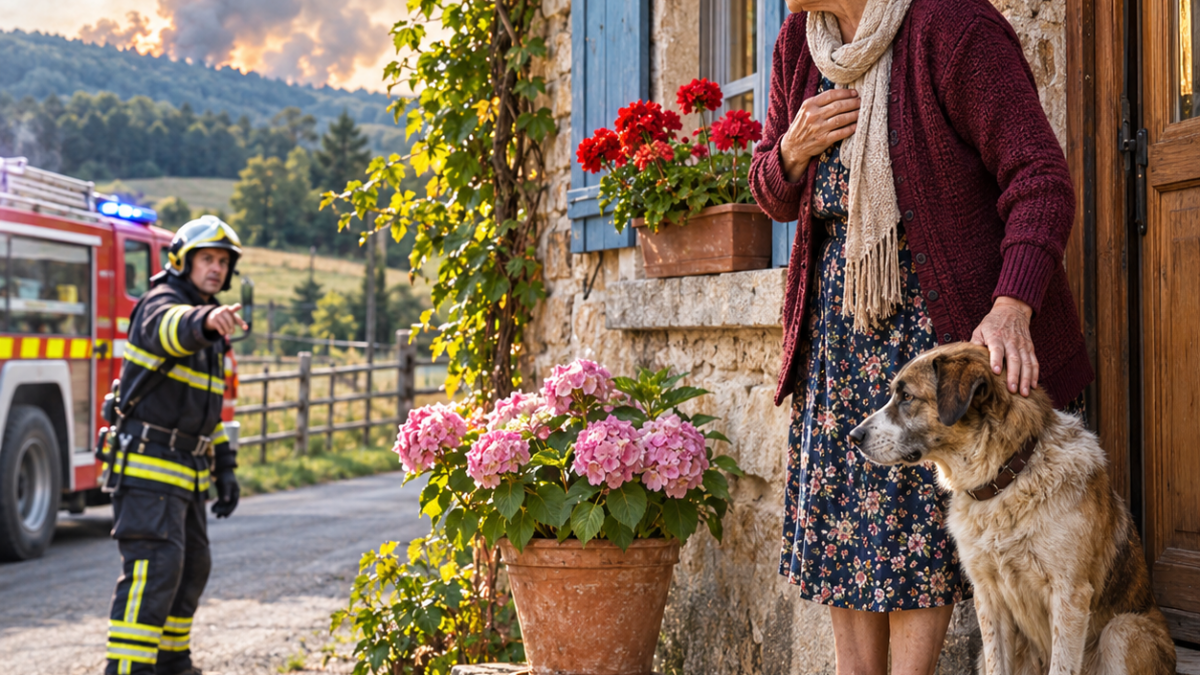
PART 2
At first I thought fear had finally overwhelmed him.
“Biscotte.”
He kept scratching.
Stone dust fell beneath his paws.
“Stop. You’ll hurt yourself.”
He ignored me.
I crawled toward him because standing had become difficult. My right knee screamed every time I put weight on it, and my shoulder had started throbbing where I had struck the floor.
Biscotte scraped again.
That was when I heard it.
Air.
Not much.
A thin whistle somewhere behind the broken cabinet.
I stared at the wall.
“What did you find?”
The cellar was older than the rest of the house. André used to joke that nobody truly knew when the original foundation had been built. Parts of it dated back more than a century, back when the property had been used to store wine and fruit from the surrounding farms.
I knew about the well.
The drainage ditch.
The old storage niches.
But not this.
Biscotte wedged his nose behind one side of the cabinet.
I crawled closer and pulled at the wood.
It didn’t move.
“Come on.”
I braced one foot against the floor and pulled harder.
Pain shot through my fingers.
Arthritis is unforgiving at the best of times. That afternoon, my hands felt almost useless.
Biscotte suddenly grabbed the edge with his teeth.
Together—an old woman with bad hands and a half-wild dog—we shifted the cabinet several inches.
Behind it was not solid stone.
There was a square opening no wider than my shoulders, half covered by rotten wooden slats and loose rocks.
I stared.
Then memory came back.
André had mentioned something once.
A ventilation channel.
Or maybe drainage.
We had been newly married. He had crawled under the terrace to repair something after heavy rain.
I had forgotten all about it.
“Dear God.”
I put my hand near the opening.
Cool air touched my fingers.
Outside air.
“Biscotte.”
He was already trying to force his body through.
“Wait.”
I pulled the rotten slats loose.
Smoke thickened behind us.
Above the cellar, wood cracked again.
The ceiling trembled.
I looked at the opening.
Too small.
For Biscotte, maybe.
For me?
No.
Even when I was twenty, I probably would not have fit through it.
Biscotte pushed his head inside.
Then stopped.
He turned toward me.
“Go.”
He did not move.
“Go!”
Nothing.
I pointed toward the tunnel.
“You can get out.”
He backed away from it.
I almost laughed.
“Now you decide to trust me?”
The absurdity hit me so hard that I started coughing.
Biscotte came closer.
His nose touched my sleeve.
“Listen to me.”
I put my hand against the side of his neck.
His body tensed, but he stayed.
“You go.”
I pointed again.
“Outside.”
He watched me.
“Go!”
A piece of plaster crashed behind us.
That did it.
Biscotte jumped.
He squeezed into the opening.
His hind legs disappeared.
For a few seconds, I could hear claws scraping somewhere inside the wall.
Then nothing.
I waited.
“Biscotte?”
Silence.
I leaned closer.
“Biscotte!”
Nothing.
My chest tightened.
I told myself that was good.
He was outside.
At least one of us had escaped.
I sat against the wall.
The smoke was lower now.
My eyes burned.
My throat felt raw.
The cellar was not yet burning, but heat from above was building.
I tried yelling again.
“Help!”
My voice sounded pathetic.
Nobody answered.
The bus was gone.
The firefighters had withdrawn.
I thought of André.
For thirty years, I had wondered about his final minutes.
Had he been afraid?
Had he known he wouldn’t come home?
Did he regret staying?
I had hated him for perhaps six months after he died.
Nobody knew that.
People called him brave.
They put his name on a plaque at the fire station.
The mayor spoke at his funeral.
Everyone told me I should be proud.
I wanted to scream at them.
Pride didn’t fix the broken boiler.
Pride didn’t sit beside me at dinner.
Pride didn’t raise our children.
For years I could not hear the word hero without feeling angry.
And now there I was, seventy-five years old, trapped beneath my own burning house because I had made almost the same choice.
“Idiot,” I whispered.
I wasn’t sure whether I meant André or myself.
Probably both.
Outside, the village had become chaos.
I learned most of that later.
The firefighter at my gate was named Julien Caron.
I knew his face but not his name before that day.
He was thirty-two, young enough that when he shouted “Mrs. Morel” I had briefly wanted to tell him I had canned tomatoes older than he was.
When I ran inside, Julien had followed.
He got as far as the hallway before part of the ceiling came down between us.
His captain ordered him back.
Julien resisted.
According to two firefighters who later told me about it, he shouted, “She’s in the cellar!”
The captain answered, “And you’ll be dead in the hallway if you stay.”
They had minutes before the flame front reached the row of houses.
The team withdrew to a defensive position farther down the road.
Julien believed I was still beneath the house.
But there was no safe route in.
Then Biscotte appeared.
He emerged from a drainage opening behind the terrace, coughing, his paws bleeding from broken stone.
For a moment he ran toward the trees.
That would have been the natural thing.
Escape.
Keep going.
Nobody would have blamed him.
He had survived.
Instead, he stopped.
Turned.
And ran toward the road.
By then the evacuation bus had reached the lower intersection.
Jeanne, my neighbor, was sitting near the back with her sick husband.
She later told me she was crying because she thought I had died.
Then someone on the bus shouted.
A dog was running behind them.
Biscotte.
He chased the vehicle almost two hundred yards before giving up.
Then he changed direction.
A fire engine was parked behind a stone wall near the vineyard road.
Biscotte ran toward it.
One firefighter tried to catch him.
He dodged.
Then ran back toward my street.
Returned.
Barked.
Ran toward the street again.
“He was trying to make us follow,” Julien told me later.
At first, nobody was certain.
A terrified stray dog running during a wildfire can do anything.
Then Biscotte grabbed the bottom of Julien’s fire-resistant trousers.
Not hard.
Just enough.
He pulled.
Released.
Ran.
Stopped.
Looked back.
Julien said, “That’s Mrs. Morel’s dog.”
The captain answered, “She doesn’t own a dog.”
“He’s the one she went back for.”
That changed everything.
The fire line was still too dangerous to approach through the front.
But Biscotte did not lead them to the front.
He ran around the neighboring vineyard.
Toward the back slope.
Toward the terrace.
Toward the little hole he had crawled through.
Three firefighters followed.
They found the opening.
Julien dropped to his knees.
“Mrs. Morel!”
I thought I was imagining him.
I lifted my head.
“Madeleine!”
This time I heard it clearly.
“I’m here!”
My voice barely worked.
I crawled toward the opening.
“Here!”
A flashlight appeared at the far end of the narrow channel.
Then Julien’s voice.
“We have her!”
I began crying.
Not elegantly.
Not with gratitude.
I cried the way frightened children cry when someone finally turns on the light.
“I can’t fit!”
“We know.”
The vent was too narrow for rescue.
But now they knew exactly where I was.
More importantly, they knew the rear wall of the cellar was shielded from the worst of the flames by the stone terrace.
The captain made a decision.
They would break through.
I heard tools.
Metal against stone.
The first impacts sounded ridiculously small.
Tap.
Tap.
Then harder.
The wall shook.
I pressed myself against the floor.
Biscotte appeared in the vent again.
I stared.
“No.”
His face emerged from the darkness.
“You idiot.”
He crawled back toward me.
“Go outside!”
He kept coming.
When his body cleared the opening, he ran directly to me.
I grabbed him.
For the first time since I had known him, Biscotte allowed me to wrap both arms around his body.
He was shaking.
So was I.
“You came back.”
He pressed his head under my chin.
“I told you to go.”
He coughed.
“You’re terrible at following instructions.”
The wall shook again.
A crack appeared.
Light came through.
“Madeleine, move back!”
Julien.
I dragged myself and Biscotte away.
Part of the wall collapsed inward.
Fresh air rushed into the cellar.
I coughed so hard I thought I would vomit.
Then I saw a helmet.
A mask.
Hands.
Julien climbed through the opening they had created.
“You really didn’t make this easy.”
I tried to answer.
My voice failed.
He crouched.
“Can you stand?”
I shook my head.
“My knee.”
He looked at Biscotte.
“And him?”
“Take him first.”
Julien laughed once.
“No.”
I frowned.
“No?”
“You first.”
“Take the dog.”
“Mrs. Morel—”
“Madeleine.”
“What?”
“If you’re going to argue with me while my house burns down, call me Madeleine.”
Even behind his mask, I could tell he smiled.
“Fine. Madeleine, you first.”
Another firefighter entered.
I pointed at Biscotte.
“He goes with him.”
The second firefighter took off one glove and reached slowly.
Biscotte growled.
“Of course,” the man said.
I put my hand on Biscotte’s neck.
“It’s okay.”
The dog looked at me.
“Go.”
This time he let the firefighter lift him.
I watched them carry Biscotte through the opening.
Only then did I allow Julien to help me.
Getting out was ugly.
Nothing like a dramatic movie rescue.
My knee barely worked.
I had bruised my shoulder and cut one palm.
Julien practically dragged me through the broken wall while another firefighter pulled from outside.
My skirt tore.
My shoe came off.
At one point I shouted something impolite about my hip.
Then suddenly I was outside.
Fresh air.
Smoke.
Orange sky.
The back half of my roof was burning.
My green shutters were blackening around the edges.
The fig tree André had planted stood against the smoke like a dark skeleton.
I stared.
“My house.”
Julien put an oxygen mask over my face.
“Don’t.”
I pushed weakly.
“Biscotte?”
Someone pointed.
He was on the ground several yards away with a firefighter pouring water over his paws.
Alive.
I stopped fighting the oxygen.
“Good.”
Then everything tilted.
The last thing I remembered was Biscotte trying to stand when they put me on the stretcher.
I woke in the hospital.
White ceiling.
Plastic tube under my nose.
My daughter Sophie sitting beside the bed.
She was fifty by then, but when she looked angry she still looked fourteen.
“You’re insane.”
I closed my eyes.
“Hello to you too.”
“You went back into a burning house.”
“There was a dog.”
She stood.
“I know there was a dog.”
“Did he make it?”
Sophie stared at me.
“Mom.”
“Biscotte.”
“He’s alive.”
I exhaled.
“Where?”
“At the veterinary clinic in Nîmes.”
“What’s wrong?”
“Burned paws. Smoke inhalation. Dehydration. A cut on his shoulder. They think he’ll be okay.”
I closed my eyes again.
“Good.”
Sophie sat.
For several seconds she said nothing.
Then, much more quietly, “You could have died.”
“I know.”
“Do you?”
“Yes.”
“You did exactly what Dad did.”
That hurt more than the bruises.
I turned my head.
“Don’t.”
“You did.”
“Your father was doing his job.”
“He was helping people.”
“I went after a dog.”
“That somehow makes it less dangerous?”
“No.”
Her voice broke.
“I already lost one parent to a fire.”
I looked at her.
She was crying.
Not loudly.
Sophie never cried loudly.
“I’m sorry.”
She shook her head.
“No. You don’t get to say that and make it disappear.”
“I know.”
“I was sitting in my car outside the evacuation center waiting for someone to tell me whether you were dead.”
I reached for her hand.
She pulled it away at first.
That hurt.
Then she gave it back.
“I’m sorry,” I said again.
This time I didn’t ask her to forgive me.
For two days I remained in the hospital.
Smoke inhalation.
A badly bruised shoulder.
A sprained knee worse than my usual pain.
A small fracture in my left wrist that I had somehow not noticed during the rescue.
Everyone kept telling me I was lucky.
Lucky.
People love that word after disasters.
It means alive.
It also means damaged in ways that could have been worse.
My house had not burned completely.
The stone walls and lower floor survived.
The roof over the living room and kitchen was badly damaged.
Most of the upper interior was destroyed by fire or water.
The cellar survived.
Of course it did.
I almost laughed when they told me.
On my second morning, Julien visited.
He stood awkwardly in the doorway holding flowers.
“Those for me?”
He looked at them.
“I think so.”
“You’re not sure?”
“My wife bought them.”
“That explains it.”
He laughed.
Then became serious.
“How are you?”
“Old.”
“You were old before.”
I stared at him.
His face changed.
“I’m sorry.”
I started laughing.
My wrist hurt when I laughed.
“Don’t make me do that.”
He pulled up a chair.
For several seconds, neither of us spoke.
Then I asked, “Was it really Biscotte?”
Julien knew exactly what I meant.
“Yes.”
“He found you?”
“He found us.”
“And brought you around the back?”
“Yes.”
I looked toward the window.
“He could have run.”
“Yes.”
“Why didn’t he?”
Julien leaned forward.
“I’m a firefighter, Madeleine. Not a dog psychologist.”
“That’s disappointing.”
“But if you want my opinion?”
I nodded.
“He knew you were still inside.”
My eyes filled.
I hated crying in front of young men.
It made me feel ancient.
Julien continued.
“We had withdrawn. We thought the rear access was blocked by fencing and brush. He showed us the drainage opening.”
“He came back into the cellar.”
“I know.”
“You saw?”
“He disappeared while we were opening the wall. I almost had a heart attack.”
“Good. Someone else should.”
Julien smiled.
Then reached into his jacket.
He took out something black.
A small metal object.
I recognized it immediately.
One of André’s old brass key tags from the cellar.
It had been hanging near the stairway for decades.
The fire had blackened it.
Julien placed it in my hand.
“We found this near the broken vent.”
Stamped into the metal were André’s initials.
A.M.
I ran my thumb over them.
“He knew about that passage.”
“Your husband?”
“Yes.”
“Lucky he never sealed it completely.”
I stared at the tag.
Thirty years after André died in a fire helping strangers, a forgotten opening he had once repaired had helped save me.
I did not know what to do with that.
So I closed my hand around the metal.
Julien stood.
“Biscotte’s at Clinique Saint-Roch.”
“I know.”
“They said maybe tomorrow you can see him.”
“I’ll go today.”
“No.”
I looked at him.
“You’re not my son.”
“No, but I am apparently the firefighter assigned to preventing you from making a second terrible decision this week.”
I laughed again.
“Get out.”
He did.
The story had already spread through the village before I left the hospital.
I hated that.
A local newspaper called Sophie.
She refused.
Someone posted a video of Biscotte running behind the evacuation bus.
Another person had filmed him leading firefighters toward the back road.
By the time I was discharged, half the region seemed to know about “the stray dog who saved the widow from the wildfire.”
I wanted none of it.
Biscotte apparently wanted less.
When Sophie drove me to the veterinary clinic, we found him beneath a table in a recovery room refusing to come out.
The veterinarian, Dr. Lemaire, crouched beside us.
“He’s medically doing well.”
“Then why is he hiding?”
“Stress.”
I knew that answer.
“Can I sit with him?”
“Yes. Don’t reach.”
“I know.”
Sophie looked at me.
“You always say that right before doing something.”
“I am capable of learning.”
She did not respond.
I lowered myself painfully onto the floor.
My knee objected.
My wrist was in a brace.
I probably looked ridiculous.
“Biscotte?”
Nothing.
I could see his nose.
“Hey.”
His head lifted.
He stayed beneath the table.
“It’s me.”
His eyes fixed on me.
I held my hand low.
No reaching.
No demand.
For perhaps thirty seconds he did nothing.
Then he crawled forward.
Slowly.
His front paws were bandaged.
The cut on his shoulder had been shaved and stitched.
When he reached me, he stopped.
I expected him to sniff my hand.
Instead, he pushed his head against my chest.
Hard.
I made a sound I will never admit to anyone.
Something between a laugh and a sob.
“Oh, Biscotte.”
He leaned harder.
I put my good arm around him.
The veterinarian looked away politely.
Sophie did not.
She cried.
That was how Biscotte became my dog.
Not legally.
Not yet.
But there are moments when paperwork is only catching up with something already decided.
The problem was that my house was uninhabitable.
I had nowhere to take him.
Sophie wanted me to stay with her in Montpellier.
She lived in an apartment building that did not allow large dogs without special permission.
Biscotte was not particularly large, but regulations did not care about emotional nuance.
Jeanne offered her spare room, but her husband needed quiet after surgery.
The town arranged temporary housing for several displaced residents in apartments near the school.
Pets were technically limited.
I was furious.
“So the dog saves my life and now he’s homeless again?”
The municipal employee looked exhausted.
“Mrs. Morel, I didn’t write the policy.”
“Then find whoever did.”
“Mom,” Sophie warned.
“No.”
The woman across the desk closed her eyes briefly.
“I’ll make a call.”
She made several.
By afternoon, the mayor himself called me.
“Madeleine, we’ll make an exception.”
“Good.”
“You don’t have to sound so victorious.”
“I nearly burned to death this week. Let me have this.”
Biscotte moved into temporary housing with me three days later.
The first night, he stood in the doorway and refused to enter.
I sat on a chair.
“It’s not home.”
He watched me.
“Mine isn’t home right now either.”
Nothing.
“We’ll both have to compromise.”
He sniffed the threshold.
Then stepped inside.
One paw.
Then another.
I almost applauded.
Instead, I pretended not to care.
The apartment had cheap furniture and beige walls.
Biscotte explored every room twice.
Then chose the space beneath the kitchen table.
For three nights, that was where he slept.
I put a bed there.
He slept beside it.
I moved the bed.
He moved farther.
I finally surrendered.
“Floor it is.”
Trust does not become complete because someone performs one heroic act.
That was another thing I learned.
Biscotte had gone into a burning house for me.
He still flinched if I moved a broom too quickly.
He still backed away from unfamiliar men.
He still guarded food sometimes.
Heroism and fear lived inside the same dog.
There was no contradiction.
The village changed around him too.
People who had once chased Biscotte from their gates began leaving treats outside.
That annoyed me.
“He doesn’t need sixteen dinners.”
Jeanne laughed.
“He’s famous.”
“He’s getting fat.”
“He was skinny.”
“Not anymore.”
The biggest surprise came two weeks after the fire.
A man named Philippe Arnaud knocked on my temporary apartment door.
I recognized him immediately.
He lived in the new development.
Months earlier, he had been one of the people who complained about Biscotte.
He stood holding a paper bag.
Biscotte saw him and retreated behind me.
Philippe noticed.
His face tightened.
“I probably deserve that.”
“What do you want?”
He held out the bag.
“Dog food.”
I stared.
“You came here to give me dog food?”
“Yes.”
“Why?”
He looked embarrassed.
“I was wrong.”
I said nothing.
People are often less prepared for silence than argument.
Philippe continued.
“My wife told me not to come.”
“She sounds sensible.”
He nodded.
“I signed the petition.”
“I know.”
“You knew?”
“Small village.”
He looked down.
“We thought he was dangerous.”
“Because he had scars?”
“Because he was stray. Because he growled at someone’s kid.”
“The kid cornered him with a bicycle.”
“I know that now.”
I folded my arms.
“What changed?”
He looked toward Biscotte.
“The obvious.”
“You mean he saved an old woman, so now he’s socially acceptable?”
His face flushed.
“That’s not what I meant.”
“It sounds close.”
He exhaled.
“You’re right.”
That surprised me.
“I was worried about property values. Complaints. The neighborhood looking…bad.”
“Neglected.”
He winced.
“You remember.”
“I remember most insults.”
“I’m sorry.”
I looked at the food bag.
Then at him.
My first instinct was to make him feel worse.
Maybe that would have been satisfying for thirty seconds.
Then André’s voice came back to me.
You don’t ask if someone deserves help.
I hated that my dead husband could still win arguments.
“Put it there.”
Philippe set down the bag.
He turned to leave.
“Mr. Arnaud.”
He stopped.
“If you actually want to apologize, don’t buy him food.”
“What should I do?”
“Next time you see a frightened animal, don’t decide what it is before you know what happened to it.”
He nodded.
“I can do that.”
“Good.”
A week later, he began helping clear fire debris from the older part of the village.
Not just my house.
Everyone’s.
That mattered more than dog food.
The wildfire had damaged nine homes badly and destroyed three completely.
Miraculously, nobody in Les Roches-Basses died.
Two firefighters were treated for minor burns.
Several people suffered smoke inhalation.
Livestock was lost on one farm.
Hundreds of acres of pine and scrubland turned black.
The village looked wounded.
Trees stood without leaves.
Utility poles leaned.
Metal fences curled from heat.
My house had lost its roof and much of the kitchen.
The green shutters André installed were ruined on one side.
The fig tree survived.
Barely.
When I returned for the first time, Biscotte came with me.
He stopped at the gate.
I stood beside him.
Neither of us moved.
The air still smelled faintly of charcoal.
“This is it.”
He looked at the house.
His body lowered.
“Yeah.”
I felt the same.
We walked slowly.
When we reached the back terrace, Biscotte pulled toward the cellar vent.
I held the leash tighter.
“No.”
He strained.
“No.”
He whined.
The opening firefighters had created had been temporarily covered with plywood.
Biscotte sniffed.
Then looked at me.
“We’re not doing that again.”
He sat.
I touched his head.
“You saved me once. That’s enough.”
The insurance process was miserable.
Forms.
Photographs.
Assessors.
Questions about what was damaged by flame versus water.
At one point an adjuster asked whether my kitchen curtains had been “in good pre-loss condition.”
I stared at him.
“They were on fire.”
“I understand.”
“Do you?”
Sophie stepped between us.
“Mom.”
“I liked those curtains.”
“You told me they were ugly.”
“That’s irrelevant.”
Reconstruction took months.
The village organized volunteer weekends.
At first I refused help.
Then thirty people arrived anyway.
Julien came in civilian clothes carrying tools.
Philippe came with his teenage son.
Jeanne brought sandwiches.
The mayor brought nothing useful but shook many hands.
I told him this.
He said, “I’m supervising.”
“You’re eating.”
“Leadership requires calories.”
Even Sophie laughed.
Biscotte stayed near me.
He no longer hid from everyone.
But he watched.
Always watched.
The biggest change was with children.
At first, he avoided them completely.
Then Philippe’s son, Lucas, started sitting near the edge of the yard during work breaks.
He did not reach.
Did not call.
He simply ate his sandwich.
On the third Saturday, Biscotte sat five feet away.
On the fourth, three.
On the fifth, Lucas broke off a tiny piece of bread.
He looked at me.
“Can I?”
“Put it down. Don’t hand it.”
He placed it on the ground.
Biscotte waited.
Then took it.
Lucas grinned.
“Why is he named Biscotte?”
I told him.
He laughed.
“That’s perfect.”
Months earlier, kids had reportedly thrown stones near Biscotte when he wandered around the development.
I did not know whether Lucas had been among them.
I never asked.
Sometimes people deserve the opportunity to become better without being forced to perform a confession first.
The fire investigation eventually concluded that the blaze had begun several miles north, probably from machinery used during prohibited high-risk hours.
There was talk of fines.
Insurance disputes.
Legal responsibility.
I had no appetite for it.
My own anger had somewhere else to go.
Rebuilding.
Healing.
Learning to live with Biscotte.
He developed strange habits.
He hated closed cellar doors.
Any cellar.
If we visited Jeanne and he saw her basement door, he stood between me and it.
I understood.
He also became obsessed with smoke alarms.
The first time the temporary apartment alarm beeped because I burned toast, Biscotte lost his mind.
He barked.
Paced.
Grabbed my sleeve.
Pulled toward the door.
I stared at him.
“Oh.”
The toast was black.
Smoke thin.
No danger.
But his body remembered.
I opened the windows and crouched beside him.
“It’s okay.”
He trembled.
“Just toast.”
The irony was not lost on me.
Biscotte terrified by burning toast.
I laughed gently.
“You were literally named after this.”
He did not appreciate the joke.
After that, I stopped burning breakfast.
Mostly.
The village council wanted to honor Biscotte.
I said no.
They asked again.
I said no again.
Then Sophie betrayed me.
She accepted on my behalf.
“You had no right.”
“You refused because you hate attention.”
“Correct.”
“This isn’t for you.”
That stopped me.
“For whom?”
“Biscotte.”
“He’s a dog.”
“Yes.”
“He doesn’t understand medals.”
“No, but people understand stories.”
I sighed.
“You sound like a politician.”
“Take it back.”
The ceremony happened six months after the fire during the reopening of the village square.
Nearly everyone came.
The rebuilt bus stop stood near the mairie.
New trees had been planted.
The hills were still black in places, but green shoots had begun appearing between burned trunks.
Nature is rude that way.
It starts over before grief gives permission.
Biscotte wore a simple blue collar.
No ribbon.
I refused ribbon.
The mayor stood at a microphone.
I stood beside him wishing the ground would swallow me.
Biscotte sat behind my legs.
The mayor told the story.
How I refused evacuation.
How Biscotte escaped through the cellar vent.
How he led firefighters around the fire line.
How he returned to the cellar.
That part made the crowd quiet.
Then the mayor said, “Some of us knew Biscotte before the fire only as the stray dog we didn’t know what to do with.”
I looked at Philippe.
He stood near the back with his family.
The mayor continued.
“Some fed him. Some ignored him. Some wanted him removed. We judged him based on what we could see: scars, fear, mistrust. We did not know the rest.”
I looked down at Biscotte.
His damaged ear twitched.
The mayor held a small plaque.
It read:
BISCOTTE
FOR COURAGE AND LOYALTY
LES ROCHES-BASSES
I hated it.
I loved it.
The crowd applauded.
Biscotte tried to hide behind me.
“See?” I whispered. “This is why I said no.”
Then something happened I did not expect.
Philippe stepped forward.
The mayor looked confused.
Philippe asked for the microphone.
I almost objected.
Then stopped.
He faced the crowd.
“I signed the complaint asking the town to remove this dog.”
Nobody moved.
His wife stared at the ground.
Philippe continued.
“I thought he was a nuisance. I was more worried about how our neighborhood looked than why an animal was sleeping in ditches.”
The square was silent.
“I was wrong.”
He looked toward me.
Then Biscotte.
“I don’t expect a dog to forgive me. But I think the least I can do is say that publicly.”
No applause.
Not immediately.
And that made the moment better.
Apologies should not always be rewarded instantly.
They should be allowed to exist without turning the person apologizing into the hero.
Philippe returned the microphone.
Then someone clapped.
A few others joined.
I didn’t.
I nodded at him.
That was enough.
After the ceremony, a little girl approached Biscotte.
Her mother stopped her.
“Ask first.”
The child looked at me.
“Can I pet him?”
I glanced down.
Biscotte watched her.
“Sit there.”
She sat on the curb.
“Don’t reach.”
She obeyed.
Biscotte sniffed.
One minute.
Two.
Then he walked toward her.
He touched his nose to her knee.
The girl smiled but stayed still.
“Now?”
I nodded.
She stroked his shoulder once.
Biscotte remained.
That moment moved me more than the plaque.
A dog who once showed his teeth when I reached for him in a burning cellar had chosen to approach a child.
Not because he had forgotten fear.
Because he had learned there could be something after fear.
The house was ready almost nine months after the fire.
Not exactly as before.
Building codes required changes.
The roof was new.
The kitchen was brighter.
The wiring was completely replaced.
The cellar had a proper external emergency opening now.
Julien insisted.
“I’m not breaking through another wall for you.”
“You enjoyed it.”
“I absolutely did not.”
The green shutters were recreated by a carpenter using the surviving ones as a pattern.
I almost cried when they went up.
Sophie stood beside me.
“They look like Dad’s.”
“Almost.”
“You think he’d approve?”
“No.”
She laughed.
“What would he say?”
“He’d say the hinges are wrong.”
“That sounds like him.”
The fig tree survived.
The first spring after the fire, it produced only a few leaves.
The second, more.
I refused to cut it down despite several people telling me it might never fully recover.
“Let it decide,” I said.
That had become my answer to many things.
The day Biscotte and I returned home permanently, he stopped at the front door.
The same threshold he had never crossed before the fire.
Remember, Biscotte had been my backyard visitor.
He had eaten behind the house.
Rested near the terrace.
Sometimes slept beneath the fig tree.
But he had never willingly entered.
The only time he had gone inside was during the fire because panic drove him beneath the floor.
Now I opened the door.
“Home.”
Biscotte stared.
I stepped inside.
He stayed outside.
“Of course.”
I put down my bag.
Sophie stood behind him.
“Want me to help?”
“No.”
I sat on the floor inside the doorway.
The new wood smelled unfamiliar.
The walls were freshly painted.
Nothing was exactly the same.
Maybe that helped.
“Take your time.”
Biscotte sniffed.
One paw crossed.
Then back.
I waited.
Eventually he stepped inside.
Two paws.
Four.
He stood in the hallway.
His body tense.
I did nothing.
He walked toward the kitchen.
Stopped.
The cellar hatch had been rebuilt.
He stared at it.
Then backed away.
I walked beside him.
“We don’t have to go there.”
He looked at me.
“Not today.”
We never used the old cellar much afterward.
Not because I was frightened.
All right.
Partly because I was frightened.
But also because some places are allowed to keep their ghosts.
Biscotte chose the living room as his sleeping place.
At first.
Then, a week later, I woke at two in the morning and found him beside my bed.
“You need something?”
He stared.
I lifted the blanket edge.
“I’m not inviting you onto the bed.”
He put two front paws up.
“You smell terrible.”
He climbed anyway.
“You’re very rude.”
He curled near my feet.
That became his place.
The dog who once refused to come within ten yards of me slept touching my ankle.
Every night.
Sophie said it was because he was guarding me.
I said it was because the floor was cold.
The truth was probably somewhere between.
Life became ordinary again.
That was the real miracle.
Not the fire.
Not the rescue.
Ordinary mornings.
I made coffee.
Biscotte followed me.
I walked slowly to the bakery.
He came.
Children knew his name.
People who had once called him “the stray” said, “Morning, Biscotte.”
He became a village dog without being everyone’s dog.
He belonged to me.
Legally too.
I signed the adoption papers through a local rescue organization after the fire.
Under previous owner, the form said:
Unknown.
Under identifying marks:
Partial left ear. Scarring.
Under temperament:
Fearful but improving.
I disliked that.
“Can we add stubborn?”
The volunteer laughed.
“No.”
“Heroic?”
“We don’t usually.”
“Then your form is inadequate.”
I signed anyway.
My relationship with Sophie changed too.
For weeks after the fire, she was angry.
Not constantly.
Worse.
Quietly.
She called too often.
Asked where I was.
Checked whether I had taken medication.
If I didn’t answer the phone within ten minutes, she called Jeanne.
Finally I confronted her.
“You have to stop.”
She stood in my rebuilt kitchen.
“Stop what?”
“Checking whether I’m alive.”
Her face changed.
“I’m your daughter.”
“You’re also fifty years old.”
“What does that have to do with anything?”
“I don’t know. It sounded useful.”
She did not smile.
I reached for her hand.
“Sophie.”
“You almost died.”
“I know.”
“You keep saying that.”
“Because I do.”
“No, you understand it intellectually. I sat at the evacuation center listening to people say your street was on fire.”
I let her speak.
“I thought I had lost you exactly the way you lost Dad.”
That silenced me.
She continued.
“And everyone was already calling you brave.”
I knew that anger.
The word hero had done the same thing to me.
I pulled out a chair.
“Sit.”
She did.
I sat across from her.
“When your father died, people kept telling me to be proud.”
Sophie looked at me.
“I wanted to punch every one of them.”
She laughed unexpectedly.
“So did I.”
“I know.”
“No, you didn’t. I was twenty.”
“You think mothers don’t notice when their daughters hate everyone at a funeral?”
Her eyes filled.
I squeezed her hand.
“I’m sorry I put you there again.”
This time the apology landed.
She nodded.
“I know why you went back.”
“That doesn’t make it smart.”
“No.”
“It was probably stupid.”
“Yes.”
“Thank you.”
She laughed through tears.
“But Biscotte saved you.”
“Yes.”
“And you’d do it again.”
I looked toward the living room.
Biscotte was asleep.
“No.”
Sophie raised an eyebrow.
I sighed.
“I would like to say no.”
“That’s more believable.”
I learned something after that.
Courage and recklessness are often separated only by what happens afterward.
If Biscotte and I had died in that cellar, nobody would have called my decision beautiful.
They would have called it tragic.
Maybe foolish.
Outcomes rewrite judgments.
I stopped telling people I had done the right thing.
I had done the thing I could live with in that moment.
Then Biscotte had done something extraordinary.
The difference mattered.
Years passed.
Biscotte’s scars softened beneath a healthier coat.
His weight stabilized.
His fear of men slowly reduced.
Julien became one of his favorite people.
That annoyed me.
“I fed you for months.”
Biscotte wagged at Julien.
“He broke a wall for you.”
Julien crouched.
“That’s true.”
“Don’t encourage him.”
Biscotte leaned into his hand.
“Traitor.”
Julien visited every year on the anniversary of the fire.
The first time, he brought flowers.
The second, wine.
By the third, I told him flowers were unnecessary and wine was preferable.
His wife came too.
Their children grew up calling Biscotte “the fire dog.”
He tolerated them.
Eventually loved them.
One summer afternoon, Julien’s youngest son left the garden gate open.
Biscotte wandered out.
Everyone panicked.
We found him ten minutes later beneath the fig tree.
Same place he had first begun trusting me years earlier.
He looked at us as though we were ridiculous.
I sat beside him.
“You know you’re not homeless anymore?”
His tail moved.
“Just checking.”
The new subdivision changed too.
Not dramatically.
It did not become a community of saints because one dog became famous.
People still complained about hedges.
Parking.
Noise.
Someone once reported Jeanne’s rooster.
The ordinary stupidity of neighborhood life continued.
But a water station appeared near the trail where walkers took dogs.
A small fund was created to help sterilize and treat stray animals.
Philippe helped organize it.
I donated.
Not much.
Enough.
The town council passed a protocol requiring strays reported as nuisances to be evaluated by an animal welfare group before removal whenever possible.
Was that because of Biscotte?
Partly.
Not entirely.
Good changes rarely belong to one story.
But stories push people.
The plaque from the ceremony ended up in my hallway.
I had refused to hang it.
Sophie did while I was shopping.
I came home.
“What is that?”
“Decoration.”
“It’s ugly.”
“It’s his award.”
“He can’t read.”
“You can.”
I left it.
Over time, I stopped seeing it.
That is how objects become part of home.
The charred brass tag with André’s initials stayed in a drawer for years.
I could not decide what to do with it.
Then one winter, I took it to a jeweler.
He cleaned it but left some of the black discoloration.
“Do you want me to polish all of that off?”
I looked at the dark edge.
“No.”
He nodded.
“Sometimes people want the fire marks.”
“I do.”
I attached it to Biscotte’s collar.
A.M.
André Morel.
The husband who died trying to save people.
The little piece of metal from the cellar opening.
Sophie saw it.
“Dad’s?”
“Yes.”
She touched it.
“You sure?”
“No.”
“That seems to be your favorite answer.”
“It’s accurate.”
Biscotte carried it for the rest of his life.
He grew old.
That is the part of rescue stories people skip when they want to end on a perfect image.
The heroic dog runs through smoke.
The old woman survives.
Music rises.
The end.
Life is longer than that if you’re lucky.
Biscotte’s muzzle turned white.
His hips stiffened.
The missing piece of his ear became less noticeable because the rest of him looked weathered too.
By the time I was eighty-two, our walks were slow enough that people joked we were racing.
Neither of us found it funny.
I had a cane.
Biscotte had arthritis medication.
We made a good pair.
Every morning we walked to the bakery.
It took twenty minutes to cover a distance I once did in eight.
We did not care.
The young baker kept a biscuit beneath the counter.
“Only one,” I warned.
She always gave him two.
“You’re undermining me.”
“He saved your life.”
“That happened seven years ago.”
“Still counts.”
Biscotte agreed.
He became less frightened of storms but never completely comfortable with smoke.
Even the smell of a neighbor’s fireplace could make him alert.
I understood.
Some memories live in the body after the mind decides everything is safe.
Mine did too.
Every summer, when the fire danger signs turned red, I checked evacuation routes.
Kept a bag ready.
Filled the car early.
Sophie called.
I answered immediately.
And Biscotte wore a harness with his name and my phone number.
No heroics.
That was our agreement.
One afternoon, years after the wildfire, I sat beneath the fig tree while Biscotte slept at my feet.
The tree had recovered.
Not perfectly.
One side remained scarred.
A section of trunk was black where heat had reached it.
But the canopy was green.
Fruit hung from branches that had once looked dead.
Philippe stopped at the gate.
He was gray-haired by then.
“Madeleine?”
“Yes?”
He pointed toward Biscotte.
“How is he?”
“Old.”
Biscotte opened one eye.
“Still judges me.”
“Good.”
Philippe smiled.
He leaned on the gate.
“Do you remember when I wanted him removed?”
“I remember everything.”
“I knew you’d say that.”
“You should be grateful. At my age memory is an achievement.”
He laughed.
Then his expression grew serious.
“I still feel ashamed.”
“Don’t.”
He looked surprised.
“Really?”
“You apologized.”
“That doesn’t erase it.”
“No.”
I looked at Biscotte.
“But shame is only useful if it changes what you do next.”
Philippe nodded slowly.
His grandson had recently adopted an abandoned dog through the local rescue.
I knew.
Everyone knew everything in Les Roches-Basses.
“You changed what you did next.”
He smiled.
“Biscotte did.”
“No. He just gave you the opportunity.”
I thought about those words later.
Maybe that was what Biscotte had done for all of us.
Opportunity.
For me to choose compassion.
For firefighters to choose risk within reason.
For Philippe to reconsider judgment.
For the village to rethink what it did with animals nobody claimed.
Biscotte did not understand any of that.
He wanted chicken.
Walks.
Sun.
Me.
That simplicity kept the story honest.
When Biscotte was around thirteen—or perhaps fourteen; nobody knew exactly—his heart began failing.
The veterinarian heard a murmur first.
Medication helped.
Then coughing started.
Especially at night.
Fluid.
More medication.
Monitoring.
I had lived this part before with people I loved.
You begin measuring days without admitting you are measuring.
Good appetite.
Good day.
Long walk.
Good day.
No coughing last night.
Good day.
Then one morning Biscotte refused breakfast.
I knew.
Not that he would die that day.
Just that the balance had shifted.
I called Sophie.
She drove down.
Julien visited.
Even Philippe came.
I threatened to throw everyone out.
“This is not a funeral.”
“No one said it was,” Sophie answered.
“You’re all looking at him.”
“He’s famous.”
“He’s trying to sleep.”
They left.
Sophie stayed.
That evening Biscotte got up and walked to the back door.
I opened it.
He went toward the fig tree.
Slowly.
I followed with my cane.
He lay beneath it.
The same patch of earth where he had once waited for me to go indoors before eating.
I sat beside him.
“You really like circles, don’t you?”
His tail moved once.
I touched André’s brass tag on his collar.
“You kept this safe.”
Biscotte breathed slowly.
The vet had told me what signs to watch.
Restlessness.
Distress.
Blue gums.
Panic.
He had none of those.
Just tiredness.
I leaned against the tree.
“You know, people think you saved me in the fire.”
His ear moved.
“You did.”
I scratched his neck.
“But that wasn’t the only time.”
I stopped.
That sounded too sentimental.
Biscotte hated sentimental speeches.
Or perhaps I did.
“Fine.”
I looked toward the green shutters.
“You were a good dog.”
His tail moved again.
“That’s enough.”
The next morning, he struggled to stand.
I called the veterinarian.
She came to the house.
Sophie sat beside me.
Biscotte lay on his blanket beneath the open window.
Outside, cicadas buzzed.
The fig leaves moved in the breeze.
I did not want a clinic.
Not for this.
The veterinarian examined him.
Then looked at me.
“We could take him in and try to stabilize him.”
“For how long?”
“I can’t promise.”
“Would he come home?”
She hesitated.
That was enough.
I touched Biscotte’s head.
“No.”
Sophie began crying.
I didn’t.
Not yet.
The veterinarian prepared the medication.
I took Biscotte’s collar in my hand.
The brass tag was warm.
A.M.
Biscotte opened his eyes.
I leaned closer.
“You remember the cellar?”
Sophie made a small sound.
“What?”
“I’m talking to him.”
“I know.”
I looked back at Biscotte.
“You refused to leave me there.”
His breathing was shallow.
“So I’m not leaving you now.”
The veterinarian gave the first injection.
Biscotte relaxed.
His head became heavier in my lap.
I stroked the scar near his ear.
“You can go this time.”
My voice finally broke.
“No need to come back.”
His tail moved once.
Then stopped.
Biscotte died with his head on my knees beneath the fig tree.
No fire.
No smoke.
No sirens.
Just wind in the leaves.
Afterward, Sophie removed his collar.
She held it toward me.
I shook my head.
“You keep it.”
“Mom—”
“Please.”
She looked at the brass tag.
“Dad and Biscotte?”
“Yes.”
She closed her hand around it.
We buried Biscotte near the fig tree.
Legally, I am not certain whether I was supposed to.
At eighty-something, I had developed selective respect for regulations.
Julien helped dig because my knee certainly wasn’t going to.
Philippe brought a small stone.
No plaque.
No heroic inscription.
I refused.
We wrote only:
BISCOTTE
HE CAME BACK
That was enough.
Months later, I sat beneath the tree alone.
The village was quiet.
A school bus passed at the end of the road.
For a second, the sound took me back to the evacuation bus.
The engine running.
The firefighter shouting.
My hand on the porch rail.
The choice.
People sometimes asked whether I regretted going back.
For years, I gave different answers.
No.
Yes.
It was stupid.
It was necessary.
I didn’t know.
The older I became, the less interested I was in simplifying it.
I risked my life.
That hurt my daughter.
That matters.
A firefighter took additional risk because of me.
That matters too.
Biscotte was alive because I went back.
I was alive because Biscotte came back for me.
Both things can be true without turning the decision into a lesson.
Maybe that is what life actually looks like.
Messier than stories.
And still worth telling.
After Biscotte died, people expected me to adopt another dog.
I didn’t.
Not immediately.
No animal should be asked to replace another.
A year passed.
Then one rainy afternoon, Julien called.
“I have a problem.”
“Is something burning?”
“No.”
“Then call someone younger.”
He laughed.
“There’s a dog at the station.”
“No.”
“You haven’t heard the problem.”
“Yes, I have.”
“He was picked up near the highway.”
“No.”
“Older dog.”
“Julien.”
“Missing half an ear.”
I went silent.
“That is manipulative.”
“I know.”
“I’m hanging up.”
“Okay.”
I hung up.
Then I put on my coat.
At the station, the dog was not Biscotte.
Of course not.
He was black.
Larger.
Both ears intact, despite Julien’s lie.
I glared.
“You said half an ear.”
“I needed you to come.”
“You are a terrible person.”
The dog stood behind a chair.
Afraid.
I crouched.
Did not reach.
“What’s his name?”
“No idea.”
I looked at Julien.
“I’m not adopting him.”
“Of course.”
I visited the next day.
Then the next.
Two weeks later, he came home with me.
I named him André.
Sophie told me that was emotional blackmail against the dead.
She was probably right.
But André the dog answered to it.
More or less.
He never replaced Biscotte.
He slept in different places.
Liked different food.
Was afraid of bicycles instead of smoke.
That was good.
Love should not repeat exactly.
Years later, the village still told Biscotte’s story.
Usually incorrectly.
Each retelling made the flames higher.
The distance he ran longer.
My age older.
One child once told me, “They said you were ninety.”
“I was seventy-five.”
“Oh.”
He looked disappointed.
“Sorry.”
I nearly hit him with my cane.
The plaque remained in the mairie after I finally donated it.
The water station stayed near the trail.
The animal fund grew.
Philippe’s grandson eventually became a veterinary nurse.
Julien became fire captain.
My green shutters faded.
The fig tree grew.
And the old cellar ventilation channel remained open behind a metal grate large enough for emergency access.
No one was allowed to seal it.
I made sure of that.
Sometimes I stood near it.
Not often.
The cellar still smelled of cool stone and earth.
The burn marks had been cleaned, but I could see where the wall had been broken.
I remembered Biscotte clawing.
The air moving through the opening.
His body disappearing.
The terrible silence afterward.
For years, people praised him for running to the firefighters.
That was extraordinary.
But the part I remembered most was different.
He came back.
He had escaped.
He was outside.
He was safe.
Then he crawled through that dark passage again and returned to the burning cellar.
People say animals don’t make moral decisions the way humans do.
Perhaps they’re right.
Maybe Biscotte acted from attachment.
Fear.
Instinct.
Maybe he simply heard my voice and came back.
I don’t need to call it anything else.
The action was enough.
A dog who had once learned not to trust people chose not to leave one behind.
That is the part that still moves me.
Not because it made him a hero.
Because of what it revealed about trust.
For three months, I gave him scraps.
Water.
Distance.
No demands.
Then one afternoon, when I needed him more than he had ever needed me, he gave all of it back.
Not because he owed me.
Because somewhere along the way, the frightened stray had decided I was his person.
I had not realized it.
He had.
And when the world burned around us, he acted accordingly.
I once asked Julien why Biscotte kept returning toward the house after finding the firefighters.
Julien thought for a moment.
Then said, “Maybe he didn’t think he had finished.”
That answer stayed with me.
Maybe none of us are finished the first time we reach safety.
Sometimes somebody is still behind us.
Sometimes you go back.
Sometimes you shouldn’t.
Sometimes someone comes back for you.
The morning after Biscotte died, I found one of his old biscuits beneath the kitchen table.
Hard as a stone.
I picked it up.
For a ridiculous second, I considered keeping it.
Then I laughed at myself.
“Absolutely not.”
I threw it outside beneath the fig tree.
A bird took it within minutes.
That felt right.
Nothing dramatic.
Nothing preserved forever.
Just something given forward.
The fire had taught our village about loss.
Biscotte taught us something quieter.
A life can look unwanted from the outside and still contain loyalty nobody has earned the right to measure.
A frightened animal can carry scars and still choose connection.
An old woman can make a reckless decision for compassionate reasons and live long enough to understand that both parts of that sentence matter.
And home can burn down without destroying everything that made it home.
The shutters returned.
The tree survived.
The cellar wall was repaired.
My daughter forgave me slowly.
The village changed imperfectly.
Biscotte grew old beside me.
That was more than I could have asked on the afternoon I first left him a bowl of water.
Sometimes, at dusk, I still looked toward the place beneath the fig tree and expected to see him there.
A thin dog.
Damaged ear raised.
Watching.
Waiting for me to go inside before approaching the food.
Then memory corrected itself.
That was only the beginning.
The Biscotte I choose to remember came later.
Healthy.
Collar around his neck.
André’s blackened brass tag touching his chest.
Walking slowly beside me through the village as if he had always belonged there.
Because eventually, he did.
And so did I.
[END OF STORY]








