PART 2: At 71, I Adopted an 11-Year-Old Retired Rescue Dog—Then a Missing Child Gave Him One Last Mission
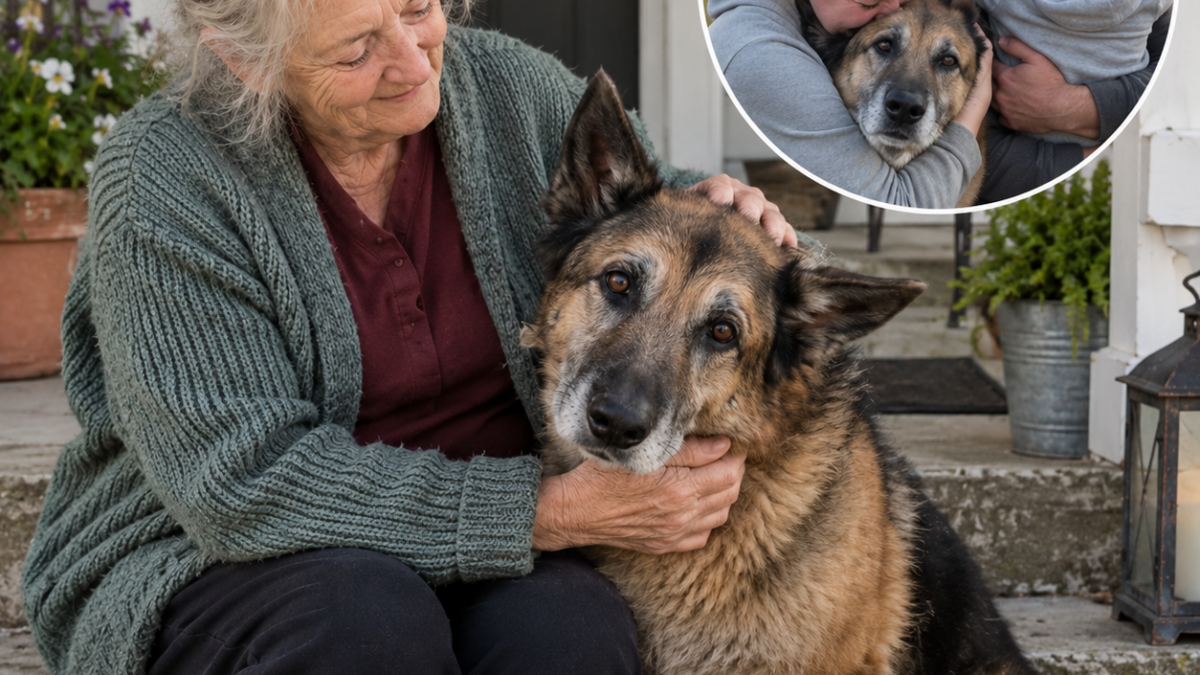
At seventy-one, I adopted an eleven-year-old retired search-and-rescue dog because I thought we could grow old quietly together.
Bruno had spent most of his life finding people who were lost, but I believed those days were behind him.
Then one afternoon, a frightened mother appeared outside my house, and I saw a look in Bruno’s eyes that I had never seen before.
My life had become quiet long before Bruno entered it.
Not unhappy.
Just quiet.
I lived alone in a small house near the edge of a rural town, watered my plants every morning, read too many mystery novels, and spent most evenings beside the front window with a cup of tea cooling in my hands.
For years, I told myself I enjoyed the peace.
Sometimes I even believed it.
Then one Tuesday morning, I drove to the county animal shelter to donate old blankets.
I had no intention of bringing anything home.
The kennels were loud. Young dogs jumped against the gates. Puppies barked. Volunteers moved quickly between bowls, leashes, and cleaning carts.
Then I saw him.
A large German Shepherd sat alone near the back of his kennel.
He wasn’t barking.
He wasn’t jumping.
He simply watched.
His muzzle was gray. His shoulders were still broad, but age showed in the careful way he shifted his weight.
“What about him?” I asked.
A shelter worker named Megan looked toward the kennel.
“That’s Bruno.”
“How old?”
“Eleven.”
I smiled faintly.
“So we’re about the same age in different languages.”
Megan laughed, but then her expression softened.
“He’s retired search and rescue.”
I looked at Bruno again.
“For real?”
“He worked with a volunteer team for years. Forest searches, missing hikers, mountain calls, lost kids. His handler died last year, and after some family complications, Bruno eventually ended up here.”
Something tightened in my chest.
“How long has he been waiting?”
“Almost four months.”
Four months.
Watching people come and go.
Watching younger dogs leave.
Waiting without knowing whether anyone would choose an old dog whose working years were already behind him.
I opened the kennel door with Megan beside me.
Bruno didn’t rush forward.
I crouched slowly.
“Hello, handsome.”
He looked directly into my eyes.
Then he stood, walked over, and pressed the side of his head against my palm.
That was it.
No dramatic decision.
No grand plan.
I adopted him that afternoon.
At home, Bruno inspected everything.
The kitchen.
The hallway.
The garden.
Every window.
Every door.
For the first week, he followed me from room to room, always lying where he could see both me and the nearest exit.
Old habits, I supposed.
If a truck stopped outside, his ears rose.
If footsteps passed the fence, he watched.
Sometimes during our walks, he would freeze over a scent and stand perfectly still, nose lifted, processing information that meant absolutely nothing to me.
But inside our home, he slowly became simply Bruno.
He slept beside my chair.
He waited near the kitchen when I cooked.
He discovered that I occasionally dropped pieces of chicken.
The silence in my house changed.
Now it had paws crossing the hallway.
A collar softly jingling.
Deep breathing beside my bed.
Then, one afternoon, everything changed.
I was trimming dead leaves from a plant on my porch when I heard shouting.
Doors opened along the street.
People hurried toward the road.
A woman ran from the house three doors down.
It was Emily Carter, the mother of a little boy named Noah.
Her face was white.
“My son is missing.”
The words moved through the neighborhood like electricity.
Noah had been playing near the edge of the woods.
He hadn’t come home.
Men grabbed flashlights.
Neighbors spread out.
Someone called the sheriff.
I stood beside my gate with Bruno.
At first, he merely watched.
Then he stood.
His ears lifted.
He looked toward Noah’s house.
Then toward the forest.
Then back at me.
Once.
Twice.
Three times.
My breath caught.
“Bruno?”
He stepped toward the road.
I suddenly remembered what Megan had told me at the shelter.
Missing hikers.
Forest searches.
Lost children.
I hurried to Emily.
“Do you have something Noah wore today?”
She stared at me.
“What?”
“His shoe. Jacket. Anything.”
Minutes later, she handed me a small sneaker.
I knelt in front of Bruno.
His nose touched the shoe.
He inhaled slowly.
Once.
Again.
Then his entire body changed.
The sleepy old dog who spent his afternoons beneath my porch disappeared.
Bruno stood taller.
His ears came forward.
His eyes sharpened.
He turned toward the forest.
“Bruno,” I whispered.
He started walking.
Then faster.
A young man beside me shouted, “Where’s he going?”
I watched my eleven-year-old dog disappear toward the tree line.
And suddenly I understood.
Bruno wasn’t going for a walk.
He was back on duty.
PART 2
“Follow him!”
I don’t remember whether I shouted those words or someone else did.
Maybe all of us did.
Three young men immediately broke away from the group and ran after Bruno.
I followed.
At seventy-one, I was not built for sprinting through a forest.
My knees reminded me of that within thirty seconds.
But there was no chance I was going back to the house.
“Mrs. Bennett,” one of the young men called over his shoulder, “you don’t have to come!”
“Yes, I do.”
“It’s rough terrain.”
“He’s my dog.”
That ended the conversation.
The young man’s name was Daniel. I knew him vaguely from town. He was twenty-six, maybe twenty-seven, broad-shouldered and usually covered in grease from the auto shop where he worked.
Beside him were Marcus Hill, who taught at the middle school, and a college student named Tyler who was home for the summer.
They could move faster than I could.
Bruno could move faster than all of us.
For an eleven-year-old dog, he seemed transformed.
This wasn’t the hurried excitement of a pet chasing a rabbit.
Everything he did had purpose.
He moved thirty yards ahead.
Stopped.
Lowered his nose.
Turned sharply.
Moved again.
Sometimes he circled back several feet before choosing another direction.
Daniel slowed beside me.
“Does he actually know what he’s doing?”
“He used to.”
“That wasn’t what I asked.”
I looked at Bruno.
“No. I suppose it wasn’t.”
The truth was, I didn’t know.
I had lived with Bruno for less than three months.
Megan had told me about his work.
She had shown me one old photograph from his rescue file—a younger Bruno wearing an orange search harness beside a man with a weathered face.
But I had never seen him work.
For all I knew, age had dulled his ability.
For all I knew, we were following an old dog into the woods while dozens of people searched somewhere else.
Then Bruno stopped.
He turned and looked at us.
Daniel pointed.
“He’s waiting.”
Bruno remained completely still until we came closer.
Then he moved again.
Marcus looked at me.
“He’s definitely waiting.”
I felt something cold travel down my arms despite the warm afternoon.
“He’s keeping the team together.”
The words came out before I consciously formed them.
Because that’s what it looked like.
Bruno wasn’t merely searching.
He was working with us.
Just as he must have worked with people for years before I ever knew him.
We passed the last houses.
The trail narrowed.
Then disappeared.
Branches scratched my arms.
Loose stones shifted beneath my shoes.
Bruno’s pace changed whenever the ground changed.
On soft earth, his nose stayed low.
On rocky stretches, he lifted his head and sampled the air.
Every few minutes he stopped.
Once, he returned almost twenty yards and searched a patch of leaves in widening circles.
Tyler whispered, “Did he lose it?”
“I don’t know.”
Bruno stood still.
Then turned toward a narrow ravine cutting between two wooded slopes.
He moved faster.
Daniel looked back at me.
“You okay?”
“No.”
He almost smiled.
“At least you’re honest.”
“My knees are seventy-one. The rest of me is currently about twelve.”
That did make him smile.
We kept going.
Behind us, we could occasionally hear distant voices.
Other searchers shouting Noah’s name.
Somewhere farther away, a whistle.
But the forest swallowed sound quickly.
I kept thinking about Emily.
The look on her face.
The tiny sneaker trembling in her hands when she gave it to me.
Noah was six.
I had seen him riding his bicycle up and down the street many times.
He was a thin little boy with brown hair that always seemed to stick up in the back.
He liked dinosaurs.
I knew that because once, while I was watering my roses, he had stopped outside my fence and explained for nearly ten minutes why a velociraptor was more dangerous than a Tyrannosaurus rex.
I had nodded as though this information might be important later.
Now I found myself wondering whether he was scared.
Whether he was hurt.
Whether he could hear people calling.
Whether night would arrive before we found him.
I pushed the thoughts away.
One foot.
Then another.
Follow Bruno.
That was all I could do.
We had been walking nearly forty minutes when Bruno suddenly stopped.
Not the usual brief pause.
He froze.
Every muscle in his body seemed to tighten.
His nose lifted.
He stared toward the left.
“Bruno?”
His ears shifted.
Then he moved.
Fast.
Much faster.
“Go!” Daniel shouted.
The three younger men ran.
I did what I could.
Branches snapped ahead of me.
I lost sight of them for several seconds.
Then I heard Marcus yell.
“Here!”
My heart lurched.
I stumbled downhill.
Daniel appeared between the trees.
“Careful!”
He grabbed my forearm before I stepped onto a loose patch of rock.
Below us was a shallow ravine.
Not enormous.
Perhaps twenty-five or thirty feet deep.
But steep enough that a child could easily fall and become invisible from the trail above.
Bruno stood at the edge.
He stared downward.
Then he barked.
Three times.
Sharp.
Controlled.
Nothing like the occasional bark he gave when a delivery truck stopped at my house.
This sound had purpose.
Marcus looked over the edge.
“There’s something down there.”
Tyler moved beside him.
“I see a bike.”
My stomach dropped.
A small blue bicycle lay twisted among rocks and brush.
One wheel still turned slightly in the wind.
Beyond it, partly hidden beneath a low branch, was a child.
“Noah!”
Nobody moved for perhaps half a second.
Then everybody moved at once.
Daniel pulled out his phone.
Marcus shouted toward the boy.
Tyler started down the slope.
“Wait!” Daniel snapped. “Don’t create two victims.”
He was right.
The ground was loose.
I remembered enough from years of ordinary life to know that panic often produces more emergencies.
Daniel called 911 and described the ravine.
Marcus moved farther along the edge looking for a safer path down.
Bruno paced once.
Then found a narrow slope between two trees and descended.
“Bruno!”
He ignored me.
Of course he did.
He was working.
I watched him pick his way carefully downward.
His hind legs were slower than they must once have been.
Age had not disappeared simply because duty had returned.
He slipped once.
Recovered.
Continued.
When he reached Noah, he stopped beside him.
He sniffed the boy’s face.
Then his hands.
Then he turned toward us.
And barked.
Two short barks.
My heart pounded.
“He’s alive,” Marcus said.
“How do you know?”
“I don’t.”
Neither did I.
But Bruno’s behavior gave me hope.
Marcus found a safer route.
“I can get down there.”
Daniel stopped him.
“The dispatcher says rescue is eight minutes out.”
“Eight minutes could matter.”
“What if his neck’s injured?”
Marcus clenched his jaw.
He knew Daniel was right.
We didn’t know what had happened.
Moving Noah could make things worse.
I called down instead.
“Noah!”
Nothing.
“Noah, sweetheart, can you hear me?”
Bruno lowered himself beside the boy.
Then Noah’s hand moved.
Barely.
But it moved.
“Oh, thank God.”
I sank to my knees.
Daniel turned away for a second and pressed both hands to the top of his head.
Tyler whispered something I couldn’t hear.
Maybe a prayer.
I didn’t ask.
“Noah,” I called again. “We’re here.”
The child’s head moved slightly.
Bruno remained pressed against his side.
Then something happened I will never forget.
Noah’s fingers lifted.
Slowly.
Weakly.
And settled into the fur along Bruno’s shoulder.
Bruno didn’t move.
The dog who had spent decades of his life being trained to search had done the searching.
Now he simply stayed.
Sirens sounded in the distance.
Not close.
But coming.
Daniel relayed our position.
Two volunteer firefighters reached us first carrying ropes and medical equipment.
Then a paramedic team.
Within minutes, the quiet woods filled with purposeful movement.
A firefighter named Cole recognized Bruno.
At least, I thought he recognized him, because when he saw the dog beside Noah, his face changed.
“Is that Bruno?”
I looked at him.
“You know him?”
“Everybody on regional search used to know Bruno.”
Before I could ask more, Cole clipped into a safety line and descended.
Bruno stood when he approached.
“Hey, old man.”
Cole crouched.
For a moment, his hand rested on Bruno’s neck.
“Still working?”
Bruno’s tail moved once.
Cole looked up at me.
“He found him?”
I nodded.
Cole shook his head.
“Of course he did.”
The medics stabilized Noah.
He had a head injury, bruising, dehydration, and what they suspected was a broken arm.
But he was breathing.
He responded when spoken to.
And he was alive.
That word became everything.
Alive.
They secured him in a rescue basket.
Bruno refused to leave until the basket began moving upward.
Then he followed.
Slowly.
The adrenaline that had carried him through the forest seemed to be fading.
By the time he reached me, his steps were heavy.
I knelt.
“You did it.”
Bruno looked up.
“You found him.”
His mouth opened slightly as he panted.
I pressed my forehead against his.
“You stubborn old man.”
Someone laughed behind me.
I was crying too hard to care.
When we reached the road, Emily was waiting beside a sheriff’s vehicle.
The moment she saw the rescue team carrying Noah, she ran.
A deputy caught her gently.
“Let them work.”
“My baby.”
“He’s alive.”
The sound she made when she heard that wasn’t quite a sob and wasn’t quite a cry.
It was something deeper.
Something pulled from a place only parents know.
They loaded Noah into the ambulance.
Emily climbed inside.
Before the doors closed, she looked around wildly.
“Where’s Bruno?”
I was surprised she knew.
Someone must have told her.
Bruno stood beside me.
Emily jumped back out despite the paramedic telling her they needed to leave.
She ran toward us.
Then she dropped to her knees.
Bruno watched her.
Emily put both hands around his face.
“Thank you.”
That was all.
Two words.
But her voice broke around them.
“Thank you.”
Bruno leaned into her hands.
The paramedic called her.
She kissed the top of Bruno’s head and ran back.
The ambulance left.
Nobody spoke for several moments.
Then people began looking at Bruno differently.
Until that day, most of my neighbors had known him as my old German Shepherd.
The quiet one.
The dog who slept on my porch.
Now Daniel crouched beside him.
“You knew exactly where you were going, didn’t you?”
Bruno gave him no answer.
Tyler laughed.
“Now he’s retired again.”
I stroked Bruno’s neck.
“We’ll see.”
Cole, the firefighter, was still standing nearby.
“You really don’t know much about him, do you?” he asked.
“Only what the shelter told me.”
He smiled.
“Bruno worked with Tom Keller.”
That name was on some of Bruno’s paperwork.
“His old handler.”
“Yeah. Tom was one of the best wilderness search guys around. Bruno worked missing persons for almost eight years.”
“Eight?”
Cole nodded.
“Kids. Alzheimer’s patients. Lost hunters. Hikers. One winter they located a woman after she spent almost twelve hours out in freezing temperatures.”
I looked down at Bruno.
He was drinking water from a collapsible bowl.
“He never mentioned it.”
Cole laughed.
“Typical Bruno.”
“What happened to Tom?”
The humor left his expression.
“Cancer.”
“I knew he died. I didn’t know how.”
“Bruno stayed with him almost to the end.”
That sentence hit me unexpectedly.
“Then Tom’s family couldn’t keep him?”
Cole sighed.
“Complicated situation. Nobody’s fault, really. Bruno bounced around for a while before the shelter took him.”
I thought of those four months in the kennel.
An eleven-year-old dog who had spent his life finding people.
Waiting for someone to find him.
“I wish I’d known.”
Cole looked at me.
“He doesn’t care what you know.”
“What does that mean?”
“He cares that he went home with you.”
I looked at Bruno.
His eyes were half closed.
Exhausted.
For the first time that day, he looked eleven again.
I knelt.
“Come on, hero.”
We walked home slowly.
Very slowly.
Every person we passed wanted to touch him.
Bruno tolerated the attention with the patience of an elderly statesman.
By the time we reached my porch, I was afraid he’d collapse.
He walked inside.
Drank.
Turned once on his favorite rug.
Lay down.
That was it.
No celebration.
No sense that he had accomplished something extraordinary.
Just an old dog returning to his nap.
I sat beside him.
“You know,” I said, “I adopted you so you could rest.”
One eye opened.
“You clearly misunderstood the arrangement.”
His eye closed.
I laughed.
Then I cried.
Quietly this time.
The house became still.
But the silence was different.
It wasn’t empty.
It was full.
Full of the afternoon.
Full of Noah’s hand in Bruno’s fur.
Full of the three sharp barks at the ravine.
Full of the knowledge that the creature sleeping beside me contained an entire history I had never seen.
I rested my hand on his side.
His ribs rose.
Fell.
Rose again.
That rhythm calmed me.
Hours later, the phone rang.
Emily.
“Noah is going to be okay.”
I closed my eyes.
“Oh, thank God.”
“He has a broken wrist, a concussion, and stitches near his hairline. They’re keeping him overnight.”
I looked at Bruno.
Still sleeping.
“The doctors said if he’d been out there through the night…”
Her voice stopped.
She didn’t finish.
She didn’t need to.
“I understand.”
“No,” she said. “I don’t think I do.”
“What?”
“I don’t understand how Bruno knew.”
“Training.”
“But he’s old.”
“Apparently nobody told him.”
She laughed through tears.
Then she became quiet.
“Can Noah see him when he comes home?”
“Of course.”
The next morning, the entire town seemed to know.
I went outside in my robe at seven and found a paper bag hanging from the porch railing.
Inside were dog treats.
A note read:
**For Bruno. Good boy.**
At eight, another neighbor brought a steak.
At nine, the local hardware store owner arrived carrying a new orthopedic dog bed.
“This is getting ridiculous,” I said.
He looked offended.
“Heroes need lumbar support.”
Bruno accepted the bed immediately.
Traitor.
By noon, someone from the local newspaper called.
I said no.
Then Emily called.
“Please.”
“Why?”
“Because people should know.”
“Bruno doesn’t care about newspapers.”
“No. But maybe someone sees an old shelter dog differently because of him.”
That changed my mind.
The reporter came that afternoon.
Her name was Claire.
She sat on my porch while Bruno slept between us.
“What made you adopt him?”
“I was lonely.”
The honesty surprised her.
She lowered her notebook.
“That’s it?”
“That’s enough.”
“Did you know he was a rescue dog?”
“I knew his background.”
“Did you think he’d ever work again?”
“Absolutely not.”
Bruno opened one eye.
I looked at him.
“Apparently I was wrong.”
Claire smiled.
“What do you think made him follow Noah’s scent?”
“He knew somebody was missing.”
“How?”
“I don’t know. I’m not Bruno.”
She laughed.
Then she asked the question that stayed with me.
“Do you think you rescued him?”
I looked at the house behind us.
Before Bruno, entire days could pass without another living creature making a sound inside those walls.
Now there were water bowls in the kitchen.
Dog hair on my cardigan.
Nose prints on the back door.
A bed beside mine.
“I think shelters use that word because it’s convenient,” I said.
“What word?”
“Rescue.”
Claire waited.
“I signed adoption papers. Bruno did the rest.”
The article ran two days later.
They used a photograph of Bruno sitting beside my porch.
I clipped it out.
Not because the headline called him a hero.
Because his expression was exactly the same as it had been the first day I saw him.
Calm.
Watchful.
Almost amused by humans making everything complicated.
Noah came home from the hospital three days later.
His left arm was in a bright blue cast.
His mother walked him to my house.
Bruno was asleep on the porch.
Noah stopped at the bottom step.
“Bruno?”
The dog’s head came up.
The change was immediate.
His ears lifted.
He stood.
Noah smiled.
Bruno walked toward him.
Slowly.
No dramatic run.
No jumping.
He simply stopped in front of the boy.
Noah wrapped one arm around his neck.
Bruno leaned his head against Noah’s chest.
Emily covered her mouth.
I turned away because I was crying again.
I had become ridiculous since adopting that dog.
Noah pulled something from behind his back.
A drawing.
It showed a large black-and-tan dog standing beside a very small stick person.
Above them was a sun larger than both.
“That’s you?” I asked.
Noah nodded.
“And Bruno?”
He nodded again.
“What are you doing?”
Noah thought seriously.
“He’s coming to get me.”
I couldn’t speak.
Emily touched my shoulder.
Later, I taped the drawing beside my bedroom mirror.
It stayed there.
For years.
After the rescue, Bruno became famous in the small way things become famous in a small town.
People greeted him at the grocery store.
Children asked to pet him.
The fire department invited us to an open house.
Cole showed me old photographs of Bruno working with Tom.
In one, Bruno was younger, leaner, wearing a red search vest.
Tom knelt beside him.
Both looked muddy.
“What search was this?” I asked.
“Missing hunter. Six hours.”
“Did they find him?”
“Bruno did.”
Another showed Bruno standing near a snow-covered road.
“Lost woman with dementia,” Cole said. “Temperature dropped below twenty that night.”
I stared at the picture.
“How many people did he find?”
Cole scratched his jaw.
“Depends what you count as a find. Direct finds? Maybe seventeen. Assisted searches? Dozens.”
Seventeen.
I looked at Bruno.
He was under a picnic table hoping someone dropped a hamburger.
“You could’ve told me.”
Cole laughed.
“What did you think he was going to do? Hand you his résumé?”
That evening, I looked through Bruno’s adoption file again.
The forms seemed different now.
Before, I had seen age.
Eleven.
Medical notes.
Arthritis.
Dental wear.
Vaccinations.
Now I saw a career.
A life.
Years of training.
Storms.
Forests.
Families waiting.
People returning home because Bruno hadn’t stopped looking.
I wondered what it had been like for him after Tom died.
Dogs do not understand death the way we do.
But they understand absence.
They understand routines breaking.
Doors that no longer open.
Voices that disappear.
Perhaps Bruno had spent months waiting for Tom.
Then months waiting in a shelter.
And then I had walked in carrying old blankets.
That thought made me smile.
Life can turn on absurdly small things.
If I had donated those blankets a week later, someone else might have adopted him.
If Noah had disappeared before Bruno came home with me, perhaps nobody in town would have known what he could do.
If I had ignored Bruno’s behavior that afternoon, perhaps searchers would have spent precious hours moving in the wrong direction.
I don’t believe every event is fate.
But sometimes coincidence becomes so precise that the word feels inadequate.
Two weeks after Noah’s rescue, the county search-and-rescue coordinator called.
His name was Lieutenant Aaron Price.
“I’d like to meet Bruno.”
“He’s retired.”
“I know.”
“Very retired.”
“I understand.”
“He takes afternoon naps.”
“Mrs. Bennett—”
“And he snores.”
There was a pause.
“Is that relevant?”
“It feels relevant.”
He laughed.
“I don’t want to put him back to work.”
“Good.”
“I’d like to evaluate him.”
That made me nervous.
“Why?”
“Because what he did with Noah is remarkable, especially at his age. We sometimes use veteran dogs in training demonstrations. Very light work. Mostly showing younger handlers scent behavior.”
I looked at Bruno.
He was sleeping.
“I don’t know.”
“Think about it.”
I did.
For three days.
Then I asked the only person whose opinion mattered.
I placed his old search harness—Cole had given it to me after finding it in Tom’s stored equipment—on the floor.
Bruno stared.
Then stood.
Walked over.
Sniffed it.
His tail began to move.
“Oh, no.”
He looked at me.
“You want this?”
His tail moved harder.
“You are supposed to be retired.”
He pushed his nose into the harness.
I laughed.
“All right.”
The following Saturday, we went to the training field.
The moment Bruno stepped out of the car, several handlers recognized him.
“Bruno?”
One woman hurried over.
She knelt.
“Hi, old man.”
Bruno sniffed her.
Then licked her cheek.
She started crying.
“I trained with Tom.”
Her name was Lisa.
She showed me a photograph on her phone of Bruno at seven years old.
“I haven’t seen him since Tom got sick.”
“He remembers you.”
“I hope so.”
He did.
That day, nobody asked Bruno to climb ravines.
Nobody asked him to run miles.
Lieutenant Price created a simple scent exercise.
A volunteer walked behind a building and hid.
Bruno sniffed a glove.
Then looked at me.
That old expression returned.
Focus.
Purpose.
He walked.
Slowly.
But directly.
He found the volunteer in less than three minutes.
Everybody applauded.
Bruno looked annoyed.
As though they were celebrating him for locating the kitchen.
Lieutenant Price laughed.
“He still has it.”
“Yes.”
“You sound surprised.”
“I live with him. Yesterday he couldn’t find the treat I dropped directly beside his foot.”
“Selective expertise.”
From then on, Bruno attended training once every few weeks.
Never strenuous work.
Never emergencies.
Just short demonstrations.
He seemed younger on those mornings.
Not physically.
His hips still bothered him.
He needed medication.
He climbed into the car more carefully.
But something inside him brightened.
I had thought retirement meant removing all responsibility.
Bruno taught me otherwise.
Sometimes purpose is not a burden.
Sometimes it is part of who we are.
That realization affected me too.
At seventy-one, I had been living as though the meaningful part of my life was finished.
Career behind me.
Travel behind me.
Most family scattered.
Friends lost gradually to distance, illness, and time.
I wasn’t depressed.
I simply assumed the future would be smaller.
Then Bruno arrived.
A dog eleven years old.
Gray muzzle.
Arthritic hips.
And when somebody needed him, he moved toward the problem.
He did not ask whether he was too old.
He did not compare himself with the younger search dogs.
He used what remained.
I began doing the same.
I volunteered at the shelter every Thursday.
At first, I folded laundry.
Then I began sitting with senior dogs.
Older animals frightened many adopters.
People worried about medical bills.
About loss.
About getting attached to a dog who might only have a few years left.
I understood those fears.
I also understood what they missed.
One afternoon, a couple stopped outside the kennel of a ten-year-old hound named Chester.
“He’s so old,” the woman said.
I was sitting nearby.
“Yes.”
“How long would he even live?”
“I don’t know.”
Her husband frowned.
“It would be awful to lose him.”
I looked at Bruno sleeping near my chair.
“Yes.”
They waited for me to say more.
I didn’t.
Finally, the woman asked, “Then why would someone do it?”
I smiled.
“Because he has to live those years somewhere.”
They stood there quietly.
Two weeks later, Chester went home with them.
That became Bruno’s second career, though he never knew it.
People heard his story.
They came looking for him.
While they were at the shelter, they noticed other senior dogs.
Over the next year, five older dogs were adopted by families who specifically mentioned Bruno.
Megan called him “the ambassador.”
I called him “a bad influence.”
He continued sleeping through both titles.
Noah visited regularly.
He and Bruno developed a quiet friendship.
Noah would sit on my porch and read aloud.
At first, simple picture books.
Then chapter books.
Bruno listened equally seriously to both.
One afternoon, Noah asked, “Does Bruno remember finding me?”
“I don’t know.”
“He remembers me.”
“Yes.”
“Then maybe.”
He stroked Bruno’s ears.
“I’m going to be a firefighter.”
“You’re seven.”
“I know.”
“Maybe finish second grade first.”
He considered that.
“Okay.”
Years passed.
Not many.
But enough.
Bruno turned twelve.
Then thirteen.
His walks became shorter.
His muzzle became almost completely gray.
He stopped attending search training except for occasional visits where everyone simply wanted to see him.
Noah grew taller.
The blue cast disappeared.
His drawing remained beside my mirror.
The village slowly stopped talking about the rescue every day.
That was good.
Extraordinary events should eventually become memories so ordinary life can return.
Bruno loved ordinary life.
Breakfast at seven.
Porch at eight.
Nap at ten.
Slow walk after lunch.
Supervision while I gardened.
Dinner at five-thirty.
He believed five-thirty meant precisely five-thirty.
At 5:31, he filed formal complaints.
One evening, while preparing his food, I looked toward the doorway.
Bruno wasn’t there.
That was unusual.
I found him lying in the hallway.
“Bruno?”
He tried to stand.
His back legs slipped.
My stomach tightened.
I helped him.
The next morning, we saw Dr. Simmons.
Tests showed worsening arthritis and spinal degeneration.
“He’s old,” the veterinarian said gently.
“I know.”
“We can keep him comfortable.”
“For how long?”
She gave me the answer veterinarians have to give when people ask impossible questions.
“We’ll watch his quality of life.”
I hated those words.
Quality of life.
Clinical.
Necessary.
Terrifying.
I adjusted everything.
More rugs.
A ramp for the porch.
Raised food bowls.
Pain medication.
Shorter walks.
Bruno accepted these accommodations without pride or embarrassment.
Dogs are wiser than humans that way.
He did not mourn the distance he used to walk.
He enjoyed the distance he could.
One afternoon, Noah came over.
He was nine now.
Bruno struggled to stand.
Noah immediately sat on the floor instead.
“You don’t have to get up.”
Bruno rested his head in the boy’s lap.
Noah looked at me.
“He’s getting old.”
“Yes.”
“Will he die?”
Children ask the questions adults spend entire conversations avoiding.
“Yes.”
“When?”
“I don’t know.”
Noah’s eyes filled.
“I don’t want him to.”
“Neither do I.”
“Can’t the vet fix it?”
“No.”
He looked down at Bruno.
For a while, neither of us spoke.
Then Noah said, “He found me.”
“I know.”
“What if I need him again?”
My throat tightened.
I sat beside him.
“You’ll carry him with you.”
“That doesn’t make sense.”
“No. Not yet.”
Noah frowned.
I touched his shoulder.
“One day it will.”
Bruno turned fourteen.
Everyone told me that was extraordinary for a German Shepherd.
I wanted fifteen.
Then sixteen.
Then twenty.
Grief makes greedy negotiators of us.
In early autumn, Bruno stopped wanting breakfast.
He still ate dinner.
Then he stopped wanting that too.
Dr. Simmons found an abdominal mass.
My hands went cold.
“Cancer?”
“Most likely.”
“Surgery?”
“At his age, with his condition, it would be very difficult.”
“Could it save him?”
She looked at me.
That look answered before her words did.
“Probably not for long.”
I stared at Bruno.
He was lying on the examination-room floor.
Calm.
Always calm.
“What would you do?”
Dr. Simmons sat beside me.
“I would take him home.”
So I did.
I didn’t tell the entire town.
I told Emily.
Noah.
Megan.
Cole.
Lieutenant Price.
People visited quietly.
Lisa brought Bruno’s old red search vest.
She placed it beside him.
“Thought you should have this.”
Bruno sniffed it.
His tail moved.
Cole sat on my porch for nearly an hour.
“He was a hell of a dog.”
“He still is.”
Cole looked embarrassed.
“Sorry.”
“Don’t apologize.”
Bruno’s head rested against my shoe.
“We’re speaking about him like he’s already gone because we’re afraid of saying what’s happening.”
Cole nodded.
“He’s dying.”
“Yes.”
Saying it hurt.
But it also cleared the air.
Bruno was dying.
And Bruno was alive.
Both things were true.
As long as the second remained true, I wanted to honor it.
We sat outside.
He ate pieces of roast chicken from my hand.
He slept in sunlight.
He walked to the mailbox once and looked exhausted afterward.
I told him that was enough.
Noah came every afternoon.
On Bruno’s last good day, Noah brought the old drawing.
The paper was wrinkled now.
“You kept another copy?” I asked.
“Mom took a picture.”
He sat beside Bruno.
“Remember this?”
Bruno sniffed the paper.
Noah smiled through tears.
“This is when you came to get me.”
Bruno rested his head against him.
Then Noah whispered something.
I almost didn’t hear.
“When it’s your turn, you don’t have to come get anybody.”
My chest broke.
“You can just rest.”
Bruno’s eyes closed.
That night, he struggled to breathe comfortably.
I knew.
People tell you that you’ll know.
I had always thought that sounded like something people said because there was nothing better to say.
But I knew.
At three in the morning, I sat on the floor beside his bed.
His head rested in my lap.
The house was silent.
Just as it had been before him.
But not empty.
Never empty again.
I stroked the place between his ears.
“You’ve done enough.”
Bruno breathed.
Slow.
Shallow.
“You found hikers.”
I stroked his face.
“You found children.”
His eyes opened slightly.
“You found Noah.”
My voice broke.
“And somehow you found me too.”
At sunrise, I called Dr. Simmons.
She came to the house.
I asked whether we could stay on the porch.
Bruno loved the porch.
She agreed.
Emily and Noah came.
So did Megan.
Nobody spoke loudly.
Noah sat beside Bruno.
He placed his small hand on Bruno’s shoulder.
Dr. Simmons explained what would happen.
I already knew.
I still hated hearing it.
Before she began, Noah leaned close.
“Bruno?”
The dog’s eyes moved toward him.
“Thank you for finding me.”
Bruno’s tail moved.
Once.
Slowly.
Exactly as it had after the rescue.
I covered my mouth.
Noah started crying.
I pulled him close with one arm while my other hand stayed on Bruno.
Dr. Simmons gave the medication.
Bruno relaxed.
His breathing softened.
I bent down.
“I’ve got you.”
For years, those dogs in his old search photographs had worn harnesses with words like SEARCH and RESCUE.
Bruno had been trained to go out when someone was lost.
To find.
To return.
To lead people home.
Now there was nowhere else he needed to go.
“You’re home,” I whispered.
His final breath left quietly.
No drama.
No struggle.
The same calmness with which he had lived beside me.
For several minutes, nobody moved.
Then Noah placed his drawing beside Bruno.
I touched the boy’s hand.
“You don’t have to leave that.”
“I want him to have it.”
I didn’t argue.
After Bruno was gone, the silence returned.
For the first time in years, I heard my refrigerator humming at night.
I heard the clock.
The pipes.
Rain against the windows.
No paws.
No collar.
No deep breathing beside my bed.
I thought loneliness had been difficult before Bruno.
It was worse after him because now I knew the difference between quiet and absence.
For weeks, I left his water bowl in the kitchen.
His bed stayed beside my chair.
His leash remained on the hook.
People told me to take my time.
I wanted to tell them time was exactly the problem.
Too much before Bruno.
Not enough with him.
One Thursday, I forced myself back to the shelter.
Megan hugged me.
Neither of us spoke for a while.
Then she said, “I saved something.”
She handed me a cardboard box.
Inside were copies of Bruno’s old search records.
Photographs.
Training certificates.
A newspaper clipping about a missing hiker he’d helped locate years earlier.
And a handwritten note from Tom.
I stared.
“Where did this come from?”
“Tom’s daughter found it.”
My hands began trembling.
The note was dated years earlier.
It wasn’t written to me.
It was about Bruno.
Tom had written:
*Bruno never understands why people call him brave. He only knows somebody is missing, and somebody should go find them.*
I read it three times.
Then another line:
*When he’s too old to work, I hope somebody gives him a porch, a soft place to sleep, and permission to be nobody’s hero.*
I cried so hard Megan sat beside me.
“I didn’t know.”
“He got the porch,” she said.
I laughed through tears.
“Yes.”
“He got the soft place.”
“Yes.”
“And he retired.”
I looked at her.
“Mostly.”
We both laughed.
I took copies of the records home.
That evening, I framed Tom’s note.
It went beside Noah’s drawing.
The two pieces told Bruno’s entire life.
One from the man who had worked beside him for years.
One from the child he found during his final mission.
Months passed.
Winter came.
Then spring.
I kept volunteering.
One morning, a woman about my age came into the shelter.
She walked slowly through the kennels.
Stopped.
Continued.
Then she noticed an old Labrador mix lying quietly near the back.
“How old?” she asked.
“Twelve.”
She winced.
“So old.”
“Yes.”
“I don’t know if I could handle losing one so soon.”
I looked at the dog.
Then at her.
“I understand.”
She waited.
I said, “But the last chapter still belongs to somebody.”
Her eyes moved back to the Labrador.
“What does that mean?”
“It means being old doesn’t mean being finished.”
I thought of Bruno standing over Noah’s sneaker.
The change in his eyes.
The forest.
The ravine.
Three sharp barks.
“It means sometimes the last chapter is the one that tells you what the whole story was for.”
The woman sat outside the kennel.
She didn’t adopt the Labrador that day.
She returned twice.
Then she did.
I watched them leave together.
The dog moved slowly.
The woman did too.
They matched perfectly.
That evening, I sat on my porch alone.
The sun fell behind the trees.
For a moment, I could almost feel Bruno beside my chair.
Not in some supernatural way.
I don’t claim that.
Memory has weight.
Habit has shape.
Love leaves patterns in places.
My hand dropped automatically toward the spot where his head used to rest.
Nothing was there.
I smiled anyway.
Noah is older now.
He still visits.
He no longer talks much about dinosaurs.
He did, however, keep one promise.
Years after Bruno found him in that ravine, Noah joined the junior fire program.
Then, when he was old enough, he became a volunteer firefighter.
On the day he completed his first certification, he came to my house wearing his uniform.
I opened the door.
For one second, I saw the six-year-old with the blue cast.
Then he smiled.
“I brought you something.”
He handed me a small framed photograph.
It showed Noah standing beside a search-and-rescue dog from the county team.
On the back he had written:
**He came to get me. So I learned to go get others.**
I couldn’t speak.
Noah hugged me.
“You told me I’d carry him.”
I looked at him.
“When?”
“When I asked what would happen if I needed Bruno again.”
I remembered.
Barely.
“You said I’d carry him with me.”
I touched the photograph.
“You understood eventually.”
He smiled.
“Yeah.”
That night, after Noah left, I sat beneath the porch light.
I thought about the morning I first entered the shelter.
I had believed I was looking for a little company.
Something to break the silence.
Maybe a small dog.
Something easy.
Instead, I brought home an eleven-year-old retired German Shepherd with arthritic hips and an invisible history.
I thought I was giving him a place to rest.
He gave me purpose.
I thought his useful years were behind him.
He found a child.
I thought old age meant shrinking away from the world.
Bruno taught me that age changes what you can do, not whether what you do matters.
I thought rescue moved in one direction.
Human saves dog.
I don’t believe that anymore.
Bruno had spent his life searching for people.
Lost hikers.
Missing children.
People wandering where they should not have been.
People frightened in forests.
People waiting for someone to notice they had not come home.
Then, near the end of his life, he ended up behind a shelter gate.
Waiting.
And one quiet seventy-one-year-old woman walked past.
Maybe I found him.
Maybe he found me.
I no longer care which version is technically correct.
We went home together.
That is what mattered.
Bruno’s final mission was not simply finding Noah.
For a long time, I believed it was.
It made the better story.
The retired rescue dog comes out of retirement one last time and finds a missing child.
Beautiful.
True.
But incomplete.
His final mission continued after the forest.
It continued when Noah decided he wanted to help people.
When senior dogs at the shelter found homes because strangers had heard about Bruno.
When I began volunteering instead of sitting alone behind my window.
When an old Labrador left with an older woman who had almost walked away because she feared grief.
When I stopped treating the later years of life as an epilogue.
Bruno’s work kept moving through people long after he could no longer walk beside us.
That may be the strangest thing about love.
A life can end.
Its consequences don’t.
I am older now than I was when Bruno came home.
My plants still need water.
I still read beside the window.
The house is still quiet.
But silence no longer frightens me.
There is a photograph of Bruno on the bookshelf.
Gray muzzle.
Alert ears.
Standing on my porch.
Beside it is Tom’s note.
Across the room hangs Noah’s childhood drawing.
A huge dog.
A tiny boy.
A bright sun.
Sometimes visitors ask me why I keep such a simple child’s drawing framed.
I tell them the truth.
“Because that picture contains the most important afternoon of three lives.”
Noah’s.
Bruno’s.
Mine.
Then I look at the dog in the drawing.
The one moving toward the little boy.
Going to find him.
Doing what he’d always done.
And I remember the sentence Tom wrote years before I ever met Bruno:
Somebody is missing, and somebody should go find them.
For most of his life, Bruno was the one who went looking.
In the end, I think we were all a little lost.
Noah in the forest.
Me inside a house that had become too quiet.
Bruno in a shelter after losing the person who had been his whole working life.
Then somehow, one old dog brought all three of us home.
And that is how I remember him.
Not as the famous rescue dog everyone wanted to congratulate.
Not as the hero in the newspaper.
Not even as the dog who found a missing child at seventy-one-year-old woman’s side.
I remember Bruno late at night.
Sleeping near my chair.
His paws twitching in some dream I could never enter.
His gray face peaceful.
His work finished.
His bowl near the kitchen.
His blanket folded beneath him.
Nothing left to prove.
Nobody left to save.
Finally allowed to be simply Bruno.
The dog I thought I had rescued so he could spend his last years resting.
The dog who showed me that sometimes the last mission is not about saving one more life.
Sometimes it is about leaving behind enough love to change every life that comes after yours.
Sometimes it is about leaving behind enough love to change every life that comes after yours.
For a long time, I thought that was where Bruno’s story ended.
I was wrong.
About six months after Noah brought me the photograph of himself beside the county search-and-rescue dog, I received a phone call from Megan at the shelter.
She sounded unusually excited.
“I need you to come down here.”
“Why?”
“Just come.”
“Megan, I am too old for mysterious phone calls.”
She laughed.
“You’ll understand when you get here.”
So that Thursday afternoon, I drove to the shelter.
The building looked almost exactly as it had the morning I first walked inside carrying a stack of old blankets.
Dogs barked from the kennels.
Volunteers moved between rooms.
Somewhere in the back, a metal bowl clattered against the floor.
But something near the front desk was different.
There was a photograph on the wall.
A very familiar photograph.
Bruno.
Not young Bruno in his search vest.
Not Bruno standing beside rescuers.
It was the photograph taken on my porch after he found Noah.
His muzzle was gray.
One ear leaned slightly outward.
His eyes were calm.
Below it was a small wooden plaque.
I stepped closer.
THE BRUNO PROJECT
I looked at Megan.
“What is this?”
She smiled.
“We’ve been talking about starting a senior-dog program.”
I read the plaque again.
“You named it after him?”
“We did.”
My throat tightened.
“Megan…”
“Before Bruno, senior dogs were some of the hardest animals for us to place. They still are. But after his story spread, more people started asking about them.”
I knew some of that.
I’d watched older dogs go home.
But I hadn’t realized how much had changed.
Megan opened a folder on the desk.
“Twenty-three senior dogs have been adopted in the last eighteen months.”
“Twenty-three?”
“Most of those adopters mentioned Bruno.”
I sat down.
For a moment, I simply stared at the photograph.
Bruno had been gone long enough that I could usually say his name without crying.
Usually.
That afternoon wasn’t one of those times.
Megan sat beside me.
“We want the program to help with adoption fees, medication, mobility equipment, and veterinary costs for older dogs.”
I wiped my cheek.
“And what do you need from me?”
She hesitated.
“We’d like you to help us tell his story.”
I almost refused.
Not because I didn’t believe in what they were doing.
Because Bruno’s story had become deeply personal to me.
It belonged to quiet nights.
To a worn leash still hanging in my closet.
To the indentation his bed had once made beside my chair.
I didn’t want him turned into a slogan.
Megan must have seen the hesitation on my face.
“We don’t want to make him into something he wasn’t,” she said. “That’s why I want you involved.”
I looked at the picture again.
Bruno had never cared about recognition.
He cared that somebody was missing.
He cared that somebody needed finding.
Maybe this was simply another version of the same thing.
Older dogs were waiting.
People who might love them simply hadn’t found them yet.
“All right,” I said.
Megan smiled.
“But no ridiculous slogans.”
“Agreed.”
“No superhero cape.”
“I hadn’t planned one.”
“No giant cardboard cutout.”
She looked guilty.
“Megan.”
“We already ordered one.”
I stared at her.
She burst out laughing.
So did I.
That was how the Bruno Project began.
At first, it was small.
A local veterinarian offered discounted examinations for dogs over eight years old.
The hardware store owner—the same man who had once delivered Bruno’s orthopedic bed—placed a donation jar beside his cash register.
Noah organized a dog-food collection through the fire department.
A woman who owned a sewing shop began making washable blankets.
People donated ramps.
Joint supplements.
Harnesses.
Old dog beds.
Then something unexpected happened.
People began donating money specifically in Bruno’s name.
Five dollars.
Ten dollars.
Twenty.
Sometimes a hundred.
One envelope arrived without a return address.
Inside was a check and a note.
For the old dogs nobody chooses first.
I kept that note.
Within a year, the shelter had enough money to cover medication for several senior dogs whose health problems might otherwise have discouraged adopters.
I started spending more time there.
Not because anybody asked me to.
Because I wanted to.
Thursday became Tuesday and Thursday.
Then sometimes Saturday.
I had a particular weakness for the old ones.
The dogs with gray faces.
Cloudy eyes.
Slow legs.
The ones who didn’t jump against the kennel door because they had already learned that making noise didn’t necessarily make anybody choose them.
One dog named Earl had been there almost three months.
He was a twelve-year-old hound with enormous ears and an expression of permanent disappointment.
Every morning, Earl walked to the front of his kennel when visitors arrived.
By afternoon, he usually returned to his bed.
People liked him.
They just didn’t choose him.
One Saturday, a man in his late sixties stopped outside Earl’s kennel.
His name was Frank.
He had lost his wife the year before.
I didn’t know that at first.
All I knew was that he stood there longer than most people.
“Can I meet him?” he asked.
“Of course.”
We brought Earl into the visiting room.
The old hound walked directly to Frank.
Sniffed his shoe.
Turned twice.
Then placed his enormous head on Frank’s knee.
Frank didn’t move.
Neither did I.
After a minute, he said quietly, “My wife always wanted a hound.”
I sat across from him.
“What stopped you?”
“Me.”
He scratched behind Earl’s ear.
“I always said dogs were too much work.”
Earl sighed.
Frank smiled faintly.
“Turns out an empty house is more work.”
I knew exactly what he meant.
“Do you live alone?”
“Yes.”
“So did I.”
He looked at me.
“With Bruno?”
“Before Bruno.”
Frank studied the photograph of him on the wall.
“That’s the search dog?”
“Yes.”
“The one who found the kid?”
“Yes.”
“He yours?”
“He was.”
Frank nodded.
“How long did you have him?”
“Not long enough.”
“That isn’t an answer.”
“It is when you love a dog.”
He looked down at Earl.
“What if I take him home and only get a year?”
I thought of Bruno.
The porch.
The forest.
Noah’s small hand in his fur.
Tom’s note.
The final morning beneath the rising sun.
“Then Earl gets a year with you.”
Frank didn’t answer.
“And you get a year with Earl.”
Still nothing.
I leaned back.
“If you knew somebody you loved had only a year left, would you want that year erased so losing them wouldn’t hurt?”
His eyes lifted toward mine.
“No.”
“Neither would I.”
Frank adopted Earl that afternoon.
Earl lived another two years and eight months.
Frank later told me they were the best two years and eight months he could remember since his wife’s death.
When Earl died, Frank came to the shelter the following Thursday.
He stood beneath Bruno’s photograph.
I hugged him.
“I told myself I wasn’t doing this again,” he said.
“I’ve said many stupid things too.”
He laughed through tears.
Then he walked down the kennel hallway.
Three weeks later, he adopted another ten-year-old dog.
That was how Bruno’s legacy moved.
Not dramatically.
Person to person.
Dog to dog.
Home to home.
Noah remained part of it too.
As he grew older, his connection to Bruno changed.
When he was a child, Bruno was the dog who found him.
As a teenager, Bruno became the reason he wanted to understand rescue work.
As a young man, he began volunteering on wilderness-search training weekends.
I attended his first major community search as an observer.
A seventy-four-year-old man with early dementia had wandered away from his daughter’s home.
Search teams gathered before sunrise.
Dogs worked scent articles.
Volunteers spread across fields and wooded trails.
I stood beside Emily.
Neither of us said it aloud.
But I knew we were both thinking about Bruno.
Noah was no longer the child being searched for.
He was wearing a reflective rescue jacket.
He was the one going into the woods.
Before his team left, he came over.
“You nervous?” I asked.
“A little.”
“Good.”
He frowned.
“Good?”
“Brave people who aren’t nervous worry me.”
He laughed.
Then his expression became serious.
“I keep thinking about him.”
“I know.”
“What would Bruno do?”
I smiled.
“Work the problem.”
Noah nodded.
Then he left.
The missing man was found three hours later by another team near a creek.
He was cold and confused but alive.
When everyone returned, Noah came straight toward me.
“We didn’t find him.”
“The team found him.”
“Not my team.”
“You weren’t competing.”
“I know.”
I touched his arm.
“Bruno searched for people. He didn’t search for credit.”
Noah looked toward the rescue dogs being loaded into their vehicles.
Then he smiled.
“Right.”
That was another thing Bruno had left behind.
Not merely the desire to help.
The understanding that helping did not have to make you important.
Years moved faster as I grew older.
That seems unfair.
Childhood summers last forever.
At seventy, a year can disappear while you’re still learning to write the date correctly.
My hair became whiter.
My knees became worse.
I stopped driving at night.
The house needed repairs more often than I believed reasonable.
But I wasn’t lonely the way I had once been.
The shelter filled part of my week.
Noah and Emily visited.
Frank became a friend.
Megan called whenever she had a senior dog she thought needed “one of my speeches.”
I insisted I did not give speeches.
She disagreed.
Then, one winter morning, she called again.
“I have someone here.”
“I am not adopting another dog.”
“I didn’t ask.”
“You were going to.”
“I wasn’t.”
“You breathed suspiciously.”
She laughed.
“Just come meet him.”
“No.”
Two hours later, I was at the shelter.
I blamed Bruno.
The dog was in kennel fourteen.
A thirteen-year-old Shepherd mix named Walter.
Gray face.
Weak back legs.
One eye clouded.
He had been surrendered after his owner entered long-term nursing care.
Walter did not come to the gate.
He lay on his blanket and watched me.
I sat outside.
“Don’t get ideas.”
Walter blinked.
“I mean it.”
He sighed.
“I had one dog. He was enough.”
Walter closed his eyes.
“You’re very manipulative.”
His eyes opened again.
I stayed forty minutes.
The next day, I returned.
Then again.
On the fourth visit, Walter came to the gate.
I put my fingers through.
He touched his nose against them.
I cried in the parking lot afterward.
The thought of adopting another dog felt disloyal.
That surprised me.
I knew intellectually that loving again did not erase Bruno.
But grief is not intellectual.
That evening, I stood in front of Bruno’s photograph.
“This feels wrong.”
The photograph offered no advice.
Typical Bruno.
I looked at Tom’s framed note.
When he’s too old to work, I hope somebody gives him a porch, a soft place to sleep, and permission to be nobody’s hero.
I laughed softly.
“You really planned this, didn’t you?”
Of course he hadn’t.
But the next morning, I called Megan.
“Tell me about Walter’s medication.”
There was silence.
Then:
“Are you asking because you’re considering—”
“Do not become emotional.”
“I’m not.”
“You sound emotional.”
“I have allergies.”
“In December?”
“Very severe winter allergies.”
Walter came home two weeks later.
He was nothing like Bruno.
That mattered.
He did not patrol windows.
He did not investigate noises.
He did not walk with the purposeful focus of a working dog.
Walter wanted food.
Warm blankets.
And uninterrupted sleep.
He had no heroic tendencies whatsoever.
His greatest achievement during his first month was stealing half a meatloaf from my kitchen counter despite having arthritis.
I called Megan.
“You told me he could barely walk.”
“He’s motivated by nutrition.”
“He committed a felony.”
“Did you leave meatloaf within reach?”
“That sounds like victim blaming.”
Walter lived with me for two years.
Quiet years.
Good years.
He never saved anybody from a forest.
He saved no missing child.
He appeared in no newspaper.
And I loved him completely.
That taught me one final lesson about Bruno.
For a long time, I had believed his life mattered because of everything extraordinary he’d done.
Seventeen direct finds.
Dozens of searches.
Noah.
The Bruno Project.
But Walter reminded me that a life does not need to be extraordinary to deserve tenderness.
An old dog sleeping safely is enough.
A warm meal is enough.
A hand resting on a gray head is enough.
A final year without fear is enough.
Bruno had been a hero.
But I had not loved him because he was a hero.
I loved him because, after his work was over, he came home.
Walter died peacefully in his sleep one spring morning.
When I found him, he was curled in his bed beneath the window.
Sunlight had fallen across his face.
I sat beside him.
I cried.
But grief felt different this time.
Not smaller.
Just less frightening.
Bruno had taught me that love ending in grief does not make the love a mistake.
Walter had confirmed it.
Later that year, the shelter held the fifth anniversary of the Bruno Project.
I nearly didn’t attend.
Large gatherings exhausted me.
Megan insisted.
“You are coming.”
“Bossy.”
“You’re eighty now. You can survive one afternoon.”
“I’m seventy-nine.”
“Same neighborhood.”
I went.
They held the event outside because the weather was warm.
Families came with dogs adopted through the program.
Old dogs.
Three-legged dogs.
Dogs on medication.
Dogs moving in carts.
Dogs with cloudy eyes.
Dogs sleeping in owners’ laps.
A large sign near the entrance displayed Bruno’s photograph.
Beneath it:
MORE THAN 100 SENIOR DOGS PLACED IN HOMES.
I stared at the number.
One hundred.
Megan appeared beside me.
“Actually, one hundred and seven.”
“Then update your sign.”
“You really know how to ruin an emotional moment.”
I smiled.
Across the lawn, Frank sat with his second senior dog.
Noah was there in rescue uniform.
Emily carried cookies.
Dr. Simmons spoke with another veterinarian.
Cole, now retired himself, stood near the food table pretending he wasn’t feeding sausage to a dog beneath it.
For a moment, I imagined Bruno walking through the crowd.
Not as a ghost.
As memory.
I knew exactly what he would have done.
Ignored the speeches.
Checked the exits.
Found the food.
Then slept.
Megan handed me a microphone.
“No.”
“Yes.”
“Absolutely not.”
“People are waiting.”
“For what?”
“For you.”
I looked at the crowd.
I hated public speaking.
But I had learned long ago that fear did not automatically mean stop.
I took the microphone.
I had prepared nothing.
So I told the truth.
“When I was seventy-one, I adopted Bruno because my house was too quiet.”
People smiled.
“I thought I was giving an old dog somewhere comfortable to spend whatever time he had left.”
I looked at the photograph behind me.
“I didn’t know he had one more search in him.”
Noah lowered his eyes.
I continued.
“Most of you know that part. Bruno found Noah when he was lost in the woods. People called it his last mission.”
I paused.
“For years, I called it that too.”
The crowd became still.
“But I’ve changed my mind.”
Megan looked at me.
“His last mission wasn’t the forest.”
I looked around at the dogs.
“At least, it didn’t end there.”
I pointed toward an old terrier sleeping in someone’s lap.
“To me, this is part of it.”
A woman hugged the terrier closer.
“The hundred and seven senior dogs who went home because people decided old didn’t mean worthless—that’s part of it.”
I looked at Noah.
“The child he found growing up to help search for other people—that’s part of it.”
Then I touched my chest.
“And an old woman who thought the important part of her life was behind her learning that she still had something useful to give—that was part of it too.”
My voice began shaking.
I didn’t fight it.
“I used to think legacy meant being remembered.”
I looked at Bruno’s photograph.
“Now I think legacy is what continues because you were here.”
No applause came immediately.
For a second, there was only silence.
Then people stood.
I hated that.
I also loved it.
When the event ended, Noah helped me gather my things.
“You know what you said?”
“I said too much.”
“No.”
He looked at Bruno’s photograph.
“You said his mission didn’t end.”
“I believe that.”
“So do I.”
We walked toward my car.
Halfway there, a little girl came running after us.
“Mrs. Bennett?”
I turned.
She couldn’t have been older than eight.
Her mother followed behind holding the leash of a very old Beagle.
“Is this your dog?” the girl asked, pointing toward Bruno’s photograph in the program brochure.
“He was.”
“My dog is old too.”
“I can see that.”
The Beagle looked approximately a thousand years old.
“What is his name?”
“Peanut.”
“Excellent name.”
The girl smiled.
“My mom said nobody wanted him because he was twelve.”
Her mother looked embarrassed.
The girl continued.
“But we wanted him.”
I crouched as much as my knees allowed.
“Then Peanut got lucky.”
She shook her head.
“No. Mom says we got lucky.”
I looked at her mother.
Her mother wiped her eye.
And suddenly I was back in the shelter years earlier.
My hand resting on Bruno’s head.
Thinking I was the one doing the rescuing.
I laughed softly.
“Your mother may be right.”
That night, I returned home.
The house was empty again.
No Bruno.
No Walter.
No collar jingling in the hallway.
But I no longer measured loneliness by whether another body occupied the room.
My house contained too much history to feel empty.
I made tea.
Sat beside the window.
The same chair.
The same quiet street.
The same kind of evening I had known before Bruno.
Yet everything was different.
On one wall was Noah’s drawing.
On another was the photograph from the Bruno Project anniversary.
Tom’s note remained framed on the shelf.
Beside it was a picture of Walter looking guilty beside what remained of my meatloaf.
I laughed every time I saw it.
Outside, the porch boards creaked as the temperature dropped.
Once, that sound would have reminded me there was nobody else there.
Now it reminded me of Bruno’s paws.
Memory had transformed silence.
That was perhaps the greatest gift.
I was no longer afraid of quiet because quiet no longer meant nothing had happened.
Quiet was where everything that mattered had room to return.
I thought of Bruno’s first day.
The shelter worker telling me:
“He waits, mostly.”
At the time, those words made me sad.
Years later, I understood them differently.
Bruno’s life had involved a great deal of waiting.
Waiting for a scent.
Waiting for a handler’s signal.
Waiting while rescuers reached someone he found.
Waiting after Tom became ill.
Waiting in a shelter.
Waiting for me.
Then I realized my life had involved waiting too.
Waiting for retirement.
Waiting for phone calls.
Waiting for visits.
Waiting for the days to become interesting on their own.
Bruno did not make my life meaningful simply by entering it.
He made me participate in it again.
That was the difference.
I stopped waiting.
I volunteered.
I spoke to strangers.
I adopted Walter.
I watched Noah grow.
I helped older dogs find homes.
I allowed grief to hurt me because I finally understood that avoiding grief required avoiding love first.
I was no longer willing to make that bargain.
Years earlier, I had believed Bruno’s final mission was finding one frightened child in a ravine.
Now, near eighty, I understood the truth.
Bruno’s final mission was much larger, though he could never have known it.
He reminded a town that old lives still have purpose.
He reminded people that retired does not mean irrelevant.
He reminded families that a senior dog is not a tragedy waiting to happen.
He reminded Noah that being rescued can become a reason to rescue someone else.
And he reminded me that the final chapters of a life do not have to be the quietest ones.
Sometimes they carry the entire meaning of the book.
Before I went to bed that night, I stood in front of Bruno’s photograph.
“You did all right, old man.”
I could almost imagine that familiar tail moving once.
Not because I believed he was standing somewhere listening.
Because I knew exactly how Bruno responded when the humans around him became unnecessarily emotional.
One tail wag.
Then back to business.
I turned off the light.
The room went dark.
And for just a second, I remembered the first night he had slept near my chair.
How comforting his breathing sounded.
How strange it felt to have another living creature in the house.
How certain I had been that I was giving an old dog somewhere safe to spend his final years.
I smiled.
I had been wrong about Bruno almost from the beginning.
I thought he needed me more than I needed him.
Wrong.
I thought his working days were over.
Wrong.
I thought finding Noah was his final act of rescue.
Wrong again.
Because even now, years after his last breath, Bruno was still helping lost things find their way home.
Old dogs.
Lonely people.
A frightened child who became a rescuer.
And one aging woman who had once mistaken silence for peace.
I opened my bedroom door.
No dog followed.
That still hurt.
It probably always would.
But beside the bed hung Noah’s drawing.
Bruno heading toward him.
Always heading toward him.
Always searching.
I touched the edge of the frame.
Then I finally understood why I had kept that childish picture for so many years.
It wasn’t a picture of Bruno finding Noah.
Not really.
It was a picture of what Bruno had done his entire life.
He went toward whoever needed him.
And somehow, when he had finally grown old and tired and should have had nothing left to give, he came toward me too.
I thought I had opened my door and allowed him inside.
The truth was simpler.
Bruno found me.
And because he did, I was never truly lost again.








