PART 2: At 3 A.M., I Found a Freezing Dog Waiting Beside the Highway—Then She Led Me to the Ditch
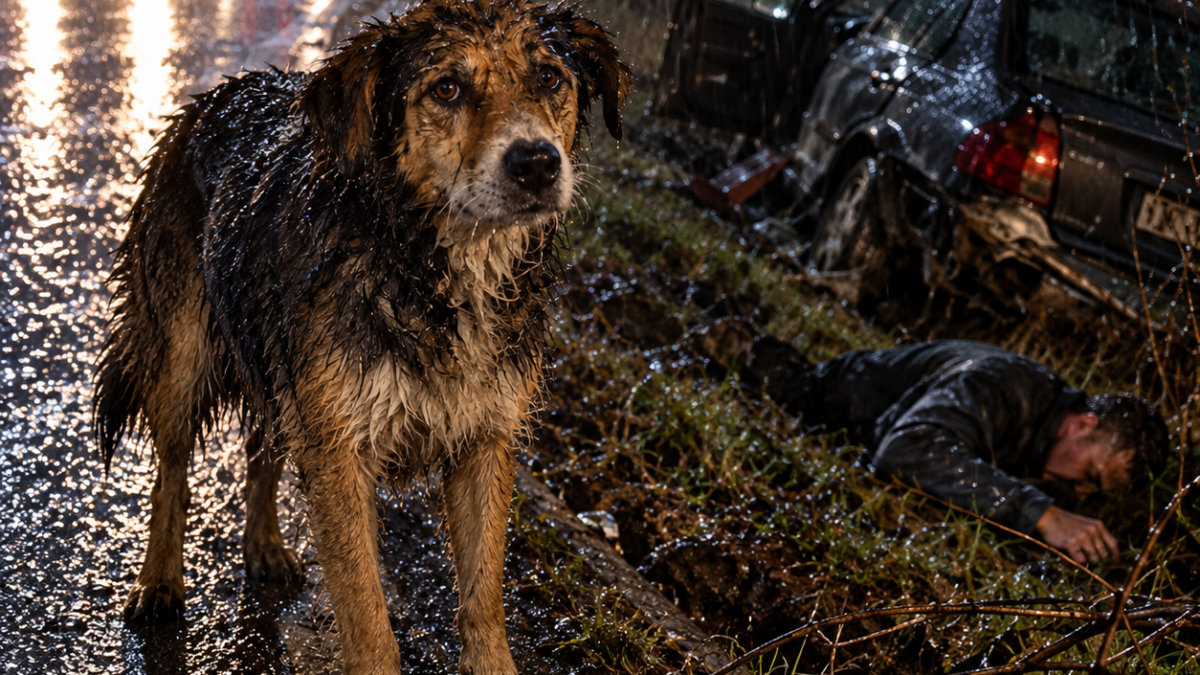
PART 2
I held the dog by the collar with one hand and kept the flashlight pointed into the ditch with the other.
“Sir!” I shouted.
Nothing.
Rain struck my face hard enough to sting.
“Can you hear me?”
The man didn’t move.
The dog pulled again.
Her paws dug into the mud.
She gave a sharp, desperate bark.
It was the first time I had heard her bark since finding her.
“Stay here.”
She did not want to.
Neither did I.
But the ditch was steep, slick and deeper than it had looked from the road. If I tried climbing down alone and slipped, emergency crews might arrive to find two injured people instead of one.
I knelt beside the dog.
“They’re coming.”
She stared downward.
“I promise.”
Sirens grew louder.
The first vehicle to arrive was an ambulance, followed seconds later by a sheriff’s cruiser and a fire-rescue truck.
A deputy ran toward me.
“What happened?”
“I found the dog first. She led me here.”
I pointed into the ditch.
“There’s a man down there.”
The deputy shined his light downward.
“Rescue! We’ve got one victim in the drainage channel!”
Everything changed immediately.
Firefighters moved equipment toward the slope.
Paramedics prepared a stretcher.
One rescuer clipped into a safety line and started down.
The dog tried to follow.
I wrapped both arms around her.
“Not yet.”
She cried.
“I know.”
The rescuer reached the man.
For several agonizing seconds, I heard only rain and voices from below.
Then:
“I’ve got a pulse!”
I closed my eyes.
The dog stopped fighting for half a second when the rescuer spoke.
“He’s breathing! Shallow, but breathing!”
Another firefighter descended.
The paramedics began calling out instructions.
The man had apparently been thrown or had crawled from the car after it left the roadway. The sedan itself had come to rest partly back on the shoulder, but he had ended up down the embankment, hidden from passing traffic.
If the dog had not remained near the road, I might never have stopped.
If she had not recognized the car, I might have driven past it after calling someone about an abandoned animal.
If she had not jumped from my vehicle and led me to the ditch, the man could have remained there until morning.
In freezing rain.
Injured.
Unconscious.
I looked at her.
“You knew.”
She stared downward.
“You knew exactly where he was.”
The rescue team placed the man on a basket stretcher.
When they started lifting him, the dog became frantic.
She barked.
Pulled.
Whined.
“Easy.”
Her eyes never left the stretcher.
As soon as the man reached the road, paramedics surrounded him.
I kept the dog several feet away.
One deputy asked, “You know him?”
“No.”
“The dog yours?”
“No. I found her about half a mile back.”
The deputy looked toward the animal.
“She’s his?”
“I think so.”
A paramedic cut away part of the man’s wet jacket.
Another checked his pupils.
I heard words that made my stomach tighten.
“Possible head trauma.”
“Left arm deformity.”
“Hypothermic.”
“Pressure’s low.”
They moved him into the ambulance.
The dog surged forward.
I almost lost my grip.
“Wait!”
She barked at the ambulance door.
One paramedic looked at me.
“Can somebody take the dog?”
“I can.”
“Hospital can’t have her in trauma.”
“I know.”
The doors closed.
The ambulance pulled away.
The dog ran after it until the leash I had improvised from a rope in my trunk reached its end.
She stood in the rain watching the red lights disappear.
Then she sat.
Exactly the way she had been sitting beside the road when I found her.
That image broke something inside me.
She had done everything she could.
Now her person was leaving again.
Only this time, people were trying to save him.
I crouched.
“He didn’t leave you.”
She looked toward the darkness.
“He’s going to the hospital.”
Of course she didn’t understand.
I took her back to my car.
This time, she let me lift her without hesitation.
The deputy came over before I closed the door.
“We need your information.”
I gave him my name and number.
“Do you know what happened?”
“Not yet.”
“What about the other car?”
“What other car?”
He pointed toward the sedan.
The driver’s side and rear quarter panel were badly damaged.
“That doesn’t look like a single-vehicle slide.”
I turned.
Under the rain and flashing lights, I saw what he meant.
The sedan had damage high along one side.
Scraped paint.
A crushed mirror.
Something else had struck it.
The deputy shined his flashlight over a streak of dark blue paint near the rear door.
“We’ll document it.”
“Hit-and-run?”
“Possibly.”
The word changed the night again.
Until then, I had assumed the man had simply lost control on the slick road.
Now I looked at the skid marks.
One set belonged to his sedan.
Near them, farther toward the centerline, another set of tire marks cut across the wet pavement.
The deputy called for traffic investigators.
I looked back at the dog.
She was curled in my jacket again.
Her eyes remained open.
Watching.
Always watching.
“What happens to her?”
The deputy leaned toward my window.
“If the man survives and she belongs to him, we’ll figure that out. For tonight, animal control won’t get here quickly in this storm.”
“I’ll take her.”
“You sure?”
I looked at her.
“Yes.”
I didn’t know then that saying those three words would rearrange the next several months of my life.
I took her to the emergency veterinary clinic first.
She was freezing.
I wasn’t taking chances.
The veterinary technician scanned her for a microchip.
The scanner beeped.
“Good news.”
“She’s chipped?”
“Yes.”
The registration listed her name.
Molly.
Her owner was Daniel Reeves.
The same name later confirmed by police as the man pulled from the ditch.
Molly.
I knelt beside her.
“So that’s your name.”
Her ears moved.
“Molly.”
Her head lifted.
There it was.
Recognition.
I almost cried.
“You’ve been waiting for Daniel.”
Her tail touched the floor once.
The clinic examined her.
Mild hypothermia.
Dehydration.
Several small cuts on her paws.
Tenderness around her neck where the old collar had rubbed.
Otherwise, incredibly, she was physically okay.
The veterinarian estimated she had been outside in the rain for hours.
“How many?”
“Hard to know.”
The crash had apparently happened sometime before I found her.
Police later estimated between forty-five minutes and ninety minutes.
It felt much longer when I imagined Molly alone beside that road.
Had she stayed with Daniel initially?
Had she climbed from the car?
Had she gone toward traffic because she understood humans traveled there?
We would never know every detail.
What we knew was enough.
She had not run away.
She had not disappeared into the woods.
She positioned herself where cars could see her.
And watched.
After treatment, I brought Molly home.
It was nearly six in the morning.
I dried her completely.
Removed the soaked collar.
Gave her a blanket.
Offered food.
She ate only a little.
Then she went to the front window.
Sat.
And watched the street.
I called the hospital.
Daniel Reeves was alive.
Critical.
That was all they could tell me.
I sent my contact information through the sheriff’s office so the family could reach me.
Then I sat on the floor near Molly.
“You saved him.”
She looked out the window.
“You have absolutely no idea what you did.”
She lay down without moving away from the glass.
I slept beside her.
At nine thirty, my phone rang.
A woman was crying before I finished saying hello.
“Is this the person who has Molly?”
“Yes.”
“Oh, thank God.”
Her name was Laura Reeves.
Daniel’s older sister.
She had received the call from the hospital around dawn.
“Is she okay?”
“She’s cold and exhausted, but yes.”
Laura started crying harder.
I let her.
“Daniel?”
“Still in surgery.”
“What happened?”
“They said broken arm, head injury, internal bleeding. They’re worried about his spleen.”
I closed my eyes.
“But he’s alive.”
“Yes.”
“That’s because of Molly.”
There was silence.
“What?”
I told her everything.
The road.
The way Molly watched traffic.
The abandoned sedan.
How she cried.
How she led me to the ditch.
Laura did not speak for almost a minute.
Then she whispered:
“That dog worships him.”
“I noticed.”
“Daniel got her after our dad died.”
“How long ago?”
“Six years.”
Laura explained that Daniel had struggled badly after losing their father.
Molly had been a rescue herself.
A frightened young dog from a county shelter.
Daniel had adopted her because, according to Laura, “She looked like she needed someone as much as he did.”
They became inseparable.
Hiking.
Road trips.
Sleeping beside the couch.
Molly rode in Daniel’s truck or car whenever possible.
“He calls her his shadow.”
I looked toward the window.
The shadow was waiting.
“Can I bring her to the hospital?”
“Not inside trauma care.”
“I know.”
“Maybe later.”
So we waited.
Daniel survived surgery.
Then another procedure.
The head injury was serious but not immediately life-threatening after stabilization.
His spleen had been damaged.
Several ribs were fractured.
His left arm was broken.
Hypothermia complicated everything.
Doctors told Laura that another hour in the ditch could have changed the outcome dramatically.
An hour.
I looked at Molly differently after hearing that.
She had not simply found Daniel.
She had found him in time.
That afternoon, a traffic investigator called me.
Detective Aaron Bell.
He wanted my full account.
I repeated everything.
“What did the other vehicle look like?”
“I never saw it.”
“Did you notice debris?”
“No.”
“Anybody else stopped?”
“Not before emergency crews.”
“Did Molly react to any cars?”
“Every car.”
He paused.
“Every one?”
“She watched them.”
“Like she was looking for someone?”
“At first I thought that. Now I think she was trying to get somebody to stop.”
Aaron wrote it down.
The investigation quickly confirmed Daniel’s car had been struck.
A piece of another vehicle’s headlamp assembly was found near the centerline.
Dark blue paint transfer.
Tire impressions.
The collision pattern suggested a larger vehicle had entered Daniel’s lane, struck the side of his sedan, then continued.
Daniel’s car spun.
Hit the shoulder.
He apparently got the driver’s door open.
Whether he tried climbing out or was thrown during the final movement was uncertain.
He ended up in the ditch.
Molly escaped too.
The other driver never stopped.
That knowledge made me angry in a way the storm had not.
Accidents happen.
Ice.
Rain.
Visibility.
Mistakes.
But leaving?
Driving away when another car had just been hit badly enough to spin off the road?
That was a decision.
Aaron agreed.
“We’re looking.”
“What are the chances?”
“Better than they were twenty years ago.”
Cameras.
Repair records.
Vehicle debris.
Witnesses.
Everything could become a thread.
While investigators searched, Molly waited for Daniel.
The first two days were hardest.
She slept near the door.
Any vehicle slowing outside brought her upright.
At night she wandered between the window and the blanket.
She ate if I stayed nearby.
She hated being alone.
I contacted Laura daily.
On the third day, Daniel woke for longer periods.
Confused.
Weak.
Unable to remember the crash clearly.
Laura asked the nurse whether she could show him a photograph.
She held up a picture of Molly on her phone.
Daniel stared.
Then tears ran down his face.
“Molly.”
His first clear word after waking.
Laura called me immediately.
“He said her name.”
I sat down hard.
Molly was beside me.
I put the phone on speaker.
Laura spoke.
“Molly?”
The dog froze.
Then Daniel’s voice came faintly from the hospital bed.
“Molly girl.”
Her reaction was instant.
She barked.
Spun.
Ran toward the door.
Whined.
“Easy!”
Daniel started crying on the other end.
“That’s her.”
Laura was crying too.
So was I.
Molly pressed against the phone.
Daniel whispered:
“I’m coming home.”
He wasn’t.
Not soon.
But for the first time, Molly heard his voice.
That night, she ate an entire meal.
I don’t believe that was a coincidence.
Over the next week, Daniel improved.
Slowly.
The brain injury created memory gaps.
He remembered driving.
Rain.
Molly in the passenger seat.
Headlights behind or beside him.
Then nothing.
He did not remember the other vehicle clearly.
Investigators continued without his memory.
A gas station camera two miles before the crash showed Daniel’s sedan traveling east.
Behind it was a dark blue pickup.
Large.
One headlamp already dimmer than the other.
Another camera at a convenience store several miles farther back caught the same vehicles.
The pickup was close behind Daniel.
Too close for the conditions.
Aaron tracked the likely make and model from the broken lamp assembly.
A late-model Ford pickup.
Hundreds existed locally.
Then a repair shop called.
A man had asked about replacing a damaged passenger-side headlight and mirror.
Dark blue Ford F-150.
He had not scheduled the repair after the shop owner said insurance documentation might be required.
The shop had security footage.
The plate was visible.
The registered owner was Travis Colton.
Police located the truck hidden behind a detached garage at a relative’s rural property.
Damage matched.
Blue paint missing.
Fresh scrape marks.
Broken lamp.
Daniel’s paint embedded along the side.
I learned these details from Aaron only after an arrest had been made.
“Was he drunk?”
“We’re not making claims we can’t prove from the night of the crash.”
That answer mattered.
By the time Travis was found, toxicology could not tell investigators what his condition had been days earlier.
But other evidence existed.
Phone data.
Location.
Truck damage.
Surveillance.
A witness who said Travis arrived home agitated and said he had “hit something.”
The hit-and-run case moved forward.
I wanted to hate Travis completely.
Maybe part of me did.
Then Aaron warned me:
“Let the facts carry this.”
He was right.
Anger makes stories simple.
Reality usually isn’t.
Travis claimed he panicked.
Said he thought Daniel’s car had remained on the roadway.
Said he didn’t realize anyone was injured.
The physical evidence contradicted parts of that account.
Daniel’s sedan had clearly left the lane.
The impact was severe.
Travis’s truck suffered substantial damage.
Whether he knew Daniel was in the ditch specifically could not be established.
What could be established was that he was involved in a serious collision and left without reporting it.
That became the case.
Molly had nothing to do with the prosecution.
Her work was already done.
She had kept Daniel alive long enough for everyone else to argue about law.
One week after the crash, the hospital finally allowed Molly to see Daniel in a controlled outdoor courtyard.
Daniel had been transferred out of intensive care.
He was still weak.
His arm was immobilized.
A bandage remained along the side of his head.
He sat in a wheelchair.
Laura pushed him through the door.
I had Molly on a leash thirty feet away.
She saw him.
Everything stopped.
Her body went completely still.
Daniel whispered:
“Hey, girl.”
Molly screamed.
That is the only word I have for the sound.
Not bark.
Not whine.
A high, broken cry I felt in my chest.
Then she ran.
I almost dropped the leash.
Daniel held out his good arm.
Molly reached him and tried to climb directly into the wheelchair.
Everyone laughed and cried at once.
“Easy.”
Daniel buried his face in her neck.
“Molly.”
Her entire body shook.
But not from cold this time.
Her tail hit the wheelchair.
Her paws pushed against his legs.
She licked his face.
Daniel cried openly.
“I’m sorry.”
Molly licked him again.
“I’m sorry you were out there.”
He had nothing to apologize for.
Still, I understood.
He had been unconscious in a ditch while she waited in freezing rain for someone to notice.
Daniel looked at me.
“You found her?”
“She found me.”
He shook his head.
“No.”
I smiled.
“She did.”
I told him the part he couldn’t remember.
How she watched cars.
How she recognized the sedan.
How she jumped from mine.
How she led me to the ditch.
Daniel put his forehead against hers.
“You saved me.”
Molly had no interest in praise.
She wanted closer.
The nurse eventually reminded us Daniel needed rest.
Removing Molly was nearly impossible.
She cried when the wheelchair moved.
Daniel reached toward her.
“I’m coming back.”
This time, I think she believed him.
The next hospital visit was easier.
Then another.
Molly learned that Daniel could disappear through the hospital door and reappear later.
Leave.
Return.
The lesson every anxious dog eventually needs.
Daniel spent almost three weeks hospitalized.
Then he moved to inpatient rehabilitation.
His arm required therapy.
Balance and headaches from the concussion persisted.
Walking long distances exhausted him.
His ribs hurt whenever he laughed or coughed.
Still, he improved.
Molly stayed with me because Daniel couldn’t care for her alone yet.
I had become temporary family.
I didn’t mind.
She slept beside my bed.
She followed me from room to room.
And every time Daniel video-called, she searched behind the phone afterward.
One evening Daniel asked:
“Does she still watch the road?”
I looked at Molly.
“No.”
That was mostly true.
She still noticed vehicles.
Especially older sedans resembling Daniel’s.
But she no longer sat at the window for hours.
She had heard his voice.
Smelled him.
Touched him.
Her waiting had changed from desperate to temporary.
Daniel closed his eyes.
“Good.”
He looked different when he opened them.
Guilty.
“What?”
“I should’ve had her buckled in.”
I understood.
Molly had been loose in the car.
She could easily have been killed.
“Yeah.”
I did not tell him not to feel guilty.
He already knew.
“I bought a crash-tested harness online,” he said.
I smiled.
“You’re not even home.”
“I’m planning.”
“That’s good.”
The accident changed him.
Not just physically.
Before discharge, Daniel ordered a proper dog restraint system.
He also replaced Molly’s old collar—the one that had rubbed the fur from her neck—with a soft padded collar.
He kept the old one.
Not out of sentimentality for suffering.
Because it reminded him how much ordinary care matters.
The criminal case continued.
Travis was eventually charged under statutes related to leaving the scene of a serious crash and failure to render or summon aid, along with traffic offenses supported by the evidence.
Daniel attended hearings when physically able.
I went to one.
Not because I needed revenge.
At least that is what I told myself.
When I saw Travis, anger returned.
He looked ordinary.
Mid-forties.
Work jacket.
Tired face.
Nothing about him looked like the kind of person capable of leaving another human being in freezing rain.
That disturbed me more than if he had looked monstrous.
People who make terrible choices usually still look like people.
The prosecution presented surveillance footage.
Vehicle debris.
Repair-shop footage.
Damage comparisons.
Phone-location records.
Daniel’s injuries.
The timeline.
Travis’s attorney argued panic.
Poor visibility.
Confusion after the collision.
No proof he knew Daniel had left the car.
The prosecutor did not need to prove every thought in Travis’s mind.
The law focused on what he did after a serious collision.
He left.
He reported nothing.
He hid the damaged vehicle.
Those facts mattered.
At one hearing, Travis looked toward Daniel.
For several seconds, neither man spoke.
Then Travis lowered his head.
There was no dramatic confrontation.
No yelling.
No cinematic confession.
Real courtrooms are quieter than stories.
Eventually, the case resolved through a combination of plea and sentencing on the charges supported by evidence.
Travis faced license consequences, financial restitution obligations, probationary supervision and a custodial sentence consistent with the court’s findings and local law.
He was also required to participate in programs ordered by the court.
No punishment could return the night.
Daniel still had scars.
Headaches.
Medical bills.
Months of therapy.
Molly still startled during heavy rain.
So when people asked me whether justice felt satisfying, the answer was complicated.
Punishment did not heal Daniel.
It did not dry Molly’s fur.
It did not erase the hour she spent beside the highway trying to make someone stop.
But it mattered that driving away was not treated like nothing.
It mattered that evidence had followed Travis even after he tried hiding the truck.
It mattered that Daniel’s injuries were acknowledged.
And it mattered that the legal process reduced the story to facts instead of rage.
The most satisfying consequence, however, happened outside court.
Travis’s insurer and restitution process covered part of Daniel’s enormous financial losses.
Daniel used a portion of the money that remained after medical obligations to support an emergency roadside-animal-response program operated through a local rescue group.
He named nothing after himself.
Nothing after the crash.
He called it Molly’s Light.
The program provided reflective blankets, slip leads, pet first-aid kits and microchip scanners to several volunteer responders who often encountered animals during nighttime emergencies.
I laughed when Daniel told me.
“Molly’s Light?”
“She stood in headlights until somebody stopped.”
I had no argument.
The first animal helped through the program was a shepherd found beside a rural road after being struck.
He survived.
Then a cat trapped beneath an overturned vehicle.
Then two dogs recovered after their owner was hospitalized in a crash.
That was the revenge I eventually liked best.
A man drove away.
The response became more people stopping.
One failure produced consequences.
Molly’s loyalty produced infrastructure.
Months after the accident, Daniel finally went home.
I drove Molly.
We stopped outside his small house.
She recognized it before I turned into the driveway.
Her body rose.
Tail moving.
Whining.
“Wait.”
Impossible request.
I opened the door.
Molly jumped out wearing her new harness.
Daniel stood on the porch with a cane.
He had been warned not to let her knock him down.
Molly ignored all medical instructions.
She ran.
Daniel braced.
I reached them just as she collided with his legs.
He laughed and winced.
“Easy!”
Molly spun around him.
Inside.
Back outside.
Inside again.
She checked every room.
Her bed.
The couch.
Kitchen.
Bedroom.
Then returned to Daniel.
Almost as if confirming:
Still here.
Everything still here.
He sat on the couch.
Molly climbed beside him.
For the first time since the crash, there was no hospital door waiting to separate them.
She fell asleep with her head across his leg.
Daniel looked at me.
“I don’t think I deserve her.”
I understood what he meant.
He had spent months blaming himself for every decision around the crash.
Driving that road.
Not using a restraint.
Being unable to protect her after impact.
“Dogs don’t measure relationships like that.”
“I should’ve kept her safer.”
“So keep her safer now.”
He looked down at Molly.
“That simple?”
“No.”
I smiled.
“But it’s useful.”
He did.
The car restraint became nonnegotiable.
Annual exams.
Updated microchip information.
A padded harness.
Emergency contact tag.
Daniel became the person who carried more dog-safety equipment than any normal human needed.
Molly benefited.
Her old collar mark slowly disappeared beneath new fur.
Rain remained difficult.
The first major storm after Daniel returned home happened late at night.
Thunder wasn’t the problem.
Rain against windows was.
Molly began pacing.
Daniel woke.
Found her near the front door.
She stared outside.
He sat on the floor.
“You don’t have to wait.”
Molly looked at him.
He opened his arms.
She approached.
He stayed there until the storm passed.
That became their routine.
Rain.
Blanket.
Floor.
Together.
Some trauma faded through repetition.
Some remained as a scar.
Molly did not need to become the dog she had been before the crash.
She only needed to feel safe as the dog she was afterward.
Daniel understood because he was learning the same thing.
His recovery was slow.
Brain injuries rarely respect impatience.
Some days he felt almost normal.
Other days headaches forced him into darkness.
His left arm regained movement gradually.
Driving terrified him.
For months he refused.
Then therapy encouraged controlled exposure.
Passenger seat first.
Short rides.
Quiet streets.
Molly rode restrained beside him.
The first time Daniel returned to the driver’s seat, his hands shook.
He almost quit.
Molly rested her chin between the seats.
Daniel looked at her in the mirror.
“You ready?”
Tail wag.
They drove around the block.
That was enough.
A week later, two blocks.
Then a mile.
Eventually, the road stopped being only the place where everything broke.
It became a road again.
Not the same road.
Daniel avoided that one for nearly a year.
When he finally chose to return, I went too.
Molly came with us.
Harnessed.
Secure.
Daylight.
Dry weather.
We parked safely near the area where I had first seen her.
Daniel got out slowly.
Molly sniffed the grass.
He stared toward the ditch.
“You found me down there?”
“Yes.”
He stood silent for a long time.
Molly wandered a few feet.
Then returned.
Daniel looked toward the shoulder.
“Where was she?”
I pointed.
“About half a mile back. Sitting near the road.”
“Watching cars?”
“Yes.”
He wiped his face.
Molly leaned against his leg.
“I’m sorry, girl.”
Again, he had nothing to apologize for.
But some guilt needs time more than correction.
We walked toward the ditch.
Daniel stopped before the edge.
He didn’t need to go closer.
Molly looked down briefly.
Then pulled toward a patch of grass.
Sniffing.
Normal.
Daniel laughed through tears.
“She doesn’t care.”
“Maybe she already finished with this place.”
That thought helped him.
We left after ten minutes.
No flowers.
No memorial.
The ditch did not own them.
Their life existed elsewhere.
Daniel returned to work part-time about fourteen months after the crash.
Molly adjusted badly.
She had grown accustomed to him being home.
The first morning he left, she stood by the window.
Daniel almost stayed.
His therapist had warned him this would be emotionally difficult for both.
I came over.
“Go.”
“She’s staring.”
“She’ll survive.”
“What if—”
“Daniel.”
He looked at me.
“You taught her you come back.”
His eyes filled.
“Then prove it.”
He left.
Molly waited twenty minutes.
Then lay on her bed.
At noon, I took her for a walk.
At five seventeen, Daniel’s car entered the driveway.
Molly exploded.
He stepped out.
She ran to him.
He knelt.
“I came back.”
Those three words meant more than anyone watching from outside would have understood.
He came back.
The next day was easier.
Then easier again.
Leave.
Return.
Trust becomes routine.
Years passed.
Molly matured.
The once-soaked dog from the highway became almost absurdly comfortable.
She developed an obsession with blankets.
Especially Daniel’s.
If he got up from the couch, Molly stole the warm spot.
If he returned, she refused to move.
“You literally saved my life.”
Molly remained still.
“I think I deserve half the couch.”
Nothing.
He sent me photographs.
I always replied the same way.
“Her couch.”
Daniel eventually stopped arguing.
Molly loved car rides again.
The first few months, she remained alert.
Later, she slept.
That might have been one of the clearest signs of healing.
A dog who had once watched every vehicle in freezing rain could now lie down in a moving car and trust the destination.
Daniel never drove without securing her harness.
He became obsessive about it.
Good.
Some fear should become preparation rather than disappear.
Molly’s Light grew too.
The small roadside-response project received local donations.
Reflective jackets.
Thermal blankets.
Portable scanners.
Pet oxygen masks for partnered emergency crews.
Training sessions taught volunteers how to approach frightened animals safely and when not to enter dangerous roadways themselves.
Daniel spoke at one event.
He hated public speaking.
Molly sat beside him.
He told the room:
“She did what no person was there to do. She stayed near me long enough to make someone notice.”
He pointed toward me.
“And he stopped.”
Then he said the sentence I remember most.
“The lesson isn’t that every person should climb into a ditch. The lesson is simpler. Don’t automatically assume someone else will stop.”
That became the heart of the program.
Safety first.
Call trained help.
But notice.
Act.
Don’t keep driving because intervention feels inconvenient.
The childless couple who volunteered on the first Molly’s Light night shift later rescued a senior dog wandering near an interstate ramp.
Another volunteer found an injured owl and contacted wildlife services.
The project expanded beyond dogs.
Molly attended events whenever possible.
She hated applause.
Loved snacks.
Perfect ambassador.
No speeches required.
At one fundraiser, somebody asked Daniel what happened to Travis.
Daniel answered briefly.
“He faced the court.”
Then changed the subject to roadside safety.
That told me he had healed.
Not forgotten.
He simply stopped giving Travis center stage.
For a long time, anger had occupied too much of Daniel’s recovery.
He imagined the moment after impact.
Travis’s truck continuing.
The decision not to call 911.
The hidden vehicle.
Eventually Daniel realized something.
Travis had taken minutes from his life.
Molly had given him years.
Why keep balancing the story around the smaller force?
That became his peace.
Not forgiveness.
Perspective.
Molly aged.
First gray hairs around her muzzle.
Then more.
Her hearing softened.
She became slower getting up on cold mornings.
Daniel celebrated every sign.
“You’re old.”
Molly wagged.
“Do you know how great that is?”
She wanted breakfast.
After the crash, Daniel had once feared she might develop long-term physical problems from the exposure.
Instead, she became a healthy senior.
Mild arthritis eventually.
Nothing unusual.
Joint medication.
Rugs.
Shorter walks.
A ramp into the vehicle.
The ramp became another argument.
Molly ignored it.
Waited for Daniel to lift her.
He had a repaired arm and should not have been lifting a heavy old dog.
“Molly.”
She stared.
“The ramp.”
No movement.
“Molly.”
Tail wag.
Daniel called me.
“She’s manipulating me.”
“She learned from you.”
“Unhelpful.”
Eventually treats solved the ramp problem.
Almost everything with Molly could be negotiated through chicken.
At eleven, she developed a small benign growth on her shoulder.
Daniel panicked.
Testing showed nothing dangerous.
He sat in the parking lot crying from relief.
The veterinarian looked at him.
“You know she’s going to have old-dog things now.”
“I know.”
“Old is good.”
Daniel smiled.
“Very good.”
That became another theme.
Old age as victory.
The dog freezing beside the road lived long enough for gray fur.
The man lying unconscious in a ditch lived long enough to complain about his knees.
They aged together.
There was something almost defiant about it.
Their lives had nearly ended in one frozen hour.
Instead, time kept coming.
Birthdays.
Christmas mornings.
Rainstorms.
Summer trips.
Vet appointments.
Workdays.
Ordinary dinners.
Thousands of mornings after the one they almost didn’t get.
The crash anniversary became less important each year.
At first, Daniel could tell you the date without thinking.
He slept badly the night before.
Molly became restless whenever heavy rain coincided with it.
By year five, Daniel nearly forgot.
Laura called.
“You okay today?”
“Why?”
She paused.
Then Daniel remembered.
The crash.
He looked at Molly sleeping upside down on the rug.
He smiled.
“I think we’re okay.”
That was when he knew the event had stopped controlling the calendar.
Not forgotten.
Integrated.
Years later, Travis completed the requirements of his sentence.
I asked Daniel whether that bothered him.
He thought for a while.
“No.”
“Really?”
“I wanted him punished forever at first.”
“And now?”
“I want him never to do it again.”
There was no way to guarantee that.
But legal consequences had existed.
Restitution had mattered.
Driver restrictions and monitoring had mattered.
The record existed.
Daniel no longer wanted to build his life around someone else’s worst decision.
That was another form of victory.
Molly didn’t know Travis’s name.
She was probably wiser for it.
At twelve, Molly’s arthritis worsened.
She still wanted walks.
Her body disagreed about distance.
Daniel bought a wagon.
I laughed when I saw it.
“She’s not going to sit in that.”
“She will.”
She didn’t.
At least not initially.
Halfway through a walk, though, her legs tired.
Daniel lifted her into the wagon.
Molly sat upright looking deeply offended.
Ten minutes later, she was asleep.
The wagon became part of life.
Walk a little.
Ride a little.
Sniff everything.
Molly’s standard.
Daniel called it retirement.
The roadside program held its tenth-anniversary event around then.
They asked Molly to attend.
She arrived in the wagon.
Gray-faced.
Wearing a padded harness.
Volunteers who had heard the story for years finally met her.
Some cried.
Daniel disliked that.
“Don’t cry at her. She’ll think she’s getting food.”
Molly did indeed think she was getting food.
She collected enough treats to make the veterinarian unhappy.
A projector displayed photographs from the years.
One showed Molly soaked and wrapped in my jacket on rescue night.
I had forgotten anyone took it.
Her eyes were enormous.
Coat dripping.
Body small.
Then another photograph showed her in the wagon ten years later.
The difference hurt in the best way.
At the event, Daniel told people:
“Everyone calls her the dog who saved my life.”
He looked down.
“She did.”
Then he smiled.
“But after that night, she also taught me how to live it.”
That was true.
Daniel had struggled with anger.
Fear.
Survivor guilt.
Driving anxiety.
Chronic pain.
Molly gave him routine.
Walk.
Feed.
Vet.
Go outside.
Get out of bed because another living thing expects breakfast.
Recovery sometimes needs purpose small enough to repeat.
Molly provided it.
When Daniel’s headaches were bad, she lay nearby.
When therapy frustrated him, she waited at home.
When he first drove again, she came with him.
The hero story went both directions.
She found him in the ditch.
He built the rest of her life around making sure she never had to wait alone again.
At thirteen, Molly’s kidneys began showing age-related decline.
Nothing catastrophic.
Diet changes.
Medication.
Monitoring.
Daniel reacted exactly as I expected.
He called three veterinarians.
Then called me.
“She’s old.”
“Yes.”
“I hate this.”
“I know.”
“We survived a hit-and-run and now kidneys are going to beat us?”
“That’s not how this works.”
He was silent.
Then sighed.
“I know.”
Bodies do not owe us forever because they survived something dramatic.
That is one of the hardest lessons rescue teaches.
Survival creates time.
It does not create immortality.
So Daniel used the time.
Shorter trips.
More soft bedding.
Favorite foods within medical limits.
Slow walks.
Long drives on sunny days where Molly slept secured in the back seat.
The fact that she could sleep in a car still moved him.
Sometimes he would pull into the driveway and sit for a few extra minutes rather than wake her.
A dog once terrified by the road now slept through it.
That was enough to make an old man cry.
By then Daniel had become an old man too, at least according to Molly.
His hair had grayed.
His injured arm developed arthritis.
Cold weather bothered both of them.
They shared a heating pad on winter mornings.
Laura teased him.
“You two are becoming the same animal.”
Daniel said:
“She has better knees.”
Not for long.
The final year began quietly.
Molly ate less.
Slept more.
Occasionally stood at the front window without any obvious reason.
The first time, Daniel became frightened.
He wondered whether she was returning mentally to that road.
I went over.
Molly was standing there watching rain.
Daniel sat beside her.
“You waiting?”
Molly looked at him.
Then walked away from the window and lay beside his chair.
Daniel started crying.
“She chose me.”
“She’s been choosing you for years.”
“I know.”
But sometimes we need one final demonstration.
The kidney disease progressed.
Medication helped.
Fluids helped.
For months, Molly remained comfortable.
Then one week, appetite dropped sharply.
Chicken still worked.
Then chicken stopped.
Daniel knew.
He called the veterinarian.
They adjusted treatment.
Molly improved for several days.
Then declined again.
There comes a point when every caregiver starts bargaining.
One more week.
One more weekend.
One more meal.
One more morning.
Daniel had already once been given an impossible number of extra mornings.
That made letting go harder, not easier.
He called me late one night.
“She looked at me tonight like she’s tired.”
I knew that sentence.
“What does the vet say?”
“We’re close.”
“You know what to do.”
“I don’t want to.”
“That’s different.”
Silence.
Then:
“She waited for me.”
I closed my eyes.
“Yeah.”
“What if I let her go too soon?”
“You’re not leaving her.”
He cried.
That was the wound underneath everything.
Leaving.
Travis left.
Daniel feared dying meant leaving.
Euthanasia felt like abandonment if he looked at it through that old night.
“It’s not the same,” I said.
“I know.”
“Then say it.”
He struggled.
Finally:
“I’m staying.”
“Yes.”
“That’s the difference.”
Exactly.
The final morning arrived with rain.
Not freezing.
Soft spring rain.
Daniel almost took it as a cruel joke.
Then he changed his mind.
“Maybe it fits.”
Molly was lying on her bed beside the window.
No pacing.
No fear.
She listened to the rain.
Daniel sat beside her.
I came over.
Laura came too.
The veterinarian arrived at home.
Nobody rushed.
There were no sirens.
No ditch.
No headlights.
No frantic search.
Molly was old.
Warm.
Dry.
Loved.
Daniel placed my old rescue jacket beside her.
I stared.
“You kept that?”
He smiled.
“You gave it to her that night.”
“I thought I lost it.”
“You did.”
He had washed it years ago and stored it carefully.
Now he placed one corner beneath Molly’s head.
She smelled it.
Maybe she remembered.
Probably not in the way humans imagine.
It didn’t matter.
The jacket had once been the first safe thing she chose.
Now it became part of the last safe place.
Daniel put his hand on her chest.
“You saved me.”
Molly breathed slowly.
“You stood in freezing rain because I couldn’t get up.”
His voice broke.
“You found somebody.”
I sat on the floor opposite him.
Daniel smiled through tears.
“And then you spent thirteen years stealing my blankets.”
Molly’s tail moved once.
We laughed.
The veterinarian gave us more time.
Daniel talked.
Not about the crash.
About everything after.
The camping trip where Molly stole a hamburger.
The Christmas she tore open a package that wasn’t hers because it smelled like treats.
The first time she used the ramp.
The roadside events.
The wagon.
The way she hated baths.
The way she loved Laura.
The way she slept in the car.
The stories became ordinary.
That was the whole point.
Finally, Daniel leaned closer.
“You don’t have to wait anymore.”
Those words silenced the room.
Molly had spent that first night waiting for someone to stop.
Then years waiting only for familiar things.
Breakfast.
Daniel returning home.
Walks.
Chicken.
Now there was nothing left to wait for.
Everyone she needed was beside her.
The veterinarian administered the first medication.
Molly relaxed.
Daniel kept his hand on her.
Rain touched the windows.
She did not look toward the road.
She looked at him.
“Good girl.”
Her breathing slowed.
“I’m here.”
Another breath.
“I stayed.”
One more.
“And you did too.”
Molly died with Daniel’s hand against her face and my old jacket under her head.
No cold asphalt.
No traffic.
No frightened watching.
Home.
Afterward, Daniel remained beside her for nearly an hour.
At one point, rain grew heavier.
He looked toward the window.
“She hated nights like this.”
“Not at the end.”
He nodded.
“No.”
That became important.
Trauma had not vanished.
But safety had become stronger than it.
Molly’s final rain was just weather.
Months later, Molly’s Light held another training event.
Daniel almost canceled.
He eventually attended alone.
For the first time in more than a decade, no dog sat beside him.
He struggled.
Then one volunteer approached with a newly rescued dog.
Young.
Nervous.
The dog had been found near a highway the week before.
Daniel crouched.
Did not reach.
Waited.
The dog approached and sniffed his hand.
Daniel smiled.
Someone took a photograph.
Later, they showed it to him.
Daniel stared at the image.
“You know what that looks like?”
I did.
A beginning.
Not Molly replaced.
Nothing replaces anyone.
But compassion continuing.
The program had helped dozens of animals by then.
Some injuries minor.
Some severe.
Not all survived.
Rescue does not guarantee happy endings.
It guarantees effort.
Attention.
A refusal to look away.
That was enough to honor Molly honestly.
They placed a small photograph of her in the volunteer training room.
Not the freezing-road photograph.
Daniel chose one from years later.
Molly asleep in the back seat of his car, secured in her harness, sunlight on her gray muzzle.
Underneath was one sentence:
**She once watched every car because she needed someone to stop.**
No second sentence was necessary.
People understood.
Years after the crash, I still drive that road sometimes.
The ditch remains.
Grass grows over the slope.
The old skid marks vanished within months.
Nothing physical announces what happened there.
That feels right.
Places do not need to hold our stories forever.
But occasionally, when rain starts after midnight, I remember headlights catching a dark shape beside the shoulder.
I remember almost continuing.
That thought still bothers me.
I had already passed her.
A few meters.
That was all.
Then something made me brake.
People sometimes ask why.
I don’t know.
Movement in the mirror.
Instinct.
Conscience.
Luck.
Maybe all of them.
What matters is that I went back.
Molly did everything after that.
She trusted the jacket.
Got into the car.
Recognized Daniel’s sedan.
Jumped out.
Ran to the ditch.
Cried until I looked down.
The world calls her heroic.
She probably thought she was doing the obvious thing.
Her person was missing.
So she stayed close.
That is what dogs do when love has given them a place in the world.
And that is why the cruelest part of the crash was never the broken metal.
It was the possibility that nobody would notice the dog standing in the rain.
Someone did.
Everything changed.
Daniel lived.
Molly lived.
A driver faced consequences for leaving.
A roadside program grew.
Other animals were found sooner.
Volunteers learned to stop safely.
And for thirteen years after one freezing night, a man and a dog woke beneath the same roof.
If anyone asks me what revenge came from that story, I no longer think first about court.
The court mattered.
Accountability mattered.
Travis hiding the truck did not erase evidence.
Driving away did not erase responsibility.
But the most satisfying answer happened outside any courtroom.
He left.
Others stayed.
That was the reversal.
One man drove away from suffering.
Dozens later trained themselves to move toward it safely.
One collision nearly ended two lives.
Molly’s loyalty helped save more.
One night taught Daniel that strangers can stop.
The years afterward taught Molly that her person always came back.
And the old dog who once trembled on wet asphalt eventually became so secure that she could sleep through a rainstorm in the back seat of the same man’s car.
That image is the one I keep.
Not the ditch.
Not the open sedan door.
Not even the moment my flashlight found Daniel below.
Molly sleeping.
Gray muzzle.
Harness clipped.
Daniel driving.
Nothing dramatic happening.
That is what rescue should become.
Ordinary life.
The terrifying story shrinking until it is only one chapter.
A dog does not need to spend forever proving she survived.
She deserves to get bored.
Old.
Stubborn.
Spoiled.
Molly did.
Daniel once told me, near the end of her life:
“Everybody says she saved me that night.”
Then he looked at her asleep beside him.
“But I think the bigger thing is she gave me all the days after.”
I understood.
Saving someone is not always one act.
Sometimes it is thirteen years of giving them a reason to get up.
A leash by the door.
A bowl to fill.
A warm body beside the couch.
A dog waiting at five seventeen because she knows you are coming home.
Molly’s first wait was desperate.
Her later waiting was trust.
That difference was her whole life.
At three in the morning, she sat beside a freezing road hoping somebody would finally stop.
Thirteen years later, on another rainy morning, she closed her eyes surrounded by the people who had never stopped choosing her.
She did not die waiting.
She died knowing.
Knowing Daniel was beside her.
Knowing home.
Knowing warmth.
Knowing that hands could stay.
And perhaps that is why, whenever I remember Molly now, I do not see the soaked dog backing away from me.
I see the moment just before she climbed onto my jacket.
She looked at me for a long time.
Afraid.
Unsure.
Wanting to believe.
Then she stepped forward.
Everything that mattered came after that.
For months after Molly died, Daniel still came home expecting to hear her before he opened the door.
It was never anything dramatic he expected.
Just the familiar scrape of old paws against the hallway rug. The dull thump of her tail against the wall. The little impatient sound she had started making in her final years whenever he took too long removing his shoes.
The first evening he came home and truly understood there would never be another sound from behind that door, he stood on the porch for almost five minutes with his key in his hand.
Rain had started.
Not heavy.
Just enough to darken the concrete.
For thirteen years, rain had meant something complicated in that house.
At first, Molly became restless whenever storms arrived after dark. She would watch the windows and pace from room to room, unable to explain why water striking glass made her body remember freezing asphalt, headlights, and a night when Daniel disappeared into a ditch.
Later, storms became manageable.
Then ordinary.
Eventually, Molly could sleep through them.
Now Daniel was the one standing in the rain, afraid to go inside.
He finally unlocked the door.
Silence.
Her bed was still beside the couch.
The ramp she had used during her last years rested against the front step.
Her water bowl sat where it always had.
Daniel looked at it for a long time.
Then he sat on the kitchen floor.
“I came back,” he whispered.
There was nobody there to hear him.
That sentence had once meant everything.
During the first months after the accident, Molly needed Daniel to return over and over until leaving stopped meaning abandonment.
Work.
Therapy.
Grocery store.
Doctor.
Front porch.
Every departure ended with Daniel coming back.
For years, Molly trusted that rhythm completely.
Now Daniel found himself wishing grief worked the same way.
Leave.
Return.
Leave.
Return.
But death is the one departure love cannot train us to expect differently.
He kept Molly’s things for a long time.
Not because he believed objects were Molly.
He knew better.
But grief makes ordinary possessions feel like evidence that a life really happened.
Her padded collar.
The crash-tested harness.
The old blue leash.
The wagon.
A dented metal food bowl.
A ridiculous rubber chicken she had loved for reasons nobody understood.
And my jacket.
That jacket stayed folded inside a wooden box beside Daniel’s bed.
It had been the first safe place Molly chose on the freezing road.
And the last familiar thing beneath her head when she died.
Daniel once told me, “That jacket got more important than anything I own.”
I laughed.
“It was twenty years old when I gave it to her.”
“That’s why I’m not giving it back.”
“I wasn’t asking.”
“Good.”
That was one of the first times he laughed after Molly’s death.
It hurt him.
He laughed anyway.
Healing rarely arrives as a clean turn.
It comes mixed.
A memory hurts and comforts at the same time.
A story makes you cry while you are smiling.
You miss someone so badly that remembering their worst habits becomes a gift.
Molly had plenty.
She stole warm spots.
She refused to move when Daniel returned.
She learned the sound of the chicken container opening from across the house.
She ignored the expensive orthopedic bed unless an old blanket was placed on top.
She developed selective deafness whenever Daniel called her inside but somehow heard a cheese wrapper from another room.
Those were the stories Daniel began telling.
Not the crash.
Not at first.
For years, strangers knew Molly as the dog who saved her owner from a ditch.
That was true.
But Daniel eventually grew tired of allowing the most frightening night of their lives to introduce her.
“She was terrible about sharing the couch,” he would say instead.
Or:
“She once stole an entire hamburger from my hand while I was talking.”
Or:
“She hated baths but loved muddy water, which was incredibly unfair.”
People laughed.
Good.
Daniel wanted them to.
Molly had spent enough of her life being admired for courage.
She deserved to be remembered for being funny too.
Molly’s Light continued without her.
That part surprised Daniel.
For a while, he considered ending the program.
The name hurt.
Every reflective vest with MOLLY’S LIGHT printed across the back reminded him that Molly herself was no longer there.
Every training event had once included her old gray face watching from beside him.
The first meeting after her death, Daniel arrived alone.
He parked outside and sat in his car.
The building was twenty feet away.
He could not make himself open the door.
Then someone knocked gently on the window.
It was Hannah, one of the newer volunteers.
“You coming in?”
Daniel looked toward the passenger seat.
Empty.
“I don’t know.”
Hannah waited.
Daniel finally said, “She was always with me.”
“I know.”
“I don’t know if I want to do this without her.”
Hannah looked toward the training room.
“We don’t really do it without her.”
Daniel looked back at her.
Hannah continued.
“The reflective blankets came from her story. The highway kits came from her story. Half the people in that room volunteered because of her.”
Daniel lowered his eyes.
“That doesn’t make her here.”
“No.”
Hannah did not offer easy comfort.
That mattered.
“But it means what she started is still happening.”
Daniel eventually went inside.
On the wall was Molly’s photograph.
Not the one from the freezing road.
Not the dramatic image.
The photograph he had chosen years earlier showed her asleep in the back seat of his car, safely clipped into her harness, gray muzzle pressed against the seat, sunlight falling across her face.
He stopped in front of it.
For a second, he almost left.
Then a call came through.
Dog reported on the shoulder of Highway 18.
Traffic moving fast.
Possible injured hind leg.
A volunteer team prepared.
Reflective jacket.
Slip lead.
Warning light.
Thermal blanket.
Scanner.
Daniel watched them check the equipment.
Then he heard himself say:
“Don’t approach from the traffic side.”
The young volunteer nodded.
“I know.”
“Park well ahead, not behind.”
“Got it.”
“And call highway patrol before stepping off the safe shoulder.”
“We will.”
Daniel realized he was still teaching.
That night, the dog was recovered safely.
No one climbed into traffic.
No rescuer was hurt.
The dog had a fractured leg but survived.
A microchip led to an elderly owner whose backyard gate had blown open during a storm.
The owner cried when the dog came home.
Daniel received the photograph around midnight.
Dog on a blanket.
Owner kneeling beside him.
Both safe.
He looked toward Molly’s photograph.
“You still bossing everyone around.”
For the first time, saying her name did not break him.
It hurt.
But did not break him.
That became progress.
Molly’s Light eventually grew beyond the county.
Nearby rescue groups requested copies of their roadside protocol.
Fire departments asked for pet oxygen kits.
Volunteer organizations requested training on safely containing frightened animals after vehicle accidents.
Daniel insisted on one rule above everything else:
“No animal rescue is worth creating another human victim.”
The program never encouraged people to rush into traffic.
Never taught hero fantasies.
Call professionals.
Make the scene visible.
Use hazard lights when safe.
Keep distance from moving vehicles.
Approach frightened animals slowly.
Carry basic equipment.
Notice.
Report.
Do not assume somebody else already called.
That final part remained Molly’s lesson.
Somebody else.
The most dangerous person on an empty road.
Daniel spoke about it at schools sometimes.
One teacher asked whether he could tell the dramatic crash story.
Daniel said yes.
But when he stood in front of the students, he changed the ending.
He described waking in the hospital.
Seeing Molly’s photograph.
Hearing later how she had stayed near the road.
Then he said:
“People call Molly brave because she didn’t leave me.”
He paused.
“But the person I think about almost as much is the driver who saw her, passed her, and then decided to go back.”
The students became quiet.
“That’s what most of you will face in life. Not a dramatic rescue. A moment when you notice something wrong and have to decide whether inconvenience is enough reason to ignore it.”
I heard about that speech later.
Daniel never mentioned my name.
Good.
It had never been about me.
I almost didn’t stop.
That truth stayed with me.
Sometimes I still replay it.
Headlights.
A dark shape.
A few meters of road.
My foot moving toward the brake.
What if I had continued?
Molly might have stayed there.
Daniel might have remained in the ditch.
Freezing rain.
Blood loss.
Hypothermia.
Minutes.
People like to think fate would have sent another car.
Maybe.
Maybe not.
You cannot build responsibility on the assumption that the next person will do what you could do safely now.
That is what Molly taught me too.
Years after her death, Daniel and I returned to the road one more time.
Not on the anniversary.
Not during rain.
Just an ordinary afternoon.
The ditch was almost unrecognizable.
Vegetation had thickened.
A drainage crew had reshaped part of the slope.
New guardrail sections had been installed after several accidents on the curve.
Daniel stood beside me.
“That’s where you found her?”
“A little farther back.”
“And I was there?”
I pointed.
He nodded.
We stayed silent.
Then Daniel did something unexpected.
He laughed.
“What?”
“I was thinking about Molly in the wagon.”
I started laughing too.
Of all memories to appear there.
“Why?”
“Because she looked so offended.”
“She hated that thing.”
“She loved it after ten minutes.”
Daniel smiled toward the ditch.
“I used to think this place was the center of everything.”
“It was for a while.”
“Yeah.”
He looked around.
“Now it just looks like a ditch.”
That was healing.
Not pretending nothing happened.
Not making peace with cruelty.
Not forgiving the driver because people think closure requires it.
Simply allowing a place to return to being a place.
Daniel did not leave flowers.
No sign.
No plaque.
Molly already had something better.
Years.
A home.
A program carrying her name.
People trained to stop safely.
The ditch needed nothing.
On the drive home, Daniel was quiet.
Then he said:
“You know what bothered me most after she died?”
“What?”
“I kept thinking she saved my life, and I couldn’t save hers.”
I looked at him.
“She died old.”
“I know.”
“That matters.”
“I know.”
“Molly didn’t die because you failed.”
He stared through the windshield.
“I know that in my head.”
“What does the rest of you think?”
“That I owed her forever.”
I understood.
Daniel had spent thirteen years trying to repay one night.
Harnesses.
Veterinary care.
Food.
Blankets.
Walks.
Medication.
Ramps.
Wagons.
Storm nights on the floor.
Every act carried a little gratitude.
But love is not debt.
Molly had not stayed beside the road because she expected repayment.
She stayed because Daniel was hers.
Daniel cared for her because she was his.
There was no ledger.
“You gave her every day you could.”
He nodded.
“And she gave you every day she could.”
Another nod.
“That’s the deal.”
Daniel smiled weakly.
“Terrible deal.”
“Absolutely.”
We laughed.
Then he cried.
Both were allowed.
Several years later, Daniel adopted another dog.
That surprised everyone.
Including Daniel.
Her name was June.
She was eight years old and had been surrendered after her owner entered assisted living.
No dramatic trauma.
No highway.
No heroic rescue.
Just an older dog needing somewhere to go.
Daniel met her through Molly’s Light after a volunteer mentioned her.
He resisted.
“I’m not replacing Molly.”
Nobody asked him to.
Replacement is impossible.
That is exactly why another relationship can exist.
June looked nothing like Molly.
Smaller.
Black coat.
One white paw.
Terrified of vacuum cleaners.
Loved bananas.
Molly hated bananas.
Daniel took that as a good sign.
The first night, June slept by the bedroom door.
Daniel woke twice to check her.
By the third night, she slept near the bed.
A month later, she was stealing Daniel’s warm couch spot.
He sent me a picture.
Caption:
Apparently this is genetic.
I replied:
You are the common denominator.
June never became Molly.
Thank God.
She became June.
That mattered.
Loving another dog did not reduce what Molly had been.
Grief sometimes lies to us.
It says opening the door again means the first love mattered less.
The opposite can be true.
Sometimes we open it because the first love taught us what a home can give.
Daniel understood that eventually.
One night, during a heavy storm, June became frightened by thunder.
Daniel sat on the floor beside her.
Same position he had taken beside Molly years earlier.
June pressed against him.
He rubbed her chest.
“You’re safe.”
The words came naturally.
Then he stopped.
Memory hit.
Molly pacing during storms.
Molly learning to settle.
Molly eventually sleeping through rain.
Daniel looked toward the framed photograph in the hallway.
“Still teaching me.”
June licked his hand.
Life continued.
Not beyond Molly.
With her woven into it.
Molly’s Light marked its fifteenth year with no large memorial event.
Daniel didn’t want one.
Instead, every volunteer vehicle received a new emergency kit.
Inside each was a thermal blanket.
On one small label were three words:
Notice. Stop. Stay.
Daniel chose them.
Notice what others miss.
Stop when it is safe and responsible.
Stay long enough to connect someone vulnerable with help.
Those words were Molly’s whole story.
She noticed Daniel missing.
She stopped beside the road.
She stayed.
And because she did, I noticed her.
Then I stopped.
Then emergency crews stayed.
One action created another.
Years after Molly’s death, I sometimes wonder what would have happened if she had run into the woods instead.
No one could have blamed her.
She was cold.
Terrified.
Probably injured by the crash or at least shaken badly.
Instinct could have sent her anywhere.
Instead, she remained visible.
People called that loyalty.
Maybe.
Maybe it was confusion.
Maybe training.
Maybe love.
We do not need to pretend we know exactly what happens in an animal’s mind for the outcome to remain extraordinary.
Molly stayed where someone might see her.
That fact saved a life.
That is enough.
Daniel eventually stopped telling people Molly had saved his life as if the sentence referred only to the ditch.
He began saying:
“She saved my life twice.”
People always asked what he meant.
“The first time, she got somebody to find me.”
“And the second?”
Daniel would smile.
“She made me want the years afterward.”
That was the deeper truth.
Survival after trauma is not the same as living.
Daniel came home injured.
Afraid of cars.
Angry.
In pain.
Unable to work normally.
Ashamed that Molly had been outside alone.
Obsessed with what Travis had done.
Molly did not cure any of that.
Therapy helped.
Doctors helped.
Family helped.
Time helped.
But Molly created routine.
Morning walk.
Medication.
Breakfast.
Harness.
Short drive.
Feed her.
Let her outside.
Sit through rain.
Get up tomorrow because she needs you again.
Small responsibilities carried Daniel toward larger recovery.
That was her second rescue.
When Daniel became old himself, he kept Molly’s photograph near his front door.
June’s photograph joined it eventually.
No competition.
No hierarchy.
Just lives.
Once, I asked why he chose that particular Molly picture.
It wasn’t the dramatic rescue photo.
Not the hospital reunion.
Not the roadside program.
It showed Molly asleep in the car.
Gray.
Harnessed.
Completely relaxed.
Daniel answered:
“Because she’s not waiting.”
I understood immediately.
That was the ending.
Not that she survived the freezing rain.
Not that Daniel survived the ditch.
Not even that justice eventually reached the driver who left.
The ending was that Molly stopped waiting.
She stopped watching every car.
Stopped fearing every departure.
Stopped treating rain like a warning.
She learned Daniel came home.
She learned the car could carry her somewhere safe.
She learned roads were sometimes just roads.
And on her final morning, when rain touched the windows and every person she loved was already beside her, Molly had nothing left to search for.
No headlights.
No missing owner.
No emergency approaching.
Everything she had once waited for was already in the room.
Daniel.
Warmth.
Home.
Hands that stayed.
That is why I still think of the moment she stepped onto my jacket.
She was soaked.
Terrified.
Unsure.
She looked at me for what felt like forever.
Then she chose one tiny piece of safety.
A wet jacket on a frozen road.
That choice led to a car.
The car led to Daniel.
Daniel led to a rescue team.
The rescue led to justice.
Justice led to Molly’s Light.
Molly’s Light led to other animals coming home.
One frightened step became years of consequences cruelty never intended.
And if there is any revenge worth keeping from that story, it is this:
The driver who left Daniel behind created one night of suffering.
Molly created fifteen years of people learning how to stop.
One man drove away.
Hundreds later chose not to.
That is the ending I prefer.
Not anger.
Not punishment.
A legacy that moved in the opposite direction.
Toward the injured.
Toward the frightened.
Toward the animal standing in rain.
Toward the person nobody has noticed yet.
Molly spent one terrible night waiting for someone to stop.
Because someone finally did, countless others learned to stop too.
And long after her last breath, Molly’s light never really went out.








