PART 2: At 2 A.M., We Thought a Massive Dog Was Killing an Old Cat—Then I Saw What He Was Really Doing
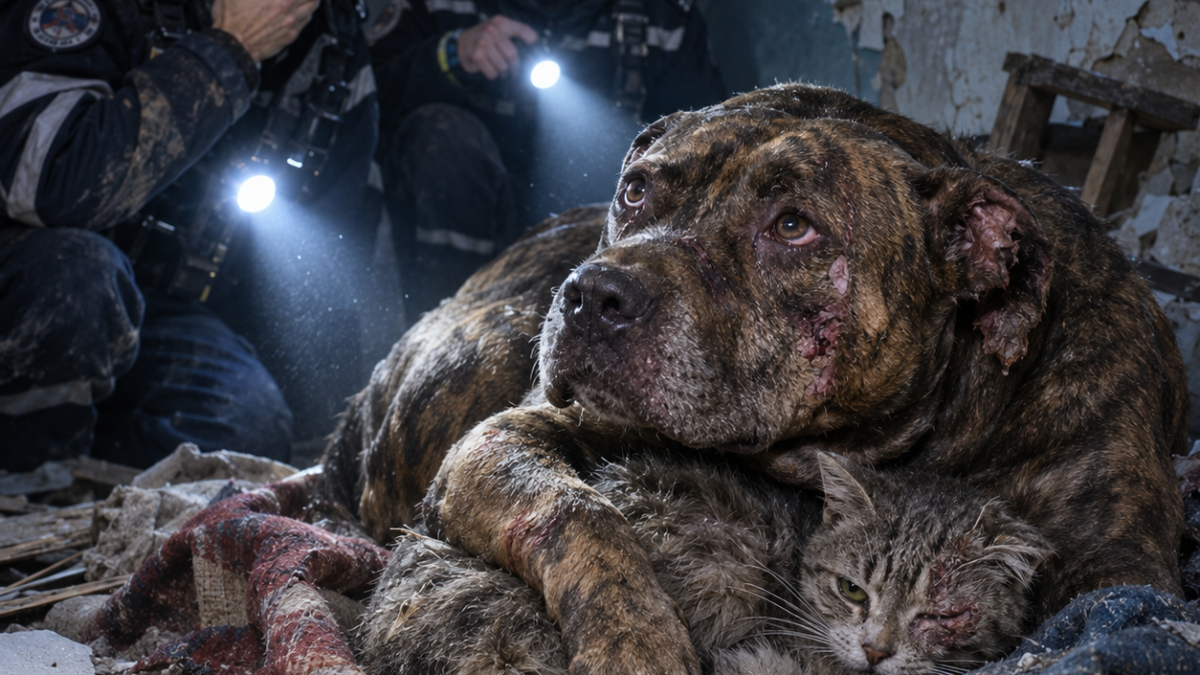
PART 2
I stayed perfectly still.
The dog lifted the cat with extraordinary care.
If you had shown me a photograph of that moment without context, it might have looked terrifying.
A powerful dog with his jaws around the neck of a tiny cat.
But there was no pressure in the bite.
No shaking.
No aggression.
He carried the old animal the way a mother dog might carry a puppy.
Then he took one step toward me.
Claire whispered, “Julien…”
“I know.”
Another step.
The cat hung limply, but I could see his chest moving.
The dog stopped about six feet away.
Then lowered the cat onto a section of old blanket.
He looked at me.
Looked at the cat.
Then back at me.
I had spent enough years around frightened people and frightened animals to recognize when force would destroy whatever fragile cooperation existed.
I lowered myself onto one knee.
“Okay.”
The dog’s ears shifted.
“I understand.”
I took off my heavy outer scarf and placed it slowly on the floor between us.
He watched.
I pushed it closer.
“Warm.”
Of course he did not understand the word.
But he understood the movement.
He sniffed the scarf.
Then stepped over it.
His body placed itself between me and the cat again.
Claire spoke quietly behind me.
“We need a vet.”
“I know.”
“And that cat is hypothermic.”
“I know.”
“We’re losing time.”
“I know, Claire.”
She stopped.
There was no good way to move quickly.
If we frightened the dog into attacking or running, we might lose both animals.
The temperature inside the house was barely better than outside.
Snow came through broken glass.
The old cat’s trembling had become weaker.
That worried me more than violent shivering would have.
I had seen hypothermia before.
People think shivering means the body is losing.
Sometimes stopping means it is losing faster.
I picked up my radio.
“Dispatch, we have two live animals. One large dog, one severely compromised cat. Request veterinary emergency contact and animal rescue support.”
The answer crackled through.
The nearest emergency veterinary clinic was open.
Animal services, however, were delayed by the storm.
Forty minutes.
Maybe longer.
I looked at the cat.
We did not have forty minutes.
Claire understood the same thing.
“We transport.”
“With him?”
She nodded toward the dog.
“Both.”
I almost laughed.
“How do you plan to get him into the car?”
Claire looked at the dog.
“Ask nicely?”
Despite everything, I smiled.
“That’s your plan?”
“You have a better one?”
No.
I did not.
We had transport blankets in the vehicle.
Claire backed out slowly to retrieve them.
The dog watched her leave.
Then looked toward me.
I stayed on the floor.
For almost two minutes neither of us moved.
I began talking.
Not commands.
Just noise.
“My name’s Julien.”
His eyes remained fixed.
“You obviously don’t care.”
The old cat made another sound.
The dog touched him with his nose.
“You’ve been taking care of him, haven’t you?”
His ears moved.
I looked around the room.
There were signs I had missed at first.
An empty plastic container near the wall.
Food scraps.
A torn bag from a butcher shop.
Several small animal-food tins, all licked clean.
Most were placed near the cat’s nest.
Farther away was a pile of bones and garbage where the dog appeared to have been eating.
He had separated their food.
That detail bothered me.
The dog looked close to starvation himself.
Yet the cat had a nest and the cleaner food containers.
I heard Claire returning.
She carried two thermal blankets and an old police transport blanket.
The dog growled again.
“Easy,” I said.
Claire stopped.
She placed everything on the floor and backed away.
I unfolded the silver thermal sheet slowly.
The sound made the dog flinch.
I froze.
He recovered.
Then I slid it toward the cat.
The dog sniffed it.
I waited.
Eventually he moved enough for me to pull one corner beneath the old animal.
That was our first physical progress.
Five minutes later, I was close enough to touch the cat.
The dog’s body was rigid.
I held up my bare hand.
“Look.”
I let him smell me.
He did.
His nose was cold.
Then he licked my knuckles once.
I nearly stopped breathing.
“Good boy.”
I moved my hand toward the cat.
The dog watched.
No growl.
My fingers touched gray fur.
Cold.
Too cold.
“Claire.”
“I know.”
I wrapped the thermal blanket around the cat.
The dog immediately nosed at it.
I let him.
Once he understood the cat was still inside, he relaxed a fraction.
“Now what?” Claire asked.
“We get the cat out.”
“And him?”
“He follows.”
“You’re sure?”
“No.”
That would become the theme of the night.
I lifted the cat.
The dog stood instantly.
His shoulders rose.
I stopped.
“He comes too.”
I turned my body slightly, giving him space.
Then I walked toward the hallway.
One step.
The dog followed.
Another.
Follow.
Claire moved behind him.
Not close.
Just enough to close the door if he tried to bolt into the street.
We reached the entrance.
Wind hit us.
Snow blew sideways.
The dog stopped.
His paws touched the icy threshold.
He whimpered.
That was the first sound I heard from him that was not a growl.
I looked down.
His paws were much worse than I had realized.
The cracks were raw.
One nail was partly torn.
No wonder there had been blood.
“You can’t walk far.”
I looked at Claire.
“Open the rear door.”
She did.
I carried the cat to the vehicle.
The dog came as far as the curb.
Then stopped.
Police lights reflected off the snow.
The engine ran.
Too much noise.
Too much unfamiliar movement.
I placed the wrapped cat on the back seat.
The dog began whining.
“Come on.”
He would not approach.
I opened the door wider.
He paced.
I could see panic building.
Claire said, “If he runs…”
“He won’t.”
I had no reason to know that.
I simply could not tolerate imagining otherwise.
The dog looked toward the abandoned house.
Then at the car.
Then the house again.
Perhaps the house was terrible.
Cold.
Broken.
Dangerous.
But it was known.
The vehicle was unknown.
Fear often chooses known suffering over unknown safety.
I walked back toward him.
He retreated.
I stopped.
“You brought him to us.”
He watched me.
“Now finish the job.”
Nothing.
The cat made a sound from inside the car.
Tiny.
Almost inaudible.
The dog heard it.
His head snapped toward the vehicle.
He crossed the distance immediately.
No hesitation.
He jumped into the back.
Claire closed the door.
I stared at her.
She stared at me.
“That worked.”
“Don’t sound surprised.”
“I’m extremely surprised.”
We drove.
I sat in the rear with the animals while Claire handled the road.
Technically, that was not ideal police procedure.
I did not care.
The dog curled against the wrapped cat and refused to move away.
I tried to inspect his collar area.
No collar.
No tag.
No obvious tattoo.
He watched me but did not object.
“You need a name.”
Claire glanced at us through the mirror.
“Already?”
“We can’t call him ‘the large dog’ for six hours.”
“What do you suggest?”
I looked at his head.
His scars.
His ridiculous size.
“Atlas.”
Claire laughed.
“That’s subtle.”
“He looks like he’s carrying the world.”
The dog sighed.
“Atlas it is.”
“And the cat?”
I looked down.
One eye gone.
The other barely functional.
Gray fur.
Fragile body.
He looked older than some furniture I owned.
“Marcel.”
Claire smiled.
“Atlas and Marcel.”
I had no idea whether those were their real names.
Later, we would discover we were wrong about one and unknowingly close about the other.
At the clinic, everything became faster.
The veterinary staff took one look at Marcel and rushed him into treatment.
Atlas tried to follow.
A technician blocked the doorway.
Atlas growled.
Not loud.
But serious.
I stepped in.
“Wait.”
The technician froze.
I moved between them.
“Atlas.”
His eyes remained on the door.
“Let them help.”
He tried to push past me.
I put one hand against his chest.
His body was all bone beneath muscle that should have been there.
“Stay.”
To my surprise, he did.
Not because he understood the command.
Because he recognized me.
That realization hit me harder than expected.
Twenty minutes earlier, I had been a threat.
Now I was the nearest thing he had to a familiar person.
The veterinarian, Dr. Élodie Martin, came out after examining Marcel.
Her face was serious.
“The cat is severely hypothermic, dehydrated and malnourished.”
“Can you save him?”
“We’re warming him slowly. His heart rhythm is unstable.”
“What else?”
“He’s very old. At least fifteen, possibly more. Severe dental disease. One eye was removed years ago or lost traumatically. The remaining eye has advanced cataract changes.”
“Blind?”
“Functionally, almost.”
I looked at Atlas.
He stood near the treatment door.
“Anything from the blood?”
“Anemia. Kidney values are elevated. Could be dehydration, could be chronic kidney disease.”
“Is he in pain?”
“Some. We’re treating it.”
“And the dog?”
She glanced toward Atlas.
“We need to examine him too.”
“Good luck.”
She raised an eyebrow.
“He let you touch him.”
“That took twenty minutes.”
“We have time.”
“Marcel may not.”
She nodded.
“We’re working on him.”
A nurse brought a bowl of water for Atlas.
He drank too quickly.
We removed it.
He looked offended.
“Slow,” I told him.
He drank again when offered smaller amounts.
Food came later.
Atlas took two bites.
Then stopped.
Looked toward the treatment room.
He walked to the door.
Sat.
Waited.
Claire folded her arms.
“He won’t eat without the cat.”
“Looks that way.”
Dr. Martin examined Atlas on the floor rather than forcing him onto a table.
Smart woman.
He tolerated the stethoscope after smelling it.
Barely tolerated his paws being inspected.
His condition was bad.
Not as immediately critical as Marcel’s.
But bad.
Severely underweight.
Multiple old scars.
Fresh cuts.
Frostbite beginning at several toe tips.
Mild hypothermia.
Evidence of previous untreated injuries.
One old rib fracture.
A scar around the neck consistent with having worn something tight for a long time.
Dr. Martin looked at me.
“He’s been surviving rough for a while.”
“How long?”
“Impossible to say.”
She touched one scar.
“Some of these are months old.”
Atlas’s head stayed pointed toward Marcel’s room.
I asked, “Could he have kept the cat alive?”
Dr. Martin nodded slowly.
“In that house? During tonight’s temperatures?”
“Yes.”
“Absolutely.”
She looked at the scraps of blood on his paws.
“He probably shared body heat. Maybe brought food.”
Claire said, “We saw food containers near the cat.”
The veterinarian looked at Atlas differently.
“He may have been caring for him.”
That sentence followed me for months.
May have been.
At the time, we knew only what we saw.
We did not know the history.
We did not know how long Atlas and Marcel had been together.
We did not know where they came from.
We did not know why a massive dog with scars and a nearly blind elderly cat had ended up hiding in a derelict house during a snowstorm.
We would learn pieces.
Never all of it.
The first piece came before sunrise.
A veterinary nurse scanned Marcel.
Microchip.
Registered.
That changed everything.
“Owner?” I asked.
The nurse checked the database.
“There is one.”
“Call.”
She did.
Disconnected number.
Address listed in Thionville.
Not Rue des Forges.
A different neighborhood.
Name:
Henri Lambert.
The cat’s registered name was not Marcel.
It was Maurice.
I looked at the gray cat through the treatment-room glass.
“Maurice.”
Claire smiled.
“You were close.”
“Both old-man names.”
The registration was eleven years old.
That told us almost nothing about where Henri Lambert was now.
Then we scanned Atlas.
No chip.
No identification.
Nothing.
By six in the morning, Maurice’s temperature had improved.
His heart rhythm was more stable.
He still looked terrible.
Atlas finally ate.
Only after a nurse opened the treatment door enough for him to see Maurice lying under warming blankets.
Atlas watched.
Then returned to the bowl.
He ate the entire portion.
Claire looked at me.
“They’re bonded.”
“I know.”
“We need to tell animal services.”
“I know.”
That worried me.
Because bonded was not always enough to keep animals together.
Especially when one was a large dog with unknown history and the other was an elderly medically fragile cat.
Different care needs.
Different facilities.
Different legal categories.
Different space.
The animal control officer arrived after seven.
His name was Benoît.
He knew his job.
He was not cruel.
I need to say that because for several hours I disliked him intensely.
He reviewed the facts.
“Cat is chipped, so technically we need to locate the registered owner.”
“Fine.”
“The dog goes to municipal holding after medical clearance.”
“No.”
Benoît looked at me.
“No?”
“They stay together.”
He sighed.
“Julien.”
“You saw them?”
“I saw the report.”
“That’s not what I asked.”
“We don’t house dogs and cats together in holding.”
“They’ll crash if separated.”
“You don’t know that.”
Claire said, “The dog wouldn’t eat until he saw the cat.”
Benoît looked toward Atlas.
“That can be stress.”
“It can also be attachment.”
He rubbed his face.
He had probably been working since before the storm.
“I have regulations.”
“And I have two animals who survived because they stayed together.”
“Temporary veterinary separation is not abandonment.”
I knew he was right.
I still hated hearing it.
Dr. Martin came over.
“Can we keep both here for forty-eight hours?”
Benoît looked at her.
“For medical necessity?”
“Yes.”
“Both?”
“The dog’s paws need treatment.”
That was true.
“And the cat?”
“Critical monitoring.”
Benoît nodded.
“Fine. Forty-eight hours.”
I exhaled.
Dr. Martin glanced at me.
“You owe me coffee.”
“Done.”
For the next two days, I visited when my shift allowed.
That was unnecessary.
They were not my animals.
Technically, the case had already moved into administrative channels.
I still went.
On the first afternoon, Atlas recognized me immediately.
His tail moved once.
That felt like receiving a medal.
I crouched.
“Hello to you too.”
Maurice was stronger.
Still weak.
But awake.
His one cloudy eye tracked sound more than movement.
When Atlas was allowed close, Maurice lifted his head.
Atlas lay beside the kennel.
The cat stretched one paw through the bars.
Placed it against Atlas’s muzzle.
I had to look away.
Not because I was embarrassed by emotion.
Because something about their dependence felt private.
Claire arrived ten minutes later.
She saw them.
“Still think ‘bonded’ is an exaggeration?”
“No.”
On the second day, we found Henri Lambert.
Or rather, we found what had happened to him.
He had died eight months earlier.
Heart attack.
Seventy-eight years old.
Lived alone.
No children.
A niece in Strasbourg had handled the estate.
We contacted her.
Her name was Isabelle.
When I asked about Maurice, she went silent.
“My uncle had a gray cat.”
“Yes.”
“One eye?”
“Yes.”
“Oh God.”
“You thought he was dead?”
“No. I thought…”
She stopped.
“What?”
“There was a dog too.”
I looked at Claire.
“What dog?”
“A big dark dog. Hugo.”
Atlas lifted his head as if he had heard something familiar.
Maybe coincidence.
Maybe not.
“Was Hugo your uncle’s?”
“Sort of.”
“What does that mean?”
“He found him.”
“When?”
“Maybe three years ago. Near the freight yards.”
“Was he injured?”
“Yes.”
That explained the scars.
“Your uncle kept him?”
“He tried. Hugo was afraid of everyone. He would stay in the garden, then eventually the basement. Maurice followed him everywhere.”
I wrote.
“What happened after your uncle died?”
Another silence.
Then the sentence that changed the case.
“I thought the animals had been taken by a neighbor.”
“Which neighbor?”
“A man named Gérard. He said he knew a rescue.”
My hand tightened around the pen.
“Full name?”
She gave it.
We checked.
The man existed.
He had helped clear Henri’s house after the death.
We contacted him.
His story changed twice in ten minutes.
First, he said he never took the animals.
Then he said the dog ran away.
Then he said he brought the cat to someone.
“Who?”
He couldn’t remember.
“Where?”
Somewhere outside town.
“Name?”
No answer.
That did not make him a criminal automatically.
Memory can be imperfect.
People panic when questioned.
But it gave us a direction.
We interviewed the neighbor across from Henri’s old house.
She remembered seeing Gérard load boxes into a van.
She remembered the dog.
And the cat.
“He put them in the back.”
“Together?”
“Yes.”
“When?”
“Two days after Mr. Lambert died.”
That was enough to continue asking questions.
Eventually Gérard admitted he had taken both animals.
Not to a rescue.
To an abandoned industrial lot several kilometers away.
He claimed Hugo became aggressive in the van.
He claimed he was frightened.
He claimed Maurice scratched him.
So he opened the rear doors and let them out.
I sat across from him in the interview room.
“You abandoned an elderly blind cat in an industrial area in winter?”
“It was summer.”
I stared.
He looked down.
“That makes it better?”
“No.”
“And the dog?”
“He was dangerous.”
“Did he bite you?”
“No.”
“Attempt?”
“He growled.”
“Because you loaded him into a van after his owner died.”
“I was trying to help.”
I leaned back.
There are lies people tell other people.
Then there are lies people tell themselves because they cannot tolerate the simplest description of what they did.
Gérard had not planned to torture animals.
He had not woken up wanting cruelty.
He had agreed to solve a problem he did not understand.
Then, when it became difficult, he made the easiest choice for himself.
He left them.
That mattered.
Cruelty is not always dramatic.
Sometimes it looks like inconvenience followed by a door opening.
We documented everything.
Animal abandonment laws existed.
The case went forward.
But the legal process was never the center of the story for me.
Hugo and Maurice were.
Now Atlas had his name.
Hugo.
When I used it at the clinic, something happened.
“Hugo?”
His head lifted immediately.
Claire stared.
“Again.”
“Hugo.”
He stood.
Tail moving.
That was his name.
Maurice made a rasping little meow.
Hugo turned toward him.
For the first time, we had more than two abandoned animals.
We had a history.
Henri Lambert had loved them.
Maurice had been with him for more than a decade.
Hugo had arrived later, injured and terrified.
The old man had fed him in the garden for months before Hugo entered the house willingly.
Maurice, according to Isabelle, was the first creature Hugo trusted.
“He used to sleep beside him,” she told us over the phone.
“My uncle said Maurice taught Hugo how to be indoors.”
I smiled.
That sounded believable.
“What happened after they were abandoned?”
“We don’t know.”
Eight months.
Eight months between the van doors opening and the snowstorm.
Somehow, Hugo kept Maurice alive.
We pieced together fragments.
Residents near the industrial area remembered seeing the dog.
A butcher said food disappeared behind his shop.
A warehouse worker remembered a large dark dog carrying something in his mouth one morning.
A woman who fed strays remembered an old gray cat living beneath a loading platform.
Then both animals disappeared from that area around October.
Probably because construction began.
They moved.
Block by block.
Eventually reaching Rue des Forges.
Hugo had found the abandoned house.
Dry enough.
Mostly sheltered.
He had built—or at least maintained—that nest for Maurice.
Newspaper.
Insulation.
Cloth.
Food.
The more we learned, the more difficult it became to think of Hugo as simply a stray dog.
He had been performing a job.
Keeping his friend alive.
The veterinary prognosis for Maurice was complicated.
Dr. Martin sat with us on day three.
“His kidneys are not great.”
“How bad?”
“Chronic disease. Probably advanced but manageable for now.”
“Blind?”
“Almost completely.”
“Teeth?”
“He’ll need dental treatment once stronger.”
“And weight?”
“Severely underweight. But he’s eating.”
I looked at Maurice.
He was eating because Hugo lay beside him.
“What about Hugo?”
“Paws will heal. He needs nutrition and rest. There may be early arthritis from old injuries.”
“How old?”
“Five to seven, roughly.”
“He looks older.”
“Hard living.”
Then came the question I feared.
“Where do they go?”
Benoît had already found a temporary solution.
A rescue group outside Metz had a heated room large enough to house both under controlled conditions.
Together.
I nearly hugged him.
I did not.
He would have hated that.
The rescue director was a woman named Sandrine.
She understood bonded animals.
Her first sentence to me was, “We are not separating them unless medically unavoidable.”
That was enough.
Hugo and Maurice moved there after five days in veterinary care.
I went with them.
Again, unnecessary.
Again, I did not care.
Hugo hated the transport crate.
Maurice hated everything except Hugo.
By the time we reached the rescue center, both were stressed.
The staff opened the connected indoor enclosure.
Hugo entered first.
Then turned around.
Maurice’s carrier was placed inside.
The door opened.
The old cat stepped out.
One paw.
Then another.
He walked directly into Hugo’s chest.
Hugo curled around him.
Sandrine looked at me.
“Oh.”
I smiled.
“Now you understand.”
“Yes.”
The next weeks changed them.
Hugo gained weight.
Not quickly.
Correctly.
Muscle began returning around his shoulders.
His coat improved.
The wounds on his paws closed.
His expression softened.
He still distrusted strangers.
But he learned the rescue staff.
One by one.
Maurice improved too.
He gained enough strength for dental work.
Several infected teeth were removed.
His kidneys required special food and fluids occasionally.
He could barely see.
But he navigated by memory and sound.
Most of all, he navigated by Hugo.
If Hugo moved to the other side of the enclosure, Maurice followed.
If Maurice lost orientation, Hugo nudged him.
Sometimes Hugo lay down and Maurice simply walked into him.
No hesitation.
That relationship became the center of everything.
It also created the next problem.
Adoption.
Who adopts a large scarred dog with fear issues and an elderly nearly blind cat with kidney disease?
Together?
The answer, initially, was nobody.
Applications came.
A few for Hugo.
More than I expected.
He was handsome once he recovered.
Big head.
Dark coat.
Beautiful amber eyes.
But every applicant heard the same thing.
“Hugo comes with Maurice.”
Some laughed.
“You mean the cat?”
“Yes.”
One man said, “I don’t want a cat.”
Application over.
A family with teenagers loved Hugo.
Then saw Maurice’s medical costs.
They hesitated.
I understood.
Older animals are expensive.
Honesty mattered.
They declined.
Another woman wanted Maurice.
She had experience with blind cats.
But she lived in a building where large dogs were prohibited.
No.
Weeks became months.
Hugo and Maurice stayed.
I visited twice a week at first.
Then once.
Then I realized I was planning my work schedule around them.
Claire noticed.
“You know you’re practically volunteering.”
“I am not.”
“You cleaned Hugo’s kennel last Saturday.”
“There was no one else available.”
“You drove forty minutes.”
“Coincidence.”
She smiled.
“You should adopt them.”
“No.”
“Why?”
“I’m a gendarme.”
“That’s not a reason.”
“I work shifts.”
“Your wife works from home.”
I stared at her.
“Leave Marianne out of this.”
“Have you told Marianne?”
“No.”
Claire started laughing.
I knew exactly why.
Because I had reached the point where not telling my wife was becoming suspicious.
Marianne knew I had been visiting “the animals from the case.”
She did not know how often.
One evening, she looked at me across the dinner table.
“You smell like dog.”
I froze.
“That is a strange accusation.”
“You were at the rescue.”
“Yes.”
“Again.”
“Yes.”
“How many times this week?”
I pretended to think.
She put down her fork.
“Julien.”
“Three.”
“Three?”
“Hugo had a veterinary follow-up.”
“You are not his owner.”
“No.”
“You sound disappointed.”
I said nothing.
Marianne studied me.
Then smiled.
“Oh no.”
“What?”
“You want them.”
“No.”
“You do.”
“Absolutely not.”
“You named them before you even knew their names.”
“That proves professional engagement.”
“It proves you’re ridiculous.”
We had never owned animals together.
Our apartment was not suitable for a big dog and elderly cat anyway.
We had a small house outside Thionville, but the yard fencing needed work.
My shifts were irregular.
Maurice needed medication.
Hugo needed patient handling.
Every practical argument said no.
Then Marianne asked one question.
“What happens if no one takes them?”
“The rescue keeps them.”
“For how long?”
“As long as necessary.”
“Together?”
“Yes.”
“Then why are you worried?”
I looked down.
“I’m not.”
She nodded slowly.
“Okay.”
That should have ended the discussion.
Instead, two Saturdays later, Marianne said, “Take me to meet them.”
I stared.
“Why?”
“Because I’m tired of hearing about people I’ve never met.”
“They’re animals.”
“You talk about Hugo more than your colleagues.”
“That’s unfair.”
“You told me about his stool consistency yesterday.”
I closed my eyes.
“I did, didn’t I?”
“Yes.”
We drove to the rescue.
Hugo disliked Marianne immediately.
Not aggressively.
He simply backed away.
She sat on the floor.
Did nothing.
That impressed me.
Most people try too hard with frightened animals.
They call.
Reach.
Crouch closer.
Marianne waited.
Maurice had no such hesitation.
He walked toward her shoe.
Sniffed.
Then stepped directly onto her leg as if she were furniture.
She looked at me.
“This is Maurice?”
“Yes.”
“He’s rude.”
“Yes.”
She stroked his back.
Hugo watched.
That was the key.
If Maurice trusted someone, Hugo reconsidered.
Twenty minutes later, Hugo came closer.
Thirty minutes.
He smelled Marianne’s hand.
Forty-five.
She touched his shoulder once.
Then stopped.
On the drive home, neither of us spoke for five minutes.
Then Marianne said, “The fence needs to be higher.”
I almost drove into a ditch.
“What?”
“If Hugo comes.”
I looked at her.
“Are you serious?”
“No.”
I waited.
She sighed.
“Yes.”
“What about Maurice?”
She turned toward me.
“Julien.”
“What?”
“You know perfectly well Maurice comes.”
That was the beginning.
Not adoption.
Preparation.
We repaired the fence.
Bought beds.
Moved cleaning products.
Created a quiet room for Maurice.
Installed baby gates so Hugo could decompress without feeling trapped.
Dr. Martin gave us a list of Maurice’s medications.
Sandrine made us visit several more times.
Good.
She should have.
Hugo was not an easy adoption.
He was loving once he trusted.
But fear could make him powerful.
We practiced leashing.
Doorways.
Handling paws.
Food boundaries.
Maurice required fewer lessons.
He simply assumed the world would arrange itself around him.
When adoption day came, I was more nervous than during some police operations.
Sandrine handed me the papers.
“Last chance.”
“For what?”
“To run away.”
Marianne said, “Ignore him.”
I signed.
Hugo watched.
Maurice slept.
We drove home.
For the first hour, Hugo remained beside the front door.
Maurice wandered directly into the kitchen and yelled.
Marianne stared.
“Is he hungry?”
“He’s always hungry.”
“We fed him before leaving.”
“He disagrees with the schedule.”
Maurice yelled again.
Hugo looked toward him.
Then at us.
I laughed.
“Welcome home.”
The first weeks were difficult.
Important word: difficult.
Not magical.
Hugo refused to enter the bedroom.
He barked at the dishwasher.
He was terrified of a broom.
The first time I lifted one, he slammed himself against the wall.
I dropped it immediately.
Marianne came running.
“What happened?”
I looked at Hugo.
His body shook.
“Broom.”
Her face changed.
We never discovered exactly what had happened to him before Henri found him.
Some scars do not come with explanations.
We simply stopped carrying brooms near him.
Over time, we desensitized him carefully.
No force.
No drama.
Maurice had other problems.
He missed the litter box sometimes because of poor vision.
He yowled at three in the morning.
He hated kidney food.
He loved Hugo’s food.
We became experts at separating meals.
Hugo, meanwhile, would give Maurice his own bowl if we weren’t watching.
I caught him doing it.
“Hugo.”
He stepped away.
Maurice moved in.
“No.”
Maurice ignored me.
I lifted the bowl.
The cat shouted.
Marianne walked in.
“What did you do?”
“Apparently I am oppressing him.”
“Give him his food.”
“He doesn’t want his food.”
“That’s because it tastes like cardboard.”
“How do you know?”
“I smelled it.”
“That is not the same.”
This became our life.
Medicine.
Walks.
Cleaning.
Training.
Work.
And something else.
Peace.
Hugo slept better at home than at the rescue.
Maurice slept beside him.
Always.
Sometimes I woke at night and found them pressed together in the hallway.
The image still took me back to Rue des Forges.
Snow through broken windows.
Blood on the floor.
My flashlight.
The growl.
How wrong I had been.
That became the emotional center of the case for me.
Not Gérard.
Not the abandonment charge.
Not the newspaper stories.
My own first assumption.
I had seen a large scarred dog over a fragile cat and decided I knew the ending.
Hugo taught me how dangerous certainty can be.
The legal case against Gérard moved slowly.
He eventually admitted abandoning both animals.
There were fines.
A suspended penalty.
Restrictions related to future animal ownership.
Some people thought the punishment was too light.
Others thought he had suffered enough from public criticism.
I stopped caring about the argument.
He came to court.
I testified to where the animals were found.
The condition.
The blood.
The nest.
Hugo’s injuries.
Maurice’s hypothermia.
Gérard’s lawyer asked whether I personally saw Gérard leave them.
“No.”
“So you cannot testify that he abandoned them.”
“I can testify to what he admitted in interview.”
The lawyer nodded.
Fair question.
Court is not social media.
Evidence matters.
Isabelle testified too.
The neighbor described the van.
The records matched.
When Gérard finally spoke, he looked older than I remembered.
“I made a mistake.”
No one reacted.
He continued.
“I thought the dog was dangerous.”
I felt my jaw tighten.
He looked toward me.
“I know what he did for the cat.”
That was the first time his voice changed.
“He kept him alive.”
The judge asked, “Does that change what you believe you should have done?”
Gérard lowered his head.
“Yes.”
That was enough for me.
Not forgiveness.
Not erasure.
Just truth spoken plainly.
The satisfying part came later.
Not in the courtroom.
At home.
Maurice survived another winter.
Then another.
His kidney disease progressed slowly.
Hugo adapted to every change.
When Maurice became weaker, Hugo walked more slowly indoors.
I noticed it before Marianne did.
“Look.”
She watched.
Maurice crossed the hallway.
Hugo followed behind him.
Not beside.
Behind.
Like a guard.
If Maurice stopped, Hugo stopped.
If Maurice turned the wrong direction, Hugo nudged him.
Marianne covered her mouth.
“He’s guiding him.”
“Yes.”
That relationship never became less extraordinary just because we got used to seeing it.
Maurice eventually lost nearly all useful vision.
He knew the house by memory.
Bed.
Food.
Water.
Hugo.
Especially Hugo.
If we moved furniture, Maurice became confused.
Hugo found him.
If Maurice woke and called, Hugo went.
Every time.
Even from sleep.
A little old-cat yowl.
Hugo stood.
Walked.
Nose to Maurice’s face.
Done.
One night, almost three years after the snowstorm, Maurice became ill.
He vomited.
Then refused food.
With kidney disease, that was serious.
We went to Dr. Martin.
Bloodwork.
Fluids.
Medication.
Hospitalization.
Hugo waited in the car with Marianne.
When I came out, she knew from my face.
“How bad?”
“Bad.”
Maurice’s kidney values had climbed dramatically.
He needed at least two days of intensive fluids.
Maybe more.
We brought Hugo home.
He refused dinner.
Of course.
I sat beside him.
“Hugo.”
Nothing.
“He’s coming back.”
Hugo looked toward the door.
I wished I believed myself.
The next morning, Hugo still had not eaten.
Marianne called Dr. Martin.
“Can we bring him?”
“To the clinic?”
“Yes.”
“Why?”
“He won’t eat.”
There was a pause.
“Bring him.”
They allowed Hugo to visit Maurice in a quiet treatment room.
The moment Maurice smelled him, the old cat tried to stand.
He couldn’t.
Hugo lay beside him.
Pressed his body against the blanket.
Maurice placed one paw on his face.
Exactly as he had done dozens of times at home.
The veterinary nurse cried.
I pretended not to.
After twenty minutes, they separated them.
Hugo ate that evening.
Not much.
Enough.
Maurice improved slightly.
Enough to come home after four days.
We knew the disease had progressed.
Dr. Martin was honest.
“Months, maybe.”
“How many?”
“No one can answer.”
“Quality?”
“Still good if he eats, moves, engages.”
He did.
For a while.
Maurice became even more demanding with age.
He yelled for food he was not allowed to have.
Slept on Marianne’s pillow.
Bit me once when I gave medication badly.
I deserved it.
Hugo tolerated everything.
Then one spring morning, Maurice did not get out of bed.
Hugo stood over him.
Not covering him.
Watching.
I touched Maurice.
His body was warm.
But his breathing was shallow.
“Marianne.”
She came.
Saw.
Sat down.
We called Dr. Martin.
She came to the house.
That mattered to us.
Maurice hated the clinic.
We wanted him home.
Dr. Martin examined him.
Then looked at me.
We had been through enough together that she did not need a speech.
“It’s time.”
I nodded.
Marianne cried immediately.
I did not.
Not yet.
Hugo lay beside Maurice.
We placed the old cat on his favorite blanket.
Hugo touched his ear.
Licked it once.
Then twice.
I had seen that before.
Rue des Forges.
Snowstorm.
Blood.
Flashlight.
The circle closed so suddenly I had to sit down.
Dr. Martin gave the first injection.
Maurice relaxed.
His paw rested against Hugo’s leg.
Hugo did not move.
The second medication came.
Maurice’s breathing stopped.
Hugo remained beside him.
For several minutes, nothing happened.
Then Hugo nudged Maurice.
Once.
Again.
He licked the old cat’s ear.
My chest hurt.
Marianne whispered, “He doesn’t understand.”
Dr. Martin said quietly, “He may understand more than we think.”
Hugo lay down.
Pressed his body around Maurice.
The same shape.
The same protection.
But now there was nothing left to protect him from.
We gave Hugo time.
Almost an hour.
Eventually he stood.
Smelled Maurice’s face.
Then walked toward me.
He pressed his head against my chest.
That was when I cried.
The days after Maurice died were harder than I expected.
Hugo searched.
Not frantically.
That was worse.
He checked the bedroom.
Kitchen.
Hallway.
Maurice’s bed.
Then returned to us.
He ate poorly.
Slept near the old blanket.
We kept routine.
Walks.
Meals.
Same times.
Same words.
No attempt to distract him constantly.
Grief deserves room even in animals.
Two weeks later, Hugo picked up one of Maurice’s old cloth toys.
A small gray mouse.
He carried it to his bed.
Slept with it.
Marianne saw.
Said nothing.
So did I.
Months passed.
Hugo adjusted.
He became more attached to us.
Especially Marianne.
Traitor.
He followed her while she worked.
Slept beside her desk.
Waited by the kitchen.
The huge dog once feared as dangerous became known by every child on our street.
We trained them too.
“Ask first.”
“Don’t hug.”
“Don’t reach over his head.”
“Let him come.”
One boy asked, “Why are his ears scarred?”
I said, “Because he had a hard life before.”
“Who hurt him?”
“I don’t know.”
“Is he still scared?”
“Sometimes.”
The boy thought about that.
Then sat on the sidewalk.
Hugo approached.
That was enough.
The old abandoned house on Rue des Forges was demolished the following year.
Before demolition, I visited once.
Officially because the property owner requested police presence during clearance after trespass complaints.
Unofficially because I wanted to see the room.
It looked smaller in daylight.
The corner where we found them was still stained.
Newspaper pieces remained beneath broken plaster.
I found a strip of the old blanket.
Gray.
Dirty.
I picked it up.
Then stopped myself.
No.
I left it.
Some evidence does not need to become a souvenir.
Outside, the demolition crew waited.
The foreman asked, “Anything important inside?”
I looked back.
“No.”
Then corrected myself.
“Not anymore.”
The house came down.
Hugo never saw it again.
Good.
There was no reason.
His future did not need the place where survival had almost failed.
Years later, people still occasionally recognized him.
One newspaper had published the story after the court case.
The headline called him:
THE DOG WHO SAVED A BLIND CAT.
I disliked that.
Not because it was false.
Because it made Hugo sound like one heroic act.
He was more interesting than that.
He was afraid of brooms.
He stole cheese.
He hated rain.
He snored louder than Maurice ever had.
He was terrible at fetch.
If you threw a ball, Hugo watched it land, then looked at you as if asking why you had thrown away a perfectly good object.
He was not a symbol.
He was a dog.
That was better.
But his story did change things.
The local rescue began flagging bonded animals more carefully.
Veterinary clinics shared information about keeping bonded pairs together during hospitalization when possible.
A winter outreach group started checking abandoned buildings for animals during severe weather.
Small things.
Real things.
Not miracles.
Just people learning.
Benoît, the animal control officer I had disliked that first morning, eventually became one of Hugo’s favorite visitors.
“Traitor,” I told the dog every time.
Benoît laughed.
“You hated me.”
“I disliked your regulations.”
“They kept animals safe.”
“They almost separated them.”
“They didn’t.”
“Because Dr. Martin saved you.”
He nodded.
“True.”
Years after Maurice died, Benoît brought us a case.
An elderly woman had been hospitalized permanently.
Her dog and cat needed placement.
Bonded.
He looked at me.
“No.”
“I didn’t ask.”
“You’re about to.”
“I was going to ask whether Sandrine’s rescue had space.”
“Oh.”
He smiled.
“You thought I was asking you to adopt them?”
“I was prepared to defend myself.”
“Marianne would have said yes.”
From the kitchen, Marianne called, “I heard that.”
Benoît laughed.
Hugo lifted his head.
I said, “Absolutely not.”
We did not adopt them.
Sandrine did find a home.
Together.
That felt like enough.
Hugo grew older.
The first signs were subtle.
Longer getting up.
Less enthusiasm for stairs.
Gray around his muzzle.
Dr. Martin diagnosed arthritis.
Medication helped.
We added rugs to slippery floors.
A ramp into the car.
Marianne bought an orthopedic bed so expensive I refused to ask the price.
Hugo ignored it for three weeks.
Then slept nowhere else.
I said, “He’s manipulating you.”
She said, “He deserves luxury.”
That was difficult to argue.
He reached somewhere around twelve.
Maybe thirteen.
We never knew exactly.
His heart remained strong.
His joints, less so.
Walks became shorter.
He still stopped at every smell.
A five-minute walk could take twenty.
I learned patience.
That may have been Hugo’s final lesson for me.
Police work trains you to move toward resolution.
Who.
What.
When.
Why.
Evidence.
Decision.
Animals do not care about resolution.
They care about the moment.
This smell.
This patch of sun.
This person.
This meal.
Hugo taught me to stand still while he smelled the same bush for ninety seconds.
That sounds ridiculous.
It changed me.
Claire retired before I did.
At her farewell party she gave me a framed photograph.
I hated it immediately.
It was from the night we found Hugo and Maurice.
Not inside the house.
Outside the clinic afterward.
Someone had taken it without my knowledge.
I was sitting on the ground.
Hugo beside me.
Maurice wrapped in a blanket.
Snow behind us.
Claire wrote beneath it:
YOU WERE WRONG ABOUT HIM.
I stared at her.
“That’s cruel.”
“It’s accurate.”
“I was wrong for thirty seconds.”
“Still counts.”
I hung it in my office.
Later, at home.
Not because I enjoyed being reminded I was wrong.
Because being wrong had turned out to matter.
The assumption had been reasonable.
Large dog.
Blood.
Small animal.
Growling.
Every visible clue pointed one direction.
Until we looked closer.
That became useful beyond animals.
In police work, first impressions are dangerous if they become final conclusions.
People lie.
Scenes mislead.
Fear fills gaps too quickly.
Hugo became a private reminder.
Look again.
Always look again.
When I retired, Marianne asked what I planned to do.
“Nothing.”
“That will last three days.”
It lasted five.
Then I began volunteering with Sandrine’s rescue twice a week.
I blamed Hugo.
He came with me occasionally.
Mostly as a calm companion for nervous dogs.
Think about that.
The dog we once considered dangerous became the dog used to reassure frightened animals.
The first time Sandrine suggested it, I thought she had lost her mind.
“Hugo?”
“He’s calm.”
“He’s enormous.”
“Exactly.”
A small terrified shepherd mix had refused food for two days.
Hugo sat outside her enclosure.
Did nothing.
The next morning, she ate.
I looked at him.
“You’ve done this before.”
He rested his head.
Yes.
He had.
Maurice.
Always Maurice.
That was the part of him that never changed.
If something smaller was frightened, Hugo slowed down.
Cats.
Small dogs.
Once a rabbit at the rescue escaped a carrier and ran directly beneath Hugo.
Everyone froze.
Hugo looked down.
The rabbit froze.
Hugo looked at me.
I picked up the rabbit.
“Good boy.”
Sandrine laughed.
“He looks insulted.”
“He usually does.”
When Hugo’s final illness came, it was not dramatic.
No snowstorm.
No abandoned house.
No emergency call.
Cancer.
A mass near his spleen.
We discovered it after he became weak one afternoon.
Ultrasound.
Bloodwork.
Options.
At his age, surgery was possible but risky.
The oncologist explained.
I listened.
Marianne asked questions.
We brought Hugo home and thought.
That night he ate chicken.
Walked into the garden.
Lay in the grass.
Looked comfortable.
The next week was similar.
Then worse.
We chose palliative care.
Some people disagreed.
That happens.
Everyone has opinions when they are not the ones holding the leash.
We knew Hugo.
We watched quality, not fear.
He had good days.
Then fewer.
On his last morning, he refused chicken.
That was the sign.
Hugo had never refused chicken.
Marianne looked at me.
I nodded.
Dr. Martin had retired by then.
Her younger colleague came to the house.
Hugo lay on the orthopedic bed near the window.
Beside him was Maurice’s gray cloth mouse.
I had not noticed until that morning.
Marianne picked it up.
“Where did this come from?”
I stared.
We had packed Maurice’s things years earlier.
Apparently not all of them.
Hugo must have found it somewhere.
Or maybe it had been beneath furniture.
I don’t know.
He smelled it.
Then rested his chin beside it.
The veterinarian arrived.
Explained everything even though we knew.
Consent.
Sedation.
Final injection.
I sat on the floor.
Hugo placed his head in my lap.
I touched the scar on one ear.
“You know, the first time I saw you, I thought you were killing him.”
His eyes moved toward me.
Marianne cried.
I smiled.
“Worst police work of my career.”
His tail tapped once.
“That was a joke.”
Another tap.
The veterinarian gave the sedative.
Hugo relaxed.
I continued talking.
“You fooled all of us.”
His breathing slowed.
“You big terrifying monster.”
Marianne laughed through tears.
I looked at the mouse.
“At least Maurice won’t have to wait long.”
I don’t know why I said that.
I am not religious.
I don’t know what I believe about animals after death.
But the sentence felt right.
Hugo died quietly.
No growl.
No snow.
No fear.
Just our hands on him.
Afterward, I sat there for a long time.
Marianne eventually placed Maurice’s toy against Hugo’s front paws.
We had him cremated.
His ashes stayed with Maurice’s.
Two simple wooden boxes.
Nothing dramatic.
Years earlier, a reporter asked me what was most remarkable about the story.
He expected me to say that Hugo saved Maurice from freezing.
That was remarkable.
But not the answer I gave.
I said:
“He had every reason to save himself.”
The reporter looked confused.
I explained.
Hugo was starving.
Injured.
Freezing.
He could move faster than Maurice.
He could have left.
Found shelter alone.
Taken the food for himself.
Instead, he carried food back.
Built a nest.
Shared warmth.
Stayed.
That was the part I could never reduce to instinct or coincidence.
I did not need to call it human morality.
I didn’t need to turn Hugo into a person.
The behavior stood on its own.
He stayed with someone weaker.
And when humans finally arrived, he did not ask us to save him first.
He moved Maurice toward us.
That image remained.
Hugo stepping forward.
Old cat gently in his mouth.
Placing him down.
Looking at me.
Almost as if saying:
Now you.
My entire relationship with him began as a handoff.
He had kept Maurice alive as long as he could.
Then he gave us the job.
We accepted.
Years later, when Maurice died, Hugo had to learn that protecting someone does not mean you can keep them forever.
Then we learned the same thing with Hugo.
Protection has limits.
Love has limits.
Time has limits.
That does not make any of them meaningless.
After Hugo died, I returned once to the rescue where Sandrine still worked.
She had a new bonded pair.
Two dogs this time.
Old.
One deaf.
One anxious.
They slept touching.
A couple was considering them.
The man asked, “Do they really have to stay together?”
Sandrine looked toward me.
I said nothing.
It wasn’t my decision.
She answered, “They’ve already lost one home. We don’t want the next one to cost them each other.”
The couple looked at the dogs.
Talked quietly.
Then asked for the adoption forms.
I walked outside.
Snow had begun falling.
Lightly.
Nothing like the storm years earlier.
Still, for one second, I was back on Rue des Forges.
Flashlight.
Broken door.
A growl.
Blood.
The old cat under a massive dog.
Claire whispering, “It’s too late for the cat.”
We had been wrong.
Maurice was alive.
Hugo was not hurting him.
The blood belonged to the protector.
That was the detail I carried longest.
The thing that looked like evidence of violence was evidence of sacrifice.
His paws were bleeding because he had been searching.
Digging.
Walking frozen streets.
Finding food.
Finding material for the nest.
We had seen blood and assumed attack.
We had seen size and assumed danger.
We had seen scars and assumed aggression.
Every visible fact was real.
Our conclusion was wrong.
I think about that whenever people tell me they can judge a situation immediately.
Sometimes you can.
Sometimes danger is exactly what it looks like.
But sometimes a growl means:
Don’t take the one I’m protecting.
Sometimes a massive animal standing over something fragile isn’t hunting.
He’s shielding it from the cold.
And sometimes the creature everyone fears is the only one in the room who has been doing the right thing all along.
I still have Claire’s photograph.
Hugo beside me.
Maurice wrapped in silver emergency fabric.
Snow in the background.
Underneath:
YOU WERE WRONG ABOUT HIM.
She meant it as a joke.
I came to appreciate it as something more.
Because I was wrong.
And thank God I looked twice.
If I had acted only on the first impression—if I had treated Hugo as an attacker before understanding the scene—everything could have ended differently.
Instead, I waited.
He showed me.
Years followed.
A home.
Medicine.
Walks.
Maurice sleeping beside him.
Hugo guiding a blind cat through rooms.
Maurice’s paw on Hugo’s face.
The courtroom.
The adoption papers.
The ridiculous kidney food.
The mouse toy.
Old age.
All of it existed on the other side of those few seconds when I chose not to rush.
That is how close entire lives can sit beside one decision.
The abandoned house is gone now.
The rescue has changed directors.
Claire moved south.
Marianne and I are older.
But on winter nights, especially when snow covers the roads, I sometimes wake around two in the morning and remember that call.
A man shouting:
“He’s enormous! He’s going to kill it!”
I remember walking through the broken door.
Remember Hugo’s growl.
Remember thinking the worst.
Then I remember him lowering his huge scarred head and licking Maurice’s ear with impossible gentleness.
Once.
Twice.
And I remember the moment fear gave way to understanding.
That was the moment their lives changed.
Mine too.
Because the dog everyone feared was never the monster in that room.
He was the blanket.
The guard.
The provider.
The friend.
And when we finally saw that clearly, all he asked us to do was help him finish what he had already been trying to do alone.
Keep Maurice alive.
We did.
For years longer than anyone could have expected.
And Hugo stayed beside him for every one of them.
[END OF STORY]








