PART 2: ALOE WAS BURIED ALIVE IN INDUSTRIAL TAR—WHEN WE FINALLY FREED HER, THE TRUTH ABOUT WHO LEFT HER THERE WAS EVEN WORSE
PART 2
I held the strip of blue nylon between two gloved fingers.
It was only six inches long.
Frayed at one end.
Cleanly cut at the other.
There was a small metal ring still attached.
“Daniel.”
Lena’s voice brought me back.
I turned.
She was still kneeling beside Aloe.
“Whatever that is, put it somewhere safe. We need to get her out first.”
I looked at the tire tracks again.
Then at Aloe.
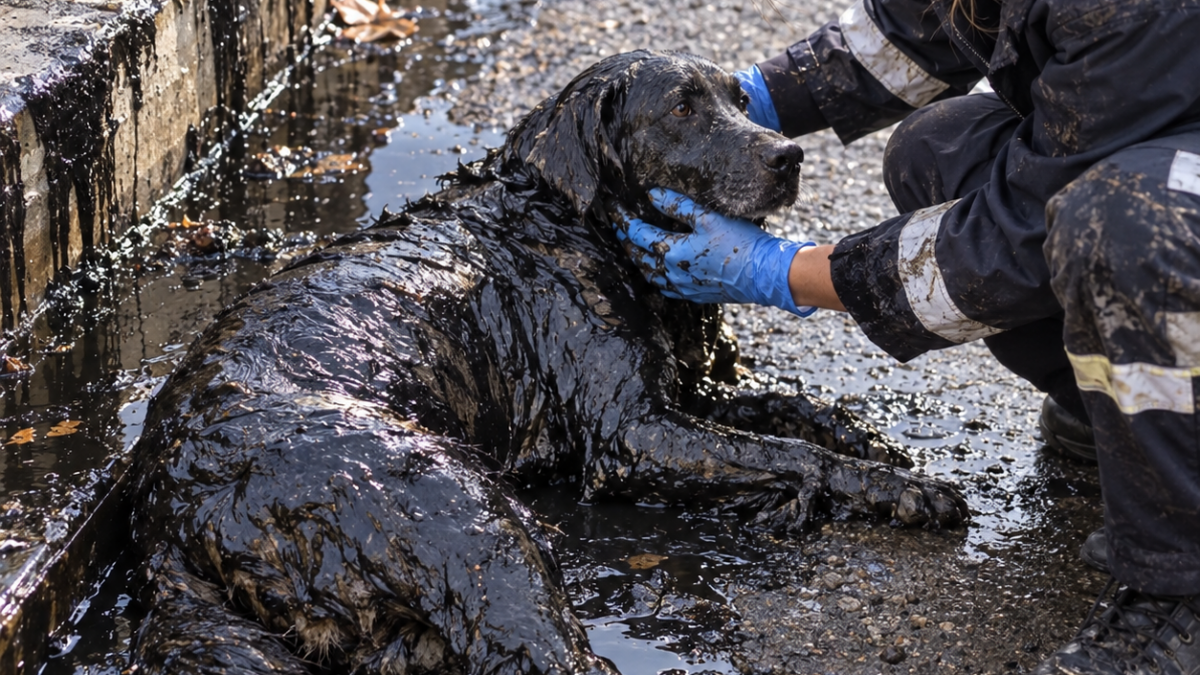
She was watching me with the only eye she could fully move.
“Yeah.”
I slipped the nylon into an unused specimen bag from our first-aid kit and placed it inside my truck.
Then I went back to work.
We would have time for anger later.
Aloe did not.
The hardest part of rescuing an animal trapped in tar is accepting that strength is almost useless.
You can’t yank.
You can’t scrape.
You can’t rush.
Every part of her coat had become bonded to every other part.
Her front legs were glued against her chest.
Her back legs were fixed together.
Tar connected her belly to the ground.
Even her ears were stuck against her skull.
Lena worked on her face.
I worked on her right shoulder.
The technicians, Maya and Chris, rotated warm towels beneath areas we managed to loosen.
The children were eventually moved across the street, but none of them left.
Especially the girl in the yellow shirt.
Her name was Sophie Carter.
Every few minutes I looked toward the fence.
She was still there.
Still watching.
At one point, her mother tried to lead her home.
Sophie shook her head.
“I named her.”
Her mother crouched.
“I know.”
“She needs somebody to stay.”
That sentence reached me even from thirty feet away.
So Sophie stayed.
And so did we.
Two hours passed.
Then three.
Aloe never tried to bite us.
That almost worried me more.
A dog in pain should object.
She should growl.
Snap.
Fight.
Aloe mostly endured.
When something hurt, she made a soft choking sound and tried to pull away even though the tar would not let her.
Lena kept checking her gums.
Her temperature.
Her heart rate.
“She is dehydrated.”
“Can we start fluids?”
“As soon as I can free enough skin.”
“What about sedation?”
“Too risky until her breathing is more stable.”
The afternoon sun dropped lower.
The tar began cooling.
That should have helped.
It didn’t.
As it cooled, it stiffened.
Aloe’s body became more tightly imprisoned.
We set up portable work lights.
Someone brought bottled water.
Someone else brought sandwiches none of us touched.
A paving contractor from another neighborhood arrived after hearing about the rescue and gave us plastic sheeting and absorbent material.
By seven o’clock, we had freed Aloe’s neck and both front paws.
She couldn’t use them.
They were too weak.
But they were free.
I slid my fingers beneath one paw.
“Feel that?”
Her toes flexed slightly.
I nearly cried over four moving toes.
“Good girl.”
Her eye shifted toward my voice.
“You’re still with us.”
Lena looked at me.
“Keep talking to her.”
So I did.
I told Aloe everything.
I told her about my terrible first apartment.
About the dog I had as a kid named Pepper who stole an entire Thanksgiving turkey breast.
About the time I locked myself out of my truck while the engine was running.
I don’t know why.
I just needed sound between us that wasn’t equipment or worried voices.
Around eight, Aloe moved her head for the first time.
Barely half an inch.
But she moved it.
Sophie saw.
“She moved!”
Everybody turned.
Aloe’s head sank back down.
But the mood changed.
Until that moment, we had been fighting tar.
Now Aloe had joined the fight.
At 9:17 p.m., after more than five hours of work, we freed her chest from the ground.
Chris slid a padded board underneath.
Maya supported her hips.
Lena held her head.
I worked the final thick strand of tar binding her rear legs to the dirt.
“Ready?”
Lena nodded.
I poured another thin stream of warmed oil.
Massaged carefully.
Waited.
The tar softened.
I lifted.
Aloe whimpered.
“Almost there.”
Another inch.
Then suddenly her leg came free.
Her whole body shifted onto the board.
Nobody spoke.
Lena checked her.
Then looked up.
“She is out.”
Sophie screamed from behind the fence.
Not in fear.
Joy.
People applauded.
I didn’t.
I couldn’t.
I had both hands resting beside Aloe’s body, and I was staring at the shape she had left behind.
The tar held an impression.
A dog-shaped hollow.
Beside it, something metallic reflected the work light.
I reached down.
A small buckle.
Blue nylon still threaded through it.
Another piece of the same leash.
And beneath that was a shallow groove dragged through the soft tar toward the place where Aloe had been trapped.
Someone had not simply walked a dog too close to a hazardous pit.
Something—or someone—had pulled her toward it.
I looked toward Lena.
She saw my face.
“What?”
I showed her.
Her expression changed.
“Photograph everything.”
I did.
The tracks.
The leash.
The groove.
A discarded work glove near the tire marks.
A crushed beverage can.
A cigarette butt.
Anything that might later matter.
Then we loaded Aloe.
Lena rode in the back of the rescue van with her.
I followed.
Sophie ran toward my truck before I could leave.
“Is she going to live?”
I looked at her.
I had learned not to promise children things I couldn’t control.
“We’re going to give her every chance.”
Sophie nodded.
Then she handed me something.
A folded piece of notebook paper.
“What is it?”
“For Aloe.”
I opened it.
A child had drawn a brown dog beneath a huge yellow sun.
Across the top she had written:
YOU ARE NOT BLACK. YOU ARE STILL YOU.
My throat tightened.
“I’ll put it where she can see it.”
Sophie looked serious.
“She can’t read.”
“I know.”
“But you can tell her.”
“I will.”
At the veterinary hospital, the real work began.
The tar we removed in the lot had only freed Aloe enough to transport her.
Her coat was still saturated.
Large patches remained on her chest, belly, ears, tail, and legs.
Lena’s team shaved what they could.
They used safe oils to loosen the rest.
No industrial solvent.
No gasoline.
Nothing toxic.
The process took most of the night.
Aloe was given fluids.
Pain medication.
Warmth.
Careful monitoring.
I sat in the hallway wearing clothes ruined beyond saving.
At 2:40 in the morning, Lena came out.
Her hair had escaped from its tie.
There was black residue across one sleeve.
“How is she?”
“Stable.”
I stood.
“That sounds good.”
“It is good.”
“But?”
“She inhaled fumes. Her skin is irritated. We don’t know how long she was trapped. There are pressure injuries where she couldn’t move.”
“Anything broken?”
“No obvious fractures.”
I closed my eyes.
That felt like winning something.
Lena continued.
“There is another issue.”
“What?”
“She is extremely thin.”
“I noticed.”
“Not from one day.”
“How long?”
“Probably weeks of inadequate nutrition.”
I looked toward the treatment room.
“So this started before the tar.”
“Yes.”
Lena crossed her arms.
“This dog was neglected before she ended up in that pit.”
Anger came back immediately.
“Then somebody dumped her.”
“Maybe.”
“The leash was cut.”
“I saw it.”
“The tire tracks stop beside the pit.”
“I know.”
“You don’t think that’s enough?”
“I think it’s enough to call animal control and law enforcement.”
“I already did.”
She looked unsurprised.
“Of course you did.”
County Animal Services Investigator Tessa Monroe arrived the next morning.
She was in her early forties, sharp-eyed, and had the calm patience of someone accustomed to angry people demanding immediate answers.
I was one of those people.
I showed her every photograph.
Then the evidence bag containing the blue leash pieces.
“You bagged this yourself?”
“Yes.”
“Who handled it?”
“Me. Gloves on.”
“Anyone else?”
“Lena saw it but didn’t touch it.”
She nodded.
“Good.”
“What happens now?”
“I go to the site.”
“And?”
“I document it.”
“And then?”
She gave me a look.
“And then I investigate.”
I hated that answer.
It sounded too slow.
“A dog was left in tar.”
“I can see that.”
“You need to find who did it.”
“That is exactly what I’m going to try to do.”
“Try?”
Tessa remained calm.
“Daniel, outrage isn’t identification.”
I stopped.
She continued.
“Give me evidence I can prove in court and I’ll use it. Give me anger and all I can do is agree with you.”
I didn’t like her in that moment.
Later, I respected her for it.
Tessa went to the industrial lot with a sheriff’s deputy.
They measured the tire impressions.
Collected the glove.
Collected the cigarette butt and beverage can.
Photographed the drag groove.
Recovered another scrap of blue webbing snagged on a rusted bolt.
Then they started asking the obvious question.
Who owned the property?
The lot belonged to Barrow Industrial Services, a small paving and roofing company that had gone out of business six months earlier.
The tar pit should not have existed.
County environmental regulations required petroleum-based waste products to be secured or removed when a commercial site closed.
Nobody had done that.
That alone opened another investigation.
But the abandoned company did not explain Aloe.
The next clue came from the neighborhood.
Sophie.
She had been riding her bike with two friends the morning before Aloe was found.
They saw a dark green pickup truck on the dirt road behind the industrial yard.
“You remember the truck?”
Tessa asked her gently, with Sophie’s mother present.
Sophie nodded.
“Why?”
“Because it had a deer sticker on the back window.”
“What kind of deer sticker?”
“White. Like antlers.”
“Did you see the driver?”
“A man.”
“Can you describe him?”
“He had a hat.”
“What color?”
“Gray.”
“Anything else?”
Sophie thought.
“He yelled at the dog.”
My hands tightened.
Tessa noticed.
She gave me a warning look.
I said nothing.
“What did he say?” she asked Sophie.
“I don’t know all of it.”
“Anything you remember?”
Sophie looked at her mother.
Then back at Tessa.
“He said, ‘Get out.’”
Silence.
“Did you see him put the dog near the tar?”
“No.”
“What did you see?”
“The truck was there. Then it left really fast.”
“And after?”
“We heard crying later.”
My stomach turned.
Aloe had been alive.
Close enough for children to hear.
Tessa wrote everything down.
“Did the truck have anything else unusual?”
Sophie closed her eyes as though trying to rebuild the image.
“One back light was broken.”
“Which one?”
She pointed left.
“Driver’s side?”
Sophie nodded.
“And there was white writing on the door.”
“What did it say?”
“I don’t know.”
That was enough to start.
Dark green pickup.
White antler decal.
Broken left taillight.
Commercial lettering.
Within two days, Tessa had a list.
Eleven local businesses used dark green trucks.
Three had hunting decals visible in public photographs.
One had a left rear taillight damaged in a customer-uploaded photo taken three weeks earlier.
Harlan Roofing & Sealcoat.
Owner: Wade Harlan.
I learned the name from Tessa only because she told me not to contact him.
Naturally, the first thing I wanted to do was contact him.
“Don’t.”
“Tessa—”
“Do not go to his business.”
“He dumped her.”
“We don’t know that.”
“You think he did.”
“I think his vehicle resembles the one a child saw.”
“Same difference.”
“No. It isn’t.”
She leaned closer.
“If you care about what happens to Aloe, do not contaminate this.”
That stopped me.
“What are you looking for?”
“Connection.”
“To Aloe?”
“Yes.”
“Do you have one?”
“Not yet.”
We got one the next day.
A veterinary clinic twenty miles away responded to Aloe’s photograph.
They recognized her.
Her name really wasn’t Aloe.
It had been Sadie.
She had been brought in fourteen months earlier for vaccinations by a woman named Amanda Harlan.
Wade Harlan’s wife.
Or former wife.
They had finalized their divorce four months earlier.
The clinic had records.
Photographs.
A microchip.
Aloe had one.
We hadn’t found it initially because the scanner had trouble reading through residual contamination and swelling near the implant site.
When Lena scanned her again after the tar removal, the number matched.
Sadie.
Female mixed breed.
Six years old.
Registered owner: Amanda Harlan.
Tessa called her.
Amanda drove to the hospital that afternoon.
I was there when she arrived.
She came through the doors crying before anyone said a word.
“Where is she?”
Lena stopped her gently.
“Who?”
“Sadie.”
Aloe heard the voice from the recovery room.
Her head lifted.
Amanda made a sound like the air had been knocked out of her.
“That’s her.”
We let her enter slowly.
Aloe was lying on a padded bed.
Most of her coat had been shaved.
Her skin was pink and irritated in places.
Thin black staining remained around her paws.
She looked nothing like the tar-covered shape from the industrial lot.
But when Amanda knelt, Aloe tried to stand.
Her back legs failed.
Amanda covered her mouth.
“Oh, baby.”
Aloe crawled.
Three feet.
That was all.
Amanda met her halfway.
Aloe pushed her head beneath Amanda’s chin.
Amanda sobbed.
Not quiet tears.
Whole-body grief.
“I thought you were dead.”
I looked at Tessa.
She was watching carefully.
Amanda held Aloe for several minutes before Tessa began asking questions.
“When did you last see Sadie?”
“Four months ago.”
“Why?”
Amanda wiped her face.
“When I left Wade, I couldn’t take her.”
“Why not?”
“My apartment didn’t allow dogs.”
“Who kept her?”
“Wade.”
“Was he supposed to?”
“Yes.”
“Did you ask about her?”
“All the time.”
“What did he tell you?”
Amanda’s face changed.
“That she ran away.”
“When?”
“Three weeks ago.”
My stomach tightened.
“Three weeks?”
Tessa glanced at me.
I stayed quiet.
Amanda nodded.
“He said the gate wasn’t latched.”
“When exactly?”
She gave a date.
Tessa wrote it down.
“Did he report her missing?”
“He told me he did.”
“Did you?”
“I posted online. I called shelters.”
Tessa asked for screenshots.
Amanda had them.
Then she gave us something more.
Text messages.
Amanda: How is Sadie?
Wade: Fine.
Amanda: Send me a picture.
Wade: Busy.
Amanda: Please.
No response.
A week later:
Amanda: I want to come see her.
Wade: Don’t come to my house.
Amanda: She is my dog too.
Wade: Not anymore.
Then, three weeks before we found Aloe:
Wade: Your stupid dog is gone.
Amanda: WHAT?
Wade: Gate was open.
Amanda: Did you call animal control?
Wade: Yes.
Amanda: Send me the report.
No response.
Amanda: Wade, send me the report number.
Wade: Stop bothering me.
No report existed.
Tessa confirmed that within an hour.
Wade Harlan had never reported Sadie missing.
Aloe hadn’t been missing three weeks either.
Lena estimated she had been in severe decline for perhaps ten to fourteen days, but the tar exposure was recent.
Something didn’t fit.
Where had she been?
That answer came from Wade’s neighbor.
A retired man named Gerald Pike.
He had security cameras because his tools had been stolen the previous year.
One camera faced his side yard.
It also captured part of Wade’s property.
Tessa obtained footage.
On the night before Aloe was discovered, at 11:38 p.m., a dog appeared near Wade’s back fence.
Thin.
Weak.
Brown.
The same body shape.
She walked slowly toward Wade’s porch.
She waited at the door.
For nearly five minutes.
Then Wade appeared.
Even on grainy footage, there was no mistaking him.
He opened the door.
Aloe’s tail moved.
That part nearly destroyed me.
She was starving.
Neglected.
But she saw him and wagged.
Wade grabbed her by the collar.
Dragged her inside.
At 12:21 a.m., his green pickup backed into the driveway.
Wade loaded something into the truck bed.
A dog.
Aloe.
Blue leash.
He drove away.
The truck returned forty-eight minutes later.
Without her.
Tessa showed me the footage only after obtaining a copy.
I watched once.
Then again.
“That’s him.”
She nodded.
“He has an explanation.”
I laughed.
“What?”
“He says Sadie had been missing for weeks, returned unexpectedly, and he drove her to an open field because she was aggressive.”
“Aggressive?”
“He claims she tried to bite him.”
I thought about Aloe immobilized in tar while strangers touched her face.
She hadn’t tried to bite anyone.
Not once.
“He says he released her beside the industrial property but never put her in the tar.”
I pointed toward the screen.
“He drove her there.”
“Likely.”
“His truck matches.”
“Yes.”
“The leash belongs to her.”
“We’re testing it.”
“He lied about reporting her missing.”
“Yes.”
“What else do you need?”
Tessa looked at me.
“To prove whether he intentionally placed her in the tar or abandoned her near an unsecured hazardous pit.”
“Does that distinction matter?”
“In court? Absolutely.”
“To Aloe?”
“No.”
That answer surprised me.
Tessa softened.
“To Aloe, all that matters is she was betrayed.”
I looked through the hospital window.
Amanda was sitting beside Aloe.
Aloe had fallen asleep with her head in Amanda’s lap.
“Then I want him to answer for it.”
“So do I.”
The investigation widened.
Harlan Roofing & Sealcoat used industrial sealants.
Including petroleum-based compounds similar to the tar at the abandoned lot.
Wade knew the property.
His former company had purchased materials from Barrow Industrial before it closed.
Employees confirmed he had visited that lot dozens of times.
He knew the tar pit existed.
Then investigators found a witness.
A night-shift delivery driver named Curtis Hall had been taking a shortcut past the industrial road around midnight.
He remembered the green pickup.
More importantly, he remembered why.
It was stopped with its hazard lights on.
Curtis slowed.
He saw a man standing near the rear of the truck.
And a dog.
“She didn’t want to walk,” he told investigators.
“What do you mean?”
“She was lying down.”
“Could you see what the man did?”
“Not clearly.”
“Did you see him leave with the dog?”
Curtis shook his head.
“No.”
“Did you see the dog after the truck left?”
“No.”
Not perfect.
But another piece.
Then forensic testing came back.
The blue nylon recovered beside Aloe matched the remaining portion of a leash found in Wade Harlan’s garage.
Same manufacturer.
Same uncommon blue-and-gray weave.
The cut ends physically aligned.
The leash hadn’t merely resembled his.
It had been one leash.
Cut into pieces.
Wade’s explanation changed.
First the dog had been aggressive.
Then the leash had broken.
Then he said he couldn’t remember whether he cut it.
Then he claimed Aloe pulled away near the lot.
Tessa recorded every version.
“You know what liars hate?” she asked me one afternoon.
“What?”
“Their previous statements.”
Aloe remained hospitalized for nine days.
Each day brought a new victory.
Standing for three seconds.
Then ten.
Drinking on her own.
Taking food from Amanda’s hand.
Walking six steps.
Then twelve.
Her skin began healing.
New fuzz appeared where her coat had been shaved.
The tar staining slowly disappeared.
But fear remained.
Anything black and shiny terrified her.
A garbage bag.
Fresh asphalt.
A dark rubber mat.
Once, a technician carried a black bucket into the room.
Aloe flattened herself against the wall and urinated.
Lena removed it immediately.
Amanda sat on the floor with her for forty minutes.
“You’re safe.”
Aloe shook.
“You’re safe.”
She didn’t believe it.
Not yet.
Trauma doesn’t disappear just because danger ends.
That lesson became important later.
Sophie visited on the tenth day.
She carried another drawing.
This one showed Aloe running through green grass.
No tar.
No fence.
No industrial yard.
Just a blue sky.
Aloe was strong enough to stand when Sophie entered.
The girl stopped.
Her eyes widened.
“Aloe?”
Her mother whispered, “Go slow.”
Sophie sat on the floor.
Aloe watched her.
Then walked forward.
One step.
Another.
Another.
She sniffed Sophie’s hand.
Sophie didn’t touch her.
Aloe chose.
She moved closer.
Placed her chin on Sophie’s knee.
Sophie cried silently.
I turned away.
Lena pretended to check a chart.
Amanda covered her mouth.
Sophie whispered:
“I told you you’re still you.”
Aloe closed her eyes.
That became the moment I stopped thinking of her as Sadie.
Amanda felt it too.
Later she said:
“Sadie was the dog who lived with Wade.”
I looked at her.
“And Aloe?”
She watched Sophie gently stroke the dog’s head.
“Aloe is the dog who survived him.”
Aloe went home with Amanda under a temporary protective-custody agreement.
Amanda had moved to a new apartment complex that allowed pets.
I helped carry in supplies.
Lena donated a bed.
Sophie and her family gave Aloe a yellow blanket.
Tessa inspected the home because the criminal case was still open.
Aloe walked from room to room.
Slowly.
Checking.
Kitchen.
Bedroom.
Living room.
Balcony.
Then back to Amanda.
The first night, Amanda texted me a picture at 11:46.
Aloe was asleep.
Really asleep.
On the yellow blanket.
For the first time since I met her, her body wasn’t rigid.
Her legs were stretched out.
Her head was sideways.
Eyes closed.
No fight left in her posture.
I stared at that photo for a long time.
Then the revenge part of the story began.
Not revenge the way I imagined it at first.
I had imagined confrontation.
I imagined Wade standing where Aloe had been trapped.
I imagined forcing him to look at the dog-shaped hollow in the tar.
I imagined yelling until he understood.
None of that happened.
Something better happened.
Evidence happened.
The county charged Wade with aggravated animal cruelty, abandonment, and related offenses.
Environmental investigators separately cited the owner of the abandoned industrial property for hazardous waste violations.
Barrow Industrial’s former principals claimed bankruptcy had left the cleanup unresolved.
The county didn’t care.
The tar pit was removed.
The entire area was fenced properly.
Soil was tested.
Waste was hauled away.
The place where Aloe had nearly died became the reason the hazard stopped existing.
Then Wade’s business began unraveling.
Not because anyone harassed him.
Because the investigation uncovered records.
Several former clients learned that Harlan Roofing & Sealcoat had been disposing of leftover sealant illegally.
A former worker admitted Wade sometimes dumped material rather than paying disposal fees.
Invoices didn’t match disposal receipts.
The environmental unit got involved.
Then the state licensing board.
I watched it happen from a distance.
Tessa had been right.
Anger would have given Wade one enemy.
Evidence gave him five agencies.
His attorney tried to negotiate.
Wade maintained Aloe had run away from him at the lot.
Then Tessa found something I didn’t know she had been searching for.
His phone location history.
At 12:27 a.m., Wade’s phone remained stationary beside the tar pit for nine minutes.
Nine minutes.
Long enough to stop.
Get out.
Handle a dog.
Cut a leash.
Do whatever happened there.
Then the phone moved away.
Aloe remained.
There was another detail.
At 12:34 a.m., his phone connected briefly to the abandoned property’s old Wi-Fi network.
Barrow Industrial’s router had somehow remained powered in a maintenance building.
Wade had used that network before.
His device automatically connected.
He had been close.
Very close.
His attorney changed strategy.
Now they argued that Aloe had slipped into the tar after Wade released her.
It was still abandonment.
Still cruelty.
But they denied deliberate placement.
Tessa didn’t speculate.
She built the case around what could be proven.
He had taken a severely emaciated dog under his responsibility.
Driven her after midnight to a known hazardous industrial property.
Removed her from the vehicle.
Left without her.
Failed to seek help.
Failed to report what happened.
Lied about her whereabouts.
Lied about reporting her missing.
And then changed his story multiple times.
Whether he pushed her, dragged her, or abandoned her feet from a tar pit, the outcome was the same.
He drove home.
Aloe couldn’t.
The preliminary hearing drew local attention.
I attended with Amanda.
Sophie was not allowed inside.
That was good.
Children should not need to hear adults explain cruelty in legal language.
Wade entered in a dark suit.
Clean.
Calm.
He didn’t look like the man I had imagined.
That bothered me.
I wanted cruelty to have a face you could recognize immediately.
It doesn’t.
Sometimes it wears a tie.
The prosecutor showed the first photograph of Aloe.
The courtroom changed.
A rigid black shape.
One visible eye.
A muzzle barely open.
Amanda began crying.
I stared at the photograph.
I remembered touching that first exposed patch of skin.
Remembered telling her about Pepper stealing Thanksgiving dinner because I was afraid silence would make her give up.
The prosecutor showed the tire tracks.
The leash.
The security footage.
The phone-location records.
The veterinarian testified.
Lena spoke carefully.
No exaggeration.
“Aloe was unable to move voluntarily when she was found.”
“Could she have freed herself?”
“No.”
“What would have happened without intervention?”
Lena paused.
“Her condition was life-threatening.”
“Why?”
“Dehydration. Heat exposure. toxic-fume exposure, pressure injury, inability to access water, inability to regulate body temperature, and progressive respiratory compromise.”
Wade looked down.
I watched him.
I wanted him to look at the screen.
He didn’t.
Then Amanda testified.
She described the divorce.
The agreement that Wade would temporarily keep Sadie.
The repeated requests for photographs.
The claim that Sadie had escaped.
The nonexistent animal-control report.
The night she learned her dog had been found alive.
The prosecutor asked:
“Did you authorize Mr. Harlan to abandon Sadie?”
“No.”
“Did you authorize him to euthanize her?”
“No.”
“Did you authorize him to release her near an industrial waste site?”
Amanda’s voice cracked.
“No.”
Wade’s attorney tried to suggest Amanda had abandoned the dog by leaving her with Wade after the divorce.
She looked directly at him.
“I left my dog in her own home with the man who had fed her for six years.”
The attorney paused.
Amanda continued.
“I made a mistake trusting him. Aloe paid for it.”
Silence.
Then Gerald Pike’s security footage played.
Aloe approaching Wade’s back door.
Her tail wagging.
That was the hardest evidence for me.
Not the tar.
Not the wounds.
The wagging tail.
Trust.
She had gone home.
She still believed home meant safety.
Wade took that trust and loaded it into a truck.
Curtis testified about seeing the pickup near the industrial road.
Tessa testified about the changing statements.
Then the prosecutor showed the leash.
One section found near Aloe.
One found in Wade’s garage.
A forensic technician explained that the cut and frayed fibers were consistent with having once formed one continuous piece.
Wade’s attorney objected to characterization.
The judge allowed the factual comparison.
Then came Wade.
He did not have to testify.
He chose to.
I think he believed he could explain it.
People like Wade often believe explanation and accountability are the same thing.
They aren’t.
He said Aloe had become difficult after Amanda left.
He said she escaped repeatedly.
He said she destroyed things.
He said she growled.
He said she bit him once.
No medical record supported that.
No veterinary record noted aggression.
He said when she returned starving, he didn’t know what to do.
So he drove her away.
The prosecutor asked:
“Why not call animal control?”
Wade said nothing for several seconds.
“I didn’t think of it.”
“You owned a phone?”
“Yes.”
“You knew where the county shelter was?”
“Yes.”
“You had taken another dog there two years earlier?”
His face changed.
“Yes.”
“So you knew animal control existed.”
“Yes.”
“Why take Sadie to an abandoned industrial site instead?”
“I wasn’t trying to hurt her.”
“That wasn’t my question.”
His attorney objected.
Overruled.
The prosecutor repeated it.
“Why that location?”
Wade looked at the table.
“She’d come back if I left her near the house.”
The words hung in the room.
Amanda made a broken sound beside me.
There it was.
Not an accident.
Not confusion.
He wanted her gone.
The prosecutor asked one more question.
“You chose a place she couldn’t easily return from?”
Wade looked at his lawyer.
Then whispered:
“Yes.”
I stopped hearing the next several seconds.
My hands shook.
Not from rage.
From something colder.
Clarity.
Aloe had not accidentally ended up far from home.
She had not wandered.
The man she trusted had selected a place specifically so she could not return.
The prosecutor did not need to shout.
“Did you go back to check on her?”
“No.”
“Did you report her abandoned there?”
“No.”
“Did you tell anyone she might be in danger?”
“No.”
“You simply drove home?”
“Yes.”
That was enough for me.
The case eventually ended in a plea before trial.
Wade admitted to felony-level animal cruelty and abandonment under the negotiated agreement, while prosecutors dismissed or consolidated several lesser counts.
He received jail time followed by probation.
He was ordered to pay restitution for Aloe’s veterinary treatment.
He was prohibited from owning or possessing animals for a lengthy period under the court order.
His contracting license was suspended after separate regulatory findings.
Environmental penalties and civil claims financially damaged his business.
Harlan Roofing & Sealcoat closed.
The green pickup disappeared from the yard.
The sign came down.
For months I had imagined revenge as one dramatic moment.
It wasn’t.
It was quieter.
It was Aloe waking up each morning while his excuses disappeared one by one.
It was her hair growing back while his business name came off the building.
It was her learning to walk confidently again while he walked into court.
It was children drawing pictures of her while investigators documented every lie.
It was her surviving long enough that the man who treated her as disposable had to hear an entire courtroom discuss the value of her life.
That was enough.
More than enough.
Aloe’s recovery took months.
Her skin healed faster than her fear.
Fresh pavement remained difficult.
Amanda learned to cross the street whenever road crews had recently laid asphalt.
Black plastic terrified her.
So did the smell of petroleum.
One day, a roofing crew began working on the apartment building across from Amanda’s.
The smell drifted through the window.
Aloe disappeared.
Amanda found her wedged inside the bathtub, shaking.
She called me.
I came over.
We didn’t drag Aloe out.
We sat on the bathroom floor.
Amanda on one side.
Me on the other.
For almost two hours.
Eventually Aloe’s shaking slowed.
She crawled forward.
Placed her head on Amanda’s leg.
That became the pattern.
No force.
No “getting over it.”
Safety repeated until her body began to believe what her mind had not yet learned.
Sophie became part of that process.
Every Saturday for several months, she visited.
Always with her mother.
She read books to Aloe.
At first from across the room.
Then closer.
Aloe liked children’s voices.
Maybe because children had been the first ones to notice her.
Sophie’s favorite book was about a dog traveling home.
Every time she finished, she closed it and told Aloe:
“You already found yours.”
Aloe would put her paw on Sophie’s shoe.
The first anniversary of the rescue, we returned to the industrial lot.
Not to the tar pit.
There was no tar pit anymore.
The county had forced cleanup.
The depression had been filled.
New soil covered the area.
A nonprofit neighborhood group received permission to plant native grasses and shade trees along the boundary.
Sophie wanted to plant something for Aloe.
She chose sunflowers.
“Because she was black when we found her,” Sophie explained, “and now she gets yellow.”
Children have a way of making symbolism sound obvious.
We planted twelve.
Aloe came with Amanda.
At first, she refused to leave the car.
I didn’t blame her.
Amanda opened the rear door.
Waited.
Aloe looked toward the lot.
Her body tightened.
“No pressure,” Amanda whispered.
Five minutes passed.
Ten.
Then Sophie approached.
She didn’t touch Aloe.
She simply sat on the pavement.
Aloe watched her.
Sophie placed a yellow sunflower on the ground.
Then scooted backward.
Aloe sniffed the air.
One paw touched the ground.
Then another.
She stepped out.
I held my breath.
Aloe walked slowly.
She stopped several times.
The place smelled different now.
Dirt.
Grass.
Water from a garden hose.
No petroleum.
No tar.
When she reached Sophie, the girl stood.
They walked together toward the new garden.
Aloe’s tail was low.
But moving.
That mattered.
At the place where we estimated the tar pit had been, Aloe stopped.
I wondered if dogs remember locations the way we do.
Maybe she remembered the smell.
Maybe the angles of the buildings.
Maybe nothing.
Her breathing changed.
Amanda knelt.
“We can leave.”
Aloe looked at her.
Then at Sophie.
Then something happened I will never forget.
She walked forward.
Across the place where the pit had been.
Straight through the fresh dirt.
To the sunflowers.
She sniffed one.
Then lifted her leg and peed beside it.
Sophie gasped.
Then started laughing.
I laughed too.
Amanda laughed so hard she cried.
After everything we’d projected onto that place—fear, cruelty, justice, survival—Aloe treated it like dirt.
Maybe that was the best ending possible.
The place didn’t own her anymore.
The second year after the rescue, Amanda bought a small house.
Aloe got a backyard.
Not a big one.
But hers.
There was grass.
A maple tree.
A wooden fence.
A porch where she spent most afternoons watching squirrels.
Amanda installed a yellow front door.
I asked why.
She said:
“I’m done with dark colors.”
Aloe approved.
She slept in patches of sunlight.
She gained weight.
Her coat returned differently.
Some areas remained thin where the tar had damaged follicles.
The hair on her chest grew in slightly lighter.
A small scar remained near her left shoulder.
But she looked like a dog again.
Not a symbol.
Not evidence.
Not a victim.
A dog.
She stole socks.
Barked at delivery drivers.
Rolled in grass immediately after baths.
Refused cheap treats but happily ate things she found on sidewalks.
She developed a personal feud with a blue recycling bin.
Those ordinary annoyances were beautiful.
One afternoon, I visited and found Aloe lying upside down on the couch.
“Remember when she wouldn’t even close her eyes around us?” I asked.
Amanda smiled.
“She snores now.”
Aloe did.
Loudly.
We stood there listening.
I realized how much healing can sound like something ridiculous.
A snore.
A bark.
Toenails clicking down a hallway.
A dog complaining because dinner is five minutes late.
Survival isn’t only dramatic.
Eventually it becomes ordinary.
That is the goal.
Years passed.
Sophie grew.
By thirteen, she volunteered at the same rescue organization that had responded to Aloe’s call.
At sixteen, she completed basic animal-handling training.
At seventeen, she helped with her first complicated neglect case.
Afterward, she sat outside our facility crying.
I found her.
“You okay?”
“No.”
“Want to talk?”
She shook her head.
Then nodded.
“I don’t understand how people can do this.”
I sat beside her.
“You don’t have to understand cruelty to oppose it.”
She stared at the parking lot.
“How do you not stay angry?”
I laughed quietly.
“I do stay angry.”
“All the time?”
“No.”
“What changed?”
I thought about Aloe.
“The animal in front of you needs something more useful than your anger.”
Sophie looked at me.
“What?”
“Your attention.”
She was silent.
I continued.
“Anger tells you something is wrong. Good. Listen to it. Then turn it into work.”
She smiled faintly.
“That sounds like something Tessa would say.”
“It probably is.”
Tessa eventually became director of the county animal-cruelty unit.
Lena expanded her clinic and created an emergency fund for animals injured in chemical or industrial accidents.
They named it the Aloe Fund.
Amanda hated the idea at first.
“She doesn’t know she’s famous.”
“Good,” Lena said. “Fame is terrible for dogs.”
The fund paid for protective equipment.
Specialized cleaning supplies.
Emergency boarding.
Treatment for burns and chemical exposure.
The first year, it helped eleven animals.
The second year, twenty-seven.
By the fifth year, I stopped counting.
That was another form of revenge.
The thing meant to destroy Aloe became the reason others survived.
Not because suffering is somehow good.
It isn’t.
I hate when people try to make pain noble after the fact.
Aloe should never have experienced it.
But once it happened, we were allowed to decide what came after.
What came after was care.
Training.
Better reporting.
Hazard cleanup.
A court case.
A fund.
A girl who grew into a rescuer because she once saw one blackened eye blink from inside a tar pit.
Aloe became older.
Her muzzle whitened.
The dog who once couldn’t move eventually became the slowest walker in the neighborhood by choice.
She liked inspecting everything.
Every mailbox.
Every bush.
Every blade of suspicious grass.
Amanda joked that a ten-minute walk required forty-five minutes.
Aloe did not care.
She had earned the right to take her time.
On her tenth birthday—or the date Amanda chose because nobody knew her exact birthday—we held a small party in the backyard.
Lena came.
Tessa came.
Sophie came home from college.
I brought a dog-safe cake.
Aloe ate the frosting and ignored most of the cake.
Sophie sat beside her.
“Do you remember me?”
Aloe sniffed her.
Then leaned against her leg.
Sophie started crying.
“Oh, come on.”
I smiled.
“What?”
“She remembers.”
“Of course she remembers.”
“How do you know?”
“I don’t.”
Sophie looked offended.
I laughed.
“But look at her.”
Aloe remained pressed against her.
Good enough.
That evening, after everyone left, Amanda and I sat on the porch.
Aloe slept between us.
“Do you ever think about what would’ve happened if those kids hadn’t found her?”
Amanda asked.
I looked at Aloe.
“Yes.”
“So do I.”
We sat quietly.
There was no useful version of that alternate story.
No reason to spend time inside it.
Aloe was here.
That was enough.
Amanda said:
“I used to blame myself.”
“For leaving her with Wade?”
She nodded.
“I knew he was angry after the divorce. But I never thought…”
“You trusted someone who had cared for her before.”
“I still left.”
“You also searched for her when he said she was missing.”
“Not enough.”
I looked at her.
“Amanda.”
She shook her head.
“I know what you’re going to say.”
“Then save me time.”
She smiled weakly.
I continued anyway.
“The person who abandoned Aloe was responsible for abandoning Aloe.”
She stared at the yard.
“You don’t know how many times I’ve replayed it.”
“I know.”
“I wish I’d taken her even if I had to sleep in my car.”
“I know.”
Aloe lifted her head.
Placed it on Amanda’s foot.
Amanda looked down.
“She forgave me.”
I shook my head.
“She isn’t keeping court records.”
Amanda laughed through tears.
Maybe dogs do not forgive the way humans define forgiveness.
Maybe they simply choose where safety is now.
Aloe chose Amanda.
Again and again.
That mattered more than guilt.
When Aloe reached twelve, arthritis began slowing her.
Lena put her on medication.
We added ramps.
Amanda covered the hardwood floors with runners so Aloe wouldn’t slip.
Most were yellow.
Of course.
Aloe accepted old age with the same stubbornness she had brought to survival.
She still insisted on her walks.
Still barked at the recycling bin.
Still stole socks.
She simply did everything more slowly.
One winter morning, Amanda called me.
“Can you come?”
I knew from her voice.
I drove over.
Aloe was on her bed near the sliding door.
Sunlight touched her face.
Amanda sat beside her.
Lena was already there.
Sophie was driving in from college.
Aloe’s breathing was shallow.
Cancer.
Not tar.
Not cruelty.
Not anything anyone had done.
Just time and biology.
Somehow that felt unfair too.
I sat on the floor.
“Hey, girl.”
Aloe opened her eyes.
Her tail tapped the bed once.
I laughed.
“You still got that?”
Another tiny movement.
Lena smiled.
“She knows you.”
I looked at Aloe’s face.
There was almost no physical sign left of the tar.
One thin patch near the shoulder.
A slightly uneven ear.
That’s all.
If you’d met her that day, you never would have guessed what she once looked like.
I thought about the first moment I saw her.
A black shape.
One blinking eye.
A body fused to the ground.
I had wondered whether there was enough dog left to save.
Now I knew the answer.
There had always been enough.
More than enough.
Sophie arrived.
She entered quietly.
She was twenty now.
Not the little girl in the yellow shirt.
But when she saw Aloe, her face became nine years old again.
She knelt.
“Hey.”
Aloe opened her eyes.
Sophie touched her forehead.
“You’re still you.”
The exact words.
After all those years.
I turned away.
Amanda didn’t.
She cried openly.
Aloe spent her last afternoon surrounded by people who knew exactly what she was worth.
That matters to me.
Her ending had nothing in common with the place where we found her.
No industrial noise.
No chemical smell.
No hard black surface pinning her down.
She lay on a soft yellow blanket.
Warm sunlight crossed the floor.
Amanda’s hand rested against her chest.
Sophie sat near her head.
Lena kept her comfortable.
I sat beside the old scar on her shoulder.
When the time came, Amanda whispered:
“You can rest.”
Aloe exhaled.
And did.
For a long time, nobody moved.
Then Sophie took something from her bag.
A folded piece of paper.
Old.
Worn.
She opened it.
The first drawing.
The one she had given me when she was nine.
Brown dog.
Yellow sun.
Crooked letters:
YOU ARE NOT BLACK. YOU ARE STILL YOU.
She had kept a photograph of it all those years.
The original had eventually been framed and hung at Amanda’s house.
We placed it beside Aloe.
I cried then.
Not because the story was tragic.
Because it wasn’t anymore.
Wade Harlan had tried to reduce Aloe to something disposable.
An inconvenience.
A dog that could be driven away and forgotten.
He failed.
Completely.
The tar didn’t become her identity.
His cruelty didn’t become her identity.
Even the rescue didn’t become her entire identity.
Aloe became the dog who slept in sunlight.
The dog who hated a recycling bin.
The dog who stole socks.
The dog who walked Sophie into animal rescue.
The dog whose case helped expose illegal dumping.
The dog whose name funded emergency treatment for animals she’d never meet.
The dog who got twelve sunflowers planted where a hazard once stood.
The dog who lived long enough to become old.
That last part matters most.
There is no greater answer to someone who treated a life as disposable than for that life to become full.
After Aloe died, Amanda had her ashes placed in a simple wooden box.
No black.
Yellow flowers carved into the lid.
A month later, we returned to the garden near the old industrial lot.
The sunflowers had multiplied.
Not the exact same plants, of course.
New generations.
Seeds from seeds from seeds.
Sophie stood beside me.
Tessa had retired by then.
Lena’s hair had gray in it.
Mine too.
Amanda carried the box.
We didn’t bury Aloe there.
That place had taken enough from her.
Instead, Amanda scattered a small handful of ashes among the sunflowers and kept the rest at home.
“For the girl she was,” she said.
Then we left.
That’s important.
We left.
Aloe didn’t belong to that place.
Even in memory.
Weeks later, I walked into Lena’s clinic and saw a new metal plaque near the reception desk.
THE ALOE FUND
Underneath were photographs.
Burn victims.
Chemical-exposure cases.
A dog rescued from wet cement.
A cat pulled from an oil-contaminated drainage canal.
A puppy injured by road sealant.
All alive.
All treated through money donated in Aloe’s name.
I stood there longer than I should have.
Lena came out.
“You okay?”
“Yeah.”
“You look like you’re crying.”
“Allergies.”
“In January?”
“Very aggressive pollen.”
She smiled.
“Of course.”
I pointed at the photographs.
“How many now?”
“Eighty-three.”
I stared.
“Eighty-three animals?”
“Since we started tracking.”
I thought about Aloe.
One dog.
One terrible afternoon.
One blinking eye inside black tar.
Eighty-three lives afterward.
Then I remembered something Tessa once told me.
Evidence was more useful than rage.
She was right.
But Aloe taught me the second half.
Love was more durable than revenge.
Wade lost his business.
Lost his license.
Lost his right to own animals for years.
Spent time in custody.
Paid restitution.
Faced the consequences of what he did.
Those things mattered.
Accountability matters.
But I don’t think about him very often anymore.
That may be the greatest victory Aloe ever had.
He became a footnote in her story.
She did not become one in his.
People still ask me about the rescue sometimes.
They ask what the worst part was.
They expect me to say the tar.
It wasn’t.
The worst part was Aloe’s eye.
Because before we freed her, before we knew her history, before we knew Wade or Amanda or Sophie or anything else, that one exposed eye kept watching us.
She couldn’t move.
Couldn’t run.
Couldn’t understand our tools.
Couldn’t know whether the hands reaching toward her would hurt her again.
And still, somewhere inside that trapped body, she stayed.
That was courage.
Not the loud kind.
Not heroic music and dramatic movement.
The quiet kind.
Breathing one more time.
Then one more.
Allowing one stranger to clean your nostril.
Allowing another to touch your paw.
Waiting while people loosen the thing holding you down one inch at a time.
Trust returning in microscopic pieces.
That’s what Aloe taught me.
Rescue is not the moment you pull someone free.
That’s only the first step.
Rescue is everything that happens afterward.
The first meal.
The first safe sleep.
The first time a black garbage bag doesn’t make you shake.
The first walk across the place where you almost died.
The first ridiculous argument with a recycling bin.
The first gray hairs.
The last sunny afternoon.
A full life.
That is rescue.
And if I close my eyes, I can still see her the way she looked at the very beginning.
Black tar.
One eye.
No movement.
Then I remember Sophie behind me in that yellow shirt.
“She should be called Aloe.”
“Why?”
“Because aloe helps burns.”
A child named her before any of us knew whether she would survive.
Maybe Sophie simply liked the name.
But over time, it became perfect.
Aloe healed.
And somehow, she helped other things heal around her.
Amanda.
Sophie.
That neighborhood.
Our rescue team.
Even that polluted patch of land.
The final time I visited the sunflower garden, a little boy was there with his father.
They didn’t know me.
The boy pointed to a small memorial marker beside the flowers.
“Who was Aloe?”
His father read the plaque.
“A dog.”
“What happened to her?”
The father looked at the marker.
Then at the flowers.
“She was hurt really badly.”
“Did she die?”
“Eventually. When she got old.”
The boy thought about that.
“Then she got better first?”
His father smiled.
“Yes.”
The boy seemed satisfied.
“So it’s a happy story.”
I turned away before they noticed me crying.
Because maybe that was the simplest version.
Aloe was hurt.
Aloe was saved.
The person responsible faced consequences.
Aloe healed.
Aloe grew old.
Aloe was loved.
And after everything darkness tried to turn her into, she got to spend the rest of her life proving that little girl’s first message right.
She was never the tar.
She was never the cruelty.
She was never the thing that happened to her.
She was still Aloe.
And in the end, that was what survived.
[END OF FULL STORY]








