PART 2: After My Wife Died, HOA Karen Tried to Steal Her 50 Acres—Then Her “Master Deed” Was Exposed as a Forgery
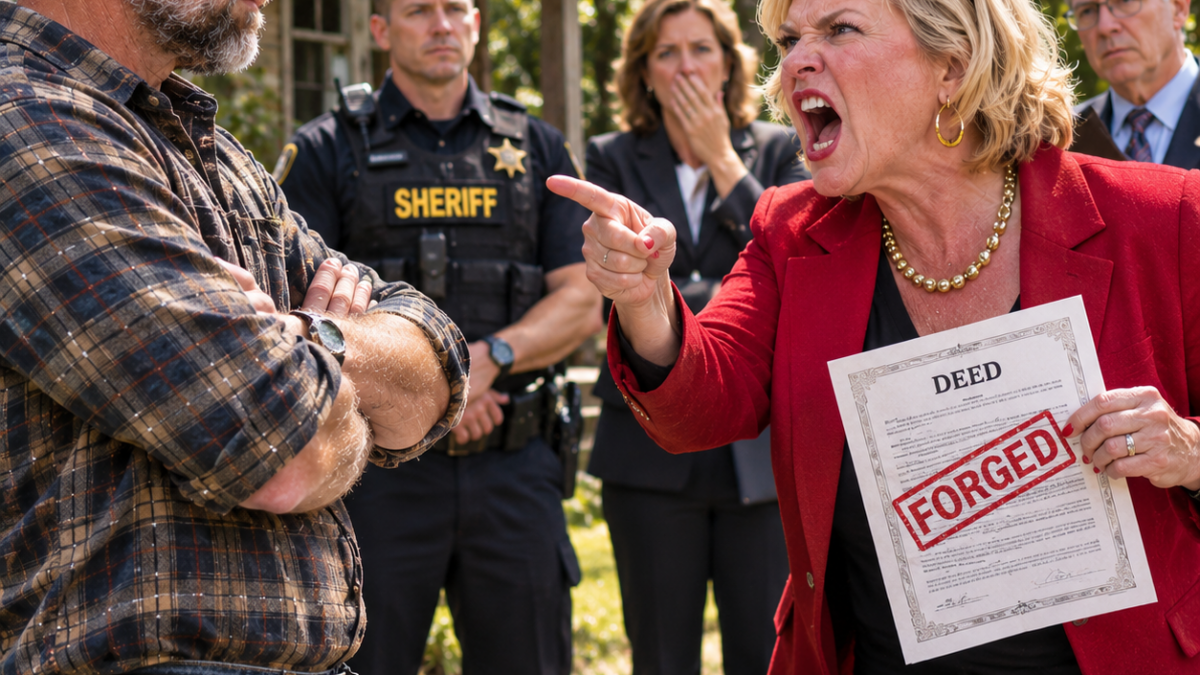
PART 2
The courier arrived the following afternoon.
Karen hadn’t exaggerated about the paperwork.
The envelope was thick, professionally printed, and embossed with the Oak Creek Estates logo.
Inside was the first official violation notice.
Seven hundred dollars immediately due.
Two hundred dollars per day beginning Monday.
The violations were listed in language so formal it almost made the absurdity feel legitimate.
**Failure to maintain approved turf standards.**
**Nonconforming agricultural fencing.**
**Unauthorized preservation of natural meadow conditions.**
I read that last one three times.
Unauthorized preservation of natural meadow conditions.
In other words:
Grass.
Wildflowers.
The land Sarah loved because it hadn’t been flattened, irrigated, chemically treated, and landscaped into submission.
I put the notice in a clear plastic sleeve.
Then I opened the binder.
Section One:
**INITIAL CONTACT**
I wrote the date.
Time.
Weather.
Karen’s exact words as accurately as I could remember them.
Twenty-five years in military engineering had given me an almost unhealthy respect for logs.
People misremember.
Paper doesn’t.
My relationship with Sarah had always been built partly around that difference.
She lived emotionally.
I solved structurally.
When we first met, she told me that every problem didn’t need a spreadsheet.
I told her most problems improved with one.
We were married twenty-seven years.
Neither of us ever convinced the other.
Her illness came fast.
Too fast.
At first it was fatigue.
Then tests.
Then scans.
Then specialists who stopped making eye contact before giving results.
Our plans for the land went from:
**Next summer.**
To:
**When treatment ends.**
Then:
**When she gets stronger.**
Then nobody said anything about the house anymore.
Sarah knew.
I knew.
The fifty acres became less of a future construction site and more of the place we walked when she had enough strength.
She loved the western ridge at sunset.
There was a grove of oaks there.
One had a trunk so wide we could barely reach around it together.
“That one stays,” she told me.
“They all stay.”
“You say that now.”
“I mean it.”
“You also want a driveway.”
“We’ll negotiate with the trees.”
She smiled.
That was Sarah.
She could make an engineer negotiate with trees.
After she died, I couldn’t walk beyond the meadow’s edge for several days.
It hurt too much.
Karen thought that made me weak.
She misunderstood grief.
Grief empties you.
Sometimes that makes you easier to control.
Sometimes it leaves nothing inside except one thing worth protecting.
For me, it was that land.
A week after the first notice, another arrived.
The daily fines had increased.
A new violation was included.
The old shed at the southern edge of the property.
One thousand dollars.
Thirty days to submit demolition plans.
Three hundred dollars just to submit the demolition application.
I almost admired the efficiency.
Fine me for owning the shed.
Then charge me to ask permission to remove the shed she claimed I wasn’t allowed to own.
I added everything to the binder.
Photographs.
Video.
Fence condition.
Shed.
Meadow.
Every boundary marker I could locate.
I photographed the old survey stakes.
The utility easement.
The stone wall near the creek.
Anything that might matter later.
Karen came by again that Saturday.
This time she brought two board members.
Three people.
Three clipboards.
They walked the property line as though inspecting an enemy fortification.
I was repairing a loose porch rail.
One of the men pointed toward the meadow.
Karen wrote something.
Another pointed toward the shed.
More notes.
Then Karen saw me.
She smiled and waved.
I didn’t wave back.
I simply watched.
That bothered her more.
People like Karen feed on reaction.
Anger allows them to become victims.
Fear allows them to become powerful.
Silence gives them nothing.
That night I wrote the first letter.
Short.
Professional.
I formally requested the complete Oak Creek Estates governing documents.
CC&Rs.
Master deed.
Phase Two annexation.
Any amendment establishing jurisdiction over Parcel 7B.
Any agreement signed by Jonathan Miller.
Any documentation explaining why enforcement supposedly began only after Sarah’s death.
Certified mail.
Return receipt.
Eight dollars and change.
Receipt went into the binder.
A week later, Karen delivered the response personally.
Her white Lexus stopped beside the farmhouse.
She stepped out carrying what looked like a legal encyclopedia.
Three inches thick.
Hard bound.
Tabbed.
“Mr. Henderson.”
“Karen.”
“As requested.”
She handed me the volume.
It weighed close to ten pounds.
“Complete covenants and restrictions.”
She had placed bright yellow tabs throughout.
“Appendix C is what you’ll want.”
“Thank you.”
“Parcel 7B is specifically identified.”
“I’ll read it.”
“Jonathan Miller’s signature is on the final page.”
“I’ll read it.”
Her smile faded.
“You know, Alex, this doesn’t need to become hostile.”
Interesting.
First name now.
Personal touch.
“I don’t believe I’ve been hostile.”
“You’re refusing to comply.”
“I’m verifying jurisdiction.”
“The jurisdiction has been established for decades.”
“Then verification should be easy.”
She stared at me.
“Your fines are approaching five thousand dollars.”
“I know.”
“They continue every day.”
“I understand math.”
She took a slow breath.
“I am trying to help you.”
That nearly broke my composure.
“Karen.”
“Yes?”
“My wife died less than a month ago.”
Her expression stiffened.
“I know.”
“You showed up six days after her funeral with a fine schedule.”
She looked away briefly.
“Board obligations don’t pause for personal circumstances.”
“Then don’t pretend this is help.”
Her jaw tightened.
She left.
I carried the HOA binder inside and set it beside mine.
Hers was polished.
Embossed.
Professional.
Mine was a cheap black office binder with handwritten labels.
I remember thinking one of them represented power.
The other represented truth.
I just didn’t yet know which was which.
For three nights, I read.
Every page.
Restrictions on lawn height.
Mailbox materials.
Fence design.
Exterior lighting.
Deck stain.
Garage-door placement.
Dog breeds.
RV parking.
Satellite dishes.
Holiday decorations.
Approved tree species.
There was even a section limiting decorative rocks.
I stopped reading at that point and poured another coffee.
Then:
Appendix C.
**MASTER DEED OF ANNEXATION — OAK CREEK ESTATES PHASE TWO**
June 12, 1989.
Parcel list.
7B.
Sarah’s fifty acres.
I felt sick.
The document looked real.
Developer signature.
Board signatures.
Property-owner signatures.
Jonathan Miller.
Sarah’s grandfather.
Below that:
Notary.
Frank J. Peterson.
Karen’s late husband.
Stamp.
Commission.
Everything.
For the first time since Karen appeared, doubt entered.
What if she was right?
What if Jonathan had signed?
Family stories are imperfect.
Sarah remembered him as stubborn.
Independent.
Hostile toward developers.
But people make decisions for reasons their grandchildren never learn.
Maybe taxes.
Maybe maintenance.
Maybe he agreed to annex but never told the family.
If the deed was legitimate, Karen’s conduct could still be abusive.
But the jurisdiction fight became much harder.
I pulled out documents Sarah had kept.
Jonathan’s will.
Old property agreements.
A birthday card.
Letters.
A photograph he’d signed for Sarah when she graduated college.
I laid the signatures side by side.
The annexation signature looked close.
Very close.
But it didn’t move the same way.
I had spent my life reading drawings and inspecting structures.
Tiny deviations matter.
An engineer learns to notice what doesn’t belong.
Jonathan’s genuine signature flowed.
The J moved into the next letter without hesitation.
The forged—or possibly forged—signature paused.
You could almost feel the pen thinking.
I needed history.
So I visited George Albertson.
George was eighty-seven.
One of the original Oak Creek residents.
He answered the door wearing gardening gloves.
“Alex Henderson?”
“Yes, sir.”
“Sarah’s husband.”
The words hit harder than expected.
“Yes.”
His expression softened.
“I’m sorry.”
“Thank you.”
Unlike Karen, he meant it.
We sat on his porch.
I explained.
At the mention of the annexation, George stopped me.
“Jonathan signed?”
“That’s what Karen says.”
“Bull.”
The certainty surprised me.
“You’re sure?”
“Jonathan Miller?”
He laughed.
“That man hated this HOA before it had a clubhouse.”
George took me inside.
His walls were full of photographs.
Oak Creek before Oak Creek.
Open farmland.
Construction equipment.
New roads.
Young trees.
He found one photograph.
A 1987 planning meeting.
Jonathan stood near the back.
Arms crossed.
Scowl.
“That meeting was about acquiring the surrounding parcels,” George said.
“What happened?”
“Developer bought almost everybody out.”
“And Jonathan?”
“Told them to go to hell.”
“That sounds like Sarah’s story.”
“He called us lawn police.”
I smiled despite myself.
George put on reading glasses and examined the copy of the deed.
“Looks like him.”
“That’s the problem.”
“But I don’t believe it.”
“Why?”
“Because two months after this date, I had coffee with him.”
My attention sharpened.
“About what?”
“HOA expansion.”
“And?”
“He was furious.”
“Did he say he’d signed?”
“He said they’d never get his land.”
That mattered.
Not proof.
But it mattered.
Then George told me about Karen.
She and Frank Peterson moved into Oak Creek in 1985.
Frank joined the board first.
Karen followed.
Over time, they consolidated authority.
Committees merged.
Enforcement became more centralized.
Board minutes became shorter.
Karen handled more records.
Then the fines intensified.
George listed families.
The artist with sculptures.
Basketball hoop.
Fence dispute.
Mailbox dispute.
The Maxwells.
“What happened to the Maxwells?”
George’s expression changed.
“Foreclosure.”
“Over what?”
“Started with dues after he lost his job.”
George looked down.
“They added late fees. Then lawn violations. Then legal costs.”
“How much?”
“Enough.”
“And the house?”
“Sold at auction.”
“To whom?”
George hesitated.
“A holding company.”
“What company?”
“Don’t remember.”
“Who owned it?”
He looked toward the street.
“We all suspected Karen.”
That was the first moment my case stopped being about my land.
I left with copies of old letters and meeting minutes.
Next I visited the family living in the Maxwell house.
Mark and Chloe.
Young.
One toddler.
They looked terrified when I mentioned Karen.
Chloe let me inside only after checking the street twice.
“What happened?”
“Our deck.”
“What about it?”
“Stain.”
I waited.
“Amber Oak.”
“What?”
“The stain color.”
Mark laughed bitterly.
“Approved color was Golden Oak.”
“How different?”
He showed me photographs.
Nearly identical.
I couldn’t tell which was which.
“They fined us ten thousand dollars.”
“For deck stain?”
“Accumulated penalties.”
“We stripped everything,” Chloe said. “Paid a contractor. Refinished it.”
She looked toward the window.
“Our son left his tricycle in the driveway for two hours last week.”
Mark handed me another letter.
Fifty-dollar violation.
I photographed it.
Before I left, Mark stopped me.
“You’re investigating the deed?”
“Yes.”
“Frank Peterson notarized it?”
“Yes.”
He lowered his voice.
“He was a notary.”
“I know.”
“No. I mean he was their document guy.”
“What does that mean?”
Mark shook his head.
“People used to joke he could make anything official.”
That sentence stayed with me.
I hired Ben Carter the next week.
Real estate lawyer.
Fellow veteran.
No tolerance for nonsense.
He opened my binder.
Then opened Karen’s.
“You know what scares me?”
“What?”
“Yours has better tabs.”
“Training.”
He studied the 1989 document.
Then the signatures.
Then George’s records.
“We need a forensic title search.”
“I agree.”
“And document examination.”
“I agree.”
“And until then?”
“Dispute fines.”
“Formally.”
“Obviously.”
Ben smiled.
“This might be fun.”
“It isn’t.”
He saw my face.
“Sorry.”
“Sarah’s land.”
“I understand.”
“No, you don’t.”
Then I regretted saying it.
Ben didn’t react defensively.
“No,” he said. “I probably don’t.”
That made me trust him.
He connected me with Silas Boone.
Retired surveyor.
Seventy-something.
Hands like roots.
Personality like sandpaper.
Silas knew every old plat in the county.
We spent afternoons in the records basement.
Microfilm.
Old survey maps.
Parcel histories.
Developer plans.
There it was.
Oak Creek development map, mid-1980s.
Most surrounding farmland acquired.
One empty block inside planned expansion.
**MILLER PARCEL — NOT ACQUIRED**
Parcel 7B.
Jonathan’s land.
The development had been designed around him.
Not with him.
Then, suddenly, 1989 annexation.
Silas stared at the document.
“Notary looks wrong.”
I looked at him.
“The signature?”
“Stamp.”
He enlarged the microfilm.
“See that edge?”
Barely.
“Serration pattern.”
“Meaning?”
“Older stamp body.”
He explained that certain seal models changed around 1988.
The deed was dated 1989.
Not proof.
But another crack.
Ben agreed.
“We need an examiner.”
Dr. Alistair Finch specialized in questioned documents.
Not glamorous work.
Microscopy.
Ink comparison.
Stroke analysis.
Notary records.
Exactly what we needed.
We sent her high-resolution images plus genuine Jonathan Miller signatures from the same period.
Then Karen escalated.
Fines passed ten thousand dollars.
A lien notice arrived.
Then foreclosure warning.
Ben responded immediately.
Formal dispute.
Notice of contested jurisdiction.
Demand that all enforcement pause pending document review.
Karen ignored it.
Then a sheriff-sale notice appeared on my door.
That was when I stopped treating her as merely arrogant.
She was trying to take the land.
Sarah had been dead only months.
And Karen was already attempting to create the same financial pressure George described in other cases.
Ben filed for an emergency injunction.
We attached:
Property history.
Disputed deed.
My correspondence.
Karen’s escalating fines.
George’s affidavit.
Mark and Chloe’s affidavit.
The judge froze the foreclosure.
Karen showed up furious.
Her attorney called me a disgruntled landowner looking for a loophole.
Ben stayed calm.
“The question isn’t whether Mr. Henderson likes the covenants.”
He placed the historical plat before the judge.
“The question is whether Oak Creek ever acquired lawful jurisdiction over Parcel 7B.”
The judge looked at the fine history.
“You assessed how much in less than two months?”
Karen’s attorney hesitated.
“Approximately—”
Karen whispered.
He answered.
“Over ten thousand dollars.”
The judge looked unimpressed.
“Injunction granted.”
Lien frozen.
Foreclosure stopped.
Full trial set months later.
Karen glared at me outside the courtroom.
“You’re wasting everyone’s money.”
I looked at her.
“Whose money?”
She walked away.
That question would become important.
The Finch report arrived a week later.
Ben and I opened it together.
Twenty pages.
Technical.
Detailed.
The conclusion:
Jonathan Miller’s signature was almost certainly not genuine.
Freehand simulation.
Unnatural pen lifts.
Tremor.
Incorrect rhythm.
Ink inconsistent with other signatures on the page.
I read the section twice.
Then:
Notary seal.
Frank Peterson’s commission number was real.
The stamp was not.
State archives contained his registered seal impression.
The seal on the annexation didn’t match.
Different design.
Different border pattern.
Different spacing.
Fabricated stamp.
Ben leaned back.
“Jesus.”
My hands went cold.
“So it’s fake.”
“Yes.”
“The whole thing.”
“Yes.”
I stood.
“We use it now.”
“No.”
I turned.
“What?”
“Not yet.”
“Ben.”
“The foreclosure is frozen.”
“She forged Sarah’s grandfather’s signature.”
“Or someone did.”
“Her husband notarized it.”
“His name appears on it.”
“She built her authority on it.”
“I know.”
“Then why wait?”
“Because the second we reveal this, documents disappear.”
I stopped.
Ben pointed toward the report.
“This is not a defense anymore.”
He closed the folder.
“This is a weapon.”
I hated the word.
But he was right.
Discovery began.
Karen’s lawyers demanded almost everything they could think of.
Financial records.
Emails.
Tax filings.
Personal communications.
We complied.
Cleanly.
Completely.
Then sent our own requests.
Twenty years of HOA finances.
Vendor payments.
Foreclosure records.
Lien records.
Board minutes.
Emails.
Holding companies.
Karen fought.
Lost.
Boxes arrived.
Document dump.
Thousands of pages.
I built a database.
Date.
Property.
Violation.
Fine.
Lien.
Foreclosure.
Purchaser.
Resale.
Vendor.
Board authorization.
Money.
Pattern.
Then I found it.
The Maxwells’ home.
Foreclosed.
Auction purchaser:
Oak Holdings LLC.
State records:
Karen Peterson.
Another property.
Same.
Another.
Different holding company.
Registered agent tied to Frank.
Another foreclosure.
Another resale.
The pattern became impossible to dismiss.
Karen identified vulnerable properties.
Job loss.
Death.
Divorce.
Older owners.
Then aggressive enforcement.
Fines.
Late fees.
Legal costs.
Lien.
Foreclosure.
Auction.
Holding company.
Resale.
Profit.
At least a dozen properties.
Millions of dollars over years.
Some cases were more complex.
Not every foreclosure was necessarily unlawful.
But enough shared suspicious features to demand investigation.
More importantly:
Phase Two and Phase Three enforcement relied heavily on the 1989 annexation.
If that deed was fraudulent, entire layers of HOA authority might be compromised.
The grief I’d been carrying changed shape.
Sarah had hated bullies.
Not loudly.
She wasn’t confrontational.
But injustice made her stubborn.
I could hear what she’d say if she saw my database.
**Alex, stop staring at spreadsheets and do something.**
So we did.
Ben contacted the state attorney general’s economic crimes unit.
Not with accusations.
With evidence.
Finch report.
Recorded deed.
Seal comparison.
Financial network.
Foreclosure timeline.
Witness statements.
For five hours, I presented it.
The senior prosecutor asked:
“You could settle the civil case.”
“Yes.”
“For a significant amount.”
“Probably.”
“Why bring this to us?”
I thought about the answer.
Then Sarah.
Her meadow.
George.
The Maxwells.
Mark and Chloe.
“Because money doesn’t stop a system.”
The prosecutor nodded.
“Go on.”
“If we settle quietly, Karen keeps whatever structure remains.”
Ben watched.
I continued.
“She used fear because people fought alone.”
The prosecutor closed the binder.
“We’ll investigate.”
That was all.
No dramatic promise.
No threat.
Just:
We’ll investigate.
Karen had no idea.
Two weeks before trial, we scheduled a community information meeting.
Not an HOA meeting.
Private rental hall in the next town.
Open invitation to Oak Creek residents.
Subject:
**PROPERTY RIGHTS AND HOA GOVERNANCE INFORMATION SESSION**
Karen sent an email warning residents not to attend.
She called it misinformation.
Threatened possible fines for circulating defamatory material.
That email filled the room.
More than three hundred people came.
Karen came too.
Front row.
Lawyer beside her.
Pastel suit.
Perfect hair.
Clipboard.
Still playing queen.
I stood behind a podium.
For the first time since Sarah died, I spoke about her publicly.
Not the illness.
Not the funeral.
The dream.
“Our plan was simple,” I told them.
“Build one house on fifty acres.”
A few people smiled.
“Sarah wanted the kitchen facing east.”
I swallowed.
“I wanted the lake.”
Pause.
“She said marriage meant compromise, so naturally she intended to get both.”
Soft laughter.
Good.
“She didn’t live long enough for us to build it.”
The room quieted.
“Six days after her funeral, Karen Peterson came to my fence.”
Karen shifted.
“I was told Sarah’s death activated HOA control over our land.”
I projected the first fine.
Then fence violation.
Shed.
Lien.
Foreclosure notice.
People murmured.
Many recognized the pattern.
Then I projected the master deed.
“This document is the foundation.”
Karen smiled.
Of course she did.
It was her favorite document.
“The 1989 Master Deed of Annexation.”
I highlighted Jonathan Miller’s name.
“Karen says Sarah’s grandfather signed away the independence of Parcel 7B.”
Karen leaned toward her lawyer.
Still confident.
Then I projected Jonathan’s genuine signatures.
Letter.
Will.
Property agreement.
Beside the annexation.
“They look similar.”
People leaned forward.
“They aren’t.”
Next slide.
Dr. Finch’s analysis.
Pen lifts.
Stroke hesitation.
Tremor.
Different ink.
The smile disappeared from Karen’s face.
Her lawyer stood.
“This is defamatory.”
Ben rose from his seat.
“Sit down.”
The lawyer looked stunned.
Ben continued calmly.
“You’ll have your forum.”
He sat.
Next slide.
Notary seal.
Frank Peterson.
Karen’s late husband.
Registered state impression.
Then deed impression.
Different.
Clearly different when enlarged.
I looked toward Karen.
“The notary stamp is fabricated.”
Noise erupted.
People shouting.
Questions.
Karen stood.
“That’s a lie!”
I raised my voice.
“The state record is available to anyone.”
“You manufactured this!”
“No.”
“You hate me!”
“No.”
That stopped her.
I surprised myself too.
“I don’t hate you.”
Her face twisted.
“You’re trying to destroy me.”
“No.”
I pointed toward the deed.
“This is destroying you.”
Silence.
Then I displayed the property list.
Maxwells.
Others.
Foreclosure dates.
Holding companies.
Resale values.
Some residents began crying.
Others cursed.
“This wasn’t just used against Sarah’s land.”
I looked across the room.
“This document became the basis for decades of enforcement.”
Karen’s lawyer was on his phone.
“This system generated liens.”
Next slide.
“Foreclosures.”
Next.
“Purchases through companies connected to HOA leadership.”
The crowd erupted again.
Mark shouted:
“You stole their homes!”
Karen turned.
“How dare you!”
George stood slowly.
He was old, but his voice carried.
“Karen.”
She froze.
George looked exhausted.
“How many?”
She stared.
“How many houses?”
“Sit down, George.”
“No.”
For the first time in decades, apparently, George Albertson refused an order from Karen Peterson.
“How many?”
Then the hall doors opened.
The room fell quiet in waves.
State investigators entered.
Two uniformed troopers behind them.
The senior investigator walked to the front.
Karen’s lawyer moved immediately.
“Who are you?”
“State Attorney General’s Office.”
Karen sat.
Not gracefully.
Collapsed.
The investigator produced paperwork.
“Karen Peterson?”
She didn’t answer.
“Ms. Peterson.”
Her lawyer touched her shoulder.
“Don’t say anything.”
She looked toward me.
For the first time since I met her, there was no superiority in her eyes.
Just fear.
The investigator continued.
“We have warrants related to an ongoing investigation into suspected forgery, fraudulent property transactions, financial misconduct, and related offenses.”
Someone gasped.
Karen stood.
“This is his doing.”
The investigator didn’t look at me.
“Ma’am, turn around.”
“You don’t understand!”
“Turn around.”
“I built this community!”
“Hands behind your back.”
The handcuffs clicked.
A small sound.
Metal.
Final.
Karen twisted enough to look toward the room.
“These people would have nothing without me!”
Nobody answered.
That was her real defeat.
Not the handcuffs.
Silence.
Three hundred people.
Nobody defending her.
She looked toward me as they led her past.
“You think Sarah would be proud of you?”
The words hit exactly where she intended.
For half a second, rage almost took me.
Ben stepped forward.
I lifted one hand.
Then answered.
“I think she’d be proud the land is still free.”
Karen’s face changed.
The troopers led her out.
I stood behind the podium after the doors closed.
Nobody cheered.
I’m glad.
This wasn’t a football game.
Families had lost homes.
People had been financially ruined.
Sarah was still dead.
Justice doesn’t resurrect anything.
It only stops the damage from spreading.
The investigation expanded.
HOA offices were searched.
Financial accounts subpoenaed.
Holding companies traced.
More residents came forward.
Old cases reopened.
Some allegations proved strong.
Others didn’t.
That’s how real investigations work.
Not every angry story becomes a crime.
But the core evidence against Karen was overwhelming enough that her legal position collapsed quickly.
The forged annexation.
Financial self-dealing.
Property transactions.
Pattern of enforcement benefiting connected entities.
She eventually accepted a plea agreement rather than face a sprawling trial.
The sentence was substantial.
Restitution was ordered.
Assets tied to the scheme were liquidated where legally available.
The holding companies disappeared.
Her control over Oak Creek ended permanently.
But I cared about one decision more than all of that.
Parcel 7B.
The court voided the lien.
The annexation was declared invalid.
Sarah’s fifty acres were free.
No lawn requirements.
No fence fines.
No architectural committee.
No Karen.
The first time Ben handed me the final recorded order, I didn’t celebrate.
I drove to the meadow.
Parked near the old farmhouse.
Walked alone to the western ridge.
Sunset.
Sarah’s favorite place.
Wind moved through the tall grass.
The oak trees looked exactly the same.
I sat beneath the largest one.
For months, I’d been fighting for the future Sarah and I planned.
But the truth was becoming impossible to ignore.
That future no longer existed.
I could build the house.
Beautiful house.
East-facing kitchen.
Lake windows.
Wraparound porch.
Everything we’d designed.
And Sarah would never walk through the door.
That thought broke something open.
I cried there for the first time since her funeral.
Not dignified tears.
Not one cinematic tear.
I folded in half beneath the oak and sobbed until my chest hurt.
Anger had protected me from grief.
Karen gave me an enemy.
Evidence gave me a mission.
Court dates gave me deadlines.
Spreadsheets gave me structure.
Now the fight was almost over.
There was nowhere left to hide.
Sarah was gone.
The meadow couldn’t change that.
I don’t know how long I sat there.
Eventually the sunset faded.
I heard Sarah’s voice in memory.
Not mystical.
Not supernatural.
Just memory.
One evening years earlier:
**Promise me we never cut these trees.**
I looked around.
Maybe the answer wasn’t building the house.
Maybe the dream could change without being betrayed.
Over the following months, Oak Creek struggled with what came next.
The old HOA structure was effectively dismantled.
That scared residents at first.
Shared roads still needed maintenance.
Common lake access needed management.
Insurance.
Lighting.
Drainage.
People needed some kind of organization.
But nobody wanted another Karen.
George surprised everyone by volunteering.
“I’ll do it temporarily.”
At eighty-eight.
Mark laughed.
“George, you complain about email.”
“I can learn email.”
Chloe said:
“We need bylaws.”
George nodded.
“Short ones.”
That earned applause.
They formed a legitimate new association through proper procedures.
No retroactive annexations.
No fake deeds.
No hidden holding companies.
Opt-in structure where legally appropriate.
Transparent budgets.
Independent annual audits.
Conflict-of-interest rules.
Limits on fines.
Mandatory notice.
Appeals.
No foreclosure action without outside legal review and a membership-level process.
George became the first president.
He hated the title.
Which made him perfect.
Mark and Chloe received reimbursement for their deck ordeal through the restitution process.
The Maxwells were harder.
They had moved.
Built a life elsewhere.
Money could never fully restore what happened.
But they received compensation.
Other families did too.
The artist Karen drove away returned one afternoon.
She stood outside her old house.
New owners invited her in.
She cried.
Billions of dollars couldn’t repair everything Karen’s system damaged.
But acknowledgement mattered.
Records corrected.
Money returned where possible.
Liens cleared.
Names restored.
People stopped whispering.
They started comparing stories.
That’s how Karen’s power finally died.
Not when she was arrested.
When residents learned to speak to one another.
I stayed outside the new HOA.
Parcel 7B remained independent.
George visited once with the new documents.
“Want to join?”
“No.”
“I had to ask.”
“I appreciate it.”
“You can still come to the barbecue.”
“I’ll consider it.”
He looked across my meadow.
“What are you going to do with all this?”
“I don’t know.”
“Developer offered you anything?”
“Several.”
“How much?”
“Enough.”
“You going to sell?”
I looked toward the western ridge.
“No.”
That answer came easily.
Weeks later, I called the county conservation office.
The woman who answered thought I wanted a tax question.
“No.”
“What are you trying to do?”
“Protect fifty acres permanently.”
“From development?”
“Yes.”
“Family land?”
“Yes.”
She asked whether I wanted a conservation easement.
Maybe.
Trust.
Maybe.
Public-access structure.
Possibly.
It took months.
Survey.
Environmental assessment.
Legal work.
Water study.
Tree inventory.
Public hearings.
For once, paperwork felt constructive.
We created a conservation trust.
The land would never become another subdivision.
No luxury homes.
No shopping center.
No HOA expansion.
Meadow preserved.
Oaks protected.
Trails carefully placed.
Wildlife habitat maintained.
A portion opened for community walking during daylight hours.
Then came the name.
Everyone assumed:
Henderson Preserve.
No.
Miller-Henderson.
Too awkward.
I knew immediately.
**Sarah Miller Henderson Memorial Preserve.**
At the dedication, almost the entire neighborhood attended.
George stood beside me.
Mark.
Chloe.
Families I’d met through the investigation.
The Maxwells drove back for it.
That nearly broke me.
There was a simple wooden sign near the trailhead.
Nothing expensive.
Nothing dramatic.
**SARAH MILLER HENDERSON MEMORIAL PRESERVE**
**50 ACRES — PROTECTED IN PERPETUITY**
Below:
**For the woman who loved this land enough to leave it wild.**
I hadn’t written the last sentence.
Chloe had.
I pretended I was angry.
She ignored me.
A little girl asked:
“Who was Sarah?”
I crouched.
“My wife.”
“Did she live here?”
“Yes.”
“Is this her park?”
I looked around.
Grass moving in wind.
Oaks.
Wildflowers.
Neighbors walking slowly along the trail.
“Yeah.”
I smiled.
“I think it is.”
Life quieted after that.
Karen became a headline for a while.
Then not.
Other news replaced her.
That’s good.
A corrupt person’s story shouldn’t remain larger than the lives they damaged.
I rarely followed updates about her incarceration.
Ben sometimes mentioned restitution orders.
George occasionally heard rumors.
I stopped asking.
Revenge had never been the point.
At least that’s what I told myself.
If I’m being fair, there were moments when watching her lose power felt satisfying.
The first frozen lien.
The forensic report.
Her face at the community meeting.
The arrest.
I’m human.
But satisfaction burns quickly.
Restoration lasts.
The first spring after the preserve opened, wildflowers covered the meadow.
Purple.
Yellow.
White.
Sarah would’ve known every name.
I knew maybe three.
People started leaving little stones near the sign.
No flowers.
We discouraged picking.
Somebody left a handwritten note.
**Thank you for saving this place.**
That one stayed with me.
Because I hadn’t saved it alone.
Sarah did first.
Her grandfather did before her.
Even Jonathan’s refusal to sell decades earlier became part of the chain.
Karen thought land was valuable because it could be controlled.
Fined.
Foreclosed.
Resold.
Developed.
Sarah understood value differently.
Value could mean leaving something untouched.
One summer evening, George and I sat on a bench beneath the big western oak.
He was ninety by then.
Still stubborn.
Still president because nobody could convince him to retire.
“You know what bothers me?” he asked.
“A long list, probably.”
He ignored that.
“We all knew Karen was bad.”
“Some did.”
“No.”
He shook his head.
“We knew.”
He pointed his cane toward Oak Creek.
“Not the crimes.”
“But the bullying.”
“Yes.”
“So why didn’t anyone stop her?”
George looked down.
“Because she was usually hurting somebody else.”
That sentence was harder than anything from court.
“Until it was you.”
“Yes.”
“Then Mark.”
“Yes.”
“The Maxwells.”
He nodded.
“We treated each case like it belonged to that family.”
He sighed.
“We never compared them.”
I looked toward the meadow.
“That’s how systems like hers survive.”
“Fear?”
“Isolation.”
George nodded.
“Same thing sometimes.”
He died two years later.
The neighborhood named a bench for him.
I complained that we were becoming a cemetery of plaques.
Chloe told me to shut up.
Oak Creek got better.
Not perfect.
There were arguments.
Budget fights.
Parking complaints.
Someone wanted to ban backyard chickens.
That meeting lasted three hours.
Normal community nonsense.
But nobody controlled every committee.
No secret companies.
No foreclosure machine.
No one person’s judgment became law.
The new board did something Karen would have hated.
They published mistakes.
If the board made an accounting error, they corrected it publicly.
If a violation notice went out incorrectly, they apologized.
At first residents thought that looked weak.
It did the opposite.
Trust grew.
Because authority that admits error feels safer than authority that claims infallibility.
I became an unofficial advisor sometimes.
Mostly because people knew I understood documents.
A young board member once brought me a draft enforcement policy.
“Too complicated,” I said.
“We need detail.”
“You need clarity.”
“What’s the difference?”
“Detail tells people everything you can do.”
“And clarity?”
“Tells them what you can’t.”
He thought about that.
Karen’s rules had endless power.
The new rules needed boundaries.
That’s what we wrote.
My farmhouse remained.
I never built the new house.
I repaired the old one instead.
Sarah and I had lived there during her last years.
At first every room hurt.
Then memories changed.
Pain remained, but softened.
Her mug stayed near the window for almost a year.
Eventually I moved it.
Not because I was moving on.
I hate that phrase.
You don’t move on from someone you loved for decades.
You move forward carrying them differently.
The preserve helped.
Every trail improvement felt like building something with her again.
A small footbridge over the wet section.
Benches.
Trail markers.
Native plant restoration.
No manicured lawns.
No perfect symmetry.
One day, Oak Creek’s landscaping committee asked whether they could fund wildflower restoration along the boundary.
I laughed.
“What?”
“Nothing.”
“Why is that funny?”
“Karen fined me for the wildflowers.”
The committee chair smiled.
“Then we’ll plant more.”
We did.
The old barbed-wire fence eventually became unsafe.
I replaced sections.
Not with white vinyl.
Not with HOA-approved decorative fencing.
Simple split rail along public areas.
Wildlife-friendly wire elsewhere.
On the day installation finished, I thought about Karen’s first words.
**This fence is entirely non-compliant.**
She was right in one sense.
It never complied with her vision.
Good.
One autumn morning, Ben called.
“Got something.”
“What?”
“Final restitution distribution.”
I went to his office.
Karen’s remaining recoverable assets had been processed through the legal system.
Victims received distributions.
My amount was larger than expected.
I stared at the figure.
“What am I supposed to do with this?”
“Spend it irresponsibly.”
“Helpful.”
“I’m your lawyer, not your financial advisor.”
I didn’t need the money.
Military retirement.
Savings.
Farmhouse paid.
Simple life.
So I put most of it into the preserve endowment.
Ben stared when I told him.
“All of it?”
“Most.”
“Why?”
“It came from the land fight.”
“So?”
“Goes back to the land.”
He leaned back.
“You know normal clients buy boats.”
“I have a canoe.”
“Depressing.”
I laughed.
The endowment paid for maintenance.
Trail work.
Habitat restoration.
Educational visits.
Local school groups began coming.
Children learned about native plants.
Watersheds.
Old-growth trees.
One teacher asked whether I would speak about Sarah.
I almost said no.
Then agreed.
I told the students she loved butterflies.
This was only partly true.
She loved everything that gave her an excuse not to mow.
I told them about her insistence that wild land wasn’t wasted land.
That was completely true.
A boy raised his hand.
“Did the bad lady try to build houses here?”
I looked at the teacher.
She looked embarrassed.
“Apparently they’ve heard the story.”
I smiled.
“She wanted control of the land.”
“Why?”
“Money. Power. Maybe both.”
“Was she evil?”
Hard question.
“No.”
The teacher looked surprised.
I continued.
“She did very wrong things.”
“But not evil?”
“I don’t know what’s inside another person.”
I pointed toward the meadow.
“What matters is what people choose to do.”
The boy thought about that.
“Her choices were evil.”
“Some were.”
That answer felt more accurate.
Karen wasn’t born with a clipboard and a foreclosure plan.
She made choices.
Then more choices.
Each time consequences were delayed, the next choice got easier.
Authority became entitlement.
Entitlement became exploitation.
Exploitation became crime.
That’s more frightening than imagining monsters.
Monsters are easy to recognize.
Ordinary people convincing themselves they deserve exceptions are harder.
Years later, I received a letter forwarded through Ben.
Karen.
Prison stationery.
I almost threw it away.
Didn’t.
It was six pages.
Most of it was still defensive.
She blamed Frank.
The board.
The developer.
Financial pressure.
Residents who refused to follow rules.
Then near the end:
**I was jealous of that land.**
I stopped.
Read it again.
**Every morning I looked out from Oak Creek and saw fifty acres that I could not control. It made no sense to me that one family could keep so much undeveloped land while the rest of us had rules. I told myself annexing it was fair. Once I believed that, everything after became easier to justify.**
There it was.
Not apology exactly.
But truth.
She continued:
**When Sarah died, I believed you would sell. I thought pressure would make it happen faster. I did not understand what the land meant to you.**
That line made me angry.
She didn’t need to understand.
It wasn’t hers.
Property rights don’t depend on whether a thief appreciates sentimental value.
But another sentence came later.
**I know now that I confused authority with ownership.**
I put the letter down.
Didn’t respond.
For months.
Then one winter afternoon, I wrote four lines.
**Karen,**
**The land is protected permanently now. No one will own it for development. What happened cannot be undone, but it does not need to be repeated. I hope you use whatever life remains to understand the difference between serving a community and controlling one.**
**Alex Henderson**
I never received another letter.
That was fine.
Forgiveness isn’t correspondence.
It isn’t friendship.
It isn’t forgetting.
Sometimes forgiveness is deciding the person who hurt you no longer gets daily access to your mind.
I still maintained boundaries.
Literal and emotional.
Sarah’s preserve became popular enough that the county wanted a larger parking lot.
I said no.
They wanted paved paths.
Mostly no.
A small accessible loop near the entrance?
Yes.
Sarah would’ve approved.
She believed nature should be available to people who couldn’t hike rough terrain.
So we created one smooth trail.
Wheelchair-accessible.
Benches.
Shade.
Nothing excessive.
At the end was the western oak.
Our tree.
I placed a small plaque there.
Not Karen.
Not the lawsuit.
Just Sarah.
**SHE WANTED THE MORNING LIGHT AND THE LAKE VIEW. SOMEHOW, SHE GOT BOTH.**
The accessible trail curved in a way that opened east in the morning and west toward the lake overlook.
Engineer compromise.
Finally.
One sunrise, I walked it alone.
Mist over grass.
Birds starting.
No traffic.
At the oak, I sat.
I was older.
Knees complained.
Sarah had been gone many years.
Some grief never disappears.
It simply becomes familiar enough to live beside.
I thought about the first week after her funeral.
Karen at the fence.
Clipboard.
Fines.
My rage.
If Karen had waited a month, would anything change?
No.
A year?
No.
The deed would still be false.
The system still corrupt.
But her cruelty forced the confrontation.
That’s the strange part.
She believed grief made me vulnerable.
In some ways, it did.
I wasn’t sleeping.
Barely eating.
I couldn’t imagine life past the next hour.
But grief also made her threats meaningless.
She threatened money.
I had just lost Sarah.
She threatened fines.
Sarah was gone.
She threatened foreclosure.
I had watched my wife die.
Karen had no idea how small her weapons looked beside that.
That’s why I could wait.
Document.
Research.
She wanted panic.
I had already lived through the worst thing that could happen to me.
Her clipboard wasn’t frightening.
That doesn’t make me brave.
It made me empty enough to focus.
Later, when life returned, I realized how close anger came to consuming everything.
The investigation gave grief somewhere to hide.
When Karen fell, grief came back.
That was harder.
Preserving the land became the way through.
Not revenge.
Creation.
I think that’s why the ending satisfied me.
Karen built wealth by converting other people’s losses into her gain.
I took money recovered from her scheme and converted it into land no one could exploit.
She used documents to take.
We used documents to protect.
She used community rules to isolate people.
The preserve brought people together.
Same tools.
Different purpose.
That’s the distinction that matters.
Power itself isn’t evil.
Paperwork isn’t evil.
HOAs aren’t automatically evil.
Law isn’t evil.
It depends on who uses them and why.
A deed can steal when forged.
A deed can protect when honest.
A board can intimidate.
A board can serve.
A fence can exclude.
A fence can protect a habitat.
Karen confused control with stewardship.
Sarah never did.
Sarah’s version of ownership always involved responsibility.
When we first discussed buying machinery to maintain the meadow, I wanted a larger tractor.
Naturally.
She said:
“You want a toy.”
“I need equipment.”
“You want a very expensive green toy.”
“It’s agricultural infrastructure.”
“Does agricultural infrastructure have cup holders?”
“Safety feature.”
She laughed for ten minutes.
I bought the tractor.
It had cup holders.
After she died, I kept using it.
Every spring.
Trail mowing.
Firebreaks.
Invasive plant control.
One day Mark helped me repair a hydraulic line.
His son—no longer the toddler from the tricycle fine—was seventeen.
He asked:
“Is it true Karen fined my parents ten grand because of a deck color?”
Mark groaned.
“We don’t need to relive this.”
His son laughed.
“Amber Oak versus Golden Oak.”
“Stop.”
I looked at the kid.
“They looked identical.”
“Thank you!” Mark shouted.
The boy asked:
“Why’d you pay?”
Mark became quiet.
“Because we were scared.”
That answer mattered.
His son looked surprised.
“Of Karen?”
“Of losing the house.”
“Could she really do that?”
Mark glanced toward me.
“She’d done it to others.”
The boy nodded slowly.
“Would you pay now?”
“No.”
“Why?”
Mark smiled.
“Because now I know my neighbors.”
That’s it.
Isolation makes threats large.
Community makes them testable.
Karen’s thirty-year empire wasn’t built entirely on forged documents.
It was built on people not comparing experiences.
The forged deed cracked the legal foundation.
The neighbors cracked the social one.
Both were necessary.
Eventually the preserve celebrated its tenth anniversary.
No fancy gala.
Sarah would’ve hated that.
Picnic.
Local musicians.
Kids.
County naturalists.
George’s bench.
Mark grilling badly.
Chloe correcting him.
Someone put up a display about the history of the property.
1920s family acquisition.
Jonathan refusing developers.
Sarah’s stewardship.
Conservation trust.
The HOA scandal was one small panel.
Exactly where it belonged.
Not the main story.
A footnote.
That’s what Karen eventually became.
A footnote in the history of land she tried to control.
That may be the most satisfying consequence of all.
She wanted her name on every rule.
Every fine.
Every meeting.
Every property decision.
Instead, Sarah’s name is on the preserve.
Not Karen’s.
People come here and ask:
“Who was Sarah Henderson?”
Nobody asks about Karen.
One evening after the anniversary, I remained after everyone left.
The folding tables were gone.
Trash collected.
Sunset beginning.
I walked to the ridge.
The same place Sarah and I once stood with imaginary house plans.
I could almost see it.
Kitchen.
Porch.
Windows.
Maybe grandchildren running through rooms we never built.
For years, I mourned that house.
Now I understood something.
The house would have been ours.
The preserve became hers.
A larger legacy.
Not because losing her was somehow good.
Never.
I would trade every acre, every legal victory, every dollar, every tree to have another ordinary Tuesday with Sarah.
But life doesn’t offer that trade.
You work with what remains.
What remained was land.
Memory.
Choice.
So I chose preservation.
I sat beneath the oak until stars appeared.
Then I said aloud:
“We kept it.”
Nobody answered.
Didn’t need to.
Wind moved through the grass.
That was enough.
Karen’s original violation notice still exists.
In my binder.
The one labeled **KAREN**.
Seven hundred dollars.
Two hundred per day.
Fence violation.
Meadow violation.
The beginning.
Beside it is Dr. Finch’s report.
The court order.
The restitution paperwork.
Conservation trust.
Final plat.
At the back is one photograph of Sarah.
Standing in the meadow.
Hands on hips.
Hair moving in wind.
Looking toward the western ridge.
On the back she’d written:
**Future home. Don’t let Alex put the garage where the view should be.**
I laughed when I found it.
Then cried.
The garage never went there.
Nothing did.
The view remains.
Exactly as she wanted.
If you ask me whether Karen got what she deserved, I don’t know how to answer that anymore.
She lost her power.
Money.
Freedom for years.
Reputation.
Her scheme collapsed.
Victims received restitution.
Those are consequences.
Deserved?
That’s for courts, morality, and whatever people believe comes after.
My concern was always narrower.
Did she stop hurting people?
Yes.
Did Sarah’s land stay free?
Yes.
Did the community learn?
Yes.
Was the fraudulent deed exposed?
Yes.
Was the land protected permanently?
Yes.
Then I have my answer.
Justice doesn’t need endless suffering.
It needs the harm to stop and the truth to remain.
The truth is simple.
Sarah’s grandfather never gave Karen’s HOA those fifty acres.
Sarah never gave them away.
I never surrendered them.
A forged signature nearly changed the story.
Nearly.
But documents built on lies eventually meet documents built on facts.
And facts, if someone is stubborn enough to keep digging, have weight.
Karen had spent thirty years building an empire on paper.
I spent months pulling one thread.
A hesitant loop in a signature.
A mismatched notary stamp.
A historical plat.
A financial ledger.
A foreclosure timeline.
One thread became another.
Until the whole thing came apart.
Not because I was smarter than everyone.
Not because I had military training.
Not because grief made me fearless.
Because Karen believed nobody would ever check.
That’s the weakness of every long-running abuse of power.
Eventually somebody checks.
Today, when I stand at Sarah’s trailhead, the old HOA boundary is almost invisible.
Wildflowers grow where Karen wanted turf.
The ancient fence is mostly gone.
The shed she fined me over still stands.
We repaired it.
It now stores trail-maintenance equipment.
A small sign hangs on the door:
**STRUCTURE EST. 1937 — STILL UNAPPROVED BY KAREN**
Chloe made it.
I pretended to object.
Visitors love it.
Maybe that’s the only revenge I truly enjoy.
The things she called violations survived.
The meadow.
The trees.
The shed.
The land.
Her empire didn’t.
And every evening, when the sun drops behind the western ridge and turns those fifty acres gold, I think of Sarah.
Not Karen.
Not the court case.
Not the forged deed.
Sarah.
That’s how I know we won.








