PART 2: After Guarding the Same Store for 10 Years, Charlie Got Sick—and They Locked Him Out Like He Meant Nothing
PART 2
I sat down beside Charlie’s kennel.
He watched me cautiously.
His eyes were cloudy with exhaustion, but every few seconds they shifted toward the treatment-room door.
I knew exactly what he was looking for.
The store.
Or someone from the store.
Some familiar voice that would call him back.
I rested my hand on the floor without reaching through the bars.
“You’re not going back there tonight.”
Charlie stared.
“I know you don’t understand.”
His nose moved.
“You think we stole you.”
He turned his head toward the wall.
That hurt more than anger would have.
A frightened dog may bark.
A defensive dog may growl.
Charlie simply withdrew.
It was as if some part of him had decided there was no point trying to understand what people wanted anymore.
The veterinarian came in carrying the first bag of IV fluids.
“We need to start immediately.”
I stood.
“How bad is the blood infection?”
“Serious enough that I’m concerned.”
“And the anemia?”
“Also serious.”
He glanced toward the X-ray.
“The good news is that the foreign material isn’t currently causing a complete obstruction.”
“So he won’t need surgery?”
“I didn’t say that.”
My stomach tightened.
“We’re going to hydrate him, treat the infection and watch closely. If the plastic moves through naturally, that’s obviously better for a dog in this condition.”
Charlie looked so fragile that the idea of anesthesia frightened me.
“How much does he weigh?”
The veterinarian told me.
The number was far below what a dog of Charlie’s frame should have carried.
I looked at his narrow waist.
“How long would it take to get this thin?”
“There’s no exact answer. But not a few days.”
I knew what he meant.
This was not simply an old dog who had missed several meals after being pushed outside.
His neglect had started before the door closed.
The disease had been allowed to progress.
The weight had been allowed to disappear.
His skin had been allowed to deteriorate.
Charlie’s removal from the store had not created his suffering.
It had simply made the suffering visible.
The staff clipped what little damaged fur remained where necessary and cleaned the worst areas.
They worked gently.
Charlie did not always respond gently.
When a technician touched one painful section near his neck, he snapped.
The technician pulled her hand away.
Charlie immediately shrank into himself.
“No punishment,” she said quietly.
Nobody raised a voice.
Nobody grabbed him.
She waited.
Then approached again from a different angle.
Charlie growled.
“That’s okay,” she said. “Tell me.”
I watched from the doorway.
Tell me.
Maybe nobody had listened when Charlie tried before.
Pain changes behavior.
Fear changes behavior.
A dog who snaps during medical handling is not necessarily vicious.
Sometimes he is simply saying the only word he has left.
Stop.
We used sedation only where medically necessary and adjusted the way he was handled.
His treatment had to heal his body without teaching him that every hand still meant pain.
That first evening, I brought a blanket and placed it near him.
Charlie sniffed.
Then turned away.
I tried food.
He ate.
That was one thing he trusted immediately.
Not people.
Food.
Or perhaps “trusted” was the wrong word.
He consumed every bite with frantic urgency.
He licked the dish long after it was empty.
“Slow down.”
He pushed his nose against the stainless steel.
“There’ll be more.”
He stared at the bowl.
I wondered how long it would take before those words meant anything.
There’ll be more.
Animals learn promises through repetition, not language.
If you feed them once, food happened.
If you feed them every day, food becomes safety.
Charlie had spent too long learning the opposite.
Take what you can now.
Tomorrow is uncertain.
That night, the hospital called me twice.
The first call came after midnight.
Charlie’s temperature had shifted.
His blood pressure needed closer monitoring.
The second came shortly before dawn.
He had stabilized.
I arrived early.
Charlie was awake.
His IV line ran from one front leg.
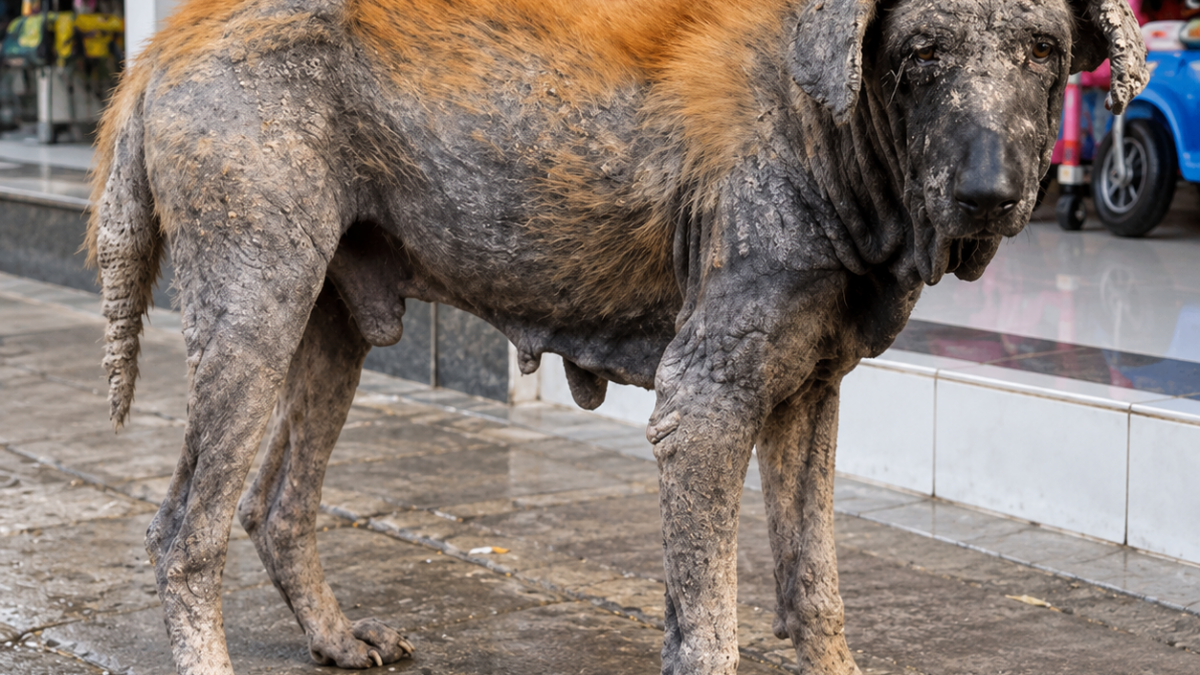
Bandaged areas covered patches of damaged skin.
He looked miserable.
“Morning.”
No tail movement.
No lifted head.
Only those tired eyes.
I sat down.
He watched the door.
“You’re still thinking about it.”
The store.
That doorway had been the fixed point of Charlie’s entire life.
People came and went.
Deliveries arrived.
Cars passed.
Employees changed.
Charlie remained.
For more than ten years, he had been part of the entrance.
Maybe people occasionally fed him.
Maybe customers spoke to him.
Maybe he slept behind the counter or near the door after closing.
Maybe he once believed that place was permanent.
Dogs do not understand employment contracts.
They understand routine.
This is where I sleep.
This person feeds me.
This sound means morning.
This door opens.
This door closes.
These people are mine.
Charlie had built his identity from those patterns.
Then one day, he changed physically.
The patterns disappeared.
The door still opened.
Just not for him.
I thought about how confusing that must have been.
Charlie had not failed to protect the store.
He had simply gotten sick.
And sickness was treated like betrayal.
That afternoon, someone from our rescue visited the store again.
We wanted clearer information about Charlie’s history.
The owner was defensive.
“He was a street dog when he came here.”
“How long ago?”
“Ten years. Maybe eleven.”
“Who fed him?”
“Everyone.”
“Did you consider him your dog?”
The owner shrugged.
“He stayed here.”
“Did he sleep inside?”
“Yes.”
“Did he guard the shop?”
“Yes.”
“Did you take him to a veterinarian?”
Silence.
“Ever?”
The owner became irritated.
“We gave him food.”
“That isn’t medical care.”
“He was fine before.”
Charlie’s photographs were shown.
The skin.
The weight.
The wounds.
The owner looked away.
“He got old.”
Old.
As though aging explained starvation.
As though age made infection inevitable.
As though old dogs stopped deserving treatment.
“When did you stop letting him inside?”
“When customers complained.”
“How long was he outside?”
The answer was vague.
Weeks.
Maybe longer.
“Did you feed him?”
“Sometimes.”
“Water?”
“There’s water around.”
That phrase stayed with me.
There’s water around.
Not a bowl.
Not responsibility.
Water existed somewhere in the world.
The conversation ended without the apology I secretly wanted.
But apologies are strange things.
If somebody only apologizes after consequences appear, the words rarely repair much.
We documented what we could.
Animal welfare authorities were notified.
There were questions about ownership, neglect, and responsibility.
I wanted immediate justice.
Charlie needed something else first.
Time.
On the third day, the foreign material began moving.
The veterinarian called me to the imaging room.
“Look here.”
He showed me the new scan.
“The pieces are progressing.”
“So no surgery?”
“If this continues, hopefully not.”
“Hopefully?”
“We still monitor.”
Charlie’s weakened condition made avoiding surgery especially important.
That evening, one fragment passed.
Then another.
Plastic.
Crinkled.
Sharp-edged in places.
I stared at the bag where staff had placed what they recovered.
Charlie had swallowed garbage because food had been stuck to it.
There is hunger.
Then there is desperation.
We use the word “starving” casually sometimes.
Charlie showed me what it truly meant.
Your stomach stops caring what else goes inside.
If something smells like food, you swallow.
Plastic included.
I returned to his kennel.
“You’re never eating trash again.”
Charlie licked his empty dish.
“I mean it.”
He stared at me.
I added a little water.
“You can have dinner later.”
He looked disappointed.
That was the first expression from him that felt almost normal.
I smiled.
“There you are.”
Day four was difficult.
The medicinal treatment for mange irritated his already damaged skin.
He snapped again.
Then refused to face us.
I sat nearby and read messages from people who had heard about him.
A woman offered to pay part of his treatment.
Another offered blankets.
Someone asked if Charlie needed a foster home.
One message said simply:
Please tell that old dog somebody cares.
I looked at him.
“Somebody cares.”
Charlie did not respond.
Maybe that was okay.
He did not owe us gratitude.
That became important to remember.
Rescue is not a transaction.
We do not save an animal and receive affection as payment.
Some dogs kiss you immediately.
Others hide.
Some wag.
Others growl.
Some take months to trust.
The help is still deserved.
Charlie was not required to become lovable enough to justify saving.
He was already worth saving.
By the end of the first week, the medication began winning.
His fever came down.
The infection markers improved.
Hydration returned.
The plastic passed naturally.
No surgery.
When the veterinarian told me, I almost hugged him.
“Can he leave the hospital?”
“Soon.”
“How soon?”
“If tomorrow’s bloodwork remains stable, we can transfer him to the shelter.”
I looked through the glass.
Charlie was sleeping.
For once, he was not watching the door.
The next afternoon, we loaded him into the vehicle.
He resisted less than before.
Still, the moment the crate door closed, he began whining.
I sat beside him for the drive.
“Different place.”
He paced as much as the crate allowed.
“We’re not taking you back.”
He cried softly.
I felt cruel saying it.
Because some part of Charlie still wanted exactly that.
We imagine animals should instantly understand when an environment is bad for them.
They do not.
Familiar suffering can feel safer than unfamiliar kindness.
The store had neglected him.
But it was the only map of life Charlie possessed.
The shelter was a different universe.
Dogs barking.
Metal bowls.
New smells.
Volunteers.
Doors.
So many doors.
The moment Charlie entered, he watched every one.
A door opened down the hall.
His head lifted.
Another clicked shut.
He stood.
A delivery came.
He stared.
Every familiar mechanical noise seemed to trigger the same hope.
Maybe this door leads back.
Maybe they are taking me home.
We placed him in a quiet area away from the busiest kennels.
Soft bedding.
Water.
Small meals on schedule.
The first night, he barely slept.
Every time footsteps passed, Charlie raised his head.
By morning, his eyes looked exhausted.
I sat inside the room.
“You waited all night, didn’t you?”
He turned away.
I wanted to tell him the truth.
The people at the store had not come.
They were not going to.
But perhaps dogs understand abandonment gradually.
Not through one explanation.
Through empty days.
The absence of the person they wait for.
That broke my heart.
We began medicinal baths twice a week under veterinary guidance.
The first one was terrible.
Charlie hated water.
Or perhaps he hated being handled.
We prepared everything beforehand.
Warm room.
Non-slip mat.
Medicated solution.
Toweling.
Two people.
No rushing.
I stepped into the bathing area with him.
“Easy.”
Charlie tried to pull backward.
His nails scraped.
“No one is hurting you.”
He did not believe me.
When warm water touched his legs, he panicked.
I stopped.
We let him breathe.
Started again.
Slowly.
The crusted areas softened.
Layers that had hardened against his skin began releasing.
Underneath, some areas were pink and raw.
The smell was strong.
Not Charlie’s fault.
Infection.
Damaged skin.
Months without treatment.
I thought about the owner saying customers did not like Charlie’s smell.
The smell had been treated as Charlie’s offense rather than a medical symptom.
That made anger rise again.
Rachel, another volunteer, noticed my expression.
“Don’t.”
“Don’t what?”
“Give that man your whole brain.”
I looked at her.
“He had ten years.”
“I know.”
“He could have treated this.”
“I know.”
“And instead—”
“I know.”
She looked toward Charlie.
“But he’s here.”
I breathed out.
“You’re right.”
Justice mattered.
But Charlie needed us in the present.
The bath lasted longer than planned.
When we finished, he trembled.
I wrapped him in thick towels.
Charlie stood still.
Then, unexpectedly, he leaned slightly against my leg.
Barely.
Maybe exhaustion.
Maybe balance.
I chose not to romanticize it.
But I stayed still so he could decide.
He did not move away.
That became our first quiet victory.
Not a wag.
Not affection.
Just contact he chose not to end.
The meals created the second.
Charlie ate four smaller meals each day.
He cleaned every bowl.
Then inspected the floor.
For weeks, he seemed convinced there had to be more.
We used slow-feeding methods so he would not gorge.
He hated them.
The first puzzle feeder earned me a look of absolute betrayal.
“You have to work for it.”
Charlie pushed it.
Food appeared.
He froze.
Pushed again.
Another piece.
He became interested.
By the fourth meal, Charlie had mastered the simple puzzle.
Rachel laughed.
“Old man’s smarter than you.”
“He’s manipulating a plastic tray.”
“So are half the people we know.”
Charlie pushed the feeder across the floor.
For several minutes, he forgot to watch the door.
I noticed.
Said nothing.
The next day, it happened again.
Then he remembered and looked toward the hallway.
Healing was like that.
Five minutes forward.
One memory backward.
His skin improved slowly.
The crusts softened.
Inflammation decreased.
Bare patches remained enormous.
But the angry redness faded.
We began seeing tiny dark hairs.
The first time I noticed them near his shoulder, I called Rachel.
“Come here.”
“What?”
“Hair.”
She leaned closer.
“That’s hair.”
“I know.”
“You called me across the building for three hairs?”
“Those are important hairs.”
Charlie looked between us.
Rachel laughed.
“He thinks we’re crazy.”
“Probably.”
I touched the air above the tiny growth.
“You grow every one of them.”
Charlie sneezed.
Weeks passed.
His energy increased.
He gained weight.
The severe hollows along his sides began filling.
His face softened as the swelling and crusts disappeared.
Still, emotionally he remained cautious.
He preferred the same corner.
Always with a view of the doorway.
We tried toys.
No interest.
A ball rolled near him.
Charlie watched it pass.
A rope toy.
Nothing.
A stuffed bear.
He sniffed once and turned away.
“He doesn’t know how,” Rachel said.
“How to play?”
“Maybe nobody ever taught him.”
Ten years.
That thought hurt.
For ten years, Charlie may have known only guarding.
Eating.
Sleeping.
Watching.
Waiting.
Play is not frivolous for dogs.
It is part of being safe enough to waste energy on something unnecessary.
Charlie had always had a job.
Perhaps nobody had ever given him permission to be useless.
So I stopped pushing toys.
Instead, I sat.
Sometimes for ten minutes.
Sometimes longer.
Charlie learned that I would enter without touching him.
I might leave a treat.
Change water.
Sit.
Leave.
Predictability.
That was more important than entertainment.
One afternoon, about a month after his rescue, I opened the door to his room.
Charlie stood.
That alone was normal.
Then he walked toward me.
Three steps.
Stopped.
I stopped too.
“Hi.”
He took another step.
His tail did not wag.
No excitement.
But he chose the approach.
I crouched sideways.
Charlie reached me.
Sniffed my knee.
Then sat.
That was all.
I wanted to throw a party.
Instead, I whispered, “Good morning.”
Charlie remained for almost a minute.
Then returned to his corner.
Afterward, I wrote the date down.
It felt important.
The next day, he did it again.
Soon, greeting became routine.
First me.
Then Rachel.
Then one of the kennel attendants.
Charlie was building a new pattern.
Door opens.
Familiar person enters.
Good things happen.
The old store door still lived in his memory.
But another doorway was slowly becoming meaningful.
Around that time, the animal welfare investigation moved forward.
The shop owner had been contacted formally.
Medical records documented severe untreated disease and malnutrition.
Witnesses confirmed Charlie’s long connection to the store.
People from neighboring businesses described seeing him outside after he was no longer allowed in.
Some had assumed the owners were feeding him.
Others admitted they had seen him searching trash.
One woman cried during her statement.
“I should’ve done something.”
That sentence repeated in different forms.
I thought he belonged to them.
I thought somebody was feeding him.
I thought someone else would call.
I thought it wasn’t my place.
Neglect survives inside assumptions.
No one person feels responsible because everybody assumes responsibility belongs somewhere else.
Charlie had lived in that gap.
The shop owner did not accept blame easily.
He insisted Charlie had never technically been his dog.
“He came and stayed.”
But photographs existed.
Old photographs.
Charlie inside the store.
Charlie beside employees.
Charlie sleeping near the counter.
Charlie wearing a makeshift collar in one.
A former worker remembered Charlie being introduced to customers as “our guard dog.”
Another remembered feeding him during night shifts.
The argument that Charlie belonged to nobody became harder to maintain.
I was asked to provide photographs from rescue.
The first examination.
The lesions.
Weight.
Bloodwork.
Foreign material.
I hated looking at those images.
But documentation mattered.
The store owner’s reaction, according to one investigator, remained mostly defensive.
“He was old.”
Those words again.
As if age were a defense.
One investigator asked, “Did you seek veterinary treatment?”
“No.”
“Why?”
“He was just a dog who stayed around.”
Just.
That word made me furious.
Ten years of loyalty reduced to just.
Yet the case was not simple.
Ownership laws.
Evidence.
Local enforcement standards.
What could be proven versus what everybody morally understood.
I learned something uncomfortable.
Justice is often narrower than outrage.
We continued cooperating without promising ourselves a dramatic outcome.
Meanwhile Charlie changed.
By the second month, dark patches of fur had returned across his back.
His face looked less like hardened leather and more like a dog’s face again.
The smell disappeared as the infection resolved.
That detail stayed with me.
The thing customers supposedly complained about was treatable.
Baths.
Medication.
Veterinary care.
The “problem” Charlie had been punished for could have been helped.
One morning, I stood beside him after a bath.
“You smell better than I do.”
Rachel walked past.
“Low bar.”
Charlie looked at her.
His tail moved.
We both froze.
It was not the first movement we had seen.
But it was different.
A wag.
Small.
Deliberate.
Directed at Rachel.
She crouched.
“Was that for me?”
Charlie’s tail moved again.
Rachel’s face softened.
“Oh, buddy.”
She reached slowly.
Charlie allowed her to scratch beneath his chin.
His eyes closed briefly.
I watched the old dog enjoy touch.
Not treatment.
Not handling.
Affection.
Maybe he had known it once.
Maybe long ago somebody at the store had loved him.
I hope so.
It would be easier to believe his entire decade had not been empty.
But whatever affection existed had failed when he became inconvenient.
Charlie was learning a different kind.
The kind that remained when he looked bad.
The kind that gave baths when he smelled.
The kind that paid medical bills when he was old.
The kind that did not require him to guard a door first.
That was new.
At the end of the second month, we introduced Charlie to a calm older female dog named Lucy.
We chose carefully.
Charlie had lived around humans and storefront traffic for years, but we did not know his dog-social history.
Lucy was gentle.
Patient.
Unimpressed by drama.
The first meeting took place in a fenced yard.
Charlie entered on leash.
Lucy sniffed the grass.
Charlie noticed her.
Stopped.
His body stiffened slightly.
We gave him space.
Lucy approached in an arc.
Charlie turned his head away.
Good.
Polite communication.
She sniffed his shoulder.
He sniffed her side.
Then they separated.
Nothing dramatic happened.
It was perfect.
Second meeting, they walked together.
Third meeting, Charlie followed Lucy voluntarily.
One afternoon, Lucy found a stuffed toy.
She picked it up.
Shook it.
Charlie stared.
Lucy dropped it.
Picked it up again.
Charlie approached.
Sniffed.
Lucy moved away.
Charlie nudged the toy.
I held my breath.
He nudged again.
Then picked it up.
Only for two seconds.
Dropped it.
Rachel grabbed my arm.
“He played.”
“I saw.”
“No, he played.”
Charlie looked at us.
We probably ruined the moment by celebrating too loudly.
He walked away.
But the next day, he picked up the toy again.
By the third week with Lucy, Charlie had developed a game.
Lucy carried a toy.
Charlie followed.
If she dropped it, Charlie took possession.
He still did not understand fetch.
We tried once.
I threw the toy.
Charlie watched it land.
Then looked at me.
His expression clearly said, You threw it. Go get it.
I laughed.
“Fair.”
Some things did not need fixing.
Charlie could define play himself.
Three months after rescue, new photographs were almost unbelievable.
His coat covered most of the once-bare body.
There were thinner patches where skin damage had been worst, but the transformation was extraordinary.
His weight had increased.
His bloodwork improved.
The infection had cleared.
Anemia was resolving.
He moved like an older dog, but not a dying one.
More importantly, his eyes had changed.
The dullness was gone.
Charlie tracked people.
Watched Lucy.
Investigated smells.
Sometimes stood near the gate waiting for his favorite volunteer.
One morning, I realized he no longer sat facing the main doorway constantly.
I walked into his room.
Charlie was asleep with his back to the door.
I stopped.
That position might mean nothing to someone else.
To me, it meant everything.
A guard dog had stopped guarding.
At least while he slept.
He trusted enough to turn his back.
I sat on the floor without waking him.
For years, Charlie had positioned himself between the world and one particular entrance.
Always watching.
Always alert.
Maybe no one had ever thanked him.
Now he slept.
That was one of the first things we gave him that felt like true freedom.
The right not to pay attention.
The right to be off duty.
Around the same time, the store began experiencing something none of us had planned.
People learned Charlie’s story.
I need to be careful about describing this because anger can become ugly quickly.
We never encouraged harassment.
Never asked anyone to threaten the owner.
Never wanted violence.
But communities talk.
Customers recognized the doorway from old photographs.
Some remembered Charlie.
A man wrote, “I used to see that dog there every morning.”
Another said, “I thought he belonged to the store.”
A woman remembered buying snacks and giving Charlie pieces of bread years earlier.
People began asking questions.
Where was Charlie?
Why had he been outside?
Why did he look like that?
The owner reportedly became frustrated.
He told people the story was exaggerated.
Then photographs from Charlie’s earlier years began appearing.
Healthy Charlie at the door.
Younger Charlie inside.
Charlie beside stacked merchandise.
Charlie sleeping behind the counter.
He had been visible for years.
Now the attempt to redefine him as an unrelated stray looked hollow.
Some customers chose to stop shopping there.
Others confronted the owner verbally.
Again, we discouraged harassment.
Accountability did not require a mob.
But consequences came naturally when people learned what had happened.
The store that had worried Charlie’s appearance would frighten customers now had customers asking why the dog had been left untreated.
I will admit something.
Part of me found that satisfying.
Not because I wanted anyone destroyed.
But because the logic had reversed.
Charlie had been pushed outside because he was considered bad for business.
Now the decision to push him outside became what damaged the store’s reputation.
That was not revenge we created.
It was consequence.
The owner eventually contacted the rescue.
“I want to see the dog.”
The request shocked me.
“Why?”
“He was with us a long time.”
I almost laughed.
Instead, I asked the team.
Opinions divided.
Some said no.
Others said perhaps Charlie deserved the choice.
The veterinarian cautioned against unnecessary stress.
We decided there would be no immediate visit.
If it ever happened, it had to be about Charlie’s welfare, not the owner’s guilt or image.
The owner grew angry.
“You took my dog.”
That sentence nearly ended the conversation.
I replied calmly, “You told us he could not stay.”
“He could have stayed outside.”
“He was critically ill.”
“I didn’t know.”
“You knew he was sick enough to remove him from the store.”
Silence.
Then, “Is he better?”
“Yes.”
“How much did treatment cost?”
I told him it had been substantial.
Silence again.
He did not offer reimbursement.
That told me enough.
“Can I have him back?”
“No.”
The answer came from somewhere immediate.
Then I corrected myself.
“The legal custody situation is being handled through the appropriate channels. But medically and behaviorally, returning him to the same circumstances would not be in his interest.”
“He knows us.”
“Yes.”
That was exactly why the situation hurt.
The owner sighed.
“I took care of him ten years.”
“And when he needed care most?”
No answer.
The conversation ended.
That evening, I sat with Charlie.
He leaned against my leg.
“You know, your old boss wants to see you.”
Charlie yawned.
“I think that’s your answer.”
Of course it was not literally an answer.
But I liked pretending.
Legal custody was eventually resolved so Charlie could remain under rescue care and be placed appropriately.
The animal welfare case produced formal consequences and restrictions based on what authorities could establish under local law.
It was not the explosive courtroom justice people imagine from movies.
No dramatic speech.
No instant ruin.
But responsibility was documented.
The neglect mattered.
Charlie could not simply be reclaimed and put back outside.
For me, that was enough legally.
The rest of the justice would come from his life.
Then we faced a question we had avoided.
Adoption.
Charlie was old.
His skin would need ongoing monitoring.
He had spent most of his life in one location.
Change had been hard.
Would anyone want him?
Applications for young healthy dogs arrived constantly.
Older dogs were different.
People worry about vet costs.
Limited years.
Preexisting conditions.
Heartbreak arriving sooner.
I understood.
But Charlie deserved a home.
The first application came from a retired man named George.
He lived alone.
Had owned German shepherd mixes for years.
His last dog had died at fourteen.
Large fenced yard.
Quiet home.
Good veterinary references.
I read the form three times.
Rachel smiled.
“You’re doing that thing.”
“What thing?”
“Looking for a reason to say no.”
“I’m evaluating.”
“You always ‘evaluate’ hardest when you love the dog.”
“That’s my job.”
“Your job is not to keep them.”
I ignored her.
George came to meet Charlie.
He was seventy-two.
Slow-moving.
Soft-spoken.
He entered Charlie’s room and did exactly what I hoped.
Nothing.
He sat in a chair.
Did not call Charlie.
Did not stare.
Did not reach.
Charlie remained in his corner.
Five minutes.
Ten.
George spoke to me quietly.
“My last dog used to sleep beside the front door.”
I smiled.
“Charlie has history with doors.”
“I know.”
“You read everything?”
“Twice.”
“He may take time.”
“I’ve got time.”
Charlie looked toward him.
George continued.
“I don’t need him to entertain me.”
That sentence caught my attention.
“A lot of people say they want an older dog because they’re calm.”
George nodded.
“Sometimes they mean they want easy.”
“Yes.”
“I don’t know if he’ll be easy.”
“No.”
“But he doesn’t owe me easy.”
I looked at him differently after that.
Charlie eventually stood.
Walked over.
Sniffed George’s pant leg.
George kept his hands still.
Charlie moved away.
“That went well,” George said.
I laughed.
“That was barely contact.”
“He chose it.”
Exactly.
The second meeting was better.
George brought nothing.
Again.
No treats.
No toys.
He sat.
Charlie approached sooner.
The third time, Charlie allowed him to scratch his chest.
Then something unexpected happened.
George stood to leave.
Charlie followed him to the door.
We all froze.
George looked back.
“Can I…”
“Wait.”
He stopped.
Charlie stood behind him.
Not guarding.
Following.
I swallowed.
Rachel leaned near me.
“He likes him.”
“I see.”
The home check was excellent.
George had one-story living.
Non-slip rugs.
A shaded porch.
No other pets.
A quiet neighborhood.
He had already asked his veterinarian about Charlie’s skin history and long-term needs.
He had also installed a dog door.
I frowned at it.
“Charlie may not use that.”
“That’s fine.”
“Why install it?”
George shrugged.
“So he can choose.”
Choose.
That word mattered.
Charlie had stood beside someone else’s doorway for ten years because that was his place.
Now there could be a doorway that belonged to him.
One he could enter or leave without permission.
I loved that.
Still, we moved slowly.
Trial visits.
Short afternoons.
Then a full day.
Charlie returned to the shelter calm.
The second full-day visit ended with him reluctant to get into our van.
Rachel grinned.
“That’s inconvenient for you.”
“Very funny.”
George stood on the porch.
Charlie looked back at him.
Then at us.
“Come on, buddy.”
Charlie hesitated.
That hesitation broke my heart in the best way.
The first time we transported him, he fought because he did not want to leave the store.
Now he hesitated because he did not want to leave George’s house.
Patterns can change.
The adoption was approved.
I spent the night before packing Charlie’s things.
Medication.
Shampoo.
Food.
Medical records.
His blanket.
Two toys, including the one Lucy had taught him to pick up.
Rachel watched.
“You’re emotional.”
“No.”
“You’re folding his blanket like it’s a wedding dress.”
“I want it neat.”
“You’re emotional.”
Charlie slept nearby.
Back to the door.
Completely unconcerned.
The next morning, George arrived.
Charlie stood before George even entered the room.
Tail moved.
Not wildly.
Charlie was never theatrical.
But deliberately.
George smiled.
“Morning, partner.”
Partner.
Not guard dog.
Not old dog.
Not rescue case.
Partner.
I liked it.
We signed everything.
I reviewed the medication schedule twice.
George listened both times.
I explained the skin-care routine.
He already had it written down.
I warned him Charlie might stare at doors.
“Makes sense.”
“He may seem like he wants to return to the store.”
“That’s okay.”
“He may not play much.”
“That’s okay.”
“He may need quiet.”
“So do I.”
I laughed.
Charlie stood beside George.
For once, he looked impatient with me.
“Fine.”
I crouched.
Charlie stepped closer.
I placed my forehead briefly against his.
“You know where you’re going?”
Tail wag.
“You’re retiring.”
Charlie sniffed my cheek.
“No more shifts.”
He looked toward the door.
I smiled.
“That door, you can use.”
George opened it.
Charlie walked through.
No one dragged him.
No crate.
No crying.
He stepped into sunlight.
Then stopped.
Looked back at me.
My chest tightened.
“Go.”
Charlie remained.
George waited.
I waved.
“You’re off duty, old man.”
Charlie turned.
Walked to the truck.
George had placed a thick bed in the back seat.
Charlie climbed with a little help.
The vehicle left.
I cried.
Of course I did.
That evening, George sent a photo.
Charlie stood on the porch.
One paw just inside the open doorway.
One paw outside.
I stared at the image.
George’s message read:
HE SPENT TEN MINUTES DECIDING WHETHER HE WAS ALLOWED TO COME IN. NOW HE’S ASLEEP IN MY LIVING ROOM.
I laughed and cried at the same time.
The next photograph showed Charlie on a rug.
No doorway nearby.
Sleeping.
The first week went well.
Charlie followed George from room to room.
Not closely.
Always several feet behind.
He watched when George cooked.
Slept near the chair while George read.
At night, Charlie chose the hallway.
Of course.
Near the front door.
George did not discourage him.
“He can sleep where he wants.”
After several days, Charlie moved farther into the house.
First beside the sofa.
Then at the foot of George’s bed.
Then, one night, George woke and found Charlie lying on the dog bed beside him.
He sent me a message at 5:40 a.m.
WE HAVE PROGRESS.
I replied later.
WHAT HAPPENED?
HE SLEPT WITHOUT GUARDING THE DOOR.
That sentence went straight into my heart.
Charlie’s new life was not dramatic.
That was its beauty.
Breakfast at seven.
Short walk.
Nap.
Lunch for George.
Porch time.
Another walk.
Dinner.
Television.
Sleep.
No customers.
No obligation.
No one complaining about appearance.
No one using him as security.
No duty.
At first, Charlie seemed confused when George left the house.
He waited by the entrance.
The first time George went grocery shopping, he returned after forty minutes and found Charlie standing exactly where he had left him.
“Buddy.”
Charlie wagged.
George opened the door.
Charlie stepped aside.
George entered.
The second trip, same thing.
Third.
Then eventually Charlie learned.
People can leave.
And return.
The door does not mean abandonment.
One afternoon, George sat outside while Charlie explored the yard.
There was no fence line he needed to patrol.
No entrance to defend.
Charlie sniffed flowers.
Investigated the shed.
Lay in sun.
George called me.
“You know what he does when someone comes to the gate?”
“What?”
“Nothing.”
I smiled.
“Nothing?”
“He looks. Then goes back to sleep.”
“That’s perfect.”
“I think he’s retired.”
Retired.
I loved that word.
Charlie had never been paid.
Never signed up.
Yet for ten years he had acted as though the store depended on him.
Now the most rebellious thing he could do was ignore a gate.
His coat continued improving.
By month five after rescue, photographs showed a nearly complete transformation.
The thick crusting was gone.
His face was soft.
Dark fur covered his body.
His eyes looked brighter.
George brushed him carefully every evening.
Charlie learned to enjoy it.
The first time George stopped brushing, Charlie nudged his hand.
“He has demands now,” George told me.
“Good.”
“He also complains if breakfast is late.”
“Better.”
“And he stole half my sandwich yesterday.”
I laughed.
“Excellent.”
“You people created a criminal.”
“No. You gave him opportunity.”
Charlie gained enough confidence to become mildly inconvenient.
That was one of my favorite phases.
He stole socks.
Not to destroy.
He carried them to his bed.
George found five there one morning.
Charlie also developed an obsession with cardboard delivery boxes.
Maybe because years near a store had made boxes familiar.
He sniffed every package.
One afternoon, George sent a video of Charlie trying to climb inside a box much too small for him.
I replied:
FORMER SECURITY PROFESSIONAL INSPECTING CARGO.
George answered:
FAILED INSPECTION. BOX DESTROYED.
Charlie finally learned to play.
Not like a puppy.
He was too old for frantic games.
But he enjoyed a soft rubber ball.
George rolled it across the living room.
Charlie walked after it.
Picked it up.
Then carried it to his bed.
Never returned it.
“That’s not fetch,” George complained.
Charlie stared.
“You understand you’re supposed to bring it back?”
Charlie lay down.
I laughed watching the video.
Charlie had spent ten years giving.
Maybe he deserved to keep the ball.
Three months after adoption, George brought Charlie back to visit.
I stood outside the shelter.
Their truck pulled in.
Charlie climbed out slowly.
He saw me.
Stopped.
Then walked faster.
His tail moved.
I crouched.
“Charlie!”
He came straight to me.
Pressed his shoulder against my chest.
That was his version of a hug.
I wrapped my arms around him.
“You look incredible.”
George smiled.
“He knows.”
Charlie had gained healthy weight.
His coat looked almost full.
The scars remained under sections of fur.
His age still showed around the muzzle.
But he no longer looked defeated.
We took him into the same yard where he had met Lucy.
Lucy was there.
She ran toward him.
Charlie’s tail moved faster.
They sniffed.
Then Lucy brought the old stuffed toy.
Dropped it.
Charlie picked it up.
I laughed.
“He remembers.”
George looked confused.
“Remembers what?”
“She taught him that.”
Charlie carried the toy around proudly.
We sat under a tree.
George told me about their routine.
The porch.
The dog door.
The walks.
“He uses it now?”
“The dog door?”
“Yes.”
“All day.”
I smiled.
“At first he waited for me to open the big door.”
“Of course.”
“Then one morning I found him outside.”
“How?”
“Used the dog door by himself.”
“What did you do?”
“I panicked because I thought he’d vanished.”
George laughed.
“Then I looked through the window and there he was, asleep in the sun.”
Choice.
That doorway belonged to Charlie.
He could leave.
Return.
Leave again.
No one chased him away.
No one locked him out.
I pictured him moving through it for the first time.
One small flap.
An ordinary pet feature.
To Charlie, it was freedom made physical.
About six months after rescue, we received the final administrative update regarding the store and welfare case.
The owner had faced the consequences authorities determined were supported by the evidence, including animal-care restrictions and financial penalties associated with the case.
Some people were disappointed.
They wanted something more dramatic.
They wanted ruin.
Prison.
Public humiliation.
I understood the anger.
But I had stopped measuring justice by how miserable the owner became.
I measured it by Charlie.
The old man was sleeping in George’s living room.
He had a yard.
Medical care.
Meals.
A door he controlled.
The store owner once said Charlie scared customers.
Now people donated to senior-dog rescue because of him.
The store owner once said Charlie smelled.
Now Charlie had a grooming routine and a coat people admired.
The store owner once acted relieved when Charlie was carried away.
Now losing Charlie was the consequence he could never reverse.
That was enough for me.
But one final confrontation happened months later.
I did not plan it.
Neither did George.
We had taken Charlie to a veterinary follow-up.
On the way home, George stopped at a small market several streets from the old store.
I was with them.
Charlie sat in the back seat.
When we returned to the vehicle, a man stood nearby.
The store owner.
I recognized him first.
He recognized Charlie.
“Is that him?”
George looked at me.
I nodded slightly.
The man stepped closer to the window.
Charlie saw him.
His body became still.
For one terrible second, I expected excitement.
Maybe recognition.
Maybe the old loyalty would surge back.
The owner smiled.
“Charlie.”
Charlie’s ears moved.
The man stepped nearer.
“Hey, boy.”
George tightened his grip on the leash, though Charlie was still inside the truck.
The owner looked at Charlie’s coat.
“He looks good.”
I said nothing.
“You fixed him.”
Still nothing.
Then he asked, “Does he remember me?”
That question surprised me.
Not Are his medical issues resolved?
Not Is he happy?
Does he remember me?
I looked at Charlie.
He stared at the man.
Then turned his head toward George.
George opened the rear door.
Charlie stepped out.
The owner crouched.
“Charlie.”
Charlie remained beside George.
The man held out a hand.
Charlie sniffed the air.
Then moved behind George’s leg.
Not dramatically.
No growling.
No bark.
He simply chose where to stand.
The owner’s smile faded.
“He used to follow me everywhere.”
George looked down at Charlie.
“Dogs change.”
The owner stood.
“Can I pet him?”
George looked at me.
I looked at Charlie.
His body was not relaxed.
“No,” I said.
The owner seemed offended.
“He was my dog.”
I kept my voice calm.
“And when he needed treatment?”
His face hardened.
“We’ve already been through all that.”
“Yes.”
George touched Charlie’s shoulder.
The dog leaned against him.
The owner watched.
Something passed across his face.
Regret?
Embarrassment?
I cannot know.
Then he said, “He looks happy.”
George answered.
“He is.”
Nothing else needed saying.
We walked toward the truck.
Charlie climbed in.
The owner remained standing behind us.
I turned once.
He was watching.
Months earlier, I might have wanted to say something cruel.
Something unforgettable.
But the image in front of him was stronger.
Charlie choosing someone else.
Charlie healthy.
Charlie leaving voluntarily.
No one forcing him away.
No crying.
No desperate look toward the old store.
Charlie jumped into George’s vehicle because that was home.
That was revenge.
Quiet.
Complete.
The old owner had once closed a door on Charlie.
Now Charlie had a door he no longer wanted to return through.
We drove away.
George stayed silent for several minutes.
Then asked, “You okay?”
“Yes.”
“You sure?”
I looked back.
Charlie was already lying down.
“Better than okay.”
Charlie had remembered the man.
I was sure of that.
Dogs remember smells, voices, routines.
But memory did not equal obligation.
That mattered.
Loyalty is beautiful.
But loyalty should not become a prison.
Charlie had finally learned he was allowed to choose the person who chose him back.
Years passed.
Charlie grew older.
Older than when we rescued him.
That sounds obvious.
But it always felt miraculous.
When we first found him, some people assumed he was near the end.
Maybe months.
Perhaps a year.
His body looked ancient because disease had aged him.
Once treated, we realized there was more life in him than anyone expected.
He celebrated his first adoption anniversary with George.
Then a second.
Then another.
Every year, George sent a photo beside the same doorway at home.
Not because Charlie guarded it.
Because he liked sitting there when the afternoon sun came through.
In the first photo, he sat upright.
Second year, more gray.
Third year, lying down.
Door open behind him.
Always open.
I saved every photograph.
One winter, George called.
“Charlie doesn’t want the long walks anymore.”
“Any limping?”
“A little stiffness.”
“Vet?”
“Appointment tomorrow.”
Age.
Arthritis.
Nothing dramatic.
Medication helped.
Walks shortened.
The yard became more important.
George installed a ramp beside the porch steps.
Charlie inspected it.
Refused.
Used the steps.
“You stubborn idiot,” George told him.
Two weeks later, Charlie decided the ramp was acceptable.
“His idea,” I said.
“Apparently.”
Aging looked different now.
At the store, age had been treated as loss of value.
With George, age changed the care.
That distinction meant everything.
When Charlie moved slowly, George moved slowly.
When his skin needed extra attention, George treated it.
When his hearing became weaker, George approached where Charlie could see him.
When stairs became hard, a ramp appeared.
No one said Charlie was inconvenient.
No one discussed whether an old dog scared visitors.
Friends who entered George’s home learned one rule.
Let Charlie come to you.
Most did.
Those who did not were corrected.
The home adapted to the dog.
The dog was never expelled from the home.
On cold mornings, Charlie slept later.
George delayed walks.
On hot days, they stayed inside.
Charlie had spent ten years adjusting himself to a business.
Now someone adjusted life around Charlie.
That was love.
Not grand declarations.
Accommodation.
One spring afternoon, George called me laughing.
“You need to come see something.”
“What?”
“Charlie has a job again.”
My stomach tightened.
“What job?”
“Relax.”
I drove over.
Charlie lay on the porch.
Beside him was a small planter.
George pointed.
“Every morning, he comes out here and watches birds eat seeds.”
“That’s the job?”
“Bird security.”
I laughed.
Charlie lifted his head.
A sparrow landed.
Charlie watched.
Did not move.
“Terrible guard.”
“Exactly.”
We sat beside him.
George had begun growing tomatoes.
Charlie occasionally ate fallen ones despite my warnings that large amounts were not ideal.
He mostly preferred sun.
At one point, a delivery driver entered the gate.
Charlie looked.
Then placed his head back down.
George smiled.
“Ten years ago he would’ve stood.”
“Now?”
“He knows somebody else can answer the door.”
I thought about that all evening.
Somebody else can answer the door.
Maybe that was the simplest definition of Charlie’s retirement.
He no longer had to be responsible for everything.
His world would keep functioning if he slept.
Food came even if he did not guard.
Shelter remained even if he did not perform.
Love remained even if he became sick.
Those were lessons he deserved earlier.
At least he learned them eventually.
George and Charlie became familiar around the neighborhood.
Slow old man.
Slow old dog.
They fit.
People waved.
Children asked to pet Charlie.
George always let Charlie decide.
If he stepped forward, yes.
If he turned away, no.
That gave Charlie something he had rarely possessed.
Consent.
At a store entrance, strangers had touched him constantly.
Customers came and went.
Charlie’s body was part of the environment.
Now it belonged to him.
One child approached too fast once.
Charlie backed up.
George stepped between them.
“Slow.”
The boy stopped.
“Is he mean?”
“No.”
George smiled.
“He just gets to decide.”
The boy waited.
Charlie eventually sniffed his hand.
The boy stroked one ear.
I watched from across the sidewalk.
He just gets to decide.
Another small sentence that felt enormous.
Around Charlie’s fourth adoption anniversary, Lucy died.
She was old too.
I worried about how Charlie would react because they still met occasionally.
George brought him to the shelter several weeks later.
Charlie entered the yard.
Looked around.
Sniffed.
He went toward the area where Lucy usually appeared.
Stopped.
Waited.
My throat tightened.
“Buddy.”
Charlie looked at me.
He returned to George.
Dogs grieve differently.
We cannot always know what they understand.
Charlie seemed quieter that afternoon.
Then life continued.
It had to.
The rescue later brought another calm dog into the yard.
Charlie tolerated him.
No instant bond.
That was okay.
Not every relationship needs replacement.
Lucy had taught Charlie to pick up a toy.
That little lesson remained long after she was gone.
Sometimes that is what survives of friendship.
A habit.
A comfort.
Something you learned because another creature showed you.
Charlie continued carrying soft toys occasionally.
Never fetch.
Absolutely never.
He remained philosophically opposed to returning anything thrown.
George said that was because Charlie believed humans should take responsibility for their own mistakes.
I agreed.
Years after the rescue, we organized a senior-dog adoption event.
Charlie attended as an ambassador.
That title made me laugh.
He spent most of the event asleep.
People came specifically to see him.
Some recognized the story.
Others did not.
An elderly woman knelt beside him.
“How old is he?”
“Very,” George said.
Charlie opened one eye.
The woman smiled.
“My husband says we shouldn’t adopt another old dog.”
“Why?”
“Too painful when they leave.”
George looked at Charlie.
Then at her.
“It is.”
He did not lie.
The woman seemed surprised.
George continued.
“But I don’t think Charlie would’ve preferred nobody love him because they were afraid of missing him later.”
I stopped what I was doing.
The woman looked down.
Charlie sniffed her fingers.
She cried.
Several weeks later, she adopted a twelve-year-old beagle.
George told me.
“That’s your fault.”
“My fault?”
“You gave a speech.”
“I answered a question.”
“You made a convert.”
Charlie slept through the entire conversation.
Again, one life branching into another.
That happened repeatedly.
Charlie’s story encouraged people to notice senior dogs.
Not hundreds.
Not some viral movement.
But enough.
One couple adopted an older shepherd.
A family sponsored medical care for a dog with mange.
Someone donated medicated shampoo.
A teenager began volunteering.
The store owner had once feared Charlie’s appearance would drive people away.
His appearance ended up drawing people toward animals who looked like him.
That felt like another reversal.
The painful skin.
The gray face.
The thin body.
Those things had made Charlie disposable to one person.
To others, they became a reason to pay attention.
Years later, I received an unexpected call from a former employee of the store.
She had worked there during Charlie’s younger years.
“I’ve wanted to talk to someone for a long time.”
“About Charlie?”
“Yes.”
She cried almost immediately.
“I loved that dog.”
I listened.
“When I worked nights, he slept near my chair.”
“Did the owner treat him well then?”
She hesitated.
“Not badly.”
That answer said something.
“He mostly ignored him. We employees fed him.”
“Did Charlie have veterinary care?”
“Not that I remember.”
“Was he always outside?”
“No. Never.”
She explained that Charlie had once moved freely in and out.
Customers liked him.
Children knew him.
He had a bowl near the back.
A blanket.
“He really thought that was his home.”
“I know.”
“When he started losing fur, I wasn’t working there anymore. Someone sent me a photo. I didn’t realize how bad it became.”
“You couldn’t have known everything.”
“I should’ve checked.”
Again.
I should have.
Guilt reaches backward pretending we had more information than we did.
“What do you want me to tell you?”
She was quiet.
“Is he happy?”
I smiled.
“Yes.”
“Really?”
“He’s old. Spoiled. Lives with a retired man. Has a yard. Refuses to fetch.”
She laughed through tears.
“That sounds like him.”
“What was he like young?”
“Oh, stubborn.”
“Still is.”
“He used to sleep right across the entrance where everyone had to step around him.”
I laughed.
“Of course.”
“And if somebody he didn’t know came after closing, he stood up immediately.”
“So he really guarded.”
“Every night.”
The woman became quiet.
“He did that for years.”
“Yes.”
“He deserved better.”
I looked at a photograph of Charlie on my desk.
“Yes.”
Sometimes healing includes hearing the truth from someone who remembers the good years.
Charlie had not spent ten years entirely unloved.
People had cared.
Employees had fed him.
Customers had known him.
Maybe that made the ending with the store more painful.
But it also meant his life there was not one long darkness.
The failure came when care became responsibility.
Affection is easy when an animal is healthy.
Responsibility begins when affection costs something.
Vet bills.
Time.
Smell.
Cleaning.
Medication.
Inconvenience.
The store had accepted Charlie’s loyalty while it was useful and cheap.
Then rejected the cost of returning it.
George never made that mistake.
As Charlie aged, the cost rose.
More appointments.
Blood panels.
Arthritis treatment.
Special food.
George paid.
Not without concern.
He was retired.
Money mattered.
We helped where rescue funds could appropriately assist.
Community donors who remembered Charlie contributed too.
When I thanked George, he shrugged.
“He guarded somebody else’s door for ten years.”
He looked toward Charlie.
“I can cover his medicine.”
That line became something I repeated often.
Not publicly.
Mostly to myself.
One winter, Charlie became seriously ill.
Not mange.
Not the old infection.
A separate age-related problem.
He stopped eating breakfast.
For Charlie, that was alarming.
George called before eight.
“He left food.”
“I’m coming.”
At the clinic, bloodwork revealed kidney issues.
Treatable to a point.
Manageable.
But serious.
Charlie stayed overnight.
I sat beside his kennel.
The hospital smell brought back memories.
Years earlier, the newly rescued Charlie watched every door.
Now he rested with his head on my hand.
No searching.
George sat on the other side.
“He knows he’s going home,” I said.
George nodded.
“Yeah.”
Charlie’s fluids ran slowly.
He looked old.
Truly old.
Not neglected.
Not broken.
Aged.
There is a difference.
Neglect makes an animal look old before their time.
Love lets them become old in the proper way.
Gray because years passed.
Thin muscles because bodies change.
Slower because there have been thousands of walks.
Charlie had finally earned genuine old age.
He improved enough to go home.
The kidney condition meant diet changes.
Medication.
More monitoring.
George adjusted everything.
Charlie hated the new food.
Of course.
George called me.
“He thinks I betrayed him.”
“He spent years eating garbage. His standards are suspicious.”
“He disagrees.”
We worked with the veterinarian to find an acceptable diet.
Charlie eventually approved one.
Mostly.
He remained Charlie.
The illness stabilized.
More months passed.
Then another year.
Every extra season felt like a gift.
One afternoon, I visited without calling.
George was on the porch.
Charlie lay beside him.
The front door stood open.
I looked at it.
Charlie noticed me and wagged.
“Still guarding?”
George smiled.
“No.”
I sat down.
Charlie shifted closer.
From where he lay, he could see the entrance.
But he was not positioned across it.
Not blocking.
Not alert.
Just resting near people he loved.
I thought about the first morning outside the store.
Charlie forcing himself upright when the shutter opened.
The broom.
Go away.
His refusal to leave.
The crate.
His crying.
If I could have shown that dog one image from the future, I would have chosen this.
Not the full coat.
Not the toys.
This porch.
Door open.
No obligation.
Charlie lying down because he wanted to.
Years after rescue, the old store changed ownership.
I learned through someone in the neighborhood.
The former owner had sold the business.
The new owners renovated.
New sign.
Fresh paint.
Different entrance display.
Charlie’s doorway disappeared visually.
I drove past once.
I expected to feel something.
Anger.
Vindication.
Sadness.
Instead, I felt almost nothing.
The place looked ordinary.
That surprised me.
For years, the doorway had carried enormous emotional weight in my mind.
But buildings do not hold loyalty.
Dogs do.
People do.
The store was just walls.
Charlie had given it meaning.
Without him, it was simply another business.
That realization freed something in me too.
We give places too much power because of what happened there.
Charlie’s real home had never been a doorway.
His real home became the relationship where he was wanted even after he stopped being useful.
That was George.
When I visited next, I told him the store had changed hands.
George scratched Charlie’s head.
“Think he cares?”
Charlie snored.
“No.”
“Good.”
The past should lose relevance when the present becomes safe enough.
Eventually, Charlie’s hearing faded significantly.
George began using hand signals.
Charlie learned quickly.
Raised palm meant wait.
Gesture toward the door meant outside.
Tap on the food mat meant dinner.
Charlie became highly interested in that signal.
Sometimes he pretended not to understand “wait” while demonstrating perfect comprehension of “dinner.”
Age had not damaged selective intelligence.
His eyesight weakened slightly too.
George kept furniture in the same place.
Night lights stayed on.
Rugs prevented slipping.
Again, adaptation.
No frustration.
No “he’s too much trouble.”
When Charlie had an accident inside for the first time, George cleaned it.
That was all.
He called later because he worried it signaled illness.
The vet checked.
Nothing severe.
Old age.
I thought about the shop owner complaining Charlie smelled.
Then imagined George kneeling with cleaning solution, concerned only about whether Charlie felt okay.
Two people can experience the same inconvenience.
One sees a burden.
The other sees a responsibility accepted through love.
Charlie was lucky enough to find the second before it was too late.
His final year came slowly.
There was no single moment when we said, This is the last chapter.
Older dogs decline in fractions.
A walk shortens.
A nap lengthens.
A meal takes longer.
A step becomes careful.
You adapt.
Then one day you look back and realize life has changed.
Charlie still liked the porch.
Still followed George into the kitchen.
Still carried socks occasionally.
Still refused to return balls.
But there were more difficult mornings.
Kidneys.
Arthritis.
General age.
We used quality-of-life assessments.
Good days versus bad.
Interest in food.
Mobility.
Comfort.
Connection.
George was terrified of waiting too long.
“I don’t want to be selfish.”
“And you don’t want to be too early.”
“No.”
“There may not be a perfect line.”
“I know.”
He looked at Charlie asleep nearby.
“I promised him the door would never close.”
“It won’t.”
“What if letting him go feels like closing it?”
That question stayed with me.
“It isn’t.”
George looked at me.
“It’s staying with him when he needs you most.”
His eyes filled.
Charlie slept.
Months earlier, that sentence would have sounded theoretical.
Soon, it became real.
One morning George called.
Charlie had not stood.
He was awake.
Alert enough to recognize him.
But his body would not cooperate.
The veterinarian came to the house.
I drove over.
Charlie lay on his bed near the open front door.
Sunlight reached part of the rug.
He had always liked that spot.
George sat beside him.
“He ate some chicken.”
“Of course he did.”
George laughed weakly.
“Kidney diet forgotten.”
“Today he wins.”
I sat on the floor.
Charlie lifted his head slightly.
His tail moved once.
I touched his cheek.
Full fur.
Gray.
Soft.
Nothing like the cracked skin from years earlier.
“Hey, old man.”
He leaned into my hand.
Outside, someone walked past on the sidewalk.
Charlie did not look.
Off duty.
Completely.
The veterinarian examined him gently.
Afterward, she spoke quietly.
We all knew.
Could treatment extend time?
Possibly a little.
Would that time likely be comfortable?
Less certain.
George cried.
“I said I wouldn’t make him stay for me.”
The veterinarian nodded.
“You’re asking the right question.”
Charlie rested.
No fear.
I looked toward the doorway.
Open.
Always open.
I remembered him standing outside the store, waiting for permission.
Now no permission was needed.
He had a home all the way to the end.
George lay beside him.
“I’m sorry I didn’t find you sooner.”
I shook my head.
Charlie did not need that apology.
But George did.
“I’m glad you found each other when you did.”
He kissed Charlie’s forehead.
“You were a good boy.”
Charlie’s ear moved.
“You didn’t have to guard anything here.”
George’s voice broke.
“You know that?”
I could not hold back tears.
“You did enough.”
Those words were for Charlie.
Maybe also for every old animal that spent its life proving usefulness.
You did enough.
You do not need to earn the food today.
You do not need to stand when someone enters.
You do not need to look beautiful.
You do not need to be young.
You do not need to perform.
You can simply be loved.
The veterinarian administered the sedative.
Charlie relaxed further.
His head rested in George’s hands.
I stroked his shoulder.
No crusts.
No open skin.
Only old fur.
Soft under my fingers.
His breathing slowed.
George whispered, “The door’s open, buddy.”
That sentence broke me.
The door’s open.
Not to leave.
Not to guard.
Just open.
Charlie’s breathing became quieter.
Then stopped.
George held him.
No one moved.
Outside, a breeze came through the doorway and moved the curtain.
Charlie was home.
Really home.
He had not died outside a business.
Not beside trash.
Not hungry.
Not wondering why he was unwanted.
He died as somebody’s family.
Old.
Treated.
Comfortable.
Held.
That was the ending.
And as painful as it was, it satisfied something inside me that had been aching since the first day.
Charlie had spent ten years believing one doorway defined his place in the world.
The last years taught him otherwise.
Afterward, George remained on the floor for a long time.
Finally he said, “The house is going to be too quiet.”
“Yes.”
“I’ll keep expecting him near the door.”
“Yes.”
He laughed through tears.
“Probably find socks in his bed for months.”
“Definitely.”
A week later, George brought Charlie’s favorite soft ball to the rescue.
“I thought Lucy’s old yard should have this.”
“You can keep it.”
“I kept plenty.”
He smiled sadly.
“This one belongs here.”
We placed it in the office.
Not a shrine.
Charlie would have hated anything too dignified.
Eventually we hung one photograph.
Not the sick one.
Not the dramatic transformation.
Charlie asleep on George’s porch.
Open doorway behind him.
Underneath, only his name.
CHARLIE.
That was enough.
People sometimes asked what happened to the store owner.
I told them the legal and administrative consequences had run their course, the business was later sold, and Charlie never went back.
Some seemed disappointed.
They wanted revenge to look louder.
But revenge is a strange word.
If by revenge they meant making someone feel pain equal to Charlie’s, I stopped wanting that.
Pain does not reverse pain.
If revenge meant proving the person who discarded him wrong, Charlie accomplished that every day.
They said he was too sick.
He healed.
They said he smelled.
Treatment cured the infection.
They said customers were frightened by how he looked.
People crossed town to meet him.
They said he no longer belonged.
He found a home where belonging was unconditional.
They treated old age like a reason to close a door.
George turned old age into a reason to move more slowly beside him.
The old owner had looked relieved when Charlie left.
Years later, Charlie saw him again and chose George.
There was no stronger answer.
The life Charlie built afterward was the verdict.
That lesson changed me.
Before Charlie, I thought loyalty was always beautiful.
Now I think loyalty is beautiful only when it is respected.
A dog will wait outside a door that has betrayed him.
That does not make the door worthy.
Animals often remain devoted to people who fail them.
That devotion should never be used as evidence that the treatment was acceptable.
Charlie kept returning because the store was all he knew.
He did not need more loyalty.
He needed another possibility.
That is what rescue gave him.
Not immediately.
At first, rescue felt like another loss.
That is an uncomfortable part of his story.
When we removed Charlie, he cried.
He resisted the crate.
He wanted the store.
Someone watching only those minutes might have believed we were hurting him.
But safety sometimes feels unfamiliar.
A neglected dog may resist leaving.
An abused dog may hide from gentle hands.
A chained dog may panic when the chain disappears because the world suddenly becomes larger than anything he understands.
We cannot judge rescue only by whether the animal feels instant gratitude.
Charlie taught me patience with that.
He did not owe us understanding.
We had to earn it through repetition.
Meal after meal.
Bath after bath.
Door after door.
Person returning after person returning.
Until one day the old patterns weakened.
The store stopped being the center.
The shelter became safe.
Then George became home.
Transformation did not happen when his fur grew back.
That was only the visible part.
The real transformation happened when Charlie slept with his back to a door.
When he stopped waiting early for meals.
When he followed George instead of watching an entrance.
When he used the dog door without asking.
When a stranger reached the gate and Charlie decided sleeping was more important.
When his old owner called his name and Charlie chose someone else.
Those were the milestones no blood test could measure.
Trust is difficult to photograph.
But it was the most important recovery of all.
Years after Charlie died, George still volunteered at senior-dog events.
He never adopted immediately.
Grief needed time.
Then one day, I found him sitting outside the kennel of a twelve-year-old dog named Milton.
Milton had cataracts.
Arthritis.
A lumpy body.
Not the kind of dog people usually competed to adopt.
George sat quietly.
I smiled.
“You’re doing it again.”
He looked at me.
“Doing what?”
“Nothing.”
He laughed.
Milton sniffed his shoe.
George looked down.
“Charlie taught me something.”
“What?”
“I don’t need a dog for ten years.”
He paused.
“I just need to make whatever years he has good.”
I had to look away.
Two weeks later, Milton went home with George.
The porch had another old dog.
Not a replacement.
Never a replacement.
Another life.
The door stayed open.
I visited months later.
Milton slept in almost the same spot Charlie once used.
Charlie’s photograph remained inside.
George had not built a memorial room.
He simply kept the picture with family photos.
That was right.
Charlie belonged among birthdays.
Relatives.
Old friends.
He was not a tragedy displayed separately.
He was family.
Milton eventually learned the dog door.
George called me.
“Apparently Charlie left instructions.”
I laughed.
Maybe kindness leaves instructions in places.
Not written.
Embedded in people.
George had learned from Charlie.
Then Milton benefited.
I learned from Charlie.
Other frightened dogs benefited.
People who heard the story chose senior animals.
The circle widened.
The store doorway that once represented rejection became less important every year.
A different doorway mattered more.
George’s.
Open.
A dog free to cross it.
I sometimes think about the first question Charlie’s eyes seemed to ask after rescue.
Why did you take me away?
If I could answer him now, I would say:
Because you had confused familiarity with home.
Because the place you served had stopped serving you.
Because loyalty is not a debt you owe forever to people who will not care for you.
Because growing old should not make you disposable.
Because pain should be treated, not hidden outside.
Because somewhere there was a porch you had never seen.
A man you had never met.
A bowl that would always be filled.
A bed no one would take.
A doorway you would never have to guard.
Because your life could still become larger than the place that rejected you.
Charlie would not understand the words.
But in the end, he understood the answer.
He lived it.
For more than ten years, Charlie thought his purpose was to stand beside somebody else’s door.
Then he got sick.
The door closed.
It felt like his life was over.
Instead, it was the first time he became free.
Free from the job.
Free from being useful.
Free from earning his place.
Free to age.
Free to be difficult.
Free to need medicine.
Free to sleep late.
Free to dislike toys.
Free to eventually enjoy one.
Free to steal socks.
Free to move slowly.
Free to stop guarding.
Free to belong without performing.
That is why the photograph on the rescue wall will always be my favorite.
Charlie asleep.
Door open.
No leash.
No duty.
Nothing to prove.
If you had shown me that photograph the morning I found him outside the store, I might not have believed it.
That Charlie looked defeated.
Every rib visible.
Skin cracked.
Eyes fixed on the only world he knew.
He thought losing that doorway meant losing everything.
He was wrong.
Sometimes the door that closes behind you is not the end of home.
Sometimes it is the first chance to find one.
Charlie spent ten years guarding a place that eventually decided he was no longer worth caring for.
He spent his final years with a man who never asked him to guard anything at all.
And if I had to choose one image to explain what love finally gave Charlie, it would not be medicine.
Not his restored coat.
Not the legal case.
Not even adoption day.
It would be an ordinary afternoon near the end of his life.
George sitting on the porch.
Charlie asleep beside him.
A stranger walking through the gate.
Charlie opening one eye.
Deciding it was not his problem.
And going back to sleep.
After ten years on duty, the old guardian had finally learned the world could keep turning without him standing watch.
Someone else would answer the door.
Someone else would protect the house.
Someone else would make sure food arrived.
Charlie could rest.
And for a dog who had given nearly his whole life protecting a doorway that ultimately rejected him, there was no more satisfying ending than that.








