PART 2: AFTER FOUR DAYS UNDER THE RUBBLE, THE TINY DOG DID ONE THING THAT BROKE THE QUIETEST RESCUER ON OUR TEAM
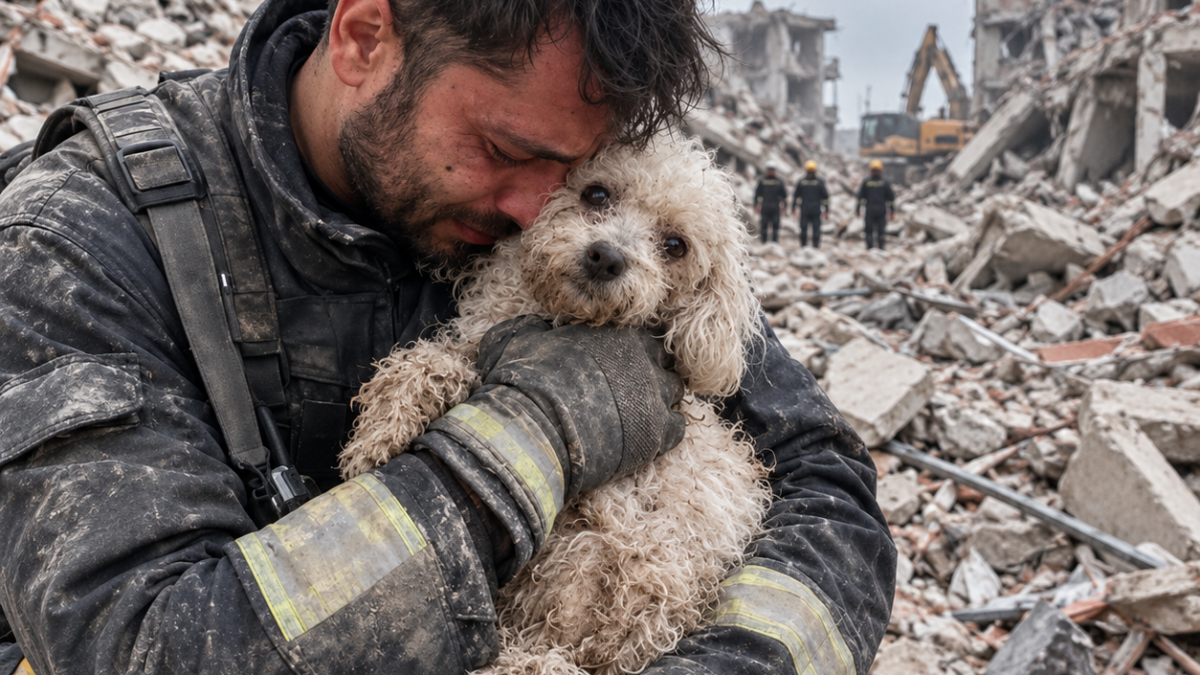
By the fourth day beneath the collapsed apartment building, anything still alive should have been too weak to make a sound.
Everyone around us was preparing to move on when the quietest rescuer on my team put his hand against a slab of concrete and said, “No. Someone is still in there.”
What happened after we opened that pocket of darkness changed the way I understood rescue forever.
My name is Ethan, and I coordinate an urban search-and-rescue team.
I met Marcus on that deployment.
He wasn’t the kind of man who filled silence because it made him uncomfortable. He spoke when something needed to be said, worked until the work was done, and had a way of studying a disaster scene as if the rubble were trying to tell him a story.
By the time we reached that collapsed residence, the search had already entered its third day.
We had pulled people out alive. We had also carried people out beneath blankets.
That changes the atmosphere around a rescue site.
Hope doesn’t disappear all at once. It gets quieter.
On the morning everything changed, Marcus stood alone in front of the east section of the ruins. Concrete floors had folded down onto one another. Dust coated the twisted rebar. Broken furniture was visible through gaps too narrow for a person to enter.
I walked over.
“What are you looking at?”
He didn’t turn.
“Last night I heard something.”
“What kind of something?”
“A scrape. Maybe two.”
I looked at the pile.
We had all been awake too long. After enough hours around shifting concrete, generators, radios, and crying families, your mind could manufacture almost anything.
“You sure?”
That was when he looked at me.
“No,” he said. “But I’m sure enough to check.”
That answer stayed with me.
We marked the section and started carefully.
Nothing about removing collapsed concrete is fast when there may be a living body beneath it. One careless lift can shift the entire load. We used tools when we could, our hands when we had to, and stopped constantly to listen.
An hour passed.
Then two.
A supervisor came by and reminded me that another sector needed manpower.
I told him we needed more time.
He looked at the pile and then at Marcus.
“For what?”
Marcus kept working.
I said, “A possible sound.”
The supervisor exhaled through his nose.
“Possible isn’t confirmed.”
“No,” I said. “But buried alive isn’t dead.”
He walked away unhappy.
By the third hour, even I had started wondering whether fatigue had fooled us.
Then Marcus raised one fist.
Every tool stopped.
The generators seemed suddenly deafening, so we shut down the nearest one.
Marcus dropped to his knees. He brushed dust away from a narrow crack between two slabs, lowered his head, and pressed one ear close to the opening.
Nobody moved.
Ten seconds.
Twenty.
Then his face changed.
Not dramatically.
Marcus never did anything dramatically.
His eyes simply widened.
He looked up at me.
“He’s there.”
I crouched beside him.
“You heard it?”
He nodded.
“Small. Very small.”
From that moment on, we stopped using anything that could create unnecessary vibration.
We moved fragments by hand.
Dust packed under my fingernails and coated my tongue. Sweat ran beneath my helmet. Marcus worked beside me with a patience I had never seen in another rescuer, touching each loose piece before moving it, testing the weight, studying what it supported.
Eventually we opened a gap barely wide enough for an arm.
Marcus removed his glove.
“Careful,” I said.
He nodded and slid his hand into the darkness.
His shoulder disappeared almost to the concrete.
Then he froze.
For one terrible second, I thought he had found what every rescuer fears finding too late.
But Marcus’s expression softened.
His fingers moved.
And from somewhere deep inside that black space came the faintest sound I had ever heard at a disaster site.
Not a cry.
Not a bark.
A tiny, broken whimper.
Marcus closed his eyes.
“He’s alive,” he whispered.
We widened the opening inch by inch.
When there was finally enough room, Marcus reached both arms inside.
I saw him brace his knees against the dust.
Then he began to pull something toward the light.
At first, all I could see was gray.
Gray dust.
Gray fur.
A trembling little body no bigger than a bundled jacket.
And just before Marcus lifted him completely free, the tiny animal opened his eyes.
PART 2
The first thing I noticed was how little he weighed.
Marcus had expected resistance when he pulled him free, so he leaned backward with both arms ready to support something heavier.
Instead, the tiny body came out almost weightless.
A little Bichon Frise.
Or at least that was what we thought beneath all the concrete dust.
His white coat had turned almost completely gray. Powder filled the curls around his ears. His ribs showed beneath the fur when he breathed. One paw was scraped raw, and his whole body shook so violently that Marcus immediately pulled him against his chest.
For a second, none of us spoke.
After four days around sirens, engines, jackhammers, radios, shouting, and concrete being cut apart, there are moments when silence hits harder than noise.
This was one of those moments.
Marcus looked down at him.
“Hey,” he whispered.
The dog’s eyes were barely open.
“Easy. You’re out.”
I reached for the emergency blanket clipped to my pack.
Before I could unfold it, the little dog lifted his head.
I thought he was trying to breathe.
Then he stretched his neck toward Marcus’s chin.
His tongue touched Marcus’s cheek.
Once.
Then again.
Marcus froze.
The dog licked the dust from the corner of his mouth.
Then his nose.
Then his cheek again.
It wasn’t frantic.
It wasn’t fear.
He simply kept pressing his face toward the man who had reached into the darkness and found him.
One of our firefighters turned away.
Another lowered his head.
I felt my throat close.
Marcus had barely spoken to any of us in three days.
I had seen him work through twenty-hour shifts without complaining. I had seen him help carry a body from the ruins and then quietly return to his position because another family was still waiting.
Nothing seemed to break through the armor around that man.
But when that dog licked his face, Marcus’s mouth tightened.
His eyes filled.
He tried to blink the tears away.
He couldn’t.
“Come on, little guy,” he whispered.
The dog licked him again.
Marcus bowed his head over him.
And the quietest man on our team started to cry.
Not loudly.
He just held that tiny animal against his chest while tears ran through the dust on his face.
Then I heard boots behind us.
Gavin Rourke, the recovery operations liaison, stopped a few yards away.
He had spent most of that morning pushing us to release sections of the site for heavy equipment.
Every hour we kept an area classified as active search meant excavators stayed parked.
And parked machines cost money.
Rourke looked at Marcus.
Then at the dog.
His expression did not soften.
“That’s what we spent three hours on?”
I stared at him.
Nobody else said anything.
Rourke pointed toward the pile.
“A dog?”
Marcus slowly raised his head.
The little Bichon was still against his chest.
“He was alive.”
“I can see that.”
“Then you have your answer.”
Rourke’s jaw tightened.
“You pulled five people off adjacent sectors.”
“I reassigned four,” I said. “One stayed on his original task.”
“You know what I mean.”
“Yes,” I said. “I do.”
He glanced at his watch.
“I need East Seven released by noon.”
Marcus looked back at the hole.
I saw something change in his expression.
Not anger exactly.
Distrust.
“No,” he said.
Rourke turned toward him.
“What?”
Marcus pointed at the cavity.
“We search the rest of it.”
“We already searched it.”
Marcus shook his head.
“I heard him after you called it clear.”
Rourke stared at him.
“That’s enough.”
“It wasn’t enough for him.”
“Marcus.”
The way Rourke said his name was meant as a warning.
Marcus didn’t raise his voice.
That almost made it stronger.
“If I heard one thing you missed, I don’t assume you missed only one thing.”
I stepped between them before it became something neither man could take back.
“We’ll finish the acoustic sweep,” I said. “Then I’ll release the sector if it’s clear.”
Rourke looked at me.
“You’re putting that in your report.”
“Absolutely.”
He gave a short laugh without humor.
“Good.”
Then he walked away.
Marcus watched him leave.
I touched his shoulder.
“Forget him. Let’s get this little guy checked.”
Marcus nodded.
But I noticed his eyes return once more to East Seven.
At the time, I thought it was simply the habit of a rescuer who hated leaving uncertainty behind.
Later, I would understand there was more to it.
We carried the dog to the field hospital in a rescue vehicle.
Marcus sat in the rear seat.
He refused to put the dog in the transport crate.
I didn’t argue.
Every time I glanced into the mirror, I saw the same picture: Marcus sitting hunched forward, one arm beneath the dog, the other hand cupped over his back as the little animal trembled.
At one point, the vehicle hit a pothole.
The dog startled awake.
His breathing suddenly became rapid.
Marcus pulled him closer.
“You’re okay.”
The dog buried his face beneath Marcus’s arm.
“You’re not going back there.”
I heard Marcus say it so quietly I almost wondered whether it was meant for the dog or for himself.
The field hospital had been set up inside a large emergency tent several blocks from the collapse.
Doctors and nurses were treating everything from cuts and fractures to dehydration and smoke exposure.
When we walked in, people turned.
Not because rescuers were unusual.
Because of Marcus.
He was a big man covered in concrete dust, carrying a dog small enough to fit beneath one arm as though he were transporting the most fragile thing on earth.
A young veterinarian volunteering with the disaster animal-response unit came toward us.
Her name was Dr. Anna Mercer.
“Where did you find him?”
“East Seven,” I said. “Structural void.”
“How long?”
Marcus answered.
“Four days.”
Anna stopped for half a second.
Then she moved quickly.
“Put him here.”
Marcus placed the dog on a padded examination table.
The moment his hands left him, the little dog tried to stand.
His legs folded.
Marcus caught him.
“It’s okay,” Anna said. “Stay close.”
She listened to his heart.
Checked his gums.
Examined his eyes.
Ran her fingers carefully over his ribs, abdomen, spine, and legs.
The dog never took his eyes off Marcus.
When Anna turned his head to examine one ear, he twisted it back toward him.
When she checked the injured paw, he whimpered and immediately stretched toward Marcus again.
Marcus gave him two fingers.
The dog rested his chin on them.
Anna looked at us.
“He’s dehydrated. Exhausted. Mild abrasions. His lungs sound better than I expected considering the dust.”
“Internal injuries?” I asked.
“I’m not feeling anything obvious, but we’ll monitor him. Fluids first. Small amounts. We need to bring him back slowly.”
Marcus stared at her.
“He was under there four days.”
“I know.”
“How is he alive?”
Anna glanced at the dog.
“Luck. A protected air pocket. Maybe access to moisture from a broken pipe or condensation. And some animals are tougher than we give them credit for.”
Marcus shook his head as if the answer still made no sense.
Anna smiled faintly.
“Sometimes a very small body carries a very large will to live.”
That was essentially what the medical team concluded: he was dehydrated and exhausted but astonishingly intact after four days beneath the wreckage. Marcus remained beside him until we persuaded him to rest, then returned at first light with a blanket and a soft ball.
But there was one problem.
Nobody knew who the dog belonged to.
He had no collar.
No tags.
Anna scanned him twice for a microchip.
Nothing.
Photographs went to animal-control officers, missing-pet volunteers, shelters, and the emergency reunification desk.
For now, he was listed simply as:
MALE DOG — SMALL WHITE MIX — EAST SEVEN RESCUE.
Marcus hated that description.
“He needs a name.”
Anna kept writing on the medical chart.
“He needs fluids.”
“He can have both.”
That made her smile.
“What do you want to call him?”
Marcus looked down at the little dog.
“I don’t know yet.”
I checked my watch.
Marcus had been awake most of the last thirty hours.
“You’re going to sleep.”
“No.”
“That wasn’t a question.”
“I’m fine.”
“You’re swaying while standing still.”
“I said I’m fine.”
Anna looked at me.
Then at him.
“You’re not.”
Marcus frowned.
She pointed to a folding chair beside the treatment crate.
“You can sit there until his first bag of fluids is finished. Then you go sleep for four hours.”
“Two.”
“Four.”
“Three.”
Anna considered it.
“Three and a half.”
Marcus stared at her.
She stared back.
I had known the woman fifteen minutes, and already I liked her.
Marcus finally sat.
The dog was placed in a recovery crate lined with towels.
Marcus put his hand against the bars.
The little Bichon crawled across the towel and curled against his fingers.
Three hours later, he still had not moved.
I finally made him leave.
“I’ll stay,” I said.
He looked at me.
“Call me if he changes.”
“I will.”
“If he starts breathing differently—”
“Marcus.”
“If he throws up—”
“I know.”
“If he wakes up frightened—”
“I’ll be here.”
He hesitated.
For the first time since meeting him, I saw something in his face that wasn’t exhaustion or concentration.
Gratitude.
“Thank you.”
Those were the first personal words Marcus ever said to me.
Then he walked out.
I stayed.
That night taught me almost as much as the rescue itself.
The little dog slept for hours.
At around one in the morning, a volunteer dimmed several lights so patients could rest.
The second the tent became darker, the Bichon woke.
He didn’t bark.
He panicked silently.
He scrambled against the side of the crate, breathing hard, trying to climb.
I stood quickly.
“Hey. Hey, buddy.”
His claws scratched the plastic floor.
I turned the light beside his crate back on.
Immediately, he stopped.
Not completely.
But enough.
He pressed himself against the corner where the light reached him.
I sat on the floor.
“You don’t like the dark anymore, do you?”
His eyes stayed on me.
For the next hour, I kept my hand inside the crate.
Eventually, he crawled toward it.
He did not lick me the way he had Marcus.
He simply rested his head across my wrist.
And I started thinking about what four days must feel like when you don’t understand concrete, rescue teams, structural voids, or clocks.
He would have known only darkness.
Pressure.
Thirst.
Noise somewhere far away.
Then silence.
Maybe he scratched until his paws hurt.
Maybe he slept because he had no strength left.
Maybe every vibration sounded like rescue until it passed.
And then, on the third night, somewhere beyond several feet of concrete, one man heard him.
At 5:41 the next morning, Marcus returned.
He had changed clothes but clearly had not done much sleeping.
Under one arm was a folded blue blanket.
In his other hand was a small soft ball.
I stared at him.
“Where did you even find that?”
“Supply tent.”
“At five in the morning?”
“A volunteer had pet donations.”
“You went shopping?”
Marcus ignored me.
The dog heard his voice.
His head came up.
Marcus crouched beside the crate.
“Morning.”
The little Bichon struggled to his feet.
Then something happened we had not seen before.
His tail moved.
Once.
Then again.
Then it started wagging so hard that his entire rear end shook.
Marcus laughed.
It was the first time I had heard that sound from him.
Anna came over carrying a clipboard.
“Well,” she said. “I guess we know who his favorite person is.”
Marcus opened the crate.
The dog stumbled out and climbed directly into his lap.
He licked Marcus’s hands.
His wrist.
His chin.
His ear.
Marcus laughed again and tried to lean away.
“Okay. Okay. I get it.”
Anna watched them.
“He’s doing well.”
Marcus immediately became serious.
“How well?”
“Good enough that he doesn’t need continuous hospital observation.”
“So he can leave?”
“He can leave medical care.”
Marcus waited.
Anna raised one finger.
“That is not the same thing as saying you own him.”
Marcus’s face fell.
“He has no chip.”
“I know.”
“No collar.”
“I know.”
“Nobody reported him?”
“Not yet.”
“Then who—”
“Marcus.”
Anna softened her voice.
“He could belong to someone who is injured. Someone displaced. Someone who has no phone. Someone who doesn’t know where to look. Disaster reunification can take weeks.”
Marcus looked down at the dog in his lap.
His hand moved slowly through the dusty curls.
“What happens to him?”
“Normally, animal control takes custody while the owner search continues.”
The little dog pressed himself closer to Marcus.
Marcus’s jaw tightened.
Anna noticed.
“There is another option.”
He looked up.
“Emergency foster.”
“What do I have to do?”
Anna smiled.
“Fill out more forms than any reasonable person should be required to fill out before breakfast.”
“I’ll do it.”
“You understand that if an owner is found, you have to return him.”
Marcus didn’t answer immediately.
The dog’s head rested against his chest.
Finally he nodded.
“If someone loves him and has been looking for him, he belongs with them.”
That answer told me more about Marcus than anything he had said since I met him.
Anna handed him the paperwork.
“What are you putting under temporary name?”
Marcus stared at the blank line.
I said, “Dusty?”
He looked at me.
I shrugged.
“I’m helping.”
“No.”
Anna suggested, “Lucky?”
Marcus shook his head.
The little dog reached up and licked his chin again.
I laughed.
“Kiss?”
Marcus gave me a look that ended that suggestion immediately.
He stared toward the opening of the tent.
Dawn had begun pushing pale light across the disaster zone.
Then he looked back at the dog.
“Phoenix.”
Anna stopped writing.
“Phoenix?”
Marcus nodded.
“Came out of something that should’ve killed him.”
I smiled.
“Phoenix it is.”
Within two hours, Phoenix left the field hospital wrapped in the blue blanket Marcus had brought.
He carried the ball in his mouth for exactly thirty seconds before falling asleep against Marcus’s chest.
I thought that was the end of the story.
A rescue.
A miracle.
A dog going home with the man who found him.
I was wrong.
Because while Phoenix was being examined, Gavin Rourke had filed an incident report.
I learned about it when I returned to command.
Our section chief, Denise Calder, called me into the operations trailer.
She closed the door.
That was the first bad sign.
The second was the paper on the table.
“What is this?” I asked.
“You tell me.”
I read the top line.
OPERATIONAL DEVIATION — SECTOR E7.
My name was listed.
So was Marcus’s.
The report claimed I had diverted personnel from assigned rescue sectors based on “an unverified nonhuman acoustic indication.”
It stated that the decision had delayed debris-clearance operations by three hours and twenty-six minutes.
Then I reached the final paragraph.
My stomach tightened.
Rourke recommended a formal review of Marcus’s judgment and my command decisions.
Denise watched me finish.
“Well?”
“He left out the part where Marcus was right.”
“It mentions the dog.”
“He left out the part where a living being was in a sector he had already classified as clear.”
Denise tapped the report.
“He argues that rescue resources are allocated primarily to human survival.”
“I know what our mission is.”
“Then tell me why you did it.”
I put the report down.
“Because Marcus heard a sound.”
“That’s it?”
“That is exactly it.”
Denise leaned back.
“You didn’t know it was a dog.”
“No.”
“If you had?”
I thought about it.
“I would’ve evaluated manpower and structural risk.”
“That wasn’t my question.”
I knew what she was asking.
Would I have kept digging if I knew the sound belonged to an animal?
I saw Phoenix licking concrete dust from Marcus’s face.
“Yes,” I said. “With the conditions we had that morning, I would’ve finished the search.”
Denise studied me for a long time.
Then she said, “Good.”
I blinked.
She pushed the report back toward me.
“Because the problem isn’t the dog.”
“What is?”
“East Seven was documented as acoustically cleared twelve hours before Marcus heard that sound.”
I stopped.
“What?”
She slid a tablet across the table.
On the screen was the sector log.
E7 — PRIMARY SEARCH COMPLETE.
E7 — SECONDARY VISUAL COMPLETE.
E7 — ACOUSTIC NEGATIVE.
Signed electronically by Gavin Rourke.
Time stamp: 18:12 the previous evening.
But Marcus had told me he’d heard the scratching during the night.
Denise said, “If that dog was able to produce an audible sound after East Seven was signed clear, we need to know whether conditions changed or the sweep wasn’t done properly.”
“Who performed the acoustic check?”
“That’s what we’re trying to establish.”
I looked again at the time stamp.
Something bothered me.
“What was happening at 18:12?”
Denise’s eyes narrowed.
“You remember?”
I did.
At 18:12, three of the acoustic specialists had been working a rescue on the west side.
I had been there.
Marcus had been there.
Almost every person qualified to run a full acoustic sweep had been somewhere else.
“Who signed the test record?”
Denise didn’t answer.
She didn’t need to.
My anger changed shape.
This was no longer about somebody criticizing us for spending three hours rescuing a dog.
If the clearance had been falsified, Rourke hadn’t simply made an administrative mistake.
He had authorized heavy machinery to approach a void that contained a living creature.
And if Phoenix had been a child?
An injured resident?
A firefighter?
The page would have looked exactly the same.
CLEAR.
I looked at Denise.
“I want the radio archive.”
“So do I.”
“When?”
“Already requested.”
I stood.
“Where’s Rourke?”
“Ethan.”
“Where is he?”
“Sit down.”
I didn’t.
Denise lowered her voice.
“You are not going to confront him while we’re collecting evidence.”
“He nearly had excavators put on that section.”
“And if you walk out there angry, he’ll know exactly what we’re looking at.”
That stopped me.
“Let the record talk,” she said.
I sat down.
For the next several days, I did what rescue coordinators are trained to do.
I worked.
And I waited.
Phoenix, meanwhile, began learning what home was.
Marcus lived alone in a small house near the edge of town.
The first night, he placed the blue blanket in a dog bed beside his couch.
Phoenix refused to use it.
He slept on Marcus’s work boot instead.
Marcus sent me a photograph at 2:13 in the morning.
No message.
Just Phoenix curled around the boot as though someone might steal it.
I wrote back:
You bought him a bed.
Marcus replied:
He disagrees.
That was the beginning of our friendship.
I started hearing from Marcus almost every day.
Usually about Phoenix.
Phoenix wouldn’t eat unless Marcus sat beside him.
Phoenix became terrified when a cabinet door slammed.
Phoenix refused to enter dark rooms.
Phoenix followed Marcus to the bathroom, kitchen, laundry room, backyard, and once into a storage closet before apparently realizing he had made a serious tactical error.
Three days after the rescue, Marcus called me.
Not texted.
Called.
I answered immediately.
“What happened?”
“He won’t sleep.”
“Is he sick?”
“No.”
“Eating?”
“Yes.”
“Drinking?”
“Yes.”
“Then what’s wrong?”
Marcus was quiet.
“When I turn off the light, he starts shaking.”
I remembered the field hospital.
“Leave one on.”
“I did.”
“And?”
“He sleeps.”
“Then leave it on.”
“For how long?”
“As long as he needs.”
Marcus was silent.
Then he said, “Okay.”
I almost laughed.
Marcus could crawl into a collapsed building with aftershocks still moving the debris.
But he needed permission to leave a lamp on for a frightened dog.
“Anything else?” I asked.
“He hides food.”
“That’s not unusual after deprivation.”
“In my couch.”
“Less ideal.”
“I found half a boiled chicken breast under a cushion.”
“Phoenix is preparing for winter.”
“He’s a Bichon.”
“Then he’s preparing badly.”
There was a pause.
Then Marcus laughed.
That laugh became more common.
At the disaster site, however, things were getting worse.
Rourke started pushing back.
First he complained about “delays in transition.”
Then he asked why our team had not released two additional sectors.
Then he requested that Marcus be removed from structural search pending review.
Denise denied it.
Rourke escalated.
He argued that emotional decision-making had compromised efficiency.
He never used Phoenix’s name.
He called him “the animal.”
That bothered Marcus more than the disciplinary threat.
One evening, after a twelve-hour shift, we sat on the rear bumper of a rescue truck eating cold sandwiches.
Marcus stared at the ground.
“You know what bothers me?”
“Rourke?”
“He keeps saying I got emotional.”
“You did.”
Marcus looked at me.
“You cried all over a dog.”
“I hate you.”
“You’ve known me a week.”
“Long enough.”
I took another bite.
“Being emotional doesn’t mean you were wrong.”
“I know.”
“Then what’s bothering you?”
He looked toward East Seven.
“He signed that place clear.”
I put my sandwich down.
“Who told you?”
“Nobody.”
“Then how do you know?”
“I saw the board before we went in.”
I said nothing.
Marcus continued.
“At midnight, when I first heard the scratching, East Seven already had a green mark.”
“You reported the sound?”
His eyes moved to mine.
“Yes.”
That was new.
“To who?”
“Rourke.”
My stomach tightened.
“What did he say?”
Marcus stared at the darkness beyond the floodlights.
“He told me it was thermal settling.”
“Exactly?”
“He said, ‘Concrete shifts at night. Stop chasing ghosts.’”
“Was it on radio?”
Marcus nodded.
“What channel?”
“Operations Three.”
I stood.
He looked up.
“Where are you going?”
“To Denise.”
“Ethan.”
I turned.
Marcus remained seated.
“Don’t make this about getting even.”
I stared at him.
“He tried to write you up.”
“I don’t care.”
“He dismissed a live indication and then signed a report implying you invented it.”
“I care about the next person under a pile.”
That silenced me.
Marcus looked down at his hands.
“If you go after him because you’re angry, he can make it about personalities. If you show what happened because it can keep somebody from dying next time, then he can’t.”
I realized then that the man everybody described as quiet wasn’t quiet because he lacked things to say.
He was quiet because he refused to waste words.
The radio recording arrived the following morning.
Denise called me into the trailer again.
This time, two safety investigators were waiting.
She played the file.
Static.
Then Marcus’s voice.
“Operations Three, this is Search Four.”
Rourke answered.
“Go.”
“Possible intermittent acoustic indication, East Seven. Light scraping. Requesting five-minute silence window.”
A pause.
Then Rourke.
“East Seven is cleared.”
Marcus replied, “Copy, but I’m hearing something.”
Rourke’s voice became sharper.
“Concrete contraction. We ran it already.”
“Requesting recheck.”
“Negative. We need your team west. Stop chasing ghosts.”
The recording ended.
Nobody spoke.
One investigator asked, “What time was this?”
Denise answered.
“01:16.”
He looked at the clearance log.
“And the documented acoustic sweep?”
“18:12.”
“Performed by?”
Denise turned another page.
“That’s the issue.”
The signature field contained a technician’s employee number.
The technician had not been in East Seven.
He hadn’t even been on that side of the site.
He had been treating a shoulder injury at the medical tent.
I felt cold despite the heat inside the trailer.
The investigator looked at me.
“When did the dog come out?”
“10:47 the next morning.”
“Alive?”
“Yes.”
He wrote something down.
Then he asked the question all of us were thinking.
“If your rescuer had followed the clearance status without question, when would mechanical debris removal have begun?”
Denise answered quietly.
“Noon.”
Thirteen minutes after Phoenix came out.
I pictured the excavator parked behind the barricade.
Its steel bucket.
Its weight.
The slab above that tiny void.
Thirteen minutes.
That was the difference.
Not between paperwork and paperwork.
Between a dog being carried out in Marcus’s arms and a machine driving over the place where he was trapped.
The investigators suspended the transition authorization for East Seven immediately.
A complete new search was ordered.
No additional survivors were found.
But that fact didn’t erase what had happened.
It only meant we had been lucky once.
Rourke found out about the investigation that afternoon.
He came looking for me.
I was checking equipment when he walked into the staging area.
“Did you pull the radio archive?”
I kept working.
“The investigators did.”
“Because of you.”
“Because of an inaccurate clearance record.”
He stepped closer.
“You’ve turned an animal recovery into an ethics investigation.”
“It was a live rescue.”
“It was a dog.”
I stopped.
Around us, several rescuers went quiet.
I faced him.
“That’s the part you still don’t understand.”
“What?”
“We didn’t know it was a dog.”
Rourke said nothing.
I continued.
“When Marcus heard that sound, there was no label attached to it. It could have been anyone.”
“You’re being dramatic.”
“No. I’m being exact.”
I pointed toward East Seven.
“You signed that sector acoustically clear. The technician whose number is on the report was at the medical tent.”
His face changed.
Only slightly.
But enough.
I knew.
He knew what had happened.
“Documentation errors happen in disasters.”
“Then tell the investigators.”
“I will.”
“Good.”
He leaned closer.
“You think saving one little dog makes you heroes?”
I almost answered angrily.
Then I remembered Marcus.
Make it about the next person under a pile.
So I said, “No. I think ignoring a sound because the schedule says you should be finished makes you dangerous.”
Rourke walked away.
That evening I went to Marcus’s house for the first time.
Phoenix reached the door before Marcus did.
The transformation shocked me.
His coat had been washed clean.
Underneath all that gray dust, he was bright white.
His curls were still uneven where Anna had clipped areas for treatment. One front paw was lightly bandaged. But his eyes were clear.
And his tail did not stop moving.
He ran toward me.
Then stopped six feet away.
He stared.
I crouched.
“Don’t remember me?”
Phoenix tilted his head.
I held out my hand.
He sniffed.
Then suddenly his entire body changed.
He rushed forward.
Two paws hit my knee.
His tongue caught my chin.
I laughed.
“All right. Apparently you do.”
Marcus stood in the doorway.
“He remembers everybody from the site.”
“Or he likes people who smell like concrete dust.”
“He hates concrete dust.”
“Fair point.”
I entered the house.
A lamp was on in every room.
I looked at Marcus.
He shrugged.
“Temporary.”
Phoenix followed us into the kitchen.
There was a new water bowl.
A new food bowl.
Three toys.
A small dog bed.
A larger dog bed.
And the blue blanket from the hospital.
I stared.
“You’ve had him three days.”
“He needed options.”
“He’s fourteen pounds.”
“He moves around.”
“You bought two beds.”
“The first one seemed too small.”
Phoenix climbed onto Marcus’s boot and sat down.
I pointed.
“He appears deeply concerned about bed size.”
Marcus ignored me.
We sat on the porch.
Phoenix curled beside his chair.
For a few minutes, neither of us spoke.
Then Marcus asked, “What happened with Rourke?”
I told him.
All of it.
The false technician number.
The radio archive.
The thirteen-minute window.
Marcus’s hand stopped moving on Phoenix’s back.
“Thirteen minutes?”
I nodded.
He looked toward the yard.
For the first time since I had known him, I saw real anger on his face.
Not loud anger.
Something colder.
“He knew I reported the sound.”
“Yes.”
“And he still ordered the machines in.”
“Yes.”
Marcus stood.
Phoenix immediately stood too.
“Where are you going?”
“Back.”
“To the site?”
“Yes.”
“Why?”
“To talk to him.”
I almost smiled despite myself.
“So now revenge is acceptable?”
Marcus glared at me.
“Don’t.”
I stood.
“You were the one who told me not to make this personal.”
“He could’ve killed him.”
“There it is.”
Marcus looked down.
Phoenix was pressed against his leg.
I lowered my voice.
“And you’re right to be angry.”
He said nothing.
“But don’t give Rourke what he wants.”
“What does he want?”
“A fight he can describe instead of a record he can’t explain.”
Marcus breathed slowly.
I could see him forcing himself to listen.
“The investigation is moving,” I said. “Let it.”
“He shouldn’t be on that site.”
“He won’t be for long.”
“You don’t know that.”
“No.”
I looked at Phoenix.
“But I know there are radio recordings, digital logs, equipment orders, and a technician who never performed the inspection listed under his number.”
Marcus sat again.
Phoenix climbed into his lap.
I said, “That’s better than punching him.”
“I wasn’t going to punch him.”
“You were absolutely going to punch him.”
Marcus looked offended.
“I was going to speak to him.”
“You were putting your boots on.”
“I speak better in boots.”
I laughed.
After several seconds, Marcus did too.
Then Phoenix licked his wrist.
The anger drained from his face.
“Thirteen minutes,” he said again.
“I know.”
Marcus lowered his forehead to the dog’s head.
Phoenix closed his eyes.
That was when I realized something else.
Marcus had rescued Phoenix from beneath the building.
But Phoenix had also given Marcus something dangerous.
Something Marcus had apparently spent years avoiding.
Someone to lose.
Over the next two weeks, the owner search continued.
We posted Phoenix’s photograph at every disaster center.
Animal-control staff checked missing-pet reports.
Volunteers contacted veterinary clinics.
Anna scanned him again with a different microchip reader.
Nothing.
Several people contacted us claiming Phoenix might be theirs.
Each claim had to be investigated.
One person insisted the dog was named Snowball.
Phoenix showed no recognition.
Another sent an old photograph of a white Maltese that was clearly female.
A third wanted to collect him but could not describe a single identifying feature and disappeared the moment animal control asked for veterinary records.
Marcus handled every possibility the same way.
He grew quiet.
Too quiet.
One night, I asked what he was afraid of.
We were sitting in his kitchen.
Phoenix was asleep under the table, one paw touching Marcus’s shoe.
“If his family is alive,” Marcus said, “I want them to find him.”
“But?”
Marcus looked down.
“I don’t want them to find him.”
He looked ashamed after saying it.
I understood.
Both feelings could be true.
“You love him.”
“He’s been here twelve days.”
“That wasn’t a denial.”
Marcus rubbed his face.
“I’ve never had a dog.”
“I gathered that from the two beds.”
He ignored me.
“I didn’t plan this.”
“Nobody plans the important ones.”
He looked at Phoenix.
“What if somebody comes tomorrow?”
“Then you do what’s right.”
“And after that?”
I knew what he meant.
Who would be waiting when he came home?
I had learned pieces of Marcus’s life slowly.
His parents were gone.
No siblings nearby.
No wife.
No children.
He had spent most of his adult life moving from one disaster deployment to another.
He was the man you called when a building fell down.
He knew how to enter broken places.
He just didn’t seem to know what to do with an intact home when nobody was inside it waiting for him.
Now somebody was.
Even if that somebody weighed fourteen pounds and stole chicken.
“I don’t know,” I said.
Marcus nodded.
That was the only honest answer.
The investigation into Rourke moved more quickly.
The digital record showed that the acoustic-clearance entry had been created from Rourke’s tablet.
The technician’s identification number had been entered manually.
The technician denied authorizing it.
Then investigators found something worse.
East Seven was not the only sector with questionable documentation.
Three clearance records had been entered during periods when the listed technicians were verifiably elsewhere.
All three sectors had been scheduled for early transition to mechanical debris removal.
I stared at the records during the review meeting.
“Why?”
One investigator answered carefully.
“We don’t establish motive before interviews are complete.”
But Denise had an explanation.
The recovery contractor’s schedule included financial penalties for missed transition targets.
Rourke’s role involved coordinating those targets.
I felt anger rise again.
“You’re telling me he was clearing search sectors to keep excavators on schedule?”
Denise stopped me.
“We’re saying the timing requires investigation.”
The distinction mattered.
So did the facts.
I learned something during those weeks that every angry person should probably learn at least once.
Justice is slower than rage.
Rage wants a door slammed open.
Justice wants every page numbered.
Rage wants somebody humiliated.
Justice wants evidence strong enough that humiliation is irrelevant.
Rourke was removed from active site authority while the investigation continued.
He blamed Marcus.
Then me.
Then Denise.
Then the contractor.
Then “chaotic disaster conditions.”
What he never did was explain how a technician’s number ended up on an inspection the technician had not performed.
Three weeks after Phoenix’s rescue, we attended the formal operational review.
Rourke sat across from us with two representatives from his company.
Marcus wore a clean dark shirt.
Phoenix was not allowed inside the municipal hearing room.
He stayed with Anna.
Marcus had checked his phone seven times before proceedings began.
I leaned toward him.
“He’s fine.”
“I know.”
“Anna is a veterinarian.”
“I know.”
“You trust her.”
“I know.”
“You’ve checked your phone again.”
Marcus put it face down.
The chair of the review panel began with routine questions.
Then the discussion reached East Seven.
Rourke’s attorney argued that the site had been chaotic and that misentered personnel numbers were clerical mistakes.
He emphasized that the rescued animal was “nonhuman.”
Marcus’s hand tightened beneath the table.
I whispered, “Don’t.”
He remained still.
The attorney continued.
“While everyone is grateful the animal survived, emergency managers must make difficult decisions about resource allocation.”
The panel chair looked toward me.
“Mr. Hale, why did you authorize continued searching?”
“Because one of my rescuers reported a live acoustic indication.”
“Did you know the source was an animal?”
“No.”
“If you had known?”
“Once the sound was confirmed and structural conditions allowed safe access, I would have completed the extraction with a small team.”
“Why?”
“Because we were already there, the void was accessible, and the subject was alive.”
Rourke shifted in his chair.
The panel chair turned to Marcus.
“Mr. Reed, describe your original report.”
Marcus leaned toward the microphone.
“At approximately 1:16 a.m., I heard intermittent scratching from East Seven.”
“Were you certain?”
“No.”
“What did you do?”
“I requested a silence window and acoustic recheck.”
“Was that request granted?”
“No.”
“Who denied it?”
Marcus looked across the room.
“Mr. Rourke.”
The recording was played.
His voice filled the chamber.
Possible intermittent acoustic indication, East Seven.
Then Rourke’s.
East Seven is cleared.
Then Marcus.
I’m hearing something.
Then the sentence that seemed different now that everyone knew what was under the concrete.
Stop chasing ghosts.
The recording ended.
The panel chair looked at Rourke.
“Did you say that?”
“Yes.”
“Why?”
“Because we’d had multiple false indications.”
“Had East Seven received the acoustic sweep recorded at 18:12?”
“My understanding was that it had.”
“Who gave you that understanding?”
Rourke hesitated.
“I don’t recall.”
The panel chair held up a document.
“The entry originated from your device.”
“The device was shared at times.”
“Your login?”
Silence.
“It may have remained logged in.”
The technician testified next.
He was calm.
Very calm.
“No,” he said. “I did not perform that sweep.”
“Did you authorize anybody to use your identification number?”
“No.”
“Where were you at 18:12?”
“Medical.”
“Can that be verified?”
“Yes.”
It already had been.
The panel chair then asked the question that ended whatever defense Rourke had left.
“Mr. Rourke, at what time did you order mechanical equipment to stage for East Seven?”
Rourke looked at his attorney.
The attorney whispered something.
Finally he answered.
“Approximately eleven.”
The panel chair checked the record.
“Actual order was 10:34.”
Nobody spoke.
“What time was the dog extracted?”
Denise answered.
“10:47.”
“Planned mechanical entry?”
“Noon.”
The chair looked down at the documents.
Then back at Rourke.
“So a live subject remained inside a sector documented as acoustically clear, a rescuer subsequently reported a sound and requested reassessment, that request was denied, and heavy machinery was ordered toward the sector before the subject had been found.”
Rourke said, “You’re making it sound deliberate.”
The chair’s expression did not change.
“I am describing the sequence.”
That sentence stayed with me.
Facts rarely need shouting when they’re arranged correctly.
Rourke’s company representative asked to speak.
He announced that the company had terminated Rourke’s site authority pending its own investigation and would cooperate with safety regulators.
Marcus showed no satisfaction.
No smile.
No triumph.
He only asked one question when the panel allowed him to speak.
“What changes now?”
The chair looked at him.
“What do you mean?”
“Next disaster. Next site. What changes?”
The room became still.
Marcus continued.
“If a rescuer reports a sound in a cleared sector, what stops someone from saying the schedule matters more?”
The review eventually produced new procedures.
Any new acoustic indication after sector clearance required documented reassessment before mechanical entry.
No clearance record could be certified using another technician’s identification.
Disputed sectors required dual sign-off.
The language was dry.
Procedures usually are.
But when I read the final policy, I didn’t see paragraphs.
I saw white curls covered in concrete dust.
I saw Marcus reaching into darkness.
I saw an excavator waiting thirteen minutes away from a miracle.
Rourke was removed from disaster-response operations.
Regulatory and employment consequences followed from the falsified records.
Marcus never celebrated.
When I asked whether he felt vindicated, he shook his head.
“I feel lucky.”
“That’s it?”
“We found the mistake because Phoenix lived long enough to prove the paperwork wrong.”
He looked at me.
“What if he hadn’t?”
I had no answer.
A month after the rescue, Anna called Marcus.
I happened to be with him.
We were repairing a loose section of fence around his backyard.
Phoenix had discovered that “small dog” and “small escape artist” were apparently the same thing.
Marcus answered the phone.
“Yeah?”
He listened.
His hammer slowly lowered.
I watched his face.
“What?”
More silence.
Then:
“You’re sure?”
His eyes closed.
“Okay.”
He ended the call.
I immediately feared the worst.
“Someone claimed him?”
Marcus looked at me.
“No.”
“Then what?”
“The hold period is finished.”
I stared.
He swallowed.
“No verified owner.”
For several seconds, he seemed unable to say anything else.
Then he looked toward the yard.
Phoenix was attacking a yellow leaf with complete commitment.
Marcus laughed once.
It broke halfway through.
“He’s legally available for adoption.”
I smiled.
“You going to think about it?”
Marcus turned toward me with an expression suggesting I had become intellectually disappointing.
“I already submitted the application.”
“When?”
“Two weeks ago.”
“You said you didn’t know if you were keeping him.”
“I lied.”
I laughed so hard Phoenix stopped fighting the leaf and stared at me.
Marcus’s adoption was approved three days later.
Anna insisted we come to the animal-response center in person to sign the final papers.
“It isn’t necessary,” Marcus said.
“It is to me,” she replied.
So we went.
Phoenix wore a blue collar.
Marcus had spent forty minutes choosing it.
I knew because he sent me eleven photographs from the pet store.
He claimed he was “checking durability.”
Nine of the photographs involved color.
When Anna placed the adoption document in front of him, Marcus read every line.
Then he reached the final box.
ANIMAL NAME.
He wrote:
PHOENIX REED.
His hand stopped.
He stared at it.
Anna quietly looked away.
I pretended to inspect a poster on the wall.
Marcus signed.
Phoenix sat beside his chair.
When Marcus put down the pen, Anna unclipped the temporary shelter lead.
“That’s it.”
Marcus looked at her.
“That’s it?”
“He’s yours.”
Phoenix immediately climbed onto Marcus’s leg.
Anna smiled.
“Or you’re his. I’m not sure which.”
Marcus knelt.
Phoenix licked his face.
Of course he did.
That was his answer to everything.
Marcus laughed and pulled him close.
“I got you.”
This time, unlike beneath the rubble, Phoenix didn’t tremble.
He simply leaned into him.
Months passed.
The emergency tents disappeared.
Roads reopened.
The ruined residence was eventually dismantled section by section.
People moved into temporary homes.
News crews left.
The world did what it always does after disaster.
It continued.
But some things remained.
Marcus kept the blue blanket.
Phoenix no longer needed a light in every room, though Marcus still left one glowing in the hallway at night.
The hidden food stopped after about six weeks.
The nightmares took longer.
Sometimes Phoenix would wake suddenly, clawing at the bedding.
Marcus learned not to grab him.
He would sit nearby.
Say his name.
Wait.
Eventually Phoenix would recognize the room.
Then he would crawl across the bed and press his body against Marcus.
Marcus told me about the first night Phoenix slept with every light off.
He spoke as proudly as if the dog had graduated from college.
“He made it until morning.”
“Congratulations.”
“No shaking.”
“Good.”
“He even slept through a thunderstorm.”
“Marcus.”
“What?”
“You realize normal people discuss sports.”
“He hates the vacuum cleaner.”
“Of course he does.”
“But thunder is fine.”
“Remarkable.”
“You’re making fun of me.”
“Constantly.”
Phoenix also changed Marcus.
That part happened more slowly.
Before the rescue, Marcus had been the first man on a site and the first one to disappear when the shift ended.
He never came to team dinners.
Never attended barbecues.
Never stayed after training.
Now he had reasons.
At first, the reason was always Phoenix.
Can’t stay. Need to feed Phoenix.
Need to walk Phoenix.
Phoenix has a vet appointment.
Phoenix doesn’t like being alone after dark.
Then one Saturday, Marcus showed up to a team cookout.
With Phoenix.
The dog became the center of attention within approximately six seconds.
A firefighter named Luis slipped him a piece of chicken.
Marcus noticed.
“Don’t feed him from the table.”
Luis froze.
Phoenix stared at the chicken.
Marcus stared at Luis.
Luis slowly withdrew his hand.
Then Phoenix placed one paw on Luis’s boot.
Luis looked at Marcus.
“This feels manipulative.”
“It is.”
“Just one piece?”
“No.”
Phoenix tilted his head.
Marcus sighed.
“Small piece.”
Phoenix had defeated him.
Again.
Anna came to the cookout too.
She sat beside me watching Marcus explain to three firefighters why Phoenix required a particular harness.
“You know,” she said, “I wasn’t sure which one of them was the patient.”
“Still aren’t?”
“No.”
Neither was I.
A year after the collapse, our department held a training seminar on search discipline and post-clearance acoustic reports.
Marcus was asked to speak.
He refused.
Then Denise asked again.
He refused again.
Then I told him Rourke had once called him emotional.
Marcus agreed to speak.
I knew which button to push.
He stood in front of sixty rescuers with no slides.
No dramatic introduction.
No polished speech.
Phoenix sat beside the podium wearing a small working-dog-style vest that clearly had no official purpose other than making everyone smile.
Marcus looked at the room.
Then he said:
“Don’t trust silence just because somebody wrote ‘clear’ on a board.”
That was his opening.
He explained the sequence.
The sound.
The denied request.
The search.
The void.
The thirteen minutes.
He never attacked Rourke personally.
He never called himself brave.
He never described the rescue as heroic.
At the end, somebody asked:
“How did you know the sound was real?”
Marcus looked down at Phoenix.
“I didn’t.”
The room waited.
“I knew I hadn’t proved it wasn’t.”
That line became part of our training culture.
Not officially.
Nobody printed it in a manual.
But rescuers repeated it.
I knew I hadn’t proved it wasn’t.
It meant uncertainty was not permission to stop thinking.
It meant procedures were tools, not substitutes for judgment.
It meant a green mark on a board did not possess ears.
After the seminar, a young rescuer approached Marcus.
“I would’ve assumed fatigue.”
Marcus nodded.
“So did I.”
“But you kept checking.”
“Yes.”
“Why?”
Marcus looked at Phoenix.
“Because if I’m wrong and check, I lose time.”
He paused.
“If I’m wrong and don’t check, somebody may lose everything.”
That was Marcus.
Few words.
Heavy ones.
Two years later, I visited his house on the anniversary of Phoenix’s rescue.
The yard had changed.
Marcus had built a low wooden ramp to the porch because Phoenix had developed a minor knee problem.
There were toys everywhere.
The dog who once had nothing now owned more property than Marcus.
Phoenix came racing toward my truck.
His coat was bright.
His body was strong.
He ran three circles around me before allowing me through the gate.
Marcus came outside carrying coffee.
“You’re late.”
“By four minutes.”
“He’s been waiting.”
“How does he know?”
“He knows your truck.”
Phoenix jumped against my leg.
I bent down.
“Apparently he does.”
We sat on the porch.
For a while, Phoenix lay between us in the sun.
Then I noticed something inside the living room.
The blue blanket.
Still folded beside his bed.
“You kept it.”
Marcus followed my gaze.
“Yeah.”
“He doesn’t use it anymore.”
“No.”
“Why keep it?”
Marcus thought about the question.
Then he said, “So I remember.”
“Remember what?”
He looked at Phoenix.
“How close I came to never knowing him.”
There are sentences you hear once and carry forever.
That was one of mine.
Marcus had told me once that before Phoenix, he believed nobody really needed him.
I hadn’t understood how serious he was.
That afternoon, sitting on the porch, he finally explained.
Years earlier, he’d lost someone he loved.
He did not give me every detail.
He didn’t need to.
Afterward, he had built his life around emergencies.
Emergencies were simple compared with grief.
A collapsed wall needed stabilization.
A trapped person needed extraction.
A fire needed extinguishing.
You could act.
You could measure.
You could solve something.
Ordinary loneliness was different.
There was no tool for it.
No procedure.
No command board.
So Marcus worked.
And worked.
And worked.
Then one night, inside a place everyone else had classified as empty, he heard scratching.
“I thought I was saving him,” Marcus told me.
Phoenix slept beside his chair.
Marcus rubbed the dog’s ear.
“But when he came out and started licking my face…”
His voice tightened.
“I don’t know.”
He stopped.
I waited.
“He looked at me like finding me was the best thing that had ever happened to him.”
I said nothing.
Marcus stared across the yard.
“And I realized I couldn’t remember the last time anybody had been happy just because I walked into a room.”
Phoenix opened one eye at the sound of his voice.
His tail tapped the porch.
Once.
Twice.
Marcus smiled.
“He does that every day.”
There was nothing useful I could say.
So I didn’t try.
Maybe that was another thing Marcus had taught me.
Not every silence needs fixing.
Some need listening.
Years have passed since that rescue.
I have worked other collapses.
Other floods.
Other fires.
I have seen extraordinary courage.
I have watched strangers crawl toward danger because somebody they had never met needed help.
I have watched dogs search debris until their paws bled.
I have watched nurses sleep in chairs.
I have watched firefighters give their water to people who had none.
And I have learned never to use the word “small” carelessly.
A small sound can stop an excavator.
A small decision can expose a dangerous system.
A small dog can change a man.
Phoenix never became a famous rescue dog.
He didn’t need to.
He never searched buildings.
Never earned a working certification.
Never appeared on television after those first photographs from the disaster.
He simply lived.
He ran through Marcus’s yard.
Slept at the foot of his bed.
Stole socks.
Hated vacuum cleaners.
Loved chicken.
Waited at the window whenever Marcus left.
And every morning, according to Marcus, Phoenix woke him by placing one paw against his face.
The same man who once barely smiled now began most mornings laughing.
Eventually Phoenix’s muzzle started turning cream around the edges.
He slowed down.
Marcus adjusted.
The walks became shorter.
The ramp became less optional.
The bed became thicker.
When Phoenix could no longer jump onto the couch easily, Marcus built him a step.
Then another.
I pointed out that he could simply buy pet stairs.
Marcus looked offended.
“I can build stairs.”
“I know.”
“Then why would I buy them?”
“Because you’ve rebuilt them three times.”
“The angle was wrong.”
“The dog weighs fifteen pounds.”
“Fourteen point six.”
I stared at him.
“You weigh him?”
“Monthly.”
Of course he did.
One evening, many years after East Seven, I received a photograph from Marcus.
Phoenix was asleep on the blue blanket.
The same one from the field hospital.
Under the photograph Marcus had written:
He chose it tonight.
I called.
Marcus answered quietly.
“You okay?”
“Yeah.”
“How is he?”
“Old.”
I understood.
I drove over.
Phoenix was lying beside the couch.
He raised his head when I came in.
His tail moved.
Slower now.
But it moved.
I sat beside him.
“Hey, miracle dog.”
He sniffed my hand.
Then licked one finger.
Marcus sat on the floor opposite me.
For the next hour, we talked.
Not about disasters.
Not about Rourke.
Not about regulations.
We talked about Phoenix.
The first stolen sandwich.
The couch chicken.
The fence escape.
The night he barked for forty minutes at a plastic grocery bag.
The time he stole Marcus’s glove and hid it beneath the bed.
The day he learned darkness was safe again.
The first morning he woke Marcus with a paw on the face.
There is a strange mercy in remembering somebody while they are still beside you.
Phoenix lived another year.
A good year.
A slower year.
Marcus carried him down the porch steps toward the end.
Phoenix didn’t seem embarrassed by it.
He had been carried out of darkness once.
He trusted those arms.
When his final day came, Marcus called me and Anna.
We both went.
Phoenix was at home.
On the blue blanket.
Sunlight came through the window.
Marcus held him the way he had held him beneath the ruins all those years before.
Phoenix’s head rested beneath his chin.
Marcus whispered things I did not hear.
I didn’t try to.
Those words belonged to them.
Just before the end, Phoenix lifted his head.
It took effort.
He touched his nose to Marcus’s cheek.
Then his tongue.
Once.
A tiny kiss.
Marcus closed his eyes.
The circle completed itself.
The first thing Phoenix had done after emerging from four days of darkness was kiss the face of the man who saved him.
And one of the last things he did was the same.
Marcus cried.
So did I.
So did Anna.
But Phoenix was not afraid.
That mattered.
He left this world in light.
In the house where every dark room had once frightened him.
On the blanket that had followed him from his first safe night.
In the arms he had chosen.
A few weeks later, I went back to Marcus’s house.
The silence was different.
Phoenix’s bowls were gone.
The toys had been collected into a box.
The two absurd dog beds had finally disappeared.
But the blue blanket remained folded on the couch.
Marcus and I sat on the porch.
Neither of us spoke for a long time.
Finally I asked:
“Would you do it again?”
He looked at me.
“What?”
“Knowing how much losing him hurts. Would you still crawl into East Seven?”
Marcus did not hesitate.
“Every time.”
I nodded.
He looked toward the yard where Phoenix used to run.
“I got years I wasn’t supposed to have.”
“So did he.”
Marcus smiled.
“Yeah.”
Months later, Marcus returned to full deployment work.
He also started volunteering with new rescue recruits.
He became the instructor who taught them to stop.
Turn off the machines.
Listen again.
Most of the young rescuers had heard the Phoenix story before meeting him.
Marcus hated that.
He would say:
“The point isn’t the dog.”
But I always thought he was only partly right.
The point was procedure.
The point was humility.
The point was never allowing schedules or paperwork to become more important than what the evidence in front of you was saying.
But the dog mattered too.
Because procedures are difficult to love.
Stories aren’t.
When I teach the case now, I describe East Seven.
I explain the false clearance.
The radio call.
The reassessment.
The thirteen-minute margin before mechanical entry.
Then I show a photograph.
Marcus sitting on his porch.
Phoenix beside him.
No rubble.
No uniforms.
No drama.
Just a man and a little white dog in afternoon sunlight.
And I tell the class:
“This is what was inside that noise.”
Not an acoustic indication.
Not a delay.
Not a line in an operational review.
A life.
A whole life.
Years of mornings.
Thousands of walks.
A blue blanket.
Chicken hidden inside a couch.
A man learning to laugh more often.
A dog learning that darkness didn’t always mean he had been abandoned.
All of it existed inside one tiny sound people almost ignored.
That is why I still think about that morning.
I think about the concrete.
The dust.
Marcus removing his glove.
His bare hand disappearing into a crack.
I think about Rourke calling the sound a ghost.
I think about how easy it would have been for us to obey the green mark on the board.
How reasonable it might even have seemed.
Everyone was exhausted.
The site was enormous.
Resources were limited.
Machines were waiting.
There were a thousand reasons to move on.
Marcus had only one reason not to.
He heard something.
Sometimes one reason is enough.
People still occasionally call what happened a miracle.
Maybe it was.
But I have worked rescue too long to leave the explanation there.
Miracles often require somebody to notice.
Somebody to doubt the paperwork.
Somebody to ask one more question.
Somebody willing to look foolish for five more minutes.
Somebody willing to kneel in dust and listen.
That day, the somebody was Marcus.
Phoenix survived four days beneath concrete.
But survival alone wasn’t the whole miracle.
The miracle was that when hope became almost silent, someone was still listening.
And Marcus?
He spent years believing he had rescued Phoenix.
I watched them long enough to know better.
They rescued each other.
My name is Ethan Hale.
I coordinate rescue teams.
I’ve spent much of my life walking into places people are trying to escape.
I used to think our job was about strength.
Steel tools.
Heavy equipment.
Training.
Courage.
Those things matter.
But East Seven taught me that sometimes the most important skill a rescuer possesses is the willingness to become completely still.
Because hope is not always loud.
Sometimes it doesn’t shout.
Sometimes it doesn’t bark.
Sometimes it doesn’t even cry.
Sometimes hope is a fourteen-pound dog beneath several feet of concrete, exhausted beyond anything his little body should have survived, scraping one paw against the darkness.
And sometimes the difference between being forgotten and being found is one quiet man who hears that sound and says:
“No.
Someone is still in there.”
[END OF FULL STORY]








